Article

Improved Post-Assembly Magnetization Performance of Spoke-Type PMSM Using a 5-Times Divided Magnetizer with Auxiliary Pole Winding


by
Seung-Heon Lee
1,
Jong-Hyun Kim
1 and
Won-Ho Kim
2,*
1
Department of Next Generation Energy System Convergence, Gachon University, Seongnam 461-701, Republic of Korea
2
Department of Electrical Engineering, Gachon University, Seongnam 461-701, Republic of Korea
*
Author to whom correspondence should be addressed.
Mathematics 2025, 13(23), 3866; https://doi.org/10.3390/math13233866
Submission received: 27 October 2025 / Revised: 24 November 2025 / Accepted: 1 December 2025 / Published: 2 December 2025
(This article belongs to the Section E2: Control Theory and Mechanics)

Abstract

Due to the reinforcement of energy efficiency regulations and the pursuit of sustainable development goals, the demand for high-efficiency electric motors has been steadily increasing. Rare-earth permanent magnets such as neodymium (Nd) and samarium (Sm) provide high power density, but their high cost and unstable supply chains have led to growing interest in ferrite-based motors. Ferrite magnets offer excellent cost-effectiveness; however, their relatively low remanent flux density and coercivity result in reduced motor performance. To compensate for these limitations, a spoke-type flux-concentrating structure is commonly employed to enhance the air-gap flux density. Nevertheless, in spoke-type motors, the magnets are deeply embedded within the rotor, making it difficult to achieve a sufficient magnetization rate during post-assembly magnetization. In this study, an optimized magnetizing yoke is proposed to achieve a post-assembly magnetization rate of over 99% while suppressing the irreversible demagnetization of untargeted magnets. Finite element analysis (FEA) results for a 10-pole ferrite rotor confirm that the proposed structure demonstrates excellent magnetization performance and effectively mitigates irreversible demagnetization.

1. Introduction

Electric motors are among the largest consumers of electrical energy in modern power systems, accounting for more than 70% of total electricity usage in the industrial sector. Therefore, the widespread adoption of high-efficiency motors is directly linked to national-level goals of reducing energy consumption and greenhouse gas emissions. It also serves as a key strategy to mitigate the need for additional power plant construction and to reduce energy infrastructure costs. In line with these efforts, many countries have enforced legal mandates for the use of high-efficiency motors, with efficiency standards becoming increasingly stringent [1,2]. Among the core components of high-efficiency motors, rare-earth-based permanent magnets (e.g., Nd, Sm) have been favored due to their high energy density, which enables compact designs and improved output performance [3]. However, the limited availability of rare-earth resources, unstable supply chains, and high production costs pose significant challenges for large-scale utilization. Consequently, numerous alternatives have been investigated to reduce dependence on rare-earth materials. Representative examples include the switched reluctance motor (SRM) and synchronous reluctance motor (SynRM) [4,5]. Although these motors operate solely on reluctant torque without using any permanent magnets, they generally exhibit lower torque density and efficiency compared to permanent magnet motors, limiting their broader application [6].
To overcome these drawbacks, ferrite-based permanent magnets, primarily composed of inexpensive iron oxides, have recently gained attention. Ferrite magnets offer advantages in terms of cost-effectiveness and manufacturability; however, their relatively low remanent flux density and coercivity compared to rare-earth magnets constrain motor performance. To compensate for these limitations, most ferrite-based permanent magnet motors employ a spoke-type flux-concentrating structure [7,8]. In this configuration, magnets are radially embedded inside the rotor to concentrate magnetic flux in the air gap and maximize the utilization of the magnetic path, thereby achieving high air-gap flux density and torque density even with low-performance magnets [9]. Recent studies have demonstrated that spoke-type permanent magnet synchronous motors (PMSMs) can achieve efficiency levels comparable to those of rare-earth magnet-based motors [10,11]. However, one of the major technical challenges of spoke-type PMSMs is the difficulty of post-assembly magnetization, since the magnets are deeply embedded inside the rotor structure [12,13,14]. In post-assembly magnetization, fewer magnetizing divisions lead to higher production efficiency and longer magnetizer lifetime, which are critical for mass production [15].
Accordingly, this study aims to achieve a post-assembly magnetization rate exceeding 99% for a 10-pole spoke-type permanent magnet motor, while simultaneously preventing irreversible demagnetization in the untargeted magnets. To accomplish this, a magnetizing yoke incorporating auxiliary pole (AP) iron is proposed. Unlike conventional magnetizing yokes, the proposed auxiliary pole structure redistributes the magnetic flux and effectively suppresses the reverse magnetic field generated in the adjacent untargeted magnets. Based on finite element analysis (FEA) considering the specifications of the magnetizer and capacitor capacity, this paper presents an optimal magnetizing yoke design that satisfies the following conditions: (1) post-assembly magnetization implementation, (2) magnetization rate improvement, and (3) prevention of irreversible demagnetization in a ferrite-based 10-pole rotor.

2. Target Spoke-Type Permanent Magnet Motor

Specification of Target Motor

Figure 1 shows the cross-sectional structure of the target spoke-type PMSM used for the post-assembly magnetization analysis. The proposed motor has a 10-pole, 15-slot configuration and adopts a spoke-type flux-concentrating structure using ferrite permanent magnets, which enhances the air-gap flux density. The permanent magnets are composed of ferrite magnet (SSM-K10iH). Both the stator and rotor cores are made of 50PN470 electrical steel, and the windings are made of copper. The shaft is fabricated from SUS303 stainless steel. The detailed specifications are summarized in Table 1, and under the rated operating speed of 3600 rpm, the motor achieves a back-electromotive force (EMF) of 165.4 Vrms, torque of 2.1 N·m, and efficiency of 91.9%.

3. Principle of Magnetization and Demagnetization of PM

3.1. Principle of Magnetization

Magnetization refers to the process of aligning the disordered magnetic moments within a magnetic material in a specific direction. In other words, when a strong magnetic field is applied externally in a certain direction, the magnetic moments inside the material align along the direction of that field—this phenomenon is called magnetization [12,13]. A magnet whose crystal orientation is randomly distributed and does not have a preferred direction of magnetization is called an isotropic magnet. Such magnets can be magnetized freely in any direction, producing the same magnetic flux density regardless of the magnetization direction—hence the term isotropic. In contrast, an anisotropic magnet is manufactured by aligning the crystal grains in a specific direction during the fabrication process. Therefore, magnetization is difficult to achieve in directions other than the alignment direction, and the magnetic flux density exhibits strong intensity only along that preferred orientation [16]. In this study, magnetization was performed along the orientation direction of the anisotropic magnet.
The magnetic polarization J and magnetic flux density B of the permanent magnet can be expressed by the following equations.
J = μ 0 χ m H     [ T ]
B = μ H = μ 0 μ r H = μ 0 1 + χ H     [ T ]
= μ 0 H + J     [ T ]
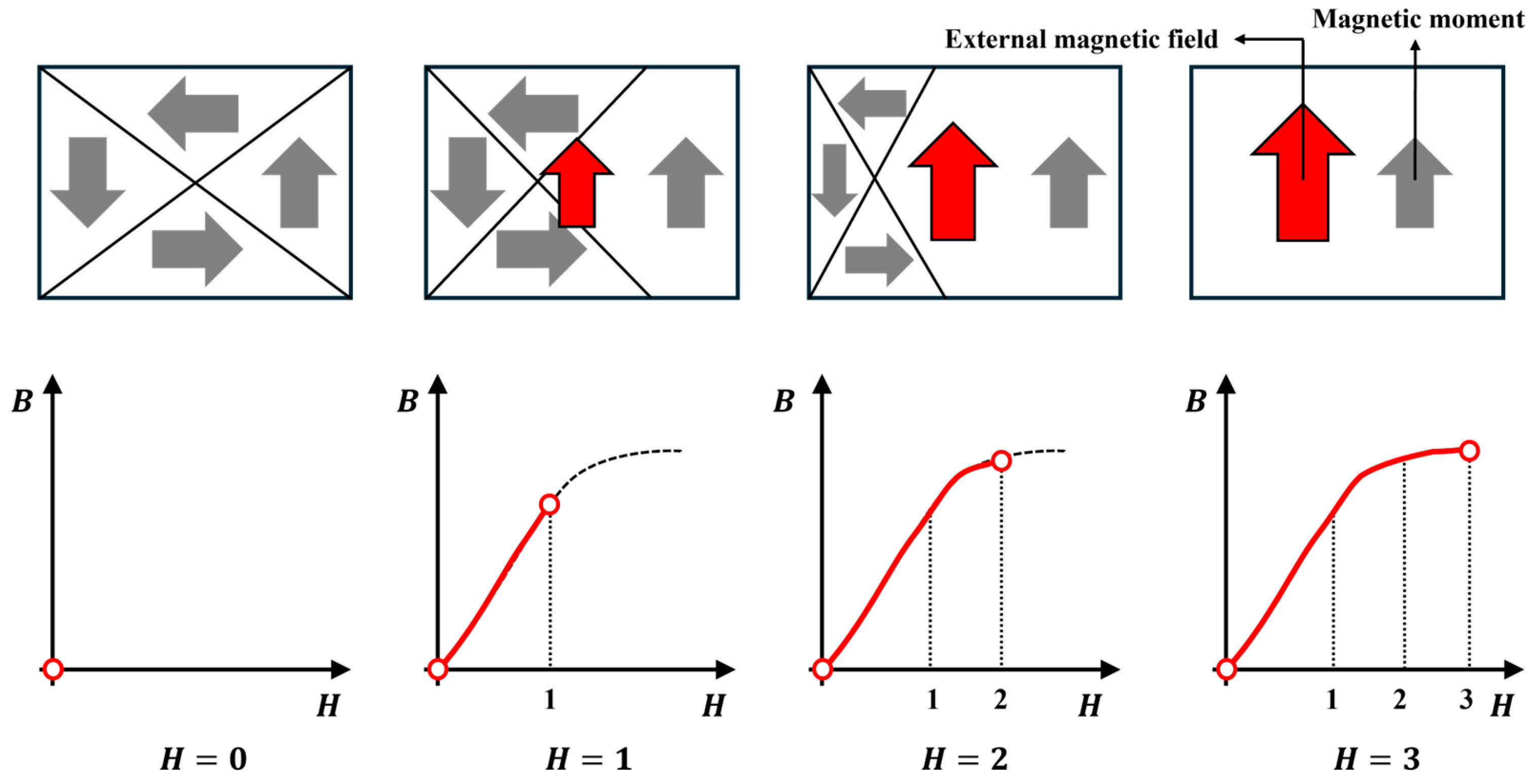
In Equation (1), J represents magnetic polarization, μ 0 is the permeability of free space, χ denotes the magnetic susceptibility, and H is the magnetic field. From this relationship, Equation (2) expresses the magnetic flux density, which indicates that an external magnetic field must be applied for magnetic flux to be established inside an unmagnetized permanent magnet [12]. Figure 2 illustrates the formation process of the initial magnetization curve when an external magnetic field is applied to an unmagnetized permanent magnet. First, when the external magnetic field H = 0 , the magnetic moments inside the magnet are randomly oriented, forming magnetic domains in arbitrary directions. Second, as the H value increases, the magnetic moments within the magnet gradually align in the same direction, leading to an increase in the magnetic flux density B . Finally, when H becomes sufficiently large, B no longer increases, and the magnetic flux reaches saturation. At this point, all internal magnetic moments are aligned with the direction of the external magnetic field, and this state is defined as the fully magnetized condition of the permanent magnet.

3.2. Principle of Demagnetization

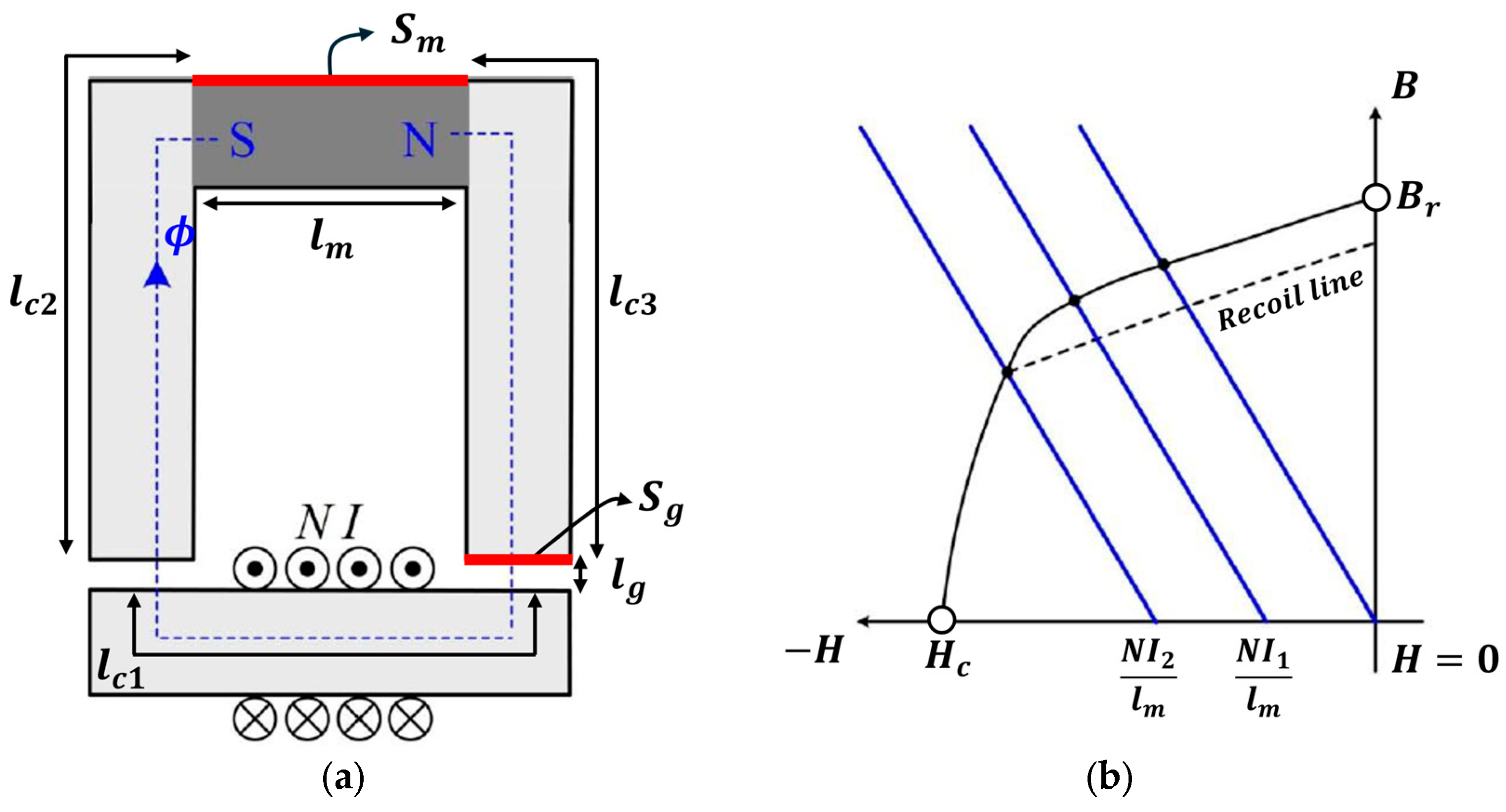
The phenomenon in which a permanent magnet loses its intrinsic magnetic properties is called demagnetization, while the weakening of the magnetic flux produced by the magnet is referred to as magnetic flux reduction. Flux reduction can be classified into reversible demagnetization, which occurs temporarily due to a change in the operating point, and irreversible demagnetization, which occurs permanently when the inherent properties of the magnet are altered [17]. Although irreversible demagnetization can be caused by various factors, in this study, it is defined as the case where a reverse magnetic field is generated in a magnetic circuit having a constant permeance line, opposite to the direction of the magnet’s magnetomotive force (MMF). This reverse field shifts the permeance line, causing the operating point to drop below the knee point on the B-H curve, which is the criterion for irreversible demagnetization. Figure 3 illustrates a conceptual diagram of the magnetic circuit and the knee point on the B-H curve. As shown in Figure 3a, assuming that the magnetic flux passing through the permanent magnet follows the blue path in the magnetic circuit model, Ampere’s circuital law can be applied to derive Equation (3).
H · d l = H m l m + H c 1 l c 1 + H c 2 l c 2 + H c 3 l c 3 + 2 H g l g = 0     [ A ]
Here, H m , H c 1 , H c 2 , H c 3 , and H g represent the magnetic field intensity inside the permanent magnet, the core, and the air gap, respectively. Similarly, l m , l c 1 , l c 2 , l c 3 , and l g denote the lengths of the permanent magnet, the core, and the air gap, respectively.
H   m l m 2 H g l g     [ A ]
  B g = S m S g B m     [ T ]
Here, S m and S g denote the cross-sectional areas of the permanent magnet and the air gap, respectively, and B g and B m represent the magnetic flux densities in the air gap and the permanent magnet. Since the magnetic circuit model in Figure 3a includes a coil winding, the equation can be expressed to include the MMF as follows:
H m l m + N I =   2 H g l g     [ A ]
Here, N I represents the MMF generated by the coil. Using Equations (5) and (6), the relationship between H m and B m can be expressed as follows:
H m + N I l m =   2 B m μ 0 S m S g l g l m [ A / m ]
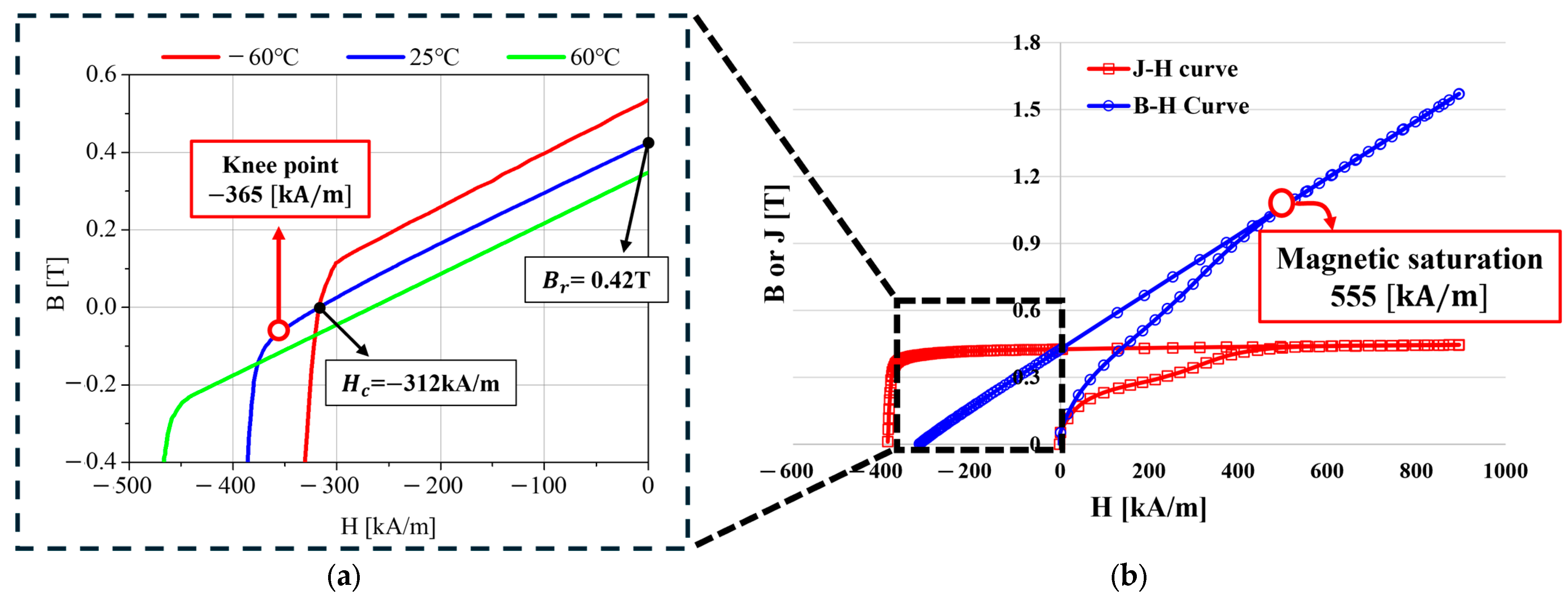
In Figure 3b, the blue line represents the B - H curves with a constant permeance line, where B r denotes the remanent flux density and H c represents the coercive field. As shown in Figure 3a, when current flows in a direction opposite to the inherent MMF of the permanent magnet within the magnetic circuit, a reverse magnetic field is generated, acting in opposition to the magnet’s original magnetization direction. This reverse field shifts the permeance line in Figure 3b, causing the operating point to move downward and potentially fall below the knee point. As shown in Figure 3b, when the reverse magnetic field is H = 0 or H = N I 1 l m , the magnetization inside the permanent magnet remains within a reversible range, and irreversible demagnetization does not occur. However, when the reverse magnetic field reaches H = N I 2 l m , the operating point moves below the knee point, leading to a permanent reduction in magnetic flux—that is, irreversible demagnetization. At this point, the residual flux density is formed along the recoil line, resulting in a decrease in the overall magnetic flux strength of the permanent magnet.

4. Post-Assembly Magnetization Analysis Setup

4.1. Magnetizing System Configuration

4.1.1. Magnetizer Specifications and Electrical Characteristics

In this study, a post-assembly magnetization method was applied, targeting a fully assembled rotor. Before performing the magnetization analysis, the specifications of the magnetizer and winding conditions were first defined. As mentioned earlier, in the post-assembly magnetization method, the magnetizing system typically uses a capacitor-discharge-type voltage source. The operational relationship of the electrical circuit that constitutes the magnetizing system can be expressed by the following equation [12]:
i p e a k =   V c ω L c · e t τ · ω τ 1 + ω τ 2
τ = 2 L c R c ,     ω = 1 L c C 1 τ 2
i p e a k = U C · C L c  
Here, i p e a k denotes the peak magnetizing current, ω denotes the electrical angular frequency, L c denotes the inductance of the magnetizing coil, V c denotes the initial charging voltage of the capacitor, τ denotes the time constant, R c denotes the resistance of the magnetizing coil, and U C denotes the capacitor load (applied) voltage. Equation (8) represents the peak discharge current considering the damping factor, and by applying Equation (9), the maximum peak current produced by the applied voltage from the idealized magnetization power source—derived from the fundamental LC relationship—can be expressed as in Equation (10). The peak current is proportional to the capacitor voltage and capacitance, but inversely proportional to the inductance of the magnetizing coil. From these relationships, the maximum peak magnetizing current for the magnetizing yoke and rotor can be derived. To fully magnetize a permanent magnet and maintain its magnetic stability, a strong external magnetic field is required. Therefore, a capacitor-discharge pulse magnetizer is typically used, which generates a large magnetic field by applying a momentary high current [13]. The main specifications of the magnetizer are the magnetizing voltage and capacitor capacitance. In this study, the magnetizing voltage was set to 3500 V, and the capacitance to 3000 µF. Subsequently, the peak magnetizing current generated from the magnetizer was applied to the coil to perform the magnetization analysis.

4.1.2. Magnetic Properties of Ferrite Magnet

For magnetization analysis, it is necessary to obtain the initial magnetization curve of the ferrite material. Figure 4 shows the B - H curve of the ferrite magnet (SSM-K10iH). Figure 4b presents the initial magnetization curves of both B - H and J - H , where the slope of the initial B - H curve represents the magnetic permeability. When the relative permeability, defined as the ratio of the magnet’s permeability to that of air, reaches approximately 1.05 (555 kA/m)—a value similar to that of the air gap—the magnetic moments inside the permanent magnet are considered fully aligned, indicating that magnetization is complete. Meanwhile, Figure 4a presents the second- and third-quadrant B - H curves incorporating the temperature-dependent magnetic properties of the ferrite magnet, in order to evaluate the behavior of the untargeted magnets during the subsequent segmented magnetization process. The ferrite magnets used in this study exhibit thermal characteristics that differ from those of NdFeB or SmCo magnets. In particular, the temperature coefficient of remanence ( B r ) is approximately −0.20%/°C, while the temperature coefficient of coercivity ( H c ) is about +0.25%/°C.
This means that B r decreases with increasing temperature, whereas H c increases, indicating that ferrite magnets maintain relatively stable coercivity even in elevated-temperature environments. Based on these characteristics, the segmented magnetization analysis in this work was performed using the knee point at 25 °C as the reference operating point. At room temperature, the knee point of the ferrite magnet appears in the third quadrant, and irreversible demagnetization occurs when the operating point shifts below approximately −365 kA/m due to a strong reverse magnetic field.

5. Basic Design of Post-Assembly Magnetizing Yoke

5.1. FEA Results of Post-Assembly Segmented Magnetization Analysis

5.1.1. Modeling of the Magnetizing Yoke

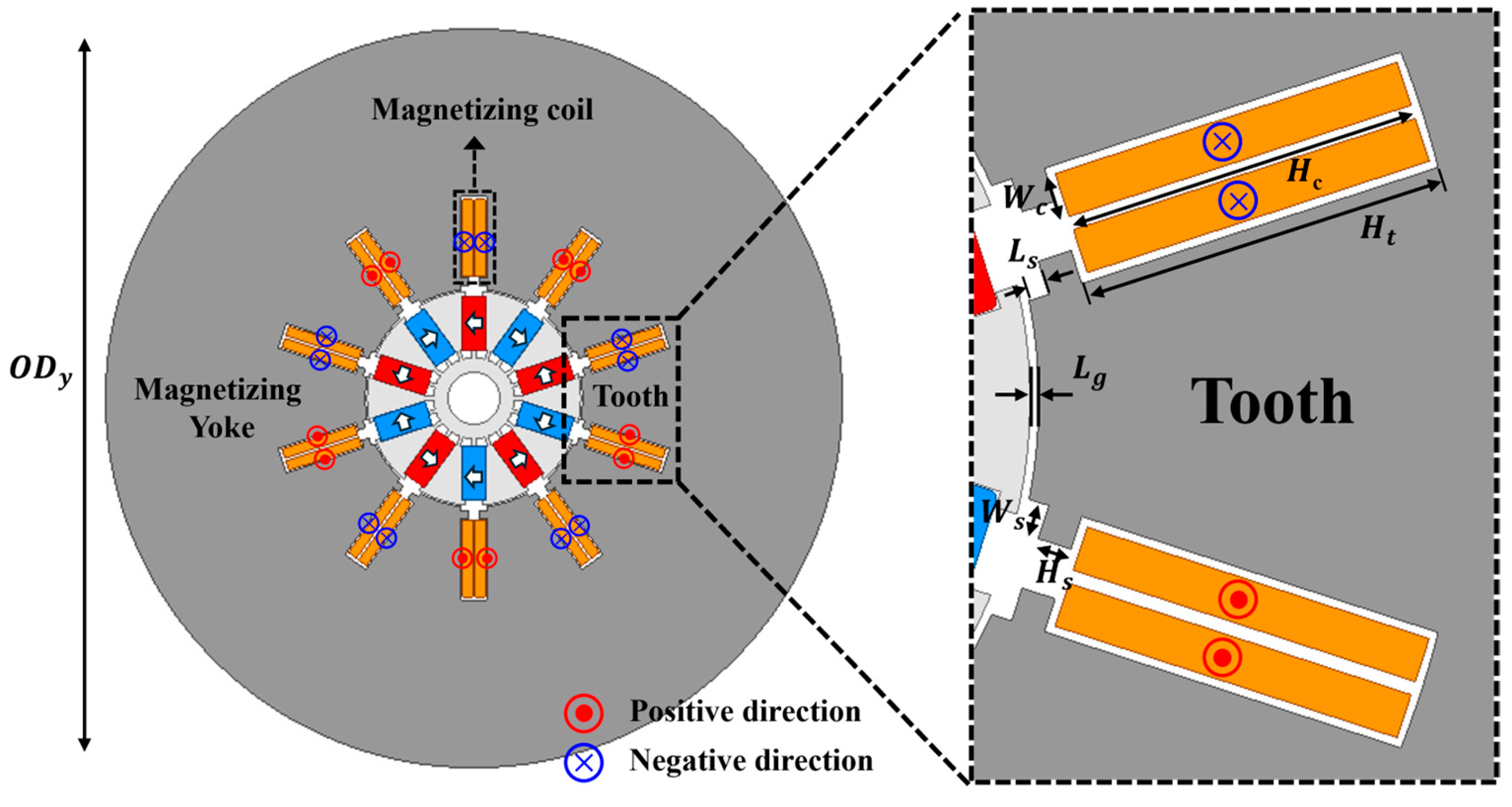
Figure 5 shows the modeling structure of the magnetizing yoke designed for the post-assembly magnetization of a 10-pole spoke-type rotor.
The magnetizing yoke is symmetrically arranged around each rotor pole to ensure a uniform magnetic field distribution during the magnetization process. Each yoke tooth is wound in series with a single-layer concentrated winding, where the coil directions are indicated as positive (red) and negative (blue). When the discharge peak current is applied to these coils, a magnetic field is generated toward the ferrite permanent magnets inserted inside the rotor. As shown on the right side of Figure 5, the geometry of the magnetizing yoke is defined by several key design parameters—such as the air gap length ( L g ) between the yoke and the rotor, yoke outer diameter ( O D y ), shoe width ( W s ), shoe height ( H s ), yoke tooth height ( H t ), coil width ( W c ), and coil height ( H c ). These parameters directly influence the magnetic flux path and saturation characteristics within the yoke [13]. The L g parameter represents the mechanical air gap between the rotor and the stator, and it was set to a minimum thickness of 0.5 mm in consideration of manufacturability and mass production. The slot, which provides space for the magnetizing coil winding, was designed considering the outer diameter of the wire and the insulation thickness, determining the H t accordingly. Meanwhile, the H s and W s were designed with the minimum dimensions required to support the winding mechanically. In addition, the shoe length ( L s ) was determined to maintain structural rigidity of the shoe while keeping a proper distance between the winding and the rotor. The yoke material was modeled with high magnetic permeability to minimize magnetic flux leakage and prevent saturation, ensuring sufficient cross-sectional area. Adequate coil space and structural symmetry were maintained to distribute the magnetic field evenly. Since a large peak current flows instantaneously during magnetization, the coil was designed as a single-layer structure to prevent Lorentz force-induced deformation between windings. The structure was designed to produce a uniform magnetic field across all poles, which plays a key role in ensuring that each permanent magnet is magnetized uniformly. Based on this model, magnetization analysis was performed according to the number of segmented magnetization steps.

5.1.2. Simulation Verification

All magnetization analyses conducted in this study were performed using the nonlinear finite-element environment of ANSYS Maxwell (2025 R2). The FEA-based magnetization procedure adopted here follows standard methodologies widely used in industry, and multiple verification steps were implemented to ensure the reliability of the numerical results. To accurately capture the highly concentrated magnetic flux regions, a locally refined mesh was applied to the air gap, magnetizing yoke, and permanent magnets.
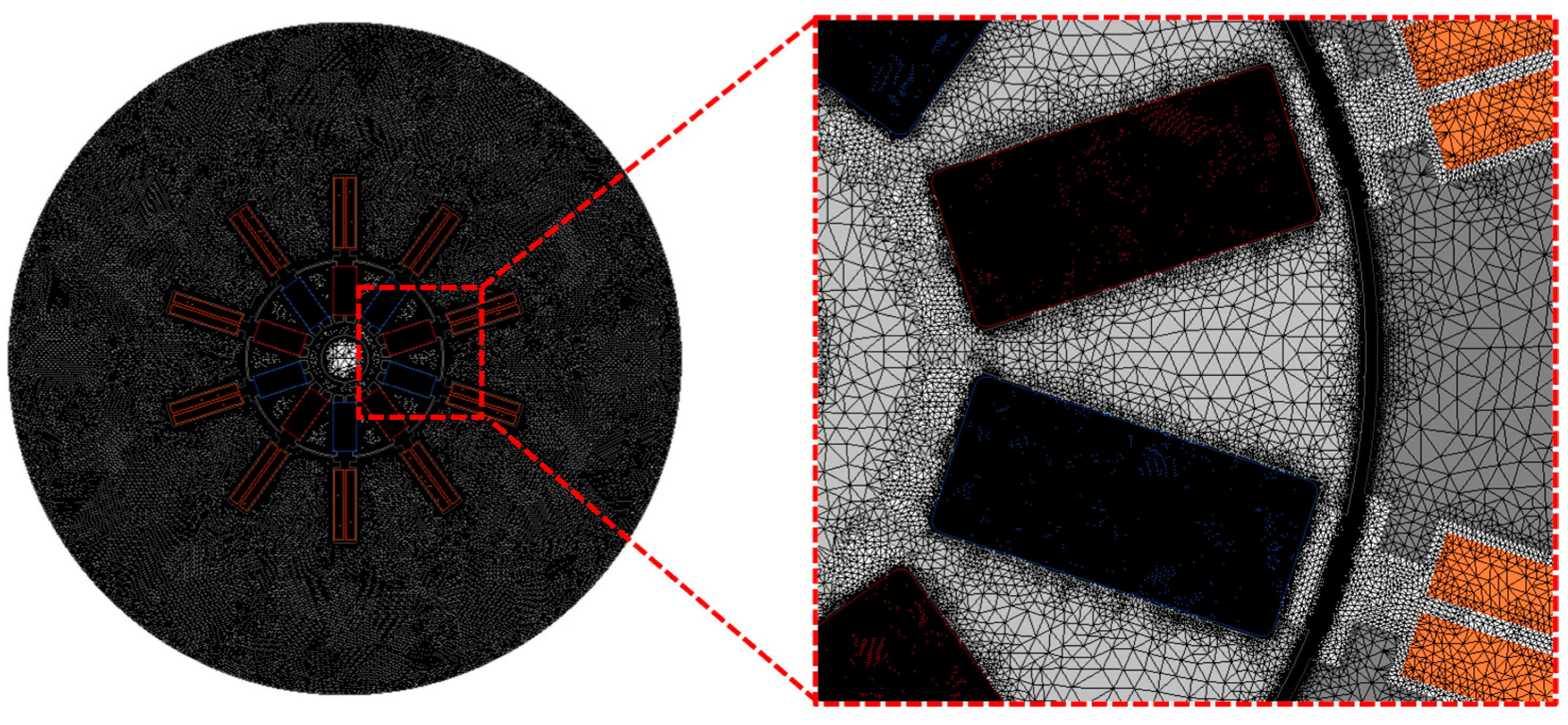
The mesh size was set to 0.1 mm for the air gap between the rotor and the magnetizing yoke, 2 mm for both the yoke and rotor core, 4 mm for the coil region, and 0.1 mm for the permanent magnets, allowing precise computation of detailed flux distributions. Depending on the geometric configuration, the total number of mesh elements varied slightly but was approximately 850,000. The magnetic scalar potential boundary condition was used to appropriately implement an open-boundary field environment. The analyses were performed using a 2D static magnetic solver, which enables significantly faster computation compared with 3D analysis while maintaining high mesh resolution and supporting efficient iterative evaluation. Depending on the mesh density, each simulation converged within approximately 15 min. Through the use of high-resolution meshing, nonlinear material modeling, and validated boundary conditions, the numerical validity and reliability of the FEA model have been sufficiently ensured, even in the absence of a physical prototype. The geometry of the magnetizing yoke and the mesh distribution applied in this study are presented in Figure 6.

5.1.3. FEA Results of Basic Post-Assembly Segmented Magnetization Analysis

In a spoke-type structure, when the magnetizing current flows and the magnetic field is applied to the permanent magnets inside the rotor, the magnetic flux is divided into two separate paths, making it difficult to achieve complete magnetization in a single process. In particular, as the number of poles increases, the core saturation becomes more severe, resulting in a further decrease in magnetization rate [12].
P o s t a s s e m b l y   m a g n e t i z a t i o n   r a t e = 1 E o E m E o × 100  
I r r e v e r s i b l e   d e m a g n e t i z a t i o n   r a t e = E o E d E o × 100
Here, E o represents the original back-EMF, E m represents the post-assembly magnetized back-EMF, and E d represents the irreversibly demagnetized back-EMF. Accordingly, Equation (11) defines the post-assembly magnetization rate, and Equation (12) defines the irreversible demagnetization rate. To address the aforementioned issues, this study applied a post-assembly segmented magnetization method.
This approach improves magnetic flux concentration by increasing the number of magnetization steps; however, excessive magnetization cycles may lead to reduced productivity and a shortened magnetizer lifespan, requiring careful consideration during design. Furthermore, during segmented magnetization, untargeted magnets may experience local irreversible demagnetization due to the reverse magnetic field, making countermeasures essential. In this study, the magnets directly facing the active magnetizing yoke during a given segmented operation are referred to as the target magnet, while the remaining magnets are untargeted magnet. Additionally, the wire diameter and slot area are crucial design factors that influence both magnetization efficiency and thermal stability. In this paper, for a 10-pole rotor, the copper wire diameter was set to 1.8 mm, and the overall winding diameter, including dual insulation coating, was 2.6 mm, as shown in Table 2. To ensure long-term reliability of the magnetizer, the maximum allowable peak current applied to the magnetizing yoke was limited to approximately 14,000 A. This corresponds to about 60% of the magnetizer’s maximum rated output. Finally, the target magnetization rate of the target magnets was set to above 99%, while the irreversible demagnetization rate of the untargeted magnets was aimed at 0%.
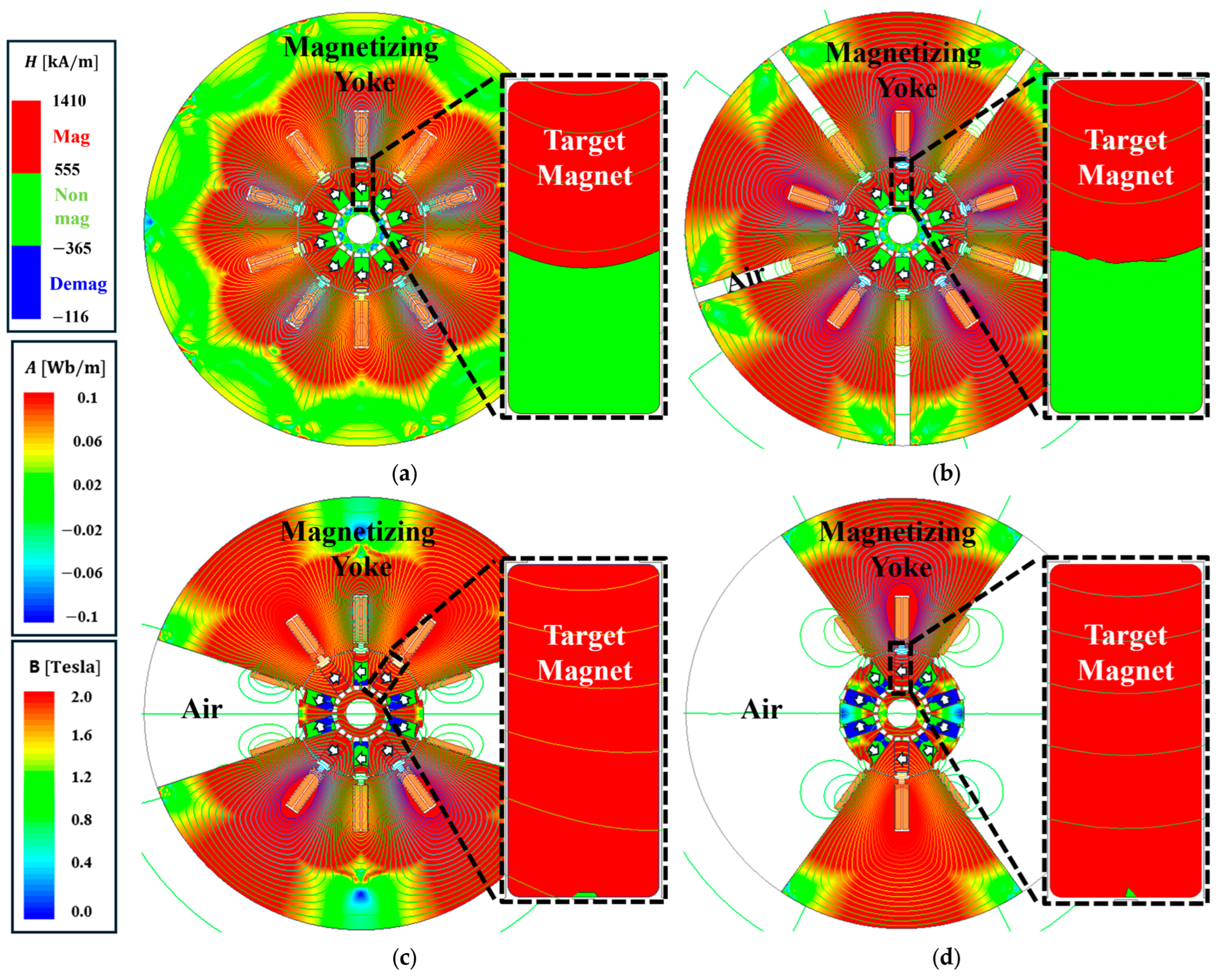
Figure 7 shows the comparison results of magnetization and demagnetization characteristics for the basic magnetizing yoke model according to the number of post-assembly segmented magnetizations (one, two, three, and five times) for a 10-pole rotor. Here, one-time, two-time, three-time, and five-time magnetizations indicate the number of divided magnetization operations applied to the rotor. For example, in the case of three magnetization steps, the rotor is first inserted into the three-division magnetizing yoke to perform the initial magnetization. The rotor is then realigned to the position of the remaining unmagnetized permanent magnets (untargeted magnets) for the second magnetization. Finally, the rotor is aligned once more with the last untargeted magnet to carry out the third and final magnetization. When a yoke configuration with a larger number of divided magnetization steps is used, the flux path becomes more efficient and relatively shorter, resulting in a higher flux density under the same MMF. Consequently, deeper magnetic flux penetration into the target magnets is achieved, thereby improving the overall magnetization ratio. The 10-time case was excluded, considering mass production efficiency and magnetizer lifespan. In all cases, the magnetizing coil had eight turns, and the peak applied current was 13,400 A, corresponding to the same MMF of 107,200 AT. In Figure 7, the first plot on the left visualizes the magnetic field distribution using color, where the red regions indicate magnetized areas, the green regions represent unmagnetized areas, and the blue regions denote irreversibly demagnetized regions. This plot is used to distinguish magnetized and demagnetized states based on the color of the permanent magnets during the magnetization analysis. The second plot illustrates the magnetic flux lines, with the legend range set from −0.1 to 0.1. The third plot displays the flux density distribution, and since saturation occurs when the flux density exceeds approximately 2 T for the 50PN470 steel, the legend range is set from 0 to 2 T. These plotting configurations are applied consistently across all simulation results presented in this study. As shown in Figure 7a,b, both the one-time- and two-time-segmented magnetization failed to achieve the target magnetization rate. Conversely, Figure 7c,d, representing the three-time and five-time-segmented magnetizations, shows that they achieved over 99% magnetization rates in the target magnets, demonstrating superior magnetization characteristics. This improvement occurs because the magnetizing flux path becomes shorter as the yoke geometry changes, leading to a higher flux density under the same MMF. However, incomplete magnetization was observed in the lower central region of the magnets. This is attributed to the magnets being deeply embedded in the rotor, where the cross-sectional area decreases toward the inner core, causing severe magnetic saturation. As a result, the magnetizing flux fails to sufficiently penetrate the inner regions, leaving unmagnetized areas as shown in Figure 7a,b. Additionally, local irreversible demagnetization was observed in the untargeted magnets during segmented magnetization. To mitigate this issue, this study further conducted a magnetization analysis, applying the auxiliary pole (AP) concept, focusing primarily on the three-time-segmented magnetization, which exhibited satisfactory magnetization performance in the target magnets.

6. Post-Assembly 3-Time Magnetization Analysis

6.1. Structure and Principle of Auxiliary Pole

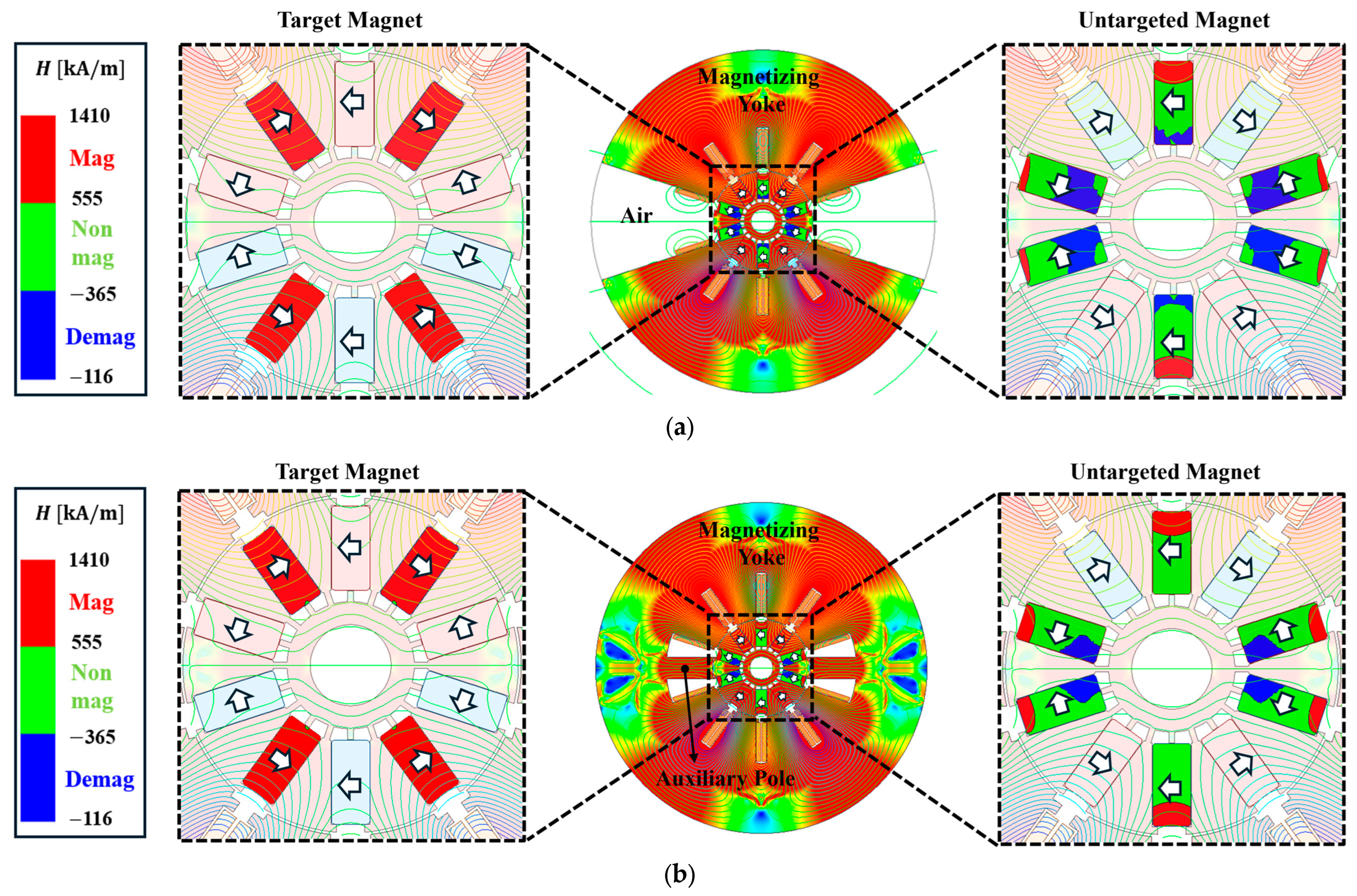
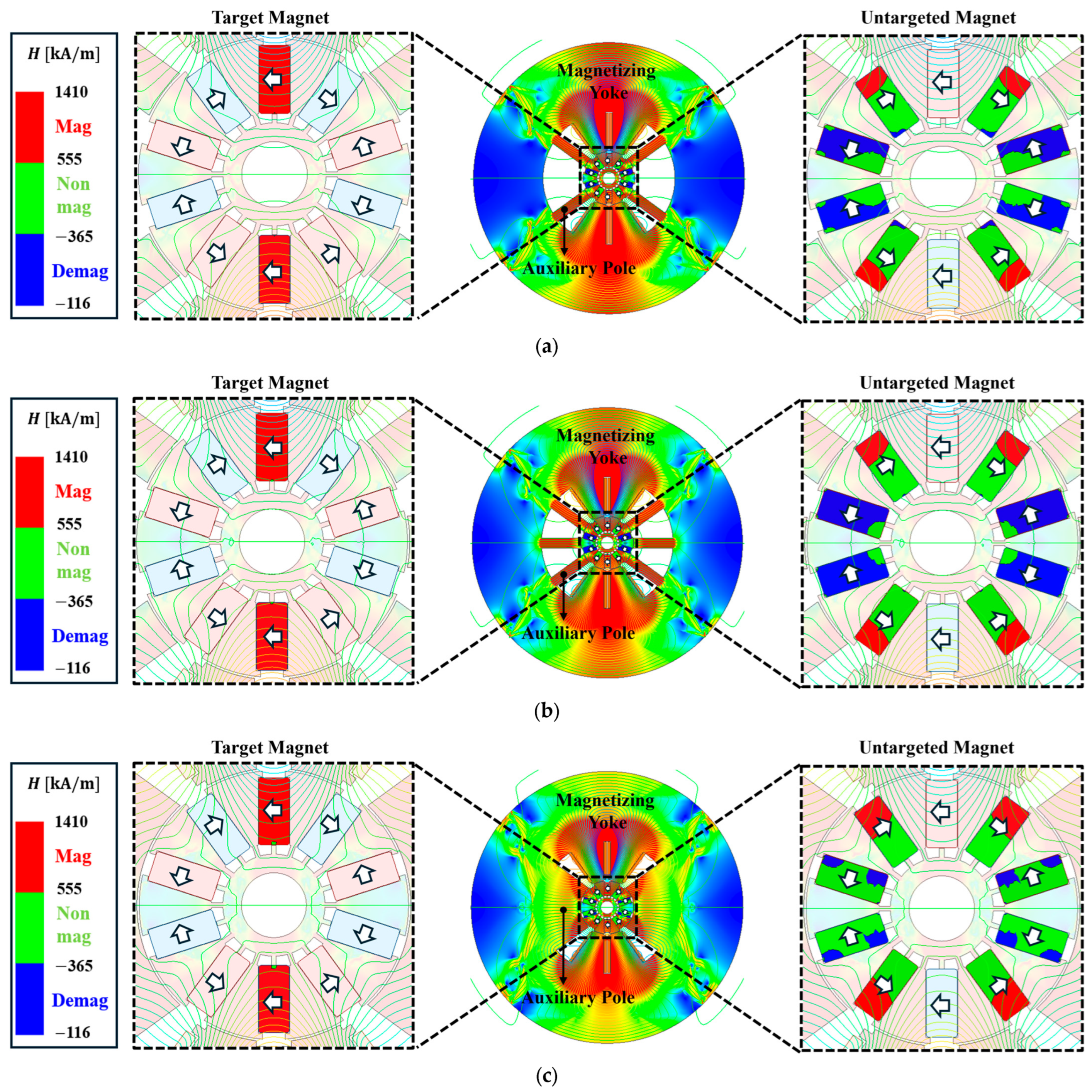
Figure 8 compares the magnetization analysis results between the conventional three-time-segmented magnetization model and the magnetizing yoke model equipped with an AP. As shown in Figure 8a, in the conventional model, the magnetic flux generated in the magnetizing yoke disperses into adjacent untargeted magnet regions. This dispersion produces a reverse magnetic field, leading to the formation of localized irreversible demagnetization zones (indicated in blue) inside the untargeted magnets. In contrast, in Figure 8b, the model with an AP has additional high-permeability iron cores attached to both sides of the magnetizing yoke. This configuration forms a new low-reluctance flux path, enabling better magnetic flux guidance. As a result, a portion of the magnetic flux directed toward the target magnet is redistributed, causing a slight reduction in the magnetization rate of the target magnet. However, the magnetic flux in the untargeted magnets flows in the same direction as the magnet’s orientation, effectively suppressing the reverse magnetic field. In summary, the model with an AP exhibits a trade-off characteristic—while the target magnet’s magnetization rate decreases slightly, the irreversible demagnetization region in the untargeted magnet is significantly reduced [12].
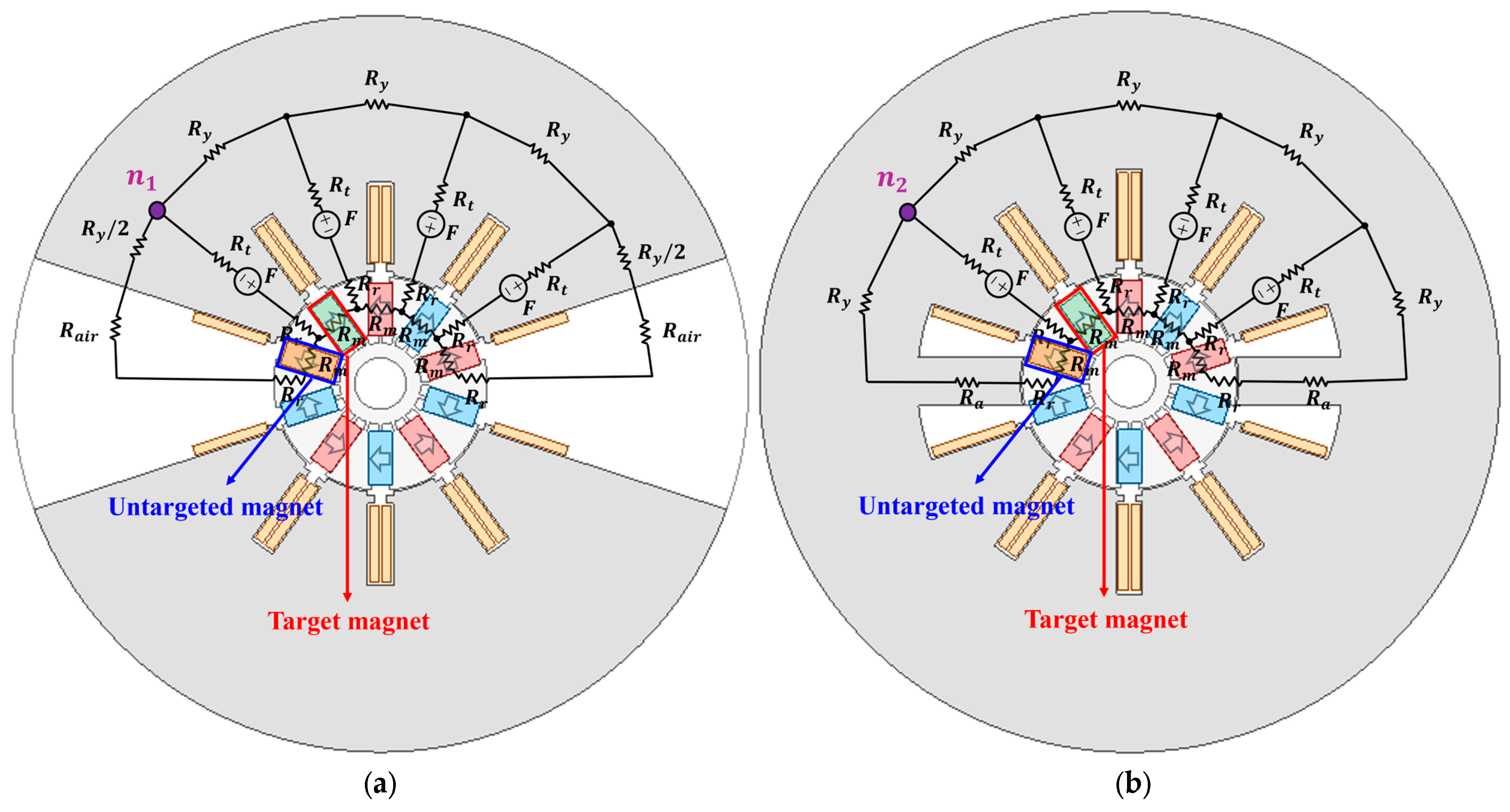
Therefore, a balanced design that simultaneously considers both the post-assembly magnetization rate and the irreversible demagnetization rate is essential. In the post-assembly magnetization process, achieving a high magnetization rate while suppressing irreversible demagnetization in untargeted magnets is a key challenge. In this study, an AP was introduced to address this issue, resulting in a significant reduction in demagnetization in the untargeted magnets. To better understand this mechanism, the magnetic flux distribution was analyzed and compared using a Magnetic Equivalent Circuit (MEC) model [12]. The MEC analysis is employed to interpret the flux distribution trends observed in the FEA results. While the FEA quantifies the magnetization and demagnetization behavior numerically, the MEC clarifies the underlying reluctance-based flux paths and explains why auxiliary poles influence compensating flux. Figure 9 illustrates the MEC configurations of both the conventional magnetizing yoke model and the AP applied model under three-time-segmented magnetization conditions. In Figure 9a, the conventional model includes air gaps with low magnetic permeability between the divided sections of the yoke, causing the magnetic flux to concentrate in alternative paths. In contrast, Figure 9b shows the AP applied model, in which the divided sections are continuously connected by iron cores, and APs are added at both ends of the yoke to enhance the magnetic flux path. This structural difference directly affects the strength and distribution of the magnetizing flux, leading to distinct behaviors in target magnet magnetization improvement and untargeted magnet demagnetization suppression.
ϕ r i g h t = ϕ t R l e f t R l e f t + R r i g h t     [ W b ] ,       ϕ r i g h t   R l e f t
ϕ l e f t = ϕ t R r i g h t R l e f t + R r i g h t     [ W b ] ,       ϕ l e f t   R r i g h t
ϕ t = ϕ l e f t + ϕ r i g h t     [ W b ]
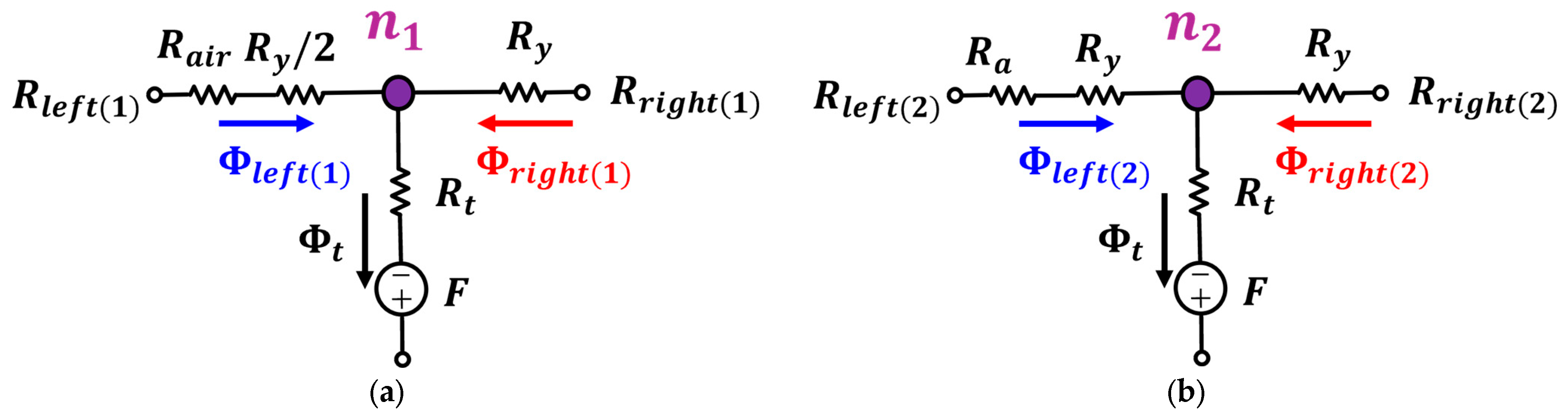
The parameters labeled in Figure 9 R t , R y , R a i r , R r , R m , and R a —represent the magnetic reluctances of the teeth, yoke, air, rotor, magnet, and AP, respectively. To clarify the flow of magnetic flux, a simplified MEC model based on nodes n 1 and n 2 is presented in Figure 10. Since the objective is to analyze the magnetic flux flow within the magnetizing yoke, the rotor’s magnetic equivalent circuit was excluded from the model. According to Kirchhoff’s law of magnetic flux, the flux generated in the teeth is the sum of the left and right flux paths converging at node n . In Figure 9, the red dotted box represents the target magnet, while the blue dotted box indicates the untargeted magnet. The right flux ( Φ r i g h t ) flowing along the right-hand path acts as the magnetizing flux, whereas the left flux ( Φ l e f t ) flowing along the left-hand path serves as the compensating flux, contributing to the suppression of irreversible demagnetization. Equation (13) expresses the right flux ( Φ r i g h t ), which is proportional to the left-path reluctance ( R l e f t ). Conversely, Equation (14) represents the left flux ( Φ l e f t ), which is proportional to the right-path reluctance ( R r i g h t ). Finally, Equation (15) defines the total flux through the tooth as the sum of the left and right fluxes, in accordance with Kirchhoff’s law. In Figure 10a,b, the magnetic reluctance equations for the left and right sides with respect to nodes n 1 and n 2 are expressed as follows:
R l e f t ( 1 ) =   R y 2 + R a i r =   l y 2 μ y S y + l a i r μ 0 S a i r     A / W b
R r i g h t ( 1 ) = R y = l y μ y S y     [ A / W b ]
R l e f t ( 2 ) = R y + R a = l y μ y S y + l a μ y S a     [ A / W b ]
R r i g h t ( 2 ) = R y = l y μ y S y     [ A / W b ]
Equations (16)–(19) represent the magnetic reluctances of the left and right paths shown in Figure 10. Here, l y , l a , S y , and S a denote the length and cross-sectional area of the yoke and AP, respectively, while μ y and μ 0 represent the permeability of the yoke and the permeability of free space (vacuum). In addition, l a i r and S a i r indicate the length and cross-sectional area of the air gap. Since the permeability of air is much smaller than that of yoke, the magnetic reluctance of air is significantly higher than that of yoke. When comparing based on the left-side reluctance, the relationship between the magnitudes of reluctance is R l e f t ( 1 ) > R l e f t ( 2 ) , while the right-side reluctance maintains R r i g h t ( 1 ) = R r i g h t ( 2 ) . Therefore, applying Equations (13)–(15), when the same magnetomotive-force-induced flux Φ t flows, the relationship between flux magnitudes is Φ l e f t ( 1 ) < Φ l e f t ( 2 ) and Φ r i g h t ( 1 ) > Φ l e f t ( 2 ) . As a result, applying an AP slightly decreases the magnetizing flux intensity but increases the compensating flux that suppresses irreversible demagnetization. Thus, as demonstrated by the magnetic equivalent circuit, the post-assembly magnetization rate of the target magnet slightly decreases, while the irreversible demagnetization rate of the untargeted magnet is significantly reduced, as shown in Figure 9.

6.2. 3-Time Magnetization Analysis with Applied Auxiliary Pole Winding

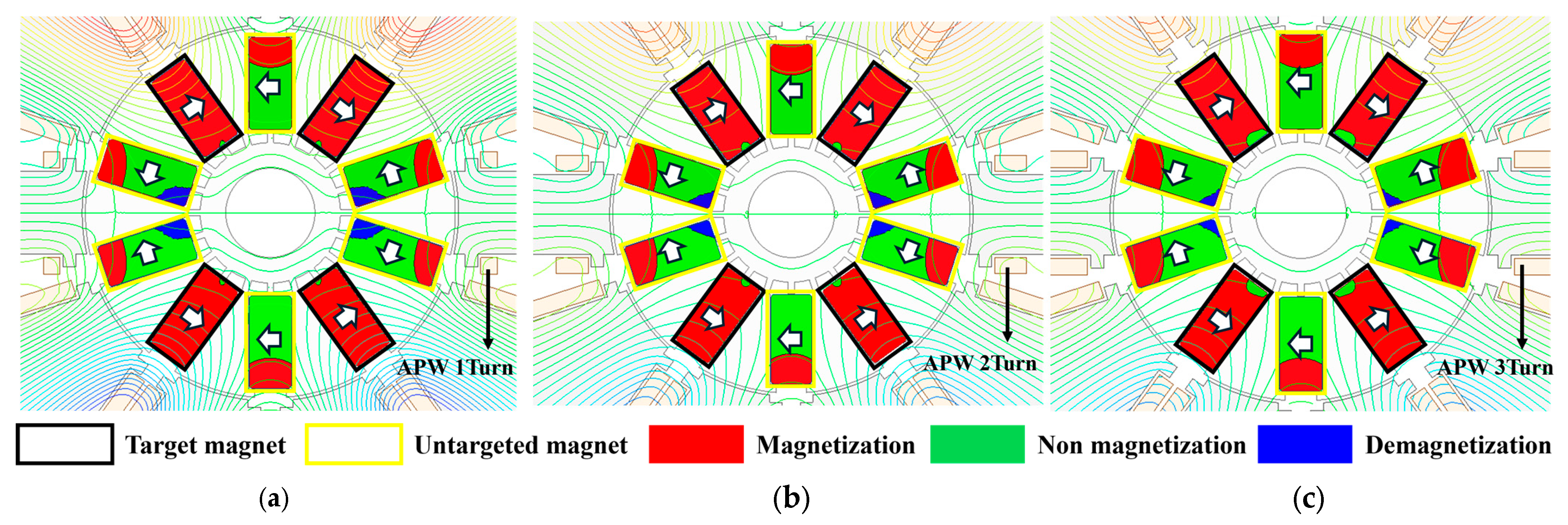
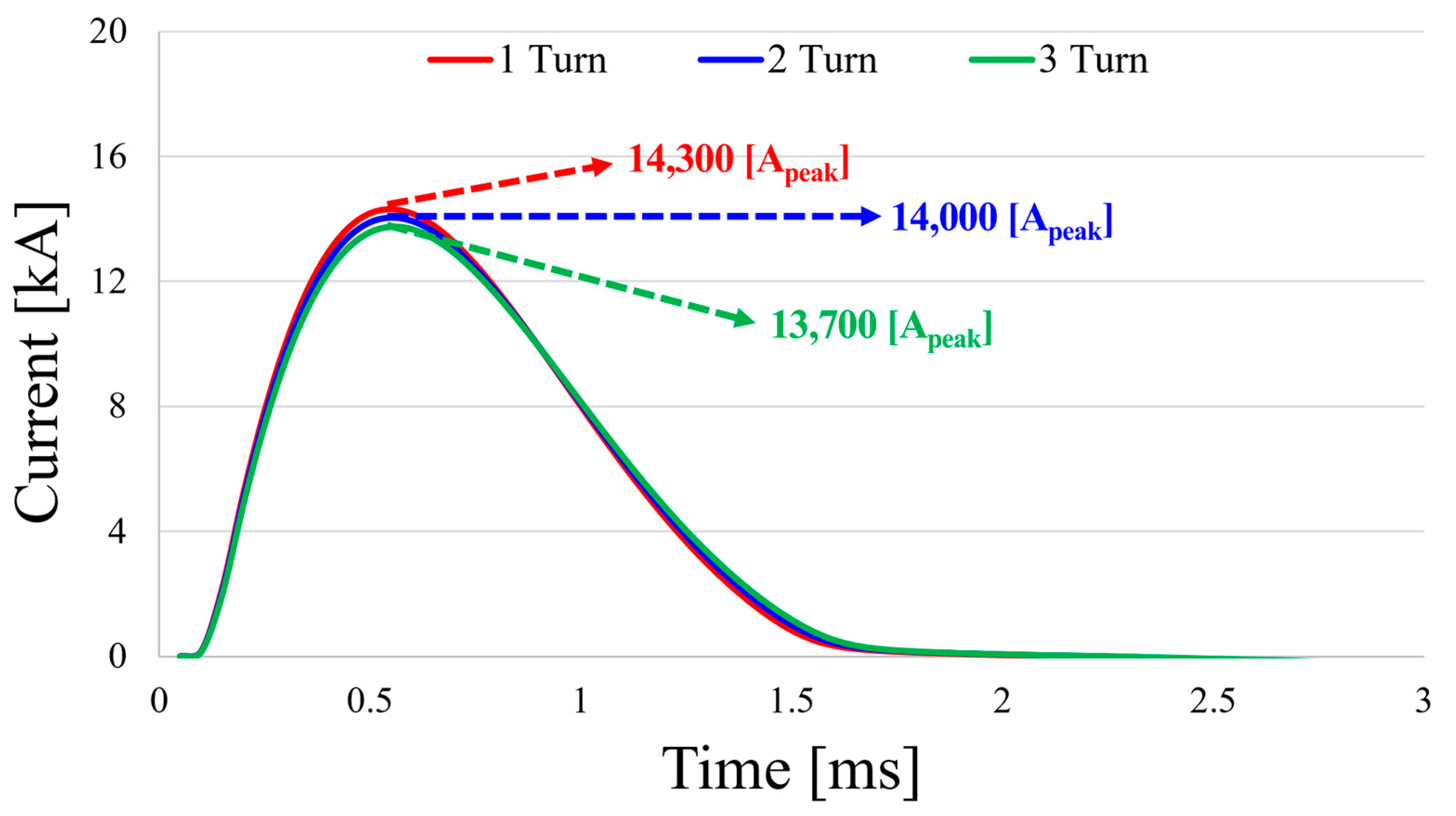
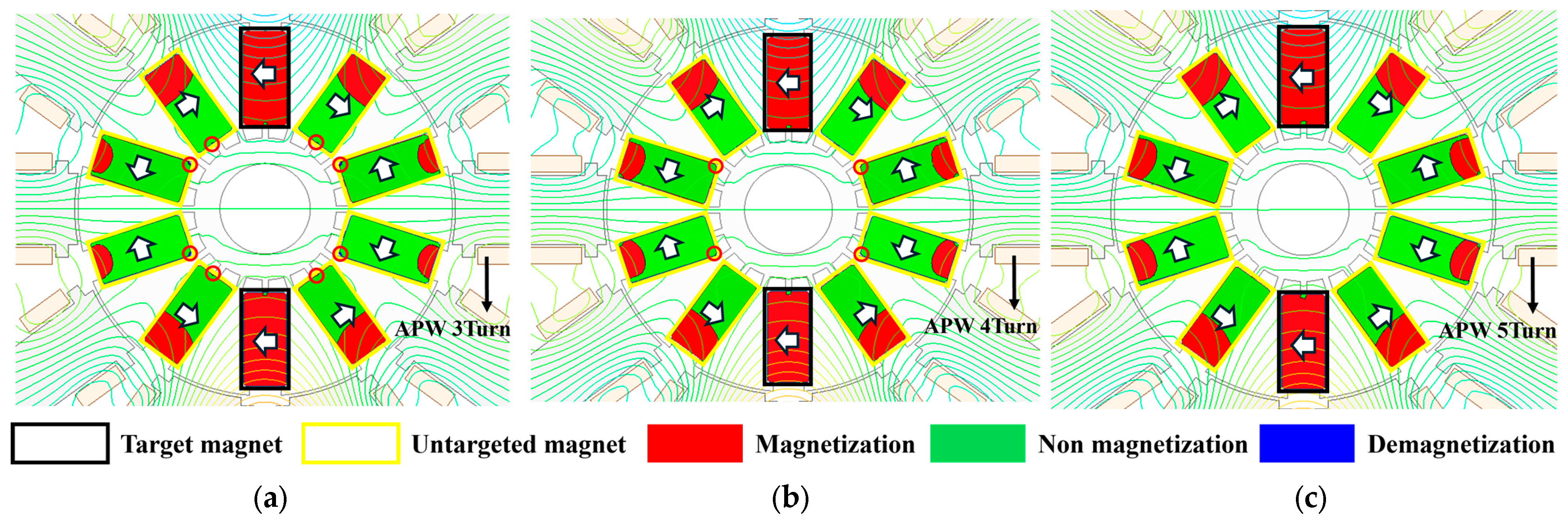
The results of magnetization analysis according to the number of turns in the auxiliary pole winding (APW) are presented in Figure 11 and Table 3. Figure 12 presents the magnetizing current waveforms according to the number of turns of the APW. In this study, a peak current waveform incorporating a 10% safety margin in winding resistance was applied, considering mechanical and thermal factors that may arise in a practical magnetizing structure. All magnetizing current analyses employed a non-periodic capacitor-discharge pulse, in which the transient current reaches its peak at approximately 0.55 ms and then decays exponentially over a tail duration of about 1.5–2.0 ms. The total pulse duration is approximately 3.0 ms. The APW is an additional structure introduced to suppress the reverse magnetic field generated in the untargeted magnets, and the MMF produced varies depending on the number of turns. This directly influences the effectiveness of compensating flux that counteracts the reverse field. The analysis results show that as the number of APW turns increases, the area of irreversible demagnetization within the untargeted magnets gradually decreases. This is because the larger number of turns enhances the MMF of the AP, thereby strengthening the compensating flux that offsets the reverse field. However, when the number of turns increased to three, part of the magnetic flux in the target magnets became dispersed, weakening the magnetizing flux intensity. Consequently, the post-assembly magnetization rate failed to meet the desired target, and some irreversible demagnetization regions still remained in the untargeted magnets.
Therefore, it was concluded that the magnetizing yoke under the three-time-segmented magnetization condition could not fully resolve the trade-off between magnetization rate and irreversible demagnetization rate. To address this, the five-time-segmented magnetization method is proposed to maintain the magnetization rate of the target magnets while effectively eliminating irreversible demagnetization in the untargeted magnets.

7. Proposed Model of Post-Assembly 5-Time Magnetization

7.1. Magnetization Analysis with Applied Auxiliary Pole

Based on the FEA results presented in Section 5.1.3 and Section 6.1, together with the derived MEC model, it was observed that as the number of segmented magnetization times increases, the reluctance of the effective flux path decreases relative to that of the ineffective path under the same MMF conditions.
Consequently, a higher magnetic flux can be delivered to the target magnet, leading to a monotonic increase in the magnetization rate. In the previous analysis using the three-time-segmented magnetizing yoke, neither the post-assembly magnetization rate of the target magnets nor the irreversible demagnetization rate of the untargeted magnets met the required performance. Therefore, in this study, a newly proposed five-time-segmented magnetizing yoke structure incorporating APs is introduced. Figure 13 shows three design variants (a), (b), and (c) of the proposed five-time-segmented magnetizing yoke. In this analysis, only the geometric effect of the auxiliary pole yoke was examined first, without applying any APW. When applying the five-time-segmented magnetization, the effective length of the magnetizing coil decreases, leading to a reduction in coil resistance. As a result, the magnetizing peak current increases and exceeds the allowable limit of 14,000 A. To maintain the peak current within the permissible range, the number of turns was increased accordingly. However, increasing the number of turns reduces the cross-sectional area of the back yoke, which in turn intensifies magnetic saturation and decreases the magnetization ratio. To mitigate this issue, the outer diameter of the magnetizing yoke was set to 300 mm in this study. The number of turns in the magnetizing coil was set to 15 turns, and the applied peak current was maintained at 13,700 A under identical conditions. The analysis results showed that, in all three designs, the target magnets achieved the desired magnetization rate; however, irreversible demagnetization regions still remained within the untargeted magnets. This is attributed to the fact that the auxiliary pole yoke alone cannot generate sufficient compensating magnetic flux to completely counteract the reverse magnetic field. In particular, for the configuration shown in Figure 13c, since the structure of the magnetizing yoke includes magnets with different orientation directions, the addition of APWs is unlikely to produce a noticeable reduction in irreversible demagnetization. Therefore, this study focuses on the magnetizing yoke structures shown in Figure 13a,b, where APWs are added to counteract the reverse field and enhance the compensating magnetic flux intensity through further magnetization analysis.

7.2. Magnetization Analysis with Applied Auxiliary Pole Winding

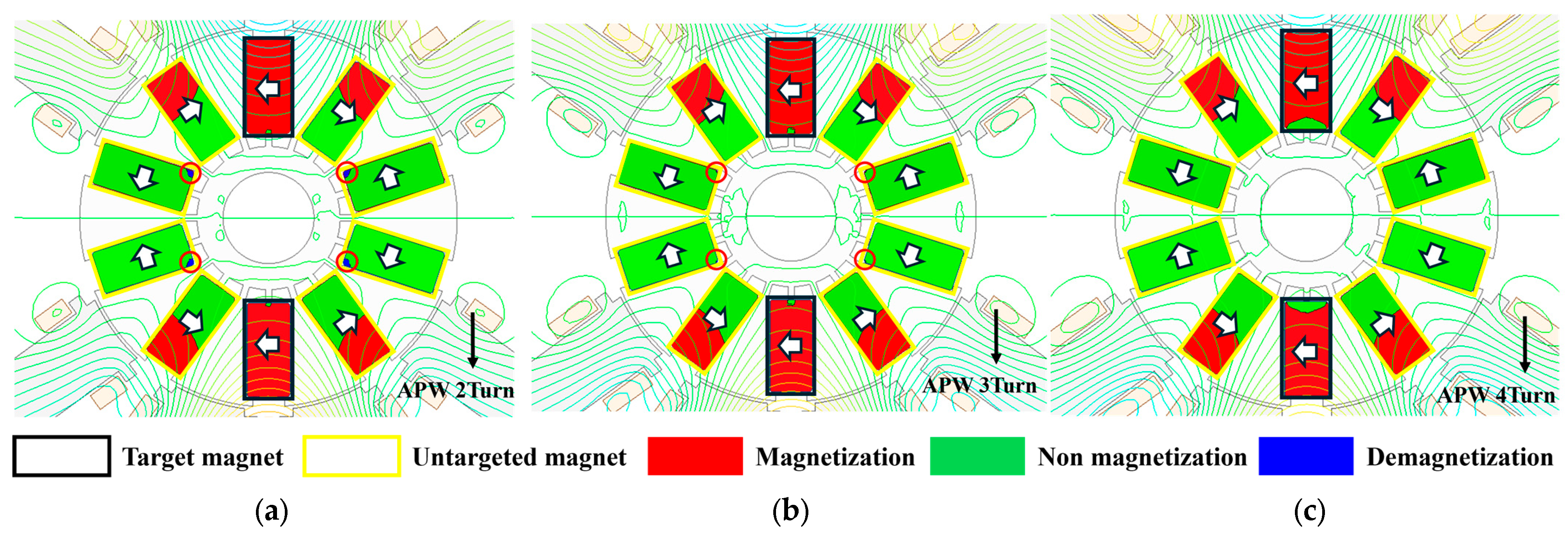
Figure 14 and Table 4 show the results of magnetization analysis when the APW was applied to the Design 1 magnetizing yoke. The magnetizing turns were evaluated based on 15 turns. As the number of turns in the APW increases, the overall resistance of the magnetizing yoke also increases, resulting in a gradual decrease in the maximum applied peak current. Consequently, the magnetizing flux density in the target magnets becomes weaker, leading to a gradual reduction in the post-assembly magnetization rate, while in the untargeted magnets, the strength of the opposite magnetic field decreases, thereby reducing the irreversible demagnetization rate. The red circles marked in Figure 14a,b indicate the regions of irreversible demagnetization occurring within the untargeted magnets. It can be observed that these areas gradually diminish as the number of APW turns increases. However, in Figure 14c, where irreversible demagnetization is completely eliminated, the magnetization rate of the target magnets fails to reach the desired level. Accordingly, an additional magnetization analysis was conducted using the Design 2 magnetizing yoke, with the results presented in Figure 15 and Table 5. The magnetizing turns were evaluated based on 14 turns. Although Design 2 exhibited a similar overall trend to Design 1, the reinforced structure resulted in a more stable magnetic flux distribution between the target and untargeted magnets. In Figure 15a,b, some irreversible demagnetization still occurred in portions of the untargeted magnets; however, in Figure 15c, the irreversible demagnetization was completely removed, and the magnetization rate of the target magnets successfully reached the target value. Therefore, this study proposes the Design 2 magnetizing yoke with five turns of the APW as the optimal configuration.

7.3. Magnetization Analysis with Proposed Model

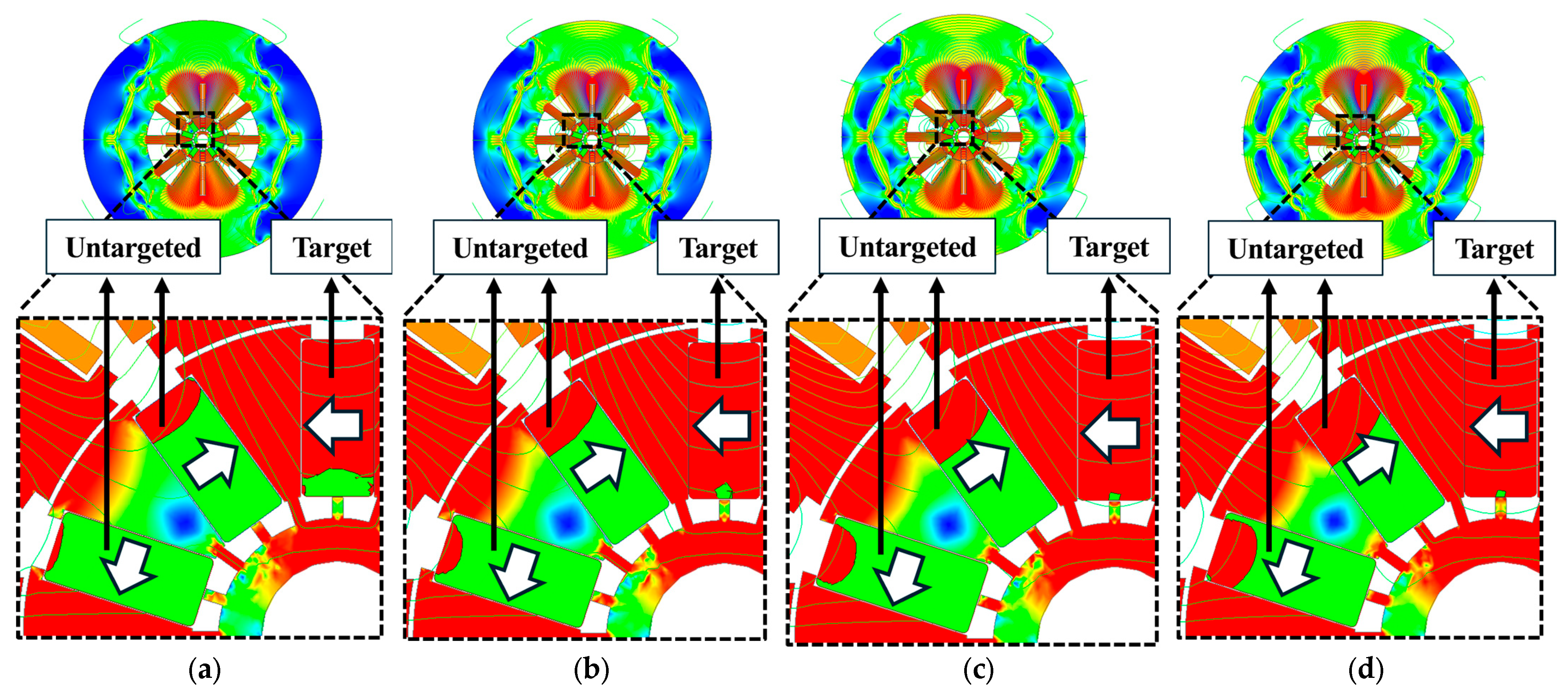
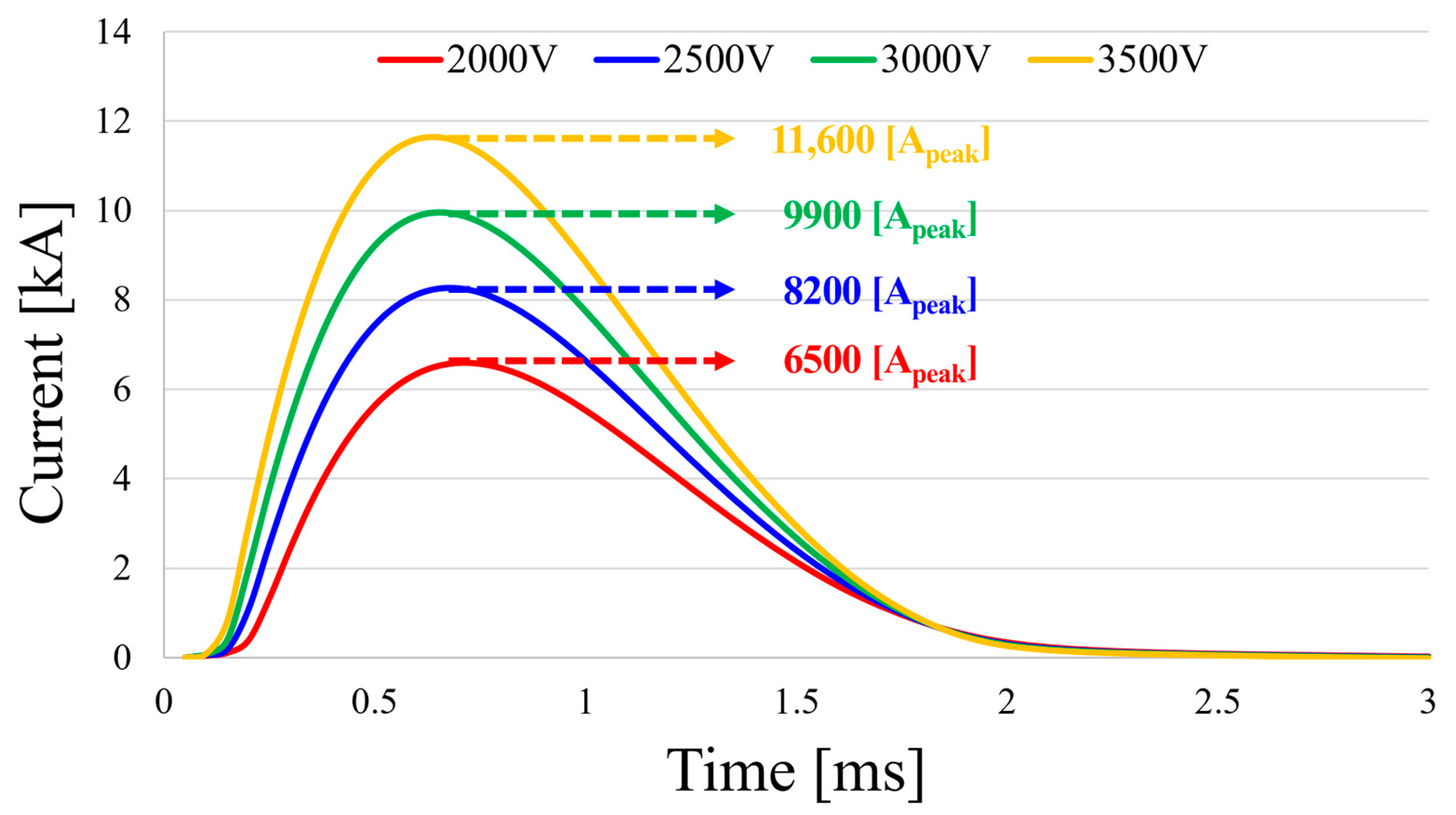
As summarized in Table 2, the maximum magnetizing voltage and capacitor specifications of the magnetizer used in this study are 3500 V and 3000 μF, respectively. In practical magnetization procedures, the applied voltage is incrementally increased from a lower level to verify magnetization performance; therefore, FEA-based magnetization analyses were conducted for the proposed model under applied voltages ranging from 2000 V to 3500 V. Figure 16 and Table 6 present the magnetization analysis results for each voltage condition. According to (10), the maximum magnetizing current decreases proportionally as the applied voltage decreases, which is consistent with the current profiles shown in Figure 17. When the maximum magnetizing current corresponding to each voltage level was applied, the magnetization ratio of the target magnet gradually increased with increasing voltage, while no irreversible demagnetization was observed in the untargeted magnets across all tested voltage levels.
Notably, the target magnet achieved the required magnetization ratio at voltage levels of 3000 V and above. Thus, it is not necessary to utilize the maximum rating of 3500 V, which can further contribute to minimizing the degradation and extending the operational life of the magnetizer.

8. Conclusions

This study focused on the design of a five-segment magnetizing yoke for a 10-pole spoke-type permanent magnet synchronous motor (PMSM) considering post-assembly magnetization. First, the characteristics of the magnetizing yoke were analyzed according to the number of magnetization divisions, and it was confirmed that the three-segment and five-segment magnetization methods were the most suitable. However, structural improvements were required to prevent irreversible demagnetization of the permanent magnets. To address this issue, an auxiliary pole and its winding were proposed to compensate for the reverse magnetic field generated during the magnetization process. Finite element analysis (FEA) confirmed that the proposed auxiliary pole and its winding effectively suppressed irreversible demagnetization within the untargeted magnets. However, in the case of the three-segment magnetizing yoke, both the magnetization rate of the target magnets and the irreversible demagnetization rate of the untargeted magnets failed to reach the desired targets. Accordingly, the five-segment magnetizing yoke was optimized in terms of auxiliary pole geometry and winding configuration. As a result, the final model completely eliminated irreversible demagnetization and achieved a post-assembly magnetization rate of 99.5% for the target magnets, validating the effectiveness of the proposed design. Since this study is an FEA-based design investigation conducted prior to prototype fabrication, experimental validation of the magnetization results will be carried out in subsequent research.

Author Contributions

Conceptualization, S.-H.L.; Methodology, S.-H.L. and W.-H.K.; Software, J.-H.K.; Validation, S.-H.L. and J.-H.K.; Formal analysis, J.-H.K.; Investigation, S.-H.L. and J.-H.K.; Resources, S.-H.L. and J.-H.K.; Data curation, J.-H.K.; Writing—original draft, S.-H.L. and J.-H.K.; Writing—review and editing, S.-H.L. and W.-H.K.; Visualization, W.-H.K.; Supervision, W.-H.K.; Project administration, W.-H.K.; Funding acquisition, W.-H.K. All authors have read and agreed to the published version of the manuscript.

Funding

This research was partly supported by the Korea Institute of Energy Technology Evaluation and Planning (KETEP) grant funded by the Korea government (Ministry of Trade, Industry & Energy, MOTIE)(20214000000060, Department of Next Generation Energy System Convergence based on Techno-Economics Platform, STEP), and in part by the Technology Development Program (RS-2024-00470254), funded by the Ministry of SMEs and Startups (MSS, Republic of Korea).

Data Availability Statement

The original contributions presented in this study are included in the article. Further inquiries can be directed at the corresponding author.

Conflicts of Interest

The authors declare no conflicts of interest.

References

  1. De Souza, D.F.; da Silva, P.P.F.; Sauer, I.L.; de Almeida, A.T.; Tatizawa, H. Life cycle assessment of electric motors—A systematic literature review. J. Clean. Prod. 2024, 456, 142366. [Google Scholar] [CrossRef]
  2. Fong, J.; de Wachter, B.; Sangiorgio, I.; Ntaras, N.; Zarkadoula, M.; de Almeida, A.T. Policy recommendations to accelerate the replacement of inefficient electric motors in the EU. Energy Effic. 2025, 18, 53. [Google Scholar] [CrossRef]
  3. Podmiljšak, B.; Saje, B.; Jenuš, P.; Tomše, T.; Kobe, S.; Žužek, K.; Šturm, S. The Future of Permanent-Magnet-Based Electric Motors: How Will Rare Earths Affect Electrification? Materials 2024, 17, 848. [Google Scholar] [CrossRef] [PubMed]
  4. Xu, Y.; Xu, Z.; Cao, H.; Liu, W. Torque Ripple Suppression of Synchronous Reluctance Motors for Electric Vehicles Based on Rotor Improvement Design. IEEE Trans. Transp. Electr. 2023, 9, 4328–4338. [Google Scholar] [CrossRef]
  5. Li, Y.; Yang, G.; Chen, Y.; Zhao, Y. A Hybrid PM-Assisted SynRM with Ferrite and Rare-Earth Magnets. IEEE Trans. Ind. Electron. 2022, 69, 11245–11255. [Google Scholar]
  6. Heidari, H.; Rassõlkin, A.; Kallaste, A.; Vaimann, T.; Andriushchenko, E.; Belahcen, A.; Lukichev, D.V. A review of synchronous reluctance motor-drive advancements. Sustainability 2021, 13, 729. [Google Scholar] [CrossRef]
  7. Rahman, M.M.; Kim, K.-T.; Hur, J. Design and Optimization of Neodymium-Free SPOKE-Type Motor with Segmented Wing-Shaped PM. IEEE Trans. Magn. 2014, 50, 865–868. [Google Scholar] [CrossRef]
  8. Jung, J.-W.; Jung, D.-H.; Lee, J. A Study on the Design Method for Improving the Efficiency of Spoke-Type PMSM. IEEE Trans. Magn. 2023, 59, 8200205. [Google Scholar] [CrossRef]
  9. Zou, T.; Li, D.; Qu, R.; Jiang, D. Performance Comparison of Surface and Spoke-Type Flux-Modulation Machines with Different Pole Ratios. IEEE Trans. Magn. 2017, 53, 7402605. [Google Scholar] [CrossRef]
  10. Huynh, T.-A.; Che, V.-H.; Hsieh, M.-F. Maximization of High-Efficiency Operating Range of Spoke-Type PM E-Bike Motor by Optimization Through New Motor Constant. IEEE Trans. Ind. Appl. 2023, 59, 1328–1339. [Google Scholar] [CrossRef]
  11. Fasil, M.; Mijatovic, N.; Jensen, B.B.; Holboll, J. Performance Variation of Ferrite Magnet PMBLDC Motor with Temperature. IEEE Trans. Magn. 2015, 51, 8115106. [Google Scholar] [CrossRef]
  12. Seol, H.-S.; Jeong, T.-C.; Jun, H.-W.; Lee, J.; Kang, D.-W. Design of 3-Times Magnetizer and Rotor of Spoke-Type PMSM Considering Post-Assembly Magnetization. IEEE Trans. Magn. 2017, 53, 8208005. [Google Scholar] [CrossRef]
  13. Jeong, M.-J.; Lee, K.-B.; Song, S.-W.; Lee, S.-H.; Kim, W.-H. A Study on Magnetization Yoke Design for Post-Assembly Magnetization Performance Improvement of a Spoke-Type Permanent Magnet Synchronous Motor. Machines 2023, 11, 850. [Google Scholar] [CrossRef]
  14. Hsieh, M.-F.; Lien, Y.-M.; Dorrell, D.G. Post-Assembly Magnetization of Rare-Earth Fractional-Slot Surface Permanent-Magnet Machines Using a Two-Shot Method. IEEE Trans. Ind. Appl. 2011, 47, 2478–2486. [Google Scholar] [CrossRef]
  15. Kim, K.S.; Park, M.R.; Kim, H.J.; Chai, S.H.; Hong, J.P. Estimation of Rotor Type Using Ferrite Magnet Considering the Magnetization Process. IEEE Trans. Magn. 2016, 52, 8101804. [Google Scholar] [CrossRef]
  16. Lee, Y.-H.; Hsieh, M.-F. Swiveling Magnetization for Anisotropic Magnets for Variable Flux Spoke-Type Permanent Magnet Motor Applied to Electric Vehicles. Energies 2022, 15, 3825. [Google Scholar] [CrossRef]
  17. Kimiabeigi, M.; Widmer, J.D.; Long, R.; Gao, Y.; Goss, J.; Martin, R.; Lisle, T.; Vizan, J.M.; Michaelides, A.; Mecrow, B.C. On selection of rotor support material for a ferrite magnet spoke-type traction motor. IEEE Trans. Ind. Appl. 2016, 52, 2224–2233. [Google Scholar] [CrossRef]
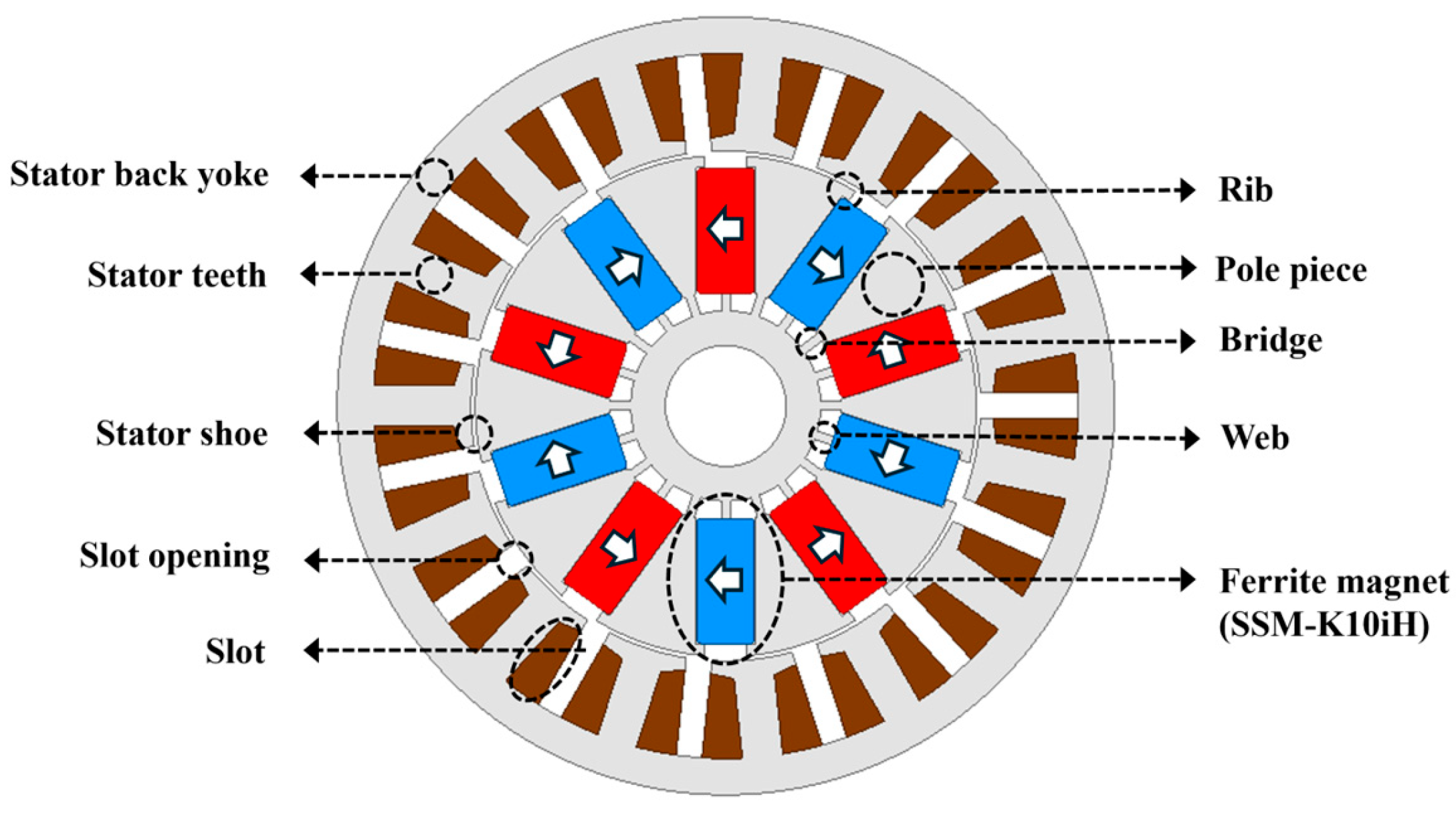
Figure 1. Ten-pole/fifteen-slot spoke-type permanent magnet motor.
Mathematics 13 03866 g001
Figure 2. Magnetization process of permanent magnet.
Mathematics 13 03866 g002
Figure 3. Schematic drawing of a magnetic circuit, (a) including coil and permanent magnet; (b) B - H curve illustrating the recoil line and irreversible magnetization effect.
Mathematics 13 03866 g003
Figure 4. Material data for magnetization analysis: (a) B - H curve in the 2nd and 3rd quadrants (b) and initial magnetization B - H and J - H curve.
Mathematics 13 03866 g004
Figure 5. Design parameters of the magnetizing yoke.
Mathematics 13 03866 g005
Figure 6. Mesh distribution of the magnetizing yoke and rotor.
Mathematics 13 03866 g006
Figure 7. Magnetizing yoke and target magnet magnetization analysis according to the number of rotor magnetization times: (a) 1 time, (b) 2 times, (c) 3 times, and (d) 5 times.
Mathematics 13 03866 g007
Figure 8. Three-time magnetization analysis result (a) conventional model (b) model with auxiliary pole.
Mathematics 13 03866 g008
Figure 9. Magnetic equivalent circuit model of three-time magnetizing yoke: (a) conventional model and (b) model with auxiliary pole.
Mathematics 13 03866 g009
Figure 10. Simplified MEC model based on node n : (a) conventional model and (b) model with auxiliary pole.
Mathematics 13 03866 g010
Figure 11. Magnetization analysis according to the number of APW turns: (a) 1 turn, (b) 2 turns, and (c) 3 turns.
Mathematics 13 03866 g011
Figure 12. Magnetizing current waveform according to the number of APW turns.
Mathematics 13 03866 g012
Figure 13. Five-time magnetization analysis result: (a) design 1, (b) design 2, and (c) design 3.
Mathematics 13 03866 g013
Figure 14. Magnetization analysis with APW—Design 1: (a) 2 turns, (b) 3 turns, and (c) 4 turns.
Mathematics 13 03866 g014
Figure 15. Magnetization analysis with APW—Design 2: (a) 3 turns, (b) 4 turns, and (c) 5 turns.
Mathematics 13 03866 g015
Figure 16. Magnetization analysis according to the applied magnetizing voltage—proposed model: (a) 2000 V, (b) 2500 V, (c) 3000 V, and (d) 3500 V.
Mathematics 13 03866 g016
Figure 17. Magnetizing current waveform according to the applied magnetizing voltage—proposed model.
Mathematics 13 03866 g017
Table 1. Target motor specifications.
ParameterValueUnit
SizeOuter/Inner diameter of stator90/59mm
Outer/Inner diameter of rotor58/14
Stack length90
MaterialStator/Rotor50PN470-
CoilCopper
MagnetFerrite (SSM-K10iH)
ShaftSUS303
SpecificationPole/Slot10/15-
Voltage380V
No-load back-EMF (@3600 rpm)165.4Vrms
Phase current1.7Arms
Torque (@3600 rpm)2.1N·m
Efficiency (@3600 rpm)91.9%
Table 2. Magnetization analysis specifications.
ParameterValueUnit
Magnetizing yoke core50PN470-
MagnetFerrite (SSM-K10iH)-
Maximum charging voltage3500V
Maximum condenser capacity3000µF
Magnetizing yoke inner/outer diameter59/200mm
Outer diameter of winding
(Bared/double-edge chamfered)
1.8 / 2.6mm
Magnetizing field555kA/m
Demagnetization field−365kA/m
Maximum allowable peak current14kA
Table 3. Results of magnetization analysis with applied auxiliary pole turns.
Parameter1 Turns2 Turns3 TurnsUnit
Maximum applied peak current14,30014,00013,700Apeak
Post-assembly magnetization rate99.59995.7%
Irreversible demagnetization rate9.76.24.1%
Table 4. Results of magnetization analysis with applied auxiliary pole turns—Design 1.
Parameter2 Turns3 Turns4 TurnsUnit
Maximum applied peak current13,30012,90012,200Apeak
Post-assembly magnetization rate99.799.294.1%
Irreversible demagnetization rate2.10.50%
Table 5. Results of magnetization analysis with applied auxiliary pole turns—Design 2.
Parameter3 Turns4 Turns5 TurnsUnit
Maximum applied peak current12,70012,10011,600Apeak
Post-assembly magnetization rate99.899.799.5%
Irreversible demagnetization rate0.50.10%
Table 6. Results of magnetization analysis with proposed model.
Parameter2000 V2500 V3000 V3500 VUnit
Maximum applied peak current65008200990011,600Apeak
Post-assembly magnetization rate87.298.399.399.5%
Irreversible demagnetization rate0000%
Disclaimer/Publisher’s Note: The statements, opinions and data contained in all publications are solely those of the individual author(s) and contributor(s) and not of MDPI and/or the editor(s). MDPI and/or the editor(s) disclaim responsibility for any injury to people or property resulting from any ideas, methods, instructions or products referred to in the content.