An Explicit Shifted Legendre Petrov–Galerkin Technique for the Time Fractional Cable Problem


Abstract
1. Introduction
- Introducing a novel method to solve the TFCP based on using the PGT along with the modified sets of shifted as basis functions.
- Employing an appropriate strategy for solving a system resulting from the application of the PGT.
- Establishing closed relations for some integrals to construct the PGT.
- Analyzing the error analysis of the truncation error in space.
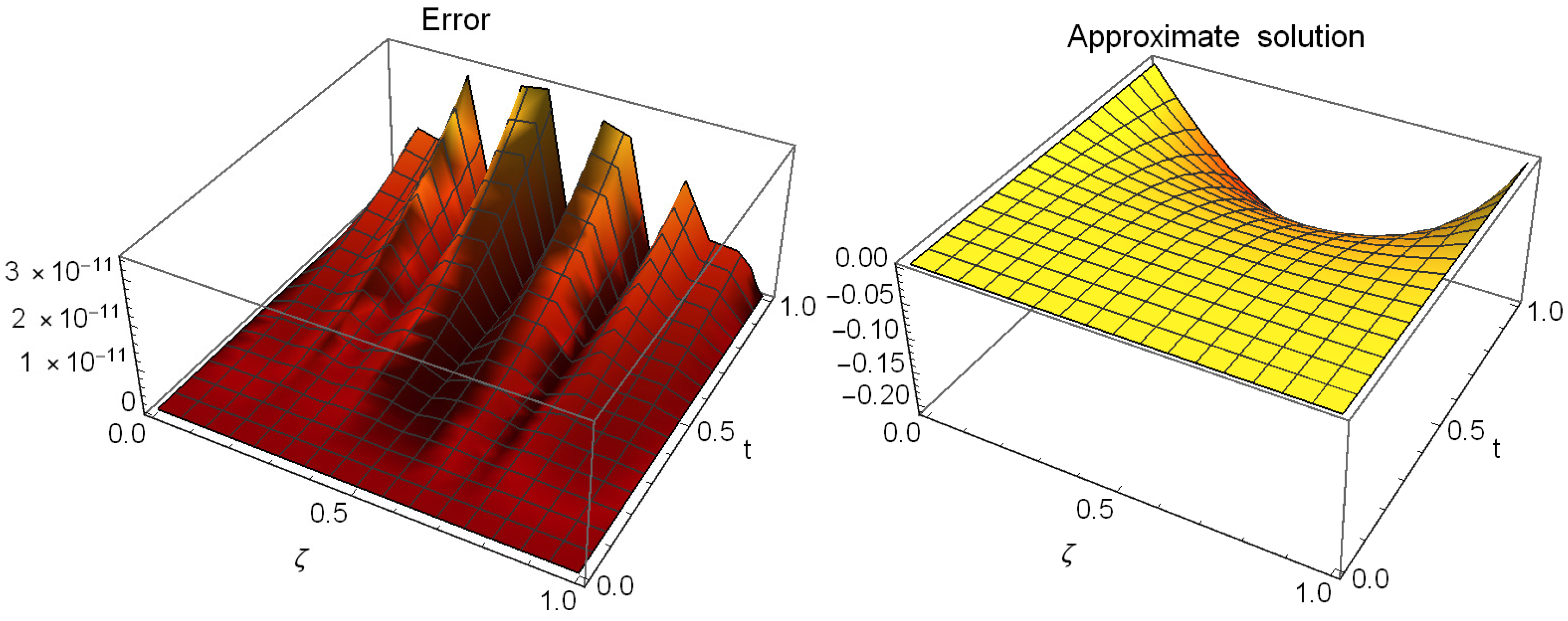
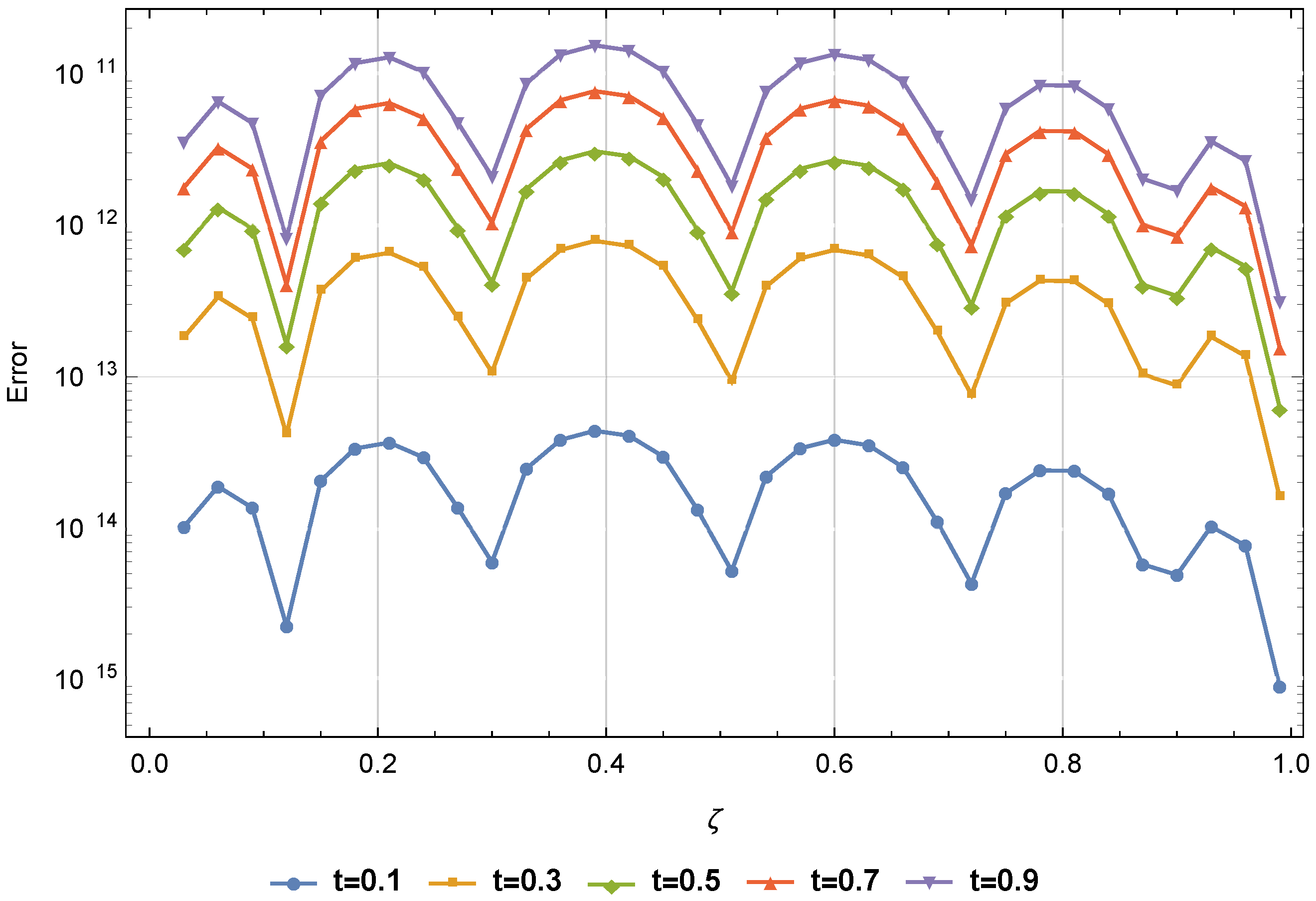
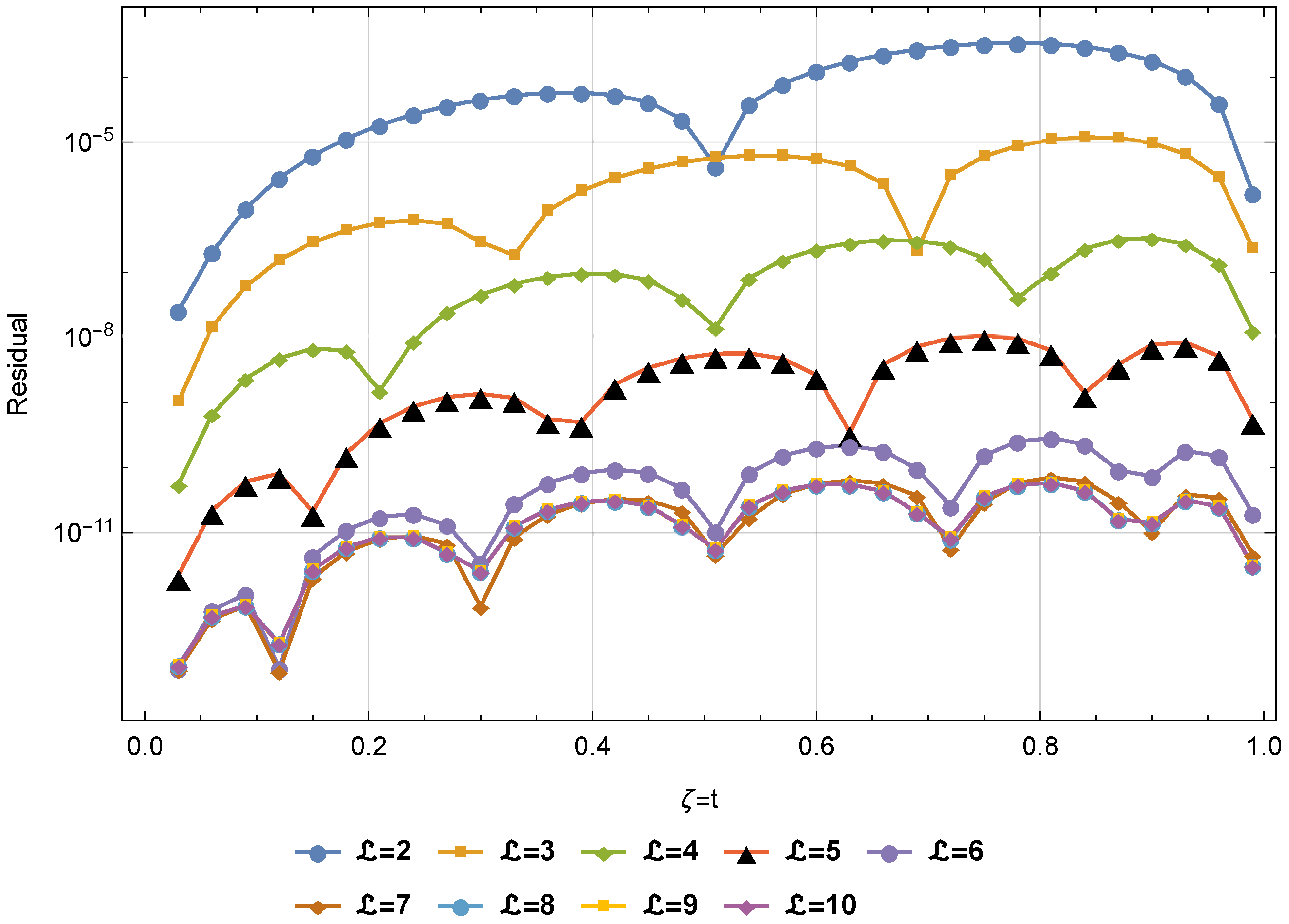
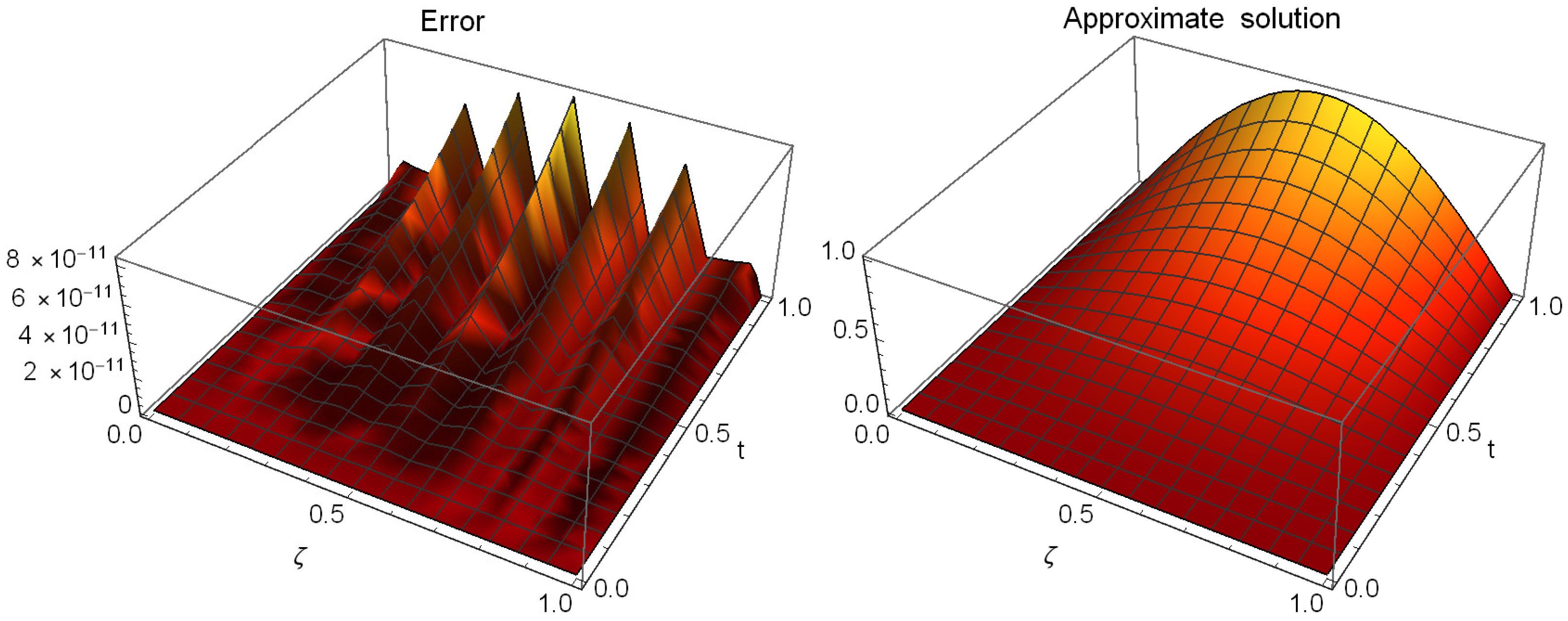
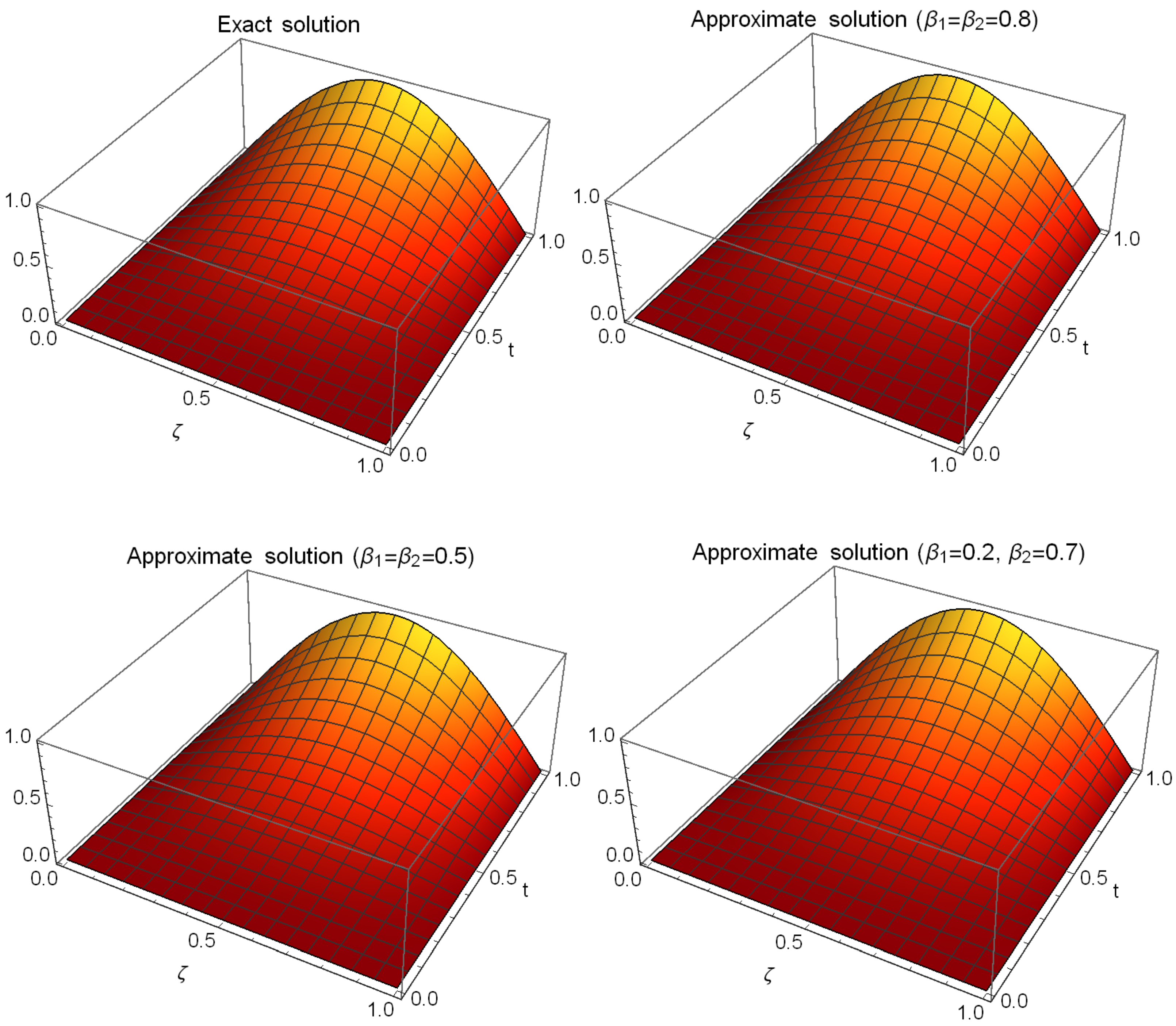
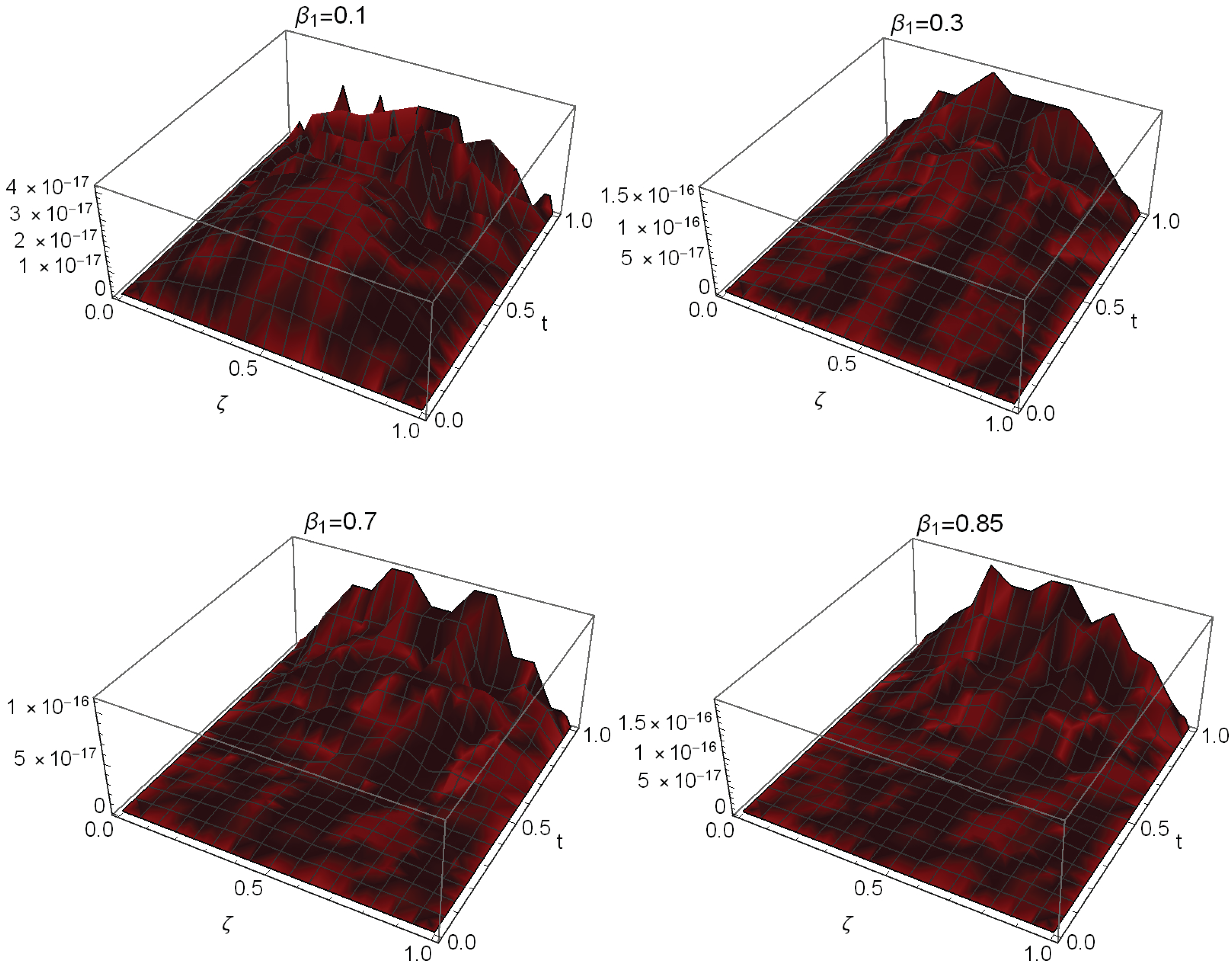
- Presenting three illustrative examples to ensure that the PGT is accurate and applicable.
- Performing some comparisons with Ref. [31] to show the accuracy of the PGT.
- The TFCP is one of the most significant problems encountered in applied sciences. This encourages us to analyze it with a new technique.
- Several numerical methods were utilized to solve the TFCP using various orthogonal and non-orthogonal polynomials as basis functions. The basis functions utilized in this article are a set of orthogonal functions. This article encourages us to apply these functions to various problems in the applied sciences.
- To the best of our knowledge, the specific basis functions along with the PGT used in this paper were not previously used in numerical analysis, which provides a compelling reason to introduce and utilize them.
- Using modified sets of shifted as basis functions allows us to take a few terms of the retained modes and obtain approximations with high precision compared to the basis of shifted .
- The employment of the presented basis functions along with the PGT for solving the TFCP is new.
- Some new operational relations are presented and employed.
2. Some Preliminaries and Essential Formulas
2.1. The Caputo FD
2.2. A Brief Outline of Legendre Polynomials and Their Shifted Ones
3. Petrov–Galerkin Technique for the Time Fractional Cable Problem
3.1. Trial Functions
3.2. The Proposed Numerical Technique
4. Convergence Analysis
5. Examples
6. Result Analysis
- Using the proposed technique allows us to take a few terms of the retained modes and obtain approximations with high precision when compared to the sinc–Bernoulli collocation method [31].
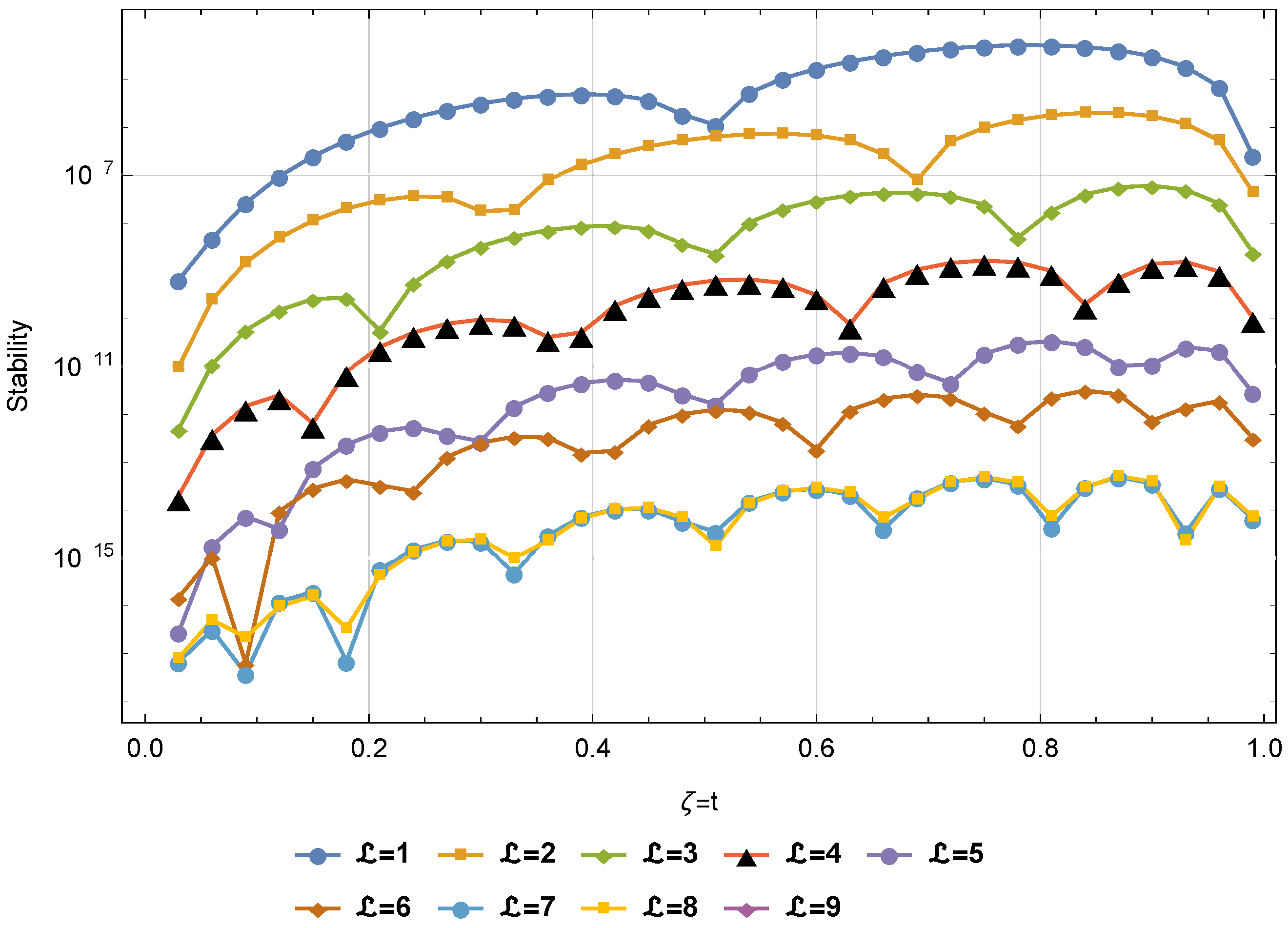
- Compared to numerical techniques that use Chebyshev polynomials, such as the collocation method, which leads to ill-conditioning near and , our numerical approach avoids this problem.
- Our proposed technique is simpler to implement compared to wavelet techniques.
7. Conclusions
Author Contributions
Funding
Data Availability Statement
Conflicts of Interest
References
- Atanackovic, T.M.; Pilipovic, S.; Stankovic, B.; Zorica, D. Fractional Calculus with Applications in Mechanics: Vibrations and Diffusion Processes; Wiley: Hoboken, NJ, USA, 2014. [Google Scholar]
- Kilbas, A.A.; Srivastava, H.M.; Trujillo, J.J. Theory and Applications of Fractional Differential Equations; Elsevier: Amsterdam, The Netherlands, 2006; Volume 204. [Google Scholar]
- Yang, Y.; Huang, Y.; Zhou, Y. Numerical simulation of time fractional cable equations and convergence analysis. Numer. Methods Partial Differ. Equ. 2018, 34, 1556–1576. [Google Scholar] [CrossRef] [Scilit]
- Kosari, S.; Xu, P.; Shafi, J.; Derakhshan, M. An efficient hybrid numerical approach for solving two-dimensional fractional cable model involving time-fractional operator of distributed order with error analysis. Numer. Algorithms 2025, 99, 1269–1288. [Google Scholar] [CrossRef] [Scilit]
- Atta, A.G. Two spectral Gegenbauer methods for solving linear and nonlinear time fractional cable problems. Int. J. Mod. Phys. C 2024, 35, 2450070. [Google Scholar] [CrossRef] [Scilit]
- Salama, F.M. On numerical simulations of variable-order fractional cable equation arising in neuronal dynamics. Fractal Fract. 2024, 8, 282. [Google Scholar] [CrossRef] [Scilit]
- Zheng, S.; Lou, Y.; Shen, S.; Lu, J. Numerical investigation of fractal oscillator for a pendulum with a rolling wheel. Fractals 2025, 33, 2550077. [Google Scholar] [CrossRef] [Scilit]
- Zheng, S.; Chen, L.; Lu, J. Numerical analysis of a fractional micro/nanobeam-based micro-electromechanical system. Fractals 2025, 33, 25500288. [Google Scholar] [CrossRef] [Scilit]
- Chen, B.; Lu, J.; Chen, L. Numerical investigation of a fractal oscillator arising from the microbeams-based microelectromechanical system. Alex. Eng. J. 2025, 126, 53–59. [Google Scholar] [CrossRef] [Scilit]
- Abdelhakem, M.; Abdelhamied, D.; El-Kady, M.; Youssri, Y.H. Two modified shifted Chebyshev–Galerkin operational matrix methods for even-order partial boundary value problems. Bound. Value Probl. 2025, 2025, 34. [Google Scholar] [CrossRef] [Scilit]
- Youssri, Y.H.; Atta, A.G. Optimal third-kind Chebyshev collocation algorithm for solving beam-type micro- and nanoscale BVPs. J. Math. Model. 2025, 13, 841–856. [Google Scholar] [CrossRef]
- Abd-Elhameed, W.M.; Abdelkawy, M.A.; Alqubori, O.M.; Atta, A.G. An accurate tau-based spectral algorithm for the time fractional bioheat transfer model. Bound. Value Probl. 2025, 2025, 124. [Google Scholar] [CrossRef] [Scilit]
- Salamaa, M.H.; Zedan, H.A.; Abd-Elhameed, W.; Youssri, Y.H. Galerkin method with modified shifted Lucas polynomials for solving the 2D Poisson equation. J. Comput. Appl. Mech. 2025, 56, 737–775. [Google Scholar] [CrossRef] [Scilit]
- Taema, M.; Dagher, M.; Youssri, Y. Spectral collocation method via Fermat polynomials for Fredholm–Volterra integral equations with singular kernels and fractional differential equations. J. Math. 2025, 14, 481–492. [Google Scholar]
- Abd-Elhameed, W.M.; Youssri, Y.H.; Doha, E.H. A novel operational matrix method based on shifted Legendre polynomials for solving second-order boundary value problems involving singular, singularly perturbed and Bratu-type equations. Math. Sci. 2015, 9, 93–102. [Google Scholar] [CrossRef] [Scilit]
- Abd-Elhameed, W.M.; Youssri, Y.H. Explicit shifted second-kind Chebyshev spectral treatment for fractional Riccati differential equation. Comput. Model. Eng. Sci. 2019, 121, 1029–1049. [Google Scholar] [CrossRef] [Scilit]
- Bhrawy, A.H.; Abd-Elhameed, W.M. New algorithm for the numerical solutions of nonlinear third-order differential equations using Jacobi-Gauss collocation method. Math. Probl. Eng. 2011, 2011, 837218. [Google Scholar] [CrossRef] [Scilit]
- Youssri, Y.H.; Abd-Elhameed, W.M.; Abdelhakem, M. A robust spectral treatment of a class of initial value problems using modified Chebyshev polynomials. Math. Methods Appl. Sci. 2021, 44, 9224–9236. [Google Scholar] [CrossRef] [Scilit]
- Cui, T.; Xu, C. Müntz Legendre polynomials: Approximation properties and applications. Math. Comput. 2025, 94, 1377–1410. [Google Scholar] [CrossRef] [Scilit]
- Sahabi, M.; Cherati, A.Y. Numerical solutions for fractional optimal control problems using Müntz–Legendre polynomials. J. Mahani Math. Res. Cent. 2025, 14, 189–217. [Google Scholar] [CrossRef]
- Sakar, M.G.; Saldır, O.; Ata, A. Numerical solution of fractional-order multi-point boundary value problems using reproducing kernel method with shifted Legendre polynomials. Z. Angew. Math. Phys. 2025, 76, 141. [Google Scholar] [CrossRef] [Scilit]
- Wu, M.; Zhou, J.; Guan, C.; Niu, J. A numerical method using Legendre polynomials for solving two-point interface problems. AIMS Math. 2025, 10, 7891–7905. [Google Scholar] [CrossRef] [Scilit]
- Heydari, M.H.; Atangana, A.; Avazzadeh, Z. Numerical solution of nonlinear fractal–fractional optimal control problems by Legendre polynomials. Math. Methods Appl. Sci. 2021, 44, 2952–2963. [Google Scholar] [CrossRef] [Scilit]
- Khan, N.A.; Sulaiman, M.; Kumam, P.; Alarfaj, F.K. Application of Legendre polynomials based neural networks for the analysis of heat and mass transfer of a non-Newtonian fluid in a porous channel. Adv. Contin. Discret. Model. 2022, 2022, 7. [Google Scholar] [CrossRef] [Scilit]
- Cao, J.; Chen, Y.; Wang, Y.; Zhang, H. Numerical analysis of nonlinear variable fractional viscoelastic arch based on shifted Legendre polynomials. Math. Methods Appl. Sci. 2021, 44, 8798–8813. [Google Scholar] [CrossRef] [Scilit]
- Sohel, M.N.; Islam, M.S.; Islam, M.S.; Kamrujjaman, M. Galerkin method and its residual correction with modified Legendre polynomials. Contemp. Math. 2022, 3, 188–202. [Google Scholar] [CrossRef] [Scilit]
- Hasan, N.N.; Mohammad, A.J. Nonpolynomial spline method for solving linear fractional differential equations. Int. J. Psychosoc. Rehabil. 2020, 24, 3819–3827. [Google Scholar] [CrossRef] [Scilit]
- Hamasalh, F.K.; Headayat, M.A. The applications of non-polynomial spline to the numerical solution for fractional differential equations. AIP Conf. Proc. 2021, 2334, 060014. [Google Scholar] [CrossRef] [Scilit]
- Vivas-Cortez, M.; Yousif, M.A.; Mahmood, B.A.; Mohammed, P.O.; Chorfi, N.; Lupas, A.A. High-accuracy solutions to the time-fractional KdV–Burgers equation using rational non-polynomial splines. Symmetry 2024, 17, 16. [Google Scholar] [CrossRef] [Scilit]
- Yousif, M.A.; Agarwal, R.P.; Mohammed, P.O.; Lupas, A.A.; Jan, R.; Chorfi, N. Advanced methods for conformable time-fractional differential equations: Logarithmic non-polynomial splines. Axioms 2024, 13, 551. [Google Scholar] [CrossRef] [Scilit]
- Moshtaghi, N.; Saadatmandi, A. Numerical solution of time fractional cable equation via the sinc–Bernoulli collocation method. J. Appl. Comput. Mech. 2021, 7, 1916–1924. [Google Scholar] [CrossRef] [Scilit]
- Podlubny, I. Fractional Differential Equations: An Introduction to Fractional Derivatives, Fractional Differential Equations, Methods of Their Solution and Some of Their Applications; Elsevier: Amsterdam, The Netherlands, 1998; Volume 198. [Google Scholar]
- Napoli, A.; Abd-Elhameed, W.M. Numerical solution of eighth-order boundary value problems by using Legendre polynomials. Int. J. Comput. Methods 2018, 15, 1750083. [Google Scholar] [CrossRef] [Scilit]
- Alzahrani, S.S.; Alanazi, A.A.; Atta, A.G. A modified collocation technique for addressing the time-fractional FitzHugh–Nagumo differential equation with shifted Legendre polynomials. Symmetry 2025, 17, 1468. [Google Scholar] [CrossRef] [Scilit]




| Technique in [31] at | Proposed Technique at | |
|---|---|---|
| (0.5, 0.5) | ||
| (0.8, 0.8) | ||
| (0.1, 0.9) |
| CPU Time | |||||
|---|---|---|---|---|---|
| 0.1 | |||||
| 0.2 | |||||
| 0.3 | |||||
| 0.4 | |||||
| 0.5 | 380.12 | ||||
| 0.6 | |||||
| 0.7 | |||||
| 0.8 | |||||
| 0.9 |
| 1 | 3 | 5 | 7 | 9 | 11 | |
|---|---|---|---|---|---|---|
| CPU time | 6.798 | 24.03 | 57.173 | 118.672 | 233.609 | 379.548 |
| Error | Error | ||||
|---|---|---|---|---|---|
| Technique in [31] | Proposed Technique () | Technique in [31] | Proposed Technique () | ||
| 0.5 | 0.5 | ||||
| 0.8 | 0.8 | ||||
| 0.1 | 0.9 | ||||
| 2 | 4 | 6 | 8 | 10 | |
|---|---|---|---|---|---|
| CPU time | 15.546 | 38.579 | 70.641 | 122.579 | 200.514 |
| CPU time | 15.102 | 38.217 | 70.138 | 123.225 | 201.302 |
Disclaimer/Publisher’s Note: The statements, opinions and data contained in all publications are solely those of the individual author(s) and contributor(s) and not of MDPI and/or the editor(s). MDPI and/or the editor(s) disclaim responsibility for any injury to people or property resulting from any ideas, methods, instructions or products referred to in the content. |
© 2025 by the authors. Licensee MDPI, Basel, Switzerland. This article is an open access article distributed under the terms and conditions of the Creative Commons Attribution (CC BY) license (https://creativecommons.org/licenses/by/4.0/).
Share and Cite
Alzahrani, S.S.; Atta, A.G. An Explicit Shifted Legendre Petrov–Galerkin Technique for the Time Fractional Cable Problem. Mathematics 2025, 13, 3861. https://doi.org/10.3390/math13233861
Alzahrani SS, Atta AG. An Explicit Shifted Legendre Petrov–Galerkin Technique for the Time Fractional Cable Problem. Mathematics. 2025; 13(23):3861. https://doi.org/10.3390/math13233861
Chicago/Turabian StyleAlzahrani, S. S., and Ahmed Gamal Atta. 2025. "An Explicit Shifted Legendre Petrov–Galerkin Technique for the Time Fractional Cable Problem" Mathematics 13, no. 23: 3861. https://doi.org/10.3390/math13233861
APA StyleAlzahrani, S. S., & Atta, A. G. (2025). An Explicit Shifted Legendre Petrov–Galerkin Technique for the Time Fractional Cable Problem. Mathematics, 13(23), 3861. https://doi.org/10.3390/math13233861