1. Introduction
Progressive first-failure censoring (P-FFC), introduced by Wu and Kuş [
1], was developed to address practical challenges in life-testing and reliability studies, where recording every failure time can be prohibitively expensive, time-consuming, or logistically impractical. This scheme integrates two well-known censoring mechanisms: the first-failure censoring design of Balasooriya [
2] and the Type-II progressive censoring (TIIPC) framework described by Balakrishnan and Cramer [
3]. Unlike conventional methods that observe all failure times, P-FFC records only the earliest failure within each group. This greatly reduces data collection effort while retaining sufficient information for reliable inference. Conceptually, it can be viewed as an adaptation of TIIPC to situations where only the minimum failure time from each group is observed. This design is particularly attractive for applied settings—such as biomedical or reliability experiments—where tracking every failure is infeasible, but recording first failures remains manageable. By focusing on early failures, the scheme achieves a balance between experimental efficiency and statistical reliability.
Wu and Kuş [
1] illustrated its practicality using the Weibull lifetime model as an example. Under the P-FFC setup,
n independent groups are formed, each containing
m identical test units, yielding a total of
units. At each observed failure time, only the first failure within the active group is recorded. After this event, a specified number of groups,
, are randomly removed from the experiment, in addition to the group where the failure occurred. This process continues until a predetermined number of failures,
k, is observed. For example, when the first failure
occurs, the affected group plus
additional groups are removed, leaving
groups under observation. Similarly, when the second failure
is observed, its corresponding group and
additional groups are removed, reducing the number of groups to
. This continues until the
k-th failure
, after which the remaining groups
and the group containing the
k-th failure are removed. Although this scheme improves experimental efficiency, it assumes that the number of groups removed at each step under the TIIPC design is fixed and known in advance—an assumption that may not hold in real-world experiments. For example, in a clinical trial, after the first patient death, some participants may voluntarily withdraw due to fear or loss of confidence in the treatment. Subsequent deaths may trigger further withdrawals, causing deviations from the planned censoring schedule. While the study may still terminate after observing
k failures, the actual number of removals at each stage becomes random and unpredictable. To address this limitation, several extensions of P-FFC have been proposed to incorporate stochastic removal mechanisms. Examples include discrete uniform removals (Huang and Wu [
4]), binomial removals (Ashour et al. [
5]), and beta-binomial (BB) removals (Elshahhat et al. [
6]). These random-removal schemes better capture the inherent uncertainty in withdrawals or unit eliminations encountered in practical testing scenarios.
Section 2 provides a detailed explanation of the sampling process under P-FFC with BB-based removals (denoted P-FFC-BB).
The alpha-power transformation technique, proposed by Mahdavi and Kundu [
7], offers a systematic and flexible mechanism for constructing new families of probability distributions from a given baseline model. By introducing an additional shape parameter
, this transformation enhances skewness, improves tail behavior, and increases modeling flexibility while preserving mathematical tractability. One member of this transformation is the
-power exponential (APE) distribution, which generalizes the classical exponential model while maintaining closed-form expressions for both of its characteristic functions. Let
Y denote the lifetime of a test unit that follows the two-parameter APE
distribution, where
. Subsequently, the probability density function (PDF)
, cumulative distribution function (CDF)
, reliability function (RF)
, and hazard rate function (HRF)
, evaluated at a mission time
, are expressed as follows:
respectively, where
(scale) and
(shape).
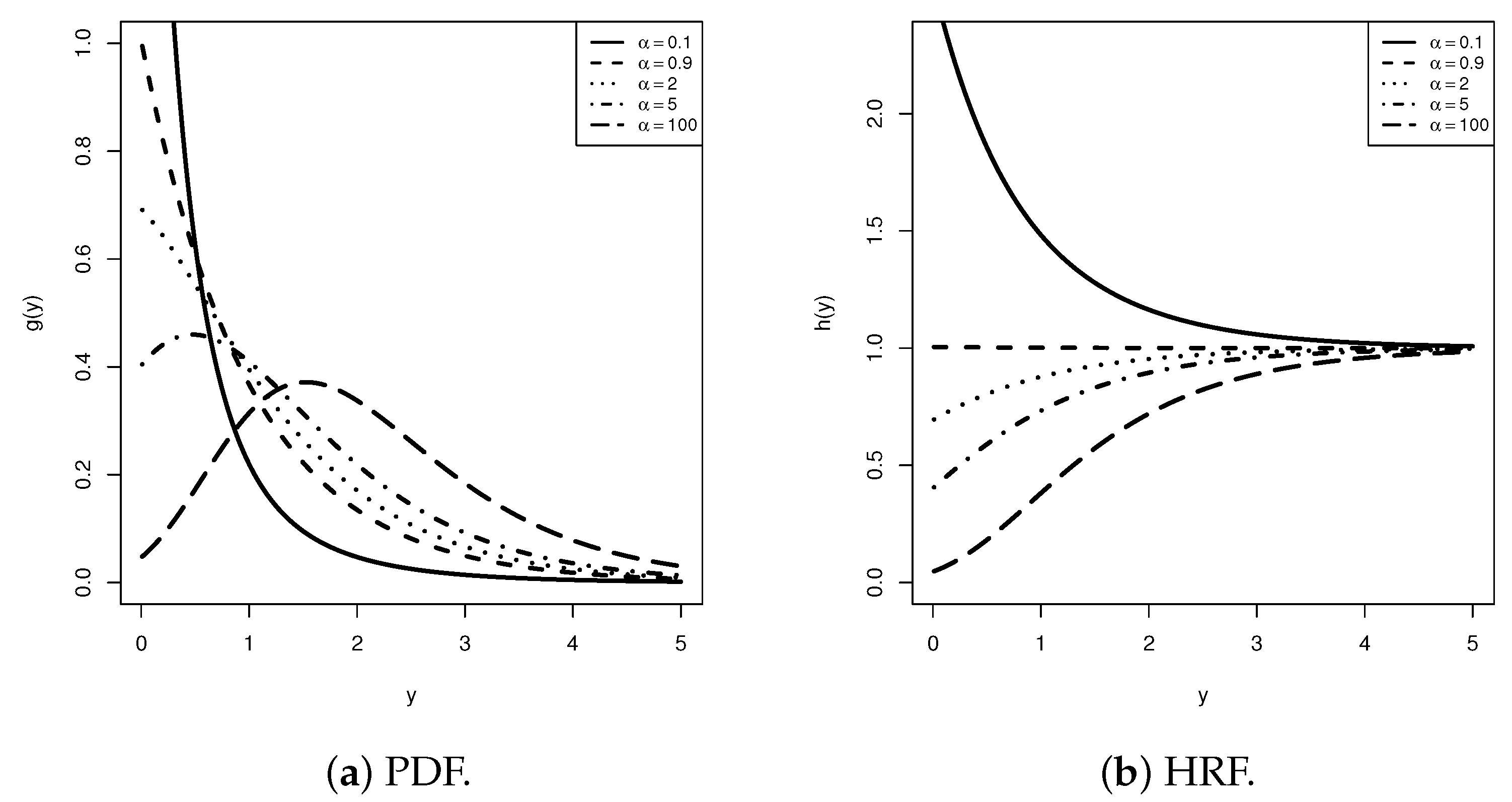
The APE distribution extends the classical exponential model by introducing a shape parameter that captures diverse hazard rate patterns, including increasing, decreasing, and bathtub shapes (see
Figure 1a). It enhances skewness and tail flexibility while retaining closed-form density and distribution functions, ensuring mathematical simplicity (see
Figure 1b). Consequently, it has gained significant attention in reliability analysis, lifetime modeling, and survival studies due to its ability to represent a broad spectrum of hazard rate shapes; see, for example, Salah [
8] based on TIIPC; Salah et al. [
9] based on Type-II hybrid; Alotaibi et al. [
10] based on adaptive TIIPC (ATIIPC); Elbatal et al. [
11] based on improved ATIIPC (IATIIPC); and Elsherpieny and Abdel- Hakim [
12] based on unified hybrid, among others.
Existing alpha-power distributions offer flexibility but are mostly limited to fixed censoring schemes and have not been developed for complex random removal mechanisms such as the beta-binomial structure. The proposed APE–P-FFC-BB strategy provides closed-form likelihoods and a Bayesian inference framework, improving computational tractability under heavy censoring. This extension fills a gap in biomedical applications by enabling practical analysis of oncology data collected through the P-FFC framework.
Recall that the P-FFC plan assumes fixed or deterministic removal schemes, which may not capture the inherent uncertainty in real clinical environments. To overcome this disadvantage, P-FFC-BB was introduced to offer an efficient compromise by recording only the earliest failures from each group while randomly removing unobserved groups to reduce experimental burden. Moreover, the exponential distribution—although widely used due to its simplicity—often lacks the flexibility required to model heterogeneous survival patterns. To address these limitations, this study integrates the alpha-powering transformation of the exponential model, which enhances its shape flexibility, with a BB random removal mechanism under a P-FFC plan. This censoring strategy provides a more realistic and computationally tractable model for analyzing survival data from heterogeneous cancer populations, offering deeper insights into early-failure behavior under complex removal dynamics. Despite the APE model’s flexibility and practical utility, which have been discussed and applied in several life-testing scenarios in the literature, further investigation is warranted in the presence of samples gathered by the proposed censoring mechanism. To address this gap, we summarize the study objectives sixfold as follows:
Applying the alpha-powering transformation of the exponential distribution within the proposed censoring scheme, adding flexibility to model various hazard rate shapes for biomedical survival data.
The joint likelihood under such a censoring setup is derived, and both maximum likelihood and Bayesian estimation procedures are developed for the model parameters and key reliability metrics of the APE distribution, as well as of the BB parameters.
Bayesian estimation of the same unknown parameters is performed under the assumption of independent gamma and beta priors. The analysis is carried out using both symmetric (squared error) and asymmetric (generalized entropy) loss functions, with the Markov Chain Monte Carlo (MCMC) method employed to approximate the posterior distributions.
In the interval estimation setup, two types of asymptotic confidence intervals and two Bayesian credible intervals are constructed for all model parameters.
Extensive Monte Carlo simulations are conducted to assess the performance of the estimators under varying test conditions using several precision metrics.
Three survival datasets—myeloma, lung, and breast cancer—are analyzed to demonstrate the suitability of the proposed model and its applicability to real-world scenarios.
This work primarily develops maximum likelihood and Bayesian estimation under the P-FFC-BB framework, and alternative inferential approaches such as penalized likelihood, EM-type algorithms, or nonparametric Bayesian methods were not explored but may further enhance robustness. Future research could investigate these estimation strategies, particularly for small or highly censored samples, to complement the inference methods presented here.
The remaining sections of this work are arranged as follows:
Section 2 depicts the P-FFC-BB design.
Section 3 and
Section 4 introduce the ML estimators (MLEs) and Bayes estimators, respectively.
Section 5 reports the simulation outcomes.
Section 6 analyzes the survival times of leukemia and breast cancer patients.
Section 7 ultimately concludes the study.
2. The P-FFC-BB Plan
Let
denote the set of observed independent order statistics failure times together with their associated removals collected under the P-FFC-BB removal plan. Assume that the individual lifetimes in
follow a continuous distribution with PDF (
) and CDF (
); then, the likelihood function (LF) of the observed data, where
, for simplicity, can be expressed as
where
and
.
Suppose that, at the
ith observed failure (
), the number of groups removed, denoted by
, follows a binomial distribution with parameters
and success probability
p. Then, the corresponding probability mass function (PMF) of
is
where
,
, and
for
.
Now, assume that the removal probability
p is not constant during the experiment but is, instead, treated as a random variable following a
distribution, where
. The corresponding beta density function of
p is then given by
where
is the beta function; see Singh et al. [
13] for additional details. Thus, from (
6) and (
7), the unconditional distribution of
becomes
After simplifying, we get
The PMF in (
8) corresponds to the BB distribution, denoted by
, where
represents the total number of trials. Accordingly, the joint probability distribution of the BB removals can be written as
Using (
8) and (
9), the joint probability of
is given by
where
We further assume that the random removals
are independent of the corresponding recorded failure times
for all
. Under this independence assumption, and by combining (
5) and (
10), the complete LF, denoted by
, can be expressed as
where
represents the joint LF that depends only on the parameter vector
, and
is the joint likelihood independent of
that depends solely on
. This factorization shows that the parameters
and
can be estimated separately. In practice, one may maximize
for
independently to obtain the corresponding MLE(s). By setting
in (
11), the TIIPC BB-based plan (introduced by Singh et al. [
13]) emerges as a special case.
Recently, several studies on progressive censoring schemes with BB removals have been reported in the literature. For example, Kaushik et al. [
14] and Sangal and Sinha [
15] investigated progressive Type-I interval and progressive hybrid Type-I plans, respectively. Using TIIPC with BB-based removals, Singh et al. [
13], Usta and Gezer [
16], and Vishwakarma et al. [
17] examined the generalized Lindley, Weibull, and inverse Weibull distributions, respectively. More recently, Elshahhat et al. [
6] analyzed the Weibull lifespan model using a P-FFC-BB strategy. The growing interest in BB-based schemes can be explained by several factors: the inherently complex formulation of the joint likelihood function, the larger number of unknown parameters that need to be estimated, and the additional computational challenges these models introduce.
4. Bayesian Inference
The Bayesian framework allows prior beliefs or expert knowledge to be incorporated into the inference process for unknown parameters. In this setting, the parameters
and
of the APE lifetime distribution are treated as random variables, with their prior distributions representing any available prior information. A particularly convenient and flexible choice is the gamma conjugate prior, as highlighted by Kundu [
19] and Dey et al. [
20]. The gamma distribution provides substantial modeling versatility, making it suitable for encoding a broad range of subjective or empirical prior beliefs. Independent gamma priors are assigned to
and
to ensure positive support and conjugacy, offering flexibility in specifying both weakly and moderately informative beliefs. Here, we assume that
and
follow independent gamma priors, specified as
and
, where
for
. These hyperparameters are selected to reflect prior information relevant to the
distribution parameters. Under this independence assumption, the joint prior PDF of
and
, denoted by
, takes the form
where
and
are assumed to be known. By substituting (
12) and (
23) into the Bayes’ theorem, the joint posterior PDF of APE
, denoted by
, can be expressed as
where its normalized term, say
, is given by
Similarly, for the BB
parameters, we assume that they are mutually independent and that each follows a gamma prior distribution, denoted by
and
, respectively. The hyperparameters
and
for
are assumed to be known. Under this independence assumption, the joint gamma PDF of
, denoted by
, is given by
From (
16) and (
25), the joint posterior PDF of BB
(say,
) can be expressed as
where
.
The squared error loss (SEL) is a commonly used symmetric loss function for Bayesian estimation. Under this criterion, the Bayes estimator, denoted by
, corresponds to the posterior mean based on the observed data. Formally, the SEL function (written as
) and the resulting Bayes estimator
can be defined as
and
respectively; see Martz and Waller [
21].
In contrast to the symmetric SEL, the generalized entropy loss (GEL) introduces an asymmetric estimation criterion. This loss function is particularly suitable when the consequences of overestimation and underestimation are not equally severe. The GEL, denoted by
, is defined as
where
denotes the derived Bayes estimator from GEL.
As seen from (
28), the generalized entropy loss is minimized when
. Notably, by setting
in (
28), the asymmetric Bayes estimator
reduces to the symmetric Bayes estimator
. When
, the GE loss penalizes overestimation more heavily than underestimation, whereas for
, the opposite effect occurs. Based on (
28), the Bayes estimator
of
is given by
For more details, see Dey et al. [
22]. Due to the nonlinear form of the posterior distribution,
, presented in (
24), closed-form expressions for the Bayes estimators of
,
, or
against both SEL and GEL functions are analytically intractable.
It is worth mentioning that the SEL function is a natural default choice due to its symmetry and simplicity, yielding posterior means as Bayes estimators. In contrast, the GEL function introduces asymmetry to accommodate scenarios where overestimation and underestimation incur unequal costs.
Consequently, we utilize the MCMC technique to approximate the Bayes estimators
and
and to construct the associated BCI estimators. To generate such samples, it is first necessary to derive the full-conditional posterior PDFs of
and
, as follows:
and
respectively.
From (
29) and (
30), it is clear that the full conditional PDFs of
and
do not belong to any standard family of statistical distributions. Therefore, direct sampling from the conditional densities
and
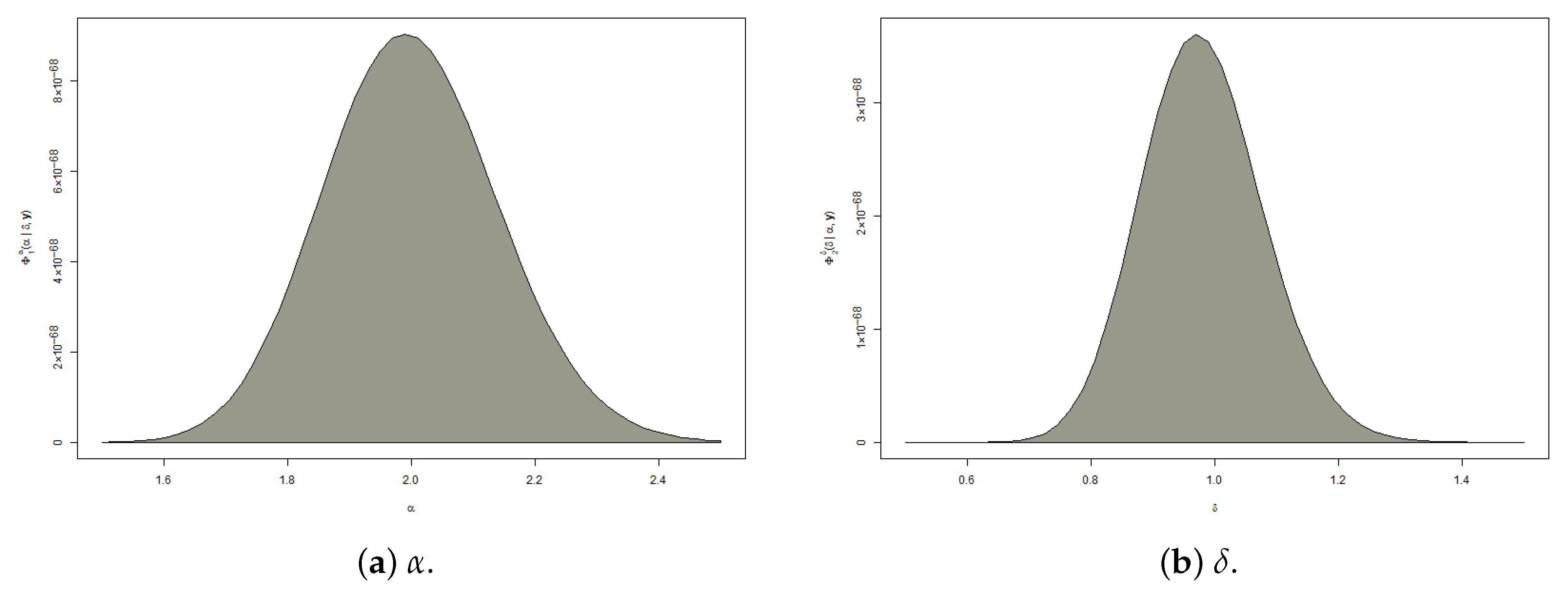
using conventional sampling methods is not possible. To handle this difficulty, as shown in
Figure 3, we employ the Metropolis–Hastings (MH) algorithm with normally distributed proposal densities to generate posterior samples. This allows us to obtain Bayesian point estimates and credible intervals for the APE model parameters
,
,
, and
; see Algorithm 1.
On the other hand, from (
26), the full-conditional PDFs of the BB parameters
, can be formulated as
and
respectively.
As expected from (
31) and (
32), the conditional PDFs of
do not correspond to any standard statistical distribution. Consequently, direct sampling from these posteriors using conventional methods is not feasible. To overcome this, again, we employ the MH algorithm, following the same procedure described in Algorithm 1, to generate MCMC samples for
.
| Algorithm 1 The MCMC (MH-based) Generation Steps |
- 1:
Input: Start with - 2:
Input: Assign starting points of as and of as - 3:
Output: Get from - 4:
Output: Calculate - 5:
Output: Get an uniform variate (say, u) from - 6:
Output: Store - 7:
As - 8:
Else set - 9:
Input: Redo Steps 3–10 for from - 10:
Output: Obtain from ( 3) and from ( 4) - 11:
Input: Set - 12:
Input: Redo Steps 1–13 times, and remove as a burn-in size - 13:
Output: Compute
and
where - 14:
Input: Sort , , , and (for ) - 15:
Output: Compute the BCI estimators of , , , and as
and
|
6. Cancer Data Applications
To illustrate the practical applicability and relevance of the proposed methodologies, we analyzed three real cancer datasets. The first dataset consists of the survival times of patients in a study on multiple myeloma, the second corresponds to remission times of leukemia patients, and the third involves recurrence-free survival times of breast cancer patients. These case studies demonstrate how the developed approaches can effectively address real-world challenges in medical research and survival analysis. These applications can be represented as follows:
Application 1: Multiple myeloma is a type of blood cancer that arises from malignant plasma cells in the bone marrow, leading to excessive production of abnormal antibodies and damage to bones, kidneys, and the immune system. This application investigates the survival experience of 48 patients diagnosed with multiple myeloma and treated with alkylating agents at the West Virginia University Medical Center. The patients, aged between 50 and 80 years, were followed prospectively to record their survival times in months, with censoring applied to those still alive at the end of the observation period; see Collett [
25].
Application 2: Lung cancer is a malignant disease in which abnormal cells in the lungs grow uncontrollably, forming tumors that can interfere with normal lung function and spread to other parts of the body. This application examines the survival data of 44 patients with advanced lung cancer who were randomly assigned to receive the standard chemotherapy regimen; see Lawless [
26]. The “standard” treatment represented the control arm in a randomized clinical trial designed to assess the effectiveness of alternative chemotherapeutic protocols.
Application 3: Breast cancer is a malignant condition marked by abnormal, uncontrolled proliferation of cells within breast tissue, most commonly originating in the milk ducts or lobular structures. It predominantly affects women and may present clinically as palpable masses and structural or morphological changes in the breast. This application analyzes recurrence-free survival times (measured in days) for 42 breast cancer patients with tumors exceeding 50 mm in size, all of whom received hormonal therapy; see Royston and Altman [
27].
In
Table 9, the survival times associated with myeloma, lung, and breast cancer patients are reported. Firstly, before analyzing the myeloma dataset, we ignore the survival times that are still censored (denoted by ‘+’). Additionally, for computational purposes, each time point in the breast cancer data is transformed by dividing survival times by 100.
Table 10 provides a detailed summary of descriptive statistics for the datasets listed in
Table 9. The summary includes minimum, maximum, mean, mode, three quartiles (
), standard deviation (Std.Dv.), and skewness, offering a comprehensive overview of the data distribution.
Before evaluating the theoretical estimators of
,
,
, and
, it is worth demonstrating the superiority of the proposed APE lifespan model compared to one of its most common competitors. To achieve this goal, the suitability of the APE distribution is first assessed alongside the Weibull (
) distribution (see Bourguignon et al. [
28]) using the three cancer datasets summarized in
Table 9. To verify model adequacy, this fitting analysis employed the Kolmogorov–Smirnov (
) test, along with its corresponding
p-value, as well as several model selection criteria: negative log-likelihood (NLL), Akaike criterion (AC), consistent Akaike criterion (CAC), Bayesian criterion (BC), and Hannan–Quinn criterion (HQC). In addition, the MLEs of
and
, together with their standard errors (Std.Ers), for both the APE and Weibull (W) models are computed and reported in
Table 11. The results in
Table 11 also demonstrate that the APE model provides the lowest estimated values for all the information criteria considered compared to the Weibull model based on the myeloma dataset, whereas the opposite conclusion is reached for the other two datasets.
Table 11 also shows that the APE model produces the highest
p-value and the smallest
statistic compared to the Weibull model for all considered datasets, indicating that the APE distribution provides an excellent fit to the myeloma, lung, and breast cancer datasets.
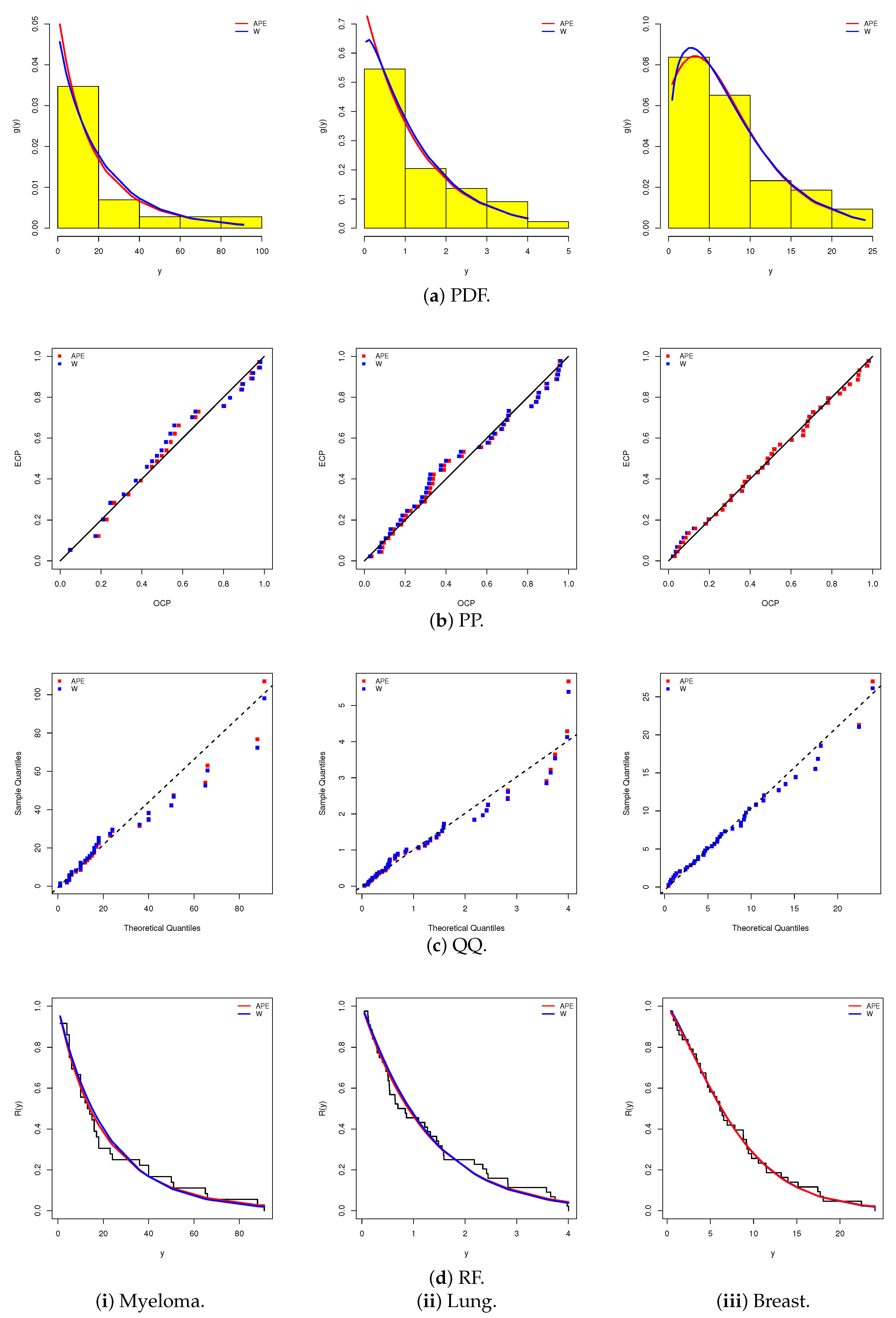
To further substantiate the model assessment,
Figure 4 provides a comprehensive visual evaluation for both the APE and W lifespan models using four diagnostic tools: (i) fitted density curves overlaid on data histograms, (ii) the fitted versus empirical probability–probability (PP) plot, (iii) the fitted versus empirical quantile–quantile (QQ) plot, and (iv) the fitted versus empirical reliability function (RF).
Figure 4a–d corroborate the numerical results, demonstrating that the APE lifetime model provides the best fit to all three cancer datasets and highlighting that the APE model is a strong competitor to the commonly used W lifespan model.
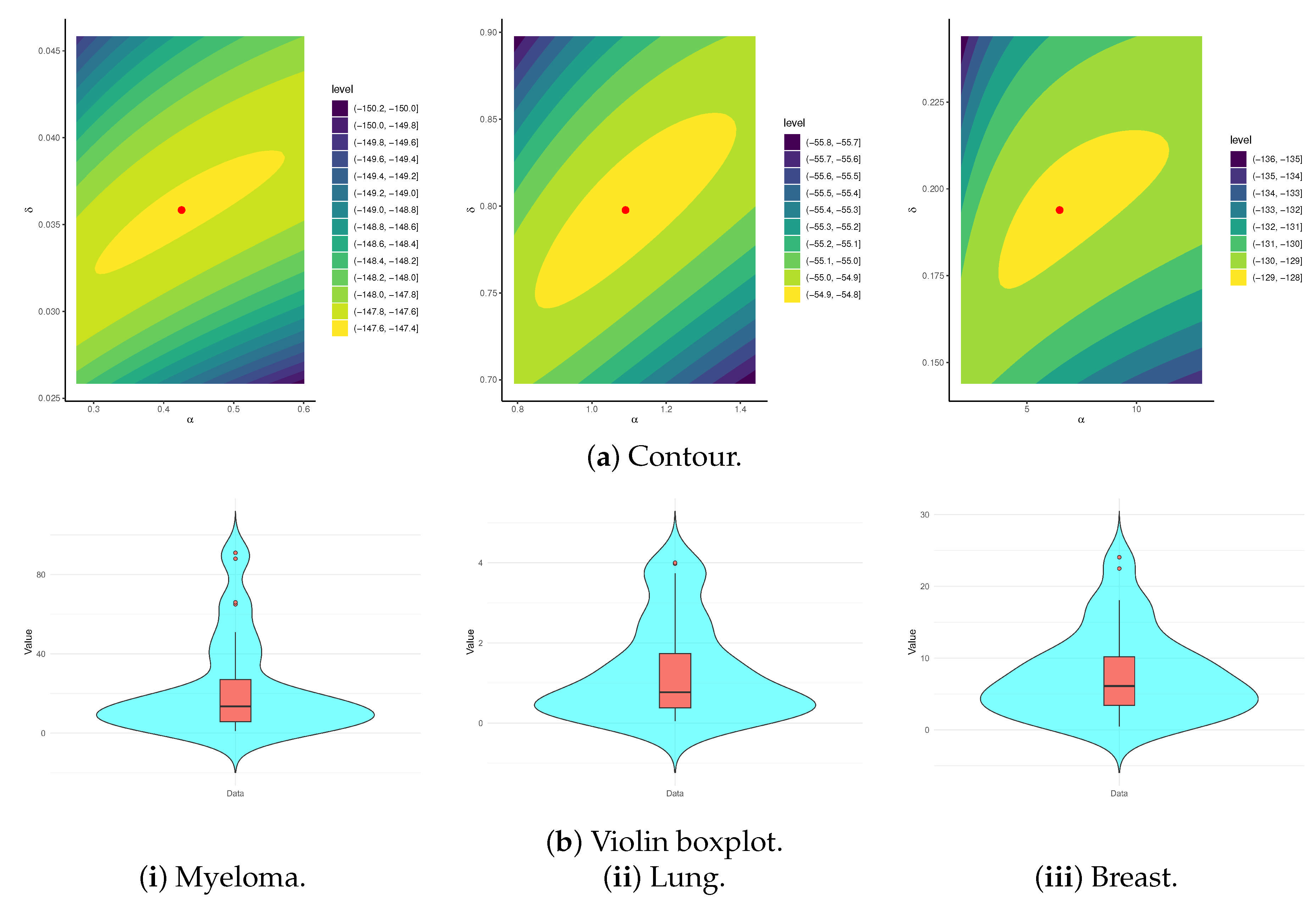
Figure 5 displays the log-likelihood contour plot and the violin boxplot of the APE
model. Moreover, the contour plot in
Figure 5a confirms the existence and uniqueness of the fitted MLEs of
and
, thereby reinforcing the model’s stability and identifiability. The estimates
and
are recommended as robust initial values for subsequent analytical procedures involving this dataset.
Figure 5b reveals that the (i) myeloma data is right-skewed, with a wider spread and several high-value outliers, indicating greater variability in survival times; the (ii) lung data is nearly symmetric, with a tighter interquartile range and fewer mild outliers, showing lower variability; and the (iii) breast data is mildly right-skewed, with a moderate spread and fewer outliers, reflecting more consistent survival times.
To assess the theoretical estimation performance of the APE model parameters (
,
,
, and
) together with the BB distribution parameters (
), the complete myeloma, lung, and breast cancer datasets were used in a simultaneous, life-testing experiment. These datasets were randomly partitioned into
groups, respectively, each containing
units, as shown in
Table 12, where starred items denote the first failure in each group. By fixing
and considering different options of
k, two artificial P-FFC-BB samples were generated from the myeloma, lung, and breast cancer datasets (see
Table 13).
In progressive censoring studies, the independence assumption between random removals and observed failure times is common because withdrawals are typically driven by administrative or external factors (e.g., patient drop-out or loss to follow-up) rather than the exact time-to-failure of other units.
Using the P-FFC-BB samples (with
) generated from the myeloma, lung, and breast cancer datasets reported in
Table 13, the corresponding Spearman rank correlation statistics (with their associated
p-values) between the observed failure times and removal counts are estimated as −0.714 (0.020), −0.678 (0.030), and −0.679 (0.031), respectively. These results indicate a statistically significant negative association: groups with earlier failures tended to have higher numbers of removals. This finding suggests that the assumption of independence between removals and failure times may not hold strictly for these datasets.
In the absence of prior information on the APE parameters
and the BB
parameters, a vague joint gamma prior with hyperparameters
was adopted. Following Algorithm 1, a total of
iterations were run, discarding the first
iterations as burn-in. Posterior summaries were then obtained for
,
,
,
, and
, including MCMC estimates under both SEL and GEL loss functions with
, as well as their 95% BCI/HPD interval estimates. For
and 1 in the myeloma, lung, and breast cancer datasets, respectively, all estimates of
and
were computed. The resulting point estimates (with their Std.Ers) and the 95% interval estimates (with their ILs) are summarized in
Table 14 and
Table 15. In comparison to classical likelihood-based estimates of
,
,
,
, and
, the point and interval estimation findings developed from the Bayesian approach showed clear superiority, producing smaller Std.Ers and shorter ILs for all parameters.
To establish the existence and uniqueness of the MLEs for the parameters of APE
and BB
, based on the P-FFC-BB datasets summarized in
Table 13,
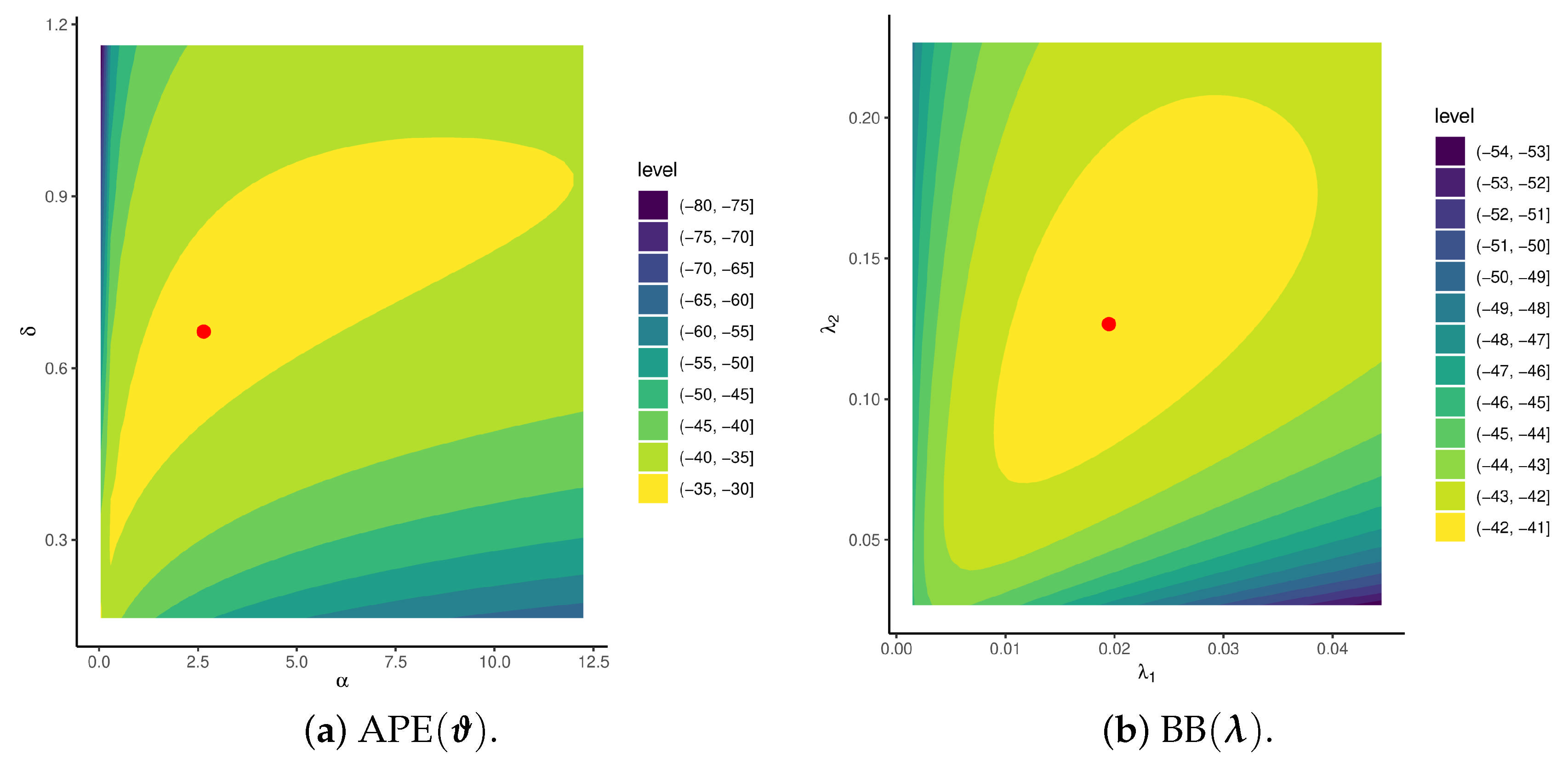
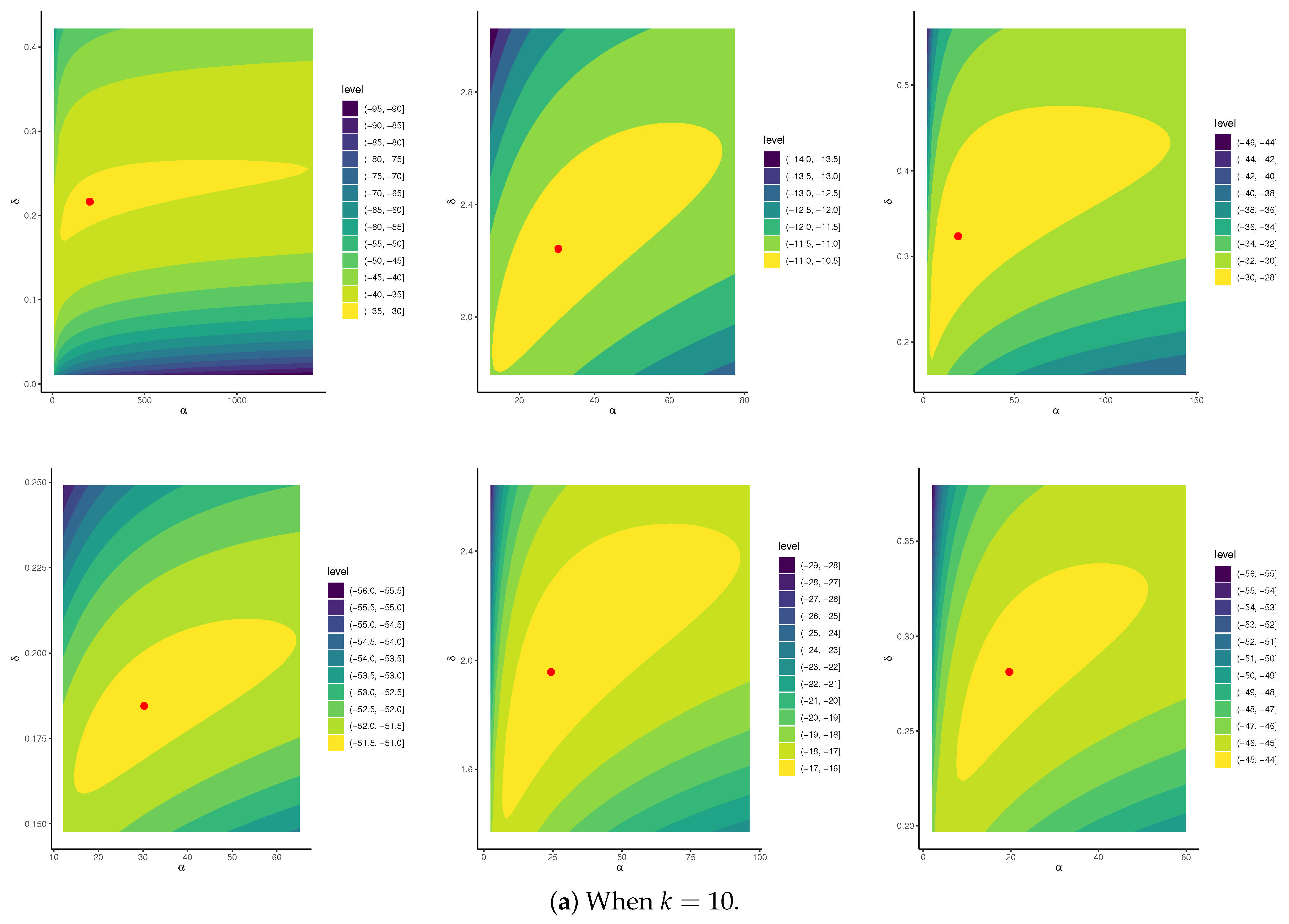
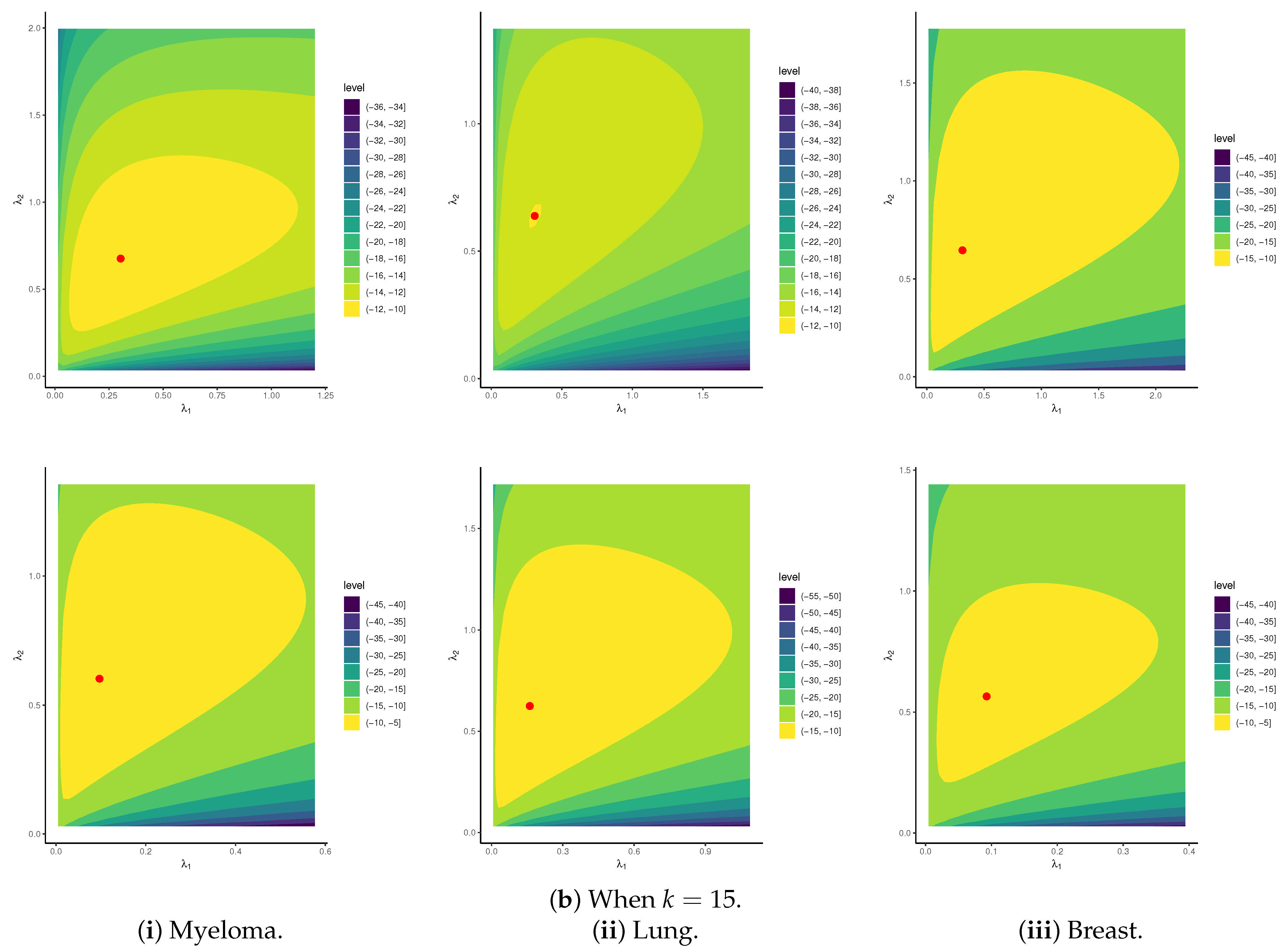
Figure 6 depicts the log-likelihood contours of
,
, and
(
). These plots demonstrate that the fitted MLEs (reported in
Table 14) for both APE
and BB
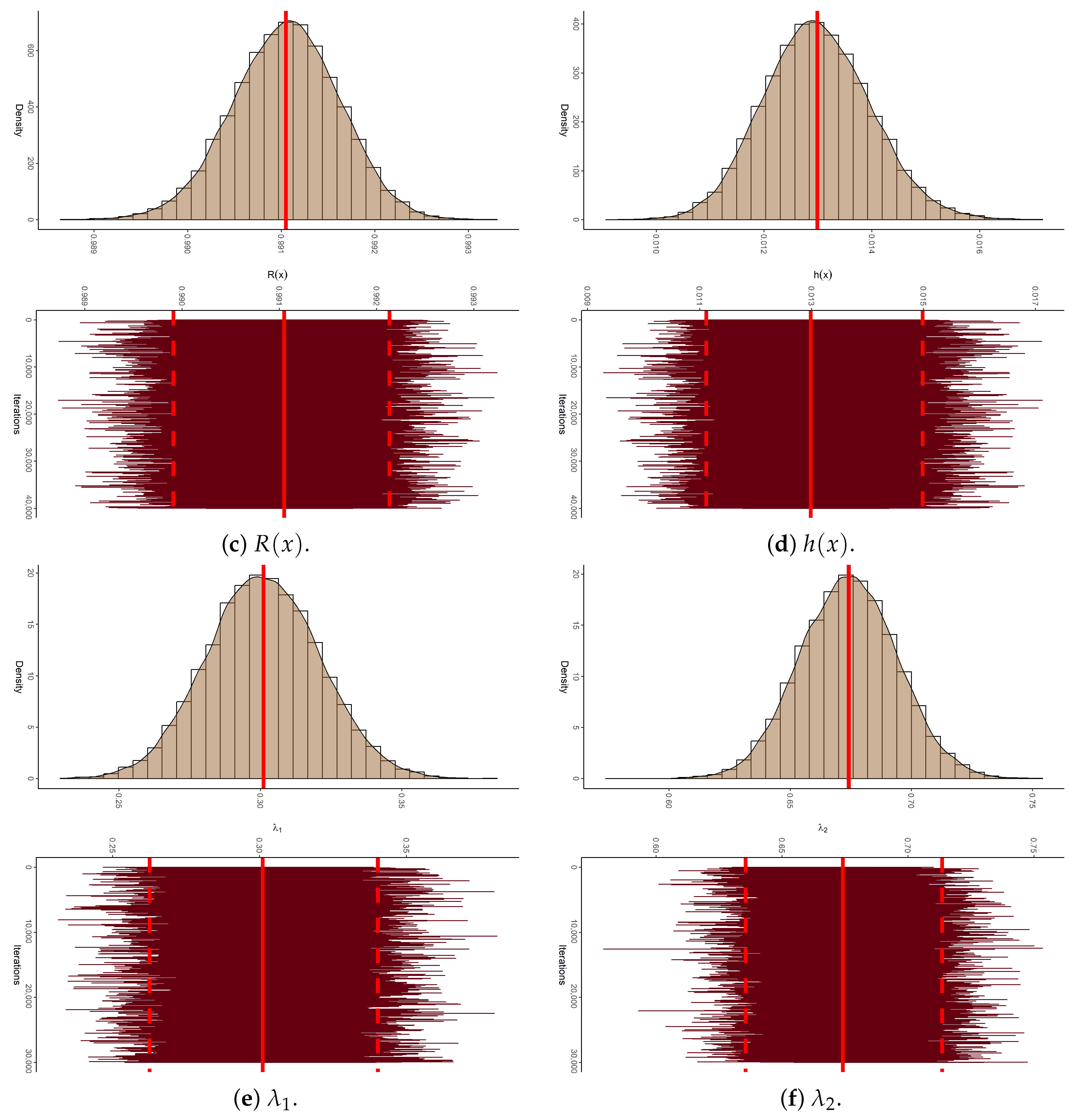
exist and are unique. Using these estimates as initial values, the proposed Markov chains were implemented. To assess the convergence behavior of the simulated 40,000 Markov chain variates for
,
,
,
, and
(
), we focused on the P-FFC-BB dataset at
(as a representative case) from
Table 13.
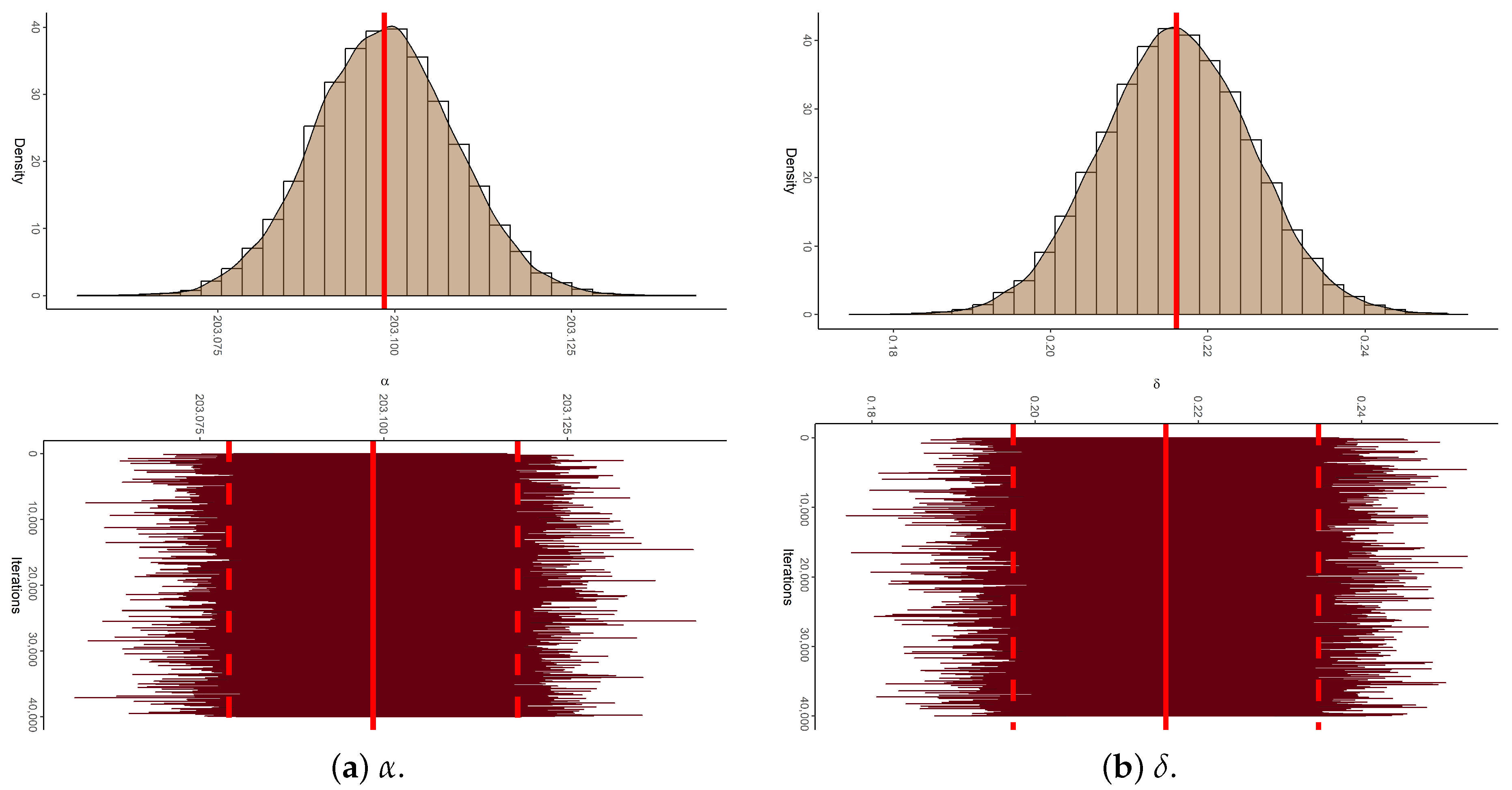
Figure 7 presents the corresponding trace plots and posterior density plots for each parameter. In each plot, the solid line denotes the Bayes’ MCMC estimates calculated by the SEL, and the dashed lines represent the 95% BCI bounds. The trace plots indicate that the simulated chains for all parameters exhibit stable and symmetric behavior, suggesting satisfactory convergence. To further validate this, we summarized key descriptive statistics based on the remaining 40,000 post-burn-in samples for each parameter (see
Table 16). These numerical summaries reinforce the visual evidence from
Figure 7, providing additional support for convergence and distributional stability across all monitored parameters.
7. Conclusions
In this work, we examined a novel alpha-powering model based on the exponential distribution within the framework of the P-FFC-BB removal plan. This contribution provides a flexible and realistic mechanism for capturing uncertainty in unit withdrawals, a prevalent challenge in reliability and biomedical studies. Comprehensive inference procedures were developed, including both maximum likelihood and Bayesian estimation methods. To address the intractability of the posterior distributions under squared-error and generalized entropy loss functions, a tailored Metropolis–Hastings algorithm was implemented, enabling accurate approximation of posterior summaries and credible intervals. To evaluate the performance of the proposed estimators, we conducted an extensive Monte Carlo simulation study, systematically assessing the effects of varying censoring levels, prior specifications, and group sizes. The simulation results revealed that Bayesian methods—particularly those based on asymmetric loss functions with informative priors—outperform the classical approach, yielding more accurate and stable estimates under complex censoring scenarios. Furthermore, asymptotic confidence intervals and Bayesian credible intervals have been derived and demonstrated satisfactory coverage probabilities across diverse settings. The practical relevance of the proposed model has been validated through applications to three real-world survival datasets from myeloma, lung, and breast cancer patients, where progressive censoring and drop-out variability are inherently present. In all cases, the proposed model exhibited superior goodness of fit, predictive reliability, and improved hazard rate estimation, underscoring its robustness in modeling complex survival mechanisms. While classical methods, such as the Kaplan–Meier estimator, Cox proportional hazards model, and Weibull-based parametric approaches, are well-established for right-censored data, they do not naturally accommodate the progressive first-failure censoring scheme with the stochastic beta–binomial removals considered here. The proposed framework specifically addresses this complexity by deriving tractable likelihoods and flexible hazard structures under such censoring, providing insights beyond the reach of conventional methods. Future work may include empirical comparisons with these classical approaches to highlight further the contexts where our method offers distinct advantages. Future research directions include extending the proposed framework to other baseline distributions with non-monotonic hazard rates, incorporating covariate effects within a regression structure, and exploring accelerated life-testing designs under similar censoring schemes. Future research could extend the proposed censoring framework to other flexible lifetime models—such as log-logistic, log-normal, generalized gamma, or Burr families—to better capture non-monotonic and heavy-tailed hazard structures.