


Abstract
In this paper, we consider a new design problem of optimizing a linear transceiver for correlated multiple-input multiple-output (MIMO) interference channels in the presence of channel state information (CSI) errors, which is a more realistic and practical scenario than those considered in the previous studies on uncorrelated MIMO interference channels. By taking CSI errors into account, the optimization problem is initially formulated to minimize the average mean square error (MSE) under the general power constraints. Since the objective function is not jointly convex in precoders and receive filters, we split the original problem into two convex subproblems, and then linear precoders and receive filters are obtained by solving two subproblems iteratively. It is shown that the proposed algorithm is guaranteed to converge to a local minimum. The numerical results show that the proposed algorithm can significantly reduce the sensitivity to CSI errors compared with the existing robust schemes in the correlated MIMO interference channel.
Keywords:
interference channel; MIMO; stochastic robustness; MSE minimization; CSI errors; general power constraints MSC:
94A05
1. Introduction
Inter-cell interference management is an important issue in upcoming wireless communications standards such as 3GPP LTE-Advanced and IEEE 802.16m due to universal frequency reuse [1,2]. One promising way to mitigate the inter-cell interference is through cooperation among base stations, e.g., coordinated multi-point transmission (CoMP) in 3GPP LTE-advanced as well as in 4G/5G/6G. In this paper, we consider a multi-cell scenario where base stations and mobile users are equipped with multiple antennas and model it as a multiple-input multiple-output (MIMO) interference channel. An interference channel is a network that models simultaneously communicating transmitter–receiver pairs using the same resources such as time and frequency [3]. In interference channels, much attention has been focused on information-theoretic studies such as interference alignment (IA), because the exact capacity characterization of the interference channels still remains unknown except for some special cases [3].
Recently, linear transceiver designs for the MIMO interference channel have been studied in [4,5,6,7] (as well as for MIMO multiuser systems in [8] and reconfigurable intelligent surface (RIS)-assisted MIMO systems in [9]) based on various criteria with the assumption of the perfect knowledge of the channel state information (CSI) at each node. To combat the assumption of perfect CSI, mean square error (MSE)-based robust transceiver design algorithms were developed in [7] while taking CSI errors into account. The results in [4,5,6,7] have been developed under the implicit assumption of independent and identically distributed (i.i.d.) or spatially uncorrelated channel elements.
1.1. Motivations
In real environments, however, the channel elements are not only erroneous due to inaccurate channel estimation or quantization of estimated CSI [10,11], but are also correlated due to little scattering and insufficient antenna spacing, e.g., the 3GPP spatial channel model (SCM). In this case, the performance of the works [4,5,6] is severely sensitive to both CSI errors and channel correlation. In addition, the existing results in [7] cannot be applicable to correlated MIMO interference channels, since they cannot appropriately deal with interference leakage through the correlated channels and their corresponding CSI errors. Although joint robust transceiver design methods with imperfect CSI were developed in [12,13] for single-user point-to-point correlated MIMO channels, these methods also cannot be directly extended to the correlated MIMO interference channels due to the interference issue.
Accordingly, in [14,15,16,17,18,19,20,21,22], effective robust transceiver designs have been developed for the MIMO interference channel with imperfect CSI. Despite these advantages in designs, the techniques in [14,15,16,17,18,19,20,21,22] have limitations or face technical obstacles in the following aspects. In [14,15,16,17,18,19], the CSI errors were assumed to be spatially uncorrelated. Also, in [20], the CSI errors were assumed to be correlated only at the transmitter sides, not at both the transmitter and receiver sides. In [21], the CSI errors were assumed to be deterministic (rather than random), which however may not adequately capture the stochastic nature of the uncertainty. In [22], a robust transceiver design scheme considering the (full) spatial correlation at both the transmitter and receiver sides was developed for the MIMO interference channel. However, [22] considered only the total power constraints at the transmitters, which clearly neglects the per-antenna power constraints, and thus hinders the practical applicability in distributed MIMO scenarios where multiple single-antenna devices collaborate to form a virtual antenna array under their strict individual power constraints (although the total power constraints and per-antenna power constraints have been investigated separately in the literature, such as in [23], these constraints have not been dealt with in an integrated or mixed manner as in our work).
1.2. Contributions
The main purpose of this study is to develop a novel robust transceiver design by considering a more realistic and practical scenario than the previous studies. The main contributions of this paper are as follows:
- We propose to design a new linear transceiver to minimize the average sum-MSE for the correlated MIMO interference channel under the CSI errors considering the general power constraints that include the total power constraints and per-antenna power constraints (as well as their mixtures) as special cases. Our design approach is based on the existing stochastic robust technique [12].
- Since the optimization problem is not jointly convex in precoders and receive filters, it is difficult to find the jointly optimal solution. In order to resolve this difficulty, we leverage the alternating optimization method. More specifically, we propose to divide the original problem into two subproblems that are convex in precoders and receive filters, respectively. Then, precoders and receive filters can be obtained by solving two subproblems iteratively.
- We present extensive numerical results, which demonstrate the superior performance and effectiveness of the proposed scheme compared to the conventional schemes.
1.3. Organization
1.4. Notations
, , and denote the transpose, conjugate transpose, and matrix square root, respectively. is the vectorization operator and is the trace of a matrix. Also, ⊗ and represent the Kronecker product and vectorization operator, respectively. denotes the expectation of a random variable x. A circular symmetric Gaussian random vector with mean and covariance matrix is denoted as .
2. System Model
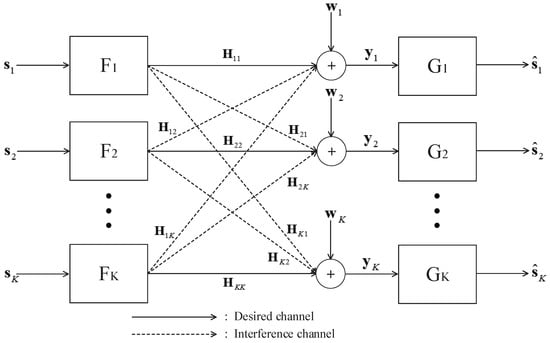
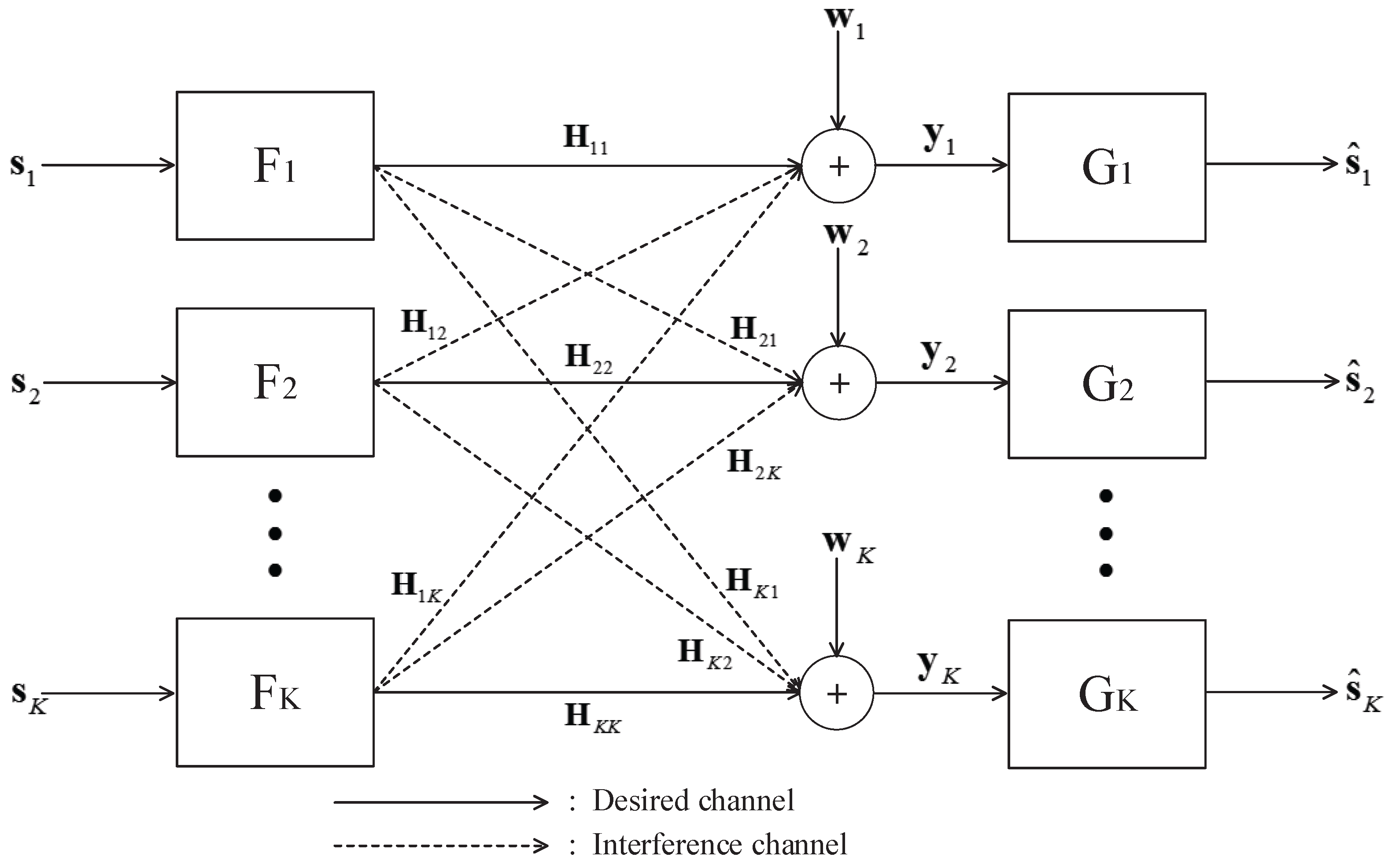
We consider the K-user MIMO interference channel as shown in Figure 1, in which there are K transmitter–receiver pairs and K transmitters that simultaneously transmit independent data streams to their intended receivers. The kth transmitter and receiver are equipped with antennas and antennas, respectively. The transmit signal vector at the kth transmitter is denoted as , where is the precoding matrix at the kth transmitter and is the symbol vector transmitted by the kth transmitter, which satisfies and .
Figure 1.
K-user MIMO interference channel.
Also, denotes the number of transmitted data streams at the kth transmitter. The received signal at the kth receiver is given by the following:
where denotes the channel matrix between the j-th transmitter and kth receiver, and it is assumed to be frequency-flat. is the additive Gaussian noise at the k-th receiver whose elements are i.i.d. . In this paper, we assume that the elements of the channel matrices are correlated and adopt the Kronecker channel model, which is widely used in MIMO systems due to its simplicity and analytical tractability [24] (p. 90). Using this model, the channel matrices can be expressed as follows:
where is the spatially white channel matrix whose elements are i.i.d. . and represent the transmit correlation at the jth transmitter and receive correlation at the kth receiver, respectively. Although the channel matrices can vary block to block due to mobile location, the correlation matrices can be assumed to be constant over a large number of blocks since the scattering environments change slowly. For this reason, they can be estimated reliably at each receiver and fed back to the transmitters through reliable feedback links [25]. Hence, we reasonably assume that the channel correlation matrices are constant and available at each node, and that the CSI errors are mainly due to the imperfect channel estimation.
We define the CSI error for each link of the interference channel as follows:
where is an estimate of . For the Kronecker channel model, the CSI error can be modeled as [13,26], and it is said to have a matrix variate complex Gaussian distribution, which can be written as follows [27]:
where is the channel estimation error variance, and and represent the column and row covariance of , respectively. It is assumed that the CSI error is independent of the transmitted symbol and noise. If the minimum MSE (MMSE) channel estimator is used to estimate the spatially white channel , the matrices and can be represented by and , respectively, and is given by , where denotes the variance of each element of [26]. On the other hand, if the correlated channel is estimated using the MMSE channel estimator, and are given by and , and is given by , where is the training signal power at the jth transmitter [13].
3. Problem Formulation and Linear Transceiver Design
3.1. General Power Constraints
We impose the general power constraints at each transmitter, which are described by
where ’s and ’s are weighting matrices and power budgets, respectively. Also, denotes the number of constraints, which determines the type of power constraint together with the weighting matrices ’s. The general power constraints in (5) include the total power constraint, per-antenna power constraints, and a mixture between total and per-antenna power constraints as special cases via a proper selection of ’s [28,29]. For example, when and , it corresponds to the total power constraint with , where corresponds to the total power budget. On the other hand, when and , , where denotes the lth unit vector (i.e., all zeros except for the lth entry being unity), the general power constraints reduce to the per-antenna power constraints as , , with corresponding to the power budget of the lth transmit antenna of the kth transmitter.
3.2. Problem Formulation
For given CSI errors with known distributions, one of the most popular approaches to design the transceiver is to optimize the average performance of the system. This approach is known as the stochastic robust technique [12,13]. By exploiting this technique, in this section, we will design a set of precoders and receive filters to minimize the average sum-MSE, i.e., the total discrepancy between the transmit signals and their estimates, over CSI errors under the general power constraints in (5). We select the sum-MSE minimization as an optimization criterion for the following reasons. First, an MSE-based design can improve the performance of the system in all SNR regions unlike the zero-forcing and matched filtering. Second, in the case of a transmission of control signals, it is better to minimize the total MSE for improvement of the transmission reliability. Finally, it is known that the solution of the weighted sum-MSE minimization problem maximizes the sum-rate if weight matrices are properly chosen [30].
Let represent the estimate of when a linear receive filter is used. In order to derive an expression of the average sum-MSE over CSI errors, denoted by
we state the following lemma.
Lemma 1
([27]). Let be a random matrix and ; then,
where is a deterministic matrix, and and are positive semi-definite matrices.
Using Lemma 1, the average sum-MSE is expressed as follows:
Our goal is to design a set of precoders and receive filters that minimize the average sum-MSE under the general power constraints at each transmitter. The optimization problem can be formulated as follows:
Since the optimization problem in (8) is not jointly convex in and , it is difficult to find and jointly. However, it is convex in for a given , and in for a given (in general, combining two convex problems does not necessarily guarantee that the resulting problem will remain convex. In our case, although the problem in (8) is convex in either or , it is not jointly convex over both and due to the coupling between and ).
Based on this observation, we divide the original problem (8) into two convex subproblems that can be solved iteratively via the alternating minimization method [5].
3.3. Receive Filter Design
For a given , the optimization problem in (8) becomes an unconstrained convex optimization problem with respect to , and hence the optimal receive filters can be obtained by the optimality conditions, which are given by . From the optimality conditions, the optimal receive filters for a given can be found in the form of the well-known Wiener filter as follows:
where .
3.4. Precoder Design
When are given, the optimization problem in (8) is a constrained convex optimization problem with respect to , because the objective function is a quadratic function and the general power constraints are convex with respect to . To be specific, with some mathematical manipulations, the average sum-MSE in (sumMSE) can be rewritten in terms of as follows:
where:
Similarly, the general power constraints in (5) can be equivalently written as follows:
where:
Using the above results and introducing the slack variables (corresponding to the upper bound of the objective value), the precoder design problem can be recast into the following second-order cone programming (SOCP):
Since the above SOCP problem is convex, it can be solved efficiently via convex optimization techniques such as the interior point method [31].
For a special case when only the total power constraints are imposed (i.e., , ), the optimal precoders can be found in a closed form to satisfy the Karush–Khun–Tucker (KKT) conditions [31]. Specifically, from the KKT conditions, the optimal precoders for a given are expressed as follows:
where . This coincides with the existing result in [22] (Equation (6)). Note, that denotes the Lagrangian multiplier associated with the total power constraint at the kth transmitter, which is chosen to satisfy . Since the total transmit power is a monotonically decreasing function of , the optimal value of can be found through a one-dimensional (1-D) search such as the bisection method [7].
3.5. Proposed Algorithm
In this subsection, based on the results (9) and (16) obtained in the previous subsections, we propose a robust transceiver design algorithm. The proposed algorithm is shown in Algorithm 1 and summarized as follows. First, the algorithm is initialized by an appropriate set of precoders that satisfies the power constraints. Then, and are iteratively updated based on (9) and (16), respectively, until the stopping criterion is met.
It is clear that the updated linear receive filters yield the minimum average sum-MSE for a given , and hence ≤ . Also, since minimizes the average sum-MSE for a given , we have ≤ . That is, the proposed algorithm monotonically decreases the average sum-MSE that is lower-bounded by zero. Thus, according to the monotonic convergence theorem [32], the proposed algorithm is guaranteed to converge to a local optimum. If initial points are properly selected, the proposed algorithm may converge to the global optimum. Several methods for choosing appropriate initial points were given in [7].
| Algorithm 1 Proposed Robust Transceiver Design for MIMO Interference Channel with Generalized Power Constraints |
|
4. Results and Discussion
4.1. Simulation Setup
In the simulations, we considered a three-user MIMO interference channel with , , and . Also, the QPSK modulation was used for each data stream. The exponential model was used for both the transmit and receive correlation matrices, and their entries were given by , and , , where and are the correlation coefficients at the transmitter and receiver, respectively [33]. Each transmitter has the same power constraint () and the noise variance at each receiver is the same (). We define the SNR as . We use the erroneous CSI model considered in [26]. In this case, , , , and the channel estimate of each link can be expressed as . Also, we set and , .
4.2. Performance Comparisons
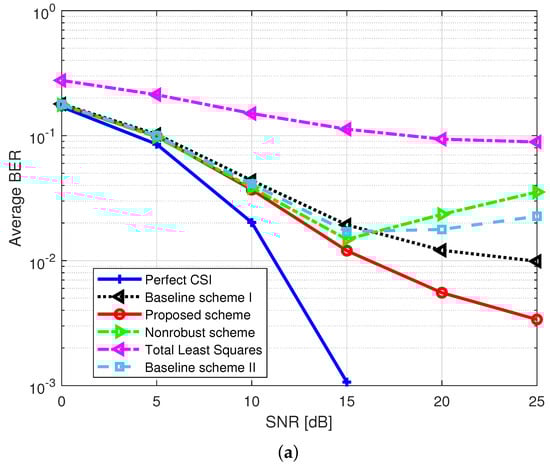
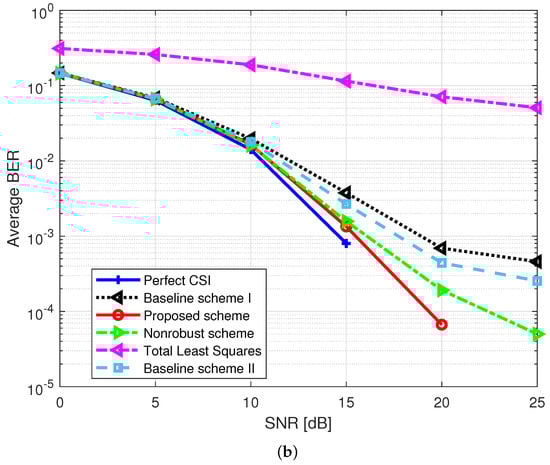
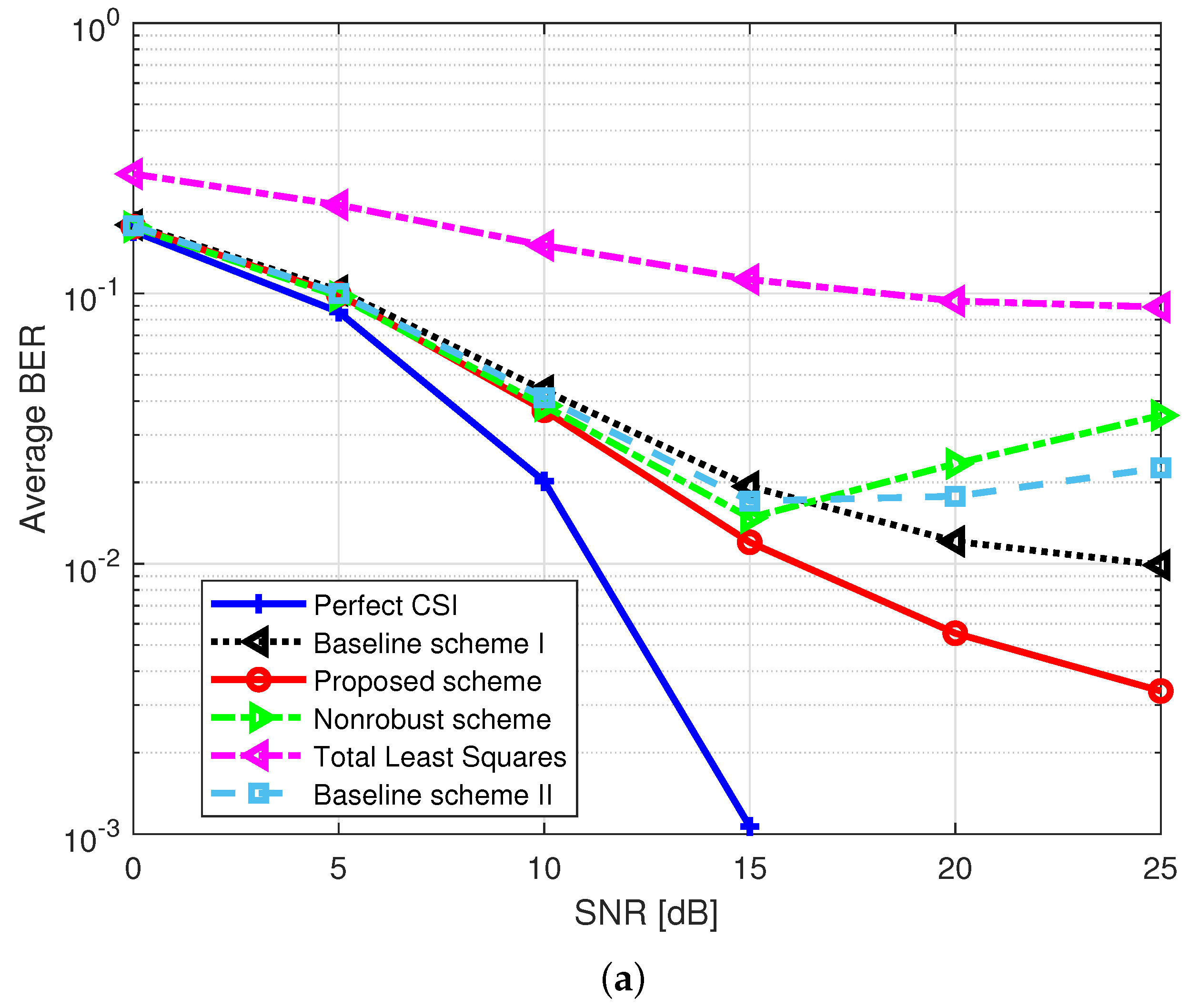
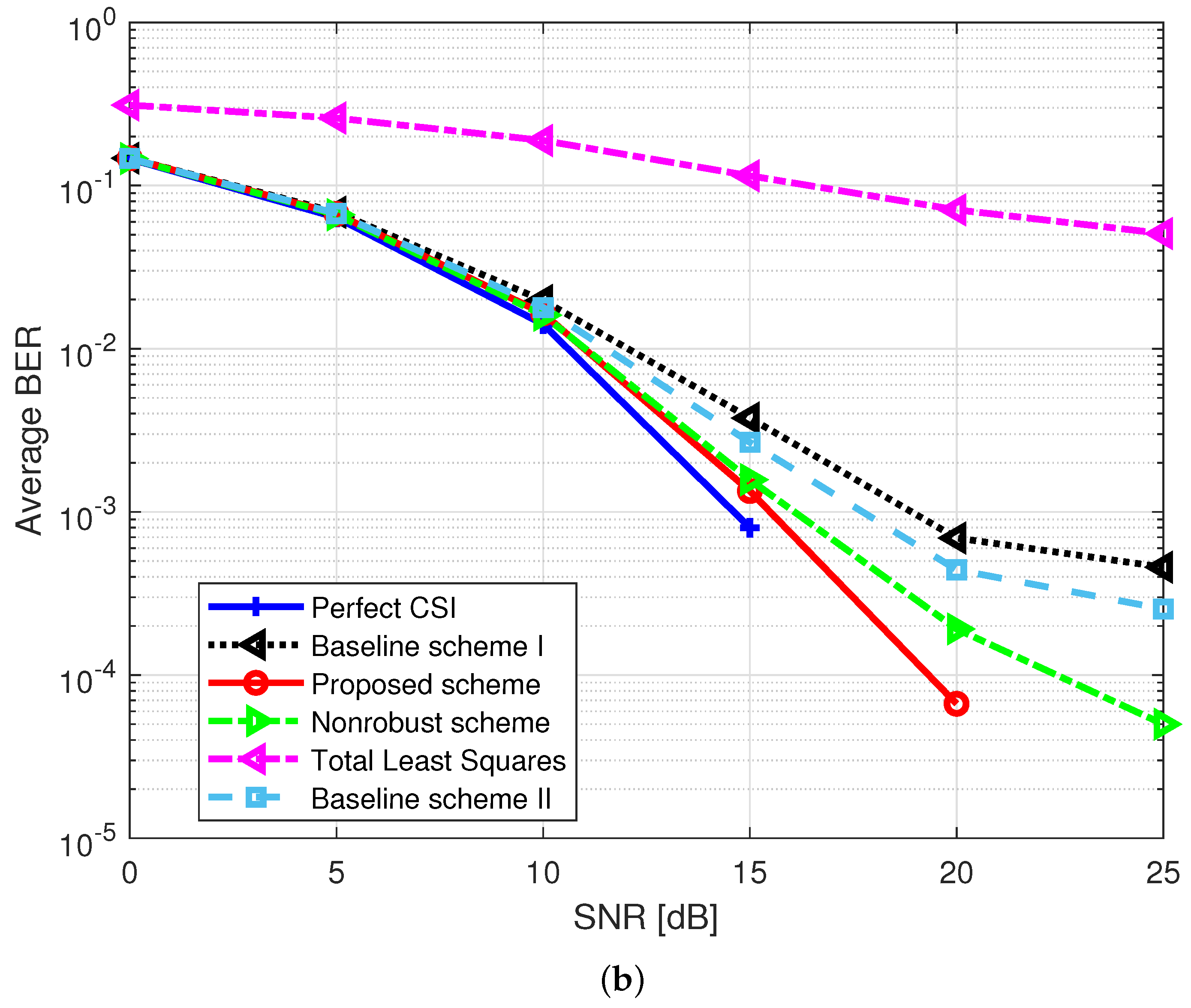
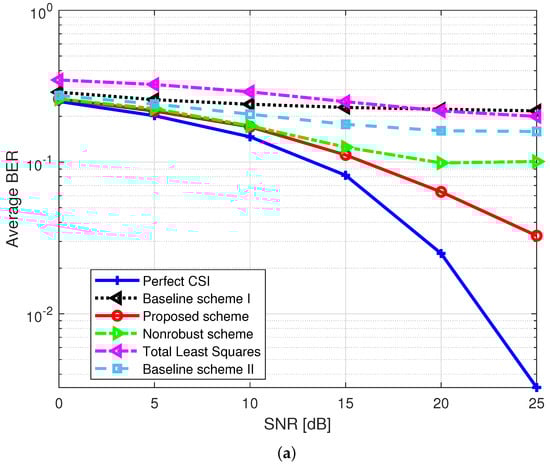
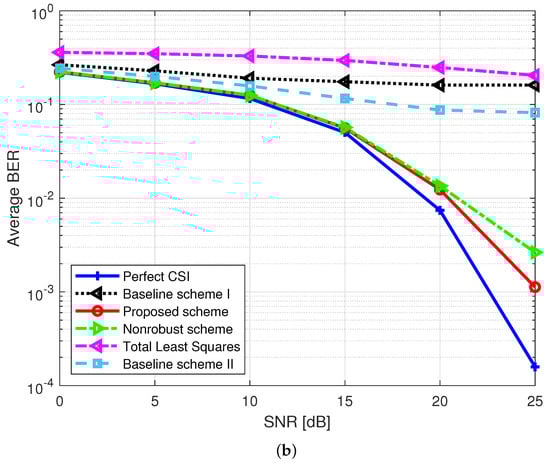
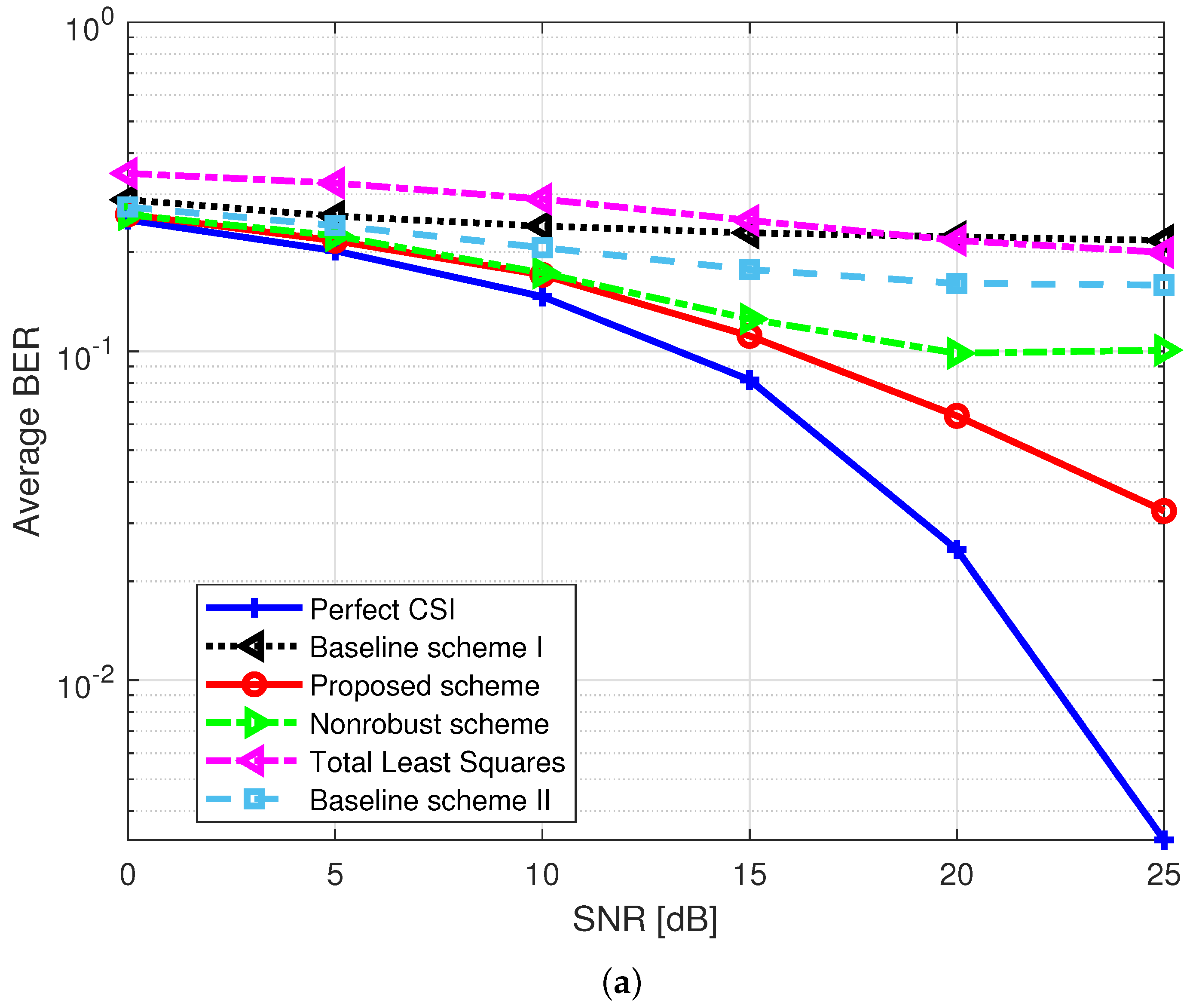
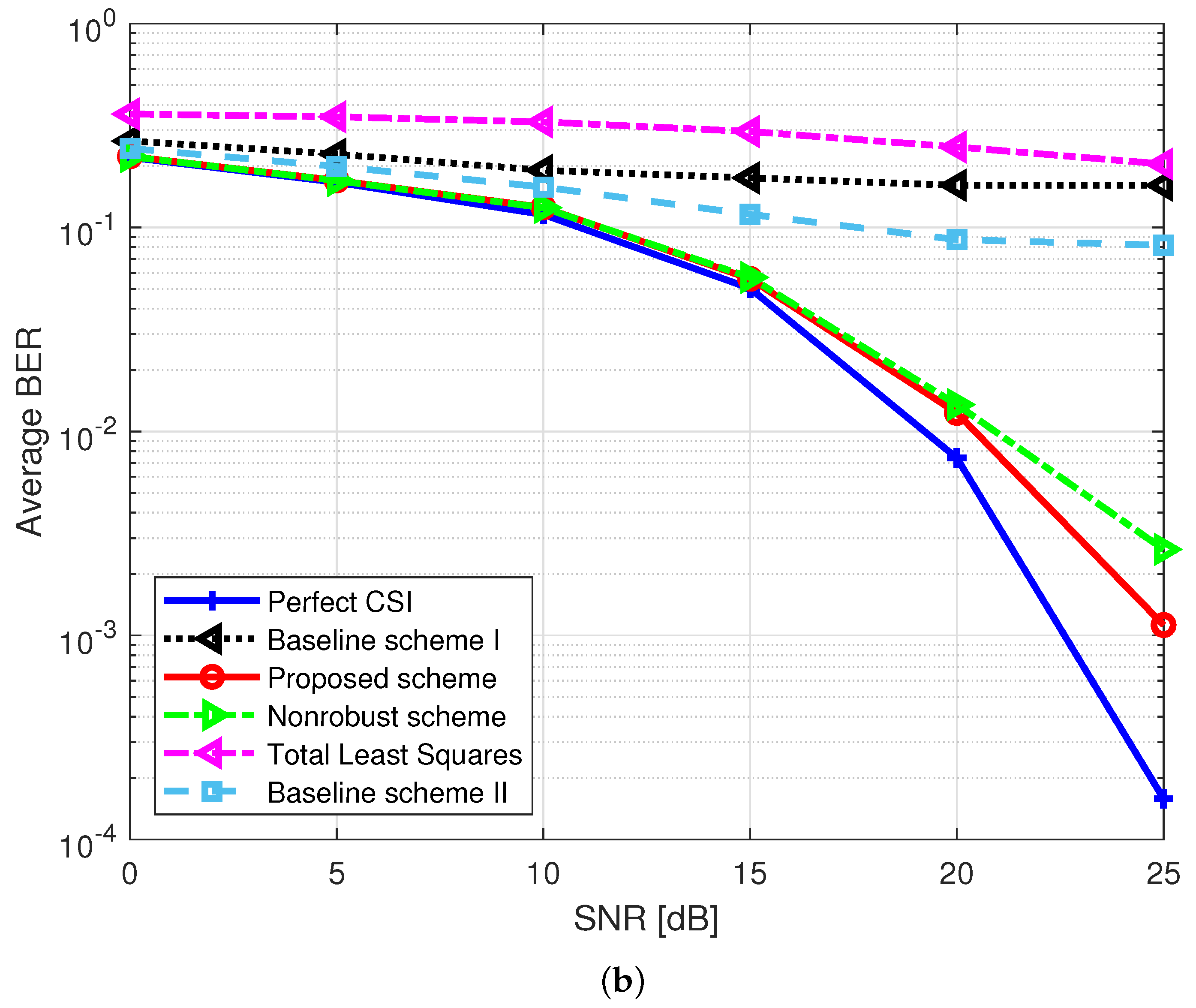
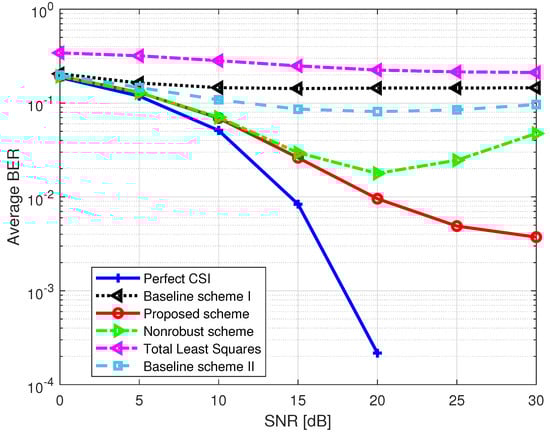
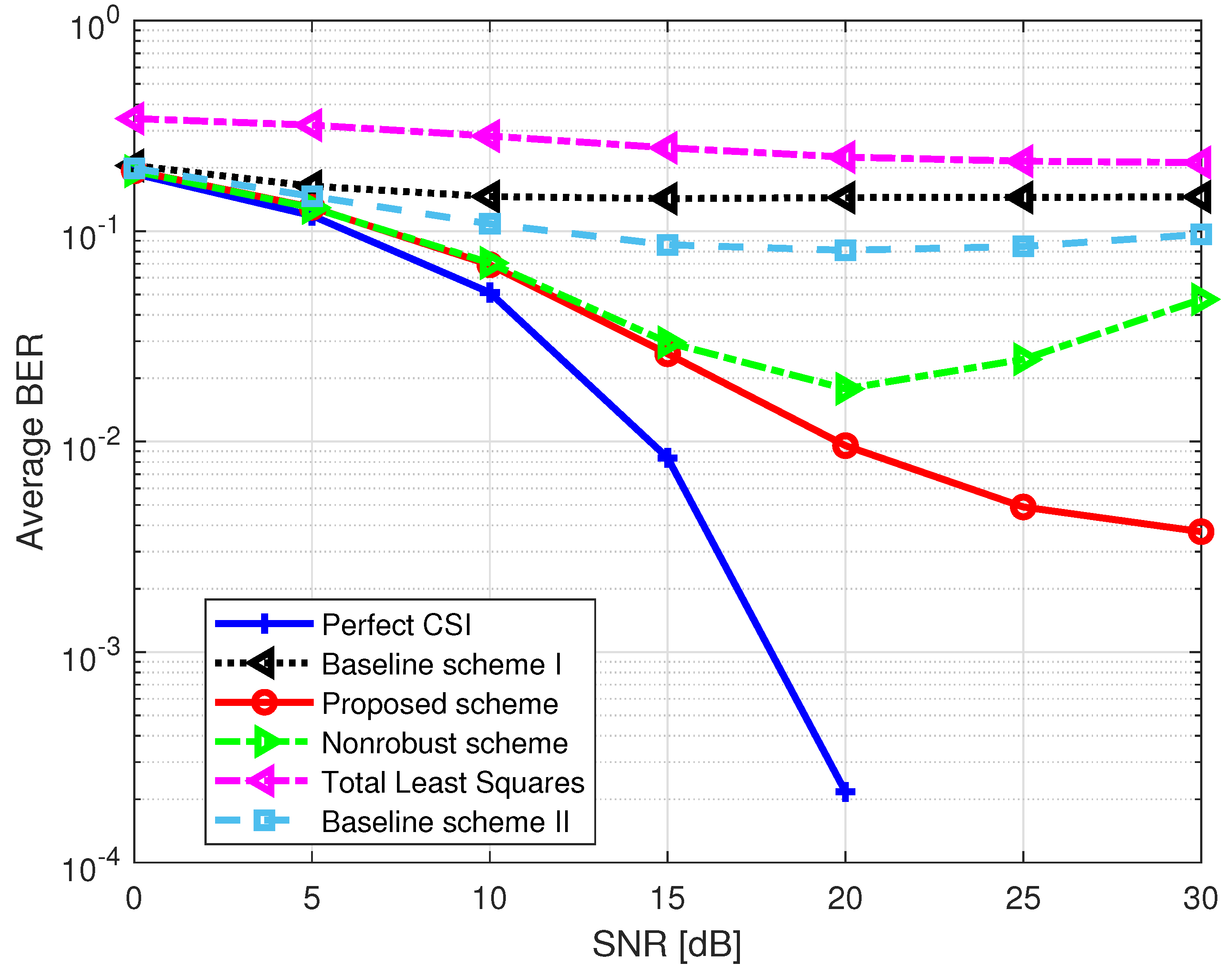
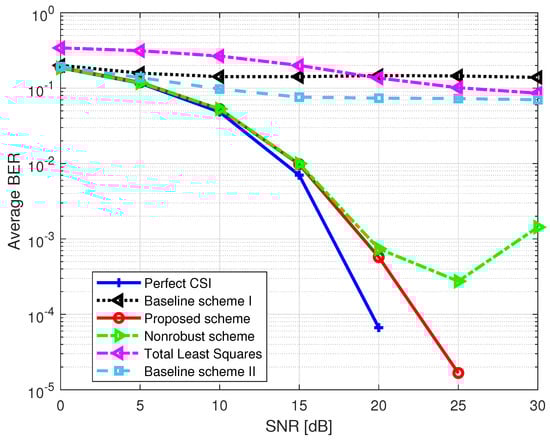
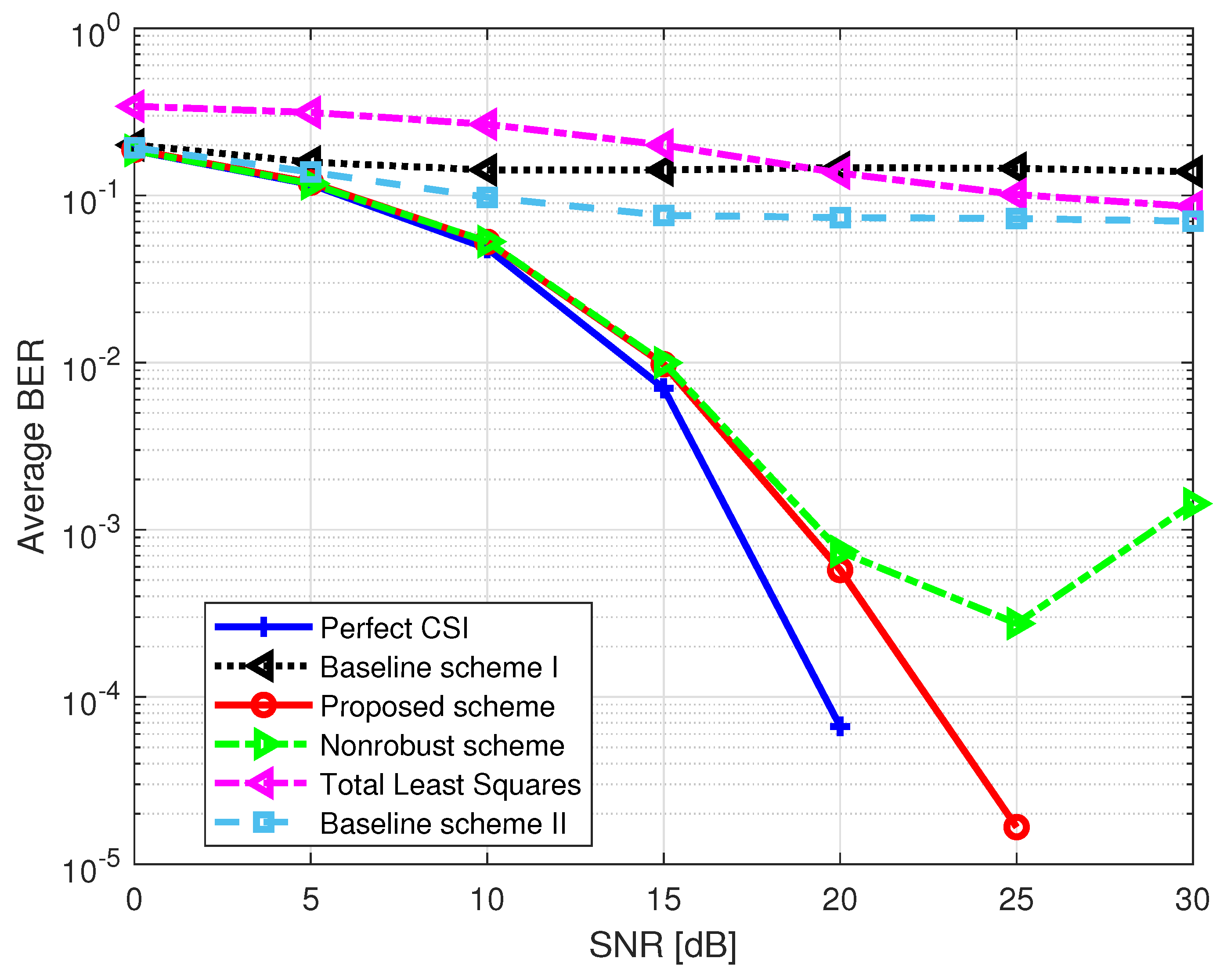
The BER performance of the proposed algorithm is compared with the following conventional schemes: a perfect CSI case, a nonrobust scheme, the robust scheme in [7] (denoted by Baseline scheme I), which corresponds to and the case in the proposed algorithm, the robust scheme in [20] (denoted by Baseline scheme II), and a conventional robust least squares technique taking the channel perturbation into account [34]. The results were averaged over 10,000 independent trials. Figure 2 shows the average BER performance for the weekly correlated MIMO interference channel () when and , . The average BER performance for the strongly correlated MIMO interference channel () is shown in Figure 3 for when and , . From these figures, we can see that the proposed algorithm provided better BER performance and significantly reduced the sensitivity to CSI errors compared with the conventional robust schemes in the correlated MIMO interference channel. When , the proposed scheme degraded by roughly 1–3 dB compared to the perfect CSI case.
Figure 2.
The average BER performance for the weakly correlated channel (). (a) , . (b) , .
Figure 3.
The average BER performance for the strongly correlated channel (). (a) , . (b) , .
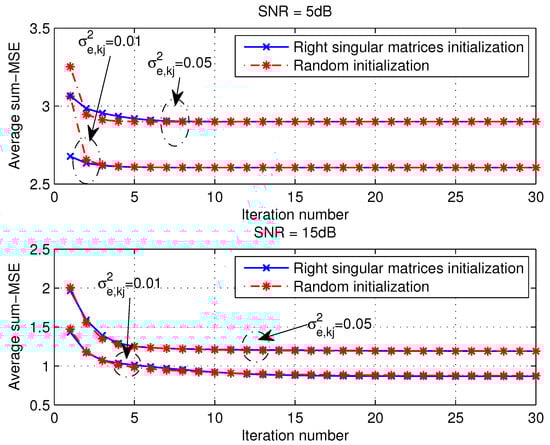
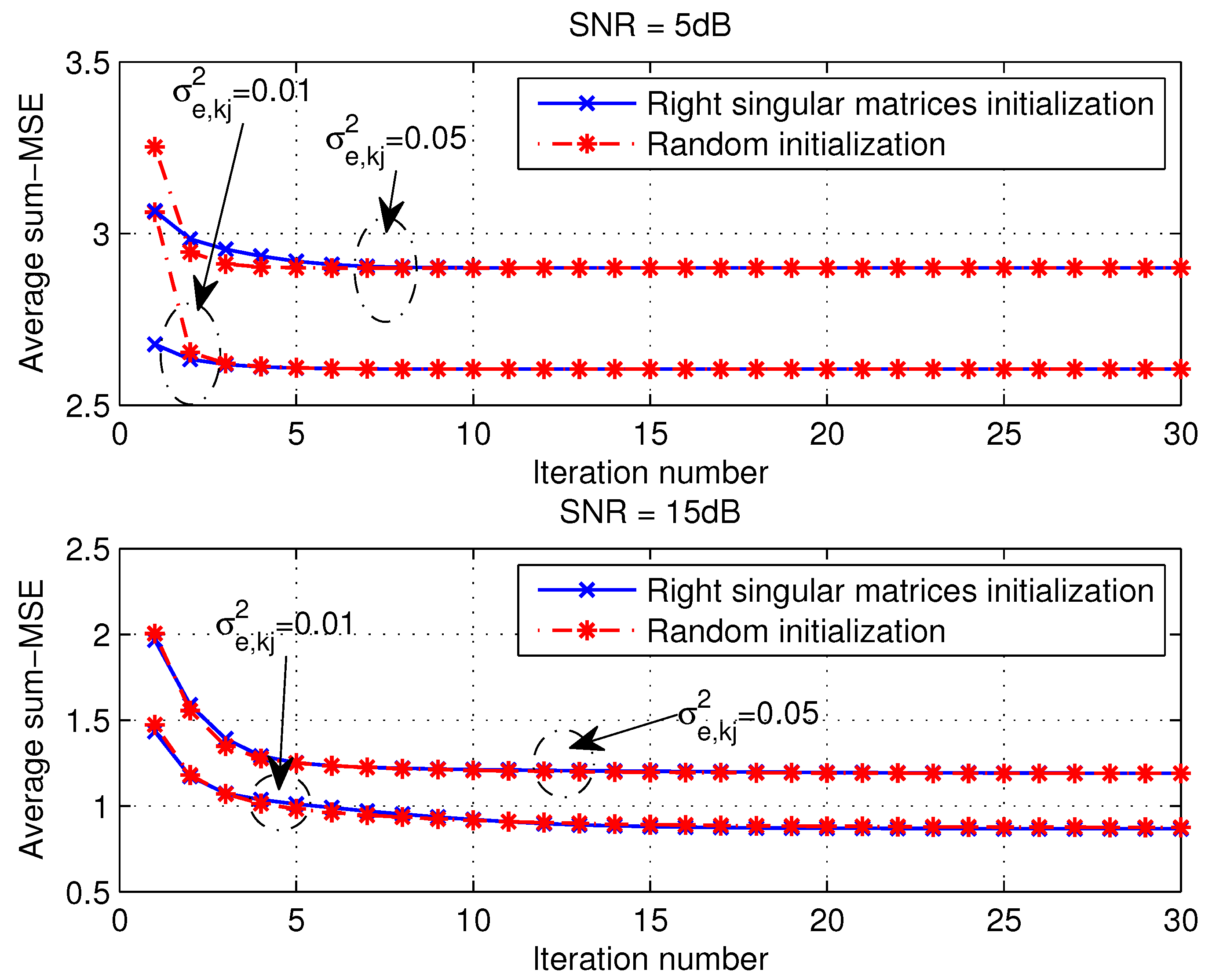
The convergence behavior of the proposed algorithm is depicted in Figure 4 for SNR = 5 dB and 15 dB with two different initialization methods. One is the singular matrices initialization method and the other is the random initialization method [7]. In both cases, we used the values and , . From the figure, we can observe that the proposed algorithm converged within a few iterations.
Figure 4.
Convergence behavior of the proposed algorithm with two different initialization methods.
As shown in Figure 5 and Figure 6, we set and , , respectively, and compared the average BER performance of the proposed and conventional schemes. From Figure 5 and Figure 6, it can be observed that the proposed scheme still significantly outperformed the other schemes.
Figure 5.
Average BER performance comparison when , .
Figure 6.
Average BER performance comparison when , .
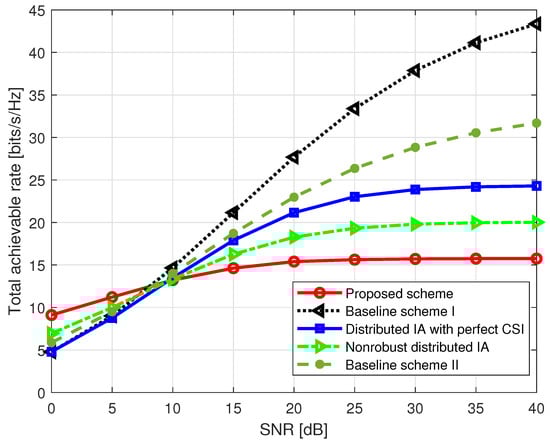
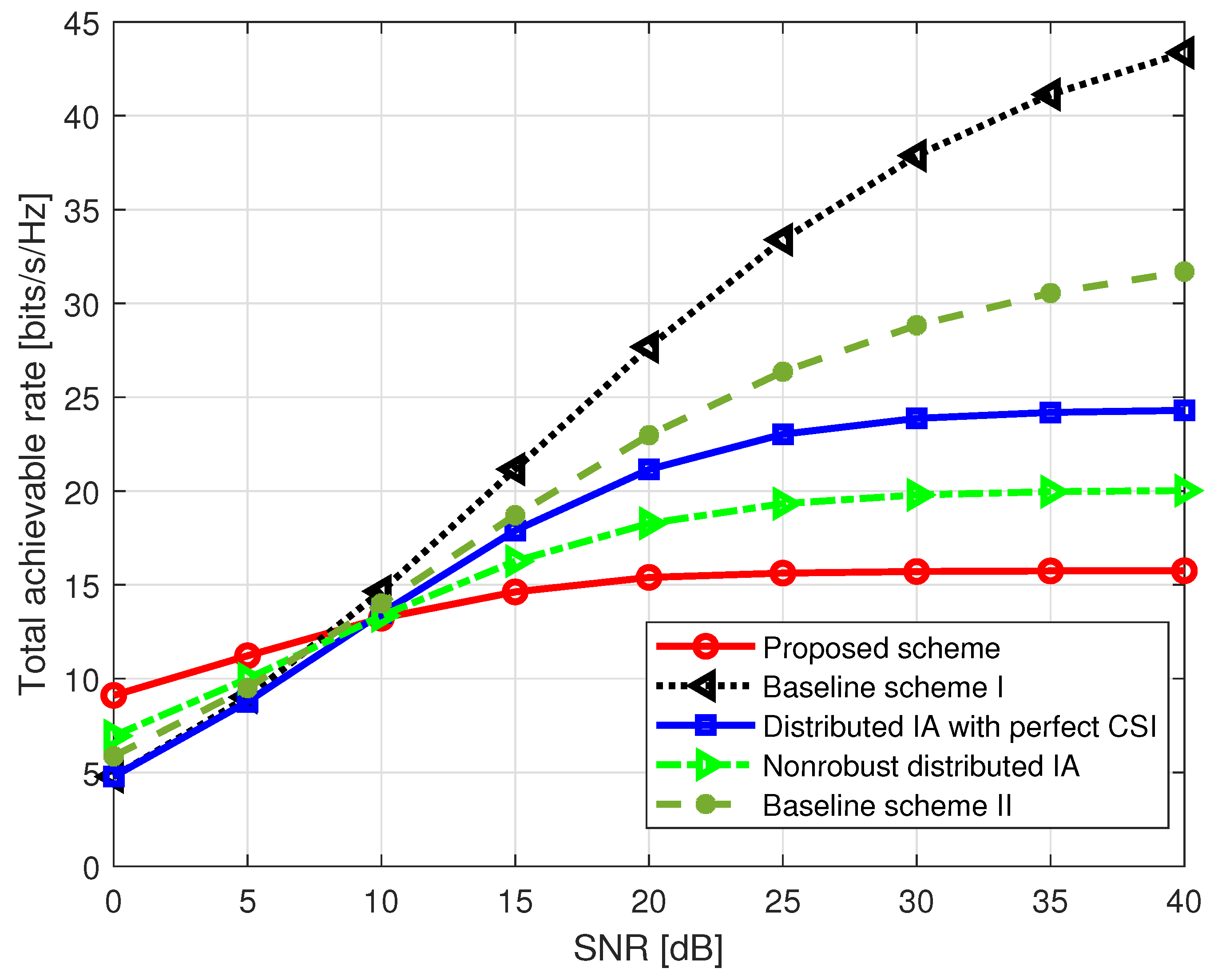
In Figure 7, the total achievable rate of the proposed scheme is compared with that of the distributed interference alignment (IA) scheme in [4] and those of the robust schemes in [7,20] when , . From the figure, we can observe that the proposed scheme yielded a higher total achievable rate than the schemes in [4,7,20], and it achieved almost the same degrees of freedom as those of the IA scheme roughly for the 0 dB to 20 dB SNR range. As the SNR increased beyond 20 dB, the performance of the proposed scheme degraded, but it still outperformed the nonrobust IA scheme and the robust schemes in [7,20] in terms of the total achievable rate.
Figure 7.
Comparison of the total achievable rate when , .
4.3. Complexity Analysis
In each iteration of Algorithm 1, the update of the receive filters requires a computational complexity of and the update of the precoders requires a computational complexity of . Thus, the overall complexity of the proposed scheme is estimated as , where denotes the number of iterations. Similarly, the computational complexity of the nonrobust scheme or the robust scheme in [4] is estimated as .
4.4. Discussion
Overall, from the numerical results along with the analysis on the computational complexities, it can be concluded that the proposed scheme yields a comparable performance to IA with perfect CSI and considerably surpasses the other schemes in terms of the BER and data rate at the cost of slightly higher computational complexity than the other schemes, thereby rendering it highly useful in practice. The conventional schemes suffer from poor sensitivities to the correlated CSI errors, and thus they should be of limited applicability in practice.
5. Conclusions
In this paper, we have investigated the robust transceiver design for the correlated MIMO interference channel in the presence of CSI errors, considering the general transmit power constraints. We have proposed an alternating optimization-based iterative algorithm minimizing the average sum-MSE with respect to the CSI errors, and it has been shown that the proposed algorithm is guaranteed to converge to a local optimum. Through the simulation results, the proposed algorithm has been demonstrated to better cope with the CSI errors compared to the conventional robust schemes in the correlated MIMO interference channel.
As an interesting and important focus of future research, it is deserved to study the robust transceiver design in a more general scenario, e.g., in multi-cell or multi-group multicast scenarios.
Author Contributions
Conceptualization, J.-M.K.; supervision, D.-W.L. All authors have read and agreed to the published version of the manuscript.
Funding
This work was supported by a Korea Agency for Infrastructure Technology Advancement (KAIA) grant funded by the Ministry of Land, Infrastructure and Transport (Grant RS-2023-00251002), and in part by First Research Fund Program In Life at Changwon National University in 2023.
Data Availability Statement
No new data were created or analyzed in this study. Data sharing is not applicable to this article.
Conflicts of Interest
The authors declare no conflicts of interest.
Abbreviations
List of mathematical symbols used in this paper:
| Symbol | Definition |
| K | Number of transmitter–receiver pairs |
| Number of antennas at the kth transmitter | |
| Number of antennas at the kth receiver | |
| Transmit signal of the kth transmitter | |
| Precoding matrix of the kth transmitter | |
| Transmit symbol (or data) of the kth transmitter | |
| Number of data streams of the kth transmitter | |
| Received signal at the kth receiver | |
| Received noise at the kth receiver | |
| MIMO channel matrix between the jth transmitter and the kth receiver | |
| Transmit correlation matrix at the kth transmitter | |
| Receive correlation matrix at the kth transmitter | |
| Estimate of | |
| Error between and | |
| Column covariance matrix of | |
| Row covariance matrix of | |
| Weighting matrix for the lth power constraint at the kth transmitter | |
| Power budget for the lth power constraint at the kth transmitter | |
| Receiver filter at the kth receiver | |
| Estimate of at the kth receiver | |
| Average sum-MSE |
References
- 3rd Generation Partnership Project (3GPP). Requirements for Further Advancements for for Evolved Universal Terrestrial Radio Access (E-UTRA); Physical Layer Aspects; Technical Reports; ETSI: Valbonne, France, 2008. [Google Scholar]
- IEEE 802.16m-07/002; Draft IEEE 802.16m Requirements; Broadband Wireless Access Working Group, WirelessMAN: New York, NY, USA, 2010.
- Cadambe, V.; Jafar, S.A. Interference alignment and the degrees of freedom of the K user interference channel. IEEE Trans. Inf. Theory 2008, 54, 3425–3441. [Google Scholar] [CrossRef] [Scilit]
- Gomadam, K.; Cadambe, V.R.; Jafar, S.A. A distributed numerical approach to interference alignment and applications to wireless interference networks. IEEE Trans. Inf. Theory 2011, 57, 3309–3322. [Google Scholar] [CrossRef] [Scilit]
- Peters, S.W.; Heath, R.W., Jr. Interference alignment via alternating minimization. In Proceedings of the 2009 IEEE International Conference on Acoustics, Speech and Signal Processing, IEEE ICASSP′09, Taipei, Taiwan, 19–24 April 2009. [Google Scholar]
- Peters, S.W.; Heath, R.W., Jr. Cooperative algorithms for MIMO interference channels. IEEE Trans. Veh. Technol. 2011, 60, 206–218. [Google Scholar] [CrossRef] [Scilit]
- Shen, H.; Li, B.; Tao, M.; Wang, X. MSE-based transceiver designs for the MIMO interference channel. IEEE Trans. Wirel. Commun. 2010, 11, 3480–3489. [Google Scholar] [CrossRef] [Scilit]
- Muthu, P.S.B.; Ponnusamy, K. Design of linear precoder for correlated multiuser MIMO system with imperfect CSI. AEU-Int. J. Electron. Commun. 2017, 74, 55–62. [Google Scholar] [CrossRef] [Scilit]
- Kang, J.-M.; Yun, S.; Kim, I.M.; Jung, H. MSE-based joint transceiver and passive beamforming designs for intelligent reflecting surface-aided MIMO systems. IEEE Trans. Wireless Commun. 2021, 11, 622–626. [Google Scholar] [CrossRef] [Scilit]
- Wang, J.; Jafar, S.A. Robust sum-GDoF of symmetric 2 × 2 × 2 weak interference channel with heterogeneous hops. IEEE J. Sel. Areas Commun. 2023, 41, 1309–1319. [Google Scholar] [CrossRef] [Scilit]
- Zhang, X.; Vaezi, M. Deep autoencoder-based Z-interference channels with perfect and imperfect CSI. IEEE Trans. Commun. 2024, 72, 861–873. [Google Scholar] [CrossRef] [Scilit]
- Zhang, X.; Palomar, D.P.; Ottersten, B. Statistically robust design of linear MIMO transceivers. IEEE Trans. Signal Process. 2008, 56, 3678–3689. [Google Scholar] [CrossRef] [Scilit]
- Ding, M.; Blostein, S.D. MIMO minimum total MSE transceiver design with imperfect CSI at both ends. IEEE Trans. Signal Process. 2009, 57, 1141–1150. [Google Scholar] [CrossRef] [Scilit]
- Chen, C.E.; Chung, W.H. An iterative minmax per-stream MSE transceiver design for MIMO interference channel. IEEE Wirel. Commun. 2012, 1, 229–232. [Google Scholar] [CrossRef] [Scilit]
- Zhang, Q.; He, C.; Jiang, L.; Li, J. Robust per-stream MSE based transceiver design for MIMO interference channel. In Proceedings of the 2013 IEEE Global Communications Conference (GLOBECOM), Atlanta, GA, USA, 9–13 December 2013; pp. 3990–3995. [Google Scholar]
- Li, C.; Liu, F.; He, C.; Jiang, L. Sum-MSE minimization for MIMO interference channels under CSI mismatch. In Proceedings of the International Conference on Ubiquitous and Future Networks, Sapporo, Japan, 7–10 July 2015; pp. 588–590. [Google Scholar]
- Teodoro, S.; Silva, A.; Dinis, R.; Castanheira, D.; Gameiro, A. New robust iterative minimum mean squared error-based interference alignment algorithm. J. Eng. 2014, 2, 49–50. [Google Scholar] [CrossRef] [Scilit]
- Zhang, Q.; He, C.; Jiang, L. Per-stream MSE based linear transceiver design for MIMO interference channels with CSI error. IEEE Trans. Commun. 2015, 63, 1676–1689. [Google Scholar] [CrossRef] [Scilit]
- Rahman, M.J.; Lampe, L. Robust MSE-based transceiver optimization for downlink cellular interference alignment. In Proceedings of the 2015 IEEE International Conference on Communications (ICC), London, UK, 8–12 June 2015; pp. 4624–4629. [Google Scholar]
- Li, L.; Chen, Z.; Fang, J. Robust interference alignment over correlated channels with imperfect CSI. In Proceedings of the 2013 IEEE 78th Vehicular Technology Conference (VTC Fall), Las Vegas, NV, USA, 2–5 September 2013. [Google Scholar]
- Xuan, G.; Conggai, L.; Feng, L. Low complexity robust linear transceiver design for MIMO interference channel. J. China Univ. Posts Telecommun. 2016, 23, 76–81. [Google Scholar] [CrossRef] [Scilit]
- Han, H.; Cai, Y.; Zhao, M.M.; Shi, Q. Robust transceiver design based on switched preprocessing for K-pair MIMO interference channels. IET Commun. 2020, 14, 300–312. [Google Scholar] [CrossRef] [Scilit]
- Stoica, P.; Ganesan, G. Maximum-SNR spatial-temporal formatting designs for MIMO channels. IEEE Trans. Signal Process. 2002, 50, 3036–3042. [Google Scholar] [CrossRef]
- Biglieri, E.; Calderbank, R.; Constantinides, A.; Goldsmith, A.; Paulraj, A.; Poor, H.V. MIMO Wireless Communications; Cambridge University Press: Cambridge, UK, 2007. [Google Scholar]
- Katselis, D.; Kofidis, E.; Theodoridis, S. On training optimization for estimation of correlated MIMO channels in the presence of multiuser interference. IEEE Trans. Signal Process. 2008, 56, 4892–4904. [Google Scholar] [CrossRef] [Scilit]
- Musavian, L.; Nakhai, M.R.; Dohler, M.; Aghvami, A.H. Effect of channel uncertainty on the mutual information of MIMO fading channels. IEEE Trans. Veh. Technol. 2007, 56, 2798–2806. [Google Scholar] [CrossRef] [Scilit]
- Gupta, A.; Nagar, D. Matrix Variate Distributions; Chapman & Hall/CRC: Abingdon, UK, 2000. [Google Scholar]
- Wang, S.; Ma, S.; Xing, C.; Gong, S.; An, J.; Poor, H.V. Optimal training design for MIMO systems with general power constraints. IEEE Trans. Signal Process. 2018, 66, 3649–3664. [Google Scholar] [CrossRef] [Scilit]
- Rong, B.; Zhang, Z.; Zhao, X.; Yu, X. Robust superimposed training designs for MIMO relaying systems under general power constraints. IEEE Access 2019, 7, 80404–80420. [Google Scholar] [CrossRef] [Scilit]
- Christensen, S.S.; Agarwal, R.; De Carvalho, E.; Cioffi, J.M. Weighted sum-rate maximization using weighted MMSE for MIMO-BC beamforming design. IEEE Trans. Wirel. Commun. 2008, 7, 4792–4799. [Google Scholar] [CrossRef] [Scilit]
- Boyd, S.; Vandenberghe, L. Convex Optimization; Cambridge University Press: Cambridge, UK, 2004. [Google Scholar]
- Bibby, J. Axiomatisations of the average and a further generalisation of monotonic sequences. Glasg. Math. J. 1974, 15, 63–65. [Google Scholar] [CrossRef] [Scilit]
- Loyka, S.L. Channel capacity of MIMO architecture using the exponential correlation matrix. IEEE Commun. Lett. 2001, 5, 369–371. [Google Scholar] [CrossRef] [Scilit]
- Golub, G.H.; Loan, C.F.V. An analysis of the total least-squares problem. SIAM J. Numer. Anal. 1980, 17, 883–893. [Google Scholar] [CrossRef] [Scilit]
Disclaimer/Publisher’s Note: The statements, opinions and data contained in all publications are solely those of the individual author(s) and contributor(s) and not of MDPI and/or the editor(s). MDPI and/or the editor(s) disclaim responsibility for any injury to people or property resulting from any ideas, methods, instructions or products referred to in the content. |
© 2024 by the authors. Licensee MDPI, Basel, Switzerland. This article is an open access article distributed under the terms and conditions of the Creative Commons Attribution (CC BY) license (https://creativecommons.org/licenses/by/4.0/).