


Abstract
In this paper, two new approximation formulas with monotonic remainders for the gamma function have been presented. Also, we present some numerical comparisons between our new approximation formulas and some known ones, which demonstrate the superiority of our results.
Keywords:
gamma function; approximation formula; monotonicity; Psi function; inequality; sharp constant MSC:
33B15; 41A60; 41A21
1. Introduction
The ordinary Euler gamma function is defined as follows [1]:
or by
The derivative of , denoted by , is called the digamma function and the derivatives for are referred to as the polygamma functions. For more information about gamma function and polygamma functions see [2,3,4,5,6], as well as the closely linked references therein, for further details.
Many disciplines of mathematics and other fields of research make substantial use of the Gamma function , which generalises the factorial function . In numerical techniques and algorithms, when exact assessments are computationally costly, gamma function approximations are essential and functions involving the Gamma function can be efficiently computed with the use of approximations [7]. Gamma function approximations are widely used in engineering and physics for the analysis of systems that show exponential decay, such as radioactive decay, fluid dynamics, and signal processing [8]. Also, Gamma function and its approximations are used in machine learning and pattern recognition in various algorithms, such as those involving probabilistic models, maximum likelihood estimation, and Bayesian inference [9].
Numerous studies concentrate on developing more precise estimates for the gamma function. Here are some of the approximate formulas most commonly used for the gamma function with bounds for their remainder functions:
Stirling’s approximation formula (see [10,11,12])
where
Ramanujan’s approximation formula (see [13,14,15])
where
Burnside’s approximation formula (see [16,17,18])
where
Gosper’s approximation formula (see [19,20,21])
where
Windschitl’s approximation formula (see [22,23,24])
where
Nemes’s approximation formula (see [25,26,27])
where
C.-P. Chen’s approximation formula (see [28])
where
Yang and Tian’s approximation formula (see [29])
where
Mahmoud and Almuashi’s approximation formula (see [30,31])
where
The goal of this study is to introduce two new approximation formulas for the gamma function with monotonic remainders in light of Mahmoud and Almuashi’s results. We also offer some numerical comparisons to show how our results outperform some of the formulas listed above.
2. Main Results
Theorem 1.
The remainder function defined from
is strictly decreasing with the sharp constant
Proof.
For , we have
and hence
Now, consider the two functions
and
Using the recurrence formula (see [1])
then we have
where
and
Then, the function is strictly decreasing for .
Using the derivative of the asymptotic formula (see [14])
where are the Bernoulli numbers generated by [1]
we get
and . Therefore, the function is positive for .
Hence,
and then
Again, using the derivative of the asymptotic Formula (4), we obtain
and hence, . Then for , and therefore we have
Using the asymptotic Formula (4) and the asymptotic series, known as Stirling’s series [14],
we get
and . Hence for and then the function is strictly increasing for . Using the two the asymptotic Formulas (4) and (6), we have
we have . Then for or is decreasing function for .
Using the asymptotic Formula (6), we have
which gives and the function satisfies
with sharp constants. □
Using the bounds of the function in Theorem 1, we get the following result:
Corollary 1.
The following inequality holds for
with sharp constants
and
Theorem 2.
The remainder function defined from
is strictly increasing with sharp constants
Proof.
For , we have
and hence
Consider the two functions
and
Then, the function is strictly increasing for .
Using the asymptotic Formula (4), we get
and . Therefore, the function is negative for . Hence,
and then
Again, using the derivative of the asymptotic Formula (4), we obtain
and hence, . Then, for , and therefore we have
Using the two asymptotic Formulas (4) and (6), we have
and . Hence, for and then the function is strictly decreasing for . Using the two asymptotic Formulas (4) and (6), we get
and . Then for or is increasing function for .
Using the asymptotic Formula (6), we obtain
Then, and the function satisfies
with sharp constants. □
Using the bounds of the function in Theorem 2, we get the following result:
Corollary 2.
The following inequality holds for
with sharp constants
and
3. Numerical Comparisons of Some Gamma Function Approximation Formulas
In this section, we contrast the numerical performance of a number of gamma function approximation formulas with our new formulations. Firstly, we will compare the following lower approximation formulas [13,21,23,28,29]:
with our new lower approximation formula
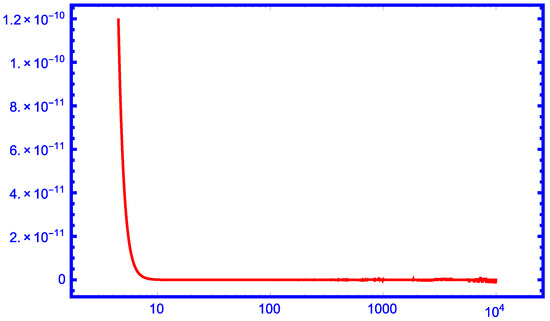
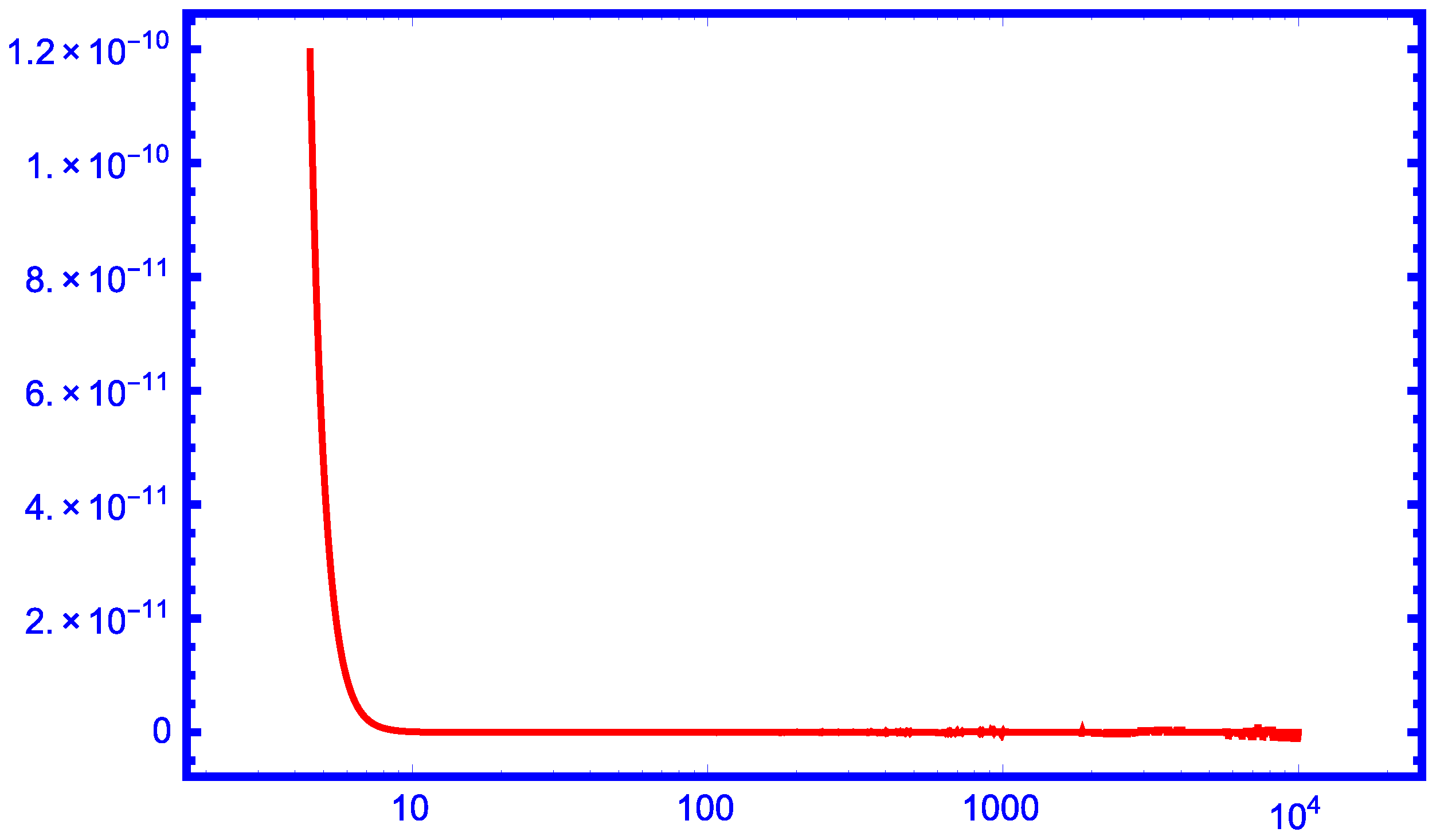
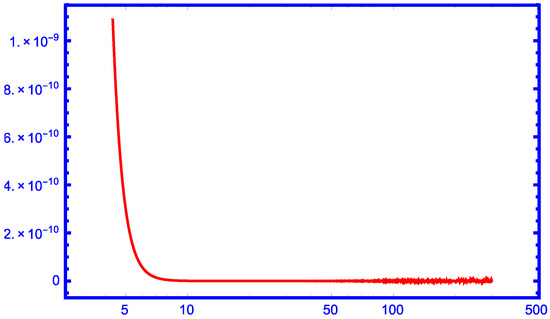
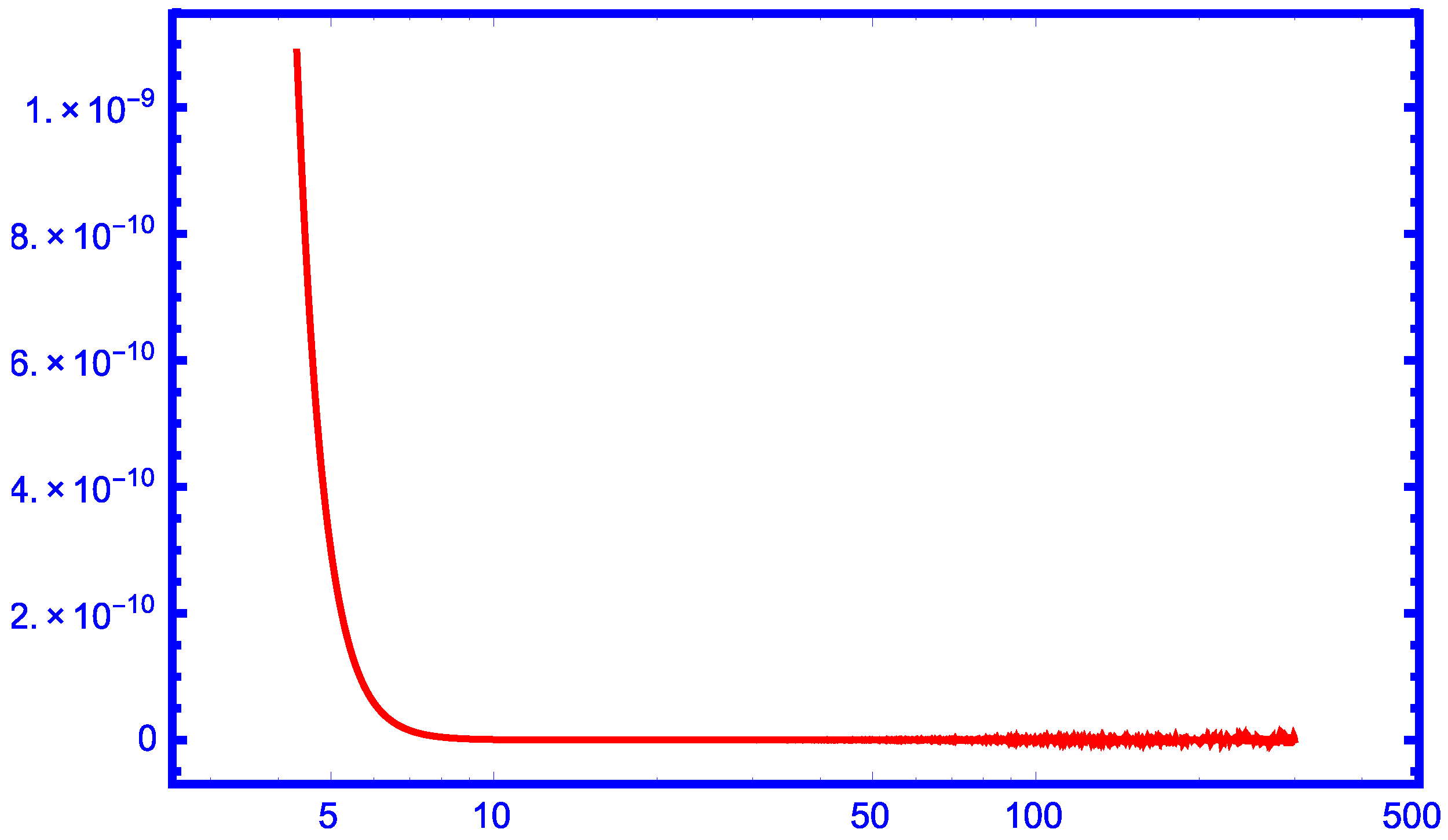
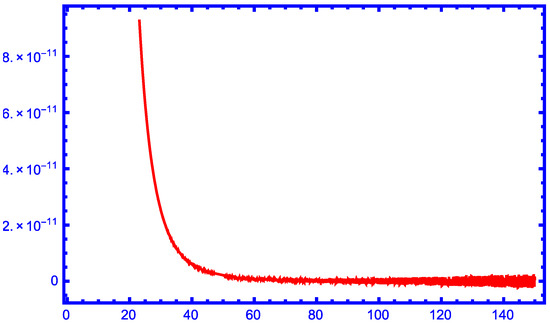
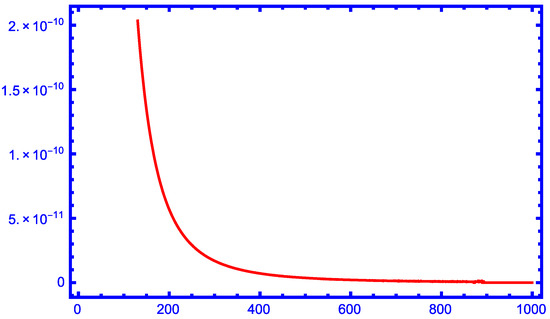
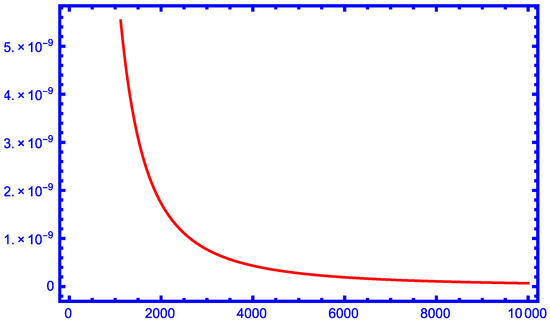
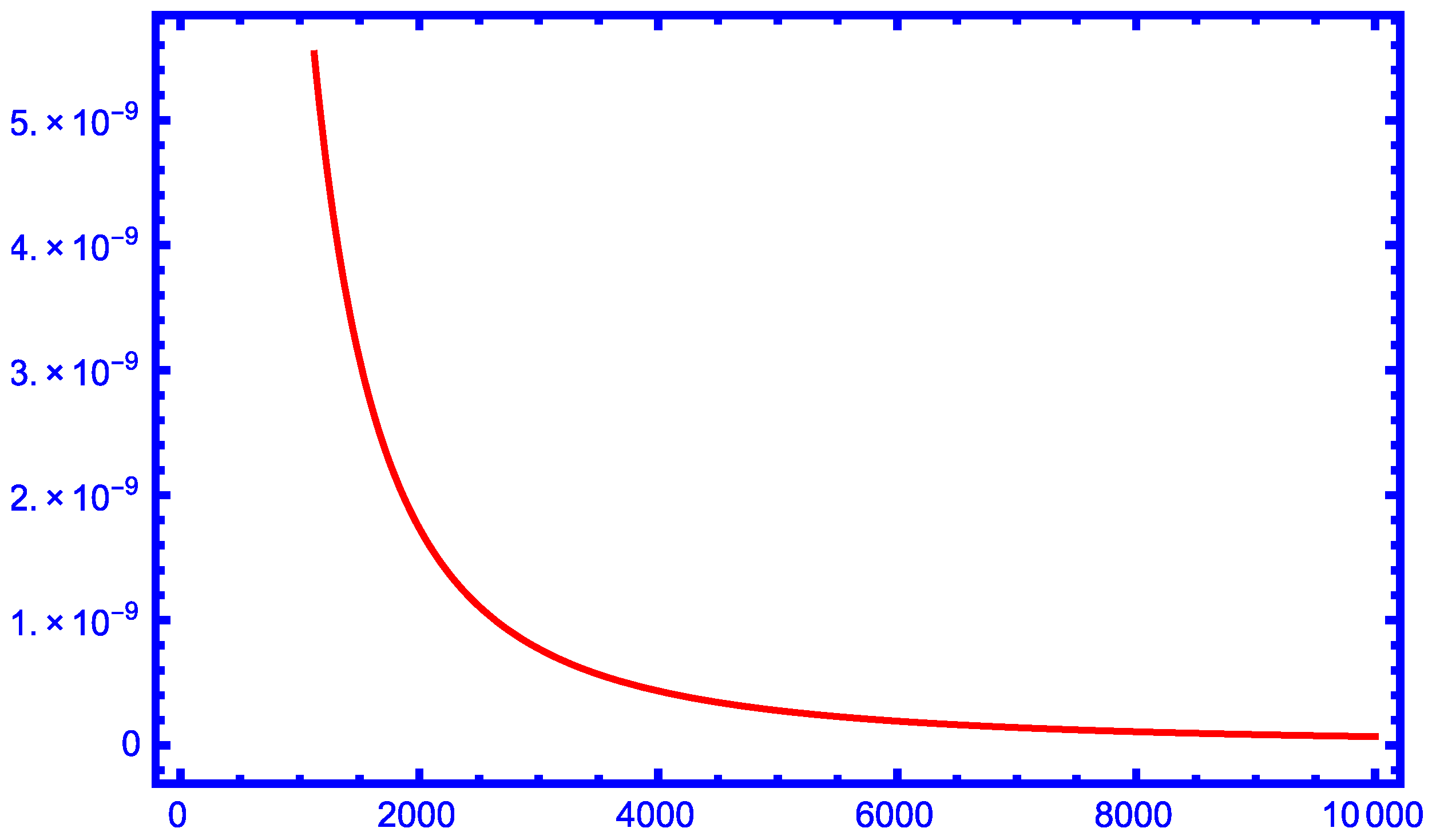
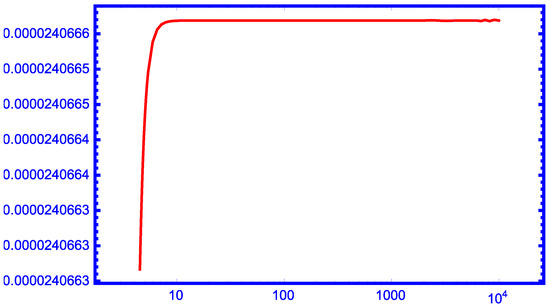
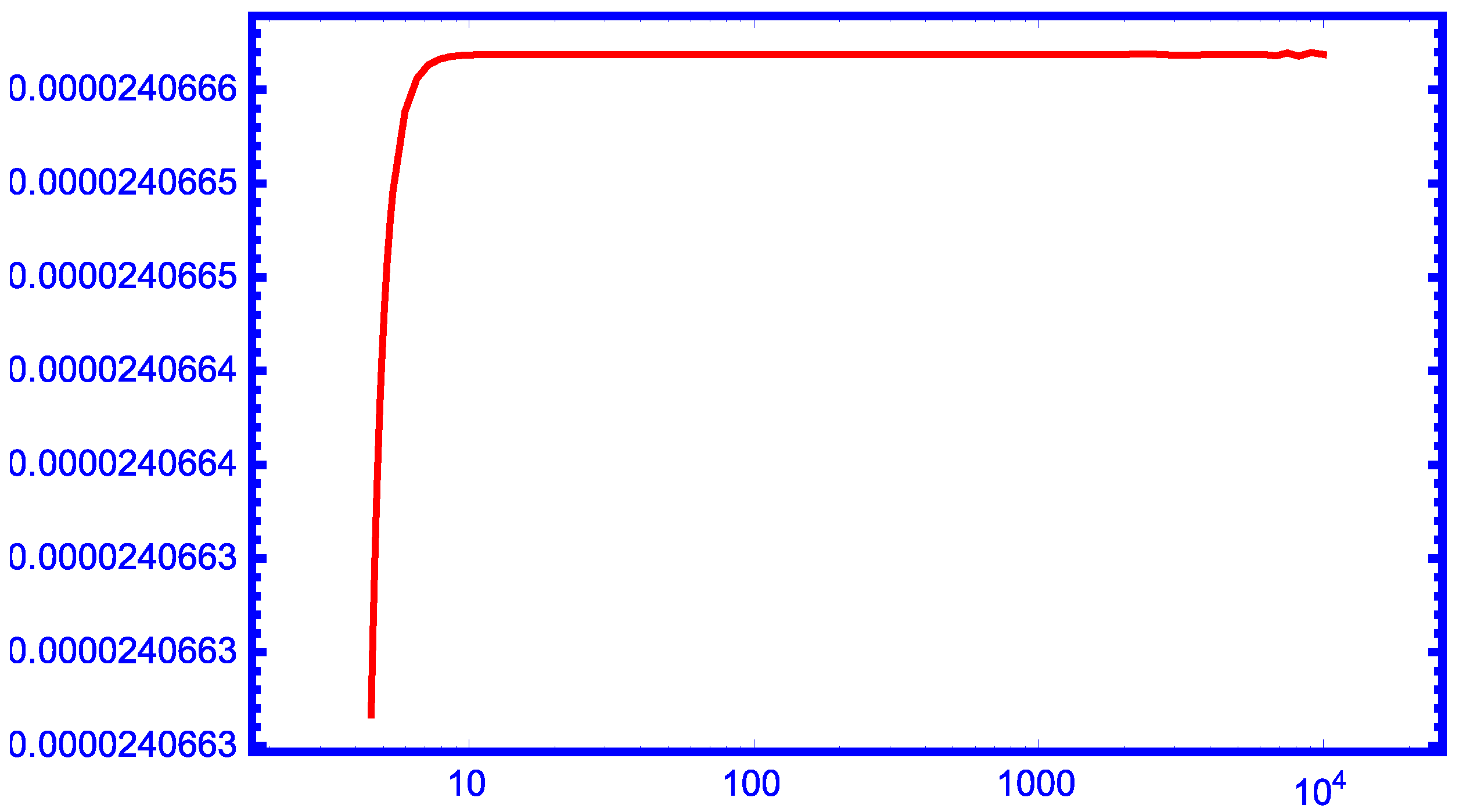
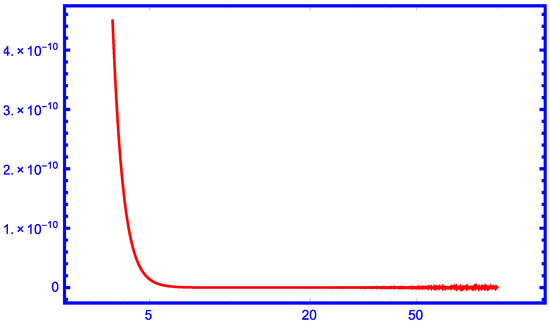
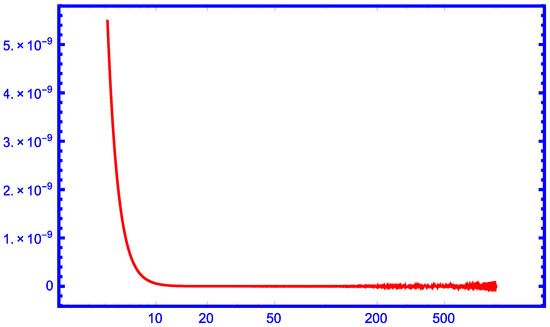
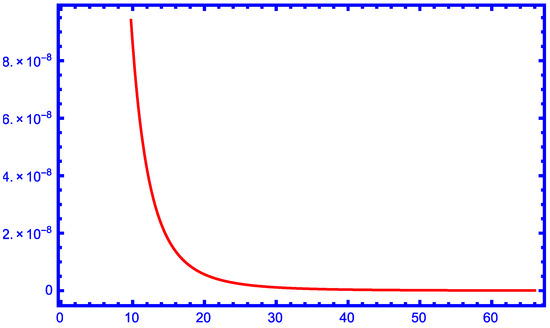
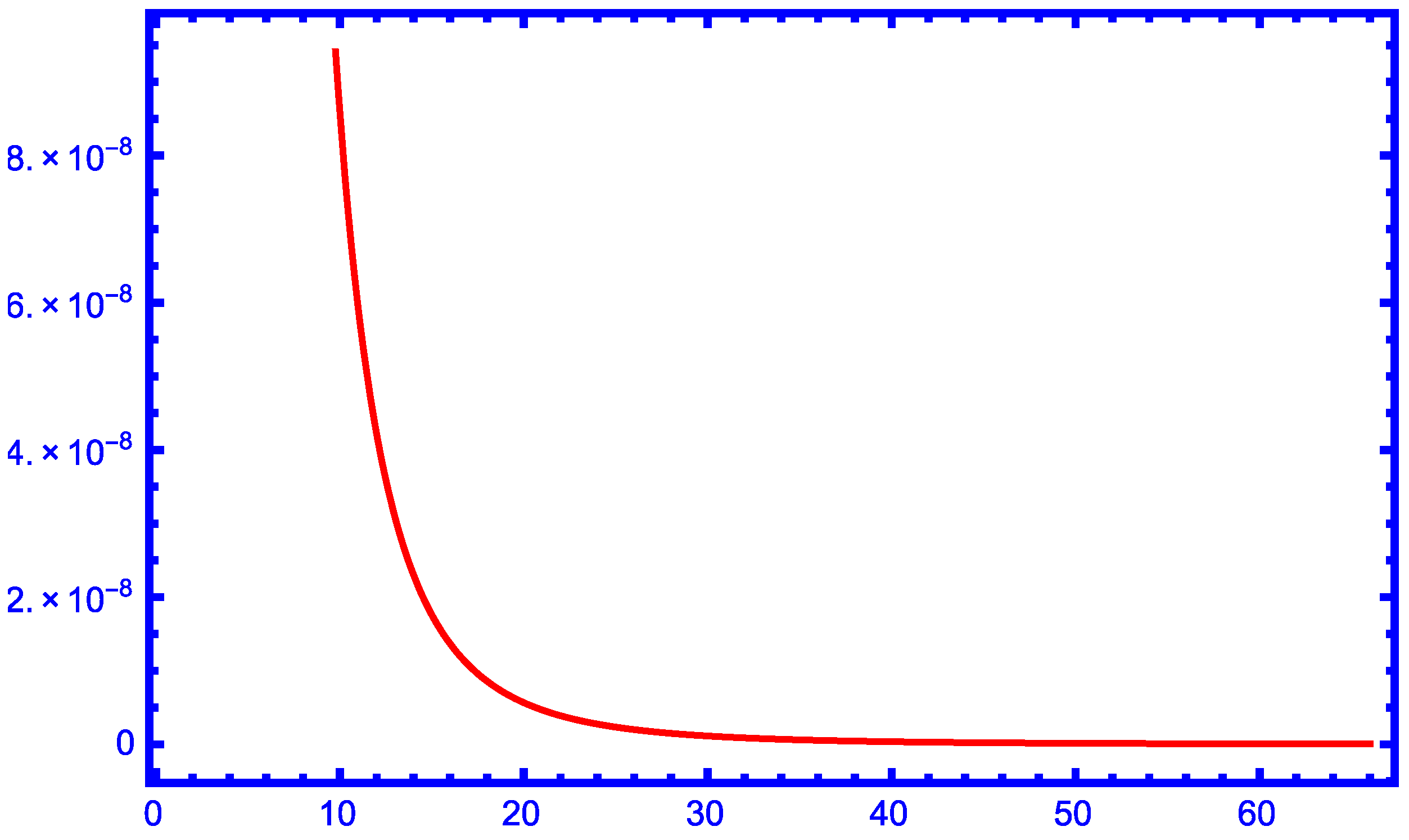
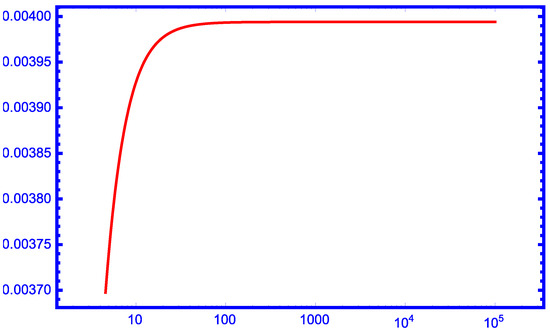
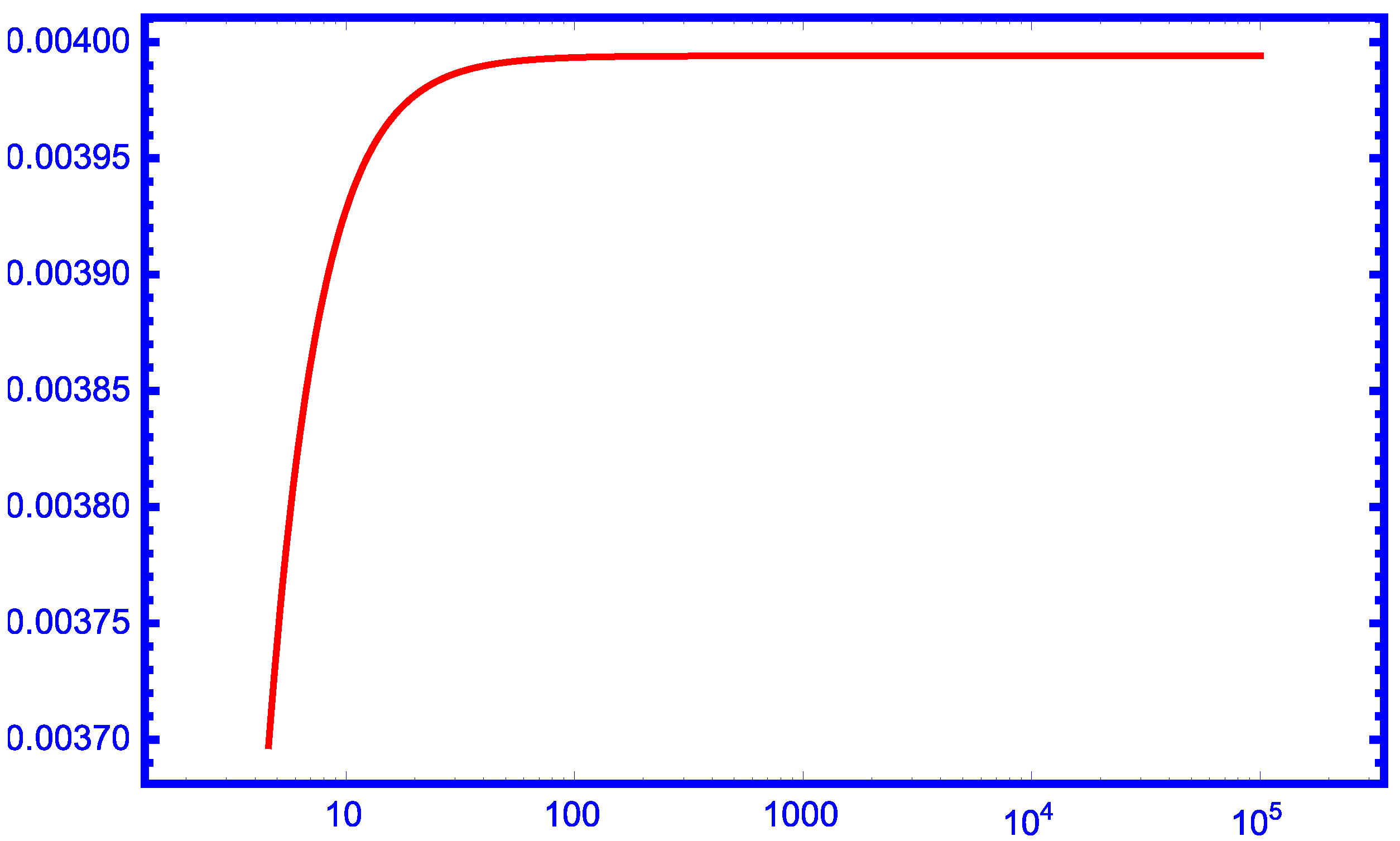
From the graphs in Figure 1, Figure 2, Figure 3, Figure 4 and Figure 5, we can see that our new approximation is better than the approximations , and for larger values of r as lower bounds of the function for .
Figure 1.
The function for .
Figure 2.
The function for .
Figure 3.
The function for .
Figure 4.
The function for .
Figure 5.
The function for .
Secondly, we will compare the following upper approximation formulas [13,21,23,28,29]:
where , with our new upper approximation formula
From the graphs in Figure 6, Figure 7, Figure 8, Figure 9 and Figure 10, we can see that our new approximation is better than the approximations , and for larger values of r as upper bounds of the function for .
Figure 6.
The function for .
Figure 7.
The function for .
Figure 8.
The function for .
Figure 9.
The function for .
Figure 10.
The function for .
Using the asymptotic Laplace’s formula (see [32])
we obtain the following behaviour of the above mentioned bounds:
and
Therefore, the faster asymptotic formula in the above-mentioned formulas will be with a rate of convergence like .
Our new bounds are, of course, superior to those in [31], which deduced from the bounds of the remainder function . Also, even though the bounds in [30] are superior to our new bounds, what strengthens our results and gives them an advantage is proving that the remainders and are monotonic and bounded in the new approximation formulas, which was not discussed in [30].
4. Discussion
We have provided an explanation of the importance of gamma function approximations and some of their applications in some sciences. Theorems (1) and (2) outline the key findings of this paper. In more concrete terms, using the formula presented by Mahmoud and Almuashi, we provided two new approximation formulas for the Gamma function that are numerically more precise than some previously mentioned formulas. Additionally, these formulas have monotonic and bounded remainder functions, which are important in practical calculations because they provide measures of how accurate the approximations are and produce new inequalities of . Finally, we have shown the rate of convergence of some approximation formulas for large values of r to facilitate comparisons with the new formulas deduced in this work.
Author Contributions
Writing to Original draft, M.M. and H.A. All authors contributed equally to the writing of this paper. All authors have read and agreed to the published version of the manuscript.
Funding
This research received no external funding.
Data Availability Statement
Data are contained within the article.
Conflicts of Interest
The authors declare no conflicts of interest.
References
- Andrews, G.E.; Askey, R.A.; Roy, R. Special Functions, Encyclopedia of Mathematics and Its Applications 71; Cambridge University Press: Cambridge, UK, 1999. [Google Scholar]
- Anderson, G.D.; Vamanamurthy, M.K.; Vuorinen, M. Topics in special functions II. Conform. Geom. Dyn. 2007, 11, 250–270. [Google Scholar] [CrossRef] [Scilit]
- Mahmoud, M.; Almuashi, H.; Moustafa, H. An asymptotic expansion for the generalized gamma function. Symmetry 2022, 14, 1412. [Google Scholar] [CrossRef] [Scilit]
- Qi, F.; Agarwal, R.P. Several functions Originating from Fisher–Rao geometry of Dirichlet distributions and involving Polygamma functions. Mathematics 2024, 12, 44. [Google Scholar] [CrossRef] [Scilit]
- Wang, M.K.; Chu, Y.M.; Song, Y.Q. Asymptotical formulas for Gaussian and generalized hypergeometric functions. Appl. Math. Comput. 2016, 276, 44–60. [Google Scholar] [CrossRef] [Scilit]
- Wang, M.K.; Chu, Y.M. Refinements of transformation inequalities for zero-balanced hypergeometric functions. Acta Math. Sci. Ser. B Engl. Ed. 2017, 37, 607–622. [Google Scholar] [CrossRef] [Scilit]
- Press, W.H.; Teukolsky, S.A.; Vetterling, W.T.; Flannery, B.P. Numerical Recipes: The Art of Scientific Computing, 3rd ed.; Cambridge University Press: Cambridge, UK, 2007. [Google Scholar]
- Arfken, G.B.; Weber, H.J.; Harris, F.E. Mathematical Methods for Physicists: A Comprehensive Guide, 7th ed.; Academic Press: Waltham, MA, USA, 2012. [Google Scholar]
- Bishop, C.M. Pattern Recognition and Machine Learning; Springer: New York, NY, USA, 2006. [Google Scholar]
- Artin, E. The Gamma Function; Athena Series; Holt, Rinehart and Winston: New York, NY, USA, 1964. [Google Scholar]
- Beesack, P.R. Improvement of Stirling’s formula by elementary methods. Univ. Beograd Publ. Elektrotenhn Fak. Ser. Mat. Fiz. 1969, 274–301, 17–21. [Google Scholar]
- Mahmoud, M.; Alghamdi, M.A.; Agarwal, R.P. New upper bounds of n! J. Inequal. Appl. 2012, 2012, 27. [Google Scholar] [CrossRef] [Scilit]
- Karatsuba, E.A. On the asymptotic representation of the Euler Gamma function by Ramanujan. J. Comput. Appl. Math. 2001, 135, 225–240. [Google Scholar] [CrossRef] [Scilit]
- Andrews, G.E.; Berndt, B.C. Ramanujan’s Lost Notebook: Part IV; Springer Science + Business Media: New York, NY, USA, 2013. [Google Scholar]
- Chen, C.-P. Padé approximant related to Ramanujan’s formula for the Gamma function. Results Math. 2018, 73, 107. [Google Scholar] [CrossRef] [Scilit]
- Burnside, W. Arapidly convergent series for logN! Messenger Math. 1917, 46, 157–159. [Google Scholar]
- Batir, N. Inequalities for the gamma function. Arch. Math. 2008, 91, 554–563. [Google Scholar] [CrossRef] [Scilit]
- Mortici, C. On the gamma function approximation by Burnside. Appl. Math. E-Notes. 2011, 11, 274–277. [Google Scholar]
- Gosper, R.W. Decision procedure for indefinite hypergeometric summation. Proc. Natl. Acad. Sci. USA 1978, 75, 40–42. [Google Scholar] [CrossRef] [Scilit]
- Batir, N. Very accurate approximations for the factorial function. J. Math. Inequal. 2010, 3, 335–344. [Google Scholar] [CrossRef] [Scilit]
- Mortici, C. Sharp inequalities related to Gosper’s formula. C. R. Acad. Sci. Paris 2010, 48, 137–140. [Google Scholar] [CrossRef] [Scilit]
- Programmable Calcualtors. Available online: http://www.rskey.org/CMS/the-library/11 (accessed on 20 April 2020).
- Alzer, H. Sharp upper and lower bounds for the Gamma function. Proc. Royal Soc. Edinburgh 2009, 139A, 709–718. [Google Scholar] [CrossRef] [Scilit]
- Yang, Z.-H.; Tian, J.-F. Windschitl type approximation formulas for the Gamma function. J. Inequal. Appl. 2018, 2018, 272. [Google Scholar] [CrossRef] [Scilit]
- Nemes, G. New asymptotic expansion for the Gamma function. Arch. Math. 2010, 95, 161–169. [Google Scholar] [CrossRef] [Scilit]
- Nemes, G. More accurate approximations for the gamma function. Thai J. Math. 2011, 9, 21–28. [Google Scholar]
- Mortici, C. A continued fraction approximation of the gamma function. J. Math. Anal. Appl. 2013, 402, 405–410. [Google Scholar] [CrossRef] [Scilit]
- Chen, C.-P. A more accurate approximation for the gamma function. J. Number Theory 2016, 164, 417–428. [Google Scholar] [CrossRef] [Scilit]
- Yang, Z.-H.; Tian, J.-F. An accurate approximation formula for Gamma function. J. Inequal. Appl. 2018, 2018, 56. [Google Scholar] [CrossRef] [Scilit] [PubMed]
- Mahmoud, M.; Almuashi, H. On Some Asymptotic Expansions for the Gamma Function. Symmetry 2022, 14, 2459. [Google Scholar] [CrossRef] [Scilit]
- Mahmoud, M.; Alsulami, S.M.; Almarashi, S. On some bounds for the Gamma function. Symmetry 2023, 15, 937. [Google Scholar] [CrossRef] [Scilit]
- Abramowitz, M.; Stegun, I.A. Handbook of Mathematical Functions with Formulas, Graphs, and Mathematical Tables; Nation Bureau of Standards, Applied Mathematical Series; Dover Publications: New York, NY, USA, 1972; Volume 55. [Google Scholar]
Disclaimer/Publisher’s Note: The statements, opinions and data contained in all publications are solely those of the individual author(s) and contributor(s) and not of MDPI and/or the editor(s). MDPI and/or the editor(s) disclaim responsibility for any injury to people or property resulting from any ideas, methods, instructions or products referred to in the content. |
© 2024 by the authors. Licensee MDPI, Basel, Switzerland. This article is an open access article distributed under the terms and conditions of the Creative Commons Attribution (CC BY) license (https://creativecommons.org/licenses/by/4.0/).