


Abstract
In this work, an innovative technique is presented to solve Emden–Fowler-type singular boundary value problems (SBVPs) with derivative dependence. These types of problems have significant applications in applied mathematics and astrophysics. Initially, the differential equation is transformed into a Fredholm integral equation, which is then converted into a system of nonlinear equations using the collocation technique based on Chebyshev polynomials. Subsequently, an iterative numerical approach, such as Newton’s method, is employed on the system of nonlinear equations to obtain an approximate solution. Error analysis is included to assess the accuracy of the obtained solutions and provide insights into the reliability of the numerical results. Furthermore, we graphically compare the residual errors of the current method to the previously established method for various examples.
Keywords:
Chebyshev polynomials; Emden–Fowler-type SBVPs; derivative dependence; functional approximation; Green’s function MSC:
34B05; 34B15; 34B16; 65L10
1. Introduction
Consider Emden–Fowler-type SBVPs with derivative dependence, as expressed by the following equation:
where and are real constants. Here, is the source function dependent on both and
The conditions and the allowance of to be discontinuous at lead to a reduction of the problem to double SBVPs [1]. Such problems are prevalent in various areas of astrophysics, including thermal explosion modeling in a rectangular slab [2,3], heat source measurements in human heads [4], oxygen concentration within spherical cells [5], shallow membrane cap theory [6], heat conduction problems [7], unsteady Poiseuille flow in a pipe [8], electroelastic dynamic problems [9], and heat explosions [10].
Solving Emden–Fowler SBVPs with derivative dependence is crucial for predicting system behaviors, such as changes in pressure, density, or temperature within stars or gaseous spheres. The solutions provide valuable insights into the structure and evolution of these systems. Finding numerical solutions for derivative-dependent second-order singular differential equations is particularly challenging due to strong nonlinearity from derivatives in the source function and the singular behavior at the origin. The motivation lies in developing numerical methods that require less computational effort while maintaining high accuracy. The collocation method has gained popularity with the widespread availability and efficiency of computers, being applied to problems in physics, engineering, and other fields.
The existence and uniqueness of the estimated solution of Equation (1) were readily obtained in [11,12,13,14,15,16] under the conditions of with and for on (0, 1].
Several numerical methods have been developed to solve Equation (1) when , including the cubic spline method [17], the finite difference method [18,19,20,21,22], the Adomian decomposition method (ADM) [23,24,25,26,27,28], the B-spline collocation method [29,30], the classical polynomial approximation method [31], etc. However, there are limited techniques available for solving Emden–Fowler SBVPs with derivative dependence. In 2014, Singh et al. [26] discussed the Adomian decomposition technique to solve an original utilizing Green’s function. In 2018, Roul [32] presented an improved normal homotopy analysis method to solve derivative-dependent SBVPs, and in 2019, Roul et al. [33] discussed quintic spline interpolation. In 2020, Shahni et al. [34] established an approximate solution for Emden–Fowler-type SBVPs with derivative dependence using Bernstein polynomials. Upon examining existing techniques, limitations were identified, such as a significant amount of computational work, especially for nonlinear singular boundary value problems. Therefore, there is a need for more efficient numerical methods that can overcome these limitations and provide a more accurate solution for nonlinear singular boundary value problems.
This work introduces a constructive approach for solving Emden–Fowler-type SBVPs with derivative dependence. In Section 2, the differential equation is converted into its equivalent Fredholm integral form. In Section 3, a collocation technique based on Chebyshev polynomials (CCM) is employed to obtain the system of nonlinear equations upon transformation of the Fredholm integral equation. Subsequently, Newton’s method is implemented to solve the system and obtain the required solution. In Section 4, the algorithm for the methodology is provided for implementing the method. In Section 5, error analysis is included to assess the accuracy of the current method. In Section 6, the maximum absolute error of the current method is computed for various examples using and norm. These numerical results are compared with those obtained using the existing BCM method [34]. The residual errors between CCM and a previously established method, i.e., BCM, are also compared graphically.
2. The Construction of the Method
The corresponding integral equations of the Emden–Fowler SBVPs are presented in this section.
2.1. Emden–Fowler SBVPs with Dirichlet–Robin Boundary Conditions
We consider the following differential equation:
, and
2.2. Emden–Fowler SBVPs with Neumann–Robin Boundary Conditions
We consider the following differential equation:
Its equivalent Fredholm integral form is
where
3. Chebyshev Collocation Method (CCM)
Definition 1.
Shifted Chebyshev polynomials (SCPs) are defined on by introducing a new variable () as
We can approximate a function () by shifted Chebyshev polynomials (SCPs) as
For the purpose of numerical calculations, we take into account the initial terms of the aforementioned expansion, and it becomes
where and are column vectors, as follows:
3.1. Dirichlet–Robin Boundary Conditions
To apply the current approach, we consider Equation (3) as
We take
It can be expressed as
where
By substituting Equations (17) and (19) into (21) and inserting the collocation points (, where ) into Equation (21), we have
where are unknowns.
In order to obtain the approximate solution of Equation (3), we substitute the unknown coefficients in Equations (17) and (19), which are obtained by applying the iteration approach to Equation (22).
Note that a desired accuracy () of Newton’s method can be obtained by using the stopping criteria (
3.2. Neumann–Robin Boundary Conditions
Consider Equation (6) as
Using similar steps as in the previous subsection, we input the expressions from Equations (13) and (14) into (23), yielding
which can be represented as
and
4. Algorithm of the Methodology
The procedure for determining unknown coefficients in the CCM method is outlined by the following algorithm:
- Input the degree of the Chebyshev polynomials, i.e., n.
- Approximate and via Equation (13).
- Input the collocation points (, ).
- Obtain a nonlinear equation in unknowns, i.e., .
- Via Newton’s method, the numerical solution is obtained.
5. Error Analysis
Let the norm of the Banach space () be defined as
where
Theorem 1.
Let the sequence converge uniformly to , where is the Chebyshev approximation function. Then, for a given , there exists a number (n) such that
Proof of Theorem 1.
The proof is provided in [36]. □
Theorem 2.
Consider a bounded function (f) in and that its second derivative exists. Then, the error bound can be derived as
which exhibits the rate of convergence () for Chebyshev’s approximation function [37], provided .
Proof of Theorem 2.
The proof is provided in [38]. □
Theorem 3.
Consider a Banach space (X) with the norm as defined in Equation (28). Let and represent the approximate and exact solutions of the integral Equation (3), respectively. Furthermore, the nonlinear function also satisfies the Lipschitz condition, as follows:
where and are the Lipschitz constants. Then, for the CCM, the estimated error bound is determined as
where , , ,
6. Numerical Illustration
We utilized MATLAB (R2015a) to determine maximum absolute errors using both and norms for various examples to assess the accuracy of the current approach. Subsequently, we compared these results with those obtained using the BCM in the different tables and also graphically compared residual errors. We define and norm errors as follows:
and
where and represent the approximate and exact solutions, respectively.
Furthermore, the residual error is defined as:
where and are obtained by using the CCM and the BCM, respectively.
Example 1.
The equivalent integral form is
where
The exact solution of differential Equation (43) is
We present a comparison of errors using the norm of the CCM with the BCM for and in Table 1 and Table 2, respectively, and a comparison of errors using the norm of the CCM with the BCM for and in Table 3 and Table 4, respectively, for Example 1. We note that achieving the desired level of accuracy is more effectively accomplished with the CCM compared to the BCM. Furthermore, Figure 1 illustrates a comparison of residual errors between the current technique and the BCM, revealing that the residual errors of the CCM are significantly lower than those of the BCM.

Table 1.
Comparison of errors using the norm for in Equation (43).
Table 2.
Comparison of errors using the norm for in Equation (43).
Table 3.
Comparison of errors using the norm for in Equation (43).
Table 4.
Comparison of errors using the norm for in Equation (43).
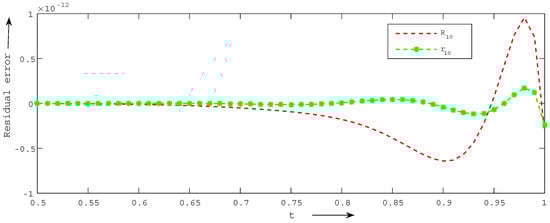
Figure 1.
Comparison of residual errors obtained by the CCM and the previously established BCM for Example 1.
Example 2.
Its equivalent integral form is
where
The exact solution of differential Equation (44) is
We present a comparison of errors of the CCM with those of the BCM for using the and norms in Table 5 and Table 6, respectively for Example 2. We note that achieving the desired level of accuracy is more effectively accomplished with the CCM compared to the BCM. Furthermore, Figure 2 illustrates a comparison of residual errors between the current technique and the BCM, revealing that the residual errors of the CCM are significantly lower than those of the BCM.
Table 5.
Comparison of errors using the norm for in Equation (44).
Table 6.
Comparison of errors using the norm for in Equation (44).
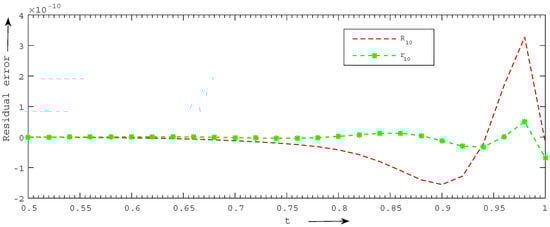
Figure 2.
Comparison of residual errors obtained by the CCM and the BCM for Example 2.
We present a comparison of errors using the and norms of the CCM with those of the BCM for for Example 3 in Table 7 and Table 8, respectively. We clearly observe that achieving the desired level of accuracy is more effectively accomplished with the CCM compared to the BCM. Furthermore, Figure 3 illustrates a comparison of residual errors between the current technique and the BCM, revealing that the residual errors of the CCM are significantly lower than those of the BCM.
Table 7.
Comparison of errors using the norm for in Equation (45).
Table 8.
Comparison of errors using the norm for in Equation (45).
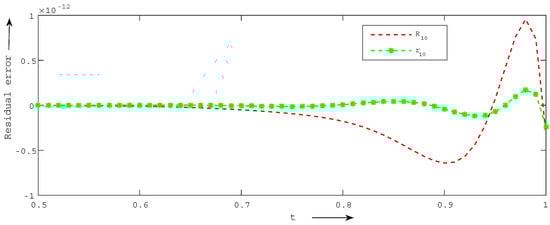
Figure 3.
Comparison of residual errors obtained by the CCM and the BCM for Example 3.
Example 4.
The equivalent integral form is
where
The exact solution of differential Equation (46) is
We present a comparison of errors using the and norms of the CCM with those of the BCM for and for Example 4 in Table 9. We clearly observe that achieving the desired level of accuracy is more effectively accomplished with the CCM compared to the BCM. Furthermore, Figure 4 illustrates a comparison of residual errors between the current technique and the BCM, revealing that the residual errors of the CCM are significantly lower than those of the BCM.
Table 9.
Comparison of errors using the and norm for and in Equation (46).
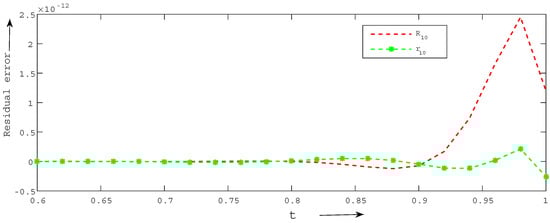
Figure 4.
Comparison of residual errors obtained by the CCM and the BCM for Example 4.
Example 5.
Consider a numerical problem without exact solution
Its equivalent form is
where
and , , , .
We compare the absolute difference of estimated solutions () of the CCM with the BCM in Table 10. It can be seen from the table that fewer errors in numerical solutions are obtained by the present method than the BCM [39].
Table 10.
Comparison of the numerical results of Equation (47).
7. Conclusions
We employed an efficient technique to approximate the numerical solution of Emden–Fowler-type SBVPs with derivative dependence. This approach utilizes the collocation technique based on Chebyshev polynomials, considering the equivalent Fredholm integral form. The major advantage of the current technique is its ability to reach the requisite level of accuracy compared to previously established methods, such as the BCM [34]. Under quite general conditions, an error analysis was established to asses the accuracy of the current technique. To validate this accuracy, we considered various numerical examples to compute the maximum absolute errors using the and norms. These results were then compared with those of the existing BCM method [34], demonstrating that the current approach is superior. Moreover, a graphical comparison of residual errors between the CCM and the BCM illustrates that the residual errors of the CCM are significantly lower than those of the BCM. Overall, the current method (CCM) renders a promising and accurate solution of these types of mathematical problems. The proposed techniques can be extended to solve systems of higher-order singular differential equations with a set of local and nonlocal boundary conditions. Additionally, the presented collocation techniques can be applied to gain insights into nonlinear singular pantograph delay differential models arising in various natural and physical phenomena. Furthermore, the current approach can be applied to solve Fredholm–Volterra- type integro-differential equations and fractional Lane–Emden–Fowler-type equations.
Author Contributions
Conceptualization, S.K. and A.K.S.; Methodology, S.K. and A.K.S.; Validation, S.K., A.K.S. and U.G.; Formal analysis, S.K., A.K.S. and U.G.; Writing–original draft, S.K. and A.K.S.; Writing–review and editing, S.K., A.K.S. and U.G.; Supervision, A.K.S. All authors contributed equally. All authors have read and agreed to the published version of the manuscript.
Funding
This research received no external funding.
Data Availability Statement
No new data were created or analyzed in this study. Data sharing is not applicable to this article.
Acknowledgments
The authors are thankful to the reviewers for their valuable suggestions to improve the manuscript.
Conflicts of Interest
The authors declare no conflicts of interest.
References
- Bobisud, L.; O’Regan, D. Positive solutions for a class of nonlinear boundary value problems at resonance. J. Math. Anal. Appl. 1994, 184, 263–284. [Google Scholar] [CrossRef]
- Van Gorder, R. Exact first integrals for a Lane-Emden equation of the second kind modeling a thermal explosion in a rectangular slab. New Astron. 2011, 16, 492–497. [Google Scholar] [CrossRef]
- Reger, K.; Van Gorder, R. Lane-Emden equations of second kind modelling thermal explosion in infinite cylinder and sphere. Appl. Math. Mechan. 2013, 34, 1439–1452. [Google Scholar] [CrossRef]
- Gray, B. The distribution of heat sources in the human head—Theoretical considerations. J. Theor. Biol. 1980, 82, 473–476. [Google Scholar] [CrossRef] [PubMed]
- McElwain, D. A re-examination of oxygen diffusion in a spherical cell with Michaelis-Menten oxygen uptake kinetics. J. Theor. Biol. 1978, 71, 255–263. [Google Scholar] [CrossRef]
- Rachnková, I.; Koch, O.; Pulverer, G.; Weinmuller, E. On a singular boundary value problem arising in the theory of shallow membrane caps. J. Math. Anal. Appl. 2007, 332, 523–541. [Google Scholar] [CrossRef][Green Version]
- Bartoshevich, M. A heat-conduction problem. J. Eng. Phys. 1975, 28, 240–244. [Google Scholar] [CrossRef]
- Galdi, G.P.; Pileckas, K.; Silvestre, A.L. On the unsteady Poiseuille flow in a pipe. Z. Angew. Math. Phys. 2007, 58, 994–1007. [Google Scholar] [CrossRef]
- Ding, H.; Wang, H.; Chen, W. Analytical solution for the electro elastic dynamics of a non homogeneous spherically isotropic piezoelectric hollow sphere. Arch. Appl. Mech. 2003, 73, 49–62. [Google Scholar] [CrossRef]
- Chandrasekhar, S. An introduction to the study of stellar structure. Ciel Terre 1939, 55, 412. [Google Scholar]
- Bobisud, L. Existence of solutions for nonlinear singular boundary value problems. Appl. Anal. 1990, 35, 43–57. [Google Scholar] [CrossRef]
- Dunninger, D.; Kurtz, J.C. Existence of solutions for some nonlinear singular boundary value problems. J. Math. Anal. Appl. 1986, 115, 396–405. [Google Scholar] [CrossRef][Green Version]
- Yan, B.; O’Regan, D.; Agarwal, R. Positive solutions for second order singular boundary value problems with derivative dependence on infinite intervals. Acta Appl. Math. 2008, 103, 19–57. [Google Scholar] [CrossRef]
- Pandey, R.K.; Verma, A.K. Existence-uniqueness results for a class of singular boundary value problems-II. J. Math. Anal. Appl. 2008, 338, 1387–1396. [Google Scholar] [CrossRef]
- Pandey, R.K.; Verma, A.K. Existence-uniqueness results for a class of singular boundary value problems arising in physiology. Nonlinear Anal. Real World Appl. 2008, 9, 40–52. [Google Scholar] [CrossRef]
- Pandey, R.K.; Verma, A.K. On solvability of derivative dependent doubly singular boundary value problems. J. Appl. Math. Comput. 2010, 33, 489–511. [Google Scholar] [CrossRef]
- Kanth, A.R. Cubic spline polynomial for non-linear singular two-point boundary value problems. Appl. Math. Comput. 2007, 189, 2017–2022. [Google Scholar]
- Chawla, M.M.; Katti, P.C. Finite difference methods and their convergence for a class of singular two point boundary value problems. Numer. Math. 1982, 39, 341–350. [Google Scholar] [CrossRef]
- Russell, R.D.; Shampine, L.F. Numerical methods for singular boundary value problems. SIAM J. Numer. Anal. 1975, 12, 13–36. [Google Scholar] [CrossRef]
- Iyengar, S.R.K.; Jain, P. Spline finite difference methods for singular two point boundary value problems. Numer. Math. 1986, 50, 363–376. [Google Scholar] [CrossRef]
- Kumar, M. A three-point finite difference method for a class of singular two-point boundary value problems. J. Comput. Appl. Math. 2002, 145, 89–97. [Google Scholar] [CrossRef][Green Version]
- Verma, A.K.; Kayenat, S. On the convergence of Mickens’ type nonstandard finite difference schemes on Lane-Emden type equations. J. Math. Chem. 2018, 56, 1667–1706. [Google Scholar] [CrossRef]
- Singh, R.; Kumar, J.; Nelakanti, G. New approach for solving a class of doubly singular two-point boundary value problems using Adomian decomposition method. Adv. Numer. Anal. 2012, 2012, 541083. [Google Scholar] [CrossRef]
- Singh, R.; Kumar, J.; Nelakanti, G. Numerical solution of singular boundary value problems using Green’s function and improved decomposition method. J. Appl. Math. Comput. 2013, 43, 409–425. [Google Scholar] [CrossRef]
- Singh, R.; Kumar, J. Solving a class of singular two-point boundary value problems using new modified decomposition method. ISRN Comput. Math. 2013, 2013, 262863. [Google Scholar] [CrossRef]
- Singh, R.; Kumar, J.; Nelakanti, G. Approximate series solution of singular boundary value problems with derivative dependence using Green’s function technique. Comput. Appl. Math. 2014, 33, 451–467. [Google Scholar] [CrossRef]
- Singh, R.; Kumar, J. An efficient numerical technique for the solution of nonlinear singular boundary value problems. Comput. Phys. Commun. 2014, 185, 1282–1289. [Google Scholar] [CrossRef]
- Singh, R.; Kumar, J. The Adomian decomposition method with Green’s function for solving nonlinear singular boundary value problems. J. Appl. Math. Comput. 2014, 44, 397–416. [Google Scholar] [CrossRef]
- Marinca, V.; Dehghan, M. Four techniques based on the B-spline expansion and the collocation approach for the numerical solution of the Lane-Emden equation. Math. Methods Appl. Sci. 2011, 36, 2243–2253. [Google Scholar]
- Roul, P.; Goura, V.M. B-spline collocation methods and their convergence for a class of nonlinear derivative dependent singular boundary value problems. Appl. Math. Comput. 2019, 341, 428–450. [Google Scholar] [CrossRef]
- Turkyimazoglu, M. Solution of initial and boundary value problems by an effective accurate method. Int. J. Comput. Methods 2017, 14, 1750069. [Google Scholar] [CrossRef]
- Roul, P. Doubly singular boundary value problems with derivative dependent source function: A fast-converging iterative approach. Math. Methods Appl. Sci. 2019, 42, 354–374. [Google Scholar] [CrossRef]
- Roul, P.; Goura, V.P.; Agrawal, R. A new high order numerical approach for a class of nonlinear derivative dependent singular boundary value problems. Appl. Numer. Math. 2019, 145, 315–341. [Google Scholar] [CrossRef]
- Shahni, J.; Singh, R. Numerical results of Emden-Fowler boundary value problems with derivative dependence using the Bernstein collocation method. Eng. Comput. 2022, 38, S371–S380. [Google Scholar] [CrossRef]
- Sastry, S.S. Introductory Methods of Numerical Analysis; PHI Learning Pvt. Ltd.: New Delhi, India, 2005. [Google Scholar]
- Powell, M.J.D. Approximation Theory and Methods; Cambridge University Press: Cambridge, UK, 1981. [Google Scholar]
- Voronovskaya, E. Dtermination de la forme Asymptotique Dapproximation des Fonctions par les polynmes de M. Bernstein Doklady. Akad. Nauk. Sssr 1932, 79, 79–85. [Google Scholar]
- Lorentz, G.; DeVore, R. Constructive Approximation, Polynomials and Splines Approximation; Springer: Berlin, Germany, 1993. [Google Scholar]
- Shahni, J.; Singh, R. An efficient numerical technique for Lane-Emden-Fowler boundary value problems: Bernstein collocation method. Eur. Phys. J. Plus 2020, 135, 475. [Google Scholar] [CrossRef]
Disclaimer/Publisher’s Note: The statements, opinions and data contained in all publications are solely those of the individual author(s) and contributor(s) and not of MDPI and/or the editor(s). MDPI and/or the editor(s) disclaim responsibility for any injury to people or property resulting from any ideas, methods, instructions or products referred to in the content. |
© 2024 by the authors. Licensee MDPI, Basel, Switzerland. This article is an open access article distributed under the terms and conditions of the Creative Commons Attribution (CC BY) license (https://creativecommons.org/licenses/by/4.0/).