1. Introduction
Harmonic functions play a central role in mathematical analysis and applied mathematics due to their intriguing properties and widespread applications. Harmonic functions are solutions to Laplace’s equation, a second-order partial differential equation that emerges in various fields such as physics, engineering, and probability theory. The study of harmonic functions opens doors to exploring diverse mathematical phenomena, including conformal mappings, potential theory, and complex analysis. Their unique characteristic of being infinitely differentiable and satisfying the mean value property has made them a staple in the analysis of functions and solutions to differential equations.
In this research, we shift our focus to harmonic functions that are subject to additional constraints, specifically those defined by a second-order differential inequality. By incorporating a second-order differential inequality, we introduce new dynamics that broaden the traditional scope of harmonic functions, leading to intriguing insights and possibly to novel applications.
In this article, the exploration of certain properties of harmonic functions defined by a second-order differential inequality provides a good basis for deeper analysis. This study aims to investigate the new characteristics that emerge from these constraints and to expand our understanding of harmonic functions beyond the classical framework. Through a combination of theoretical derivations and practical examples, we will uncover the distinctive attributes and potential applications that arise from this area of research.
Consider
as the open unit disk in the complex plane
. Let
denote the set comprising complex-valued harmonic functions
f within
. These functions are normalized such that
and
. Also, let
Every function
has the canonical representation
, where
both
h and
g are analytic in
is locally univalent and sense-preserving in
if and only if
in
. Denote by
the subclass of
that is univalent and sense-preserving in the open unit disk
(see [
1,
2]). When
, the traditional set
comprising analytic, univalent, and normalized functions within the unit disk
is a subset of
, similar to how the set
consisting of analytic and normalized functions in
is a subset of
.
Let , , and denote the subsets of that map onto convex, starlike, and close-to-convex domains, respectively. Correspondingly, , , and represent the subsets of mapping onto their respective domains.
In 2013, Ponnusamy et al. [
3] introduced a class:
and they proved that functions in
are close-to-convex.
Recently, Ghosh and Vasudevarao [
4] defined a class for
:
and they investigated coefficient bounds, growth estimates, convolution, and radius of convexity for the partial sums of the members of their class.
Also, Rajbala and Prajapat [
5] studied such properties of the class
where
.
In 2014, Nagpal and Ravichandran [
6] studied a class
of functions
satisfying the condition
for
, which is a harmonic analogue of the class
defined by Chichra [
7] consisting of the functions
satisfying the condition
for
. In 1977, Chichra [
7] studied the class
for some
where
consisting of the analytic function
such that
for
Recently, Liu and Yang [
8] defined a class:
where
Next, Çakmak and et al. [
9] investigated some properties of the class
where
and
Finally, Breaz et al. [
10] defined a subclass:
where
Other interesting studies of harmonic mappings that inspired us in this work are [
11,
12,
13,
14,
15]. In [
11], new subclasses of harmonic functions are introduced for which coefficient inequality results and distortion bounds are obtained. An investigation is conducted on a subset of univalent, sense-preserving, complex-valued close-to-convex harmonic functions in the open unit disc in [
12] and the coefficient and growth estimates are obtained, an area theorem is established, and boundary dynamics and convolution and convex combination features are examined. Other subclasses of harmonic functions are examined in the other papers listed above, concerning distortion limits and univalence conditions, extreme points, partial sum problems, and convolution-related properties.
For the study presented in this paper, the following class is considered.
Denote by
the class of functions
and satisfy
where
and
Let
denote a class of functions
such that
Al-Refai [
16], studied the inclusion properties of the class
.
In
Section 2, we derive bounds for coefficients and estimates for growth and establish sufficient conditions for coefficients within the class
. In
Section 3, we demonstrate that the class maintains closure under convex combinations and convolution operations among its elements. Additionally, in
Section 4, graphical representations of some function examples belonging to this class will be given.
2. The Sharp Coefficient Estimates and Growth Theorems of
In this section, we shall investigate the necessary and sufficient coefficient conditions and distortion bounds for functions belonging to the class
Theorem 1. The mapping if and only if for each μ such that
Proof. Suppose
For each
Thus,
for each
Conversely, let
, then,
Setting
,
. Therefore,
. For each fixed
and arbitrarily chosen complex number
with
that is,
(
3) becomes
and hence,
□
Theorem 2. Let the function f be in the form (1) and , then, for The result is sharp and equality holds for the function Proof. Suppose that
Using the series representation of
and
we derive
Allowing
we prove the result (
4). Moreover, it can be easily seen that the equality is achieved for
. □
Theorem 3. Let the function f be in the form (1) and . Then, for we haveAll the results given in this theorem are certain and the equations are provided for the following function Proof. Suppose that
then, from Theorem 1,
for each
Thus, for each
we have
for
Therefore, there exists an analytic function
p of the form
with a positive real part in
such that
Comparing coefficients on both sides of (
5), we have
Since
for
and
is arbitrary, the proof of (i) is complete. By following the methods in proof (i), proof (ii) and proof (iii) are obtained. For
the function
shows that all inequalities are sharp. □
Now, we give a sufficient condition for a function to be in the class
Theorem 4. Let withthen, Proof. Suppose that
Then, using (
6),
Hence,
□
Theorem 5. Let for Then,Inequalities are sharp for the function Proof. Let
Then, using Theorem 1,
and for each
, we have
, where
Thus, we obtain
and
Making substitution
and simplifying yields
and
Now, integrating (
8) and making substitution
produces
On the other hand, since Re
, then
, where “≺” denotes subordination (see [
2]). Let
Thus, we obtain
and
Since
is arbitrary, we have
Since
and
in particular, we have
and
Then,
and
Since
is arbitrary, we have (
7). □
3. Convex Combinations and Convolutions
This section explores the properties of convex combinations and convolutions within the class of harmonic mappings. Additionally, this section introduces the concept of the Hadamard product, a convolution of a harmonic function with an analytic function, and proves its closure property under certain conditions on the analytic function.
Overall, these results contribute to a deeper understanding of the structural properties of harmonic mappings in the class , providing foundational insights and analytical tools for further study.
Theorem 6. The class is closed under convex combinations.
Proof. Suppose
for
and
The convex combination of functions
may be written as
where
Then, both
h and
g are analytic in
with
and
showing that
. □
A sequence of non-negative real numbers is said to be a convex null sequence, if as , and We shall require the following Lemma 1 and Lemma 2 to prove the results of the convolution.
Lemma 1 ([
17]).
If is a convex null sequence, then functionis analytic and in Lemma 2 ([
18]).
Let the function p be analytic in Δ with and in Then, for any analytic function Ϝ in the function takes values in the convex hull of the image of Δ under Lemma 3. Let then
Proof. Suppose
is given by
then
which is equivalent to
in
where
Now consider a sequence
defined by
It can be easily seen that the sequence
is a convex null sequence. Using Lemma 1, this implies that the function
is analytic and
in
Writing
and making use of Lemma 2 shows that
for
□
Lemma 4. Let for Then, ∈
Proof. Suppose
and
Then, the convolution of
and
is defined by
Since
, we then have
Since
and using Lemma 3,
in
Now, applying Lemma 2 to (
9) yields
in Thus, ∈ □
Now, using Lemma 4, we prove that the class is closed under convolutions of its members.
Theorem 7. Let for Then, ∈
Proof. Suppose
. Then, the convolution of
and
is defined as
In order to prove that
∈
we need to prove that
for each
By Lemma 4, the class
is closed under convolutions for each
for
Then, both
and
given by
belong to
. Since
is closed under convex combinations, then the function
belongs to
. Hence,
is closed under convolution. □
Now, we consider the Hadamard product of a harmonic function with an analytic function, which is defined by Goodloe [
19] as
where
is a harmonic function and
is an analytic function in
Theorem 8. Let and be such that for then, ∈
Proof. Suppose that
then,
for each
By Theorem 1, to show that
∈
we need to show that
∈
for each
Write
as
and
Since
and
in
Lemma 2 proves that
. □
Corollary 1. Let and then,
Proof. Suppose then, for As a corollary of Theorem 8, ∈ □
4. Graphical Representation
Graphical representation is pivotal in understanding harmonic functions by providing visual insights into their behavior and properties. Graphical representations, such as plots and diagrams, offer a tangible way to grasp their oscillatory patterns, amplitude variations, and phase shifts. Visualizing graphs allows one to discern key features like nodes, antinodes, and resonance frequencies, which are crucial for analyzing phenomena ranging from acoustics to electromagnetic fields.
Harmonic functions, which satisfy Laplace’s equation and exhibit qualities such as periodicity and symmetry, can often be complex to comprehend through equations alone. Moreover, graphical representation facilitates the comparison of different harmonic functions, aiding in identifying similarities, differences, and underlying mathematical relationships. Thus, in the realm of harmonic functions, graphical representation serves as an indispensable tool for elucidating their intricate nature and enhancing conceptual understanding.
These visual tools not only aid in the comprehension of abstract concepts but also serve as powerful aids in educational settings. They help students and researchers alike to bridge the gap between theoretical formulations and practical understanding. By providing a concrete representation, graphical methods can illuminate subtle aspects of harmonic functions that might otherwise be overlooked. Hence, the use of graphical representation is essential in both learning and teaching environments for a more intuitive grasp of harmonic phenomena.
In this section, we will examine where the unit disk is mapped under these functions for the special values of the functions in this article.
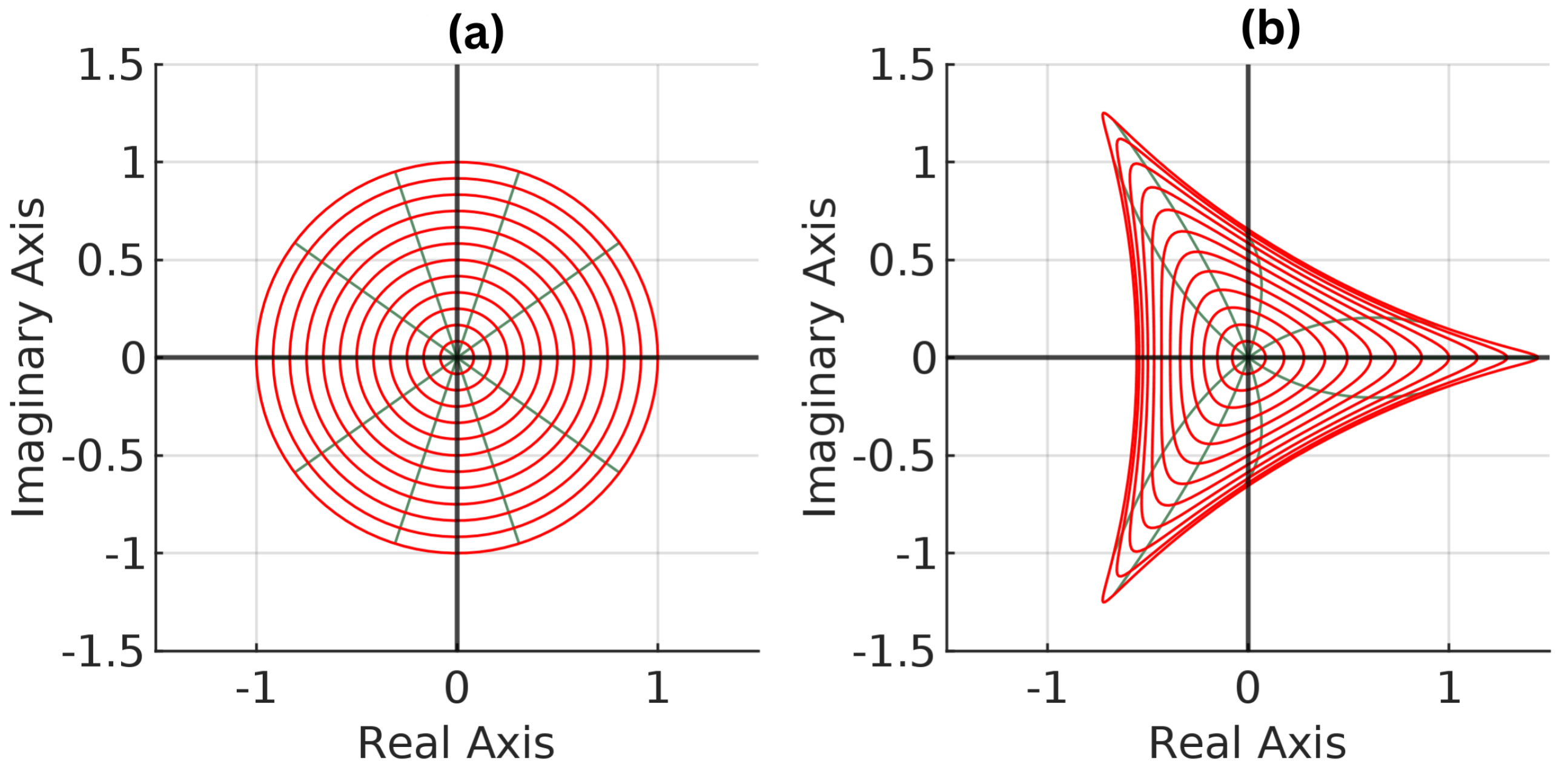
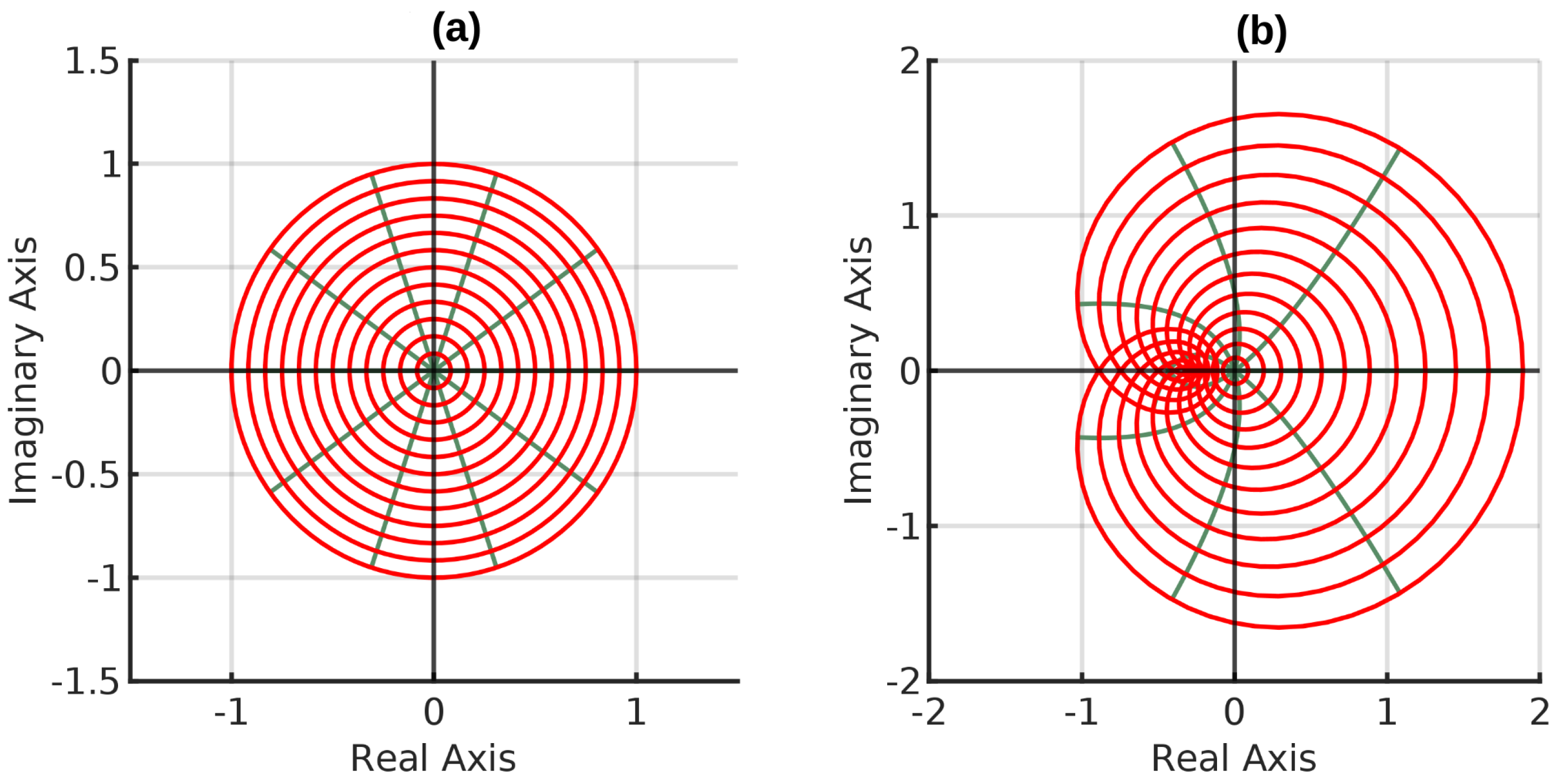
Example 1. Consider the function in Theorem 2. Let and . Then, .
With the help of
Figure 1, it can be seen which region the unit disk transforms into under the function
f. In general, these graphs provide a visual representation of the effect of the transformation on geometric shapes in the complex plane.
Figure 1a shows the unit disk, while
Figure 1b shows their transformed images, showing how the complex function changes the points on the unit disk.
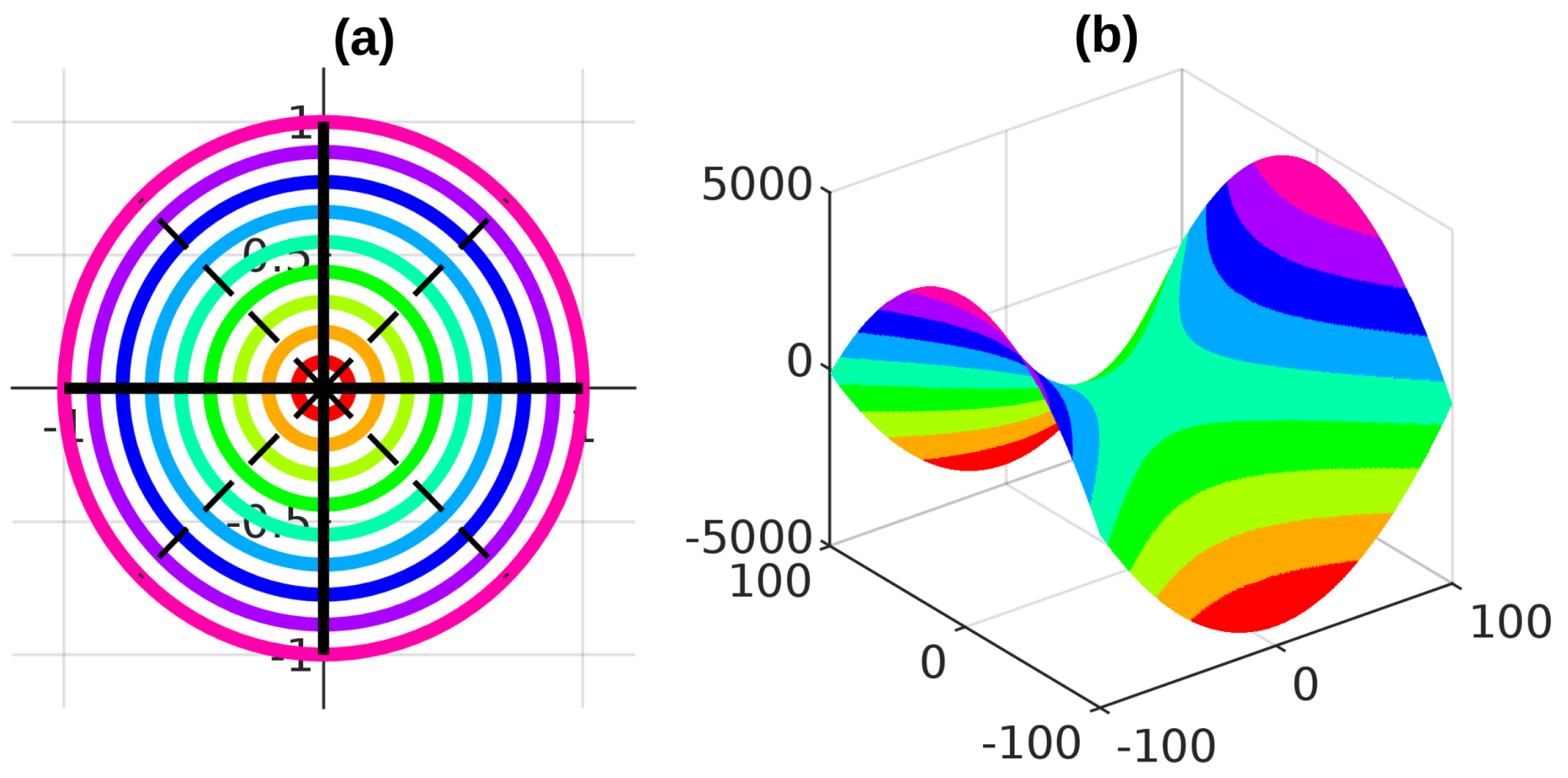
In
Figure 2, the 3D graph of the unit disk under the
f function will be examined. To better understand the three-dimensional image to be drawn, we have drawn circles in different colors inside the unit disk. If we imagine that the circles of different colors we have drawn are filled with the same colors, we can find out in which region the
f function transforms the different colors on the unit disk.
This example also shows us that is a non-empty subclass of harmonic functions defined by a differential inequality.
Now, we will look at these applications for a different function and examine what the unit disk will look like under the new f function. As in Example 1, first, the image set under the given function and then the three-dimensional drawing of the unit disk will be given. In Example 1, we derived the function from Theorem 2; now, it will be derived from Theorem 3.
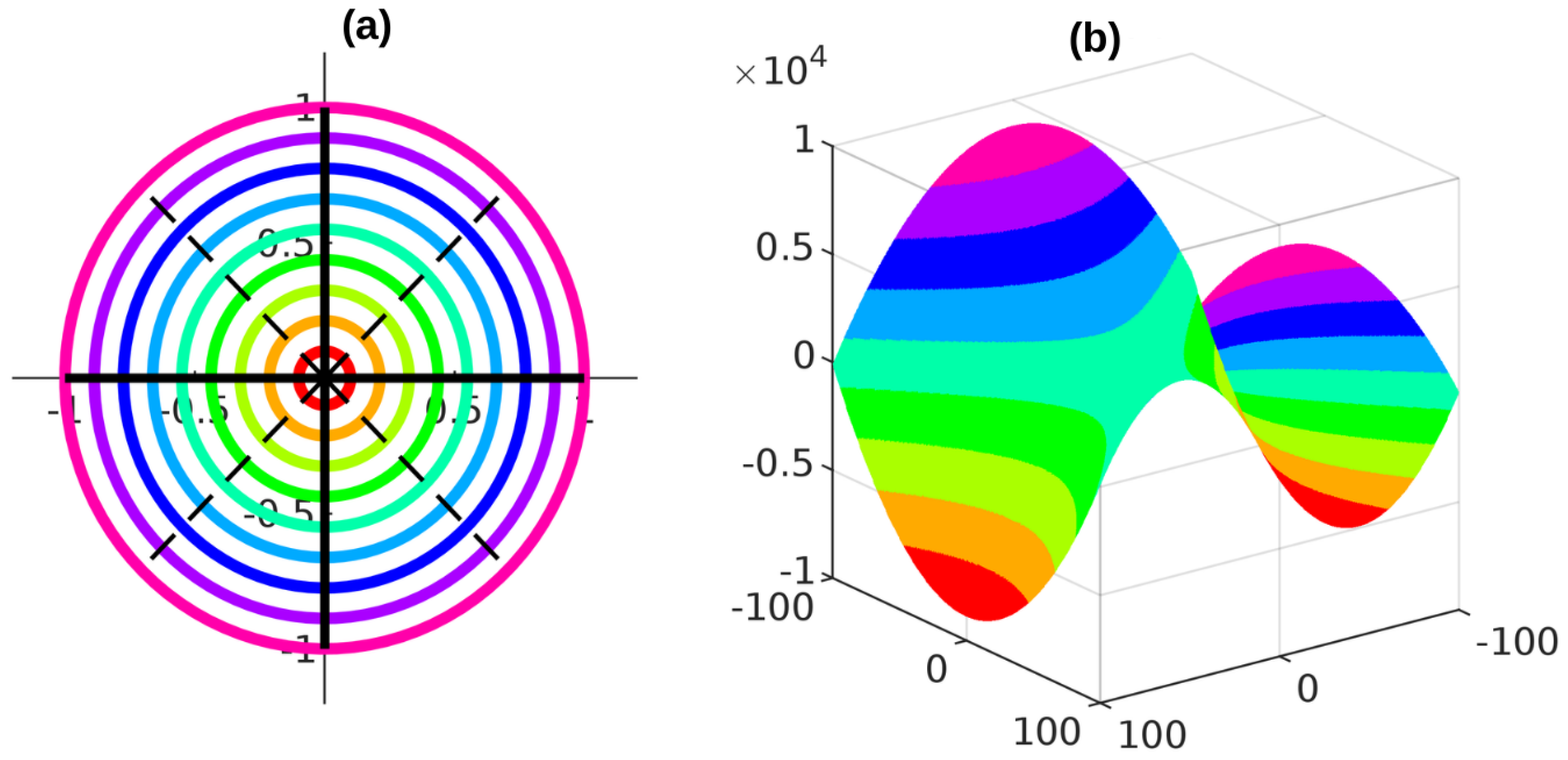
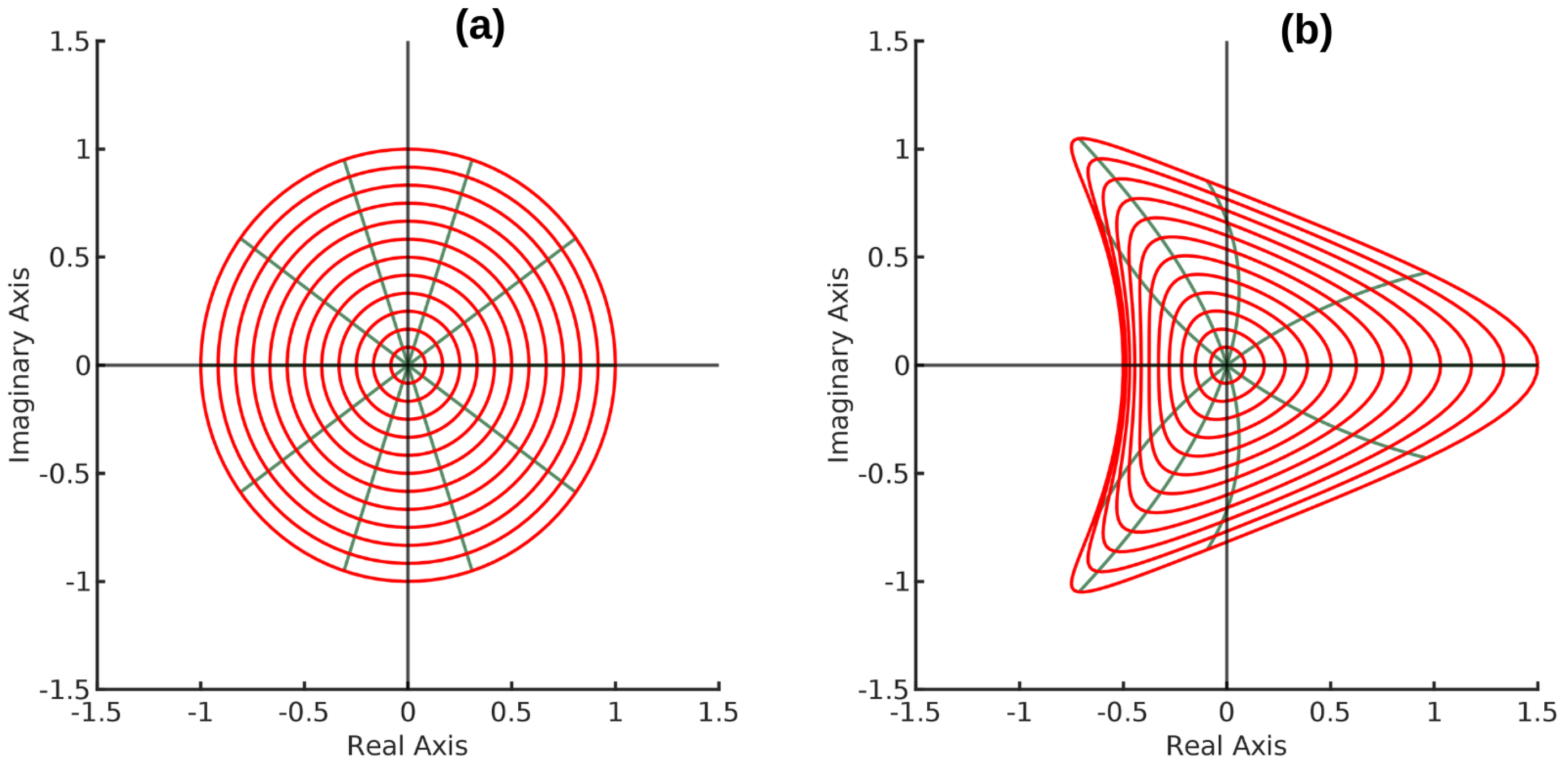
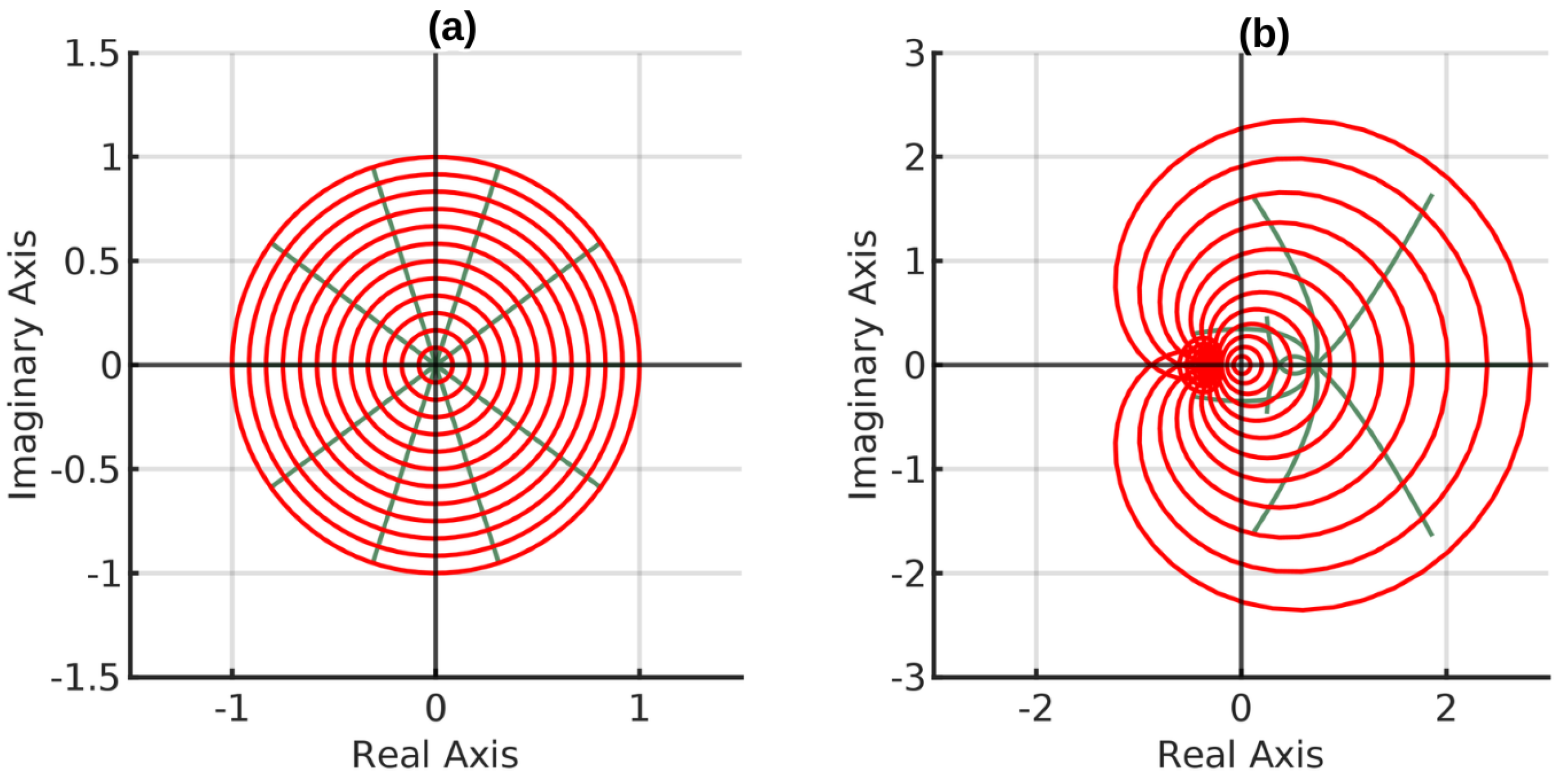
Example 2. Consider the function in Theorem 3. Let and . Then, . The region into which the function f used here transforms the unit disk is shown in Figure 3. We will now examine the 3D graph of the function
defined in Example 2 (
Figure 4).
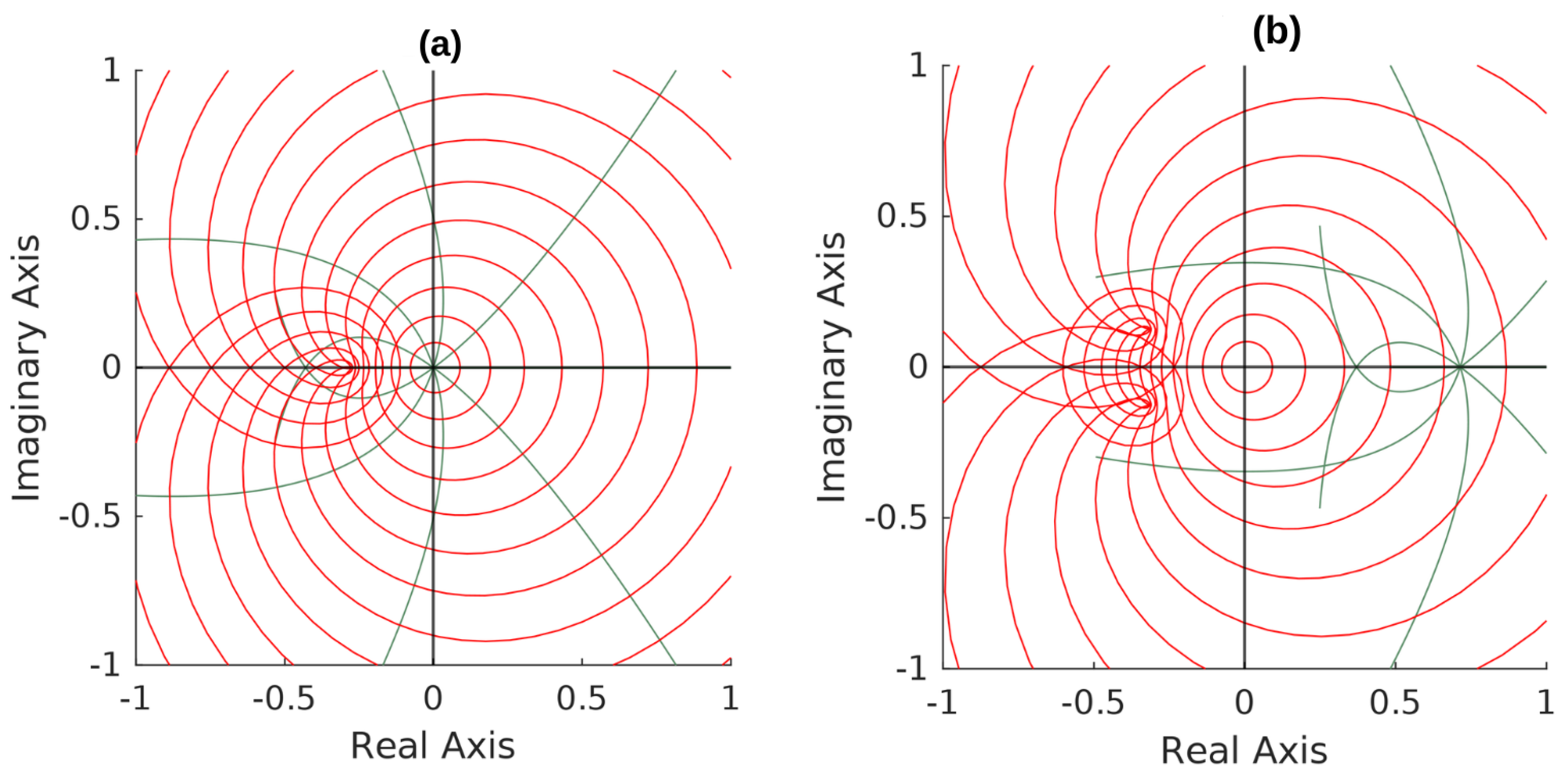
Example 3. Consider the function in Theorem 3. Let and . Then, . The region into which the function f used here transforms the unit disk is shown in Figure 5. Now, we will show what
Figure 3b and
Figure 5b look like up close for a better understanding. We have enlarged these plottings, and they are shown below (
Figure 6).
Example 4. For , and , we can write from (1). The region into which the function f used here maps the unit disk is shown in Figure 7. 5. Discussion
We obtained sharp coefficient bounds and growth estimates for the subclass, providing necessary and sufficient conditions for functions to be included. Through Theorem 1, we showed that the class is related to the well-established class of harmonic functions by a convolution operation, indicating structural robustness. The closure properties of the subclass under convex combinations and convolutions were established. The graphical examples provided a vivid understanding of how these functions map the unit disk, illustrating their geometric transformations. Through various examples, the graphs demonstrated the impact of different coefficients on the transformation of the unit disk, offering insights into the shape and behavior of the resulting regions. The 3D plots expanded the visual perspective, allowing a more comprehensive view of the transformations, emphasizing how harmonic functions influence the unit disk. Overall, these results contribute to the ongoing study of harmonic functions and their complex mappings. The graphical representations serve as a bridge between theory and visualization, enhancing comprehension and providing tangible insights into the behavior of harmonic functions under specific constraints. These visualizations can aid in identifying patterns and structures that may not be immediately apparent through theoretical analysis alone. The findings from this exploration open the door to further studies, particularly in the areas of geometric function theory and applied mathematics, where understanding the structure and transformation of harmonic functions is crucial.
Author Contributions
Conceptualization, S.Y., H.B. and G.I.O.; methodology, S.Y., H.B. and G.I.O.; software, S.Y., H.B. and G.I.O.; validation, S.Y., H.B. and G.I.O.; formal analysis, S.Y., H.B. and G.I.O.; investigation, S.Y., H.B. and G.I.O.; resources, S.Y., H.B. and G.I.O.; data curation, S.Y., H.B. and G.I.O.; writing—original draft preparation, S.Y. and H.B.; writing—review and editing, S.Y., H.B. and G.I.O.; visualization, S.Y., H.B. and G.I.O.; supervision, S.Y.; project administration, H.B.; funding acquisition, G.I.O. All authors have read and agreed to the published version of the manuscript.
Funding
This research received no external funding.
Data Availability Statement
The original contributions presented in the study are included in the article, further inquiries can be directed to the corresponding authors.
Conflicts of Interest
The authors declare no conflicts of interest.
References
- Clunie, J.; Sheil-Small, T. Harmonic univalent functions. Ann. Acad. Sci. Fenn. Ser. A. I. Math. 1984, 9, 3–25. [Google Scholar] [CrossRef]
- Duren, P. Harmonic Mappings in the Plane; Cambridge Tracts in Mathematics, 156; Cambridge University Press: Cambridge, UK, 2004. [Google Scholar]
- Ponnusamy, S.; Yamamoto, H.; Yanagihara, H. Variability regions for certain families of harmonic univalent mappings. Complex Var. Elliptic Equ. 2013, 58, 23–34. [Google Scholar] [CrossRef]
- Ghosh, N.; Vasudevarao, A. On a subclass of harmonic close-to-convex mappings. Monatsh. Math. 2019, 188, 247–267. [Google Scholar] [CrossRef]
- Mathi, M.; Prajapat, J.K. On a subclass of close-to-convex harmonic mappings. Asian-Eur. J. Math. 2021, 14, 2150102. [Google Scholar] [CrossRef]
- Nagpal, S.; Ravichandran, V. Construction of subclasses of univalent harmonic mappings. J. Korean Math. Soc. 2014, 53, 567–592. [Google Scholar] [CrossRef]
- Chichra, P.N. New subclass of the class of close-to-convex function. Proc. Am. Math. Soc. 1977, 62, 37–43. [Google Scholar] [CrossRef]
- Liu, M.S.; Yang, L.M. Geometric properties and sections for certain subclasses of harmonic mappings. Monatshefte für Mathematik 2019, 190, 353–387. [Google Scholar] [CrossRef]
- Çakmak, S.; Yasar, E.; Yalcin, S. Some basic geometric properties of a subclass of harmonic mappings. Bol. Soc. Mat. Mex. 2022, 28, 54. [Google Scholar] [CrossRef]
- Breaz, D.; Durmuş, A.; Yalçın, S.; Cotîrlă, L.-I.; Bayram, H. Certain Properties of Harmonic Functions Defined by a Second-Order Differential Inequality. Mathematics 2023, 11, 4039. [Google Scholar] [CrossRef]
- Çaglar, M.; Cotîrlă, L.-I.; Cătaș, A. A new family of harmonic functions defined by an integral operator. Acta Univ. Apulensis Math. Inform. 2022, 72, 1–13. [Google Scholar] [CrossRef]
- Nagpal, S.; Ravichandran, V. A subclass of close-to-convex harmonic mappings. Complex Var. Elliptic Equ. 2014, 59, 204–216. [Google Scholar] [CrossRef][Green Version]
- Silverman, H.; Silva, E.M. Subclasses of harmonic univalent functions. N. Z. J. Math. 1999, 28, 275–284. [Google Scholar]
- Murugusundaramoorthy, G.; Vijaya, K.; Breaz, D.; Cotîrlă, L.-I. Subclasses of Noshiro-Type Starlike Harmonic Functions Involving q-Srivastava–Attiya Operator. Mathematics 2023, 11, 4711. [Google Scholar] [CrossRef]
- Oros, G.I.; Yalçın, S.; Bayram, H. Some Properties of Certain Multivalent Harmonic Functions. Mathematics 2023, 11, 2416. [Google Scholar] [CrossRef]
- Al-Refai, O. Some properties for a class of analytic functions defined by a higher-order differential inequality. Turk. J. Math. 2019, 43, 2473–2493. [Google Scholar] [CrossRef]
- Fejér, L. Über die Positivität von Summen, die nach trigonometrischen oder Legendreschen Funktionen fortschreiten. Acta Litt. Sci. Szeged 1925, 2, 75–86. [Google Scholar]
- Singh, R.; Singh, S. Convolution properties of a class of starlike functions. Proc. Am. Math. Soc. 1989, 106, 145–152. [Google Scholar] [CrossRef]
- Goodloe, M. Hadamard products of convex harmonic mappings. Complex Var. Theory Appl. 2002, 47, 81–92. [Google Scholar] [CrossRef]
| Disclaimer/Publisher’s Note: The statements, opinions and data contained in all publications are solely those of the individual author(s) and contributor(s) and not of MDPI and/or the editor(s). MDPI and/or the editor(s) disclaim responsibility for any injury to people or property resulting from any ideas, methods, instructions or products referred to in the content. |
© 2024 by the authors. Licensee MDPI, Basel, Switzerland. This article is an open access article distributed under the terms and conditions of the Creative Commons Attribution (CC BY) license (https://creativecommons.org/licenses/by/4.0/).