Abstract
Recently, the fixed-point theorem for fuzzy contractive mappings has been investigated within the framework of intuitionistic fuzzy metric-like spaces. This interesting topic was explored through the utilization of G-Cauchy sequences as defined by Grabiec. The aim of this study is to enhance the aforementioned results in a few aspects. Initially, the proof of the fixed-point theorem is simplified and condensed, allowing for potential generalization to papers focusing on similar fixed-point analyses. Furthermore, instead of G-Cauchy sequences, the classical Cauchy sequences proposed by George and Veeramani are examined, incorporating an additional condition on the fuzzy metric. Within this context, a solution to an old unresolved question posed by Gregory and Sapena is provided. The findings are reinforced by relevant examples. Finally, the introduced fuzzy metrics are applied to the field of image processing.
MSC:
47H10; 54H25; 68U10; 94A08
1. Introduction
Grabiec [1] adhered to the concept of fuzzy metric space introduced by Kramosil and Michalek [2] and presented a novel notion of G-Cauchy sequences, which significantly deviates from the classical definition of Cauchy sequences proposed by George and Veeramani [3]. While it is evident that G-Cauchyness is a weaker concept compared to the classical one, discussion and confusion have arisen surrounding this notion [4,5]. Additionally, it has been demonstrated (Note 3.13, [3]) that the standard fuzzy metric space is not G-complete, and that a compact fuzzy metric space does not necessarily guarantee G-completeness [6]. A more comprehensive study on various Cauchy and convergence types can be found in [7].
When focusing on fixed-point results related to G-Cauchyness, simpler proofs are achieved without the ease of transfer to the classical case. In this context, Gregory and Sapena [8] pose an open question regarding the fixed-point theorem in the classical case for fuzzy contractive sequences:
Harandi [9] introduced a fuzzy metric-like space with a fresh perspective on the metric when . Various authors have studied fixed-point theorems in fuzzy metric-like spaces, including Ćirić contraction [9], fuzzy contractive sequences [10], and fuzzy b-metric-like spaces [11]. Park [12] introduced intuitionistic fuzzy metric spaces inspired by the notion of intuitionistic fuzzy sets by Atanassov [13]. Further insights into intuitionistic fuzzy metric spaces, along with various fixed-point theorems and applications, can be found in [14,15,16,17].
In [18], intuitionistic fuzzy metric-like spaces are explored as a combination of concepts introduced by Harandi and Park, with direct references to fixed-point results obtained in [10]. Among numerous applications, the potential of fuzzy and probabilistic metrics and fixed-point results in image processing is highlighted [19,20,21,22]. This application is particularly realized through intuitionistic fuzzy sets [23,24,25].
The primary objectives of this paper are twofold as follows: to enhance interesting fixed-point results and examples related to intuitionistic fuzzy metric-like spaces as presented in [18], and to apply the introduced fuzzy metrics in image processing. The Introduction and Preliminaries provide essential concepts and notes on fuzzy metric-like and intuitionistic fuzzy metric spaces, with specific comments on the definition of Cauchy sequences in fuzzy metric spaces. Subsequently, the fixed-point theorem in intuitionistic fuzzy metric-like spaces is examined, incorporating the fuzzy contractive condition established by Gregory and Sapena, as well as the classical Cauchy sequences promoted by George and Veeramani. The discussion is supported by examples and appropriate fuzzy metrics utilized for image processing in the final section of the paper.
Some applications of fuzzy contractions in various fields of mathematics and engineering science through fractional differential equations are presented by Younis and Abdau in [26].
2. Preliminaries
Definition 1
([9]). Let A mapping is called metric-like on Λ if the following hold:
The pair is called a metric-like space (MLS) on
Clearly, is called metric-like on
Definition 2
([27,28]). A binary operation is a continuous t-norm if ★ satisfies the following conditions:
is commutative and associative;
is continuous;
for all
whenever and and
Definition 3
([27,28]). A binary operation is a continuous t-conorm if ⊙ satisfies the following conditions:
is commutative and associative;
is continuous;
for all
whenever and and
Definition 4
([3]). The triplet is called a fuzzy metric space (FMS), where Λ is an arbitrary set, ★ is a continuous t-norm and M is a fuzzy set on if it satisfies the following conditions, for all and
if and only if
is continuous.
is non-decreasing for all in
If is an FMS, we say that or simply is a fuzzy metric on By
is defined a standard fuzzy metric induced by metric Every fuzzy metric on generates a topology on , which has as a base the family of open sets of the form where for all and
Theorem 1
([3]). A sequence in a fuzzy metric space converges to if, and only if, for all
Definition 5
([3,29]). A sequence in a fuzzy metric space is called Cauchy if for each and each there exists such that for all or, equivalently, if for all is called complete if every Cauchy sequence in Λ is convergent with respect to
Due to the definition of fuzzy metric spaces given by Kramosil and Michalek [2]), Grabiec established the following definition of a Cauchy sequence:
Definition 6
([1]). A sequence in a fuzzy metric space is called G-Cauchy if for each and each
is G-complete if every G-Cauchy sequence in is convergent.
Definition 7
([9]). The triplet is a fuzzy metric-like space (FMLS), where Λ is an arbitrary set, ★ is a continuous t-norm and is a fuzzy set on , satisfying the following conditions, for all and
if then
is a continuous mapping.
Since in a fuzzy metric-like space, may be less than this concept is applicable when the degree of nearness of x and y is not perfect for the case
Proposition 1
([10]). Let be any metric-like space. Then, the triplet is an FMLS, where ★ is defined by for all and the fuzzy set is given by
for all and
Proposition 1 still holds for t-norm and shows that every metric-like space induces a fuzzy metric-like space. Specially, for , we have the standard fuzzy metric-like space
Example 1
([10]). Let and Define ★ by and the fuzzy set in by
for all Then, is a MLS and is an FMLS, but it is not an FMS, as for all and
Proposition 2
([10]). Let be any MLS. Then, the triplet is an FMLS, where ★ is given by or for all and the fuzzy set is defined by
for all
Example 2
([10]). Let Define ★ by and the fuzzy set in by
for all Then, is an MLS and is an FMLS, but it is not an FMS, as for all and
Example 3
([10]). Let Define by and the fuzzy set in by:
then, is an FMLS, but it is not an FMS.
Definition 8
([12]). A 5-tuple is said to be an intuitionistic fuzzy metric space if Λ is an arbitrary set, ★ is a continuous t-norm, ⊙ is a continuous t-conorm and are fuzzy sets on , satisfying the following conditions, for all
if, and only if,
is continuous;
if, and only if,
is continuous.
Then, is called an intuitionistic fuzzy metric on The functions and denote the degree of nearness and the degree of non-nearness between x and y with respect to respectively. Also, is non-decreasing and is non-increasing for all
Remark 1
([12,30]). Every fuzzy metric space is an intuitionistic fuzzy metric space of the form such that the t-norm ★ and t-conorm ⊙ are associated, i.e., for any
Example 4
([12]). (Induced intuitionistic fuzzy metric). Let be a metric space. Denote and for all and let and be fuzzy sets on defined as follows:
for all Then, is an intuitionistic fuzzy metric space.
The above example holds even with the t-norm and the t-conorm If we take we obtain the standard intuitionistic fuzzy metric:
Example 5
([12]). Let Define and for all and let and be fuzzy sets on as follows:
for all and Then, is an intuitionistic fuzzy metric space, where the t-norm ★ and t-conorm ⊙ are not associated. Note that the above function is not an intuitionistic fuzzy metric with the t-norm and t-conorm defined as and
Definition 9
([18]). Let Λ be an arbitrary set, ★ a continuous t-norm, and ⊙ a continuous t-conorm. Let and be fuzzy sets on Then, is an intuitionistic fuzzy metric-like space (IFMLS) if the following conditions are satisfied, for all and
is continuous;
is continuous.
Proposition 3
([18]). Let be any metric-like space. Then, the 5-tuple is an IFMLS, where and for all and are given by
for all
Proposition 3 holds even with the t-norm and
Example 6
([18]). Let and Let and for all Define the fuzzy sets and in by
for all and Then, is an IFMLS, but it is not an IFMS, as and for all and
Note that, by (IFML1), in Proposition 3 and Example 6, parameter m must be greater than 1.
Proposition 4
([18]). Let be any MLS. Then, the 5-tuple is an IFMLS, where or and or for all and the fuzzy sets and are defined by
for all
Example 7
([18]). Let and Define the fuzzy sets and G in by
for all Then, is an IFMLS, but it is not an IFMS, as for all and
Example 8
([18]). Let and Define the fuzzy sets and in by:
for all Then, is an IFMLS, but it is not an IFMS.
Definition 10
([9,12]). Let be an IFMLS.
(a) A sequence in Λ is called convergent to if and for all
(b) A sequence in Λ is called Cauchy if there are and , such that,
for each and each there exists such that
for all or, equivalently, if
for all
(c) is called complete if every Cauchy sequence in Λ converges to some such that
and
for all
3. Main Results
Definition 11.
Let be an IFMLS. A mapping is called an intuitionistic fuzzy contractive if there exists such that
and
for all and Here, λ is called the intuitionistic fuzzy constant of
Remark 2.
Trivially, every intuitionistic fuzzy contractive mapping is a fuzzy contractive mapping.
Theorem 2.
Let be a complete intuitionistic fuzzy metric-like space and an intuitionistic fuzzy contractive mapping with intuitionistic fuzzy contractive constant λ. Let
and
Then, T has a unique fixed point and for all
Proof.
For any arbitrary a sequence is defined as for all If there exists an such that then is considered a fixed point of the function Now, assuming that for all then, for and referring to the contractive condition (1), we have:
As we let n approach infinity, we obtain:
It is necessary to prove that the sequence is a Cauchy sequence. Assuming the opposite, i.e., there exist and sequences and such that for every and
and
Clearly, from (6),
Using (IFML5), for any and it follows that
By letting in the inequality (9), considering the continuity of T and (3), we can deduce
and, together with (8), we have
Therefore, we have:
Now,
On the other hand, we can show that
So,
Using the contractive condition for , we can express the relationship as follows:
Letting , we obtain:
This leads to a clear contradiction.
By the second contractive condition (2), we have
Therefore, we can conclude that
To prove that sequence is a Cauchy sequence, we assume the contrary. That is, there exist and sequences and such that for every and the following inequalities hold:
and
From (11), we have:
Using (IFML10), for arbitrary and we obtain:
If we take in the inequality (9), by continuity of ⊙ and (4), we can deduce the following:
and in conjunction with (13), we conclude,
Therefore, we can conclude that
Now,
Conversely, we can observe that
So,
In the context of a contractive condition for , we have
and letting , we obtain
which is an obvious contradiction.
In both cases, the sequence is a Cauchy sequence, implying the existence of such that This leads to the relationships:
and
Furthermore, we have:
and as we obtain:
This holds only if Similarly from
as we arrive at:
which is possible only if
So, we have that
and
The remaining part of the proof follows the same structure as discussed in [18]. □
Example 9
(Example 4 from [18]). Let and with intuitionistic fuzzy sets defined as:
for all Then, forms a complete IFMLS. The mapping T, defined as
is intuitionistic fuzzy contractive for By Theorem 1 [18], T has a unique fixed point.
Remark 3.
The mapping T defined in Example 9 is not intuitionistic fuzzy contractive. Specifically, condition (1) is satisfied when However, when considering condition (2), for we observe that:
As when for any it follows that
Remark 4.
Theorem 2 enhances the results presented in Theorem 1 [18] in several key aspects. Firstly, it is noted that the limits (5) and (10) can only be attained through the contraction conditions (1) and (2), as demonstrated in the proof of Theorem 2. Additionally, Theorem 2 highlights the presence of classical Cauchy sequences, as opposed to the G-Cauchy sequences discussed in [18]. This distinction is achieved through the introduction of supplementary conditions (3) and (4), which can be easily satisfied, as illustrated in the subsequent examples.
Furthermore, if any contractive condition leads to (5), then the sequence automatically becomes G-Cauchy, as demonstrated by the inequality:
which leads to the result as Utilizing this, the simplification and shortening of many proofs (for example, in [10,11,18]) could be performed.
Moreover, the condition (3) along with the methodologies employed in the proof of Theorem 2 can be extended to the context of FMS. This extension provides a resolution to the open question posed by Gregory and Sapena [8] regarding the fixed-point theorem involving fuzzy contractive sequences within the classical Cauchy framework.
Example 10.
Remark 5.
Example 10 essentially improves Example 4 [18] considering Remark 3. Additionally, the utilization of the parameter in defining the intuitionistic fuzzy sets and ensures that This condition illustrates that an IFMLS is not directly induced by an FMLS, as outlined in Remark 1.
Example 11.
Example 12.
In [24], intuitionistic fuzzy sets given by
are applied in color image processing for leukocyte segmentation. From this perspective, keeping all elements from Example 11, except , where, for , we have
Then, condition (2) holds for
For example, if we take , then
Remark 6.
In Example 11, more general fuzzy sets can be observed as follows:
for all and Also, with
for all and the set Λ could contain negative reals, for example,
4. Application
In this section, we explore the application of fuzzy metrics in filtering grayscale images. This application draws from the concept of the fuzzy filter as defined by N. M. Ralević, D. Karaklić and N. Pištinjat in [31], among other similar articles. Fuzzy metrics encompass a range of concepts that are influenced by image pixels. Each image pixel (“position”, “brightness level”) can be characterized by spatial coordinates of pixel (points from the screen), and by the number , which represents the brightness level of the pixel.
Image filtering is the process of waking up a suspect pixel replaced with the one without the sum. Typically, this is achieved by replacing the central pixel in the window , ( (a square portion of the image of pixels) with a pixel which represents the other pixels from V in the best possible way, that is, by the pixel that is the most similar in brightness and spatial distance to other pixels from W.
Selection bias is another potential concern because it is of enormous importance to choose a good criterion for selecting such a pixel without noise, which will replace the pixel with noise in a given window W, because the choice of pixels affects the image quality, i.e., affects the degree of the removed noise.
In the algorithm for fuzzy filtering of images, we utilize a metric as follows:
The fuzzy metric which is used in order to measure similarity in brightness level among pixels is:
The fuzzy metric that considers the spatial distance between pixels is:
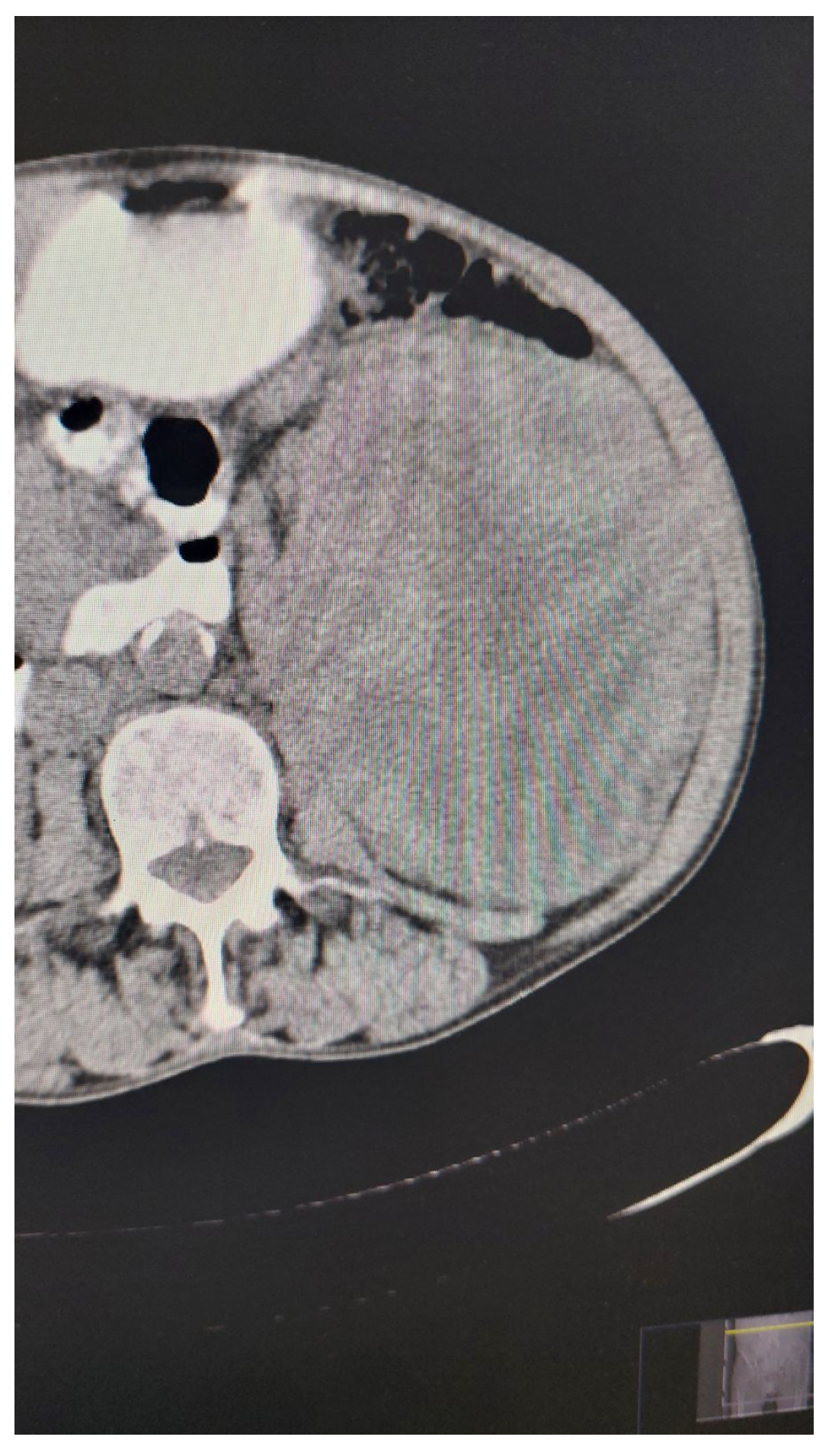
In the following example, the picture Figure 1 is given in jpg format.
Figure 1.
Original image kidney.jpg.
To test the quality of that image, we will use the image quality index UIQI, defined in the paper by Z. Wang and A.C. Bovik [32]. For measuring sharpness, we have used the image quality metrics introduced in the paper [33] by N.D. Narvekar and L.J. Karam.
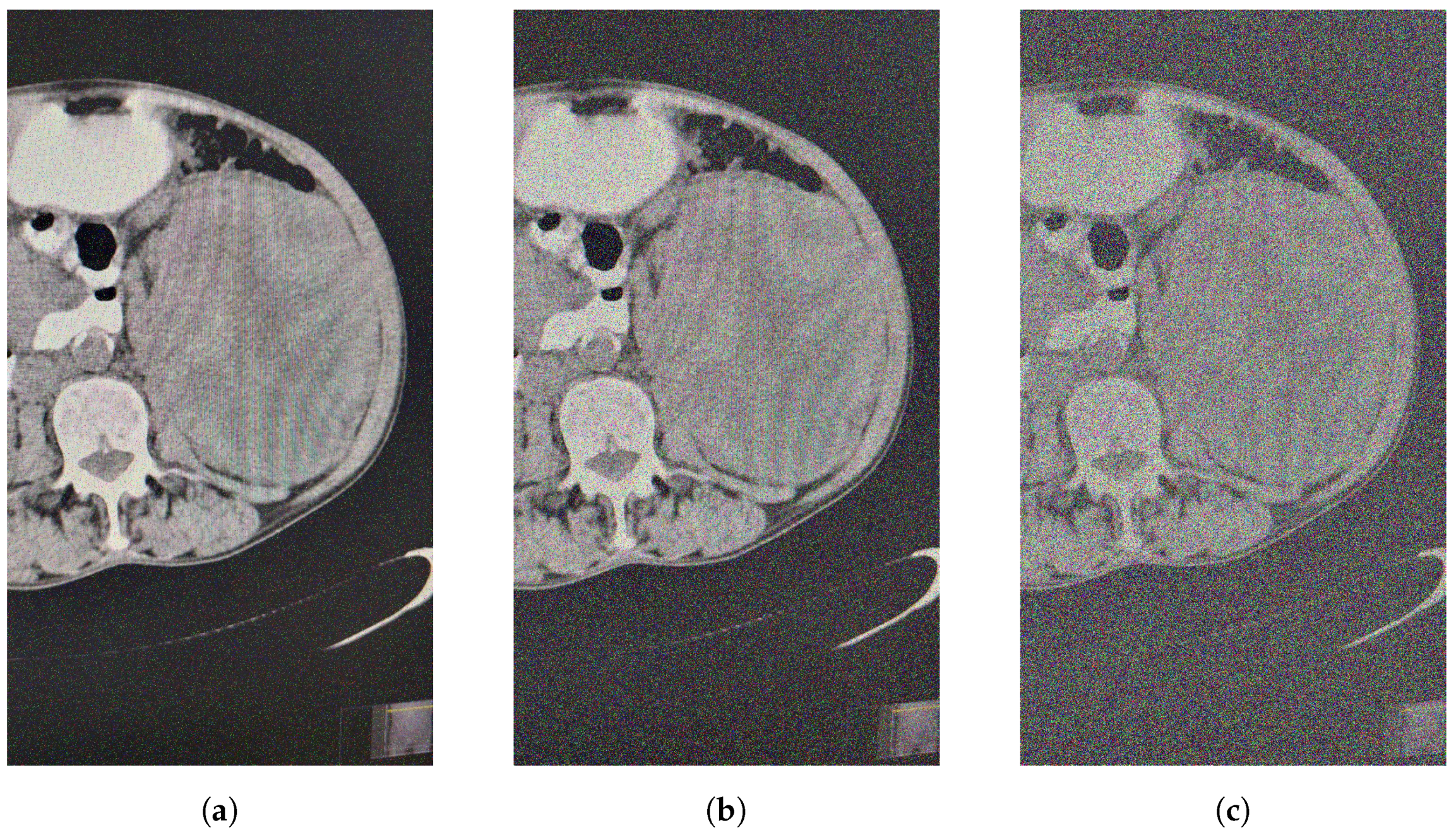
As we can see, the filtered image given below is contaminated with and salt and pepper noise. The chosen size of window is 5.
Let us present the results of the experiments we conducted and the corresponding images. We will compare the quality of the images obtained using the fuzzy filter FF and the vector median filter VMF.
Let (Figure 2).
Figure 2.
(a) Contaminated image . (b) Contaminated image . (c) Contaminated image .
The values of the metric of image quality UIQI for the filtered image (Figure 3a) by median filter are equal to The sharpness for the image filtered by VMF is 0.7578.
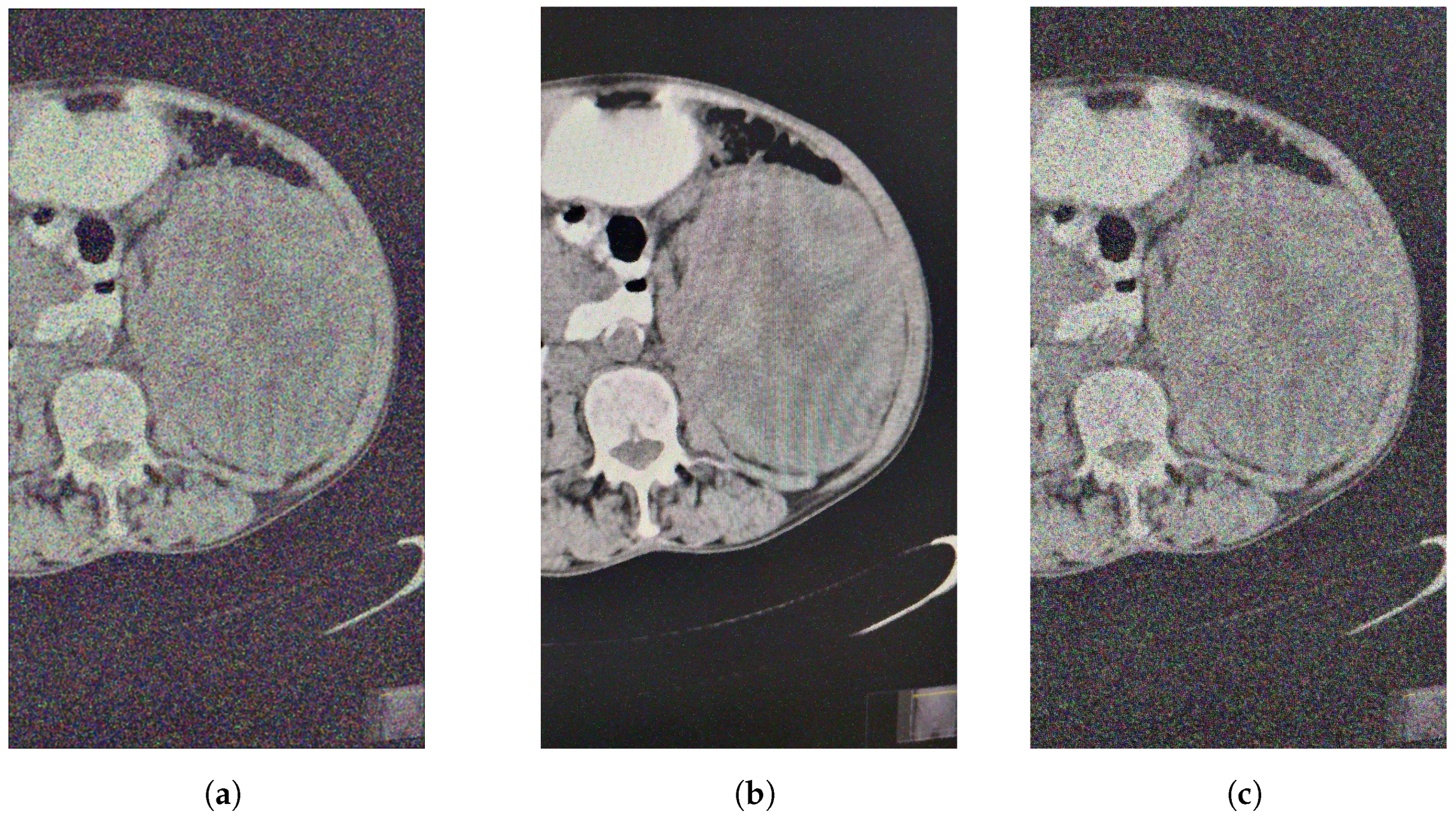
Figure 3.
(a) Decontaminated image by VMF. (b) Decontaminated image by FF. (c) Decontaminated image by FF.
The tested values of the parameters appearing in those metrics ranged from 0 to 500 with a step of 100 for while t ranged from 0 to 1.1 with a step of 0.1. The best values of the UIQI image quality metric (for each color) for the image filtered (using the method proposed in [31]) were obtained for and that is for (Figure 3b),
The sharpness for the image filtered by our metric is 0.9918.
The tested values of the parameters appearing in those metrics ranged from 0 to 500 with a step of 20 for while t ranged from 0 to 500 with a step of 20. The best values of the UIQI image quality metric (for each color) for the image filtered were obtained for and that is for ,
The sharpness for the image filtered by our metric is 0.9915.
The tested values of the parameters appearing in those metrics ranged from 0 to 5000 with a step of 200 for while t ranged from 0 to 1 with a step of 0.1. The best values of the UIQI image quality metric (for each color) for the images filtered were obtained for and that is for
The sharpness for the image filtered by our metric is 0.9901.
Let (Figure 2b).
The values of the metric of image quality UIQI for the filtered image by median filter are equal to The sharpness for the image filtered by VMF is 0.6943.
The tested values of the parameters appearing in those metrics ranged from 0 to 500 with a step of 100 for while t ranged from 0 to 500 with a step of 100. The best values of the UIQI image quality metric (for each color) for the image filtered were obtained for and that is for (Figure 3c),
The sharpness for the image filtered by our metric is 0.9967.
Let (Figure 2c).
The values of the metric of image quality UIQI for the filtered image by median filter are equal to The sharpness for the image filtered by VMF is 0.8719.
The tested values of the parameters appearing in those metrics ranged from 0 to 500 with a step of 100 for while t ranged from 0 to 500 with a step of 100. The best values of the UIQI image quality metric (for each color) for the image filtered were obtained for and that is for
The sharpness for the image filtered by our metric is 0.9985.
Our results showed that our filtered image had slightly lower values in terms of UIQI image quality but significantly higher sharpness. This emphasizes the relationship between image quality and sharpness, which is crucial when preserving important details in the image.
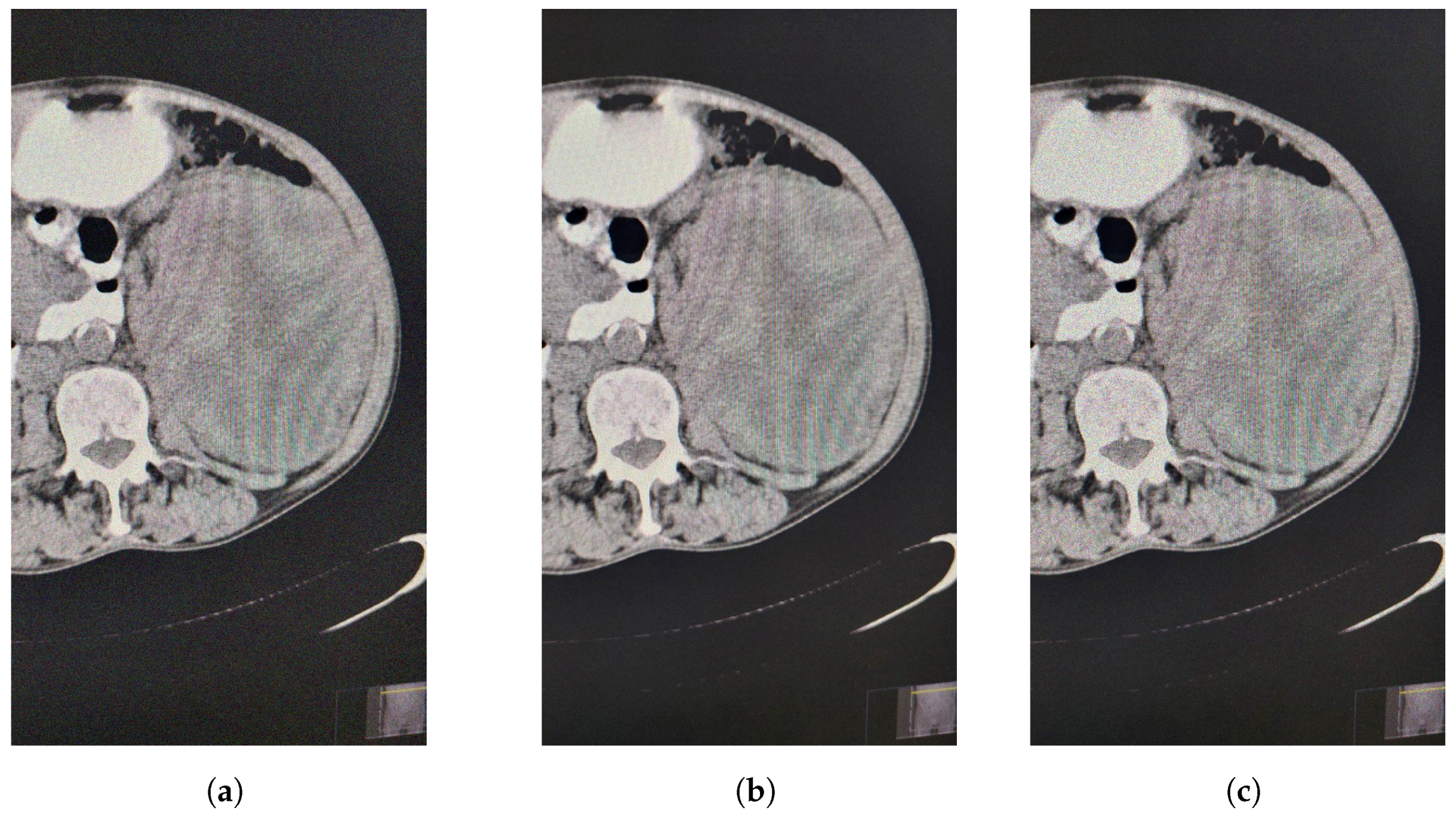
The previous experiments involved filtering images noised with different percentages of salt and pepper noise using the median filter (VMF) and the fuzzy filter (FF). Now, we apply other types of noise (Figure 4a–c), to the same original image Figure 1 using the appropriate functions in the MATLAB package.
Figure 4.
(a) Contaminated image by Gaussian noise. (b) Contaminated image by Poisson noise. (c) Contaminated image by speckle noise.
The programs we use are coded in the MATLAB package, and to test image quality, we use the UIQI quality index (Z. Wang and A.C. Bovik [32]). For testing the sharpness of the filtered images, we use the metrics defined in the paper by N.D. Narvekar and L.J. Karam [33]. Note that the UIQI index and sharpness values range within the interval where values closer to 1 indicate better filtering quality and image sharpness.
In the algorithm for fuzzy filtering of images, we use a metric defined as above in (15). The fuzzy metric used to measure similarity in brightness level among pixels is given in (16), with the parameter . The tested values of the parameter K appearing in these metrics ranged from 0 to 5000, with a step of 500.
The fuzzy metric that considers the spatial distance between pixels is given in (17) and the tested values of the parameter t appearing in those metrics ranged from 0 to 5000 with a step of 500.
For the median filter, the obtained results are given in the Table 1:
Table 1.
Values of UIQI and sharpness for VMF.
For the fuzzy filter, the obtained results are given in the Table 2:
Table 2.
Values of UIQI and sharpness for FF.
When considering the fuzzy metrics with parameter , the image filtered by FF exhibits the best UIQI index.
We note that the median filter gives a higher UIQI quality index for images obtained by removing noise from the noised original images, for all types of noise considered (Table 1 and Table 2). The sharpness of the filtered images using FF is noticeably better than that of images filtered with VMF (Table 1 and Table 2).
If we look at the fuzzy metrics parameters that occur with FF, the best UIQI index is achieved with images where
Research on image filtering using fuzzy metric-based filters can be found in studies such as [31,34,35].
5. Conclusions
The fixed-point theorem for fuzzy contractive mappings was explored within intuitionistic fuzzy metric-like spaces (Onbaşioğlu, Varol, Matematika, 2023, 11, 1902). As well as improvements and simplifications of the evidence, generalizations were examined for Cauchy sequences as understood by George and Veeramani.
Furthermore, we aimed to examine how intuitionistic fuzzy metric-like spaces that fulfill the conditions of the stated fixed-point theorem behave compared to other fuzzy metrics in applications. Specifically, image filtering with a fuzzy filter (FF) based on such fuzzy metrics was compared to the vector median filter (VMF). Images were subjected to different levels of pepper noise. Various parameters in the fuzzy metrics were adjusted and illustrated as part of the research. In the examples provided, the fuzzy metric proved to be more effective in enhancing the quality of the filtered image with FF compared to VMF, resulting in better image sharpness.
In future work, which will focus solely on image filtering, different classes of fuzzy metrics and their corresponding fuzzy filters will be compared, observing the quality of their filtering. Comparisons can also be made for other types of noise, such as Gaussian noise, Poisson noise, and speckle noise. Some examples of such comparisons are represented in this paper.
Distances in general, and fuzzy metrics in particular, being used in image processing can also be applied to image segmentation, as demonstrated in other works by the author (see, for example, [36,37]), and copy-move forgery detection on images [38], and others. This will demonstrate the impact of intuitionistic fuzzy metric-like segmentation on quality.
Author Contributions
Conceptualization, T.D.; Methodology, D.R.; Writing—original draft, T.D. and N.R.; Writing—review & editing, D.R. and B.C.; Supervision, N.R. All authors have read and agreed to the published version of the manuscript.
Funding
This research was partially supported by the Science Fund of the Republic of Serbia, #GRANT No 7632, Project “Mathematical Methods in Image Processing under Uncertainty”—MaMIPU and the Provincial Secretariat for Higher Education and Scientific Research (AP Vojvodina, Republic of Serbia) through the project no. 142-451-3188/2023-01.
Data Availability Statement
The original contributions presented in the study are included in the article, further inquiries can be directed to the corresponding author.
Acknowledgments
This research has been partially supported by the Ministry of Science, Technological Development and Innovation (Contracts No. 451-03-65/2024-03/200156 and No. 451-03-65/2024- 03/200134) and the Faculty of Technical Sciences, University of Novi Sad through project “Scientific and Artistic Research Work of Researchers in Teaching and Associate Positions at the Faculty of Technical Sciences, University of Novi Sad” (No. 01-3394/1).
Conflicts of Interest
The authors declare no conflicts of interest. The funders had no role in the design of the study; in the collection, analyses, or interpretation of data; in the writing of the manuscript; or in the decision to publish the results.
References
- Grabiec, M. Fixed points in fuzzy metric spaces. Fuzzy Sets Syst. 1989, 27, 385–389. [Google Scholar] [CrossRef]
- Kramosil, I.; Michalek, J. Fuzzy metric and statistical metric spaces. Kybernetika 1975, 11, 326–334. [Google Scholar]
- George, A.; Veeramani, P. On some result in fuzzy metric spaces. Fuzzy Sets Syst. 1994, 64, 395–399. [Google Scholar] [CrossRef]
- Song, G. Comments on ‘A common fixed point theorem in a fuzzy metric space’. Fuzzy Sets Syst. 2003, 135, 409–413. [Google Scholar] [CrossRef]
- Vasuki, R.; Veeramani, P. Fixed point theorems and Cauchy sequences in fuzzy metric spaces. Fuzzy Sets Syst. 2003, 135, 415–417. [Google Scholar] [CrossRef]
- Tirado, P. On compactness and G-completeness in fuzzy metric spaces. Iran. J. Fuzzy Syst. 2012, 9, 151–158. [Google Scholar]
- Gregori, V.; Miñana, J.J.; Morillas, S.; Sapena, A. Cauchyness and convergence in fuzzy metric spaces. RACSAM 2017, 111, 25–37. [Google Scholar] [CrossRef]
- Gregori, V.; Sapena, A. On fixed-point theorems in fuzzy metric spaces. Fuzzy Sets Syst. 2002, 125, 245–252. [Google Scholar] [CrossRef]
- Harandi, A.A. Metric-like spaces, partial metric spaces and fixed points. Fixed Point Theory Appl. 2012, 204, 1–10. [Google Scholar]
- Shukla, S.; Abbas, M. Fixed point results in fuzzy metric-like spaces. Iran. J. Fuzzy Syst. 2014, 11, 81–92. [Google Scholar]
- Javed, K.; Uddin, F.; Arshad, M.; Ishtiaq, U.; Alsamir, H. On Fuzzy b-Metric-Like Spaces. J. Funct. Spaces 2021, 6615976. [Google Scholar] [CrossRef]
- Park, J.H. Intuitionistic fuzzy metric spaces. Chaos Solitons Fractals 2004, 22, 1039–1046. [Google Scholar] [CrossRef]
- Atanassov, K.T. Intuitionistic fuzzy sets. Fuzzy Sets Syst. 1986, 20, 87–96. [Google Scholar] [CrossRef]
- Alaca, C.; Turkoglu, D.; Yildiz, C. Fixed points in intuitionistic fuzzy metric spaces. Chaos Solitons Fractals 2006, 29, 1073–1078. [Google Scholar] [CrossRef]
- Ješić, S.N.; Babačev, N.A. Common fixed point theorems in intuitionistic fuzzy metric spaces and L-fuzzy metric spaces with nonlinear contractive condition. Chaos Solitons Fractals 2008, 37, 675–687. [Google Scholar] [CrossRef]
- Ćirić, L.B.; Ješić, S.N.; Ume, J.S. The existence theorems for fixed and periodic points of nonexpansive mappings in intuitionistic fuzzy metric spaces. Chaos Solitons Fractals 2008, 37, 781–791. [Google Scholar] [CrossRef]
- Jiao, Z. On Fixed Point Theorems in Intuitionistic Fuzzy Metric Spaces. J. Appl. Math. 2012, 5, 474983. [Google Scholar] [CrossRef]
- Onbaşioğlu, Ş.; Varol, B.P. Intuitionistic Fuzzy Metric-like Spaces and Fixed-Point Results. Mathematics 2023, 11, 1902. [Google Scholar] [CrossRef]
- Hanjing, A.; Suantai, S. A Fast Image Restoration Algorithm Based on a Fixed Point and Optimization Method. Mathematics 2020, 8, 378. [Google Scholar] [CrossRef]
- Karaklić, D.; Gajić, L.J.; Ralević, N.M. Some Fixed Point Results in a Strong Probabilistic Metric Spaces. Filomat 2019, 33, 2201–2209. [Google Scholar] [CrossRef]
- Morillas, S.; Gregori, V.; Peris-Fajarnés, G.; Latorre, P. A fast impulsive noise color image filter using fuzzy metrics. Real-Time Imaging 2005, 11, 417–428. [Google Scholar] [CrossRef]
- Valentin, G.; Morillas, S.; Sapena, A. Examples of fuzzy metrics and applications. Fuzzy Sets Syst. 2011, 170, 95–111. [Google Scholar]
- Balasubramaniam, P.; Ananthi, V.P. Image fusion using intuitionistic fuzzy sets. Inf. Fusion 2014, 20, 21–30. [Google Scholar] [CrossRef]
- Bouchet, A.; Montes, S.; Diaz, I. Intuitionistic fuzzy sets applied to color image processing. In Proceedings of the WILF 2021: 13th International Workshop on Fuzzy Logic and Applications, Vietri sul Mare, Italy, 20–22 December 2021. [Google Scholar]
- Deng, H.; Sun, X.; Liu, M.; Ye, C.; Zhou, X. Image enhancement based on intuitionistic fuzzy sets theory. IET Image Process 2016, 10, 701–709. [Google Scholar] [CrossRef]
- Younis, M.; Abdau, A.A.N. Novel Fuzzy Contractions and Applications to Engineering Science. Fractal Fract. 2024, 8, 28. [Google Scholar] [CrossRef]
- Menger, K. Statistical metrics. Proc. Natl. Acad. Sci. USA 1942, 28, 535–537. [Google Scholar] [CrossRef]
- Schweizer, B.; Sklar, A. Statistical metric spaces. Pac. J. Math. 1960, 10, 314–334. [Google Scholar] [CrossRef]
- George, A.; Veeramani, P. On some results of analysis for fuzzy metric spaces. Fuzzy Sets Syst. 1997, 90, 365–368. [Google Scholar] [CrossRef]
- Gregori, V.; Romaguera, S.; Veeramani, P. A note on intuitionistic fuzzy metric spaces. Chaos Solitons Fractals 2006, 28, 902–905. [Google Scholar] [CrossRef]
- Ralević, N.M.; Karaklić, D.; Pištinjat, N. Fuzzy metric and its applications in removing the image noise. Soft Comput. 2019, 23, 12049–12061. [Google Scholar] [CrossRef]
- Wang, Z.; Bovik, A.C. A universal image quality index. IEEE Signal Process. Lett. 2002, 9, 81–84. [Google Scholar]
- Narvekar, N.D.; Karam, L.J. An Improved No-Reference Sharpness Metric Based On The Probability Of Blur Detection. In Proceedings of the 2009 International Workshop on Video Processing and Quality Metrics or Consumer Electronics (VPQM), Scottsdale, AZ, USA, 15–16 January 2010. [Google Scholar]
- Ralević, N.; Paunović, M. Applications of the fuzzy metrics in image denoising and segmentation. Tech. Gaz. 2021, 28, 819–826. [Google Scholar]
- Ralević, N.M.; Paunović, M.; Iričanin, B. Fuzzy metric spaces and applications in image processing. Math. Montisnigri 2020, 48, 103–117. [Google Scholar] [CrossRef]
- Nedović, L.j.; Ralević, N.M.; Pavkov, I. Aggregated distance functions and their application in image processing. Soft Comput. 2018, 22, 4723–4739. [Google Scholar] [CrossRef]
- Ralević, N.M.; Delić, M.; Nedović, L. Aggregation of fuzzy metrics and its application in image segmentation. Iran. J. Fuzzy Syst. 2022, 19, 19–37. [Google Scholar] [CrossRef]
- Milosavljević, N.S.; Ralević, N.M. Fuzzy methaheuristic model for copy-move forgery detection on images. Multimed. Tools Appl. 2023, 83, 1–16. [Google Scholar] [CrossRef]
Disclaimer/Publisher’s Note: The statements, opinions and data contained in all publications are solely those of the individual author(s) and contributor(s) and not of MDPI and/or the editor(s). MDPI and/or the editor(s) disclaim responsibility for any injury to people or property resulting from any ideas, methods, instructions or products referred to in the content. |
© 2024 by the authors. Licensee MDPI, Basel, Switzerland. This article is an open access article distributed under the terms and conditions of the Creative Commons Attribution (CC BY) license (https://creativecommons.org/licenses/by/4.0/).