1. Introduction
The field of orthogonal matrix polynomials is rapidly advancing, yielding significant results from both theoretical and practical perspectives. The role of Orthogonal matrices is advancing due to their essence in numerical computations, geometry, signal processing, coding theory, cryptography, and quantum mechanics. Their versatility and efficiency make them indispensable across various fields, driving ongoing research and development. Special functions, as a mathematical discipline, hold paramount significance for scientists and engineers across a myriad of application areas. The theory of special functions is highly significant in the formalism of mathematical physics. Hermite and Chebyshev polynomials, fully examined in the publication by [
1,
2], are fundamental special functions widely recognized for their broad range of applications in physics, engineering, and mathematical physics. These applications span from theoretical number theory to solving real-world problems in the disciplines of physics and engineering. In addition, the Hermite matrix polynomials have been introduced and thoroughly researched in several articles [
3,
4,
5,
6]. Matrix polynomials in special functions have a vital role in mathematical physics, electrodynamics, and image processing.
Multi-variable special polynomials hold significant importance across various mathematical domains and applications. Defined in multiple variables, they extend the principles of classical uni-variate polynomials into higher dimensions. These polynomials find utility in algebraic geometry, mathematical physics, and computer science. The exploration of multi-variable special polynomials encompasses diverse families, each characterized by unique properties and applications, establishing them as valuable tools for scholars and practitioners alike.
Hermite polynomials stand out as highly applicable orthogonal special functions dating back to the classical period. They serve as solutions to differential equations equivalent to the Schrödinger equation for a harmonic oscillator in quantum mechanics. Furthermore, these polynomials play a crucial role in the investigation of classical boundary-value problems in parabolic regions, particularly when utilizing parabolic coordinates.
Recently, it has been shown that the symbolic method provides a powerful and efficient means to introduce, study special functions, and reform special functions [
7,
8]. This method is also been proven to be helpful in introducing certain extensions of several special functions. The umbral formalism can be considered as a sub-field of the symbolic methods. In umbral formalism, we obtain suitable “umbra” based on some boundary conditions of the special polynomials.
Dattoli considered the idea of umbra denoted by
, for 2VHKdFP
as [
9]:
where
serve as the polynomial vacuum for 2VHKdFP
thus, the action of
yields 2VHKdFP
.
The exponential of umbra
is particularly important to derive the generating function for 2VHKdFP
. In view of Equation (
1), the exponential of umbra
is of the form [
9]:
In view of Equation (
1), the umbral image of 2VHKdFP
is given by
Recently, Dattoli et al. discovered a link between trigonometric functions and Laguerre polynomials. They proposed a way to introduce a new family of polynomials that connects Laguerre polynomials with trigonometric functions. This family of polynomials is known as
-polynomials [
10]. They expanded on this concept by adding a parameter
and generalizing it to associated-
polynomials.
The symbolic definition of associated-
polynomials is of the form [
10]:
where
denotes a symbolic operator given by Dattoli et al. [
11], which operates on the vacuum function
as:
and
The generating relation and explicit form of associated-
polynomials are [
10]:
and
respectively.
The associated cosine function
is symbolically defined as [
10]:
Recently, Zainab and Raza [
12] introduced the 1-variable
matrix polynomials
by interchanging the role of
u and
v in the Equation (
4) and then taking
in the resultant expression as follows:
The symbolic image of
polynomials is as follows [
12]:
where matrix exponent of symbolic operator
is given by
such that
where
P and
Q are positive stable matrices
and
.
The generating function and series definition of 1-variable
matrix polynomials
is given by [
12]:
and
respectively.
The associated cosine matrix function
is defined by means of the following symbolic images [
12]:
The term “quasi-monomial” figures to the polynomial sequence
, having two operators, especially named as multiplicative operator
and derivative operator
satisfying the following relations [
13]:
and
respectively.
The following commutation relation satisfy by the operators
and
:
Thus, the operators
and
satisfy a weyl group structure [
13]. By making use of the operators
and
, various characteristics of polynomial
can be obtained. If
and
have differential realizations, then the following differential equation satisfies by the polynomial
:
If
represents the complex plane cut along the negative real axis, and
denotes the principal logarithm of
u, then
is equivalent to
. For a matrix
P in
, its two-norm, denoted by
, is defined as
, where
for a vector
represents the usual Euclidean norm, given by
. The set containing all eigenvalues of
P is denoted by
. If
and
are holomorphic functions of the complex variable
u, defined in an open set
of the complex plane, and
P is a matrix in
such that
, then the matrix functional calculus dictates that
If
P is a matrix with
, then
denotes the image by
The matrix functional calculus acts on the matrix
P. We say that
P is a positive stable matrix [
4,
5,
14] if
In this paper, we propose a convolution between the two variables Hermite polynomials and the
-matrix polynomials to introduce a new family of polynomials called the 2-variable Hermite
-matrix polynomials.
Section 2 delves into this newly introduced family’s generating function, series definition, differential equation, and differential recurrence relation. Also, we establish the quasi-monomiality property of these polynomials. In
Section 3, we obtain some summation formulae. In
Section 4, by using the computer-aided program (Wolfram Mathematica), we consider some examples of this hybrid family and give their graphical representations, mainly to observe from several angles how zeros of these polynomials are distributed and located.
Section 5 concludes this paper by introducing the concept of 1-variable Hermite
-matrix polynomials and obtaining their zeros.
2. Hermite -Matrix Polynomials
In this section, we introduce the 2-variable Hermite -matrix polynomials by using a symbolic approach and obtain their generating function, series definition, multiplicative and derivative operators, differential equation, and differential recurrence relation.
Now, we recall the generating function and series definition of Classical Hermite polynomials
. The classical Hermite polynomials
are defined by the means of the following generating function [
1]:
and explicit representation
respectively.
2-variable Hermite Kempe de Fériet polynomials (2VHKdFP)
is given by the following generating relation and series definition [
15]:
and
respectively.
Now, we introduce the 2-variable Hermite
-matrix polynomials (2vH
MP)
by replacing
u in (
11) with the symbolic operator of Hermite polynomial as
We obtain the following theorem for generating function and series definition of Hermite -matrix polynomials :
Theorem 1. The following generating function and series definition hold true for Hermite λ-matrix polynomials :andrespectively. Proof. From the Equation (
27), we have
or equivalently,
Since,
,
In view of Equations (
2) and (
16), we have assertion (
28).
Again from the Equation (
27), we get
In view of Equation (
3), we get
In view of Equation (
6), we get
Using Equation (
5), we have assertion (
29). □
Theorem 2. The Hermite λ-matrix polynomials are quasi-monomial with respect to the following multiplicative and derivative operators:andrespectively. Proof. Operating
on both sides of Equation (
27), we get
which on again using Equation (
27), gives
again in view of Equations (
17) and (
39) we have the assertion (
36).
Now, differentiating Equation (
27) partially with respect to
u, we find
which on again using Equation (
27) gives
In view of Equations (
18) and (
41) we get assertion (
37). □
Theorem 3. The differential equation satisfied by Hermite λ-matrix polynomial is given by Proof. In view of Equations (
20), (
36) and (
37), we get the assertion (
42). □
Theorem 4. The Hermite λ-matrix polynomials satisfy the following differential reccurence relation: Proof. On differentiating Equation (
28) with respect to
u, we have
which in view of Equation (
28), we have
or, equivalently
On comparing the equal powers of
s, we get the assertion (
43).
We proceed with the proof of (
44) by using mathematical induction. In view of Equation (
43), result (
44) is true for
.
By induction, assertion (
43) follows assertion (
44). □
4. Graphical Representation and Distribution of Zeros
In this section, we obtain certain examples and give their graphical representation and distribution of zeros of 2-variable Hermite -matrix polynomials.
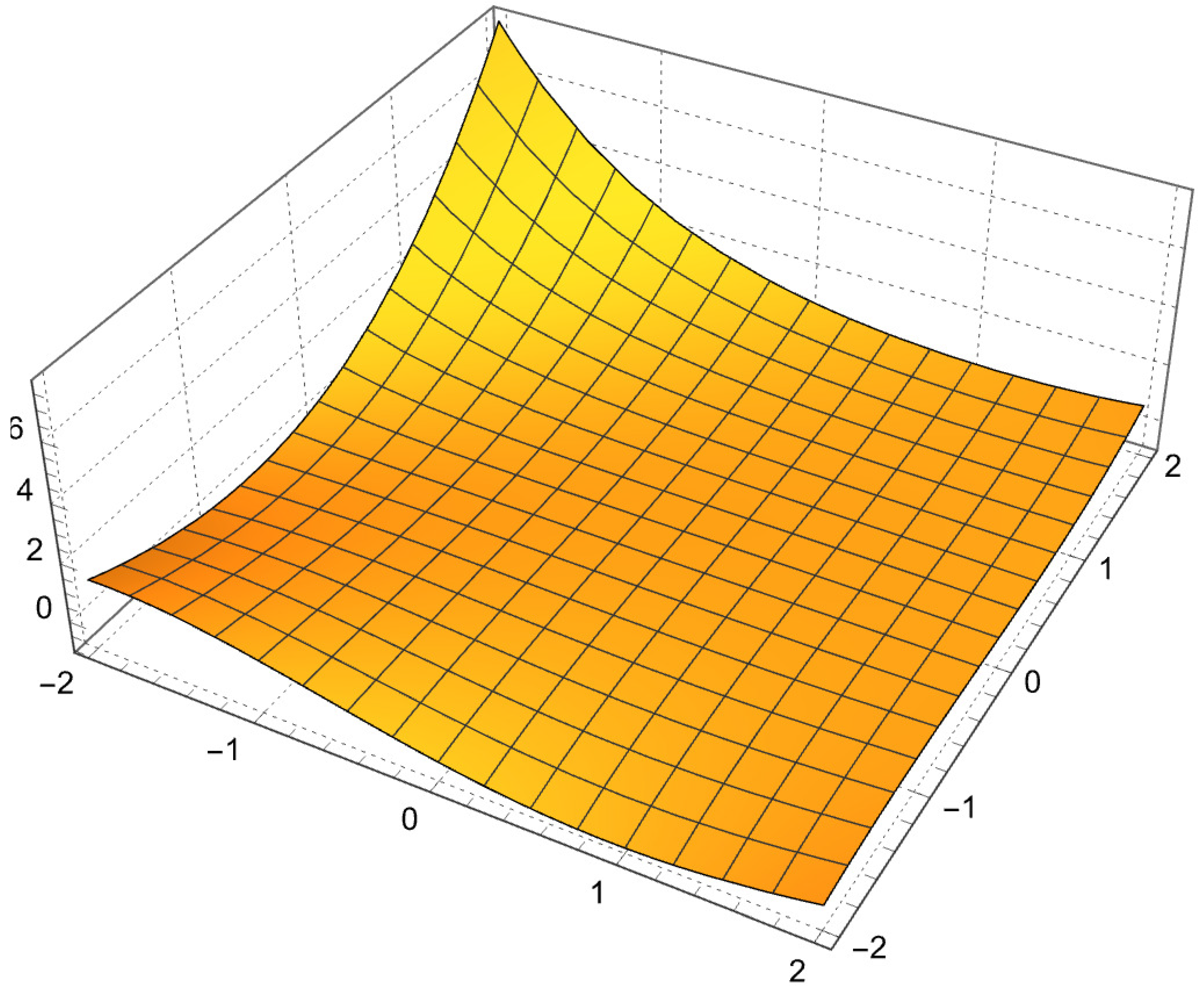
Example 1. For and the eigenvalues of matrix P are , so matrix P is satisfying the condition given in Equation (22) and hence, is positive stable matrix. For and in view of Equation (29), 2vHλMP is given by Example 2. Since in view of Equations (4) and (11), for , the λ-matrix polynomials transform to the associated-λ polynomials . Therefore, for the same choice of P, 2vHλMP transform to 2-variable Hermite λ associated polynomials (2vHaλP) . Thus, for Equations (27)–(29), (36), (37) and (42)–(44) reduce to respective symbolic definition, generating function, series definition, multiplicative operator, derivative operator, differential equation and differential recurrence relation for 2vHaλP . First, we draw the surface plots of 2vHa
P
, for
and
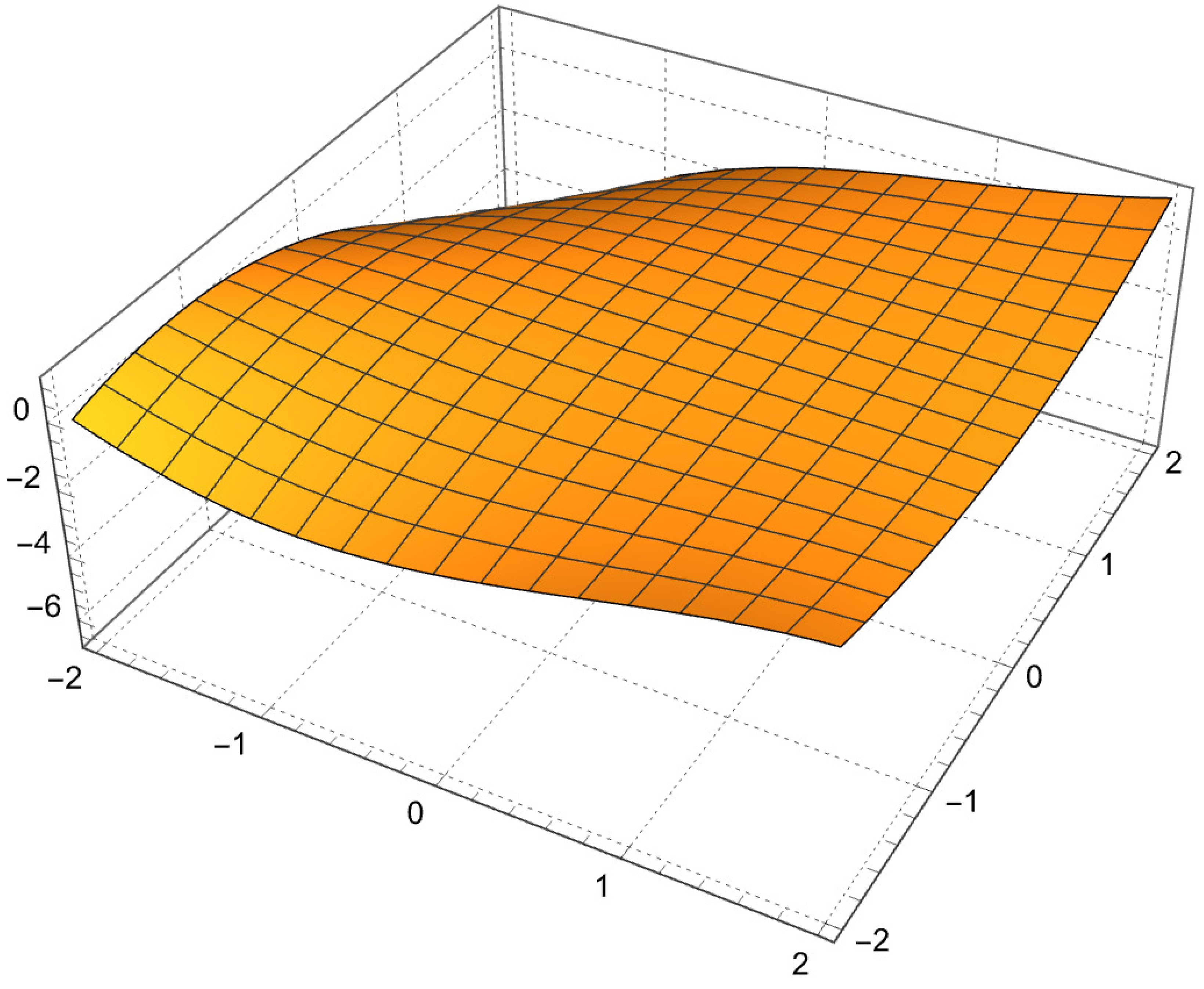
and same choice for
in
Figure 1 and
Figure 2.
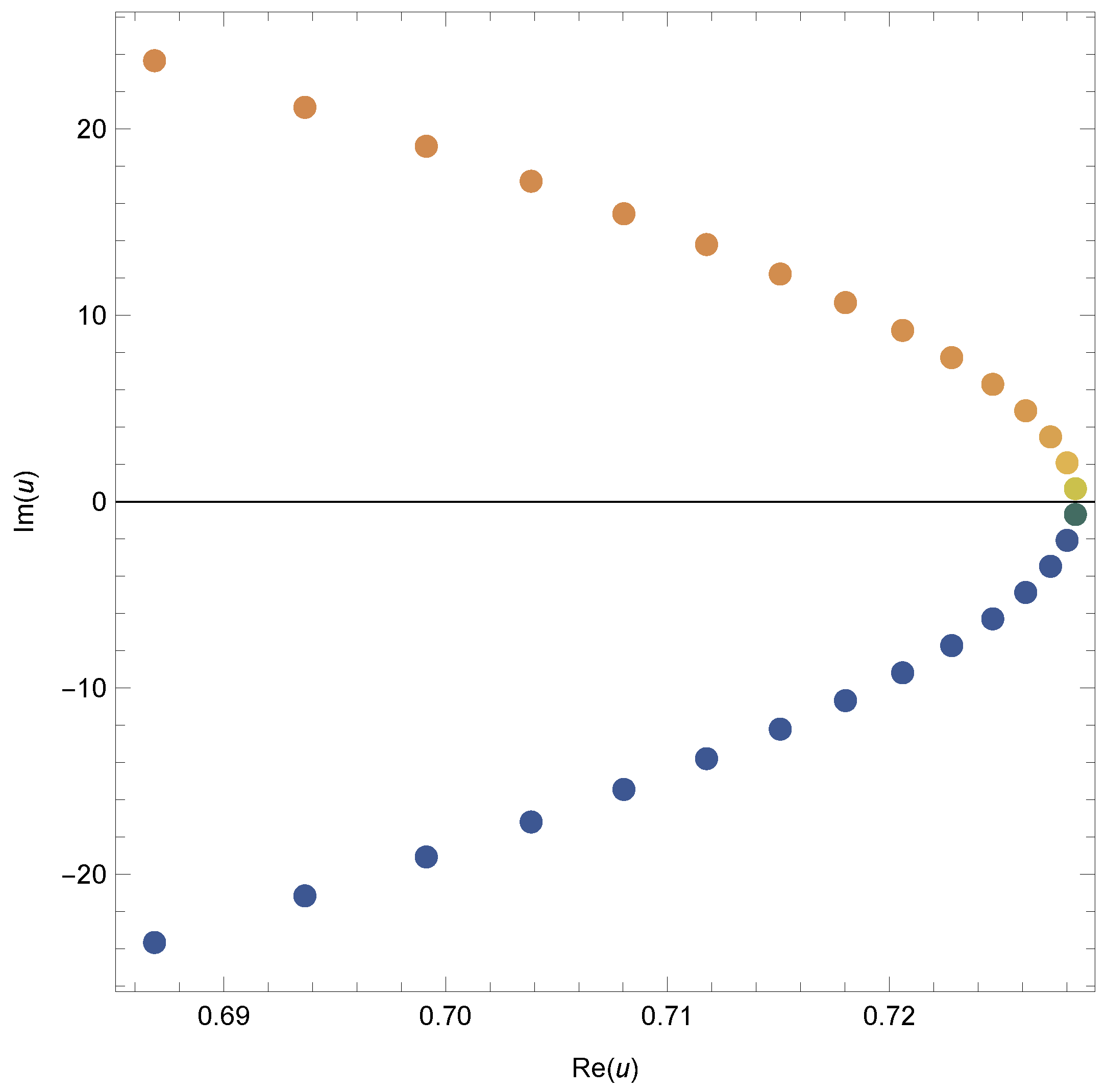
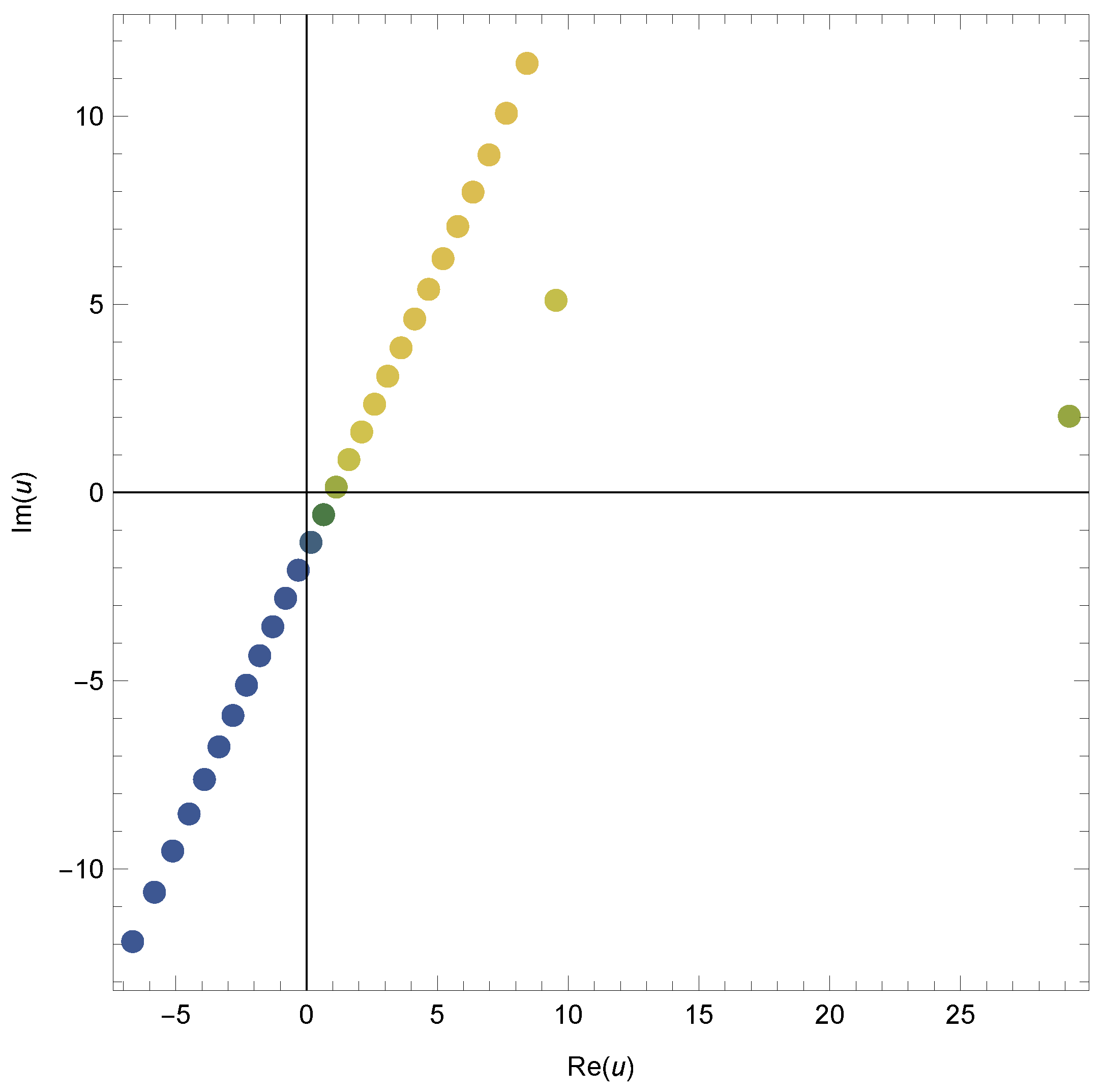
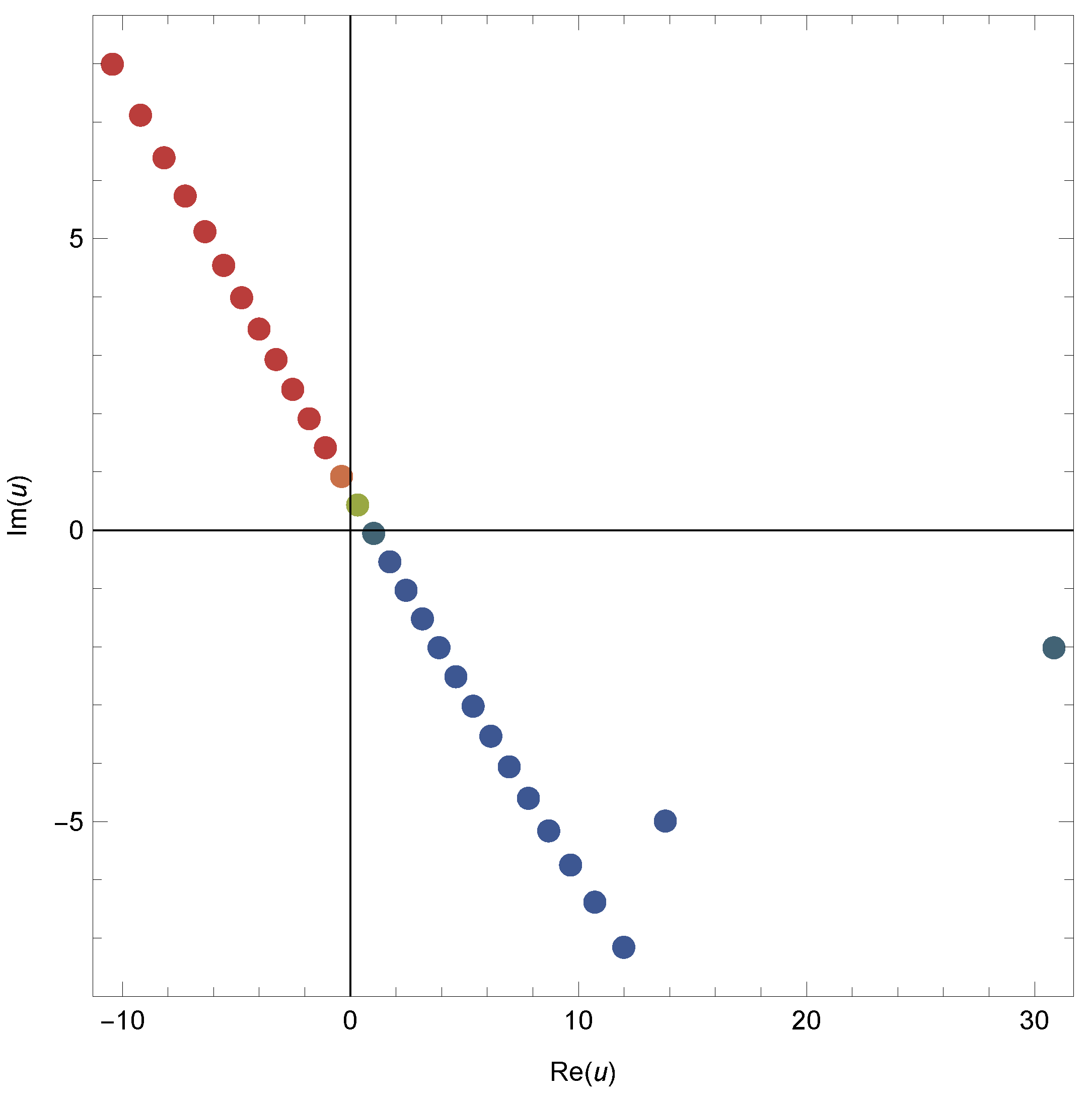
Now, we find the roots of equation
for different choices for
v.
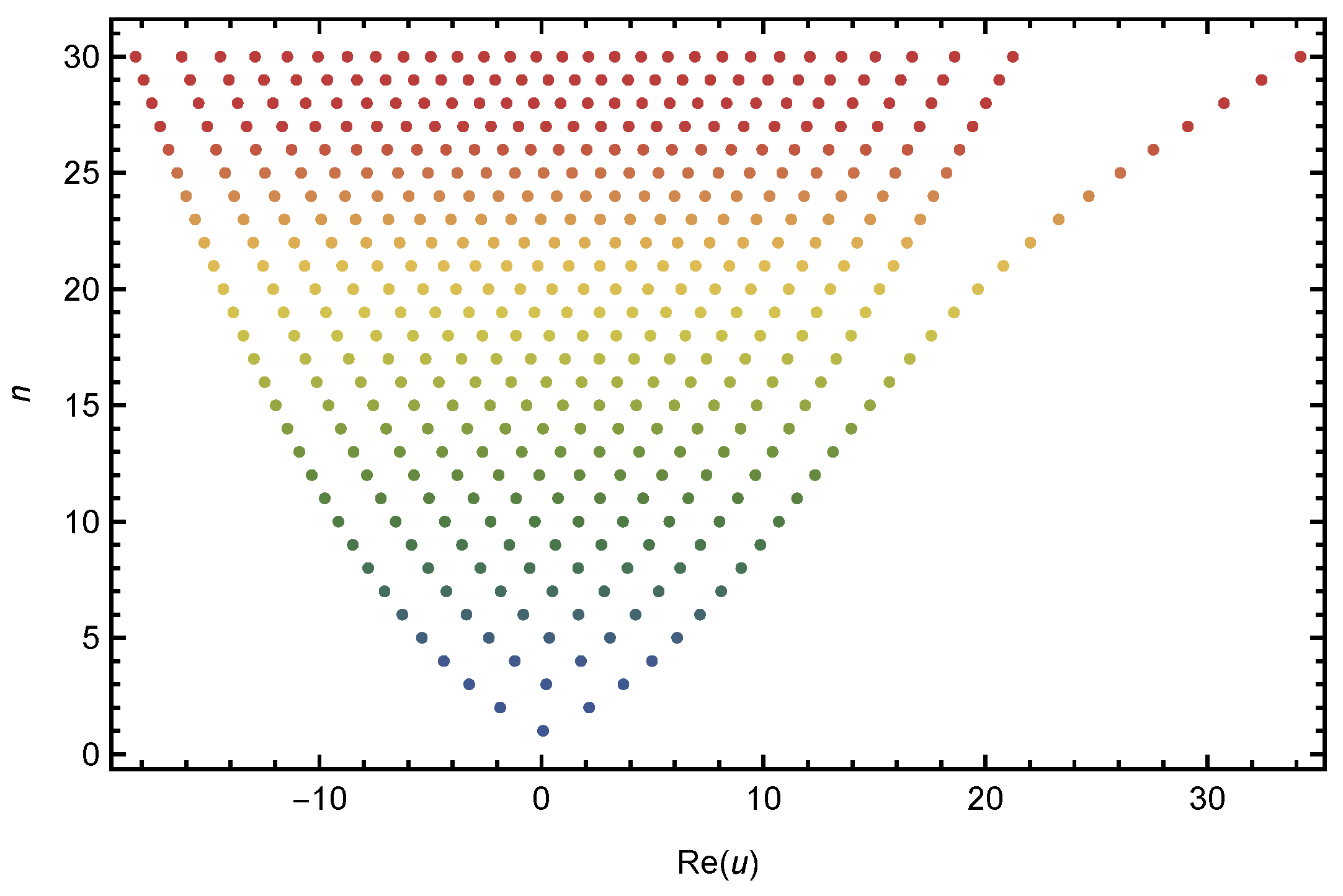
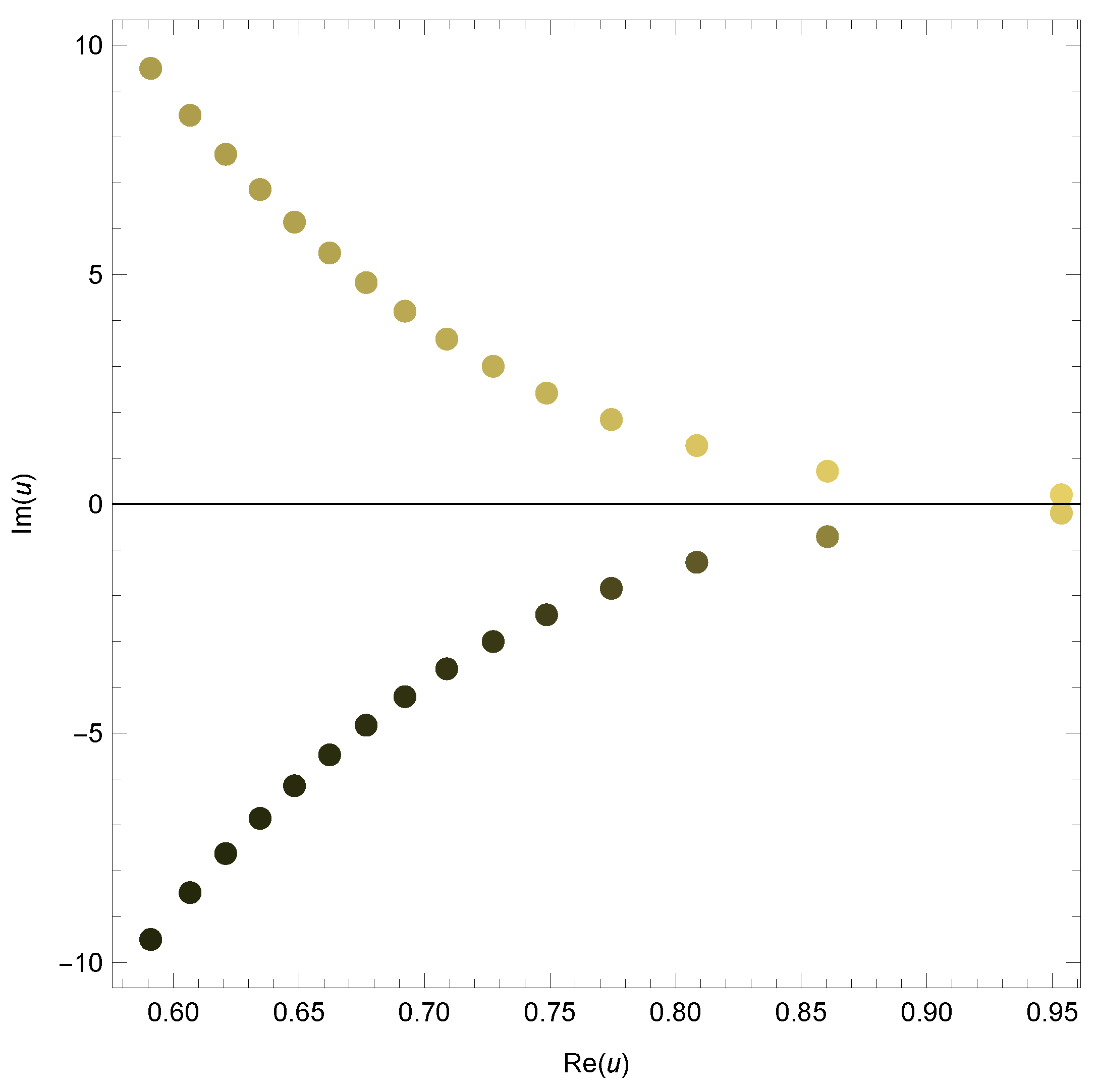
Figure 3 shows the roots of the equation
,
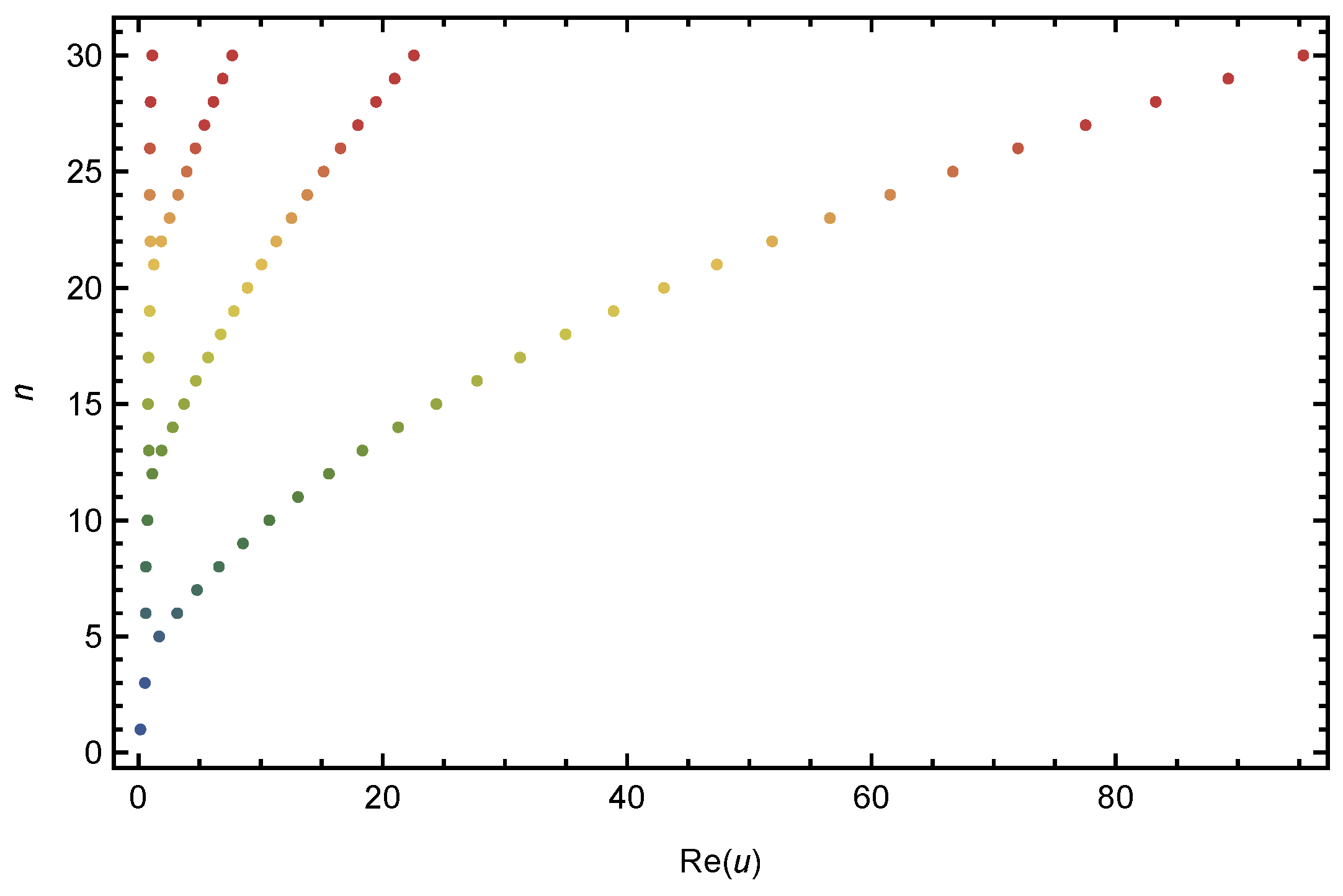
Figure 4 shows the roots of the equation
, whereas
Figure 5 and
Figure 6 show the roots of the equation
and
, respectively. Certain roots of the equation
and beautiful graphical representation are shown. We plot the zeros of the 2vHa
P
for
and different choices of
v and
in
Figure 3,
Figure 4,
Figure 5 and
Figure 6. Some recent developments in this field can be found in [
17,
18].
In
Figure 3, we choose
and
. In
Figure 4, we choose
and
. In
Figure 5, we choose
and
In
Figure 6, we choose
and
.
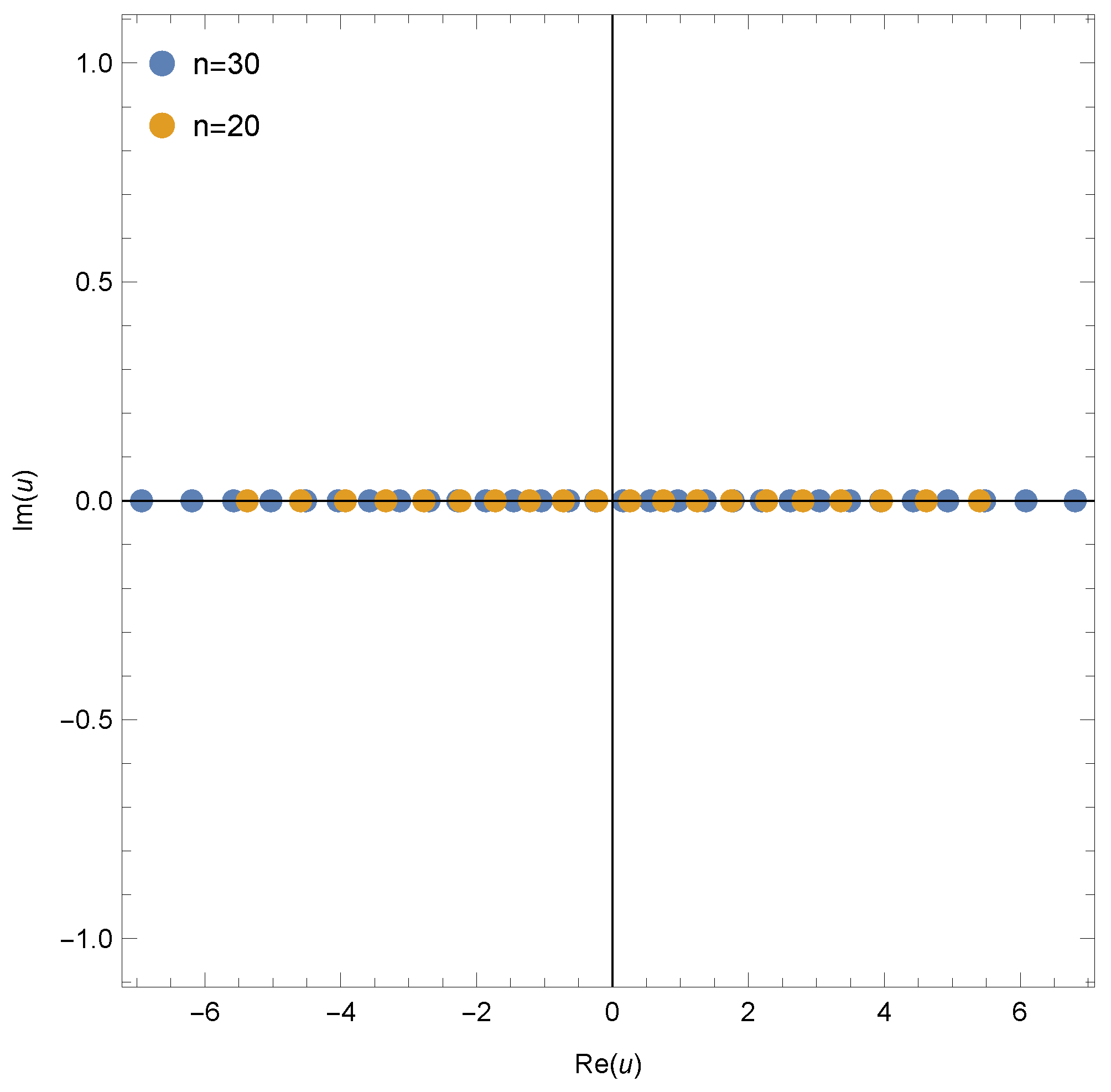
Plots of real roots of the 2vHa
P
for
are presented in
Figure 7 and
Figure 8. In
Figure 7, we choose
and
. In
Figure 8, we choose
and
. It is worth noticing that for negative values of
v, no of real roots are more than that of positive values of
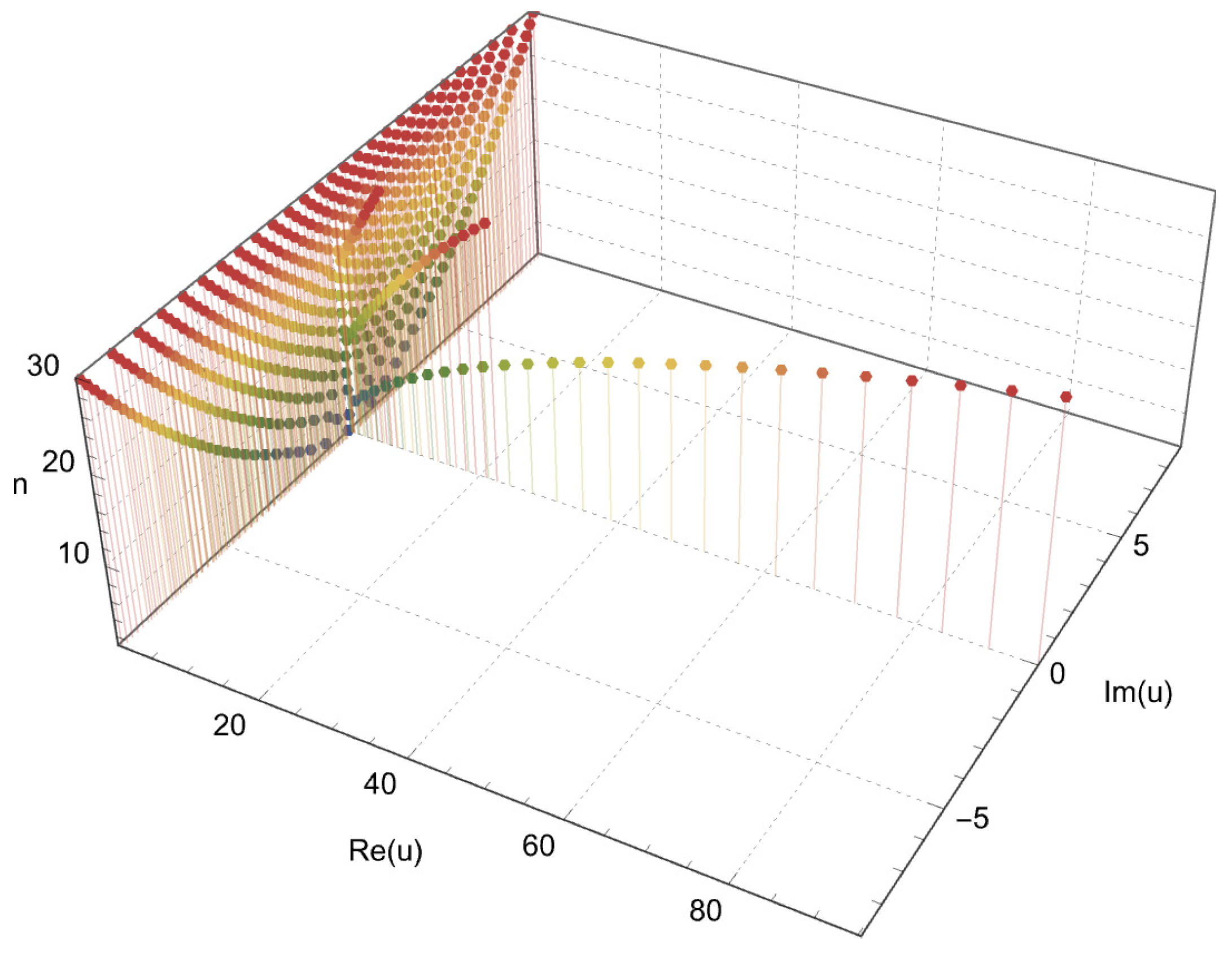
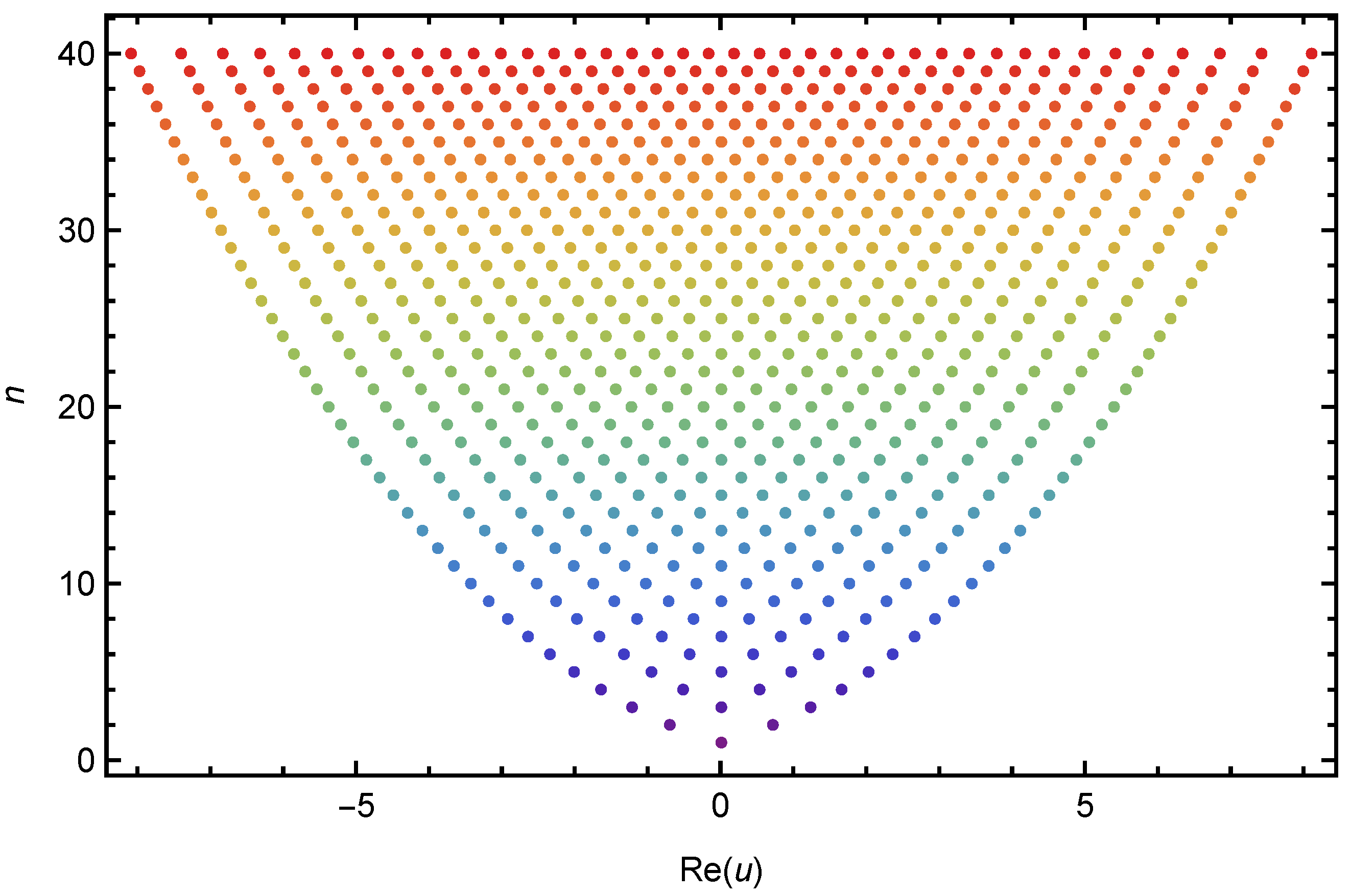
v. Stacks of roots of the 2vHa
P
for
,
and
from a 3D structure are presented in
Figure 9.
Our numerical results for the solutions satisfying 2vHa
P
for
and
are listed in
Table 1.
5. Concluding Remarks
In concluding remarks, we introduce the idea of 1-variable Hermite -matrix polynomials (1vHMP) .
From Equations (
23) and (
25) it is clear that the 2VHKdFP
is related to the classical Hermite polynomials
as:
In view of Equations (
27) and (
62), the symbolic definition of 1vH
MP
is given by
Similarly, taking into account Equation (
63), we obtain the generating function and series definition of 1vH
MP
:
and
respectively.
The multiplicative and derivative operators of 1vH
MP
:
and
respectively.
In view of Equations (
20), (
66) and (
67), the following differential equation is satisfied by 1vH
MP
:
Since in view of Equations (
4) and (
11), for
, the
-matrix polynomials
transform to the associated-
polynomials
. Therefore, for the same choice of
P, 1vH
MP
transform to 1-variable Hermite associated
associated polynomials (1vHa
P)
. Thus, for
Equations (
63)–(
68) reduce to respective symbolic definition, generating function, series definition, multiplicative operator, derivative operator, and differential equation for 1vHa
P
.
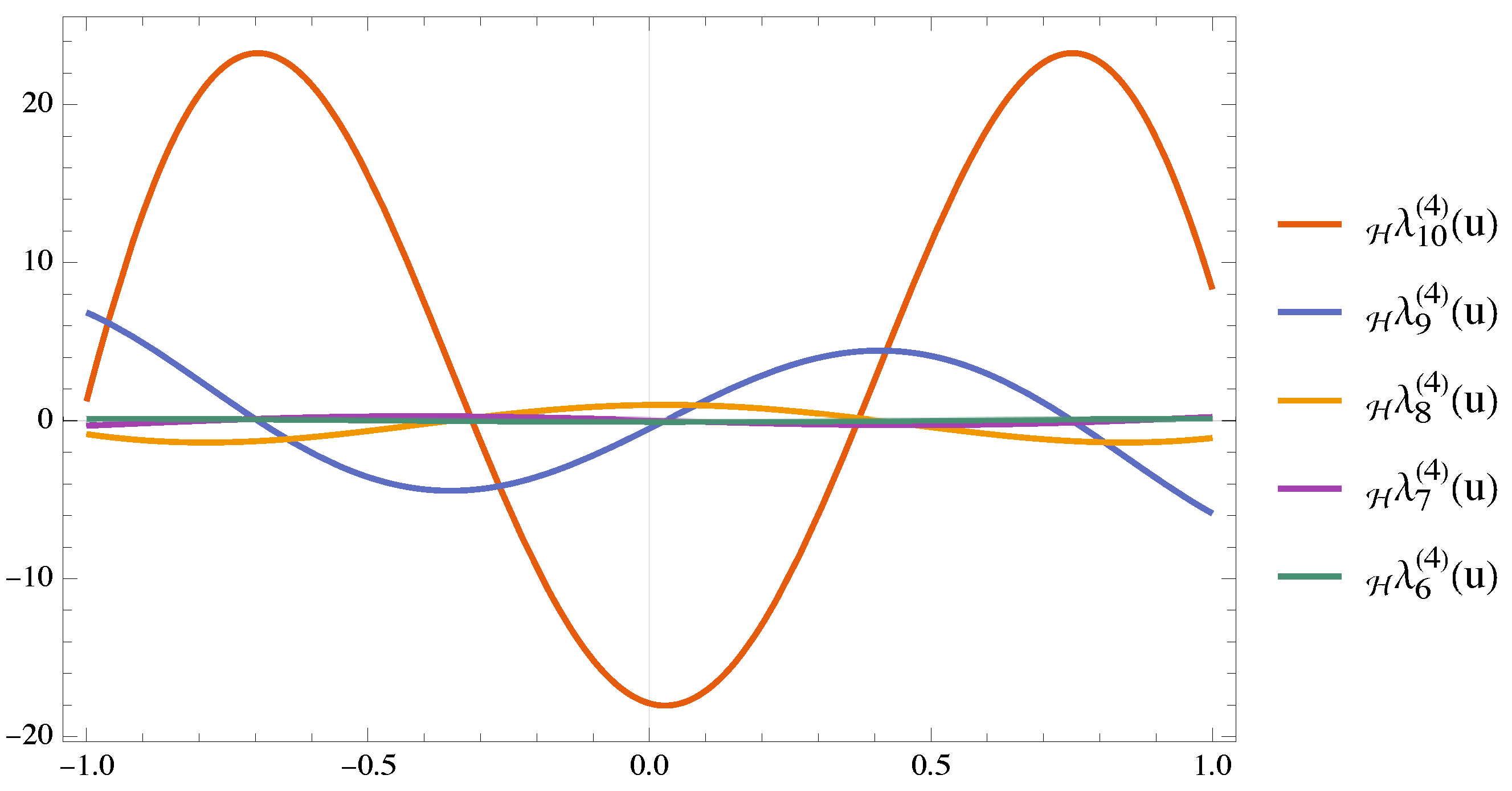
Now, we illustrate the shape of 1vHa
P
and examine its zeros. In
Figure 10, we present the graphs of 1vHa
P
.
Our numerical results for the solutions satisfying 1vHa
P
for
and
are listed in
Table 2.
Next in
Figure 11 and
Figure 12, we investigate the beautiful pattern of zeros of the 1vHa
P
. The plot of real zeros of the 1vHa
P
for
for
structure are presented in
Figure 11.
We can discern a consistent pattern in the complex roots of the 2-variable Hermite associated polynomials . Consequently, the following conjectures are plausible for the equation 1vHa.
We observed that the solutions of the 1vHa
P equations exhibit no
reflection symmetry for
. It is anticipated that the solutions of the 1vHa
equations possess
reflection symmetry (refer to
Figure 11 and
Figure 12).
Conjecture 1. Prove or disprove that 1vHaλP for and has reflection symmetry analytic complex functions.
Finally, we addressed the more general problem of determining the number of zeros of the equation . We were unable to ascertain whether this equation has n distinct solutions. Our interest lies in determining the number of complex zeros of the equation .
Conjecture 2. Prove or disprove that 1vHaλP have n distinct roots.
As a result of investigating more n variables, it is still unknown whether the above conjectures are true or false for all variables n.
In this article, our aim is to introduce the set of hybrid matrix polynomials associated with -polynomials and explore their properties using a symbolic approach. The main outcomes of this study include the derivation of generating functions, series definitions, and differential equations for the newly introduced two-variable Hermite -matrix polynomials. Furthermore, we establish the quasi-monomiality property of these polynomials and derive summation formulae. Finally, we obtain the graphical representation and symmetric structure of their approximate zeros for different choices of , and using computer-aided programs.
The results of this article have the potential to motivate researchers and readers to conduct further research on these special matrix polynomials. These results may be applied in mathematics, mathematical physics, and engineering.