Abstract
This study aims to establish common fixed point theorems for a pair of compatible self-mappings within the framework of extended parametric -metric spaces. To support our assertions, we provide corollaries and examples accompanied with graphical representations. Moreover, we leverage our principal outcome to guarantee the existence of a common solution to a system of integral equations.
MSC:
47H10; 54H25
1. Introduction
Fixed point theory, a captivating area of study, is useful across many areas of research, most especially in engineering and sciences. With its wide range of applications, mathematical analysis depends heavily on this popular and very effective method for problem solving.
Maurice Fréchet [1], in his seminal work, introduced the concept of a metric space as a generalization of the traditional notion of distance. In the literature, through a variety of methodologies and alterations to the underlying axioms, the idea of metrics has been broadened and diversified. Out of the many generalizations, only a few are genuine, such as the semi-metric (proposed by Wilson [2]), quasi-metric (proposed in [3]), b-metric (proposed in [4,5]), dislocated quasi-metric (dq-metric) (proposed in [6]), S-metric (proposed by Sedghi et al. [7] through alterations to the symmetry property), parametric (proposed by Hussain et al. [8]), parametric S-metric (proposed by Taş and Özgür [9]), -metric (proposed by Souayah and Mlaiki [10] and modified by Rohen et al. [11] in 2017), extended -metric [12], generalized dq-metric (proposed in [13]), and parametric -metric spaces (proposed by Taş and Özgür [14]). Recently, Mani et al. [15] introduced the notion of an extended parametric -metric space and derived some well-known classical fixed point theorems along with its topological property. Numerous scholars have thoroughly investigated these spaces and derived several kinds of results on the existence of fixed points; a few of them are [16,17,18,19].
In 1976, Jungck [20] proved a fixed point result for a pair of maps (assuming that one of them must be continuous) by generalizing the Banach contraction principle. A considerable amount of study has been focused on the analysis of common fixed points of mappings that satisfy certain contractive conditions. Some authors have demonstrated the existence of a fixed point for a map that may exhibit a discontinuity in its domain. Nevertheless, the maps in consideration were continuous at the fixed point. Recent years have seen numerous authors using similar ideas to obtain coincidence point results for different kinds of mappings on metric spaces. We refer the reader to see [21,22,23,24].
Prior to discussing the primary findings of this research, it is necessary to provide several essential theories that include crucial definitions, illustrative instances, and supporting lemmas, all of which will significantly contribute to the proof of our main theorems.
2. Basic Principles and Relevant Literature
Definition 1
([7]). A function is said to be S-metric on a nonempty set X, if it satisfies the following axioms for each :
- 1.
- ;
- 2.
- if and only if ;
- 3.
- .
The pair is called an S-metric space.
Definition 2
([11]). A function is said to be -metric on a nonempty set , with , if it satisfies the following axioms for each :
- 1.
- if and only if ;
- 2.
The pair is said to be an -metric space.
The subsequent definition was given by Mani et al. [25].
Definition 3
([25]). A function is said to be extended parametric -metric on a nonempty set , where is a positive real-valued function, if it satisfies the following axioms for each :
- .
- for all if and only if ;
- .
- .
The pair is called an extended parametric -metric (EPSb) space.
Example 1
([25]). Let Define function by
and a function by
for each and for all . Then, is an extended parametric -metric space.
Example 2.
Let and define function by
and the function by
for each and for all Then, is an extended parametric -metric space.
Remark 1.
It is important to mention here that a parametric S-metric space is a generalization of an S-metric space that introduces a parameter to the distance function. This parameter modifies the way distances are measured between points in the space. Some more examples of parametric S-metric and parametric -metric spaces can be found in [8,9,14,25].
Remark 2.
It is also worth it to note that every extended parametric -metric space, in general, is not a parametric S-metric space. Indeed, let us consider the following functions for each and for all :
This is not a parametric S-metric space.
Definition 4
([25]). Suppose is an extended parametric -metric space. The pair is said to be a symmetric extended parametric -metric space, if for all is a parameter, it satisfies the following condition:
Definition 5
([25]). A sequence <> in an extended parametric -metric space is said to be the following:
- 1.
- Convergent if it converges to ν if and only if for all and for all .
- 2.
- Cauchy sequence if for all n and m, with , and for all
Definition 6
([25]). The space “ is called complete if every Cauchy sequence is convergent in ”.
Definition 7.
A function is said to be continuous at a point , where and are two extended parametric -metric spaces, if for every sequence in and for all ,
implies that
Remark 3.
A function is said to be continuous at if and only if it is continuous for all .
Definition 8.
Let be an extended parametric -metric space. A pair of self-mappings is said to be compatible if and only if
whenever is a sequence in such that
for some and for all .
This study aims to establish the existence and uniqueness of a common fixed point by presenting two theorems in complete symmetric extended parametric -metric spaces. In later sections, we provide some examples along with graphical representations, several corollaries, and an application to discuss the existence of a common solution to a system of integral equations and substantiate the main findings. The results obtained not only generalize but also expand some well-known results from the existing literature on symmetric extended parametric -metric spaces.
3. Common Fixed Point Theorems for Pair of Self Maps
This section aims to provide a collection of significant lemmas that are valuable in the endeavor of demonstrating our fundamental theorems.
Lemma 1.
Let be a symmetric extended parametric -metric space. Suppose there exist two sequences and such that for all ,
If the sequence exists such that for some , then .
Proof.
Given that for any sequences ,
gives that
Claim:
To prove this, we show that
Suppose that on the contrary, .
Since is a symmetric extended parametric -metric space,
Hence, . □
Lemma 2.
Let be an extended parametric -metric space and suppose that there exists a sequence such that for all it satisfies
If for any ,
where then is a Cauchy sequence in an extended parametric -metric space.
Proof.
Using iterations on Equation (3), we obtain
For all with and , in using condition -2 from Definition 3 and applying Equation (4), we obtain
Consequently, we obtain
Suppose we have a series
and its partial sum
In applying the ratio test and using Equation (4), the series
converges.
Hence, from Equation (6), for , we have
Thus, as . In what follows, is a Cauchy sequence. □
Let us begin with our first result.
Theorem 1.
Suppose that , and are self-maps defined on a complete symmetric extended parametric -metric space , with and such that for each and for all with , the following is satisfied:
where
Further, assume that for any ,
Moreover, let the pairs and be compatible. Then, , and have a unique common fixed point in provided that and are continuous.
Proof.
Let . Since , therefore, there exists such that , and also, implies that one can choose such that . In general, we can construct sequences such that and .
Let us assume that . Therefore, we can choose a sequence such that for all ,
Let us substitute , , and in Equation (7). We obtain
where
In using Equation (8) and the fact that , we have
Here, two possibilities arise:
- Choice-1
- ;
- Choice-2
- .
Suppose Choice 1 is true; then, from Equations (9) and (10), we arrive at a contradiction. Thus, Choice 2 must be true. Hence, from Equation (9), we have
Again, upon substituting , , and , in Equation (7), we obtain
where
By following an argument similar to that above, we can obtain
Consequently, for , it follows that
Reiterating the process n times, we obtain
Lemma 2 guarantees that the sequence is a Cauchy sequence.
Since is a complete extended parametric -metric space, there exists some such that
The continuity property of provides that
The compatibility property on and Lemma 1 provide that
Further, from Equation (7) and upon substituting and , we obtain
where
Since , it follows that .
Also, the continuity of implies that
Since the pair is compatible, in using Lemma (1), we obtain
Upon substituting and in Equation (7), we obtain
where
This is possible if .
Once again, from Equation (7),
where
And by taking the upper limit as in (11) and making use of , we obtain
Since , it follows that and .
Similarly, using the same argument, from Equation (7), we can deduce that
which implies that and .
Thus, we proved that
If there exists another common fixed point in of all , and , then
where
which implies that and . Thus, is a unique common fixed point of , and . □
Remark 4.
If we eliminate the variable k from Theorem 1, then the certainty of the existence of a fixed point is doubtful.
In the following result, we used an auxiliary function , described below, to establish a common fixed point theorem in a symmetric complete extended parametric -metric space.
Definition 9.
Let Φ denote the class of all functions , which is increasing and continuous, such that for each fixed , , as
Theorem 2.
Suppose is an extended parametric -metric space, which is symmetric and complete. Let be four self-mappings such that the following conditions are satisfied:
- 1.
- 2.
- and are continuous;
- 3.
- The pair and are compatible;
- 4.
- For all and for all , there exists a function such that
where
Further, assume that there exists such that for every , we have
Then, the maps , and have a unique common fixed point.
Proof.
Let be arbitrary point in . We can construct a sequence in as follows:
Now, we show that is a Cauchy sequence.
Let .
Then, using Equation (22), we have
where
Here, two possibilities arise:
- Choice-1
- ;
- Choice-2
- .
Suppose Choice 1 is true; then, from Equations (23) and (24), we arrive at a contradiction. Thus, Choice 2 must be true. Hence, from Equation (23), we have
Further,
where
Using similar arguments as above, we have
More precisely, for all , we have
For all (from Definition 3), we have
Since for all , as . Hence, is a Cauchy sequence in . Since is a complete extended parametric -metric space, there exists such that
Since is continuous, we have
Also, as is compatible, then . So, using Lemma 1, we have .
Suppose that . Then, condition (22) gives that
where
Taking the upper limit as in (27), we obtain
Using , we obtain that , i.e., u is a fixed point of .
Similarly, the continuity of and compatibility of the pair imply that
Therefore, using Lemma (1), we have .
Further, assume that . Therefore, by condition (22), we obtain
where
Taking the upper limit as in (29), we obtain
This is possible only if . Thus, so far, we have .
Again, upon considering condition (22), we have
where
Taking the upper limit as in (31), we obtain
If , then in based on the property of , we obtain a contradiction. This gives that .
One more time, condition (22) gives that
where
If , then upon combining the above two inequalities, we have .
Thus, we have deduced that ; that is, u is a common fixed point of the maps , and .
To guarantee the uniqueness, suppose that p is another common fixed point of , and ; that is,
If , condition (22) implies that
where
Thus, we obtain that
which is a contradiction. Hence, . Therefore, u is the one and only fixed point of , and . □
4. Corollaries and Numerical Illustrations
In this part, we discuss the consequential outcomes of our primary findings and provide only a few instances with graphical representations that highlight the soundness of our findings.
In letting in Theorem 1, we have the following result.
Corollary 1.
Suppose that , and are self-maps defined on a complete symmetric extended parametric -metric space , with and , such that for each and for all with , the following is satisfied:
where
Further, assume that for any ,
Moreover, if the pairs and are compatible, then the maps , and have a unique common fixed point in provided that is continuous.
If we set in Corollary 1, we have the following important result as an extension and generalization of the result of Jungck [20].
Corollary 2.
Suppose that and are self-maps defined on a complete symmetric extended parametric -metric space , with , such that for each and for all with , the following is satisfied:
where
Further, assume that for any ,
Moreover, if the pair is compatible and is continuous, then the maps and have a unique common fixed point in .
Corollary 3.
Suppose that , and are self-maps defined on a complete symmetric extended parametric -metric space , with and For all and for all , there exists a function such that
where
Further, assume that there exists such that for every , we have
Moreover, if the pairs and are compatible, then the maps , and have a unique common fixed point in provided that is continuous.
Proof.
If we take , then from Theorem 2, it follows that , and have a unique common fixed point. □
Corollary 4.
Suppose that and are self-maps defined on a complete symmetric extended parametric -metric space , with For all and for all , there exists a function such that
where
Further, assume that there exists such that for every , we have
Moreover, if the pair is compatible and is continuous, then the maps and have a unique common fixed point in .
Proof.
By letting and in Theorem 2, we obtain the result. □
Corollary 5.
Suppose is an extended parametric -metric space, which is symmetric and complete. Let be four self-mappings such that it satisfies the following conditions:
- 1.
- 2.
- and are continuous;
- 3.
- The pair and are compatible;
- 4.
- For all and for all , suppose that
where
Further, assume that there exists such that for every , we have
Then, the maps , and have a unique common fixed point.
Proof.
By letting in Theorem 2, we obtain the result. □
Remark 5.
Note the following:
- 1.
- Corollary 2 is an extension of the result of Jungck [20] in an EPSb-metric space.
- 2.
- Corollary 4 is an extension of the result of Saluja [26] in an EPSb-metric space.
- 3.
- Corollary 5 is an extension of the result of Sedghi et al. [27] in an EPSb-metric space.
Example 3.
Let Define function by
and a function by
where each is a parameter, and Then, is an EPSb space.
Define self-maps , and on by
Obviously, and . Furthermore, the pairs and are compatible mappings.
We have
where
Meanwhile, for each , let
Then,
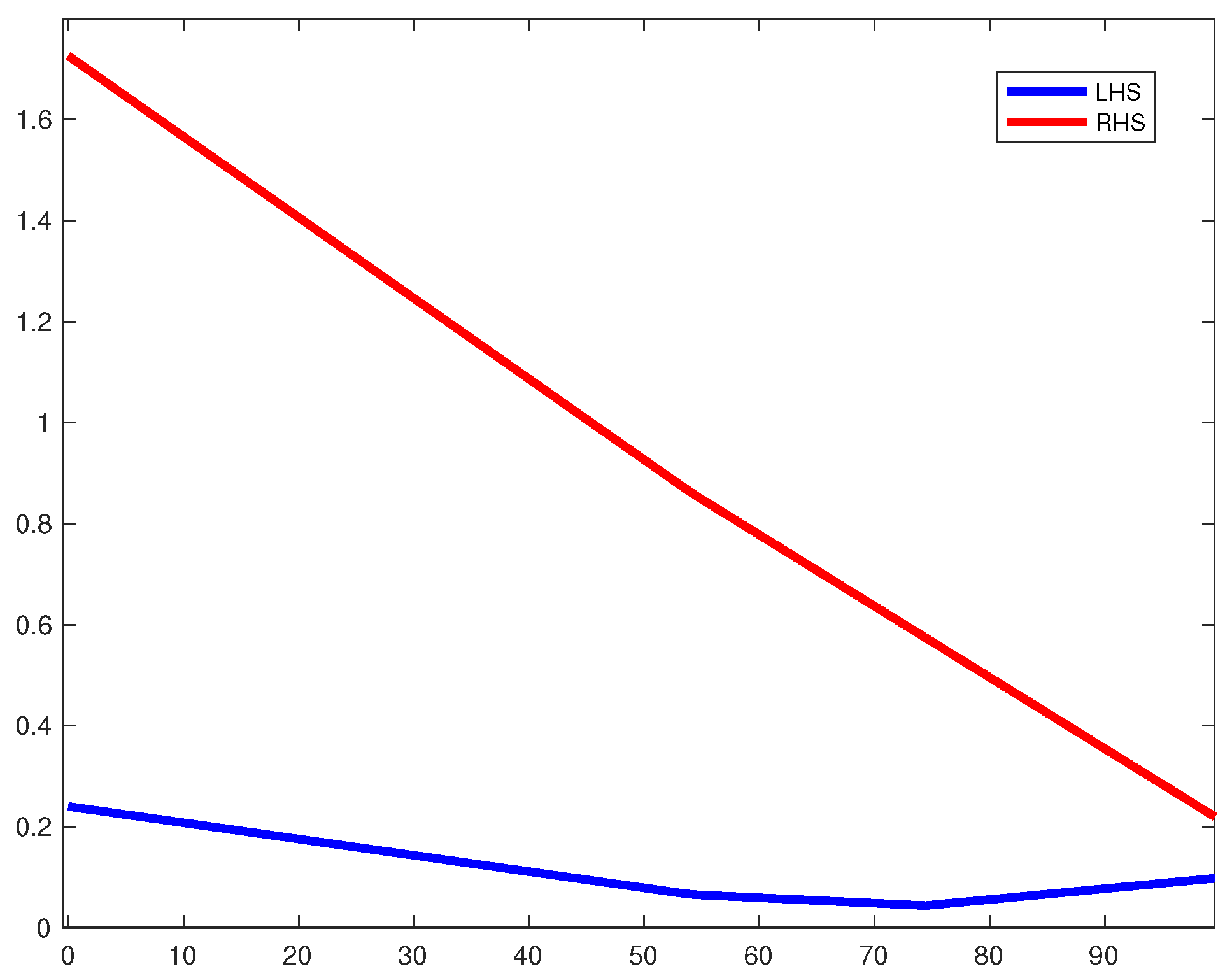
Thus, all the necessities of Theorem 1 have been accomplished. Also, the behavior of inequality (7) of Example 3 is shown graphically in Figure 1. The number 0 is the only fixed point that is common to the mappings , and .
Figure 1.
Graphical behavior of inequality (7) of Example 3.
Example 4.
Let Define function by
and a function by
where each is a parameter, and Then, is an EPSb space.
Define self-maps , and on by
Obviously, and .
Furthermore, the pairs and are compatible mappings.
From inequality (7), we have
where
Also, for every , consider
Then,
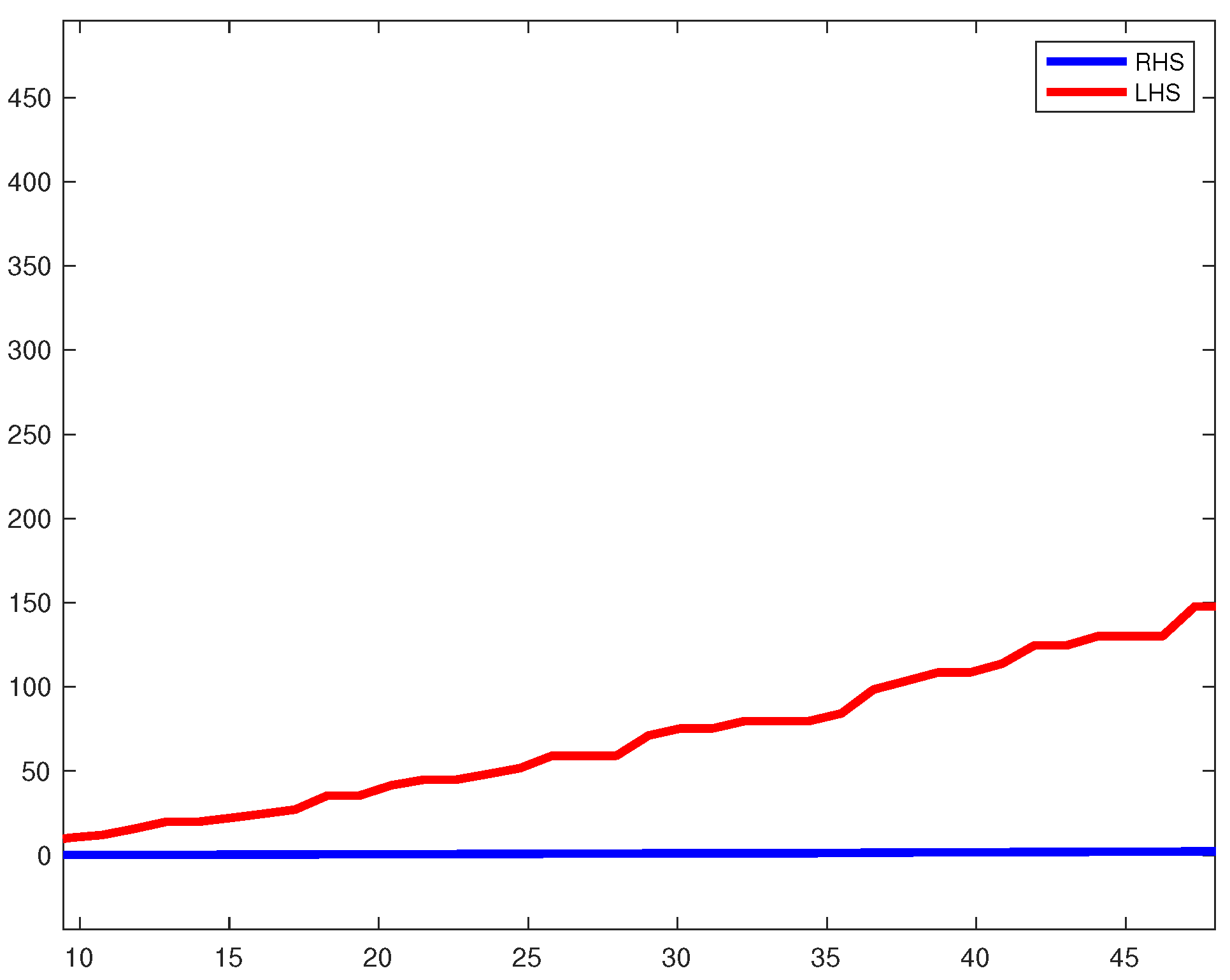
Thus, all the necessities of Theorem 1 have been accomplished. Also, the behavior of inequality (7) of Example 4 is shown graphically in Figure 2. The number 0 is the only fixed point that is common to the mappings , and .
Figure 2.
Graphical behavior of inequality (7) of Example 4.
Example 5.
Let Define function by
and a function by
where each is a parameter, and Then, is an EPSb space.
Define self-maps , and on by
Obviously, and .
Furthermore, the pairs and are compatible mappings.
Alternatively, for every , let us consider
Then,
Thus, all the necessities of Theorem 2 have been accomplished. The number 0 is the only fixed point that is common to the mappings , and .
5. Common Solution of System of Integral Equations: Existence and Uniqueness
Here, we use the results obtained in Section 3 to investigate the existence of a solution for a Fredholm integral problem.
For a real number and for all define by
and by
It is evident that is a complete extended parametric -metric space for all .
Theorem 3.
Let consists of all continuous real-valued functions defined on the closed and bounded interval in the real number system . Then, the system of linear integral equations
has a unique solution if it satisfies the following assumptions:
- (i)
- is continuous;
- (ii)
- is continuous;
- (iii)
- For every
Proof.
Let us define by
and
where , and
Now,
Consider
Using the Cauchy–Schwartz inequality, we obtain
For every , and hence, all the conditions of Corollary 2 are satisfied, and therefore, there exist a in that is a common fixed point of maps and . That is, is a common solution of the integral in Equation (36). □
6. Conclusions
This study presented a more comprehensive version of the conventional fixed point problems within the context of symmetric extended parametric -metric spaces. The discussion aimed to establish common fixed point theorems for two pairs of compatible self-maps. This paper includes two theorems and a few examples. These examples highlight the relevance and practicality of our findings. We have also shown that in the case when all functions are real-valued and continuous, specified on a closed and bounded interval , with the condition , the system of linear integral equations has a unique common solution.
Author Contributions
All authors; conceptualization, N.M. and S.B.; methodology, N.M.; validation, R.S., S.B. and A.S.; formal analysis, N.M.; investigation, S.B.; resources, R.S.; writin–original draft preparation, S.B.; writing–review and editing, R.S.; visualization, A.S.; supervision, N.M.; project administration, R.S. All authors have read and agreed to the published version of the manuscript.
Funding
This work was supported by the Directorate of Research and Innovation, Walter Sisulu University.
Data Availability Statement
Data are contained within the article.
Acknowledgments
The authors sincerely thank the reviewers for their careful reading, constructive comments, and fruitful suggestions, which have been incorporated to improve the manuscript.
Conflicts of Interest
The authors declare no conflict of interest.
References
- Fréchet, M. Sur quelques points du calcul fonctionnel. Rend. Circ. Mat. Palermo 1906, 22, 1–74. [Google Scholar] [CrossRef]
- Wilson, W.A. On Quasi-Metric Spaces. Am. J. Math. 1931, 53, 675–684. [Google Scholar] [CrossRef]
- Berinde, V. Generalized contractions in quasimetric spaces. In Seminar on Fixed Point Theory; “Babeş-Bolyai” University: Cluj-Napoca, Romania, 1993; Volume 93, pp. 3–9. [Google Scholar]
- Bakhtin, I.A. The contraction mapping principle in almost metric space. In Functional Analysis; Ul’yanovskiy Gosudarstvennyy Pedagogicheskiy Institute: Ulyanovskiy, Russia, 1989; pp. 26–37. [Google Scholar]
- Czerwik, S. Contraction mappings in b-metric spaces. Acta Math. Inform. Univ. Ostrav. 1993, 1, 5–11. [Google Scholar]
- Zeyada, F.M.; Hassan, G.H.; Ahmed, M.A. A generalization of a fixed point theorem due to Hitzler and Seda in dislocated quasi-metric spaces. Arab. J. Sci. Eng. Sect. A Sci. 2006, 31, 111–114. [Google Scholar]
- Sedghi, S.; Shobe, N.; Aliouche, A. A generalization of fixed point theorems in S-metric spaces. Mat. Vesn. 2012, 64, 258–266. [Google Scholar]
- Hussain, N.; Khaleghizadeh, S.; Salimi, P.; Abdou, A.A.N. A new approach to fixed point results in triangular intuitionistic fuzzy metric spaces. Abstr. Appl. Anal. 2014, 2014, 690139. [Google Scholar] [CrossRef]
- Taş, N.; Özgür, N.Y.L. On parametric S-metric spaces and fixed-point type theorems for expansive mappings. J. Math. 2016, 2016, 4746732. [Google Scholar] [CrossRef]
- Souayah, N.; Mlaiki, N. A fixed point theorem in Sb-metric spaces. J. Math. Comput. Sci. 2016, 16, 131–139. [Google Scholar] [CrossRef]
- Rohen, Y.; Došenović, T.; Radenovixcx, S. A note on the paper a fixed point theorems in Sb-metric spaces. Filomat 2017, 31, 3335–3346. [Google Scholar] [CrossRef]
- Mlaiki, N. Extended Sb-metric spaces. J. Math. Anal. 2018, 9, 124–135. [Google Scholar]
- Brzdek, J.; Karapnar, E.; Petrucel, A. A fixed point theorem and the Ulam stability in generalized dq-metric spaces. J. Math. Anal. Appl. 2018, 467, 501–520. [Google Scholar] [CrossRef]
- Taş, N.; Özgür, N.Y. Some fixed-point results on parametric Nb-metric spaces. Commun. Korean Math. Soc. 2018, 33, 943–960. [Google Scholar] [CrossRef]
- Mani, N.; Sharma, A.; Shukla, R. Fixed point results via real-valued function satisfying integral type rational contraction. Abstr. Appl. Anal. 2023, 2023, 2592507. [Google Scholar] [CrossRef]
- Aydi, H.; Bota, M.F.; Karapınar, E.; Mitrović, S. A fixed point theorem for set-valued quasi-contractions in b-metric spaces. Fixed Point Theory Appl. 2012, 2012, 88. [Google Scholar] [CrossRef]
- Bota, M.; Molnár, A.; Varga, C. On Ekeland’s variational principle in b-metric spaces. Fixed Point Theory 2011, 12, 21–28. [Google Scholar]
- Roy, K.; Saha, M. Branciari Sb-metric space and related fixed point theorems with an application. Appl. Math. E-Notes 2022, 22, 8–17. [Google Scholar]
- Rezaee, M.M.; Sedghi, S. Coupled fixed point theorems under nonlinear contractive conditions in S-metric spaces. Thai J. Math. 2021, 19, 1519–1526. [Google Scholar]
- Jungck, G. Commuting mappings and fixed points. Am. Math. Mon. 1976, 83, 261–263. [Google Scholar] [CrossRef]
- Bhardwaj, V.K.; Gupta, V.; Mani, N. Common fixed point theorems without continuity and compatible property of maps. Bol. Soc. Parana. Mat. 2017, 35, 67–77. [Google Scholar] [CrossRef][Green Version]
- Gupta, V.; Mani, N.; Ansari, A.H. Generalized integral type contraction and common fixed point theorems using an auxiliary function. Adv. Math. Sci. Appl. 2018, 27, 263–275. [Google Scholar]
- Gupta, V.; Jungck, G.; Mani, N. Some novel fixed point theorems in partially ordered metric spaces. AIMS Math. 2020, 5, 4444–4452. [Google Scholar] [CrossRef]
- Taş, N.; Ayoob, I.; Mlaiki, N. Some common fixed-point and fixed-figure results with a function family on Sb-metric spaces. AIMS Math. 2023, 8, 13050–13065. [Google Scholar] [CrossRef]
- Mani, N.; Beniwal, S.; Shukla, R.; Pingale, M. Fixed point theory in extended parametric Sb-metric spaces and its applications. Symmetry 2023, 15, 2136. [Google Scholar] [CrossRef]
- Saluja, G.S. Common fixed point theorems in S-metric spaces involving control function. Ann. Math. Comput. Sci. 2023, 18, 40–55. [Google Scholar] [CrossRef]
- Sedghi, S.; Shobkolaei, N.; Shahraki, M.; Došenović, T. Common fixed point of four maps in S-metric spaces. Math. Sci. 2018, 12, 137–143. [Google Scholar] [CrossRef]
Disclaimer/Publisher’s Note: The statements, opinions and data contained in all publications are solely those of the individual author(s) and contributor(s) and not of MDPI and/or the editor(s). MDPI and/or the editor(s) disclaim responsibility for any injury to people or property resulting from any ideas, methods, instructions or products referred to in the content. |
© 2024 by the authors. Licensee MDPI, Basel, Switzerland. This article is an open access article distributed under the terms and conditions of the Creative Commons Attribution (CC BY) license (https://creativecommons.org/licenses/by/4.0/).