1. Introduction
In the 1940s, Feynman [
1] disclosed that the Schrödinger equation, which governs the time evolution of quantum states in quantum mechanics, could be solved by averaging over sample paths, an observation which led him to a far-reaching reformulation of the quantum theory in terms of path integrals [
2,
3]. Based on this idea, Kac recognized that a similar representation could be given for solutions of the heat transfer equation [
4,
5]. Accordingly, this representation is now referred to as the Feynman–Kac formula, which verifies and extends Feynman’s path integrals [
6]. The Feynman–Kac formula has numerous applications in various fields including mathematics, statistics, physics, chemistry, and finance [
7,
8], providing an intriguing connection between solutions of elliptic and parabolic differential equations and stochastic processes. Specifically, it provides a method for solving a variety of partial differential equations (PDEs) through random path simulations of a stochastic process. For instance, in quantitative finance, the relationship between geometric Brownian motion and the Black–Scholes PDE is a special case of the Feynman–Kac theorem [
9]. Conversely, some stochastic differential equations describing random processes can be examined by deterministic methods [
10].
To present the Feynman–Kac formula, we consider the continuous functions
,
, and
, where
is fixed. Suppose that
v is a continuous, real-valued function of class
on
and satisfies
with the terminal condition
Then, the function
v is said to be a solution of the Cauchy problem for the backward heat Equation (
1) with potential
k and Lagrangian
g, subject to the terminal condition in Equation (
2). Note also that Equation (
1) with
corresponds precisely to the Schrödinger equation (in the imaginary time) for a particle in potential
k. Suppose that
where
K is a positive constant and
. The Feynman–Kac formula consists of the existence part and the uniqueness part as follows: The former states that
v admits the stochastic representation
for any
and
, where
is a
d-dimensional Brownian motion and
is the expectation operator with
. Then, the latter asserts that such a solution is unique, as remarked in Refs. [
11] (p. 268) and [
12] (p. 120). Readers may also refer to Refs. [
6] (Chapter 3), [
13] (Section 11.4), and [
14] (Section 8.2), for further details on the Feynman–Kac formula.
In this paper, we present a counterexample that violates the uniqueness of the Feynman–Kac formula. Specifically, it is disclosed that the Feynman–Kac formula carries infinitely many solutions rather than a unique solution. The possibility of nonuniqueness alerts us that the solution method based on the Feynman–Kac formula may lead to extraneous and irrelevant results. These implications are discussed in relation to the initial conditions.
2. A Boundary-Value Problem and Its Feynman–Kac Solution
We consider a simple example for
with
and let
with
. General cases with nonvanishing
k and
g are considered later in
Section 3. Then, Equations (
1) and (
2) become, respectively,
It is well known (see, e.g., [
15]) that
is the fundamental solution of the PDE (
6), where
is the probability density function of the standard Gaussian random variable.
We now define the function
for
, which, according to the Feynman–Kac formula, satisfies the heat transfer PDE (
6) and the initial condition in Equation (7). Equation (
8) is divided into two parts:
with
where
is the indicator function of a subset A and
is the cumulative distribution function of the standard Gaussian random variable. It is then easy to show that
and
satisfy the heat transfer PDE:
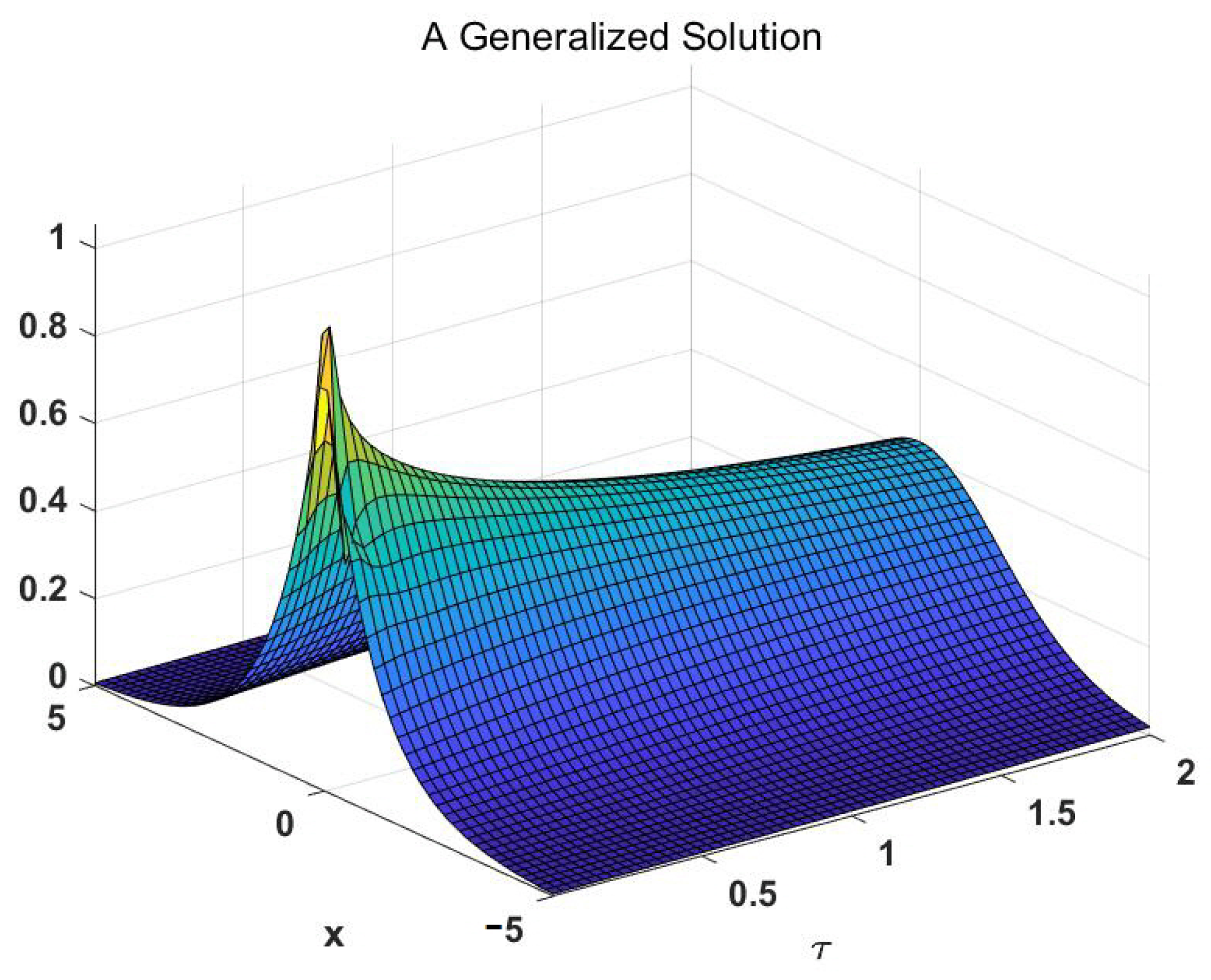
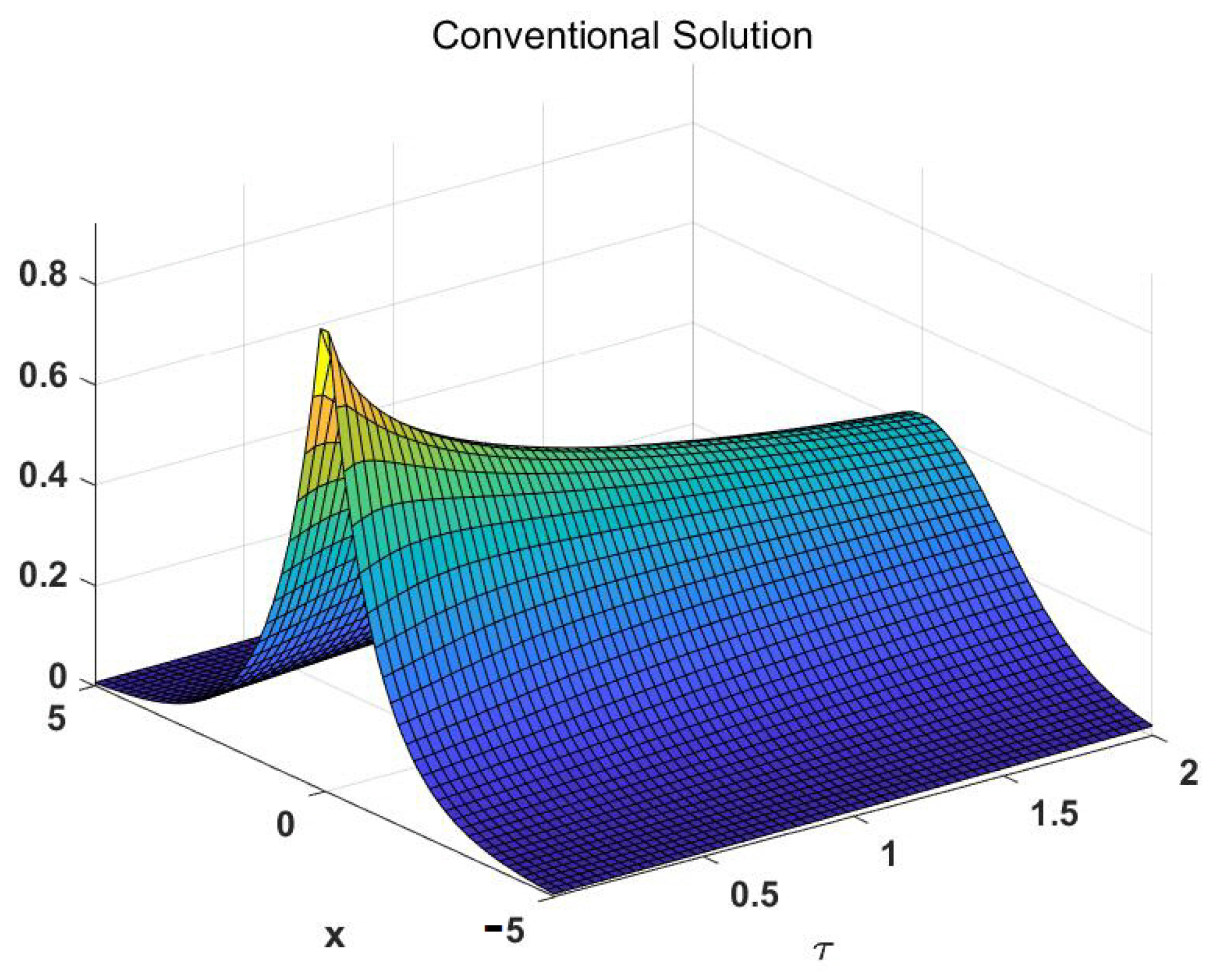
For comparison, we plot the conventional (fundamental) solution in
Figure 1 and the generalized solution given by Equation (
9) in
Figure 2.
Note that Equation (
9) plotted in
Figure 2 generalizes the fundamental solution in
Figure 1 to a heavy-tailed skew distribution [
16].
Here, we remark that
is not defined for
. Accordingly, as in Theorem 55.4 of Körner [
17] (p. 277), the initial condition in Equation (7) should be replaced by
This means that the solution
should be assumed right-continuous at
; otherwise, the heat transfer PDE may not be connected with the initial condition.
3. Kernel Solutions
As discussed in Körner [
17] (pp. 338–346), the uniqueness of a heat transfer boundary problem is not as trivial a question as sometimes claimed. The simple uniqueness theorem presented there goes as follows: Let
be twice differentiable satisfying the heat transfer PDE (
6). If
as
uniformly for
x in any chosen interval
and if
as
uniformly for
t in any chosen interval
, then
for all
However, even the fundamental solution
does not satisfy the former uniformity condition, making this uniqueness theorem not so practical. Recently, on the other hand, general solutions of the heat transfer boundary problem were reported [
16,
18]. Using those general solutions of the heat transfer boundary problem, we now present additional representations of the Feynman–Kac formula.
For any
, we consider the probabilists’ Hermite polynomial of order
m:
the first five of which are given by
,
,
,
, and
. For each
, we define
which can be written as
with
Here, we note that
and make use of the transform
to write
where the identity
has been used for obtaining the third equality. We further note that
which gives
and
Putting Equation (
23) into Equation (
20) leads to
with
Applying a mathematical induction to Equation (
25), one finds that
can be expressed as a linear combination of the expectations
in Equation (
17).
Letting
, we obtain
which in turn yields
and
These two Equations (
28) and (
29) imply
where the last equality holds by the recurrence relation
It is thus concluded that
satisfies the heat transfer PDE:
for each
. Since
and
for
satisfy the heat transfer PDE (
6), Equation (
25) indicates that the expectation
also satisfies the PDE.
Likewise, we can show
with
which, again via a mathematical induction applied to Equation (
33), can be shown to obtain the form of a linear combination of the expectations
in Equation (18). It is then straightforward to show, in the same manner as before, that
satisfies the heat transfer PDE:
for each
. Since
as well as
satisfy the heat transfer PDE (
6), Equation (
33) indicates that
also satisfies the PDE.
Now Equations (
16), (
25), and (
33) imply
which satisfies the heat transfer PDE in Equation (
6). For any
and
, we define
with
Equations (
32) and (
35) show that
satisfies the heat transfer PDE:
Henceforth, we find the coefficients
subject to the initial condition
Applying L’Hospital’s rule to Equations (
26) and (
34), we obtain
for
. Therefore, we have
for
. Meanwhile, the symmetries of
and
imply
for
, which, together with Equation (
38), lead to
In consequence, we obtain
which result in
Let us consider the case where the coefficients
and
of
vanish for each
k. Labeling such a set of coefficients
with
as
, we write
with
where
is the largest integer less than or equal to
x. It is then obvious from Equations (
32) and (
35) that
satisfies the heat transfer PDE (
6). Moreover, Equations (
42) and (49) imply that
vanishes as
approaches zero from above:
To summarize, we have the “theorem” that the Feynman–Kac formula does not support the uniqueness property:
is a kernel solution to the boundary-value problem consisting of the heat transfer PDE (
6) and the initial condition in Equation (
52), and accordingly,
is a generalized solution to the boundary-value problem consisting of the heat transfer PDE (
6) and the initial condition in Equation (52). Note that
, expressed as a linear combination of the expectations
in Equation (
17) and
in Equation (18), satisfies the heat transfer PDE (
6) and the initial condition in Equation (7) for any
and
. It is thus concluded that the Feynman–Kac formula does not support the uniqueness property, which proves the “theorem”.
Finally, we consider the extension of the analysis, albeit one counterexample should suffice for falsification [
19], to the general case of Equation (
1) with nonvanishing
k and
g, again for
. (Generalization to the case of higher dimensions,
, is straightforward.) First, suppose that
v is a solution of the equation for
:
with vanishing boundary conditions. We know that there exist infinitely many solutions
u of the equation with
:
with appropriate boundary conditions. Adding the two Equations (
53) and (
54), we obtain that
satisfies Equation (
53) with the same boundary conditions as those in Equation (
54). Since there are infinitely many
u, we thus conclude that Equation (
53) indeed carries infinitely many solutions. We next consider the case of constant
k and
:
Multiplying both sides by
, we obtain Equation (
54) for
. This again implies that Equation (
55) carries infinitely many solutions of the form
. (This can also be generalized to the case of time-dependent
, where
takes the place of
in the procedure. Namely, the solutions of Equation (
55) assume the form
. More generally, in the presence of both
g and
k, putting
yields Equation (
53) with
g replaced by
. As a result, the solution takes the form
, where
v is a solution of Equation (
53) (with
g replaced by
) and
u represents the infinitely many solutions of Equation (
54). The most general case of
k depending on
x is beyond the scope of this paper and left for future study.
Now, let us comment on how to obtain the “unique” solution among the generalized solutions. When generating random numbers
from a Brownian motion in Equation (
4), we need initial conditions in the time interval
(with
) in addition to those at the time
. These initial conditions generate the random numbers of one particular generalized solution. This is related to the assumption that the solution is differentiable at
. Note also that in physics, we usually deal with the case where the initial conditions are given in the steady state [
20] (p. 11). This amounts to assuming the initial conditions in the time interval
, not just at the time
. Therefore, the PDE is uniquely determined by the conditions specified in the time interval
.
4. Conclusions
We have shown that the Feynman–Kac formula does not yield a unique solution but carries infinitely many solutions, as demonstrated by the counterexample presented. This indicates that the Feynman–Kac formula, albeit a useful and elegant tool, should be used with caution. In quantum mechanics, as addressed in
Section 1, this formula gives the path integral representation of the solution of the Schrödinger equation. The nonuniqueness then suggests an interesting possibility of additional solutions other than the conventional ones. Their implications are currently under investigation. Furthermore, in quantitative finance, the Feynman–Kac formula is used widely to compute efficiently solutions of the Black–Scholes PDE for European option prices [
9]. There the nonuniqueness of the Feynman–Kac formula brings on infinitely many solutions to the Black–Scholes boundary-value problem [
21]. This indicates that the Black-Scholes formula violates the fundamental law of one price in economics.
In general, the Feynman–Kac formula has been utilized to solve certain PDEs via random path simulations of stochastic processes and to compute some expectations for random processes by deterministic methods. However, one should be cautious since its nonuniqueness implies that such methods may produce unreliable results. It would be of interest and importance to clarify mathematical criteria, if any, for the validity of such an analysis with respect to the existence and uniqueness in PDEs. It is suggested that the nonuniqueness is related to the nature of the initial condition. Such an assumption of stationarity or differentiability amounts to the initial condition assumed in a time interval, which may determine the PDE uniquely. The investigation of this relationship is left to future studies, where the main point will be presented more succinctly, and the detailed argument will be more focused.