



Global Dynamics of a Diffusive Within-Host HTLV/HIV Co-Infection Model with Latency


Abstract
1. Introduction
- Viral latent reservoirs: A major impediment to eliminating HIV infection by antiretroviral therapy is the presence of latent HIV-infected cells. Cells that are latently infected carry the virions, but do not generate them until they are activated. There are many studies that have dealt with the development of HIV infection models with active and latent infected cells without taking spatial dependence into account, e.g., [12,13,14,15].
- Cellular transmission: Wang and Wang [8] considered only one mode of transmission of the infection occurring when the HIV particles infect the healthy CDT cells (FTC), but several studies have indicated that infected-to-cell (ITC) is another method of transmission, carried out through virological synapses between HIV-infected and healthy CDT cells [16]. Wang et al. [17] extended the work of [8] by including ITC transmission. Following that, Sun and Wang [18] incorporated time delay into the model presented in [17] and considered the incidence rate in a general form.
- (C1)
- The hosts of both HIV and HTLV are healthy CDT cells;
- (C2)
- The presence of latently infected HIV and HTLV cells;
- (C3)
- Both HTLV and HIV have a specific bilinear CTL immune response;
- (C4)
- Several factors can lead to CDT cells becoming infected with HIV, including free HIV particles, latent HIV-infected cells, and active HIV-infected cells;
- (C5)
- HTLV has two routes of transmission: (i) horizontally through the straight ITC contact over the virological synapse and (ii) vertically where the active HTLV-infected cells can transmit HTLV via mitotic division;
- (C6)
- All types of cells and viruses diffuse spatially.
2. Model Formulation
3. Properties of Solutions
4. Equilibrium Analysis
- Infection-free equilibrium, and . Both HIV and HTLV are not present in this case.
- Persistent HIV mono-infection equilibrium accompanied by an inefficient immune response, with components given byThe parameter defines the basic HIV mono-infection reproductive number for Model (4), which is given asis responsible for determining whether or not a persistent HIV mono-infection is possible. In the meantime, the immune system is unable to respond effectively. In addition, exists if .
- Persistent HTLV mono-infection equilibrium accompanied by an inefficient immune response, , with components given byThe parameter specifies the basic HTLV mono-infection reproductive number for Model (4) and is given asis responsible for determining whether or not a persistent HTLV mono-infection is possible. In the meantime, the immune system is unable to work effectively. Further, exists if .
- Persistent HIV mono-infection equilibrium accompanied only by efficient HIV-specific CTL, , with components given byandrepresents the HIV-specific CTL immunity reproductive number for HIV mono-infection. In the case of HIV mono-infection, indicates whether or not HIV-specific CTL immunity is efficient in the case of HIV mono-infection where the HTLV infection is not present. The component satisfies the quadratic equation:whereSince and , then and the positive real root of Equation (5) is calculated as follows:exists if .
- Persistent HTLV mono-infection equilibrium accompanied only by efficient HTLV-specific CTL, , with components given byThe term is introduced as the HTLV-specific CTL immunity reproductive number for HTLV mono-infection and is defined asIn fact, indicates whether or not HTLV-specific CTL immunity is efficient in the case HTLV mono-infection where the HIV infection is not present. On the other hand, exists if .
- Persistent HTLV/HIV co-infection equilibrium accompanied only by efficient HIV-specific CTL, , with components given byHere, is the HTLV infection reproductive number when the HIV infection exists, andwhereIn fact, determines whether or not HIV-infected individuals can further be dually infected with HTLV.
- Persistent HTLV/HIV co-infection equilibrium accompanied only by efficient HTLV-specific CTL, , with components given byrepresents the HIV infection reproductive number when HTLV infection exists, andThe parameter indicates whether or not an HTLV-infected individual can further be dually infected with HIV.
- Persistent HTLV/HIV co-infection equilibrium accompanied by efficient HIV-specific CTL and HTLV-specific CTL, , with components given byandThe parameters and represent, respectively, the competingHIV-specific CTL and HTLV-specific CTL reproductive numbers in the case of HTLV/HIV co-infection. Here, satisfies the equation:whereSince and , then and the positive real root of Equation (7) is calculated as follows:It is obvious that if and then exists.
5. Global Properties
- -
- According to the arithmetic–geometric mean inequality:we have
- -
- Consider a function in which
- -
- Denoteand let represent the largest invariant subset of
- -
- Define a function . We have that for all and if and only if .
- -
5.1. Stability of Equilibrium
5.2. Stability of Equilibrium
5.3. Stability of Equilibrium
5.4. Stability of Equilibrium
5.5. Stability of Equilibrium
5.6. Stability of Equilibrium
5.7. Stability of Equilibrium
5.8. Stability of Equilibrium
6. Numerical Simulations
6.1. Stability of the Equilibria
- (1)
- (2)
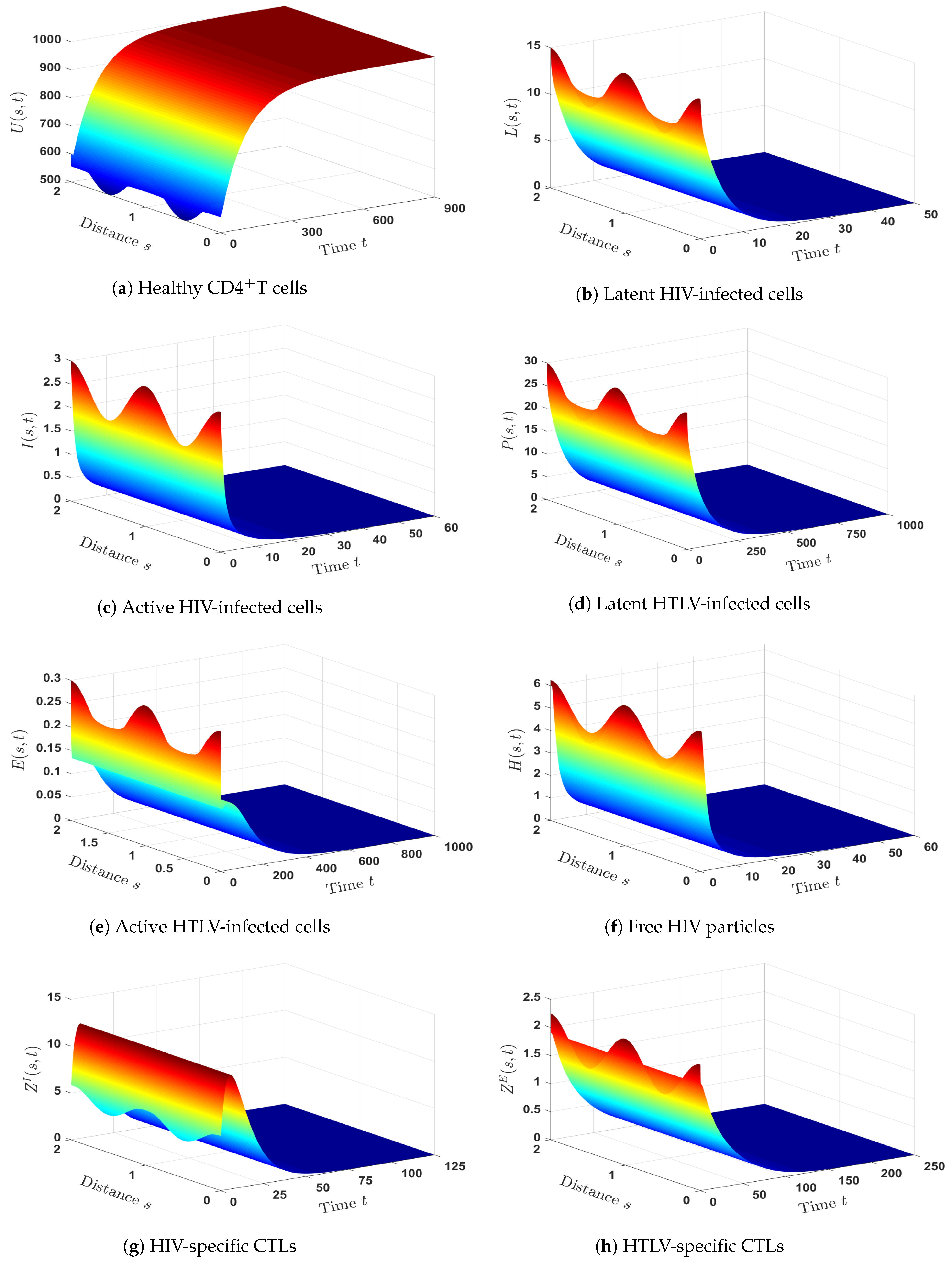
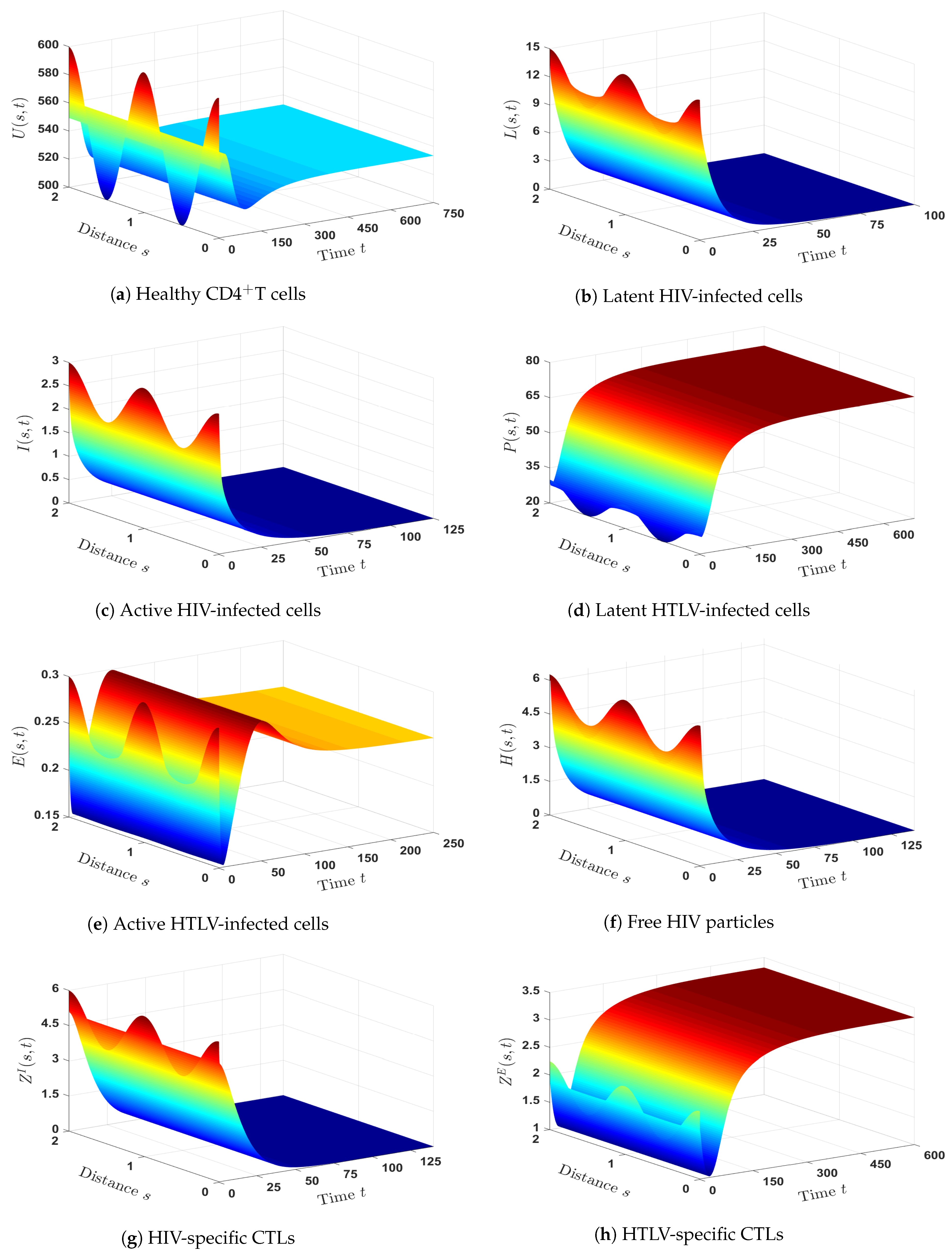
- We selected and. With such a choice, we obtained , , and hence, . Theorem 2 implies that is GAS, which is displayed in Figure 2. As a result, HIV mono-infection will persist, but with an inefficient CTL immune response.
- (3)
- We set and . Then, we calculated , and then, . The numerical results showed that exists. Figure 3 illustrates that is GAS. It is evident from this that the numerical outcomes and the theoretical finding of Theorem 3 are consistent. Therefore, a persistent HTLV mono-infection with an inefficient CTL immunity is present.
- (4)
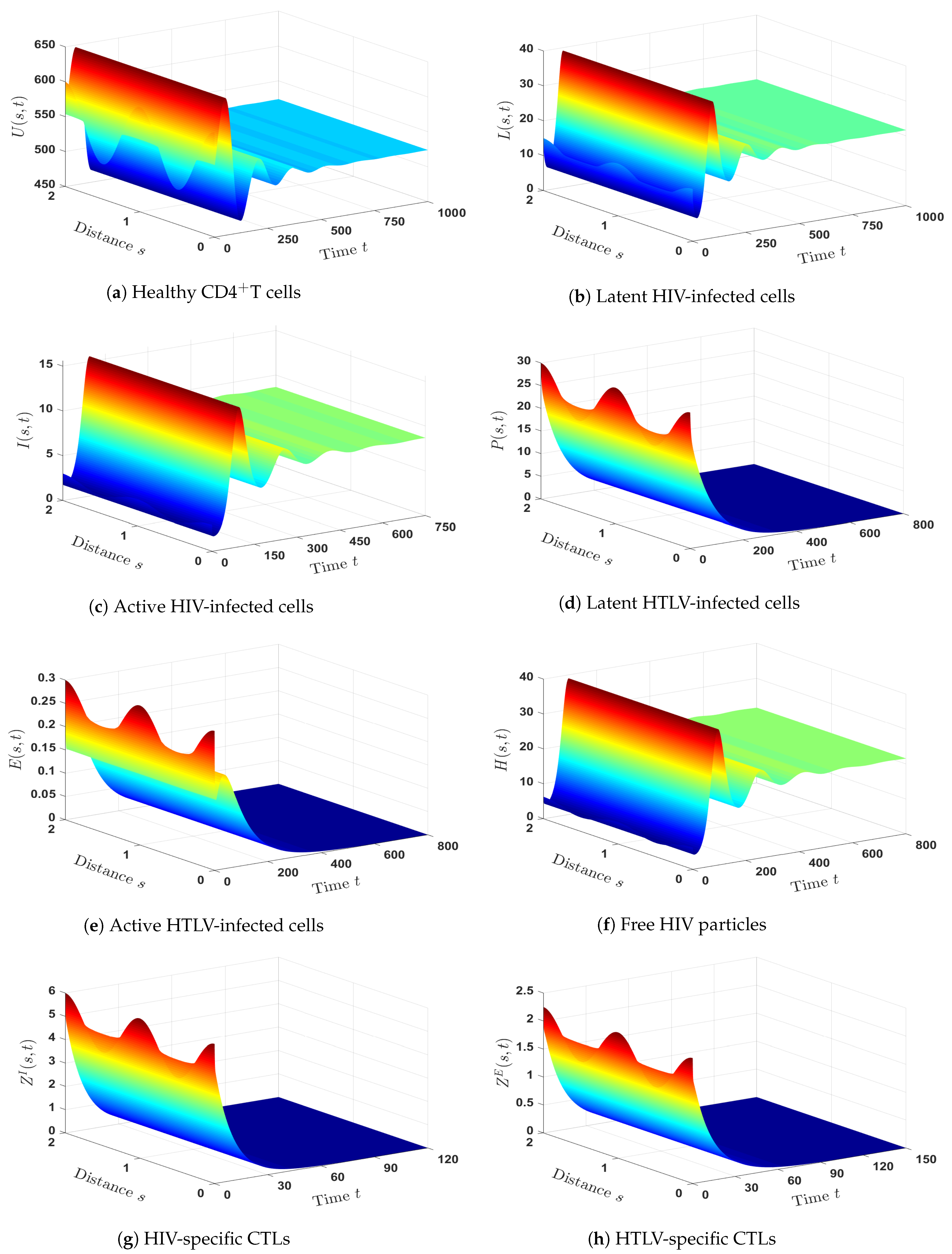
- We took and to yield and . Figure 4 shows that is GAS based on Theorem 4. Therefore, a persistent HIV mono-infection with an efficient HIV-specific CTL immune response is reached.
- (5)
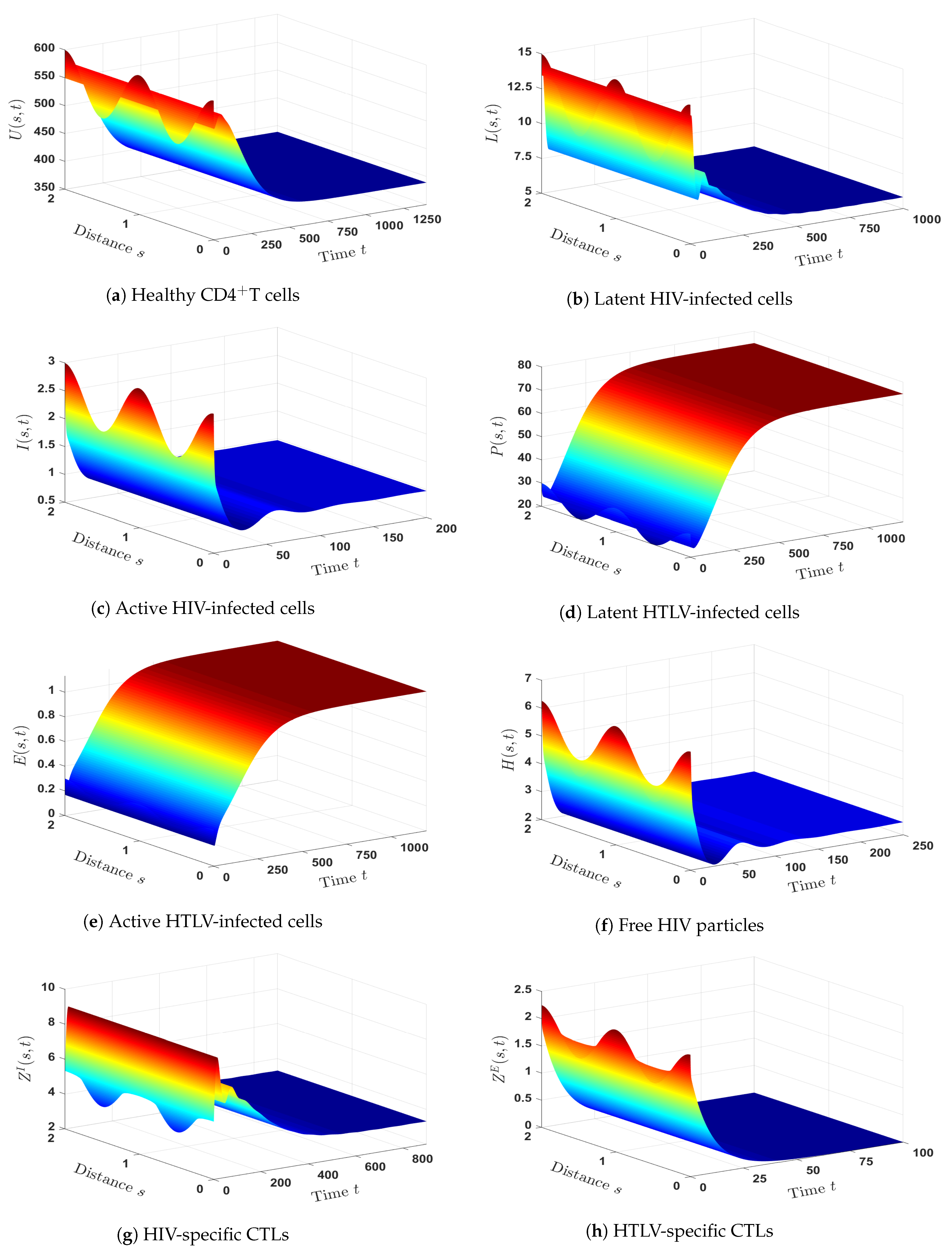
- We set and . Then, we calculated and . According to these data, exists and is given by . In Figure 5, we show that is GAS, which is consistent with Theorem 5. There is a persistent HTLV mono-infection in this case, with efficient HTLV-specific CTL immunity.
- (6)
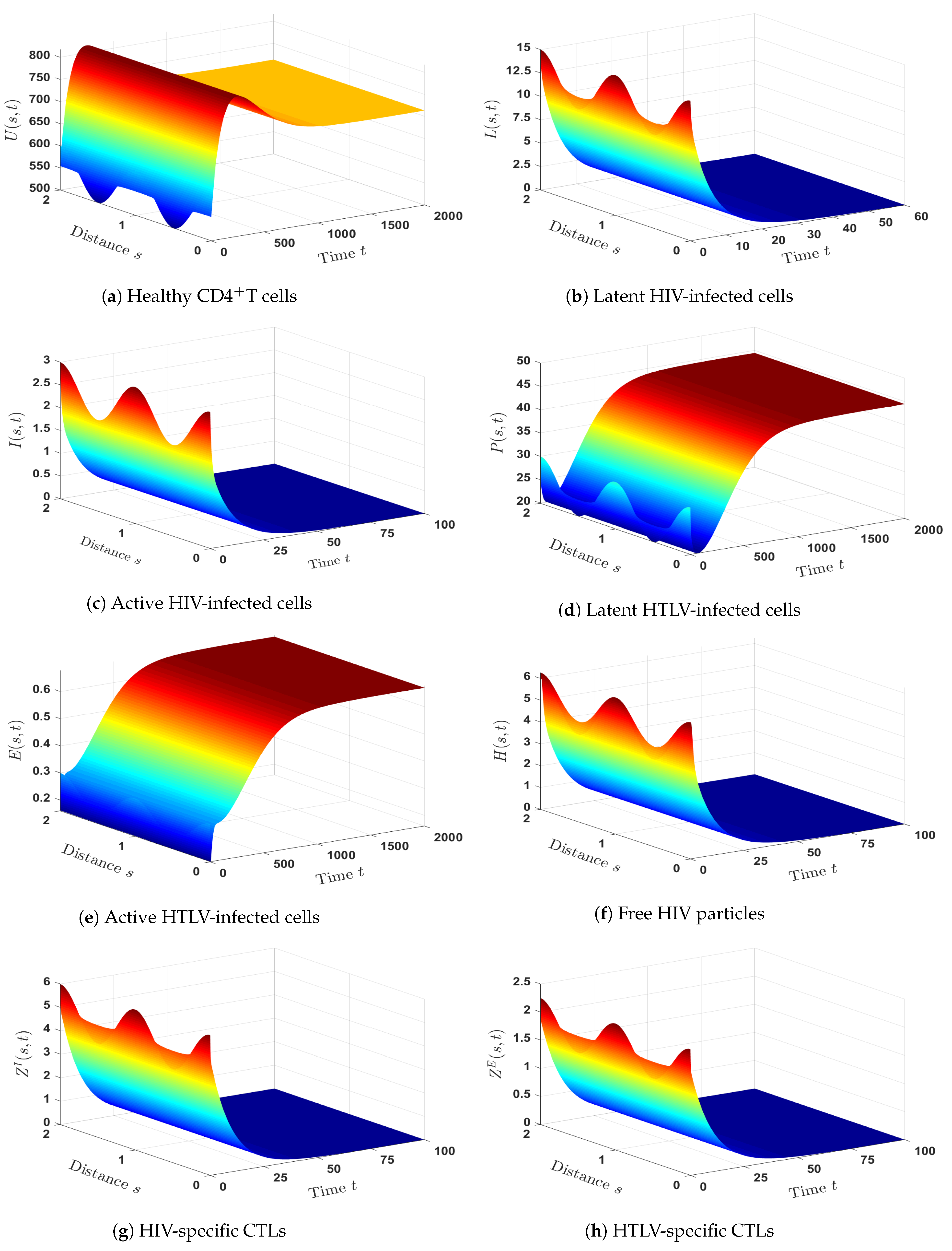
- We chose and . Hence, we have , , and . The numerical outcomes displayed in Figure 6 confirmed the existence and global stability of . Theorem 6 is, therefore, affirmed by this result. In this case, there is a persistent co-infection with HTLV and HIV together with an efficient HIV-specific CTL immunity, whereas the HTLV-specific CTL immunity is an inefficient.
- (7)
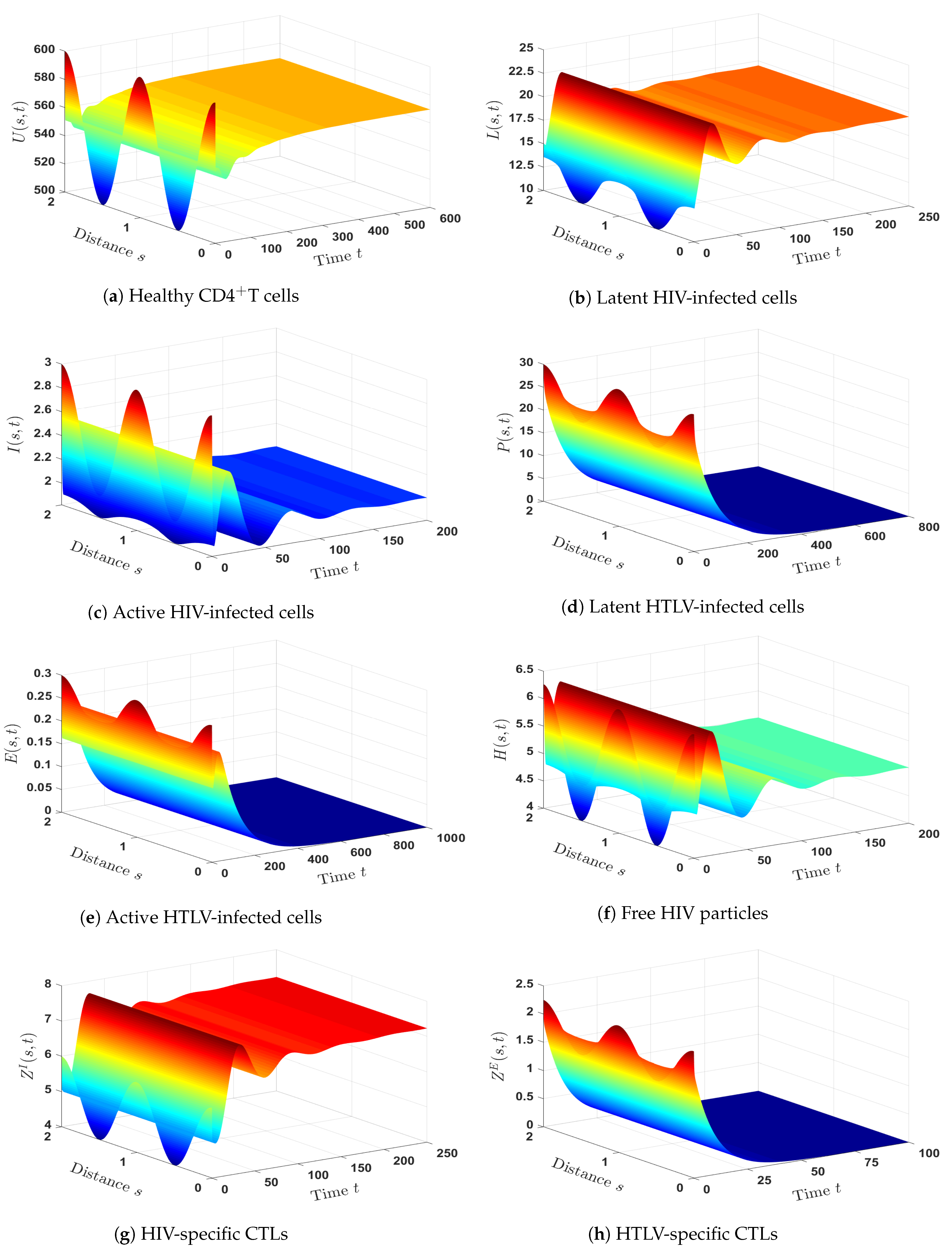
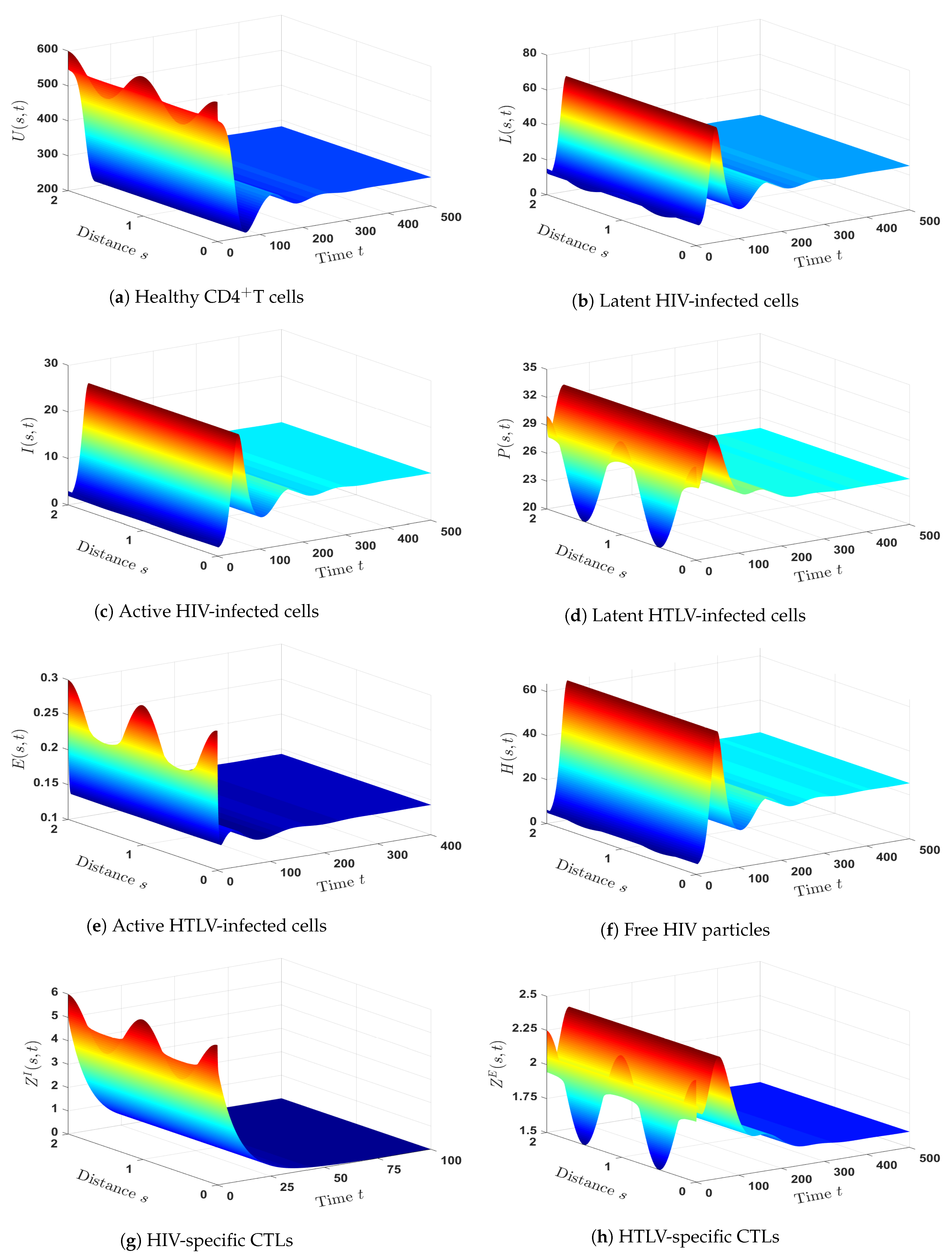
- We picked and . This gives , and . As can be seen from Figure 7, the equilibrium is GAS, and this is a confirmation of Theorem 7. In such a case, a persistent co-infection with HTLV and HIV occurs together with the effective HTLV-specific CTL immunity; however, the HIV-specific CTL immunity is not working.
- (8)
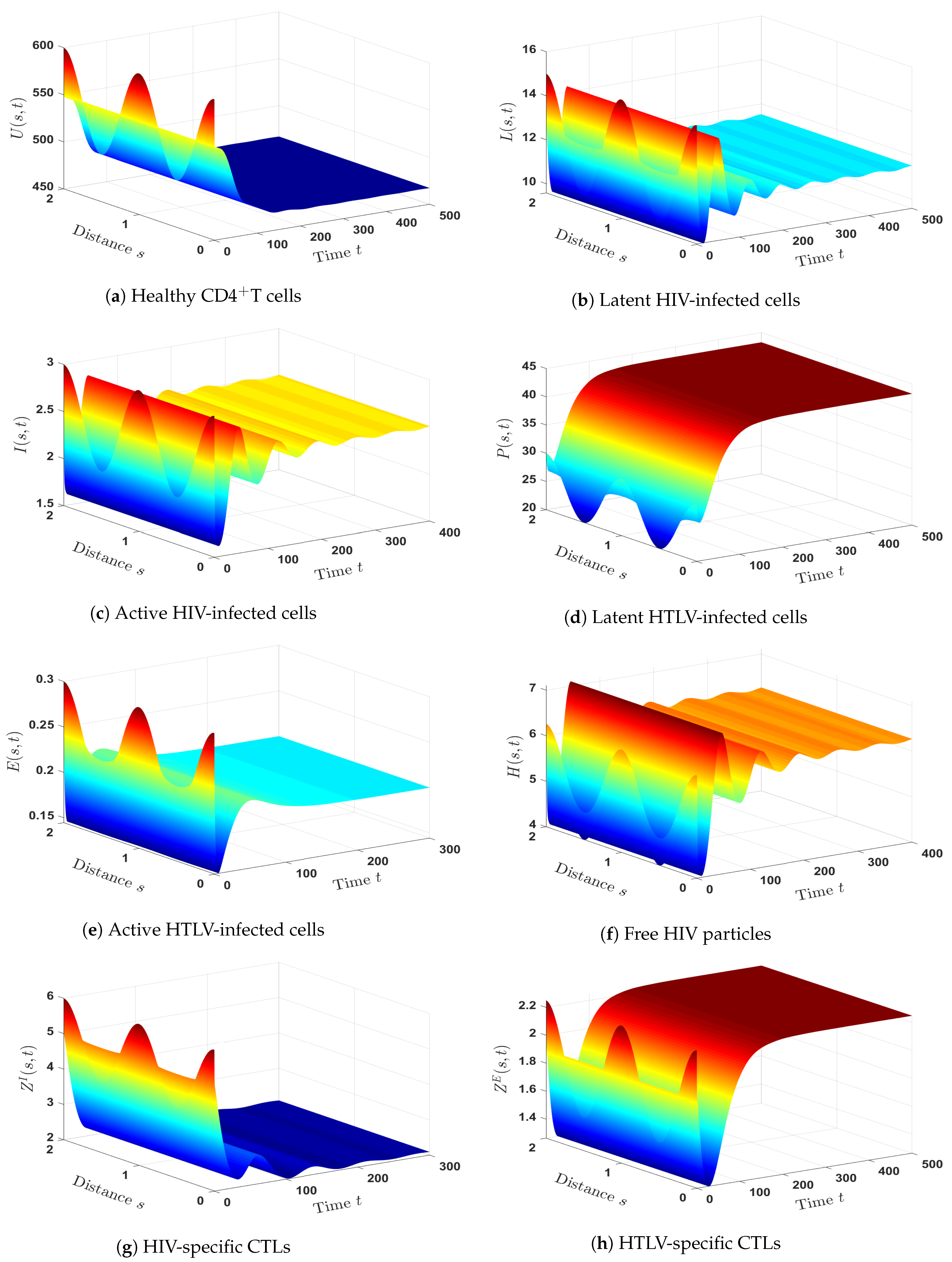
- We chose and . These data give and . Figure 8 illustrates that is GAS. Theorem 8 is, therefore, confirmed. Consequently, a persistent co-infection with HTLV and HIV occurs where the immune system is functioning well.
6.2. Comparison Study
- (i)
- The impact of HTLV infection on the dynamical behavior of HIV mono-infection:The following HIV mono-infection model was compared with Model (1) in order to determine the impact of HTLV infections on HIV mono-infection dynamics:The comparison was made through the following considerations:
- The parameters , , , , and are fixed.
- We chose (in the case of HTLV/HIV co-infection dynamics).
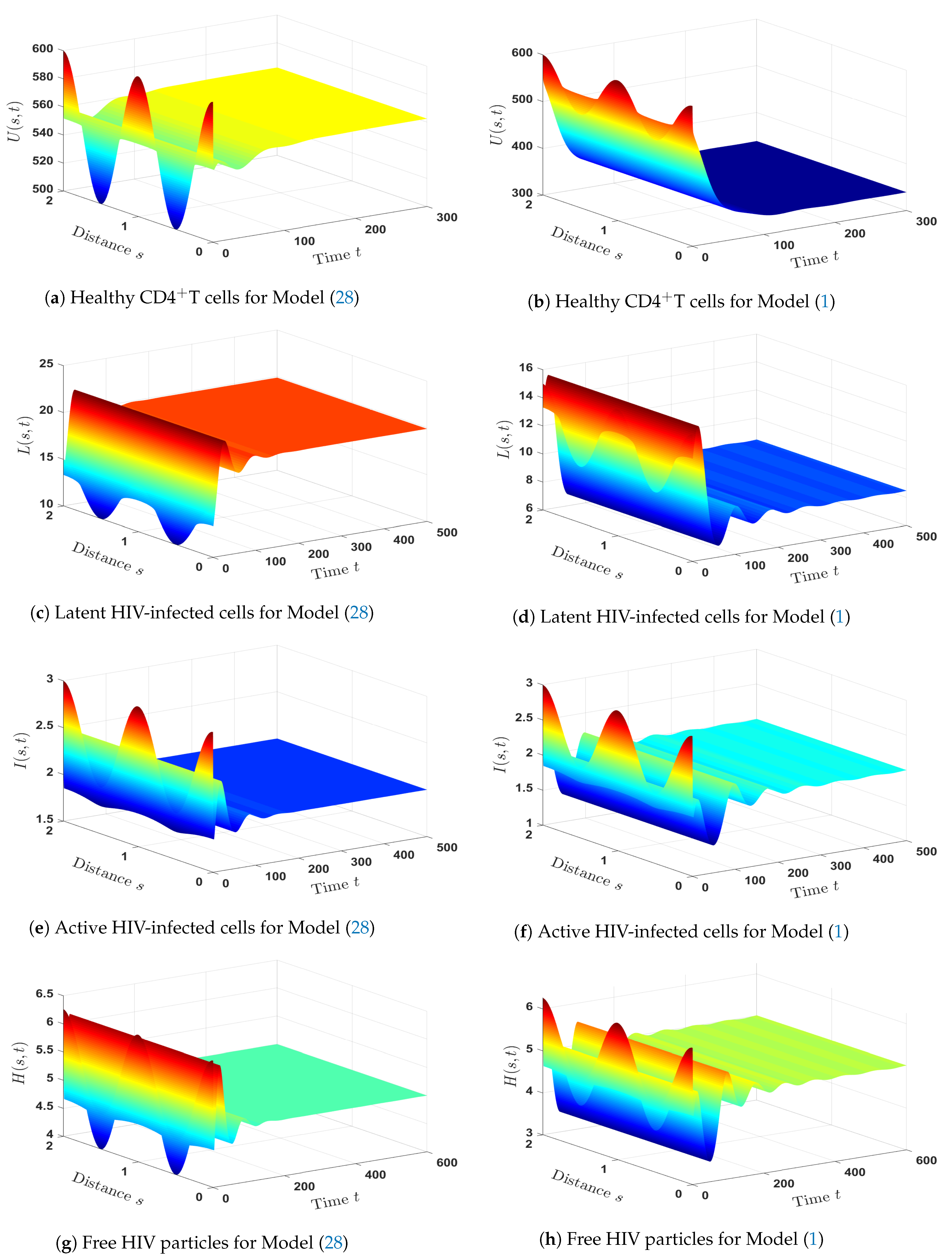
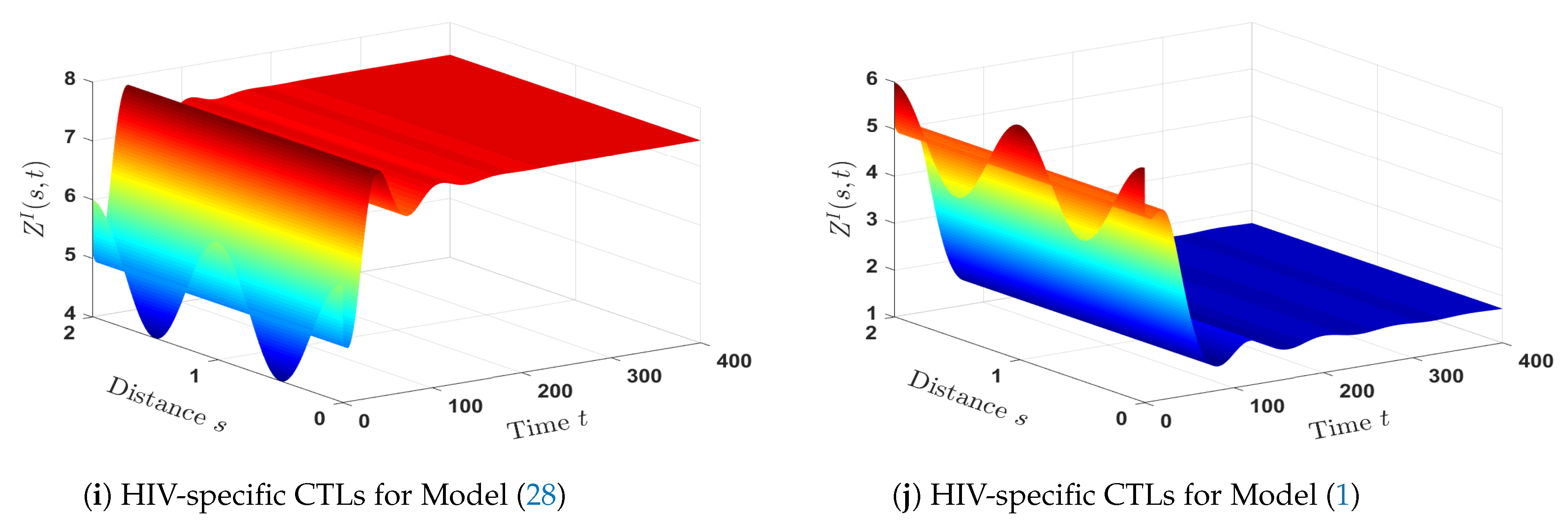
As shown in Figure 9, patients with only HIV who are co-infected with HTLV have lower levels of CDT cells (both latent and healthy), as well as HIV-specific CTLs. On the other hand, the concentration of free HIV particles reaches the same level in both HIV mono-infection and HTLV/HIV co-infection. Actually, this finding is compatible with the results of a recently published paper [59], where the study indicated that there are no discernible contrasts between HIV mono-infected and HTLV/HIV co-infected in terms of the number of HIV particles. - (ii)
- The impact of HIV infection on the dynamical behavior of HTLV mono-infection:In order to know how HIV infection influences the HTLV mono-infection dynamics, we compared Model (1) with an HTLV mono-infection model as given below:To make the comparison, we took into account the following factors:
- The parameters , , and are fixed.
- We picked and (in the case of HTLV/HIV co-infection dynamics).
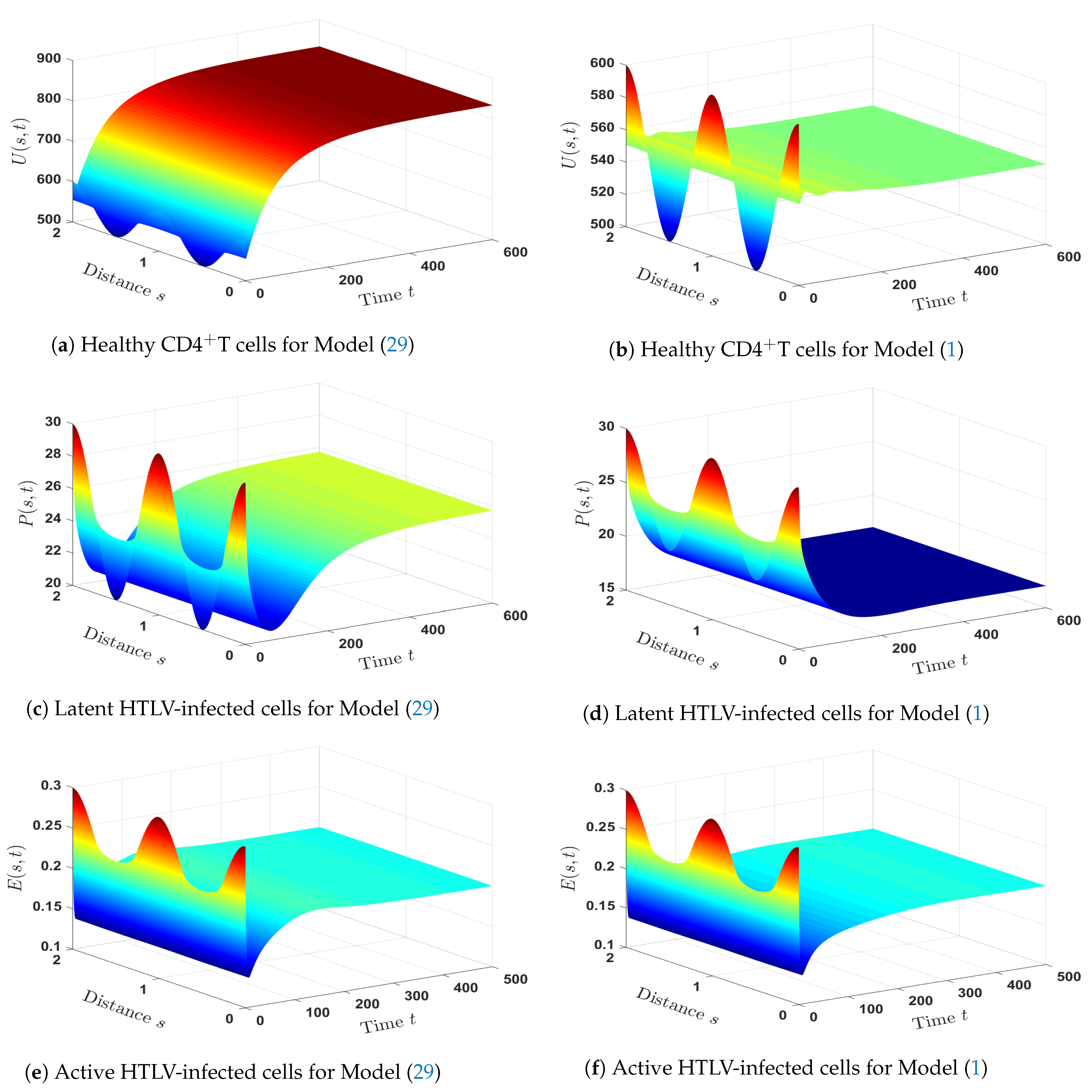
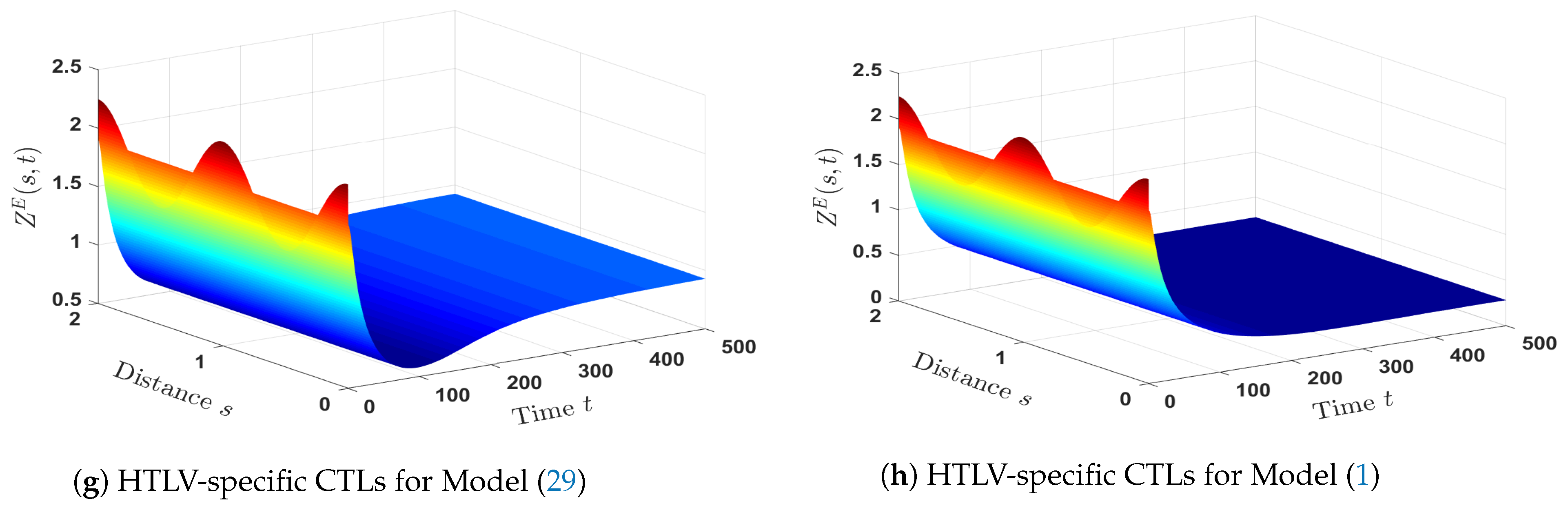
The solutions of Models (1) and (29) are shown by Figure 10. We noticed that, in the case of co-infection, the densities of CDT cells (both latent and healthy) and HTLV-specific CTLs are less than those in the case of HTLV mono-infection. However, both HTLV mono-infection and HTLV/HIV co-infection have the same level of density of active HTLV-infected cells.
7. Conclusions
Author Contributions
Funding
Data Availability Statement
Acknowledgments
Conflicts of Interest
References
- Nowak, M.A.; Bangham, C.R.M. Population dynamics of immune responses to persistent viruses. Science 1996, 272, 74–79. [Google Scholar] [CrossRef]
- Lai, X.; Zou, X. Modelling HIV-1 virus dynamics with both virus-to-cell infection and cell-to-cell transmission. SIAM J. Appl. Math. 2014, 74, 898–917. [Google Scholar] [CrossRef]
- Mojaver, A.; Kheiri, H. Mathematical analysis of a class of HIV infection models of CD4+T-cells with combined antiretroviral therapy. Appl. Math. Comput. 2015, 259, 258–270. [Google Scholar] [CrossRef]
- Adak, D.; Bairagi, N. Analysis and computation of multi-pathways and multi-delays HIV-1 infection model. Appl. Math. Model 2018, 54, 517–536. [Google Scholar] [CrossRef]
- Guo, T.; Qiu, Z. The effects of CTL immune response on HIV infection model with potent therapy, latently infected cells and cell-to-cell viral transmission. Math. Biosci. Eng. 2019, 16, 6822–6841. [Google Scholar] [CrossRef]
- Liu, H.; Zhang, J.F. Dynamics of two time delays differential equation model to HIV latent infection. Phys. A 2019, 514, 384–395. [Google Scholar] [CrossRef]
- Chen, W.; Tuerxun, N.; Teng, Z. The global dynamics in a wild-type and drug-resistant HIV infection model with saturated incidence. Adv. Differ. Equ. 2020, 2020, 25. [Google Scholar] [CrossRef]
- Wang, K.; Wang, W. Propagation of HBV with spatial dependence. Math. Biosci. 2007, 210, 78–95. [Google Scholar] [CrossRef]
- Kang, C.; Miao, H.; Chen, X.; Xu, J.; Huang, D. Global stability of a diffusive and delayed virus dynamics model with Crowley-Martin incidence function and CTL immune response. Adv. Differ. Equ. 2017, 2017, 324. [Google Scholar] [CrossRef]
- McCluskey, C.C.; Yang, Y. Global stability of a diffusive virus dynamics model with general incidence function and time delay. Nonlinear Anal. Real World Appl. 2015, 25, 64–78. [Google Scholar] [CrossRef]
- Miao, H.; Teng, Z.; Abdurahman, X.; Li, Z. Global stability of a diffusive and delayed virus infection model with general incidence function and adaptive immune response. Comput. Appl. Math. 2017, 37, 3780–3805. [Google Scholar] [CrossRef]
- Perelson, A.S.; Essunger, P.; Cao, Y.; Vesanen, M.; Hurley, A.; Saksela, K.; Markowitz, M.; Ho, D.D. Decay characteristics of HIV-1-infected compartments during combination therapy. Nature 1997, 87, 188–191. [Google Scholar] [CrossRef] [PubMed]
- Perelson, A.S.; Nelson, P.W. Mathematical analysis of HIV-1 dynamics in vivo. SIAM Rev. 1999, 41, 3–44. [Google Scholar] [CrossRef]
- Rong, L.; Perelson, A.S. Modeling latently infected cell activation: Viral and latent reservoir persistence, and viral blips in HIV-infected patients on potent therapy. J. Theor. Plos Comput. Biol. 2009, 5, e1000533. [Google Scholar] [CrossRef]
- Buonomo, B.; Vargas-De-Leon, C. Global stability for an HIV-1 infection model including an eclipse stage of infected cells. J. Math. Anal. Appl. 2012, 385, 709–720. [Google Scholar] [CrossRef] [PubMed]
- Sigal, A.; Kim, J.T.; Balazs, A.B.; Dekel, E.; Mayo, A.; Baltimore, R.M.D. Cell-to-cell spread of HIV permits ongoing replication despite antiretroviral therapy. Nature 2011, 477, 95–98. [Google Scholar] [CrossRef]
- Wang, J.; Yang, J.; Kuniya, T. Dynamics of a PDE viral infection model incorporating cell-to-cell transmission. J. Math. Anal. Appl. 2016, 444, 1542–1564. [Google Scholar] [CrossRef]
- Sun, H.; Wang, J. Dynamics of a diffusive virus model with general incidence function, cell-to-cell transmission and time delay. Comput. Math. Appl. 2019, 77, 284–301. [Google Scholar] [CrossRef]
- Xu, J.; Hou, J.; Geng, Y.; Zhang, S. Dynamic consistent NSFD scheme for a viral infection model with cellular infection and general nonlinear incidence. Adv. Differ. Equ. 2018, 2018, 108. [Google Scholar] [CrossRef]
- Agosto, L.; Herring, M.; Mothes, W.; Henderson, A. HIV-1-infected CD4+ T cells facilitate latent infection of resting CD4+ T cells through cell-cell contact. Cell 2018, 24, 2088–2100. [Google Scholar] [CrossRef]
- Elaiw, A.M.; AlShamrani, N.H. Stability of a general CTL-mediated immunity HIV infection model with silent infected cell-to-cell spread. Adv. Differ. Equ. 2020, 2020, 355. [Google Scholar] [CrossRef]
- Gao, Y.; Wang, J. Threshold dynamics of a delayed nonlocal reaction–diffusion HIV infection model with both cell-free and cell-to-cell transmissions. J. Math. Anal. Appl. 2020, 488, 124047. [Google Scholar] [CrossRef]
- Tang, S.; Teng, Z.; Miao, H. Global dynamics of a reaction–diffusion virus infection model with humoral immunity and nonlinear incidence. Comput. Math. Appl. 2019, 78, 786–806. [Google Scholar] [CrossRef]
- Luo, Y.; Zhang, L.; Zheng, T.; Teng, Z. Analysis of a diffusive virus infection model with humoral immunity, cell-to-cell transmission and nonlinear incidence. Phys. A 2019, 535, 122415. [Google Scholar] [CrossRef]
- AlAgha, A.D.; Elaiw, A.M. Stability of a general reaction–diffusion HIV-1 dynamics model with humoral immunity. Eur. Phys. J. Plus 2019, 134, 1–18. [Google Scholar] [CrossRef]
- Elaiw, A.M.; Agha, A.D.A. Stability of a general HIV-1 reaction–diffusion model with multiple delays and immune response. Phys. Stat. Mech. Its Appl. 2019, 536, 1–20. [Google Scholar] [CrossRef]
- Wang, W.; Wang, X.; Guo, K.; Ma, W. Global analysis of a diffusive viral model with cell-to-cell infection and incubation period. Math. Methods Appl. Sci. 2020, 43, 5963–5978. [Google Scholar] [CrossRef]
- Ren, X.; Tian, Y.; Liu, L.; Liu, X. A reaction–diffusion within-host HIV model with cell-to-cell transmission. J. Math. 2018, 2018, 1831–1872. [Google Scholar] [CrossRef]
- Vargas-De-Leon, C. The complete classification for global dynamics of amodel for the persistence of HTLV-1 infection. Appl. Math. Comput. 2014, 237, 489–493. [Google Scholar]
- Lim, A.G.; Maini, P.K. HTLV-Iinfection: A dynamic struggle between viral persistence and host immunity. J. Theor. Biol. 2014, 352, 92–108. [Google Scholar] [CrossRef]
- Pan, X.; Chen, Y.; Shu, H. Rich dynamics in a delayed HTLV-I infection model: Stability switch, multiple stable cycles, and torus. J. Math. Anal. Appl. 2019, 479, 2214–2235. [Google Scholar] [CrossRef]
- Wang, L.; Liu, Z.; Li, Y.; Xu, D. Complete dynamical analysis for a nonlinear HTLV-I infection model with distributed delay, CTL response and immune impairment. Discret. Contin. Dyn. 2020, 25, 917–933. [Google Scholar] [CrossRef]
- Wang, Y.; Liu, J.; Heffernan, J.M. Viral dynamics of an HTLV-I infection model with intracellular delay and CTL immune response delay. J. Math. Anal. Appl. 2018, 459, 506–527. [Google Scholar] [CrossRef]
- Li, F.; Ma, W. Dynamics analysis of an HTLV-1 infection model with mitotic division of actively infected cells and delayed CTL immune response. Math. Methods Appl. Sci. 2018, 41, 3000–3017. [Google Scholar] [CrossRef]
- Li, S.; Zhou, Y. Backward bifurcation of an HTLV-I model with immune response. Discret. Contin. Dyn. Syst. Ser. B 2016, 21, 863–881. [Google Scholar]
- Wang, W.; Ma, W. Global dynamics of a reaction and diffusion model for an HTLV-I infection with mitotic division of actively infected cells. J. Appl. Anal. Comput. 2017, 7, 899–930. [Google Scholar] [CrossRef]
- Casoli, C.; Pilotti, E.; Bertazzoni, U. Molecular and cellular interactions of HIV-1/HTLV coinfection and impact on AIDS progression. AIDS Rev. 2007, 9, 140–149. [Google Scholar]
- Silva, M.T.; Espíndola, O.D.; Leite, A.C.; Araújo, A. Neurological aspects of HIV/human T lymphotropic virus coinfection. AIDS Rev. 2009, 11, 71–78. [Google Scholar]
- Brites, C.; Sampalo, J.; Oliveira, A. HIV/human T-cell lymphotropic virus coinfection revisited: Impact on AIDS progression. AIDS Rev. 2009, 11, 8–16. [Google Scholar]
- Isache, C.; Sands, M.; Guzman, N.; Figueroa, D. HTLV-1 and HIV-1 co-infection: A case report and review of the literature. IDCases 2016, 4, 53–55. [Google Scholar] [CrossRef]
- Beilke, M.A.; Theall, K.P.; O’Brien, M.; Clayton, J.L.; Benjamin, S.M.; Winsor, E.L.; Kissinger, P.J. Clinical outcomes and disease progression among patients coinfected with HIV and human T lymphotropic virus types 1 and 2. Clin. Infect. Dis. 2004, 39, 256–263. [Google Scholar] [CrossRef]
- Elaiw, A.M.; AlShamrani, N.H. Analysis of a within-host HIV/HTLV-I co-infection model with immunity. Virus Res. 2020, 295, 198204. [Google Scholar] [CrossRef]
- Elaiw, A.M.; AlShamrani, N.H.; Hobiny, A.D. Mathematical modeling of HIV/HTLV co-infection with CTL-mediated immunity. AIMS Math. 2021, 6, 1634–1676. [Google Scholar] [CrossRef]
- Elaiw, A.M.; AlShamrani, N.H. Stability of HTLV/HIV co-infection model with mitosis and latency. Math. Eng. 2021, 18, 1077–1120. [Google Scholar]
- Elaiw, A.M.; AlShamrani, N.H. Analysis of an HTLV/HIV co-infection model with diffusion. Math. Biosci. Eng. 2021, 18, 9430–9473. [Google Scholar] [CrossRef] [PubMed]
- Wang, Z.; Guo, Z.; Peng, H. Dynamical behavior of a new oncolytic virotherapy model based on gene variation. Discret. Contin. Dyn. Syst. Ser. S 2017, 10, 1079–1093. [Google Scholar] [CrossRef]
- Xu, Z.; Xu, Y. Stability of a CD4+ T cell viral infection model with diffusion. Int. J. Biomath. 2018, 11, 1850071. [Google Scholar] [CrossRef]
- Zhang, Y.; Xu, Z. Dynamics of a diffusive HBV model with delayed Beddington-DeAngelis response. Nonlinear Anal. Real World Appl. 2014, 15, 118–139. [Google Scholar] [CrossRef]
- Smith, H.L. Monotone Dynamical Systems: An Introduction to the Theory of Competitive and Cooperative Systems; American Mathematical Society: Providence, TX, USA, 1995. [Google Scholar]
- Protter, M.H.; Weinberger, H.F. Maximum Principles in Differential Equations; Prentic Hall: Englewood Cliffs, NJ, USA, 1967. [Google Scholar]
- Henry, D. Geometric Theory of Semilinear Parabolic Equations; Springer: New York, NY, USA, 1993. [Google Scholar]
- Elaiw, A.M.; AlAgha, A.D. Global dynamics of reaction–diffusion oncolytic M1 virotherapy with immune response. Appl. Math. Comput. 2020, 367, 124758. [Google Scholar] [CrossRef]
- Elaiw, A.M.; AlAgha, A.D. Analysis of a delayed and diffusive oncolytic M1 virotherapy model with immune response. Nonlinear Anal. Real World Appl. 2020, 55, 103116. [Google Scholar] [CrossRef]
- Barbashin, E.A. Introduction to the Theory of Stability; Wolters-Noordhoff: Groningen, The Netherlands, 1970. [Google Scholar]
- LaSalle, J.P. The Stability of Dynamical Systems; SIAM: Philadelphia, PA, USA, 1976. [Google Scholar]
- Lyapunov, A.M. The General Problem of the Stability of Motion; Taylor & Francis, Ltd.: London, UK, 1992. [Google Scholar]
- Maziane, M.; Lotfi, E.M.; Hattaf, K.; Yousfi, N. Dynamics of a class of HIV infection models with cure of infected cells in eclipse stage. Acta Biotheor. 2015, 63, 363–380. [Google Scholar] [CrossRef] [PubMed]
- Elaiw, A.M.; Agha, A.D.A. Global Stability of a reaction–diffusion malaria/COVID-19 coinfection dynamics model. Mathematics 2022, 10, 4390. [Google Scholar] [CrossRef]
- Vandormael, A.; Rego, F.; Danaviah, S.; Alcantara, L.C.; Boulware, D.R.; de Oliveira, T. CD4+ T-cell count may not be a useful strategy to monitor antiretroviral therapy response in HTLV-1/HIV co-infected patients. Curr. HIV Res. 2017, 15, 225–231. [Google Scholar] [CrossRef] [PubMed]
- Hattaf, K. On the stability and numerical scheme of fractional differential equations with application to biology. Computation 2022, 10, 97. [Google Scholar] [CrossRef]
- Hattaf, K. A New generalized definition of fractional derivative with non-singular kernel. Computation 2020, 8, 49. [Google Scholar] [CrossRef]
- Hattaf, K.; Karimi, M.I.E.; Mohsen, A.A.; Hajhouji, Z.; Younoussi, M.E.; Yousfi, N. Mathematical modeling and analysis of the dynamics of RNA viruses in presence of immunity and treatment: A case study of SARS-CoV-2. Vaccines 2023, 11, 201. [Google Scholar] [CrossRef] [PubMed]

| Equilibrium | Global Stability |
|---|---|
| and | |
| , and | |
| , and | |
| and | |
| and | |
| , and | |
| , and | |
| and |
| Parameter | Value | Parameter | Value | Parameter | Value | Parameter | Value |
|---|---|---|---|---|---|---|---|
| 10 | 2 | ||||||
| b | |||||||
| Varied | Varied | ||||||
| Varied | 5 | Varied | |||||
| Varied | |||||||
| Varied | |||||||
Disclaimer/Publisher’s Note: The statements, opinions and data contained in all publications are solely those of the individual author(s) and contributor(s) and not of MDPI and/or the editor(s). MDPI and/or the editor(s) disclaim responsibility for any injury to people or property resulting from any ideas, methods, instructions or products referred to in the content. |
© 2023 by the authors. Licensee MDPI, Basel, Switzerland. This article is an open access article distributed under the terms and conditions of the Creative Commons Attribution (CC BY) license (https://creativecommons.org/licenses/by/4.0/).
Share and Cite
AlShamrani, N.H.; Elaiw, A.; Raezah, A.A.; Hattaf, K. Global Dynamics of a Diffusive Within-Host HTLV/HIV Co-Infection Model with Latency. Mathematics 2023, 11, 1523. https://doi.org/10.3390/math11061523
AlShamrani NH, Elaiw A, Raezah AA, Hattaf K. Global Dynamics of a Diffusive Within-Host HTLV/HIV Co-Infection Model with Latency. Mathematics. 2023; 11(6):1523. https://doi.org/10.3390/math11061523
Chicago/Turabian StyleAlShamrani, Noura H., Ahmed Elaiw, Aeshah A. Raezah, and Khalid Hattaf. 2023. "Global Dynamics of a Diffusive Within-Host HTLV/HIV Co-Infection Model with Latency" Mathematics 11, no. 6: 1523. https://doi.org/10.3390/math11061523
APA StyleAlShamrani, N. H., Elaiw, A., Raezah, A. A., & Hattaf, K. (2023). Global Dynamics of a Diffusive Within-Host HTLV/HIV Co-Infection Model with Latency. Mathematics, 11(6), 1523. https://doi.org/10.3390/math11061523

