1. Introduction
A spanning subgraph of a graph
G in which every vertex has two degrees is called a
2-factor of
G. It represents the union of cycles which has the same vertex set as
G. Specifically, if the number of these cycles is one, then we call it a Hamiltonian cycle. Enumerating and generating Hamiltonian paths are of interest in chemistry, theoretical physics and biophysics related to polymer melting, protein folding [
1] and the study of magnetic systems with
symmetry [
2]. It might also be useful in the theory of algorithms [
3,
4]. Additionally, the path planning problem for robots and machine tools [
5] as well as security and intellectual property protection using microelectrode dot array (MEDA) biochips [
6] make the study of this problem important in engineering and bioinformatics, especially when
G is a grid graph. For a brief overview of the chronology of the research on enumeration of Hamiltonian cycles in different graph families, we refer the reader to [
7].
The grid graphs with
(
) vertices on different surfaces can be considered sequences with an index
n (or
m). The sequences of the numbers of Hamiltonian cycles (
) in the rectangular grid graph and the thin and thick cylinders obtained in recent papers revealed some interesting properties. For example, asymptotically equal behavior (when
) of these sequences in the contractible and non-contractible cases was spotted for the thin cylinder [
8]. For the thick grid cylinder, the supremacy of contractible Hamiltonian cycles over non-contractible ones depends on the parity of
m [
9]. Additionally, the computational data for
indicated that the coefficient for the dominant eigenvalue in the non-contractible case was equal to one and that the positive dominant characteristic root in the contractible case was equal to the same one associated with the rectangular grid graph [
10].
With the aim to find some conclusions which can help in proving the above-mentioned properties, we started the investigation of 2-factors in these graphs as a generalization of Hamiltonian cycles. The research in [
11,
12] was dedicated to the rectangular
, thick cylinder
and Moebius strip
grid graphs. We proposed an algorithm for obtaining 2-factor transfer digraphs common for all three classes and explored its structure. In this paper, we continue with three new classes of grid graphs: the thin cylinder
, torus
and Klein bottle
, all of which have
vertices.
2. Definitions, Notations and Tools
The structure of (square) grid graphs under consideration allows the grouping of vertices in “columns” and consideration of their edges as “vertical” and “horizontal”.
The
, where
and
denote the path and cycle with
n vertices, respectively, can be obtained from the rectangular grid graph
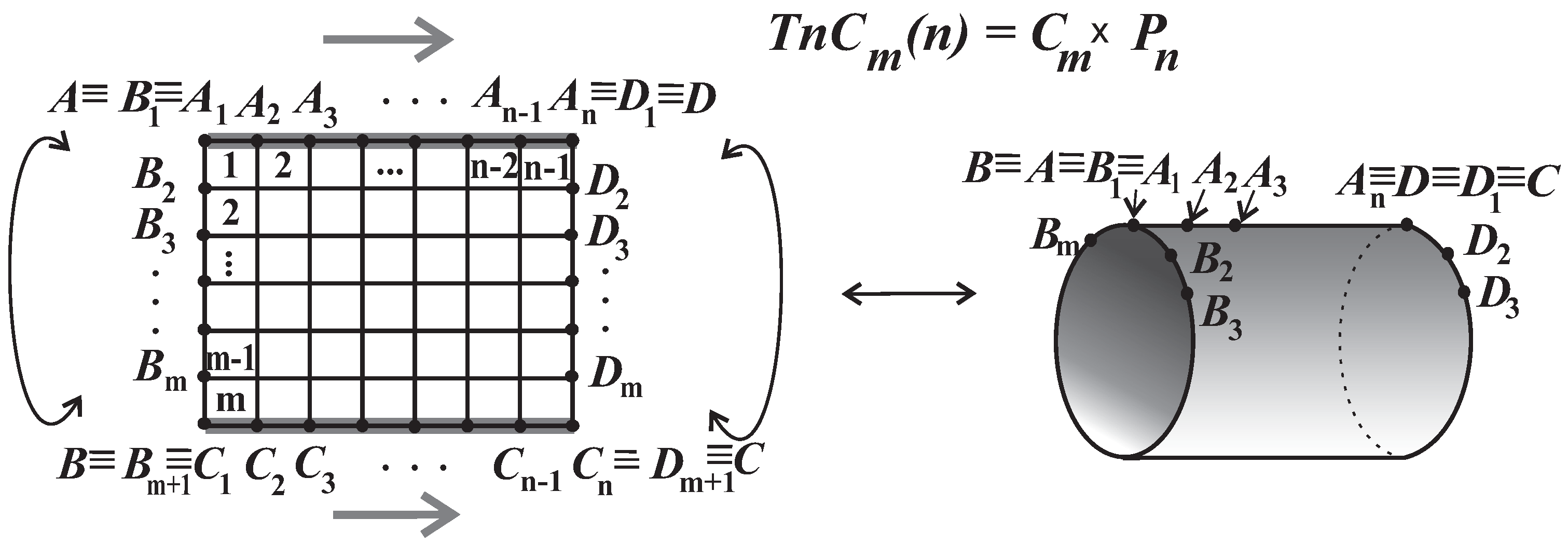
by identification of the corresponding vertices from the first and last rows (in
Figure 1, the vertex
coincides with
, both from the
ith column, where
) without producing (horizontal) multiplying edges. The other two graphs from the title can be obtained from the thin grid cylinder
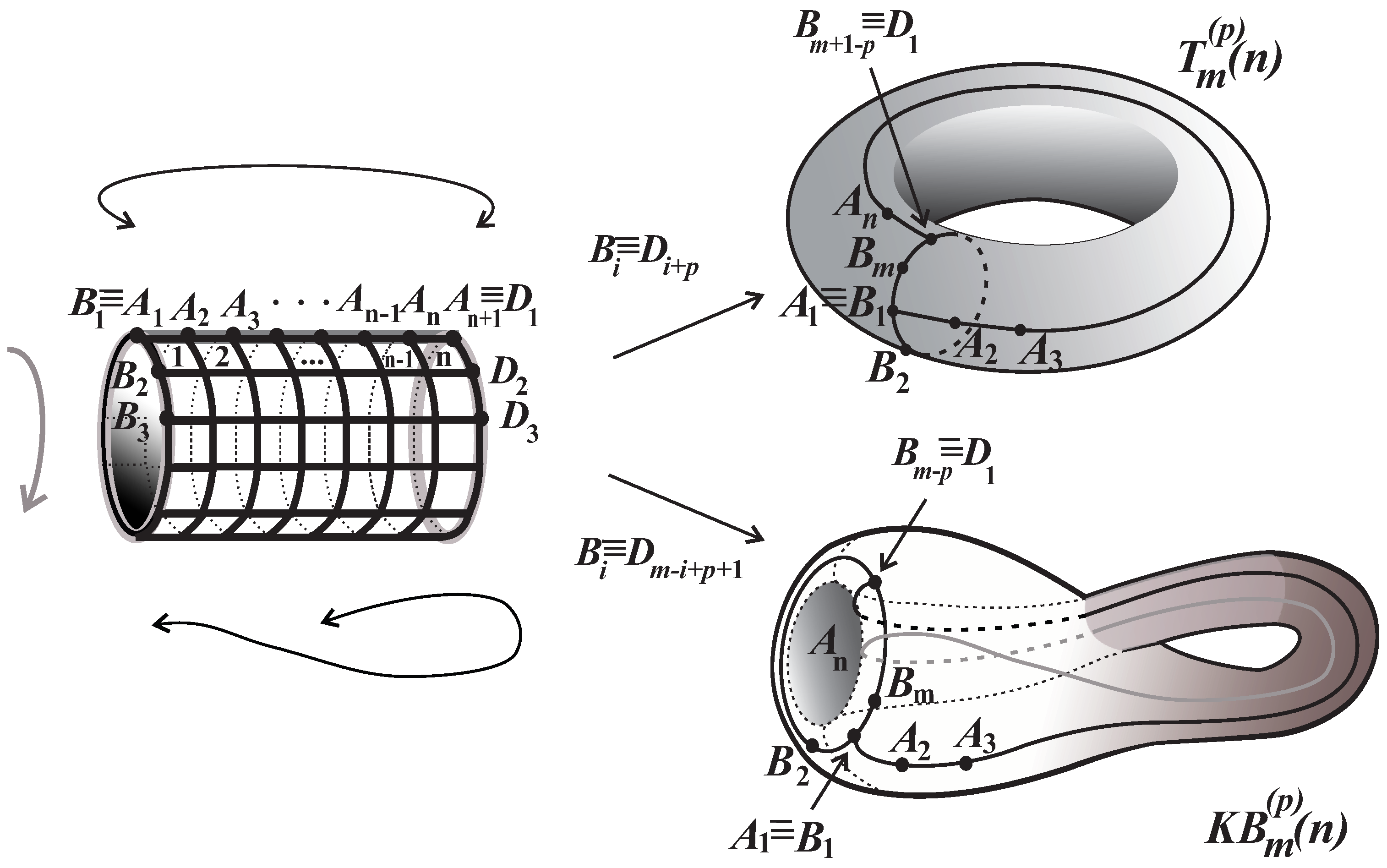
by gluing the corresponding vertices from the first and last columns without producing vertical multiplying edges. The identification of corresponding vertices from the first and last columns in
can be achieved in several ways, resulting in the following grid graphs on a torus or Klein bottle surface (see
Figure 2).
Definition 1. Let and denote the vertices belonging to the ith row () from the first and last columns, respectively, in the graph .
The torus (grid) () is the graph obtained from with identification vertices and for and without duplicating edges.
The Klein bottle is the graph obtained from with identification vertices and for and without duplicating edges. In both cases, the sign + in subscript is the addition modulo m. The value is called the width of the grid graph.
Informally, in both cases, we elongated the cylinder and then bent it so that the two ends of the cylinder (i.e., the cycles with vertices and ) came close to each other. Prior to identification, one end of the cylinder was twisted until the corresponding vertices matched. Note that is just a special case of the torus grid graph.
For an arbitrary 2-factor of a considered graph of the width , we coded its vertices. To each column, we joined a word over some alphabet of a length m (abbreviated as m-word). These words represent the vertices of the so-called transfer digraph . The arcs in reflect the possibility that two m-words appear as adjacent columns. The process of enumeration of 2-factors was reduced to enumeration of some oriented walks in this digraph. Contrary to the case of rectangular, thick cylinder and Moebious strip grid graphs, where the words assigned to the columns of vertices are linear, for the graphs from the title (, and ()), we treated those words as circular ones.
In
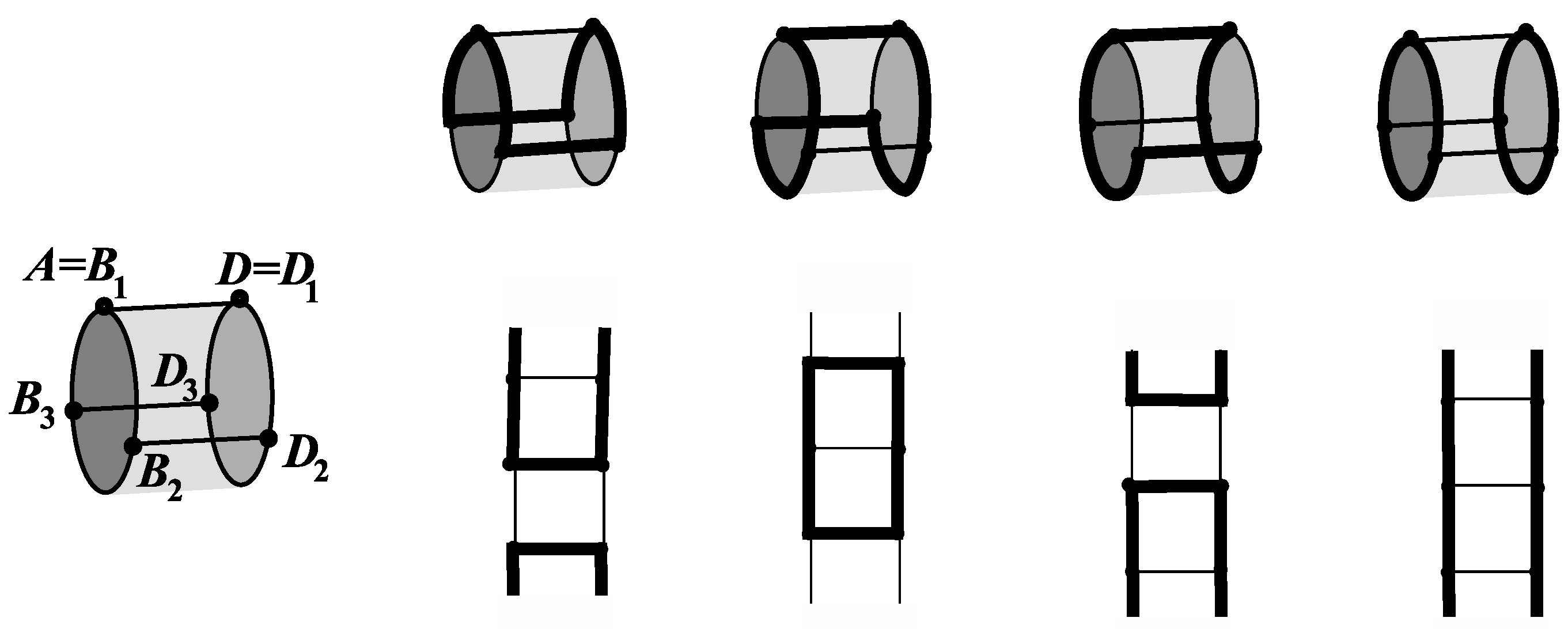
Figure 3, the grid graph
and all its possible 2-factors are shown. With the exception of the last case, all other 2-factors were connected (i.e., Hamiltonian cycles).
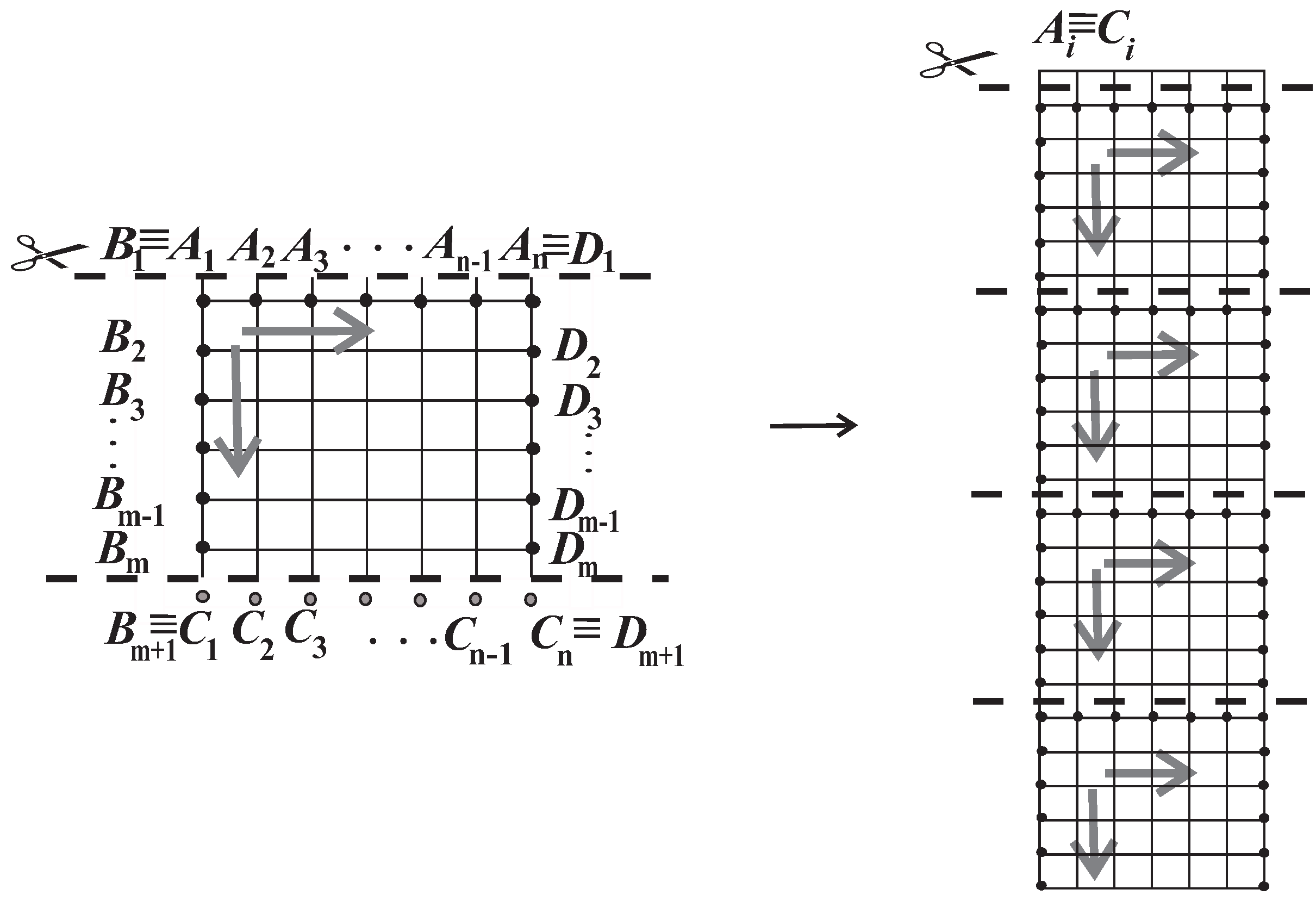
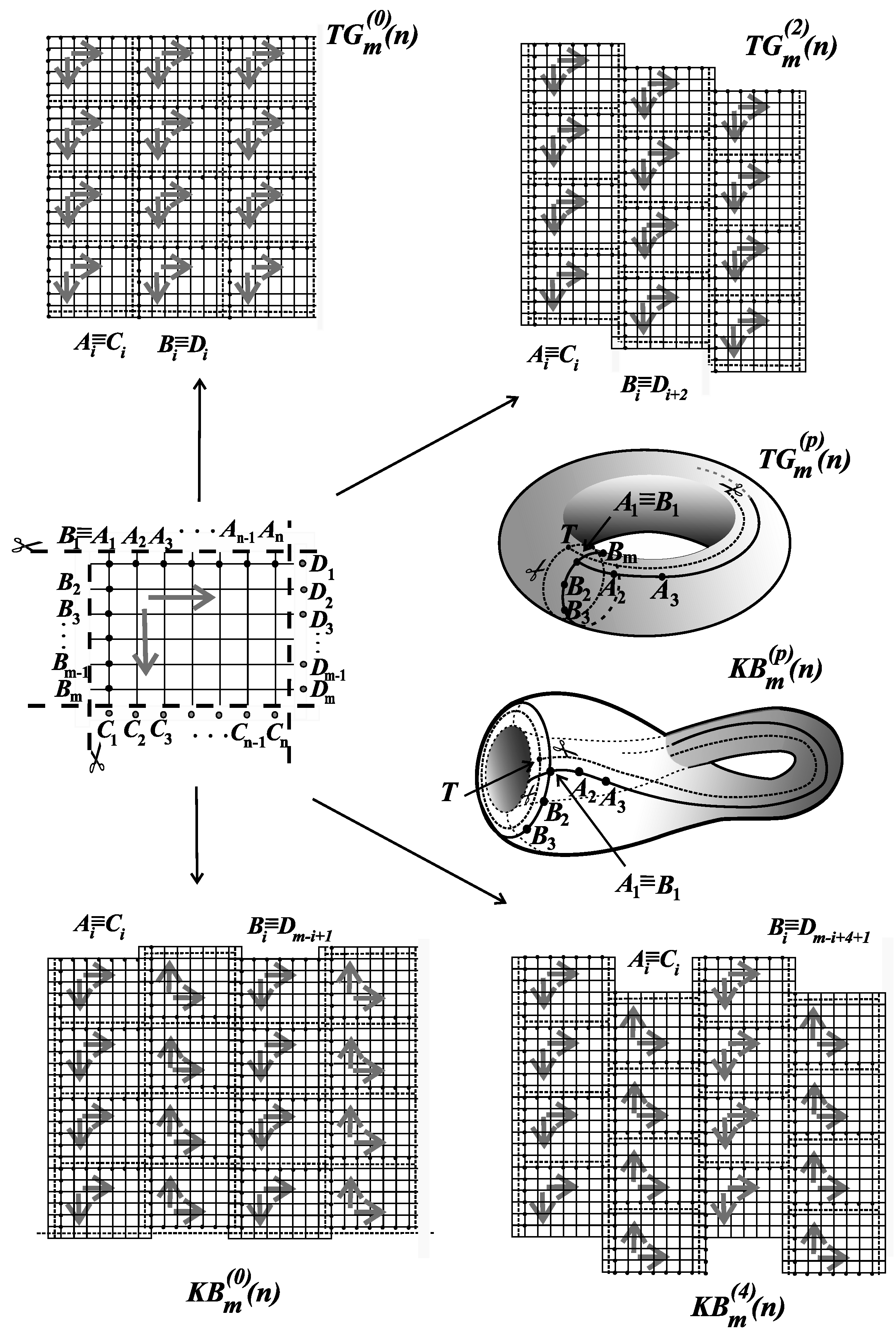
To be able to “walk to the left, right, upper or down” trough the cycles in a 2-factor of one of our grid graphs, imagine that we “cut and develop in the plane” the surfaces of the considered graph. At first, in the case of the torus
or Klein bottle
, we “cut” the edges connecting the vertices of the last and first columns. Then, in all three cases, we did the same with the edges connecting the vertices of the last and first rows of the cylinder and developed them in the plane (see
Figure 3 below).
Definition 2. The picture obtained after the described “cutting and developing in the plane", in which the lines corresponding to the edges of the considered 2-factor are bolded, is called the flat representation (FR). In the case of the thin cylinder, by using translation of an infinite number of copies of FR and linking them to each other in a sequence, we obtained the infinite strip grid graph of a width n. In the other two cases, at first we produced the similar infinite strip. Then, we made the copies of it, and using translation (in the case of torus) and glade symmetry (in the case of the Klein bottle), we tiled the whole plane, taking into account that , for , or , for . The picture of the infinite grid graph obtained from copies of FR is called the rolling imprints (RI).
Figure 4 illustrates this tiling technique for
and
Figure 5 for
,
,
and
.
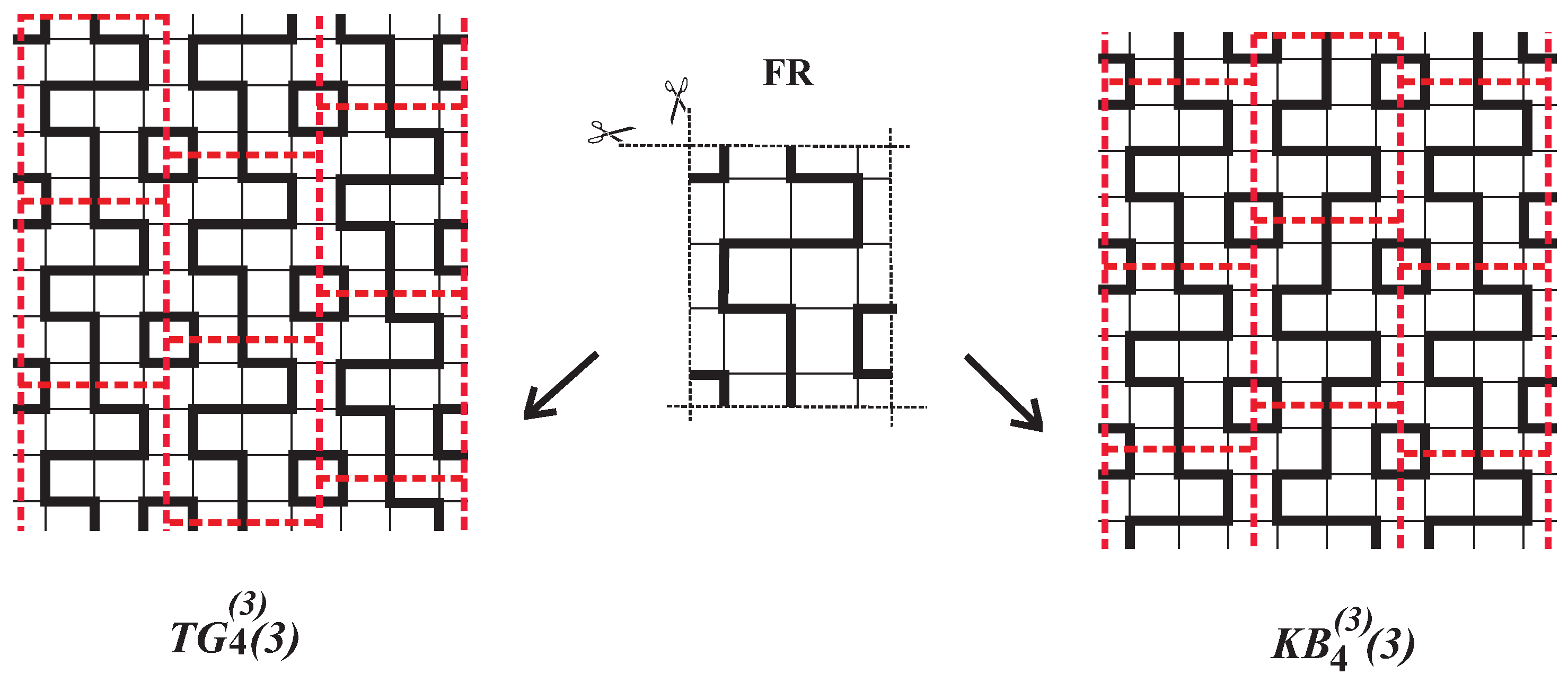
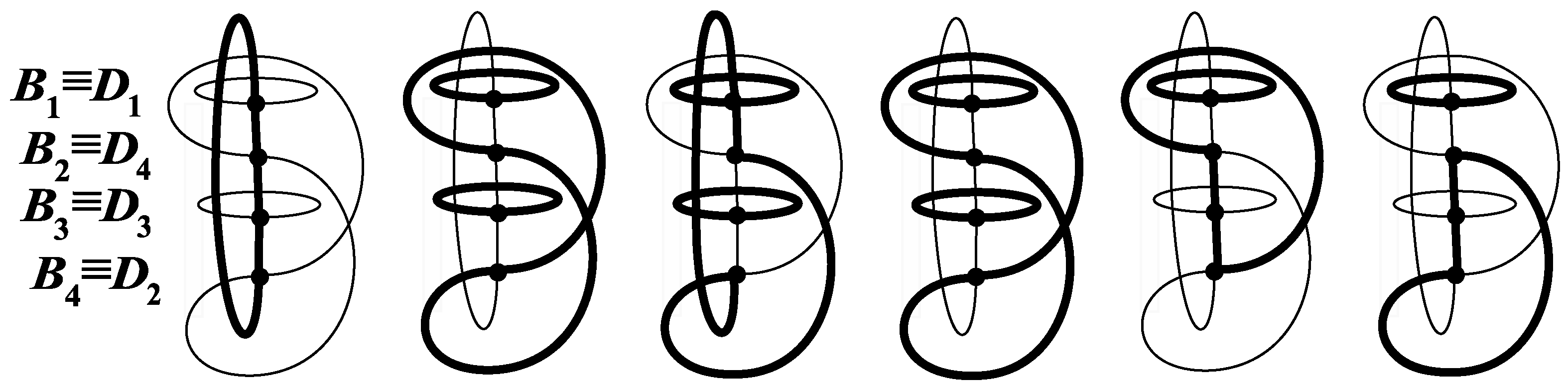
Note that one FR can serve different types or classes of grid graphs (see
Figure 6). The concept of rolling imprints was introduced in [
10]. Observe that the bold lines in RI determined the 2-factor of the infinity grid graph for all three classes.
In this problem, we use matrix labeling. Thus, each vertex of the considered grid graph G with vertices is represented with an ordered pair , where i is the ordinal number of the row viewed from top to bottom in FR while j is the ordinal number of the column in FR viewed from left to right:
Definition 3. We associate each 2-factor of the observed graph G with the so-called code matrix , where is one of six possible labels shown in Figure 7 (called alpha letters) that corresponds to the vertex (, ). By reading the columns of these code matrices from top to bottom, we obtain the so-called alpha words. For instance, three alpha words—
,
and
(following column order)—determined the 2-factors shown in
Figure 6. The digraphs
and
, shown in
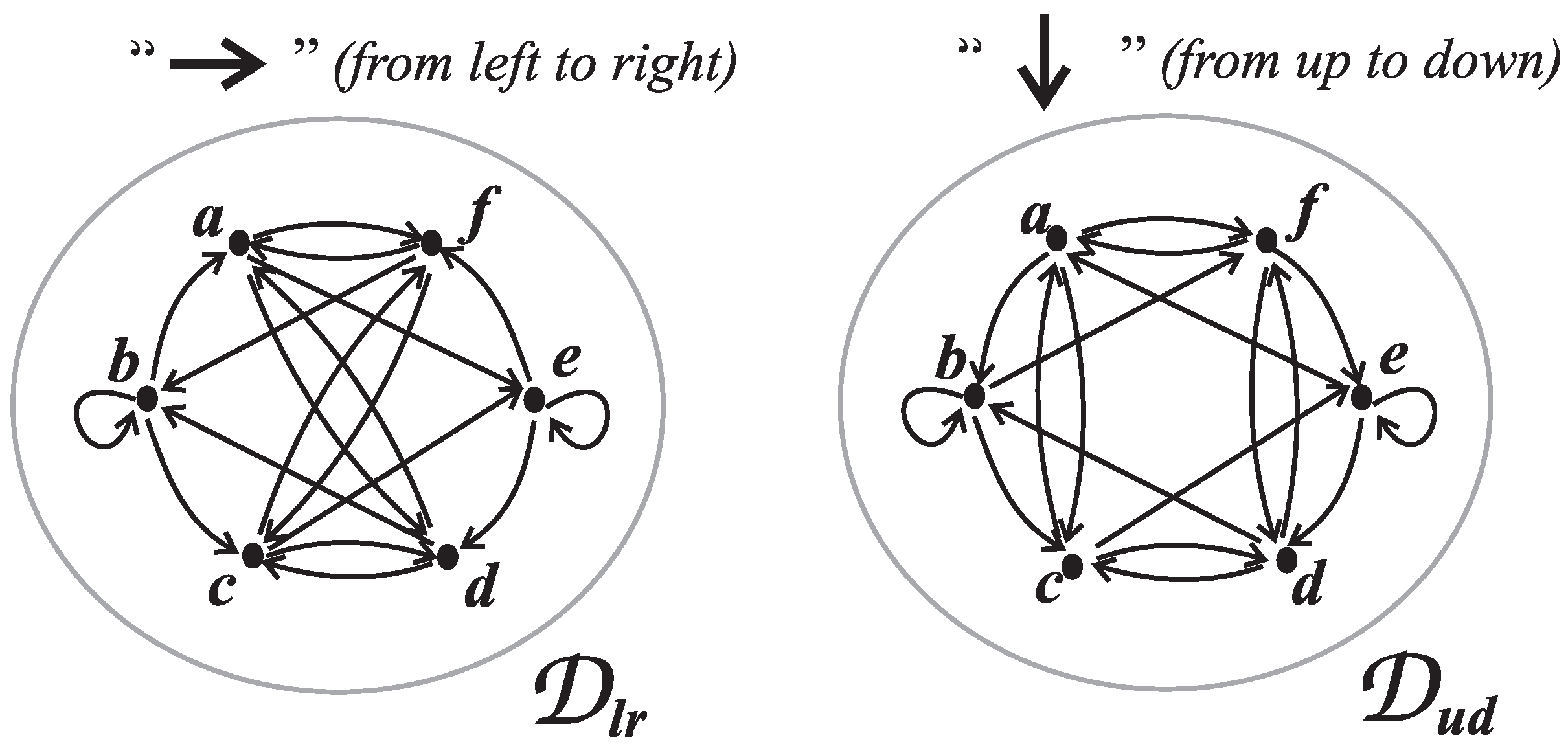
Figure 8, describe the possibility that two alpha letters correspond to two adjacent vertices of
G in a 2-factor. Contrary to the case when
G is a linear grid graph [
11,
12], now, these words are circular.
The organization of the rest of this paper is as follows. In
Section 3, by using code matrices, we give a characterization of the 2-factors for each of the grid graphs from the title. Using this characterization and the transfer matrix method [
13], we propose algorithms for obtaining the numbers of 2-factors, labeled by
,
and
, where the integer
p refers to the type of grid graph. Additionally, we give some properties of the transfer digraph
, whose adjacency matrix
is the transfer matrix used in these algorithms. In this way, the problem of enumerating 2-factors in the considered grid graphs reduces to the enumeration of some special oriented walks in the digraph
.
Under the Cayley–Hamilton theorem [
14], for sufficiently large values of
n, it follows that the required sequences
and
satisfy the same recurrence relation, which is determined by the characteristic polynomial of the transfer matrix
. In this way, for fixed
m and
p values, these sequences are completely determined by the recurrence relation and the initial values which can be obtained from
as well.
For a sequence
which is determined by a homogeneous linear recurrence relation of the order
n with constant coefficients
(
) for
and initial values
, it is well known (see Chapter 7 in [
15]) that its generating function
is the rational function whose denominator is
and numerator is
, where
and
for
(this can be checked by simply multiplying the series
by the denominator and applying the recurrence relation). Similarly, when we have a rational function
, the corresponding sequence
(
) satisfies the recurrence relation that we can “read” from the denominator of
. (The verification of this assertion can be derived from Theorem 2.1 in [
16].)
The generating functions are more desirable than merely listing a finite number of entries within the sequence because they also allow us to analyze the asymptotic behavior of the sequences. They provide compact formulas to record, in an indirect way, the entire sequences under consideration. The
nth member of a sequence
whose generating function is
can be obtained using derivatives of the function (i.e.,
) (the Maclaurin series formula). When we can find all the eigenvalues of the recurrence relation, then the explicit formula for the
nth member of the sequence is obtained by solving the corresponding system of linear equations. This is a well-known standard procedure (see 7.2 in [
15]), and for recurrence relations of a small order, one can use the identity
where
(see Lemma 2.1 in [
17]).
Our main goal is to find generating functions for , and . In the case of the sequence , we deal with just one component of instead of the whole digraph, and hence the corresponding characteristic polynomial is a factor of one for the whole digraph . As m grows, the generating functions become lengthy and awkward, even for . Luckily, the first algorithm which uses digraph can be improved. We prove that the number of vertices of is and that is a disconnected digraph with strongly connected components.
In
Section 4, we reduce
to the transfer digraph
of the order
. Thus, we improve the algorithms for obtaining
,
and
. In the case of a thin grid cylinder, we use just one of the components of
, labeled as
, which can be additionally reduced, resulting in the digraph
. We prove that
is also a disconnected digraph with strongly connected components, its adjacency matrix is symmetric, and that the number of its edges is
.
The numerical data about
we gathered for
with the implementation of the algorithms described in
Section 4 revealed some interesting properties for
concerning the order of its components and the generating functions for the considered sequences
,
and
. In
Section 5, we present some of these results and pose a few assertions. Namely, we prove that
for all
. In the case of the Klein bottle, we conjecture that the number
is independent of the value of
p when
m is odd and depends just on the parity of
p when
m is even.
The explicit formulae and recurrence relations of
,
and
for smaller values of
m are given in
Section 6. The list of the generating functions
for
,
and
for
is given in the extended version of this paper [
18].
3. Enumeration of 2-Factors Using
For each alpha letter
, we denote with
(
) the alpha letter of the situation from
Figure 7 obtained by reflecting the situation of
over a horizontal (vertical) line. To be precise,
and
are images of
under the mapping
The digraph is responsible for building alpha words, and the other one is responsible for the adjacency of columns in the code matrices in the following sense:
Lemma 1 (Characterization of 2-factors for circular grid graphs)
. The code matrix for any 2-factor of satisfies the following properties ():
- 1.
Column condition: For every fixed j (),the ordered pairs , where , must be arcs in the digraph .
- 2.
Adjacency of column condition: For every fixed j, where , the ordered pairs , where , must be arcs in the digraph .
- 3.
First and last column conditions:
- (a)
If , then the alpha word of the first column consists of the letters from the set and of the last column of the letters from the set .
- (b)
If , then the ordered pairs , where , must be arcs in the digraph .
- (c)
If , then the ordered pairs , where , must be arcs in the digraph .
The converse is that for every matrix with entries from that satisfies conditions 1–3, there is a unique 2-factor on the grid graph G.
Proof. Properties 1–3 can be easily proven by checking the compatibility for all the possible edge arrangements for the adjacent vertices of G in the considered 2-factor and vice versa, where the validity of conditions 1–3 for the matrix ensures that the obtained subgraph of G is a unique spanning 2-regular graph (i.e., 2-factor). □
Definition 4. For any alpha word , the alpha words and are called horizontal and vertical conversions of α, respectively. The circular word is called a rotation of α.
Clearly, , , and . Note that
Now, we can create for each integer m a digraph (common for all three types of grid graphs) in the following way: the set of vertices consists of all possible circular words over the alphabet (alpha words) which fulfill Condition 1 (column condition) from Lemma 1. An arc joins to , i.e., or if Condition 2 (adjacency of the column condition) from Lemma 1 is satisfied for the vertices v and u.
The subset of which consists of all the possible first (last) columns in the code matrices for (Condition 3a, Lemma 1) is denoted by (). Under Condition 1, the first column of is an alpha word from . Similarly, the last column of is an alpha word from . Consequently, we have the following:
Lemma 2. The cardinalities of and are equal to the mth member of the Lucas sequence (, where ).
Proof. This can be carried out analogically as was performed in the linear case (see Lemma 3.1 in [
11]). In particular, the characteristic polynomial of the adjacency matrix of the subdigraph of
induced by the set
or
is
. The polynomial in brackets determines the recurrence relation for the numbers of all oriented closed walks of a length
m in the considered subdigraph, starting and ending with the same vertex. Consequently,
and
for
.
Since and , we conclude that , for all . □
Definition 5. A square symmetric binary matrix of the order such that if and only if the ith and jth vertex of the digraph can be obtained from each other by horizontal conversion is called the H-conversion matrix for . A permutation binary matrix of the order such that if and only if where and are the ith and jth vertex of the digraph , respectively, is called the rotation matrix for .
Lemma 3. If , and () denote the number of 2-factors of , and , respectively, thenwhere , and are the adjacency (transfer), H-conversion and rotation matrix for the digraph , respectively, and . Proof. The number of all the possible code matrices is equal to the number of all oriented walks of the length in the digraph for which the initial and final vertices satisfy the first and last column conditions from Lemma 1.
In the case of , this number is equal to the sum of entries of the th power of , where and . Since every vertex from is direct successor of any vertex from , we have that . As the vertex belongs to both and , we further obtain that the requested number is equal to .
In the case of , the number of all the possible code matrices (i.e., rolling imprints) with the first column is , where is equal to the number of all oriented walks of a length in the digraph with an initial vertex and one of predecessors of (equivalent to ) as a final vertex (Condition 3(b) from Lemma 1) or all oriented walks of a length n which start with and end with (the number ). Consequently, the total number of 2-factors of equals the trace of the matrix . The trace of a product of the square matrices does not depend on the order of multiplication, so .
The case is similar to the previous one. Specifically, the enumeration of all oriented walks of a length in starting from and ending at one of the predecessors of (Condition 3(c) from Lemma 1) comes down to finding the trace of the matrix or . □
Proposition 1 (Properties of vertical conversion)
. For every we have Proof. The proof is straightforward. □
Lemma 4. The number of vertices in is
Proof. Let
be the number of all circular words of a length
m over the alphabet
that satisfy the column condition of Lemma 1. It is equal to the number of all closed oriented walks (the first vertex is labeled) of a length
m in
(i.e., the trace of the
mth power of the adjacency matrix of
). Since the characteristic polynomial of this matrix is
, we have
, with initial the conditions
(words from
) and
(words from
). By solving the above recurrence relation, we obtain
, (
), which implies
. In order to prove that every circular word
w accounted for in
is a vertex of
, note that
and
(see Equation (
4)). This means that the word
w appears as a column in the code matrix for
. □
The following definition and lemma are taken from [
11], with the only difference being that they now refer to circular words:
Definition 6. The outlet (inlet) word of the word is the binary word (), where Note that
(
) if and only if the situation
shown in
Figure 7 has an edge “on the right” (“on the left”):
Lemma 5. The digraph for is disconnected. Each of its components is a strongly connected digraph.
Proof. This proof is analogical as in the linear case. Specifically, if two words w and v are adjacent vertices in , then the number of ones in their outlet words must have the same parity. Consequently, there exist two vertices of (for example, the words and ) belonging to different components.
Note that if there exists a directed walk (of a length ), then the existence of the directed walk (see Proposition 1) confirms the second part of this lemma. □
Let , , where is the component of , which contains the vertex (). We also introduce as the component of , which contains the vertex () (this component is sufficient for enumerating 2-factors for the thin grid cylinder ):
Lemma 6. if and only if m is even.
Proof. If m is even, then and are connected (belong to the same component) because (i.e., ). If m is odd, then the number of ones in the outlet words of the vertices in and are of different parities, and therefore . □
4. Enumeration of 2-Factors Using and
If two vertices from have the same outlet word, then they have the same set of direct successors. We grouped all vertices from having the same corresponding outlet word and replaced them with just one vertex, labeled by their common outlet words. Next, we substituted all the arcs in , starting with vertices with the same outlet word and ending in same vertex with only one arc. In this way, we reduced the transfer digraph onto with the adjacency (transfer) matrix :
Example 1. The vertices with the common outlet word 1001 were all replaced with . All edges starting from these vertices and ending in were changed by one arc: . However, the same was valid for edges starting from these vertices and ending in . This resulted in the existence of two parallel edges () in .
Note that in the linear case [
11], the digraph
is simple (i.e., without multiple arcs) because two different vertices from
with the same outlet word cannot have the same direct predecessor. The situation with circular words is different. In particular, for two binary words
u and
w of a length
m, there exist at most two vertices from
whose inlet and outlet words are
u and
w, respectively. In other words, for the given horizontal edges of a 2-factor corresponding to a column of vertices of the considered grid graph, if such a 2-factor exists at all, then there exist at most two possible choices of vertical edges for that column and that 2-factor. This implies that the entries of
are from the set
:
Theorem 1. The adjacency matrix of the digraph is a symmetric matrix (i.e., ).
Proof. Suppose that , where . Then, there exist vertices such that , where and . Since and , we have that . □
Theorem 2. The digraph is disconnected. Each of its components is a strongly connected digraph.
Proof. Note that all the vertices of which are glued in one vertex belong to the same component, so such gluing does not reduce the number of components. Using this, the statement of the theorem follows directly from Lemma 5. □
The component of which contains the circular word is denoted by . The component of containing the circular word is labeled as , and the union of the remaining components is denoted by :
Example 2. The adjacency matrices of , and for , and are shown below:
and ;
and ;
and , where
and .
Theorem 3. The number of vertices in digraph is .
Proof. We will prove that there exists at least one vertex
with
, where
v is an arbitrary circular binary word of a length
m. In [
11], we proved that every binary (linear) m-word except the word
(one of the so-called queens [
12]) for odd
m values is a vertex of the transfer digraph for the linear case (thick cylinder and Moebius strip grid graphs). Note that this digraph is the subdigraph of
. Thus, it remains to find
with
(where
m is odd). Since
,
belongs to the same component of
as
, which confirms the statement of this theorem. □
Theorem 4. The number of edges in is
Proof. We establish the bijection between the set and in the following way:
Each single arc () from is paired with exactly one vertex , whose incoming arcs are all replaced with the arc . Clearly, , , and there is no vertex with whose incoming arcs have an origin with the outlet word v.
A double arc (two parallel arcs) in is paired with exactly two vertices x and y from , where all incoming arcs of x are replaced with one of the two parallel arcs and all incoming arcs of y are replaced with the another one. Now, , , and x and y are the only two vertices in with these properties.
The above-described bijection and Lemma 4 prove the theorem. □
For a binary word , we introduce the labels and . Note that for any :
Proposition 2 (Properties of horizontal conversion)
. For an arbitrary , we have Proof. The proof is straightforward. □
Definition 7. The H-conversion matrix for is the square binary matrix of the order for which if and only if ().
The rotation matrix for is the permutation matrix of the order for which if and only if ().
Note that the matrix is a symmetric one (i.e., ), and is the identity matrix. The process of enumeration of 2-factors can be improved using the new transfer matrix :
Theorem 5. where is the adjacency matrix of the digraph and . Proof. For the observed digraph (
or
), the number of oriented walks of a length
n which start with vertex
x and finish with vertex
y is denoted by
. Recall that the number
, where
, is equal to the
entry
of the
nth power of the matrix
. Note that
Using this and Lemma 3, we have
which completes the case
.
In order to obtain the expressions for the other two cases, observe that
By using Equations (
11) and (
12), for any integer
k and
, we obtain
By applying Lemma 3 again and Equation (
13) to
, we obtain
For
, the procedure is similar. From Equations (
11) and (
12) and Proposition 2, for any integer
k and
, we obtain
Now, Lemma 3 and Equation (
14) yield that
□
Furthermore, reduction of the transfer matrices is possible just in the case where using the following:
Lemma 7. If , then and . Additionally, for any vertex ().
Proof. If , where , then there exists an integer for which . By using the property of reflection symmetry, if , then and , and we obtain that , which implies . Since , we conclude that and .
Similarly, by using the property of rotational symmetry, if , then and , and we have . Hence, and . Therefore, and for an arbitrary integer k. □
Now, we can glue vertices v, , and () into one vertex for , resulting in a new digraph . During gluing, we retain the arcs starting from just one of these vertices and delete the ones starting from other vertices. Multiple arcs appear when glued vertices have a common direct predecessor:
Example 3. For example, for , in the transition from to , the vertices , , and are glued. The adjacency matrix of is obtained by adding the fourth, fifth and sixth columns to the third one. After that, the added columns and corresponding rows are removed. The resulting matrix is where
Consequently, the number remains the same in both digraphs and .
Corollary 1. The number is equal to entry of the nth power of the adjacency matrix for , where .
5. Computational Results and Open Questions
We have written computer programs for the computation of the adjacency matrices of the digraphs
,
,
,
, and
(
) and the initial members of the required sequences
,
and
,
. The data pertaining to the size of these digraphs are summarized in
Table 1 and
Table 2.
By analyzing the computational data for
(in the case of
for
), we spotted some properties of the digraphs
,
and
which have been discussed and proven in the previous sections for arbitrary
. The proofs of the properties concerning the structure of
will be explained in another place (see [
19]). Now, we express them in the following theorem:
Theorem 6 ([
19]).
For each even , the digraph has exactly components (i.e., ), where contains both and , all the components () are bipartite digraphs, For each odd , the digraph has exactly two components (i.e., ) which are mutually isomorphic and with vertices.
Based on the obtained numerical results, we computed the generating functions
(
),
(
) and
(
) using standard procedures (for details on such procedures, we recommend [
20]).
Recall that they are the rational functions whose denominators provide important information about the required sequences. In particular, the Cayley–Hamilton theorem guarantees a recurrence relation for any such sequence, and we can “read” it from the denominator of corresponding generating function:
Example 4. The generating function for the Klein bottle is .
The corresponding recurrence relation for the sequence , is .
The sequence , is completely determined by it and the initial values (see Figure 9), , , , , , and . The generating functions
, where
, as well as
and
, given as a sum of the generating functions over the components of
, where
, are listed in [
18]. The orders of the recurrence relations (obtained from the polynomial in the denominator of the joined rational function) for
,
and
are displayed in
Table 1,
Table 3 and
Table 4, respectively.
In the case of the torus grid, we noticed that some generative functions coincide:
Proof. Since
, we have
. Additionally, the matrix
and all its powers are symmetric ones, and thus
□
In the case of the Klein bottle, the matches of generative functions are less obvious, so we pose the following:
Conjecture 1. If m is odd, then the generating function is invariant under a change in the value p (). If m is even, then the values depend only on the parity of p.
Similar to the linear case of grid graphs (thick cylinder and Moebius strip), the obtained computational results revealed that the maximum eigenvalues of the adjacency matrices of
and its component
(the one containing the vertex
) coincided with each other. Since the digraph
is isomorphic to (or the same as)
(in accordance with Lemma 6 and Theorem 6), their maximum eigenvalues coincide, too. This eigenvalue is denoted by
. Some of the values
and corresponding coefficients
for
are given in
Table 5.
7. Conclusions
In this paper, we presented two algorithms for determination of the number of all spanning unions of cycles (abbreviated as 2-factors) in three classes of grid graphs: the thin cylinder
, torus
and Klein bottle
, all of which had a width of
m. For this purpose, we introduced and discussed two digraphs,
and
, the latter of which was obtained by reduction from the former of the order
. The whole process for these so-called circular grid graphs is quite similar to the one for linear grid graphs (rectangular, thick cylinder and Moebius strip grid graphs) [
11], although the number of observed grid graphs for a fixed
m value in the circular case was larger than the one in the linear case due to the different twisting degrees (
) for
and
. We proved that the number of edges in
for the circular case was twice the number of edges in the linear case, although they had almost the same number of vertices (for odd
m values, the number of vertices in the linear case was
). The numerical data obtained by implementation of the algorithms described in this paper show that this increased number of edges contributed to the reduction in the number of components in
only when
m was odd. (We spotted exactly two components which appeared to be mutually isomorphic [
19].) We calculated the generating functions for the number of 2-factors
for
as well as
and
for
, which can be found in the extended version of this paper [
18]. We noticed that some of them matched. Specifically, all generating functions for
,
were mutually equal when
m was odd, while when
m was even, they depended only on the parity of
p. We proved the matches of the generating functions
and
for any
.
Every component of
was strongly connected, and hence its adjacency matrix was irreducible. Since the component
had the loop
, its matrix
was primitive (a square nonnegative matrix, some power of which is positive). From the Perron–Frobenius theory [
21], we can conclude that
has a simple, positive eigenvalue
such that
for any other eigenvalue
for
. This implies that for odd
m values,
has the dominant eigenvalue
with an algebraic multiplicity of two (Theorem 6), which by using the well-known property for the trace of a matrix implies that
when
. However, the computational results show that the coefficients
and
for
for the grid graphs
and
when
m is odd are equal to two as well. In other words, they do not depend on the type of grid graph (i.e., on the value
p).
The reason why the dominant (positive) eigenvalue for any component () is less than when m is even seems to still be unknown. If we adopt this as the truth, then we have when . The question about coefficients and when m is even remains open, since we obtained that they were equal to one for .