Abstract
Logistics security, as the lifeline of the economy connecting production, distribution, and consumption, holds a pivotal position in the modern economic system, where any potential threats like natural disasters or cyber attacks could have far-reaching impacts on the overall economy. With a unique large-scale logistics data set, logistics networks between cities in China are constructed. We thus identify communities of cities that have dense logistics connections in these networks. The cities in the communities are found to exhibit strong connections in the economy, resources, and industry. The detected communities are also aligned with the urban agglomerations mentioned in the guidelines reported by the National Development and Reform Commission of China. We further extend our analysis to assess the resilience of the city logistics networks, especially focusing on the influence of community structures. Random and intentional attacks are considered in our resilience analysis. Our results reveal that the city logistics networks are robust to the random attacks and are vulnerable to the intentional attacks on the nodes with dense links between and within communities. Our results not only deepen our understanding of the community structure and resilience of the city logistics networks but also provide insights on how to improve the efficiency and safety of intercity logistics.
MSC:
05C82; 90B06; 91D30
1. Introduction
The trend of globalization has strengthened the economic connections between cities and regions. Urban development is no longer an isolated phenomenon but has been integrated into the whole world economy [1,2,3]. The growth and prosperity of cities may strongly depend on the complex logistics system and the community structure in logistics networks, i.e., clusters of cities with strong logistics connections, which has become an important indicator of regional economic cooperation [4,5]. Recent empirical studies have demonstrated that the economic indicators of cities are able to explain the position of cities in city logistics networks [6] and predict the freight volume between cities [7,8,9].
The uneven distribution of basic resources, ports, airports, production, and consumption results in high demands for logistics and transportation. As stated in the gravity model [7], the freight volume between cities positively correlates with the economic strengths of the cities and negatively correlates with the distance between the cities. Thus, on the one hand, the cities which are geographically far away may have surprisingly strong logistics links. Beijing, Shanghai, and Guangzhou are typical examples due to their leading economic strength in China [6]. On the other hand, geographical proximity also plays an important role in shaping logistics connections and economic exchanges between neighboring cities [10,11,12], which may lead to the emergence of city communities.
However, the logistics network communities may have potential effects on the structural vulnerabilities, and the failure of nodes in the network may affect the integrality and function of the community structure [13,14], thus having the detriment of certain industries and the entire economic system. During the lockdown in Shanghai in 2022, the automotive and auto-parts industries encountered an unprecedented crisis related to supply chain disruption. Manufacturing plants were temporarily closed or operated at reduced capacity. Meanwhile, restrictions on movements and transportation further made the situation even worse, causing delays in both inbound raw materials and outbound products. This resulted in a ripple effect along the supply chain, affecting not only local operations but also international partnerships and deliveries. Consequently, this crisis inspires the industries to reevaluate their supply chain strategies for greater resilience against future disruptions.
Resilience analysis is an efficient tool to investigate the stability of networks. Previous studies have mainly focused on the resilience and robustness of high-speed railway networks [15], oil trade networks [16,17], container shipping networks [18], and transportation networks [19], and little attention is focused on the resilience of city logistics networks. To fill this gap, we set our main research goal to uncover the structural vulnerability of city logistics networks under different types of attacks, including random attacks and targeted attacks, with the help of the huge data set of logistics orders and complex network methods.
The contributions of this paper are listed in the following. First, by incorporating geographical adjacency constraints into the community detecting algorithm in Ref. [20], we extend the application of the original algorithm to extracting the spatial community structure. Second, instead of focusing on the topological structure of communities, we present the factors driving the formation of communities in city logistics networks, including economic integration, natural resources, and so on. Third, differing from the resilience analysis based on the attacks on randomly chosen nodes and the maximum degree nodes, we intentionally attack the nodes having dense links between and within communities. Our results reveal that such attacks are very efficient to break down the city logistics networks.
This paper is organized as follows: Section 2 presents the literature review. Section 3 introduces the data set. Section 4 presents the community detection algorithm. Section 5 describes the results of the detected communities. Section 6 presents the resilience analysis on the city logistics network. Section 7 concludes this paper.
2. Literature Review
With the remarkable development of regional economics, flows of people, goods, capital, and information between cities and countries have increased tremendously in recent years. The infrastructure of transportation has been modeled as a complex network to understand the system of transportation and logistics, including urban road networks [21,22], expressway networks [23,24,25], and high-speed railway networks [26,27,28], to list a few. With the accumulation of flow data, the network pattern of flows has also received considerable attention [29,30,31,32]. Flow networks within cities, between cities, and between counties are extracted from digital footprints [33], travel trip trajectories [34,35,36], mobile phone data [27,37], and online freight orders [38]. By extracting networks based on the intercity flow data in China, it has been found that cities exhibit spatial dependence and hierarchical characteristics and can be divided into different economic regions [24]. By building three circulation networks of grains, vegetables, and fruits between cities in China based on a data set of online freight orders, one finds that the gaps between cities, such as agricultural productivity, transportation disparity, relative wholesale competitiveness, and information technology, facilitate the formation of links in the circulation networks [38].
As a type of flow network, freight transportation networks comprise nodes of departures and destinations, which may represent manufacturers, warehouses, logistics centers, freight terminal clusters [9], and connections of cargo orders through different modes of transportation. Extensive research reveals that freight transportation networks could be classified into categories according to their transport modes, for example, maritime networks [39], air freight networks [40,41], railway freight networks [42], and so on. Theories and methods in complex networks are employed to investigate the topological characteristics of freight transportation networks and uncover the underlying factors driving the formation of networks [40,43,44,45,46]. The degree distribution and community structure of freight transportation networks also reveal the importance of cities or regions [46] and the regional economic integration [10,40,45]. By building transportation networks based on 3.5 billion entry and exit records from toll collection systems in China, it has been found that the transportation networks contain the information of regional economic development patterns and the network measurements are correlated with the regional economic development indicators [47].
Besides topological structures and network formations, the resilience of freight transportation networks is a major concern for policymakers and transportation managers. Network resilience usually refers to the ability that one network adapts to and absorbs external shocks to maintain its structure and function [48,49,50]. Many network-based indicators, including the percentage of nodes in the largest connected component, topological efficiency, and so on, are proposed to measure the network resilience [51,52,53]. More than 50 indicators of network resilience based on network structures and functions are summarized in a mini-review [54]. By building a global container shipping network, the structural vulnerability is investigated under the situations of labor strikes, trade embargoes, and natural disasters [18]. In crude oil trade networks, network resilience can be assessed by the resistance of breaking functions when node failures occur [16,17]. In Ref. [55], optimization strategies have been proposed to reduce recovery time and enhance the resilience of transportation networks.
3. Data Sets
The first data set contains the online freight orders from 334 cities in China during the period from 15 December 2018 to 14 December 2019. The orders record the information of the posting time, poster, origination, destination, type of goods, weight of goods, and truck type. A segment of the online freight order data is reported in Table 1. The posters may repeatedly submit orders with similar content when the underlying freight demand is urgent. Thus, for orders sharing the same origination and destination, the similarity is measured via the Levenshtein distance (http://github.com/ztane/python-Levenshtein/, accessed on 13 May 2023). By keeping the orders with similarity coefficients less than 80% in relation to other orders, we build a city logistics network W on each day, in which the link weight represents the average daily number of freight orders from city i to city j. The gravity model and the radiation model have been well validated in this data set [7,8,9].
Table 1.
A segment of the online freight order data.
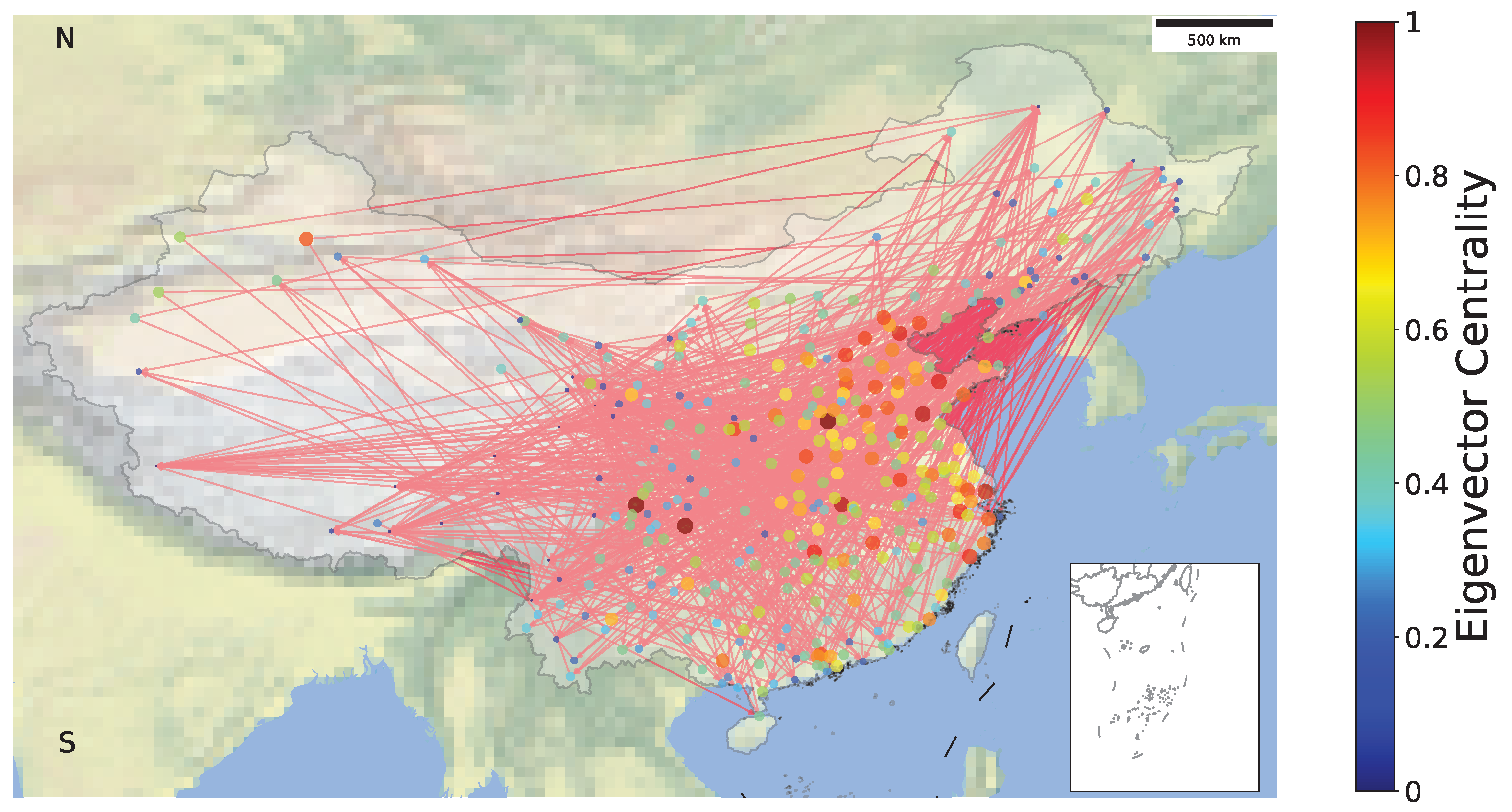
Figure 1 provides a plot of the city logistics networks on the geographical map of China, aiming to capture the nuances of the freight transportation between the cities. Each node in the network represents one city in China and the links between the cities denote the average daily volume of the freights. For better visibility, we only show the outgoing links having the top three freight volumes for each city. The node size is determined according to the incoming and outgoing freight orders, serving as a proxy of the city’s logistical importance. Meanwhile, the node color is indicative of the city’s eigenvector centrality, as clarified by the colorbar. One can find that cities located close to the eastern coastlines are generally larger in node size compared to their western counterparts. This observation aligns with the common understanding that eastern areas in China are more economically developed than the western regions. Additionally, the network reveals a pronounced urban agglomeration effect, which is particularly noticeable around core cities, like Shanghai, Guangzhou, Zhengzhou, Chengdu, and Chongqing. In these clusters, the cities are densely interconnected, potentially due to the economic synergies or the pivotal role that these core cities play in the transportation networks.
Figure 1.
Plots of the city logistics network W on the Chinese map.
The second data set is the traveling costs between two given cities, including the distance, duration, and tolls for different types of trucks, which is retrieved from the amap API (https://lbs.amap.com/). Table 2 lists a segment of the travel costs for different types of trucks, in which the truck type, truck length, origination, destination, driving time, driving distance, Electronic Toll Collection (ETC), and gas consumption are listed. The gas consumption is measured as the liters of gas consumed per kilometer. Electronic Toll Collection is a system used for automatically collecting tolls on expressways, bridges, and tunnels. Vehicles can pass through the toll stations without stopping, thereby facilitating the payment of tolls. Obviously, the summation of the ETC payments and gas costs gives the total travel costs.
Table 2.
A segment of the travel costs for different types of trucks.
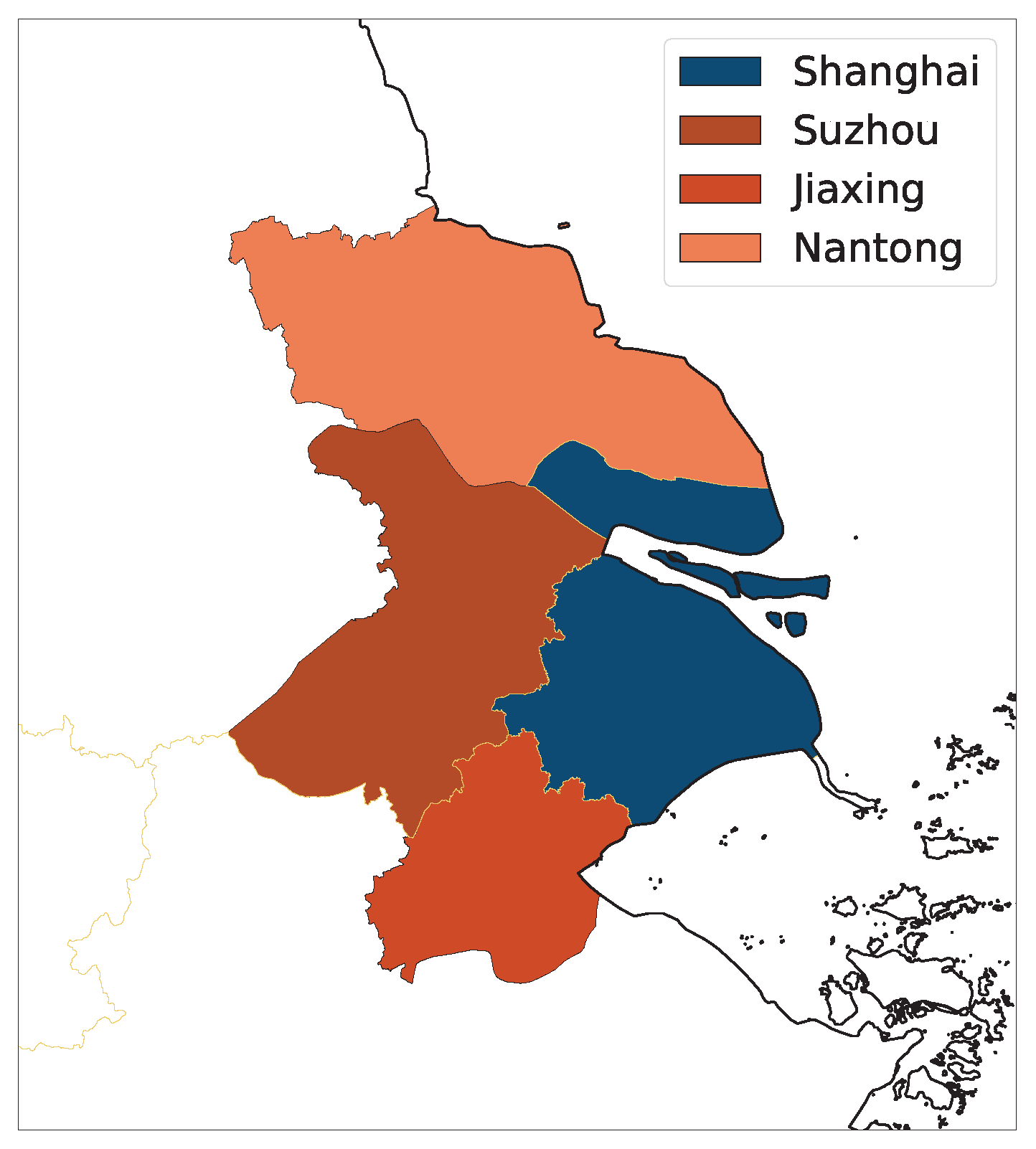
The third data set records the geographical adjacencies between cities, which is also known as “bordering”. This information has been collected and reconstructed using map data released by the Ministry of Land and Resources of China. As shown in Figure 2, Shanghai is highlighted in dark blue and shares its border with three cities, namely, Suzhou (in brown), Jiaxing (in red), and Nantong (in orange). The map in Figure 2 is limited to a geographical window spanning from 119.5 to 122.5 degrees east longitude and 30 to 33 degrees north latitude.
Figure 2.
Schematic diagram of the cities bordering Shanghai.
The first data set is provided by a leading truck logistics company in China, namely, Shanghai Yunyou Logistics. The data are recorded in the CSV files and contain more than 60 million entries. A segment of the first data set is shown in Table 1. Shanghai Yunyou Logistics also provides an API to retrieve the gas consumption when the information of the truck type, truck length, origination, destination, and driving distance is known. However, we are restricted by the disclosure of the source data. For the sake of transparency, collaboration, and providing more background information to facilitate future research, the network data are submitted to GitHub: https://github.com/ailen9466/city_logistics_networks (accessed on 15 October 2023).
4. Algorithm of Detecting Spatial Community
Here, we concentrate our efforts on the spatial community structure in the city logistics network. Following Ref. [20], we identify the spatial community structure by maximizing the following network modularity,
where and represent the freight volume and travel cost from city i to city j. As we know, ETC payments only occur when the transportation route contains toll roads, and truck drivers are very sensitive to the total travel costs due to the low freight rates in China. In our analysis, we simply set the ETC payment as to highlight the fact that truck drivers are more concerned about the ETC payments. stands for the node strength, the sum of the link weights incident to a node, of city i. m is the total freight volume in China. equals 1 if cities i and j belong to the same community and 0 otherwise. The identified spatial communities in the city logistics network can be linked to the phenomenon of urban agglomeration, in which cities exhibit the features of geographical proximity, convenient transportation, and active exchanges.
By utilizing the adjacency matrix of the city freight network, our spatial community of cities is given by the network community detection algorithm [20,56]. The detailed algorithm is given as follows:
- In the initial step, each city is assigned to one community.
- For each city, we take the action of moving the city from its current community to one of its neighboring communities. By evaluating the gain of modularity for all possible outcomes, the outcome of the city movement with the maximum positive gain of modularity is accepted as a new configuration of communities.
- The second step is repeated until no movement of the city can improve the modularity.
The corresponding pseudo code is listed in Algorithm 1.
The gain of modularity is originated from removing a city from a community and adding a city into a community, such that . Following Ref. [20], the changes in modularity can be estimated by
where m is the total freight volume in the city logistics network, is the sum of the link weights from city i to the cities in the community, is the sum of the link weights incident to city i, and is the sum of the link weights incident to the cities in the community. And the expression of is nothing but the negative of . We must note that our community detection method may not fully uncover hierarchical features, because there is an underlying assumption of no other mesoscale structure in the city logistics networks [57,58].
| Algorithm 1 Detecting spatial community by maximizing network modularity. |
|
5. Results of Detecting Communities
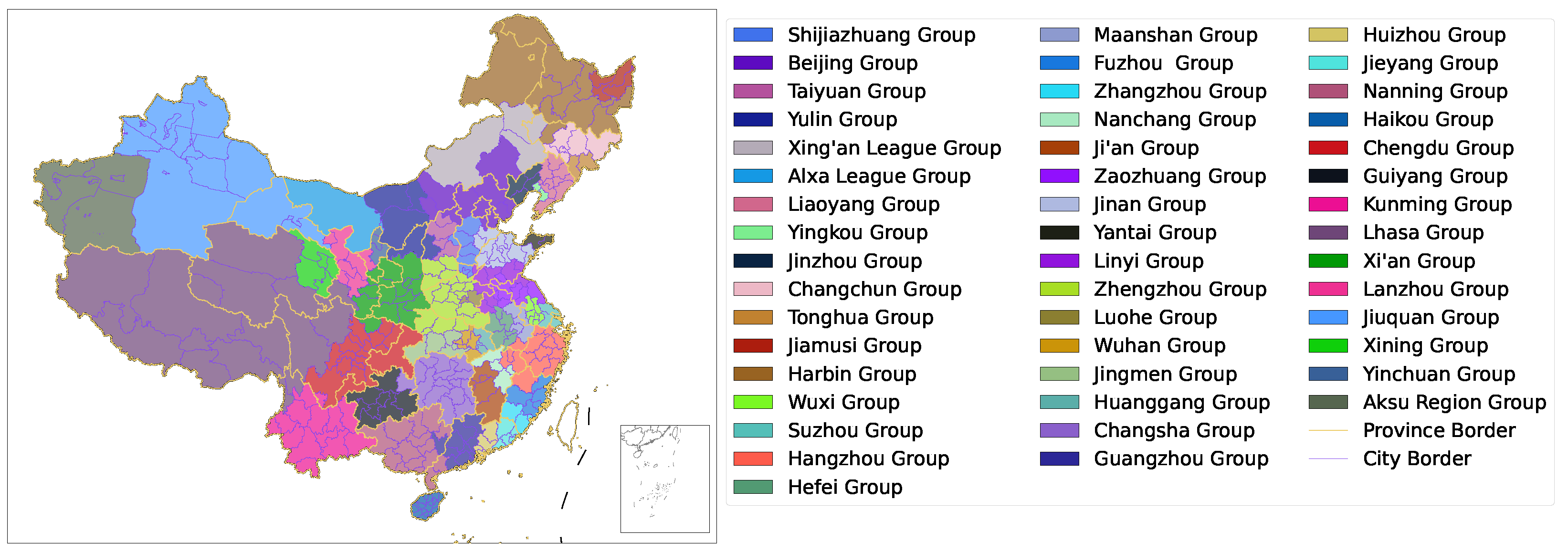
By applying the community detection algorithm in Section 4 to the city logistics network, the 334 cities are clustered into 47 spatial communities. The detailed results are shown in Appendix A Table A1. As shown in Figure 3, the adjacent cities belonging to the same community are illustrated in the same color. The solid lines indicate the borders of the cities and provinces. Note that Taiwan, Hong Kong, and Macao are not included in our analysis. One can see that the spatial communities of the cities are different from the administrative districts of the provinces. The smallest community only consists of two cities, and the largest community, located in central China, contains twenty cities. Our communities of cities can be understood through factors like economic integration, natural resources, transportation, culture and dialect, and administrative division, which are listed in Table 3. Obviously, one can see that economic integration and natural resources are the main driving forces of the city clusters, which can explain the formation of 22 and 12 city clusters, respectively.
Figure 3.
Plots of the spatial communities on the Chinese map.
Table 3.
Classification of city clusters based on the factors of economic integration, natural resources, transportation, culture and dialect, and administrative division.
Economic integration will lead to trade liberalization, the free movement of labor and capital, and convergence of economic policies, which in turn will boost the economic growth of the involved regions. The city clusters of Nanjing and Shanghai are two typical examples due to the economic integration in the Yangtze River Delta. Nanjing, the capital city of Jiangsu, and the cities of Wuhu, Maanshan, Chuzhou, and Xuancheng in Anhui are grouped into one community. On the one hand, Nanjing is geographically adjacent to Chuzhou in the north, Maanshan in the west, Wuhu and Xuancheng in the south, and Zhenjiang in Jiangsu in the east. On the other hand, Nanjing has more social and economic connections with the adjacent cities in Anhui than those cities in Jiangsu. For instance, the Nanjing Metro Line S2 (also known as the Nanjing–Maanshan Intercity Railway) serves as a means of daily transportation for white-collar workers shuttling between Nanjing and Maanshan. Additionally, the Nanjing Metro Line S3 is planned to be extended to the western Liangshan area of Zhengpu Port in Maanshan (https://jyj.mas.gov.cn/content/article/2004829001, accessed on 10 October 2023). Similarly, Shanghai and the cities of Suzhou and Nantong in Jiangsu also form one community, indicating that Suzhou and Nantong are integrated into the economic circle of the Shanghai metropolitan area. The Shanghai Metro Line 11 has been shuttling between Kunshan, a county-level city in Suzhou, and Shanghai since 2013.
Natural resources like coal mines or forests play a crucial role in shaping the economic development of a region, which encourages the development of resource-related industries and provides employment opportunities. For instance, the city clusters of Jiamusi are formed due to the coal mining in the Sanjiang–Muling region, the Hegang mining area, the Shuangyashan mining area, and the Fujin mining area. Similarly, the Harbin group covers the forest lands of the Greater Hinggan Mountains in the northwest of Heilongjiang Province and the coniferous, broad-leaved, and mixed coniferous-broad-leaved forest lands in the northern part of Hulunbuir city, which form an important ecological area.
Transportation infrastructure, including roads, bridges, railways, and airports, facilitates trade and commerce and accelerates the movements of goods and people. The Guangzhou group contains the cities west of the Pearl River, and the Huizhou group includes the cities east of the Pearl River. The Guangzhou government has proposed the Guangzhou Rail Transit Network Plan (2018–2035) (http://www.guangzhou.gov.cn/202208/03/156098_54323948.htm, accessed on 13 May 2023), in which a city rail transit system within Guangdong, covering a total of 53 lines and 2029 kilometers, will be built by 2035. According to the plan, there will be 18 connecting channels between Guangzhou and Foshan, which will make Guangzhou and Foshan the most urbanized areas in China. At the same time, Shenzhen has developed the Shenzhen–Dongguan–Huizhou Road Network Connection Plan (http://jtys.sz.gov.cn/zwgk/xxgkml/ghjh/zxgh/content/post_4278061.html, accessed on 13 May 2023) to enhance the integration of transport infrastructure. In this plan, the government will build 12 cross-city expressways, 10 expressways, 41 trunk roads, and 18 secondary roads that connect Shenzhen, Dongguan, and Huizhou. And according to the Shenzhen–Dongguan–Huizhou Rail Transit Integration Connection Plan (http://www.gd.gov.cn/gdywdt/tzdt/content/post_76770.html?jump=false, accessed on 13 May 2023), there will be a total of 17 cross-city rail lines among Shenzhen, Dongguan, and Huizhou in the future.
The historical administrative division may influence local economics, infrastructure, and resource allocation. If two cities used to be in one administrative division, there may be more connections in business, transportation, and communication. For example, the cities in the small communities, such as the Yingkou group, the Yantai group, and the Tonghua group, belong to the same administrative region in history. For the Yingkou group, Panjin and Yingkou were merged together in November 1975, and the merged city was separated into two cities again in 1984–1985 [59]. For the Yantai group, the three counties of Rongcheng, Wendeng, and Rushan in Weihai originally belonged to Yantai [60]. For the Tonghua group, the cities of Tonghua and Baishan were separated from the Tonghua area in 1985 [60].
The culture and dialect of one region can influence social norms, entrepreneurship, and risk preferences, which play an important role in firm organizations. The Jieyang group in Guangdong Province contains the cities next to Fujian, which is in alignment with the traditional division of Guangdong dialects. Most people speak the Hakka and Chaoshan dialects (https://www.meizhou.gov.cn/zjmz/mzgk/mzfy/, accessed on 13 May 2023) in the cities belonging to the Jieyang group, which may result in dense logistic flows in the Chaoshan area.
Our spatial communities of cities also agree with the national urban agglomerations, which were proposed in the 14th Five-Year Plan of China and in the guidelines reported by the National Development and Reform Commission of China (https://www.gov.cn/xinwen/2019-02/21/content_5367465.htm, accessed on 13 May 2023). The correspondence between national urban agglomerations and spatial communities is listed in Table 4. It is observed that the Yangtze River Delta and the Middle Reaches of the Yangtze River contain six spatial communities because these regions have heavy freight orders and Hubei, Hunan, and Jiangxi in the Middle Reaches of the Yangtze River serve as logistics hubs in China.
Table 4.
Correspondence between the national urban agglomerations and the spatial communities of cities.
6. Resilience of City Logistics Network
Network resilience analysis has been widely used in server failures, power network outages, and transportation network disruptions [15,61]. Such an analysis is performed through simulations in which nodes are chosen to be removed from the network and the topological characteristics of the remaining network plotted with respect to the percentage of removing nodes are adopted to show the network resilience. In simulations, the nodes are removed according to a random or targeted strategy. One usually employs the degree to measure the importance of the nodes in the targeted strategy. As the formation of communities in city logistics networks results from economic integration, natural resources, transportation infrastructures, and so on, it is interesting to investigate the resilience of city logistics networks from the perspective of the spatial communities of cities. Following Ref. [61], we assess the importance of one node in a network through two indicators, including the within-community degree z-score and participation coefficient. These two indicators measure how well one node connects to the other nodes belonging to its own community and to the nodes outside its own community. For node in community j, the within-community degree z-score of node is defined as follows:
where represents the number of links between node and the other nodes in community j, and and represent the minimum and maximum value of for all the nodes in community j. The participation coefficient of node is defined as follows:
where is the number of links of node to the nodes in community j; is the degree of node , representing the number of connections to other nodes; and J is the set of detected communities. Obviously, locates in the range of . approaching 0 or 1 means that links of evenly distribute between communities or fall into one community. We thus define a composite index to evaluate the importance of the nodes from the perspective of within community and between communities, such that,
where w is the weight and ranges from 0 to 1. For simplification, we set in our analysis.
Following Refs. [15,61], we define four typical network topological characteristics, namely, the percentage of nodes in the largest connected component (PNLCC), topological efficiency (TE), average unit degree betweenness (AUDB), and average unit degree betweenness of the community (AUDBC), to uncover the dynamics of the network resilience under random and targeted attacks. The percentage of nodes in the largest connected component is nothing but the ratio between the number of nodes in the largest connected component after removing certain nodes and the total number of nodes in the original networks. The topological efficiency is measured by the inverse of the shortest paths between pairs of nodes and is defined as follows:
where N is the number of nodes in the network, and is the shortest path length from node i to node j in the network. High topological efficiency indicates that the network is well integrated or well connected and that information spreads quickly and directly between nodes. For one given node , its unit degree betweenness is obtained by normalizing its betweenness centrality to its degree , such that
Obviously, is able to identify important nodes that are not well connected in networks. One can estimate the AUDB by simply taking the average of the unit degree betweenness over all nodes. A logistics network of urban agglomerations is obtained if each community is regarded as one node, which allows us to estimate the unit degree betweenness of the communities and the average unit degree betweenness of the communities. This generalized unit degree of betweenness assesses the importance of urban agglomeration in logistics networks.
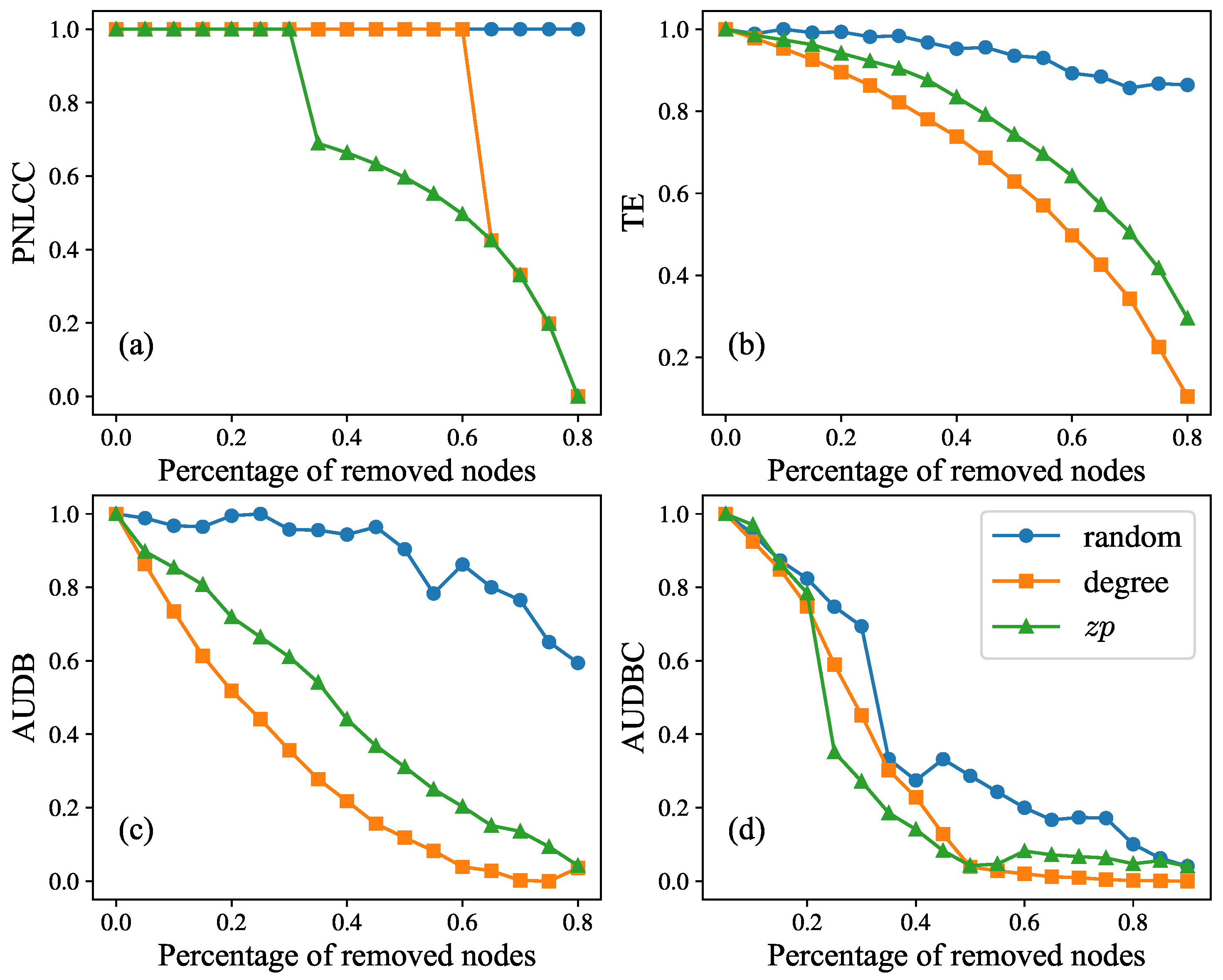
In our analysis of network resilience, we simulate three types of attacks to remove nodes, including random attacks, attacks based on the largest degree, and attacks based on the largest . The corresponding results are illustrated in Figure 4, in which four topological characteristics are plotted with respect to the percentage of removed nodes. It is observed that all topological characteristics exhibit a decreasing pattern when nodes are gradually removed. As our logistics network is almost fully connected, one can infer that disconnecting the network requires removing a large fraction of nodes. As shown in Figure 4a, one can see that the targeted attacks based on the largest are very efficient, and the network breaks into disconnected fragments when 30% of the nodes are removed. In comparison to the attacks based on the largest degree, the critical points of fragments are close to 60%. We also find that the city logistics network is extremely robust to random attacks, as all the nodes are connected when 80% of the nodes are removed. Figure 4b,c illustrate the plots of the TE and AUDB with respect to the percentage of removed nodes. One can see that the TE and AUDB have the smallest drop speed under random attacks and the largest drop speed under the largest degree attacks, indicating that the city logistics network is vulnerable to targeted attacks and is robust to random attacks. Figure 4d plots the AUDBC as a function of the percentage of removing nodes. It is observed that the AUDBC curve drops the slowest for the random attacks and drops the fastest for the largest attacks. We can also find that the logistics network of urban agglomerations quickly falls into fragments when 20–30% of the nodes are removed under the three types of attacks, indicating the structural vulnerability of the network of urban agglomerations.
Figure 4.
Results of network resilience analysis under three types of simulated attacks, including random attacks, attacks based on the largest degree, and attacks based on the largest . Four typical network characteristics, including PNLCC (a), TE (b), AUDB (c), and AUDBC (d), are plotted with respect to the percentage of removed nodes. Three types of attacks are shown in the legend of (d).
7. Conclusions
By using a unique data set of online freight orders in China during a period from 15 December 2018 to 14 December 2019, daily and annual logistics networks are constructed, in which the nodes are cities and the links are the freight volumes between cities. We have applied a spatial community detection algorithm on the city logistics networks, which gives 47 spatial communities. Interestingly, these communities not only align with modern urban areas as stated in the guidelines reported by the National Development and Reform Commission of China but also coincide with national urban agglomerations in the 14th Five-Year Plan of China. The emergence of communities suggests strong connections in economics, resources, and industries between cities within communities, indicating that economic integration, natural resources, transportation, culture and dialect, and administrative divisions are important factors driving the formation of communities.
Our resilience analysis indicates that the city logistics network is generally robust against random attacks. However, intentional attacks targeting critical nodes—especially those with dense links both between and within communities—can lead to effective network fragmentation. These findings offer insights into the protection of key nodes within logistics networks. For future directions and applications, one may explore more methods to construct anti-attack measures based on community structures, to enhance the resilience and recovery of logistics networks based on communities, and to improve national logistics security from the perspective of network topology.
Author Contributions
Conceptualization, Z.-Q.J. and Y.-H.D.; Software, J.-C.M.; Validation, Y.-J.M.; Investigation, J.-C.M.; Writing—original draft, J.-C.M.; Writing—review & editing, Z.-Q.J., Y.-J.M. and Y.-H.D.; Visualization, J.-C.M.; Supervision, Z.-Q.J.; Project administration, Z.-Q.J.; Funding acquisition, Z.-Q.J. and Y.-H.D. All authors have read and agreed to the published version of the manuscript.
Funding
This work was partly supported by the National Social Science Fund Youth Project No. 20CJY020, the China Scholar Council State Scholarship Fund 202206740032, and the Fundamental Research Funds for the Central Universities.
Data Availability Statement
Data available on request due to restrictions eg privacy or ethical, but we still provide the codes and part of the data on GitHub: https://github.com/ailen9466/city_logistics_networks (accessed on 15 October 2023).
Acknowledgments
The authors are grateful to Shanghai Yunyou Logistics Company for providing the data sets and the anonymous referees for valuable suggestions.
Conflicts of Interest
The authors declare no conflict of interest.
Appendix A. Results of Spatial Community Detection

Table A1.
Results of spatial community detection. This table reports the names of 47 detected spatial communities and the cities in the corresponding community.
Table A1.
Results of spatial community detection. This table reports the names of 47 detected spatial communities and the cities in the corresponding community.
| Community | City |
|---|---|
| Shijiazhuang Group | Shijiazhuang, Handan, Xingtai, Baoding, Yangquan, Anyang, Hebi |
| Beijing Group | Beijing, Tianjin, Tangshan, Qinhuangdao, Zhangjiakou, Chengde, Langfang, Datong, Hohhot, Chifeng, Ulanchabu |
| Taiyuan Group | Taiyuan, Shuozhou, Jinzhong, Xinzhou |
| Yulin Group | Luliang, Baotou, Ordos, Bayannaoer, Yulin |
| Xing’an League Group | Tongliao, Xing’an League, Xilinguole League, Baicheng |
| Alxa League Group | Wuhai, Alxa League |
| Liaoyang Group | Shenyang, Dalian, Anshan, Fushun, Benxi, Dandong, Liaoyang, Tieling |
| Yingkou Group | Yingkou, Panjin |
| Jinzhou Group | Jinzhou, Fuxin, Chaoyang, Huludao |
| Changchun Group | Changchun, Jilin City, Siping, Liaoyuan, Yanbian Korean Autonomous Prefecture |
| Tonghua Group | Tonghua, Baishan |
| Jiamusi Group | Hegang, Shuangyashan, Jiamusi |
| Harbin Group | Hulunbuir, Songyuan, Harbin, Qiqihar, Jixi, Daqing, Yichun, Qitaihe, Mudanjiang, Heihe, Suihua, Daxinganling area |
| Wuxi Group | Wuxi, Changzhou, Yangzhou, Zhenjiang, Taizhou |
| Suzhou Group | Shanghai, Suzhou, Nantong |
| Hangzhou Group | Hangzhou, Ningbo, Wenzhou, Jiaxing, Huzhou, Shaoxing, Jinhua, Quzhou, Zhoushan, Taizhou, Lishui, Huangshan, Nanping, Jingdezhen, Shangrao |
| Hefei Group | Hefei, Huainan, Tongling, Anqing, Liuan, Chizhou |
| Maanshan Group | Nanjing, Wuhu, Maanshan, Chuzhou, Xuancheng |
| Fuzhou Group | Fuzhou, Putian, Sanming, Quanzhou, Ningde |
| Zhangzhou Group | Xiamen, Zhangzhou, Longyan |
| Nanchang Group | Nanchang, Jiujiang, Yingtan, Fuzhou |
| Jian Group | Pingxiang, Xinyu, Ganzhou, Jian, Yichun |
| Zaozhuang Group | Xuzhou, Huaian, Yancheng, Suqian, Bengbu, Huaibei, Suzhou, Zaozhuang |
| Jinan Group | Cangzhou, Hengshui, Jinan, Qingdao, Zibo, Dongying, Weifang, Tai’an, Dezhou, Liaocheng, Binzhou |
| Yantai Group | Yantai, Weihai |
| Linyi Group | Lianyungang, Fuyang, Bozhou, Jining, Rizhao, Linyi, Heze, Puyang, Shangqiu |
| Zhengzhou Group | Changzhi, Jincheng, Yuncheng, Linfen, Zhengzhou, Kaifeng, Luoyang, Pingdingshan, Xinxiang, Jiaozuo, Xuchang, Sanmenxia, Nanyang, Xinyang, Zhumadian, Jiyuan, Shiyan, Xiangyang, Suizhou, Shennongjia Forest Area |
| Luohe Group | Luohe, Zhoukou |
| Wuhan Group | Wuhan, Xiaogan, Xianning, Xiantao, Tianmen |
| Jingmen Group | Yichang, Jingmen, Jingzhou, Enshi Tujia and Miao Autonomous Prefecture, Qianjiang |
| Huanggang Group | Huangshi, Ezhou, Huanggang |
| Changsha Group | Changsha, Zhuzhou, Xiangtan, Hengyang, Shaoyang, Yueyang, Changde, Zhangjiajie, Yiyang, Chenzhou, Yongzhou, Huaihua, Loudi, Xiangxi Tujia and Miao Autonomous Prefecture, Tongren |
| Guangzhou Group | Guangzhou, Shaoguan, Zhuhai, Foshan, Jiangmen, Zhaoqing, Yangjiang, Qingyuan, Zhongshan, Yunfu, Wuzhou |
| Huizhou Group | Shenzhen, Huizhou, Heyuan, Dongguan |
| Jieyang Group | Shantou, Meizhou, Shantou, Chaozhou, Jieyang |
| Nanning Group | Zhanjiang, Maoming, Nanning, Liuzhou, Guilin, Beihai, Fangchenggang, Qinzhou, Guigang, Yulin, Baise, Hezhou, Hechi, Laibin, Chongzuo |
| Haikou Group | Haikou, Sanya, Sansha, Danzhou |
| Chengdu Group | Chongqing, Chengdu, Zigong, Luzhou, Deyang, Mianyang, Suining, Neijiang, Leshan, Nanchong, Meishan, Yibin, Guang’an, Dazhou, Ya’an, Bazhong, Ziyang, Liangshan Yi Autonomous Prefecture, Zhaotong |
| Guiyang Group | Guiyang, Liupanshui, Zunyi, Anshun, Bijie, Qianxinan Buyi and Miao Autonomous Prefecture, Qiandongnan Miao and Dong Autonomous Prefecture, Qiannan Buyi and Miao Autonomous Prefecture |
| Kunming Group | Panzhihua, Kunming, Qujing, Yuxi, Baoshan, Lijiang, Puer, Lincang, Chuxiong Yi Autonomous Prefecture, Honghe Hani and Yi Autonomous Prefecture, Wenshan Zhuang and Miao Autonomous Prefecture, Xishuangbanna Dai Autonomous Prefecture, Dali Bai Autonomous Prefecture, Dehong Dai and Jingpo Autonomous Prefecture |
| Lhasa Group | Aba Tibetan and Qiang Autonomous Prefecture, Garze Tibetan Autonomous Prefecture, Nujiang Lisu Autonomous Prefecture, Diqing Tibetan Autonomous Prefecture, Lhasa, Shigatse, Qamdo, Linzhi, Shannan, Naqu, Ali District, Gannan Tibetan Autonomous Prefecture, Guoluo Tibetan Autonomous Prefecture, Yushu Tibetan Autonomous Prefecture, Haixi Mongolian Tibetan Autonomous Prefecture |
| Xi’an Group | Guangyuan, Xi’an, Tongchuan, Baoji, Xianyang, Weinan, Yan’an, Hanzhong, Ankang, Shangluo, Tianshui, Pingliang, Qingyang, Longnan, Guyuan |
| Lanzhou Group | Lanzhou, Jinchang, Baiyin, Wuwei, Dingxi, Linxia Hui Autonomous Prefecture, Zhongwei |
| Jiuquan Group | Jiayuguan, Zhangye, Jiuquan, Urumqi, Karamay, Turpan Region, Hami Region, Bortala Mongolian Autonomous Prefecture, Bayingoleng Mongolian Autonomous Prefecture, Ili Kazakh Autonomous Prefecture, Tacheng Region, Altay Region |
| Xining Group | Xining, Haidong, Hainan Tibetan Autonomous Prefecture, Huangnan Tibetan Autonomous Prefecture, Hainan Tibetan Autonomous Prefecture |
| Yinchuan Group | Yinchuan, Shizuishan, Wuzhong |
| Aksu Region Group | Aksu Region, Kizilsu Kirgiz Autonomous Prefecture, Kashgar Region, Hotian Region |
References
- Bai, X.; Xu, M.; Han, T.; Yang, D. Quantifying the impact of pandemic lockdown policies on global port calls. Transp. Res. Part A Policy Pract. 2022, 164, 224–241. [Google Scholar] [CrossRef] [PubMed]
- Derudder, B.; Feng, X.; Shen, W.; Shao, R.; Taylor, P.J. Connections between asian and European world cities: Measurement, analysis, and evaluation. Land 2022, 11, 1574. [Google Scholar] [CrossRef]
- Derudder, B.; Taylor, P.J. Three globalizations shaping the twenty-first century: Understanding the new world geography through its cities. Ann. Am. Assoc. Geogr. 2020, 110, 1831–1854. [Google Scholar] [CrossRef]
- Wu, J.; Zhan, X.; Xu, H.; Ma, C. The economic impacts of covid-19 and city lockdown: Early evidence from China. Struct. Chang. Econ. Dyn. 2023, 65, 151–165. [Google Scholar] [CrossRef] [PubMed]
- Jin, X.; Xu, H.; Guo, M.; Luo, J.; Deng, Q.; Yu, Y.; Wu, J.; Ren, H.; Hu, X.; Fan, L.; et al. Effect of covid-19 response policy on air quality: A study in south China context. Atmosphere 2022, 13, 842. [Google Scholar] [CrossRef]
- Ma, J.C.; Wang, L.; Jiang, Z.Q.; Yan, W.; Zhou, W.X. City logistics networks based on online freight orders in China. Phys. A 2021, 583, 126333. [Google Scholar] [CrossRef]
- Wang, L.; Ma, J.C.; Jiang, Z.Q.; Yan, W.; Zhou, W.X. Gravity law in the Chinese highway freight transportation networks. EPJ Data Sci. 2019, 8, 37. [Google Scholar] [CrossRef]
- Wang, L.; Ma, J.C.; Jiang, Z.Q.; Yan, W.; Zhou, W.X. Highway freight transportation diversity of cities based on radiation models. Entropy 2021, 23, 637. [Google Scholar] [CrossRef]
- Zhou, W.X.; Wang, L.; Xie, W.J.; Yan, W. Predicting highway freight transportation networks using radiation models. Phys. Rev. E 2020, 102, 052314. [Google Scholar] [CrossRef]
- Hu, Y.; Chen, Y. Coupling of urban economic development and transportation system: An urban agglomeration case. Sustainability 2022, 14, 3808. [Google Scholar] [CrossRef]
- Ma, J.; Wang, J.; Szmedra, P. Economic efficiency and its influencing factors on urban agglomeration-an analysis based on China’s top 10 urban agglomerations. Sustainability 2019, 11, 5380. [Google Scholar] [CrossRef]
- Huang, Y.; Hong, T.; Ma, T. Urban network externalities, agglomeration economies and urban economic growth. Cities 2020, 107, 102882. [Google Scholar] [CrossRef]
- Ge, J.; Li, X.; Wu, Z.; Sun, Y.; Kanrak, M. The distribution of emergency logistics centers under the covid-19 lockdown: The case of yangtze river delta area. Sustainability 2022, 14, 10594. [Google Scholar] [CrossRef]
- Zhu, P.; Dai, X.; Li, X.; Gao, C.; Jusup, M.; Wang, Z. Community detection in temporal networks via a spreading process. EPL 2019, 126, 48001. [Google Scholar] [CrossRef]
- Zhang, J.; Hu, F.; Wang, S.; Dai, Y.; Wang, Y. Structural vulnerability and intervention of high speed railway networks. Phys. A 2016, 462, 743–751. [Google Scholar] [CrossRef]
- Du, R.J.; Dong, G.G.; Wang, Y.G.; Zhao, L.F.; Zhang, X.; Vilela, A.L.; Stanley, H.E. Identifying the peak point of systemic risk in international crude oil importing trade. Energy 2019, 176, 281–291. [Google Scholar] [CrossRef]
- Ji, Q.; Zhang, H.Y.; Fan, Y. Identification of global oil trade patterns: An empirical research based on complex network theory. Energy Conv. Manag. 2014, 85, 856–865. [Google Scholar] [CrossRef]
- Viljoen, N.M.; Joubert, J.W. The vulnerability of the global container shipping network to targeted link disruption. Phys. A 2016, 462, 396–409. [Google Scholar] [CrossRef]
- Ip, W.H.; Wang, D. Resilience and friability of transportation networks: Evaluation, analysis and optimization. IEEE Syst. J. 2011, 5, 189–198. [Google Scholar] [CrossRef]
- Blondel, V.D.; Guillaume, J.L.; Lambiotte, R.; Lefebvre, E. Fast unfolding of communities in large networks. J. Stat. Mech. 2008, 2008, P10008. [Google Scholar] [CrossRef]
- Luo, Z.; Yang, B. Towards resilient and smart urban road networks: Connectivity restoration via community structure. Sustain. Cities Soc. 2021, 75, 103344. [Google Scholar] [CrossRef]
- Duan, Y.; Lu, F. Structural robustness of city road networks based on community. Comput. Environ. Urban Syst. 2013, 41, 75–87. [Google Scholar] [CrossRef]
- Ke, W.; Chen, W.; Yu, Z. Uncovering spatial structures of regional city networks from expressway traffic flow data: A case study from jiangsu province, China. Sustainability 2017, 9, 1541. [Google Scholar] [CrossRef]
- Chen, W.; Liu, W.; Ke, W.; Wang, N. Understanding spatial structures and organizational patterns of city networks in China: A highway passenger flow perspective. J. Geogr. Sci. 2018, 28, 477–494. [Google Scholar] [CrossRef]
- Chen, W. Delineating the spatial boundaries of megaregions in China: A city network perspective. Complexity 2021, 2021, 2574025. [Google Scholar] [CrossRef]
- Ding, R.; Fu, J.; Du, Y.; Du, L.; Zhou, T.; Zhang, Y.; Shen, S.; Zhu, Y.; Chen, S. Structural evolution and community detection of China rail transit route network. Sustainability 2022, 14, 12342. [Google Scholar] [CrossRef]
- Liu, X.; Huang, J.; Lai, J.; Zhang, J.; Senousi, A.M.; Zhao, P. Analysis of urban agglomeration structure through spatial network and mobile phone data. Trans. GIS 2021, 25, 1949–1969. [Google Scholar] [CrossRef]
- Szabo, D.; Koroesi, A.; Biro, J.; Gulyas, A. Deductive way of reasoning about the internet as level topology. Chin. Phys. B 2015, 24, 118901. [Google Scholar] [CrossRef][Green Version]
- Meng, X.; Lin, J.; Fan, Y.; Gao, F.; Fenoaltea, E.M.; Cai, Z.; Si, S. Coupled disease-vaccination behavior dynamic analysis and its application in COVID-19 pandemic. Chaos Solitons Fractals 2023, 169, 113294. [Google Scholar] [CrossRef]
- Meng, X.; Cai, Z.; Si, S.; Duan, D. Analysis of epidemic vaccination strategies on heterogeneous networks: Based on seirv model and evolutionary game. Appl. Math. Comput. 2021, 403, 126172. [Google Scholar] [CrossRef]
- Zhu, P.; Cheng, L.; Gao, C.; Wang, Z.; Li, X. Locating multi-sources in social networks with a low infection rate. IEEE Trans. Netw. Sci. Eng. 2022, 9, 1853–1865. [Google Scholar] [CrossRef]
- Cheng, L.; Li, X.; Han, Z.; Luo, T.; Ma, L.; Zhu, P. Path-based multi-sources localization in multiplex networks. Chaos Solitons Fractals 2022, 159, 112139. [Google Scholar] [CrossRef]
- Mou, J. Extracting network patterns of tourist flows in an urban agglomeration through digital footprints: The case of greater bay area. IEEE Access 2022, 10, 16644–16654. [Google Scholar] [CrossRef]
- Xie, C.; Yu, D.; Zheng, X.; Wang, Z.; Jiang, Z. Revealing spatiotemporal travel demand and community structure characteristics with taxi trip data: A case study of new york city. PLoS ONE 2021, 16, e0259694. [Google Scholar] [CrossRef] [PubMed]
- Jia, T.; Cai, C.; Li, X.; Luo, X.; Zhang, Y.; Yu, X. Dynamical community detection and spatiotemporal analysis in multilayer spatial interaction networks using trajectory data. Int. J. Geogr. Inf. Sci. 2022, 36, 1719–1740. [Google Scholar] [CrossRef]
- Li, Z.T.; Nie, W.P.; Cai, S.M.; Zhao, Z.D.; Zhou, T. Exploring the topological characteristics of urban trip networks based on taxi trajectory data. Phys. A 2023, 609, 128391. [Google Scholar] [CrossRef]
- Gao, S.; Liu, Y.; Wang, Y.; Ma, X. Discovering spatial interaction communities from mobile phone data. Trans. GIS 2013, 17, 463–481. [Google Scholar] [CrossRef]
- Ma, Y.J.; Jiang, Z.Q.; Dai, Y.H.; Dai, P.F.; Wang, L.; Zhou, W.X. Understanding the circulation network of agro-products in China based on the freight big data. Ann. Oper. Res. 2023, in press. [Google Scholar] [CrossRef]
- Xu, M.; Pan, Q.; Muscoloni, A.; Xia, H.; Cannistraci, C.V. Modular gateway-ness connectivity and structural core organization in maritime network science. Nat. Commun. 2020, 11, 2849. [Google Scholar] [CrossRef]
- Guimerà, R.; Mossa, S.; Turtschi, A.; Amaral, L.A.N. The worldwide air transportation network: Anomalous centrality, community structure, and cities’ global roles. Proc. Natl. Acad. Sci. USA 2005, 102, 7794–7799. [Google Scholar] [CrossRef]
- Lei, W.; Alves, L.G.A.; Amaral, L.A.N. Forecasting the evolution of fast-changing transportation networks using machine learning. Nat. Commun. 2022, 13, 4252. [Google Scholar] [CrossRef]
- Sen, P.; Dasgupta, S.; Chatterjee, A.; Sreeram, P.A.; Mukherjee, G.; Manna, S.S. Small-world properties of the Indian railway network. Phys. Rev. E 2003, 67, 036106. [Google Scholar] [CrossRef] [PubMed]
- Verschuur, J.; Koks, E.E.; Hall, J.W. Ports’ criticality in international trade and global supply-chains. Nat. Commun. 2022, 13, 4351. [Google Scholar] [CrossRef] [PubMed]
- Wolf, F.; Kirsch, C.; Donner, R.V. Edge directionality properties in complex spherical networks. Phys. Rev. E 2019, 99, 012301. [Google Scholar] [CrossRef] [PubMed]
- Verma, T.; Russmann, F.; Araujo, N.A.M.; Nagler, J.; Herrmann, H.J. Emergence of core-peripheries in networks. Nat. Commun. 2016, 7, 10441. [Google Scholar] [CrossRef] [PubMed]
- Ser-Giacomi, E.; Vasile, R.; Hernandez-Garcia, E.; Lopez, C. Most probable paths in temporal weighted networks: An application to ocean transport. Phys. Rev. E 2015, 92, 012818. [Google Scholar] [CrossRef] [PubMed]
- Li, B.; Gao, S.; Liang, Y.; Kang, Y.; Prestby, T.; Gao, Y.; Xiao, R. Estimation of regional economic development indicator from transportation network analytics. Sci. Rep. 2020, 10, 2647. [Google Scholar] [CrossRef] [PubMed]
- Folke, C. Resilience: The emergence of a perspective for social-ecological systems analyses. Glob. Environ. Chang. 2006, 16, 253–267. [Google Scholar] [CrossRef]
- Gao, J.; Barzel, B.; Barabasi, A.L. Universal resilience patterns in complex networks. Nature 2016, 530, 307–312. [Google Scholar] [CrossRef]
- Elmqvist, T. Development: Sustainability and resilience differ. Nature 2017, 546, 352. [Google Scholar] [CrossRef]
- Schneider, C.M.; Moreira, A.A.; Andrade, J.S.; Havlin, S.; Herrmann, H.J. Mitigation of malicious attacks on networks. Proc. Natl. Acad. Sci. USA 2011, 108, 3838–3841. [Google Scholar] [CrossRef] [PubMed]
- Latora, V.; Marchiori, M. Efficient behavior of small-world networks. Phys. Rev. Lett. 2001, 87, 198701. [Google Scholar] [CrossRef] [PubMed]
- Crucitti, P.; Latora, V.; Marchiori, M.; Rapisarda, R. Efficiency of scale-free networks: Error and attack tolerance. Phys. A 2002, 320, 622–642. [Google Scholar] [CrossRef]
- Schaeffer, S.E.; Valdes, V.; Figols, J.; Bachmann, I.; Morales, F.; Bustos-Jimenez, J. Characterization of robustness and resilience in graphs: A mini-review. J. Complex Netw. 2021, 9, cnab018. [Google Scholar] [CrossRef]
- Schwalm, C.R.; Anderegg, W.R.L.; Michalak, A.M.; Fisher, J.B.; Biondi, F.; Koch, G.; Litvak, M.; Ogle, K.; Shaw, J.D.; Wolf, A.; et al. Global patterns of drought recovery. Nature 2017, 548, 202–205. [Google Scholar] [CrossRef] [PubMed]
- Traag, V.A.; Waltman, L.; van Eck, N.J. From louvain to leiden: Guaranteeing well-connected communities. Sci. Rep. 2019, 9, 5233. [Google Scholar] [CrossRef] [PubMed]
- Zhang, W.; Thill, J.C. Mesoscale structures in world city networks. Ann. Am. Assoc. Geogr. 2019, 109, 887–908. [Google Scholar] [CrossRef]
- Zhang, W.; Gong, Z.; Niu, C.; Zhao, P.; Ma, Q.; Zhao, P. Structural changes in intercity mobility networks of China during the COVID-19 outbreak: A weighted stochastic block modeling analysis. Comput. Environ. Urban Syst. 2022, 96, 101846. [Google Scholar] [CrossRef]
- Panjin City People’s Government Local Chronicles Office. Panjin Yearbook; Liaohai Press: Shenyang, China, 2017; pp. 12–46. (In Chinese)
- Shi, W. Changes in the Administrative Divisions of the People’s Republic of China (1949–2002); People’s Publishing House: Beijing, China, 2006. (In Chinese) [Google Scholar]
- Sun, Y.; Mburu, L.; Wang, S. Analysis of community properties and node properties to understand the structure of the bus transport network. Phys. A 2016, 450, 523–530. [Google Scholar] [CrossRef]
Disclaimer/Publisher’s Note: The statements, opinions and data contained in all publications are solely those of the individual author(s) and contributor(s) and not of MDPI and/or the editor(s). MDPI and/or the editor(s) disclaim responsibility for any injury to people or property resulting from any ideas, methods, instructions or products referred to in the content. |
© 2023 by the authors. Licensee MDPI, Basel, Switzerland. This article is an open access article distributed under the terms and conditions of the Creative Commons Attribution (CC BY) license (https://creativecommons.org/licenses/by/4.0/).