1. Introduction
In this paper, we study the weak convergence of a family of Gibbs probability measures via Laplace’s method ([
1,
2,
3,
4]). This method is interpreted as a weak convergence of probability measures, which was used by Hwang [
5]. Yu. Kaniovski and G. Pflug [
6] investigated Laplace’s method to study the limit stationary distribution of the birth and death process.
In this paper, we suppose that the Gibbs potential
depends on a parameter
, and
Q is a probability measure on the Euclidean space
, such that it dominates
for any
. To show the tightness of the family
we give some additional conditions for the probability measure
Q and for the limit Gibbs potential
H of
when
. Under these conditions, the limit distribution
P of
, as
, is concentrated on the set of the global minima of the limit Gibbs potential, so we give an explicit calculus for the limit probability
P. We use these results to prove that the stationary probability of the repairman problem converges to some probability measure as its state space goes to infinity.
The repairman problem was introduced very early in queuing theory, and in the 1960s, important results concerning stochastic approximations, in particular diffusion approximation, were given by Iglehart [
7], and later on, more detailed results on averaging and diffusion approximation were given by Korolyuk [
8], see also [
4,
9,
10]. The repairman problem is as follows. Consider
n identical devices working independently and simultaneously with lifetimes exponentially distributed with parameter
. It is also supposed that we have the possibility of repairing
failed devices at one time, where the service times are independent and exponentially distributed with mean value
. Suppose that we have a stock of
m separate devices of the same type assumed as not broken while waiting for replacements. As soon as a device breaks down, we replace it with another identical one [
7,
8,
11]. This is a special case of the birth and death process, but with interesting features, see, e.g., [
4,
8,
12,
13].
The aim of this paper is to generalize the Hwang theorem [
5] and apply it to obtain the weak convergence of the stationary distribution of the repairman problem. The method used here is that proposed by Kaniovski and Pflug in [
6], where the stationary distribution is written in Gibbs form, and then we apply the weak convergence of the last stationary distribution.
Hence, we propose an alternative to Lyapunov’s function ([
14]) or to direct methods ([
11]) for stationary probability convergence in a series scheme (i.e., a functional setting). For weak convergence, see, e.g., [
1,
2,
3,
15].
Section 2 presents the problem setting and notation.
Section 3 presents the tightness of the family of probability measures
, the limit probability concentration on the set of global minima of the limit Gibbs potential, and the main results and an explicit calculus of the limit distribution.
Section 4 presents an application, where we study the stationary distribution of the repairman problem with limited service and spare devices [
8], which has a Gibbs representation, using the results of
Section 3. It is proven that the limit stationary distribution is concentrated and uniformly distributed on the set of global minima of the limit Gibbs potential. Finally, in
Section 5, we present some conclusions and perspectives.
2. Problem Statement and Existence of the Limit Probability
Let
Q be a fixed probability measure on
, where
, and
is the Borel
–algebra of the Euclidean space
, with the scalar product denoted by
and the induced Euclidean norm denoted by
. Let
be a family of real-valued functions defined on
, and
be a real-valued continuous function defined on
with a finite global minimum denoted by
Define the set of points where the global minimum of
is reached as
and denote the neighborhood of the set
N by
In what follows, we suppose that for any
, we have
and
H is continuous on some neighborhood of its global minimum.
The space of integrable and bounded functions is equipped with the uniform norm
Laplace’s method is used here to define a probability measure
P on the set of the global minima of the limit Gibbs potential as weak convergence of the family
, defined as
where
as
. If
converges weakly to
P, then
P is the searched probability measure. We investigate this method with some additional conditions to show that the limit probability
P exists and is explicitly defined on the set of global minima of the limit Gibbs potential.
Subsequently, when the integration domain is not indicated, it is supposed to be the whole space .
Let us suppose here that
converges uniformly to
H, i.e.,
We have the following result, similar to Proposition 1 in [
5], but here in a more general setting where the Gibbs potential depends on a parameter.
Proposition 1.
If is tight, then H has a global finite minimum.
Proof. We provide the proof by contradiction. We suppose that the minimum of
H exists and it is equal to 0 (
), and that
is not tight, i.e., there exists
, and
,
as
, such that for any compact set
K in
Since
H is continuous on a neighborhood of its global minimum, then there exists
such that for all
,
is a compact set. Hence,
The uniform convergence (
3) implies that for
, there exists
such that for all
Then, we obtain the following inequality
Again, assumption (
3) implies that, for
, there exists
such that, for all
,
By assumption (
2), we have
Therefore,
converges to 0 as
. Hence, a contradiction arises with hypothesis (
4). □
Remark 1.
It is worth noting here that we cannot conclude from the above first inequality that goes to zero, since can go to infinity, as goes to zero.
In the following, we suppose that the minimum of the limit Gibbs potential H exists and is finite.
Proposition 2.
For all , the following convergences holdexponentially fast in . To prove Proposition 2, we need the following lemma:
Lemma 1.
For all , there exists such that for all Proof of Lemma 1.
Let
, then
By the uniform convergence (
3), there exists
such that for all
, we have
Proof of Proposition 2.
Owing to Lemma 1, there exists
such that for all
,
By (
3), there exists
such that for all
, we have
The above inequality concludes the proof. □
Remark 2.
Proposition 2 means that the limit probability P is concentrated on the set of global minima of the limit Gibbs potential .
4. The Repairman Problem
Let us apply the previous results to obtain the limit distribution of the stationary one in the repairman problem [
7,
8] in the averaging scheme. This is an alternative method to Lyapunov’s function method in the diffusion approximation scheme to prove convergence of stationary probabilities [
11].
This system can be described by a Markov birth and death process
, representing the number of failed components at time
t, with state space [
7,
8,
11]
and jump intensities given by
In what follows, suppose that and , where and are constants.
Now, consider a Markov process
with state space
and intensity functions given by
where
.
Consider now the normalized process defined by
with the velocity of jumps defined by
This function enables us to classify the repairman problem depending on the position of the equilibrium point
p defined by
Under the condition , the interval is an equilibrium set of a repairable system. Our main objective is to describe the stationary distribution of this repairable system on the equilibrium set .
4.1. Gibbs Potential for the Stationary Distribution
The stationary distribution
of the process
, may be written as follows:
where
By using the Gibbs potential, the stationary distribution (
11) is represented as follows (see [
6]):
with
and where
is the Gibbs potential determined by the following relation
where
and
is the kernel of the Gibbs potential
.
Then, the limit Gibbs potential is represented as
Therefore, in what follows and in the case when
, we will use the Gibbs potential for a stationary distribution with the kernel represented on the interval
by
Alternatively, in explicit form on the left interval
and on the right interval
Owing to (
10), on the interval,
It is easy to verify that the set
is an equilibrium set for the limit Gibbs potential (
13)
4.2. Limit Stationary Distribution
The stationary distribution of a repairable system induces a stationary distributed random variable
, with
In this example, Q is the probability measure and on , where .
We can show that
which means that
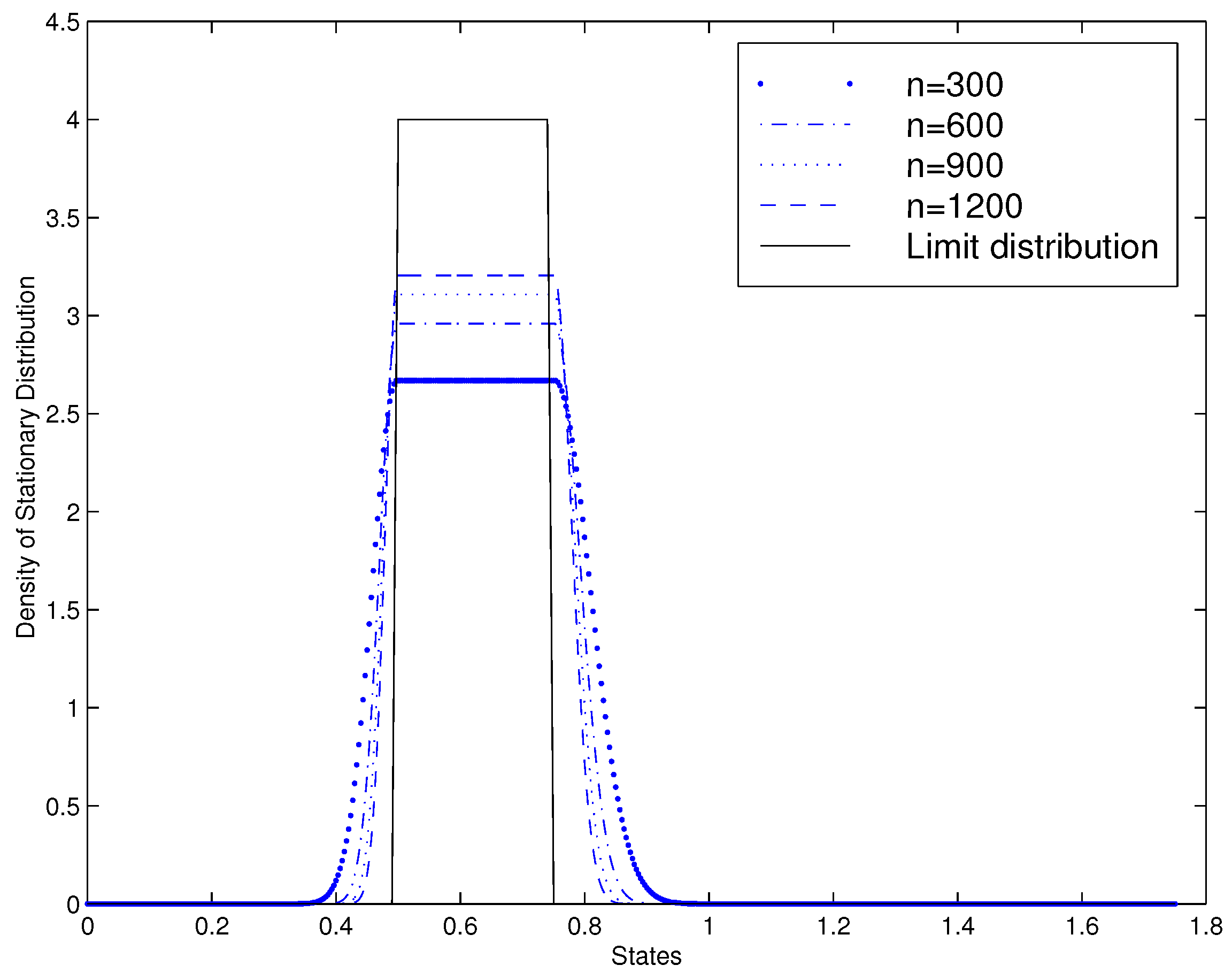
Then, the random variable converges weakly to some random variable uniformly distributed on the equilibrium set with density
Finally, we give the following numerical example (see
Figure 1), which clearly shows that the limit stationary distribution is uniformly distributed on the equilibrium set
.