


Abstract
With the increasing operating mileage and ownership of high-speed electric multiple units (EMU), a reasonable operation and maintenance strategy is the key to ensure their safe and reliable operation. As a key component of recombined EMU, creating a reasonable and effective risk assessment method for the fully automatic coupler draft gear (FACDG) is the first task. Therefore, based on fuzzy rough number theory, combined with the analytic hierarchy process (AHP), entropy weight method (EWM), technique for order performance by similarity to ideal solution (TOPSIS) and grey relational analysis (GRA), a risk priority indicator of comprehensive nearness degree is developed. Furthermore, a novel multi-criteria decision making (MCDM) failure modes, effects and criticality analysis (FMECA) assessment method is proposed. The effectiveness and rationality of the risk assessment method proposed are verified by the analysis of data and failure modes of a certain FACDG at fourth-level engineering maintenance.
MSC:
91B05; 90B25; 90C29
1. Introduction
With the rapid development of high-speed railway technology, high-speed electric multiple units (EMU) have become an indispensable means of transportation in people’s daily life due to their high speed, low energy consumption, light pollution and stability [1,2,3,4,5,6]. In China, there are two operation modes: short EMU trains with 8 cars (standard units) and long EMU trains with 16 cars (two standard units) [7]. By the end of 2021, the total operating mileage of China’s high-speed railway (CHSR) reached more than 40,000 km, and it is served by more than 4000 EMU trains (standard units). However, the short EMU trains are often programmed to operate as long EMU trains according to operating assignment and maintenance scheduling. The fully automatic coupler draft gear (FACDG) is the key device to achieve the recombined EMU, which realizes the mechanical, electrical and pneumatic linkage and transfers the traction force and braking force of a standard unit. Its failure leads to major safety risks such as decoupling, control failure and emergency braking failure [8,9,10]. The FACDG is visually inspected and lubricated in first-level to third-level maintenance, and disintegrate maintenance is carried out in fourth-level and fifth-level maintenance. Therefore, using accurate failure modes analysis and the determination based on risk assessment method is the most effective way to develop reasonable maintenance scheduling and ensure the safe and effective operation of EMU trains.
Failure modes, effects and criticality analysis (FMECA) is an effective method for multi-failure modes reliability risk assessment. All potential failure modes occurring in each component of a system are identified, and the cause of each failure mode and its impact on system operation are determined [10,11,12,13]. Therefore, the FMECA method is widely used to carry out reliability risk assessment in many fields, such as railway rolling stock [10], electrical system [11], aeronautical [13], engineering machinery [14], nuclear engineering [15], maritime [16,17], wind turbines [13,18,19], etc. Appoh and Yunusa-Kaltungo [8] proposed a dynamic mixture model for the comprehensive risk assessment of multiple failure sources. The robustness and accuracy of the model were verified via the application analysis of a coupler in the rolling stock. The criticality of their failure modes and weaknesses were obtained using the criticality matrix method. Then, a shorter-time and lower-cost preventive maintenance schedule was determined based on the analysis results [20,21,22,23]. Deng et al. [24] proposed a framework based on the FMECA method and network theory. The results of a case analysis showed that the most dangerous failure in bogie systems came from the wheel size. Fu et al. [25] proposed a risk prioritization model with the cumulative prospect theory and type 2 intuitionistic fuzzy. In the risk assessment, the risk sensitivity and decision-making psychology were analyzed using the cumulative prospect theory, and the uncertainty was described using the type 2 intuitionistic fuzzy number. In order to solve the high-dimensional problem, Mohammadzadeh et al. [26] proposed a simple and effective deep learning type 2 fuzzy neural network based on Fourier. Bognár and Hegedűs [27] studied the PRISM method and aggregation functions, and presented the risk assessment and prioritization suitable for different situations methodology. Based on the shortages of traditional failure mode and effects analysis, Ouyang et al. [28] proposed a novel failure mode and effects analysis classification method for risk assessment by combining risk factors in pairs. Huang et al. [29] established an analysis system for multiple operating failures of EMU, and obtained the interaction between the failure modes and the failure propagation chain. Based on the analysis of China’s high-speed railway control system, a fuzzy FMECA method with a cloud model was proposed, which can effectively reduce the subjective influence of expert factors on the assessment results [30,31]. In order to improve the rationality of the FMECA analysis results, many scholars have carried out research on method improvement. Wang et al. [32] developed a risk assessment method based on fuzzy weighted geometric mean. The assessment was carried out using fuzzy terms and fuzzy ratings, which solved the problem that the original method cannot adequately prioritize failure modes. The technique for order performance by similarity to ideal solution (TOPSIS) method cannot directly decide the sorting of alternatives in the decision-making process; for this problem, Zhang et al. [33,34] established an improved TOPSIS method that can deal with the sorting and classification of alternatives simultaneously by introducing the decision theory of fuzzy rough sets. Song et al. [35] developed a novel risk priority method based on rough number and TOPSIS theory, which can not only control fuzziness and subjectivity in an uncertain environment, but can also consider the importance of risk factors in the determination of failure modes risk priority. Li et al. [36] proposed a normalization algorithm on account of the analytic hierarchy process (AHP) by introducing the weights of risk assessment factors. The failure modes and effects analysis of floating offshore wind turbines is completed by using the proposed algorithm, and the results showed that the catastrophic failures can be minimized. Zhu et al. [37] integrated the rough number theory, AHP and compromise sorting method to improve the objectivity of FMECA assessment. In this method, the subjective uncertainty of expert evaluation was solved using rough number theory, the subjective weight of risk factors was obtained by the AHP and the compromise sorting method of failure modes was obtained using the compromise sorting method. Gupta et al. [38] proposed a risk assessment model for FMECA based on fuzzy logic and Dempster–Shafer theory. Wen et al. [39] presented a risk assessment method considering the weights of the risk factors. The fuzzy language term sets were used to deal with the hesitation information, the known information was used to supplement the missing information and the statistical variance was used to ensure the weights of the risk factors. Fata et al. [40] proposed an improved FMECA technique based on multi-criteria decision making (MCDM) of the Elimination et Choice Translating Reality (ELECTRE) TRI method. Failure modes were classified into different risk levels, and the appropriate threshold control was used to achieve a gradual transition from indifference to a preference for decision makers. Wang et al. [41] proposed a hybrid MCDM model based on TOPSIS, the simple additive weight (SAW) method and grey relational analysis, which can solve the problem of conflicts among alternatives of MCDM. Poongavanam et al. [42] carried out studies on three different kinds of MCDM and identified the best solution to meet the environmental agreement from 14 alternatives. Many scholars have made a lot of contributions in the research of risk assessment methods, but more attention is paid to solving the shortcomings in some aspects of assessment.
Based on the failure modes and data statistics of fourth-level overhaul, combined with the analysis results of the RPN method used, it was found that there is an inconsistency between the results of the RPN method and the failure modes of the actual operation and maintenance [43]. The lack of the RPN method used was found, and the corresponding solution was obtained. In this paper, the fuzzy sets theory is used to deal with the subjective uncertainty of decision makers. The uncertainty among decision makers is resolved using the rough number theory. The weights of risk assessment factors are calculated using the AHP-EWM. The risk priority ranking is carried out by means of TOPSIS-GRA. An FMECA assessment method is proposed. The validity and rationality of the risk assessment method proposed are verified via the analysis of operation and maintenance of a certain FACDG. The proposed method lays a good foundation for the reasonable formulation of maintenance strategy in China’s operating EMUs.
Herein, in Section 2, the fuzzy sets theory and the rough number theory are firstly introduced, the comprehensive weights method is presented based on analyzing of risk assessment factors and the comprehensive nearness degree of the risk priority ranking is proposed based on TOPSIS-GRA. In Section 3, a practical case study on the application of the proposed method is carried out. The conclusions of this paper and future research works are presented in Section 4.
2. Methodology
2.1. Fuzzy Sets Theory
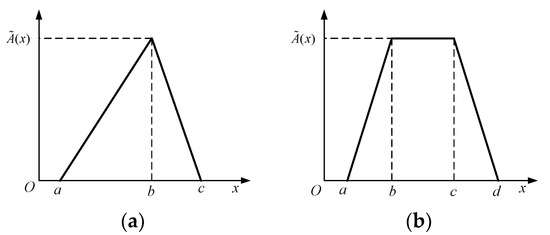
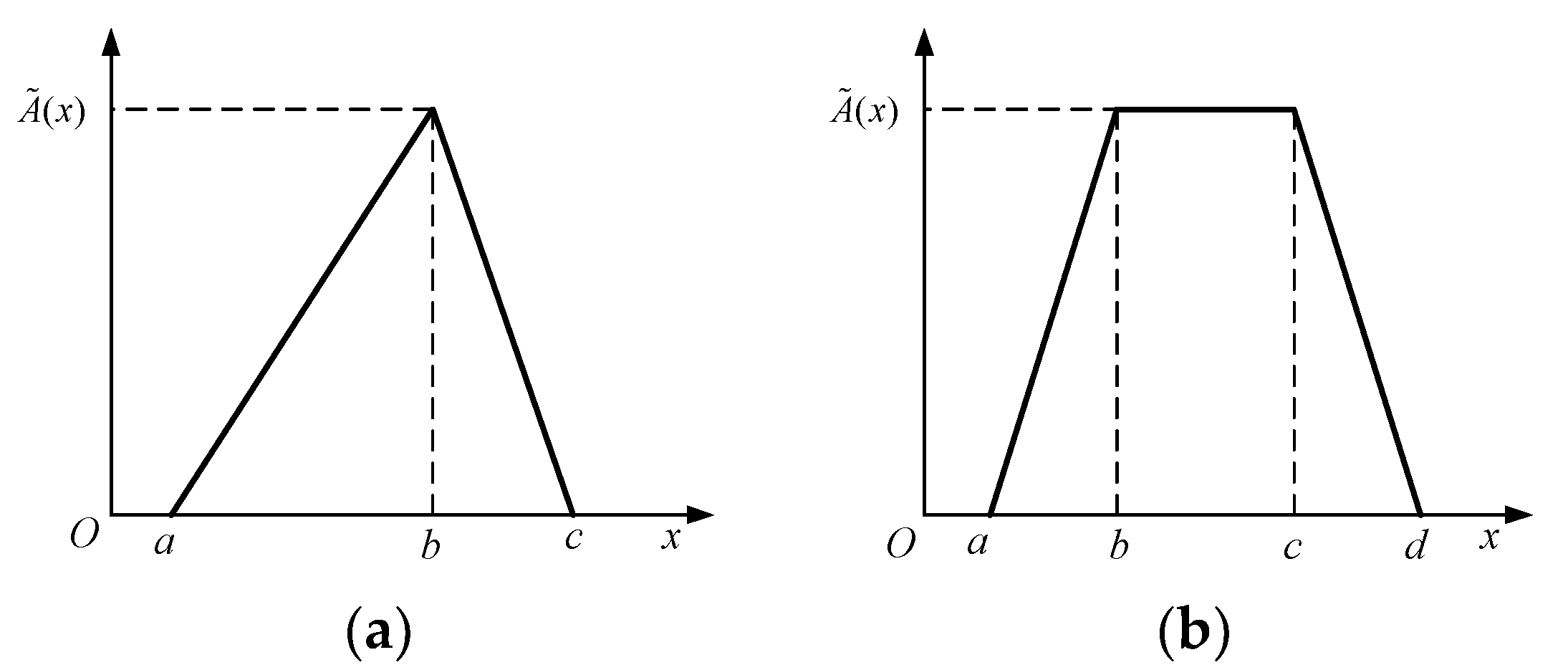
The fuzzy sets theory is applied to solve the problem of uncertainty and accuracy of decision makers in an assessment. Based on the method of information expression and quantization, a convex fuzzy set characterized by a given interval of real numbers is constructed, and the membership degree of each real number is determined to be between 0 and 1 [44,45]. The membership functions as a triangle and trapezoid are shown in Figure 1. Therefore, they can, respectively, be expressed as [46]
Figure 1.
The membership function: (a) triangle and (b) trapezoid.
For finding an exact value which can best represent the fuzzy sets from the membership function, the Alpha-cut defuzzification (ACD) method proposed by Amir is used for defuzzification [47]. Therefore, the defuzzification equations of the membership function as a triangle and trapezoid can, respectively, be described as
Based on the fuzzy assessment language, the decision results are obtained by the decision maker’s assessment of each risk factor of the failure modes. The defuzzification decision matrix X is obtained via the ACD method. This is,
where xij is the defuzzification value of each failure mode, i = 0, 1, 2, …, m; j = 0, 1, 2, …, n, m is the number of failure modes; and n is the number of risk assessment factors.
2.2. Rough Number Theory
By using interval values instead of exact values to indicate the uncertainty among decision makers, the decision makers’ individual cognitive bias and randomness are effectively avoided. The uncertainty and subjectivity among decision makers can be reduced effectively, and the objectivity of assessment results can be improved [48]. Herein, the rough number theory is applied to solve the weight of the decision makers’ assessment in the FMECA for FACDG.
The rough number of any class Ch in the domain of discourse U is defined as
The aggregating rough number RN(C) is expressed as
where and are the upper approximation and lower approximation of the Ch, , ; NU and NL are the number of objects included in the upper approximation and lower approximation of the Ch; and h = 1, 2, …, q, q is the number of decision makers [35].
The uncertainty is expressed using the lower approximation and upper approximation in rough number theory. The size of the interval of the boundary region characterizes the size of the uncertainty among decision makers. Therefore, even though the data size is small and the distribution is unknown, it can handle the uncertainty among domain decision makers and maintain the objectivity of the original information.
2.3. Comprehensive Weight Analysis
The weights of the risk assessment factors include the subjective weights and objective weights in order to assign full play to the advantages of the subjective and objective weights analysis methods. Herein, the AHP is used to determine the subjective weights, and the EWM is applied to calculate the objective weights.
2.3.1. Subjective Weight Analysis
The AHP is a systematic, hierarchical and multi-criteria decision analysis method, which is applied to solve the comparison problem of multiple indicators and schemes to select the optimal scheme [36]. Its main steps are as follows:
Step 1: Divide the hierarchical structure. Considering the objectives, objects and criteria of decision making, the hierarchical structure can be divided into target level and indicator level.
Step 2: Construct pairwise comparison matrix A. Saaty’s method shown in Table 1 is used to determine the importance of different attributes relative to the target [36]. aj and ag represent the risk assessment factors, ajg indicates the relative importance of aj to ag and ajg is the integer from 1 to 9 or its reciprocal.
Table 1.
Pairwise comparisons of Saaty’s method.
Then, the pairwise comparison matrix A can be described as
where j, g = 1, 2, …, n. Herein, the risk assessment factors contain the Severity (S), Occurrence (O), Detection (D) and Maintenance (M).
Step 3: Solve for the relative weights. The maximum eigenvalue λmax and the corresponding eigenvector ω are received according to the pairwise comparison matrix A. The equation is expressed as
Step 4: Consistency test. The consistency is verified by calculating the consistency ratio (CR) of the comparison matrix A. The CR is described as
where CI is the consistency indicator of pairwise comparison matrix, , and RI is the average random consistency indicator of the same order, which is determined by the order of the pairwise comparison matrix [37].
Generally, the pairwise comparison matrix A can be accepted when CR < 0.1. Otherwise, the comparison value should be adjusted until CR < 0.1.
Step 5: Determine the subjective weights of the risk assessment factors. The aggregated comparison matrix is determined as
Then, the subjective weight wsj of each risk assessment factor can be calculated as
The normalization form of the subjective weights is described as
2.3.2. Objective Weight Analysis
The EWM is applied to obtain the objective weights of the risk assessment factors. The values of dispersion can be measured using the implied interactions among risk factors in decision making; then, the objective weight of each risk factor is obtained [49]. The greater the value dispersion of the risk assessment factor, the smaller the entropy value, and the greater the weight should be. The input data of EWM are the decision matrix. The input data should be normalized for calculating entropy, and the indicator of positive and negative can be determined in the normalization process.
The normalized decision matrix can be expressed as
The positive indicator and negative indicator are described as [50]
where xjmax and xjmin are the maximum and minimum values of the same risk assessment factor, respectively.
Then, the entropy Sj of each risk assessment factor is defined as
The information entropy redundancy Hj is described as
Based on the rough number theory, the information entropy redundancy of each decision maker’s evaluation data is determined as
The information entropy redundancy represents the objective weight of each risk assessment factor, i.e., H = wo. Therefore, the normalization form of the objective weight of the risk assessment factor is expressed as
Consequently, the comprehensive weight w is established as
2.4. Risk Priority Ranking
The MCDM method can solve complex problems with high uncertainty and multiple viewpoints by ranking the failure modes according to existing decision information [41]. The TOPSIS method determines the fault risk by determining the distance between the evaluation sequence and the positive and negative ideal solution vectors. However, if the total distance is the same, the risk of failure modes cannot be judged. The GRA judges the fault risk using the similarity of reference sequence, and the limitation of the TOPSIS can be solved. Therefore, the combination of the TOPSIS and GRA can satisfy the risk ranking of multi-failure modes of the FACDG.
2.4.1. TOPSIS Analysis
The TOPSIS method was proposed by Hwang and Yoon in 1981 for solving the MCDM problem. Since then, scholars have proposed improved methods according to their research. Saxena et al. [51] proposed an optimal software reliability growth selected model based on criteria importance through inter-criteria correlation and TOPSIS. Atenidegbe and Mogaji [52] developed a TOPSIS-Entropy assessment model for contamination risk. Yeo et al. [53] proposed an improved fuzzy TOPSIS risk assessment technique for engine systems, which effectively improves the assessment efficiency through a high-hazard risk control scheme. According to the rough TOPSIS method, the positive ideal solution (PIS) and the negative ideal solution (NIS) should be determined [35]. In the benefit criterion, the larger the indicator value, the closer to the PIS, while it is the opposite in the cost criterion. The PIS and the NIS can, respectively, be expressed as
where and are, respectively, the values of the criteria PIS and NIS, B is the benefit criterion and C is the cost criterion.
In general, the Euclidean distance is used to calculate the distance between each data sequence and the PIS and the NIS. The distance between the data sequence and PIS and NIS are, respectively, expressed as
where is the distance between the data sequence and PIS, and is the distance between the data sequence and NIS.
The dimensionless PIS and NIS are, respectively, defined as
2.4.2. Grey Relational Analysis
The grey relational analysis (GRA) is an effective analysis method for solving the decision problem in an uncertain environment and multi-attribute situation. The process is to plot each factor as a sequence curve, and the relational grade of each risk assessment factor by the similarity of its geometric shape can be obtained [54]. The rough GRA method is applied as follows.
The positive reference sequence and negative reference sequence are set as
Then, the compared sequence is described as
The benefit criterion is described as
The cost criterion is described as
where ξ is the resolution coefficient, which is used to decrease the effect of the excessive maximum value on the distortion of the correlation coefficient, and is generally taken as 0.5 [55].
Then,
where and are, respectively, the positive and negative relational grade of and ; the closer the value is to 1, the better the correlation.
The dimensionless positive correlation degree and negative correlation degree are defined as
The analysis indicates that the larger the values of and , the closer they are to the PIS, namely, the lower the risk of failure mode. Similarly, the larger the values of and , the closer they are to the NIS, namely, the higher the risk of failure mode. A comprehensive indicator or can be established as
where α1 and β1 are the weights of the indicators and , and α2 and β2 are the weights of the indicators and .
The comprehensive nearness degree δi is established as
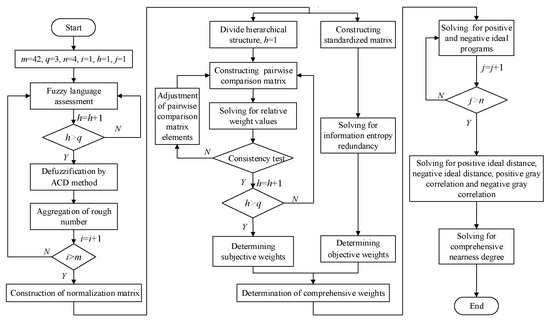
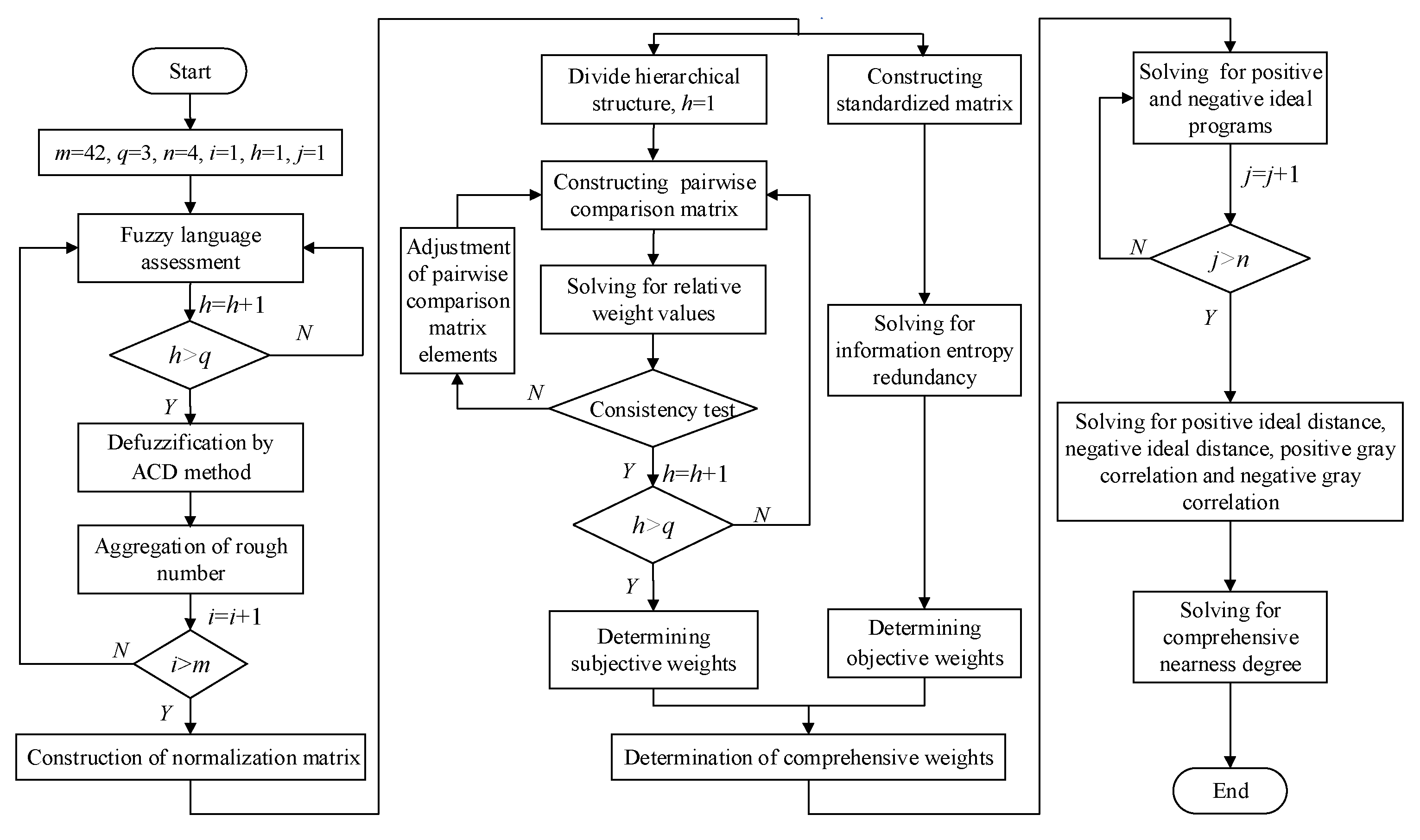
Therefore, based on the above analysis, the risk assessment process of the fuzzy rough number FMECA is shown in Figure 2.
Figure 2.
Flowchart of assessment process of the fuzzy rough number FMECA.
3. Application Example: The Case of a Certain FACDG
In this section, we use a certain FACDG, widely used in China’s operating EMUs, as an application example. The methodology is proposed by analyzing the shortcomings of the RPN method and the characteristics of other risk assessment methods [49]. The methodology established in Section 2 is applied to carry out the risk assessment analysis.
3.1. Failure Modes Analysis
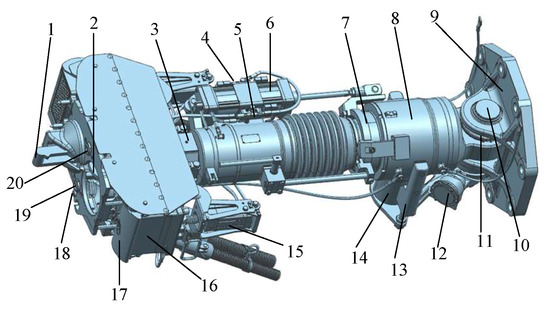
Figure 3 shows a certain FACDG that is widely used in China’s operating EMUs. It includes a connected system, electric coupler and pusher, air circuit system, telescopic and cushioning devices, electrical components and mounting alignment device. The FACDG is used to realize the connection between short EMU trains to form long EMU trains. The convex cone at the front of the FACDG is introduced into the concave cone of the opposite FACDG, and the coupling rods are interlocked with the notch of the coupler tongue. Meanwhile, the pipeline valves are squeezed to complete the air circuit connection. After that, the electric coupler cover is opened under the pneumatic action, and the circuit connection is completed. When uncoupling, the electrical coupler is first uncoupled, and then the separation of mechanical and pneumatic circuits is realized.
Figure 3.
Model of the FACDG. 1—Coupling rod, 2—Coupler tongue, 3—Connecting snap ring, 4—Single electric solenoid valve, 5—Double electric solenoid valve, 6—Telescopic cylinder, 7—Collapsed pipe, 8—Rubber ring, 9—Mounting base, 10—Master pin, 11—Rubber bearing, 12—Centering device, 13—Bracket, 14—Rubber support, 15—Push cylinder, 16—Electric coupler, 17—Electric coupler cover, 18—Uncoupling pipeline valve, 19—Main pipeline valve, 20—Brake pipeline valve.
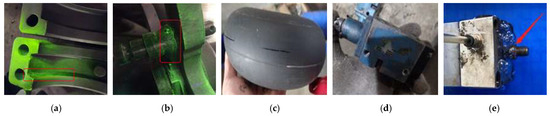
Table 2 shows the failure modes and analysis of a type of FACDG with fourth-level overhaul from November 2015 to June 2020, and the images of high-risk failure components are shown in Figure 4.
Table 2.
Failure modes analysis of the FACDG.
Figure 4.
Images of failure components: (a) Cracks on upper connecting snap ring; (b) Cracks on locating pin rod; (c) Cracks and damages on the surface; (d) Valve element rusted and unable to move; (e) Air leakage at rod end.
3.2. Analysis of Fuzzy Assessment
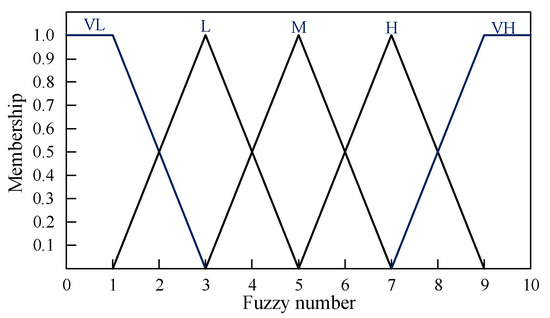
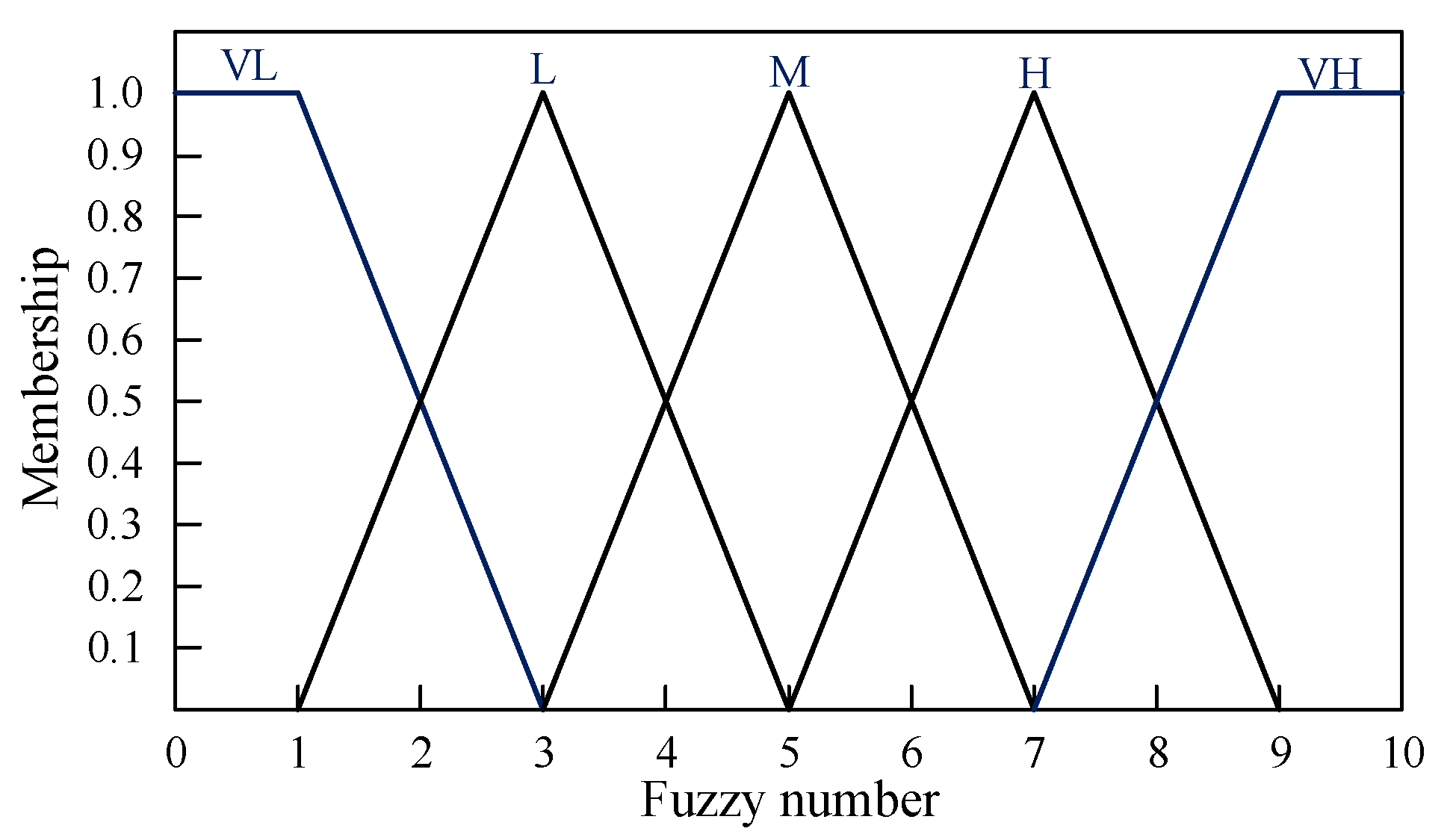
The membership function of FACDG fuzzy assessment is established by using the trapezoidal and triangular fuzzy numbers, as shown in Figure 5. The fuzzy assessment language of risk factors is classified into five levels, VL, L, M, H and VH, based on the statistical analysis of 42 failure modes. The assessment criteria of determined risk assessment factors is illustrated in Table 3. According to the membership function established, assessment criteria and the 42 failure modes of FACDG, the fuzzy numbers are obtained by combining the fuzzy linguistic assessment of three decision makers for S, D and M. The O is determined by the failure rate of the fourth-level maintenance. Then, the defuzzification numbers are obtained using the ACD method. The determined fuzzy numbers and defuzzification numbers are shown in Table 4.
Figure 5.
The membership function of fuzzy linguistic variables.
Table 3.
The assessment criteria of risk assessment factors.
Table 4.
The fuzzy numbers and defuzzification numbers.
Therefore, the defuzzification decision matrices are obtained.
The aggregated decision matrix Xc is obtained according to rough number theory.
Compared with the weighting approach specified [12], the interval-expressed aggregated decision matrix can effectively solve the uncertainty problem in the evaluation process. For improving the comparability of the assessment indicator, each assessment indicator is evaluated using the interval normalization method. Herein, the maximum value of the upper limit of the rough number of each risk assessment factor is selected as the phase reference point. Then, the normalized equations are expressed as
The normalized decision matrix XR of the aggregated decision matrix is calculated.
3.3. Weights of Risk Assessment Factors
3.3.1. Calculation of Subjective Weights
Based on the nine-scale method and the pairwise comparison on four risk assessment factors, the pairwise comparison matrix of three decision makers are obtained according to Equation (8).
The maximum eigenvalues of the pairwise comparison matrix are, respectively, obtained according to Equation (9).
The eigenvectors corresponding to the maximum eigenvalues are obtained, respectively.
The consistency indicators CI of the comparison matrix are, respectively, calculated.
Herein, RI is taken as 0.89 [37]; therefore, the consistency ratios, CR, of the comparison matrices are, respectively, obtained.
Therefore, because the values of CRA1, CRA2 and CRA3 are all less than 0.1, all pairwise comparison matrices pass the consistency test.
Then, the rough number comparison matrix is obtained.
The subjective weight of each risk assessment factor is obtained according to Equation (12).
Then, the normalization form of the subjective weight is obtained according to Equation (13).
3.3.2. Calculation of Objective Weights
The evaluation information from decision makers’ defuzzification of failure modes is used as the numerical information for calculating the objective weights. The target layer is the criticality of the failure modes. Therefore, the target layer is isotropic with the risk assessment factors; that is, the greater the value of the risk assessment factor, the greater the criticality of the failure mode. Then, the normalized matrices for fuzzification , , and are, respectively, obtained.
The information entropy redundancy H1, H2, H3 and HO can be obtained using the Equations (16) and (17).
The information entropy redundancy of aggregation H is obtained using Equation (18).
The normalized objective weights can be obtained using Equation (19).
Based on the results of subjective and objective weighting analyses of the AHP method and the EWM method, it can be seen that the use of a single AHP method cannot satisfy the research of this paper [36,37]. Therefore, integrating the normalized decision matrix and the comprehensive weight w, the weighted decision matrix can be obtained.
3.4. Risk Ranking of Failure Modes
It is necessary to analyze whether the risk assessment factor is the benefit criterion or the cost criterion. For risk priority ranking, the PIS indicates a low risk of failure mode, and the NIS indicates a high risk of failure mode. Herein, the higher the value of the four risk assessment factors, the higher the risk. Therefore, the cost criterion is applied. The PIS and NIS of the four risk assessment factors are calculated according to Equations (21) and (22). Table 5 shows the calculation results.
Table 5.
PIS and NIS of the risk assessment factors.
The Euclidean distances and are obtained using Equations (23) and (24). Then, the dimensionless Euclidean distances and are determined using Equations (25) and (26).
The PIS and NIS are used as the reference sequences in the gray correlation method. The gray correlation matrices of PIS and NIS are calculated. Thereby, the gray correlations and are obtained using Equations (32) and (33). Then, the dimensionless gray correlations and are determined using Equation (34).
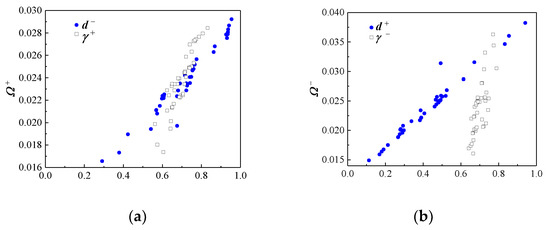
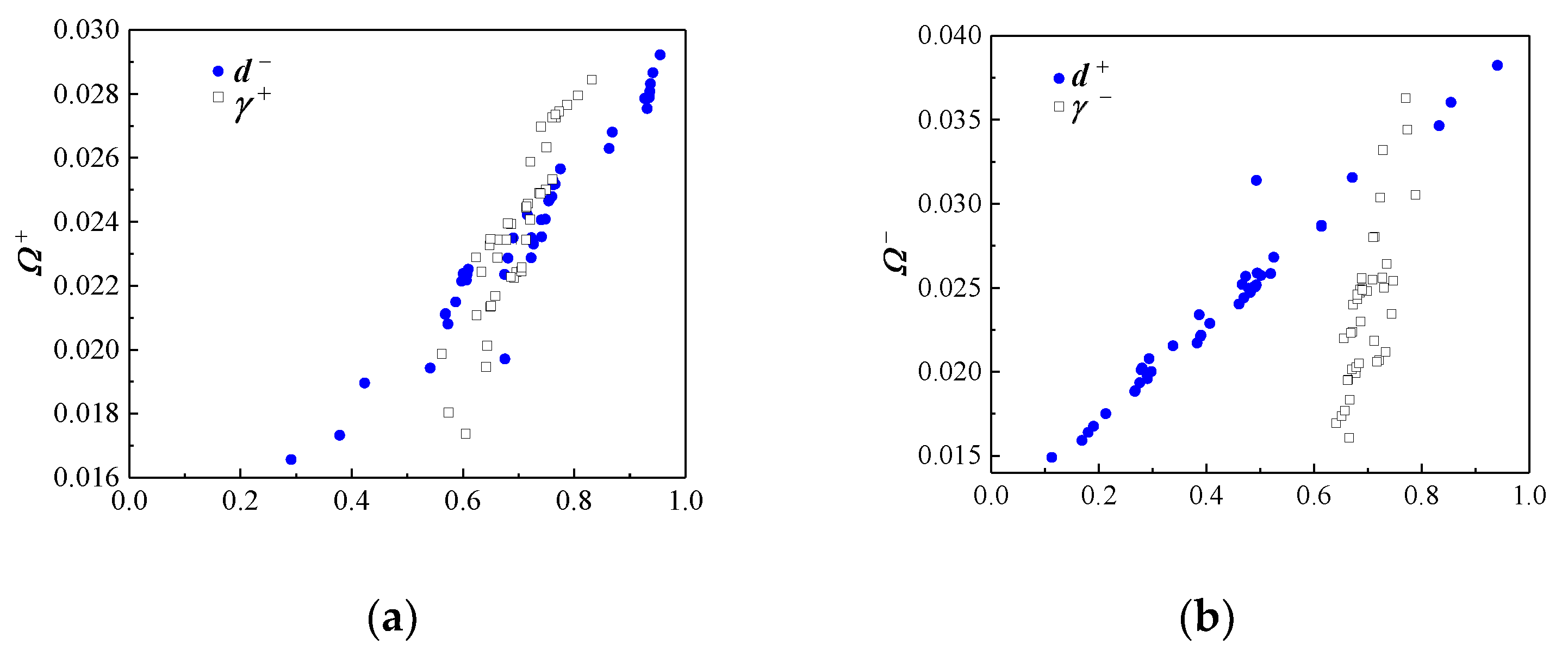
FACDG has many failure modes; if a single TOPSIS method is used here [35], there is a situation where the Euclidean distances are the same but the failure modes are different. According to the analysis, it can be seen that the larger the values of and , the larger the target layer and the larger the values of and , the larger the target layer . So, the dimensionless Euclidean distance and dimensionless gray correlations are all positive indicators. The dimensionless weight coefficients , , and are determined. The relationship of the target layer to and , and the target layer to and , are shown in Figure 6.
Figure 6.
Variation in target layer vs. dimensionless Euclidean distance and dimensionless gray correlation: (a) ; (b) .
Therefore, the nearness degree of each failure mode is calculated. Table 6 shows the results of the fuzzy rough number FMECA based on the comprehensive nearness degree and the RPN method [43]. Based on the results of the RPN method, it can be found that the extreme difference in RPN values of failure modes reaches 3594, which can lead to the deviation of risk ranking of failure modes due to the instability of assessment sensitivity. Likewise, there are seven groups of failure modes with the same RPN values, namely, 0303A and 0304A; 0101B, 0105A and 0603A; 0101A and 0606A; 0104A and 0402A; 0202A, 0203A and 0302A; 0401A and 0504B; and 0204A and 0208A. This is due to assigning the same weight to the decision makers. However, it can be found that the risk priority of failure modes can be better distinguished via the comprehensive nearness degree, and the same criticality of failure mode does not appear. The comprehensive nearness degree of 42 failure modes is maintained within the range of an order of magnitude. Additionally, the risk level of failure modes has a good agreement with the engineering maintenance analysis [43]. The shortcomings of the traditional RPN method are better solved, such as the uncertainty of subjective assessment by decision makers, uncertainty among decision makers, the same criticality of failure modes due to different combinations of risk assessment factors and the unstable sensitivity. It can be found that the most critical failure mode is the fatigue damage of the upper connecting snap ring, as shown in Table 6. The proposed FMECA assessment methodology for FACDG was verified to be reasonable and effective through the comparative analysis of the actual engineering maintenance statistics, the fuzzy rough number method and the traditional RPN method. The proposed methodology lays a good foundation for the development of the reliability maintenance strategy of FACDG.
Table 6.
PIS and NIS of the risk assessment factors.
4. Conclusions
Integrating the fuzzy rough theory, AHP-EWM and TOPSIS-GRA, a multi-criteria decision-making FMECA assessment methodology is proposed. In this method, the fuzzy sets theory is adopted to resolve the subjective uncertainty of decision makers. The uncertainty among decision makers is resolved using the rough number theory. For the different contributions of risk assessment factors, the AHP and EWM are, respectively, applied to determine the subjective weights and objective weights. The comprehensive weight model is developed. The TOPSIS and GRA are applied to resolve the instability of risk assessment sensitivity, and a comprehensive nearness degree is established to deal with the risk priority ranking. Based on the analysis of the structure and working principle of a certain FACDG, combined with the statistical analysis of the fourth-level engineering maintenance, a statistical classification of 42 failure modes is established. The comparative analysis of the proposed method with engineering maintenance and the RPN method are carried out. The results show that the major failure modes obtained from the risk priority ranking of the proposed risk assessment method are in good agreement with the major failure modes of the engineering maintenance, which verifies that the proposed risk assessment method is valid and reasonable. Simultaneously, it lays a basis for the development of a reliable maintenance strategy for the FACDG in the EMU.
Based on the study in this paper, future work can be carried out as follows: (1) The research of other risk assessment methods in FACDG should be carried out. (2) The applicability of the proposed method for other systems of EMUs should be examined. (3) Research on risk assessment methods in fifth-level FACDG should be carried out.
Author Contributions
Conceptualization, Y.Y.; methodology, Z.L. (Zhongqiang Luo) and Y.Y.; software, Z.L. (Zhongqiang Luo); validation, Z.L. (Zhongqiang Luo), Z.L. (Zhenyu Liu) and Z.L. (Zhibo Liu); formal analysis, Z.L. (Zhongqiang Luo); resources, Y.Y., Z.L. (Zhongqiang Luo) and Z.L. (Zhenyu Liu); data curation, Y.Y. and Z.L. (Zhongqiang Luo); writing—original draft preparation, Y.Y., Z.L. (Zhongqiang Luo) and Z.L. (Zhenyu Liu); writing—review and editing, Y.Y. and Z.L. (Zhongqiang Luo); visualization, Y.Y., Z.L. (Zhongqiang Luo) and Z.L. (Zhenyu Liu); supervision, Y.Y.; project administration, Y.Y. and Z.L. (Zhongqiang Luo); funding acquisition, Y.Y. All authors have read and agreed to the published version of the manuscript.
Funding
This research received no external funding.
Data Availability Statement
The data used in this paper are available on request from the corresponding author.
Conflicts of Interest
The authors declare no conflict of interest.
References
- Pan, A.X.; Gong, Y.; Yang, Z.G. Failure analysis on abnormal leakage of radiator for high-speed train transformer. Eng. Fail. Anal. 2021, 129, 105673. [Google Scholar] [CrossRef] [Scilit]
- Hu, Y.X.; Tan, A.C.; Chen, L.; Li, Y.P. Failure analysis of fractured motor bolts in high-speed train due to cardan shaft misalignment. Eng. Fail. Anal. 2021, 122, 105246. [Google Scholar] [CrossRef] [Scilit]
- Fan, T.B.; Ren, Z.S.; Xue, R. Load variation of the wheel-mounted brake disc bolts of a high-speed train. Eng. Fail. Anal. 2021, 119, 105001. [Google Scholar] [CrossRef] [Scilit]
- Zhao, H.W.; Liang, J.Y.; Liu, C.Q. High-speed EMUs: Characteristics of technological development and trends. Engineering 2020, 6, 234–244. [Google Scholar] [CrossRef] [Scilit]
- Liu, P.; Yang, L.X.; Gao, Z.Y.; Li, S.K.; Gao, Y. Fault tree analysis combined with quantitative analysis for high-speed railway accidents. Saf. Sci. 2015, 79, 344–357. [Google Scholar] [CrossRef] [Scilit]
- Yang, Z.Y.; Han, J.M.; Li, W.J.; Li, Z.Q.; Pan, L.K.; Shi, X.L. Analyzing the mechanisms of fatigue crack initiation and propagation in CRH EMU brake discs. Eng. Fail. Anal. 2013, 34, 121–128. [Google Scholar] [CrossRef] [Scilit]
- Zhao, P.; Han, B.M.; Li, D.W.; Li, Y.W. Model and algorithm for the first-level maintenance operation optimization of EMU trains. J. Intell. Fuzzy Syst. 2021, 41, 2145–2160. [Google Scholar] [CrossRef] [Scilit]
- Appoh, F.; Yunusa-Kaltungo, K. Dynamic hybrid model for comprehensive risk assessment: A case study of train derailment due to coupler failure. IEEE Access 2022, 10, 24587–24600. [Google Scholar] [CrossRef] [Scilit]
- Zhu, T.; Yang, B.Z.; Yang, C.; Xiao, S.N.; Yang, G.W.; Yang, B. The mechanism for the coupler and draft gear and its influence on safety during a train collision. Int. J. Veh. Syst. Dyn. 2018, 56, 1375–1393. [Google Scholar] [CrossRef] [Scilit]
- Dinmohammadi, F.; Alkali, B.; Shafiee, M.; Bérenguer, C.; Labib, A. Risk evaluation of railway rolling stock failures using FMECA technique: A case study of passenger door system. Urban Rail Transit 2016, 2, 128–145. [Google Scholar] [CrossRef] [Scilit]
- Singh, J.; Singh, S.; Singh, A. Distribution transformer failure modes, effects and criticality analysis (FMECA). Eng. Fail. Anal. 2019, 99, 180–191. [Google Scholar] [CrossRef] [Scilit]
- Carpitella, S.; Certa, A.; Izquierdo, J.; Fata, C.M.L. A combined multi-criteria approach to support FMECA analyses: A real-world case. Reliab. Eng. Syst. Saf. 2018, 169, 394–402. [Google Scholar] [CrossRef] [Scilit]
- Zhou, A.M.; Yu, D.J.; Zhang, W.Y. A research on intelligent fault diagnosis of wind turbines based on ontology and FMECA. Adv. Eng. Inform. 2015, 29, 115–125. [Google Scholar] [CrossRef] [Scilit]
- Pantelić, M.P.; Bošnjak, S.M.; Misita, M.Z.; Gnjatović, N.B.; Stefanović, A.Z. Service FMECA of a bucket wheel excavator. Eng. Fail. Anal. 2020, 108, 104289. [Google Scholar] [CrossRef] [Scilit]
- Karatop, B.; Taşkan, B.; Adar, E.; Kubat, C. Decision analysis related to the renewable energy investments in Turkey based on a Fuzzy AHP-EDAS-Fuzzy FMEA approach. Comput. Comput. Eng. 2021, 151, 106958. [Google Scholar] [CrossRef] [Scilit]
- Elidolu, G.; Sezer, S.I.; Akyuz, E.; Arslan, O.; Arslanoglu, Y. Operational risk assessment of ballasting and de-ballasting on-board tanker ship under FMECA extended Evidential Reasoning (ER) and Rule-based Bayesian Network (RBN) approach. Reliab. Eng. Syst. Saf. 2023, 231, 108975. [Google Scholar] [CrossRef] [Scilit]
- Akyuz, E.; Celik, E. A quantitative risk analysis by using interval type-2 fuzzy FMEA approach: The case of oil spill. Marit. Policy Manag. 2018, 45, 979–994. [Google Scholar] [CrossRef] [Scilit]
- Tazi, N.; Châtelet, E.; Bouzidi, Y. Using a hybrid cost-FMEA analysis for wind turbine reliability analysis. Energies 2017, 10, 276. [Google Scholar] [CrossRef] [Scilit]
- Shafiee, M.; Dinmohammadi, F. An FMEA-based risk assessment approach for wind turbine systems: A comparative study of onshore and offshore. Energies 2014, 7, 619–642. [Google Scholar] [CrossRef] [Scilit]
- Kim, J.H.; Jeong, H.Y.; Park, J.S. Development of the FMECA process and analysis methodology for railroad systems. Int. J. Automot. Technol. 2009, 10, 753–759. [Google Scholar] [CrossRef] [Scilit]
- Kim, J.H.; Jeong, H.Y. Evaluation of the adequacy of maintenance tasks using the failure consequences of railroad vehicles. Reliab. Eng. Syst. Saf. 2013, 117, 30–39. [Google Scholar] [CrossRef] [Scilit]
- Cheng, X.Q.; Xing, Z.Y.; Qin, Y.; Zhang, Y.; Pang, S.H.; Xia, J. Reliability analysis of metro door system based on FMECA. J. Intell. Learn. Syst. Appl. 2013, 5, 216–220. [Google Scholar] [CrossRef]
- Fang, F.; Zhao, Z.J.; Huang, C.; Zhang, X.Y.; Wang, H.T.; Yang, Y.J. Application of reliability-centered maintenance in metro door system. IEEE Access 2019, 7, 186167–186174. [Google Scholar] [CrossRef] [Scilit]
- Deng, Y.L.; Li, Q.M.; Lu, Y. A research on subway physical vulnerability based on network theory and FMECA. Saf. Sci. 2015, 80, 127–134. [Google Scholar] [CrossRef] [Scilit]
- Fu, Y.; Qin, Y.; Wang, W.Z.; Liu, X.W.; Jia, L.M. An extended FMEA model based on cumulative prospect theory and type-2 intuitionistic fuzzy VIKOR for the railway train risk prioritization. Entropy 2020, 22, 1418. [Google Scholar] [CrossRef] [Scilit]
- Mohammadzadeh, A.; Zhang, C.W.; Alattas, K.A.; El-Sousy, F.F.M.; Vu, M.D. Fourier-based type-2 fuzzy neural network: Simple and effective for high dimensional problems. Neurocomputing 2023, 547, 126316. [Google Scholar] [CrossRef] [Scilit]
- Bognár, F.; Hegedűs, C. Analysis and consequences on some aggregation functions of PRISM (partial risk map) risk assessment method. Mathematics 2022, 10, 676. [Google Scholar] [CrossRef] [Scilit]
- Ouyang, L.H.; Che, Y.H.; Yan, L.; Park, C. Multiple perspectives on analyzing risk factors in FMEA. Comput. Ind. 2022, 141, 103712. [Google Scholar] [CrossRef] [Scilit]
- Huang, W.C.; Kou, X.Y.; Zhang, Y.; Mi, R.W.; Yin, D.Z.; Xiao, W.; Liu, Z.R. Operational failure analysis of high-speed electric multiple units: A Bayesian network-K2 algorithm-expectation maximization approach. Reliab. Eng. Syst. Saf. 2021, 205, 107250. [Google Scholar] [CrossRef] [Scilit]
- Xu, Z.J.; Zhang, Y.P.; Su, H.S. Risk evaluation approach and application research on fuzzy-FMECA method based on cloud model. TELKOMNIKA Indones. J. Electr. Eng. 2014, 12, 1509–1518. [Google Scholar] [CrossRef] [Scilit]
- Su, H.S.; Wang, D.T.; Su, L. Fuzzy FMECA risk evaluation and its applications in Chinese train control systems based on cloud model. J. Intell. Fuzzy Syst. 2019, 37, 1299–1309. [Google Scholar] [CrossRef] [Scilit]
- Wang, Y.M.; Chin, K.S.; Poon, G.K.K.; Yang, J.B. Risk evaluation in failure mode and effects analysis using fuzzy weighted geometric mean. Expert Syst. Appl. 2009, 36, 1195–1207. [Google Scholar] [CrossRef] [Scilit]
- Zhang, K.; Zhan, J.M.; Wang, X.Z. TOPSIS-WAA method based on a covering-based fuzzy rough set: An application to rating problem. Inf. Sci. 2020, 539, 397–421. [Google Scholar] [CrossRef] [Scilit]
- Zhang, K.; Dai, J.H. A novel TOPSIS method with decision-theoretic rough fuzzy sets. Inf. Sci. 2022, 608, 1221–1244. [Google Scholar] [CrossRef] [Scilit]
- Song, W.Y.; Ming, X.G.; Wu, Z.Y.; Zhu, B.T. A rough TOPSIS approach for failure mode and effects analysis in uncertain environments. Qual. Reliab. Eng. Int. 2014, 30, 473–486. [Google Scholar] [CrossRef] [Scilit]
- Li, H.; Díaz, H.; Soares, C.G. A failure analysis of floating offshore wind turbines using AHP-FMEA methodology. Ocean Eng. 2021, 234, 109261. [Google Scholar] [CrossRef] [Scilit]
- Zhu, G.N.; Hu, J.; Qi, J.; Gu, C.C.; Peng, Y.H. An integrated AHP and VIKOR for design concept evaluation based on rough number. Adv. Eng. Inform. 2015, 29, 408–418. [Google Scholar] [CrossRef] [Scilit]
- Gupta, G.; Ghasemian, H.; Janvekar, A.A. A novel failure mode effect and criticality analysis (FMECA) using fuzzy rule-based method: A case study of industrial centrifugal pump. Eng. Fail. Anal. 2021, 123, 105305. [Google Scholar] [CrossRef] [Scilit]
- Wen, T.C.; Chung, H.Y.; Chang, K.H.; Li, Z.S. A flexible risk assessment approach integrating subjective and objective weights under uncertainty. Eng. Appl. Artif. Intell. 2021, 103, 104310. [Google Scholar] [CrossRef] [Scilit]
- Fata, C.M.L.; Giallanza, A.; Micale, R.; Scalia, G.L. Improved FMECA for effective risk management decision making by failure modes classification under uncertainty. Eng. Fail. Anal. 2022, 35, 106163. [Google Scholar] [CrossRef] [Scilit]
- Wang, P.; Zhu, Z.Q.; Wang, Y.H. A novel hybrid MCDM model combining the SAW, TOPSIS and GRA methods based on experimental design. Inf. Sci. 2016, 345, 27–45. [Google Scholar] [CrossRef] [Scilit]
- Poongavanam, G.; Sivalingam, V.; Prabakaran, R.; Salman, M.; Kim, S.C. Selection of the best refrigerant for replacing R134a in automobile air conditioning system using different MCDM methods: A comparative study. Case Stud. Therm. Eng. 2021, 27, 101344. [Google Scholar] [CrossRef] [Scilit]
- Luo, Z.Q. Maintenance Strategy Research and Reliability Evaluation for Fully Automatic Coupler Draft Gear of EMU. Master’s Thesis, Northeastern University, Shenyang, China, 2023. (In Chinese) [Google Scholar]
- Zadeh, L.A. Fuzzy Sets. Inf. Control 1965, 8, 338–353. [Google Scholar] [CrossRef] [Scilit]
- Bouchet, A.; Sesma-Sara, M.; Ochoa, G.; Bustince, H.; Montes, S.; Díaz, I. Measures of embedding for interval-valued fuzzy sets. Fuzzy Sets Syst. 2023, 467, 108505. [Google Scholar] [CrossRef] [Scilit]
- Buffa, P.; Giardina, M.; Prete, G.; Ruvo, L.D. Fuzzy FMECA analysis of radioactive gas recovery system in the SPES experimental facility. Nucl. Eng. Technol. 2021, 53, 1464–1478. [Google Scholar] [CrossRef] [Scilit]
- Pourabdollah, A.; Mendel, J.M.; John, R.I. Alpha-cut representation used for defuzzification in rule-based systems. Fuzzy Sets Syst. 2020, 399, 110–132. [Google Scholar] [CrossRef] [Scilit]
- Zhai, L.Y.; Khoo, L.P.; Zhong, Z.W. A rough set based QFD approach to the management of imprecise design information in product development. Adv. Eng. Inform. 2009, 23, 222–228. [Google Scholar] [CrossRef] [Scilit]
- Li, Z.; Luo, Z.J.; Wang, Y.; Fan, G.Y.; Zhang, J.M. Suitability evaluation system for the shallow geothermal energy implementation in region by Entropy Weight Method and TOPSIS method. Renew. Energy 2022, 184, 564–576. [Google Scholar] [CrossRef] [Scilit]
- Ba, D.J.; Chen, G.W.; Li, P. Application of LS-PCP model based on EWM in predicting settlement of high-speed railway roadbed. J. Infrastruct. Intell. Resil. 2023, 2, 100037. [Google Scholar] [CrossRef] [Scilit]
- Saxena, P.; Kumar, V.; Ram, M. A novel CRITIC-TOPSIS approach for optimal selection of software reliability growth model (SRGM). Qual. Reliab. Eng. Int. 2022, 38, 2501–2520. [Google Scholar] [CrossRef] [Scilit]
- Atenidegbe, O.F.; Mogaji, K.A. Modeling assessment of groundwater vulnerability to contamination risk in a typical basement terrain using TOPSIS-entropy developed vulnerability data mining technique. Heliyon 2023, 9, e18371. [Google Scholar] [CrossRef] [Scilit] [PubMed]
- Yeo, S.; Jeong, B.; Lee, W.J. Improved formal safety assessment methodology using fuzzy TOPSIS for LPG-fueled marine engine system. Ocean. Eng. 2023, 269, 113536. [Google Scholar] [CrossRef] [Scilit]
- Javed, S.A.; Gunasekaran, A.; Mahmoudi, A. DGRA: Multi-sourcing and supplier classification through dynamic grey relational analysis method. Comput. Ind. Eng. 2022, 173, 108674. [Google Scholar] [CrossRef] [Scilit]
- Deng, J.L. Control problems of grey systems. Syst. Control Lett. 1982, 1, 288–294. [Google Scholar] [CrossRef] [Scilit]



Disclaimer/Publisher’s Note: The statements, opinions and data contained in all publications are solely those of the individual author(s) and contributor(s) and not of MDPI and/or the editor(s). MDPI and/or the editor(s) disclaim responsibility for any injury to people or property resulting from any ideas, methods, instructions or products referred to in the content. |
© 2023 by the authors. Licensee MDPI, Basel, Switzerland. This article is an open access article distributed under the terms and conditions of the Creative Commons Attribution (CC BY) license (https://creativecommons.org/licenses/by/4.0/).