1. Introduction
Polymer flooding is an advanced technique used in the field of Enhanced Oil Recovery (EOR) to improve the recovery of viscous oil from reservoirs. It involves injecting a mixture of chemicals, including polymers and surfactants, to reduce the viscosity of the injected fluids during the flooding process. The flow behavior of polymeric solutions in porous media is recognized as a complex phenomenon, where the viscosity of a polymer solution plays a pivotal role in governing its flow characteristics [
1,
2,
3]. The viscosity of a polymer solution is influenced by factors such as concentration, polymer structure, velocity, heterogeneity, and temperature [
4,
5,
6]. The Flory–Huggins equation describes the viscosity of a polymeric solution at zero shear rates, which relates the viscosity to the concentration of the polymer [
1,
7,
8,
9]. The shear-thinning viscosity model accounts for the non-Newtonian behavior of polymer solutions, indicating that the viscosity decreases with increasing shear rate or flow velocity [
10]. Polymer flooding has been the subject of extensive research over numerous years. However, its successful implementation remains a challenge primarily due to the highly heterogeneous nature of reservoir properties. These heterogeneities significantly impact the flow and transport processes, necessitating a specialized approach to constructing mathematical models and developing computational algorithms [
8,
11,
12,
13].
The reservoir properties and fluid behavior exhibit significant spatial and temporal variations at multiple scales. The heterogeneities can range from pore-scale variations to field-scale geological features. Capturing these fine-scale details in numerical simulations can be computationally prohibitive. Upscaling and multiscale methods are essential approaches that aim to bridge the gap between the fine-scale details of the reservoir and the practical computational requirements for reservoir-scale simulations. Various multiscale and homogenization methods have been extensively studied and developed in the field of reservoir simulations. Multiscale methods involve decomposing a system into multiple scales or levels of detail, each representing different physical phenomena or spatial resolutions. These methods consider the interactions and interdependencies between scales and provide a framework for capturing the effects of heterogeneity, nonlinearity, and other complex behaviors. Some commonly used multiscale methods include the Multiscale Finite Element Method [
14,
15], Mixed Multiscale Finite Element Method [
16,
17,
18], Multiscale Finite Volume Method [
19,
20], Generalized Multiscale Finite Element Method [
21,
22,
23,
24], Constrain Energy Minimization method [
25], and Non-Local Multi-Continua upscaling [
26,
27,
28,
29,
29]. In [
30], the authors considered the upscaling of parameters related to polymer flooding. The procedure involves three stages: (1) single-phase upscaling of the absolute permeability, (2) two-phase upscaling of relative permeabilities, and (3) upscaling of the parameters involved in polymer flooding. The upscaling–downscaling method of EOR simulation (polymer, surfactant, and thermal) was presented in [
31]. In this algorithm, the pressure distribution is solved on the upscaled coarse grid, but the fine-scale heterogeneities are included in the computation of the saturations using a downscaled velocity. In [
10], the extension of the multiscale restricted-smoothed basis method was presented for polymer flooding, including shear-thinning effects. Multiscale methods effectively reduce the computational complexity while preserving the system’s key characteristics that enable efficient computation by reducing the degrees of freedom in the simulation models.
This paper considers a polymer flooding process in heterogeneous porous media. A mathematical model is described by equations for the flow and transport (water saturation and polymer concentration). The convenient way to solve such problems includes the construction of a sufficiently fine grid that resolves heterogeneity on the grid level (fine grid). To approximate space variables, we use a finite volume approximation with explicit time approximation for the transports and implicit time approximation for the flow processes. Approximations on the fine grid lead to a large system of equations that are computationally expensive to solve. The main challenge is related to the pressure equation, which requires the solution of the large system of equations associated with the fine grid [
10,
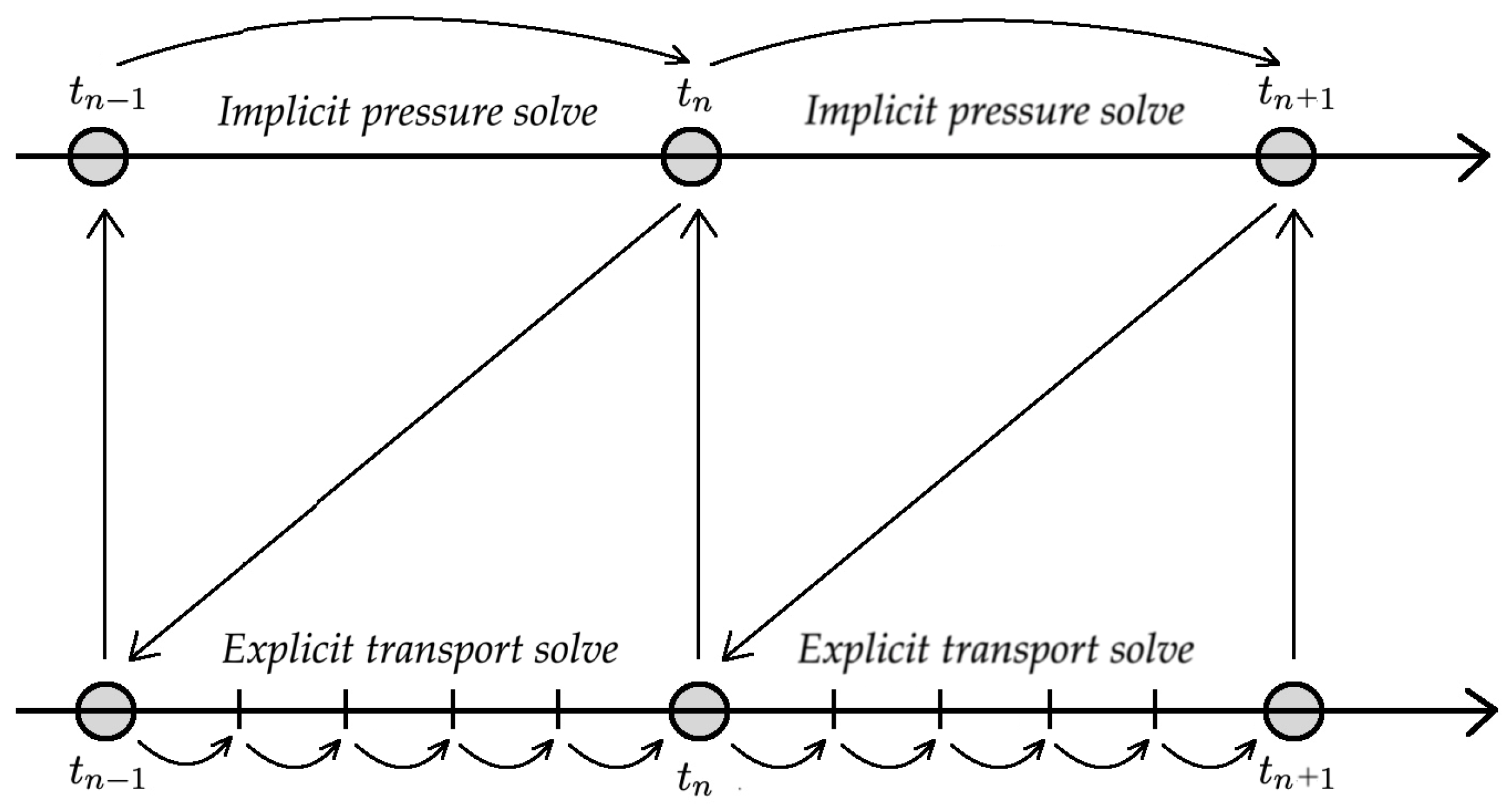
31]. To reduce the cost associated with the pressure solution, we first apply a loose coupling approach. Loose coupling is closely related to the operator-splitting techniques and mutilate time stepping [
32]. We apply a loose coupling algorithm to run a transport solve with a minor time step, which is restricted by the stability of the explicit approximation, and call an implicit pressure to solve with a coarser time step. The loosely coupled scheme is typical for multiphysics problems, where different time scales can characterize each sub-problems. In [
33], the loose coupling algorithm is used for coupled fluid flow and geomechanical deformation simulation. In [
34], the study of the partitioned solution procedure for thermomechanical coupling was presented, where a separate time integration scheme solves each sub-problem. The multirate iterative schemes for the poroelasticity problem are presented in [
35], where the multirate iterative coupling scheme exploits the different time scales for the mechanics and flow problems by taking multiple finer time steps for flow within one coarse mechanics time step. In [
32], the physics-based two-level operator splitting is used for two-phase flow problems with a multiscale solver for pressure solving. The two-level operator splitting is based on the split into the three sub-systems (elliptic in the pressure equation, hyperbolic, and parabolic in the saturation equation). The multiscale finite volume element method is applied for the elliptic and parabolic sub-systems.
In this work, we combine operator-splitting techniques with a multiscale approach for polymer flooding processes in heterogeneous porous media. Motivated by a loose coupling approach presented for a two-phase flow problem in [
32], we extend it and investigate for the polymer flooding process, where for the pressure equation upscaling, we use a multiscale method with an online local correction process. The construction of reduced order model is based on the Generalized Multiscale Finite Element Method (GMsFEM). In GMsFEM, we construct multiscale basis functions on the offline stage for a given heterogeneous field; then, we use them to define the projection/prolongation matrix and construct a coarse grid approximation. However, for accurate solutions to nonlinear problems, the multiscale basis function should incorporate information about the current solution (saturation, concentration, and pressure). Such basis reconstruction is computationally expensive and leads to the regeneration of the projection matrix [
36,
37,
38]. In this work, we propose a local online correction technique for the nonlinear pressure equation that arises in the simulation of the polymer flooding process. In local online correction, we use local residual information to correct the current multiscale solution in a set of non-overlapping local domains. Next, we construct the splitted multiscale approach based on the additive representation of the pressure matrix. We propose decoupling related to the multicontinuum types of problems for separating the primary continuum from others [
39]. Furthermore, we can associate such splitting with separating the part related to the regular coarse grid approximation and the remaining part for the local spectral enrichment. The presented technique provides an accurate solution for the nonlinear velocity field, leading to accurate, explicit calculations of the saturation and concentration equations. We present numerical results for two-dimensional model problems with different polymer injection regimes for two hetergeneity fields. To test the presented coupled and splitted multiscale method, we investigate the influence of coarse grid size, the number of multiscale basis functions, the effect of the correction step, and loose coupling on the method’s accuracy.
The paper is organized as follows. In
Section 2, we present a problem formulation with a basic mathematical model of the polymer flooding process and consider the construction of the discrete problem on the fine grid using a finite volume method, an explicit transport scheme and loose coupling with an implicit pressure solve. In
Section 3, we construct a coupled and splitted multiscale method for the solution of the flow equation on the coarse grid, where we introduce offline and online stages with a local residual-based correction for nonlinear pressure problems. A numerical investigation is presented in
Section 4 for two-dimensional model problems with different polymer injection regimes for two hetergeneity fields. Finally, the conclusion is presented.
3. Multiscale Model Reduction
We construct a coarse scale approximation for the pressure equation using the Generalized Multiscale Finite Element Method (GMsFEM). In GMsFEM, we construct a multiscale basis function to capture the behavior of the solution at a fine scale. The GMsFEM approach involves two stages: offline and online. In the offline stage, we define local domains (subdomains), construct multiscale basis functions by solving the local eigenvalue problems, and generate a projection matrix. In the online stage, we project fine-scale problems onto the multiscale space using a projection matrix and solve a reduced-order problem on the coarse grid. The solution obtained using GMsFEM provides an accurate representation of the multiscale behavior on the coarse scale grid and can be downscaled to the fine-scale resolution using a projection matrix. Finally, after calculating the pressure equation using the multiscale method, we calculate a saturation and concentration on the fine grid using explicit formulas.
The accuracy of the transport problem solution highly depends on the accuracy of the nonlinear velocity field that is calculated based on the current pressure distribution. To address this issue, we propose an additional online correction step that can significantly reduce the error of the multiscale method. The correction step is based on the local calculations in the subdomains using information about the current residuals.
3.1. Offline Stage
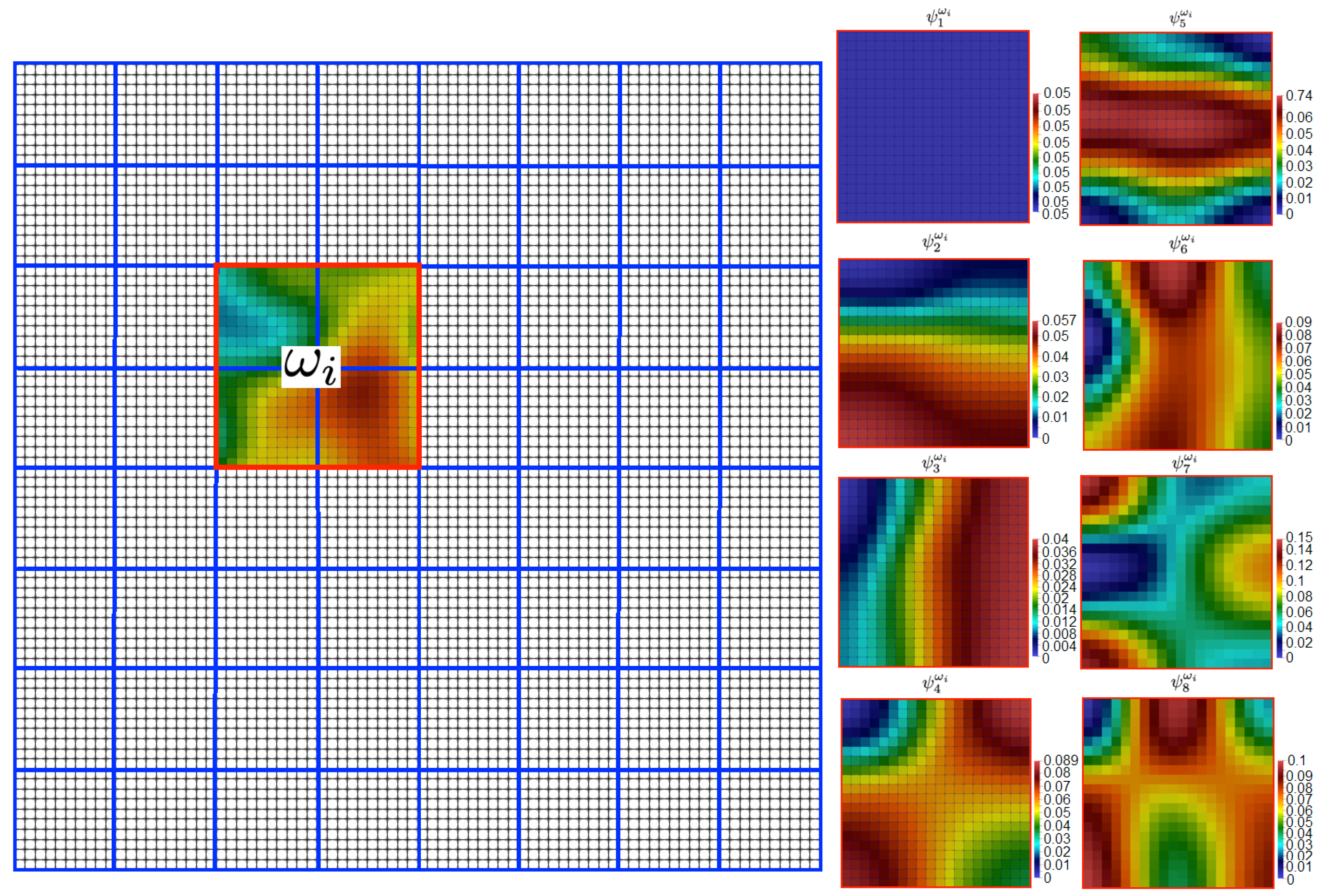
Let
be the coarse grid with cells
, and
is the local domain related to the coarse grid node that is constructed as a combination of the several coarse cells that contains the corresponding coarse grid node (see
Figure 3).
In order to construct multiscale basis functions on the offline stage for the nonlinear problem, we use a linear part of the pressure equation. In each local domain
, we solve the following eigenvalue problem
with
where
and
is the number of coarse grid cells in the local domain
.
Next, we choose eigenvectors that correspond to the smallest
eigenvalue (
) and create a projection matrix
where
is the linear partition of unity functions, and
is the number of the local domains (number of coarse grid nodes).
3.2. Online Stage
Once the projection matrix is constructed, the GMsFEM can be used to solve the problem on the coarse scale, taking advantage of the reduced dimension.
We use constructed multiscale basis functions to solve the pressure equation on the coarse grid. We use the projection matrix
R to project the fine grid system to the coarse grid
with
After the solution of the reduced system, we reconstruct a fine grid solution
Note that the size of the system is , is the number of local multiscale basis functions in and is the number of coarse grid vertices. For the numerical investigation, we set to take the same number of basis functions in each local domain (), and therefore, we have . The convergence of the presented method depends on a number of local basis functions and coarse grid size.
Then, on the online stage, we have the following algorithm for the transport and flow problem with loose coupling:
Initialize saturation, concentration and pressure fields using initial conditions , , and project pressure onto the coarse grid .
For each time iteration ():
- -
If the remainder of dividing n by is equal to zero ( is the given number). Then, Implicit pressure solve.
Generate a fine scale matrix and right-hand side vector ( and ), project the system onto coarse grid ( and ), solve the system of the linear Equation (12) to find and downscale the solution to fine grid .
- -
Explicit transport solve.
Update saturation and concentration using explicit formulas on the fine grid:
where
and
are calculated using a multiscale solution
and
.
The accuracy of the transport problem solution highly depends on the accuracy of the nonlinear velocity field that is calculated based on the current pressure distribution. To address this issue, we propose an additional online correction step that can significantly reduce the error of the multiscale method.
3.3. Online Residual-Based Local Correction
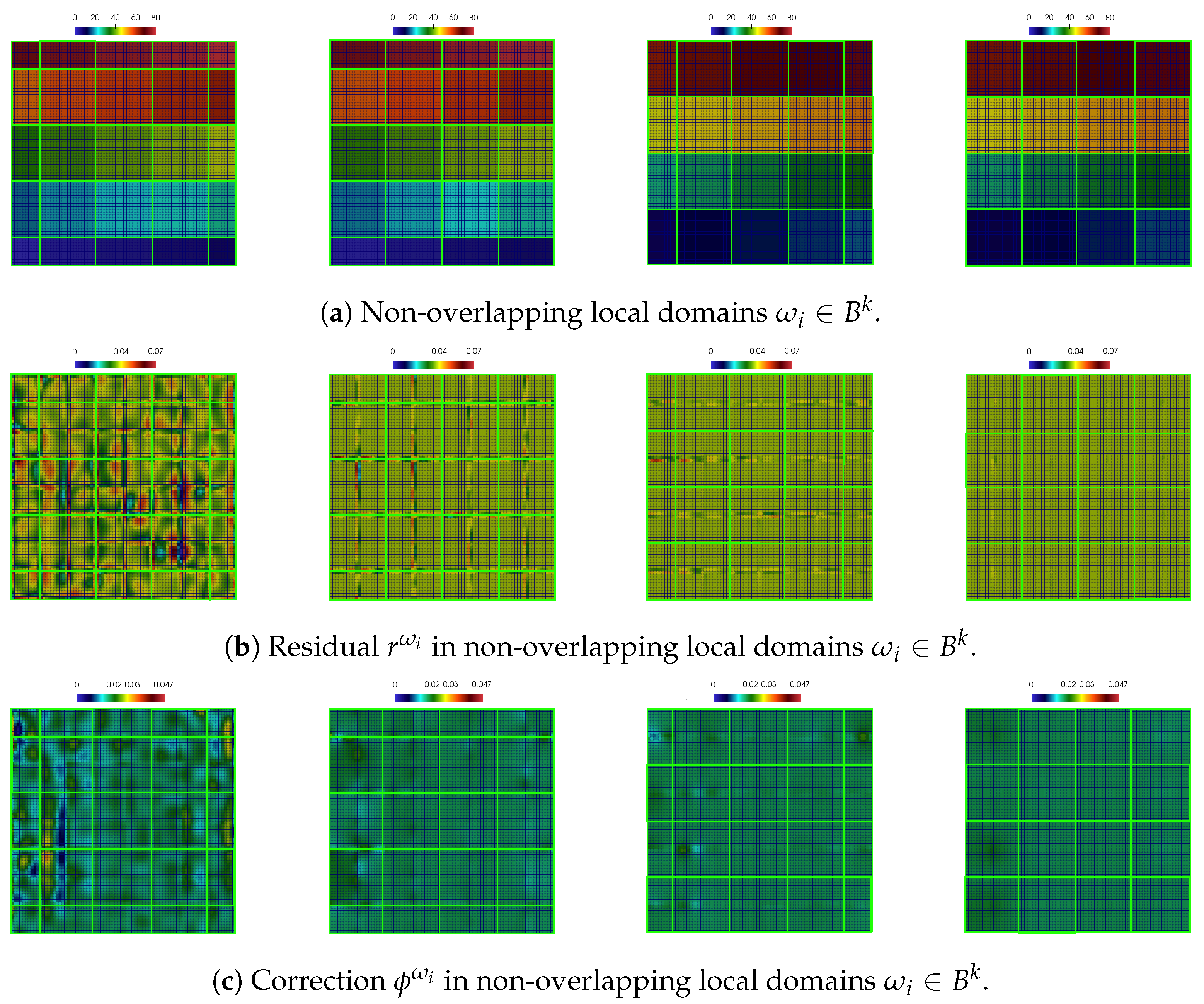
The correction step is based on the local calculations in the subdomains using information about the current residuals. After the solution of the pressure Equation (12), in each local domain, we find a local residual and solve the following local problem in
with
with zero Dirichlet boundary conditions except for the global boundary, where we set a zero Newman boundary condition.
We construct a local correction
in a non-overlapping set of local domains
, where for the quadratic coarse cells, we have for sets of local domains (see the first row in
Figure 4). The correction function in the
kth set of subdomains is used to update the solution
where
is the solution of Problem (12) and
with
We have the following algorithm:
Initialize saturation, concentration, and pressure fields using initial conditions , , and project pressure onto the coarse grid .
For each time iteration ():
- -
If the remainder of dividing n by is equal to zero ( is the given number). Then, Implicit pressure solve.
- *
Generate fine scale matrix and right-hand side vector ( and ), project system onto coarse grid ( and ), solve system of linear Equation (12) to find and downscale the solution to fine grid .
- *
For each set of non-oversampling local domains , iteratively calculate local corrections in and update current solution using (19) and (20).
- -
Explicit transport solve.
Update saturation and concentration using explicit Formula (15) with .
The proposed online correction, similar to the multiscale basis functions calculations, is based on the local calculations in a non-overlapping set of local domains . For the case of quadratic cells, we have four sets of non-overlapping subdomains. Moreover, this additional step does not affect the size of the coarse scale system.
3.4. Multiscale Splitting Approach
A regular multiscale method (GMsFEM), considered above, leads to the solution of the coupled system of equations related to a number of basis functions with size
. Next, instead of the solution of the coupled system of linear equations on each time step, we use an additive representation of the matrix to construct an uncoupled scheme for the pressure equation. In this work, we propose a decoupling related to the multicontinuum types of problems to separate the primary continuum from others [
39]. Furthermore, we know that the first eigenvalue is the constant, and therefore, the resulting first basis is the regular bi-linear partition of the unity function. Therefore, we can associate such a type of splitting with the separation of the part related to the regular coarse grid approximation and remain a part with the local spectral enrichment. This approach is highly connected with our recent work [
39], where we proposed a novel splitting algorithm for the flow in fractured porous media.
Let
, where
is constructed based on the first basis function for each local domain, and
contains the remaining basis functions, i.e.,
Then, instead of (12), we can use the following form of the coarse-scale system of pressure
where
The construction of the multiscale splitting approach is based on an additive representation of the pressure operator
with
Here, we approximate the coupling term in the first equation using the previous time layer and obtain the following multiscale splitting scheme
where
is the known solution from the previous time layer.
Such a representation leads to the independent calculations of the problems related to the first basis, and all remain basis functions
This system is decoupled, and allows us to first calculate solution and then find using .
Finally, we have the following algorithm:
Initialize saturation, concentration, and pressure fields using initial conditions , , and project pressure onto the coarse grid .
For each time iteration ():
- -
If the remainder of dividing n by is equal to zero ( is the given number). Then, Implicit pressure solve.
- *
Generate fine scale matrix and right-hand side vector (
and
), and project system onto coarse grid
Solve system of linear equations to find
Solve system of linear equations to find
Downscale the solution to fine grid with .
- *
For each set of non-oversampling local domains , iteratively calculate local corrections in and update current solution using (19) and (20).
- -
Explicit transport solve.
Update saturation and concentration using explicit Formula (15) with .
4. Numerical Results
We consider the solution of the flow and transport in heterogeneous porous media (
). We set source terms
,
on left and right boundaries. For the nonlinear coefficient, we use
and
,
,
,
and
[
4,
7,
9]. We consider two permeability fields for the numerical investigation. Both permeabilities are generated using the Karhunen–Loéve expansion [
40,
41]. The Gaussian covariance matrix is used with with correlation lengths
,
for Heterogeneity-1 and
,
for Heterogeneity-2.
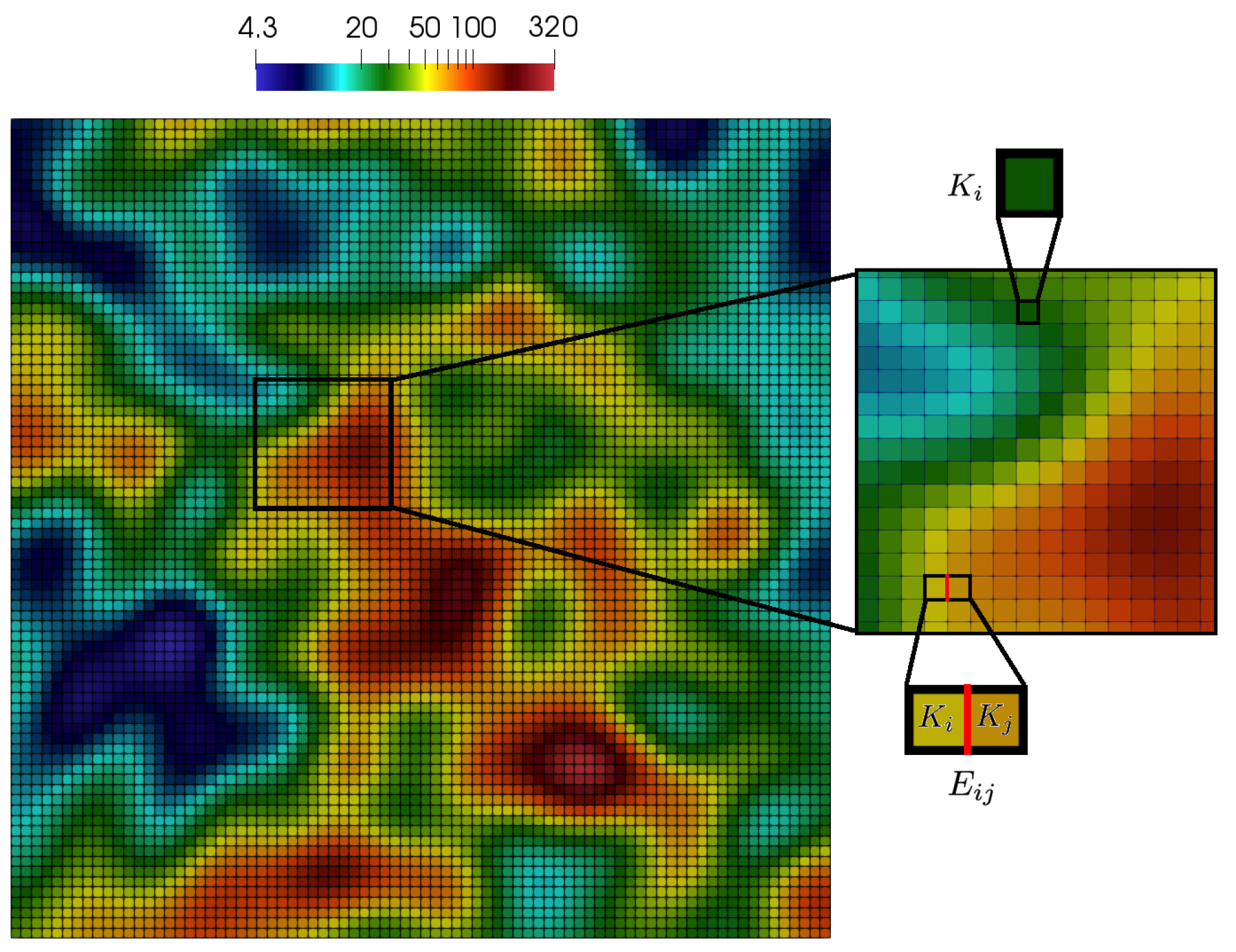
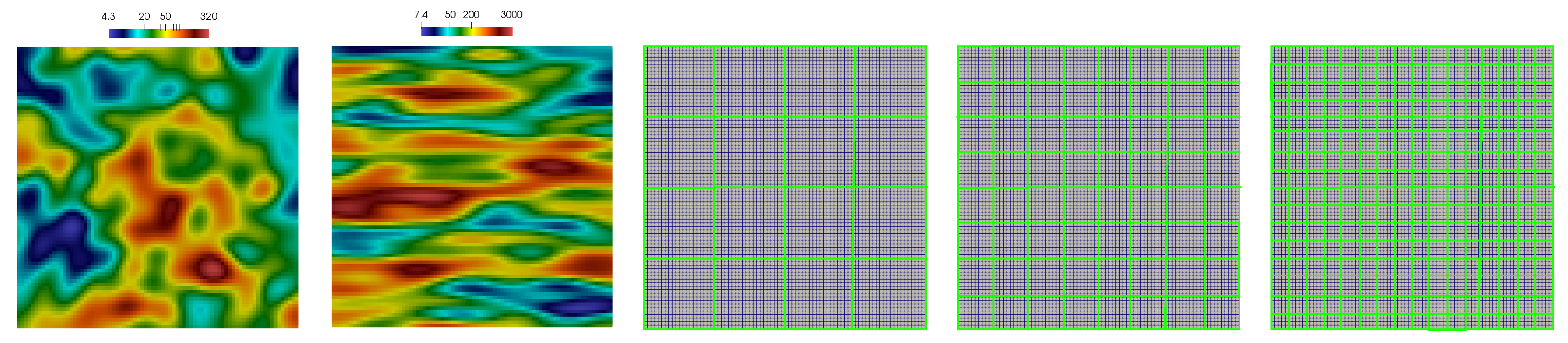
Figure 5 shows a permeability
for Heterogeneity-1 and Heterogeneity-2. The fine grid is
, and the coarse grid is
,
and
(see
Figure 5).
We consider four test problems with different polymer injection options:
Test 1. Pure water injection: and for .
Test 2. Injection of polymer in first 100 time steps: , for and , for .
Test 3. Injection of polymer in first 200 time steps: , for and , for .
Test 4. Injection of polymer: , for .
We set initial conditions , and simulate 500 time steps with for Heterogeneity-1 and for Heterogeneity-2.
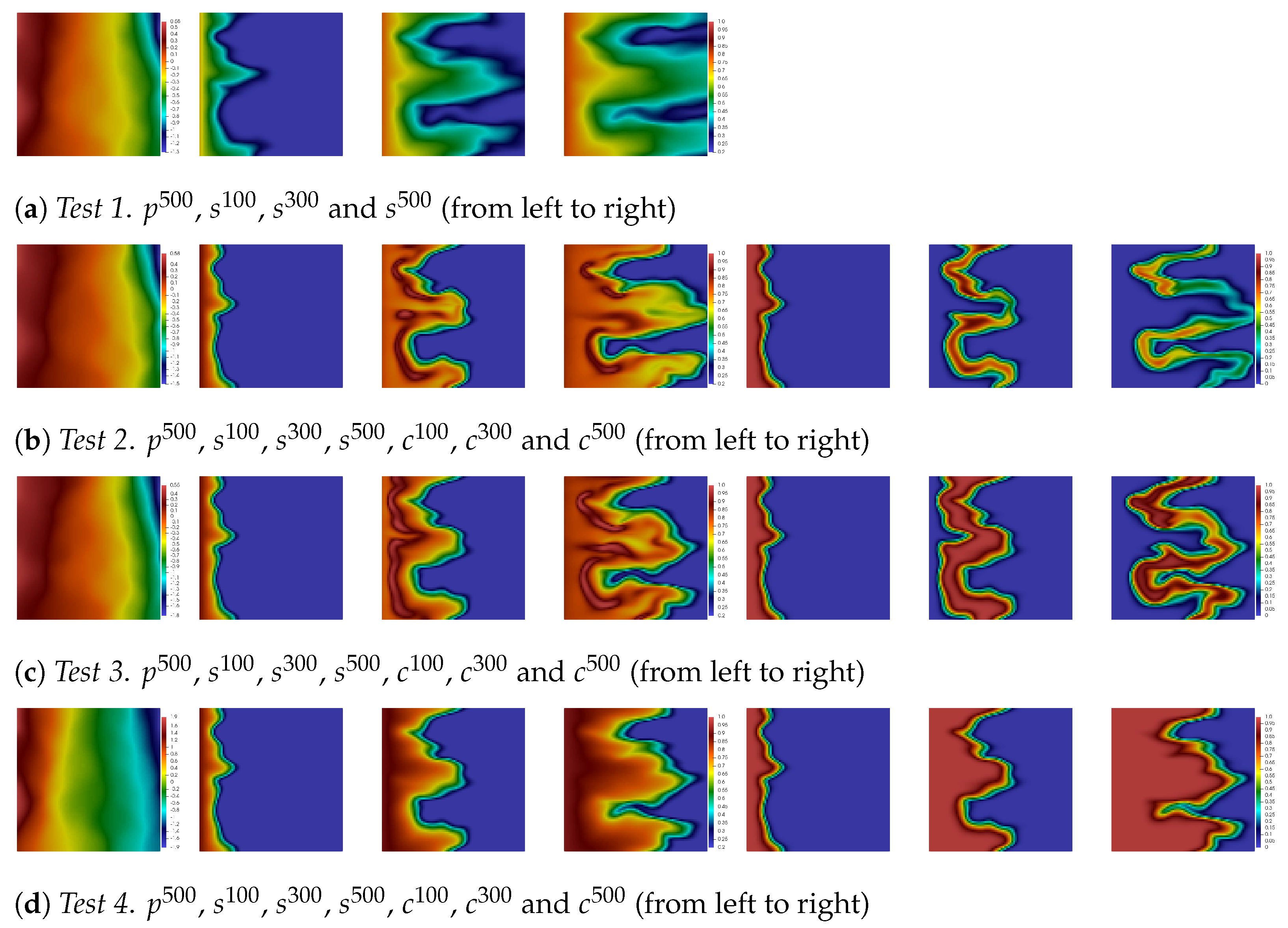
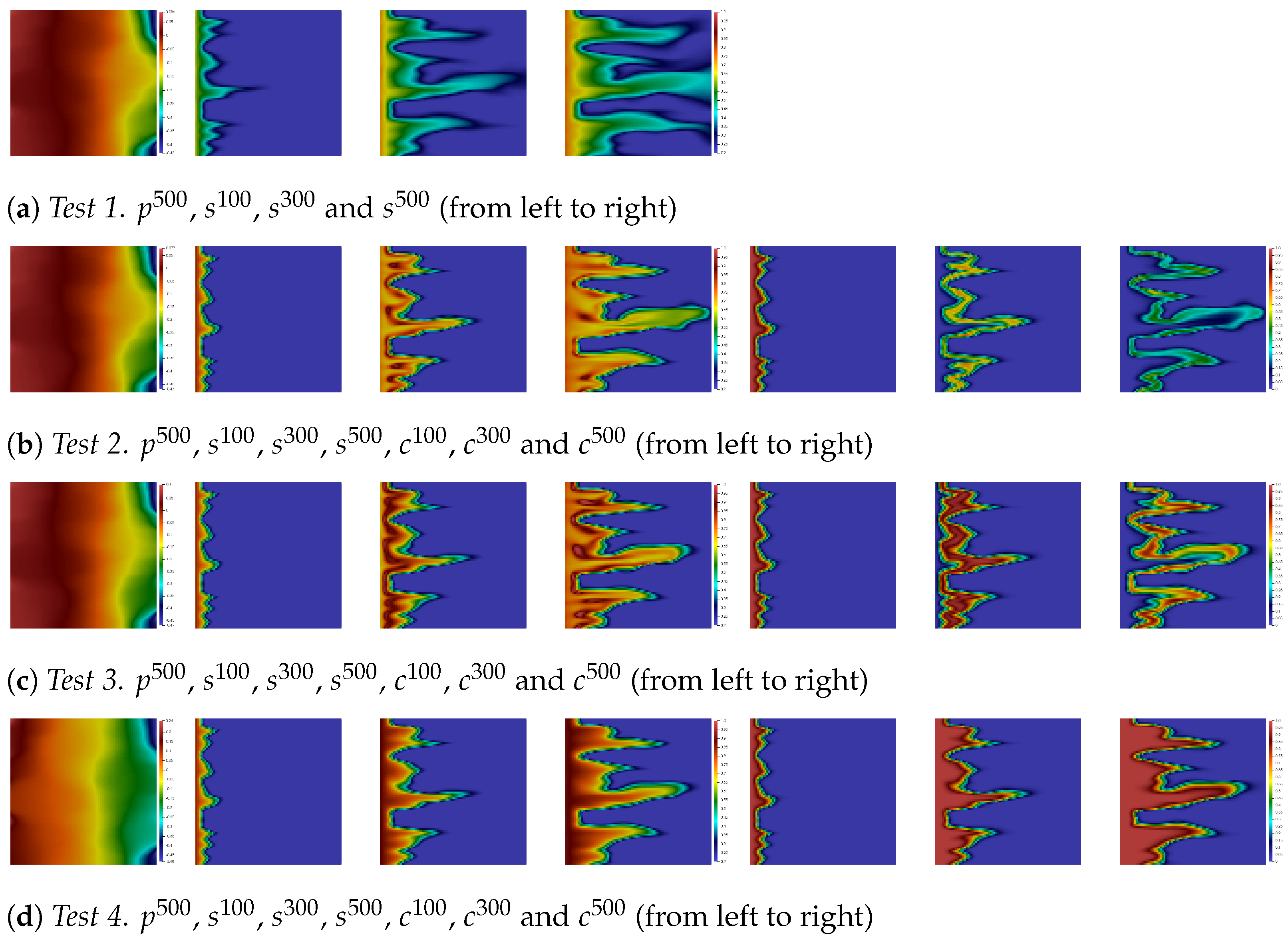
In
Figure 6 and
Figure 7, we depict the reference (fine grid) solution for Heterogeneity-1 and Heterogeneity-2, respectively. The simulation results are presented for Test 1, 2, 3 and 4 (from top to bottom). The pressure, saturation and concentration,
,
,
,
,
,
and
are depicted from left to right. We observe a significant influence of the heterogeneity field on the solution, where both probabilities are highly heterogeneous, and Heterogeneity-2 exhibits channelized features. Moreover, in
Figure 6 and
Figure 7, we observe a comparison between different polymer injection options in Test 1, 2, 3 and 4.
To compare the accuracy of the presented multiscale method and splitting techniques, we use the relative
error in percentage for the saturation, concentration and pressure fields. Additionally, we calculate errors for the total and wetting phase velocity fields. We use the corresponding fine-grid solution for each test problem as a reference solution. The errors are calculated using the following formulas on the fine grid:
using the
norm
Here, n is the time layer; , and are the reference (fine grid) solution; , and are the solution using the multiscale method.
Additionally, we calculate errors for the wetting phase velocity and total velocity
where
and
are the wetting and total velocities calculated based on the fine grid solution (reference solution);
and
are the multiscale solutions based on wetting and total velocities. The accuracy of the velocity field directly affects the explicitly calculated saturation and concentration field errors.
Next, we present the numerical study results for the splitted multiscale approach. We start with the traditional coupled multiscale approach, where pressure is solved using the generalized multiscale finite element method with and without an online correction. We vary a number of multiscale basis functions to investigate the influence on the method’s accuracy. Then, we present results for the splitted multiscale approach, where we decouple part of the equation related to the first basis function or primary continuum [
39,
42]. Finally, we combine the multiscale splitting approach with the loose coupling approach for transport and pressure equations.
4.1. Multiscale Method with Online Correction
We consider the traditional coupled multiscale approach, where pressure is solved using a generalized multiscale finite element method with and without online correction. We vary a number of multiscale basis functions to investigate the influence on the method’s accuracy. We start with Heterogeneity-1.
In
Table 1,
Table 2 and
Table 3, we present relative errors for three coarse grids
,
and
for Heterogeneity-1. We start by discussing the multiscale approximation results without a local correction step. We observe good results for all test cases with a sufficient number of multiscale basis functions for the pressure that can provide a good approximations of fluxes. For example, when we take 16 multiscale basis functions, we have less than one percent of error for the pressure field on the
coarse grid in all tests (see
Table 1). However, the wetting phase velocity error is significant (6.7%, 8.4%, 9.3%, and 6.4% for Test 1, 2, 3 and 4, which directly affects the saturation and concentration. For example, we have 5.4% and 6.5% of errors for saturation and concentration in Test 2. In Test 4, we observe more minor errors with 3.7% and 1.5% for saturation and concentration. On the
coarse grid compared with the
grid, we observe better results for the wetting phase velocity. For 16 multiscale basis functions, we obtain nearly one percent of the velocity error, which directly affects the saturation and concentration errors. We provide results with 0.9–1.3% for saturation and 0.2–1.5% for concentration (
Table 2). For the
coarse grid, we obtain less than one percent of errors for velocity, saturation, and concentration for all test cases using 12 and 16 basis functions (
Table 3). Furthermore, we obtain a more significant error in Test 2and the slightest error in Test 4in all coarse grids.
Next, we consider results with the local online correction and discuss the effect of the correction on the errors of the velocity field and the corresponding saturation and concentration errors. From the presented results in
Table 1,
Table 2 and
Table 3, we observe a considerable error reduction after the application of the presented local correction step using residual information. In
Table 1, we reduce the saturation error from 16% to 1.9% using the online correction step for the case with four multiscale basis functions in Test 1. In Test 4, we have 27%, 19%, and 14% of errors for the wetting phase velocity, saturation, and concentration using four basis functions. For the algorithm with a local online correction, we reduce errors to 2.4%, 1.3%, and 0.6% for wetting phase velocity, saturation, and concentration. In Test 2 and 3, we obtain excellent results for the online correction for the multiscale solution with eight basis functions, where we have 0.8 and 1.3% of error for saturation and concentration in Test 2, and 0.6 and 1.1% of error for saturation and concentration in Test 2. However, we obtain an excellent error reduction only when we use a sufficient number of preconstructed basis functions. On the finer coarse grid (
in
Table 2 and
in
Table 3), we observe good results for all test cases using four multiscale basis functions and two multiscale basis functions for
and
grids, respectively.
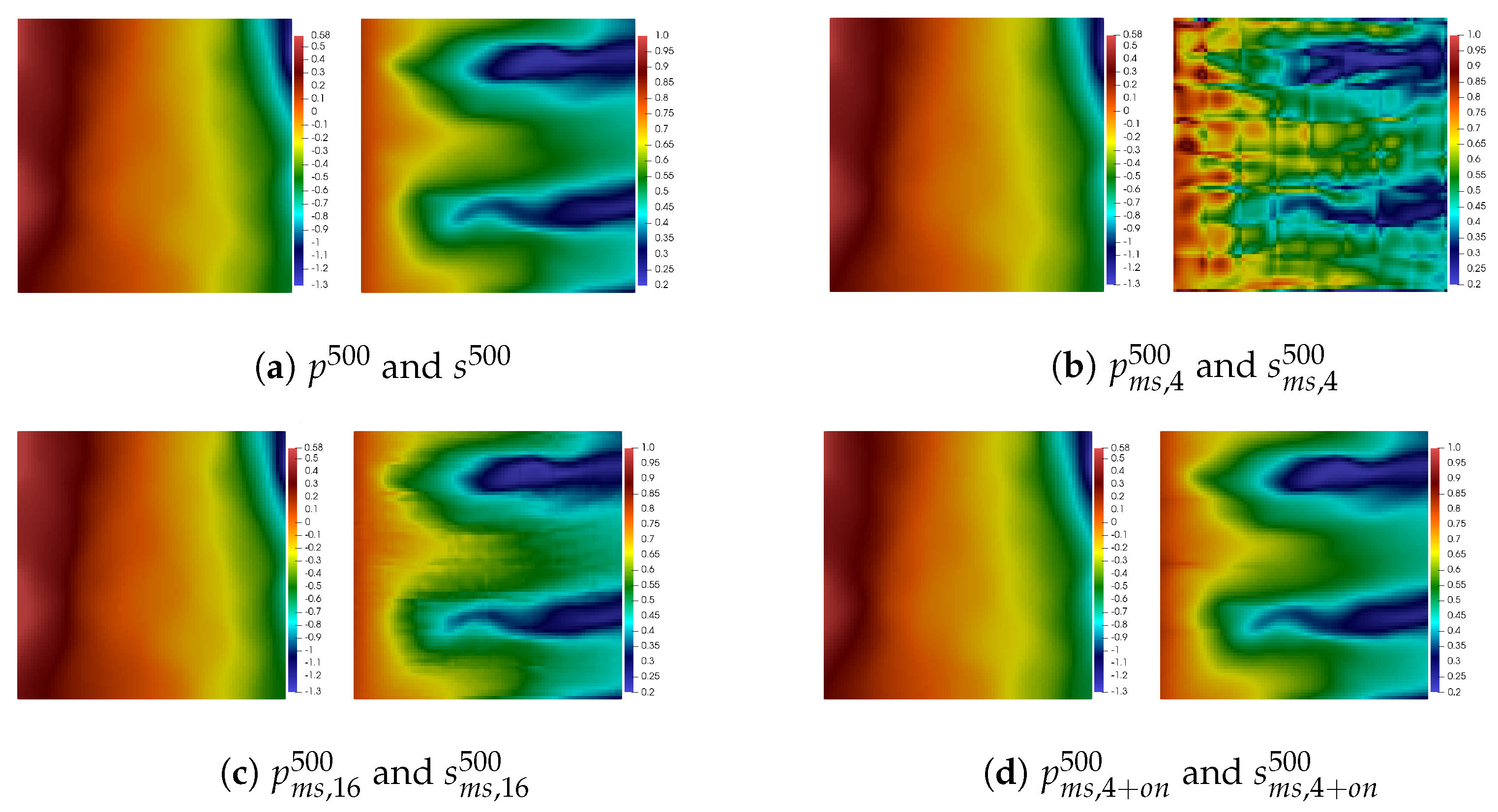
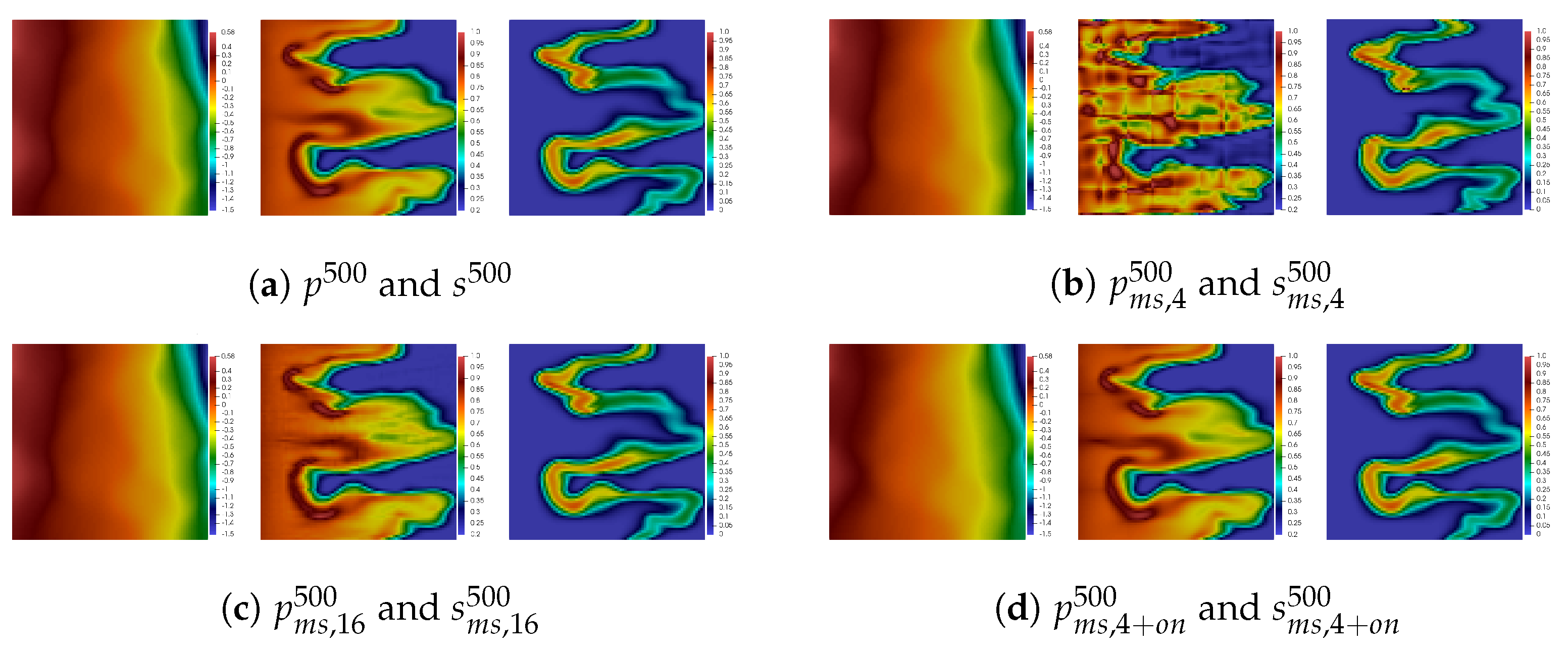
In
Figure 8,
Figure 9,
Figure 10 and
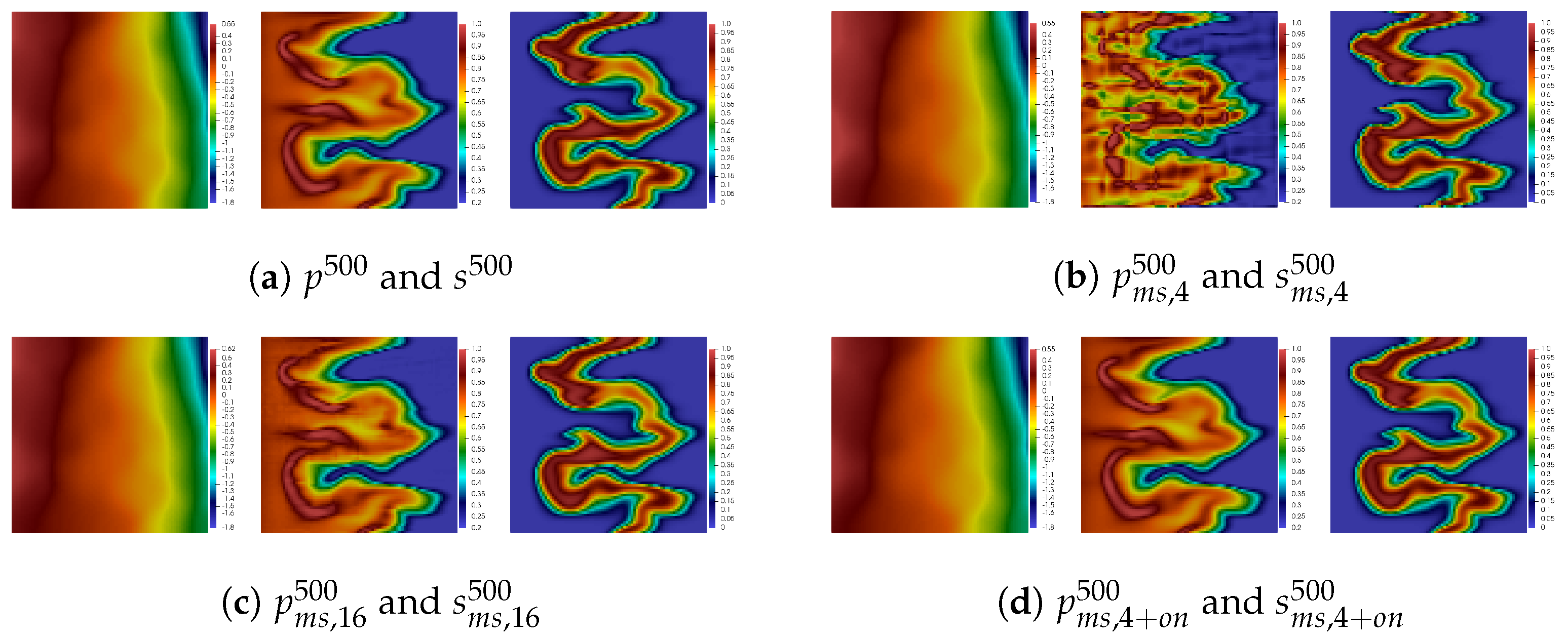
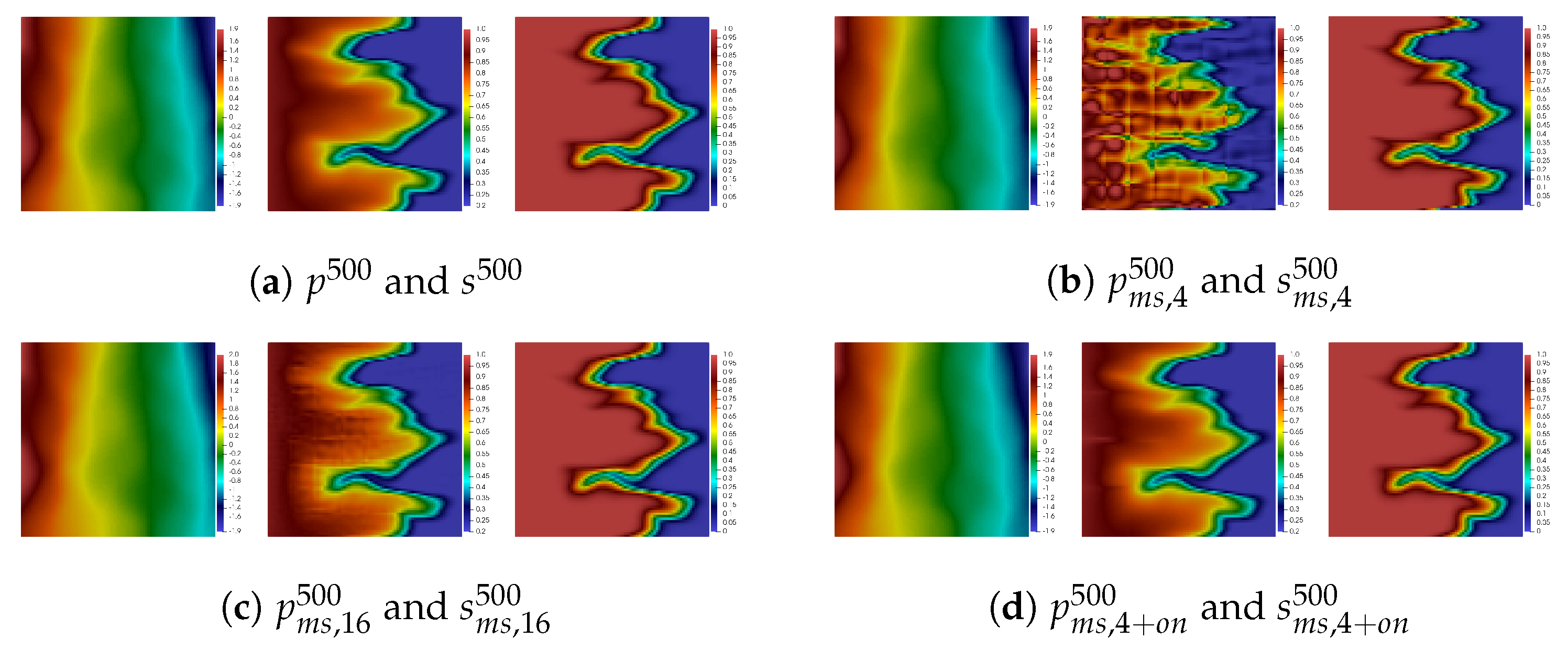
Figure 11, we depict results of numerical simulations at a final time for Tests 1, 2, 3 and 4 for Heterogeneity-1. In the first column, we depict a fine grid solution. The results using the presented multiscale method using four multiscale basis functions without and with online correction are depicted in the second and third columns. In the last fourth column, we demonstrate the results of the multiscale method using 16 multiscale basis functions without online correction. From the presented results of fine grid simulations, we observe a strong influence of the polymer concentration on the final saturation (see
Figure 8 and
Figure 11 for Tests 1 and 4). The effect of the polymer injection duration is represented in
Figure 9 and
Figure 10 for Tests 2 and 3.
In
Figure 8, the results illustrate the accuracy of the presented multiscale solver for the solution of the two-phase flow problem (Test 1, no polymer injection). From the second and fourth columns, we observe the slight influence of a number of multiscale basis functions on the pressure field. However, the explicitly calculated fine grid saturation has a considerable difference. Moreover, the presented approach with local residual-based correction provides excellent results for the case with four multiscale basis functions.
In
Figure 9 and
Figure 10, we consider Tests 2 and 3, where polymer injection is given at the first 100 and 200 time steps, respectively (total number of time steps is 500). The concentration and pressure fields look accurate for the case with 4 and 16 multiscale basis functions without correction. However, the saturation field is susceptible to the number of bases, and the four functions are insufficient for obtaining good results. However, the proposed local online correction provides great results.
Numerical results for the Test 4 are presented in
Figure 11. Similarly to the previous test problems, we observe a considerable influence of the number of basis functions on the final saturation solution.
Next, we consider test cases for Heterogeneity-2. In
Table 4, we present relative errors for an
coarse grid. We observe good results for all test cases with a sufficient number of multiscale basis functions for the pressure that can provide good approximations of fluxes. Moreover, we observe the effect of the online correction step that works great with a sufficient number of multiscale basis functions for all test cases of the polymer injection for Heterogeneity-2. In the channelized permeability field, we observe significant errors for the multiscale method without a correction step compared. However, online correction leads to very accurate results with fewer basis functions. For example, using the online correction step, we have
of error for concentration using four multiscale basis functions and
using eight multiscale basis functions in the
Test 2 for Heterogeneity-1. For Heterogeneity-2, we have
of error for concentration using four multiscale basis functions and
using eight multiscale basis functions in the
Test 2.
For the multiscale solution of the pressure equation, we observe that the online local residual-based correction provides an excellent error reduction for the velocity field, leading to accurate calculations of the saturation and concentration problems. From the presented results in
Table 1,
Table 2 and
Table 3, we also observe the effect of the coarse grid size and a number of local multiscale basis functions on the method accuracy, where a finer coarse grid leads to the minor error with a smaller number of basis functions. The effect of the heterogeneity field on the method accuracy is investigated.
4.2. Splitted Multiscale Approach
We present results for the splitted multiscale approach, where we decouple part of the equation related to the first basis function or primary continuum.
In
Table 5 and
Table 6, we present the errors at the final time for a splitted multiscale approach. The calculation is performed on the
coarse grid. By system splitting, we separate the equations for the first and all other continua. The resulting errors are minor for the pressure field but lead to more significant errors for concentrations in the case without online correction. For example, we have
,
,
and
for the regular coupled multiscale method, and
,
,
and
for the splitted multiscale method in Test 3 with Heterogeneity-1 (see
Table 2 and
Table 5). In Test 3 for Heterogeneity-2, we have
,
,
and
for the regular coupled multiscale method, and
,
,
and
for the splitted multiscale method in Test 3 (see
Table 4 and
Table 6) However, we observe accurate results for the case with online correction. In this case, correction reduces the error of multiscale offline basis functions and is remarkable for the splitting approach. Therefore, we can use a splitting approach for the polymer flooding processes with an online correction step to reduce errors. Note that the error behavior is similar for two types of heterogeneity.
4.3. Loose Coupling
Finally, we combine a multiscale splitting approach with a loose coupling technique for transport and pressure equations. We consider the traditional and splitted multiscale approaches with two values of the loose coupling parameter and 5.
In
Table 7 and
Table 8, we present results for the loose coupling approach for Heterogeneity-1 and Heterogeneity-2. In the loose coupling approach, we calculate pressure if the remainder of dividing
n by 2 is equal to zero. For
, we observe good results with almost the same errors except Test 2, where the minimum error for concentration was 0.03% using 16 multiscale basis functions with online correction compared with 1.9% for the case for loose coupling. We obtain a slightly bigger error by comparing traditional coupled and splitted multiscale approaches. Overall, we can state that the results with online correction work great for the splitted multiscale method with loose coupling. Moreover, we observe that the loose coupling works better for Heterogeneity-2 with more minor errors.
In
Table 9 and
Table 10, we present results for the loose coupling approach, where we calculate pressure if dividing
n by 5 equals zero. Therefore, with the total number of iterations of 500, we calculate pressure only 100 times. From the results, we observe that the errors highly vary for different test cases; in the Tests 2 and 3, the errors increase significantly for both coupled and splitted multiscale approaches.
For example, in Test 3 for Heterogeneity-1, the concentration errors are
and
without and with online correction for eight multiscale functions. For loose coupling with
, we obtain
and
, respectively. In Test 2 for Heterogeneity-1, the concentration errors are
and
without and with online correction for eight multiscale functions. For loose coupling with
, we obtain
and
, respectively. Overall, we observe a significant effect of the polymer injection schemes on the error behavior of the presented loose coupled splitted multiscale method with online correction, where the most complex case is related to the shorter injection time in Test 2, which leads to the thinner polymer concentration profiles (see
Figure 6 and
Figure 7). The multiscale method for Tests 2 and 3 works worse than for Test 4 with continuous injection for all methods (
Table 9 and
Table 10).