


Abstract
In the present work, we prove a result concerning an ordering over intuitionistic fuzzy pairs generated by the power mean () for . We also introduce a family of orderings over intuitionistic fuzzy pairs generated by the weighted power mean () and prove that a similar result holds for them. The considered orderings in a natural way extend the classical partial ordering and allow the comparison of previously incomparable alternatives. In the process of proving these properties, we establish some inequalities involving logarithms which may be of interest by themselves. We also show that there exists for which a finite set of alternatives, satisfying some reasonable requirements, some of which were not comparable under the classical ordering, has all its elements comparable under the new ordering. Finally, we provide some examples for the possible use of these orderings to a set of alternatives, which are in the form of intuitionistic fuzzy pairs as well as to results from InterCriteria Analysis.
MSC:
03E72; 26D07
1. Introduction
Decision making under uncertainty, especially when the data are represented by intuitionistic fuzzy values or intuitionistic fuzzy interval values, has gained increasing interest in recent decades [1,2,3,4,5,6,7,8,9]. Recent research has been concentrated on the reduction in redundant information from the set of considered alternatives without affecting the quality of the decision [10], finding approaches applicable to cases with incomplete or missing evaluations [11], or finding approaches that are suitable for multi-attribute decision making [12,13], while others were focused on investigating the relationships between different possible orderings and their advantages and disadvantages [9,14,15,16].
Intuitionistic fuzzy pairs (IFPs) may be viewed as single-point intuitionistic fuzzy sets (see [17]), all of which are associated with the same element. Different orderings were defined over IFPs. The two classical ones are due to Atanassov [18] as well as Bustince and Burillo [19] (the latter one was also studied in detail by E. Marinov [20]). In order to select certain IFPs among some which are incomparable under the classical ordering of Atanassov, another ordering has to be used. The approaches usually used either employ a ranking function which produces a real-valued number, thus implying a linear order, or some distance measure to which also provides a real-valued number as a result. Our approach slightly differs from that, since we consider the families of partial orderings which tend towards linear ordering as certain parameters grow. In a previous investigation, two of the authors of the present work first introduced the component biased power mean-based ordering between IFPs, denoted by [21]. It is, in a way, the natural generalization of Atanassov’s classical ordering, which in terms of power mean, may be stated as
The main contributions of the current work are:
- The establishment of the fact that, for if then for any ,
- The introduction of a new ordering—a first component biased weighted power mean-based ordering —which has the same property both for and for any
- Providing the necessary and sufficient conditions for the possibility to make any two alternatives from a set of IFPs comparable under some of these orderings stated as Proposition 1.
The considered families of orderings ( and ), thus provide an opportunity for a more flexible yet consistent way of comparing a larger selection of IFPs, which are incomparable under the classical ordering. In terms of the orderings between the closed subintervals of the unit interval introduced by Bustince et al. in [8], these families of orderings may be considered admissible successive refinements of the partial order as p and/or grows.
The paper is organized as follows: Section 2 provides the basic definitions and auxiliary results which will be further used. Section 3 provides proofs of the properties of the considered families of orderings. Section 4 establishes the necessary and sufficient condition to make any two alternatives from a set of IFPs comparable under some of these orderings, providing examples for the possible applications of the orderings based on that, as well as a comparison with the results obtained by other existing orderings from the literature. Section 5 provides a brief overview of the results and outlines future directions for research.
2. Preliminaries and Auxiliary Results
Here, we provide a concise description of the notions and auxiliary results that will be required for the formulation and proof of our main results.
Definition 1
(cf. [22]). An intuitionistic fuzzy pair is an ordered couple of real non-negative numbers such that:
This concept is important in practice since many methods implementing intuitionistic fuzzy techniques generate estimates in the form of IFPs. One such example is the InterCriteria Analysis (ICrA). For these estimates, the first component usually has a sense of validity, similarity, or some form of agreement or parity, while the second component signifies falsity, distance, or some form of disagreement or disparity, etc. When a choice between two IFPs is required, an ordering (or an appropriate ranking method) must be used.
The classical partial ordering introduced by Atanassov (see [18]) is given by
Definition 2
(cf. [18,22]). For two IFPs: and we say that u is less or equal to and we write:
iff
It is readily obvious that ≤ is only partial ordering, since it is transitive, reflexive, and antisymmetric but there exist u and for which (2) is not satisfied. For instance, the pairs and are not comparable under classical ordering.
Other classical ordering worth mentioning is outlined as follows.
Definition 3
(cf. [19,20]). For two IFPs: and we say that u precedes and we write:
iff
This ordering, called -ordering by E. Marinov, is in some sense counterpart to classical ordering. Indeed, excluding the cases of simultaneous equalities in (3) and (2), we have that, if two elements are comparable under one of these orderings, they are incomparable under the other.
Definition 4
([23], p. 175). The power mean of two non-negative numbers is given by:
Special cases (obtained as a limit) of the power mean worth mentioning are the following:
The power mean has the following nice property [23] (p. 175):
Definition 5
(cf. [23], p. 175). The power mean with the weight α of two non-negative numbers is given by:
where
Definition 6
([21]). Given two IFPs and , we say that u is the first component biased power mean-based with a value of p less or equal to v and write if
Definition 7.
Given two IFPs and , we say that u is the first component biased power mean with a weight of α based on a value of p, which is less than or equal to v, and write if
Remark 1.
If we consider the IFP as corresponding to the closed subinterval we can see that the ordering introduced in [8] as:
is equivalent to (see Definition 2):
Therefore, any refinement on partial order ≥ (from Definition 2) would also be a refinement on As we shall further prove, implies which in turn implies for we can thus introduce the successive admissible (partial) linear orders
which, as p grows, refine the previous (partial) order (see Theorem 1 in Section 3). In the same line of reasoning (see Theorem 2 in Section 3), we can introduce the family of admissible orderings which are successive refinements of the ordering as α approaches 1:
Further, we will make use of
Lemma 1.
For any constant and for all , the following inequality is fulfilled:
Proof.
Consider the function
defined for all .
It is increasing in the interval since
and has a minimum for Since, from the condition of Lemma 1, it follows that we have for
□
We will also require the following
Lemma 2.
Let Then, for all and , it is true that
Proof.
We rewrite (11) as:
The left-hand side (LHS) of (12) is obviously increasing with Let us consider the right-hand side (RHS) and denote it by We will show that decreases with t on the interval We have
Using the fact that, for ,
when which is obviously true in our case, we obtain:
Hence, g decreases with t on the interval Thus, we conclude that the minimum value of on the interval is obtained for
Since the LHS of (12) is increasing with it will also reach its maximum value for Hence, if we establish that
we will complete the proof. After simplification, this is equivalent to
which is equivalent to
The last can be simplified to (since ):
i.e., we need to establish that
However, since we have
□
3. Main Results
We are now ready to formulate our main results.
Theorem 1.
Let and If
for some then
for all
Proof.
From (1) and the first inequality of (6), we have If the statement of Theorem 1 is obviously valid. Furthermore, without loss of generality, we will assume Let us denote that
Thus, without loss of generality, we may assume that The statement of Theorem 1 is equivalent to the following:
If
we have
for all
Without loss of generality, we can rewrite (18) as
where and we have In the same manner, (19) is equivalent to
Let us assume that (otherwise, the statement is obvious) and it is true that
for some
Let us now consider the first derivative of We have
The sign of depends on the sign of
Putting and from the fact that using Lemma 1, we obtain that while Hence, (23) is impossible as we have
□
This result permits us to consider all ordering generated by as a transition from a partial to linear ordering, which is obtained (as a limit) for Due to (17), we know that this ordering preserves the existing relations, i.e., they increase the number of comparable elements in a consistent manner.
The introduction of the weight allows us to fine-tune our orderings (while keeping them consistent), shifting them closer to the linear order by providing a higher priority to the first component.
Theorem 2.
Let and Let Then, if
for some we have
for all
Proof.
From (1) and the first inequality of (7), we have If the statement of Theorem 2 is obviously valid. Furthermore, without loss of generality, we will assume Let us denote
Thus, The statement of Theorem 2 (in this case) is equivalent to the following:
If
then, we have
for all
Without loss of generality, we can rewrite (26) as
where and we have In the same manner, (27) is equivalent to
Let us assume that (otherwise the statement is obvious) and that it is true that
for some
Let us consider the first derivative of with respect to x
where
The sign of solely depends on if
Putting and using the fact that there exists for which , by Lemma 2, we obtain that
Hence, (31) can never be true, since we have
□
Corollary 1.
Let and Let Then, if for some
it follows that
4. Possible Applications of the Obtained Results
Proposition 1.
Given a finite set of alternatives in the forms of IFPs, which does not contain the alternative (corresponding to total indeterminacy or complete lack of information), there always exists and (or) for which the alternatives are fully ordered under and (or) .
Proof.
Without loss of generality, we may assume that the set is
such that it is fulfilled for all
We will show that we can find such that all IFPs in the set are comparable under The elements for which or are already ordered under the classical ordering, so without loss of generality, we will assume
In other words, we have If, for a given we have then Therefore, we will further assume that
We will show that, if (35) is true, there exists an integer for which
To establish that fact, we observe that, from (35), it follows that we must have
The validity of (37) is easily established when we observe that it is equivalent to:
which is certainly true in view of and (35). We note that (36) is equivalent to
In view of (37), we see that the right-hand-side of (38) is decreasing as n grows, while the left-hand side is certainly increasing as n grows. Thus, (38) will be evidently true when
Since then for any positive constant c, there must exist a positive integer such that
and therefore, we established that (36) is valid for some Thus, for the same n, we have since (36) implies
Therefore, after going through all possible pairs, taking the maximum of all n-s and denoting it by , we obtain a set of alternatives that is fully ordered with respect to
In view of Corollary 1, it is evident that similar reasoning may be applied with respect to as we let it grow. □
Remark 2.
Note that introduced in the above proof, is clearly larger than the smallest value of for which the full ordering is obtained. However, since we were only interested in establishing the existence, and not concerned with the practical calculation of the said value, we would postpone the question of finding the smallest value for another time.
Furthermore, to better illustrate the implications of Proposition 1, we will consider two examples.
Example 1.
Let us be given the set of alternatives:
The only IFPs here, which are not comparable under the classical ordering, are and We can easily see that:
In fact, the value of p for which this ordering becomes true is Therefore, the set of alternatives for becomes linearly ordered under this power mean ordering and we have
If we instead use the weighted power mean ordering, we can, by using , achieve the same result for i.e.,
Example 2.
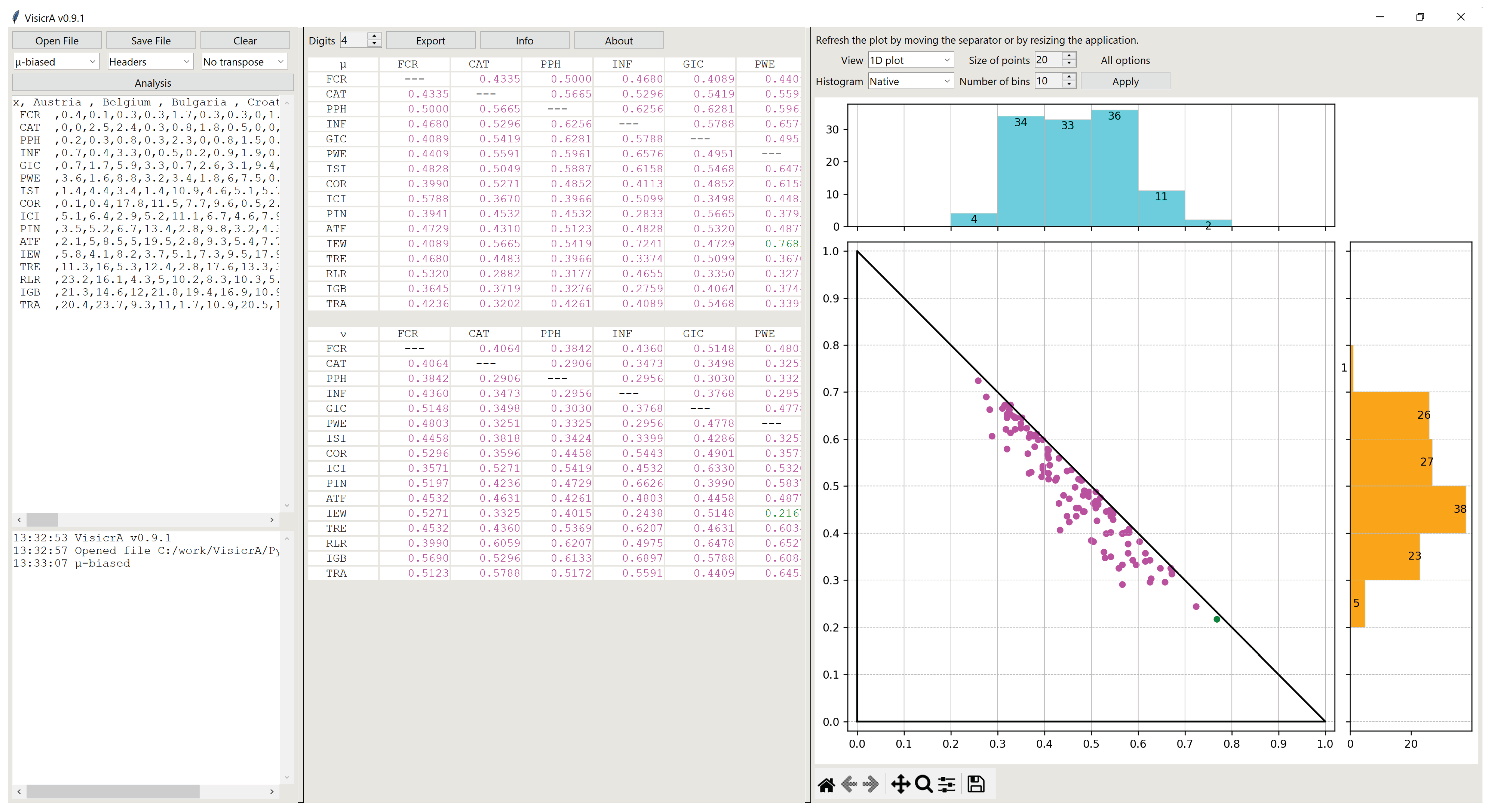
We consider the data used in [24], which we have processed using VisicrA software v.0.9.1 (developed in Python by N. Ikonomov), as shown in Figure 1.
Figure 1.
A view of the VisicrA software processing input data from [24].
The InterCriteria Analysis provides an estimation in the forms of IFPs, regarding the relationships between the different criteria. The factors considered in [24] are the following:
- Poor work ethic in national labor force (PWE);
- Access to financing (ATF);
- Corruption (COR);
- Crime and theft (CAT);
- Foreign currency regulations (FCR);
- Government instability/coups (GIC);
- Inadequate supply of infrastructure (ISI);
- Inadequately educated workforce (IEW);
- Inefficient government bureaucracy (IGB);
- Inflation (INF);
- Insufficient capacity to innovate (ICI);
- Policy instability (PIN);
- Poor public health (PPH);
- Restrictive labor regulations (RLR);
- Tax rates (TRA);
- Tax regulations (TRE).
We only concentrate our attention on the couples PWE-ISI, PWE-COR, PWE-ICI, PWE-PIN, PWE-ATF, PWE-IEW, PWE-TRE, PWE-RLR, PWE-IGB, and PWE-TRA, representing the relationship of PWE to the various other factors related to the incentive to do business, which InterCriteria Analysis evaluates as:
We can easily see that only two IFPs are incomparable by the classical ordering, namely those corresponding to PWE-TRE and PWE-IGB, with values and However, it is not difficult to observe that hence, we have (under ) the following order for the strength of the relations between the factors: PWE-RLR PWE-TRA PWE-TRE PWE-IGB PWE-PIN PWE-ICI PWE-ATF PWE-COR PWE-ISI PWE-IEW.
As can be seen from Example 2, our proposed orderings may be used over results from InterCriteria Analysis to obtain a linear order among them. At any rate, whether it is always appropriate to do so, and whether the considered orderings may infer counter-intuitive or even wrong conclusions, is a matter of a future research. Here, we only established the theoretical framework which permits enables us to implement this possibility in a consistent manner.
Furthermore, we will compare the result of the application of our orderings to previously proposed ones. We require the following definitions:
Definition 8
(cf. [25,26]). For the IFP , its score S and accuracy H are given by:
Definition 9
(cf. [2]). For two IFPs, the order is defined as follows:
Definition 10
(cf. [3]). For two IFPs, the order is defined as follows:
where
Definition 11
(cf. [5]). For two IFPs, the order is defined as follows:
where
Definition 12
(cf. [6]). For two IFPs, the order is defined as follows:
where
Definition 13
Definition 14
(cf. [9]). For two IFPs, the order is defined as follows:
where
Below, we present a comparison of the orderings over some IFPs.
In Table 1, signifies the smallest integer value for p after which the ordering is valid. It can be seen that ordering agrees well with most other orderings, specifically, , , and (the second example shows the opposite ordering after , but for cases where , i.e., the two orderings are actually equivalent). Therefore, it seems to be possible to use the proposed orderings as an auxiliary tool, for instance, when a majority voting regarding the correct ordering between two IFP alternatives is needed.
Table 1.
IFPs compared under the considered orderings.
We conclude this section with a final example showing how our results may be utilized for selection based on IFPs’ evaluations.
Example 3.
Further, we consider the selection of traveling by airplane. We suppose there are three feasible ways to travel from the starting destination to the target destination. The criteria that need to be satisfied are as follows —convenience of air travel; —reliability of travel; —total time to reaching final destination; and —total price of travel.
Convenience of travel signifies whether a flight is direct (as provided by suppliers and ), or whether it is with a transfer flight from the same or allied company (i.e., the luggage is automatically transferred)—as provided by supplier —or the second flight is provided by a different supplier, implying that the passenger will need to claim their luggage and check it in again (). The reliability of travel may be calculated by the number of executed flights and the number of canceled flights divided by all planned flights in the previous month. The total time required to reach the final destination includes an estimation of the expected duration of all flights with the use of some type of affordable public transport to the city center from the final airport. Note that airports located farther from the city may have limited means of transportation (or some may not be available after certain hour), as reflected in the IFPs’ values of and which although are not provided by the suppliers themselves, are nonetheless affected by the arrival times and the target airport, so it is fair to be attributed to them. The total price of travel includes all possible travel expenses plus the price for some reasonable refreshments (offered as a free service by suppliers and ) as shown in Table 2.
Table 2.
Choosing to travel by airplane according to criteria estimated as IFPs.
We consider three types of travelers , and whose preferences may be represented by the following weights:
As one can readily observe, the orderings of the suppliers by the criteria are as follows:
In order to provide a meaningful comparison, let us, by analogy with Definition 13, introduce:
fixing we obtain for the maximum theoretical value of from (48)–(50) (by substituting the value of , the best alternative among all suppliers) to be:
By calculating the actual values for each supplier, we obtain:
Thus, according to the score corresponding to we can conclude that the best choice for the type passenger is a direct flight by closely followed by a direct flight by , and the best choice is also valid for the type passenger; however, is preferred to in this case. Only —a type 3 passenger—would choose (based on the best price), a choice extremely closely followed by
Had we used the ordering from Definition 12, we would have obtained similar results to those shown in Table 3.
Table 3.
Z-order for the considered example.
However, for , the Z order asserts that is better than But in view of (52) and the fact that the highest weight of type passenger is focused on the reliability of travel, it would seem that our ordering provides a more reasonable suggestion.
5. Conclusions
In the present work, we constructed new orderings depending on the weighted power mean which allow us to compare a larger number of alternatives in the form of intuitionistic fuzzy pairs in a consistent manner. We proved that these orderings approach the linear ordering as the value of p grows to thus naturally allowing more intuitionistic fuzzy pairs to become comparable, while preserving the already existing order. We illustrated the possible application to a set of alternatives and to the results obtained from InterCriteria Analysis. We also compared our proposed orderings with the ones mostly used and have provided an example of their use. In future work, we will extend these approaches, if possible, to constructing other orderings depending on different generalized means over the intuitionistic fuzzy pairs, and we shall study their properties.
Author Contributions
Conceptualization, P.V., T.S. and L.T.; methodology, A.M. and V.A.; software, N.I. and A.M.; validation, L.T. and T.S.; formal analysis, P.V., T.S., N.I. and V.A.; investigation, P.V., A.M., N.I., L.T., T.S. and V.A.; writing—original draft preparation, P.V., T.S. and L.T.; writing—review and editing, A.M., V.A. and N.I.; visualization, N.I.; supervision, P.V. and L.T.; project administration, P.V. and T.S.; funding acquisition, P.V., L.T., T.S. and N.I. All authors have read and agreed to the published version of the manuscript.
Funding
This research was funded by the Bulgarian National Science Fund under grant number KP-06-N22-1/2018 “Theoretical research and applications of InterCriteria Analysis”.
Data Availability Statement
All the data in this study, as well as the software and data used in Example 2, is either contained in the Tables and Figures, or can be freely downloaded from the Software and Case studies sections of https://intercriteria.net/.
Conflicts of Interest
The authors declare no conflict of interest.
References
- Xu, Z. Intuitionistic preference relations and their application in group decision making. Inf. Sci. 2007, 177, 2363–2379. [Google Scholar] [CrossRef] [Scilit]
- Xu, Z.; Yager, R. Some geometric aggregation operators based on intuitionistic fuzzy sets. Int. J. Gen. Syst. 2006, 35, 417–433. [Google Scholar] [CrossRef] [Scilit]
- Zhang, X.; Xu, Z. A new method for ranking intuitionistic fuzzy values and its application in multiattribute decision making. Fuzzy Optim. Decis. Mak. 2012, 11, 135–146. [Google Scholar] [CrossRef] [Scilit]
- Liao, H.; Xu, Z. Priorities of intuitionistic fuzzy preference relation based on multiplicative consistency. IEEE Trans. Fuzzy Syst. 2014, 22, 1669–1681. [Google Scholar] [CrossRef] [Scilit]
- Szmidt, E.; Kacprzyk, J. Amount of information and its reliability in the ranking of Atanassov’s intuitionistic fuzzy alternatives. Stud. Comput. Intell. 2009, 222, 7–19. [Google Scholar]
- Guo, K. Amount of information and attitudinal-based method for ranking Atanassov’s intuitionistic fuzzy values. IEEE Trans. Fuzzy Syst. 2014, 22, 177–188. [Google Scholar] [CrossRef] [Scilit]
- Xing, Z.; Xiong, W.; Liu, H. A Euclidean approach for ranking intuitionistic fuzzy values. IEEE Trans. Fuzzy Syst. 2018, 26, 353–365. [Google Scholar] [CrossRef] [Scilit]
- Bustince, H.; Fernandez, J.; Kolesárová, A.; Mesiar, R. Generation of linear orders for intervals by means of aggregation functions. Fuzzy Sets Syst. 2013, 220, 69–77. [Google Scholar] [CrossRef] [Scilit]
- Huang, B.; Liu, J.; Guo, C.; Li, H.; Feng, G. Relative-distance-based approaches for ranking intuitionistic fuzzy values. Artif. Intell. Rev. 2021, 54, 3089–3114. [Google Scholar] [CrossRef] [Scilit]
- Ma, X.; Qin, H.; Abawajy, J.H. Interval-Valued Intuitionistic Fuzzy Soft Sets Based Decision-Making and Parameter Reduction. IEEE Trans. Fuzzy Syst. 2020, 30, 357–369. [Google Scholar] [CrossRef] [Scilit]
- Qin, H.; Li, H.; Ma, X.; Gong, Z.; Cheng, Y.; Fei, Q. Data Analysis Approach for Incomplete Interval-Valued Intuitionistic Fuzzy Soft Sets. Symmetry 2020, 12, 1061. [Google Scholar] [CrossRef] [Scilit]
- Dhankhar, C.; Kumar, K. Multi-attribute decision-making based on the advanced possibility degree measure of intuitionistic fuzzy numbers. Granul. Comput. 2023, 8, 467–478. [Google Scholar] [CrossRef] [Scilit]
- Zeng, S.; Chen, S.-M.; Kuo, L.-W. Multiattribute decision making based on novel score function of intuitionistic fuzzy values and modified VIKOR method. Inf. Sci. 2019, 488, 76–92. [Google Scholar] [CrossRef] [Scilit]
- Feng, F.; Liang, M.; Fujita, H.; Yager, R.R.; Liu, X. Lexicographic Orders of Intuitionistic Fuzzy Values and Their Relationships. Mathematics 2019, 7, 166. [Google Scholar] [CrossRef] [Scilit]
- Huang, Z.; Weng, S.; Lv, Y.; Liu, H. Ranking Method of Intuitionistic Fuzzy Numbers and Multiple Attribute Decision Making Based on the Probabilistic Dominance Relationship. Symmetry 2023, 15, 1001. [Google Scholar] [CrossRef] [Scilit]
- Szmidt, E.; Kacprzyk, K.; Bujnowski, P. To what extent can intuitionistic fuzzy options be ranked? Notes Intuitionistic Fuzzy Sets 2022, 28, 193–202. [Google Scholar] [CrossRef] [Scilit]
- Atanassov, K.T. Intuitionistic Fuzzy Sets. In Proceedings of the VII ITKR Session, Sofia, Bulgaria, 20–23 June 1983. (Deposed in Centr. Sci.-Techn. Library of the Bulg. Acad. of Sci., 1697/84) (In Bulgarian); Reprinted in Int. J. Bioautom. 2016, 20, S1–S6. (In English) [Google Scholar]
- Atanassov, K.T. On Intuitionistic Fuzzy Sets Theory; Springer: Berlin/Heidelberg, Germany, 2012. [Google Scholar]
- Bustince, H.; Burillo, P. Structures on intuitionistic fuzzy relations. Fuzzy Sets Syst. 1996, 78, 293–303. [Google Scholar] [CrossRef] [Scilit]
- Marinov, E. π-ordering and index of indeterminacy for intuitionistic fuzzy sets. In Modern Approaches in Fuzzy Sets, Intuitionistic Fuzzy Sets, Generalized Nets and Related Topics. Volume I: Foundations; IBS PAN-SRI PAS: Warsaw, Poland, 2014; pp. 129–138. [Google Scholar]
- Vassilev, P.; Stoyanov, T. On Power Mean Generated Orderings between Intuitionistic Fuzzy Pairs. In Advances in Fuzzy Logic and Technology 2017. EUSFLAT IWIFSGN 2017; Kacprzyk, J., Szmidt, E., Zadrożny, S., Atanassov, K., Krawczak, M., Eds.; Advances in Intelligent Systems and Computing; Springer: Cham, Switzerland, 2018; Volume 643, pp. 476–481. [Google Scholar] [CrossRef] [Scilit]
- Atanassov, K.; Szmidt, E.; Kacprzyk, J. On Intuitionistic Fuzzy Pairs. Notes Intuitionistic Fuzzy Sets 2013, 19, 1–13. [Google Scholar]
- Bullen, P.S. Handbook of Means and Their Inequalities; Kluwer Academic Publishers: Dordrecht, The Netherlands, 2003. [Google Scholar]
- Doukovska, L.; Atanassova, V. InterCriteria Analysis of the Most Problematic Factors for Doing Business in the European Union, 2017–2018. In Flexible Query Answering Systems. FQAS 2019; Cuzzocrea, A., Greco, S., Larsen, H., Saccà, D., Andreasen, T., Christiansen, H., Eds.; Lecture Notes in Computer Science; Springer: Cham, Switzerland, 2019; Volume 11529, pp. 353–360. [Google Scholar] [CrossRef] [Scilit]
- Chen, S.-M.; Tan, J.-M. Handling multicriteria fuzzy decision-making problems based on vague set theory. Fuzzy Sets Syst. 1994, 67, 163–172. [Google Scholar] [CrossRef] [Scilit]
- Hong, D.H.; Choi, C.-H. Multicriteria fuzzy decision-making problems based on vague set theory. Fuzzy Sets Syst. 2000, 114, 103–113. [Google Scholar] [CrossRef] [Scilit]


Disclaimer/Publisher’s Note: The statements, opinions and data contained in all publications are solely those of the individual author(s) and contributor(s) and not of MDPI and/or the editor(s). MDPI and/or the editor(s) disclaim responsibility for any injury to people or property resulting from any ideas, methods, instructions or products referred to in the content. |
© 2023 by the authors. Licensee MDPI, Basel, Switzerland. This article is an open access article distributed under the terms and conditions of the Creative Commons Attribution (CC BY) license (https://creativecommons.org/licenses/by/4.0/).