1. Introduction
Great attention has recently been paid to optimal control problems for the models of magnetohydrodynamics (MHD) for a viscous conducting incompressible fluid. There are a number of papers devoted to the theoretical study of such problems. Among these, we mention the papers [
1,
2,
3,
4,
5,
6,
7,
8], devoted to studying the control problems for a stationary MHD system, and papers [
9,
10,
11,
12], where the authors study control problems in a nonstationary case. In these papers, solvability of the control problems is proved, and optimality systems that describe the necessary conditions of the extremum are constructed and studied. In [
5], the uniqueness and stability of the solutions of control problems are studied for some particular cases.
Along with optimal control problems, inverse or identification problems for the MHD models as well as for other hydrodynamic models play a key role in applications. In these problems, some parameters (constant or functional) that are included into a boundary value problem under study are unknown and are required to be determined together with the solution by using additional information about the state of the system. It is significant that the identification problems can be reduced to appropriate control problems by choosing a suitable tracking-type cost functional. As a result, control and identification problems can be analyzed using a common approach based on the theory of smooth-convex extremum problems in Hilbert or Banach spaces [
13,
14] (see also [
15]).
In this paper, we study control problems for the stationary MHD model in which magnetohydrodynamic equations are considered under mixed boundary conditions for a magnetic field and under the Dirichlet boundary condition for velocity (see
Section 2). The role of controls in control problems under study is played by normal and tangential components of the magnetic field given on the different parts of the boundary and by exterior current density given within the flow region. Our goal is to construct a theory for studying local uniqueness and the stability of optimal solutions. Reaching of this goal will be based on generalization of the approach developed in [
5,
16] for studying the stability of optimal solutions for the stationary Navier–Stokes and MHD systems related to small perturbations of the cost functionals to be minimized. In this approach, there is no requirement to determine the second derivative of the cost functional under minimization, since it is based on the analysis of fundamental properties of the optimality system for the control problem under study and the use of special estimates for the difference of solutions of the original and perturbed control problems. The method is rather simple, natural and applicable for the models of hydrodynamics, heat convection, mass transfer and other hydrodynamic models based on the Navier–Stokes system [
15]. The use of this approach allows us to obtain stability estimates for optimal solutions with respect to small perturbations of the cost functional in an explicit and sufficiently easy-to-interpret form.
One of the features of this work consists in proving the solvability of optimal control problems under minimum requirements on normal and tangential components of the magnetic field given on the different parts of boundary and playing the role of controls in control problems. This result, in contrast to [
5], allows the use of simple
norms for the normal and tangential components of the magnetic field instead of the standard
norms of boundary controls as Tikhonov regularizers while studying control problems for the MHD system. This regularization is needed to prove the local uniqueness and stability of the control problem solutions. The latter is the main goal of the study.
The structure of this paper is as follows. In
Section 2, the boundary value problem is formulated for stationary MHD equations under inhomogeneous mixed boundary conditions for a magnetic field, and some notations that will be used throughout the paper are introduced along with the presentation of some additional facts that are necessary for studying optimal control problems. Presented in
Section 3 are two lemmas on the existence of lifting of the velocity and of the magnetic component of the solution of the boundary value problem under consideration. In addition, the unique solvability of a generalized linear analogue of the original MHD boundary value problem is proved. In
Section 4, two optimal control problems are formulated, and their solvability is proved, the optimality system describing the first-order necessary optimality conditions is derived and, on the basis of its analysis, the additional properties of optimal solutions are established. Finally, in
Section 5, we will prove the local uniqueness and stability of the solutions for the control problems for “magnetic field-tracking” or “velocity-tracking” cost functionals.
2. Statement of the Boundary Value Problem and Notation
While studying the flows of electrically conducting fluids in real-life devices, the necessity often arises in flows of conducting fluid modeling in domains with boundaries consisting of parts with different electrophysical properties. Mathematical modeling of conducting flows in such types of domains gives rise to the study of boundary value problems for MHD equations under the mixed boundary conditions for a magnetic field.
Let
be a bounded domain of space
with boundary
consisting of two parts
and
. In this paper, we study control problems for the stationary magnetohydrodynamic equations of a viscous incompressible fluid
considered in domain
under the following inhomogeneous boundary conditions:
Here
is the velocity vector,
and
are magnetic and electric fields, respectively,
, where
P is the pressure,
is a fluid density,
,
,
and
are constant kinematic and magnetic viscosity coefficients,
is a constant electrical conductivity,
is a constant magnetic permeability,
is the outer normal to
, and
is the exterior current density. Further, we will refer to problem (
1)–(
3) for given
and
as Problem 1. It should be noted that all the quantities used in (
1)–(
3) are dimensional and, moreover, their physical dimensions are defined in terms of SI units.
We emphasize that Equations (
1) and (
2) are considered under mixed boundary conditions with respect to electromagnetic field
in (
3). These conditions generalize two types of previously used boundary conditions. The first type is described by relations
and
on
, corresponding to a perfectly conducting boundary (see, e.g., [
2,
3,
4,
5,
17,
18,
19,
20]). The second type is described by the condition
on
(see [
8,
21,
22]) corresponding to a perfectly insulating boundary.
For the first time, global solvability of the homogeneous analogue of Problem 1 was proved in [
23]. In this work, mathematical tools from [
24,
25,
26] were essentially used. Global solvability of the inhomogeneous mixed Problem 1 was proved in [
27]. In [
28], the results obtained in [
27] were generalized for the model of heat conducting magnetohydrodynamics. It should be noted that papers [
29,
30,
31], magnetohydrodynamic equations are studied under mixed boundary conditions with respect to velocity and under the standard boundary conditions of the first type for an electromagnetic field. In [
32], the author proves the existence of a very weak solution of the MHD boundary value problem using the Dirichlet boundary condition for a magnetic field. In [
33], the MHD boundary value problem is studied in the case where a pressure and zero tangential velocity component are specified on an entire boundary. A local solvability of boundary value and boundary control problems for the model of magnetomicropolar flow is proved in paper [
6], where the optimality systems are also derived and analyzed for the control problem.
Papers [
4,
28] and a number of others study the solvability of boundary value problems for stationary and nonstationary magnetohydrodynamics–Boussinesq systems. In [
34], the authors study the properties of solutions (and, in particular, solvability) of the heat conducting magnetic hydrodynamic equations with the buoyancy effects due to temperature differences in the flow, Joule and viscous heating effects. In [
35,
36], the authors study the solvability of boundary value problems respectively for a steady or nonsteady MHD–Boussinesq system considered under mixed boundary conditions for temperature, magnetic field and velocity, in the general case when the thermal conductivity viscosity coefficient, electrical conductivity, magnetic permeability and specific heat of the fluid depend on the temperature.
We will assume below that the domain and the boundary partitioning into parts and satisfy
(i) is a bounded domain in the space , and its boundary consists of 1 disjoint closed – surfaces , ,…, , each of which has a finite area where is the outer boundary of .
(ii) Sets
and
are not empty, open and the following conditions take place:
The conditions in (ii) mean that each of the parts and consists of a finite number of connected components of the boundary .
It is assumed that, in the general case, is a multi-connected domain and by , we denote the number of handles of . The case corresponds to a simply connected domain.
The numbers
n and
m are respectively called the first and second Betti numbers (see, e.g., [
15] (p. 277) and [
37]). Typical examples of domain
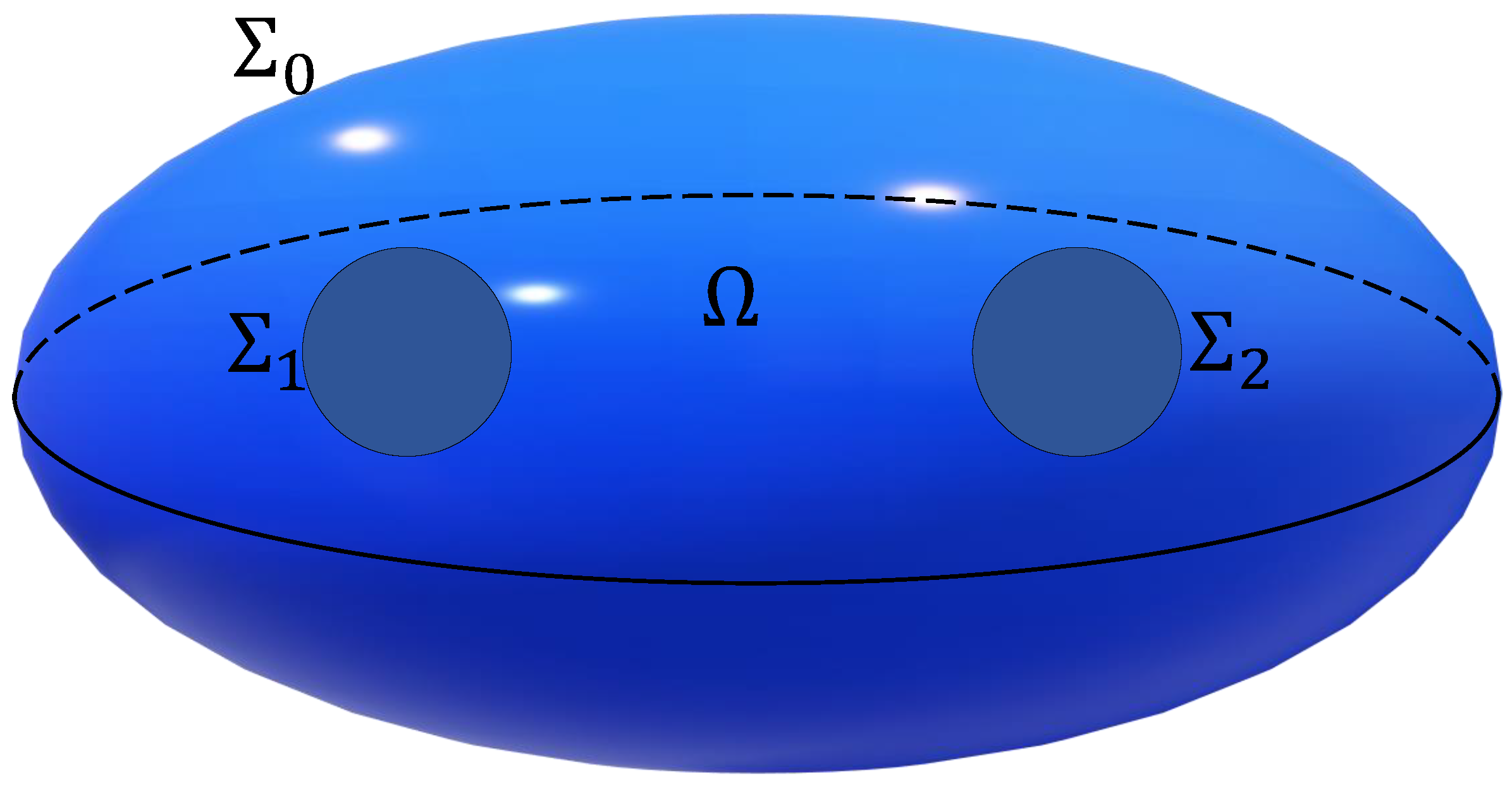
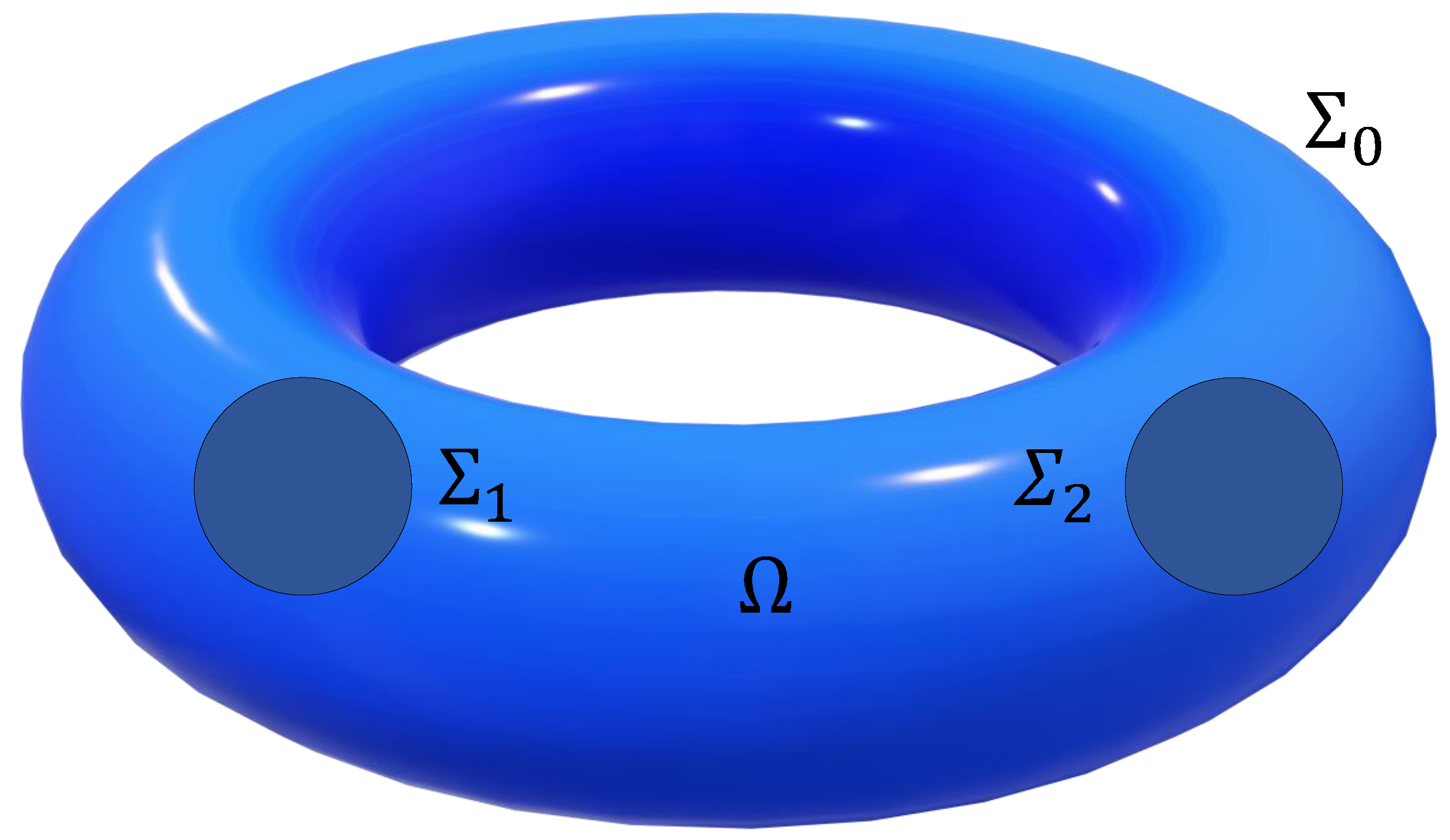
are shown in
Figure 1 and
Figure 2, where a simply connected domain
with a disjoint boundary
(with Betti numbers
and
) and multi-connected toroidal domain
with a disjoint boundary
(with Betti numbers
and
), respectively, are presented.
Similarly to [
37], we denote, by
+ 1, the number of connected components of the part
of the boundary
, by
,
we denote the internal connected components of the boundary
contained in
. It is clear that
if
and
if
. Similarly, by
(or
), we denote the number of handles of the part
(or
). Clearly,
(where
n is the number of handles of
).
Below we will use the Sobolev spaces , , , where D denotes or the boundary or a part . The corresponding spaces of vector functions are denoted by and . The inner products and norms in the spaces and are denoted by and . The inner products and norms in and are denoted by and . By and we denote norm and seminorm in or in . For arbitrary Hilbert space H by we denote the dual space of H. By we will denote the subspace in consisting of tangential on vector functions. Set , , for .
Let
be the space of infinitely differentiable compactly supported functions in
,
be the closure of
in
,
,
,
,
,
. In addition to the spaces defined above, we will use the spaces
,
,
and the space
, endowed with Hilbert norm defined by
Here
l is a dimensional factor of the dimension
, and its value is equal to 1,
denotes the SI dimension of the length (for more detail, see
Section 4).
Any vector defined on the boundary (or on a part ) can be decomposed to the sum of two vectors—the normal and tangential components and : . If , the components and are given by formulas and . Here decribes the normal component of field , describes the tangential vector orthogonal to the normal and to . It is clear that on if . By (or we denote the operator defined on , which is placed in correspondence to every function with the normal trace (or tangential trace ).
The following Green’s formulae (see, e.g., [
38]) will be used below:
If
or
the right-hand sides of (
5) or (
6) become
or
. Based on (
5), (
6) we say, following [
25], that the function
weakly satisfies condition
on
if
Similarly, we say that
weakly on
if
Let
be the closure of
with respect to norm
in (
4). Set
Equalities
,
or
,
in (
7) are understood in the weak sense defined above.
We remind that the spaces
and
are finite dimensional [
37]. In particular, the dimension of
under conditions (i), (ii) is exactly
, and the basis of the space
consists of gradients
of harmonic functions
,
satisfying boundary conditions
and harmonic vector fields
,
satisfying the condition
for any cycle
,
, contained in
and not homotopic to zero in
. Here and below,
is the Christoffel symbol equal to 1 at
and 0 at
.
Similarly, the basis of
consists of gradients
of harmonic functions
,
satisfying the boundary conditions
and harmonic vector fields
satisfying the condition
,
. Here
denotes a cicle contained in
that is not homotopic to zero in
.
A number of important properties inherent in the function spaces defined above and proved in [
25] are presented in the following lemma.
Lemma 1. We assume that conditions (i), (ii) hold. Then:
(1) and the norm is equivalent to the norm ;
(2) there is a positive constant depending on domain Ω and such that the following holds: (3) the orthogonal decomposition of the space holds: Along with the spaces
and
, their subspaces
will be used equipped, respectively, with norms
The spaces
and
will be used below as the solution spaces for magnetic and electric components, respectively. In turn, the spaces
will play the role of the solution spaces for velocity
. Besides Lemma 1, we also will use the following lemma (for details, see [
25,
26,
38]).
Lemma 2. Under condition (i) there exist constants , , , , , , depending on Ω such that Moreover, the following equality holds: The bilinear form defined by satisfies Below, when formulating a result on the existence of magnetic lifting, we will need the space
endowed with a norm
and its subspace
, with the norm
. Here
is the linear surface divergence operator on the part
of the boundary
(see [
15,
37]). In the case
, instead of
, we will write
.
Let the following conditions for the data take place in addition to conditions (i), (ii):
(iii) , ,
(iv) , , , .
As usual, while studying control problems for the MHD system, we will deal with a weak form of Problem 1. This consists of finding a triple of functions
satisfying
In order to obtain (
19), one should multiply the first relation in (
1) by
, the first relation in (
2) by rot
where
, to integrate over
, to apply Green’s formulas, to add the obtained results and to make use of the identity (see details in [
27])
The identity (
19) does not contain electric field
, which was eliminated with the help of (
21). However, using a condition on a boundary vector
in (iii), vector
can be uniquely recovered from triple
satisfying (
19) such that the first equation in relations (
2) holds a.e. in
(see [
27]). This allows us to refer, below, to the mentioned triple
satisfying relations (
19), (
20) as a weak solution to Problem 1.
3. Lifting of the Velocity and Magnetic Field, Solvability of Problem 1 and Its Linear Analogue
The proof of the existence of a solution of the inhomogeneous boundary value problem (
1)–(
3) essentially uses the results for the existence of lifting of the velocity and magnetic field corresponding to the boundary conditions in (
3). By velocity lifting, we mean the function
satisfying the boundary condition
. By magnetic field lifting, we mean the function
satisfying the mixed boundary conditions
and
. The existence of velocity lifting is ensured by the following lemma, proved in [
3].
Lemma 3. Under condition (i) for each function and arbitrary number , there is a function such that Here is a constant depending on ε and Ω.
The existence of the lifting of the magnetic part of the solution is ensured by the following result, which is a generalization of Theorem 4.2 in [
37], where it was proved in the case
.
Lemma 4. Let conditions (i), (ii) be satisfied. Then for any pair and , where , there exists a unique function such that Here is a constant independent of q and .
In what follows, the vector alone, defined in Lemma 4, will play the role of magnetic lifting for Problem 1.
Let us define two linear subspaces of
:
From Lemma 4, applied for the case
on
, it follows that for any function
, there exists a unique solution
of problem (
23) for
, while for any function
there exists a unique solution
of problem (
23) for the case
. Moreover, when
runs through
, its normal component
runs through the space
. Similarly, when
runs through the space
, its tangential component
runs through the space
.
Define the next products of spaces:
Along with Problem 1, when studying the control problems below, an important role will be played by a linear analogue of Problem 1. This consists of finding a triple
satisfying the functions
Here
is an arbitrary functional, “velocity”
, “magnetic field”
and
are given functions. In fact, we have somewhat generalized the linear analogue of Problem 1 by replacing the solenoidality condition
by the more general condition
. Another generalization is that by the functional
in (
26), we mean an arbitrary functional from
, which does not necessarily coincide with the functional
defined in (
19).
The following lemma about the unique solvability of problems (
26), (
27) holds.
Lemma 5. Let conditions (i), (ii) be satisfied. Then for any quintuple for arbitrary , there exists a unique solution of problems (26), (27), and for the solution the following estimates hold: Here , , are nondecreasing continuous functions of , , , , .
Proof of Lemma 5. The existence of the solution of (
26), (
27) and estimate (
28) are proved using the scheme proposed in [
3] (see also [
15], Chapter 6). For proving the uniqueness, let us assume that there exist two solutions
,
, of problem (
26), (
27). Then the quantities
,
and
belong to
and satisfy
Setting
,
in (
29) and using (
16), we arrive at the relation
where (
31) takes place by (
10), (
11) if
and
or
and
in
. Then from (
29), it follows that
for all
. This means by inf-sup condition (
17), that
or
in
. □
Let us rewrite the problem (
26), (
27) in an equivalent operator form. To this end, we put in correspondence with the bilinear continuous forms
linear continuous operators
,
,
, acting by
Using (
32), one can rewrite the identity (
26) in the equivalent operator form
Setting
, we define the operator
by
By construction,
belongs to the space of continuous linear operators
, and the original linear problems (
26), (
27) is equivalent to the operator equation
From Lemma 5, it follows that (
34) has a unique solution for any element
. This means that the operator
is surjective and invertible. Then it follows from Banach’s inverse operator theorem that the operator
is an isomorphism. Therefore, the following theorem holds.
Theorem 1. Let assumptions (i), (ii) be satisfied. Then the operator , which is defined by (32), (33), is the isomorphism of the space X into Y. We now formulate the following result concerning the sufficient conditions of the existence of the solution to Problem 1, which was proved in [
27].
Theorem 2. Under assumptions (i)–(iv) there exists a weak solution to Problem 1, and for this solution the following estimates hold: Here , and are nondecreasing continuous functions of norms , , , , , . If, besides, elements , and are small (or “viscosity coefficients” ν, are, vice versa, great) in the sensewhere constants , , , were defined in Lemmas 1 and 2, then the weak solution is unique. Remark 1. Theorem 2 was proved in [27] under an additional condition on function , namely that is a tangential vector on Σ. If this condition does not hold, i.e., , one can prove only the local solvability of Problem 1. Thus, the problem of global solvability of inhomogeneous problem (1)–(3) in the general case when is still an open problem (see related discussion in [15,22]). 4. Statement of Control Problems, Optimality System and Additional Properties of Optimal Solutions
We note that problems (
1)–(
3) contain constant parameters
and functional parameters—boundary functions
and “volume” source densities
and
. To solve problems (
1)–(
3), one must specify values of respective parameters, boundary functions and sources. In practice, however, some of their specific elements may be unknown, and one should determine them and the solution
using certain information about the solution.
In this section, control problems for the MHD system (
1)–(
3) will be considered, for which we prove their global solvability. These problems are to minimize the so-called cost functionals, which depend on the variables
of the main state and other unknown functions (controls) satisfying the state Equations (
1)–(
3). We will choose one specific cost functional:
Here the function
describes, in a subdomain
velocity field, given functions
and
have a similar sense for magnetic field or pressure. We note that functionals
are used to solve inverse problems for the MHD system (
1)–(
3) using the optimization method. This method was developed by A.N. Tikhonov in the process of creating the famous Tikhonov regularization method [
39]. Currently, the optimization method is one of the fundamental methods for solving inverse problems arising in electromagnetism, acoustics, fluid mechanics, heat and mass transfer, design of complicated technical devices and in other fields of physics, natural science and engineering (for more detail, see [
40,
41,
42,
43,
44,
45,
46,
47,
48,
49,
50,
51]).
As controls in this paper, we choose three functions: q, and . The function will play the role of distributed control, while q and will play the role of boundary controls in the control problems stated below. We assume that the functions q, and change over sets , and satisfying the following conditions:
(j) , , are nonempty convex closed sets.
Setting
,
, we define an operator
by
and rewrite the weak form (
19), (
20) of Problem 1 as operator equation
Let us introduce a functional and nonnegative parameters , , , , and let us presuppose that the following conditions take place, in addition to (j):
(jj) is a weakly lower semicontinuous cost functional;
(jjj) , , , and , , are limited sets, or , , and the functional is bounded below.
The following problem will be considered below:
The parameters
,
,
,
serve in regulating the relative contribution of each of the terms in (
40) and, moreover, to adjust their dimensions. Another purpose of using
is to ensure the uniqueness and stability for the control problems under study (see below). The last three terms in the structure of
J are penalization terms. In what follows, we will refer to these terms as regularizers (strong in the case
and weak for
). As will be shown in
Section 5, just the presence of these regularizers in the structure of the functionals under minimization will allow us to prove the theorems concerning both the uniqueness and stability for optimal solutions.
Let
,
,
be a set of possible pairs for problem (
40).
Theorem 3. Let the assumptions (i)–(iii), (j)–(jjj) hold, and let the set be nonempty. Then for arbitrary , the problem (40) has at least one solution . Proof of Theorem 3. Let us denote by
,
a minimizing sequence, for which
By the conditions of Theorem 3 and in virtue of Theorem 2, we have the following estimates for
,
,
,
,
,
:
Here
are some constants that do not depend on
m. From the given estimates, it follows that there are weak limits
,
,
,
,
,
of some subsequences of sequences
,
,
,
,
,
. As usual, one should consider that as
It is clear that
,
,
,
and
where
. Let us show that
, i.e., that
To this end, we note that
,
and
satisfy the identity
Let us pass to a limit in (
43) as
. From (
41), it follows that all linear terms in (
43) pass to corresponding linear terms in (
42) as
. Let us treat nonlinear terms beginning with
. Since
, then arguing as in [
3], we easily derive that
We now consider the second nonlinear term
in (
43). It is clear that
Let us prove firstly that for the first term in (
45), we have
For this purpose, it is sufficient to prove that for an arbitrary pair, a number
and a test function
, there exists a number
such that
As
is the closure of
by norm
, then for mentioned function
there exists a sequence
, converging to
by norm
as
. It is clear that for all
, we have
From (
41) follows that the norms
and
are uniformly bounded. Therefore for all
there exists a number
such that for the second term in the right-hand side of (
48) we have
Let us consider the first term on the right-hand side of (
48). Based on Hölder inequality for three functions, we have
Since
and
in
as
by (
41), then there exists a number
such that the estimate
holds for all
,
. From the obtained inequality and from (
48), (
49), the estimate (
47) follows. Since
is an arbitrary positive number, the relation (
46) is proved.
Now we turn to the second term on the right-hand side of (
45) and prove that
From the weak convergence of the sequence
in the space
, the weak convergence of
to
in
follows. As
, we have
Therefore, (
50) is proved. From (
46) and (
50), it follows from (
45) that
Using the analogous scheme, one can show that for the last nonlinear term in (
43), we have
As a result, passing to the limit in (
43) as
, we arrive by (
44), (
51) and (
52) at (
42). Finally, since
J below is weakly semicontinuous on
functional, we have that
. □
According to Theorem 3, the solution of the control problem (
40) exists for any value
. The case
, corresponding to weak regularizers when
,
, is physically the most interesting. Another physically interesting case is the control problem with weak regularizers having the form
provided that
for
as in the situation of problem (
40) with strong regularizers. Let the following additional condition apply:
(jv) ; , , and K is a bounded set in .
The proof of the following theorem is carried out analogously to the proof of Theorem 3.
Theorem 4. Let the assumptions (i)–(iii) and (j), (jj), (jv) hold, and let the set be nonempty. Then the problem (53) has a solutuion for any . Our next goal is to analyze the uniqueness and stability of the solutions of our control problems. For this purpose, we apply the technique developed in [
5], which is based on using the additional properties of optimal solutions obtained by analyzing the optimality system. Therefore, the next stage of our study is to obtain the required optimality system. For concreteness, we will consider the case of control problem (
40). Preliminarily, we define the spaces
which are dual of spaces
X and
Y defined in (
25).
By [
13], the derivation of the optimality system uses finding of the Fréchet partial derivative with respect to
of
defined in (
38). The simple analysis shows that the mentioned partial derivative at any point
is a linear continuous operator
, which associates every element
with the element
. Here the elements
,
,
,
,
are defined by the triples
and
from relations
By
, we denote the operator adjoint to
, which is defined by
Following to [
13] (Chapter 1), let us introduce an element
having the sense of an adjoint state and define the Lagrangian
where
by
Here and below,
,
or
denote the duality pairings between
and
, between
and
or between
and
, respectively. Based on the results of [
13] (Chapter 1), one can prove the following theorem about the justification of the Lagrange principle for problem (
40) and the regularity for the Lagrange multiplier
.
Theorem 5. Let, under assumptions (i)–(iii) and (j), (jjj), the element be a local minimizer for problem (40), and let the cost functional I have the continuous Fréchet derivative with respect to at . Then: (1) there is a nonvanishing Lagrange multiplier for which the Euler–Lagrange equationfor adjoint state is satisfied and the minimum principle holds, having the form (2) If, besides, condition (36) holds for each triple , then any nonvanishing Lagrange multiplier satisfying (56) is regular, i.e., . Moreover, it is determined uniquely if the value is given. Proof of Theorem 5. To prove statement 1 of Theorem 5 by [
13] Chapter 1 (see also [
15], Chapter 6), it is sufficient to prove that the operator
is a Fredholm operator. By virtue of (
54), the operator
can be written in the form
Here the operators
are defined by relations (
32) and (
33), while the operator
is defined by
Using estimates (
13)–(
15), we deduce that
Since the space
and the space
for any
are continuously and compactly embedded into the space
, then estimates (
60)–(
62) imply that the operator
where
is defined by (
59) is continuous and compact. In addition, it follows from Theorem 1 that the operator
, defined by relations (
32) and (
33) is an isomorphism. This means that the operator
is Fredholm as the sum of the isomorphism
and the continuous compact operator
. Therefore, statement 1 about existence of nonzero Lagrange multiplier
is proved.
It remains to prove the regularity of the multiplier
, i.e., that
under conditions (
36). Arguing as in paper [
3], one can verify that (
56) is equivalent to three identities with respect to the adjoint state
having the form:
The mentioned statement about the regularity of the multiplier
is equivalent to the statement about the nonexistence of nonvanishing solutions of the systems (
63), (
64) at
, in which the elements
and
are connected by the relation
. To prove this, one should denote by
an arbitrary solution of problems (
63), (
64) at
. Setting
,
and
in (
63), (
64) and using (
16), we have
Arguing as in [
8], i.e., applying inequalities (
8), (
10), (
13)–(
15) for estimating all terms in (
65) and using estimates (
35) at
,
, we derive the following inequality from (
65):
From (
66), it follows under smallness conditions (
36) at
,
that
and
in
.
Setting
,
in (
63) at
, we have
which in the case
, transforms to
From (
68), it follows that
By inf-sup condition (
17), this identity holds if
. Setting
in (
68), we obtain
for all
. This means that
in
.
Setting
,
in (
67), we arrive at
Choosing
in (
70), where
is defined in (
24), we obtain
for all
. This means that
in
. Analogously, we deduce that
in
. Thus, we obtained
, and the regularity of the Lagrage multiplier is proved. Concerning the uniqueness property of the Lagrange multiplier
, it is a consequence of Fredholm property of the linear operator
. □
We note that the Lagrangian
defined in (
55) is a continuously differentiable function of controls
,
and
, and its partial derivatives
with respect to
q,
with respect to
and
with respect to
in any point
are determined by
As the triple
is a minimizer of the function
on a closed convex set
by (
57), the following inequalities hold (see, e.g., [
52]):
Identities (
63) and (
64), the variational inequalities (
71)–(
73) and the operator constraint (state equation) (
39), which is equivalent to the weak forms (
19) and (
20) of Problem 1, constitute the optimality system for our control problem (
40). It describes the first-order necessary conditions of optimality.
Below we will assume that multiplier
is dimensionless. Dimensions of adjoint state variables
clearly depend on dimension
of parameter
. We assume that the dimension
is chosen so that the dimensions of the adjoint state variables
and
coincide with those of
and
p in the main state
, i.e., so that
Here and below, , , and denote the SI dimensions of the length, time, electric current and mass units expressed in meters, seconds, amperes and kilograms, respectively. This allows us to refer to and as “adjoint velocity”, “adjoint magnetic field” and “adjoint pressure”.
Remark 2. It follows from conditions , and (64) that the adjoint velocity ξ and adjoint magnetic field η possess properties Here is a characteristic function of the set Q. We emphasize that the adjoint velocity ξ, unlike η, is in a general case a nonsolenoidal vector function except for the case when the cost functional I is independent of pressure p. Only in this case and, moreover, .
To prove the uniqueness and also stability of the solution of (
40), we need to introduce additional conditions for the data depending on the cost functional. Below, we preliminarily derive one important inequality with respect to the difference of a solution
of problem (
40) and a solution
of the perturbed problem (
40). In addition, we derive the estimates for the difference
via the difference
.
Let us denote by
an arbitrary solution to problem (
40). By
, we denote the solution to problem
Here
is a functional which is close to functional
I. By virtue of Theorem 2, we have for triples
,
:
Let the values
and
be such that
To make conditions (
78) more illustrative and to simplify the subsequent presentation, we define the parameters
They are analogues of the hydrodynamic dimensionless parameters [
53], namely the Reynolds number Re, the magnetic Reynolds number Rm, the Hartman number Ha and the magnetic Prandtl number Pm. We emphasize that parameters
,
,
and
are dimensionless. To demonstrate this fact, one should know the dimensions of all parameters
and
defined in Lemma 2 and also of
and
entering into (
78). In order to determine the dimensions of
,
,
and
, it will be assumed, below, the norms
and
of a function
u in
and in
and seminorm
in
are defined as follows:
Here
l is the dimensional factor having the dimension
with value equal to 1. Using (
80), one can verify that the dimensions of
and
are connected with the dimension
of
u by the formulas
We recall also (see, e.g., [
15] (p. 272)) that
Combining this with (
10)–(
15), (
17) and (
74) yields
Using (
81), we have that
i.e., all the parameters
,
,
and
defined in (
79) are dimensionless. Since parameters
and
are connected by relation
, we can rewrite conditions (
78) in the following form containing only three nondimensional parameters
,
and
:
Denote, by
,
, the Lagrange multipliers that correspond to solutions
and
of problems (
40) and (
76), respectively (these multipliers are determined uniquely under conditions (
82)). By definition, they satisfy identities
Here we renamed
,
. We define the following differences:
We now deduce an important inequality for differences (
85). While obtaining the inequality, we will use some ideas and results from [
5], which we will sketch here for the reader’s convenience.
Subtract relations (
19), (
20), written for
, from (
19), (
20) for
,
. Using (
85), we obtain
Set
in the inequality (
73) under
, written at
,
, and then we set
in (
73) under
, written at
,
. We obtain
and
. Adding these inequalities yields the relation
In the same manner, we derive from (
71) and (
72) the inequalities
Let us subtract identities (
83), (
84) for
from (
83), (
84) for
and set
. Adding the results and using conditions
,
,
, we obtain
We now set
,
in (
86) and subtract from (
90). Using (
88), (
89) and relations
we arrive at
This inequality alone will take the important role in
Section 5 when studying the local uniqueness and stability for optimal solutions. It is appropriate to formulate this result as the next theorem.
Theorem 6. Let, under assumptions of Theorem 3 for cost functionals I and and under (82), pairs and be solutions to (40) and (76), respectively. Let , , be adjoint states which correspond to these solutions. Then the relation (91) for differences defined in (85) holds. We now consider problems (
86), (
87) with respect to differences
,
and
. In this problem, differences
,
and
play the role of the data together with functions
and
. Below, we will need estimates for norms of the differences
,
and
p via norms of the differences
q,
and
. In order to derive these estimates, we present the difference
in the form
where
is a unique solution of (
23) corresponding to differences
and
, while
is a certain function. We set
and
in (
86). Taking into account (
16) and condition
, we obtain
Using estimates (
10)–(
15), (
77) and setting
, we obtain from (
92) that
Applying (
79) and Young’s inequality
or
,
, at
,
or
, we consequently derive that
Taking into account (
94)–(
97), we obtain from (
93) that
It follows from (
78) that
Using (
99), we derive from (
98) that
where
From (
100), we conclude that
Since
, from (
102), (
103), using (
11), we obtain the needed estimates for differences
and
:
Here
and
are dimensionless constants defined by
Based on (
17), we now derive a similar estimate for the difference
. In view of (
17) for function
p and for any (small enough) number
, there exists a function
,
such that
Setting
,
in (
86), we obtain
Using the previous estimate (
107) for
and (
10), (
13)–(
15) from (
108), we deduce that
Dividing (
109) by
and using (
104), (
105) yields
Taking into account (
104) and (
105), we obtain the following estimate:
Here
is a dimensionless constant defined by
Remark 3. We note two peculiarities of the mathematical apparatus used in this paper. On the one hand, we use the dimensional MHD system (1)–(3) so that all formulae used or obtained in the paper are dimensional. On the other hand, we essentially use three dimensionless parameters , , defined in (79) and three dimensionless constants , , defined in (106), (112). These constants depend on , and snf contain important information on the MHD system (1), (2). In particular, using and , we could write estimates of the norms of differences and p via norms of differences and in the simple form (104), (105) and (111). We recall that these estimates hold under the condition (82). Based on these estimates and Theorem 6, in Section 5, we establish similar stability estimates for a number of specific control problems for the MHD system (1)–(3) under study. 5. Analysis of Uniqueness and Stability for Solutions to Control Problems
We begin with consideration of the case when
in (
40), i.e., we consider control problem
Here
,
. Denote by
,
,
,
,
,
a solution to problem (
113) that corresponds to the function
. By
, we denote a solution to problem (
113) that corresponds to another function
.
We define dimensionless parameter
(Reynolds number for the data
) by
where
l is a dimensional constant defined in
Section 2. We assume that the data for problem (
113) or parameters
,
,
and
are such that the following condition with some sufficiently small
takes place:
Here
,
are dimensionless constants defined in (
106).
Lemma 6. Let, under assumptions (i)–(iii), (j) and (82), a pair be a solution to problem (113) corresponding to function , , where is an arbitrary nonempty open subset. Assume that condition (115) is satisfied. Then the following estimate for holds: Proof of Lemma 6. Setting
, in addition to (
85), we have that
,
,
In view of (
117), identities (
83), (
84) for adjoint states
,
, corresponding to solutions
and the main inequality (
91) for differences
,
,
p,
q,
,
defined in (
85), take by Remark 2 the form
Our nearest purpose is to estimate adjoint state variables
and
via
. To this end, we set
,
in (
118). Using (
16) and conditions
in
,
,
and
, we obtain
Taking into account estimates (
10)–(
15), (
77) and (
79), (
80), (
114), we have
In virtue of (
121)–(
124) and (
99), we infer from (
120) that
where
. Using (
79) and (
124), we conclude from the last inequality that
Taking into account (
126) from (
119), we arrive at
Omitting the nonpositive term
, we derive from (
127) that
or
Since , , Lemma 6 is proved. □
If
, the estimate (
116) is the stability estimate in
norm for the component
of the solution
of problem (
113) with respect to small disturbances of function
in the norm of
. The same estimate was obtained in viscous hydrodynamics [
16]. Additionally, if
we conclude from (
116) that
in
Q. This yields together with (
127) and (
86) that
,
,
. In turn, it follows from this fact and (
104), (
105), (
111) that
,
,
in
. The latter is equivalent to the uniqueness for the solution of (
113).
We cannot prove the estimates for differences
and
, which are analogous to (
116). Based on (
128), however, one can obtain coarser stability estimates for all differences
and
p even in situations in which
, i.e.,
Q is only a part of
. Indeed, let us consider inequality (
127). Using (
128), we deduce from (
127) that
where
is defined in (
116). From (
104), (
105), (
111) and (
129), we arrive at
Let us describe the obtained result as the theorem:
Theorem 7. Let parameter be defined by relation (114) and let assumptions of Lemma 6 be fulfilled. Then the stability estimates (130) for problem (113) hold where . We now study the uniqueness and stability for solutions to the control problem (
40) in the case when
, i.e., we consider control problem
Here, as usual,
,
. Denote by
a solution to the problem (
131) that corresponds to the function
. By
, we denote the solution to problem (
131) that corresponds to another function
.
Let us define a parameter
and dimensionless Hartman number
for the data
by
We assume that the data for problem (
131) or parameters
,
,
and
are such that the following condition with some sufficiently small
takes place:
Lemma 7. Let, under assumptions (i)–(iii), (j) and (82), a pair be a solution to problem (131) that corresponds to the function , , where is an arbitrary nonempty open subset. Assume that the condition (133) is satisfied. Then the following estimate for difference holds: Proof of Lemma 7. Setting
, in addition to (
85), we have that
,
,
In view of (
135), identities (
83), (
84) and the main inequality (
91) become
We firstly estimate adjoint state variables
and
via
. To this end, we set
,
in (
136). In virtue of (
16) and conditions
,
and
, we obtain
Using (
79), (
80), (
132), we derive, in addition to (
121)–(
123), that
Taking into account (
99), (
121)–(
123) and (
139), we infer from (
138) that
where
. Using (
79) and (
139), we conclude from the last inequality that
Using (
141) from (
137), we arrive at
Omitting the nonpositive term
, we infer from (
142) that
or
. □
If
, the estimate (
134) is the stability estimate in the
norm for the magnetic component
of the solution
of problem (
131) with respect to small disturbances of function
in (
131). If, besides,
in
Q it follows from (
134) that
in
Q. This, together with (
104), (
105), (
111) and (
142), yields that
,
,
,
,
,
. The latter is equivalent to the uniqueness for the solution of (
131).
Again, we note that we cannot prove the estimates for differences
and
, which are analogous to (
134), but we can obtain coarser estimates for
and
p even if
Q is only a part of
. Indeed, using (
134), we infer from (
142) that
where
is defined in (
134). From (
104), (
105), (
111) and (
143), we come to the required stability estimates having the form (
130). Thus, the following result was proved.
Theorem 8. Let parameters γ and be defined by relations (132) and let conditions of Lemma 7 be fulfilled. Then the stability estimates (130) for control problem (131) hold where . Using an analogous scheme, similar theorems can be proved for control problems corresponding to weak regularizers
and
as in (
53), or to the third cost functional
defined in (
37). We leave the formulations and proofs of the corresponding theorems to the reader.