


Abstract
Let H be a crossed group-cograded Hopf quasigroup. We first introduce the notion of p-Yetter–Drinfeld quasimodule over H. If the antipode of H is bijective, we show that the category of Yetter–Drinfeld quasimodules over H is a crossed category, and the subcategory of Yetter–Drinfeld modules is a braided crossed category.
Keywords:
Hopf quasigroup; crossed group-cograded Hopf quasigroup; p-Yetter–Drinfeld quasimodule; braided crossed category MSC:
16T05; 17A01; 18M15
1. Introduction
In order to understand the structure and relevant properties of the algebraic 7-sphere, Klim and Majid in [1] proposed the notion of Hopf quasigroups. They are non-associative generalizations of Hopf algebras; however, there are certain conditions about antipode that can compensate for their lack of associativity. Hopf quasigroups are no longer associative algebras, so their compatibility conditions are quite different from those of Hopf algebras.
Turaev introduced the notion of braided crossed categories, which is based on a group G, and showed that such a category gives rise to a 3-dimensional homotopy quantum field theory with target space . In fact, braided crossed categories are braided monoidal categories in Freyd–Yetter categories of crossed G-sets (see [2]), and play a key role in the construction of these homotopy invariants.
Zunino introduced a kind of Yetter–Drinfeld module over crossed group coalgebra in [3], and constructed a braided crossed category for this kind of Yetter–Drinfeld module. This idea was generalized to multiplier Hopf T-coalgebras by Yang in [4]. It is natural to ask the question: Does this method also hold for some other algebraic structures?
Motivated by this question, the main purpose of this paper is to construct a braided crossed category by p-Yetter–Drinfeld modules over crossed group-cograded Hopf quasigroups.
This paper is organized as follows: In Section 2, we recall some notions, such as braided crossed categories, Turaev’s left index notation, and Hopf quasigroups. These are the most important building blocks on which this article is founded.
In Section 3, we introduce crossed group-cograded Hopf quasigroups and then provide some examples of this algebraic structure. Moreover, we give a method to construct crossed group-cograded Hopf quasigroups, which relies on a fixed crossed group-cograded Hopf quasigroup. At the end of this section, we show that a group-cograded Hopf quasigroup with the group G is indeed a Hopf quasigroup in the Turaev category.
In Section 4, we first give the definition of p-Yetter–Drinfeld quasimodules over a crossed group-cograded Hopf quasigroup H. We then show the category of Yetter–Drinfeld quasimodules over H is a crossed category, and the subcategory of Yetter–Drinfeld modules is a braided crossed category.
2. Preliminaries
2.1. Crossed Categories and Turaev Category
Recall the following definitions from [5,6,7]. Let G be a group. A category C over G is called a crossed category if it satisfies the following:
- (1)
- C is a monoidal category;
- (2)
- C is a disjoint union of a family of subcategories , and for any . The subcategory is called the component of C;
- (3)
- Consider a group homomorphism , and assume that , where is the group of invertible strict tensor functors from C to itself, for all . The functors are called conjugation isomorphisms.
We will use Turaev’s left index notation from [7,8] for functors : Given and an object , the functor will be denoted by or and will be denoted by . Since is a functor, for any object and any composition of morphism in C, we obtain and . Since the conjugation is a group homomorphism, for any , we have and . Since for any , the functor is strict, we have for any morphism f and g in C, and .
Recall that a braiding of a crossed category C is a family of isomorphisms , where satisfies the following conditions:
- (1)
- For any arrow and ,
- (2)
- For all , we havewhere a is the natural isomorphisms in the tensor category C.
- (3)
- For all and ,
A crossed category endowed with a braiding is called a braided crossed category. For more details, see [9].
A Turaev category as a special symmetric monoidal category is introduced by Caenepeel from [10]. We recall the notion of Turaev category : Let R be a commutative ring. A Turaev R-module is a couple , where X is a set, and is a family of R-modules indexed by X. A morphisms between two T-modules and is a couple , where is a function, and is a family of linear maps indexed by Y. The composition of and is defined as follows:
The category of Turaev R-modules is called the Turaev category and denoted by .
2.2. Hopf Quasigroups
Throughout this article, all spaces we consider are over a fixed field k.
Recall from [1] that a Hopf quasigroup H is a unital (not necessarily associative) algebra and a counital and coassociative coalgebra with the morphisms and are algebra morphisms. There exists a linear map such that
In this paper, we use Sweelder notation for the coproduct: , for any . As in [11], in the following, we write for simplicity. Using this notation, we can rewrite the conditions (5) and (6) of a Hopf quasigroup as
for all .
If the antipode S of H is bijective, then for all , we have
A morphism between Hopf quasigroups H and B is a map which is both an algebra and a coalgebra morphism. A Hopf quasigroup is associative if, and only if, it is a Hopf algebra. For more details, see [1,11].
3. Crossed Group-Cograded Hopf Quasigroup
In this section, we first introduce the notion of crossed group-cograded Hopf quasigroups, generalizing crossed Hopf group-coalgebra introduced in [7]. Then we prove that a group-cograded Hopf quasigroup is indeed a Hopf quasigroup in the Turaev category, and provide a method to construct crossed group-cograded Hopf quasigroups.
Definition 1.
Let G be a group. is called a group-cograded Hopf quasigroup over k, where each is a unital k-algebra with multiplication and unit , comultiplication Δ is a family of homomorphisms , and counit ϵ is a homomorphism defined by , such that the following conditions:
- (1)
- whenever and , and ;
- (2)
- Δ is coassociative, in the sense that for any ,and for all the is an algebra homomorphism and .
- (3)
- ϵ is counitary in the sense that for any ,and ϵ is an algebra homomorphism and ;
- (4)
- endowed H with algebra anti-homomorphisms , then for any ,
We extend the Sweedler notation for a comultiplication in the following way: For any ,
As in the Hopf group-coalgebra (or group-cograded Hopf algebra) case, we show group-cograded Hopf quasigroups are Hopf quasigroups in a special category as follows.
Proposition 1.
If is a group-cograded Hopf quasigroup, then is a Hopf quasigroup in the Turaev category .
Proof.
As H is a group-cograded Hopf quasigroup and G is a group with the multiplication m, we can give a unital algebra structure by
such that
We can also give a coalgebra structure by
such that are algebra maps.
Let , then we can consider a map in the Turaev category as the antipode of , where S is the antipode of the group-cograded Hopf quasigroup H. Next, we will only check that satisfy the condition (7), the condition (8) is similar. Indeed,
and
Since H is a group-cograded Hopf quasigroup, we have . Thus, the left hand of Equation (7) holds, and the right hand is similar. □
Definition 2.
A group-cograded Hopf quasigroup is said to be a crossed group-cograded Hopf quasigroup provided it is endowed with a crossing such that
- (1)
- each satisfies , and preserves the counit, the antipode, and the comultiplication, i.e., for all ,
- (2)
- π is multiplicative in the sense that for all , .
If all of its subalgebras are associative, then H is a crossed Hopf group-coalgebra introduced in [7]. In the following, we give two examples of crossed group-cograded Hopf quasigroups; both examples are derived from an action of G on a Hopf quasigroup over k by Hopf quasigroup endomorphisms.
Example 1.
Let be a Hopf quasigroup. Set and G is the homomorphism group of H, where for each , the algebra is a copy of H. Fix an identification isomorphism of algebras . For , we define a comultiplication by
where . The counit is defined by for . For , the antipode is given by
where . For , the homomorphism is defined by . It is easy to check that is a crossed group-cograded Hopf quasigroup.
Using the mirror reflection technique introduced in Turaev [7], we can give a construction of crossed group-cograded Hopf quasigroups from a fixed crossed group-cograded Hopf quasigroup as follows.
Theorem 1.
Let be a crossed group-cograded Hopf quasigroup, then we can define its mirror in the following way:
- (1)
- as an algebra, , for all ;
- (2)
- define the comultiplication by: for ,
- (3)
- the counit of is the original counit ϵ;
- (4)
- the antipode ;
- (5)
- for all , define the cross action .
Then is also a crossed group-cograded Hopf quasigroup.
Proof.
It is easy to check that is coassociative, and is a counit of . By the definition of , , for all , naturally holds.
We will only prove Equation (13) of holds; the Equation (14) of is similar. Indeed,
and
so the Equation (13) of holds.
It is obvious that is multiplicative, and each preserves the counit, so if each preserves the antipode and comultiplication, the mirror of H is also a crossed group-cograded Hopf quasigroup. Indeed, for all ,
thus preserves the antipode. We finally consider comultiplication, for all ,
and
hence preserves comultiplication. Then we conclude is a crossed group-cograded Hopf quasigroup. □
Remark 1.
Let H be a crossed group-cograded Hopf quasigroup. If is the mirror of H, then the mirror of is = H.
Example 2.
Let be a crossed group-cograded Hopf quasigroup introduced in Example 1.
Set to be the same family of algebras with the same counit, the same action π of G, the comultiplication , and the antipode defined by
where . By Theorem 1, becomes a crossed group-cograded Hopf quasigroup.
Note that the crossed group-cograded Hopf quasigroups and , which are defined in Examples 1 and 2, respectively, are mirrors of each other.
4. Construction of Braided Crossed Categories
Let be a crossed group-cograded Hopf quasigroup with a bijective antipode S. We introduce the definition of p-Yetter–Drinfeld quasimodules over H, then show the category of Yetter–Drinfeld quasimodules is a crossed category, and the subcategory of Yetter–Drinfeld modules over H is a braided crossed category.
Recall the definition of left H-quasimodule in [11]; we give the following definition.
Definition 3.
Let V be a vector space, is called a left -quasimodule if there exists an action satisfying
Moreover, if the condition (22) is instead by , where , then the left -quasimodule is a left -module.
Definition 4.
Let V be a vector space and p a fixed element in group G. A couple is said to be a left-right p-Yetter–Drinfeld quasimodule, where V is a unital -quasimodule, and for any is a k-linear morphism, denoted by Sweedler notation (write for short) such that the following conditions are satisfied:
- (1)
- V is coassociative in the sense that, for any , we have
- (2)
- V is counitary, in the sense that
- (3)
- V is crossed, in the sense that for all , and ,
Remark 2.
The conditions (26) and (27) follow the definition of a Yetter–Drinfeld quasimodule in Alonso’s paper.
Given two p-Yetter–Drinfeld quasimodules and , a morphism of these two p-Yetter–Drinfeld quasimodules is an -linear map and satisfies the following diagram: for any ,
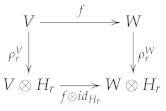 that is, for all ,
Then we have the category of p-Yetter–Drinfeld quasimodules; the composition of morphisms of p-Yetter–Drinfeld quasimodules is the standard composition of the underlying linear maps. Moreover, if we assume that V is a left -module, then we say that is a left-right p-Yetter–Drinfeld module. Obviously, left-right p-Yetter–Drinfeld modules with the obvious morphisms is a subcategory of , denoted by .
Proposition 2.
Proof.
Proposition 3.
If and , then with the module and comodule structures, as follows:
where and .
Proof.
We first check that is a left -quasimodule, and the unital property is obvious. We only check the left hand side of Equation (22); the right hand is similar. For all ,
where the first and second equalities rely on (30), the third equality follows by (22). Then is a left -quasimodule.
In the following equations, we check that the coassociative condition holds:
and
This shows that .
The counitary condition is easy to show. Then we check the crossed condition, as follows:
Finally, we check the Equation (26), and the Equation (27) is similar.
Hence . □
Following Turaev’s left index notation, let , the object have the same underlying vector space as V. Given , we denote the corresponding element in .
Proposition 4.
Let and . Set as a vector space with structures
for any and . Then .
Proof.
We first check that is a left -quasimodule. The condition (21) is easy to check. Next, we prove the condition (22).
The proof of the other side is similar to the above, so is a left -quasimodule, and the coassociative and counitary are also satisfied.
In the following, we show that the crossing condition holds:
Finally, we will check that the quasimodule coassociative conditions hold. We just compute the Equation (26); the Equation (27) is similar. For all ,
where the first and third equalities rely on (33); the second one follows by (26). This completes the proof. □
Proposition 5.
Let and . Then is an object in , and is an object in .
Proof.
We first check that is an object in . It is obvious that both and are in the category . Then we show that the action and coaction of these two -Yetter–Drinfeld quasimodules are exactly equivalent.
As is a -Yetter–Drinfeld quasimodule with the structures
Then, we show is a -Yetter–Drinfeld quasimodule with the same structures of . Indeed, the action of is
Hence has the same cation with .
And the coaction of is
Hence, as an object in .
As is a -Yetter–Drinfeld quasimodule with the structures
Then we show is a -Yetter–Drinfeld quasimodule with the same structures of . Indeed, the action of is
Hence has the same cation with .
And the coaction of is
Thus, as an object in . □
For a crossed group-cograded Hopf quasigroup H, we define as the disjoint union of all with . If we endow with tensor product as in Proposition 3, then we obtain the following result.
Theorem 2.
The Yetter–Drinfeld quasimodules category is a crossed category.
Proof.
By Proposition 4, we can give a group homomorphism , by
where the functor acts as follows: given a morphism , for any , we set .
Then it is easy to prove is a crossed category. □
Following the ideas by lonso in [12], we will consider the category of left-right p-Yetter–Drinfeld modules over H, which is a subcategory of .
Proposition 6.
Let and . Set as an object in . Define the map
Then is H-linear, H-colinear and satisfies the conditions:
for . Moreover, .
Proof.
We first show that is H-linear. First, compute
so we have , that is, is H-linear.
Secondly, we prove that is H-colinear. In fact,
Thirdly, we can find satisfies the conditions (35) and (36). However, here we only check the first condition, and the other is similar.
Finally, we check the condition . Indeed,
This completes the proof. □
Similar to [12], we can give the braided an inverse in the following way.
Proposition 7.
Let and . Then this can give the braided an inverse , which is defined by
where .
Proof.
For any , we have
Conversely, for any ,
Since is an isomorphism with inverse . □
As a consequence of the above results, we obtain another main result of this paper.
Theorem 3.
Denote as the disjoint union of all with , where H is a crossed group-cograded Hopf quasigroup. Then is a braided crossed category over group G.
Proof.
As is a subcategory of the category , so it is a crossed category. Then we only need prove is braided.
The braiding in can be given by Proposition 6, and the braiding is invertible; its inverse is the family , which is defined in Proposition 7. Hence, it is obvious that is a braided crossed category. □
Example 3.
Let us consider the crossed group-cograded Hopf quasigroup in Example 1. Moreover, G is the isomorphism group of Hopf quasigroup H. If V is a Yetter–Drinfeld module of H, then we can endow V with a p-Yetter–Drinfeld module structure of , as follows:
- (1)
- The left -module structure of V is a copy of the left H-module structure of V, because is an identification isomorphism of algebras;
- (2)
- Define a new coaction by .
Then we can show that V is a p-Yetter–Drinfeld module over , and it is easy to check that is a braided crossed category; the braided structure is given by .
5. Conclusions
For a group-cograded Hopf quasigroup , we first discovered that H with the group G is a Hopf quasigroup in the Turaev category . Moreover, if is a crossed group-cograded Hopf quasigroup, then the mirror is also a crossed group-cograded Hopf quasigroup. Following Alonso’s idea, we prove that the category of Yetter–Drinfeld quasimodules is a crossed category. Furthermore, the subcategory is a braided crossed category, which is relevant to the construction of some homotopy invariants. A possible topic for further research is a braid structure of the category .
Author Contributions
Conceptualization, H.L. and T.Y.; project administration, T.Y.; supervision, T.Y.; writing—original draft preparation, H.L. and L.Z.; writing—review & editing, T.Y.; funding acquisition, T.Y. All authors have read and agreed to the published version of the manuscript.
Funding
The work was partially funded by the China Postdoctoral Science Foundation (Grant No.2019M651764), and the National Natural Science Foundation of China (Grant No. 11601231).
Institutional Review Board Statement
Not applicable.
Informed Consent Statement
Not applicable.
Data Availability Statement
Not applicable.
Acknowledgments
The authors would like to express their gratitude to the anonymous referees for their very helpful suggestions and comments which led to the improvement of our original manuscript.
Conflicts of Interest
The authors declare no conflict of interest.
References
- Klim, J.; Majid, S. Hopf quasigroups and the algebraic 7-sphere. J. Algebra 2010, 323, 3067–3110. [Google Scholar] [CrossRef]
- Freyd, P.J.; Yetter, D.N. Braided compact closed categories with applications to low dimensional topology. Adv. Math. 1989, 77, 156–182. [Google Scholar] [CrossRef]
- Zunino, M. Yetter-Drinfeld modules for crossed structures. J. Pure Appl. Algebra 2004, 193, 313–343. [Google Scholar] [CrossRef][Green Version]
- Yang, T.; Wang, S.H. Constructing new braided T-categories over regular multiplier Hopf algebras. Commun. Algebra 2011, 39, 3073–3089. [Google Scholar] [CrossRef]
- Joyal, A.; Street, R. Braided tensor categories. Adv. Math. 1993, 102, 20–78. [Google Scholar] [CrossRef]
- Lane, S.M. Categories for the Working Mathematician; Springer: New York, NY, USA, 1971. [Google Scholar]
- Turaev, V. Homotopy field theory in dimension 3 and crossed group-categories. arXiv 2000, arXiv:math/0005291. [Google Scholar]
- Virelizier, A. Hopf group-coalgebras. J. Pure Appl. Algebra 2002, 171, 75–122. [Google Scholar] [CrossRef]
- Kassel, C. Quantum Groups; Springer: New York, NY, USA, 1995. [Google Scholar]
- Caenepeel, S.; Lombaerde, M.D. A categorical approach to Turaev’s Hopf group-coalgebras. Commun. Algebra 2006, 34, 2631–2657. [Google Scholar] [CrossRef]
- Brzeziński, T.; Jiao, Z. Actions of Hopf quasigroups. Commun. Algebra 2012, 40, 681–696. [Google Scholar] [CrossRef][Green Version]
- Álvarez, J.N.A.; Vilaboa, J.M.F.; Rodríguez, R.G.; Calvo, C.S. Projections and Yetter-Drinfel’d modules over Hopf (co)quasigroups. J. Algebra 2015, 443, 153–199. [Google Scholar] [CrossRef]
Publisher’s Note: MDPI stays neutral with regard to jurisdictional claims in published maps and institutional affiliations. |
© 2022 by the authors. Licensee MDPI, Basel, Switzerland. This article is an open access article distributed under the terms and conditions of the Creative Commons Attribution (CC BY) license (https://creativecommons.org/licenses/by/4.0/).