Utilize Fuzzy Delphi and Analytic Network Process to Construct Consumer Product Design Evaluation Indicators



Abstract
1. Introduction
2. Theoretical Background
2.1. Innovative Product Design Methods
2.2. Consumer Product Design Factors
3. Research Methods
3.1. Establishment of Product Innovation Design Methods
3.2. Establishment of Design Factors That Meet Consumer Needs
3.3. Fuzzy Delphi Method (FDM)
3.4. Analytical Network Process (ANP)
3.5. Selection of Experts for Questionnaire Survey
4. Data Analysis and Results
4.1. FDM Analysis Results
4.2. Analysis Results by Analytical Network Process
5. Conclusions and Suggestion
Author Contributions
Funding
Conflicts of Interest
References
- Chang, J.-C.; Lin, W.-C. Using Innovation Diffusion Theory to Examine Persona Design-A Case Study in Table PC. J. Cult. Creat. Ind. Res. 2013, 3, 85–96. [Google Scholar] [CrossRef]
- Fan, M.; Chiou, M.-H. A study of the factors effecting the time-to- market of new product development. In Proceedings of the 2005 9th Conference on Interdisciplinary and Multifunctional Business Management, Taipei, Taiwan, 28 May 2005; pp. 577–592. [Google Scholar]
- Chou, C.-C. Research of Product Designing Using the Working standard Process. J. Lan Yang Inst. Technol. 2015, 14, 43–51. [Google Scholar] [CrossRef]
- Wu, C.-H.; Luh, D.-B. Myths Surrounding Innovation Design in the Industry 4.0 Era. Manag. Rev. 2018, 37, 35–51. [Google Scholar] [CrossRef]
- Hsu, Y.-T. A Study on the Pedagogical Content Knowledge of Technology Education. Technol. Hum. Educ. Q. 2015, 2, 16–29. [Google Scholar] [CrossRef]
- Sung, M.-H.; Wang, B.-J.; Yang, K.-L. Constructing a Theory-driven and Practice-based Intelligent Innovation Model: A Case Study on Foot Pedals. J. Sci. Eng. Technol. 2012, 8, 1–8. [Google Scholar] [CrossRef]
- Hung, K.-C.; Wang, C.-H.; Nien, S.-H.; Tu, C.-P.; Wang, P.-K.; Chen, P.; Chang, W.-F. Establishment of Quality Function Deployment Model Based on an Intuitionistic Fuzzy Approach: Optical Lens Development and Design. J. Qual. 2012, 19, 581–601. [Google Scholar] [CrossRef]
- Li, X.M.M.; Zheng, M.; Xu, Z.; He, L. A framework of product innovative design process based on TRIZ and Patent Circumvention. J. Eng. Des. 2013, 24, 830–848. [Google Scholar] [CrossRef]
- Huang, H.-F.; Hsieh, M.-H.; Hsieh, Y.-W. Comparison of Usability in the Different Design Drawing Tools for Industrial Design Students. J. Ergon. Study 2019, 21, 27–39. [Google Scholar] [CrossRef]
- Kuo, Y.-M.; Lin, Z.-C.; Tan, A.Y.K. Applying Design Thinking to the Research and Development of Innovative Nursing Devices. J. Nurs. Res. 2021, 68, 13–18. [Google Scholar] [CrossRef]
- Chang, W.C.; Lin, M.H. A Comparison Study between the Product Form Image and Product Form Feature. J. Des. 2004, 9, 59–70. [Google Scholar] [CrossRef]
- Chávez, F.C.; Chaurand, R.A.; Ávila, I.C.L. Effect of Subjective Evaluation Factors on the Buying Decision of Residential Furniture. Procedia Manuf. 2015, 3, 6467–6474. [Google Scholar] [CrossRef][Green Version]
- Huang, H.-F.; Hsieh, M.-H.; You, J.-W. The Investigation of 3C Product’s Value in the Perception—The Case of Surface Materials and Shapes. J. Ergon. Study 2020, 22, 1–15. [Google Scholar] [CrossRef]
- Chen, W.-L.; Chiang, Y.-M.; Hsh, M.-Y. A Study on the Product Design Impact Factors of the Dehumidifier. J. SHU-TE Univ. 2014, 16, 39–51. [Google Scholar]
- Chou, W.-R. Product Design under the Green Thinking: Case Studies. Praxes 2014, 8, 114–131. [Google Scholar]
- Tu, J.-C.; Wu, C.-N. Impact of Awareness and Attitude of Environmental Protection and Green Consumption Behavior on Green Furniture Design. J. Des. 2005, 10, 21–35. [Google Scholar] [CrossRef]
- Chou, S.-H.; Chu, H.-M.; Chiou, C.-Y.; Zhang, B.-K. Exploring the Relationship between Importance and Satisfaction on Product Attributes for GPS Sport Watch Users. J. Tour. Leis. Manag. 2016, 4, 89–99. [Google Scholar] [CrossRef]
- Prati, E.; Villani, V.; Peruzzini, M.; Sabattini, L. An Approach Based on VR to Design Industrial Human-Robot Collaborative Workstations. Appl. Sci. 2021, 11, 11773. [Google Scholar] [CrossRef]
- Chen, Z.-J.; Chen, J.-X. Evaluation of the usability of the smartphone operating interface. Ind. Des. 2011, 124, 52–57. [Google Scholar] [CrossRef]
- Lim, Y.R.; Ariffin, A.S.; Ali, M.; Chang, K.-L. A Hybrid MCDM Model for Live-Streamer Selection via the Fuzzy Delphi Method, AHP, and TOPSIS. Appl. Sci. 2021, 11, 9322. [Google Scholar] [CrossRef]
- Chen, W.-L. Integrating FDM and ISM to Analyze the Key Design Indicators of Children Furniture. J. SHU-TE Univ. 2020, 22, 49–66. [Google Scholar]
- Lai, W.-T. Constructing Performance Indicators for the Total Quality Teaching Method Using the Fuzzy Delphi Method. Int. J. Intell. Technol. Appl. Stat. 2021, 14, 19–31. [Google Scholar] [CrossRef]
- Li, W.-X.; Chang, Y.-Y.; Zhu, J.-W. Using ANP Model to Explore the Factors Considered by Consumers in Purchasing Sports Equipment. J. Leis. Tour. Sport Health 2010, 15, 49–61. [Google Scholar] [CrossRef]
- Ibrahim, M.; Bassford, M.; Ackerley, H.; Cornelius, V. Creative design dynamics and creative systems. IEEE Aerosp. Electron. Syst. Mag. 2010, 25, 30–34. [Google Scholar] [CrossRef]
- Chaung, Y.-J.; Wang, C.-T.; Lee, Y.-J.; Wang, T.-H.; Lin, C.-B. Research on R & D and Innovation of Multi-functional Creative Building Block Series. Tajen J. 2020, 54, 21–45. [Google Scholar]
- Chang, P.-T.; Sung, Y.-C.; You, J.-G. Relationship among Nike’s Brand Image, Value, and Satisfaction. Taiwan Hosp. Tour. J. 2015, 10, 39–52. [Google Scholar]
- Chen, W.-L.; Su, Y.-L.; Chang, S.-M. Application of Customer-Oriented to Explore Toy Product Design Demand Quality and Planning Matrix. J. Prof. Mech. Eng. 2011, 4, 6–11. [Google Scholar] [CrossRef]
- Wei, W.-L.; Chang, W.-C. A Study on Selecting Optimal Product Design Solution Using Fuzzy Delphi Method and Analytic. J. Des. 2005, 10, 59–77. [Google Scholar] [CrossRef]
- Wu, C.-F.; Lin, K.-C.; Yang, C.-Y.; Liao, S.-F. The Influence of Relationship between Distinct Hand Tools and Universal Design Scales with Screwdriver. J. Des. 2016, 21, 25–43. [Google Scholar]
- Yang, C.-M.; Liu, Z.-H.; Kao, C.-H.; Wang, X.-G. A Preliminary Study on DFX Based Green Product Assessment. Ind. Des. 2008, 119, 201–205. [Google Scholar] [CrossRef]
- Hsiao, S.-W.; Zheng, J.-L. Application Research of Synchronous Design Strategy in Thermos Design. Ind. Des. 2010, 122, 1–6. [Google Scholar] [CrossRef]
- Chien, C.-W. How Form of Products can Affect Users’ Functional and Emotional Cognition: Case Study on Cell Phone and Fan. J. Des. Sci. 2019, 22, 85–110. [Google Scholar] [CrossRef]
- Su, C.-H.; Wang, S.-H.; Tsai, T.-L. Applying Kano Two-Dimensional Quality Model to Explore FPS Games the Customer Demand of Desktop Computers. Takming Univ. J. 2015, 39, 59–74. [Google Scholar]
- Wu, H.-L.; Chen, J.-H. Survey the Tactic Performed Fashion Color by the Viewpoint of Marketing Communication. J. Des. Res. 2004, 4, 53–59. [Google Scholar] [CrossRef]
- Wang, Y.; Liu, S. Ergonomic design of handheld products. Chin. J. Ergon. 2011, 17, 52–55. [Google Scholar]
- Fang, C.-W.; Chang, P.-Y.; Ning, H.-C.; Huang, C.-H.; Lo, M.-F.; Hung, C.-C.; Lin, H.-L.; Chu, T.-L.; Tsao, K.-C. Application of an Innovative Quality Assessment Form for Medical Technology E-learning Materials: A Practical Design Facilitating Positive Learning Experiences. J. Biomed. Lab. Sci. 2020, 32, 117–135. [Google Scholar]
- Huang, S.-Y.; Wang, C.-Y. Product Design Investigation of Mobile Phone VR Headset. J. Qual. 2021, 28, 33–53. [Google Scholar] [CrossRef]
- Noorderhuben, N. Strategic Decision Making; Addison-Wesley: Boston, MA, USA, 1995. [Google Scholar]
- Chung, C.-W.; Xu, Y.-J.; Chen, Y.-A.; Hsin, J.-C. Study on the Construction of Development Indicators of Recreational Fisheries by the Fuzzy Delphi Method. Kaohsiung Norm. Univ. J. Educ. Soc. Sci. 2017, 43, 85–98. [Google Scholar]
- Wang, W.-M.; Peng, H.-H. A Fuzzy Multi-Criteria Evaluation Framework for Urban Sustainable Development. Mathematics 2020, 8, 330. [Google Scholar] [CrossRef]
- Hsu, H.-M.; Wey, W.-M.; Tsai, P.-J. The Applications of Analytic Network Process to the Priorities of Interdependent Housing Projects Selection. J. Archit. 2007, 62, 49–74. [Google Scholar]
- Jeng, T.-B. Fuzzy Assessment Model for Maturity of Software Organization in Improving its Staff’s Capability. Master’s Thesis, National Taiwan University of Science and Technology, Taipei, Taiwan, 1996. [Google Scholar]
- Chiu, Y.-H.; Jheng, Y.-M.; Hsieh, T.-Y. Using Fuzzy Delphi Method and Analytic Network Process in the Development Assessment of the Cultural and Creative Industries Park. J. Archit. 2012, 80, 85–109. [Google Scholar] [CrossRef]
- Saaty, T.L. The Analytic Hierarchy Process: Planning, Priority Setting, Resource Allocation; McGraw-Hill: New York, NY, USA, 1980. [Google Scholar]
- Rodrigues, D.; Godina, R.; da Cruz, P.E. Key Performance Indicators Selection through an Analytic Network Process Model for Tooling and Die Industry. Sustainability 2021, 13, 13777. [Google Scholar] [CrossRef]
- Lin, C.-T.; Chiang, C.-Y. Developing and Applying a Selection Model for Corrugated Box Precision Printing Machine Suppliers. Mathematics 2021, 9, 68. Available online: https://www.mdpi.com/2227-7390/9/1/68 (accessed on 5 December 2021). [CrossRef]
- Chang, S.-S. Fuzzy Multi-Criteria Decision Making For. Evaluation Method; Wu-Nan Culture Enterprise: Taipei, Taiwan, 2012. [Google Scholar]
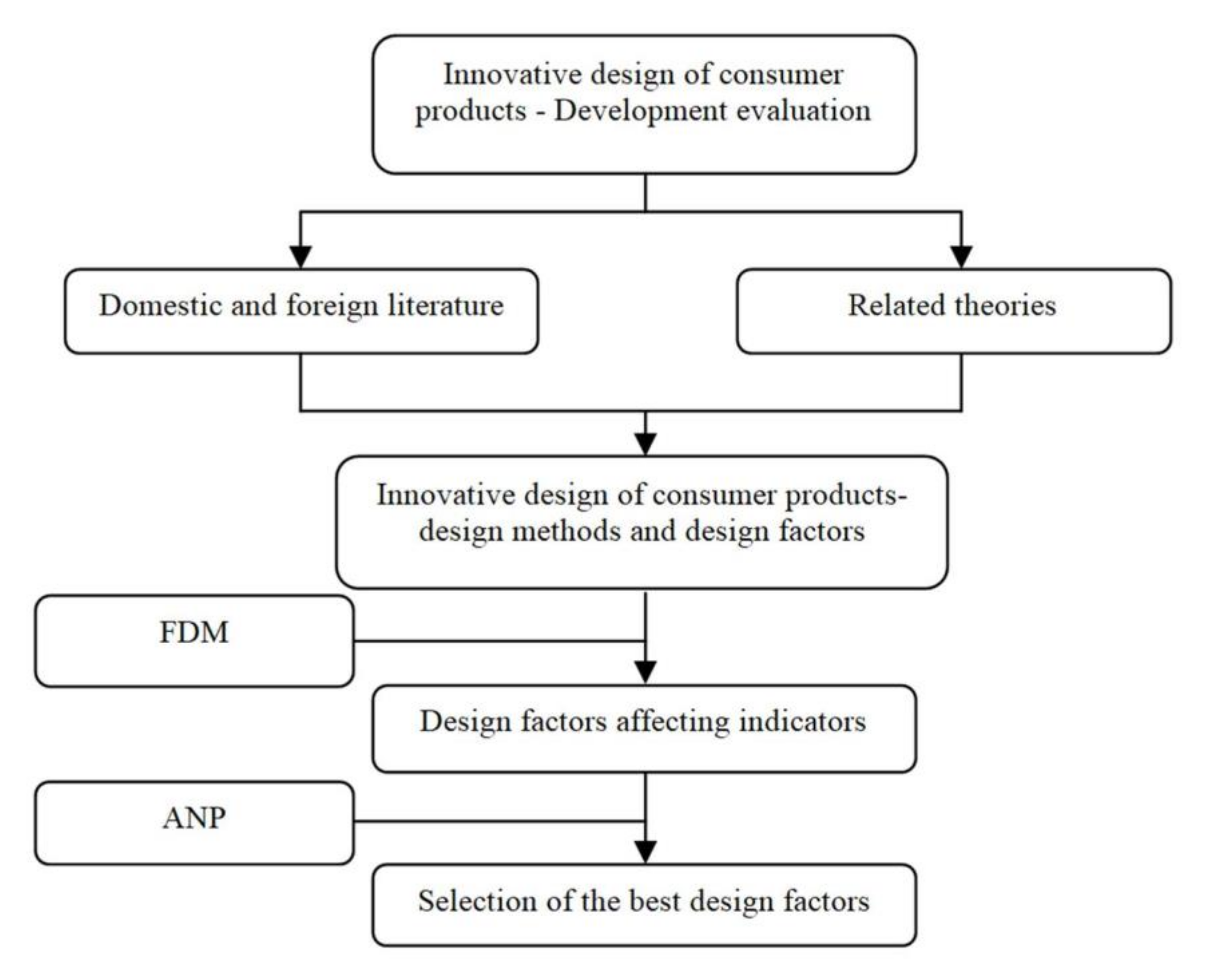


| Design Stage [24] | Design Methods | Definition Description |
|---|---|---|
| Scope | QFD (User needs) [7] | Starting from clarifying the “user needs”, the design factors are summarized and transformed into the system requirements and functions the product. |
| Idea | TRIZ (Creative invention development) [8] | Use creative imagination and make a breakthrough based on the “TRIZ” innovation principles. Find out the problem of different aspects of the product and propose an innovative design process for the product. |
| Patent (Design trends and obstacles) [6,8] | Conduct the “patent analysis” and sort out the innovative countermeasures, to create feasible designs and avoid patent infringement. | |
| CAD (Actualization of design ideas) [9] | Use “CAD” drawing tools to design ID and MD of product to actualize and digitize the concept. | |
| Prototype | Prototype (Realization of designs) [10] | Use a digital processing machine (3D Print, CNC, etc.) to make a “prototype” to verify that it meets user needs. |
| Design Indicator | Decision Elements | Design Elements | Design Factors | Literature Review (Scholar/Year) | |||||||||||||||||||||
|---|---|---|---|---|---|---|---|---|---|---|---|---|---|---|---|---|---|---|---|---|---|---|---|---|---|
| W. R., Chou, (2014) [15] | C., Tu, et al. (2005) [16] | Y. J., Chaung, et al. (2020) [25] | W. C., Chang et al. (2004) [11] | P. T., Chang, et al. (2019) [26] | S. H., Chou, et al. (2016) [17] | W. L., Chen, (2020) [21] | W. L., Chen, et al. (2014) [14] | W. L., Chen, et al. (2011) [27] | W. L., Wei, et al. (2005) [28] | C. F., Wu, et al. (2016) [29] | C. M., Yang, et al. (2008) [30] | S. W., Xiao, et al. (2010) [31] | C. W., Chien, et al. (2018) [32] | C. H., Su, et al. (2015) [33] | H. L., Wu, et al. (2004) [34] | C. C., Chen, et al. (2011) [19] | W. H., Li, et al. (2010) [23] | Y. Wang, (2011) [35] | C.F., Cortés, et al. (2015) [12] | F. Chunhua. et al. (2020) [36] | S. Y., Huang, et al. (2021) [37] | ||||
| User Demand | A. Product Aspects | a. Product Type | 1. Moderate size | O | O | O | O | ||||||||||||||||||
| 2. Reasonable body weight | O | O | O | ||||||||||||||||||||||
| 3. Unique style | O | O | O | O | O | O | O | O | O | ||||||||||||||||
| 4. Convey the emotion of the story | O | O | O | ||||||||||||||||||||||
| 5. Modeling organic bionics | O | O | |||||||||||||||||||||||
| 6. The shape is geometrically symmetrical | O | ||||||||||||||||||||||||
| 7. The shape is cute and streamlined | O | ||||||||||||||||||||||||
| b. Product Material | 8. Meet functional requirements | O | O | O | |||||||||||||||||||||
| 9. Less processing and easy access | O | ||||||||||||||||||||||||
| 10. Easy to clean and maintain | O | O | |||||||||||||||||||||||
| c. Product Color | 11. Sense of the trend | O | O | ||||||||||||||||||||||
| 12. Natural color and environmental friendly | O | O | |||||||||||||||||||||||
| 13. Harmonious and bright color | O | O | O | ||||||||||||||||||||||
| 14. Unique personality | O | O | |||||||||||||||||||||||
| d. Product Texture | 15. Anti-slip and comfortable touch | O | O | ||||||||||||||||||||||
| 16. Delicate craft value | O | ||||||||||||||||||||||||
| 17. Unique texture | O | ||||||||||||||||||||||||
| e. Product Function | 18. Convenient and friendly control | O | O | O | O | O | O | ||||||||||||||||||
| 19. Unique and innovative functions | O | O | O | O | O | O | |||||||||||||||||||
| 20. Storage is light and easy | O | O | |||||||||||||||||||||||
| 21. The structure is stable and durable | O | O | O | O | O | O | O | ||||||||||||||||||
| 22. Easy to carry and transport | O | O | O | ||||||||||||||||||||||
| 23. Easy to assemble and adjust | O | ||||||||||||||||||||||||
| 24. Easy to disassemble and repair | O | O | O | O | O | O | |||||||||||||||||||
| 25. Modularization and easy replacement | O | O | O | O | O | O | |||||||||||||||||||
| 26. Comply with safety regulations | O | O | O | ||||||||||||||||||||||
| 27. With education and learning | O | O | |||||||||||||||||||||||
| 28. Additional functions | O | O | O | O | |||||||||||||||||||||
| f. Human Factor Design | 29. Comfortable to operate and wear | O | O | O | O | ||||||||||||||||||||
| 30. Energy-saving, labor-saving and low-consumption | O | ||||||||||||||||||||||||
| 31. Reliable safety protection | O | O | |||||||||||||||||||||||
| 32. The size can be adjusted | O | ||||||||||||||||||||||||
| 33. Detailed operating instructions | O | O | |||||||||||||||||||||||
| 34. No burrs and sharp corners | O | ||||||||||||||||||||||||
| g. Human–Machine interface | 35. Good icon recognition | O | |||||||||||||||||||||||
| 36. Fast control feedback | O | O | O | ||||||||||||||||||||||
| 37. The interface is intuitive and easy to learn | O | O | |||||||||||||||||||||||
| 38. High extension compatibility | O | O | |||||||||||||||||||||||
| h. Sustainable Environmental Protection | 39. Easy to disassemble and recycle | O | O | O | O | O | |||||||||||||||||||
| 40. Reproduction and reuse | O | O | O | O | O | ||||||||||||||||||||
| 41. The material is non-toxic and friendly | O | O | O | O | O | O | |||||||||||||||||||
| 42. Longer life cycle | O | O | O | ||||||||||||||||||||||
| 43. Energy saving, carbon reduction and low consumption | O | O | O | O | O | O | |||||||||||||||||||
| 44. Material/packaging reduction | O | O | |||||||||||||||||||||||
| B. Brand Aspects | i. Product Sales | 45. Real price level | O | O | O | ||||||||||||||||||||
| 46. Brand Promotions | O | O | O | ||||||||||||||||||||||
| 47. Experience physical access | O | ||||||||||||||||||||||||
| j. Brand Value | 48. Personal style and taste | O | O | O | |||||||||||||||||||||
| 49. Good quality and value | O | O | O | ||||||||||||||||||||||
| 50. High brand awareness | O | O | O | ||||||||||||||||||||||
| 51. Manufacturing location | O | ||||||||||||||||||||||||
| 52. Commodities are serial | O | ||||||||||||||||||||||||
| 53. Excellent brand evaluation | O | O | |||||||||||||||||||||||
| k. After-sales Service | 54. Good repair service | O | O | O | O | O | |||||||||||||||||||
| 55. With product warranty | O | ||||||||||||||||||||||||
| 56. Professional and friendly customer service | O | ||||||||||||||||||||||||
| Steps | 1 | 2 | 3 | 4 | 5 | 6 | 7 | 8 | 9 | 10 | 11 | 12 | 13 | 14 | 15 |
|---|---|---|---|---|---|---|---|---|---|---|---|---|---|---|---|
| R.I | 0.00 | 0.00 | 0.58 | 0.90 | 1.12 | 1.24 | 1.32 | 1.41 | 1.45 | 1.49 | 1.51 | 1.48 | 1.56 | 1.57 | 1.59 |
| Type | Item | Effective Number of Samples | Percentage (%) |
|---|---|---|---|
| Identity | Innovative design research scholars Enterprise development designer Design company designer | 4 6 5 | 27 40 33 |
| Education | College University Master PhD | 1 2 11 1 | 7 13 73 7 |
| Working Experience | 5–10 years 11–15 years 16–20 years More than 20 years | 0 5 6 4 | 0 33 40 27 |
| Job & Duty | Senior Executives (Chairman, General Manager, Chief Executive Officer) Supervisor (associate, manager, director, section chief) Staff (engineers, designers) | 6 5 4 | 40 33 27 |
| Aspects & Indicator | Grey Zone Certified Value | Difference between Optimistic and Conservative Cognition Value | Mi-Zi Show Converged | Consensus Importance | Del or Not |
|---|---|---|---|---|---|
| QFD (User needs) | 1 | 4.16 | 3.16 | 8.15 | |
| TRIZ (Creative invention development) | 1 | 4.21 | 3.21 | 7.23 | |
| Patent (Design trends and obstacles) | 1 | 3.8 | 2.8 | 7.32 | |
| CAD (Actualization of design ideas) | 1 | 3.56 | 2.56 | 7.31 | |
| Prototype (Realization of designs) | 1 | 3.48 | 2.48 | 7.37 |
| Aspects & Indicator | Grey Zone Certified Value | Difference between Optimistic and Conservative Cognition Value | Mi-Zi Show Converged | Consensus Importance | Del or Not |
|---|---|---|---|---|---|
| A. Product Dimension | 1 | 3.55 | 2.55 | 7.35 | |
| B. Brand Dimension | 1 | 4.1 | 3.1 | 7.34 |
| Aspects & Indicator | Grey Zone Certified Value | Difference between Optimistic and Conservative Cognition Value | Mi-Zi Show Converged | Consensus Importance | Del or Not |
|---|---|---|---|---|---|
| a. Product Type | 2 | 3.49 | 1.49 | 7.48 | |
| b. Product Material | 1 | 3.68 | 2.68 | 7.33 | |
| c. Product Color | 2 | 3.7 | 1.7 | 6.68 | |
| d. Product Texture | 1 | 3.72 | 2.72 | 7.34 | |
| e. Product Function | 2 | 3.4 | 1.4 | 7 | |
| f. Human Factor Design | 0 | 3.39 | 3.39 | 8 | |
| g. Human–Machine Interface | 1 | 3.53 | 2.53 | 7.43 | |
| h. Sustainable Environmental Protection | 2 | 3.75 | 1.53 | 6.68 | |
| i. Product Sales | 2 | 4.45 | 2.45 | 6.64 | |
| j. Brand Value | 1 | 4.33 | 3.33 | 7.28 | |
| k. After-sales Service | 3 | 4.02 | 1.02 | 6.49 |
| Aspects & Indicator | Grey Zone Certified Value | Difference between Optimistic and Conservative Cognition Value | Mi-Zi Show Converged | Consensus Importance | Del or Not |
|---|---|---|---|---|---|
| 1. Moderate size | 0 | 3.8 | 3.8 | 7 | |
| 2. Reasonable body weight | 0 | 3.9 | 3.9 | 7 | |
| 3. Unique style | 3 | 4.2 | 1.2 | 6.21 | |
| 4. Convey the emotion of the story | 4 | 3.6 | −0.4 | 4.42 | X |
| 5. Modeling organic bionics | 1 | 4 | 3 | 4.54 | X |
| 6. The shape is geometrically symmetrical | 1 | 3.7 | 2.7 | 5.38 | X |
| 7. The shape is cute and streamlined | 2 | 3.8 | 1.8 | 4.15 | X |
| 8. Meet functional requirements | 1 | 3.9 | 2.9 | 7.33 | |
| 9. Less processing and easy access | 3 | 3.7 | 0.7 | 5.67 | X |
| 10. Easy to clean and maintain | 3 | 3.4 | 0.4 | 6.31 | |
| 11. Sense of the trend | 2 | 4.1 | 2.1 | 6.54 | |
| 12. Natural color and environmental friendly | 2 | 4 | 2 | 5.11 | X |
| 13. Harmonious and bright color | 2 | 3.6 | 1.6 | 5.78 | X |
| 14. Unique personality | 3 | 4.1 | 1.1 | 6 | X |
| 15. Anti-slip and comfortable touch | 1 | 3.6 | 2.6 | 6.43 | |
| 16. Delicate craft value | 4 | 3.3 | −0.7 | 6.73 | X |
| 17. Unique texture | 1 | 3.6 | 2.6 | 6.1 | |
| 18. Convenient and friendly control | 1 | 3.6 | 2.6 | 7.4 | |
| 19. Unique and innovative functions | 2 | 3.7 | 1.7 | 6.7 | |
| 20. Storage is light and easy | 2 | 3.6 | 1.6 | 6.8 | |
| 21. The structure is stable and durable | 1 | 3.5 | 2.5 | 7.3 | |
| 22. Easy to carry and transport | 1 | 3.6 | 2.6 | 6.5 | |
| 23.Easy to assemble and adjust | 2 | 3.6 | 1.6 | 6.9 | |
| 24. Easy to disassemble and repair | 1 | 3.7 | 2.7 | 6.5 | |
| 25. Modularization and easy replacement | 2 | 3.5 | 1.5 | 6.9 | |
| 26. Comply with safety regulations | 1 | 3.6 | 2.6 | 7.4 | |
| 27. With education and learning | 1 | 3.9 | 2.9 | 5.4 | X |
| 28. Additional functions | 1 | 4.2 | 3.2 | 5.4 | X |
| 29. Comfortable to operate and wear | 0 | 3.2 | 3.2 | 8 | |
| 30. Energy-saving, labor-saving and low-consumption | 2 | 3.1 | 1.1 | 6.9 | |
| 31. Reliable safety protection | 0 | 3.4 | 3.4 | 8 | |
| 32. The size can be adjusted | 2 | 3.3 | 1.3 | 6.8 | |
| 33. Detailed operating instructions | 3 | 3.5 | 0.5 | 6.8 | |
| 34. No burrs and sharp corners | 2 | 3.7 | 1.7 | 7.5 | |
| 35. Good icon recognition | 0 | 3.4 | 3.4 | 8 | |
| 36. Fast control feedback | 2 | 3.3 | 1.3 | 7 | |
| 37. The interface is intuitive and easy to learn | 1 | 3.3 | 2.3 | 8.3 | |
| 38. High extension compatibility | 3 | 3.4 | 0.4 | 6.4 | |
| 39. Easy to disassemble and recycle | 3 | 3.9 | 0.9 | 6.2 | |
| 40. Reproduction and reuse | 4 | 3.8 | −0.2 | 5.5 | X |
| 41. The material is non-toxic and friendly | 3 | 3.6 | 0.6 | 6.3 | |
| 42. Longer life cycle | 5 | 3 | −2 | 5.9 | X |
| 43. Energy saving, carbon reduction and low consumption | 2 | 3.3 | 1.3 | 5.2 | X |
| 44. Material/packaging reduction | 4 | 4 | 0 | 5.7 | X |
| 45. Real price level | 2 | 3.3 | 1.3 | 6.8 | |
| 46. Brand Promotions | 6 | 3.4 | −2.4 | 5.3 | X |
| 47. Experience physical access | 1 | 3.7 | 2.7 | 7.3 | |
| 48. Personal style and taste | 2 | 3.7 | 1.7 | 6.6 | |
| 49. Good quality and value | 1 | 3.6 | 2.6 | 7.3 | |
| 50. High brand awareness | 3 | 3.6 | 0.6 | 5.8 | X |
| 51. Manufacturing location | 3 | 3.4 | 0.4 | 5.5 | X |
| 52. Commodities are serial | 3 | 3.6 | 0.6 | 5.5 | X |
| 53. Excellent brand evaluation | 0 | 3.9 | 3.9 | 8 | |
| 54. Good repair service | 1 | 3.5 | 2.5 | 7.4 | |
| 55. With product warranty | 1 | 3.6 | 2.6 | 7.4 | |
| 56. Professional and friendly customer service | 0 | 3.3 | 3.3 | 8 |
| Design Indicator | Decision Elements | Design Elements | Design Factors |
|---|---|---|---|
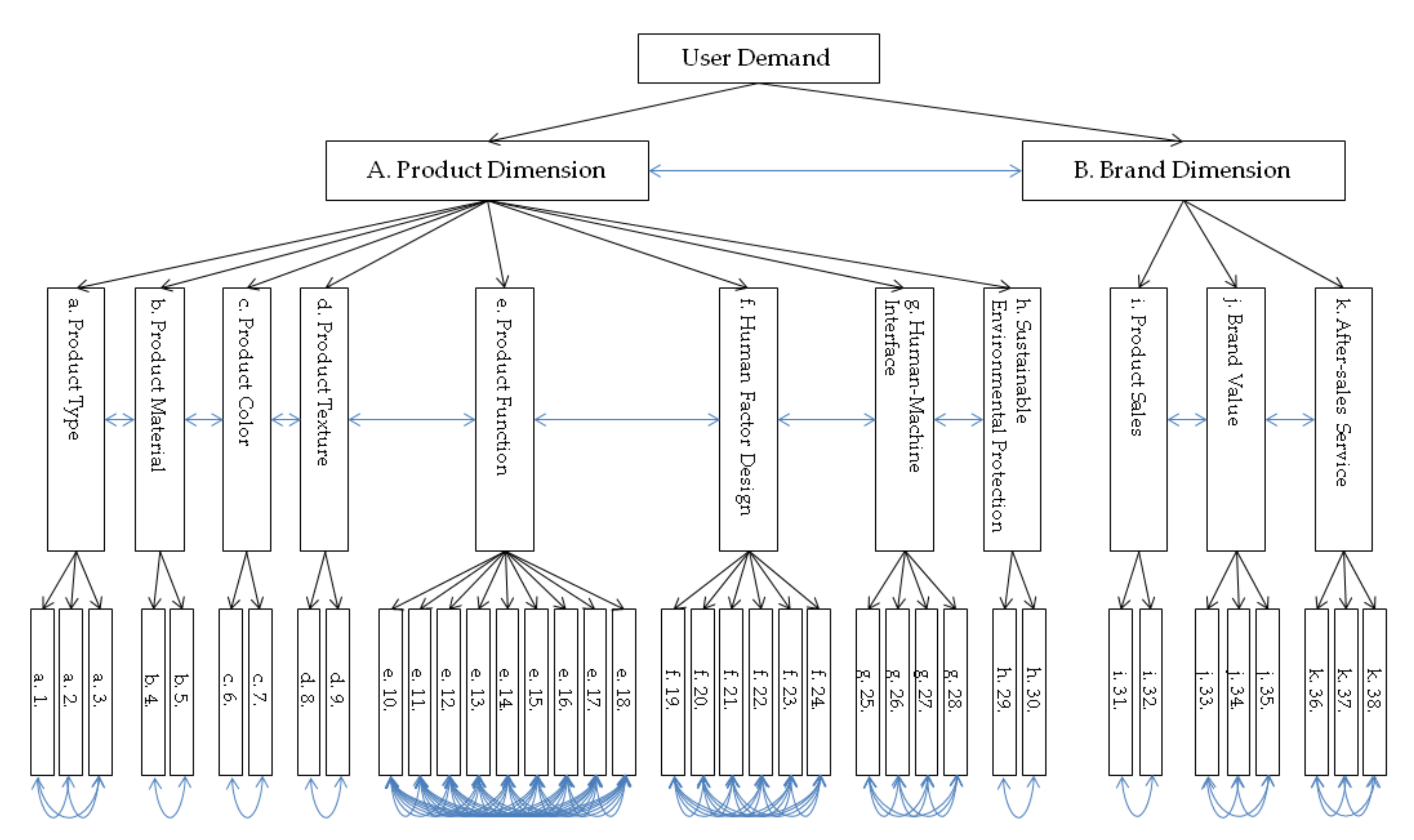
| User Demand | A. Product Dimension | a. Product Type | a1. Moderate size |
| a2. Reasonable body weight | |||
| a3. Unique style | |||
| b. Product Material | b4. Meet functional requirements | ||
| b5. Easy to clean and maintain | |||
| c. Product Color | c6. Sense of the trend | ||
| c7. Unique personality | |||
| d. Product Texture | d8. Anti-slip and comfortable touch | ||
| d9. Unique texture | |||
| e. Product Function | e10. Convenient and friendly control | ||
| e11. Unique and innovative functions | |||
| e12. Storage is light and easy | |||
| e13. The structure is stable and durable | |||
| e14. Easy to carry and transport | |||
| e15. Easy to assemble and adjust | |||
| e16. Easy to disassemble and repair | |||
| e17. Modularization and easy replacement | |||
| e18. Comply with safety regulations | |||
| f. Human Factor Design | f19. Comfortable to operate and wear | ||
| f20. Energy-saving, labor-saving and low-consumption | |||
| f21. Reliable safety protection | |||
| f22. The size can be adjusted | |||
| f23. Detailed operating instructions | |||
| f24. No burrs and sharp corners | |||
| g. Human–Machine Interface | g25. Good icon recognition | ||
| g26. Fast control feedback | |||
| g27. The interface is intuitive and easy to learn | |||
| g28. High extension compatibility | |||
| h. Sustainable Environmental Protection | h29. Easy to disassemble and recycle | ||
| h30.The material is non-toxic and friendly | |||
| B. Brand Dimension | i. Product Sales | i31. Real price level | |
| i32. Experience physical access | |||
| j. Brand Value | j33. Personal style and taste | ||
| j34. Good quality and value | |||
| j35. Excellent brand evaluation | |||
| k. After-sales Service | k36. Good repair service | ||
| k37. With product warranty | |||
| k38. Professional and friendly customer service |
| Aspects & Indicator | A | B |
|---|---|---|
| A. Product Dimension | 1 | 1.2889 |
| B. Brand Dimension | 0.7759 | 1 |
| Design Elements | a. | b. | c. | d. | e. | f. | g. | h. |
|---|---|---|---|---|---|---|---|---|
| a. Product Type | 1 | 1.9134 | 1.8730 | 1.0533 | 0.4409 | 0.6170 | 0.5691 | 1.2620 |
| b. Product Material | 0.5226 | 1 | 1.1940 | 0.4551 | 0.3495 | 0.3393 | 0.3145 | 0.5450 |
| c. Product Color | 0.5339 | 0.8375 | 1 | 0.3836 | 0.2933 | 0.2424 | 0.2818 | 0.5645 |
| d. Product Texture | 0.9494 | 2.1973 | 2.6069 | 1 | 0.2918 | 0.3348 | 0.4682 | 0.5799 |
| e. Product Function | 2.2681 | 2.8612 | 3.4095 | 3.4270 | 1 | 0.7884 | 0.6363 | 0.7619 |
| f. Human Factor Design | 1.6207 | 2.9472 | 4.1254 | 2.9869 | 1.2684 | 1 | 0.4714 | 0.8621 |
| g. Human–Machine interface | 1.7572 | 3.1797 | 3.5486 | 2.1358 | 1.5716 | 2.1213 | 1 | 1.0043 |
| h. Sustainable Environmental Protection | 0.7924 | 1.8349 | 1.7715 | 1.7244 | 1.3125 | 1.1600 | 0.9957 | 1 |
| Design Elements | i. | j. | k. |
|---|---|---|---|
| i. Product Sales | 1 | 0.3561 | 0.5209 |
| j. Brand Value | 2.8082 | 1 | 0.9665 |
| k. After-sales Service | 1.9198 | 1.0347 | 1 |
| Design Factors | a.1. | a.2. | a.3. |
|---|---|---|---|
| a.1. Moderate size | 1 | 1.3498 | 1.4986 |
| a.2. Reasonable body weight | 0.7409 | 1 | 1.2550 |
| a.3. Unique style | 0.6673 | 0.7968 | 1 |
| Design Factors | b.4. | b.5. |
|---|---|---|
| b.4. Meet functional requirements | 1 | 1.6336 |
| b.5. Easy to clean and maintain | 0.6121 | 1 |
| Design Factors | c.6. | c.7. |
|---|---|---|
| c.6. Sense of the trend | 1 | 0.7141 |
| c.7. Unique personality | 1.4004 | 1 |
| Design Factors | d.8. | d.9. |
|---|---|---|
| d.8. Anti-slip and comfortable touch | 1 | 1.0601 |
| d.9. Unique texture | 0.9433 | 1 |
| Design Factors | e.10. | e.11. | e.12. | e.13. | e.14. | e.15. | e.16. | e.17. | e.18. |
|---|---|---|---|---|---|---|---|---|---|
| e.10. Convenient and friendly control | 1 | 0.9968 | 1.178 | 0.7799 | 1.1719 | 1.5211 | 1.9468 | 1.9368 | 0.6153 |
| e.11. Unique and innovative functions | 1.0032 | 1 | 0.8351 | 0.6021 | 0.8783 | 1.0856 | 0.971 | 1.3138 | 0.4953 |
| e.12. Storage is light and easy | 0.8489 | 1.1975 | 1 | 0.3345 | 0.4766 | 0.4411 | 0.5228 | 0.7339 | 0.3818 |
| e.13. The structure is stable and durable | 1.2822 | 1.6609 | 2.9895 | 1 | 1.4874 | 1.1723 | 1.2481 | 1.0845 | 0.2757 |
| e.14. Easy to carry and transport | 0.8533 | 1.1386 | 2.0982 | 0.6723 | 1 | 0.6798 | 0.4607 | 0.4918 | 0.3274 |
| e.15. Easy to assemble and adjust | 0.6574 | 0.9211 | 2.2671 | 0.8530 | 1.4710 | 1 | 0.9535 | 0.9385 | 0.3099 |
| e.16. Easy to disassemble and repair | 0.8533 | 1.0299 | 1.9128 | 0.8012 | 2.1706 | 1.0488 | 1 | 1.0871 | 0.3437 |
| e.17. Modularization and easy replacement | 0.5163 | 0.9211 | 1.3626 | 0.9221 | 2.0333 | 1.0655 | 0.9199 | 1 | 0.4066 |
| e.18. Comply with safety regulations | 1.6252 | 2.0190 | 1.9128 | 3.6271 | 3.0544 | 3.2268 | 2.9095 | 2.4594 | 1 |
| Design Factors | f.19. | f.20. | f.21. | f.22. | f.23. | f.24. |
|---|---|---|---|---|---|---|
| f.19. Comfortable to operate and wear | 1 | 2.0638 | 0.5173 | 1.225 | 2.0197 | 0.8027 |
| f.20. Energy-saving, labor-saving and low-consumption | 0.4845 | 1 | 0.5075 | 0.9477 | 1.6213 | 0.8677 |
| f.21. Reliable safety protection | 1.9331 | 1.9704 | 1 | 2.1463 | 2.8769 | 1.2001 |
| f.22. The size can be adjusted | 0.8163 | 1.0552 | 0.4659 | 1 | 1.8634 | 1.0164 |
| f.23. Detailed operating instructions | 0.4951 | 0.6168 | 0.3476 | 0.5367 | 1 | 0.5206 |
| f.24. No burrs and sharp corners | 1.2458 | 1.1525 | 0.8333 | 0.9839 | 1.9209 | 1 |
| Design Factors | g.25. | g.26. | g.27. | g.28. |
|---|---|---|---|---|
| g.25. Good icon recognition | 1 | 0.7740 | 0.3175 | 1.0527 |
| g.26. Fast control feedback | 1.2920 | 1 | 0.4635 | 1.4805 |
| g.27. The interface is intuitive and easy to learn | 3.1496 | 2.1575 | 1 | 1.9542 |
| g.28. High extension compatibility | 0.9499 | 0.6754 | 0.5117 | 1 |
| Design Factors | h.29. | h.30. |
|---|---|---|
| h.29. Easy to disassemble and recycle | 1 | 0.5837 |
| h.30. The material is non-toxic and friendly | 1.7132 | 1 |
| Design Factors | i.31. | i.32. |
|---|---|---|
| i.31. Real price level | 1 | 1.5879 |
| i.32. Experience physical access | 0.6298 | 1 |
| Design Factors | j.33. | j.34.j | j.35.j |
|---|---|---|---|
| j.33. Personal style and taste | 1 | 0.5110 | 0.3075 |
| j.34. Good quality and value | 1.9569 | 1 | 1.0679 |
| j.35. Excellent brand evaluation | 3.2520 | 0.9364 | 1 |
| Design Factors | k.36. | k.37. | k.38 |
|---|---|---|---|
| k.36. Good repair service | 1 | 1.0521 | 1.2119 |
| k.37. With product warranty | 0.9505 | 1 | 1.828 |
| k.38. Professional and friendly customer service | 0.8252 | 0.5470 | 1 |
| Design Indicator | Decision Elements | Decision Weighting | Design Elements | Elements Weighting | Design Factors | Factors Weighting | Overall Weighting | Sorting | CR |
|---|---|---|---|---|---|---|---|---|---|
| Demand | A. Product Dimension | 0.563 | g. Human–Machine interface | 0.208 | g25. Good icon recognition | 0.199 | 0.0414 | 11 | 0.013 |
| g26. Fast control feedback | 0.270 | 0.0562 | 3 | ||||||
| g27. The interface is intuitive and easy to learn | 0.531 | 0.1104 | 1 | ||||||
| g28. High extension compatibility | 0.211 | 0.0439 | 9 | ||||||
| f. Human Factor Design | 0.172 | f19. Comfortable to operate and wear | 0.178 | 0.0306 | 15 | 0.012 | |||
| f20. Energy-saving, labor-saving and low-consumption | 0.130 | 0.0224 | 23 | ||||||
| f21. Reliable safety protection | 0.274 | 0.0471 | 6 | ||||||
| f22. The size can be adjusted | 0.150 | 0.0258 | 20 | ||||||
| f23. Detailed operating instructions | 0.087 | 0.0150 | 29 | ||||||
| f24. No burrs and sharp corners | 0.180 | 0.0310 | 14 | ||||||
| e. Product Function | 0.171 | e10. Convenient and friendly control | 0.156 | 0.0267 | 19 | 0.029 | |||
| e11. Unique and innovative functions | 0.118 | 0.0202 | 27 | ||||||
| e12. Storage is light and easy | 0.081 | 0.0139 | 30 | ||||||
| e13. The structure is stable and durable | 0.158 | 0.0270 | 18 | ||||||
| e14. Easy to carry and transport | 0.100 | 0.0171 | 28 | ||||||
| e15. Easy to assemble and adjust | 0.124 | 0.0212 | 25 | ||||||
| e16. Easy to disassemble and repair | 0.137 | 0.0234 | 21 | ||||||
| e17. Modularization and easy replacement | 0.124 | 0.0212 | 26 | ||||||
| e18. Comply with safety regulations | 0.306 | 0.0523 | 5 | ||||||
| h. Sustainable Environmental Protection | 0.142 | h29. Easy to disassemble and recycle | 0.369 | 0.0524 | 4 | 0.000 | |||
| h30.The material is non-toxic and friendly | 0.631 | 0.0896 | 2 | ||||||
| a. Product Type | 0.108 | a1. Moderate size | 0.415 | 0.0448 | 8 | 0.001 | |||
| a2. Reasonable body weight | 0.320 | 0.0346 | 13 | ||||||
| a3. Unique style | 0.266 | 0.0287 | 17 | ||||||
| d. Product Texture | 0.088 | d8. Anti-slip and comfortable touch | 0.515 | 0.0453 | 7 | 0.000 | |||
| d9. Unique texture | 0.485 | 0.0427 | 10 | ||||||
| b. Product Material | 0.059 | b4. Meet functional requirements | 0.620 | 0.0366 | 12 | 0.000 | |||
| b5. Easy to clean and maintain | 0.380 | 0.0224 | 22 | ||||||
| c. Product Color | 0.051 | c6. Sense of the trend | 0.417 | 0.0213 | 24 | 0.000 | |||
| c7. Unique personality | 0.583 | 0.0297 | 16 | ||||||
| B. Brand Dimension | 0.437 | k. After-sales Service | 0.390 | k36. Good repair service | 0.355 | 0.1385 | 4 | 0.020 | |
| k37. With product warranty | 0.394 | 0.1537 | 2 | ||||||
| k38. Professional and friendly customer service | 0.251 | 0.0979 | 6 | ||||||
| j. Brand Value | 0.433 | j33. Personal style and taste | 0.165 | 0.0714 | 7 | 0.032 | |||
| j34. Good quality and value | 0.391 | 0.1693 | 3 | ||||||
| j35. Excellent brand evaluation | 0.444 | 0.1923 | 1 | ||||||
| i. Product Sales | 0.177 | i31. Real price level | 0.614 | 0.1087 | 5 | 0.000 | |||
| i32. Experience physical access | 0.386 | 0.0683 | 8 |
Publisher’s Note: MDPI stays neutral with regard to jurisdictional claims in published maps and institutional affiliations. |
© 2022 by the authors. Licensee MDPI, Basel, Switzerland. This article is an open access article distributed under the terms and conditions of the Creative Commons Attribution (CC BY) license (https://creativecommons.org/licenses/by/4.0/).
Share and Cite
Yao, K.-C.; Lai, J.-Y.; Huang, W.-T.; Tu, J.-C. Utilize Fuzzy Delphi and Analytic Network Process to Construct Consumer Product Design Evaluation Indicators. Mathematics 2022, 10, 397. https://doi.org/10.3390/math10030397
Yao K-C, Lai J-Y, Huang W-T, Tu J-C. Utilize Fuzzy Delphi and Analytic Network Process to Construct Consumer Product Design Evaluation Indicators. Mathematics. 2022; 10(3):397. https://doi.org/10.3390/math10030397
Chicago/Turabian StyleYao, Kai-Chao, Jian-Yuan Lai, Wei-Tzer Huang, and Jui-Che Tu. 2022. "Utilize Fuzzy Delphi and Analytic Network Process to Construct Consumer Product Design Evaluation Indicators" Mathematics 10, no. 3: 397. https://doi.org/10.3390/math10030397
APA StyleYao, K.-C., Lai, J.-Y., Huang, W.-T., & Tu, J.-C. (2022). Utilize Fuzzy Delphi and Analytic Network Process to Construct Consumer Product Design Evaluation Indicators. Mathematics, 10(3), 397. https://doi.org/10.3390/math10030397