1. Introduction
A hypergraph is a pair , where is the nonempty vertex set, is the edge set, and each edge is a nonempty subset of . We call and the order and the size of the hypergraph , respectively. For an integer , if each edge in has exactly k vertices, then is called k-uniform. Hence, a simple graph is called a 2-uniform hypergraph. For a vertex , we use (or just ) to denote the degree of the vertex v, which is the number of edges of containing v. The complete hypergraph and k-uniform complete hypergraph with order n are denoted by and , respectively. A pendant vertex is the vertex with degree 1. A pendant edge e is the edge which contains exactly pendant vertices. Let W be a sub-hypergraph of and the vertex , the degree of the vertex u in the sub-hypergraph W, denoted by . If , then = 0.
A path of length
q from
to
in a hypergraph
is defined as a sequence of vertices and edges
, where all
are distinct and all
are distinct such that
,
for
. If
and
, then it is called a cycle. For any vertices
, if there exists a path between them, then we say that the hypergraph
is connected. Otherwise, the hypergraph
is disconnected. A hypertree is a connected hypergraph without cycles. It is evident that the size of a
k-uniform hypertree is
. For vertices
, the distance between
u and
v is the length of a shortest path between them in the hypergraph
, denoted by
(or just
for short). In particular,
. The eccentricity
(or just
) of a vertex
v in
is the maximum distance from
v to any other vertex in
, i.e.,
and the diameter
of a hypergraph
is the maximum eccentricity of any vertex in
, that is,
The diametral path of a hypergraph is the shortest path between two vertices which has a length equal to the diameter of the hypergraph.
In organic chemistry, many topological indices (for example, Balaban’s index [
1], Wiener index [
2,
3,
4,
5,
6], Zagreb index [
7]) have been found to be useful for the isomer discrimination and pharmaceutical drug design. Some topological indices have been employed associated with the eccentricity such as eccentric distance sum [
8,
9,
10,
11,
12,
13] and the eccentric connectivity index [
14,
15,
16,
17]. In 2000, Gupta et al. [
18] introduced another topological index associated with the eccentricity, named as the connective eccentricity index. Through experiments, the authors found that the connective eccentricity index was more effective than Balaban’s mean square distance index in predicting biological activity.
In this paper, we study the connective eccentricity index on hypergraphs. The connective eccentricity index (CEI) of a hypergraph
is defined as
Many researchers have investigated the connective eccentricity index (CEI) of a simple graph [
19,
20,
21,
22]. A hypergraph is the generalization of a simple graph. Hypergraph theory has many applications in chemistry [
23,
24]. For example, the study in [
23] indicated that the hypergraph model has a higher accuracy for molecular description. In order to study the topological and organizational properties of hypergraph models more comprehensively, some topological indices (for example, Eccentric connectivity index (ECI) [
25], Wiener index [
5,
6], Degree [
26]) have been extended from graphs to hypergraphs. Hence, it is interesting and meaningful to investigate the connective eccentricity index (CEI) of a hypergraph.
This paper is organized as follows. In
Section 2, we study how the connective eccentricity index of hypergraphs changes under two types of graph transformations. In
Section 3, we determine the maximal and minimal values of the connective eccentricity index among all
k-uniform hypertrees on
n vertices. In
Section 4, we determine the maximal and minimal values of the connective eccentricity index among all
k-uniform hypertrees with given diameter
d. In
Section 5, we establish some relationships between the connective eccentricity index and the eccentric connectivity index of hypergraphs.
2. Hypertree Transformations and CEI
In this section, we propose two types of transformations on hypertrees and show the changes of the connective eccentricity index under these transformations. These two transformations can simplify the structure of the hypertrees and reveal the change trend of CEI. These can help determine the extremal values of CEI and characterize the extremal graphs.
Theorem 1.
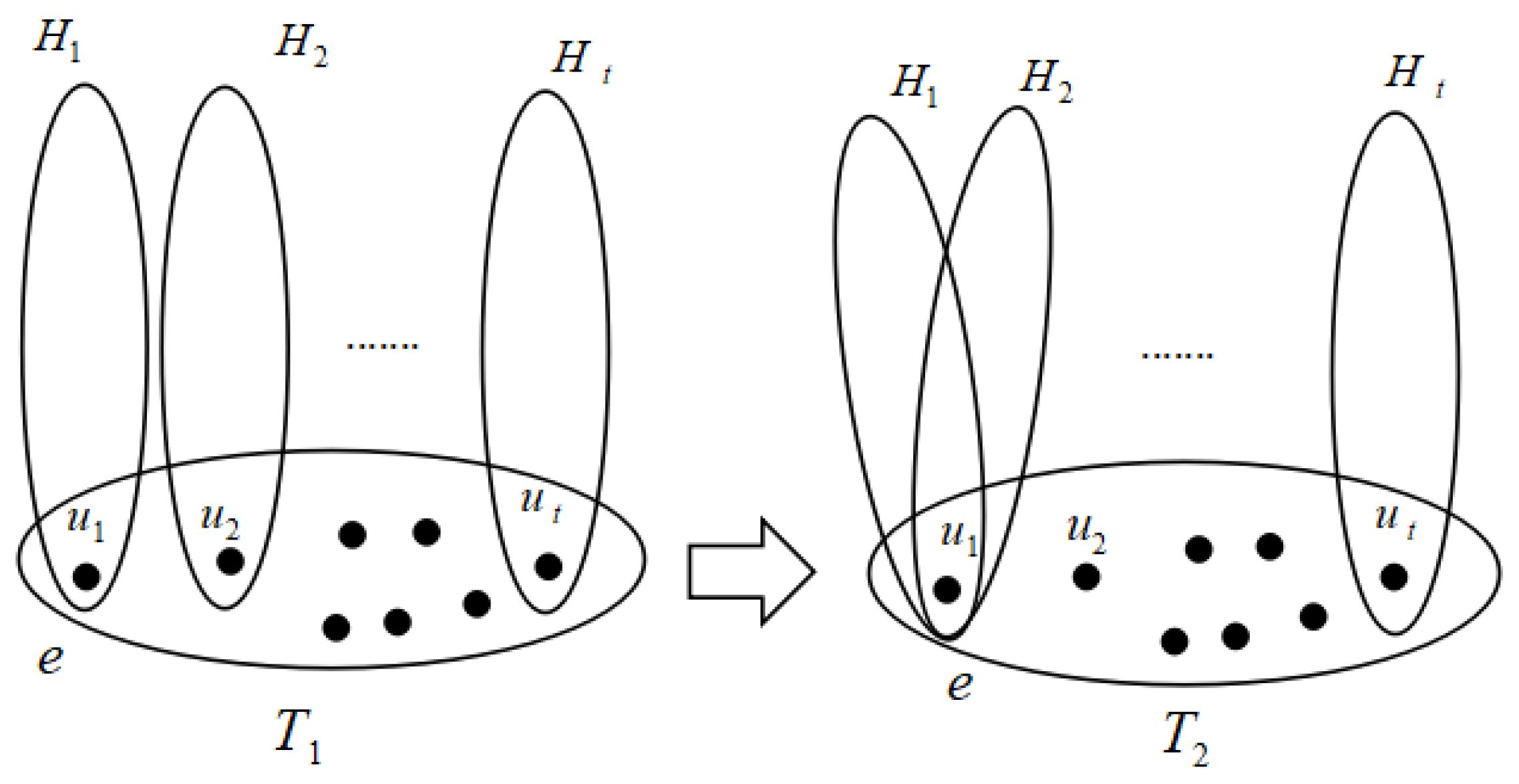
Let () be an edge of a connected hypertree , and suppose that e contains at least three non-pendant vertices. Let be three non-pendant vertices in e and let be the sub-hypertree of such that and for . Assume that the eccentricity for . Let be the hypertree obtained from by moving the sub-hypertree from to (as depicted in Figure 1). Then, . Proof. Note that and for any vertex , and for any vertex .
For vertices and , we have
, ;
, ;
, ;
, .
In this sequel, we divide into four cases to verify the result.
. and .
In this case,
,
,
,
. It follows that
. and
In this case,
,
,
,
. It follows that
.
In this case,
,
,
,
. It follows that
. and
In this case,
,
,
,
. It follows that
This completes the proof. □
Theorem 2.
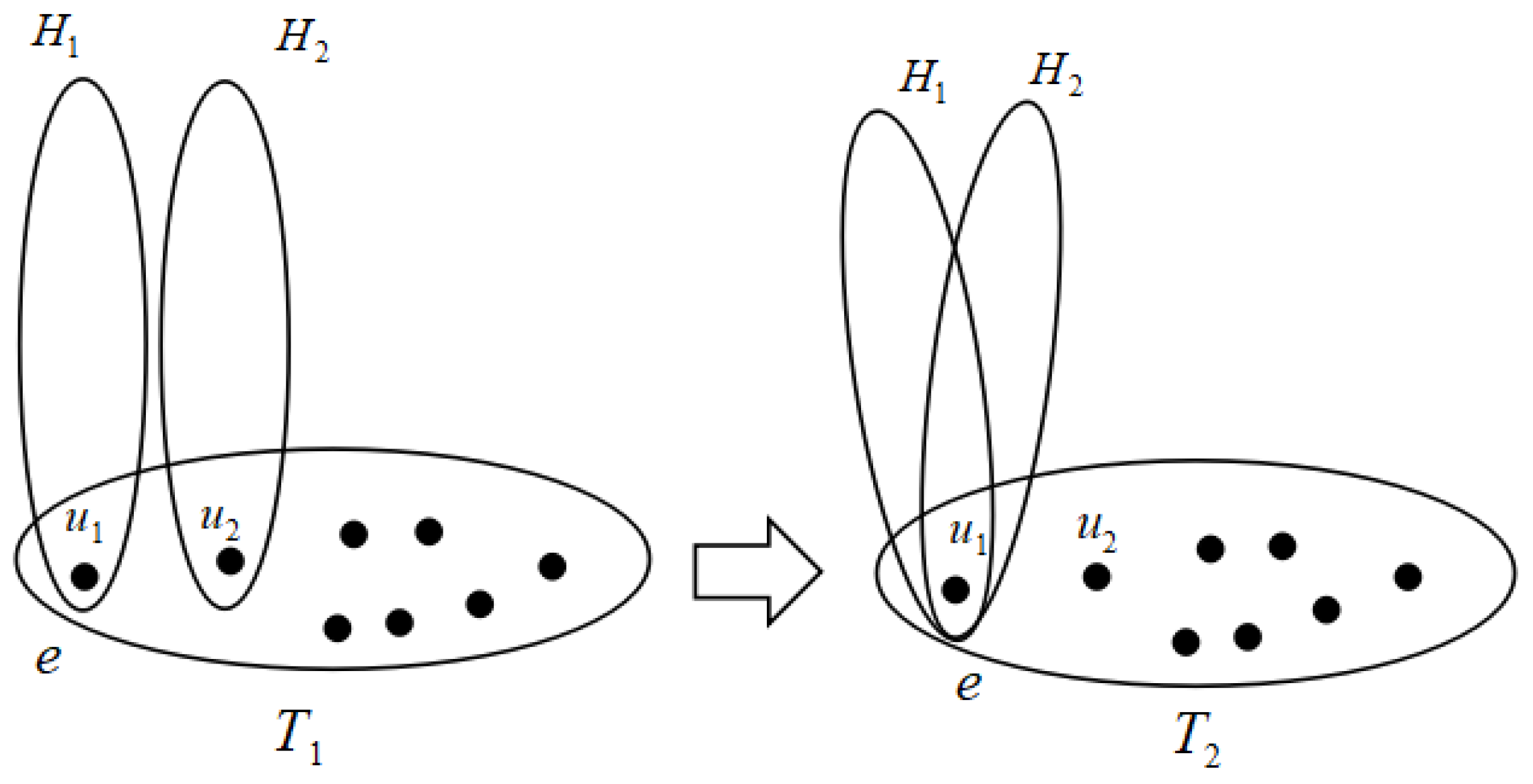
Let () be an edge of a connected hypertree . Assume that and are the only two non-pendant vertices in e. In addition, and are two sub-hypertrees of such that and for . Let be the hypertree obtained from by moving the sub-hypertree from to (as depicted in Figure 2). Then, . Proof. Note that and for any vertex , and for any vertex .
For vertices and , we have
, ;
, ;
, ;
, .
In this sequel, we divide into three cases to verify the result.
. .
In this case,
,
,
,
. It follows that
. .
In this case,
,
,
,
. It follows that
.
In this case,
,
,
,
. It follows that
This completes the proof. □
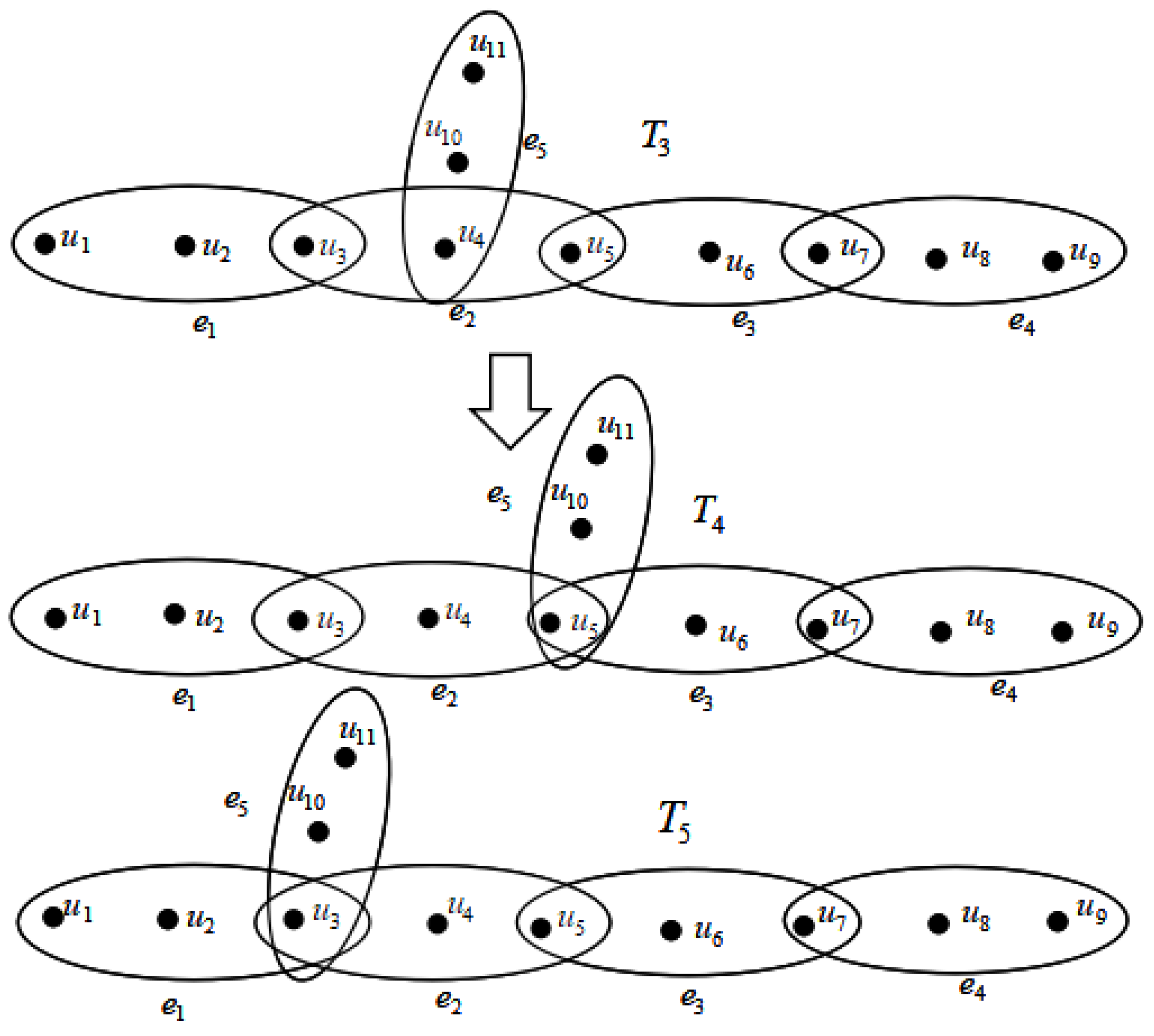
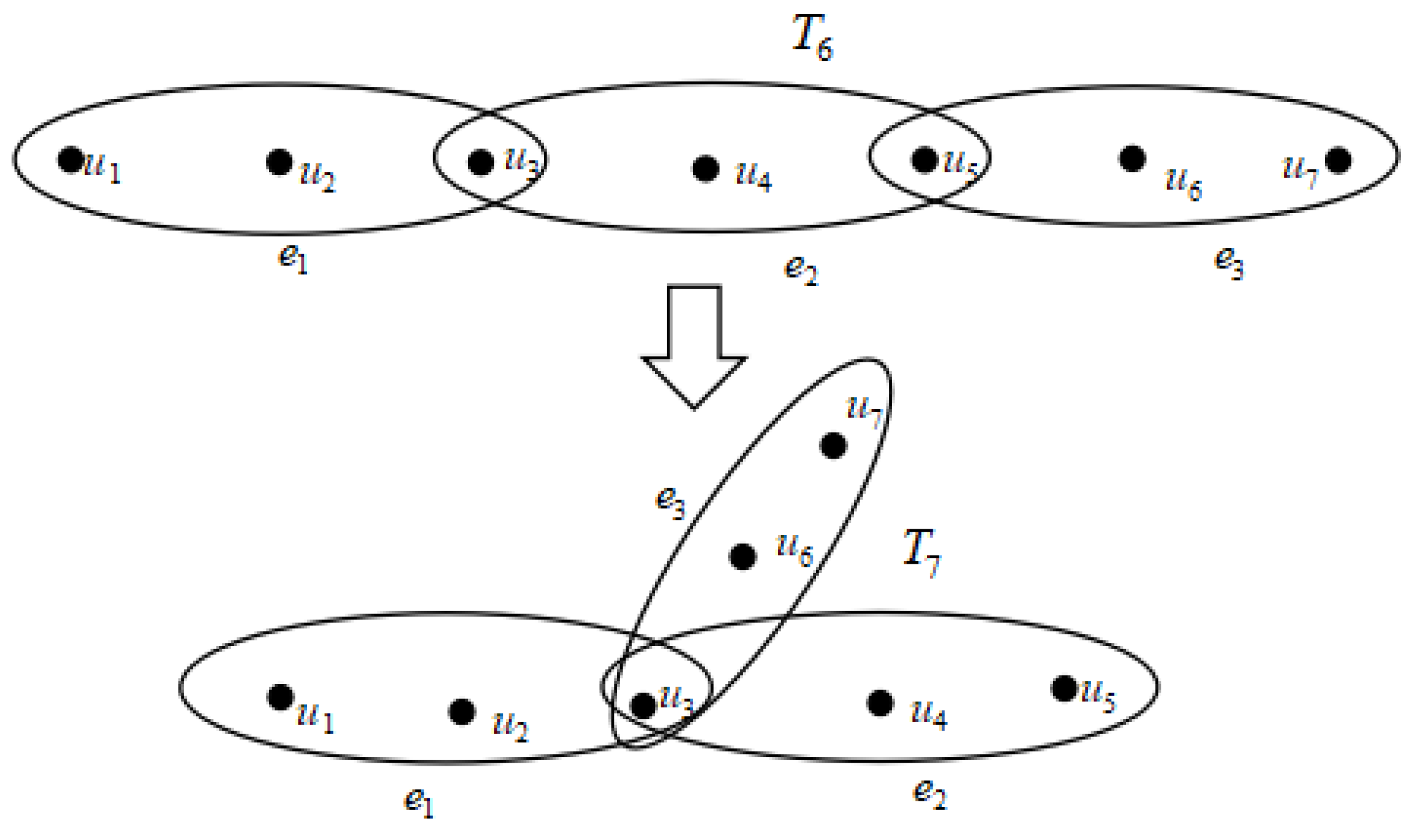
In order to better demonstrate the influence of hypertree transformations I and II on CEI, we apply them on 3-uniform hypertree
(
Figure 3) and 3-uniform hypertree
(
Figure 4), respectively, and calculate the corresponding CEI before and after the structural change of the corresponding hypertree.
Applying Transformation I, we calculate and compare the CEI of hypertrees
,
, and
as follows.
Applying Transformation II, we calculate and compare the CEI of hypertrees
and
as follows.
3. The Maximal and Minimal Values of CEI of -Uniform Hypertrees with Size
In this section, we shall determine the maximal and minimal values of CEI among all k-uniform hypertrees on n vertices with size m.
Firstly, we recall the concept of a loose path introduced in [
27,
28]. For a connected
k-uniform hypertree
T with vertex set
and edge set
, if
for
then
T is called a
k-uniform loose path, denoted by
.
For a connected hypertree T on n vertices with m edges, if all edges of T are pendant edges at a common vertex u, then T is called a hyperstar (with center u), denoted by . If the hypertree is k-uniform, then it is called a k-uniform hypertree, denoted by .
Theorem 3.
Let T be a connected hypertree on n vertices with edges. Then,The equality holds if and only if Proof. Suppose on the contrary that , then at least one edge of T is a non-pendant edge. Without loss of generality, we denote a non-pendant edge of T by .
By applying the transformations of Theorems 1 and 2 on T, we move all the sub-hypertrees on one common edge of T from different vertices x to a common vertex v, , . The resulting hypertree is denoted by . By Theorems 1 and 2, we conclude that . After finitely performing the transformations of Theorems 1 and 2, we can get a hypertree such that and . □
Theorem 4.
Let T be a connected k-uniform hypertree on n vertices with size . Then,The equality holds if and only if Proof. From Theorem 3, we conclude that the equality holds if and only if
Note that
,
,
and
for
. Therefore, it follows that
□
The following lemma is immediate, and so we omit its proof.
Lemma 1.
Let T be a k-uniform hypertree on n vertices. Then, .
Theorem 5.
Let T be a connected k-uniform hypertree on n vertices with size . Then,The equality holds if and only if Proof. It is evident that the diameter of is , i.e., the number of the edges of . Let be a connected k-uniform hypertree on n vertices. Suppose on the contrary that . Let d be the diameter of and , be the diametral path of , where () and for . Then, and .
Next, we move a pendant edge in to and produce a new hypertree. It means that we delete this pendant edge and organize and -pendant vertices in the pendant edge to build a new edge. We denote the new hypertree by . In fact, we can repeat the above operation by finite steps to get a new hypertree such that .
Note that for , for . It is evident that , , for , for and .
Let
, where
is incident to one vertex in
and
vertices in
. Let
. By Lemma 1, we have
. From the definition of CEI, it follows that
Therefore, if , and for any k-uniform hypertrees T with size , we conclude that if and only if . By direct calculation, we get the CEI of . □
For a k-uniform hypertree T, if , then T is a tree. From Theorems 4 and 5, we can deduce the following known theorem.
Theorem 6 ([
22]).
Let T be a tree on n vertices. Then,The right equality holds if and only if and the left equality holds if and only if . 4. The Maximal and Minimal Values of CEI of -Uniform Hypertrees with Given Diameter
In this section, we shall determine the maximal and minimal values of CEI of k-uniform hypertrees with a given diameter. Firstly, we introduce two kinds of k-uniform hypertrees of order n with diameter d.
Let , be a path where () such that and for . For even d, let be a k-uniform hypertree obtained from a path P by attaching t pendant edges at vertex , where is a nonnegative integer. It means that all edges of are pendant edges at . For odd d, let be the hypertree obtained from the path P by attaching pendant edges at some vertices in . Note that is not unique. We denote by the set of hypertrees of the form for odd d.
Theorem 7.
Let T be a connected k-uniform hypertree on n vertices with diameter , and let be a nonnegative integer. Then,The equality holds if and only if for even d, or for odd d. Proof. Let be the extremal k-uniform hypertree which has the maximal CEI among all k-uniform hypertrees on n vertices with diameter Let , be the diametral path of , where () such that and for . By Theorems 1 and 2, we conclude that all edges of must be pendant edges at some vertices in where . For convenience, we denote by .
We now consider the case when
d is even. Assume that
be pendant edges attached a vertex in
and
attached at
. If
, then
. We build a new hypertree
which is obtained from
by moving these pendant edges
to
. Assume that
,
for
. It is evident that all vertices in
have the same eccentricity in
(
). The same result holds in
. From the definition of CEI, one has
Since
,
,
, which contradicts to the fact that
has the maximal CEI. Then,
. We conclude that all edges of
are pendant edges attaching at
, i.e.,
. By direct calculation, we get the CEI of
.
For odd d, these vertices in have the same eccentricity , and the eccentricities of the vertices in are more than . Similarly to the above proof, we get that all edges of are pendant edges at some vertices in , i.e., . By direct calculation, we get the CEI of the hypertrees in . □
Lemma 2.
Let T be a connected k-uniform hypertree with diameter d and the diameter path ,. Let be a vertex with some pendant edges attached. Let be the hypertree obtained by moving these pendant edges from ω to some vertices in . Then,
Proof. Let
(
) be all pendant edges attached at
. Let
(
) be the vertices in
and
for
. For convenience, we set
. It is evident that these vertices in
have the same eccentricity
. Therefore, it follows that
Note that for , for ; . Therefore, . □
In the rest of this section, we shall deal with the minimal CEI of k-uniform hypertrees with a given diameter. For nonegative integers p, q, let be the k-uniform hypertree obtained from the diametral path , by attaching p and q pendant edges at some vertices in and some vertices in , respectively. It is evident that and . Let be the set of hypertrees of the form .
Theorem 8.
Let T be a connected k-uniform hypertree on n vertices with diameter and be a nonnegative integer. Then,The equality holds if and only if . Proof. Let be the hypertree that has the minimal CEI among all hypertrees on n vertices with diameter d. Let , be the diametral path of , where () such that and for . We only need to verify that all edges of are pendant edges attaching at some vertices in .
By Lemma 2,
has the following form: some pendant edges are attached at some vertices in
while others are attached at some vertices in
. Assume that there exists a vertex
with a pendant edge
attached in
. For a vertex
and
. It is evident that these vertices in
have the same eccentricity and
. Let
be the hypertree obtained from
by moving
from
u to
w. Next, we compare the CEI of
and
. By the definition of CEI, it follows that
Note that , . Then, . This contradicts to the fact that has the minimal CEI. Therefore, we conclude that all edges of are pendant edges attaching at some vertices in , then . By direct calculation, we get the CEI of . □
From Theorems 7 and 8, we can deduce the following known theorems, respectively.
Theorem 9 ([
22]).
Let T be a tree on n vertices with diameter . Then,This equality holds if and only if for even d, or for odd d. Theorem 10 ([
22]).
Let T be a tree of order n with diameter . Then,This equality holds if and only if .