


Abstract
In this paper, the Heisenberg doubles and Long dimodules of a BiHom-Hopf algebra are introduced. Then, we discussed the relation between BiHom-Hopf equation and BiHom-pentagon equation, and we obtain the solutions of BiHom-Hopf equation from Heisenberg doubles. We also showed that the parametric generalized Long dimodules can provide the solutions of BiHom-Yang-Baxter equation and generalized -equation.
MSC:
16T99; 16T25
1. Introduction
The theory of Hom-type algebras arises from the q-deformations of Witt and Virasoro algebras (see [1,2]). Then, the theory of Hom-type algebras is rapidly developing into a hot topic in algebra theory [3,4,5,6,7,8]. In 2008, Makhlouf and Silvestrov introduced the definition of Hom-associative algebras [4]. In 2012, Caenepeel and Goyvaerts introduced the monoidal Hom–Hopf algebras [9] in order to provide a categorical approach to Hom-type algebras. In 2015, as the generalization of both Hom-(co)algebras and monoidal Hom-(co)algebras, BiHom-(co)algebras and BiHom-bialgebras were investigated by Graziani, Makhlouf, Menini, and Panaite in [10]. Note that a BiHom-algebra is an algebra in which the identities defining the structure are twisted by two homomorphisms. This class of algebras was introduced from a categorical approach in [10] which can be viewed as an extension of the class of Hom-algebras. Further research on BiHom-type algebras could be found in [11,12,13,14,15] and so on.
It is well known that some classical nonlinear equations in Hopf algebra theory, such as the quantum Yang-Baxter equation, the Hopf equation, the pentagon equation, and the -equation. In [16], the algebraic solutions of Hopf equation and pentagon equation are discussed. In [17], Militaru proved that each Long dimodule gave rise to a solution for the -equation. Long dimodules are the building stones of the Brauer-Long group [18]. The discussion of solutions of BiHom-type Yang-Baxter equation can be seen in [11,19]. The natural consideration is to ask: does there exist algebraic solutions of BiHom-Hopf equation, BiHom-pentagon equation, and BiHom-type -equation? That is the motivation of our paper.
In order to obtain the algebraic solutions of the above BiHom-type nonlinear equations, we introduced the Heisenberg doubles and the parametric generalized BiHom-Long dimodules of a BiHom-Hopf algebra. We also generalized Theorem 3.1 and Theorem 5.10 in [20].
The paper is organized as follows. In Section 2, we first recall some notions of BiHom-Hopf algebras. In Section 3, we describe the BiHom-Hopf equation and BiHom-pentagon equation, and provide the algebraic solutions of BiHom-Hopf equation through Heisenberg doubles. In Section 4, we introduce the parametric generalized BiHom-Long dimodules, and provide the algebraic solutions of the BiHom–Yang-Baxter equation and generalized -equation.
2. Preliminaries
Throughout the paper, always mean integers in . Let be a fixed field and , and be the category of finite dimensional -spaces. All algebras are supposed to be over . For the comultiplication of a -space C, we use the Sweedler–Heyneman’s notation (see [21]): for any . When we say a “BiHom-algebra” or a “BiHom-coalgebra”, we mean the unital BiHom-algebra and counital BiHom-coalgebra. We always assume that the BiHom-structure maps are invertible.
2.1. BiHom-Hopf Algebras
In this section, we will review several definitions and notations related to BiHom-bialgebras.
Recall from [10] or [15] that a BiHom-algebra A over is a 5-tuple , , where A is a -linear space, is an element (the unit), are both bijective linear maps, is a linear map, with notation , satisfying the following conditions, for all :
Remark 1.
Note that the second line of the above identities can be derived from the first line. See [15], (Proposition 2.9).
Example 1.
- (1)
- If is an associative algebra, are both algebra isomorphisms, then is a BiHom-algebra.
- (2)
- If , then A becomes a Hom-algebra.
A BiHom-coalgebra C over is a 5-tuple , in which C is a linear space, are linear isomorphisms, and are linear maps, such that
Remark 2.
Note that the third line of the above identities can be derived from the first two lines. See [15], (Proposition 2.11).
Example 2.
- (1)
- If is a coassociative coalgebra, are both coalgebra isomorphisms, then is a BiHom-coalgebra.
- (2)
- If , then C becomes a Hom-coalgebra.
A BiHom-bialgebra H over is a 9-tuple , with the property that , , is a BiHom-algebra, is a BiHom-coalgebra, and are all morphisms of BiHom-algebras preserving unit, i.e., for all ,
Moreover, it is easy to check that are BiHom-coalgebra maps, are BiHom-algebra maps, and they commute with each other (see [15], Proposition 2.14).
Example 3.
- (1)
- If is a bialgebra, are all bialgebra isomorphisms, then is a BiHom-bialgebra.
- (2)
- If is a finite dimensional BiHom-bialgebra, . Define the multiplication ⋆, the comultiplication (with notation ) and byDefine byThen, is a BiHom-bialgebra.
- (3)
- If , then H becomes a Hom-bialgebra. If , then H becomes a monoidal Hom-bialgebra.
Recall from [22] that a BiHom-Hopf algebra H over is a 10-tuple ), where is a BiHom-bialgebra, (the antipode) commutes with , and satisfies, for any ,
Proposition 1.
Recall from [22] that, if H is a BiHom-Hopf algebra, then for any , the antipode S satisfies
Moreover, if S is a bijection, then
Example 4.
- (1)
- If is a Hopf algebra, are all Hoppf algebra isomorphisms and satisfying , then is a BiHom-Hopf algebra.
- (2)
- If is a BiHom-Hopf algebra, under the consideration of Example 3 (2), we immediately obtain that , ⋆, ε, , , , , and , , ε, , , , , ( are all BiHom-Hopf algebras.
- (3)
- If and , then H becomes the so-called monoidal BiHom-Hopf algebra (see [10], Definition 6.4). If , then H becomes the usual Hom–Hopf algebra. Similarly, if , then H becomes the usual monoidal Hom–Hopf algebra.
2.2. BiHom-Modules and BiHom-Comodules of a BiHom-Bialgebra
Assume that , is a BiHom-bialgebra. Recall that a -space M is called a left BiHom-module of H (in short, an H-BiHom-module) if there exist -linear isomorphisms (the Hom-structure maps), and an H action (with notation ), such that, for any , ,
If and are left H-BiHom-modules with H-actions and, respectively, , a morphism of H-BiHom-modules is an H-linear map satisfying the conditions
The category of H-BiHom-modules and morphisms will be denoted by .
Remark 3.
- (1)
- Obviously, .
- (2)
- The definition of right BiHom-module of H can be defined in a similar way.
- (3)
- For any integers , , forms a monoidal category under the following structures:
- the tensor product of and is , , where the H-action on is given by
- the unit object is with the trivial module action;
- for any , the the associativity and the unit constraints are given by
We write this monoidal category by .
Dually, recall from [15], (Definition 5.3) that a right H-BiHom-comodule is a 5-tuple , where M is a linear space, are linear isomorphisms, and we have a linear map (called a coaction) , with notation , for all , such that the following conditions are satisfied
If and are right H-BiHom-comodules with coactions and, respectively , a morphism of right H-BiHom-comodules is a linear map satisfying the conditions
The category of H-BiHom-comodules and H-colinear morphisms will be denoted by .
Remark 4.
- (1)
- Obviously, .
- (2)
- The definition of left BiHom-comodule of H can be defined in a similar way.
- (3)
- For any integers , forms a monoidal category under the following structures:
- the tensor product of H-BiHom-comodules and is with the H-coaction :
- the unit object is with the trivial coaction;
- the associativity constraint and the unit constraint and are given by
We denote this monoidal category by .
3. The BiHom-Type Heisenberg Doubles and the BiHom-Hopf Equation
In this section, we will discuss the algebraic solutions of the BiHom-Hopf equation and the BiHom-pentagon equation.
3.1. BiHom-Hopf Equation and BiHom-Pentagon Equation
In this subsection, we will discuss the relation between the BiHom-Hopf equation and BiHom-pentagon equation.
Definition 1.
Let be a BiHom-algebra over , be an element in and satisfy
(1) If satisfies , i.e.,
where , then we say is a solution of the BiHom-Hopf equation.
(2) If satisfies , i.e.,
then we say is a solution of the BiHom-pentagon equation.
Example 5.
- (1)
- is a solution of the BiHom-Hopf equation and the BiHom-pentagon equation.
- (2)
- For any , is a solution of the BiHom-Hopf equation if and only if and , is a solution of the BiHom-Hopf equation if and only if and .
- (3)
- If , then A is the usual algebra, and the solution of the BiHom-Hopf equation becomes the solution of usual Hopf equation, the solution of the BiHom-pentagon equation becomes the solution of usual pentagon equation (see [[16], Definition 11] for details).
Proposition 2.
- (1)
- If is a solution of the BiHom-Hopf equation, then is a solution of the BiHom-pentagon equation.
- (2)
- If is invertible, then is a solution of the BiHom-Hopf equation if and only if is a solution of the BiHom-pentagon equation.
Proof.
- (1)
- Self evident.
- (2)
- Note that and are inverse with each other, and are inverse with each other, where means the inverse of . Hence, the conclusion holds.
□
Proposition 3.
Let , be an invertible solution of the BiHom-Hopf equation. If we define a -linear map , , by
where , , then is a BiHom-algebra morphism. Furthermore, forms a Hom-coalgebra without a counit.
Proof.
For any , we compute
which implies is a BiHom-algebra morphism.
Moreover, since Proposition 2, is a solution of the BiHom-pentagon equation, then we have
hence the conclusion holds. □
3.2. Heisenberg Doubles of a BiHom-Hopf Algebra
In this subsection, we will provide the algebraic solutions of BiHom-Hopf equation from Heisenberg doubles. From now on, we assume that is a finite dimensional BiHom-Hopf algebra, and S is bijective. Recall from Example 3 (2) that
is a BiHom-bialgebra. Then, we obtain the following definition.
Definition 2.
For any , the -th Heisenberg double of H, in a form containing H and , is a BiHom-algebra with the following structure
where , .
Proof.
For any , , we have
which implies the BiHom-associative law. Obviously, we have
which implies the BiHom-unit law. Hence, is a BiHom-algebra. □
Theorem 1.
is a solution of the BiHom-Hopf equation, where and are dual bases of H and , respectively.
Proof.
For any , we have
and
where and and and are both dual bases of H and , respectively. This implies that is a solution of the BiHom-Hopf equation. □
Corollary 1.
is a solution of the BiHom-pentagon equation.
Proof.
It is easy to check (by using Equation (3)) that
is the inverse of . Hence, the conclusion holds because of Proposition 2. □
4. The BiHom-Long Dimodules and the BiHom- Equation
In this section, we will describe the algebraic solutions of the BiHom–Yang-Baxter equation and BiHom- equation.
4.1. The Parametric Generalized BiHom-Long Dimodules
In this subsection, we will introduce the generalized BiHom-Long dimodules which play an important role in the BiHom–Yang-Baxter equation and BiHom- equation. Assume that and are two BiHom-Hopf algebras.
Definition 3.
A -space U is called a left-right generalized BiHom-Long dimodule of H and B, if there exist morphisms such that is both a left H-BiHom-module and a right B-BiHom-comodule, and the following compatibility condition is satisfied:
for all and . We denote by the category of generalized BiHom-Long dimodules, with morphisms being H-linear and B-colinear.
Example 6.
- (1)
- For any , define the left H-action ⇀ on byand define the right B-coaction on bythen it is straightforward to check that is a generalized BiHom-Long dimodule.
- (2)
- Similarly, for , if we define the left H-action ⇁ on byand define the right B-coaction on bythen, it is straightforward to check that is also an object in .
For any , we can define the monoidal structures in as follows:
- the monoidal product of of is , where the BiHom-module and BiHom-comodule structures are given by
- the unit object is with the trivial H-action and trivial B-coaction.
Theorem 2.
For any , forms a monoidal category under the above structures.
Proof.
First, for any , , we have
which implies Equation (11). Hence, .
Second, define the the the associativity and the unit constraints by
where , then, it is not hard to check that is a monoidal category. □
Remark 5.
We denote (under the monoidal structures given above) by .
Proposition 4.
For any , is monoidal isomorphic to .
Proof.
Define functor by
where , , and is given by
for any , , . Obviously, is a monoidal isomorphic functor. □
4.2. BiHom-Type Yang-Baxter Equation
In this subsection, we will show that the generalized BiHom-Long dimodules will provide the algebraic solutions of the BiHom–Yang-Baxter equation.
Definition 4.
Let H be a BiHom-Hopf algebra. Recall from [22] that a quasitriangular structure of His an invertible element , such that the following conditions hold:
for any , where .
Remark 6.
Let be integers, and be two elements in . Recall from [22], (Section 3.2) that, for any , if we define families of maps and as follows:
- is given by
- is given bythen is a braiding in with the inverse if and only if is a quasitriangular structure of H with the inverse element .
Lemma 1.
If is a quasitriangular structure of H, then
Proof.
Be similar to [23], (Lemma 2.1.2). □
Lemma 2.
If is a quasitriangular structure of H, then, for any , we have
where .
Proof.
Equation (13) holds because of Equation (Q2). Actually,
which implies the conclusion. □
Lemma 3.
If H is a BiHom-Hopf algebra with bijective antipode S, and is a quasitriangular structure of H, then we have
and hence
Proof.
Firstly, due to Equation (12), we immediately obtain that
thus, from Equation (Q3), we have
which implies .
Secondly, we can obtain in a similar way.
Definition 5.
Recall from [22], (Definition 3.18) that a coquasitriangular structure on a BiHom-Hopf algebra His a bilinear form , such that σ is invertible under the convolution invertible, and the following formulae are satisfied:
Remark 7.
For any bilinear form , (where mean any integers), define the families of maps by
Then, recall from [22], (Theorem 3.20) that σ is a coquasitriangular form of H if and only if is a braided category with the braiding .
Being similar to Lemmas 1 and 3, we have the following property.
Lemma 4.
- (1)
- If σ is a coquasitriangular form of H, then for any , we have
- (2)
- If H is a BiHom-Hopf algebra with bijective antipode S, and σ is a coquasitriangular form of H, then, for any , we have
Now, assume that and are two BiHom-Hopf algebras.
Theorem 3.
If H is quasitriangular and B is coquasitriangular, then forms a braided category.
Proof.
Suppose that is a quasitriangular structure of H, and is a coquasitriangular structure on B. For any , , , define
Obviously, is compatible with the BiHom-structure maps. Since we have
is H-linear. Similarly, we have
which implies is B-colinear. Moreover, we also have
and similarly we can obtain .
Now, for any , consider , where
Next, we will show is the inverse of . Indeed, we have
and similarly we can obtain . This means that is a braided category. □
Under the consideration above, we obtain the following result.
Corollary 2.
The family of maps for any is a solution of the following BiHom-type Yang-Baxter Equation:
Proof.
Straightforward. □
4.3. Generalized -Equation
In this section, we will show that the generalized BiHom-Long dimodules will provide the algebraic solutions of BiHom-type -equation. From now on, we always assume that is a BiHom-Hopf algebra over .
Definition 6.
Let be a natural transformation in . If the following diagram is commutative
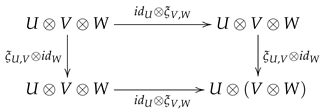 in , then we say ξ is a solution of the -equation.
Theorem 4.
For any integer , the following -linear maps
where satisfies the following generalized BiHom-type -equation in :
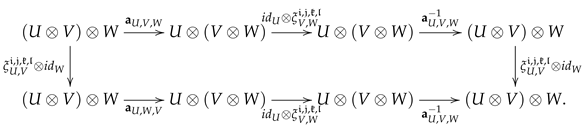
Proof.
For any , , , since the following identities
the conclusion holds. □
Remark 8.
As a special case of Theorem 4, if , then H is a Hom–Hopf algebra, and we immediately obtain [8], (Proposition 5.11).
5. Conclusions
For a BiHom-Hopf algebra H, we first introduced the parametric Heisenberg doubles of H, and show that they can provide the solutions of the BiHom-Hopf equation and BiHom-pentagon equation. Then, we investigated the generalized BiHom-type Long-dimodules, and the solution of BiHom--equation derived from them. Moreover, if H is both quasitriangular and coquasitriangular, then BiHom-type Long-dimodules also provide the solutions of BiHom-Yang-Baxter equation.
Author Contributions
Conceptualization, X.Z. and H.W.; methodology, H.W.; validation, X.Z. and H.W.; formal analysis, X.Z.; investigation, H.W.; resources, H.W.; writing original draft preparation, H.W.; writing review and editing, X.Z.; visualization, H.W.; supervision, X.Z.; project administration, H.W.; funding acquisition, X.Z. and H.W. All authors have read and agreed to the published version of the manuscript.
Funding
The work was partially supported by the Project Funded by the China Postdoctoral Science Foundation (No. 2020M672023) and the National Natural Science Foundation of China (Nos. 11871301, 12271292).
Data Availability Statement
Not applicable.
Acknowledgments
The authors would like to express their gratitude to the anonymous referee for their very helpful suggestions and comments which led to the improvement of our original manuscript.
Conflicts of Interest
The authors declare no conflict of interest.
References
- Hartwig, J.; Larsson, D.; Silvestrov, S. Deformation of Lie algebras using σ-derivations. J. Algebra 2006, 295, 314–361. [Google Scholar] [CrossRef]
- Hu, N.H. q-Witt algebras, q-Lie algebras, q-holomorph structure and representations. Algebra Colloq. 1999, 6, 51–70. [Google Scholar]
- Makhlouf, A.; Panaite, F. Yetter-Drinfeld modules for Hom-bialgebras. J. Math. Phys. 2014, 55, 013501. [Google Scholar] [CrossRef]
- Makhlouf, A.; Silvestrov, S. Hom-algebras structures. J. Gen. Lie Theory Appl. 2008, 2, 51–64. [Google Scholar] [CrossRef]
- Makhlouf, A.; Silvestrov, S. Hom-Lie admissible Hom-coalgebras and Hom–Hopf algebras. In Generalized Lie theory in Mathematics, Physics and Beyond; Springer: Berlin, Germany, 2008; Chapter 17; pp. 189–206. [Google Scholar]
- Yau, D. Hom-quantum groups I: Quasitriangular Hom-bialgebras. J. Phys. A 2012, 45, 065203. [Google Scholar] [CrossRef][Green Version]
- Yau, D. Hom-Yang-Baxter equation, Hom-Lie algebras and quasitriangular bialgebras. J. Phys. A 2009, 42, 165202. [Google Scholar] [CrossRef]
- Zhang, X.H.; Dong, L.H. Braided mixed datums and their applications on Hom-quantum groups. Glasgow Math. J. 2018, 60, 231–251. [Google Scholar] [CrossRef]
- Caenepeel, S.; Goyvaerts, I. Monoidal Hom–Hopf algebras. Comm. Algebra 2011, 39, 2216–2240. [Google Scholar] [CrossRef]
- Graziani, G.; Makhlouf, A.; Menini, C.; Panaite, F. BiHom-associative algebras, BiHom-Lie algebras and BiHom-bialgebras. SIGMA 2015, 11, 086. [Google Scholar] [CrossRef]
- Fang, X.L.; Liu, W. Solutions of the BiHom–Yang-Baxter equations. Mat. Sb. 2018, 209, 128–145, translation in Sb. Math. 2018, 209, 901–918. [Google Scholar] [CrossRef]
- Guo, S.J.; Zhang, X.H.; Wang, S.X. The construction and deformation of BiHom-Novikov algebras. J. Geom. Phys. 2018, 132, 460–472. [Google Scholar] [CrossRef]
- Li, J.; Chen, L.Y.; Sun, B. Bihom-Nijienhuis operators and T*-extensions of Bihom-Lie superalgebras. Hacet. J. Math. Stat. 2019, 48, 785–799. [Google Scholar] [CrossRef]
- Liu, L.; Makhlouf, A.; Menini, C.; Panaite, F. σ,τ-Rota-Baxter operators, infinitesimal Hom-bialgebras and the associative (Bi)Hom-Yang-Baxter equation. Canad. Math. Bull. 2019, 62, 355–372. [Google Scholar] [CrossRef]
- Zhang, X.H.; Wang, D.G. Cotwists of bicomonads and BiHom-bialgebras. Algebra Represent. Theor. 2020, 23, 1355–1385. [Google Scholar] [CrossRef]
- Caenepeel, S.; Militaru, G.; Zhu, S.L. Frobenius and separable functors for generalized module categories and nonlinear equations. In Lecture Notes in Mathematics (1787); Springer: Berlin/Heidelberg, Germany, 2002. [Google Scholar]
- Militaru, G. The Long dimodules category and nonlinear equations. Algebra Represet. Theor. 1999, 2, 177–200. [Google Scholar] [CrossRef]
- Long, F. The Brauer group of dimodule algebras. J. Algebra 1974, 30, 559–601. [Google Scholar] [CrossRef]
- Ma, T.S.; Li, J. Nonhomogeneous associative Yang-Baxter equations. Bull. Math. Soc. SCI. Math. Roumanie (N.S.) 2022, 65, 97–118. [Google Scholar]
- Wang, S.X.; Zhang, X.H.; Guo, S.J. The Hom-Long dimodule category and nonlinear equations. Electron. Res. Arch. 2022, 30, 362–381. [Google Scholar] [CrossRef]
- Sweedler, M.E. Hopf Algebras; Benjamin: New York, NY, USA, 1969. [Google Scholar]
- Zhang, X.H.; Wang, W.; Chen, J.Z. Parametric representations of BiHom-Hopf algebras. 2022; Submitted. [Google Scholar]
- Majid, S. Foundations of Quantum Group Theory; Cambridge University Press: London, UK, 1995. [Google Scholar]
Publisher’s Note: MDPI stays neutral with regard to jurisdictional claims in published maps and institutional affiliations. |
© 2022 by the authors. Licensee MDPI, Basel, Switzerland. This article is an open access article distributed under the terms and conditions of the Creative Commons Attribution (CC BY) license (https://creativecommons.org/licenses/by/4.0/).