1. Introduction
In recent years, the MASs [
1] with swarm intelligence have been applied in many fields, such as attitude alignment and consensus [
2], automated highway systems [
3], flocking [
4], formation control [
5,
6], and so on. In practical applications, MASs should optimize the global objective and reach consensus under appropriate control protocols. Different from traditional optimization methods, distributed optimization can effectively avoid the dependence of centralized control to improve privacy protection [
7], reliability [
8] and scalability [
9].
The major assignment of distributed optimization is to design appropriate distributed control protocols, which not only enable agents to achieve efficient swarm behaviors through local collaborations but also optimize the global objective. Therefore, the distributed optimization of MASs is widely used in the maximization of social welfare [
10], optimization of allocate resources [
11], energy management of microgrids [
12,
13,
14,
15], and sensor networks [
16]. According to different information updating and transmission rules, existing distributed optimization models can be generally divided into two categories: discrete-time models and continuous-time models. Early researches mainly focused on discrete-time models [
17,
18,
19,
20,
21,
22,
23]. Subsequently, the distributed optimization problem for MASs with continuous-time models was considered because it can effectively avoid the analysis of time complexity in discrete-time algorithms with the assistance of modern control theory. At present, some meaningful results have been obtained. For instance, an objective optimization problem for MASs over strongly connected weighted balanced networks was studied in [
24]. Considering the constraints of control input, an optimization algorithm with input saturation was designed in [
25]. To shorten the convergence time, the finite-time and fixed-time optimization algorithms were proposed in [
26,
27], respectively.
Most distributed optimization problems were considered based on first-order or second-order MASs. In [
28], a first-order distributed optimization problem with an information restriction policy was studied. In [
29,
30], the first-order distributed optimization problems over directed network structure were discussed. In [
31,
32], some gradient-based algorithms based on second-order MASs with undirected networks were proposed. In addition, several distributed optimization problems with exogenous disturbances were considered in [
33]. However, most distributed optimization algorithms for second-order MASs were proposed based on undirected network structures. How to design distributed optimization algorithms on directed networks is challenging. This is one of the motives of this paper.
In practical application, agents are usually limited by communication resources. Continuous communication inevitably leads to high energy consumption. To reduce unnecessary communication, the event-triggered control technique was employed in the design of the distributed optimal control protocol. For example, some event-triggered subgradient and consensus algorithms were proposed to address optimization problems for first-order MASs over undirected networks in [
34,
35], respectively. In [
36], an event-triggered zero-gradient-sum algorithm over directed networks was proposed. Additionally, a distributed optimization problem for second-order MASs with undirected networks was considered based on the event-triggered communication algorithm in [
37]. To our knowledge, the distributed optimization problems for second-order MASs over directed networks have not been considered by using an event-triggered communication algorithm.
Based on the above discussion, this paper considers the distributed optimization problem for second-order MASs over directed networks. Both continuous-time and event-triggered communication protocols are proposed. The main contributions of this paper can be broadly summarized as follows:
- (1)
Motivated by [
38,
39], this paper considers a more general distributed optimization problem, which can be regarded as a generalization of the existing one in [
33,
37]. The global optimization objective is the weighted sum of local objective functions, which can adjust the global optimization objective more flexibly. Thus, it has a wider application prospect.
- (2)
A directed network is constructed based on the considered optimization problem, and a second-order continuous protocol is proposed according to the constructed directed network. Some sufficient conditions are obtained to ensure the solvability of the considered optimization problem.
- (3)
In order to reduce the limited resource cost, an event-triggered communication protocol is designed. Combined with the linear transformation method and Lyapunov stability theory, we can prove that the optimization problem can be solved under the proposed protocols.
The remaining parts of this paper are organized as follows. Some preliminaries are presented in
Section 2. In
Section 3, the continuous-time communication protocol is proposed. In
Section 4, an improved event-triggered protocol is given. A simulation example is presented in
Section 5. Finally, a conclusion is given in
Section 6.
Notations. Let and denote the N-dimensional Euclidean space and dimensional matrices. is the identity matrix with dimension. and denote the column vectors with N ones and N zeros, respectively. ⊗ and denote the Kronecker product and the Euclidean norm, respectively. represents the gradient of function . is the transposition of matrix (vector x), and is the inverse of matrix . denotes the positive integer set.
3. The Continuous-Time Communication Protocol
In this section, we assume that the communication among agents is continuous. Based on directed graph
, the following algorithm is presented
where
denote the position and the velocity states of agent
i, respectively.
, and
are positive parameters.
is an auxiliary variable, and the initial value satisfies
.
Remark 2. The distributed optimal algorithm (3) not only contains the consensus term and optimization term but also has auxiliary variable . Motivated by [37,42], the auxiliary variable , as the integral of , is designed for ensuring that the equilibrium point of (3) is the optimal value through the transmission of local information. Remark 3. Compared with [37], each item of (3) has a weighted coefficient to efficiently adjust the influence strength on the distributed optimization algorithm. It is well known that the sensitivity of the second-order MASs is higher than that of the first-order MASs, so the stability analysis becomes more difficult. The algorithm (3) is suitable for second-order MASs because of their improved flexibility and higher fineness. In addition, different from the algorithm in [42], the dynamics of do not use the position information of agents in this paper. Thus, the calculation consumption is much simpler than the existing one. Because of the strict convexity of function
, the objective function
is also a differentiable and strongly convex function. Based on Assumption 1, the optimization problem (
1) has a unique optimal solution
According to the definition of Laplacian
, the distributed optimization algorithm (
3) can be rewritten as the following compact form:
where
, ⋯,
,
, ⋯,
,
.
Assumption 4. For algorithm (3), is satisfied, and there exist parameters , such that and , where , , and is a constant. Lemma 1. For algorithm (3), if Assumptions 1 and 2 are satisfied, then there is a unique solution for any initial value on . Proof. Based on the strict convexity of function
, one can easily know that there exists one solution for algorithm (
3) at least. Therefore, we only need to prove the uniqueness of the solution. Let
, then one can obtain
It is noticed that
is Lipschitz continuous, then the solution of
exists. Assume there are two different solutions of Equation (
4), which are
and
satisfying initial condition
. Based on the Assumption 1, we can obtain that
where
and
. Additionally, then, it has
By using the Gronwall inequality, one has
which means that
for
. Therefore, Lemma 1 is proved. □
If Assumption 1 and equality
holds, then there exists an equilibrium point
of algorithm (
4). Therefore, the following equation is satisfied for the
:
Since
is strongly connected and detail-balanced, then it has
. Left multiplying
for the third equation of (
5), it has
; equivalently,
. In combination with
, it has
Because
is an inevitable diagonal matrix, then the first equation of (
5) implies
. Substituting
into the second equation of (
5), and left multiplying
, it has
, that is
. Hence,
is an optimal value of (
2).
We define
and
, then the system (
4) is described as follows:
Denote
,
and
, it has
Then, the variables of equality (
7) is divided as follows
,
, and
,
, in which
and
,
,
. Therefore, equality (
7) can be decomposed as follows
and
Remark 4. Different from the dynamics in [37], the parameter is added to adjust the changing rate of in the proposed dynamics. Hence, the application scope of the second-order system is generalized. In the meantime, the matrix transformation from system (6) to system (7) solves the difficulties caused by the asymmetry of directed network topology. Theorem 1. Suppose that Assumptions 1–4 hold, then the optimization problem (1) can be solved via distributed algorithm (3). Proof. Construct the following Lyapunov function
where
and
Note that
if
.
and
if and only if
. Then,
and
if and only if
. Take the time derivation of
,
and
, it has
and
Therefore, the time derivation of
is obtained as
As is an identity orthogonal matrix, and , then one has .
Therefore, it has that
where
,
, and
. By comparing the above inequalities, we can easily know that
. Thus, we only need to prove
,
. From the condition of Theorem 1,
, and
if and only if
. Therefore, consensus can be achieved. □
Remark 5. The distributed optimization problem for MASs with directed networks is more difficult than those on undirected networks, which are mainly reflected in two aspects. The first aspect is the symmetry of the Laplacian matrix of the network topology. The symmetry of the Laplacian matrix of undirected topology can be fully utilized as in [33,37], but the Laplacian matrix is usually asymmetric for directed topology. Therefore, to solve the optimization problem on directed networks, other more complicated methods need to be adopted. The second aspect is that the optimization problem is usually only with the sum of local objective functions and without the convex hull. However, in order to solve more general distributed optimization problems, the directed network needs to be designed carefully in this paper. Remark 6. It is not difficult to see that the above algorithm relies on continuous-time communication, which contains distinct shortcomings. In practical application, a continuous-time algorithm inevitably needs a lot of communication costs. As we all know, the bandwidth, transmission energy, and communication frequency are limited by the current industrial level and cannot be used indefinitely. Therefore, in the next subsection, we propose a new algorithm in order to improve this drawback.
4. The Event-Triggered Communication Protocol
Based on directed communication topology
, the following algorithm is presented
where
denotes the
kth event instant of agent
i for
. Other parameters are consistent with the ones in algorithm (
3).
Before analyzing the distributed optimal algorithm, the measurement error
of agent
i is defined as
. Hence, with the definition of
, the distributed optimal algorithm (
12) for
can be rewritten as follows
According to the definition of Laplacian
, the distributed optimal algorithm can be rewritten as the following compact matrix–vector form:
where
,
,
, ⋯,
,
,
,
,
,
,
.
We perform a similar coordination transformation as before. Define
and
, then the new transformed system is described as follows:
Denote
and
. Then, we divide the variables as follows:
and
,
, where
and
,
,
,
. Hence, equality (
15) can be rewritten as follows:
and
Assumption 5. For MAS (12), is satisfied, and there exist parameters , such that , , and , where are positive constants, , , , , and ϵ and are two positive constants, and is a positive number for adjustment. Moreover, the event-trigger instantly satisfieswhere . Theorem 2. Suppose that Assumptions 1–3 and 5 hold, then the optimization problem (1) can be solved via distributed algorithm (12). Proof. Choosing the same Lyapunov function as (
8). Based on equalities (
9)–(
11), (
16), and (
17), we take the time derivation of
, and
for
, as follows:
and
Therefore, the time derivation of
for
is obtained as
By using the Young’s inequality with
,
for
, one has
Then, we consider the following Lyapunov function
where
Note that
and
if and only if
and
. Take the time derivation of
and
for
, respectively, one has
Therefore, the time derivation of
for
is obtained as
By using Young’s inequality, it has
and
Let
, then it is clear that
where
,
,
,
, and
.
Next, we let
, where
. As
and
, it has
Moreover, according to the above definition
, one has
Based on
, it has
Based on
, let
where
is an arbitrary positive parameter.
Consequently, it is clear that
Therefore, the agent
i can use event-triggered sampling control (
18) to determine whether to store and update sampling data.
From the condition of Theorem 2, , and if and only if . Therefore, the state of the system can be asymptotically uniform and converge to the optimal solution of the optimization problem. □
Remark 7. Compared with existing work in [37], the selection of the Lyapunov function is different. In our paper, the positive function , inspired by the one in [44], is added to broaden the limitation of related coefficients in the dynamics. Remark 8. In this event-triggered algorithm, the global information and are used by each agent in the trigger function. To avoid using global information, the proposed algorithm will be improved in our future work.
Theorem 3. For the MAS (12), if all conditions of Theorem 2 are satisfied, then there is no Zeno behavior. Proof. For
,
, the the upper right-hand derivative of
is given by
According to equality (
12), it has
As the functions
and
are continuous and differentiable on the closed interval
, then there exist at least two points
and
in
, which makes the following two formulas hold, respectively,
and
Denote .
Since
, considering equality (
20), we can obtain
where
is a constant. The event instants of agent
i are determined by equality (
18), and the next event will not be triggered before
. Therefore, it has
From equality (
23), we can easily obtain that
. As the network topology
is strongly connected, directed, and detail-balanced,
if and only if
That means all agents states achieve consensus, and the communication between agents is no longer needed. Then, before all agents achieve consensus. Therefore, Zeno behavior can be excluded. □
Remark 9. The optimization problem with event-triggered communication and data rate constraint was investigated in [18]. To preprocess the information, a vector-valued quantizer with finite quantization levels was introduced. This gives us a good research direction. In [18], the considered system is a first-order linear difference equation, and the optimization problem is modeled as the sum of all agents’ local convex cost functions. However, in our paper, we consider a second-order multi-agent system, and the optimization problem is the weighted sum of agents’ local convex cost functions. 5. Numerical Example
In this section, an economic dispatch example is used to verify the performance of the proposed algorithms (
3) and (
12).
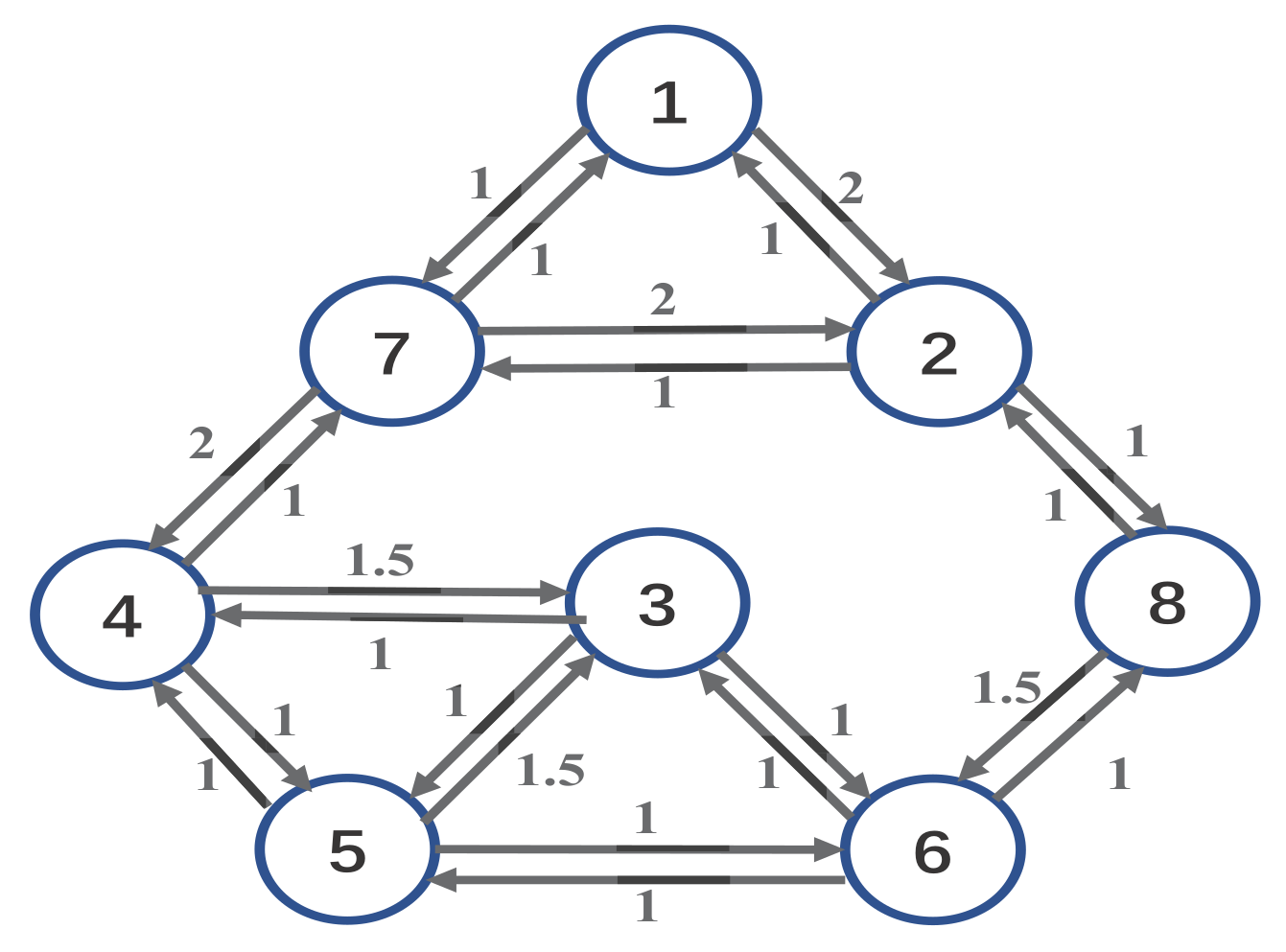
We consider a power system which contains 8 generators and 22 loads. The active power generated by the
ith generator is denoted by
, and the allocation weight is represented by
. The communication topology is constructed as shown in
Figure 1.
The cost functions are given by the quadratic function [
26]
, in which
, and
represent the cost coefficients. Therefore, the economic dispatch problem is given by
In the simulation, we let
,
,
, and
and choose the initial states as
,
,
,
,
,
,
, and
. The cost coefficients and the allocation weights are given in
Table 1.
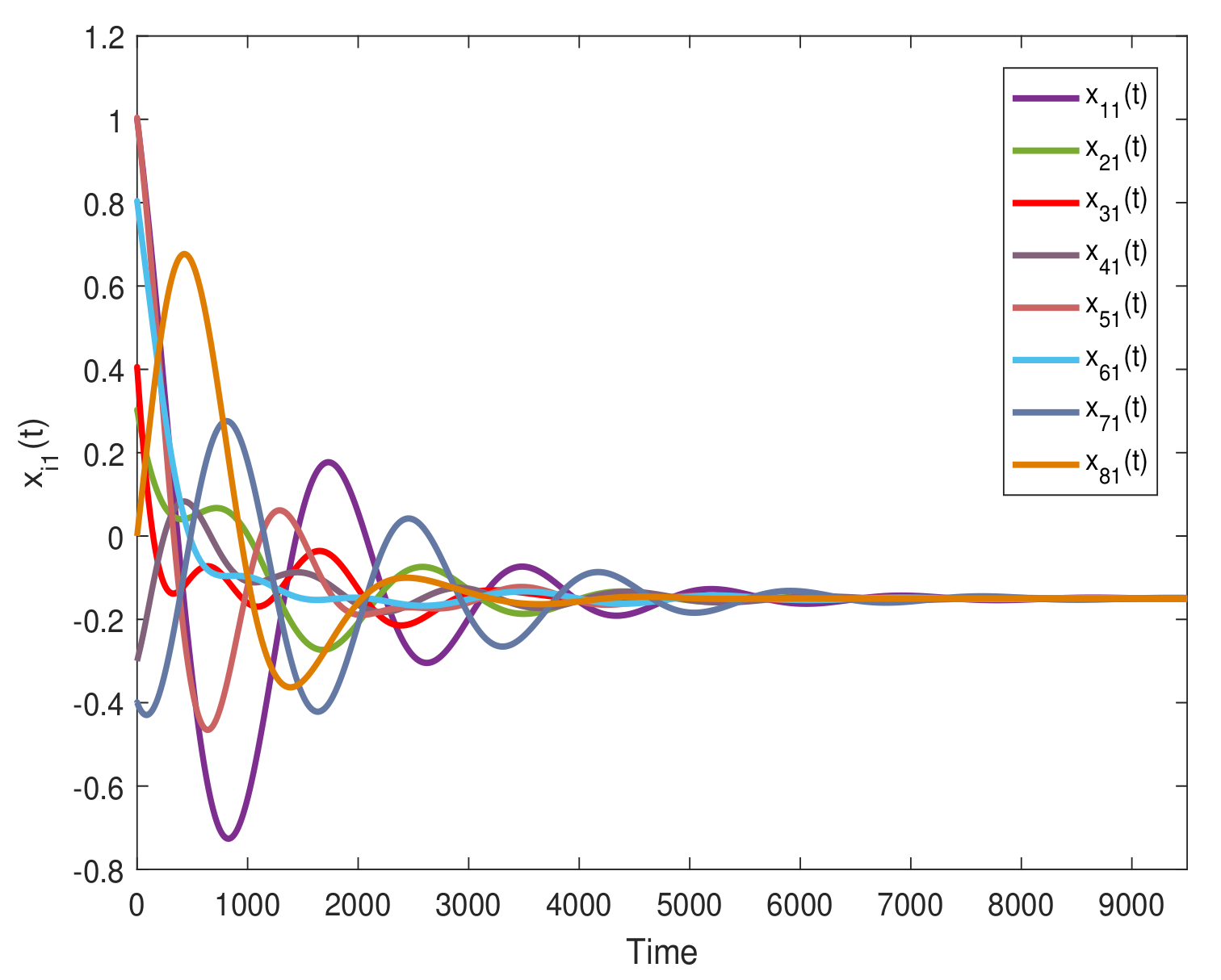
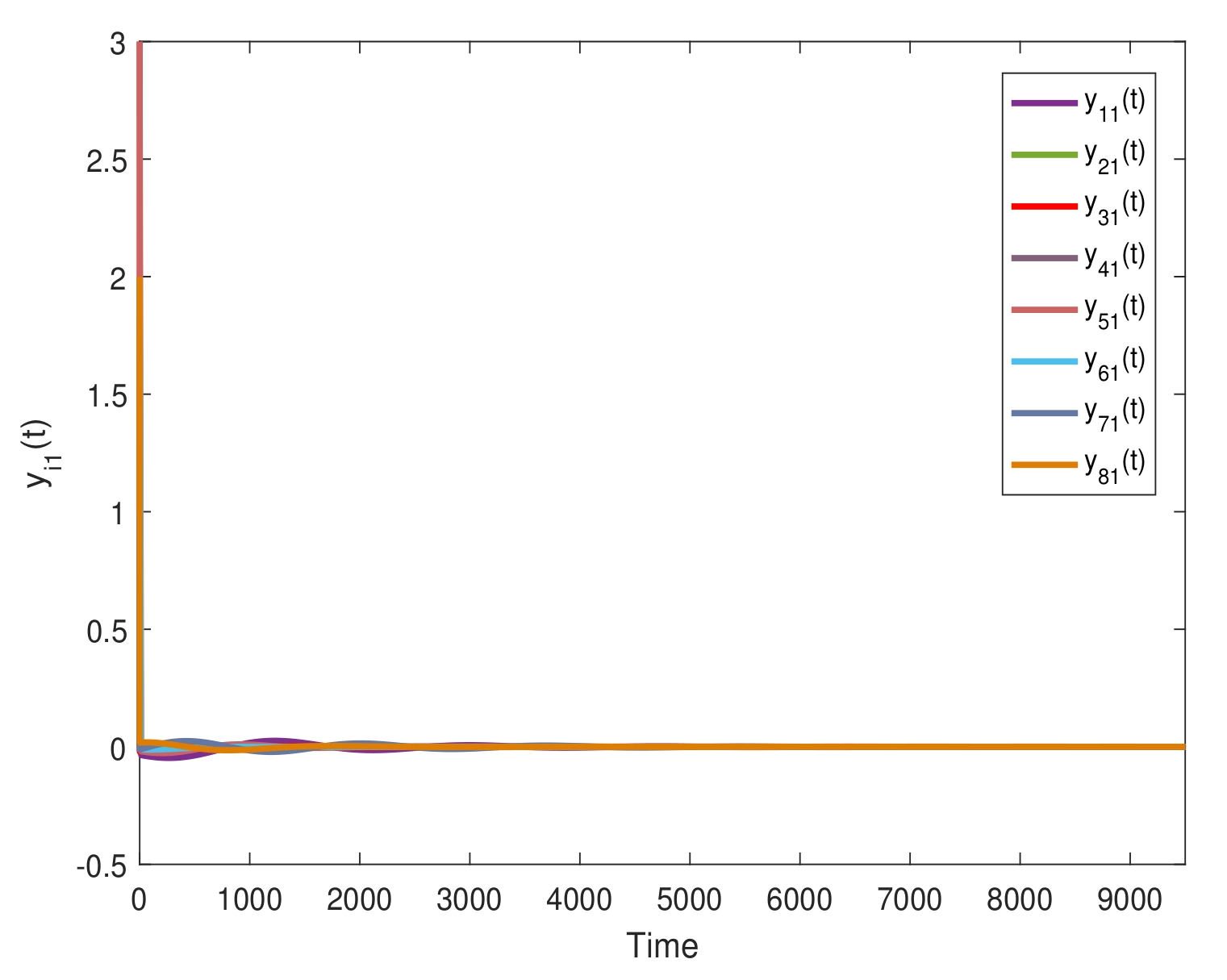
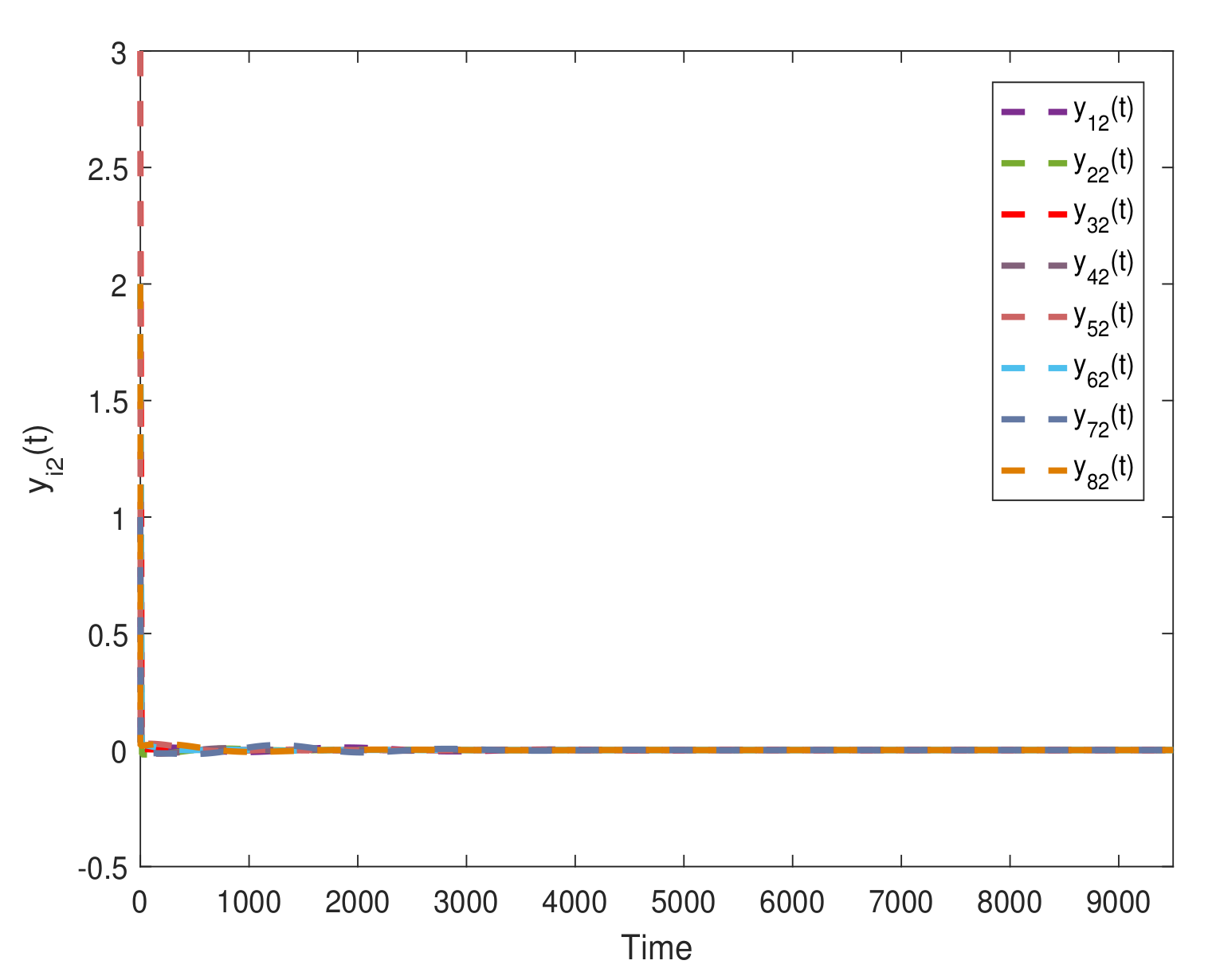
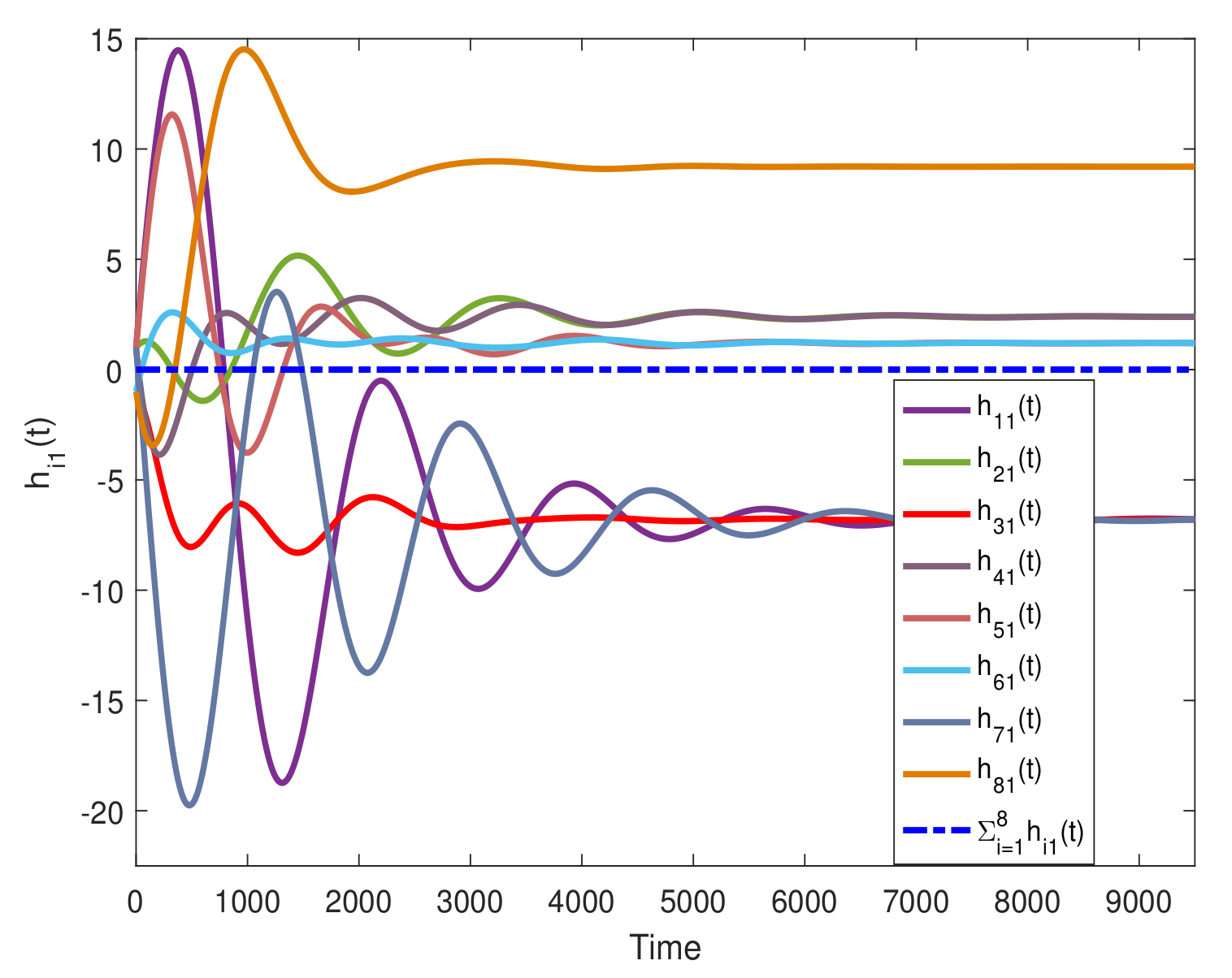
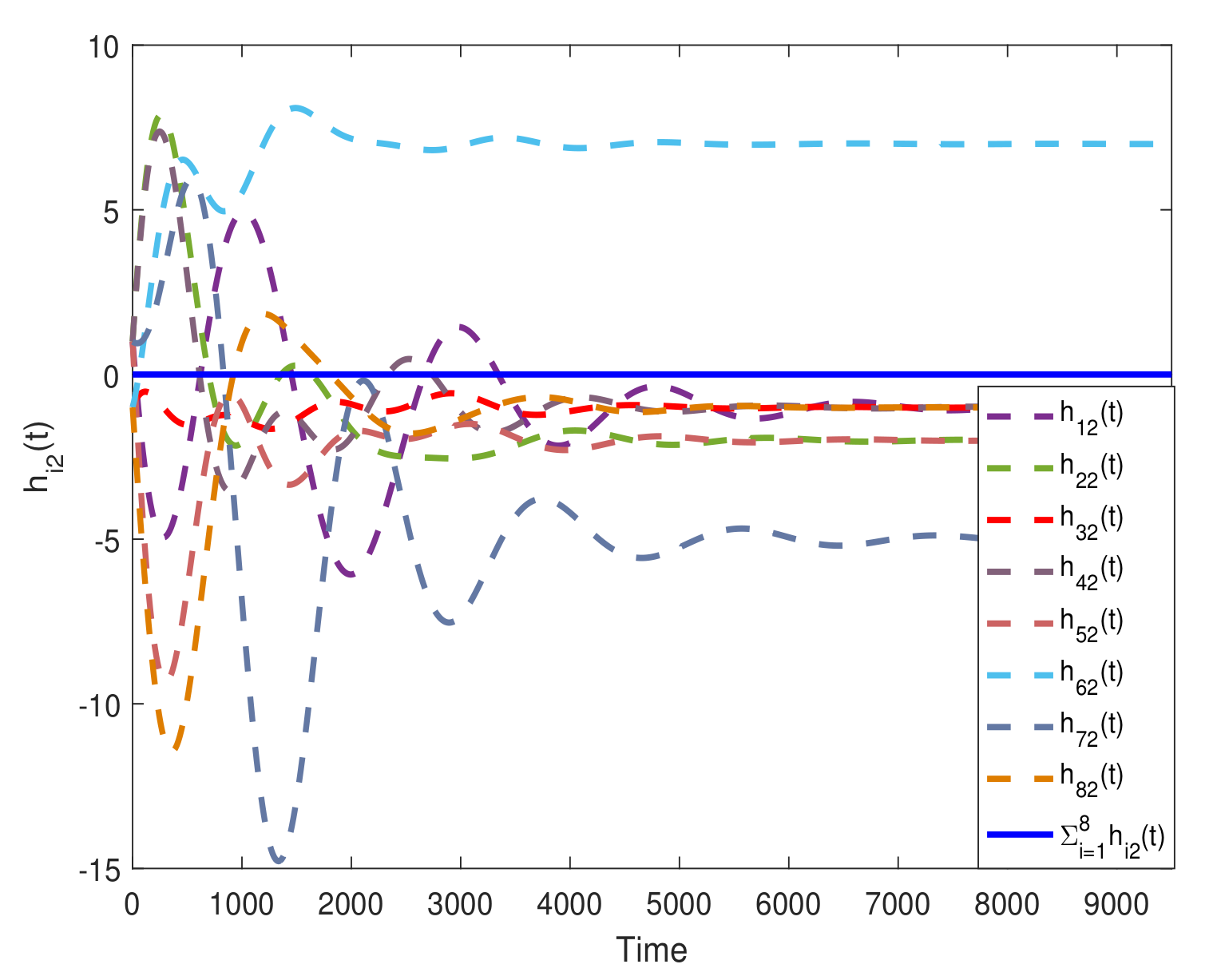
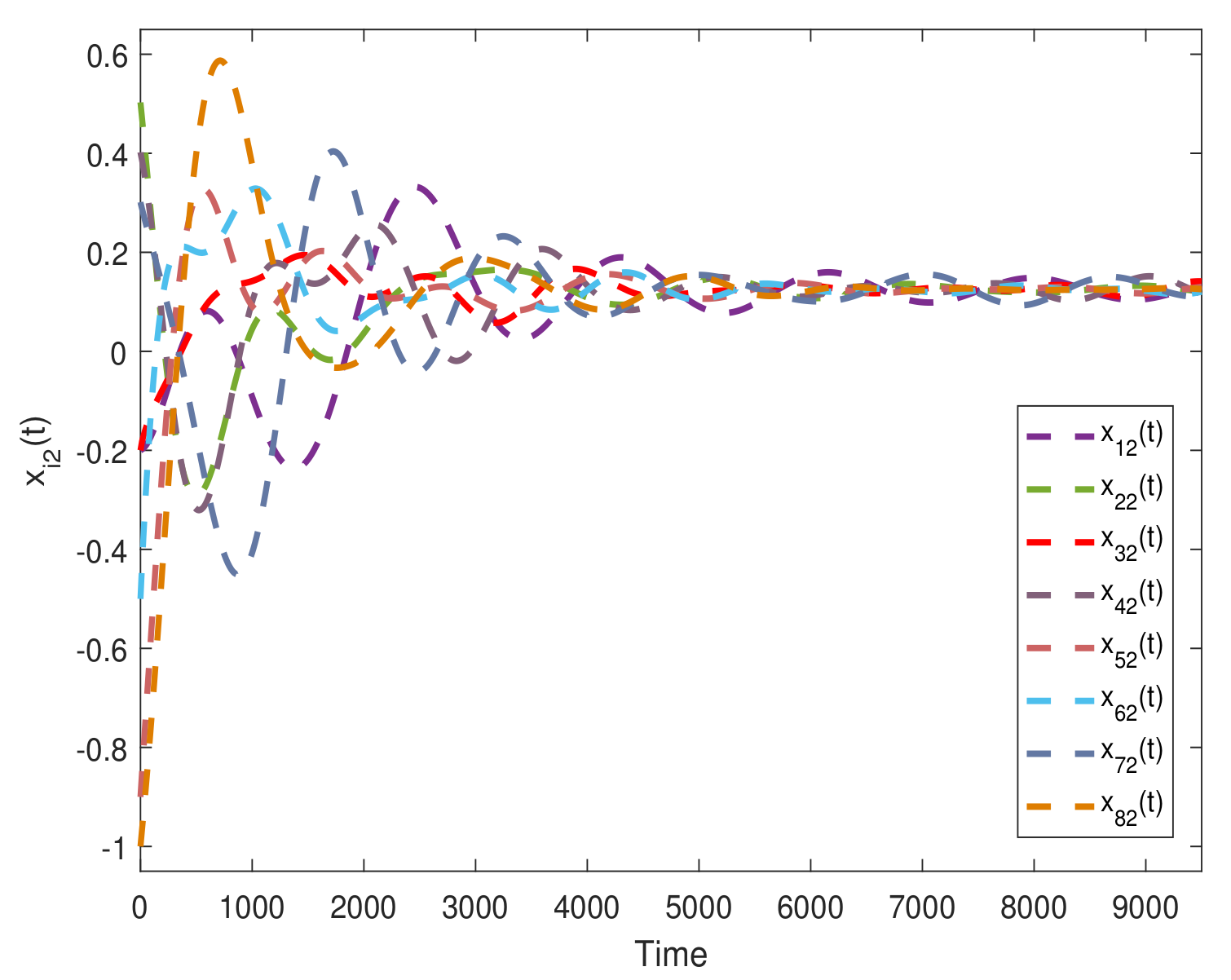
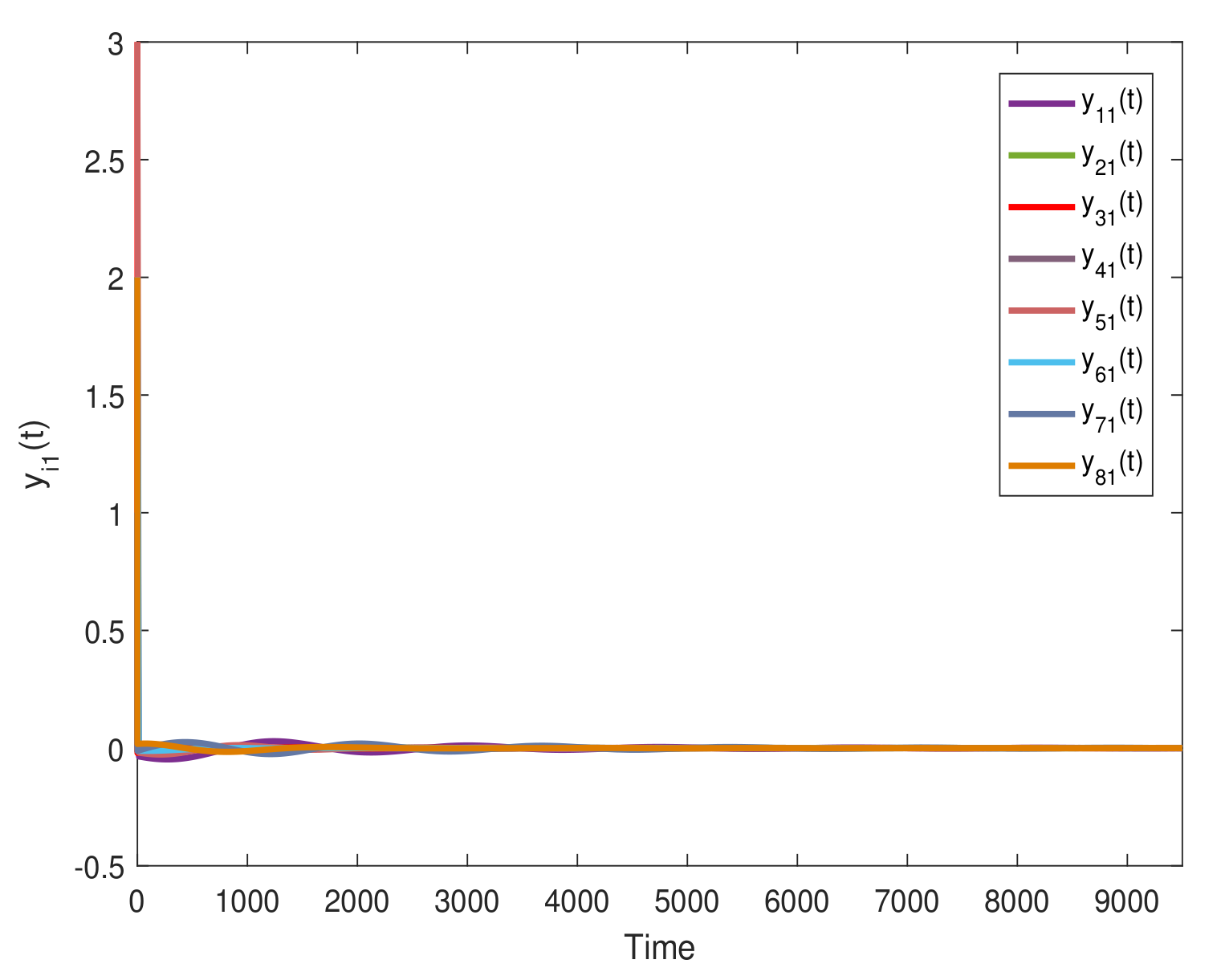
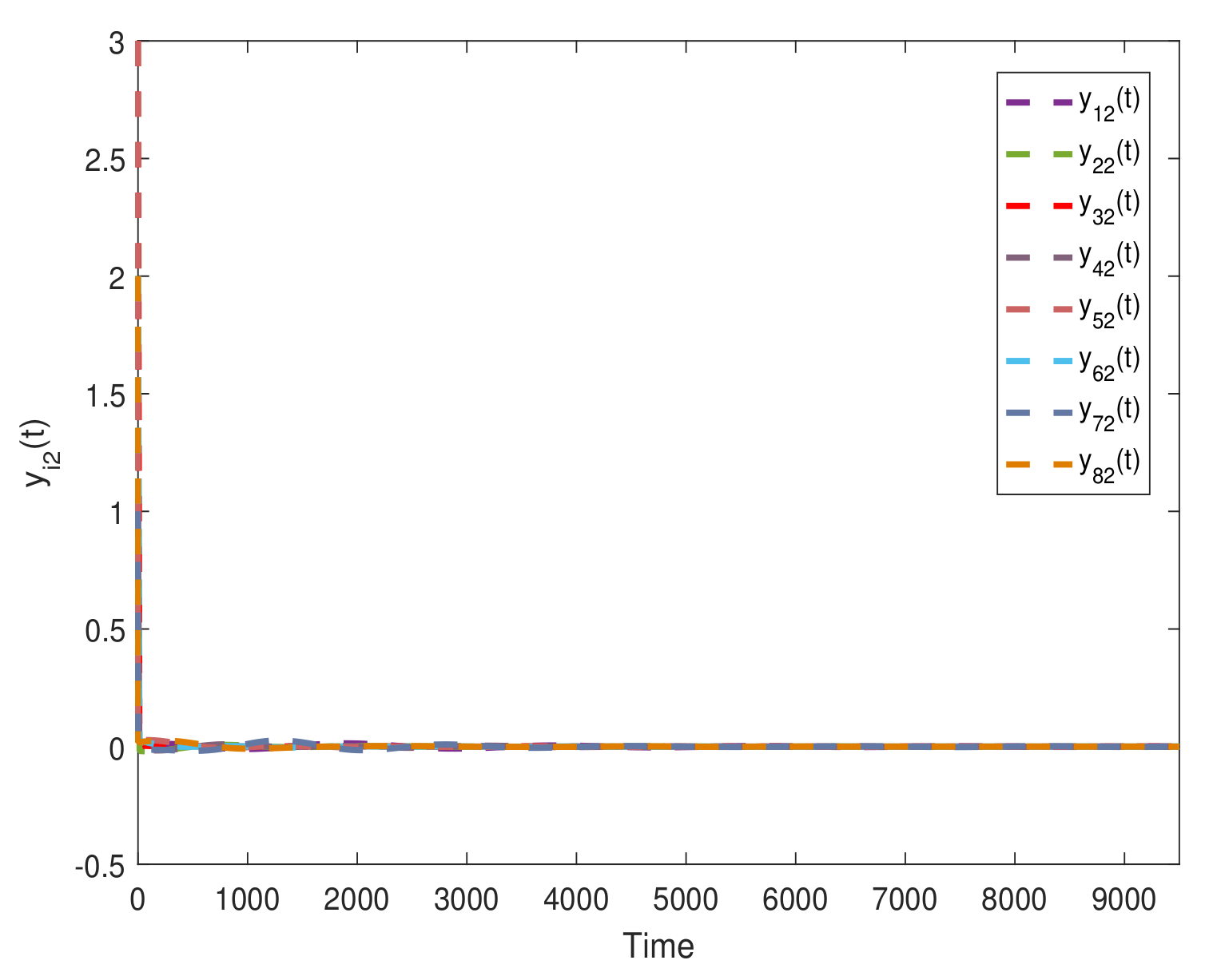
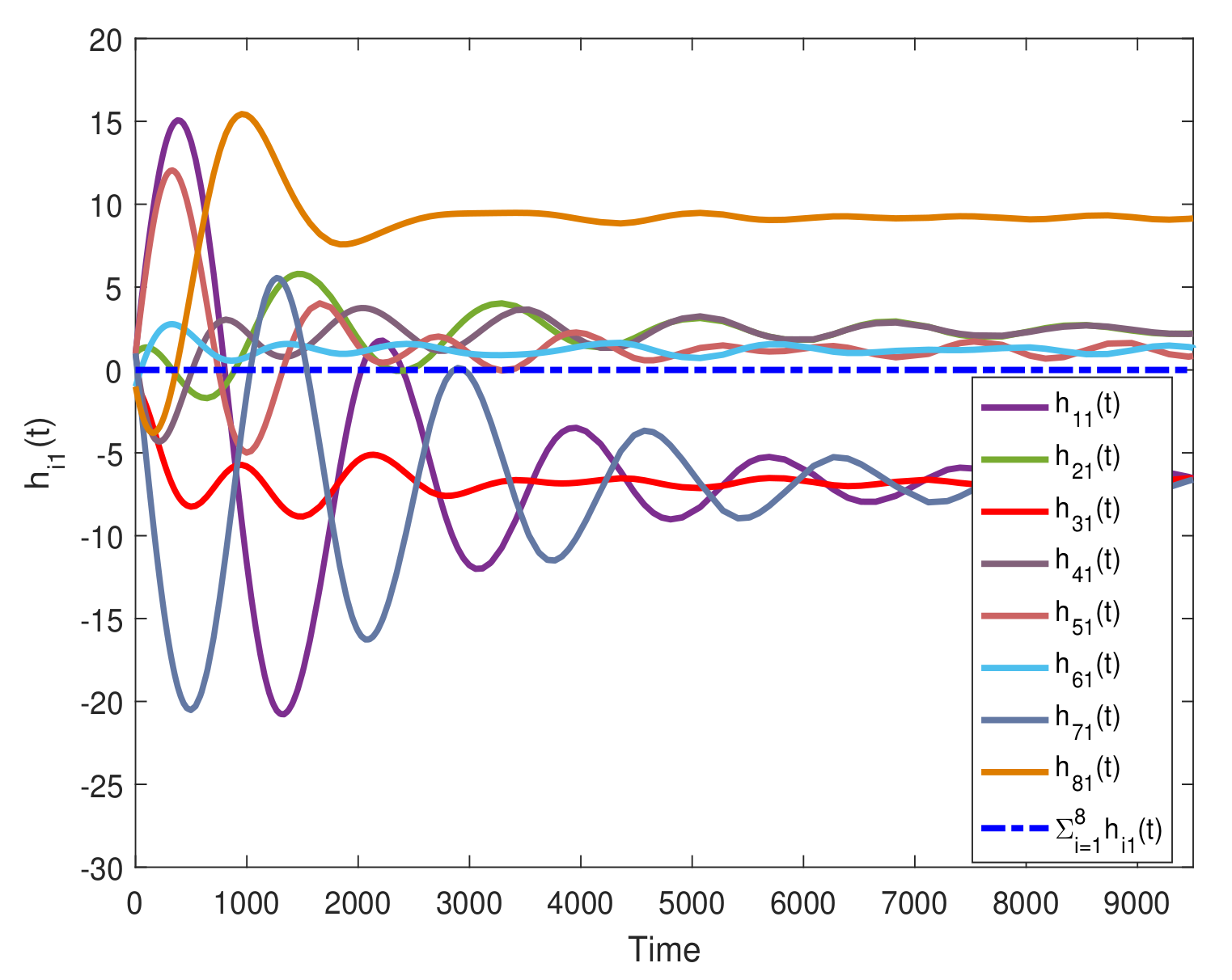
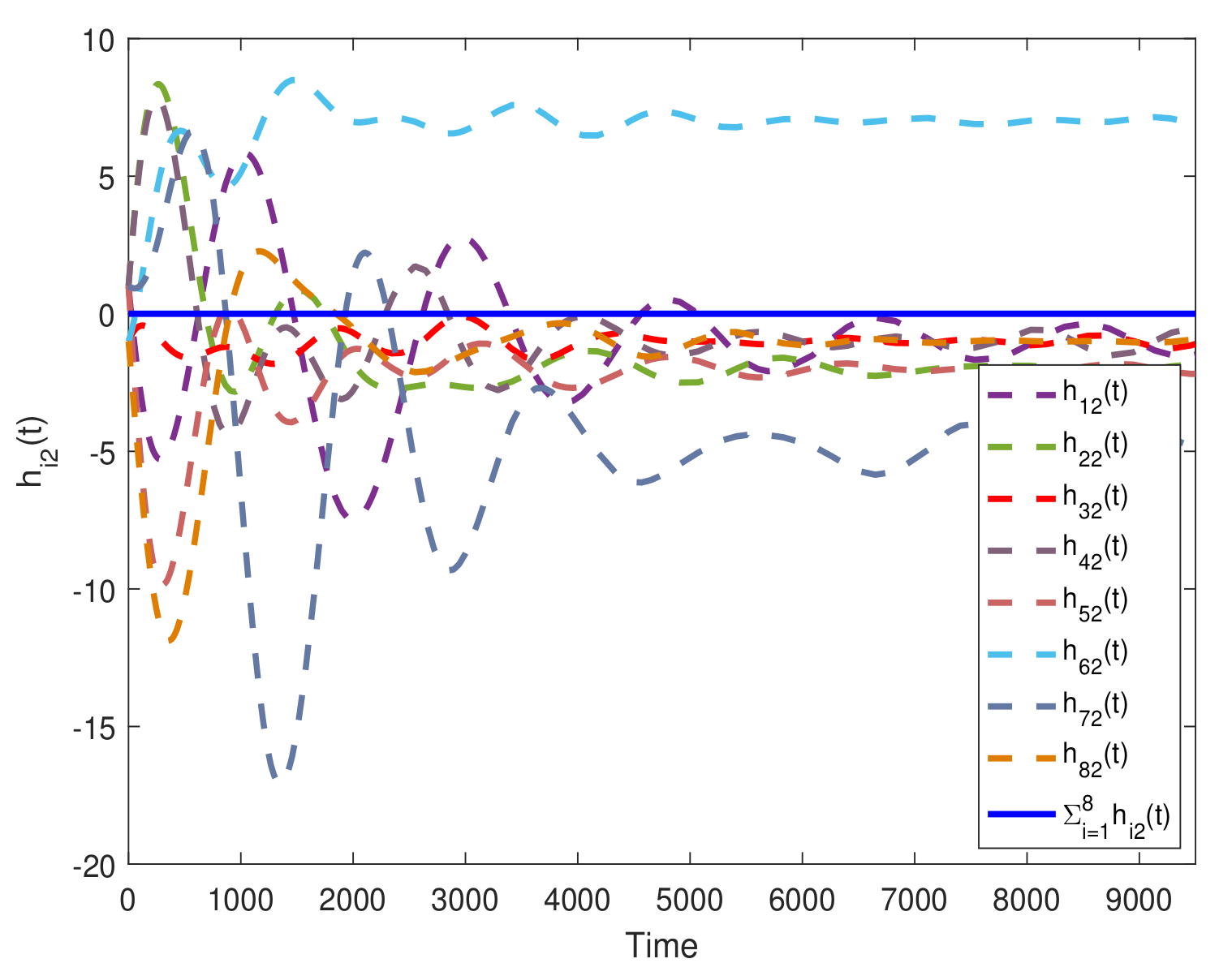
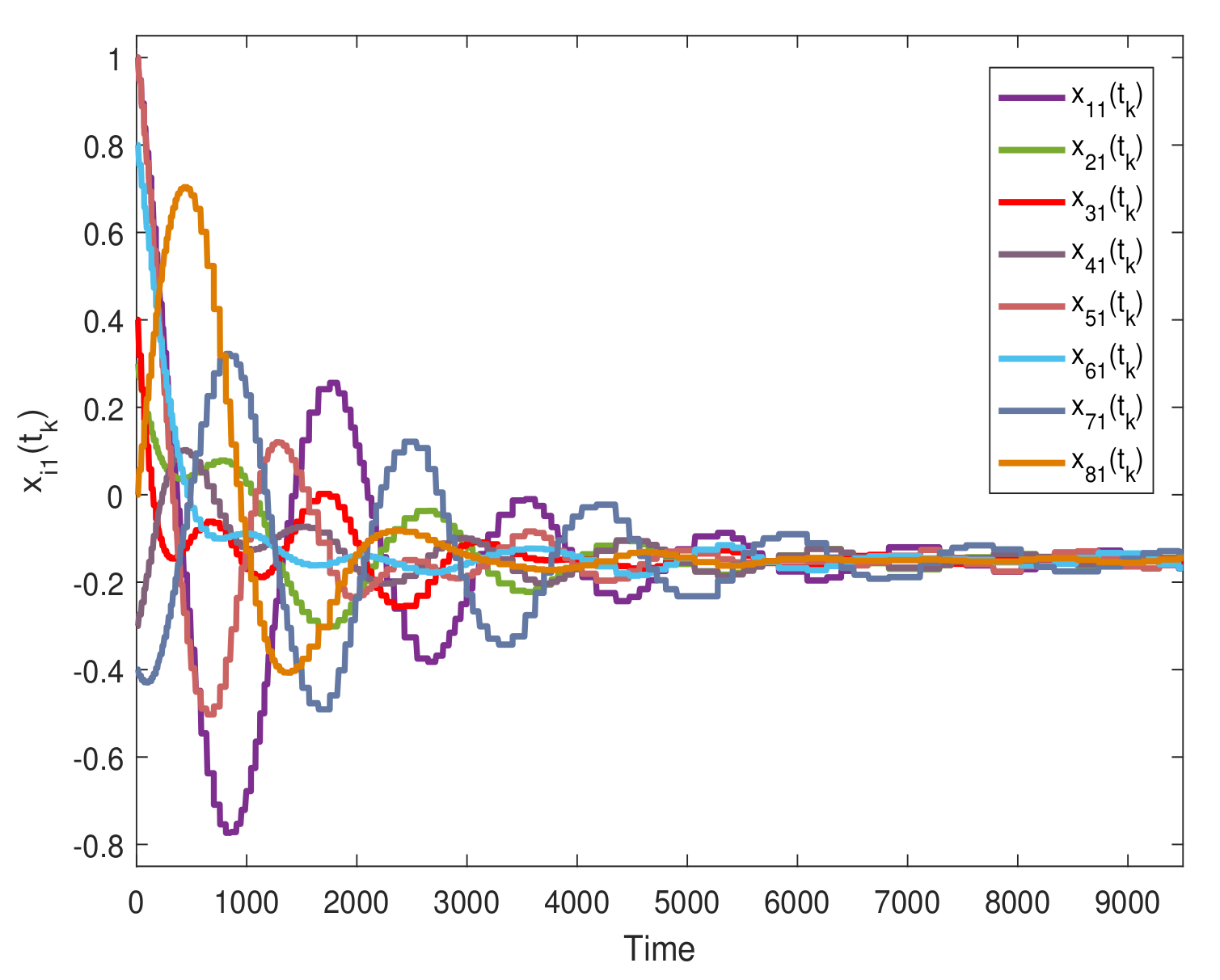
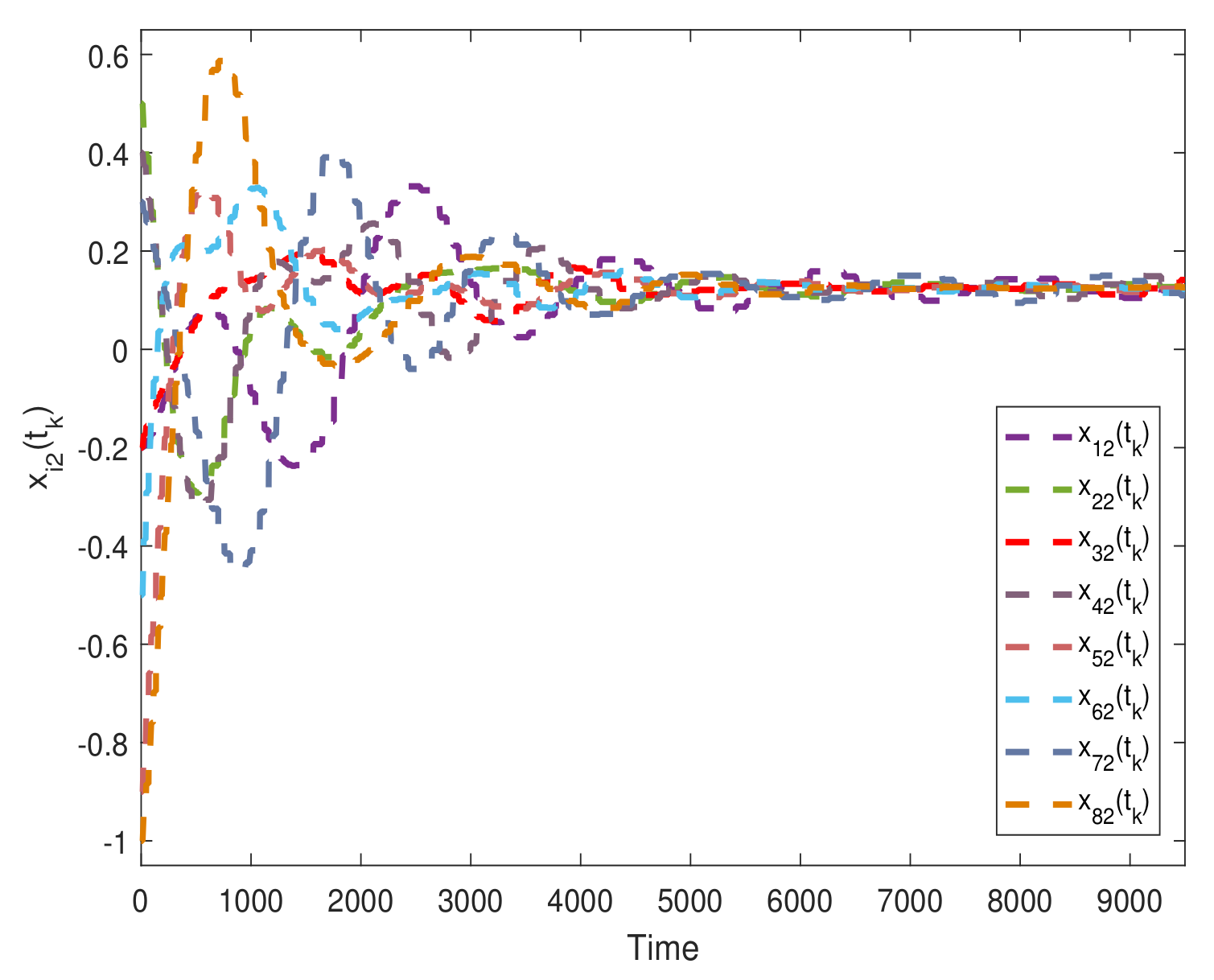
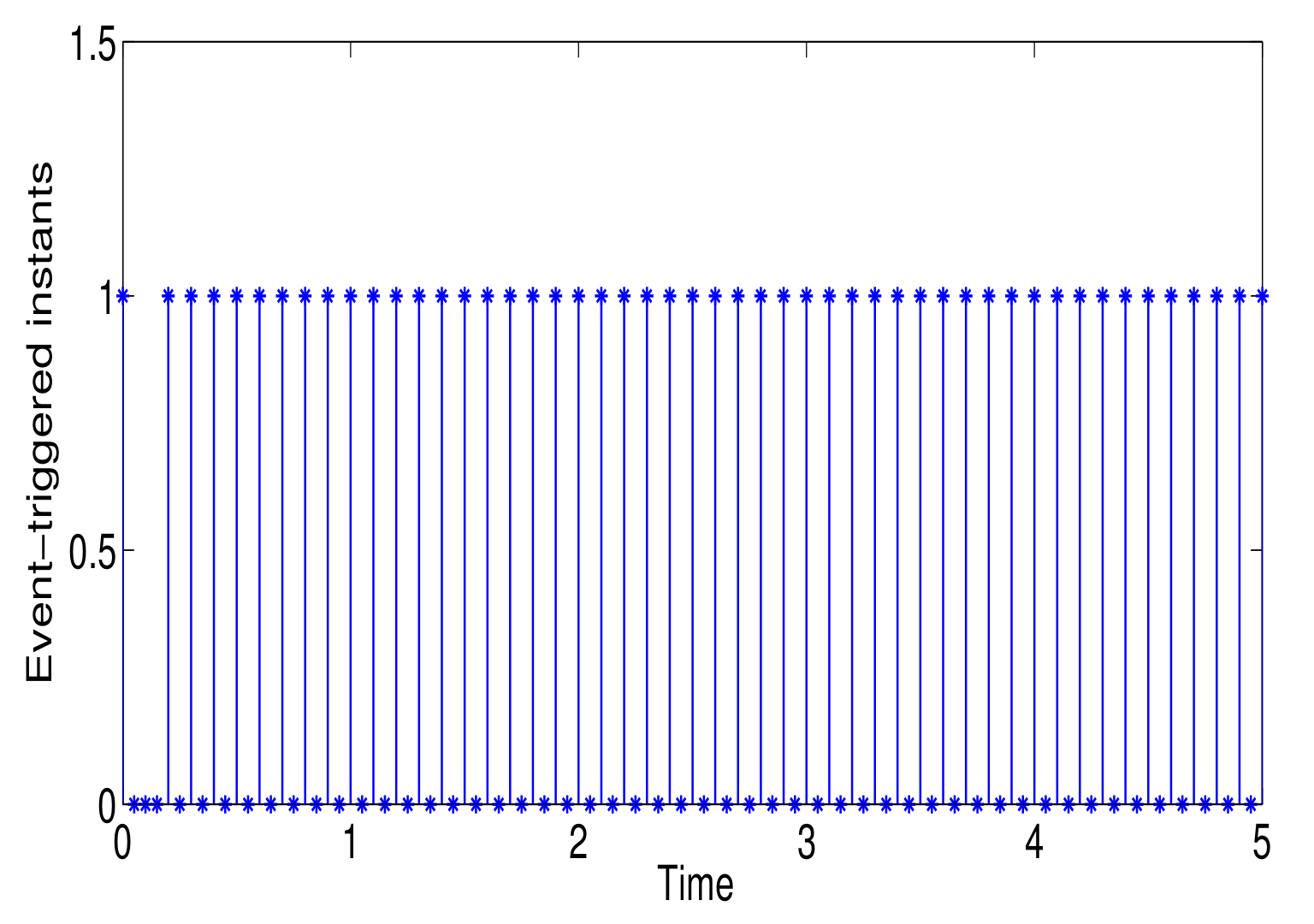
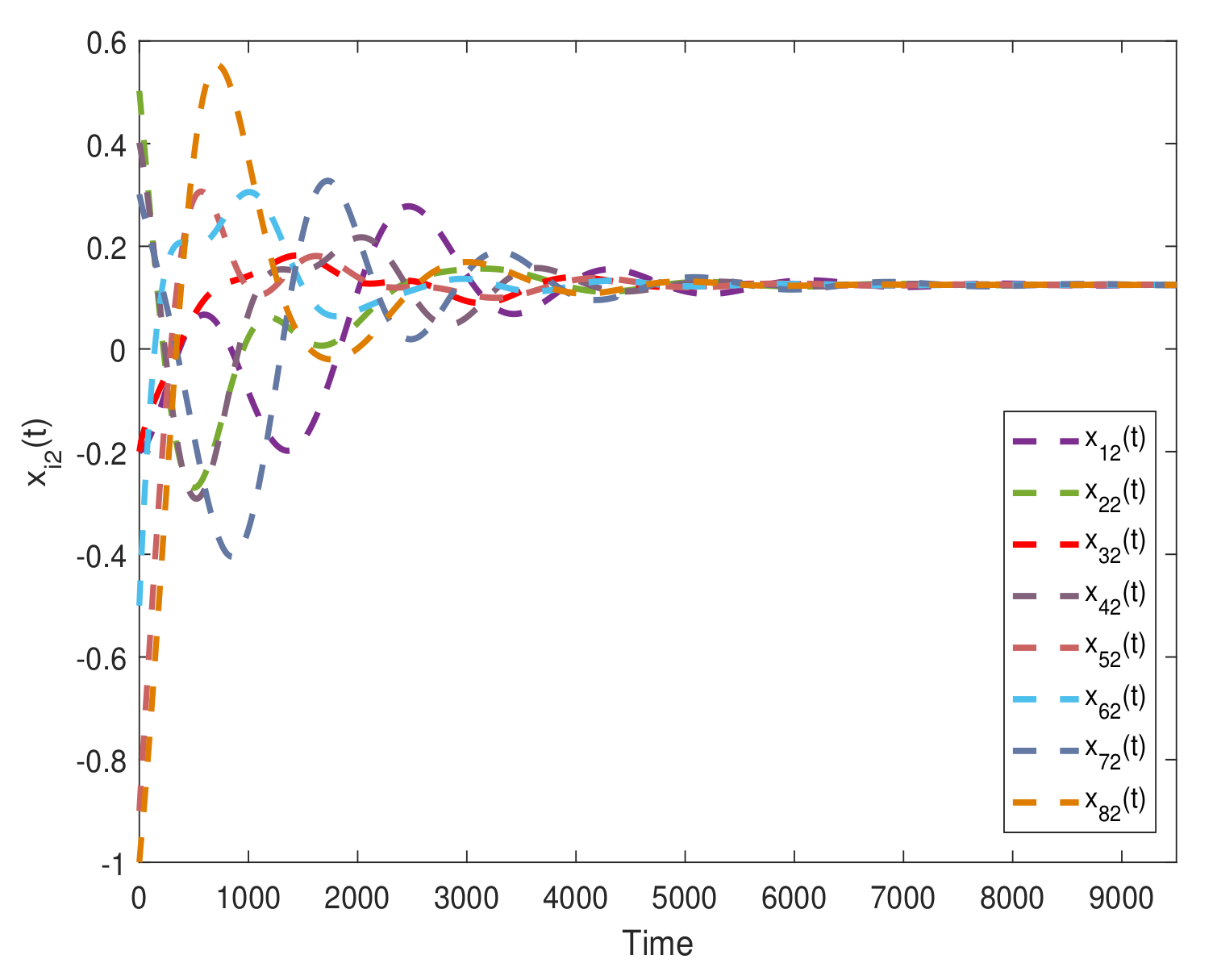
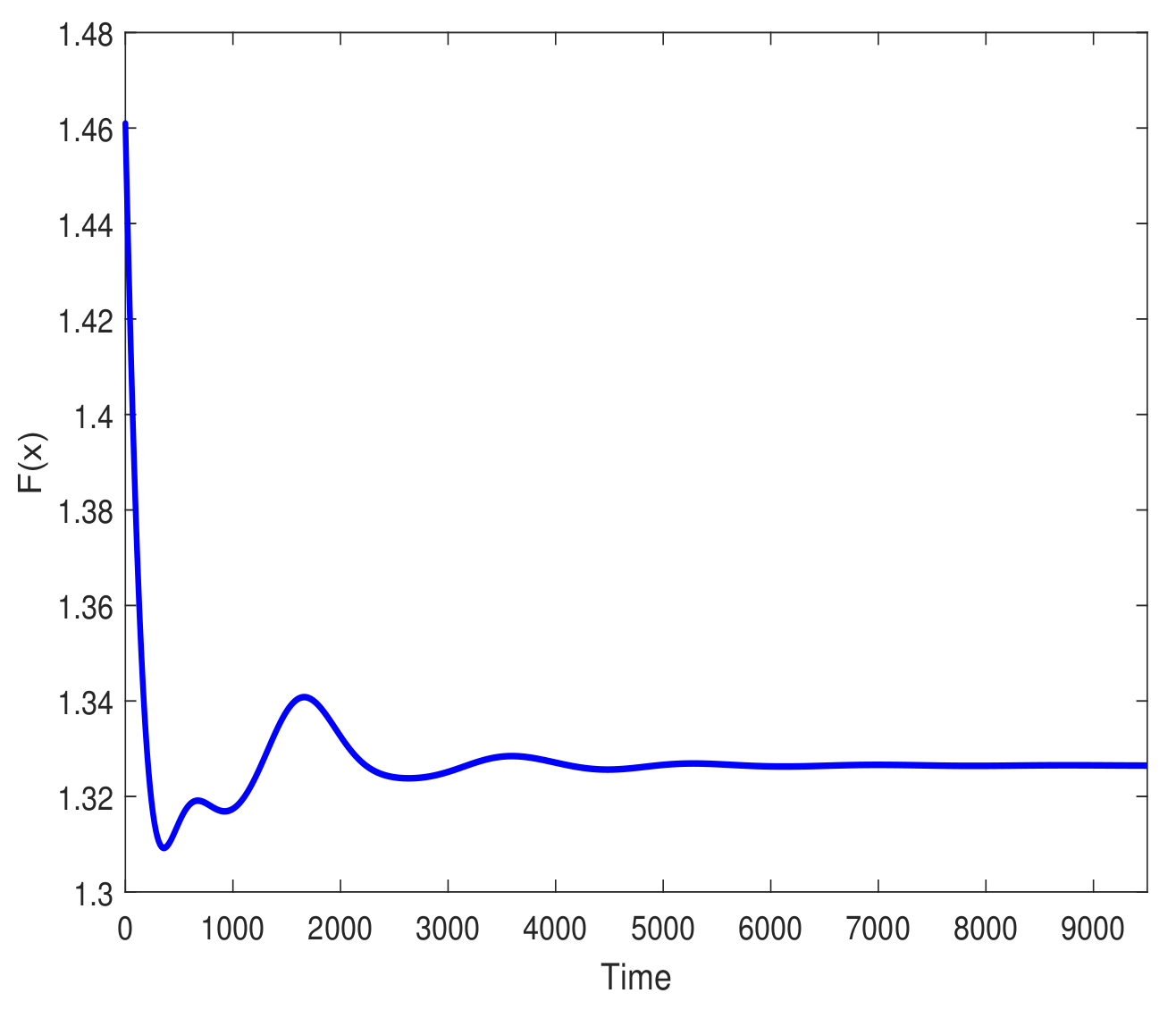
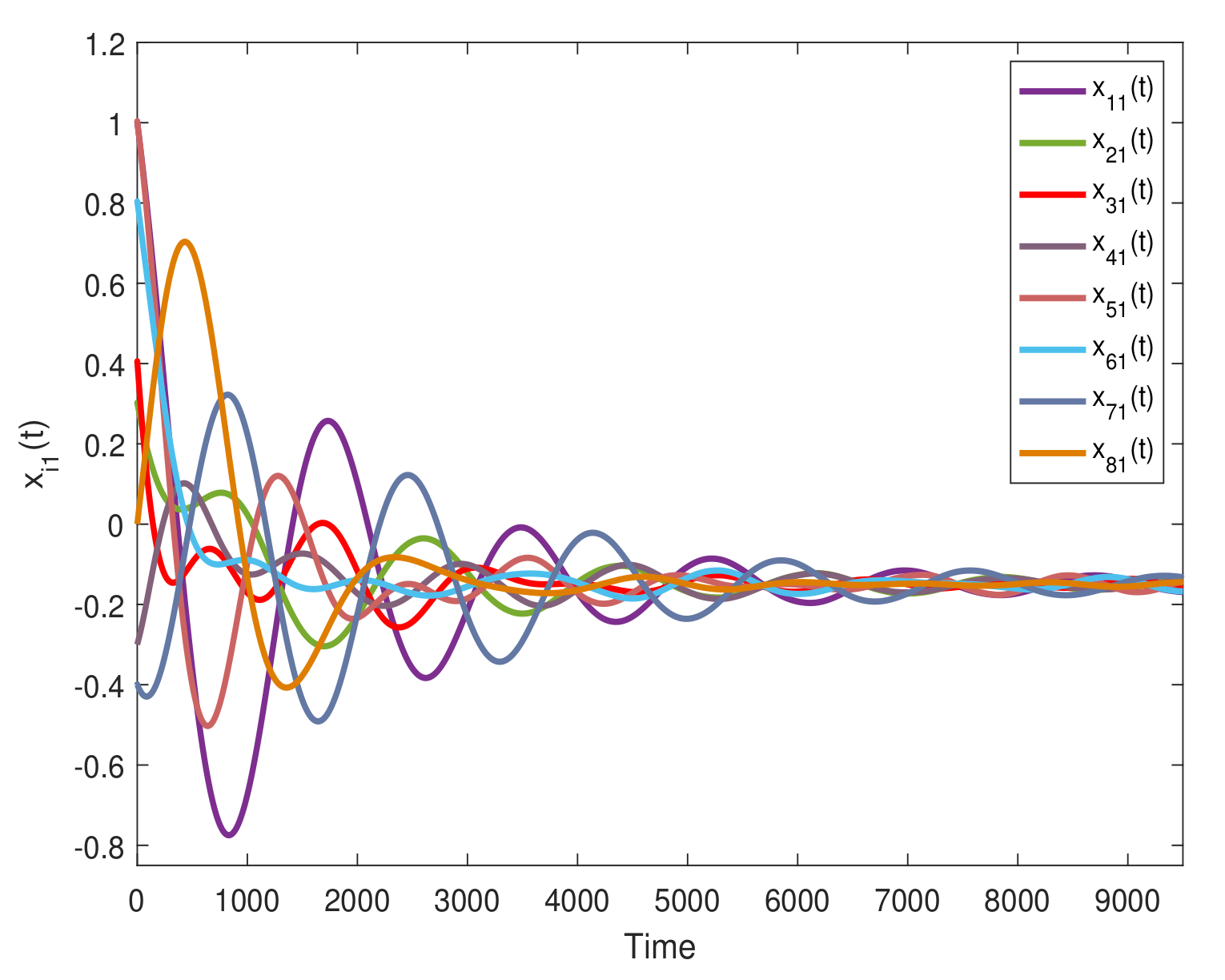
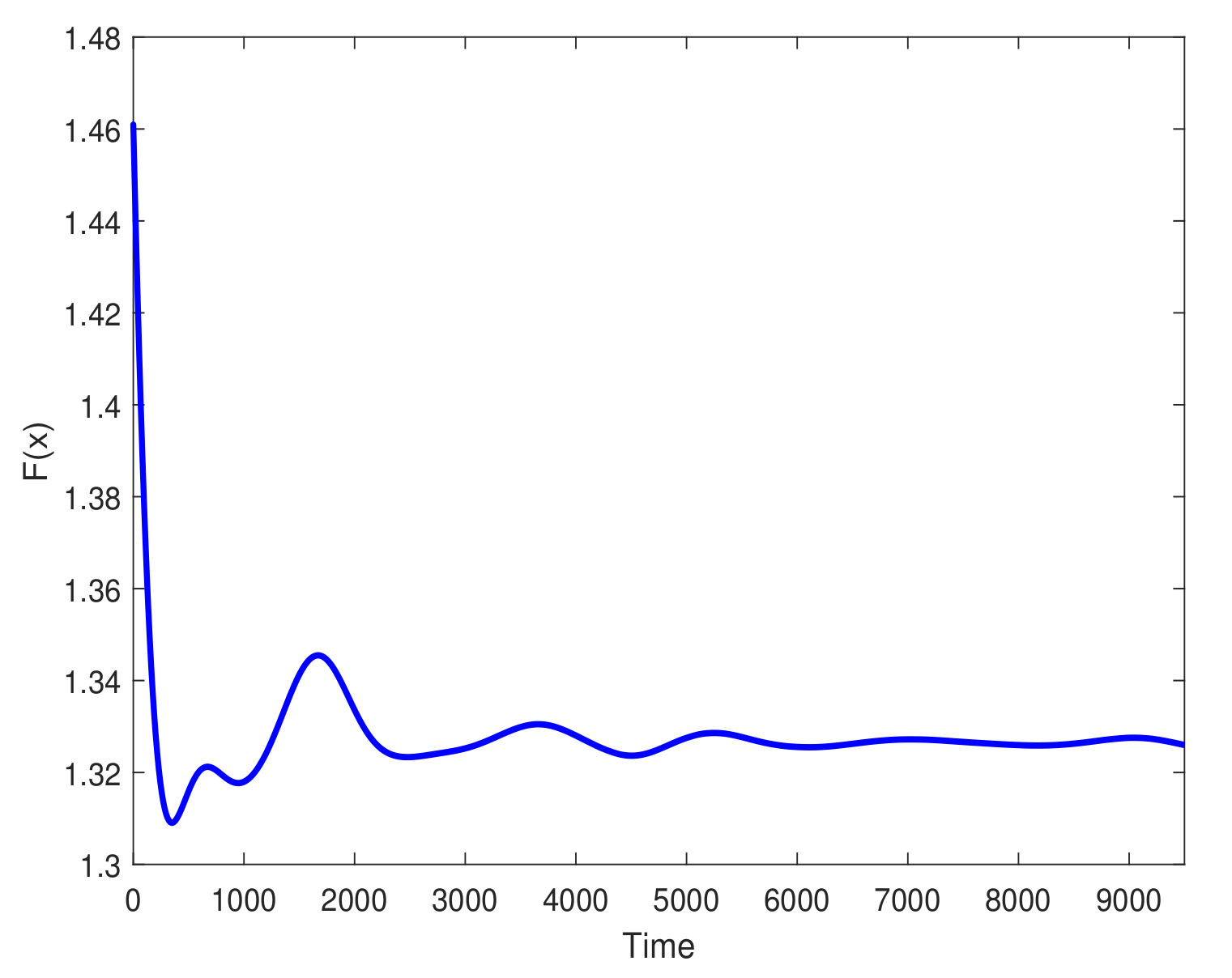
Case 1. For the optimization problem (24), we use the proposed algorithm (3) with the above parameters. Through calculation, all conditions of Theorem 1 are satisfied. By using MATLAB software for simulation, the states of and are given in Figure 2 and Figure 3, respectively. It is noted that all agents’ states reach consensus and gradually converge to the optimal solution . Figure 4 and Figure 5 show the trajectories of and , respectively. Obviously, and gradually converge to 0. Figure 6 and Figure 7 show the evolution trajectories of and , respectively. From Figure 6 and Figure 7, it can be seen that the condition of is always satisfied. Moreover, gradually converge to some constants. Based on the third equation of (3), that means all agents’ states asymptotically reach the same value. The evolution trajectory of the objective function is shown in Figure 8. Case 2. For the optimization problem (24), we use the proposed algorithm (12). All parameters are the same as the ones in Case 1. Through calculation, all conditions of Theorem 2 are also satisfied. The states of and are given in Figure 9 and Figure 10, respectively, where the optimal solution is asymptotically reachable. The trajectories of and are presented in Figure 11 and Figure 12, respectively. Apparently, they all asymptotically converge to 0. Figure 13 and Figure 14 show the trajectories of and , respectively. The condition of is always satisfied. Figure 15 and Figure 16 describe the trajectories of and , respectively. It can be shown that and oscillate to the same value. Figure 17 shows the evolution trajectory of the objective function . Figure 18 shows the event-triggered instants, in which 1 and 0 represent trigger and non-trigger, respectively. According to the comparison between Cases 1 and 2, we find that the continuous-time communication algorithm (
3) and the event-triggered communication algorithm (
12) can make the states of MAS achieve consensus and asymptotically reach the optimal solution of the optimization problem (
24). That means these two algorithms are feasible. However, under the same conditions, the event-triggered communication algorithm can effectively reduce the limited resource cost of the agents while slowing down the convergence rate of the system. Therefore, in practical application, selecting the optimal method still needs the analysis of specific problems.
Through simulation, we can verify that the distributed optimization problem (
1) can be solved asymptotically under the proposed continuous-time communication and event-triggered control protocols. This means that the optimal solution can be obtained as
. In a finite time, only an approximate solution of the optimization problem can be obtained. However, in some practical applications, such as the economic dispatch of smart grids, the optimal allocation is required in a finite time. Therefore, the distributed optimization algorithms with finite-time convergence are worth studying further.