Inertial Tseng Method for Solving the Variational Inequality Problem and Monotone Inclusion Problem in Real Hilbert Space

 ,
,
Abstract
:1. Introduction
2. Preliminaries
- (i)
- monotone if
- (ii)
- nonexpansive if
- (iii)
- firmly nonexpansive if
- (iv)
- -strongly monotone if there exists such that
- (v)
- -inverse strongly monotone if there exists such that
- (vi)
- -Lipschitz continuous with such that
- (i)
- (ii)
- (iii)
- (i)
- (ii)
- ;
- (iii)
- ), .
3. Main Result
- (i)
- and
- (ii)
- (iii)
- and
4. Consequences
- (i)
- and
- (ii)
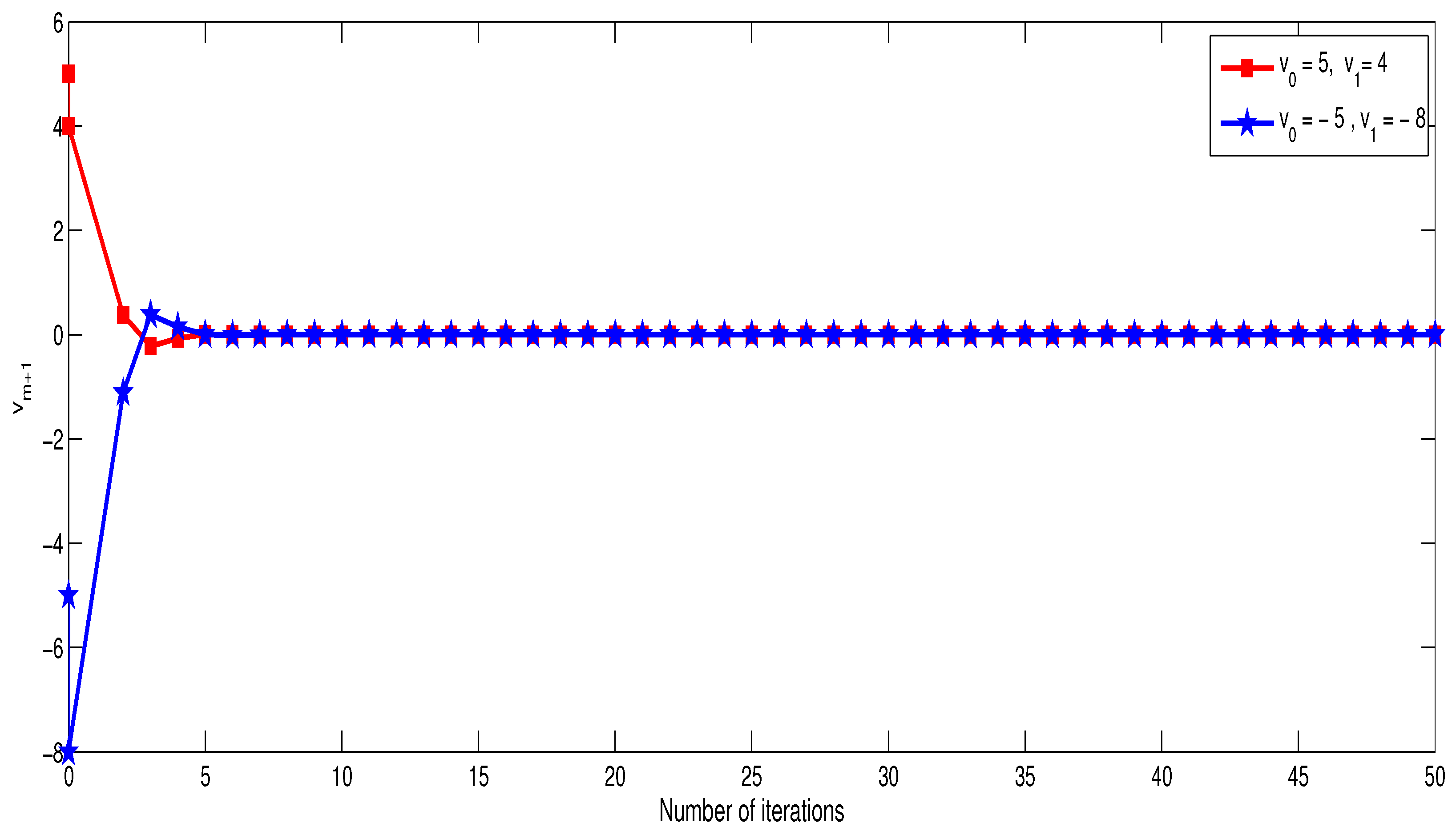
5. Numerical Experiment
6. Conclusions
Author Contributions
Funding
Institutional Review Board Statement
Informed Consent Statement
Data Availability Statement
Acknowledgments
Conflicts of Interest
References
- Hartman, P.; Stampacchia, G. On some non-linear elliptic differential-functional equations. Acta Math. 1966, 115, 271–310. [Google Scholar] [CrossRef]
- Facchinei, F.; Pang, J.S. Finite-Dimensional Variational Inequalities and Complementarity Problems; Springer: New York, NY, USA, 2003. [Google Scholar]
- Jolaoso, L.O.; Oyewole, K.O.; Okeke, C.C.; Mewomo, O.T. A unified algorithm for solving split generalized mixed equilibrium problem, and for finding fixed point of nonspreading mapping in Hilbert spaces. Demonstr. Math. 2018, 51, 211–232. [Google Scholar] [CrossRef]
- Jolaoso, L.O.; Taiwo, A.; Alakoya, T.O.; Mewomo, O.T. A strong convergence theorem for solving pseudo-monotone variational inequalities using projection methods. J. Optim. Theory Appl. 2020, 185, 744–766. [Google Scholar] [CrossRef]
- Kinderlehrer, D.; Stampacchia, G. An Introduction to Variational Inequalities and Their Applications; SIAM: New York, NY, USA, 2000. [Google Scholar]
- Konnov, I. Combined Relaxation Methods for Variational Inequalities; Springer Science & Business Media: Berlin, Germany, 2001; Volume 495. [Google Scholar]
- Mewomo, O.; Ogbuisi, F. Convergence analysis of an iterative method for solving multiple-set split feasibility problems in certain Banach spaces. Quaest. Math. 2018, 41, 129–148. [Google Scholar] [CrossRef]
- Ogbuisi, F.; Mewomo, O. Iterative solution of split variational inclusion problem in a real Banach spaces. Afr. Mat. 2017, 28, 295–309. [Google Scholar] [CrossRef]
- Ogbuisi, F.; Mewomo, O. Convergence analysis of common solution of certain nonlinear problems. Fixed Point Theory 2018, 19, 335–358. [Google Scholar] [CrossRef]
- Censor, Y.; Gibali, A.; Reich, S. Strong convergence of subgradient extragradient methods for the variational inequality problem in Hilbert space. Optim. Methods Softw. 2011, 26, 827–845. [Google Scholar] [CrossRef]
- Censor, Y.; Gibali, A.; Reich, S. The subgradient extragradient method for solving variational inequalities in Hilbert space. J. Optim. Theory Appl. 2011, 148, 318–335. [Google Scholar] [CrossRef]
- Censor, Y.; Gibali, A.; Reich, S. Algorithms for the split variational inequality problem. Numer. Algorithms 2012, 59, 301–323. [Google Scholar] [CrossRef]
- Cholamjiak, P.; Suantai, S. Iterative methods for solving equilibrium problems, variational inequalities and fixed points of nonexpansive semigroups. J. Glob. Optim. 2013, 57, 1277–1297. [Google Scholar] [CrossRef]
- Liu, L.; Cho, S.Y.; Yao, J.C. Convergence analysis of an inertial Tseng’s extragradient algorithm for solving pseudomonotone variational inequalities and applications. J. Nonlinear Var. Anal. 2021, 5, 627–644. [Google Scholar]
- Tian, M.; Xu, G. Inertial modified Tseng’s extragradient algorithms for solving monotone variational inequalities and fixed point problems. J. Nonlinear Funct. Anal. 2020, 2020, 35. [Google Scholar]
- Combettes, P.L.; Wajs, V.R. Signal recovery by proximal forward-backward splitting. Multiscale Model. Simul. 2005, 4, 1168–1200. [Google Scholar] [CrossRef]
- Daubechies, I.; Defrise, M.; De Mol, C. An iterative thresholding algorithm for linear inverse problems with a sparsity constraint. Commun. Pure Appl. Math. A J. Issued Courant Inst. Math. Sci. 2004, 57, 1413–1457. [Google Scholar] [CrossRef]
- Duchi, J.; Singer, Y. Efficient online and batch learning using forward backward splitting. J. Mach. Learn. Res. 2009, 10, 2899–2934. [Google Scholar]
- Raguet, H.; Fadili, J.; Peyré, G. A generalized forward-backward splitting. SIAM J. Imaging Sci. 2013, 6, 1199–1226. [Google Scholar] [CrossRef]
- Attouch, H.; Peypouquet, J.; Patrick, R. Backward–forward algorithms for structured monotone inclusions in Hilbert spaces. J. Math. Anal. Appl. 2018, 457, 1095–1117. [Google Scholar] [CrossRef]
- Huang, Y.; Dong, Y. New properties of forward–backward splitting and a practical proximal-descent algorithm. Appl. Math. Comput. 2014, 237, 60–68. [Google Scholar] [CrossRef]
- Tseng, P. A modified forward-backward splitting method for maximal monotone mappings. SIAM J. Control Optim. 2000, 38, 431–446. [Google Scholar] [CrossRef]
- Lions, P.L.; Mercier, B. Splitting algorithms for the sum of two nonlinear operators. SIAM J. Numer. Anal. 1979, 16, 964–979. [Google Scholar] [CrossRef]
- Boț, R.I.; Csetnek, E.R.; László, S.C. An inertial forward–backward algorithm for the minimization of the sum of two nonconvex functions. EURO J. Comput. Optim. 2016, 4, 3–25. [Google Scholar] [CrossRef]
- Cholamjiak, P.; Shehu, Y. Inertial forward-backward splitting method in Banach spaces with application to compressed sensing. Appl. Math. 2019, 64, 409–435. [Google Scholar] [CrossRef]
- Lorenz, D.A.; Pock, T. An inertial forward-backward algorithm for monotone inclusions. J. Math. Imaging Vis. 2015, 51, 311–325. [Google Scholar] [CrossRef] [Green Version]
- Moudafi, A.; Shehu, Y. Convergence of the forward–backward method for split null-point problems beyond coerciveness. J. Nonlinear. Convex. Anal. 2019, 20, 1659–1672. [Google Scholar]
- Polyak, B.T. Some methods of speeding up the convergence of iteration methods. Ussr Comput. Math. Math. Phys. 1964, 4, 1–17. [Google Scholar] [CrossRef]
- Alvarez, F.; Attouch, H. An inertial proximal method for maximal monotone operators via discretization of a nonlinear oscillator with damping. Set-Valued Anal. 2001, 9, 3–11. [Google Scholar] [CrossRef]
- Husain, S.; Khan, F.A.; Furkan, M.; Khairoowala, M.U.; Eljaneid, N.H. Inertial Projection Algorithm for Solving Split Best Proximity Point and Mixed Equilibrium Problems in Hilbert Spaces. Axioms 2022, 11, 321. [Google Scholar] [CrossRef]
- Moudafi, A.; Oliny, M. Convergence of a splitting inertial proximal method for monotone operators. J. Comput. Appl. Math. 2003, 155, 447–454. [Google Scholar] [CrossRef]
- Padcharoen, A.; Kitkuan, D.; Kumam, W.; Kumam, P. Tseng methods with inertial for solving inclusion problems and application to image deblurring and image recovery problems. Comput. Math. Methods 2021, 3, e1088. [Google Scholar] [CrossRef]
- Tan, B.; Cho, S.Y. Strong convergence of inertial forward–backward methods for solving monotone inclusions. Appl. Anal. 2021, 1–29. [Google Scholar] [CrossRef]
- Brezis, H. Operateurs maximaux monotones, North-Holland. Math. Stud. 1973, 5, 1–183. [Google Scholar]
- Iiduka, H.; Takahashi, W. Strong convergence theorems for nonexpansive mappings and inverse-strongly monotone mappings. Nonlinear Anal. Theory Methods Appl. 2005, 61, 341–350. [Google Scholar] [CrossRef]
- Rockafellar, R.T. On the maximality of sums of nonlinear monotone operators. Trans. Am. Math. Soc. 1970, 149, 75–88. [Google Scholar] [CrossRef]
- Rockafellar, R.T. Monotone operators and the proximal point algorithm. SIAM J. Control Optim. 1976, 14, 877–898. [Google Scholar] [CrossRef]
- Bauschke, H.H.; Combettes, P.L. Convex Analysis and Monotone Operator Theory in Hilbert Spaces; Springer: New York, NY, USA, 2011; Volume 408. [Google Scholar]
- López, G.; Martín-Márquez, V.; Wang, F.; Xu, H.K. Forward-backward splitting methods for accretive operators in Banach spaces. Abstr. Appl. Anal. 2012, 2012, 109236. [Google Scholar] [CrossRef] [Green Version]
- Xu, H.K. Viscosity approximation methods for nonexpansive mappings. J. Math. Anal. Appl. 2004, 298, 279–291. [Google Scholar] [CrossRef]
- Mainge, P.E. Strong convergence of projected subgradient methods for nonsmooth and nonstrictly convex minimization. Set-Valued Anal. 2008, 16, 899–912. [Google Scholar] [CrossRef]
- Gibali, A.; Thong, D.V. Tseng type methods for solving inclusion problems and its applications. Calcolo 2018, 55, 1–22. [Google Scholar] [CrossRef]


| No. of Iterations | ||
|---|---|---|
| 1 | 5.000000 | −5.000000 |
| 2 | 4.000000 | −8.000000 |
| 3 | 0.378620 | −1.113300 |
| 4 | −0.223623 | 0.382014 |
| 5 | −0.069201 | 0.153097 |
| 6 | 0.004352 | −0.001065 |
| 7 | 0.006116 | −0.011969 |
| 8 | 0.000776 | −0.002098 |
| 9 | −0.000338 | 0.000556 |
| 10 | −0.000123 | 0.000267 |
| 11 | 0.000005 | 0.000004 |
| 12 | 0.000011 | −0.000020 |
| 13 | 0.000002 | −0.000004 |
| 14 | −0.000001 | 0.000001 |
| 15 | 0.000000 | 0.000000 |
Publisher’s Note: MDPI stays neutral with regard to jurisdictional claims in published maps and institutional affiliations. |
© 2022 by the authors. Licensee MDPI, Basel, Switzerland. This article is an open access article distributed under the terms and conditions of the Creative Commons Attribution (CC BY) license (https://creativecommons.org/licenses/by/4.0/).
Share and Cite
Husain, S.; Tom, M.A.O.; Khairoowala, M.U.; Furkan, M.; Khan, F.A. Inertial Tseng Method for Solving the Variational Inequality Problem and Monotone Inclusion Problem in Real Hilbert Space. Mathematics 2022, 10, 3151. https://doi.org/10.3390/math10173151
Husain S, Tom MAO, Khairoowala MU, Furkan M, Khan FA. Inertial Tseng Method for Solving the Variational Inequality Problem and Monotone Inclusion Problem in Real Hilbert Space. Mathematics. 2022; 10(17):3151. https://doi.org/10.3390/math10173151
Chicago/Turabian StyleHusain, Shamshad, Mohammed Ahmed Osman Tom, Mubashshir U. Khairoowala, Mohd Furkan, and Faizan Ahmad Khan. 2022. "Inertial Tseng Method for Solving the Variational Inequality Problem and Monotone Inclusion Problem in Real Hilbert Space" Mathematics 10, no. 17: 3151. https://doi.org/10.3390/math10173151
APA StyleHusain, S., Tom, M. A. O., Khairoowala, M. U., Furkan, M., & Khan, F. A. (2022). Inertial Tseng Method for Solving the Variational Inequality Problem and Monotone Inclusion Problem in Real Hilbert Space. Mathematics, 10(17), 3151. https://doi.org/10.3390/math10173151