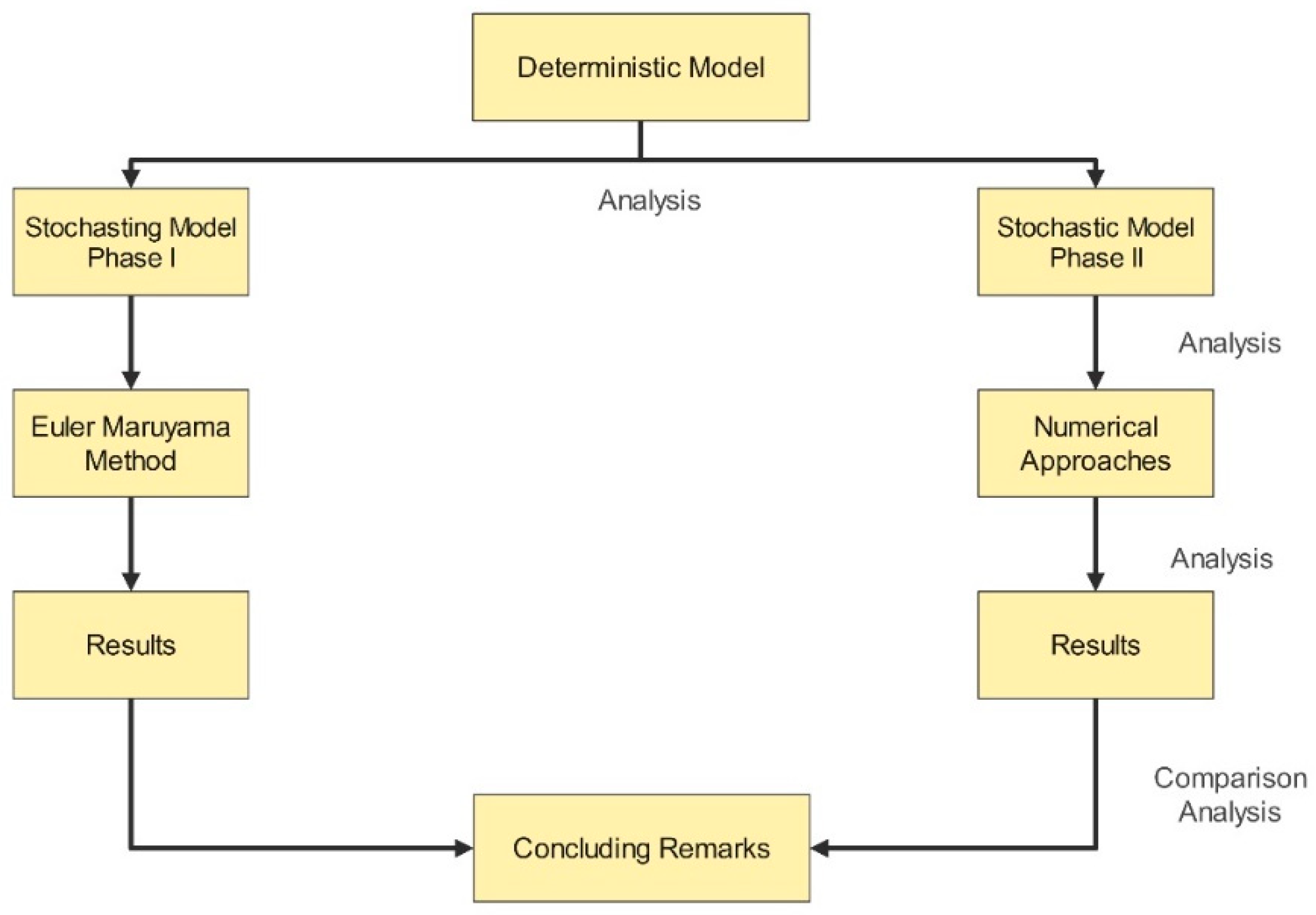
Abstract
Evolutionary approaches have a critical role in different disciplines such as real-world problems, computer programming, machine learning, biological sciences, and many more. The design of the stochastic model is based on transition probabilities and non-parametric techniques. Positivity, boundedness, and equilibria are investigated in deterministic and stochastic senses. An essential tool, Euler–Maruyama, is studied for the solution of said model. Standard and nonstandard evolutionary approaches are presented for the stochastic model in terms of efficiency and low-cost approximations. The standard evolutionary procedures like stochastic Euler–Maruyama and stochastic Runge–Kutta fail to restore the essential features of biological problems. On the other hand, the proposed method is efficient, of meager cost, and adopts all the desired feasible properties. At the end of this paper the comparison section is presented to support efficient analysis.
Keywords:
Lassa fever disease; stochastic epidemic model; stochastic evolutionary approaches; stability analysis MSC:
34A34; 34K50; 37H05; 37H10; 65C30
1. Literature Review
In 2020, Onah et al. formulated a dynamical system for the Lassa fever model depending on socio-economic class. The effect of the disease on the economy was studied worldwide [1]. In 2020, Peter et al. modified a fundamental disease model with the optimal control strategies [2]. In 2020, Bakare et al. worked on the transmission dynamics of the disease and derived a nonlinear ordinary differential equation by introducing the seasonal parameters. Although stochastic methods are suitable for quantitative study via a mathematical model, they play an important role in data analysis, such as in environmental cases [3,4,5], finance [6], energy [7], and epidemiology [8]. For this purpose, some steps are recommended, such as preventive measures, educational campaigns, community hygiene, and isolation of infected humans [9]. In 2021, Collins et al. formulated a mathematical model for control measures of Lassa fever. According to epidemiologists, the population was divided into higher and lower socio-economic classes, and control measures such as treatments, an educational campaign, community hygiene, and rodent safety were discussed [10]. Caraballo et al. [11] studied the epidemic model through the comparative analysis of random and stochastic techniques. Jesus et al. [12] investigated the random perturbations of an ecoepidemiological model. In 2017, Obabiyi et al. developed a mathematical model for Lassa fever and divided the population into two parts: humans and rodents. They suggested early-stage treatment, working in a hygienic environment, and controlling the rodent population, affecting the human race [13]. In 2020, Dachollom et al. addressed the epidemic with a broader double-dimensional approach, such as the natural and medical sciences. They developed a mathematical model to control Lassa fever infection [14]. In 2013, Bawa et al. derived a deterministic model for a disease-free state and obtained to control disease dynamics [15]. In 2020, Sattler et al. developed an animal model of Lassa fever from 2018 to 2019. The Nigerian fatality rate was 25.4%, and the socio-economic burden occurred massively in the endemic region [16]. In 2020, Okolo et al. developed a mathematical model for controlling Lassa fever by isolation and treatments. They proved that the disease-free equilibrium is locally asymptotically stable [17]. In 2019, Marien et al. derived a mathematical model based on field data for rodent control to fight Lassa fever. This model recommended continuous control or rodent vaccination as the only policy [18]. In 2019, Akhmetzhanov measured the periodic parameters of transmission for Lassa fever. This model is based on human infection and rodent population and also analyzed the infectious disease outbreaks in humans, animals, and plants [19]. In 2019, Nwasuka et al. analyzed the treatment as a control measure, formulated a mathematical model of Lassa fever with separation of the infected individual, and evaluated the transmission dynamics [20]. In 2019, Zhao et al. developed the association between disease reproduction number and local rainfall. The reproduction number was calculated from four different growth models: (1) Richards, (2) three-parameter logistics, (3) Gompertz, and (4) Weibull [21]. In 2020, Martins et al. developed a mathematical model to control the spreading Lassa fever and analyzed the existence and stability of a disease-free equilibrium [22]. In 2020, Abdulkarim et al. discussed the objective factors and death rates of the Bauchi state of Nigeria. The data was from 2015 to 2018, when the outbreaks and fatality rates increased, and death mainly occurred seven days later than the symptoms were shown [23]. In 2015, James et al. analyzed the transmission dynamics of Lassa fever. They derived that the zero-equilibrium state is stable when the population is less than the death rate or both are equal [24]. In 2017, Innocent et al. developed an understanding of Lassa fever and its control measures, developed a mathematical model for investigating the dynamics of the disease, and suggested avoiding contact with species that carried viruses and introducing vaccines for humans [25]. In 2018, Akinpelu et al. developed a mathematical model for sensitivity analysis of Lassa fever. This model is divided into five compartments of susceptible (S), latent (L), infected (I), isolated (I), and recovered (R) by using the next-generation method and obtained , showing that disease-free equilibrium was locally and globally asymptotically stable [26]. In 2015, James et al. analyzed stability for Lassa fever and suggested quarantines and making strategies for permanent immunity [27]. In 2019, Obasi et al. derived the primary reproduction number of the Lassa fever epidemic. is inversely proportional to the square of the inter-epidemic period of an infectious disease [28]. Aznar-Gimeno et al. [29] studied the stepwise algorithm for linearly combining biomarkers under index theory. The suitable way of mathematical modeling infectious diseases in all circumstances is stochastic. Many approaches are used to handle the stochastic models based on stochastic differential equations used in literature, such as Milstein, Euler–Maruyama, and many more. All existing techniques do not have symmetry with the fundamental structure of the continuous model, including positivity, boundedness, and dynamical consistency. The construction of a stochastic nonstandard finite difference method is needed to handle such issues and make symmetry with the continuous model. The strategy of our paper is as follows: in Section 2, the deterministic model and the analysis of the Lassa fever disease model are formulated. Section 3 is based on the invention of the disease model in the stochastic form. In Section 4 the computational approaches to model the Lassa fever disease and their results are described. Finally, the conclusion and future framework are discussed.
2. Model Formulation
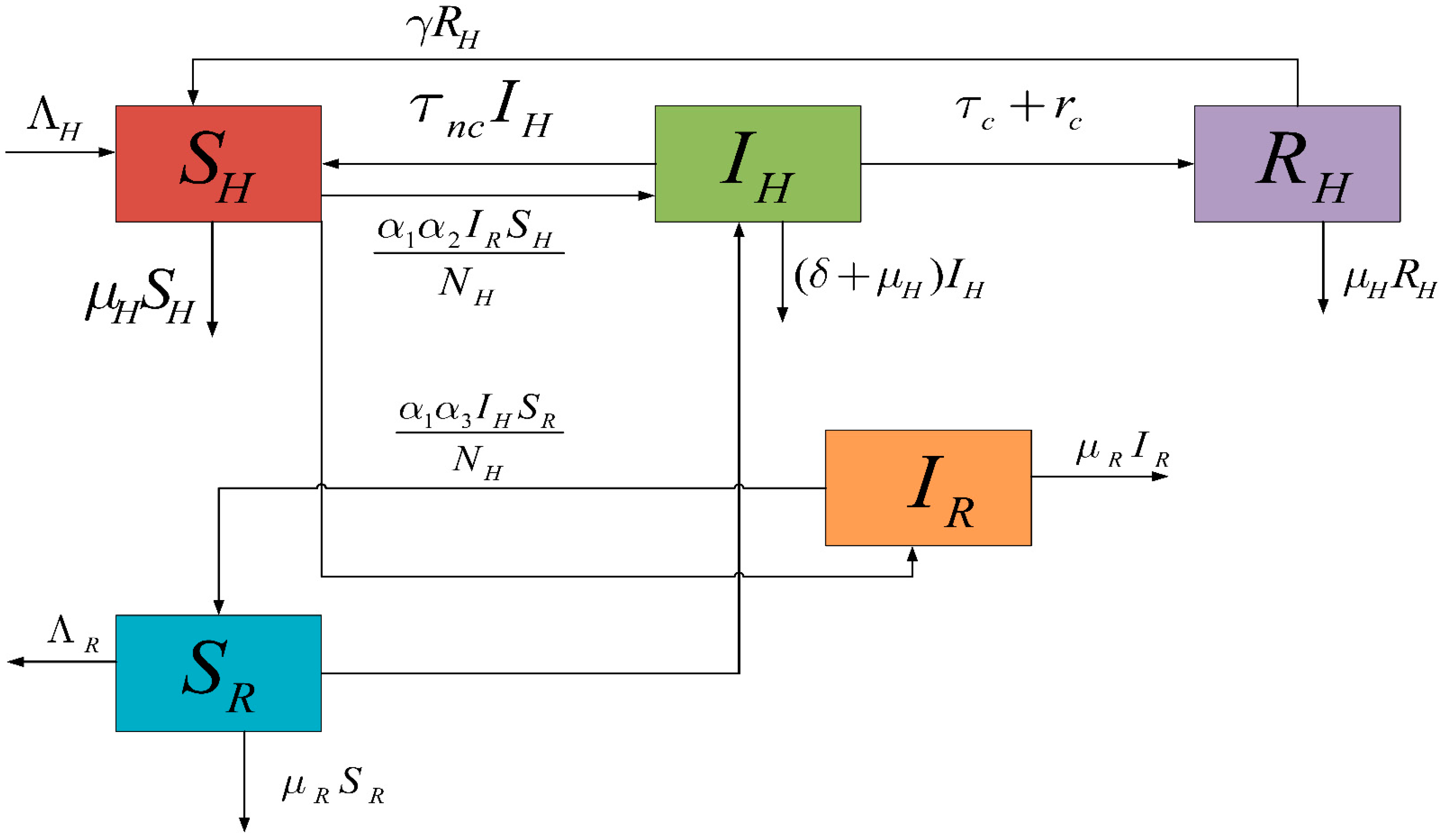
For any time , the variables and constants of the model are as follows: denoted as the susceptible class, represented as the infectious class, represented as the recovered class, characterized represented as the susceptible rats, represented as the infectious rats, represented as whole humans’ population. The dynamics of Lassa fever are presented in Figure 1 as follows [30]:
Figure 1.
Flow chart of Lassa fever model.
Table 1 is presented the physical relevance of the constants as follows:
Table 1.
Physical applicability of the model.
The model with equations is as follows:
where .
2.1. Positivity and Boundedness
For any time t ≥ 0, the feasible region of the model is as follows:
Lemma 1.
The solutionsof the Equations (1)–(5) are positive at any timet ≥ 0, with given non-negative initial conditions.
Proof.
It is clear from the Equations (1)–(5) that:
as desired. □
Lemma 2.
The solutionsof the Equations (1)–(5) are bounded at any timet ≥ 0, to proveand.
Proof.
By considering the function as follows:
By Gronwall’s inequality, we get ,
By Gronwall’s inequality, we get
as desired. □
2.2. Model Equilibria
There are two equilibria of Equation (1) to Equation (5), as follows: disease-free equilibrium ( and endemic equilibrium ( where , , . And, , , , .
The next-generation matrix method is used to calculate the reproduction number. The transmission matrix, denoted by , and transition matrix, denoted by , are obtained by considering the infected classes from the system (1)–(5) and adding the disease-free equilibrium. The reproduction number is represented as the largest eigenvalue of .
where , is called the reproduction number.
3. Stochastic Formulation Phase-I
A transition matrix technique, also known as a stochastic or probability matrix, is a square matrix representing the transition probabilities of a stochastic system. Let be a vector for the disease model. The changes in the disease model concerning time are calculated in Table 2.
Table 2.
Possible changes in the process of the model.
Thus, .
The Euler–Maruyama scheme is implemented on Equation (8) to find its stimulating results by using the scientific literature of the model. This is presented in Table 1 and is as follows:
where is the discretization parameter.
4. Formulation Phase-II
Considering the dynamical system (1)–(5), add uncertainty parameter with Brownian motion as follows [31]:
where represents each compartment’s randomness and B(t) is the Brownian motion.
4.1. Fundamental Properties of the Stochastic Model
In this section, the positivity and boundedness of systems (9)–(13) are discussed. Let us consider the vectors as follows:
And the norms
And
Also, denote are the families of all non-negative functions defined on , respectively. Also, twice differentiable in U and V and once in t.
We define the differential operators associated with three dimensional SDEs:
as,
and
If acts on a function then we denote
where T means Transportations.
Theorem 1.
For system (9)–(13) and any given initial conditions, there are unique solutions, respectively, and it will remain inwith probability one.
Proof.
where , then expectation will be
Since the local Lipschitz constraints are satisfied with all model parameters. Therefore, by Ito’s formula, the given model admits a positive solution in the sense of local on , and explosion time is denoted by . To prove, the model has a global solution that is .
Let be sufficiently large for , lying with the interval . For each integer , define a sequence as follows:
where, we set ( is empty set). Since is non-decreasing as m→ꝏ,
Then . Now, we wish to show , as desired. If this statement is violated, then there exist such that
Define a functions by
By Ito’s formula on (21), we have
For simply, we let , then Equation (23) will be written as
where, is positive constant. By integrating Equation (24) from 0 to .
where , then Expectation will be
Set and from Equation (14), we have P (. For every there are some i such that equals either m or for I = 1,2,3. Hence, is less than .
Then we obtain
The indicator function is represented by of . Letting leads to the contradiction.
as desired.
Again, by applying Ito’s formula on Equation (22), we have
To simplify, we let , then Equation (28) as
where, is a positive constant by integrating Equation (29) from .
Hence, is less than . Then we obtain,
as desired. □
4.2. Stochastic Euler Approach
The discretization of the system (9)–(13) under the rules of the stochastic Euler approach is as follows:
where h is any discretization parameter and .
4.3. Stochastic Runge—Kutta Approach
The discretization of the system (9)–(13) under the rules of the stochastic Runge–Kutta approach is as follows:
First Stage
Second Stage
Third Stage
Fourth Stage
Final Stage
where h is any discretization parameter and .
4.4. Stochastic Nonstandard Finite Difference Approach
The stochastic non-standard finite difference scheme for Equations (9)–(13) can be defined as follows [32,33]:
where h is any discretization parameter and .
4.5. Stability Analysis
Considering the functions A, B, C, D, and E for the system (43)–(47) by assuming the as follows:
The elements of Jacobean matrix as follows:
Theorem 2.
Forthe eigenvalues of the Jacobian matrix at the disease-free equilibrium for the system (43)–(47) lie in the unit circle if.
Proof.
The Jacobean matrix at disease-free equilibrium (DFE-E0) = is as follows:
□
Lemma 3.
For the quadratic equation,,3, if and only if the following conditions are satisfied:
- (i)
- .
- (ii)
- .
- (iii)
- .
Proof.
The proof is straightforward. □
4.6. Comparison Section
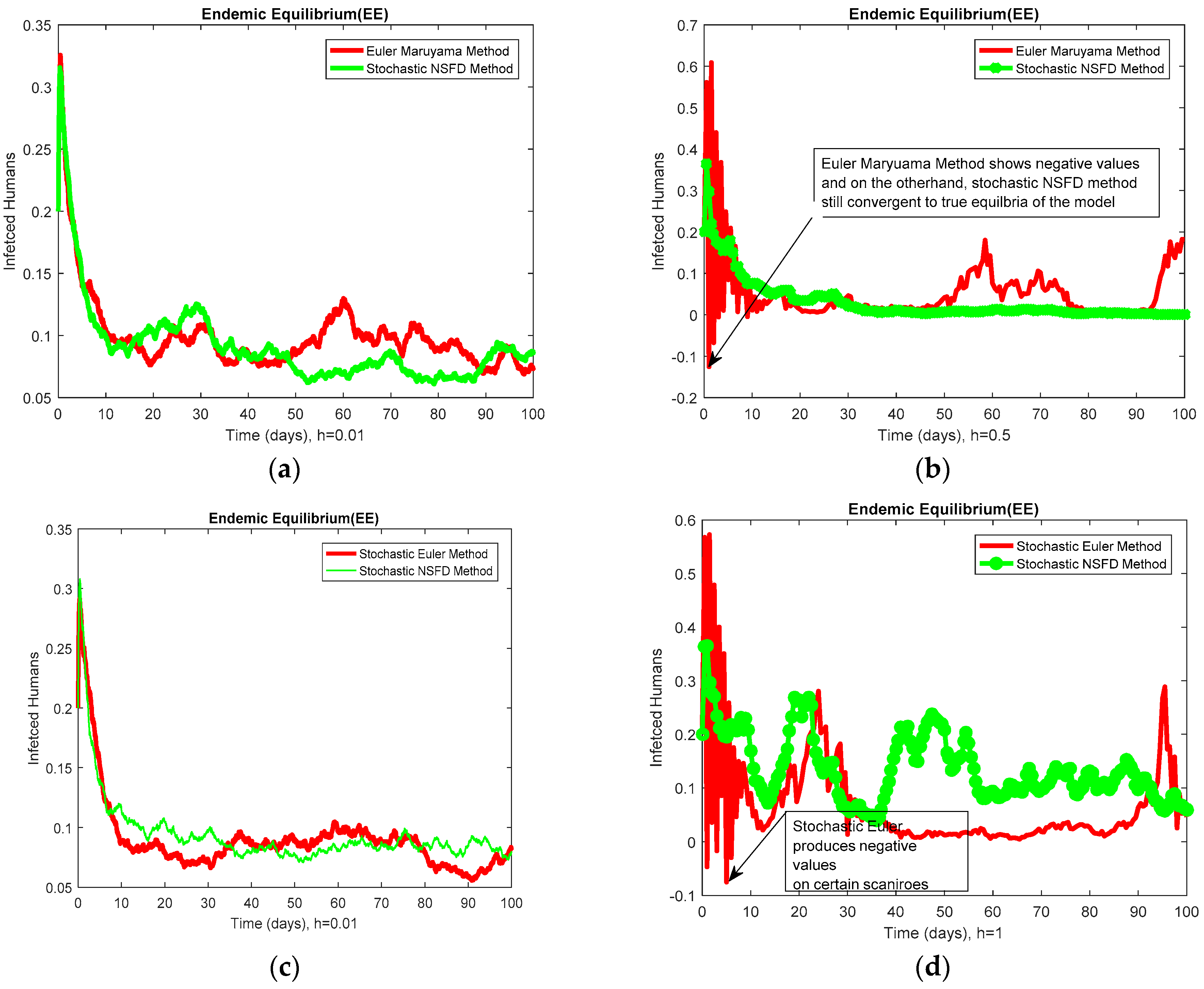
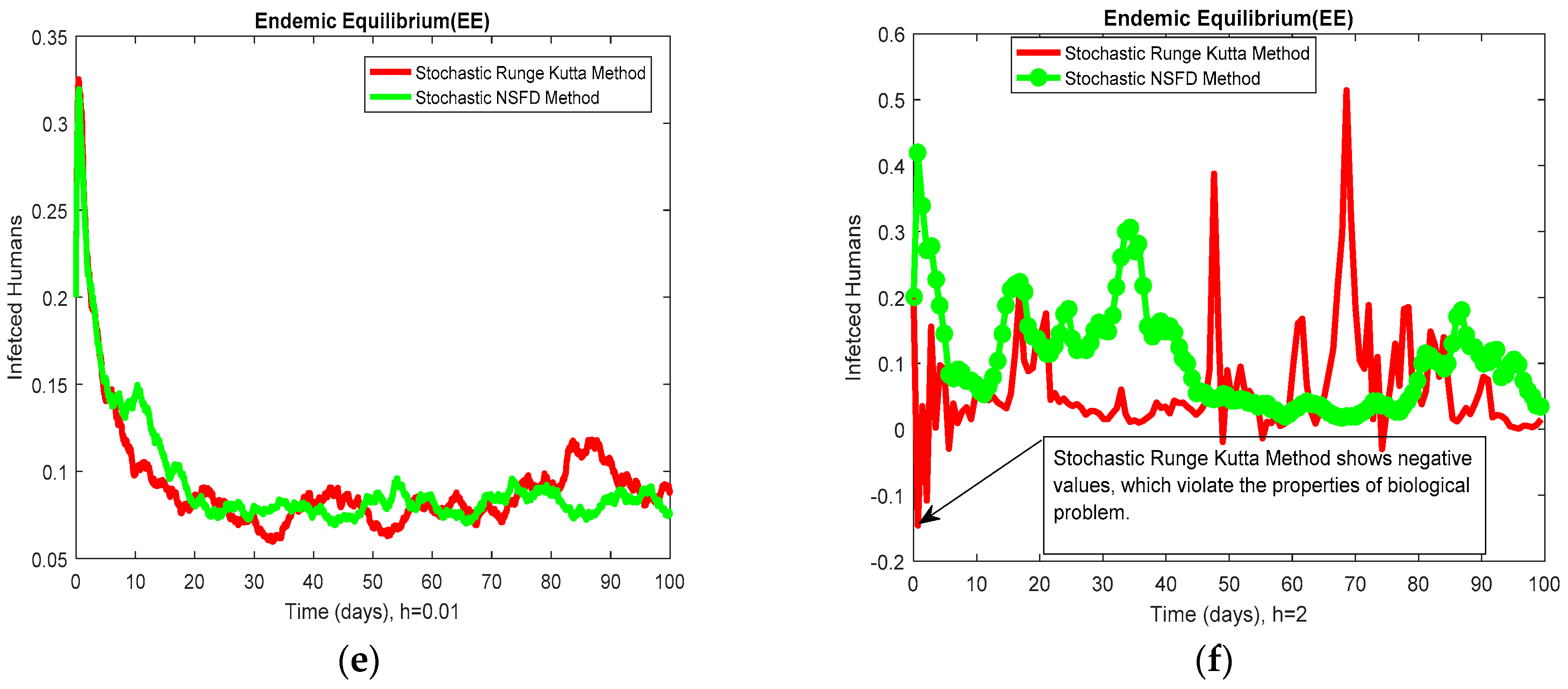
This section compares the behavior of the graphs of infected humans of Euler Maruyama, stochastic Euler, and sto-chastic Runge Kutta schemes with the NSFD scheme for different step sizes.
5. Concluding Remarks
Table 3 predicts the efficacy of the existing methods with the proposed technique. All methods are consistent in small time steps (the disease behavior for a short period). After taking an increase in time, the existing methods are not compatible with the solution of the continuous model, even violating the properties, such as positivity, boundedness, and dynamical consistency. This means the current techniques are unsuitable for predicting the disease’s behavior for a long time. The graphical behavior of Euler–Maruyama, stochastic Euler, stochastic Runge–Kutta, and SNSFD schemes are given in Figure 2 and Figure 3. Figure 4 presents the schematic map of the Lassa fever model. The analysis predicts that mouse-to-human transmission rate and mouse death rate are among the most critical parameters. Hence, the abundance of mice is the most crucial driver of Lassa fever transmission. The following steps could be adequate to control the disease by decreasing rodent-to-human communication, e.g., using rodent-safe food containers, collecting garbage far from the houses, and reducing human-to-human transmission. Our simulations suggest modifying control parameters corresponding to such measures might mitigate the epidemic, but they seem insufficient to drive it to extinction. In the future, we shall extend this idea to annealing genetic GAN for imbalanced web data learning as presented in [34].
Table 3.
Comparison of numerical techniques for different step sizes ‘h.
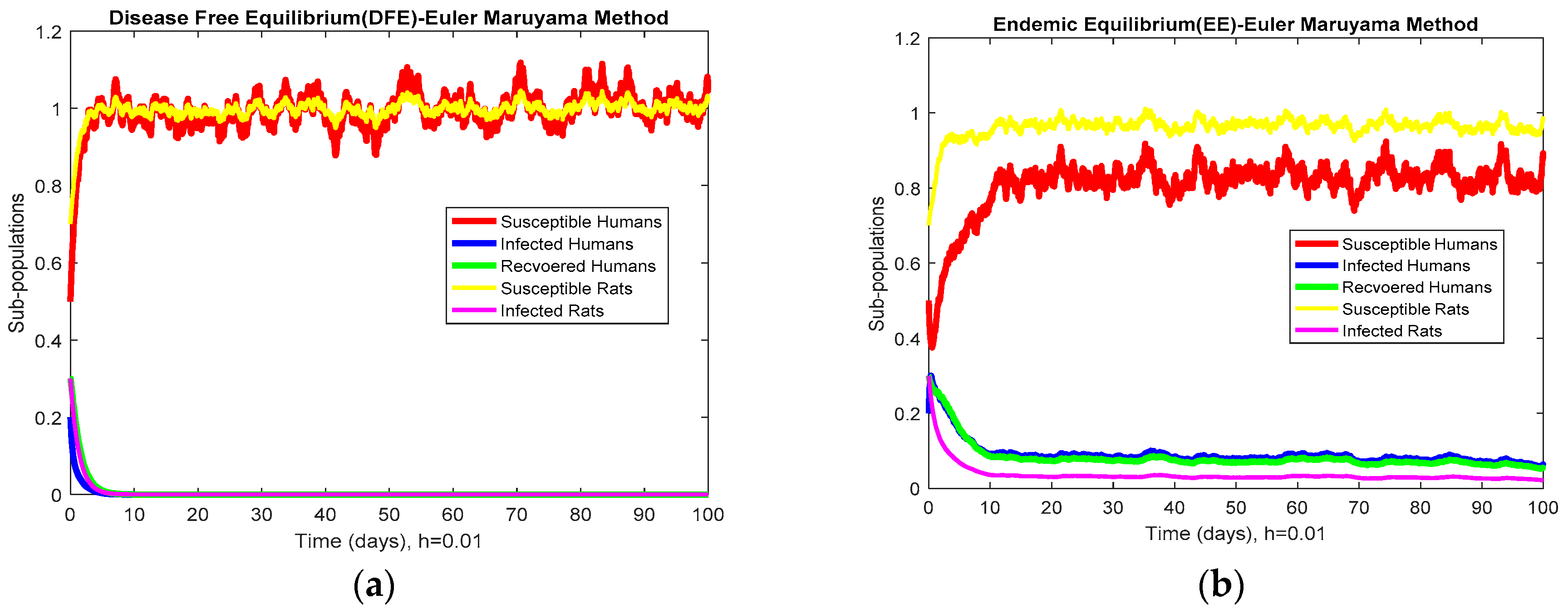
Figure 2.
Depicts the graphical behavior of the system (8) through the Euler–Maruyama method with the help of stochastic differential equations (SDEs) package. (a) The behavior of each subpopulation for disease-free equilibrium at . (b) The behavior of each subpopulation for endemic equilibrium at .

Figure 3.
Combined graphical behaviors of NSFD with Euler-Maruyama, stochastic Euler, and stochastic Runge-Kutta methods at different time-step sizes. (a) The behavior of infected humans through both methods converge to the proper equilibrium at h = 0.01. (b) Euler-Maruyama method diverges and even produces negative values after taking the long-term behavior, but the proposed method is still convergent. (c) The stochastic Euler method depicts the exact behavior of the disease, like the stochastic nonstandard finite difference method. (d) However, the stochastic Euler method fails to restore the dynamical properties at . (e) The stochastic Runge-Kutta methods converges like stochastic NSFD at (f) The stochastic Runge-Kutta method diverges when we take days, but the proposed method is convergent and restores the dynamical properties of the model.
Figure 4.
A schematic diagram of the Lassa fever model.
Author Contributions
Conceptualization, N.A.; data curation, H.H.; formal analysis, H.H., A.R., E.E.M. and W.P.; funding acquisition, J.A.; investigation, M.M.A. and W.P.; methodology, A.R.; project administration, J.A., M.R. and E.E.M.; resources, M.R.; software, A.R. and W.P.; supervision, M.R. and N.A.; validation, N.A. and M.M.; visualization, A.R. and M.M.; writing–original draft, M.M.; Writing–review & editing, M.M. All authors have read and agreed to the published version of the manuscript.
Funding
No funding is available regarding this article.
Institutional Review Board Statement
Not applicable.
Informed Consent Statement
Not applicable.
Data Availability Statement
All of the necessary data and the implementation details have been included in the manuscript.
Acknowledgments
The authors extend their appreciation to the Deanship of Scientific Research at King Khalid University for funding this work through Large Groups [project under grant number (RGP.2/116/43)]. The authors would like to thank the Deanship of Scientific Research at Umm Al-Qura University for supporting this work by Grant Code: (22UQU4330953DSR02). Taif University Researchers Supporting Project number (TURSP-2020/20), Taif University, Taif, Saudi Arabia. The authors are thankful to the Govt. of Pakistan for providing the facility to conduct the research. All Authors are grateful for the suggestions of anonymous referees to improve the quality of the manuscript.
Conflicts of Interest
There is no challenging interest in this article.
References
- Onah, I.S.; Collins, O.C. Dynamical system analysis of a Lassa fever model with varying socio-economic classes. J. Appl. Math. 2020, 2020, 1–12. [Google Scholar] [CrossRef]
- Peter, O.J.; Abioye, A.I.; Oguntolu, F.A.; Owolabi, T.A.; Ajisope, M.O.; Zakari, A.G.; Shaba, T.G. Modelling and optimal control analysis of Lassa fever disease. Inform. Med. Unlocked 2020, 20, 100419. [Google Scholar] [CrossRef]
- Caraka, R.E.; Chen, R.C.; Yasin, H.; Pardamean, B.; Toharudin, T.; Wu, S.H. Prediction of Status Particulate Matter 2.5 using State Markov Chain Stochastic Process and HYBRID VAR-NN-PSO. IEEE Access 2019, 7, 161654–161665. [Google Scholar] [CrossRef]
- Masseran, N.; Safari, M.A.M. Modeling the transition behaviors of PM10 pollution index. Environ. Monit. Assess 2020, 192, 441. [Google Scholar] [CrossRef] [PubMed]
- Caleyo, F.; Velázquez, J.C.; Valor, A.; Hallen, J.M. Markov chain modelling of pitting corrosion in underground pipelines. Corros. Sci. 2009, 51, 2197–2207. [Google Scholar] [CrossRef]
- Schweizer, M. Editorial: 25th anniversary of Finance and Stochastics. Finance. Stochastics 2022, 26, 1–3. [Google Scholar] [CrossRef]
- Koniorczyk, M.; Grymin, W.; Zygmunt, M.; Bednarska, D.; Wieczorek, A.; Gawin, D. Stochastic energy-demand analyses with random input parameters for the single-family house. Build. Simul. 2022, 15, 357–371. [Google Scholar] [CrossRef]
- Polcz, P.; Csutak, B.; Szederkényi, G. Reconstruction of Epidemiological Data in Hungary Using Stochastic Model Predictive Control. Appl. Sci. 2022, 12, 1113. [Google Scholar] [CrossRef]
- Bakare, E.A.; Are, E.B.; Abolarin, O.E.; Osanyinlusi, S.A.; Ngwu, B.; Ubaka, O.N. Mathematical Modelling and Analysis of Transmission Dynamics of Lassa fever. J. Appl. Math. 2020, 2020, 6131708. [Google Scholar] [CrossRef]
- Collins, O.C.; Okeke:, J.E. Analysis and Control Measures for Lassa fever Model Under Socio-Economic Conditions. In International Conference on Recent Trends in Applied Research; IOP Publishing: Bristol, UK, 2021. [Google Scholar]
- Caraballo, T.; Colucci, R. A comparison between random and stochastic modeling for a SIR model. Commun. Pure Appl. Anal. 2017, 16, 151. [Google Scholar] [CrossRef]
- de Jesus, L.F.; Silva, C.M.; Vilarinho, H. Random perturbations of an eco-epidemiological model. arXiv 2020, arXiv:2007.10188. [Google Scholar] [CrossRef]
- Obabiyi1, O.S.; Onifade, A.A. Mathematical Model for Lassa fever Transmission Dynamics with Variable Human and Reservoir Population. Int. J. Differ. Equ. Appl. 2017, 16, 1311–2872. [Google Scholar]
- Dachollom, S.; Madubueze:, C.E. Mathematical Model of the Transmission Dynamics of Lassa fever Infection with Controls. Math. Model. Appl. 2020, 5, 65–86. [Google Scholar] [CrossRef]
- Bawa, M.; Abdulrahman, S.; Jimoh, O.R.; Adabara, N.U. Stability Analysis of the Disease-Free Equilibrium State for Lassa fever Disease. J. Sci. Technol. Math. Educ. 2020, 9, 115–123. [Google Scholar]
- Sattler, R.A.; Paessler, S.; Ly, H.; Huang, C. Animal Models of Lassa fever. Pathogens 2020, 9, 197. [Google Scholar] [CrossRef] [PubMed]
- Okolo, P.N.; Nwabufo, I.V.; Abu, O. Mathematical Model for the Transmission Dynamics of Lassa Fever with Control. Sci. World J. 2020, 15, 62–68. [Google Scholar]
- Mariën, J.; Borremansb, B.; Kouroumad, F.; Bafordaye, J.; Riegere, T.; Günther, S.; Magassouba, N.; Leirs, H.; Fichet-Calvet, E. Evaluation of Rodent Control to fight Lassa Fever Based on field Data and Mathematical Modelling. Emerg. Microbes Infect. 2019, 8, 640–649. [Google Scholar] [CrossRef] [PubMed]
- Akhmetzhanov, A.R.; Asai, Y.; Nishiura, H. Quantifying the Seasonal Drivers of Transmission for Lassa fever In Nigeria. Phil. Trans. R. Soc. B 2019, 374, 20180268. [Google Scholar] [CrossRef] [PubMed]
- Nwasuka, S.C.; Nwachukwu, I.E.; Nwachukwu, P.C. Mathematical Model of the Transmission Dynamics of Lassa Fever with Separation of Infected Individual and Treatment as Control Measures. J. Adv. Math. Comput. Sci. 2019, 32, 1–15. [Google Scholar] [CrossRef]
- Zhao, S.; Musa, S.S.; Fu, H.; He, D.; Qin, H. Large-scale Lassa fever outbreaks in Nigeria: Quantifying the association between disease reproduction number and local rainfall. Epidemiol. Infect. 2020, 148, 1–12. [Google Scholar] [CrossRef]
- Martins, O.; Moses, M.S.; Dahiru, U.; Abdulkadir, A. Basic Reproductive Number for the Spread and Control of Lassa fever. Int. J. Math. Trends Technol. 2016, 30, 1–7. [Google Scholar] [CrossRef]
- Abdulkarim, M.A.; Babale, S.M.; Umeokonkwo, C.D.; Bamgboye, E.A.; Bashorun, A.T.; Usman, A.A.; Balogun, M.S. Epidemiology of Lassa Fever and Factors Associated with Deaths. Emerg. Infect. 2020, 26, 799–801. [Google Scholar] [CrossRef]
- James, T.O.; Abdulrahman, S.; Akinyemi, S.; Akinwande, N.I. Dynamics Transmission of Lassa Fever Disease. Int. J. Innov. Res. Educ. Sci. 2019, 2, 2349–5219. [Google Scholar]
- Innocent, E.B.; Omo, E. Lassa fever and its Control Measures. Sci. Res. 2017, 7, 75–79. [Google Scholar]
- Akinpelu, F.O.; Akinwande, R. Mathematical Model for Lassa fever and Sensitivity Analysis. J. Sci. Eng. Res. 2018, 5, 1–9. [Google Scholar]
- James, T.O.; Akinyemi, S.T.; Oluwade, B. Stability Analysis of Lassa fever with Quarantine and Permanent Immunity. Int. Inst. Acad. Res. Dev. 2015, 1, 71–81. [Google Scholar]
- Obasi, C.; Mbah, G.C.E. On the Basic Reproduction Number of Lassa fever Epidemics and Its Relationship with Inter-Epidemic Period. J. Niger. Soc. Math. Biol. 2019, 2, 66–79. [Google Scholar]
- Aznar-Gimeno, R.; Esteban, L.M.; del-Hoyo-Alonso, R.; Borque-Fernando, Á.; Sanz, G. A Stepwise Algorithm for Linearly Combining Biomarkers under Youden Index Maximization. Mathematics 2022, 10, 1221. [Google Scholar] [CrossRef]
- Faniran, T.S. A Mathematical modelling of lassa fever dynamics with non-drug compliance rate. Int. J. Math. Trends Technol. 2017, 47, 305–317. [Google Scholar] [CrossRef]
- Allen, E.J.; Allen, L.J.S.; Arciniega, A.; Greenwood, P.E. Construction of Equivalent Stochastic Differential Equation Models. Stoch. Anal. Appl. 2008, 26, 274–297. [Google Scholar] [CrossRef]
- Mickens, R.E. A fundamental principle for constructing nonstandard finite difference schemes for differential equations. J. Differ. Equ. Appl. 2005, 11, 645–653. [Google Scholar] [CrossRef]
- Mickens, R.E. Advances in Applications of Nonstandard Finite Difference Schemes; World Scientific: Singapore, 2005. [Google Scholar]
- Hao, J.; Wang, C.; Yang, G.; Gao, Z.; Zhang, J.; Zhang, H. Annealing Genetic GAN for Imbalanced Web Data Learning. IEEE Trans. Multimedia. 2021, 24, 1164–1174. [Google Scholar] [CrossRef]
Publisher’s Note: MDPI stays neutral with regard to jurisdictional claims in published maps and institutional affiliations. |
© 2022 by the authors. Licensee MDPI, Basel, Switzerland. This article is an open access article distributed under the terms and conditions of the Creative Commons Attribution (CC BY) license (https://creativecommons.org/licenses/by/4.0/).