Abstract
This paper is devoted to the construction and analysis of some new families of n-point ternary subdivision schemes. Some members of the families were adapted to the presence of discontinuities converging to limit functions without Gibbs oscillations. We present a numerical comparison where we check the theoretical properties.
Keywords:
subdivision; ternary; Laurent polynomial; convergence; reproduction polynomials; discontinuities; Gibbs phenomenon MSC:
65D17
1. Introduction
Subdivision schemes are used in CAGD since they are able to generate curves and surfaces from an initial set of control points. In past years, a great number of works have been published on linear subdivision schemes.
In this paper, we present some new n-point ternary families of subdivision schemes:
- , a 2-point interpolatory family that generates a continuous limit function; this family can be considered ’generalized’ of the ternary 2-point subdivision scheme proposed in [1].
- , a 3-point approximating family that gives a continuous limit function.
- , a 3-point approximating family that has continuity of the limit function; this family can be considered ‘generalized’ of the ternary 3-point subdivision scheme proposed in [1], the ternary 3-point subdivision scheme defined in [2] (with ), and the ternary subdivision scheme presented in [3].
We also propose new family-approximating subdivision schemes:
- A 4-point family () that gives a continuous limit function;
- A 5-point family (,) that has continuity of the limit function;
- A 6-point family () that generates the limit function.
We prove the convergence of the new family subdivision schemes; in order to study the reproduction polynomial property, we present an important theorem (Theorem 7) for the m-ary subdivision scheme and we apply it to the new ternary subdivision schemes. Moreover, we study the polynomial generation and the absence of the Gibbs oscillations on the limit functions near discontinuities of the new families, and we perform a numerical comparison considering the case of discontinuities on the initial data.
The constructions of the subdivision schemes are interesting because we generalize some existing schemes, giving more possibilities. Moreover, the theoretical properties derived for the new schemes are important in applications, such as CAGD and image processing.
2. Background
A ternary subdivision scheme is defined by
where is called the mask.
The general form of (1) can be written as
The norm of a ternary subdivision scheme S is defined by:
and the Laurent polynomial by
For the convergence, we have the following results:
Definition 1
([4]). A triadic subdivision scheme S is said to be convergent if
The limit function g is denoted by
The next theorem presents a necessary condition for the convergence of a ternary subdivision scheme.
Theorem 1
([5]). Let S be a convergent ternary subdivision scheme, with a mask a. Then
The Laurent polynomial of a convergent ternary subdivision scheme verifies [6]
and there exists the Laurent polynomial , such that
The subdivision scheme (the first-order difference scheme of S) associates the symbol and satisfies the following proposition:
Proposition 1
([6]). Let S be a subdivision scheme defined by a mask satisfying (2). Then there exists a subdivision scheme with the property
where and .
To prove the convergence of the subdivision scheme S, we use the subdivision scheme as follows:
Theorem 2
([5]). S is a uniformly convergent ternary subdivision scheme if and only if converges uniformly to the zero function for all initial data ; that is
According to Theorem 2, to prove that the convergence of S is equivalent to proving that for some integer (which means is contractive), in this paper, we take .
In order to check the regularity of the limit functions obtained by the subdivision scheme S, we apply the flowing theorem.
Theorem 3
([5]). Let us consider a scheme S with the Laurent polynomial . If there exists a polynomial , such that
and it is verified that the associated scheme is contractive, then the limit function is for any initial data.
Corollary 1.
If there exists a polynomial , such that
with for some integer , then the limit function is for any initial data.
Proof.
We suppose that there exists a polynomial , verifying
where , is contractive. In fact, the symbol of the first-order difference scheme of is then , so is contractive. □
3. Some New Families of n-Point Ternary Subdivision Schemes
In this section, we propose some new families of n-point ternary subdivision schemes with the parameter w. Firstly, we present the following new family of Laurent polynomials:
, where the exponents m depend on and are given in the following table
| 0 | 1 | 2 | 3 | 4 | 5 | 6 | |
| m | 2 | 1 | 3 | 5 | 6 | 6 | 8 |
3.1. The 2-Point Ternary Interpolatory Subdivision Schemes
• A family of 2-point ternary interpolatory subdivision schemes can be obtained, after setting in (6). We obtain the following Laurent polynomial:
The subdivision scheme associated with the Laurent polynomial (7) is the interpolating subdivision scheme:
Remark 1.
For , this scheme coincides with the scheme by M.F. Hassan and N.A. Dodgson [1].
3.2. Two New Families of the 3-Point Ternary Subdivision Scheme
- Putting in (6), we obtain the Laurent polynomial:
The subdivision scheme corresponding to the Laurent polynomial (9) is:
- For in (6), we obtain the following Laurent polynomial:
The subdivision scheme associated with the Laurent polynomial (11) is given as:
Remark 2.
• For , the scheme coincides with the scheme by K. Rehan and S. Siddiqi, [2] (with ).
• For , the above scheme coincides with the scheme by S. Siddiqi and K. Rehan, [3].
• For , this scheme coincides with the scheme by M.F. Hassan and N.A. Dodgson, [1].
3.3. A New Family of 4-Point Ternary Subdivision Schemes
• We set in (6), and obtain the Laurent polynomial:
The subdivision scheme associated with the Laurent polynomial (12) is:
3.4. A New Family of 5-Point Ternary Subdivision Schemes
- For in (6), we obtain the Laurent polynomial:
The subdivision scheme associated with the Laurent polynomial (14) is:
Remark 3.
• For , the above subdivision scheme coincides with the scheme of [7] (with ).
• This is exactly the same subdivision scheme defined in [8], where , (with , and ).
- For in (6), we obtain the Laurent polynomial:
The subdivision scheme associated with the Laurent polynomial (16) is:
3.5. A New Family of 6-Point Ternary Subdivision Schemes
For in (6), we obtain the Laurent polynomial:
The subdivision scheme associated with the Laurent polynomial (18) is:
4. Convergence Analysis
Theorem 4.
Proof.
The family of Laurent polynomials (6) can be written as
where
( is the symbol of the first-order difference of the scheme ).
Case 1: if , then
we have the mask of the scheme , Since , this norm , when .
Case 2: if , then
we have the mask of the scheme
Since , this norm , when .
Case 3: , in this case
we have the mask of the scheme
Since , this norm , when .
Case 4: for , we have
we have the mask of the scheme
Since , this norm , when .
Case 5: if , then
we have the mask of the scheme
Since , this norm , when .
Case 6: if , then
the mask of the scheme is
Since , this norm , when .
Case 7: for ,
The norm , this norm , when . □
Theorem 5.
Proof.
Since , this norm , when .
Hence, the family of the subdivision scheme is when . □
Hölder Regularity
Theorem 6.
Proof.
The proof of the theorem (5) implies that
Following the method of O. Rioul in [9], the ternary subdivision schemes , have a Hölder regularity , where v verifies
Choosing , we have
□
5. Reproduction Polynomials of Any m-Arity Subdivision Scheme and Comparisons
To study the reproduction polynomials of the subdivision schemes, we need some results.
Definition 2
([10]). A subdivision scheme reproduces polynomials of degree d if it is convergent and if for any polynomial and initial data
Let , the arity of a subdivision scheme and the subsymbols of a Laurent polynomial are defined in [11] by
and the k-th derivative of a subsymbol is given as
where are the polynomials
Lemma 1
([11]). The k-th derivative of a Laurent polynomial satisfies
if and only if
where are the m roots of the unity.
Corollary 2.
The k-th derivative of a Laurent polynomial verifies
if and only if
Proof.
We first remark that
new we use the Lemma 1 to obtain the result. □
Lemma 2.
Let and . Then a Laurent polynomial satisfies
and
if and only if
Proof.
If , using the definition of the polynomial and Relation (23), we have for any :
Let us assume that there is an equivalence between (22) and (23) for and we prove this equivalence for .
Because the polynomial is of degree d, then with , such that
For and any
Since , this is equivalent to
□
To present the main theorem in this section, we need a parameterization defined as following
Definition 3
([11]). For any subdivision scheme , we denote by the corresponding parametric shift and attach the data for to the parameter values
Theorem 7.
A convergent subdivision scheme with an arity reproduces polynomials of degree with respect to the parameterization in (24) if and only if
where
Proof.
It follows from Theorem 4.3 in [11] and Lemma (2). □
Remark 4.
The necessary condition for the convergence imply the reproduction of the constants .
Particular case.
For a ternary subdivision scheme (), the relation (25) can be written as
for
5.1. Polynomial Reproduction and Approximation Order of the Subdivision Schemes
To obtain the order of approximation of the family subdivision schemes, we use the next theorem
Theorem 8
([12]). A convergent subdivision scheme that reproduces polynomial has an approximation order of
Theorem 9.
The subdivision scheme defined by (8) reproduces the polynomial of degree 1 when .
Proof.
Corollary 3.
The interpolatory subdivision scheme defined in (8) has an approximation order of 2 when .
Theorem 10.
The subdivision scheme defined by (10) reproduces the polynomial of degree 1 .
Proof.
Theorem 11.
The subdivision , defined by (11) reproduces polynomials of degree 1 , and of degree 2 for .
Proof.
Theorem 12.
The subdivision scheme defined in (13) reproduces the polynomial of degree 1 , and degree 2 when .
Proof.
Theorem 13.
The subdivision scheme defined in (15) reproduces the polynomial of degree 1 and of degree 3 for .
Proof.
Theorem 14.
The subdivision scheme defined by (17), reproduces the polynomial of degree 1 , and of degree 3 for .
Proof.
Theorem 15.
The subdivision scheme defined in (19) reproduces the polynomial of degree 1 , and of degree 3 for .
Proof.
Corollary 4.
Corollary 5.
5.2. Polynomial Generation
The generation degree of a subdivision scheme is the maximum degree of polynomials that can potentially be generated by the scheme, provided that the initial data are chosen correctly [13].
Theorem 16.
Proof.
This proof is based on the same idea presented in [11].
Since , then the families of subdivision schemes generate polynomials up to the degree .
Since , then the families of subdivision schemes generate polynomials up to degree . □
6. Gibbs Phenomenon
In this section, we are going to prove that the new family subdivision schemes do not suffer from the Gibbs phenomenon oscillations for some values of w.
Theorem 17.
The family subdivision schemes , for do not introduce the Gibbs phenomenon close to the discontinuities, for all , and respectively.
Proof.
Using theorem 3.1 presented in [14], and the fact that the family subdivision schemes , for , are convergent and have positives masks, for all , and , respectively, we have the results. □
7. Comparison with Another Subdivision Schemes
In the following table, we present a comparison of our schemes with several schemes that we can find in the literature.
| n-point | Schemes | Type | Continuity | Coincide with | |
| 0 | 2-point | scheme | interpolatory | for | Scheme [1] for |
| 1 | 3-point | scheme | approximating | for | |
| 2 | 3-point | scheme | approximating | for | Scheme [1] for |
| Scheme [3] for | |||||
| Scheme [2] (with ) for | |||||
| 3-point | Scheme in [2] | approximating | |||
| 3 | 4-point | scheme | approximating | for | |
| 4-point | Scheme in [5] | approximating | |||
| 4-point | Scheme in [2] | approximating | |||
| 4-point | Scheme in [15] | approximating | |||
| 4 | 5-point | scheme | approximating | for | Scheme [7] (with ) for |
| Scheme in [8] for | |||||
| (with ) | |||||
| 5 | 5-point | scheme | approximating | for | |
| 5-point | Scheme in [7] | approximating | |||
| 5-point | Scheme in [15] | approximating | |||
| 6 | 6-point | scheme | approximating | for | |
| 6-point | Scheme in [15] | approximating |
8. Numerical Tests
In this section, we present some numerical experiments in 1d and 2d.
Example 1.
In this example, we use two functions to obtain the initial data , a continuous function defined by
and a discontinuous function defined by
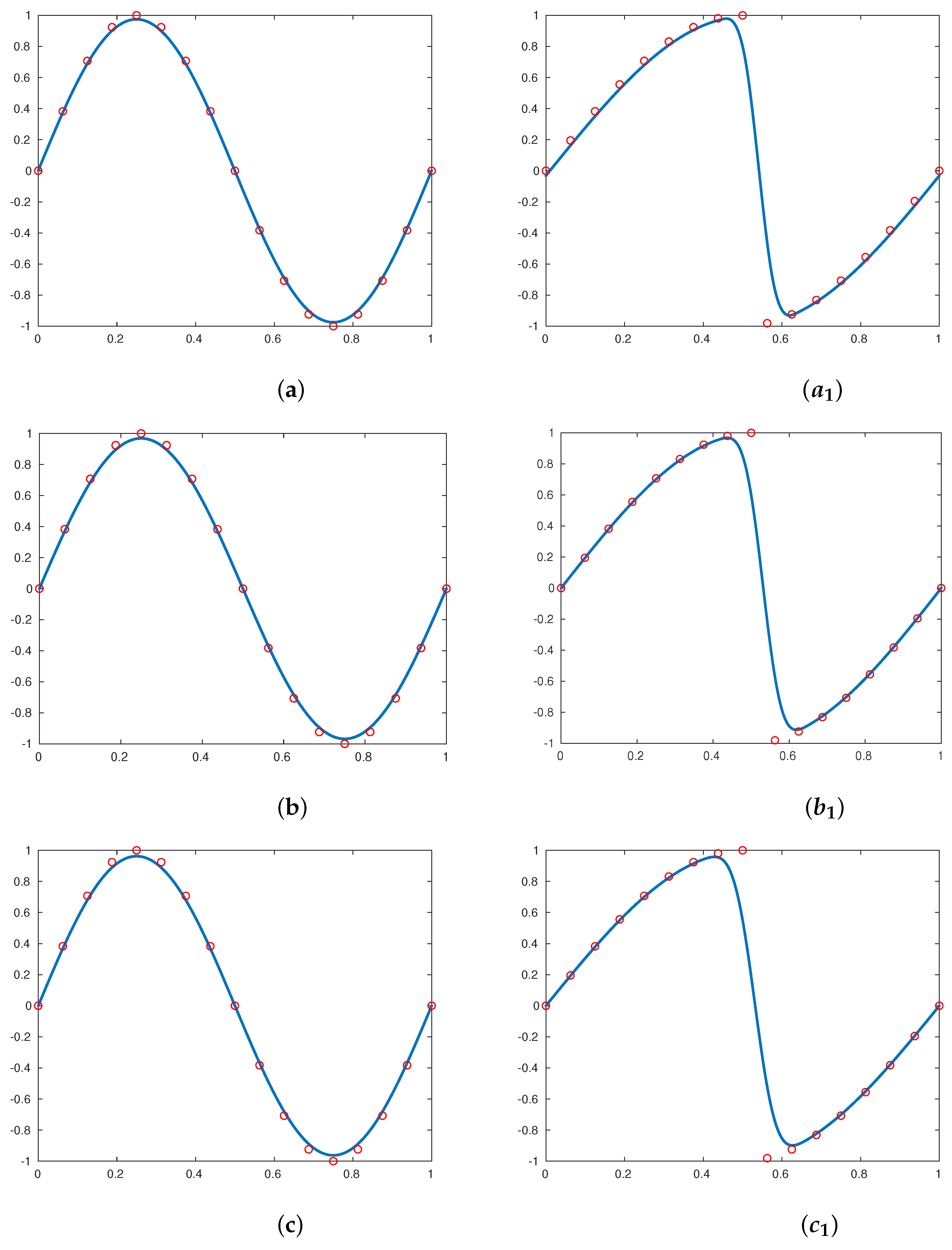
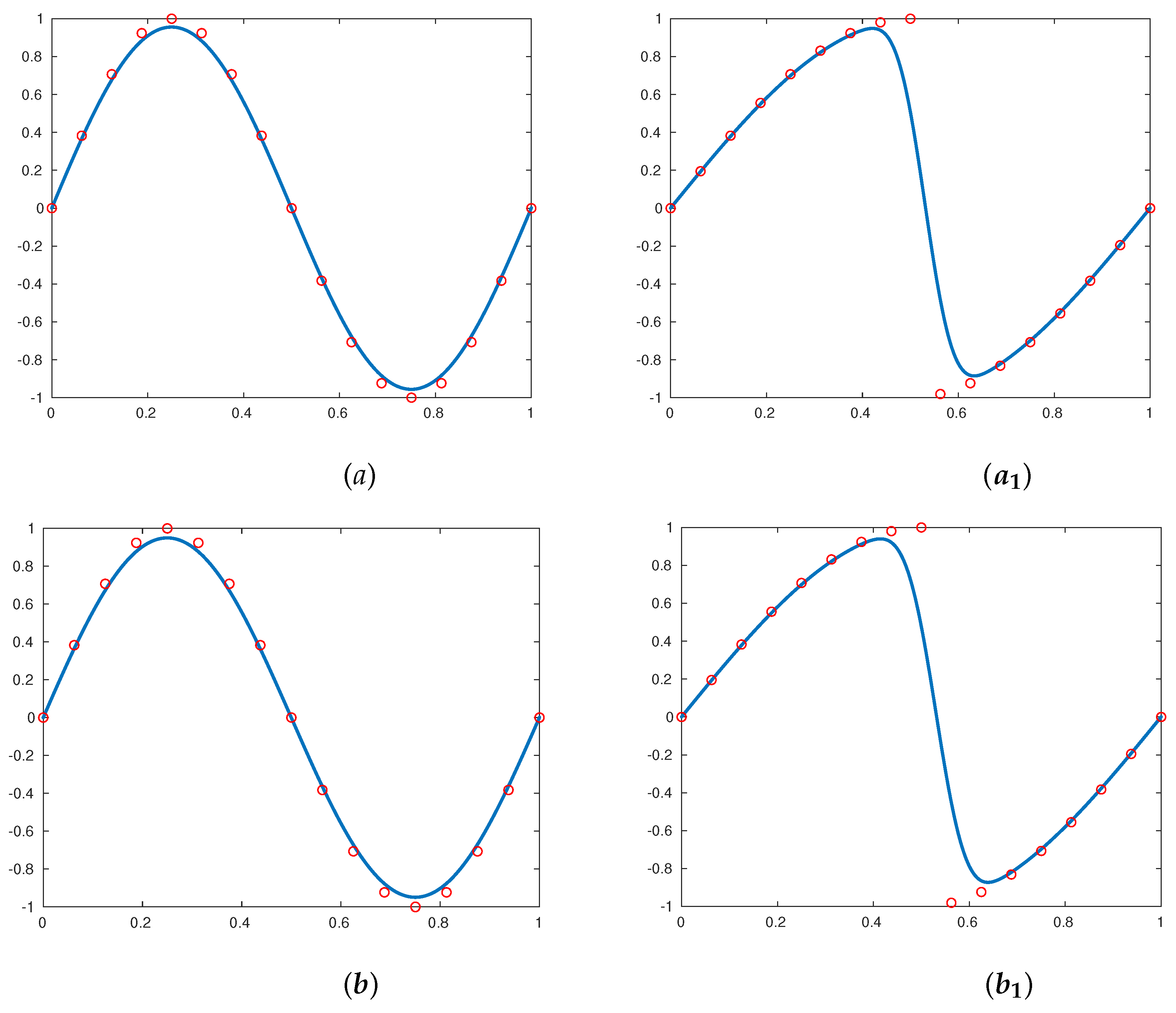
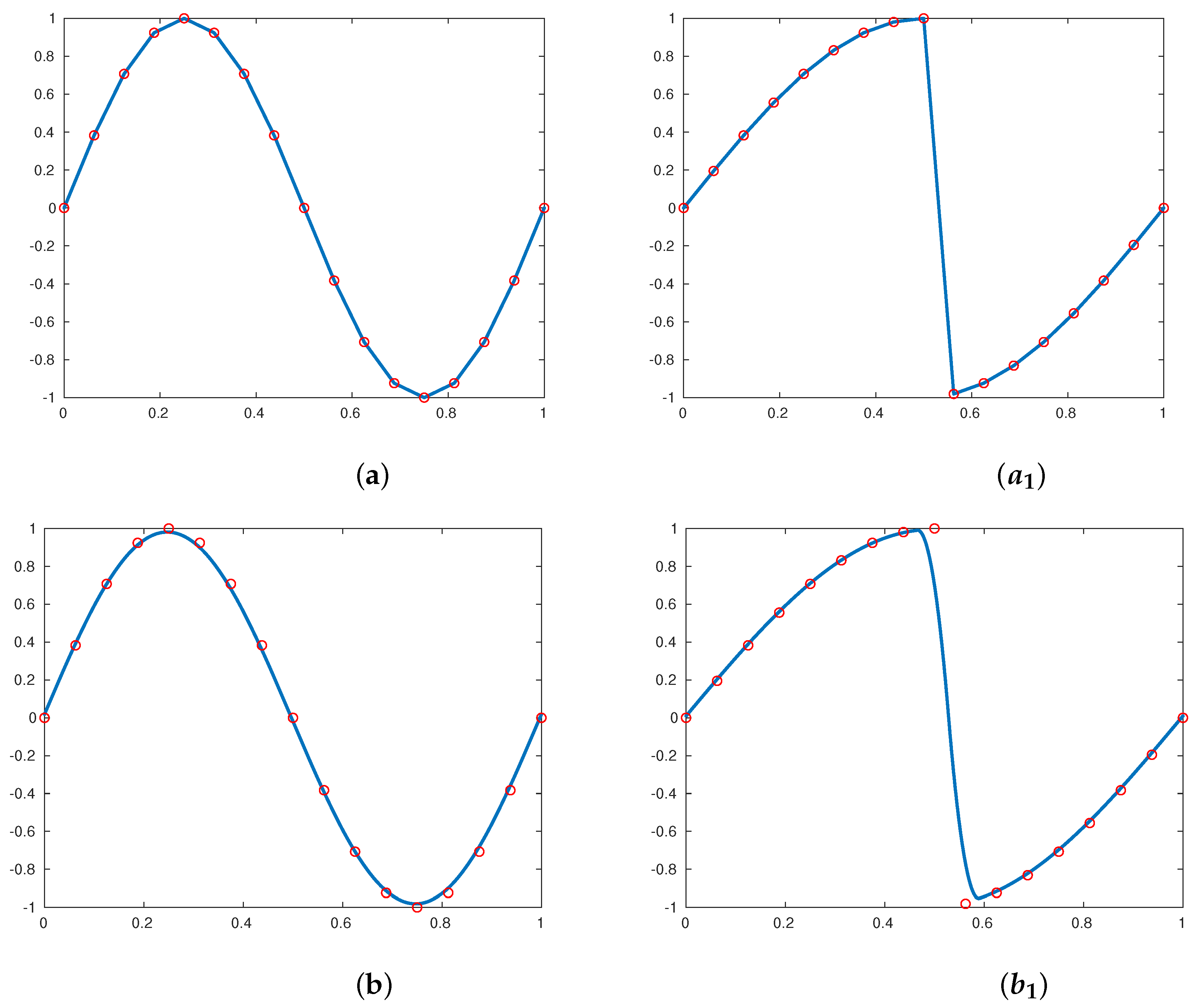
For , the limit functions obtained by the interpolatory subdivision scheme , and the approximating subdivision schemes , , using the continuous function given in (33) and the discontinuous function (34), have a regularity, , respectively, and they are displayed in Figure 1, Figure 2 and Figure 3. It is clear that (in the figures obtained by the discontinuous function (34)), all of these subdivision schemes do not produce the Gibbs oscillations close to the discontinuities in the limit functions.
Figure 1.
Images on the left were obtained using the continuous function (33), images on the right were obtained using the discontinuous function (34) using five subdivision scales; the results shown in (a), (also ) and (b), (also ) were obtained by (10) and (11), respectively, where . In this figure, the original sampling is represented in ∘.
Figure 2.
Images on the left were obtained using the continuous function defined in (33), images on the right were obtained using the discontinuous function (34) using five subdivision scales; the results shown in (a), (also ), (b), (also ), and (c), (also ) were obtained by (11), (13), and (15), respectively, where . In this figure, the original sampling is represented in ∘.
Figure 3.
Images on the left were obtained using the continuous function defined in (33), images on the right were obtained using the discontinuous function (34), using five subdivision scales; the results shown in (a), (also ) and (b), (also ) were obtained by (17) and (19), respectively, where . In this figure, the original sampling is represented in ∘.
Example 2.

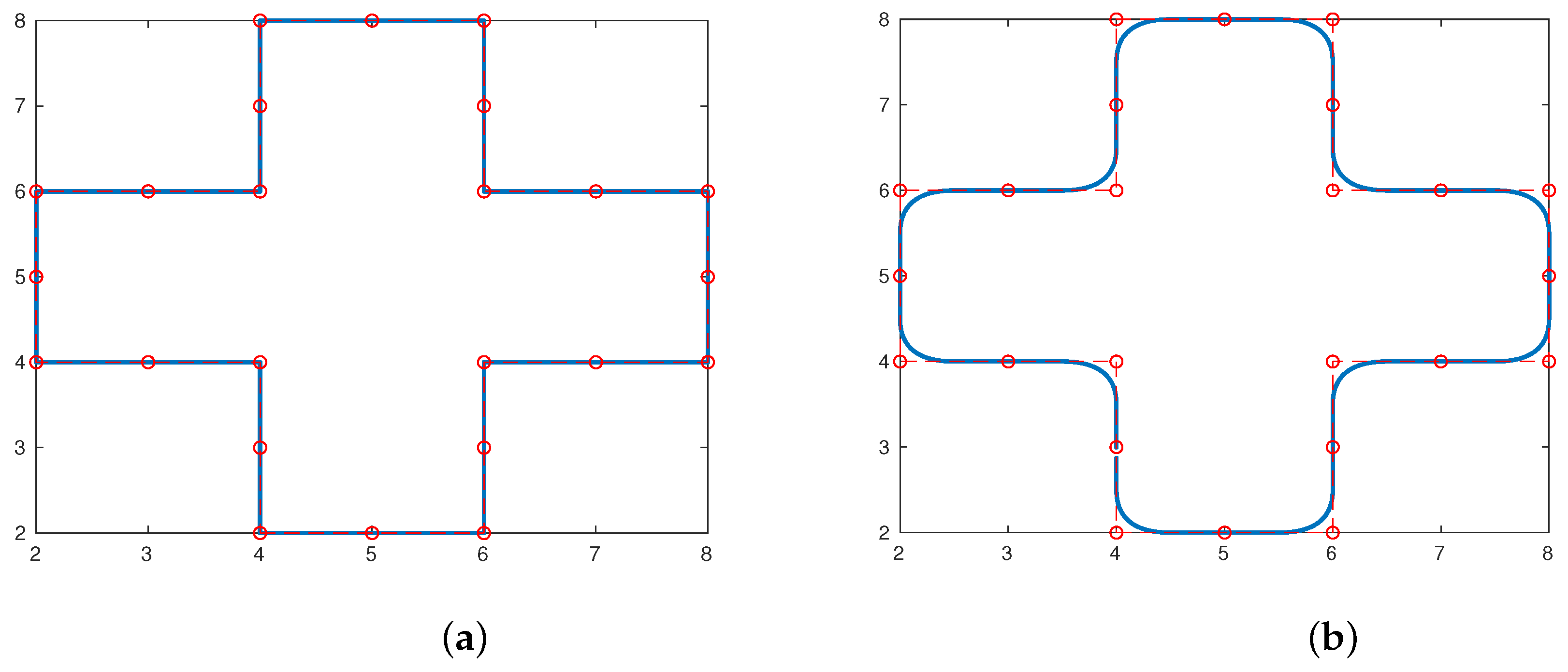
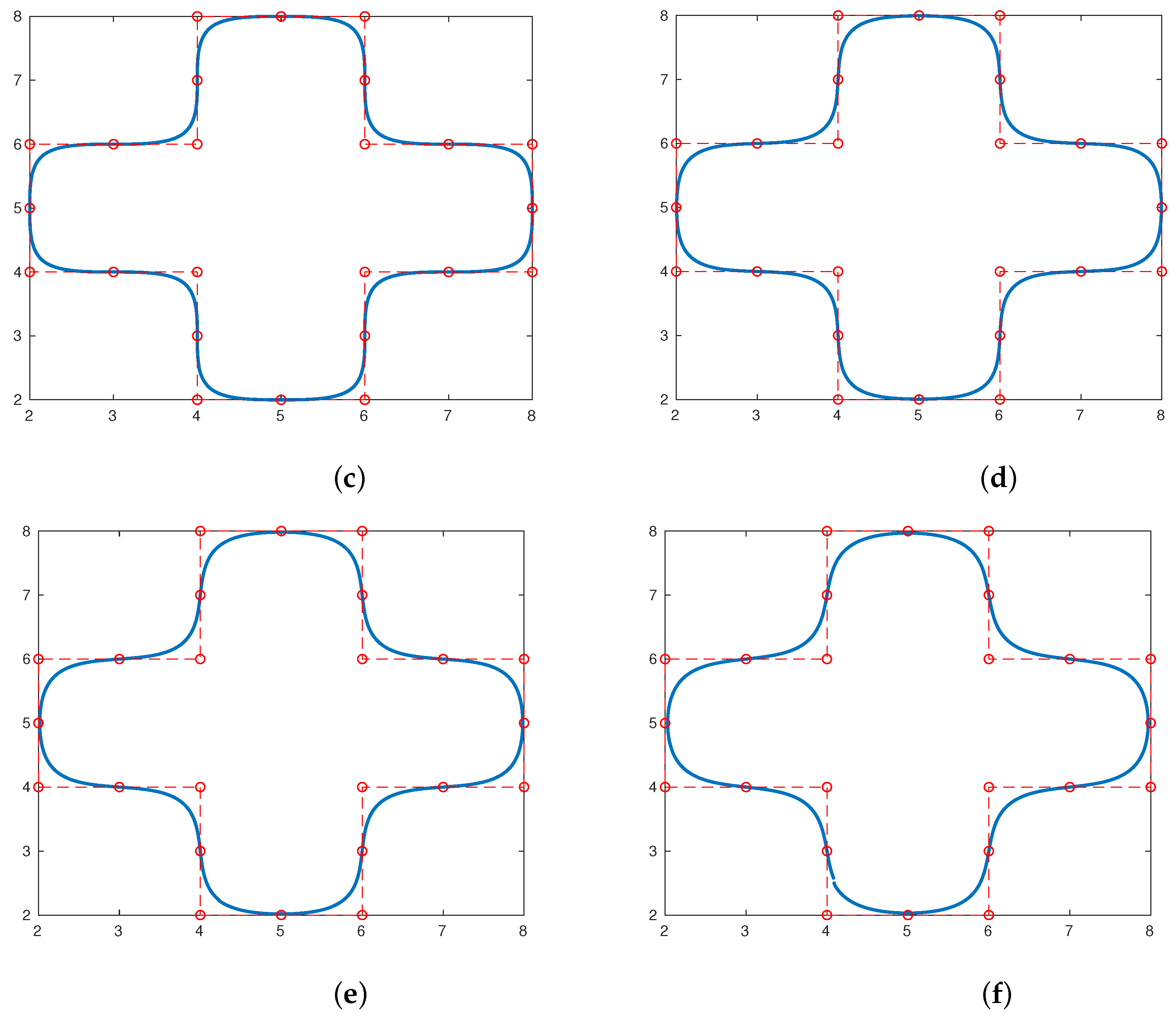
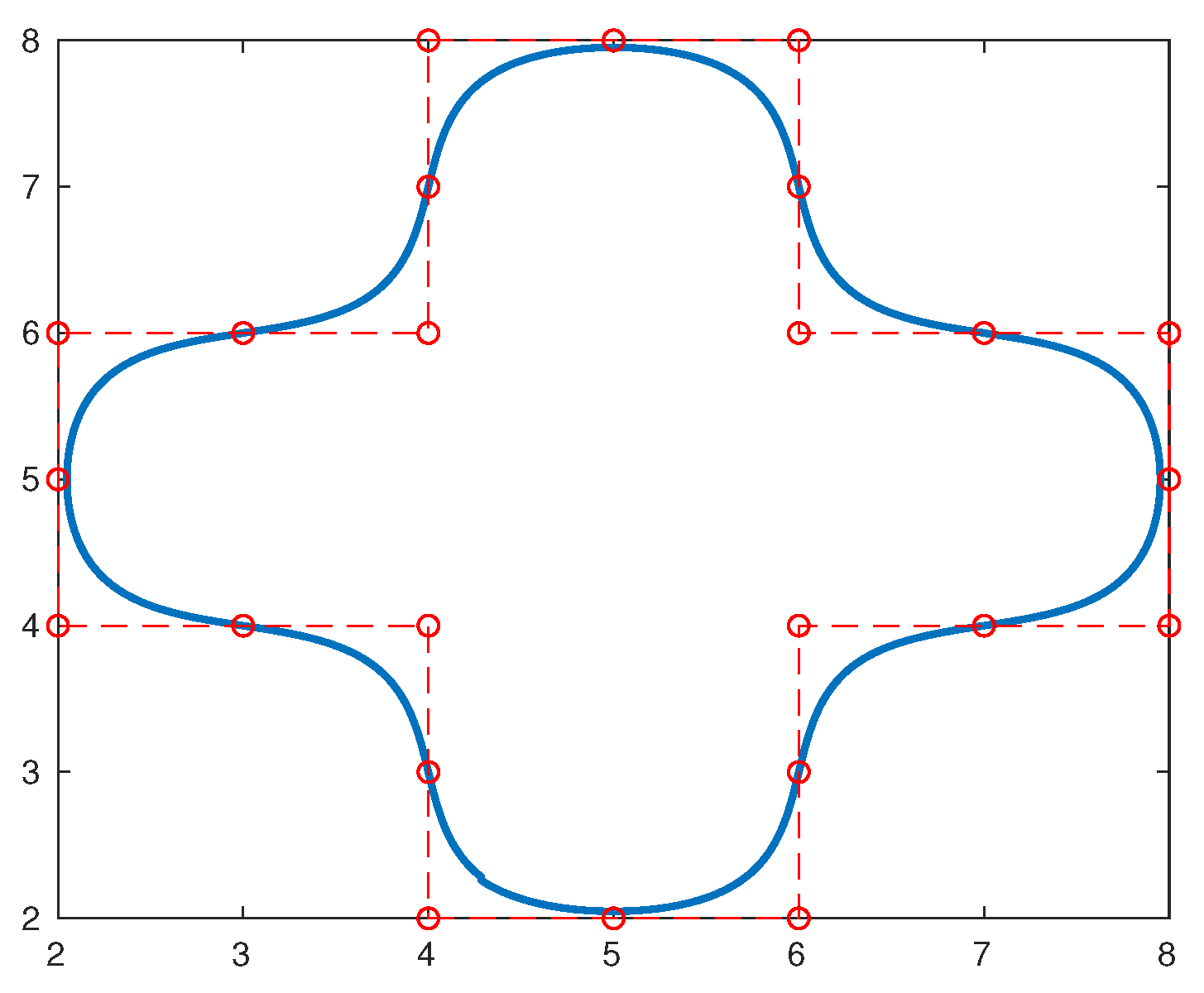
For , we will obtain, in this experiment, the limit functions for several curves in 2d, obtained by the interpolatory subdivision scheme and the approximating subdivision schemes , , using the original data, are displayed in Figure 4 and Figure 5. Moreover, we can note that there are no Gibbs phenomena in the limit functions.

Figure 5.
The limit function in 2d using five subdivision scales obtained by (19), where . In this figure, the original sampling is represented in ∘.
Example 3.
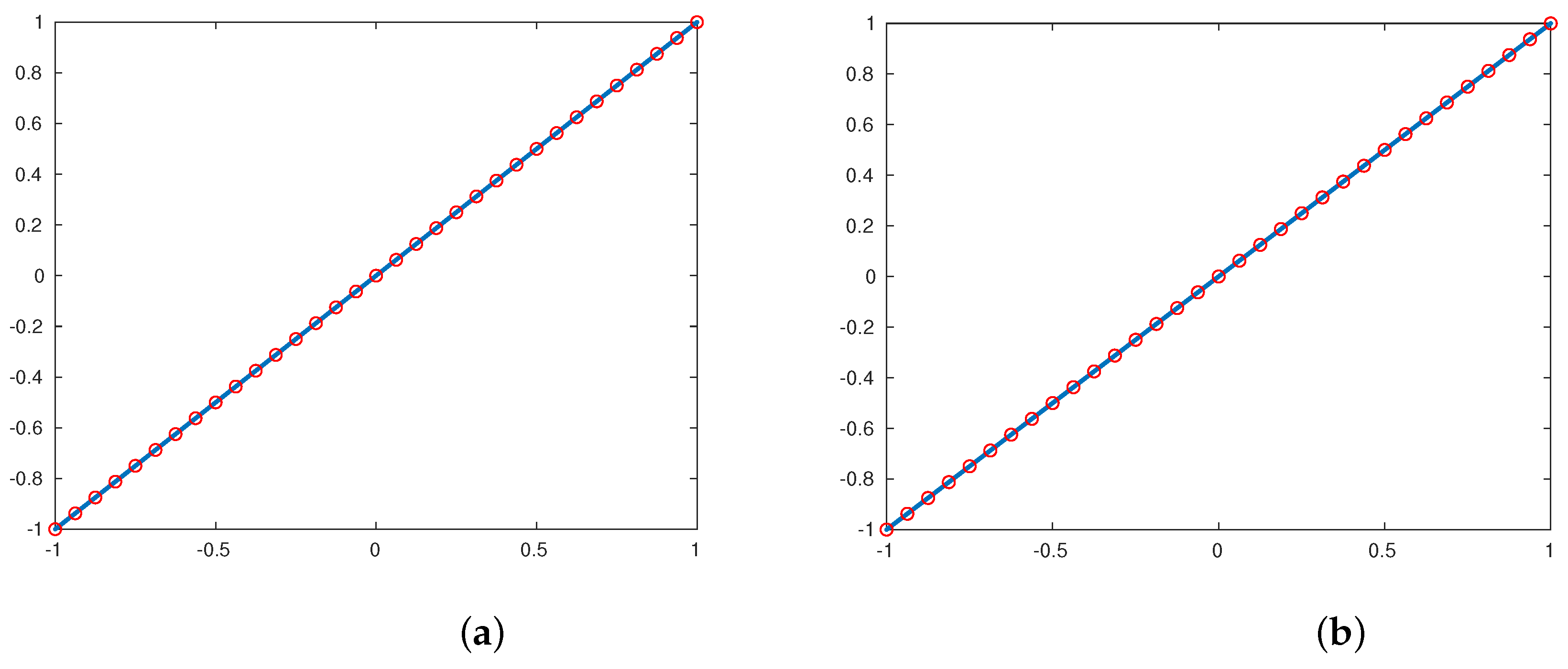
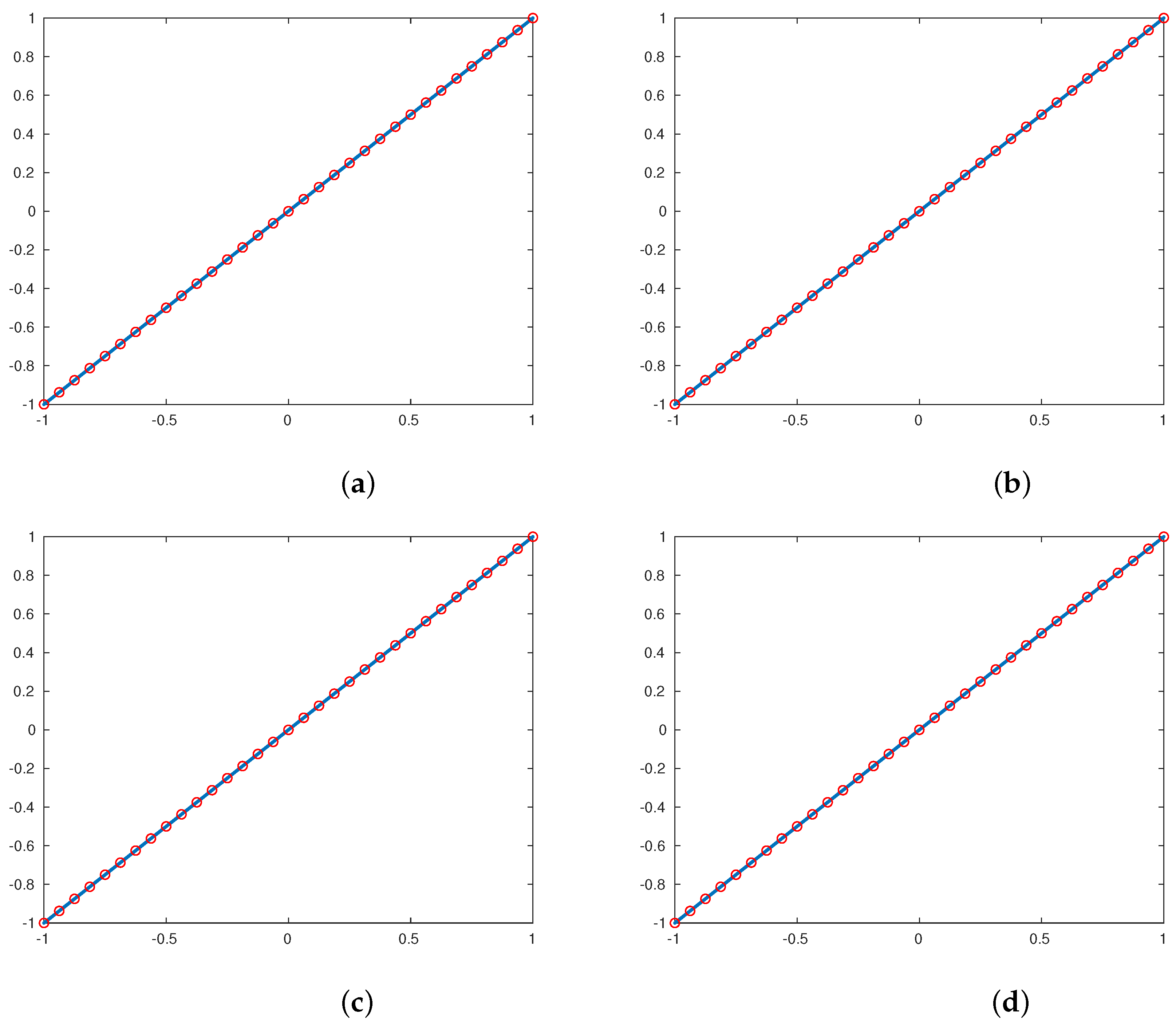
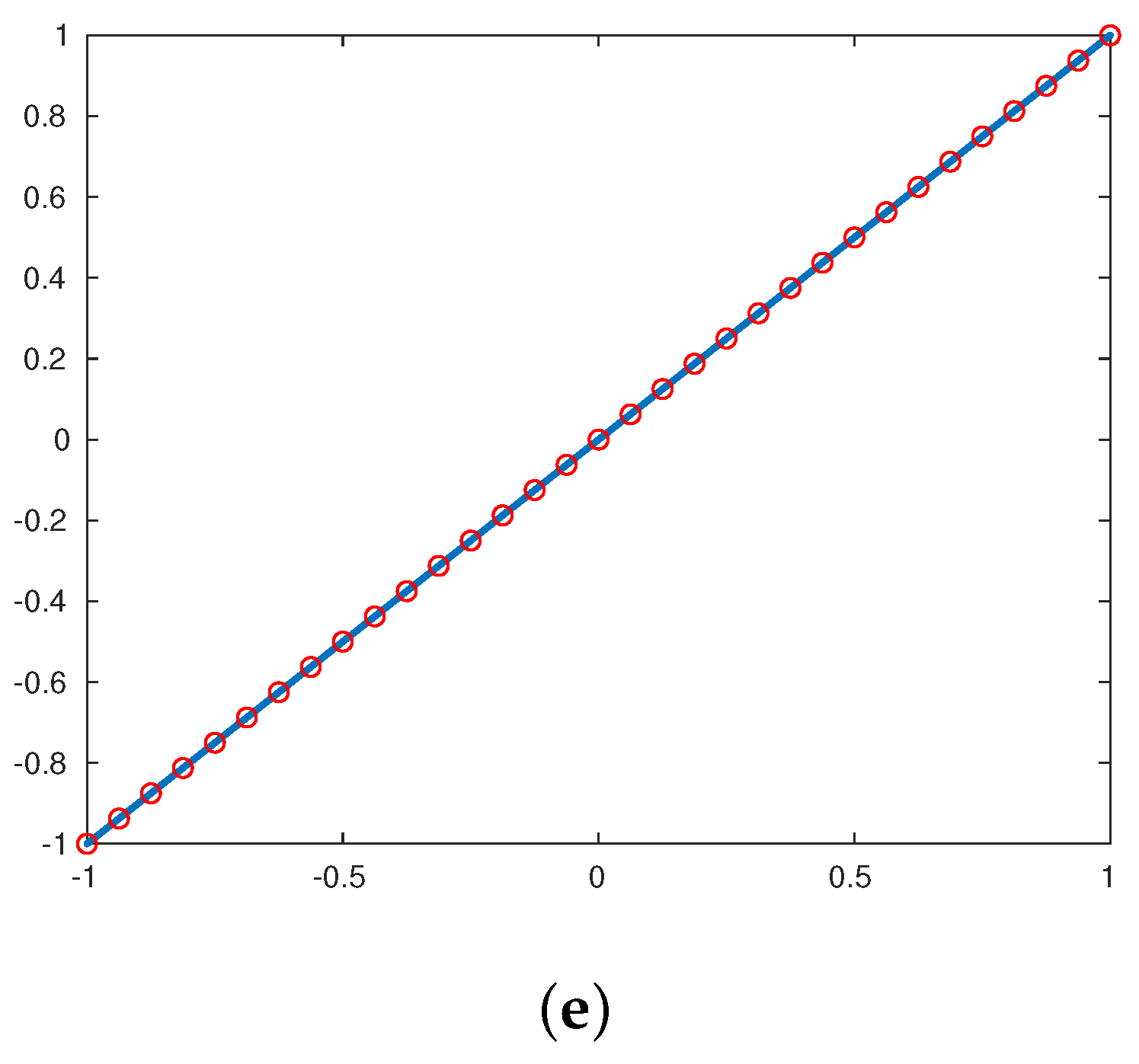
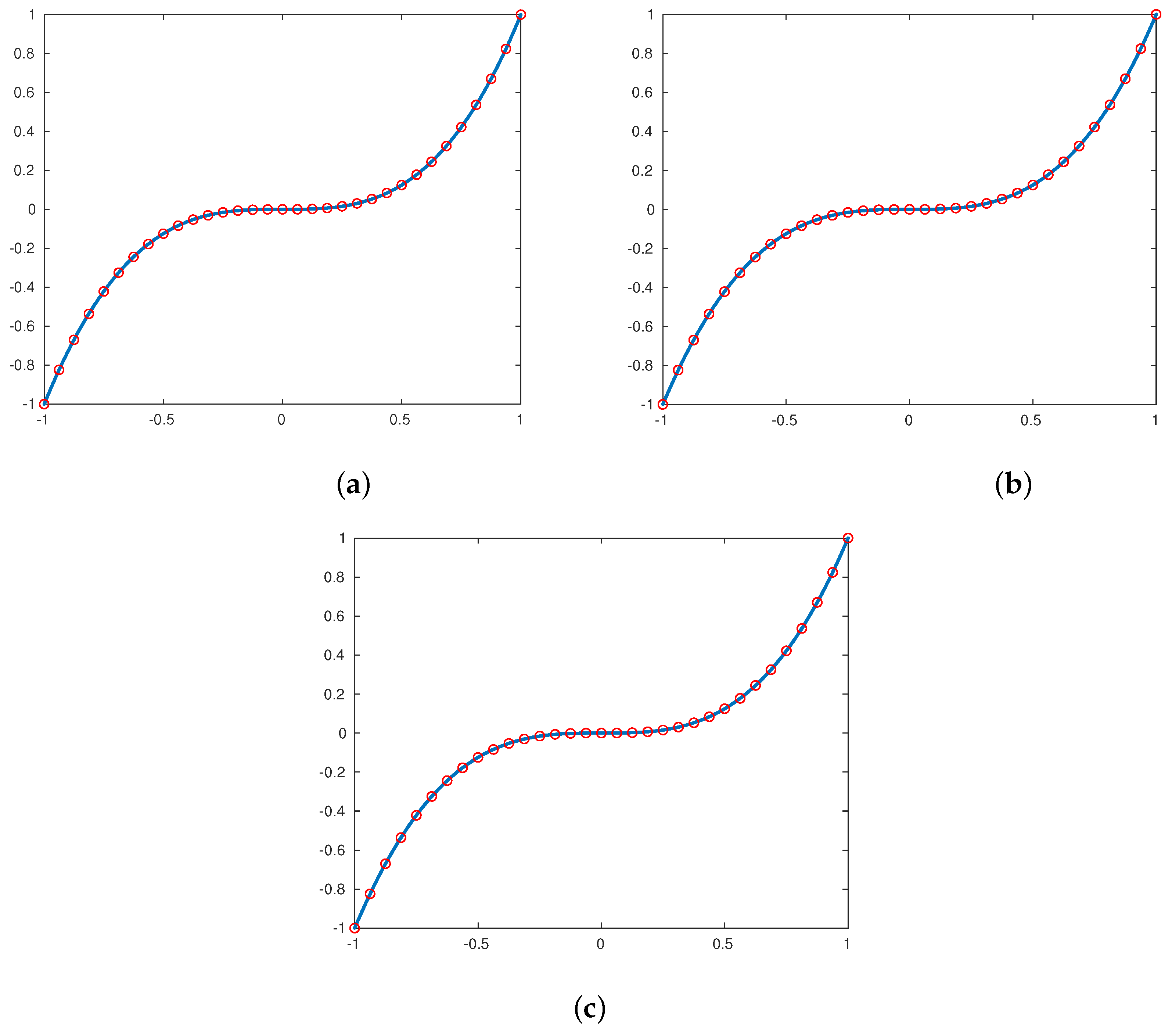
In this experiment, we will test the reproduction polynomials property; here, we use the linear polynomial defined by to obtain the initials points. Applying the above subdivision schemes , with , we obtain the same polynomial as a limit function of each subdivision scheme , the results are presented in Figure 6 and Figure 7.
Example 4.
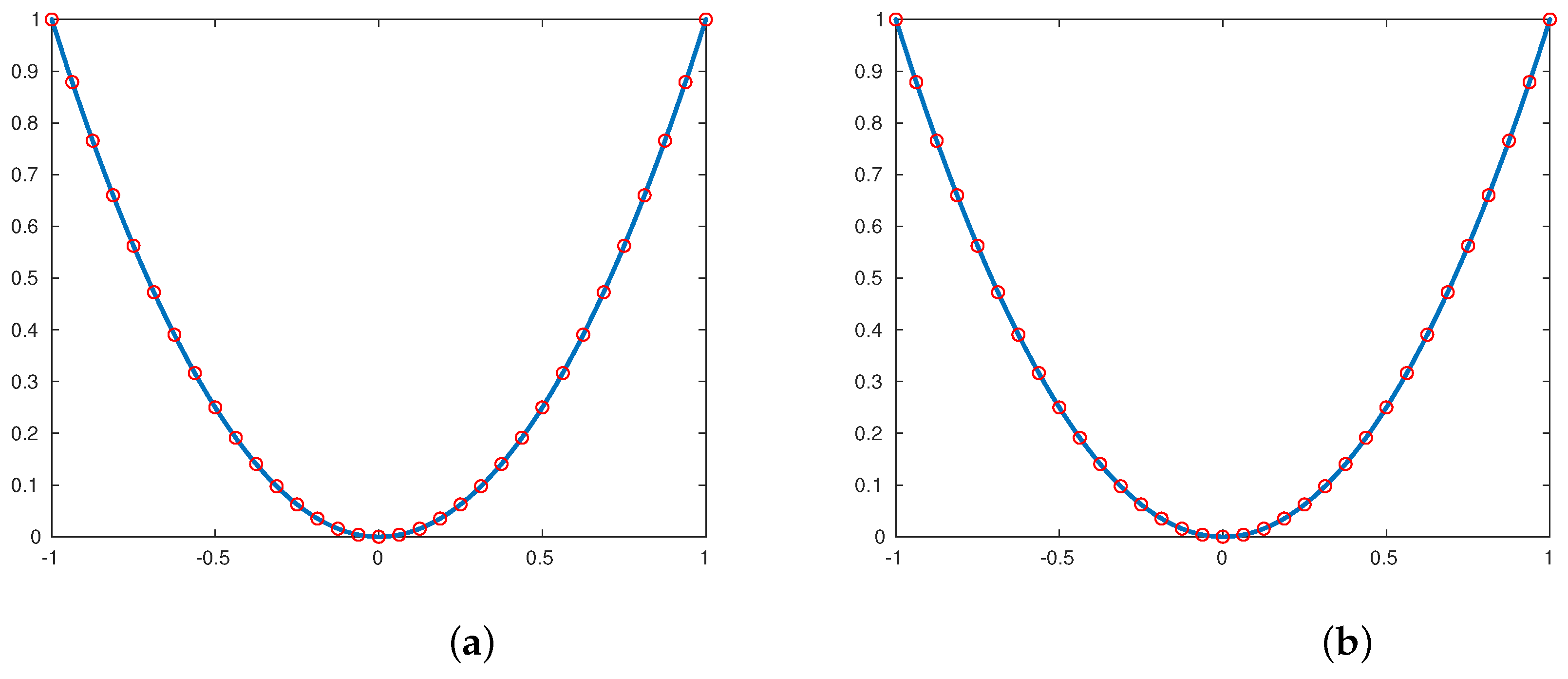
In Theorems 11 and 12, we proved that the subdivision schemes and reproduce the polynomials of degree 2 for and , respectively; to check this, we used the polynomial defined by to obtain the initials points. Applying the subdivision schemes , with and with , we obtained the same polynomial as a limit function of both subdivision schemes and . The results are presented in Figure 8.
Example 5.
In this example, we will test the reproduction polynomials of degree 3 of the subdivision schemes , , and . To obtain the initials points, we used the polynomial defined by . Applying the subdivision schemes , with , with and with , we obtain the same polynomial as a limit function of each subdivision scheme , , and . The results are presented in Figure 9.
9. Conclusions
In this paper, we presented and analyzed some new families of ternary subdivision schemes depending on free parameters. The families can be generalized to any order of approximation. We studied the convergence and the adaptation to the presence of discontinuities. We found some members in the families with very good properties. These subdivision schemes are good alternatives for the generation of curves and surfaces.
Author Contributions
Formal analysis, S.Z.; Methodology, S.B. and M.J.L.; Supervision, S.A. All authors have read and agreed to the published version of the manuscript.
Funding
This work was funded by project 20928/PI/18 (Proyecto financiado por la Comunidad Autónoma de la Región de Murcia a través de la convocatoria de Ayudas a proyectos para el desarrollo de investigación científica y técnica por grupos competitivos, incluida en el Programa Regional de Fomento de la Investigación Científica y Técnica (Plan de Actuación 2018) de la Fundación Séneca-Agencia de Ciencia y Tecnología de la Región de Murcia) and by the national research project PID2019-108336GB-I00 (MINECO/FEDER).
Conflicts of Interest
The authors declare no conflict of interest.
References
- Hassan, M.F.; Dodgson, N.A. Ternary and three point univariate subdivision schemes. In Curve and Surface Fitting: Saint-Malo 2002; Cohen, A., Merrien, J.-L., Schumaker, L.L., Eds.; Nashboro Press: Brentwood, UK, 2003; pp. 199–208. [Google Scholar]
- Rehan, K.; Siddiqi, S. A family of ternary subdivision schemes for curves. Appl. Math. Comput. 2015, 270, 114–123. [Google Scholar] [CrossRef]
- Siddiqi, S.S.; Rehan, K. A ternary three point scheme for curve designing. Int. J. Comput. Math. 2010, 87, 1709–1715. [Google Scholar] [CrossRef]
- Amat, S.; Choutri, A.; Ruiz, J.; Zouaoui, S. On a nonlinear 4-point ternary and non-interpolatory subdivision scheme eliminating the Gibbs phenomenon. Appl. Math. Comput. 2018, 320, 16–26. [Google Scholar] [CrossRef]
- Ko, K.P.; Lee, B.G.; Yoon, G.J. A ternary 4-point approximating subdivision scheme. Appl. Math. Comput. 2007, 190, 1563–1573. [Google Scholar] [CrossRef]
- Hassan, M.F.; Ivrissimitzis, I.P.; Dodgson, N.A.; Sabin, M.A. An interpolating 4-points C2 ternary stationary subdivision scheme. Comput. Aided Geom. Des. 2002, 19, 1–18. [Google Scholar] [CrossRef]
- Siddiqi, S.S.; Rehan, K. Ternary 2N-point Lagrange subdivision schemes. Appl. Math. Comput. 2014, 249, 444–452. [Google Scholar] [CrossRef]
- Zhang, L.; Ma, H.; Tang, S.; Tan, J. A combined approximating and interpolating ternary 4-point subdivision scheme. J. Comput. Appl. Math. 2019, 349, 63–578. [Google Scholar] [CrossRef]
- Rioul, O. Simple regularity criteria for subdivision schemes. SIAM J. Math. Anal. 1992, 23, 1544–1576. [Google Scholar] [CrossRef]
- Dyn, N.; Hormann, K. Polynomial reproduction by symmetric subdivision schemes. J. Approx. Theory 2008, 155, 28–42. [Google Scholar] [CrossRef] [Green Version]
- Conti, C.; Hormann, K. Polynomial reproduction for univariate subdivision schemes of any arity. J. Approx. Theory 2011, 163, 413–437. [Google Scholar] [CrossRef] [Green Version]
- Dyn, N. Interpolatory subdivision schemes. In Tutorials on Multiresolution in Geometric Modelling Summer School Lecture Notes Series Mathematics and Visualization; Iske, A., Quak, E., Floater, M., Eds.; Springer: Berlin, Germany, 2002; pp. 25–50. [Google Scholar]
- Romani, L. A Chaikin-based variant of Lane–Riesenfeld algorithm and its non-tensor product extension. Comput. Aided Geom. Des. 2015, 32, 22–49. [Google Scholar] [CrossRef]
- Zhou, J.; Zheng, H.; Zhang, B. Gibbs phenomenon for p-ary subdivision schemes. J. Inequal. Appl. 2019, 48. [Google Scholar] [CrossRef]
- Siddiqi, S.; Younis, M. Construction of ternary approximating subdivision schemes. UPB Sci. Bull. 2014, 76, 1223–7027. [Google Scholar]
Publisher’s Note: MDPI stays neutral with regard to jurisdictional claims in published maps and institutional affiliations. |
© 2022 by the authors. Licensee MDPI, Basel, Switzerland. This article is an open access article distributed under the terms and conditions of the Creative Commons Attribution (CC BY) license (https://creativecommons.org/licenses/by/4.0/).