1. Introduction
When homogenizing a number of problems of complex heat transfer in periodic structures, new nonstandard boundary and initial—boundary value problems appear (see, for example, articles [
1,
2,
3] and references therein). To justify the corresponding asymptotic approximations, it is necessary to study the solvability of these problems, the qualitative properties of solutions, and the dependence the norms of solutions on the small parameter
, which characterizes the dimensions of the periodicity cell.
This article is devoted to the study of a nonstandard initial-boundary value problem
which arises upon homogenization of the problem of radiative-conductive heat transfer (
5)–(
9). Here
is a small parameter;
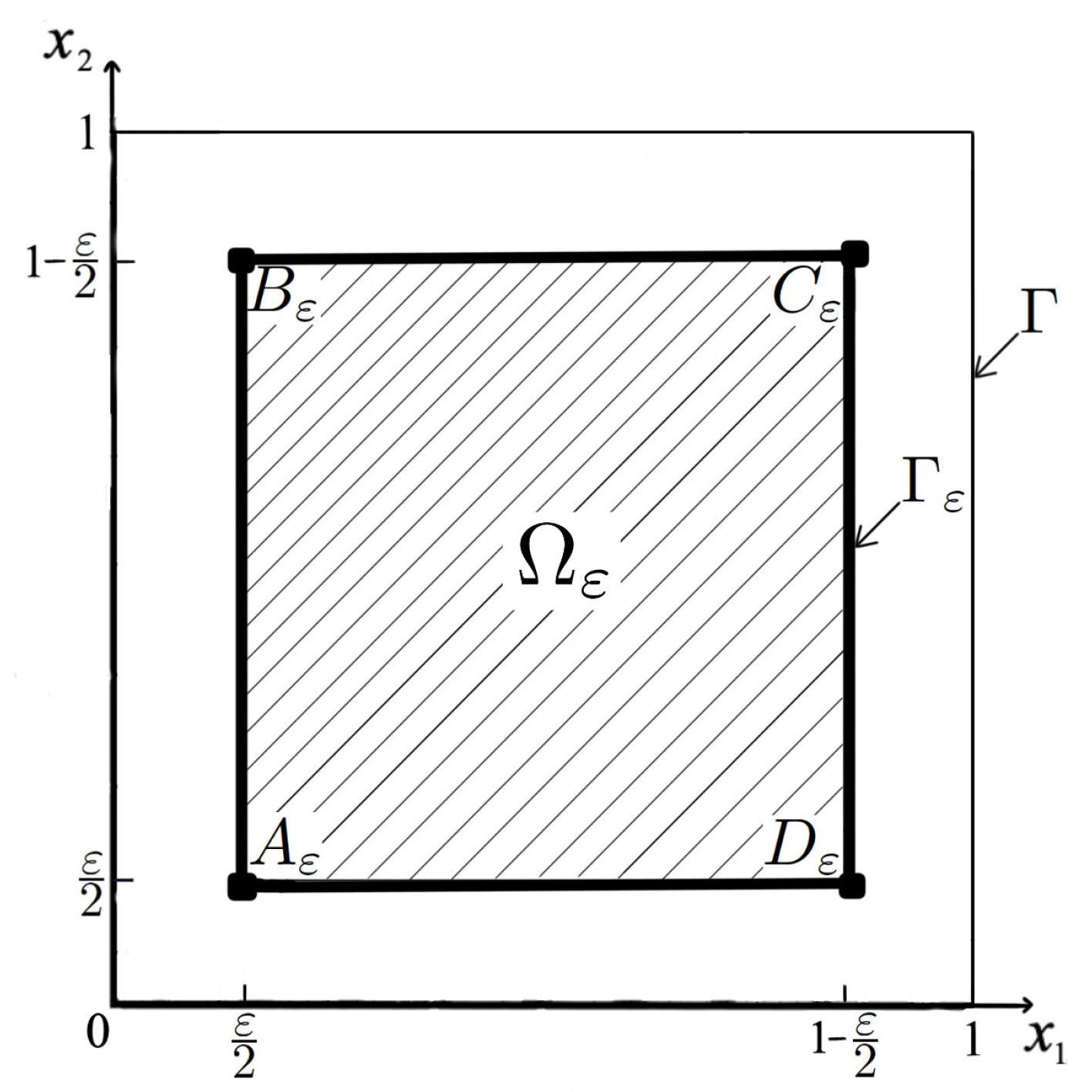
,
(where
) is the square with boundary
, and
is the set of its corner points (
Figure 1).
Everywhere below
,
,
and
,
are the derivatives along the outward normal and tangent to
. At corner points
The problem (
1)–(
4) is singularly perturbed. Its solution depends on the small parameter
, but we omit
in order to simlify the notation.
The boundary conditions (
2) are non-linear conditions of the Venttsel type [
4], since they include the time derivative and the second derivatives of the unknown function along the tangent direction. In addition, these conditions are supplemented by conditions (
3) at corner points.
The study of parabolic initial-boundary value problems with Venttsel type conditions was started in [
5,
6,
7,
8,
9,
10]. References to later works can be found, for example, in [
11,
12,
13].
The stationary analogue of the problem (
1)–(
4) was studied in [
3].
Let’s give a brief description of the problem leading to (
1)–(
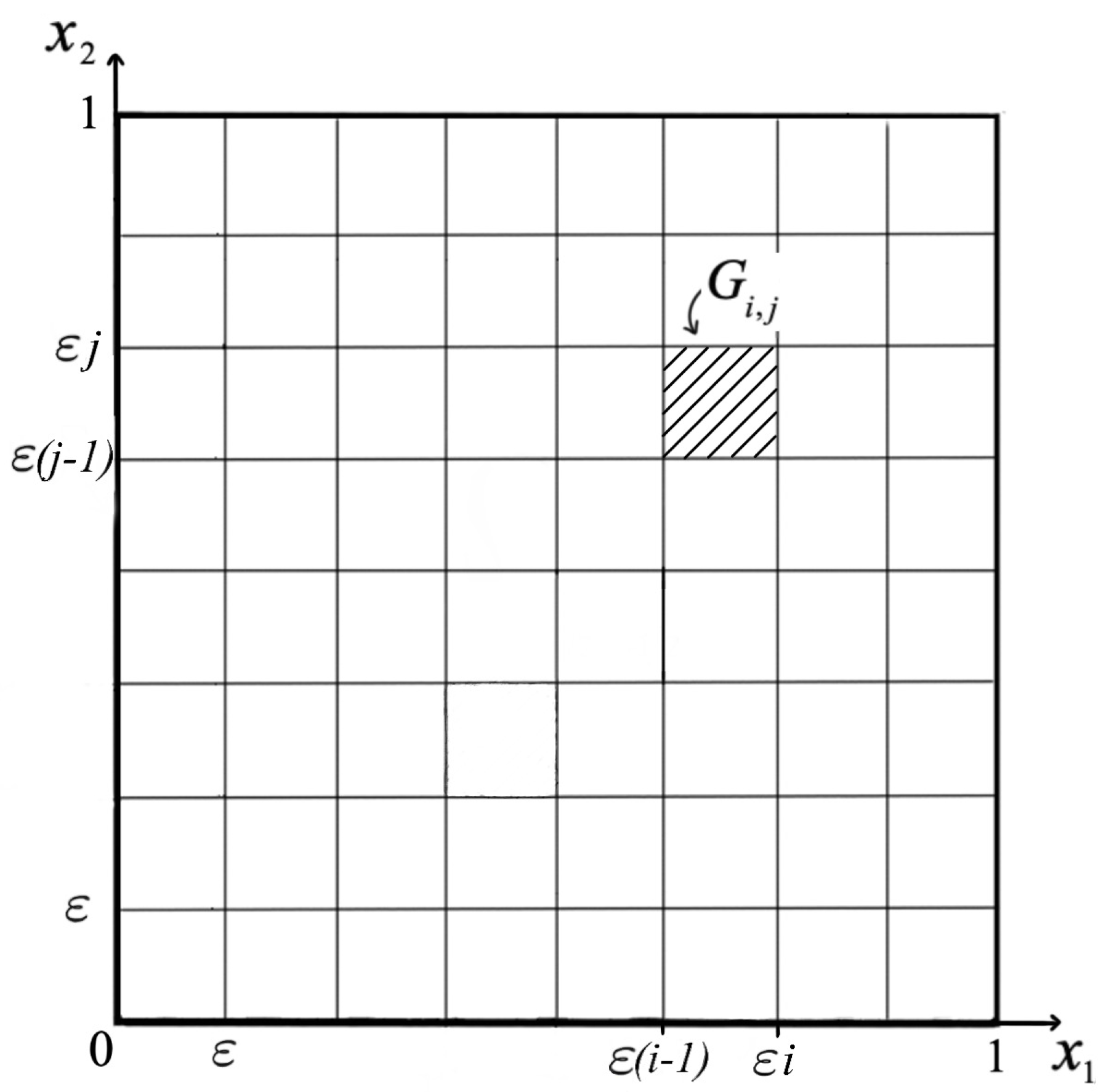
4). Consider the nonstationary radiative-conductive heat transfer problem in periodic system consisting of
heat-conducting square-section rods separated by vacuum layers and placed in a square box
with boundary
(
Figure 2).
With each rod we associate the elementary square
where
. The sought function
is interpreted as the absolute temperature at the point
at time
t and is defined on the set
(
Figure 2).
The heat propogation inside
G is decribed by the equation
Here is the heat capacity coefficient, is the thermal conductivity coefficient, f is the density of internal sources.
The heat exchange by radiation on the boundaries of neighboring rods is described by conditions
Here , is the Stefan—Boltzmann constant, is the apparent emmitance ( for absolutely black rods).
Heat exchange by radiation with the boundary of the box having given temperature
is described by the boundary condition
where
and
is the apparent emmitance.
Equation (
5) and boundary conditions (
6), (
7) are supplemented by the initial condition
The simplest homogenization of the problem (
5)–(
9), performed as in [
3], leads to the problem (
1)–(
4), where
and the operators
,
are defined in
Section 2.
The solution
v to the problem (
1)–(
4) as
is considered as an asymptotic approximation to the solution
u to the problem (
5)–(
9). Problem (
1)–(
4), which approximates the problem (
5)–(
9), does not contain information on the value of the thermal conductivity coefficient
. Computational experiments for the stationary problem [
14] show that this is not essential for large values of
. However it leads to the impossibility of practial usage of this approximation for small values of
. A more accurate approximation, performed similarly to [
3], taking into account the influence of the coefficient
, leads to the problem (
1)–(
4) with
and
.
The paper is organized as follows. In
Section 2 we introduce the used functional spaces and prove a number of auxiliary assertions.
Section 3 contains results on the properties of the corresponding stationary problem, following from [
3]. In
Section 4 we define a weak solution to the problem (
1)–(
4) and prove upper and lower estimates for the weak solution. In
Section 5, we prove the uniqueness of the weak solution. In
Section 6, the existence of a weak solution is established and its estimates are derived. In
Section 7 we establishe the result about regularity of the weak solution. Besides we derive estimates for the norms of the derivatives
,
,
,
.
2. Some Notations and Function Spaces
Remind that
, where
,
is a boundary of square
and
is the set of its corner points. Note that
where
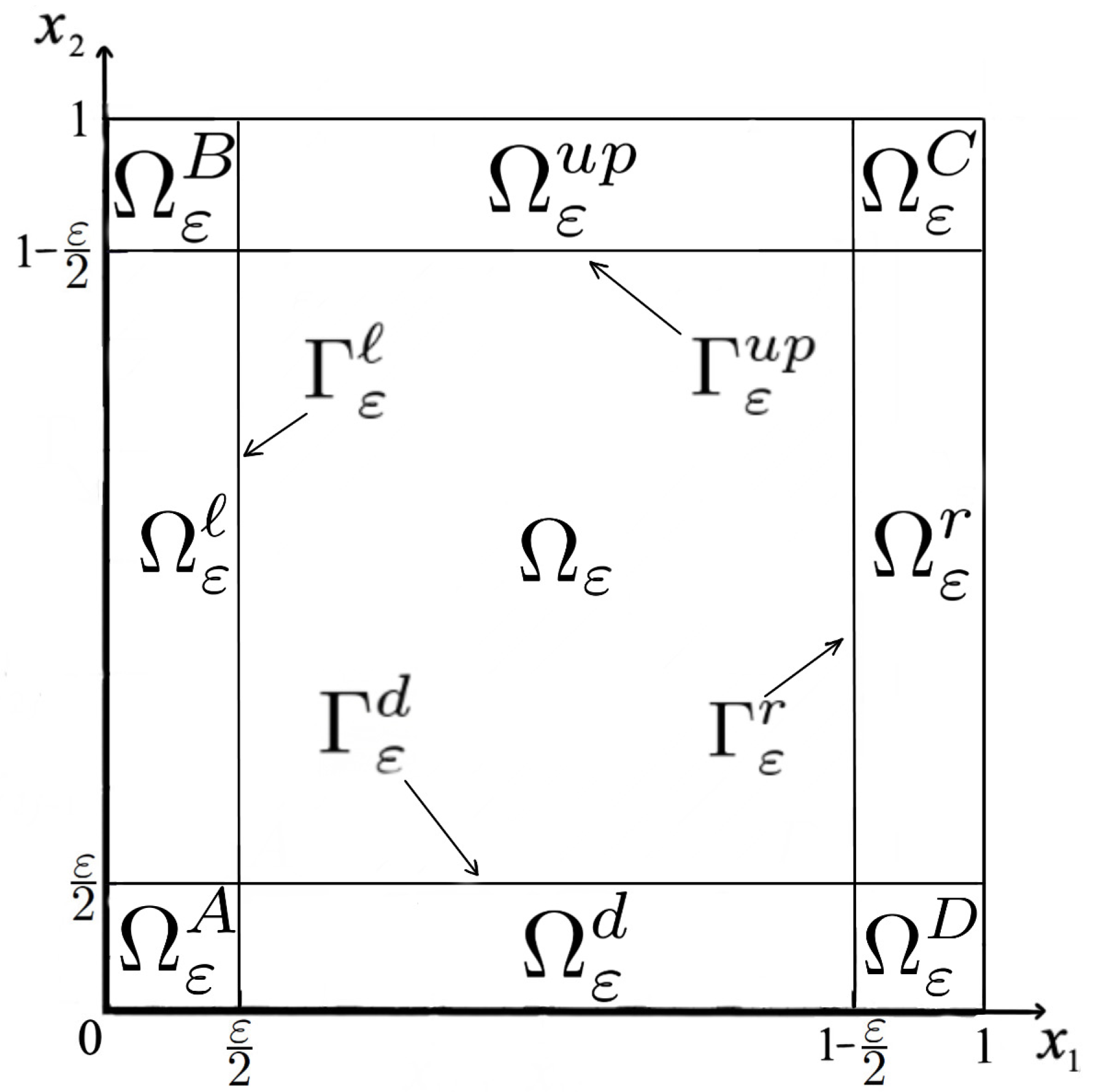
Also introduce the sets (
Figure 3)
and note that
2.1. Spaces and
We introduce the Euclidean space
of functions
h defined on
with the inner product and the norm respectively
We introduce the Hilbert space
with elements
, the inner product and the norm respectively
We define the operator
by the formula
, where
is the restriction of
f to
,
We also define the operator
by the formula
Note that
is a closed subspace of
. The operator
performs an isomorphism between
and
, where
and
We also define the operator
, which associates with the function
the pair of functions
, where
and
2.2. The Space
Denote by the space of functions defined on , infinitely differentiable on each side of and equal to zero in some neighborhood of the corner points set .
Let
,
. The function
, satisfying the identity
is called the weak order
k derivative of the function
u along the tangent to
and is denoted by
.
We denote by the space of functions , that possess the weak derivative . Let denote the trace of the function on and denote the trace of the function on .
We introduce the space
with the inner product and the norm respectively
where
is the restriction of the trace
on
.
It is easy to see that is a separable Hilbert space.
We introduce the extension operator
by the formula
In what follows, we identify functions with their extensions .
It is easy to see that the operator
performs a continuous and dense embedding of
into
. As a consequence, we can assume that
where the embedding
is continuous and dense.
We introduce the notation
for the duality of spaces
and
Let
. Considering
as a subspace of
, we have:
Identifying
with
,
, we arrive at the equality
Note that for any function
the inner product
also generates a functional from
, since
2.3. The Space
Denote by the space of functions that possess the weak derivative . Restrictions of the function on each of the sides belong to the space , which emplies that for the values are well defined.
We introduce the space
with the norm
where
and
It is easy to see that the space is separable and Hilbert.
2.4. The Space
and Some of Its Properties
We introduce the space
equipped with the norm
Note that .
It is easy to see that the following assertion is true.
Lemma 1. Assume that , , . If then ,and the mapping is continuous as a mapping from to . Corollary 1. Assume that , , . If then
,and the mapping is continuous as a mapping from to . Lemma 2. Assume that , , where , , . Then and Proof of Lemma 2. First, we assume
. Then
and
Passing in (
17) to the limit as
, we arrive at the equality (
16), from which it follows that
Suppose now that
. In the standard way [
15] we construct the sequence
such that
in
as
. As a consequence,
is in
.
It follows from the estimate
that
Passing to the limit in the equality
we arrive at the equality (
18), which implies the assertion of the lemma. □
We introduce the notation
and set
Lemma 3. Assume that . Then . Besides,
and Proof of Lemma 3. It is known [
16,
17] that if
then
,
on
and
on
. Moreover, [
16], the mapping
is continuous as a mapping from
to
. Therefore
implies that
. Besides,
and the mapping
is continuous as a mapping from
to
.
Thus, from it follows that .
We set
, where
and
Note that
,
, and
Note that
where
. So
Passing in (
20) to the limit as
, we arrive at the equality
from which the assertion of the lemma follows. □
Let
,
. Introduce the cut-off function
and put
Lemma 4. Assume that . Then . Moreover, and Proof of Lemma 4. It is known [
16,
17] that from
it follows that
, where
on
and
on
. Besides [
16], the mapping
is continuous as a mapping from
to
.
It is clear also that
implies that
,
and the mapping
is continuous as a mapping from
to
.
Thus, from it follows that .
Let
, where
and
Note that
,
and
Using the Lebesgue dominated convergense theorem, we have
Passing to the limit at (
22), we arrive at the equality
from which the assertion of the lemma follows. □
3. Stationary Problem
We have studied in [
3] the stationary version of the problem (
1)–(
4):
We give a summary of the results following from [
3].
Let the following conditions be satisfied:
, , , ;
; moreover, the functions H, are strictly increasing,
,
and
where
,
are positive constants.
Note that the functions (
10), (
11) satisfy the conditions
.
We define the
weak solution to the problem (
23)–(
25) as the function
such that
and
Identification of functions
with their extensions
,
allows us to rewrite the identity (
27) in a more compact way
The following theorems on the unique solvability of the problem (
23)–(
25) and on the regularity of its weak solutions follows from [
3].
Theorem 1. A weak solution to the problem (23)–(25) exists, is unique and satisfies the estimate Theorem 2. Let v be a weak solution to the problem (23)–(25). Then and the following estimate holds:where is the mean value of over Γ. In addition, Equation (23) holds in , the boundary condition (24) is satisfied in and the condition (25) holds in . If then the following estimate holds We need an additional result on the semicontinuity of the resolving operator of the problem (
23)–(
25):
Lemma 5. Let , , , , and in , in as . Let be a weak solution to the problem (23)–(25) with f and replaced by and , respectively. Then weakly in as , where v is a weak solution to the problem (23)–(25). Proof of Lemma 5. (From the estimates (
29), (
30) it follows that the sequence
is bounded in
. Therefore there is a subsequence
and the function
v such that
and
weakly in
.
It is clear that
in
and
in
. Passing to the limit in the identity
we arrive at the identity (
28), meaning that
v is a weak solution to the problem (
23)–(
25).
Since the weak solution of this problem is unique, the entire sequence converges to weakly in . □
4. Definition of a Weak Solution and Some of Its Properties
Let’s move on to studying the problem (
1)–(
4). We set
,
.
We assume that the following conditions are satisfied:
, , , ;
; ;
, , И .
In addition, the following inequalities hold
where
is a constant.
The functions
H,
satisfy the conditions
. Besides,
and for all
the following inequality holds:
where
is a constant.
4.1. Definition of a Weak Solution
Let
v be a classical solution to the problem (
1)–(
4). Multiplying the left and right parts of the Equation (
1) on the arbitrary function
and integrating the result over
, we have
Due to the boundary condition (
2)
In turn, due to the condition (
3)
As a result, we arrive at the identity
Note that the identification of the functions
v and
and their extensions
and
allows us to rewrite this identity in the following compact way:
For further convenience, we replace the functions
,
and
by
and rewrite the identity (
33) in the following form:
By a weak solution to the problem (
1)–(
4) we mean the function
such that
and
Since
, the condition (
37) holds in the such sense that
in
as
, i.e.,
It is easy to see that the function
is a weak solution to the problem (
1)–(
4) if and only if
and
holds for all
and all
such that
.
4.2. Upper and Lower Estimates for a Weak Solution
Lemma 6. Let v be a weak solution to the problem (1)–(4). Then the following estimate holds: Proof of Lemma 6. We put
. It is clear that
. From (
36) it follows that
Hence
. Besides, since
and
, then
Taking into account the equality (
19), we have
where
for
and
for
.
Taking into account that
, we arrive at the inequality
which implies that
for all
. Thus,
. □
Lemma 7. Let v be a weak solution to the problem (1)–(4). Then and the following estimate holds Proof of Lemma 7. We put and . Note that by Lemma 6 and .
Let
,
. From (
36) it follows that
Moreover, due to the monotonicity of the function
, we have
Taking into account the formula (
21), we have
We put
and note that
. Using the estimate
we come from (
42) to the inequality
Let us show that the following estimate holds
Suppose that for some . Then there exists such that and for all .
Since
for
, then from (
43) it follows that
Let us transform this inequality into the form
Integrating it over the interval
, we have
Thus, the inequality (
44) is valid. From this inequality it follows that
Passing in this estimate to the limit as
, we arrive at the inequality
which implies that
. Hence
. □