


Abstract
In this paper, we consider parallel-machine scheduling with release times and submodular penalties (), in which each job can be accepted and processed on one of m identical parallel machines or rejected, but a penalty must paid if a job is rejected. Each job has a release time and a processing time, and the job can not be processed before its release time. The objective of is to minimize the makespan of the accepted jobs plus the penalty of the rejected jobs, where the penalty is determined by a submodular function. This problem generalizes a multiprocessor scheduling problem with rejection, the parallel-machine scheduling with submodular penalties, and the single machine scheduling problem with release dates and submodular rejection penalties. In this paper, inspired by the primal-dual method, we present a combinatorial 2-approximation algorithm to . This ratio coincides with the best known ratio for the parallel-machine scheduling with submodular penalties and the single machine scheduling problem with release dates and submodular rejection penalties.
1. Introduction
All jobs must be accepted and processed in classical scheduling problems [1,2,3,4]. However, to gain more profit, we can reject some jobs that have a larger processing time and result in smaller profits. Bartal et al. [5] first addressed the multiprocessor scheduling problem with rejection (MSR), in which the jobs can be rejected and a penalty must paid for each rejected job. The objective is to minimize the makespan of the accepted jobs plus the total penalty of the rejected jobs. For the MSR, Bartal et al. [5] proposed a 2-approximation algorithm in time and a polynomial-time approximation scheme (PTAS). Later, Ou et al. [6] improved a (3/2+)-approximation algorithm in time , where can be any small given constant.
Variants of the MSR have been studied extensively [7,8,9]. Zhang et al. [7] considered single machine scheduling with release dates and rejection, where jobs cannot be processed before their corresponding release dates. The objective is to minimize the makespan of the accepted jobs plus the total penalty of the rejected jobs. They proved that this problem is -hard, and presented a 2-approximation algorithm and a fully polynomial-time approximation scheme (FPTAS). Zhong et al. [10] considered two parallel-machine scheduling with release dates and rejection, and presented a (3/2+)-approximation algorithm with time complexity , where is any given small positive constant. Zhang and Lu [8] considered parallel-machine scheduling with release dates and rejection, and presented a 2-approximation algorithm. In particular, when m is a fixed constant, Zhang and Lu [8] designed an FPTAS.
A set function of J is a mapping from all subsets of J to real numbers, i.e., . A set function is submodular if it satisfies , which has the property of decreasing marginal return. Recently, submodular functions have played a key role in the field of combinatorial optimization [9,11,12,13]. Liu and Li [14] considered parallel-machine scheduling with submodular penalties and proposed a -approximation algorithm based on the greedy method and list scheduling algorithm. Zhang et al. [15] considered precedence-constrained scheduling with submodular rejection on parallel machines, and proposed a 3-approximation algorithms. Based on the primal-dual method, Liu and Li presented a 2-approximation algorithm for [16] single machine scheduling with release dates and submodular rejection penalty. More related results can be found in the surveys [17,18,19,20,21,22,23].
Motivated by the optimization problems mentioned-above, we consider parallel-machine scheduling with release times and submodular penalties ( ), which is defined as follows.
Given a set of n jobs and a set of m parallel machines, each job has a processing time and a release time , where the job can be processed at or after its release time, without loss of generality, we assume that . For the penalty submodular function , without loss of generality, we assume that . The is to find a rejected set R, The objective is to minimize the makespan of the accepted jobs plus the penalty of R, where the penalty is determined by penalty submodular function .
Clearly, if for , the problem is exactly the parallel-machine scheduling with submodular penalties considered in [14]; If the rejection cost function is linear, the problem is exactly the parallel-machine scheduling with penalties considered in [9]; If , the problem is exactly the single machine scheduling problem with release dates and submodular rejection penalty considered in [16].
A difficulty of implementing the algorithm presented in [9] on the problem is that the release time of the jobs is different and the jobs cannot be processed immediately in the given order. In order to overcome this problem, using the traversal method, we determine the set of jobs with designated release time and unify the releasing time of the other jobs. Then, in this paper, we present a combinatorial 2-approximation algorithm for . This ratio coincides with the best known ratio for the parallel-machine scheduling with submodular penalties and the single machine scheduling problem with release dates and submodular rejection penalties.
2. Terminologies and Key Lemmas
Zhang and Lu [8] showed that the problem can be solved by the earliest release date (ERD)-rule. That is, whenever some machine is idle and some job is available, process the unscheduled job with the ERD-rule. Thus, we have the following lemma.
Lemma 1.
For, , there exists an optimal schedule such that the accepted jobs are processed in the ERD-rule on each machine.
For convenience, for any , write and let
be the set of jobs with release time plus processing time larger than . Correspondingly, let be the set of jobs such that
Then, the following lemma is obtained.
Lemma 2.
For any , can be computed in polynomial time.
Proof.
For each , we can find the set in polynomial time. Obviously, if is monotonically nondecreasing, then and the lemma holds.
Otherwise, we construct an auxiliary set function defined on all subsets of as follows:
By the submodularity of , for any two subsets , we have
This implies that is a submodular function. Thus, can be computed within polynomial time using the method in [24].Therefore, for any , we have
where . Thus, this lemma holds. □
Let be the optimal schedule and let be the rejected job set of . Write , and , where is the makespan of . Then, we have the following.
Lemma 3.
There exists an optimal schedule that satisfies .
Proof.
Let and , then we have
By Lemma 2, can be found in polynomial time, where is the set with minimum penalty satisfied . This implies that
by . Since is a submodular function, we have , i.e.,
Notably, assuming , we prove that there exists an optimal schedule , in which all the jobs in are rejected.
Because the process time of any job is nonnegative, it follows that we can schedule all the jobs in by schedule . This implies that the makespan of the jobs in is no more than . Thus, we have
Therefore, is an optimal schedule and this lemma holds. □
3. Approximation Algorithm
In this section, we consider the problem and propose a 2-approximation algorithm.
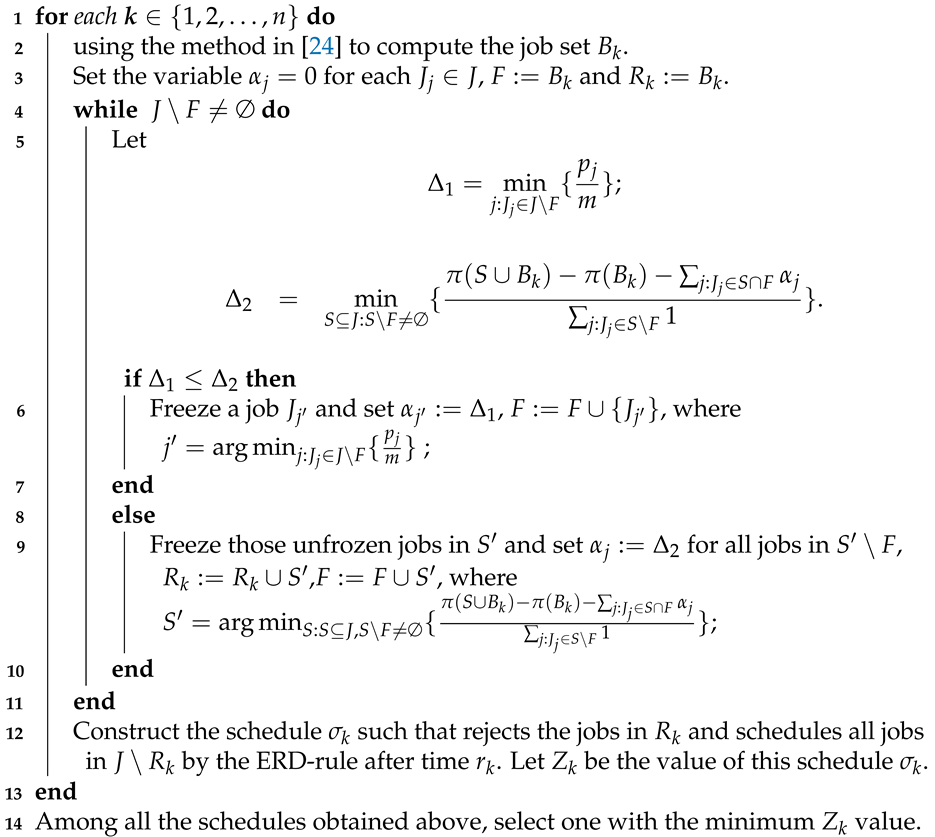
For each , we introduce an auxiliary variable , which is similar to the dual variable in the primal-dual method.
Lemma 4.
Algorithm 1 can be implemented in polynomial time.
| Algorithm 1: |
 |
Proof.
Clearly, can be found in polynomial time by Lemma 2 for any . Then, we consider the implementation of the while loops of Algorithm 1. Let and be the value of dual variable of job and the set of frozen jobs after the t- execution of while loops of Algorithm 1, respectively. For convenience, we define and . Note that the while loops of Algorithm 1 need to execute at most n times for any .
For any t- () execution of the while loops of Algorithm 1, it is obvious that can be found in polynomial time for .
Write
where we define -, and for any subset . Similar to the proof of Lemma 2, we have that is a submodular function. In particular, we can obtain that is a submodular function because and are linear functions. Then, using the combinatorial algorithm for the ratio of two submodular functions minimization problem considered in [25], the value of can be found in polynomial time. Thus, can be found in polynomial time.
Therefore, the lemma holds. □
For any , let be a feasible schedule in Algorithm 1 and let be the rejected set of . In addition, let be the value of dual variables when job is frozen. Then, we have the following results because and the other can be obtained by the value .
Additionally, we suppose that is frozen at the - execution of the while loops of Algorithm 1. Then, during the t- implementation of the while loops of Algorithm 1, we have
Moreover, we have the following results.
Lemma 5.
For any and any , we have
Proof.
For any , we consider the t- implementation of the while loops of Algorithm 1. We suppose that the number of the while loops of Algorithm 1 is , i.e., .
Lemma 6.
For any , the rejected job set satisfies
Proof.
For any , we consider the t- implementation of the loops of Algorithm 1. Then, during the - and - implementation of the loops of Algorithm 1, we assume that ,let and be the selected job sets in J at time and , respectively. Thus, we have
where can be found by Algorithm 1, and then is a constant. Similarly, we have
For any job , since is frozen at (or even earlier), we have by relation (3), and
where the first inequality comes from the submodularity of , and the second inequality follows by inequality (6).
This implies that
Therefore, we have because is equal to merging all subsets selected by this similar case, and then the lemma holds. □
Let be the schedule obtained from Algorithm 1. Let Z and be the objective value of schedule and optimal schedule , respectively. Then, we have the following.
Theorem 1.
and this bound is tight.
Proof.
Let be the makespan of and let be the rejected job of ; then, the objective value of is
Let , by the pigeonhole principle, we have
where . By Lemma 3, without loss of generality, we assume that
Consider during the implementation of Algorithm 1. We define and as the output schedule and the makespan of this schedule. Let be the rejected job set of and let be the value of dual variables when all jobs in J are frozen. Then, we have
where , the first inequality follows from inequality (8), the second inequality follows from Lemma 5, the third inequality follows from inequality (2), and the last equality follows from Lemma 6.
Let be the last completion job, i.e., the completion processed time of is . Furthermore, let be the starting processing time of in . Thus, we have and .
By the ERD-rule, if , all machines are busy in the time interval . Then, we have
Otherwise, for , we have by for each . Therefore, we have
Furthermore, we have because and the definition of . Then, summing up the inequalities (9) and (10), we can obtain the following
To show that the bound is tight, we present an instance with four jobs and two parallel machines:
and the submodular function is
By Algorithm 1, when , the resulting schedule is to reject all the jobs, and ; when or , both the resulting schedule and are to reject and to process and on machine and process on machine , and ; when , the resulting schedule is to process , and on machine and process on machine , and . The optimal schedule is to process , and on machine and process on machine , and . Thus, we have .
Hence, we reach the conclusion of this theorem. □
4. Conclusions
In this paper, we investigate parallel-machine scheduling with release times and submodular penalties (), which is a generalization of parallel-machine scheduling with release times and rejection penalties and single machine scheduling with release dates and submodular penalties. For , we propose a 2-approximation algorithm.
For parallel-machine scheduling with release times and rejection penalties, there exists a PTAS. For , there is a question of whether it is possible to design a PTAS or a further improved algorithm. Furthermore, establishing a better algorithm is an interesting direction for future work.
The vector scheduling problem [19,22,23] is a generalization of parallel machine scheduling, where each job is associated with a d-dimensional vector. Thus, the vector parallel-machine scheduling with release times and rejection penalties, which can be viewed as one generalization of the , deserves to be explored. It is possible to design a 2-approximation algorithm, but it is a challenge.
In [26], Liu et al considered a k-prize-collecting cover problem, in which at least k points are covered. The k-prize-collecting scheduling problem with release times and rejection penalties, which can be viewed as another generalization of the , deserves to be explored.
Author Contributions
Conceptualization, W.W. and X.L.; methodology, X.L.; validation, W.W.; formal analysis, W.W.; investigation, X.L.; resources, X.L.; writing—original draft preparation, W.W.; writing—review and editing, X.L.; visualization, W.W.; supervision, X.L.; project administration, X.L. All authors have read and agreed to the published version of the manuscript.
Funding
The work is supported in part by the Project of Yunnan Provincial Department of Education Science Research Fund (NO. 2019Y0022).
Institutional Review Board Statement
Not applicable.
Informed Consent Statement
Not applicable.
Data Availability Statement
Not applicable.
Conflicts of Interest
The authors declare no conflict of interest.
References
- Graham, R.L. Bounds on multiprocessing timing anomalies. SIAM J. Appl. Math. 1969, 17, 416–429. [Google Scholar] [CrossRef] [Green Version]
- Davis, E.; Jaffe, J.M. Algorithms for scheduling tasks on unrelated processors. J. ACM 1981, 28, 721–736. [Google Scholar] [CrossRef]
- Hochbaum, D.S.; Shmoys, D.B. Using dual approximation algorithms for scheduling problems theoretical and practical results. J. ACM 1987, 34, 144–162. [Google Scholar] [CrossRef]
- Hochbaum, D.S.; Shmoys, D.B. Approximation algorithms for scheduling unrelated parallel machines. Math. Program. 1990, 46, 259–271. [Google Scholar]
- Bartal, Y.; Leonardi, S.; Marchetti-Spaccamela, A.; Sgall, J.; Stougie, L. Multiprocessor scheduling with rejection. SIAM J. Discret. Math. 2000, 13, 64–78. [Google Scholar] [CrossRef]
- Ou, J.; Zhong, X.; Wang, G. An improved heuristic for parallel machine scheduling with rejection. Eur. J. Oper. Res. 2015, 241, 653–661. [Google Scholar] [CrossRef]
- Zhang, L.; Lu, L.; Yuan, J. Single machine scheduling with release dates and rejection. Eur. J. Oper. Res. 2009, 198, 975–978. [Google Scholar] [CrossRef]
- Zhang, L.; Lu, L. Parallel-machine scheduling with release dates and rejection. 4OR-A Q. J. Oper. Res. 2016, 14, 387–406. [Google Scholar] [CrossRef]
- Xu, D.; Wang, F.; Du, D.; Wu, C. Approximation algorithms for submodular vertex cover problems with linear/submodular penalties using primal-dual technique. Theor. Comput. Sci. 2016, 630, 117–125. [Google Scholar] [CrossRef]
- Zhong, X.; Pan, Z.; Jiang, D. Parallel-machine scheduling with release dates and rejection. J. Comb. Optim. 2016, 33, 934–944. [Google Scholar] [CrossRef]
- Fujishige, S. Submodular Functions and Optimization, 2nd ed.; Elsevier: Amsterdam, The Netherlands, 2005. [Google Scholar]
- Edmonds, J. Submodular functions, matroids, and certain polyhedra. In Combinatorial Optimization; Jünger, M., Reinelt, G., Rinaldi, G., Eds.; Springer: Berlin/Heidelberg, Germany, 2003. [Google Scholar]
- Du, D.; Lu, R.; Xu, D. A Primal-dual approximation algorithm for the facility location problem with submodular penalties. Algorithmica 2012, 63, 191–200. [Google Scholar] [CrossRef]
- Liu, X.; Li, W. Approximation algorithms for the submodular load balancing with submodular penalties. Optim. Lett. 2021, 15, 2165–2180. [Google Scholar] [CrossRef]
- Zhang, X.; Xu, D.; Du, D.; Wu, C. Approximation algorithms for precedence-constrained identical machine scheduling with rejection. J. Comb. Optim. 2018, 35, 318–330. [Google Scholar] [CrossRef]
- Liu, X.; Li, W. Approximation algorithm for the single machine scheduling problem with release dates and submodular rejection penalty. Mathematics 2020, 8, 133. [Google Scholar] [CrossRef] [Green Version]
- Liu, X.; Li, W. Combinatorial approximation algorithms for the submodularmulticut problem in trees with submodular penalties. J. Comb. Optim. 2020. [Google Scholar] [CrossRef]
- Liu, X.; Xing, P.; Li, W. Approximation algorithms for the submodular load balancing with submodular penalties. Mathematics 2020, 8, 1785. [Google Scholar] [CrossRef]
- Liu, X.; Li, W.; Zhu, Y. Single machine vector scheduling with general penalties. Mathematics 2021, 9, 1965. [Google Scholar] [CrossRef]
- Guan, L.; Li, W.; Xiao, M. Online algorithms for the mixed ring loading problem with two nodes. Optim. Lett. 2021, 15, 1229–1239. [Google Scholar] [CrossRef]
- Li, W.; Li, J.; Zhang, X.; Chen, Z. Penalty cost constrained identical parallel machine scheduling problem. Theor. Comput. Sci. 2015, 607, 181–192. [Google Scholar] [CrossRef]
- Li, W.; Cui, Q. Vector scheduling with rejection on a single machine. 4OR-A Q. J. Oper. Res. 2018, 16, 95–104. [Google Scholar] [CrossRef]
- Dai, B.; Li, W. Vector scheduling with rejection on two machines. Int. J. Comput. Math. 2020, 97, 2507–2515. [Google Scholar] [CrossRef]
- Iwata, S.; Fleischer, L.; Fujishige, S. A combinatorial strongly polynomial algorithm for minimizing submodular functions. J. ACM 2001, 48, 761–777. [Google Scholar] [CrossRef]
- Fleischer, L.; Iwata, S. A push-relabel framework for submodular function minimization and applications to parametric optimization. Discret. Appl. Math. 2003, 131, 311–322. [Google Scholar] [CrossRef] [Green Version]
- Liu, X.; Li, W.; Xie, R. A primal-dual approximation algorithm for the k-prize-collecting minimum power cover problem. Optim. Lett. 2021. [Google Scholar] [CrossRef]
Publisher’s Note: MDPI stays neutral with regard to jurisdictional claims in published maps and institutional affiliations. |
© 2021 by the authors. Licensee MDPI, Basel, Switzerland. This article is an open access article distributed under the terms and conditions of the Creative Commons Attribution (CC BY) license (https://creativecommons.org/licenses/by/4.0/).