Teacher Professionalism in Omani Schools: Qualitative Insights from the ELT Context


Abstract
1. Introduction
2. Literature Review
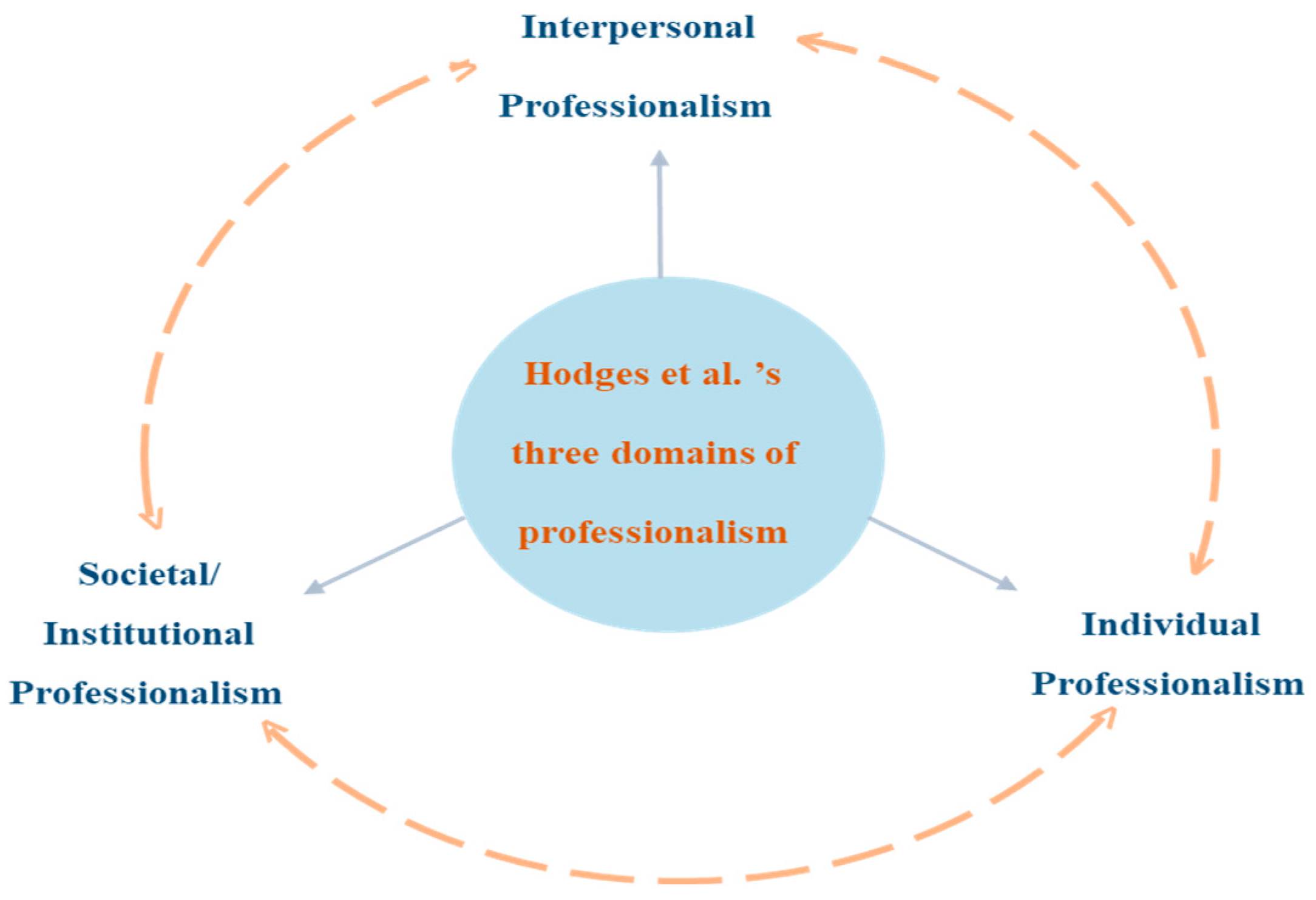
2.1. Theoretical Framework of Teacher Professionalism
2.2. Related Studies
3. Methodology
3.1. Research Design
3.2. Population and Sample
3.3. Research Instrumentation
3.4. Data Collection
3.5. Data Analysis
3.6. Ethical Considerations
4. Results
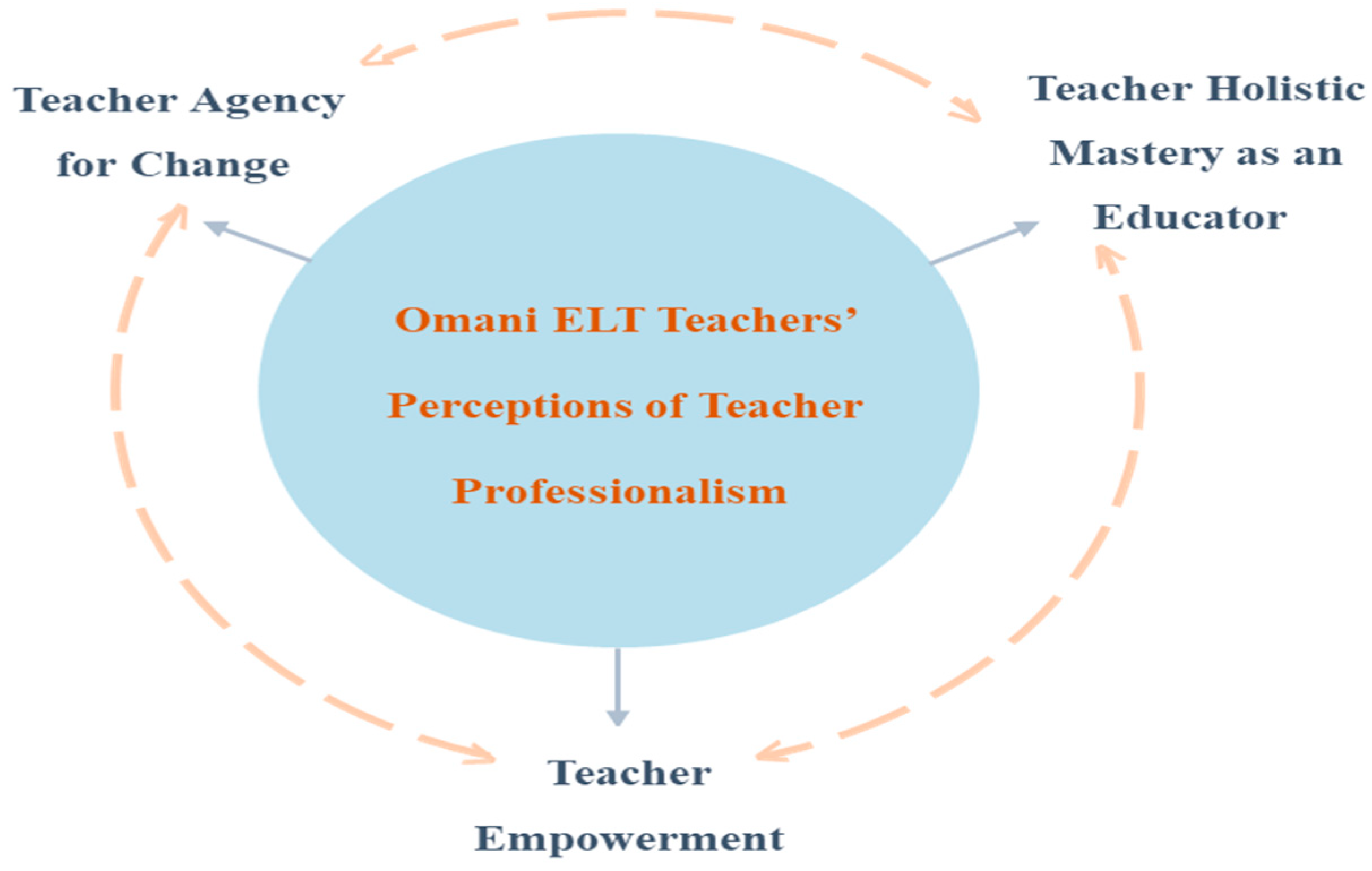
4.1. Theme 1: Teacher Holistic Mastery as an Educator
4.1.1. Teacher Pedagogical Competence
- Subject-Matter Expertise
- Effective Teaching
4.1.2. Teacher Professional Relationships
4.2. Theme 2: Teacher Agency for Change: Within and Beyond the School
4.2.1. The Improvement of Self
By the time you think you have reached full professionalism, it means you have definitely stopped learning. So if you are to develop your professionalism, don’t think of it as an end point in the future. You keep learning. Maybe you retire and still you don’t think of yourself as a professional. It is not because you haven’t learned anything, but because there is always something more to learn.
- Teacher as PD Advocate
- Teacher as Reflective Practitioner
I can say that this is one of the attitudes that a teacher should have: that you have constant feedback either from yourself, from other teachers, from supervisors, or even the headmistress. So feedback is the key to developing your career.
As a senior teacher, the post-lesson discussion for me is not only, ‘I like this and I don’t like that.’ It’s more than that. You need to know how and why the teacher did this in her lesson, how she overcame the problem in that lesson, and so on.
- Teacher as Researcher
It gives me deep insights into the education system and teaching … I feel like doing research or even reading research refreshes the mind. So, I don’t want my mind to freeze. I want to refresh it.
4.2.2. Improvement of Others
- Impact on Students and Society
Part of my job is to focus on these things because we want our generation to be good. It’s not just learning; it’s also to have values. If they do not have values, I believe that those students will never learn.
- Collaboration and School Improvement
This institution of teaching is like a table made out of three legs. One is the teacher, one is the student, and one important leg is the parent. This is a very important foundation to build a responsible environment for the students.
4.3. Theme 3: Teacher Empowerment
4.3.1. Societal Empowerment
4.3.2. Institutional Empowerment
- Voice in Decision-Making
- Teacher Autonomy
- PD Opportunities
And at that time, I remember that I would be sitting in the chair, the instructors talking, and the only idea that I had in mind was ‘You don’t get us, you don’t understand us.” You’re saying something completely different from what we need.
- Financial Support
These promotions are important for us. Because we don’t have promotions, many teachers don’t care about improving themselves or their teaching because they know they will need to do some extra work, but they will not be rewarded for it.
5. Discussion
5.1. Teacher Holistic Mastery as an Educator
5.1.1. Pedagogical Competence
5.1.2. Professional Relationships
5.2. Teacher Agency for Change: Within and Beyond the School
5.2.1. Self-Development
5.2.2. Developing Others
5.3. Teacher Empowerment
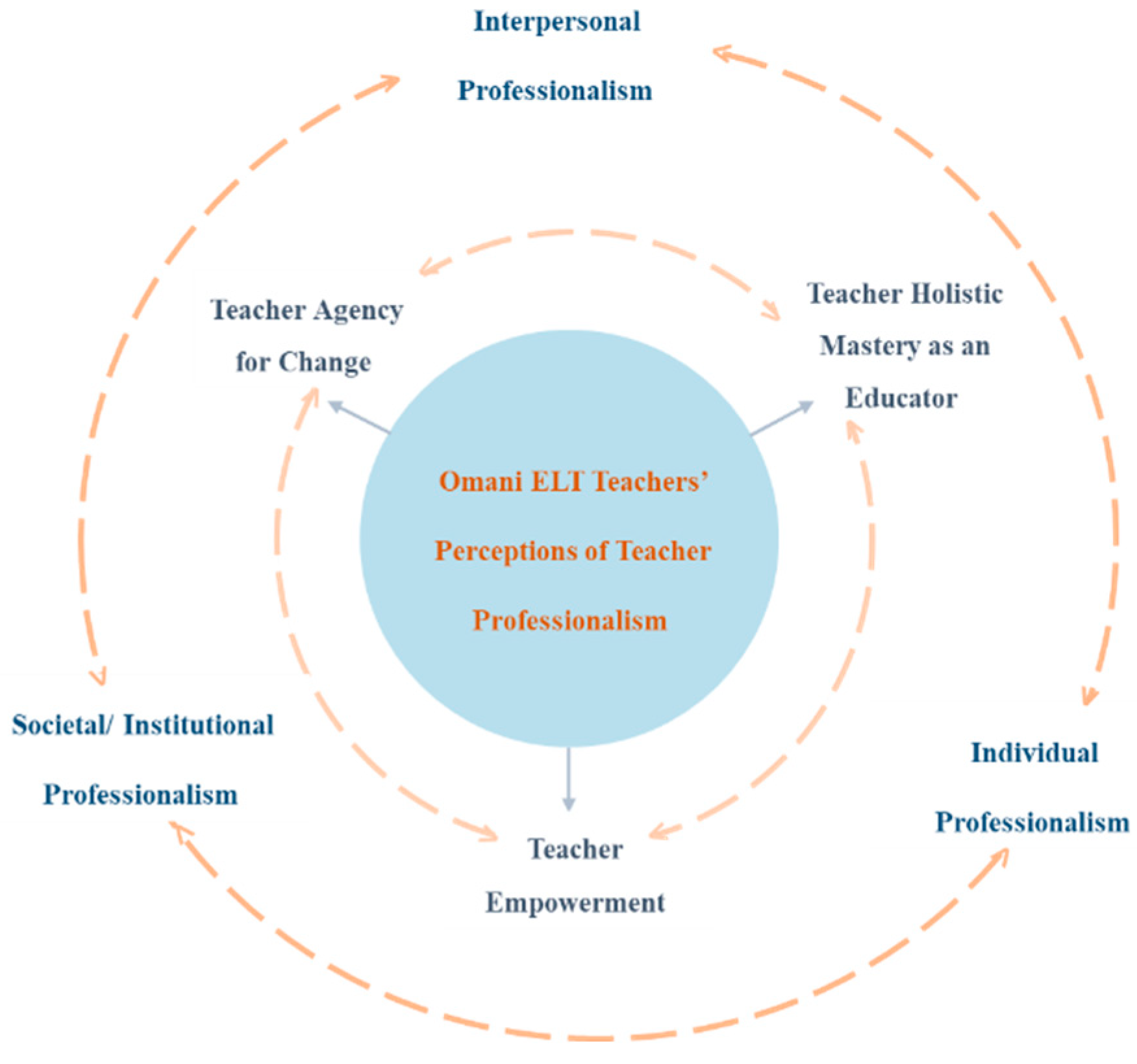
5.4. Situating the Emergent Themes in Hodges et al.’s Model of Professionalism
6. Conclusions, Limitations and Implications
Author Contributions
Funding
Institutional Review Board Statement
Informed Consent Statement
Data Availability Statement
Acknowledgments
Conflicts of Interest
Appendix A. Interview Protocol Document
Interview Introduction
- Please introduce yourself
- 2.
- Why did you choose to become a teacher? Was it your first choice? If not, why did you choose to continue in the profession?
| Domain | Main Question | Probes |
| RQ 1 & RQ 3: What are Omani ELT novice/experienced teachers’ perceptions of professionalism? | ||
Individual professionalism
| 1. In your opinion, what are the characteristics of a professional ELT teacher? | - What are the personal qualities of a professional teacher? - Do you think the personal qualities of a professional teacher are inherited or acquired? Why? |
| 2. What attitudes should a professional teacher hold and display? | - In the classroom with students, with colleagues and the administrations. - How can teachers’ attitudes impact students, colleagues, etc.? | |
| 3. What knowledge do you think is essential to become a professional ELT teacher? | - Can language proficiency indicate whether the teacher is professional or not? How? - How important is it for teachers to know about recent research and contemporary trends? | |
| 4. What skills make a professional ELT teacher? | - To what extent do you think research skills are important for professional teachers in your context? Why? - To what extent do you think skills like critical thinking, creativity, communication, and collaboration are important for professional teachers in your context? - To what extent do you think assessment, management, teaching skills, technological skills, etc., are important? Why? | |
| 5. Do you consider yourself a professional teacher? Why? | - Are there certain practices that make you feel professional or that someone is professional? What are they? - Are there certain situations that make you feel unprofessional? What are they? | |
Interpersonal professionalism
| 6. How would you describe your relationship with your students? | - What do you value the most in your relationship with your students? - How can teachers demonstrate effective communication and engagement with their students? - How does a teacher exhibit professionalism through his/her interaction with the students? |
| 7. How would you describe your relationship with your colleagues? | - What are the topics you usually talk about? - What issues do you usually discuss in the teachers’ meeting? - How does a teacher exhibit professionalism through his/her interaction with colleagues? | |
| 8. How would you describe your relationship with your principal? | - How do you describe the communication between you and the principal? - How does a teacher exhibit professionalism through his/her interaction with the principal? | |
| 9. What does ‘collaborative school environment’ mean to you? Give specific examples. | - How can we foster collaboration at schools? | |
| 10. What kind of initiatives do you take to improve your performance as a teacher? | - What kind of initiatives do you take to improve your performance int the classroom? - What kind of initiatives do you take to improve the educational experiences in your school in general? | |
Societal/institutional professionalism
| 11. How can teachers extend their influence beyond the classroom and school walls and contribute to enhancing society? | - Do you participate in social initiatives in your community? Do you volunteer? - How can teachers use social media to expand their influence? |
| 12. What values and ethics make a professional teacher? | - What are the ethical considerations that you take when practicing your job? - How important are values such as respect, integrity, fairness, equity to maintain professionalism? | |
| 13. To what extent do you think teachers should contribute to installing the Islamic values and morals on students? | - Do you think teachers should focus mainly on teaching or do they have a role in teaching Islamic values to students? Why? How can they do so? | |
| 14. How do you think society should perceive and appreciate teachers? | - How do students, their parents, community members, other teachers and principals perceive ELT teachers? - To what extent do you agree with these perceptions? | |
| 15. What would be the ideal working environment for an ELT teacher at the micro level (school) and the macro level (MoE)? | - How do you want to be treated at both levels so that you can feel your professionalism is supported and encouraged? (resources/financial incentives/decision making/reflection/research/etc.) | |
| 16. What do you think about the methods used at the institutional level (both MoE and school) to assess teacher professionalism/quality? | - Give examples of such methods. Do you think they are sufficient? - Are there other ways you prefer to be assessed by? What are they? | |
| 17. What does being an autonomous teacher mean to you? | - Do you perceive yourself as autonomous? Why? | |
| 18. How can teachers become leaders in education? | - Who do you view as leaders in the field of education either locally or internationally? - How do you think they became leaders over time? What are their practices? | |
| Closure | ||
| 19. What do you aspire to achieve in this profession? | - How do you see yourself as a teacher in the future (Let’s say in the 5 coming years)? - What is one aspect of the profession you want to focus on and improve the most within the coming 5 years? | |
References
- Al’Abri, K., Alhadabi, A., & Emam, M. (2022). Association between motivation to leave the teaching profession profiles and job satisfaction among Omani teachers: A latent profile analysis. Teaching and Teacher Education, 117, 103807. [Google Scholar] [CrossRef]
- Al-Bakri, S., & Troudi, S. (2020). EFL teachers’ beliefs about professionalism and professional development: A case study from Oman. Journal of Applied Linguistics and Professional Practice, 15(1), 1–23. [Google Scholar] [CrossRef]
- Al Balushi, K. A. (2021). Effectiveness of TESOL teachers’ continuous professional development: Perspectives form Oman. Advances in Language and Literary Studies, 12(1), 1–12. [Google Scholar] [CrossRef]
- Al-Harthi, A. S., Hammad, W., Al-Seyabi, F., Al-Najjar, N., Al-Balushi, S., & Emam, M. (2022). Evaluating the effectiveness of teacher education in Oman: A multiple case study of multiple stakeholders. Quality Assurance in Education, 30(4), 477–494. [Google Scholar] [CrossRef]
- Al Hashmi, W., & Klassen, R. M. (2020). Developing a situational judgement test for admission into initial teacher education in Oman: An exploratory study. International Journal of School & Educational Psychology, 8(Suppl. 1), 187–198. [Google Scholar] [CrossRef]
- Al Jabri, M. J. H., Silvennoinen, H., & Griffiths, D. (2018). Teachers’ professional development in Oman: Challenges, efforts and solutions. International Journal of Learning, Teaching and Educational Research, 17(5), 82–103. [Google Scholar] [CrossRef]
- Al-Khamisi, J. H., Al Seyabi, F., & Hammad, W. (2025). Exploring the effect of using lesson study approach on Omani EFL teachers’ reflective thinking. Reflective Practice, 26(5), 772–784. [Google Scholar] [CrossRef]
- Al-Kiyumi, A., & Hammad, W. (2019). Instructional supervision in the Sultanate of Oman: Shifting roles and practices in a stage of educational reform. International Journal of Leadership in Education, 22(2), 237–249. [Google Scholar] [CrossRef]
- Al Qalhati, N., Karim, A. M., Al Mughairi, B., Al Hilali, K., & Hossain, M. I. (2020). Study on job satisfaction among teachers in sultanate of Oman. International Journal of Academic Research in Business and Social Sciences, 10(10), 422–434. [Google Scholar] [CrossRef]
- Al Shabibi, A. S., & Silvennoinen, H. (2018). Challenges in education system affecting teacher professional development in Oman. Athens Journal of Education, 5(3), 261–282. [Google Scholar] [CrossRef]
- Baggini, J. (2005). What professionalism means for teachers today. Education Review, 18(2), 5. [Google Scholar]
- Bani Oraba, S. S. (2020). Exploring English language teachers’ professionalism at the colleges of technology in Oman (Publication No. 28930605) [Doctoral dissertation, University of Exeter]. ProQuest Dissertations & Theses Global. [Google Scholar]
- Berliner, D. C. (1994). Expertise: The wonder of exemplary performances. In Creating powerful thinking in teachers and students (pp. 161–186). Wadsworth Pub Co. [Google Scholar]
- Boyt, T. E., Lusch, R. F., & Naylor, G. (2001). The role of professionalism in determining job satisfaction in professional services: A study of marketing researchers. Journal of Service Research, 3(4), 321–330. [Google Scholar] [CrossRef]
- Braun, V., & Clarke, V. (2006). Using thematic analysis in psychology. Qualitative Research in Psychology, 3(2), 77–101. [Google Scholar] [CrossRef]
- Capen, S. M. (2017). The context of teacher professionalism: A case study of teacher perceptions of professionalism at the university laboratory school [Doctoral dissertation, University of Hawai’i]. ScholarSpace. [Google Scholar]
- Chapman, D. W., Al-Barwani, T., Mawali, F. A., & Green, E. (2012). Ambivalent journey: Teacher career paths in Oman. International Review of Education, 58(3), 387–403. [Google Scholar] [CrossRef]
- Demirkasımoğlu, N. (2010). Defining “Teacher Professionalism” from different perspectives. Procedia-Social and Behavioral Sciences, 9, 2047–2051. [Google Scholar] [CrossRef]
- Dodillet, S., Lundin, S., & Krüger, J. O. (2019). Constructing professionalism in teacher education. Analytical tools from a comparative study. Education Inquiry, 10(3), 208–225. [Google Scholar] [CrossRef]
- Florida, N. A., & Mbato, C. L. (2020). Novice versus experienced teachers: How they transform their vulnerability into professional identity in an Indonesian junior high school. Journal of Education Research and Evaluation, 4(1), 8–16. [Google Scholar] [CrossRef]
- General Directorate of Educational Supervision. (2024). Supervisory visit form for a field/subject teacher (Issue No. 2). General Directorate of Educational Supervision. [Google Scholar]
- Gökdaş, İ., Karacaoğlu, Ö. C., & Özkaya, A. (2024). COVID-19 and teachers’ digital competencies: A comprehensive bibliometric and topic modeling analysis. Humanities and Social Sciences Communications, 11(1), 1740. [Google Scholar] [CrossRef]
- Hammad, W., Hilal, Y. Y., & Bellibaş, M. Ş. (2024). Exploring the link between principal instructional leadership and differentiated instruction in an understudied context: The role of teacher collaboration and self-efficacy. International Journal of Educational Management, 38(4), 1184–1203. [Google Scholar] [CrossRef]
- Hammad, W., Sawalhi, R., Salim Al-Harthi, A., Alamri, F., & Morad, H. (2025). Perceptions of teacher leadership in the Arab region: A comparative analysis of three countries. Educational Management Administration & Leadership, 53(2), 258–278. [Google Scholar]
- Hammarberg, K., Kirkman, M., & De Lacey, S. (2016). Qualitative research methods: When to use them and how to judge them. Human Reproduction, 31(3), 498–501. [Google Scholar] [CrossRef] [PubMed]
- Hodges, B. D., Ginsburg, S., Cruess, R., Cruess, S., Delport, R., Hafferty, F., Ho, M.-J., Holmboe, E., Holtman, M., Ohbu, S., Rees, C., Ten Cate, O., Tsugawa, Y., Van Mook, W., Wass, V., Wilkinson, T., & Wade, W. (2011). Assessment of professionalism: Recommendations from the Ottawa 2010 conference. Medical Teacher, 33(5), 354–363. [Google Scholar] [CrossRef] [PubMed]
- Korkmazgil, S., & Seferoğlu, G. (2021). Teacher professionalism: Insights from Turkish teachers of English into the motives that drive and sustain their professional practices. Journal of Education for Teaching, 47(3), 366–378. [Google Scholar] [CrossRef]
- Kurnianingsih, S., Yuniarti, K. W., & Kim, U. (2012). Factors influencing trust of teachers among students. International Journal of Research Studies in Education, 1(2), 85–94. [Google Scholar] [CrossRef]
- Michel, H. A. (2013). The first five years: Novice teacher beliefs, experiences, and commitment to the profession (Publication No. 3567712) [Doctoral dissertation, University of California]. ProQuest Dissertation and Theses Global. [Google Scholar]
- Mockler, N. (2005). Trans/forming teachers: New professional learning and transformative teacher professionalism. Journal of In-Service Education, 31(4), 733–746. [Google Scholar] [CrossRef]
- Moss, P. (2014). The democratic and reflective professional: Rethinking and reforming the early years workforce. In L. Miller, J. Devereux, L. Miller, C. Cable, & G. Goodliff (Eds.), Supporting children’s learning in the early years (pp. 183–191). Routledge. [Google Scholar]
- Okas, A., Schaaf, M., & Krull, E. (2014). Novice and experienced teachers’ views on professionalism. TRAMES: A Journal of the Humanities & Social Sciences, 18(4), 327–344. [Google Scholar]
- Özdemir, T. Y., Demirkol, M., & Polat, H. (2019). Teaching as a professionalism through teachers’ perspective. Turkish Online Journal of Qualitative Inquiry, 10(3), 296–320. [Google Scholar] [CrossRef][Green Version]
- Patton, M. Q. (2002). Qualitative research & evaluation methods. SAGE. [Google Scholar]
- Rizvi, M., & Elliota, B. (2005). Teachers’ perceptions of their professionalism in government primary schools in Karachi, Pakistan. Asia-Pacific Journal of Teacher Education, 33(1), 35–52. [Google Scholar] [CrossRef]
- Sachs, J. (2001). Teacher professional identity: Competing discourses, competing outcomes. Journal of Education Policy, 16(2), 149–161. [Google Scholar] [CrossRef]
- Sachs, J. (2016). Teacher professionalism: Why are we still talking about it? Teachers and Teaching, 22(4), 413–425. [Google Scholar] [CrossRef]
- Salehizadeh, S., Shabani, M. B., & Malmir, A. (2020). Professionalism: The perceptions of Iranian English teachers of competence and performance in language teaching (Research paper). Iranian Journal of English for Academic Purposes, 9(1), 1–14. [Google Scholar]
- Shin, M. (2012). “Whole teacher” crisis: Examining pre-service student teachers’ perceptions of professionalism. International Journal of Education, 4(4), 134–143. [Google Scholar] [CrossRef][Green Version]
- Shon, K. (2006). Teacher professionalism. Faculty Publications and Presentations, 46. Available online: https://digitalcommons.liberty.edu/educ_fac_pubs/46 (accessed on 12 March 2024).
- Swann, M., McIntyre, D., Pell, T., Hargreaves, L., & Cunningham, M. (2010). Teachers’ conceptions of teacher professionalism in England in 2003 and 2006. British Educational Research Journal, 36(4), 549–571. [Google Scholar] [CrossRef]
- Tichenor, M. S., & Tichenor, J. M. (2005). Understanding teachers’ perspectives on professionalism. Professional Educator, 27, 89–95. [Google Scholar]
- Transcriptor. (n.d.). Transcriptor: AI transcription tool. Available online: https://transcriptor.ai (accessed on 24 May 2024).
- Webb, R., Vulliamy, G., Hämäläinen, S., Sarja, A., Kimonen, E., & Nevalainen, R. (2004). A comparative analysis of primary teacher professionalism in England and Finland. Comparative Education, 40(1), 83–107. [Google Scholar] [CrossRef]



| Participant Code | Gender | Position a | Governorate | City | Teaching Experience (Year) | Grade Level (Now) |
|---|---|---|---|---|---|---|
| 1 | F | T | Ad Dakhiliyah | Bahla | 3 | 10 |
| 2 | M | T | Ad Dakhiliyah | Nizwa | 1 | 5 |
| 3 | F | T | Ad Dakhiliyah | Samail | 3 | 8 & 12 |
| 4 | F | T | Muscat | Al Amarat | 3 | 10 |
| 5 | M | T | Muscat | Al Seeb | 5 | 10 |
| 6 | F | T | Ad Dakhiliyah | Nizwa | 7 | 12 |
| 7 | M | ST | Ad Dakhiliyah | Nizwa | 17 | 10 |
| 8 | F | ST | Ad Dakhiliyah | Al Hamra | 16 | 7 |
| 9 | F | ST | Muscat | Al Qurm | 21 | 12 |
| 10 | M | ST | Muscat | Al Seeb | 24 | 5 |
Disclaimer/Publisher’s Note: The statements, opinions and data contained in all publications are solely those of the individual author(s) and contributor(s) and not of MDPI and/or the editor(s). MDPI and/or the editor(s) disclaim responsibility for any injury to people or property resulting from any ideas, methods, instructions or products referred to in the content. |
© 2026 by the authors. Licensee MDPI, Basel, Switzerland. This article is an open access article distributed under the terms and conditions of the Creative Commons Attribution (CC BY) license.
Share and Cite
Al Hashimi, N.; Al Seyabi, F.; Al Busaidi, S.; Hammad, W. Teacher Professionalism in Omani Schools: Qualitative Insights from the ELT Context. Educ. Sci. 2026, 16, 414. https://doi.org/10.3390/educsci16030414
Al Hashimi N, Al Seyabi F, Al Busaidi S, Hammad W. Teacher Professionalism in Omani Schools: Qualitative Insights from the ELT Context. Education Sciences. 2026; 16(3):414. https://doi.org/10.3390/educsci16030414
Chicago/Turabian StyleAl Hashimi, Nasraa, Fawzia Al Seyabi, Saleh Al Busaidi, and Waheed Hammad. 2026. "Teacher Professionalism in Omani Schools: Qualitative Insights from the ELT Context" Education Sciences 16, no. 3: 414. https://doi.org/10.3390/educsci16030414
APA StyleAl Hashimi, N., Al Seyabi, F., Al Busaidi, S., & Hammad, W. (2026). Teacher Professionalism in Omani Schools: Qualitative Insights from the ELT Context. Education Sciences, 16(3), 414. https://doi.org/10.3390/educsci16030414