Skip to Content
Education SciencesEducation Sciences
  • Article
  • Open Access

13 February 2026

The Responsive Teacher Formation Framework (RTFF): Towards Teacher Belonging, Wellbeing, Autonomy and Agency in Primary Education


,
,
,
and
1
Institute of Community Services (ICS), Malta College of Arts, Science and Technology (MCAST), Triq Kordin, PLA9032 Paola, Malta
2
Applied Research & Innovation Centre (ARIC), Malta College of Arts, Science and Technology (MCAST), Triq Kordin, PLA9032 Paola, Malta
*
Author to whom correspondence should be addressed.

Abstract

Teacher education systems globally experience a gap in implementation between policy aspirations and everyday enactment, with implications for initial teacher education (ITE), the quality of practicums, professional identity, and teacher recruitment and retention. Situated in Malta’s superdiverse context and informed by international debates on professional capital, care ethics, inclusion, and ecological conceptions of agency, this article introduces the Responsive Teacher Formation Framework (RTFF). This original, theoretically integrated, and empirically grounded framework foregrounds four interdependent pillars of professional formation: belonging, wellbeing, autonomy and agency. Drawing on a two-year, multi-strand national inquiry synthesising perspectives from children, families, newly qualified teachers, learning support educators, and school leaders, we integrated artefact-elicitation, focus groups, interviews, and questionnaires using reflexive thematic analysis and cross-strand configurational synthesis. Through a meta-synthesis convergence of the different strands of the study, recurrent tensions surface, including procedural versus lived belonging; attention versus neglect of wellbeing; nominal autonomy versus fragile system supports and policy endorsement versus constrained agency. The findings demonstrate how these complexities are experienced across the ITE–school interface. We argue that the RTFF offers a coherent and tractable syntax for ITE programme (re)design that is both theoretically robust and practically adaptable, diagnostically sensitive to local context, and implementable at scale. The model contributes to international discourse by linking fragmented debates on these four pillars into a responsive framework of, and for, teacher formation. Beyond the Maltese case, the RTFF offers an adaptable orientation for superdiverse settings seeking to transition from compliance-driven quality assurance to formation-centred professional excellence. The article concludes by outlining how the RTFF can anchor more integrated and sustainable policy, as well as nurture professional learning communities, thereby advancing the transformation of teacher education for academic excellence.

1. Introduction

Programmes for Initial Teacher Education (ITE) in primary schooling aim to prepare future teachers with the necessary skills and knowledge to address diverse student needs and adhere to relevant policy standards (Malik, 2018). The literature in the field acknowledges that the quality of ITE plays a fundamental role in enhancing classroom practices, teaching and learning, supporting student achievement, and contributing to broader societal transformation (Ben-Peretz & Flores, 2018). This is evident in light of current challenges, such as greater diversity among students and changing school environments due to migration and multiculturalism, all of which significantly affect teachers’ roles and the nature of teacher education (Ben-Peretz & Flores, 2018). In this vein, it remains essential to carry out systematic and analytical reviews on teacher education policies and practices to certify that teachers are well-prepared to support students to gain the knowledge and skills required to thrive in rapidly evolving democratic societies and an increasingly globalised world (Kowalczuk-Walędziak & Parmigiani, 2020).
During the period between 2020 and 2022, several countries across various regions recorded particularly high levels of primary teacher attrition, reaching 10% or more (UNESCO, 2024). The teaching profession has seen a decline in overall attractiveness, leading to fewer prospective teachers entering the field and a continued loss of qualified educators (Eurydice, 2021). Teacher shortages have emerged as a global concern, characterised by complex and urgent challenges that demand sustained, long-term solutions and consistent investment (Eurydice, 2018). There is no international database that enumerates the total number of ITE programmes worldwide, and major comparative agencies explicitly acknowledge that global information on teacher preparation structures remains incomplete and unevenly reported. UNESCO (2024) and the UNESCO Institute for Statistics (2024) note substantial cross-national variation in entry requirements, institutional arrangements and qualification levels, making global quantification unfeasible. Comparative reviews consistently show that many countries operate multiple teacher-education providers and several differentiated pathways, including variations in level, subject specialisation and mode of preparation (Darling-Hammond, 2017; OECD, 2021; Schwille & Dembélé, 2007; World Bank, 2020, 2021). Given this documented diversity, it is reasonable to infer that the global landscape consists of a very large number of distinct ITE programmes rather than a limited, standardised set.
Across the European Union, shortages are widespread, particularly in primary and secondary education, with more than half of Member States reporting a significant need for qualified teachers (Eurydice, 2018). ITE systems across Europe display marked structural diversity. Eurydice (2021) reports that countries commonly operate multiple pathways, most notably concurrent and consecutive models, which differ in duration, sequencing of professional preparation and qualification level. Provision is further differentiated by phase of education, subject specialism and institutional type, resulting in several distinct programmes within single systems. OECD analyses likewise emphasise variation in programme design and entry routes across European jurisdictions (OECD, 2021). This regional complexity parallels wider international patterns in which teacher preparation is dispersed across institutions and programme types rather than consolidated into uniform or standardised routes (Darling-Hammond, 2017; Moon, 2018).
Various programmes in Primary Education include degrees, namely, the Bachelor of Education (Institute for Education, 2025) and Bachelor of Arts (University of Malta, n.d.-a), as well as specialised options such as the Bachelor of Science (Cardiff University, n.d.). However, despite their implementation, these programmes might fall short in addressing progressing educational needs, highlighting the need for updated strategies in teacher training (Darling-Hammond, 2017). Current ITE programmes are distinguishable for several notable reasons. To begin with, their inclusive curricula equip teachers with well-rounded skills and prepare them to handle the varied demands of the classroom (Darling-Hammond & Bransford, 2005). These programmes integrate theoretical foundations with practical experience, promoting a strong grasp of educational concepts and their application in real-world settings through work-based learning (WBL). Furthermore, these programmes are structured to help prospective primary teachers achieve both international and national standards, ensuring that graduates are well-prepared to contribute effectively to the teaching profession (Darling-Hammond, 2017). There are also important contextual and methodological patterns in research on initial teacher education. Scorțescu and Sava (2024) reviewed a substantial number of studies, with a large concentration within European contexts, often associated with developments linked to the Bologna Process and European Commission initiatives aimed at enhancing teacher quality through reforms in initial teacher education. Across these studies, recurring themes related to collaboration, communication, and partnership emerged as central to effective teacher preparation. These relational processes ranging from mentor and peer collaboration during work-based learning to collective reflection and peer mentoring, underscore the importance of integrated and practice-oriented approaches within ITE (Scorțescu & Sava, 2024).
While current teacher training programmes offer significant advantages, several shortcomings are evident. The fast-paced evolution of education, influenced by technological advances, globalisation, and evolving student requirements, means these programmes may not fully equip teachers for the challenges ahead (Aubusson & Schuck, 2013). Traditional models often prioritise established methods rather than promoting creativity, adaptability, and critical thinking, all of which are essential for modern teachers. In addition, topics like digital literacy, inclusive education, and social-emotional learning are increasingly vital but may not be thoroughly covered in current training for future primary teachers (Howard et al., 2021). As a result, existing programmes may struggle to prepare teachers for the multifaceted demands of future classrooms adequately. The role of teachers has evolved significantly, requiring them to deliver high-quality, inclusive education to increasingly diverse students while managing classrooms, personalising teaching, integrating technology, and supporting students’ socio-emotional well-being. These complex demands make ITE preparation and continuous professional development essential throughout teachers’ careers (OECD, 2019). These specific challenges are acknowledged in Malta’s Education Strategy 2024–2030 (Ministry for Education, Sport, Youth, Research and Innovation, 2024). The strategy’s central objective is to address the factors contributing to low retention across the education system, both within compulsory schooling and beyond, as well as “volatile demographics in the classroom, students’ diverse needs and the unfavourable ramifications of social media” (Ministry for Education, Sport, Youth, Research and Innovation, 2024, p. 32). In Malta, the educational system is undergoing significant societal changes due to factors such as an influx of students from migrant backgrounds, advancements in technology like the use of devices in the classroom, and ongoing policy developments and reform. This context underscores the importance of ensuring that newly qualified teachers (NQTs) are well-equipped for the challenges they will encounter.
To address the challenges in Malta’s primary education system, the Comprehensive Overview of Malta’s PrimAry School Stakeholders’ (COMPASS) Project was initiated to conduct a thorough investigation into its various facets. The project involved five studies that gathered feedback from multiple stakeholder groups, including primary school students, families (parents/legal guardians), NQTs, Learning Support Educators (LSEs), and school leaders. The primary aim was to investigate these diverse perspectives to understand the current state of primary education and propose tangible improvements for teacher training and classroom practices.
The five studies collectively explored multiple perspectives within the primary education sector. Study A focused on recognising and acknowledging student voices to better understand their experiences and viewpoints within primary schooling. Study B gathered data from families, as parents and legal guardians serve as children’s first educators and primary communicators within the home, providing insights into existing gaps and future needs in primary education. Study C examined the experiences of newly qualified primary school teachers as they transitioned from prospective teachers to full-time teachers, exploring how they navigated this liminal space whilst forming their professional identities amidst both the excitement of their new roles and the challenges that accompanied them. Study D investigated the role and experiences of LSEs who are central to implementing inclusive practices, supporting students with impairments, collaborating with teachers, and integrating family insights into personalised learning approaches, thereby underlining potential gaps in current primary education provision. Study E gained perceptions from school leaders, whose practical knowledge and understanding of the day-to-day realities of present schooling confirmed that promoting a collaborative approach strengthened the overall quality and success of teacher preparation.
This paper begins by introducing the ITE context and challenges and examining the liminal stage of teacher formation, situating the study within Malta’s superdiverse educational context. It then traces the development of the study’s conceptual nature, moving from a multi-strand national inquiry and literature-derived framework through instrument design to the empirical refinement that culminates in the Responsive Teacher Formation Framework (RTFF). Positioned as a framework-development article, the primary purpose is to introduce and justify the RTFF as a synthesis-level lens; while the programme’s multi-stakeholder design enables systematic comparison of convergent and divergent perceptions across groups, such cross-group analyses are reported in the strand-specific papers rather than in the present synthesis. The central sections elaborate the RTFF, its theoretical foundation, and the tensions between policy narratives and lived practice. The article subsequently explores how the RTFF can be integrated into ITE programmes, and then outlining implications for practice and policy. It concludes by reflecting on limitations and advancing a formation-grounded perspective for teacher education.

1.1. Addressing the Liminal Stage

The transition and the formation of a professional identity merits attention to address the shift from prospective teacher training to effectively forming part of the workforce. This phase is the liminal stage—when a prospective teacher is on the threshold of gaining professional status. This paper investigates this professional formation phase, by examining the experiences of newly qualified teachers and other pertinent stakeholders. The study purposefully omits veteran teachers whose experiences are considered outside the purview of informing the process of current teacher formation.
Teacher shortage has become a dire concern internationally, with UNESCO demanding urgency and the desperate need for action to reach the fourth Sustainable Development Goal for high quality provision of lifelong learning that is inclusive and fair (United Nations, 2025). This is further compounded by the OECD (2025) report highlighting a high percentage of NQTs resigning after teaching for merely five years or less. With teacher shortages soaring, the preliminary years when a NQT joins the workforce require attention to address attrition by identifying the determining factors that promote retention. Teacher attrition is often analysed through the lens of work conditions and pay (Doherty, 2020). Moreover, the development of auto-pedagogical competence, that is the ability to manage one’s professional formation, among prospective primary teachers remains a largely underexplored area within contemporary pedagogical research. Modern educational trends position the primary teacher as far more than a transmitter of knowledge. Teachers are now expected to foster student engagement, nurture intrinsic motivation, and create conditions that support individualised learning and continuous growth. This requires a shift from teacher-led education to more autonomous learning environments. In this evolving reality, primary teachers must continually expand their expertise and apply it to complex pedagogical challenges (Petkova & Tynyskhanova, 2025).
We are proposing to reposition the argument around four pillars: belonging, wellbeing, autonomy and agency; to address attrition by fostering an environment that could lead to retention. This argument is built on the contention points brought forward in the policy landscape and reinforced by the voices of stakeholders, with the scope of building a resilient primary teacher workforce by strengthening the teacher’s identity in the liminal stage from student to professional. This section takes a closer look at the precarious transitional space of initial teacher formation posited within the discourse of teacher retention.
Suarez and McGrath (2022) define teacher identity as “the perceptions, views, beliefs, emotions, motivations, and attitudes that teachers have about their own role” (2022, p. 8). Teacher retention is here tied to teacher identity and this is the link being analysed. This connection stems from the process of teacher formation and the development of a professional identity (Cunningham, 2020). Nestled within programmes of study, WBL has been established as an integral part of professional formation. WBL provides the prospective teacher with the opportunity to experience the professional role in conjunction with the possibility to reflect, question, probe and analyse the factual expectations of the role when measured against their personal understanding of the role (Jackson, 2017). This experience allows prospective teachers to deliberately contemplate their professional identity as it emerges and continues to be formed thereafter, fostering cognizant professional identity construction. Suarez and McGrath (2022) presented an interesting representation of identity, with attributes both hailing from the individual identity and emanating from the collective identity (Suarez & McGrath, 2022). The teacher’s understanding of the role is shaped by the culmination of individual experiences and those shared with like-minded individuals. This understanding of professional identity presents the experience as a timeless process, since formation is built on personal experiences and ideals shaped throughout life to that point and continues to take shape adapting and adjusting to the present reality. This posits professional identity into the philosophical realm rather than a mere transition or phase. By purporting that professional identity is a continual state being moulded by experience, the focus on the liminal stage from prospective teacher to professional requires not only recognition of this aspect of professionalism but a conscious examination to determine its implications.
In their study of the transition from a prospective to a professional teacher, Reissner and Armitage-Chan (2024) present a typology of professional identity formation being developed throughout a programme of studies as becoming, aligning, exploring and struggling. Reissner and Armitage-Chan (2024) recommend educational interventions which can be achieved by questioning and addressing these phases and identifying role models and the student’s aspired professional identity to help create a more sustainable professional. This sense of becoming suggests a process of evolving through which an individual is investigating a current state apropos a desired future self, as a lived experience that requires analysis and understanding. Palmér (2016) explains how “professional identity is considered as a unit of analysis that focuses on the whole rather than on part of a person, and on that person’s becoming rather than knowing”, (Palmér, 2016, p. 683). It is this process of rumination and reflection that requires changing or transforming, this argument is here being presented as vital for an enduring professional identity.
Essential to this discussion is the aligning and struggling process mentioned earlier within an individual and even more so as part of a community of teachers. This communal identity deserves further attention, as it foregrounds the process of adapting within a community of practitioners. Toh et al. (2022) place the professional identity within the realm of society, based on the contention that the individual’s values, beliefs and principles during professional formation come in contact and are shaped by the community of teachers’ values, beliefs and principles. The need for reflection is especially vital when these are in conflict. When a student whose teacher formation is still in the early stages interacts with a community of practitioners, the socialisation process requires an integration process to assimilate newly discovered experiences within a spectrum of possible identities (Toh et al., 2022). The role of the mentor during this formative stage is essential. Explicit interactions about self-worth and discussions leading to a successful experience peppered with reflections on the struggles become vital, since positive experiences during the liminal space have been tied to retention (Izadinia, 2015). The discussions on teacher retention and addressing attrition are intertwined with the discourse of support during the formative stages and the transition into the community of teachers (Schaefer, 2013). Moving away from the discourse on rationality and cognition and into the emotional narrative, the sentiments experienced during the construction of a teacher’s professional identity can support or hinder the process since these feelings shape the experience and the professional formation thereafter. The affective reactions play a vital role in initial teacher formation necessitating an examination of the triggers to allow for response reactions that regulate these emotions built within the professional identity (Chen et al., 2022). When a student interacts with the role within a community of teachers, because of the emotional needs that the teacher role necessitates, by understanding the emotional trajectory of the role a student inherently assimilates the mechanism to regulate a reaction thereby channelling positive affirmations within the professional role. We contend that a sustainable teaching career demands that this narrative is embedded in ITE.
It follows that a strong professional identity that addresses the range of emotional experiences deters attrition, framed by the school culture created by the leaders and the peers within the school community (Cunningham, 2020). The initial teacher formation experience is impacted by the stakeholders which during the liminal stage encompasses interactions with the school community and the mentors guiding the student, shaped by the individual reflective process which determines the toolbox that initial teacher have at their disposal. Teacher retention is fostered through occupational wellbeing (Nwoko et al., 2025).

1.2. Background and Context

The shortage of qualified teachers is a global concern, affecting both the current and future educational workforce, and Malta is no exception. Teacher retention in Malta is increasingly challenged by a sharp rise in voluntary resignations, a decline in the number of teacher graduates, persistent difficulties in filling teaching vacancies during the scholastic year, and a growing reliance on supply teachers who lack the required qualifications (Galea, 2020). The Malta National Education Strategy 2024–2030 underscores the nation’s commitment to transformation in education, emphasising the need to build on past achievements while addressing future challenges to secure high-quality learning for all: “Education plays a decisive role in shaping the future of the individual and society. The theoretical framework of the National Education Strategy 2024–2030 is embedded within the concept of transformation, a process which recognises and builds on past achievements, while orienting itself to future exigencies” (Ministry for Education, Sport, Youth, Research and Innovation, 2024).
Within this context, Malta’s teacher preparation system includes two main entry routes for Primary Education: the long-established traditional route, dating back to 1978 and characterised by full-time study prior to entering the profession, initially through training colleges and later through the university (Eurydice, 2025; Times of Malta, 2018; University of Malta, n.d.-b) and a part-time pathway introduced in 2018, which allows individuals to undertake supply teaching while completing their studies (Eurydice, 2025; University of Malta, n.d.-b; Times of Malta, 2018). The latter was created as an immediate response to teacher shortages and is delivered through a Ministry-funded institute, reflecting ongoing efforts to ensure a sustainable and well-prepared teaching workforce (European Commission, 2019; Eurydice, 2025; Institute for Education, 2025).
For students aiming to teach at the primary level, pursue training specifically designed for this sector. At present, the most common pathway involves completing a relevant Bachelor’s degree (MQF Level 6, 180 ECTS), followed by a Master’s in Teaching and Learning (MQF Level 7, 120 ECTS) in Early Childhood and Primary Education, offered by the University of Malta (n.d.-a). Since the 2018–2019 academic year, candidates have also been able to opt for a part-time Bachelor of Education (MQF Level 6, 180 ECTS credits) offered by the Institute for Education, which enables them to qualify as teachers without first undertaking a BA programme (Institute for Education, 2025). The Institute for Education provides two part-time qualification routes: the Bachelor of Education (Hons) for those with a full MQF Level 4 qualification, and the Master of Education for those who already hold a first degree (MQF Level 6, 180 ECTS credits) (Institute for Education, 2025). From the 2023–2024 academic year, a new option has also been introduced at the University of Malta: the Bachelor of Arts in Primary Education (MQF Level 6, 180 ECTS credits), which leads directly to qualification as a primary school teacher (Eurydice, 2025).
To enter the teaching profession in Malta, candidates must possess the required qualifications and obtain a teacher’s warrant issued by the Council for the Teaching Profession (CTP) (Council for the Teaching Profession Malta, n.d.; Eurydice, 2025; Institute for Education, 2024). Eligibility for a warrant is based on holding a qualification recognised by the CTP, although the Council may also consider other professional qualifications awarded by accredited institutions, assessing pedagogical training and teaching practice components (Eurydice, 2025). Beyond approved qualifications, NQTs complete a two-year Induction and Mentoring Programme during probation (Eurydice, 2025; Kutsyuruba & Bezzina, 2024). The Malta Further and Higher Education Authority (MFHEA) sets accreditation criteria for all qualifications, including teacher preparation (Eurydice, 2025; Malta Further and Higher Education Authority, 2025). These features of the Maltese teacher preparation system clearly indicate the intention of the development of the proposed framework, which seeks to respond to challenges faced by education systems experiencing teacher shortages, policy reform, and increasing demands on initial teacher education. The framework addresses changing expectations of teacher preparation and professional readiness, both within Malta and in comparable education systems internationally, especially countries undergoing similar educational reforms.

2. Materials and Methods

2.1. From Multi-Strand Inquiry to Conceptual Framework

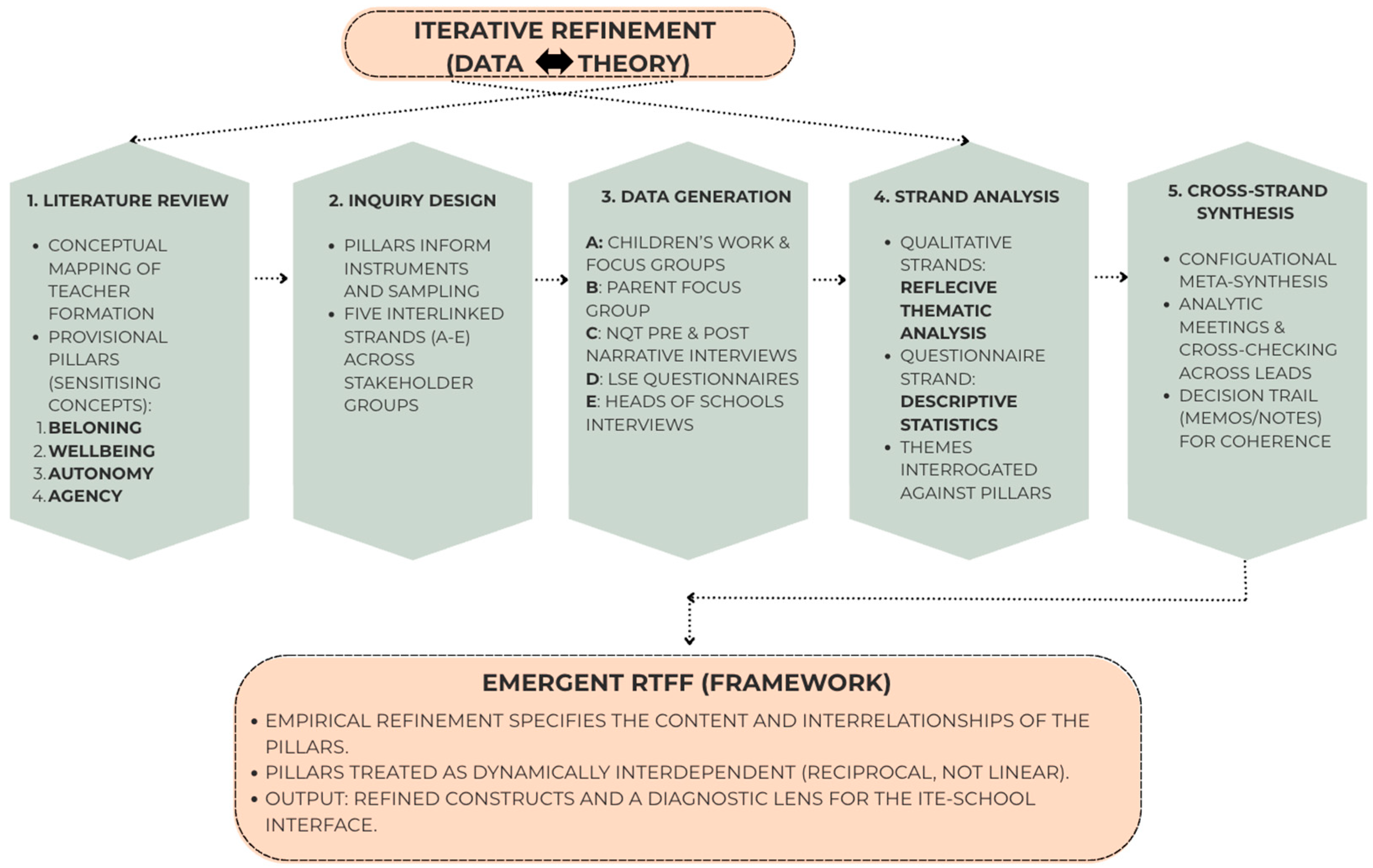
As indicated in the introduction, this article draws on the COMPASS Project; a multi-strand two-year national study conducted in Malta, which examined teacher formation within and across ITE programmes and primary schools. The overall design comprised five interlinked studies (A–E), as outlined in the introduction, and data were generated through children’s work and focus group discussions (Study A), an online focus group with parents (Study B), narrative pre- and post-interviews with three NQTs (Study C), a structured online questionnaire completed by 134 LSEs (Study D), and six semi-structured interviews with Heads of Schools from the three sectors (Study E). Purposive and convenience sampling strategies (Cohen et al., 2018) were adopted as appropriate in each strand. Reflexive thematic analysis (Braun & Clarke, 2022) was applied to the qualitative datasets and descriptive statistics (Cohen et al., 2018) to the questionnaire data. Strand-level findings were subsequently brought into dialogue through a cross-strand configurational meta-synthesis (Gough et al., 2012), supported by iterative analytic meetings, cross-checking of interpretations across strand leads and reflexive analytic notes to enhance the credibility and coherence of the synthesis. This meta-synthesis underpins the development of the RTFF, which is discussed in Section 4.
The procedural detail of each strand lies beyond the scope of this paper and will be reported elsewhere. The focus here is on how this multi-strand design enabled a staged process of conceptual mapping in which an initial, literature-derived framework informed the design of the inquiry, provided an orienting analytic lens during analysis and was progressively refined in the light of the empirical findings into the theoretical framework presented in this article. Figure 1 depicts the sequential and iterative analytic pathway through which the RTFF was developed; from literature-derived sensitising pillars, through multi-strand data generation and strand-level analyses, to cross-strand configurational synthesis and the final framework:
Figure 1. Development of the Responsive Teacher Formation Framework (RTFF) from literature-derived pillars to an emergent framework through multi-strand inquiry, strand-level analysis, and cross-strand configurational synthesis.

2.2. Literature-Derived Conceptual Framework

In line with the principles of conceptual mapping (Maxwell, 2013; Miles et al., 2018), we began with a primarily deductive orientation to the literature on teacher formation. Following Maxwell’s (2013) characterisation of a conceptual framework as “the system of concepts, assumptions, expectations, beliefs, and theories that supports and informs your research” (p. 39), we considered our initial framing of teacher formation as a tentative theory of the phenomena under investigation. Drawing on international and national scholarship on professional capital (Hargreaves & Fullan, 2012), care and wellbeing in teaching (Day & Gu, 2014), and teacher autonomy and agency (Biesta et al., 2015; Priestley et al., 2012), we articulated four provisional pillars of teacher formation: belonging, wellbeing, autonomy and agency.
In keeping with Blumer’s (1954) notion of sensitising concepts to “merely suggest direction along which to look… providing clues and suggestions” (pp. 7–8), these pillars were conceptualised as offering general directions for inquiry and not as precise and definite. The pillars specified the key dimensions of teacher formation we sought to examine and the hypothesised relations among them, while leaving open how these dimensions would be locally configured across different sites, roles and career stages.

2.3. Instrument Design

This literature-derived framework was then used as a form of theoretical sensitivity (Glaser, 1978) in the design of the research instruments and the initial analytic lenses for each strand. Theoretical sensitivity, as developed in grounded theory traditions (Charmaz, 2014; Glaser, 1978), refers to the capacity to notice, interpret and give analytic weight to particular processes and relationships, while remaining open to the unexpected. We drew on this notion heuristically rather than methodologically; the framework oriented our attention to particular issues and tensions in teacher formation, but did not predetermine what could be found in the data.
Practically, the four pillars informed the construction of the interview guides, focus group prompts and questionnaire statements, ensuring that each strand attended, in contextually appropriate ways, to questions of belonging, wellbeing, autonomy and agency. In Miles et al.’s (2018) terms, the framework functioned as an initial “network” (p. 15, emphasis in original) that specified “the main things to be studied… and the presumed relationships among them” (p. 15). The framework guided decisions about which actors to include (students, parents, NQTs, LSEs and school leaders), which contexts to sample (state, church and independent schools), and which aspects of their experiences we sought to examine. At the same time, the instruments deliberately included open prompts and spaces for unanticipated concerns, so that through the data we could problematise or extend the initial conceptual map.

2.4. Analytic Approach and Cross-Strand Synthesis

Across qualitative strands, i.e., Study A–C and Study E, analysis was undertaken using a reflexive thematic approach, with themes developed through iterative engagement with the dataset, reflexive memoing, and transparent documentation of analytic decisions. In keeping with this interpretivist orientation, analytic quality was prioritised through coherence, reflexive accountability and a clear decision trail. For Study D, which focused on Learning Support Educators and used a questionnaire with a valid sample of 143 respondents, items were structured in sections aligned to the RTFF pillars of belonging, wellbeing, autonomy and agency and combined closed-response items, including frequency and rating scales, with open-ended prompts. Closed items were summarised using descriptive statistics, comprising frequencies, percentages and distribution bands, and open-ended responses were thematically coded with counts of mentions to provide an indicative profile of recurrent concerns and priorities. Technical instrument development documentation and strand-specific reporting are presented in the dedicated Study D output.
Cross-strand synthesis was conducted as a configurational meta-synthesis. Strand-level analytic summaries were compared in structured analytic meetings involving strand leads, with explicit attention to convergence, divergence and boundary cases. Interpretations were cross-checked across the team, and reflexive analytic notes were maintained to strengthen the credibility and coherence of the synthesis.
Given that the purpose of this article is to introduce the RTFF as a synthesis output, full strand-level result reporting is not provided here and will be reported in dedicated strand publications. To strengthen traceability, Table 1 provides an evidence-summary indicating which strands contributed to each RTFF pillar and the recurrent tensions identified across stakeholder groups:
Table 1. Summarises how evidence from the five strands underpins the four pillars of the RTFF, supporting transparency without reproducing full strand-level reporting.
We contend that it is important to reiterate that while the multi-stakeholder design enables analysis of convergent and divergent perceptions across groups, this manuscript is positioned as a framework-development article; systematic cross-group comparison will therefore be reported in strand papers rather than in the present synthesis.

3. Results

Empirical Refinement and the Emergent Theoretical Framework

As the individual studies were conducted and analysed, the strand-level findings were repeatedly brought into dialogue with the initial conceptual framework. Within each strand, reflexivity (Finlay, 2002) enabled a movement between data and theory in which the four pillars operated both as sensitising concepts and as matters of scrutiny. Themes were developed inductively within strands and then examined in cross-strand workshops between us, drawing on configurative logics of qualitative evidence synthesis (Gough et al., 2017; Thomas et al., 2017).
Through these iterative cycles of strand-level and cross-strand analysis, the original pillars were elaborated, differentiated and, in some respects, reconfigured. Tracing belonging across the strands showed it to be simultaneously relational and institutional. At the micro level it was tied to collegial trust, recognition and everyday emotional support, echoing work that links teachers’ sense of belonging to the quality of professional relationships and identity affirmation in school communities (Strayhorn, 2019). At the meso and macro levels, however, belonging was also constrained by contractual status, deployment patterns and opportunities for meaningful participation in decision-making, thus resonating with analyses of how employment conditions and organisational cultures shape teachers’ attachment to, or alienation from, their institutions (Borg & Mayo, 2006).
Wellbeing was similarly rearticulated as inseparable from workload, recognition and moral purpose. Participants’ accounts highlighted the emotional intensification of teaching and support roles, and the cumulative effects of accountability pressures, time scarcity and administrative demands, in line with research that situates teacher wellbeing at the intersection of personal commitment, school conditions and policy environments (Cefai, 2008). At the same time, the data underscored that wellbeing could not be reduced to stress management or individual resilience: it was sustained when teachers felt that their work remained aligned with deeply held educational values and when leadership practices acknowledged and protected that moral purpose, echoing the argument that vulnerability and resilience are structurally produced rather than purely personal characteristics (Day & Gu, 2014).
The pillars of autonomy and agency were shown to be unevenly distributed across roles and career stages, and strongly contingent on policy, leadership and material conditions. While some participants described spaces for professional judgement in curriculum and pedagogical decision-making, others narrated highly constrained enactment under tight performative regimes or rigid organisational routines. In several strands, leadership practices and staff cultures functioned as key conversion factors that either enabled teachers to mobilise their professional capital collectively or left them isolated and compliant (Hargreaves & Fullan, 2012).
Through this process, the analytic work progressively interrogated and recalibrated the initial, literature-based conceptual framework in the light of the empirical evidence. The flow of reasoning moved from that framework as a provisional map, through theoretically sensitised inquiry in which the four pillars were treated as both lenses and objects of critique, towards a more fully articulated theoretical framework. The RTFF therefore crystallises an emergent set of constructs whose content and interrelationships have been re-specified in the dialogue between prior theory and the situated experiences of participants, rather than simply confirmed.
The RTFF is therefore being offered as an emergent theoretical account of teacher formation that is both conceptually grounded and empirically informed. It retains continuity with the initial pillars of belonging, wellbeing, autonomy and agency, yet re-specifies their content and interrelationships in ways that reflect the lived experiences of students, guardians, NQTs, LSEs and school leaders in Maltese primary education. In positioning the RTFF, we do not claim a universal model but a contextually generated, middle-range theoretical framework (Kaidesoja, 2019; Merton, 1968), sufficiently abstract to speak beyond the immediate study yet richly textured enough to remain accountable to participants’ situated histories and conditions. Following arguments about analytic and theoretical generalisation in qualitative research (Lincoln & Guba, 1985), the framework is offered as a set of ideas that can be adapted to and applied in other systems grappling with similar tensions around teacher professionalism (Cochran-Smith, 2021). We contend that the framework can serve as a theoretically grounded analytic lens for ongoing debates on how teacher formation is supported, constrained and re-imagined in contemporary education systems. From this conceptual grounding, we turn to the policy and theoretical foundations that shaped the construction of the RTFF. Transferability needs to be interpreted through contextual mechanisms. Malta’s system is small and highly interconnected, meaning policy expectations can travel rapidly through formal regulation and dense professional networks; this can intensify both enabling conditions (e.g., relational proximity that supports belonging) and constraints (e.g., reputational dynamics that may narrow perceived autonomy and agency). In addition, Malta’s culturally and linguistically diverse school communities can increase the relational work required to sustain belonging and wellbeing. We therefore frame the RTFF as a middle-range, analytically portable tool rather than an implementation template as it specifies core constructs and tensions, while each system must identify its own governance, resourcing and cultural conditions that shape how the four pillars are enabled or curtailed. This stance aligns with scholarship cautioning against decontextualised policy borrowing (e.g., Allais, 2014; Phillips & Ochs, 2004; Steiner-Khamsi, 2004).

4. Discussion

4.1. Teacher Formation—The Responsive Teacher Formation Framework (RTFF)

The theoretical framework presented in this research paper is grounded in three key national policy documents: the National Curriculum Framework for All (Ministry for Education and Employment, 2012), the Learning Outcomes Framework (Ministry for Education and Employment, 2015), and the recently launched National Education Strategy 2024–2030 (Ministry for Education, Sport, Youth, Research and Innovation, 2024). Across these documents, the RTFF’s four pillars are emphasised as core values intended to shape both students experience and professional practice. The literature and research on these pillars, however, indicate that their enactment in teacher education remains uneven, revealing a gap between policy vision and practical implementation. Consequently, the theoretical understanding developed in this study is informed not only by what these policy documents prescribe but also by academic work and critiques that highlight the limitations, inconsistencies, and challenges within the current curriculum and national policies. To support our analysis, we draw on a broad body of scholarship that examines the four pillars. To provide a coherent foundation for this framework, the next sections elaborate on the four theoretical pillars that inform its design. While they are presented separately for analytical clarity, we argue that they are not isolated in nature or structure; rather, they operate through a dynamic interplay that shapes teachers’ professional experiences.

4.2. Theoretical Pillars of the RTFF

4.2.1. Belonging

In teacher education contexts, belonging may be operationalised through indicators such as sustained mentoring relationships, opportunities for collaborative reflection, recognition of teachers’ professional voice, and participation in decision-making spaces within schools or training institutions. In this sense, belonging extends beyond comfort to function as a relational condition that shapes both professional growth and meaningful learning. Defined as feeling respected, valued, accepted, and supported within one’s educational community, belonging is regarded as a critical foundation for teachers’ wellbeing and development (Strayhorn, 2019). Scholars emphasise that this foundation is inherently relational; it is considered essential to human growth and learning (Noddings, 2015) and a necessary component of belonging (Abawi et al., 2022). Under such conditions, teachers feel safe, recognised, and connected, enabling fuller engagement in their professional environments. Research further demonstrates that belonging functions as a “pathway to sustaining success and engagement” (Ragoonaden et al., 2025, p. 4), suggesting that it supports the very capacities teachers need to flourish.
Crucially, belonging is not an optional add-on to learning; rather, it constitutes an integral aspect of the learning process, implying that learning cannot be separated from the relational conditions that sustain it (Ainscow et al., 2006; Cefai, 2008; Noddings, 2015). Extending this argument, Ainscow et al. (2006) propose that inclusion requires more than access; it demands active engagement within learning communities. Parekh (2014) similarly contends that belonging is grounded in shared power and culturally affirming practices, which together foster deeper participation. This perspective is echoed in the national context, where Borg and Mayo (2006) argue that democratic education depends on forms of critical belonging and social agency that move beyond superficial notions of inclusion. Taken together, these insights position belonging not merely as a feeling but as a relational and structural condition that underpins the wellbeing of both teachers and students; systematically connected to the remaining three pillars of wellbeing, autonomy, and agency, as the following sections demonstrate.

4.2.2. Wellbeing

Teacher wellbeing in this framework encompasses emotional, relational, and professional dimensions, reflected in factors such as manageable workload expectations, access to collegial support, perceived professional value, and opportunities for restorative professional dialogue. This pillar is conceptually grounded in belonging, as research demonstrates a close and reciprocal relationship between teachers’ experiences of belonging and their wellbeing (Ragoonaden et al., 2025). Building on this, scholars argue that resilience and wellbeing do not arise by chance but must be intentionally cultivated through whole-school approaches to emotional education (Cefai, 2008). The relational demands placed on teachers further strengthen this argument: teaching involves significant emotional labour, and teacher resilience is therefore essential for sustaining wellbeing (Day & Gu, 2014). From an ethical standpoint, wellbeing is situated within a relational and moral framework, with caring relationships positioned as fundamental to educational life (Noddings, 2015). In line with this view, Roffey (2012) identifies respect, value, and trust as key components of teacher wellbeing, underscoring how positive relational climates enhance teachers’ capacity to thrive.
While the literature positions these virtues as essential to supporting teacher wellbeing, research also points to several underlying challenges that directly affect it. These include the declining attractiveness of teaching as a profession (McCallum et al., 2017) and differences associated with teacher characteristics, including gender. For example, younger teachers may struggle with job security and maintaining a healthy work–life balance, whereas older teachers may face challenges sustaining motivation and keeping pace with contemporary teaching practices (Nwoko et al., 2025). Seen in their entirety, the literature highlights that teacher wellbeing is both relationally constructed and structurally influenced, requiring supportive professional cultures as well as attention to the diverse needs and circumstances of teachers.

4.2.3. Autonomy

Autonomy within the underpinning framework is understood as supported professional discretion, evidenced through teachers’ capacity to adapt pedagogy, exercise professional judgement in assessment practices, and contribute to curricular interpretation within agreed national parameters. Debates surrounding teacher autonomy reveal persistent tensions between professional agency and the operational realities of contemporary schooling (Schwarz-Franco & Hadar, 2024). Although autonomy is frequently presented as a core feature of teacher professionalism, it is often mediated by compliance cultures and top-down mandates that limit teachers’ capacity to exercise meaningful pedagogical judgement. Within this context, the role of educational leadership becomes critical; structures should enable rather than restrict professional decision-making (Bezzina, 2016). Yet autonomy cannot be understood solely as individual freedom. When separated from collaborative cultures, it risks slipping into professional isolation rather than contributing to strengthened agency (Hargreaves & Fullan, 2012). A relational perspective further suggests that autonomy depends on the presence of supportive systems and organisational conditions, rather than on personal disposition alone (Priestley et al., 2015b). These dynamics are not unique to Malta, but they are accentuated within highly centralised and resource-constrained settings such as ours, where structural demands frequently circumscribe the scope for discretionary judgement. Viewed collectively, these insights underscore the need to reconceptualise autonomy not as a solitary endeavour but as a collective and system-enabled capacity; one that depends on professional trust, collaborative cultures, and organisational conditions that make autonomous action possible. At the same time, this reconceptualisation must acknowledge that autonomy often sits in productive tension with system coherence, particularly within high-accountability contexts where performative requirements and compliance-oriented mechanisms can narrow professional discretion. In this sense, the RTFF does not seek to dilute shared curricular intent or national priorities but rather to safeguard meaningful professional judgement exercised within the parameters of established national standards, thereby supporting autonomy as a relational and bounded practice rather than an unregulated one.

4.2.4. Agency

Within the framework, autonomy is understood as teachers’ supported capacity to exercise professional judgement in their work, expressed through engagement in school-based inquiry, participation in policy dialogue, and the ability to act on professional values despite structural constraints. Scholarship on teacher agency highlights its complexity as a relational and contextual phenomenon rather than a fixed individual attribute. Priestley et al. (2012) argue that teacher agency is shaped by the interplay of personal, structural, and relational factors, emphasising that professional action is always situated within broader social and organisational conditions. Building on this, Biesta et al. (2015) conceptualise agency as an ecological achievement; which emerges through the dynamic interaction of teachers with their environments, rather than a quality they simply possess. This implies that teachers act according to the situations they encounter, thereby acting “by means of their environment rather than simply in their environment” (p. 627). Research further argues that agency depends on unique situational factors, including individual efforts and available resources (Biesta & Tedder, 2007). This view resonates with Emirbayer and Mische’s (1998) influential account of agency as a temporally structured process comprising iterational, projective, and practical–evaluative dimensions. Their work shows that agency is not only an embedded process of social engagement but also one informed by the past (iterational), the future (projective), and the present (evaluative). Viewed together, these perspectives underscore that teacher agency arises at the intersection of personal capacity, structural affordances, and relational dynamics. Yet, despite widespread endorsement of teacher agency in policy discourse, assessment structures and accountability regimes continue to constrain teachers’ choice and voice, limiting the conditions under which agency can be meaningfully exercised. While teacher autonomy can sometimes sit uneasily alongside system coherence, the RTFF seeks to safeguard professional discretion without undermining shared curricular intent, supporting both teacher agency and systemic alignment.
Although the pillars within the RTFF, have been presented through interdependent sections, they are not conceived as parallel or independent constructs but as dynamically interrelated conditions that mutually reinforce one another. Belonging functions as the relational foundation, shaping teachers’ sense of safety, recognition, and inclusion within professional communities. When belonging is established, it supports wellbeing by reducing emotional strain and fostering relational trust. Wellbeing, in turn, creates the affective and psychological conditions necessary for teachers to exercise autonomy meaningfully, as professional judgement is difficult to sustain under conditions of stress or precarity. Autonomy enables agency by providing scope for teachers to act purposefully and make pedagogical choices, while agency feeds back into belonging by strengthening teachers’ sense of contribution, recognition, and professional voice. These relationships are therefore reciprocal rather than linear, with each pillar both enabling and being shaped by the others within specific structural and relational contexts.

4.2.5. Policy Rhetoric and the Realities of Practice

Despite the prominence of belonging, wellbeing, autonomy and agency across the outlined key national policy documents, significant tensions emerge between policy aspirations and implementation. These tensions reveal a recurring pattern: while the language of reform is values-driven, the structural conditions required to realise such values remain uneven, underdeveloped, or absent (Priestley et al., 2015a).
Belonging is strongly emphasised across the national curriculum framework and policies (Ministry for Education, Sport, Youth, Research and Innovation, 2024), yet its operationalisation remains uneven. Policies often emphasise access rather than participation, but they offer limited guidance on how relational belonging can be cultivated in schools. As a result, belonging is often valued symbolically rather than enacted meaningfully, with insufficient attention to the relational, cultural, and participatory processes needed to sustain it. A similar pattern emerges with wellbeing. Policy documents consistently prioritise student wellbeing (Ministry for Education, Sport, Youth, Research and Innovation, 2024), but the mechanisms for implementation remain unclear, fragmented, or inconsistently applied across schools. Moreover, teacher wellbeing, which is essential for effective teaching and relational engagement, is largely overlooked. This imbalance reveals a narrow understanding of wellbeing that does not account for the interdependence of student and teacher experiences.
Tensions also arise regarding autonomy. While autonomy is formally acknowledged within policy discourse, its realisation in practice is constrained by system-dependent structures. Teachers are permitted, and at times encouraged, to exercise professional judgement, yet the sustainability of such autonomy is undermined by inconsistent support, centralised decision-making, and procedural demands. Autonomy, therefore, becomes episodic or symbolic rather than an embedded and supported dimension of professional practice. Finally, agency is promoted as a desirable outcome for both students and teachers. However, in practice, agency remains strongly constrained by policy. Student agency is referenced in aspirational terms, yet the conditions enabling it such as flexible pedagogy, shared power, and relational trust, are not consistently present. Teacher agency, meanwhile, is shaped and limited by performance structures, power dynamics, and organisational constraints. This results in an environment where agency is endorsed rhetorically but difficult to enact meaningfully.
Overall, these tensions highlight a recurring disconnect between policy commitments and the realities of everyday educational practice. Bridging this gap requires not only articulating values but also establishing the structural, relational, and cultural conditions that allow belonging, wellbeing, autonomy, and agency to take root in fundamental and sustainable ways.

5. Conclusions

5.1. Integrating the RTFF into Initial Teacher Education

The RTFF provides an approach through which ITE providers can strengthen the coherence of professional formation. By emphasising belonging, wellbeing, autonomy and agency as mutually shaping conditions, the RTFF shifts attention from fragmented notions of competence acquisition (European Commission, 2020b), towards a more ecological view of becoming a teacher. This orientation resonates with recent calls to re-centre teacher identity, relationships and purpose at the heart of professional learning (Darling-Hammond & Oakes, 2021; Murray et al., 2016). The RTFF therefore offers a timely framework for redesigning programme structures so that they cultivate depth rather than procedural completion. Applied within ITE, the framework encourages the crafting of learning experiences that move beyond task compliance to attune prospective teachers to the moral and intellectual demands of the profession, as well as relational ones. Structured relational encounters during placements, for example, enable belonging to develop through shared pedagogical work (Kelchtermans, 2017). Likewise, routine reflective dialogue with mentors/assessors foregrounds wellbeing as a systemic condition, rather than an individual trait to be managed (Carroll et al., 2021). Opportunities for justified pedagogical decision-making strengthen autonomy and help prospective teachers to articulate the rationales underpinning their actions (Soini et al., 2015). Supported participation in school-level initiatives, even in small steps, cultivates promising agency and confidence in approaching institutional, or better, school life.
The RTFF does not treat these domains as discrete. The project findings, reinforced by the stakeholders’ evidence, show that professional formation falters when belonging, wellbeing, autonomy and agency are developed in isolation. The framework therefore equips ITE providers with a coherent, interdependent foundation for formation-centred programme design.

5.2. Implications for Practice and Policy

The RTFF also carries significant implications for school-level practice and system-level policy. At practice level, the framework legitimises a shift towards learning cultures that recognise teachers as reflective and situated practitioners. It provides a conceptual vocabulary through which mentors and leaders can examine how everyday routines either foster or constrain teachers’ sense of belonging, their ethical purpose and their capacity to exercise professional judgement. This aligns with recent analyses highlighting that teacher professionalism is shaped as much by workplace conditions as by formal qualifications (Menter & Flores, 2020).
At policy level, the RTFF functions as an interpretive and diagnostic tool. It supports ministries, regulators and ITE providers to examine whether current quality assurance structures cultivate the conditions necessary for sustainable teacher professionalism. European policy frameworks emphasise competence-based teacher standards and mobility (European Commission, 2020a), but they rarely address the relational infrastructure through which competencies are enacted. The RTFF offers a complementary orientation, one that acknowledges that policies on autonomy, wellbeing or inclusion remain aspirational unless they are underpinned by supportive school cultures. The COMPASS Project illustrates this alignment as the recommendations such as embedding community-building opportunities during placements, enabling flexible lesson design, and establishing routine wellbeing reflection exemplify how the RTFF can inform policy refinement. The framework also encourages policymakers to adopt context-sensitive decision-making, avoiding universalist assumptions and prioritising responsiveness to local histories, workforce dynamics and system (or context) pressures. Taken together, the RTFF equips practitioners and policymakers with a shared, theoretically grounded language for shaping teacher formation as a collective responsibility rather than an individual achievement.

5.3. Limitations

Although the RTFF is conceptually and empirically grounded, several limitations temper its claims. First, the RTFF is grounded in Malta’s highly interconnected primary education system. This affords analytical clarity because enactment and its consequences are comparatively traceable; however, the same mechanisms may operate differently in large, decentralised contexts where governance layers, accountability routines and resource ecologies vary across regions. In such systems, the notion of policy is often encountered as locally interpreted expectations rather than a singular, system-wide signal (Ball et al., 2012; Spillane, 2004). Transferability should therefore be treated as analytic, not mimetic (Coburn, 2003). A pragmatic adaptation pathway is to: (i) conduct a brief contextual diagnostic (governance, resources, workforce conditions, diversity patterns) against the four pillars; (ii) pilot the RTFF in contrasting regions/school clusters to surface local mechanisms and unintended effects; and (iii) scale through networked professional learning rather than compliance-driven roll-out, mitigating the risks associated with policy borrowing (Allais, 2014; Steiner-Khamsi, 2004). Secondly, the study must be interpreted within the policy environment of the European Education Area. European frameworks prioritise teacher mobility, standardisation and measurable competences (European Commission, 2020a). While these agendas aim to enhance quality and comparability, they also risk reproducing homogenising logics that undervalue localised knowledge and the cultural–historical diversity of teacher formation. The RTFF aligns with some European priorities; notably autonomy, wellbeing and inclusion, yet its ecological, context-sensitive orientation sits uneasily alongside policy tendencies towards managerialism and performativity (Connell, 2025). The framework therefore invites caution against policy transfer that overlooks conversion factors shaping how teachers experience belonging, professional purpose and agency. Finally, the epistemic foundations of the RTFF draw largely from Western scholarly work. While this literature offers substantial insight, it risks marginalising alternative epistemologies. Future research could enrich the framework by engaging with other contexts, such as Indigenous and Global South perspectives, on teacher formation, thereby widening the theoretical repertoire and addressing epistemic justice.

5.4. Towards Formation-Centred Teacher Education

The RTFF develops a theoretically grounded and empirically validated account of teacher formation that foregrounds the interdependence of belonging, wellbeing, autonomy and agency. Rather than viewing these as discrete competencies or policy objectives, the framework reveals them as the pillars through which teachers learn to inhabit the profession. By tracing how these conditions unfold across the ITE–school interface, the RTFF advances a formation-centred orientation that complements and challenges contemporary models of quality assurance.
The study’s meta-synthesis illustrates that when these pillars align implicitly, teachers develop professional identities anchored in purpose, collegial trust and ethical responsibility; when misaligned, they encounter fragmentation, emotional strain and constrained agency. This insight is crucial at a time when international systems face acute recruitment and retention pressures. The RTFF suggests that sustainable professional growth requires systemic attention to the relational, affective and intellectual ecology of teaching. Beyond the Maltese context, the RTFF offers a conceptual bridge between international debates on teacher professionalism and the situated realities of school life. At its core, the framework invites systems to re-imagine teacher education as a long-term process of cultivating reflective and ethically anchored professionals, rather than as preparation for performance. By foregrounding formation over compliance, responsiveness over prescription and relational depth over procedural efficiency, the RTFF contributes a principled and hopeful direction for rethinking teacher education in Europe and beyond.

Author Contributions

Conceptualisation, E.C., A.M.C., M.D., S.A.G. and H.S.; methodology, E.C., A.M.C., M.D., S.A.G. and H.S.; investigation, E.C., A.M.C., M.D., S.A.G. and H.S. (with each author leading and generating data within a distinct strand of the COMPASS project); data curation, E.C., A.M.C., M.D., S.A.G. and H.S.; formal analysis, E.C., A.M.C., M.D., S.A.G. and H.S. (strand-level analysis and cross-strand synthesis undertaken collaboratively); writing—original draft preparation, E.C., A.M.C., M.D., S.A.G. and H.S.; writing—review and editing, E.C., A.M.C., M.D., S.A.G. and H.S.; visualisation, E.C., A.M.C., M.D., S.A.G. and H.S.; supervision, E.C., A.M.C., M.D., S.A.G. and H.S.; project administration, E.C., A.M.C., M.D., S.A.G. and H.S.; funding acquisition, E.C., A.M.C., M.D., S.A.G. and H.S. All authors have read and agreed to the published version of the manuscript.

Funding

This research was funded by the Malta College of Arts, Science and Technology (MCAST). Research Funding Support RFS_26_02.

Institutional Review Board Statement

The study was approved by the MCAST Ethics Committee (research proposal no. 1016_2024; approval date: 15 January 2024). Research access to State schools was additionally authorised by the Ministry for Education, Sport, Youth, Research and Innovation (Education Strategy and Quality Assurance Department; Research and School Internal Review Directorate; Ref. R12-2024 2117; date: 7 December 2024).

Data Availability Statement

Data is unavailable due to privacy and ethical restrictions.

Acknowledgments

The authors wish to express their sincere thanks to all participants who took part in the five studies underpinning this research. We are grateful to the children, families (parents and legal guardians), NQTs, LSEs, and school leaders who generously shared their time, experiences and perspectives. Their contributions were essential to the depth, integrity and relevance of this study.

Conflicts of Interest

The authors declare no conflicts of interest.

Abbreviations

The following abbreviations are used in this manuscript:
BABachelor of Arts
BEdBachelor of Education
COMPASSComprehensive Overview of Malta’s PrimAry School Stakeholders
CTPCouncil for the Teaching Profession
GDPRGeneral Data Protection Regulation
HEIHigher Educational Institution
ITEInitial Teacher Education
LOFLearning Outcomes Framework
LSE(s)Learning Support Educators
MCASTMalta College of Arts, Science and Technology
MEYRMinistry for Education, Sport, Youth, Research and Innovation
MFHEAMalta Further and Higher Education Authority
MQFMalta Qualifications Framework
NCFNational Curriculum Framework
NQT(s)Newly Qualified Teacher(s)
OECDOrganisation for Economic Co-operation and Development
RTFFResponsive Teacher Formation Framework
SDG(s)Sustainable Development Goal(s)
TALISTeaching and Learning International Survey
UISUNESCO Institute for Statistics
UNESCOUnited Nations Educational, Scientific and Cultural Organization
WBLWork-based learning

References

  1. Abawi, L., Oliver, M., & Johnson, B. (2022). Defining inclusion: What it is and what it is not in educational settings. International Journal of Inclusive Education, 26(5), 555–570. [Google Scholar]
  2. Ainscow, M., Booth, T., & Dyson, A. (2006). Improving schools, developing inclusion. Routledge. [Google Scholar]
  3. Allais, S. (2014). Selling out education: National qualifications frameworks and the neglect of knowledge. Sense Publishers. [Google Scholar]
  4. Aubusson, P., & Schuck, S. (2013). Teacher education futures: Today’s trends, tomorrow’s expectations. Teacher Development, 17(3), 322–333. [Google Scholar] [CrossRef]
  5. Ball, S. J., Maguire, M., & Braun, A. (2012). How schools do policy: Policy enactments in secondary schools. Routledge. [Google Scholar]
  6. Ben-Peretz, M., & Flores, M. A. (2018). Tensions and paradoxes in teaching: Implications for teacher education. European Journal of Teacher Education, 41, 202–213. [Google Scholar] [CrossRef]
  7. Bezzina, C. (2016). Educational leadership for twenty-first century schools: A critical look at the development of school leaders in Malta. Educational Management Administration & Leadership, 44(2), 295–315. [Google Scholar] [CrossRef]
  8. Biesta, G. J. J., Priestley, M., & Robinson, S. (2015). The role of beliefs in teacher agency. Teachers and Teaching: Theory and Practice, 21(6), 624–640. [Google Scholar] [CrossRef]
  9. Biesta, G. J. J., & Tedder, M. (2007). Agency and learning in the lifecourse: Towards an ecological perspective. Studies in the Education of Adults, 39, 132–149. [Google Scholar] [CrossRef]
  10. Blumer, H. (1954). What is wrong with social theory? American Sociological Review, 19, 3–10. [Google Scholar] [CrossRef]
  11. Borg, C., & Mayo, P. (2006). Public intellectuals, radical democracy and social movements: A pedagogy of hope for contemporary Malta. Peter Lang. [Google Scholar]
  12. Braun, V., & Clarke, V. (2022). Thematic analysis: A practical guide. SAGE Publications. [Google Scholar]
  13. Cardiff University. (n.d.). Education (BSc). Available online: https://www.cardiff.ac.uk/study/undergraduate/courses/course/education-bsc (accessed on 24 November 2025).
  14. Carroll, A., York, A., Fynes-Clinton, S., Sanders-O’Connor, E., Flynn, L., Bower, J. M., Forrest, K., & Ziaei, M. (2021). The downstream effects of teacher well-being programmes: Improvements in teachers’ stress, cognition and well-being benefit their students. Frontiers in Psychology, 12, 689628. [Google Scholar] [CrossRef] [PubMed]
  15. Cefai, C. (2008). Promoting resilience in the classroom: A guide to developing pupils’ emotional and cognitive skills. Jessica Kingsley Publishers. [Google Scholar]
  16. Charmaz, K. (2014). Constructing grounded theory (2nd ed.). SAGE. [Google Scholar]
  17. Chen, Z., Sun, Y., & Jia, Z. (2022). A study of student-teachers’ emotional experiences and their development of professional identities. Frontiers in Psychology, 12, 810146. [Google Scholar] [CrossRef]
  18. Coburn, C. E. (2003). Rethinking scale: Moving beyond numbers to deep and lasting change. Educational Researcher, 32(6), 3–12. [Google Scholar] [CrossRef]
  19. Cochran-Smith, M. (2021). Rethinking teacher education: The trouble with accountability. Oxford Review of Education, 47(1), 8–24. [Google Scholar] [CrossRef]
  20. Cohen, L., Manion, L., & Morrison, K. (2018). Research methods in education (8th ed.). Routledge. [Google Scholar]
  21. Connell, R. (2025). The good university: What universities actually do and why it’s time for radical change. Bloomsbury Academic. [Google Scholar]
  22. Council for the Teaching Profession Malta. (n.d.). Application for a teacher’s warrant. Available online: https://upe.mt/wp-content/uploads/2021/03/PW-Application-2015.pdf (accessed on 25 November 2025).
  23. Cunningham, N. (2020). An analysis of the changing factors which influence the development of teacher identity [Undergraduate thesis/Research study]. ResearchGate. Available online: https://www.researchgate.net/publication/351783322_An_analysis_of_the_changing_Factors_which_influence_The_development_Of_teacher_identity (accessed on 24 November 2025).
  24. Darling-Hammond, L. (2017). Teacher education around the world: What can we learn from international practice? European Journal of Teacher Education, 40(3), 291–309. [Google Scholar] [CrossRef]
  25. Darling-Hammond, L., & Bransford, J. (Eds.). (2005). Preparing teachers for a changing world: What teachers should learn and be able to do. Jossey-Bass. [Google Scholar]
  26. Darling-Hammond, L., & Oakes, J. (2021). Preparing teachers for deeper learning. Harvard Education Press. [Google Scholar]
  27. Day, C., & Gu, Q. (2014). Resilient teachers, resilient schools: Building and sustaining quality in testing times. Routledge. [Google Scholar]
  28. Doherty, J. (2020). A systematic review of literature on teacher attrition and school-related factors that affect it. TEAN Journal, 12(1), 75–84. [Google Scholar]
  29. Emirbayer, M., & Mische, A. (1998). What is agency? American Journal of Sociology, 103(4), 962–1023. [Google Scholar] [CrossRef]
  30. European Commission. (2019). Education and training monitor 2019—Malta. Publications Office of the European Union. Available online: https://education.ec.europa.eu/sites/default/files/document-library-docs/et-monitor-report-2019-malta_en.pdf (accessed on 22 November 2025).
  31. European Commission. (2020a). European framework for the digital competence of educators: DigCompEdu. Publications Office of the European Union. [Google Scholar] [CrossRef]
  32. European Commission. (2020b). Supporting teacher and school leader careers. Publications Office of the European Union. Available online: https://op.europa.eu/en/publication-detail/-/publication/8f31a897-2f41-11eb-b27b-01aa75ed71a1 (accessed on 22 November 2025).
  33. Eurydice. (2018). Teaching careers in Europe: Access, progression and support (Eurydice Report). Publications Office of the European Union. [Google Scholar]
  34. Eurydice. (2021). Teachers in Europe: Careers, development and well-being (Eurydice Report). Publications Office of the European Union. [Google Scholar]
  35. Eurydice. (2025). Initial education of teachers working in early childhood and school education, Malta. Available online: https://eurydice.eacea.ec.europa.eu/eurypedia/malta/initial-education-teachers-working-early-childhood-and-school-education (accessed on 26 November 2025).
  36. Finlay, L. (2002). Negotiating the swamp: The opportunity and challenge of reflexivity in research practice. Qualitative Research, 2(2), 209–230. [Google Scholar] [CrossRef]
  37. Galea, F. (2020). Actions speak louder than words: Investigating teacher attrition in Malta. Malta Review of Educational Research, 14(1), 93–114. [Google Scholar]
  38. Glaser, B. G. (1978). Theoretical sensitivity: Advances in the methodology of grounded theory. Sociology Press. [Google Scholar]
  39. Gough, D., Oliver, S., & Thomas, J. (2017). An introduction to systematic reviews (2nd ed.). SAGE. [Google Scholar]
  40. Gough, D., Thomas, J., & Oliver, S. (2012). Clarifying differences between review designs and methods. Systematic Reviews, 1, 28. [Google Scholar] [CrossRef]
  41. Hargreaves, A., & Fullan, M. (2012). Professional capital: Transforming teaching in every school. Teachers College Press. [Google Scholar]
  42. Howard, S. K., Tondeur, J., Ma, J., & Yang, J. (2021). What to teach? Strategies for developing digital competency in preservice teacher training. Computers & Education, 165, 104149. [Google Scholar] [CrossRef]
  43. Institute for Education. (2024). Programmes. Available online: https://ife.edu.mt/frequently-asked-questions/programmes/ (accessed on 24 November 2025).
  44. Institute for Education. (2025). Bachelor of education (hons) primary education. Ministry for Education, Sport, Youth, Research and Innovation, Malta. Available online: https://ife.edu.mt/bachelor-of-education-hons-primary-education/ (accessed on 26 November 2025).
  45. Izadinia, M. (2015). A closer look at the role of mentor teachers in shaping preservice teachers’ professional identity. Teaching and Teacher Education, 52, 1–10. [Google Scholar] [CrossRef]
  46. Jackson, D. (2017). Developing pre-professional identity in undergraduates through work-integrated learning. Higher Education, 74(5), 833–853. [Google Scholar] [CrossRef]
  47. Kaidesoja, T. (2019). Building middle-range theories from case studies. Studies in History and Philosophy of Science Part A, 78, 23–31. [Google Scholar] [CrossRef]
  48. Kelchtermans, G. (2017). Studying teachers’ lives as an educational issue. Teacher Education Quarterly, 44, 7–26. [Google Scholar]
  49. Kowalczuk-Walędziak, M., & Parmigiani, D. (2020). Introduction. Teacher education in central and eastern europe: Issues, policies, practices. Eastern European Journal of Transnational Relations, 4(1), 7–12. [Google Scholar]
  50. Kutsyuruba, B., & Bezzina, C. (2024). Head of school engagement in teacher induction and mentoring in Malta. European Journal of Education Management, 7(2), 109–124. [Google Scholar] [CrossRef]
  51. Lincoln, Y. S., & Guba, E. G. (1985). Naturalistic inquiry. Sage. [Google Scholar]
  52. Malik, R. S. (2018). Educational challenges in 21st century and sustainable development. Journal of Sustainable Development Education and Research, 2(1), 9–20. [Google Scholar] [CrossRef]
  53. Malta Further and Higher Education Authority. (2025). New 2025 framework for accreditation MFHEA programs. Available online: https://www.maltaquality.education/new-2025-framework-accreditation-mfhea-programs/ (accessed on 20 November 2025).
  54. Maxwell, J. A. (2013). Qualitative research design: An interactive approach (3rd ed.). SAGE. [Google Scholar]
  55. McCallum, F., Price, D., Graham, A., & Morrison, A. (2017). Teacher wellbeing: A review of the literature. AIS. Available online: https://apo.org.au/node/201816 (accessed on 18 November 2025).
  56. Menter, I., & Flores, M. A. (2020). Connecting research and professionalism in teacher education. European Journal of Teacher Education, 44(1), 115–127. [Google Scholar] [CrossRef]
  57. Merton, R. K. (1968). Social theory and social structure (Enlarged ed.). Free Press. [Google Scholar]
  58. Miles, M. B., Huberman, A. M., & Saldaña, J. (2018). Qualitative data analysis: A methods sourcebook (4th ed.). SAGE. [Google Scholar]
  59. Ministry for Education and Employment. (2015). Learning outcomes framework. Ministry for Education and Employment.
  60. Ministry for Education and Employment. (2012). National curriculum framework. Ministry for Education and Employment.
  61. Ministry for Education, Sport, Youth, Research and Innovation. (2024). National Education Strategy 2024–2030. Ministry for Education, Sport, Youth, Research and Innovation.
  62. Moon, B. (2018). Teacher education and the challenge of development. Routledge. [Google Scholar]
  63. Murray, J., Mutton, T., Beauchamp, G., Clarke, L., Hulme, M., Jephcote, M., Kennedy, A., Magennis, G., Menter, I., O’Doherty, T., Peiser, G., & Cochran-Smith, M. (2016). Teacher education in England: Change in abundance, continuities in question. In Teacher education in times of change (1st ed., pp. 57–74). Bristol University Press. [Google Scholar] [CrossRef]
  64. Noddings, N. (2015). The challenge to care in schools: An alternative approach to education (2nd ed.). Teachers College Press. [Google Scholar]
  65. Nwoko, J., Adegboye, O., Malau-Aduli, A., Anderson, E., & Malau-Aduli, B. (2025). The influence of school environment and demographics on teacher wellbeing. Scientific Reports, 15, 34970. [Google Scholar] [CrossRef]
  66. OECD. (2019). TALIS 2018 results (volume I): Teachers and school leaders as lifelong learners. OECD Publishing. [Google Scholar] [CrossRef]
  67. OECD. (2021). Initial teacher preparation: Insights from OECD education policy reviews. OECD Publishing. [Google Scholar]
  68. OECD. (2025). Education policy outlook 2025: Nurturing engaged and resilient lifelong learners in a world of digital transformation. OECD Publishing. [Google Scholar] [CrossRef]
  69. Palmér, H. (2016). Professional primary school teacher identity development: A pursuit in line with an unexpressed image. Teacher Development, 20(5), 682–700. [Google Scholar] [CrossRef]
  70. Parekh, G. (2014). Students’ experience of belonging in school. Toronto District School Board. [Google Scholar]
  71. Petkova, I., & Tynyskhanova, A. (2025). Prospects for professional training for the development of autopedagogic competence in future primary school teachers. Pedagogy and Psychology, 64, 143–154. [Google Scholar] [CrossRef]
  72. Phillips, D., & Ochs, K. (2004). Researching policy borrowing: Some methodological challenges in comparative education. British Educational Research Journal, 30(6), 773–784. [Google Scholar] [CrossRef]
  73. Priestley, M., Biesta, G., Philippou, S., & Robinson, S. (2015a). The teacher and the curriculum: Exploring teacher agency. In D. Wyse, L. Hayward, & J. Pandya (Eds.), The SAGE handbook of curriculum, pedagogy and assessment (pp. 187–201). SAGE. [Google Scholar]
  74. Priestley, M., Biesta, G., & Robinson, S. (2012). Teachers as agents of change: An exploration of the concept of teacher agency. Available online: https://www.researchgate.net/publication/277798152_Teachers_as_agents_of_change_An_exploration_of_the_concept_of_teacher_agency (accessed on 22 November 2025).
  75. Priestley, M., Biesta, G., & Robinson, S. (2015b). Teacher agency: An ecological approach. Bloomsbury Academic. [Google Scholar]
  76. Ragoonaden, K. O., Cherkowski, S., Kutsyuruba, B., Walker, K., Claypool, T., Basch, J., & Godden, L. (2025). Teacher education, well-being and a sense of belonging. Canadian Journal of Education/Revue Canadienne de L’éducation, 48, 1313–1344. [Google Scholar] [CrossRef]
  77. Reissner, S. C., & Armitage-Chan, E. (2024). Manifestations of professional identity work: An integrative review of research in professional identity formation. Studies in Higher Education, 49(12), 2707–2722. [Google Scholar] [CrossRef]
  78. Roffey, S. (2012). Pupil wellbeing—Teacher wellbeing: Two sides of the same coin? Educational and Child Psychology, 29(4), 8–17. [Google Scholar] [CrossRef]
  79. Schaefer, L. (2013). Beginning teacher attrition: A question of identity making and identity shifting. Teachers and Teaching: Theory and Practice, 19(3), 260–274. [Google Scholar] [CrossRef]
  80. Schwarz-Franco, O., & Hadar, L. L. (2024). Teachers’ appreciation of autonomy as a personal interpretation of professional reality. Teaching and Teacher Education, 141, 104501. [Google Scholar] [CrossRef]
  81. Schwille, J., & Dembélé, M. (2007). Global perspectives on teacher learning: Improving policy and practice. UNESCO IIEP. [Google Scholar]
  82. Scorțescu, M., & Sava, S. (2024). Research on pedagogical practice in initial teacher education for primary and pre-school teachers: A systematic literature review. Journal of Educational Sciences, XXV(1), 49. [Google Scholar] [CrossRef]
  83. Soini, T., Pietarinen, J., Toom, A., & Pyhältö, K. (2015). What contributes to first-year student teachers’ sense of professional agency in the classroom? Teachers and Teaching, 21(6), 641–659. [Google Scholar] [CrossRef]
  84. Spillane, J. P. (2004). Standards deviation: How schools misunderstand education policy. Harvard University Press. [Google Scholar]
  85. Steiner-Khamsi, G. (Ed.). (2004). The global politics of educational borrowing and lending. Teachers College Press. [Google Scholar]
  86. Strayhorn, T. L. (2019). College students’ sense of belonging: A key to educational success for all students (2nd ed.). Routledge. [Google Scholar]
  87. Suarez, V., & McGrath, J. (2022). Teacher professional identity: How to develop and support it in times of change. OECD Education Working Papers No. 267. OECD Publishing. [Google Scholar] [CrossRef]
  88. Thomas, J., O’Mara-Eves, A., Harden, A., & Newman, M. (2017). Synthesis methods for combining and configuring textual or mixed methods data. In D. Gough, S. Oliver, & J. Thomas (Eds.), An introduction to systematic reviews (2nd ed., pp. 181–211). SAGE. [Google Scholar]
  89. Times of Malta. (2018). Teacher education in the past 40 years. Available online: https://timesofmalta.com/article/Teacher-education-in-the-past-40-years.667967 (accessed on 21 November 2025).
  90. Toh, R., Koh, K., Lua, J., Man Wong, R. S., Ying Quah, E., Panda, A., Ho, C., Lim, N., Ong, Y. T., Chua, K., Wei, V. W., Chyi, S. L., Wong, H., Xuan Yeo, L., See, S. Y., Teo, J. J. Y., Renganathan, Y., Chin, A., & Krishna, L. K. R. (2022). The role of mentoring, supervision, coaching, teaching and instruction on professional identity formation: A systematic scoping review. BMC Medical Education, 22, 531. [Google Scholar] [CrossRef]
  91. UNESCO. (2024). Global teacher shortage monitor. UNESCO. [Google Scholar]
  92. UNESCO Institute for Statistics. (2024). Minimum standards for teachers: A proposal to define a global education level for teaching. UNESCO. [Google Scholar]
  93. United Nations. (2025). United Nations statistic division [Online]. Available online: https://unstats.un.org/sdgs/report/2017/goal-04/ (accessed on 24 November 2025).
  94. University of Malta. (n.d.-a). Bachelor of arts (honours) in primary education. Available online: https://www.um.edu.mt/courses/overview/ubahpreft-2026-7-o/ (accessed on 18 November 2025).
  95. University of Malta. (n.d.-b). History—Faculty of education/institute for primary education studies. University of Malta. Available online: https://www.um.edu.mt/ipes/aboutus/history/ (accessed on 19 November 2025).
  96. World Bank. (2020). Teacher management in Africa: Lessons for policy and practice. World Bank. [Google Scholar]
  97. World Bank. (2021). The status of teacher professional development in developing countries. World Bank. [Google Scholar]
Disclaimer/Publisher’s Note: The statements, opinions and data contained in all publications are solely those of the individual author(s) and contributor(s) and not of MDPI and/or the editor(s). MDPI and/or the editor(s) disclaim responsibility for any injury to people or property resulting from any ideas, methods, instructions or products referred to in the content.

Article Metrics

Citations

Article Access Statistics

Multiple requests from the same IP address are counted as one view.