Advancing Early Childhood Mental Health Consultation: Evaluating Traditional and AI-Enhanced Approaches to Support Children and Teachers

 , , , and
Abstract
1. Introduction
1.1. Importance of Social–Emotional Development
1.2. Role of Early Care and Education Centers
1.3. Infant and Early Childhood Mental Health Consultation Model
1.4. Theoretical Framework
1.5. Rationale for Current Study
2. Materials and Methods
2.1. Participants
2.2. Procedures
2.2.1. Intervention Condition 1: Traditional JS
2.2.2. Intervention Condition 2: JS Go
JS Go Chatbot Model: Data Flow, Storage, and Safeguards for Teacher Input
2.2.3. Matched-Control Condition: HC2
2.2.4. Consultant Training
2.3. Measures
2.3.1. Demographics
2.3.2. Child Measures
2.3.3. Teacher Measures
2.4. Statistical Analysis
3. Results
3.1. Baseline Characteristics
3.2. Child Social–Emotional Outcomes
3.3. Teacher and Classroom Outcomes
4. Discussion
4.1. Child Social–Emotional Outcomes
4.2. Teacher and Classroom Outcomes
4.3. Interpretation and Implications
4.4. Limitations
5. Conclusions
Supplementary Materials
Author Contributions
Funding
Institutional Review Board Statement
Informed Consent Statement
Data Availability Statement
Conflicts of Interest
Abbreviations
| ANOVA | One-Way Analysis of Variance |
| AI | Artificial Intelligence |
| DECA | Devereux Early Childhood Assessment |
| ECE | Early Care and Education |
| ECMHC | Early Childhood Mental Health Consultation |
| HC2 | Healthy Caregivers–Healthy Children |
| HERS-C | Health Environment Rating Scale-Classroom |
| JS | Jump Start |
| JS Go | Jump Start on the Go |
| SD | Standard Deviation |
| SDQ | Strengths and Difficulties |
| TPF | Total Protective Factors |
References
- Alkon, A., Ramler, M., & MacLennan, K. (2003). Evaluation of mental health consultation in child care centers. Early Childhood Education Journal, 31(2), 91–99. [Google Scholar] [CrossRef]
- Becker, D. R., McClelland, M. M., Loprinzi, P., & Trost, S. G. (2014). Physical activity, self-regulation, and early academic achievement in preschool children. Early Education and Development, 25(1), 56–70. [Google Scholar] [CrossRef]
- Bierman, K. L., Heinrichs, B. S., Welsh, J. A., Jones, D. E., & Crowley, D. M. (2025). How a preschool intervention affected high school outcomes: Longitudinal pathways in a randomized-controlled trial. Child Development, 96(3), 1236–1249. [Google Scholar] [CrossRef] [PubMed]
- Blair, C., & Raver, C. C. (2015). School readiness and self-regulation: A developmental psychobiological approach. Annual Review of Psychology, 66, 711–731. [Google Scholar] [CrossRef]
- Bodovski, K., & Youn, M. J. (2011). The long term effects of early acquired skills and behaviors on young children’s achievement in literacy and mathematics. Journal of Early Childhood Research, 9(1), 4–19. [Google Scholar] [CrossRef]
- Bowlby, J. (1988). A secure base: Parent-child attachment and healthy human development. Basic Books. [Google Scholar]
- Bronfenbrenner, U. (1992). Ecological systems theory. Jessica Kingsley. [Google Scholar]
- Brown, C. M., Copeland, K. A., Sucharew, H., & Kahn, R. S. (2012). Social-emotional problems in preschool-aged children: Opportunities for prevention and early intervention. Archives of Pediatrics & Adolescent Medicine, 166(10), 926–932. [Google Scholar] [CrossRef]
- Center for Early Childhood Mental Health Consultation. (2013). Foundations of infant and early childhood mental health consultation. Georgetown University. [Google Scholar]
- Cicchetti, D., & Lynch, M. (1993). Toward an ecological/transactional model of community violence and child maltreatment. Psychiatry, 56, 96–118. [Google Scholar] [CrossRef]
- Cipriano, C., Rappolt-Schlichtmann, G., & Brackett, M. A. (2020). Supporting school community wellness with social and emotional learning (SEL) during and after a pandemic. Edna Bennett Pierce Prevention Research Center, The Pennsylvania State University. Available online: https://prevention.psu.edu/wp-content/uploads/2022/05/PSU-SEL-Crisis-Brief.pdf (accessed on 29 October 2025).
- Collie, R. J. (2021). COVID-19 and teachers’ somatic burden, stress, and emotional exhaustion: Examining the role of principal leadership and workplace buoyancy. AERA Open, 7. [Google Scholar] [CrossRef]
- Conners Edge, N. A., Kyzer, A., Davis, A. E., & Whitman, K. (2021). Infant and early childhood mental health consultation in the context of a statewide expulsion prevention initiative. Journal of Educational and Psychological Consultation, 32(3), 315–336. [Google Scholar] [CrossRef]
- Crane, J., Mincic, M. S., & Winsler, A. (2011). Parent-teacher agreement and reliability on the Devereux Early Childhood Assessment (DECA) in English and Spanish for ethnically diverse children living in poverty. Early Education and Development, 22(3), 520–547. [Google Scholar] [CrossRef]
- Croft, S., Stride, C., Maughan, B., & Rowe, R. (2015). Validity of the strengths and difficulties questionnaire in preschool-aged children. Pediatrics, 135(5), e1210–e1219. [Google Scholar] [CrossRef] [PubMed]
- Curbow, B., Spratt, K., Ungaretti, A., McDonnell, K., & Breckler, S. (2000). Development of the child care worker job stress inventory. Early Childhood Research Quarterly, 15, 515–536. [Google Scholar] [CrossRef]
- Donoghue, E. A., & Council on Early Childhood. (2017). Quality early education and child care from birth to kindergarten. Pediatrics, 140(2), e20171488. [Google Scholar] [CrossRef] [PubMed]
- Drake-Croft, J., Parker, A., Rabinovitz, L., Brady, R., & Horen, N. (2025). Advancing mental health and equity through infant and early childhood mental health consultation. Healthcare, 13(5), 545. [Google Scholar] [CrossRef]
- Draper, C. E., Yousafzai, A. K., McCoy, D. C., Cuartas, J., Obradović, J., Bhopal, S., Fisher, J., Jeong, J., Klingberg, S., Milner, K., Pisani, L., Roy, A., Seiden, J., Sudfeld, C. R., Wrottesley, S. V., Fink, G., Nores, M., Tremblay, M. S., & Okely, A. D. (2024). The next 1000 days: Building on early investments for the health and development of young children. Lancet, 404(10467), 2094–2116. [Google Scholar] [CrossRef]
- Finlay-Jones, A., Ang, J., Bennett, E., Downs, J., Kendall, S., Kottampally, K., Krogh-Jespersen, S., Lim, Y., MacNeill, L., Mancini, V., Marriott, R., Milroy, H., Robinson, M., Smith, J., Wakschlag, L., & Ohan, J. (2021). Caregiver-mediated interventions to support self-regulation among infants and young children (0–5 years): A protocol for a realist review. BMJ Open, 11. [Google Scholar] [CrossRef]
- Futterer, J., Mullins, C., Bulotsky-Shearer, R. J., Guzmán, E., Hildago, T., Kolomeyer, E., Howe, E., Horen, N., Sanders, L. M., & Natale, R. (2024). Initial validation of the health environment rating scale-early childhood consultation-classroom (HERS-ECC-C). Infant Mental Health Journal, 45(4), 449–463. [Google Scholar] [CrossRef]
- Geller, S., & Lynch, K. (1999). Teacher opinion survey. Virginia Commonwealth University Intellectual Property Foundation and Wingspan, LLC. [Google Scholar]
- Goodman, R. (1997). The strengths and difficulties questionnaire: A research note. Journal of Child Psychology and Psychiatry, 38(5), 581–586. [Google Scholar] [CrossRef]
- Gray, S. A. (2015). Widening the circle of security: A quasi-experimental evaluation of attachment-based professional development for family child care providers. Infant Mental Health Journal, 36(3), 308–319. [Google Scholar] [CrossRef]
- Gu, Q., & Day, C. (2007). Teachers resilience: A necessary condition for effectiveness. Teaching and Teacher Education, 23(8), 1302–1316. [Google Scholar] [CrossRef]
- Guzmán-Muñoz, E., Concha-Cisternas, Y., Jofré-Saldía, E., Castillo-Paredes, A., Molina-Márquez, I., & Yáñez-Sepúlveda, R. (2025). Physical activity and its effects on executive functions and brain outcomes in children: A narrative review. Brain Sciences, 15(11), 1238. [Google Scholar] [CrossRef]
- Harding, J. F., & Paulsell, D. (2018). Improving access to early care and education: An equity-focused policy research agenda. Mathematica Policy Research. Available online: https://d1wqtxts1xzle7.cloudfront.net/58385692/Harding_and_Paulsell_2018_A_policy_research_agenda_for_ECE-libre.pdf?1549981438=&response-content-disposition=inline%3B+filename%3DImproving_Access_to_Early_Care_and_Educa.pdf&Expires=1762362554&Signature=ca1YUCxqVzoFW6uYfIsWuyBvKaBkxkZVYj44zH8RTdDubAfYuul89rYlNESMLBlil~Pf4eHnpfZCSI7lyeZE0zv3WPBlCjkV6UnNfRkhm4Gi0ciQ3jAsL324XQ0CAvyxPwXvi~URXt5kV1WKhizfBkEnv51wqomNHzbjvvbtBDUAAls81kaLTU7yhCgObVvBJJ54BqRwtmnKoTXOnMjwkE6YaG2u~eZliZb8ZptM1gk-6kclGpzdVQurXlngNJ4Eesxmy7gPGulhr2Z7zPT6YkCMvDC5qoesSxDqaIHeulDITtQjcDU7mNXQlAToljfZUsW~P3Wizk4FYj3doTO1Ig__&Key-Pair-Id=APKAJLOHF5GGSLRBV4ZA (accessed on 29 October 2025).
- Harris, P. A., Taylor, R., Thielke, R., Payne, J., Gonzalez, N., & Conde, J. G. (2009). Research electronic data capture (REDCap)—A metadata-driven methodology and workflow process for providing translational research informatics support. Journal of Biomedical Informatics, 42(2), 377–381. [Google Scholar] [CrossRef] [PubMed]
- Hartman, S., Winsler, A., & Manfra, L. (2017). Behavior concerns among low-income, ethnically and linguistically diverse children in child care: Importance for school readiness and kindergarten achievement. Early Education and Development, 28(3), 255–273. [Google Scholar] [CrossRef]
- Heffron, M. C., & Murch, T. (2010). Reflective supervision and leadership in infant and early childhood programs. Zero to Three. [Google Scholar]
- Hoffman, T. K., & Kuvalanka, K. A. (2019). Behavior problems in child care classrooms: Insights from child care teachers. Preventing School Failure: Alternative Education for Children and Youth, 63(3), 259–268. [Google Scholar] [CrossRef]
- Housman, D. (2017). The importance of emotional competence and self-regulation from birth: A case for the evidence-based emotional cognitive social early learning approach. International Journal of Child Care and Education Policy, 11, 1–19. [Google Scholar] [CrossRef]
- Hunter, A., Bingler, J., Wertlieb, D., & Center for Early Childhood Mental Health Consultation. (2016a). Equity in early childhood mental health consultation. Georgetown University. [Google Scholar]
- Hunter, A., Davis, A., Perry, D. F., & W., J. (2016b). The Georgetown model of early childhood mental health consultation for school-based settings. Georgetown University Center for Child and Human Development. Available online: https://www.ecmhc.org/documents/FCC_SB%20ECMHC%20Manual.pdf (accessed on 29 October 2025).
- Kadik, F. Z., Eng, E., Pappas, K., & Berger, S. (2025). Improved classroom and child outcomes through mental health consultation in New York City subsidized early care and education programs. Infant Mental Health Journal, 46(5), 604–614. [Google Scholar] [CrossRef]
- Knowles, M., Holton, E., & Swanson, R. (2015). The adult learner (8th ed.). Routledge. [Google Scholar]
- LeBuffe, P. A., & Naglieri, J. A. (1999). The Devereux Early Childhood Assessment (DECA): A measure of within-child protective factors in preschool children. NHSA Dialog, 3(1), 75–80. [Google Scholar] [CrossRef]
- LeBuffe, P. A., & Naglieri, J. A. (2012). The devereux early childhood assessment for preschoolers, second edition (DECA-P2) assessment, technical manual, and user’s guide. Kaplan. [Google Scholar]
- McCoy, D. C., Connors, M. C., Morris, P. A., Yoshikawa, H., & Friedman-Krauss, A. H. (2015). Neighborhood economic disadvantage and children’s cognitive and social-emotional development: Exploring head start classroom quality as a mediating mechanism. Early Childhood Research Quarterly, 32, 150–159. [Google Scholar] [CrossRef]
- Miles, E., Stoker, J., Senehi, N., Ash, J., Schlueter, L., Baumann, C., & Barney, J. (2021). Suspension and expulsion in Colorado early care and education settings: Child, program, and community-level predictors. Infant Mental Health Journal, 42(6), 767–783. [Google Scholar] [CrossRef]
- Naglieri, J., Lebuffe, P., & Shapiro, V. (2013). Assessment of social-emotional competencies related to resilience. In Handbook of resilience in children (pp. 261–272). Springer. [Google Scholar] [CrossRef]
- Natale, R., Agosto, Y., Bulotsky Shearer, R. J., St George, S. M., & Jent, J. (2023a). Designing a virtual mental health consultation program to support and strengthen childcare centers impacted by COVID-19: A randomized controlled trial protocol. Contemporary Clinical Trials, 124, 107022. [Google Scholar] [CrossRef]
- Natale, R., Atem, F. D., Lebron, C., Mathew, M. S., Weerakoon, S. M., Martinez, C. C., Shelnutt, K. P., Spector, R., & Messiah, S. E. (2022a). Cluster-randomised trial of the impact of an obesity prevention intervention on childcare centre nutrition and physical activity environment over 2 years. Public Health Nutrition, 25(11), 3172–3181. [Google Scholar] [CrossRef]
- Natale, R., Bailey, J., Kolomeyer, E., Futterer, J., Schenker, M., & Bulotsky-Shearer, R. (2023b). Early childhood teacher workplace stress and classroom practices. Journal of Early Childhood Teacher Education, 44, 1–18. [Google Scholar] [CrossRef]
- Natale, R., Howe, E., Velasquez, C., Guzman Garcia, E., Granja, K., Caceres, B., Erban, E., Ramirez, T., & Jent, J. (2025a). Co-designing an infant early childhood mental health mobile app for early childhood education teachers’ professional development: Community-based participatory research approach. JMIR Formative Research, 9, e66714. [Google Scholar] [CrossRef] [PubMed]
- Natale, R., Kenworthy LaMarca, T., Pan, Y., Howe, E., Agosto, Y., Bulotsky-Shearer, R. J., St George, S. M., Rahman, T., Velasquez, C., & Jent, J. F. (2025b). Strengthening early childhood protective factors through safe and supportive classrooms: Findings from jump start + COVID support. Children, 12(7), 812. [Google Scholar] [CrossRef] [PubMed]
- Natale, R., Kenworthy LaMarca, T., Rahman, T., Howe, E., Bulotsky-Shearer, R. J., Agosto, Y., & Jent, J. (2024). Using re-aim to assess infant early childhood mental health practices in classrooms serving children with and without disabilities. Healthcare, 12(24), 2501. [Google Scholar] [CrossRef]
- Natale, R., Kolomeyer, E., Futterer, J., Mahmoud, F. D., Schenker, M., Robleto, A., Horen, N., & Spector, R. (2022b). Infant and early childhood mental health consultation in a diverse metropolitan area. Infant Mental Health Journal, 43(3), 440–454. [Google Scholar] [CrossRef]
- Natale, R., Pan, Y., Agosto, Y., Velasquez, C., Granja, K., Guzmán Garcia, E., & Jent, J. (2025c). Efficacy, feasibility, and utility of a mental health consultation mobile application in early care and education programs. Children, 12(6), 800. [Google Scholar] [CrossRef]
- National Resource Center for Health and Safety in Child Care and Early Education. (2016). Achieving a state of healthy weight: 2015 update. University of Colorado Denver. Available online: https://nursing.cuanschutz.edu/docs/librariesprovider2/research/ashw/ashw-2015-report.pdf (accessed on 29 October 2025).
- Powell, G., Mackrain, M., & Lebuffe, P. (2007). Devereux early childhood assessment for infants and toddlers technical manual. Kaplan Early Learning Corporation. [Google Scholar] [CrossRef]
- Saitadze, I., & Lalayants, M. (2021). Mechanisms that mitigate the effects of child poverty and improve children’s cognitive and social–emotional development: A systematic review. Child & Family Social Work, 26(3), 289–308. [Google Scholar] [CrossRef]
- Sandstrom, H., & Dwyer, K. (2021). Mental health consultation and home-based child-care providers: Challenges and considerations for expanding IECMHC services (Issue Brief). Urban Institute. Available online: https://www.urban.org/sites/default/files/publication/104989/mental-health-consultation-and-home-based-child-care-providers_0.pdf? (accessed on 3 November 2025).
- SAS Institute. (2019). SAS certified professional prep guide: Advanced programming using SAS 9.4. SAS Institute. [Google Scholar]
- Schreier, H. M., & Chen, E. (2013). Socioeconomic status and the health of youth: A multilevel, multidomain approach to conceptualizing pathways. Psychological Bulletin, 139(3), 606–654. [Google Scholar] [CrossRef]
- Sciamanna, J. (2020). Disparities in preschool discipline. Journal of Early Childhood Education Policy, 9(1), 23–31. [Google Scholar]
- Shamblin, S., Graham, D., & Bianco, J. A. (2016). Creating trauma-informed schools for rural Appalachia: The partnerships program for enhancing resiliency, confidence and workforce development in early childhood education. School Mental Health, 8(1), 189–200. [Google Scholar] [CrossRef]
- Silver, H. C., Davis Schoch, A. E., Loomis, A. M., Park, C. E., & Zinsser, K. M. (2023). Updating the evidence: A systematic review of a decade of Infant and Early Childhood Mental Health Consultation (IECMHC) research. Infant Mental Health Journal, 44(1), 5–26. [Google Scholar] [CrossRef]
- Sinclair, V. G., & Wallston, K. A. (2004). The development and psychometric evaluation of the Brief Resilient Coping Scale. Assessment, 11(1), 94–101. [Google Scholar] [CrossRef]
- Stegelin, D. A. (2018). Preschool suspension and expulsion: Defining the issues. Institute for Child Success, 67, 1–20. Available online: https://www.instituteforchildsuccess.org/wp-content/uploads/2018/12/ICS-2018-PreschoolSuspensionBrief-WEB.pdf (accessed on 29 October 2025).
- Stein, R., Garay, M., & Nguyen, A. (2024). It matters: Early childhood mental health, educator stress, and burnout. Early Childhood Education Journal, 52(2), 333–344. [Google Scholar] [CrossRef]
- U.S. Department of Education, Office for Civil Rights. (2021). Civil Rights Data Collection: 2017–18 state and national tables. Available online: https://ocrdata.ed.gov/estimations/2017-2018 (accessed on 29 October 2025).



| Characteristic | JS Go (n = 51) | JS (n = 51) | HC2 (n = 51) | Total (n = 153) |
|---|---|---|---|---|
| Child age (years), mean (SD) | 3.66 (0.72) | 3.67 (0.81) | 3.49 (0.76) | 3.61 (0.77) |
| Child gender, n (%) | ||||
| Female | 22 (43.1) | 22 (43.1) | 22 (43.1) | 66 (43.1) |
| Male | 29 (56.9) | 29 (56.9) | 29 (56.9) | 87 (56.9) |
| Child race, n (%) | ||||
| White | 43 (89.6) | 40 (87.0) | 24 (52.2) | 107 (76.4) |
| Black | 0 (0.0) | 3 (6.5) | 18 (39.1) | 21 (15.0) |
| Native American | 1 (2.1) | 0 (0.0) | 0 (0.0) | 1 (0.7) |
| Multiracial | 4 (8.3) | 0 (0.0) | 2 (4.4) | 6 (4.3) |
| Other | 0 (0.0) | 3 (6.5) | 2 (4.4) | 5 (3.6) |
| Child ethnicity, n (%) | ||||
| Hispanic | 45 (93.8) | 41 (89.1) | 28 (59.6) | 114 (80.9) |
| Non-Hisp White | 2 (4.2) | 3 (6.5) | 1 (2.1) | 6 (4.3) |
| Non-Hisp Black | 0 (0.0) | 0 (0.0) | 13 (27.7) | 13 (9.2) |
| Haitian | 0 (0.0) | 2 (4.3) | 5 (10.6) | 7 (5.0) |
| Other | 1 (2.1) | 0 (0.0) | 0 (0.0) | 1 (0.7) |
| Primary language, n (%) | ||||
| English | 9 (18.8) | 6 (13.0) | 29 (61.7) | 44 (31.2) |
| Spanish | 39 (81.3) | 40 (87.0) | 17 (36.2) | 96 (68.1) |
| Creole | 0 (0.0) | 0 (0.0) | 1 (2.1) | 1 (0.7) |
| Characteristic | JS Go (n = 5) | JS (n = 18) | HC2 (n = 23) | Total (n = 46) | p-Value 1 |
|---|---|---|---|---|---|
| Teacher age (years), mean (SD) | 36.0 (5.6) | 42.0 (9.5) | 46.4 (12.9) | 43.4 (11.0) | 0.0016 2 |
| Gender, n (%) | |||||
| Female | 5 (100) | 16 (88.9) | 22 (95.7) | 43 (93.5) | 0.70 3 |
| Male | 0 (0.0) | 2 (11.1) | 1 (4.3) | 3 (6.5) | |
| Race, n (%) | |||||
| White | 4 (80.0) | 13 (72.2) | 16 (69.6) | 33 (71.7) | 0.33 3 |
| Black | 0 (0.0) | 3 (16.7) | 6 (26.1) | 9 (19.6) | |
| Multiracial | 0 (0.0) | 0 (0.0) | 1 (4.3) | 1 (2.2) | |
| Other | 1 (20.0) | 2 (11.1) | 0 (0.0) | 3 (6.5) | |
| Ethnicity, n (%) | |||||
| Hispanic | 5 (100) | 16 (88.9) | 17 (73.9) | 38 (82.6) | 0.39 3 |
| Non-Hisp Black | 0 (0.0) | 0 (0.0) | 4 (17.4) | 4 (8.7) | |
| Haitian | 0 (0.0) | 2 (11.1) | 2 (8.7) | 4 (8.7) | |
| Primary language, n (%) | |||||
| English | 0 (0.0) | 1 (5.6) | 6 (26.1) | 7 (15.2) | 0.37 3 |
| Spanish | 5 (100) | 16 (88.9) | 16 (69.6) | 37 (80.4) | |
| Creole | 0 (0.0) | 1 (5.6) | 1 (4.3) | 2 (4.4) | |
| Highest education, n (%) | |||||
| Elementary or less | 0 (0.0) | 1 (5.9) | 1 (4.3) | 2 (4.4) | 0.83 3 |
| Some High School | 0 (0.0) | 0 (0.0) | 1 (4.3) | 1 (2.2) | |
| High School/GED | 0 (0.0) | 4 (23.5) | 1 (4.3) | 5 (11.1) | |
| Technical training | 1 (20.0) | 1 (5.9) | 2 (8.7) | 4 (8.9) | |
| Some College | 1 (20.0) | 3 (17.6) | 4 (17.4) | 8 (17.8) | |
| Associate Degree | 1 (20.0) | 1 (5.9) | 2 (8.7) | 4 (8.9) | |
| Bachelor’s Degree | 2 (40.0) | 5 (29.4) | 11 (47.8) | 18 (40.0) | |
| Graduate Degree | 0 (0.0) | 2 (11.8) | 1 (4.3) | 3 (6.7) |
| Outcome | Time | JS Go Mean (SE) | JS Go 95% CI | JS + Mean (SE) | JS + 95% CI | HC2 Mean (SE) | HC2 95% CI | Time Main Effect (F, p) | Intervention × Time (F, p) |
|---|---|---|---|---|---|---|---|---|---|
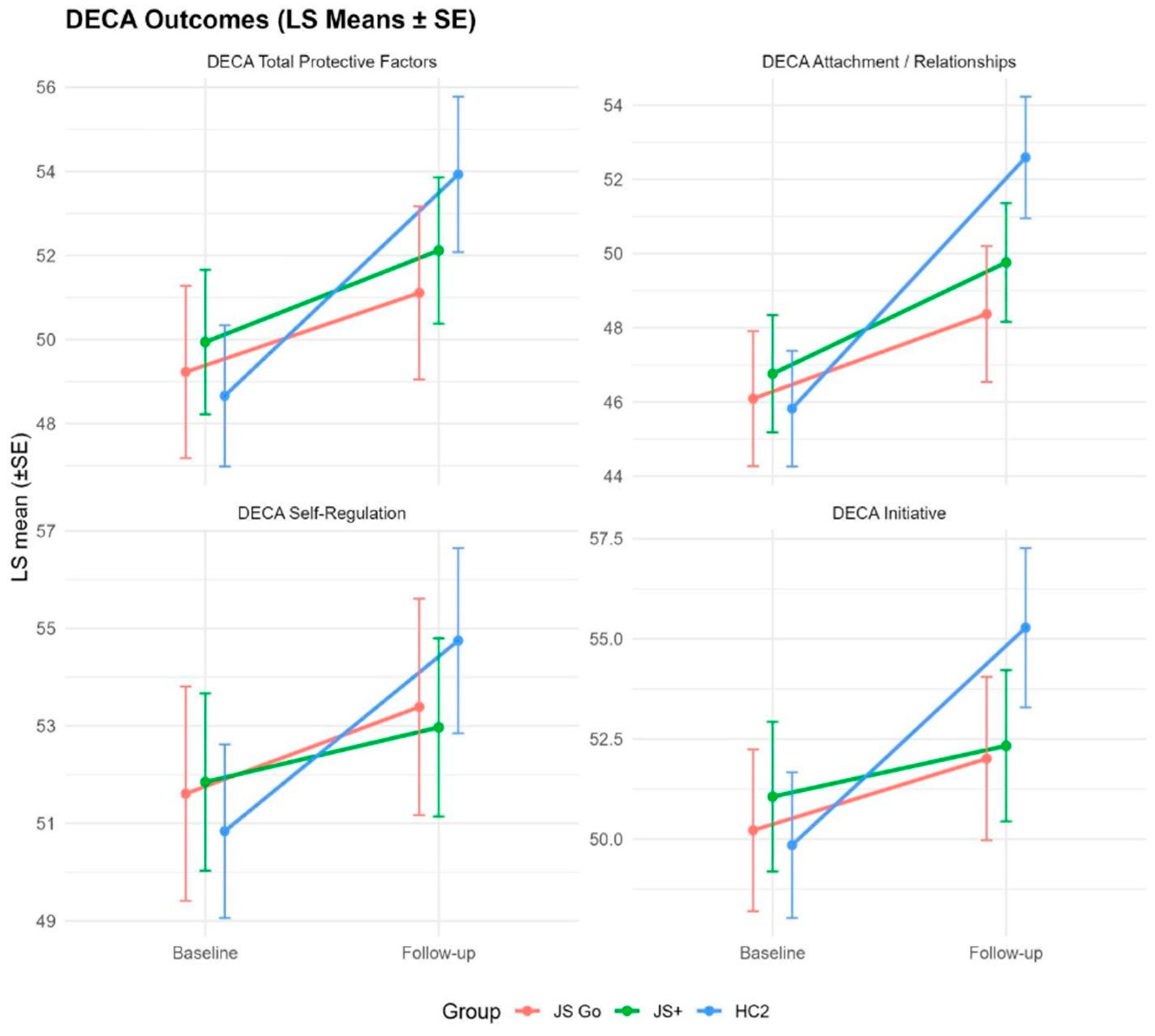
| DECA Total Protective Factors | Baseline | 49.23 (2.05) | [45.10, 53.36] | 49.94 (1.72) | [46.51, 53.37] | 48.66 (1.68) | [45.33, 51.98] | F = 13.55, p = 0.0003 | F = 1.55, p = 0.2150 |
| Follow-up | 51.11 (2.06) | [46.95, 55.26] | 52.12 (1.74) | [48.65, 55.58] | 53.93 (1.85) | [50.27, 57.59] | |||
| DECA Attachment/Relationships | Baseline | 46.09 (1.82) | [42.43, 49.75] | 46.76 (1.58) | [43.62, 49.91] | 45.82 (1.56) | [42.73, 48.90] | F = 25.92, p < 0.0001 | F = 3.03, p = 0.0513 |
| Follow-up | 48.37 (1.83) | [44.68, 52.07] | 49.76 (1.60) | [46.59, 52.93] | 52.59 (1.64) | [49.33, 55.85] | |||
| DECA Self-Regulation | Baseline | 51.61 (2.20) | [47.15, 56.08] | 51.85 (1.82) | [48.22, 55.48] | 50.84 (1.78) | [47.30, 54.37] | F = 6.03, p = 0.0153 | F = 0.80, p = 0.4526 |
| Follow-up | 53.39 (2.22) | [48.90, 57.88] | 52.97 (1.83) | [49.33, 56.60] | 54.75 (1.90) | [50.98, 58.51] | |||
| DECA Initiative | Baseline | 50.22 (2.02) | [46.15, 54.29] | 51.06 (1.87) | [47.36, 54.77] | 49.85 (1.82) | [46.24, 53.46] | F = 11.38, p = 0.0010 | F = 2.27, p = 0.1066 |
| Follow-up | 52.01 (2.04) | [47.91, 56.11] | 52.33 (1.89) | [48.60, 56.07] | 55.28 (1.99) | [51.35, 59.21] | |||
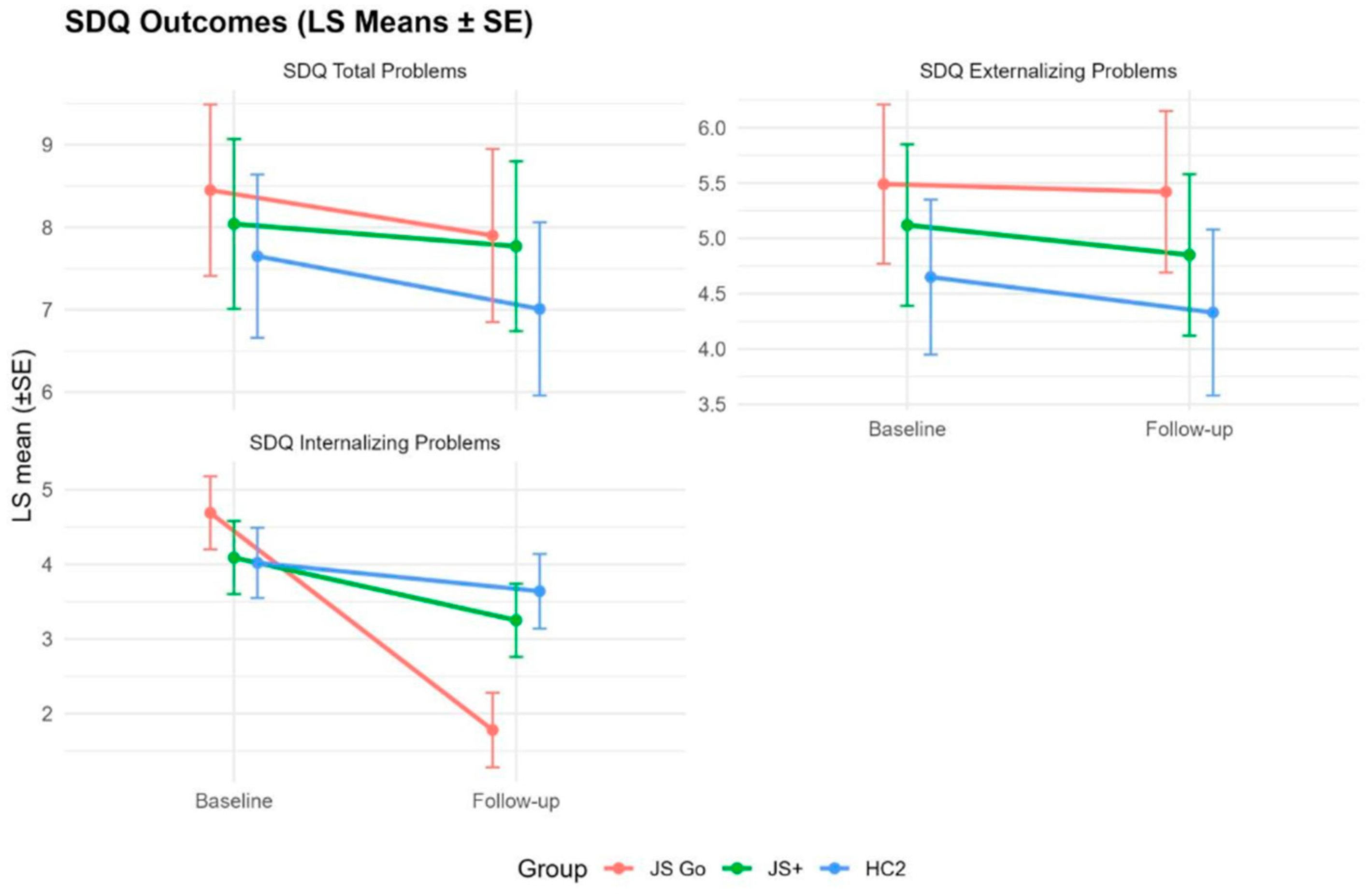
| SDQ Total Problems | Baseline | 8.45 (1.04) | [6.36, 10.55] | 8.04 (1.03) | [5.99, 10.08] | 7.65 (0.99) | [5.69, 9.62] | F = 1.07, p = 0.3033 | F = 0.05, p = 0.9487 |
| Follow-up | 7.90 (1.05) | [5.79, 10.01] | 7.77 (1.03) | [5.72, 9.81] | 7.01 (1.05) | [4.94, 9.09] | |||
| SDQ Externalizing Problems | Baseline | 5.49 (0.72) | [4.04, 6.95] | 5.12 (0.73) | [3.68, 6.56] | 4.65 (0.70) | [3.26, 6.04] | F = 0.40, p = 0.5305 | F = 0.05, p = 0.9543 |
| Follow-up | 5.42 (0.73) | [3.95, 6.88] | 4.85 (0.73) | [3.41, 6.29] | 4.33 (0.75) | [2.86, 5.81] | |||
| SDQ Internalizing Problems | Baseline | 4.69 (0.49) | [3.70, 5.67] | 4.09 (0.49) | [3.12, 5.05] | 4.02 (0.47) | [3.10, 4.95] | F = 28.16, p < 0.0001 | F = 9.65, p = 0.0001 |
| Follow-up | 1.78 (0.50) | [0.79, 2.78] | 3.25 (0.49) | [2.28, 4.22] | 3.64 (0.50) | [2.65, 4.63] | |||
| Outcome | JS Go vs. HC2 Diff (SE) | JS Go vs. HC2 95% CI | Adj p | JS+ vs. HC2 Diff (SE) | JS+ vs. HC2 95% CI | Adj p |
|---|---|---|---|---|---|---|
| DECA Total Protective Factors | −2.82 (2.28) | [−7.45, 1.80] | 0.816 | −1.81 (1.95) | [−5.72, 2.10] | 0.938 |
| DECA Attachment/Relationships | −4.21 (1.93) | [−8.14, −0.28] | 0.25 | −2.83 (1.66) | [−−6.17, 0.51] | 0.529 |
| DECA Self-Regulation | −1.36 (2.44) | [−6.35, 3.64] | 0.994 | −1.78 (2.03) | [−5.88, 2.32] | 0.951 |
| DECA Initiative | −3.27 (2.13) | [−7.61, 1.06] | 0.642 | −2.95 (1.92) | [−6.80, 0.90] | 0.644 |
| SDQ Total Problems | 0.89 (1.03) | [−1.23, 3.01] | 0.954 | 0.75 (0.98) | [−1.21, 2.72] | 0.972 |
| SDQ Externalizing Problems | 1.08 (0.73) | [−0.43, 2.60] | 0.676 | 0.51 (0.71) | [−0.91, 1.93] | 0.978 |
| SDQ Internalizing Problems | −1.86 (0.52) | [−2.92, −0.81] | 0.006 | −0.40 (0.49) | [−1.38, 0.58] | 0.966 |
| Outcome | Time | JS Go Mean (SE) | JS Go 95% CI | JS+ Mean (SE) | JS+ 95% CI | HC2 Mean (SE) | HC2 95% CI | Time Main Effect (F, p) | Intervention × Time (F, p) |
|---|---|---|---|---|---|---|---|---|---|
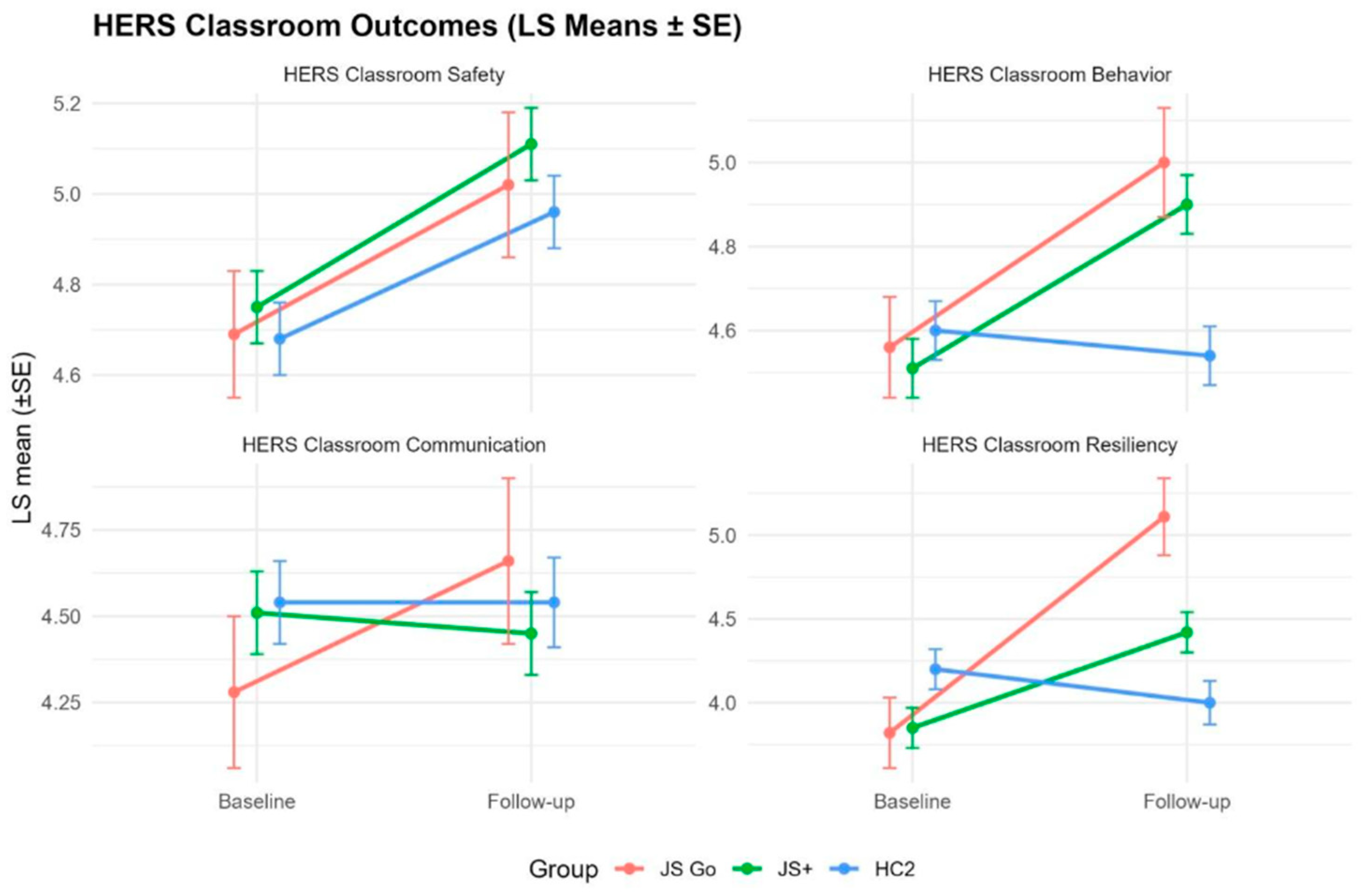
| HERS Classroom Safety | Baseline | 4.69 (0.14) | [4.41, 4.97] | 4.75 (0.08) | [4.59, 4.90] | 4.68 (0.08) | [4.52, 4.84] | F = 12.88, p = 0.0010 | F = 0.11, p = 0.8986 |
| Follow-up | 5.02 (0.16) | [4.71, 5.34] | 5.11 (0.08) | [4.95, 5.26] | 4.96 (0.08) | [4.80, 5.13] | |||
| HERS Classroom Behavior | Baseline | 4.56 (0.12) | [4.33, 4.80] | 4.51 (0.07) | [4.38, 4.64] | 4.60 (0.07) | [4.47, 4.73] | F = 9.66, p = 0.0037 | F = 5.05, p = 0.0118 |
| Follow-up | 5.00 (0.13) | [4.74, 5.26] | 4.90 (0.07) | [4.77, 5.03] | 4.54 (0.07) | [4.40, 4.69] | |||
| HERS Classroom Communication | Baseline | 4.28 (0.22) | [3.85, 4.72] | 4.51 (0.12) | [4.27, 4.75] | 4.54 (0.12) | [4.30, 4.77] | F = 0.51, p = 0.4778 | F = 0.60, p = 0.5541 |
| Follow-up | 4.66 (0.24) | [4.18, 5.14] | 4.45 (0.12) | [4.21, 4.68] | 4.54 (0.13) | [4.29, 4.80] | |||
| HERS Classroom Resiliency | Baseline | 3.82 (0.21) | [3.41, 4.24] | 3.85 (0.12) | [3.61, 4.09] | 4.20 (0.12) | [3.96, 4.44] | F = 14.84, p = 0.0005 | F = 8.95, p = 0.0007 |
| Follow-up | 5.11 (0.23) | [4.65, 5.57] | 4.42 (0.12) | [4.18, 4.66] | 4.00 (0.13) | [3.75, 4.25] | |||
| Brief Resiliency Scale | Baseline | 18.16 (0.75) | [16.69, 19.63] | 17.81 (0.40) | [17.03, 18.59] | 17.84 (0.35) | [17.16, 18.52] | F = 0.70, p = 0.4067 | F = 1.99, p = 0.1492 |
| Follow-up | 16.16 (0.75) | [14.69, 17.63] | 18.28 (0.40) | [17.50, 19.06] | 18.19 (0.38) | [17.45, 18.93] | |||
| Teacher Opinion Survey | Baseline | 47.68 (1.80) | [44.15, 51.21] | 46.88 (1.06) | [44.80, 48.96] | 47.57 (0.96) | [45.69, 49.45] | F = 0.18, p = 0.6714 | F = 0.90, p = 0.4147 |
| Follow-up | 44.68 (1.80) | [41.15, 48.21] | 47.63 (1.06) | [45.55, 49.71] | 48.37 (1.05) | [46.31, 50.43] | |||
| Childcare Worker Job Demands | Baseline | 2.74 (0.27) | [2.22, 3.26] | 2.70 (0.15) | [2.41, 2.99] | 2.70 (0.13) | [2.45, 2.95] | F = 1.34, p = 0.2539 | F = 0.72, p = 0.4914 |
| Follow-up | 2.64 (0.27) | [2.12, 3.16] | 3.12 (0.15) | [2.83, 3.41] | 2.95 (0.14) | [2.68, 3.22] | |||
| Childcare Worker Job Resources | Baseline | 4.61 (0.19) | [4.24, 4.98] | 4.52 (0.11) | [4.30, 4.74] | 4.59 (0.09) | [4.41, 4.77] | F = 0.09, p = 0.7649 | F = 0.38, p = 0.6866 |
| Follow-up | 4.44 (0.19) | [4.07, 4.81] | 4.62 (0.11) | [4.40, 4.84] | 4.52 (0.10) | [4.32, 4.72] | |||
| Childcare Worker Job Control | Baseline | 3.44 (0.23) | [2.99, 3.89] | 3.26 (0.13) | [3.01, 3.51] | 3.22 (0.11) | [3.00, 3.44] | F = 4.75, p = 0.0350 | F = 0.78, p = 0.4671 |
| Follow-up | 2.82 (0.23) | [2.37, 3.27] | 3.01 (0.13) | [2.76, 3.26] | 3.11 (0.12) | [2.87, 3.35] |
| Outcome | JS Go vs. HC2 Diff (SE) | JS Go vs. HC2 95% CI | Adj p | JS+ vs. HC2 Diff (SE) | JS+ vs. HC2 95% CI | Adj p |
|---|---|---|---|---|---|---|
| HERS Classroom Safety | 0.06 (0.18) | [−0.29, 0.41] | 0.999 | 0.14 (0.12) | [−0.09, 0.37] | 0.819 |
| HERS Classroom Behavior | 0.46 (0.15) | [0.16, 0.75] | 0.042 | 0.36 (0.10) | [0.16, 0.55] | 0.011 |
| HERS Classroom Communication | 0.12 (0.27) | [−0.43, 0.66] | 0.998 | −0.10 (0.17) | [−0.44, 0.25] | 0.993 |
| HERS Classroom Resiliency | 1.11 (0.27) | [0.57, 1.65] | 0.003 | 0.42 (0.18) | [0.05, 0.79] | 0.24 |
| Brief Resiliency Scale | −2.02 (0.84) | [−3.70, −0.35] | 0.18 | 0.09 (0.56) | [−1.01, 1.20] | 1 |
| Teacher Opinion Survey | −3.65 (1.99) | [−7.63, 0.32] | 0.46 | −0.65 (1.38) | [−3.41, 2.10] | 1 |
| Childcare Worker Job Demands | −0.32 (0.29) | [−0.90, 0.26] | 0.88 | 0.19 (0.19) | [−0.20, 0.57] | 0.92 |
| Childcare Worker Job Resources | −0.08 (0.21) | [−0.50, 0.35] | 0.999 | 0.10 (0.14) | [−0.19, 0.39] | 0.98 |
| Childcare Worker Job Control | −0.30 (0.26) | [−0.81, 0.22] | 0.86 | −0.11 (0.17) | [−0.45, 0.23] | 0.99 |
Disclaimer/Publisher’s Note: The statements, opinions and data contained in all publications are solely those of the individual author(s) and contributor(s) and not of MDPI and/or the editor(s). MDPI and/or the editor(s) disclaim responsibility for any injury to people or property resulting from any ideas, methods, instructions or products referred to in the content. |
© 2025 by the authors. Licensee MDPI, Basel, Switzerland. This article is an open access article distributed under the terms and conditions of the Creative Commons Attribution (CC BY) license.
Share and Cite
Natale, R.; Velasquez, C.; Pan, Y.; Darabi, M.D.; Agosto, Y.; Hubbard, L.A.; Jent, J.F. Advancing Early Childhood Mental Health Consultation: Evaluating Traditional and AI-Enhanced Approaches to Support Children and Teachers. Educ. Sci. 2026, 16, 53. https://doi.org/10.3390/educsci16010053
Natale R, Velasquez C, Pan Y, Darabi MD, Agosto Y, Hubbard LA, Jent JF. Advancing Early Childhood Mental Health Consultation: Evaluating Traditional and AI-Enhanced Approaches to Support Children and Teachers. Education Sciences. 2026; 16(1):53. https://doi.org/10.3390/educsci16010053
Chicago/Turabian StyleNatale, Ruby, Carolina Velasquez, Yue Pan, Morgan Debra Darabi, Yaray Agosto, Lillian Ashleigh Hubbard, and Jason F. Jent. 2026. "Advancing Early Childhood Mental Health Consultation: Evaluating Traditional and AI-Enhanced Approaches to Support Children and Teachers" Education Sciences 16, no. 1: 53. https://doi.org/10.3390/educsci16010053
APA StyleNatale, R., Velasquez, C., Pan, Y., Darabi, M. D., Agosto, Y., Hubbard, L. A., & Jent, J. F. (2026). Advancing Early Childhood Mental Health Consultation: Evaluating Traditional and AI-Enhanced Approaches to Support Children and Teachers. Education Sciences, 16(1), 53. https://doi.org/10.3390/educsci16010053