Pre-Service Teachers’ Interpretations and Decisions About a 3D Geometry Activity Sequence


Abstract
1. Introduction
2. Literature Review and Theoretical Framework
2.1. Literature Review on Textbooks: Geometry
2.2. Literature Review on Pre-Service Teacher Knowledge of Geometry
2.3. Curricular Noticing Conceptualisation
2.4. Our Study: Objective and Research Questions
- How do PTs interpret characteristics of a textbook activity sequence while also recognising its limitations in supporting students’ learning of polyhedron, prism, and pyramid concepts? (RQ1)
- How do PTs complete the activity sequence to address these limitations? (RQ2)
3. Method
3.1. Participants and Context
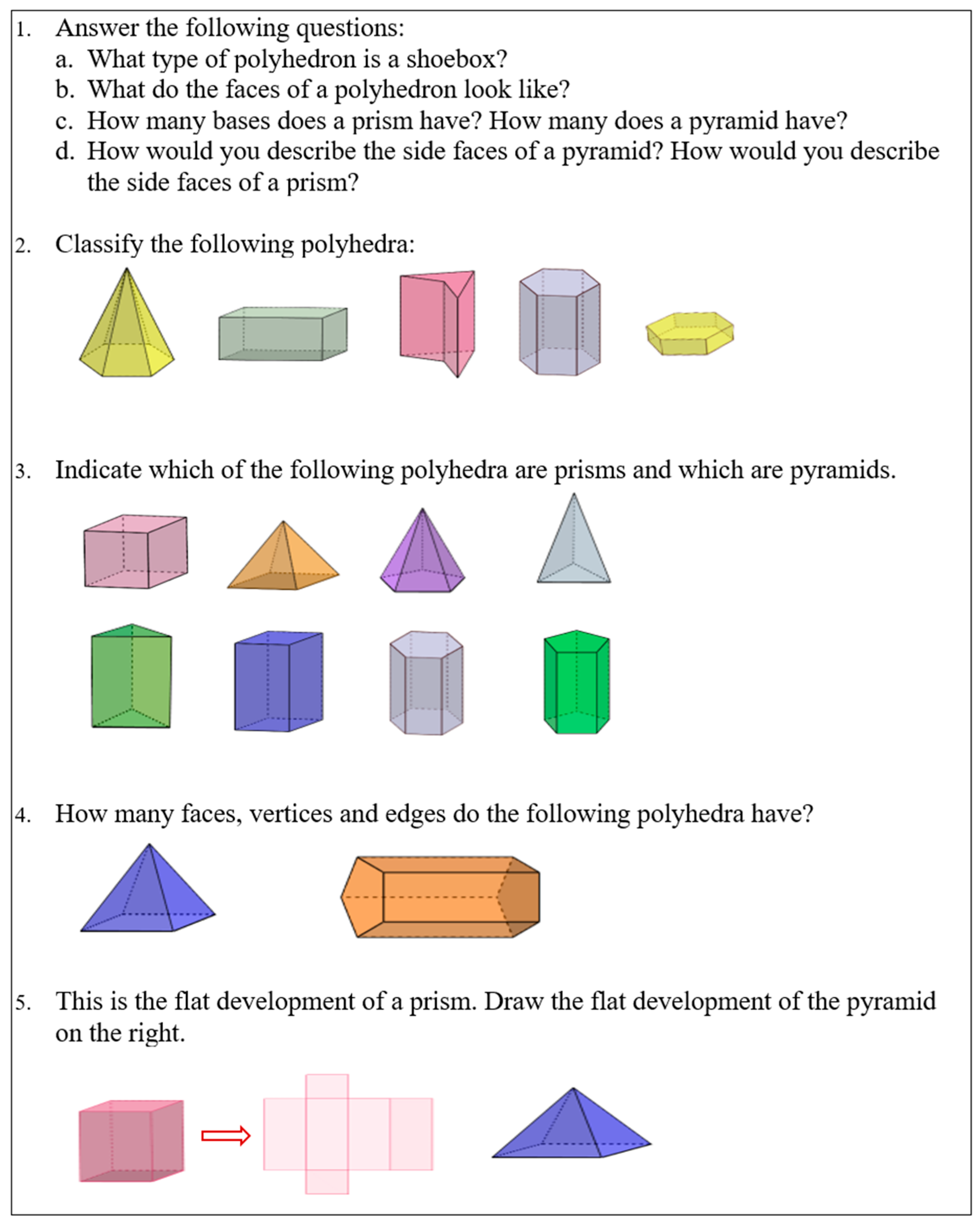
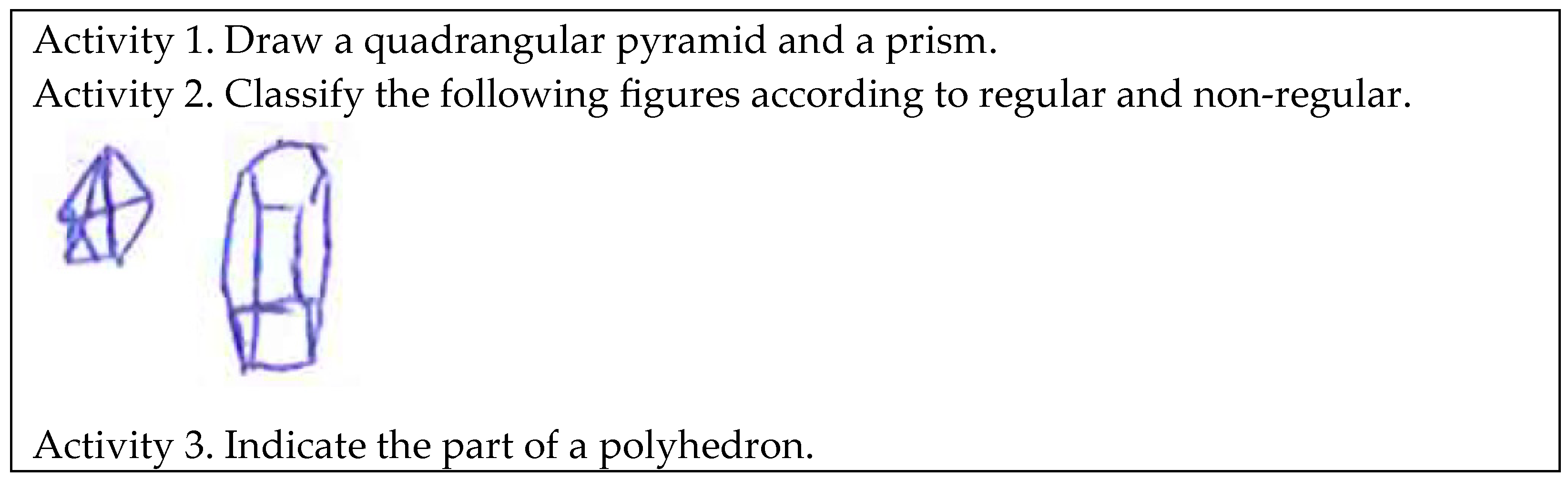
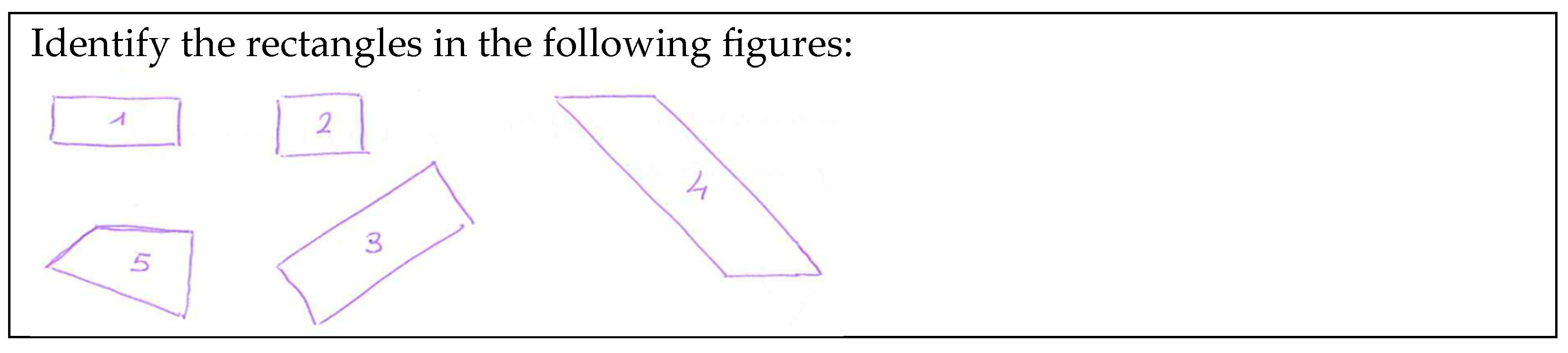
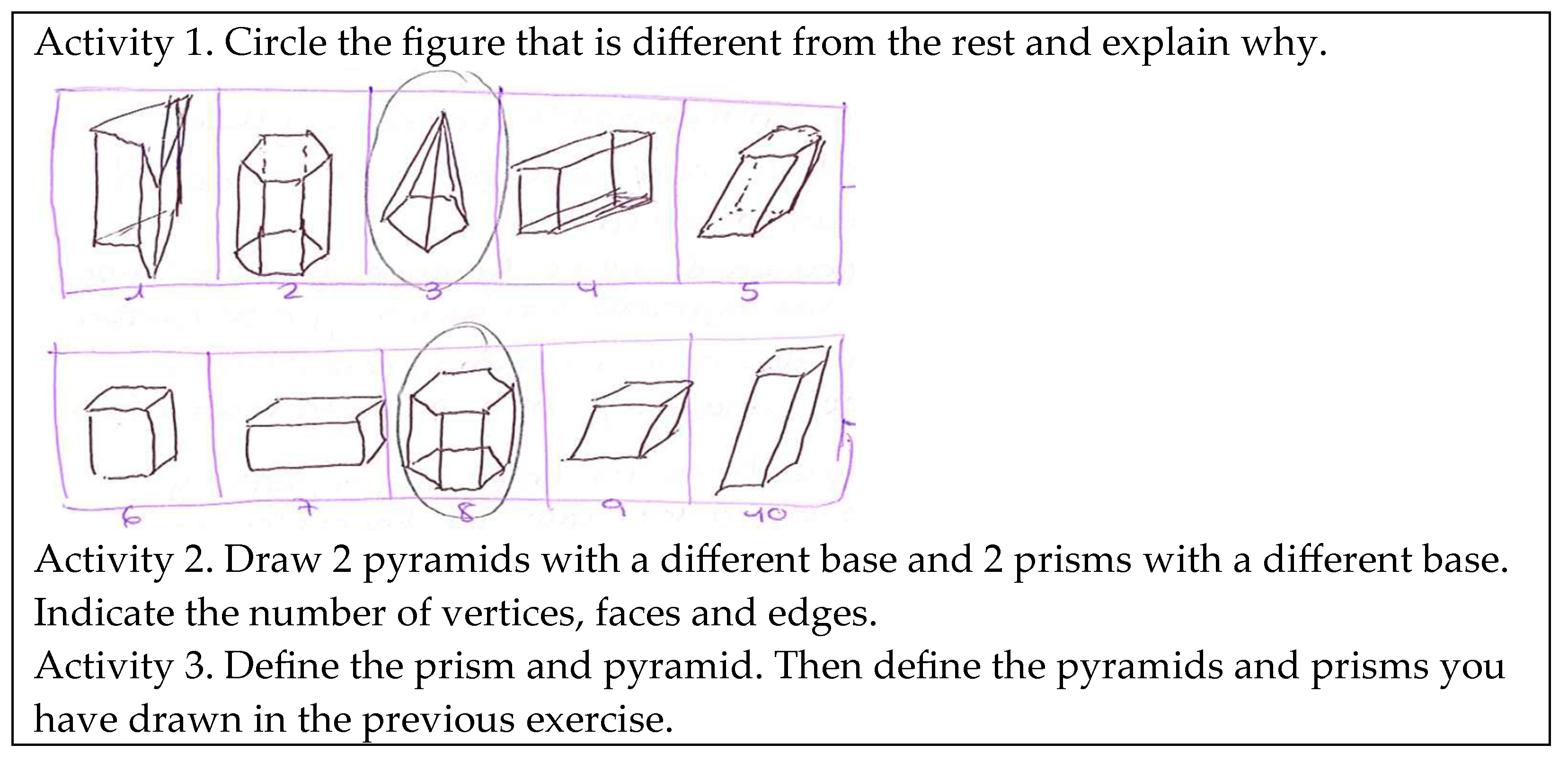
3.2. Instrument: Task and Theoretical Lens
- For each activity, indicate: (i) Which geometrical process/es are used (e.g., recognising, constructing, classifying, etc.); (ii) The attributes of each 3D figure; and (iii) The modes of representation.
- Considering the activity sequence: (i) What other 3D figure attributes could be added to help students acquire the polyhedron, pyramid and prism concepts? (ii) What other geometrical processes could be added? and (iii), What other modes of representation could be introduced?
- Complete the activity sequence (a minimum of 3 activities) to support the students’ understanding of the concepts of polyhedron, prism, and pyramid.
3.3. Data and Analysis
4. Results
4.1. PT Interpretations
4.2. PT Decisions to Address the Limitations
4.2.1. PTs Who Were Not Coherent with Their Interpretations
4.2.2. PTs Who Were Coherent in Relation to Their Interpretation
5. Discussion and Conclusions
Author Contributions
Funding
Institutional Review Board Statement
Informed Consent Statement
Data Availability Statement
Conflicts of Interest
Abbreviations
| 3D | three-dimensional |
| PTs | pre-service primary school teachers |
References
- Amador, J. M., Males, L. M., Earnest, D., & Dietiker, L. (2017). Curricular noticing: Theory on and practice of teachers’ curricular use. In E. O. Schack, M. H. Fisher, & J. A. Wilhelm (Eds.), Teacher noticing: Bridging and broadening perspectives, contexts, and frameworks (pp. 427–443). Springer. [Google Scholar] [CrossRef]
- Aslan-Tutak, F., & Adams, T. L. (2015). A study of geometry content knowledge of elementary preservice teachers. International Electronic Journal of Elementary Education, 7(3), 301–318. [Google Scholar]
- Barnhart, T., & van Es, E. (2015). Studying teacher noticing: Examining the relationship among pre-service science teachers’ ability to attend, analyze and respond to student thinking. Teaching and Teacher Education, 45, 83–93. [Google Scholar] [CrossRef]
- Barrantes-López, M., López, M. L., & Fernández-Leno, M. (2014). Las representaciones geométricas en los libros de textos utilizados en la Comunidad Autónoma de Extremadura. Campo Abierto: Revista de Educación, 33(1), 97–116. [Google Scholar]
- Battista, M. (2012). Cognition-based assessment & teaching of geometric shapes. Building on students’ reasoning. Heinemann. [Google Scholar]
- Bernabeu, M., Moreno, M., & Llinares, S. (2021). Anticipating primary school students’ answers of hierarchical classifications tasks: Features of preservice primary teachers’ curricular reasoning. Acta Scientiae, 23(6), 121–146. [Google Scholar] [CrossRef]
- Blanco, T. F., González-Roel, V., Diego-Mantecón, J. M., & Ortiz-Laso, Z. (2021). Análisis de la conexión arte-matemáticas en los libros de texto de educación primaria. Educación Matemática, 33(3), 67–93. [Google Scholar] [CrossRef]
- Buforn, A., Llinares, S., Fernández, C., Coles, A., & Brown, L. (2022). Pre-service teachers’ knowledge of the unitizing process in recognizing students’ reasoning to propose teaching decisions. International Journal of Mathematical Education in Science and Technology, 53(2), 425–443. [Google Scholar] [CrossRef]
- Callejo, M. L., & Zapatera, A. (2017). Prospective primary teachers’ noticing of students’ understanding of pattern generalization. Journal of Mathematics Teacher Education, 20, 309–333. [Google Scholar] [CrossRef]
- Cavanagh, M., & Tran, D. (2023). Pre-service teachers’ curricular noticing when providing feedback on peers’ lesson plans. In M. Ayalon, B. Koichu, R. Leikin, L. Rubel, & M. Tabach (Eds.), Proceeding of the 46th conference of the international group for the psychology of mathematics education (Vol 2, pp. 171–178). PME. [Google Scholar]
- Choy, B. H., & Dindyal, J. (2021). Productive teacher noticing and affordances of typical problems. ZDM—Mathematics Education, 53(1), 195–213. [Google Scholar] [CrossRef]
- Dietiker, L., Males, L. M., Amador, J. M., & Earnest, D. (2018). Curricular noticing: A framework to describe teachers’ interactions with curriculum material. Journal for Research in Mathematics Education, 49(5), 521–532. [Google Scholar] [CrossRef]
- Dindyal, J., Schack, E. O., Choy, B. H., & Sherin, M. G. (2021). Exploring the terrains of mathematics teacher noticing. ZDM—Mathematics Education, 53(1), 1–16. [Google Scholar] [CrossRef]
- Díaz-Levicoy, D., Ferrada, C., & Salgado-Orellana, N. (2019). Estudio sobre las actividades de evaluación en geometría propuestas en los libros de texto chilenos de Educación Primaria. TANGRAM-Revista de Educação Matemática, 2(4), 19–41. [Google Scholar] [CrossRef]
- Earnest, D., & Amador, J. M. (2019). Lesson planimation: Prospective elementary teachers’ interactions with mathematics curricula. Journal of Mathematics Teacher Education, 22, 37–68. [Google Scholar] [CrossRef]
- Fan, L., Zhu, Y., & Miao, Z. (2013). Textbook research in mathematics education: Development status and directions. ZDM—Mathematics Education, 45(5), 633–646. [Google Scholar] [CrossRef]
- Fernández, C., & Choy, B. H. (2019). Theoretical lenses to develop mathematics teacher noticing. In S. Llinares, & O. Chapman (Eds.), International handbook of mathematics teacher education: Volume 2 (pp. 337–360). Brill. [Google Scholar] [CrossRef]
- Fernández, C., Sánchez-Matamoros, G., Valls, J., & Callejo, M. L. (2018). Noticing students’ mathematical thinking: Characterization, development and contexts. Avances de Investigación en Educación Matemática, 13, 39–61. [Google Scholar] [CrossRef]
- Ferrero de Pablo, L., Martín Martín, P., & Gómez Quesada, J. M. (2018). Matemáticas 5 primaria: Pieza a Pieza. Anaya. [Google Scholar]
- Girit-Yildiz, D., & Ulusoy, F. (2024). Investigating how prospective mathematics teachers prepare history integrated lesson plans with assessing historical elements in mathematics textbooks. International Journal of Science and Mathematics Education, 22(2), 307–331. [Google Scholar] [CrossRef]
- Glasnovic Gracin, D. (2018). Requirements in mathematics textbooks: A five-dimensional analysis of textbook exercises and examples. International Journal of Mathematical Education in Science and Technology, 49(7), 1003–1024. [Google Scholar] [CrossRef]
- Gupta, D., Soto, M., Dick, L., Broderick, S. D., & Appelgate, M. (2018). Noticing and deciding the next steps for teaching: A cross-university study with elementary pre-service teachers. In G. J. Stylianides, & K. Hino (Eds.), Research advances in the mathematical education of pre-service elementary teachers. An international perspective (pp. 261–275). Springer. [Google Scholar] [CrossRef]
- Ivars, P., Fernández, C., & Llinares, S. (2020). Uso de una trayectoria hipotética de aprendizaje para proponer actividades de instrucción. Enseñanza de las Ciencias, 38(3), 105–124. [Google Scholar] [CrossRef]
- Ivars, P., Fernández, C., Llinares, S., & Choy, B. H. (2018). Enhancing noticing: Using a hypothetical learning trajectory to improve pre-service primary teachers’ professional discourse. Eurasia Journal of Mathematics, Science and Technology Education, 14(11), em1599. [Google Scholar] [CrossRef]
- Jacobs, V. R., Empson, S. B., Jessup, N. A., Dunning, A., Pynes, D., Krause, G., & Franke, T. M. (2024). Profiles of teachers’ expertise in professional noticing of children’s mathematical thinking. Journal of Mathematics Teacher Education, 27(3), 295–324. [Google Scholar] [CrossRef]
- Jacobs, V. R., Lamb, L. L. C., & Philipp, R. A. (2010). Professional noticing of children’s mathematical thinking. Journal for Research in Mathematics Education, 41(2), 169–202. [Google Scholar] [CrossRef]
- Jones, K., Mooney, C., & Harries, T. (2002). Trainee primary teachers’ knowledge of geometry for teaching. Proceedings of the British Society for Research into Learning Mathematics, 22(2), 95–100. [Google Scholar]
- Kurt-Birel, G., Deniz, S., & Önel, F. (2020). Analysis of primary school teachers’ knowledge of geometry. International Electronic Journal of Elementary Education, 12(4), 303–309. [Google Scholar] [CrossRef]
- Llinares, S., Fernández, C., Ivars, P., González-Forte, J. M., & Zorrilla, C. (2025). Features of pre-service primary school teachers’ curricular noticing: The fraction concept. ZDM—Mathematics Education. [Google Scholar] [CrossRef]
- McDuffie, A. R., Chopping, J., Drake, C., & Davis, J. (2018). Middle school mathematics teachers’ orientations and noticing of mathematics curriculum materials. International Journal of Educational Research, 92, 173–187. [Google Scholar] [CrossRef]
- Moreno, M., Sánchez-Matamoros, G., Callejo, M. L., Pérez-Tyteca, P., & Llinares, S. (2021). How prospective kindergarten teachers develop their noticing skills: The instrumentation of a learning trajectory. ZDM—Mathematics Education, 53(1), 57–72. [Google Scholar] [CrossRef]
- Mthethwa, H. M., Ogbonnaya, U. I., & Van Putten, S. (2024). Context in geometry in secondary school mathematics textbooks. Acta Didactica Napocensia, 17(2), 112–124. [Google Scholar] [CrossRef]
- Purnomo, Y. W., Julaikah, A. A., Hapsari, G. C. A., Oktavia, R. C., & Ikhsan, R. M. (2024). A comparison of angle problems in Indonesian and Singaporean elementary school mathematics textbooks. Mathematics Teaching Research Journal, 15(6), 146–170. [Google Scholar]
- Purnomo, Y. W., Shahrill, M., Pandansari, O., Susanti, R., & Winarni, W. (2022). Cognitive demands on geometrical tasks in Indonesian elementary school mathematics textbook. Jurnal Elemen, 8(2), 466–479. [Google Scholar] [CrossRef]
- Rotem, S. H., & Ayalon, M. (2024). Constructing coherency levels to understand connections among the noticing skills of pre-service mathematics teachers. Journal of Mathematics Teacher Education, 27(4), 579–605. [Google Scholar] [CrossRef]
- Shayeb, H., Shahbari, J. A., & Haj-Yahya, A. (2025). First-and second-grade prospective teachers reconstructing definitions of polygon diagonals. Mathematics Education Research Journal, 37, 399–426. [Google Scholar] [CrossRef]
- Strauss, A., & Corbin, J. (1990). Basic of grounded theory methods. Sage. [Google Scholar]
- Sunzuma, G., & Maharaj, A. (2019). In-service teachers’ geometry content knowledge: Implications for how geometry is taught in teacher training institutions. International Electronic Journal of Mathematics Education, 14(3), 633–646. [Google Scholar] [CrossRef]
- Weyers, J., König, J., Scheiner, T., Santagata, R., & Kaiser, G. (2024). Teacher noticing in mathematics education: A review of recent developments. ZDM—Mathematics Education, 56(2), 249–264. [Google Scholar] [CrossRef]
- Yang, D. C., Tseng, Y. K., & Wang, T. L. (2017). A comparison of geometry problems in middle-grade mathematics textbooks from Taiwan, Singapore, Finland, and the United States. Eurasia Journal of Mathematics, Science and Technology Education, 13(7), 2841–2857. [Google Scholar] [CrossRef]
- Zhang, Q., Choy, B. H., & Lee, M. Y. (2025). Teacher noticing in diverse educational contexts: Concepts, research, and future pathways. ECNU Review of Education, 8(3), 924–934. [Google Scholar] [CrossRef]
- Zorrilla, C., González-Forte, J. M., Ivars, P., & Fernández, C. (2024). Mirar profesionalmente los materiales curriculares: Coherencia entre interpretar y decidir. In N. Adamuz-Povedano, E. Fernández-Ahumada, N. Climent, & C. Jiménez-Gestal (Eds.), Investigación en educación matemática XXVII (pp. 537–544). SEIEM. [Google Scholar]


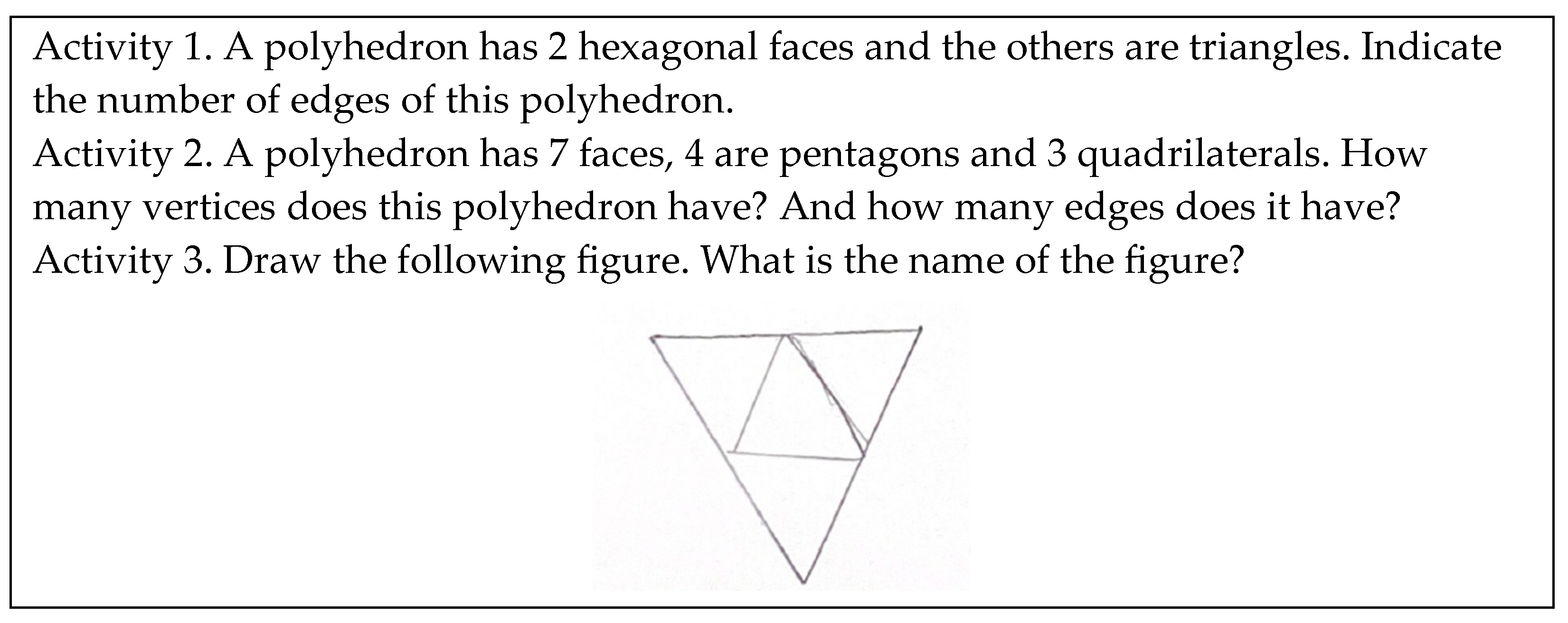
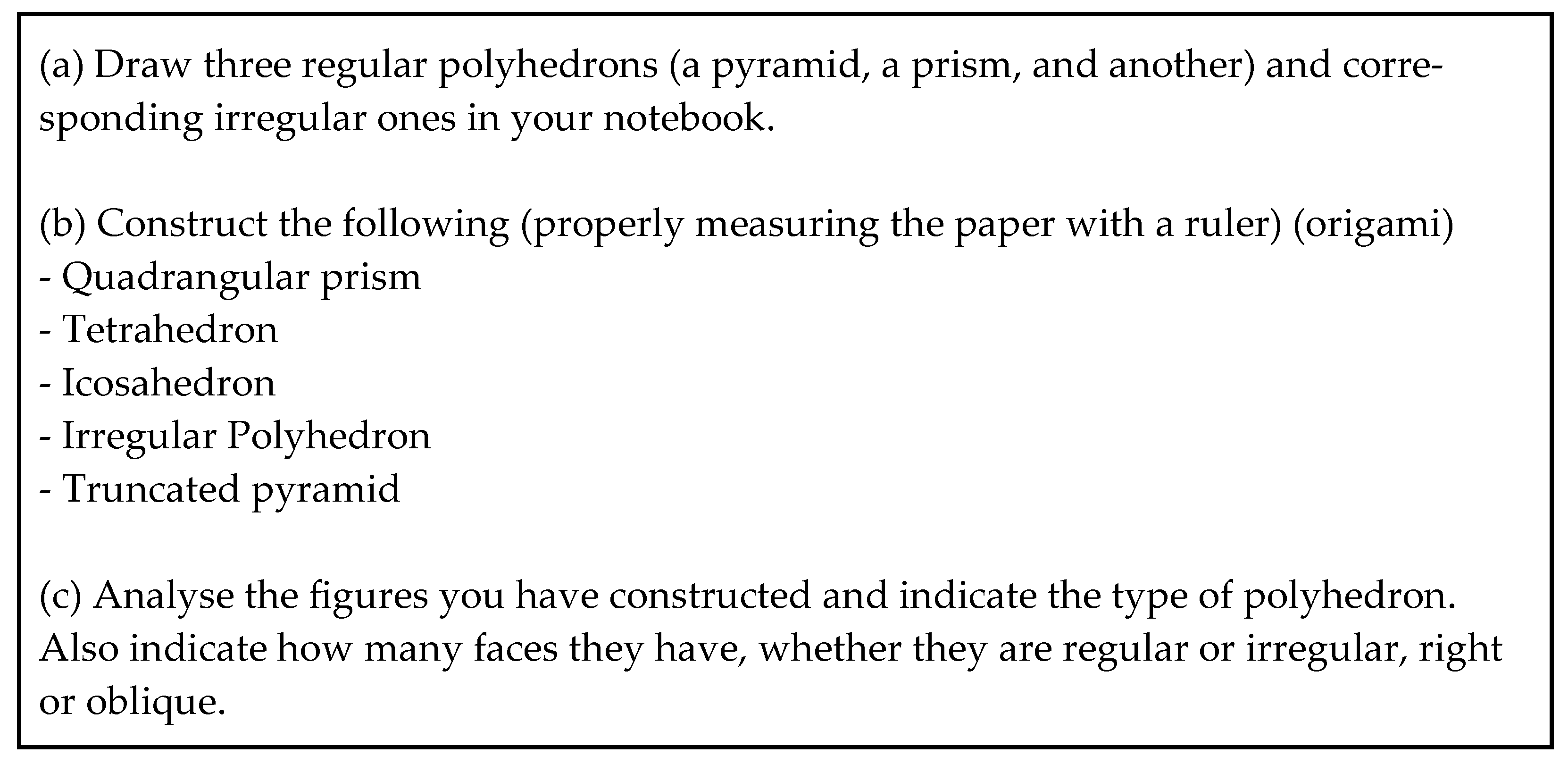



| Characteristic | PT Answer | Description | Category |
|---|---|---|---|
| Attributes | To understand the polyhedron concept, we could propose activities to work on concavity and convexity. These attributes can also be worked on using prisms and pyramids. | PT01 identifies “concavity and convexity” as a missing attribute in the sequence | “concave/convex” |
| Geometrical process | Among the geometrical processes, those of recognising attributes, classifying and constructing figures are addressed. We could therefore propose activities in which students need to define figures. | PT01 identifies “defining” as a missing geometrical process in the sequence | “defining” |
| Mode of representation | To promote understanding, we could use concrete materials such as the polydron. | PT01 identifies a “manipulative” as a mode of representation missing in the sequence | “manipulative” |
| Attributes | Concave polyhedra, irregular polyhedra, polyhedra in non-prototypical positions, oblique polyhedra. | PT02 identifies “concavity, irregularity, obliquity and non-prototypical positions” as missing attributes in the sequence | “concave/convex”; “oblique/right”; “regular/irregular”; “non-prototypical” |
| Geometrical process | I would suggest tasks involving figure definition and construction, since most activities involve identifying and classifying. | PT02 identifies “defining” as a missing geometrical process in the sequence | “defining” |
| Mode of representation | Graphical representation and using concrete materials would help to support understanding. | PT02 identifies “concrete materials” (manipulatives) as a mode of representation missing in the sequence | “manipulatives” |
| PT Answer | Identified Characteristics Which Differed from the Textbook Sequence |
|---|---|
| PT03’s answer Activity 1. Define the following figure 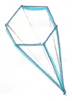 Activity 2. Construct a heptagonal right prism. Activity 3. Classify the following figures into prisms or pyramids and according to the base (quadrangular or triangular):  | Attributes: number of base sides (hexagonal, triangular, etc.) Geometrical processes: defining |
| PT02’s answer Activity 1. Draw the figure  Activity 2. Define the figures that appear in activity 1. Activity 3. Classify the figures in activity 1 according to the number of the sides of their bases. | Attributes: number of base sides Geometrical processes: defining |
| Relating Interpreting and Deciding | Coherence | Other Characteristics and PTs Difficulties | |
|---|---|---|---|
| PT02 | PT02 identifies “defining” as a missing geometrical process in the sequence and designs an activity of defining | Coherence with: geometrical processes | This PT adds an attribute “number of base sides” that had not previously been identified. Any inaccuracy was detected in the designed activity sequence. |
| Attributes | Number of PTs |
|---|---|
| Attributes, geometrical processes and modes of representation | 37 |
| Attributes and geometrical processes | 11 |
| Geometrical processes and modes of representation | 5 |
| Attributes and modes of representation | 15 |
| Attributes | 10 |
| Geometrical processes | 1 |
| Modes of representation | 6 |
| Attributes | Number of PTs |
|---|---|
| Attributes, geometrical processes and modes of representation | 1 |
| Attributes and geometrical processes | 3 |
| Attributes and modes of representation | 7 |
| Geometrical processes and modes of representation | 3 |
| Attributes | 38 |
| Geometrical processes | 7 |
| Modes of representation | 9 |
Disclaimer/Publisher’s Note: The statements, opinions and data contained in all publications are solely those of the individual author(s) and contributor(s) and not of MDPI and/or the editor(s). MDPI and/or the editor(s) disclaim responsibility for any injury to people or property resulting from any ideas, methods, instructions or products referred to in the content. |
© 2025 by the authors. Licensee MDPI, Basel, Switzerland. This article is an open access article distributed under the terms and conditions of the Creative Commons Attribution (CC BY) license.
Share and Cite
Fernández, C.; Ortiz-Laso, Z.; Saorín, A.; Bernabeu, M. Pre-Service Teachers’ Interpretations and Decisions About a 3D Geometry Activity Sequence. Educ. Sci. 2026, 16, 54. https://doi.org/10.3390/educsci16010054
Fernández C, Ortiz-Laso Z, Saorín A, Bernabeu M. Pre-Service Teachers’ Interpretations and Decisions About a 3D Geometry Activity Sequence. Education Sciences. 2026; 16(1):54. https://doi.org/10.3390/educsci16010054
Chicago/Turabian StyleFernández, Ceneida, Zaira Ortiz-Laso, Antonio Saorín, and Melania Bernabeu. 2026. "Pre-Service Teachers’ Interpretations and Decisions About a 3D Geometry Activity Sequence" Education Sciences 16, no. 1: 54. https://doi.org/10.3390/educsci16010054
APA StyleFernández, C., Ortiz-Laso, Z., Saorín, A., & Bernabeu, M. (2026). Pre-Service Teachers’ Interpretations and Decisions About a 3D Geometry Activity Sequence. Education Sciences, 16(1), 54. https://doi.org/10.3390/educsci16010054