


Abstract
In a low-reading-achievement context, this study examines the applicability of the Simple View of Reading in the Dominican Republic, a Spanish-speaking country, assessing elementary students across the first seven years of formal schooling, and it investigates the contribution of key psycholinguistic precursors to decoding fluency and reading comprehension across public and private schools. Structural equation models were estimated for a sample of 1168 Dominican students across three grade-level clusters and for each educational subsystem (public vs. private). Model fit indices support the adequacy of the proposed latent structure. Our findings reveal that decoding emerges as the primary predictor of reading comprehension in the early grades, whereas language comprehension becomes increasingly influential in later grades—although this shift appears to occur later than reported in other contexts, particularly within public schools. Moreover, phonological awareness contributes persistently to decoding (even in 6th–7th), supporting the hypothesis of delayed decoding automatization, which could account for the reading-comprehension difficulties identified in international assessments. Socioeconomic position exhibits a decreasing effect on reading comprehension as students’ progress through school, although it remains significant at all grades. These findings highlight the need for educational policy approaches that accelerate decoding automatization to free cognitive resources for comprehension processes, emphasizing effective phonological-awareness training and explicit, systematic literacy instruction.
1. Introduction
Reading comprehension is one of the strongest predictors of academic success (Bastug, 2014; revise (Clinton-Lisell et al., 2022) for a meta-analysis). It also promotes the development of critical thinking and autonomy in the acquisition of new knowledge. These characteristics result in citizens who are better educated and possess greater critical capacity. In a context such as the Dominican Republic, this becomes especially relevant given the country’s high school dropout rates: only 15.4% of students reach university level, and 37.5% will not finish primary education (Oficina Nacional de Estadística de la República Dominicana, 2014). The country shows very low academic performance in indicators such as reading comprehension, ranking 76th out of 81 countries evaluated in the PISA reading assessment (OECD, 2023), and in the ERCE reading test, 73% of 3rd-grade students remain at the lowest performance level, compared to 44.3% in Latin America and the Caribbean, as well as 40.7% of 6th-grade students compared to 23.3% in the region (UNESCO, 2021). In this context, it is urgent to identify a model—adapted to the local social reality—that may inform public policies aimed at improving and facilitating Dominican students’ learning processes.
One of the most widely used models to explain performance differences in reading comprehension is the Simple View of Reading (SVR; Gough & Tunmer, 1986; Hoover & Gough, 1990). The theory posits that reading comprehension performance is the product of oral language comprehension and decoding ability (understood as the ability to convert written words into their oral form, either aloud or silently).
SVR understands the relationship between decoding and language comprehension as multiplicative rather than additive. This reflects the theoretical assumption that successful reading comprehension requires the simultaneous availability of both components. If either component is severely constrained, reading comprehension will be compromised. The model predicts the existence of reader profiles, including readers with decoding difficulties (poor decoding and intact oral language), and readers with language difficulties (good decoders with weak oral language). It also predicts developmental shifts in the relative contribution of each component, decoding having stronger influence in the initial phases of reading instruction, and language comprehension becoming increasingly dominant as decoding becomes automatized.
The language-comprehension factor of SVR is constructed on lexical-semantic, morphological, and syntactic knowledge; however, both the Reading Rope and the Active View of Reading, models that further complement SVR, stress the importance of cultural knowledge (content knowledge relevant to the text), literary knowledge (genres and text structures), and verbal reasoning (Duke & Cartwright, 2021; Scarborough, 2001). In studies testing the Simple View of Reading, the language-comprehension component has frequently been measured through listening tasks with examiner-read texts followed by comprehension questions, following the original theoretical proposal (Gough & Tunmer, 1986). Other studies have used indirect measures of oral comprehension, with vocabulary being the most frequently assessed ability (Ripoll Salceda et al., 2014), followed by morphosyntactic skills.
The decoding ability factor of SVR refers to the set of processes that allow written symbols to be translated into their corresponding phonological forms, therefore enabling access to lexical representations. One of the reference models describing the strategies used to decode written language is the Dual Route model (Coltheart et al., 2001; Coltheart & Rastle, 1994), which posits the existence of two different but compatible parallel strategies: the nonlexical route, in which graphemes are sequentially converted into phonemes to form words (allowing pseudoword reading), and the lexical route, in which the reader directly recognizes known words. Scarborough (2001) and Duke and Cartwright (2021) integrate both strategies into their models, under the labels decoding and visual recognition. Beginner readers learning in transparent orthographies such as Spanish mainly employ the former strategy. As they repeatedly read the same words correctly, they internalize visual patterns that allow direct, faster, and more cognitively efficient word recognition (the self-teaching mechanism described by (Share, 1995)). This mechanism relates to Automaticity Theory, which posits that increasingly rapid and efficient word recognition through wider use of the lexical route allows cognitive resources to shift from decoding to comprehension (Cooper et al., 2024; LaBerge & Samuels, 1974).
In turn, learning to decode is built upon specific psycholinguistic abilities recognized as precursors to reading. Phonological awareness (PA) is associated with learning to decode through the nonlexical route, particularly with accuracy (Suárez-Coalla et al., 2013), and is therefore highly relevant at the beginning of reading acquisition, but its predictive weight declines quickly, especially in transparent orthographies (Furnes & Samuelsson, 2010). Rapid automatized naming (RAN) is related to the acquisition of reading fluency and tends to gain increasing relevance in decoding from 1st grade onward (Vaessen & Blomert, 2010). Finally, short-term verbal memory (STVM) has been described as influencing decoding (Peng et al., 2018), although evidence suggests that its contribution may be smaller—or even nonexistent—in transparent orthographies (Caravolas et al., 2012; Cubilla-Bonnetier & Sánchez-Vincitore, 2025).
The two components of SVR (language comprehension and decoding ability) explain 61% of the variance in reading comprehension during the early years of primary education in studies conducted in languages with opaque orthographies (Quinn & Wagner, 2018), although some of this explained variance may be due to measurement error associated with instruments and may in fact be around 50% (Ripoll Salceda et al., 2014). The model has shown validity in multiple orthographies (Florit & Cain, 2011), including Spanish, although it appears to explain a smaller proportion of reading-comprehension variance: in Peru, the model explained 28% in 1st grade and 27% in 3rd grade (Tapia Montesinos et al., 2022), and in Chile 31% in 2nd grade and 11% in 4th grade (Infante et al., 2012), in Peru in high-SES students and in Chile in public-school students. Additionally, experimental results show that during the first stages of learning to read, reading comprehension strongly depends on decoding ability, while oral comprehension progressively becomes the main explanatory factor after the decoding “bottleneck period” (Quinn & Wagner, 2018). Studies in Spanish confirm this pattern, although the contribution of decoding seems to decline earlier as decoding becomes automated sooner in transparent orthographies (Tapia Montesinos et al., 2022; Tobia & Bonifacci, 2015). Transparent orthographies are writing systems in which grapheme–phoneme correspondences are highly consistent and largely one-to-one, allowing words to be decoded reliably through systematic phonological recoding, such as Spanish.
The SVR has been revised and expanded without refuting its main components. The Reading Rope model (Scarborough, 2001) specifies the components of each of the two main factors: language comprehension includes vocabulary, language structure, background knowledge, verbal reasoning, and literary knowledge, and decoding fluency is explained by phonological awareness, decoding skills (alphabet knowledge, grapheme-phoneme correspondences, blending skills), and visual (orthographic or direct) word recognition. Scarborough also incorporates the idea that these components do not operate separately but are intertwined and mutually reinforce each other gradually as reading ability develops. Likewise, the Active View of Reading (Duke & Cartwright, 2021) expands the model by adding a third factor of self-regulation and executive functions (inhibition, working memory, cognitive flexibility, planning, and monitoring). It also incorporates other key components such as motivation, sociocultural context, and so-called bridging processes (vocabulary, phonological awareness, graphophonemic-semantic cognitive flexibility, concepts about reading, reading fluency).
In low-reading-achievement contexts, as observed in some Latin America–Caribbean countries, the SVR has shown a good fit, but appears to present certain specific features. As noted, in transparent orthographies the contribution of decoding declines rapidly, such that in 3rd grade it is practically non-existent and language comprehension becomes dominant (Tapia Montesinos et al., 2022). However, in Panama, a Spanish-speaking country, the contribution of decoding (specifically, accuracy) did not decline until after 4th grade (Cubilla-Bonnetier & Sánchez-Vincitore, 2025), similar to what was observed in the Dominican Republic (Sánchez-Vincitore et al., 2022), which is also a Spanish-speaking country. Moreover, in both contexts another particularity was documented: a very late dependence on phonological-awareness skills (even up to 4th grade), whereas in transparent orthographies this ability is expected to cease contributing after 1st grade (Defior, 2008; Furnes & Samuelsson, 2010).
In the Dominican Republic, beyond the low performance in international reading-comprehension tests, a substantial reading-achievement gap has been documented between public and private schools. Part of this gap is attributable to differences between educational systems and another part to marked socioeconomic differences between students in both systems (Cubilla-Bonnetier et al., 2025, based on the same dataset used in the present work), such that public-school students may be considered to face a double vulnerability.
The National Policy for Early Literacy at the Appropriate Stage (Consejo Nacional de Educación, 2023) of the Dominican Republic defines early literacy as a fundamental right and a shared responsibility of the education system, aiming to ensure that all children complete initial literacy by the end of the first cycle of primary education (third grade). In response to persistently low achievement in reading, writing, and mathematics, the policy prioritizes early, systematic, and equitable intervention. Despite these advances, implementation has faced challenges related to the prevailing instructional orientation, which has emphasized a textual–communicative and constructivist approach. While this orientation foregrounds meaning-making and exposure to diverse text types, it places comparatively less emphasis on the systematic development of phonics and reading automaticity. Although the current curriculum recognizes phonics as a foundational skill, it does not clearly articulate a developmentally sequenced progression through which automaticity can be established, limiting the extent to which higher-level textual processes can be fully supported.
Considering all the above, the present study pursued two objectives, both aimed at informing educational policies: (1) to examine the functioning of the principles of the SVR and the contribution of psycholinguistic variables to decoding in a low-reading-achievement context such as the Dominican Republic; and (2) to explore the effect of SES and school type (public or private) on the functioning of SVR parameters.
2. Materials and Methods
2.1. Participants
We evaluated 1168 participants (51.6% from the public educational system, 54.7% girls) from 27 randomly selected public and private schools across the metropolitan region of Santo Domingo (Dominican Republic). Three clusters were considered according to reading-development stage: end of 2nd–beginning of 3rd grade (n = 380), end of 4th–beginning of 5th grade (n = 408), and end of 6th–beginning of 7th grade (n = 380). In each selected school, all students whose families provided explicit consent were evaluated. Assessments were administered by evaluators specifically trained by the project researchers and were conducted simultaneously in public and private schools to prevent developmental differences between both groups.
2.2. Instruments
Reading comprehension (RC), the dependent variable of the study, was assessed through different tasks from the text comprehension subtest of PROLEC-R (Cuetos et al., 2014).
To compose the decoding factor (D), we selected the variables syllable reading (evaluated with the ECLEC test; Cubilla-Bonnetier & Sánchez-Vincitore, 2023) and word reading, pseudoword reading, and text reading, taken from PROLEC-R (Cuetos et al., 2014). For each of these measures, a fluency variable was constructed (correct items read per minute): syllable reading fluency (S), word reading fluency (W), pseudoword reading fluency (PW), and text reading fluency (T).
Language comprehension was represented by oral comprehension (OC), based on oral responses to questions about examiner-read texts from the oral comprehension subtest of PROLEC-R.
Additionally, as psycholinguistic precursors of decoding, we included a PA factor (phonological awareness), evaluated with different tasks from the PROLEXIA test (Cuetos et al., 2020), and a RAN factor. The PA factor consisted of the following subtests: (1) Odd-one-out; (2) Number of syllables; (3) Repetition of pseudowords; (4) Syllable omission; (5) Phoneme substitution; (6) Syllable reversal; (7) Word spelling; and (8) Pseudoword spelling (the last two were not administered in the 2nd–3rd grade cluster). The RAN factor was created using four tasks following the classical RAN test (Denckla & Rudel, 1974): naming colors (RANC), objects (RANO), numbers (RANN), and letters (RANL). Finally, within the decoding precursors, short-term verbal memory (STVM) was included not as a factor but as a variable, measured through the Auditory Sequential Memory subtest of the Illinois Test of Psycholinguistic Abilities (ITPA; Kirk et al., 2004).
A family questionnaire was used to evaluate socioeconomic status (SES). An index was created from three variables: family income (FI), maternal education (ME), and paternal education (FE).
All instruments had been previously used in the country, and their psychometric properties can be consulted in Cubilla-Bonnetier et al. (2025).
2.3. Statistical Analysis
To determine the percentage of reading-comprehension variance explained by the SVR model, linear regression models were conducted using SPSS (v. 27.0.1.0).
Before testing structural equation models (SEM), we performed exploratory and confirmatory factor analyses, which allowed us to discard indicators with low factor loadings (eliminating those below 0.50, following the acceptability criteria of Hair et al., 2018) and confirm that factors compatible with the theoretical framework could be constructed. The final SEM models exhibited good fit indices according to the criteria proposed by Kline (2011), as shown in Table 1. Both factor analyses and SEM were conducted using JASP (v. 0.18.3).

Table 1.
Fit indices of the reported SEM models.
3. Results
3.1. Objective 1: To Examine the Functioning of the Principles of the SVR Model and the Contribution of Psycholinguistic Variables to Decoding in a Low-Reading-Achievement Context Such as the Dominican Republic
Linear regression was used to estimate the proportion of variance in reading comprehension (adjusted R2) explained by the SVR factors (oral language comprehension, vocabulary, and comprehension of grammatical structures as part of the language factor, and alphabetic knowledge and fluency in reading syllables, words, pseudowords, and texts to compose the decoding factor). The adjusted R2 values indicate that the components of the model explained 53% of the variance in reading comprehension in 2nd–3rd grade (F(12,379) = 37.314, p < 0.001), 26% in 4th–5th grade (F(12,407) = 13.189, p < 0.001), and 24% in 6th–7th grade (F(12,379) = 10.987, p < 0.001).
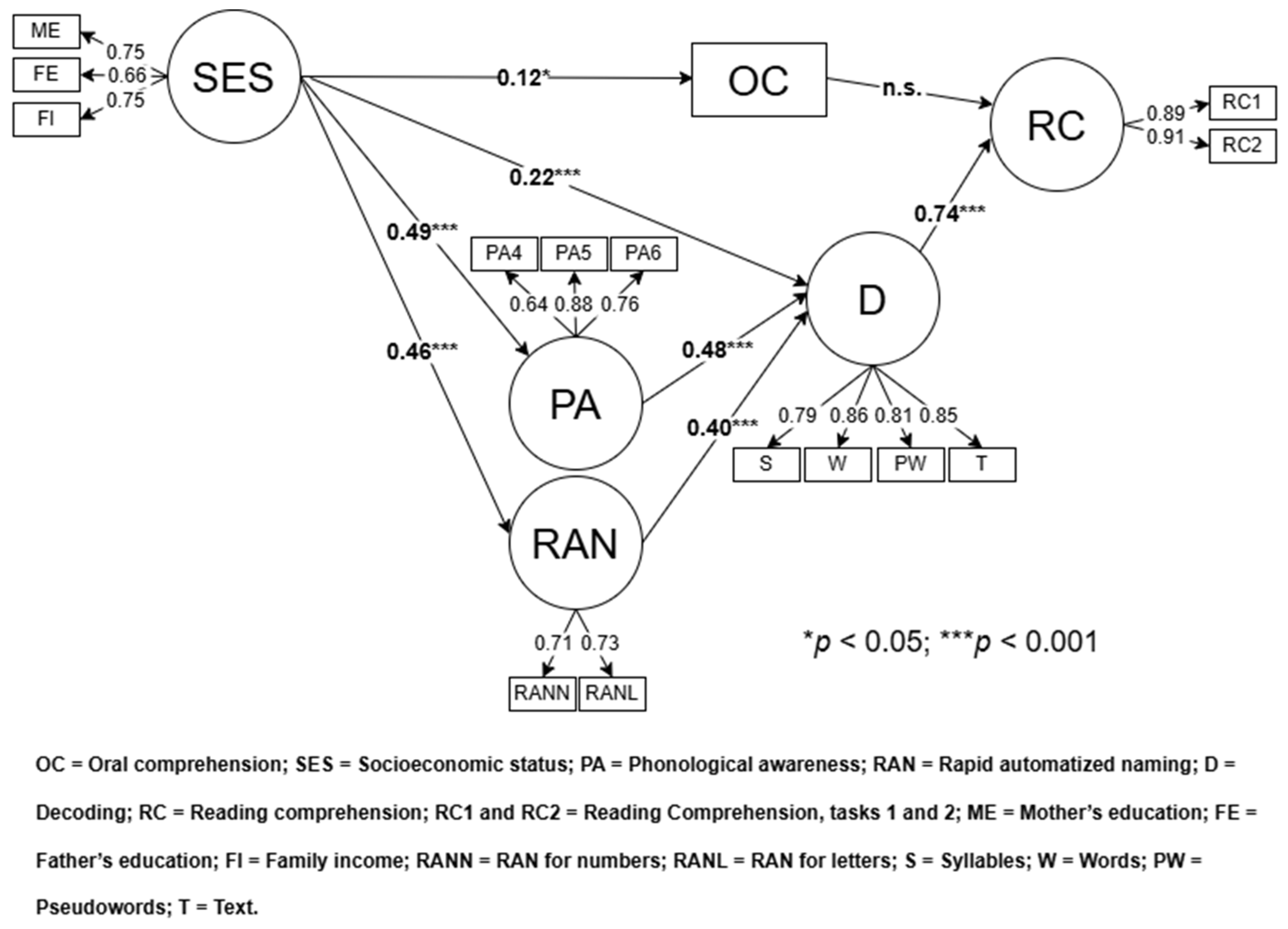
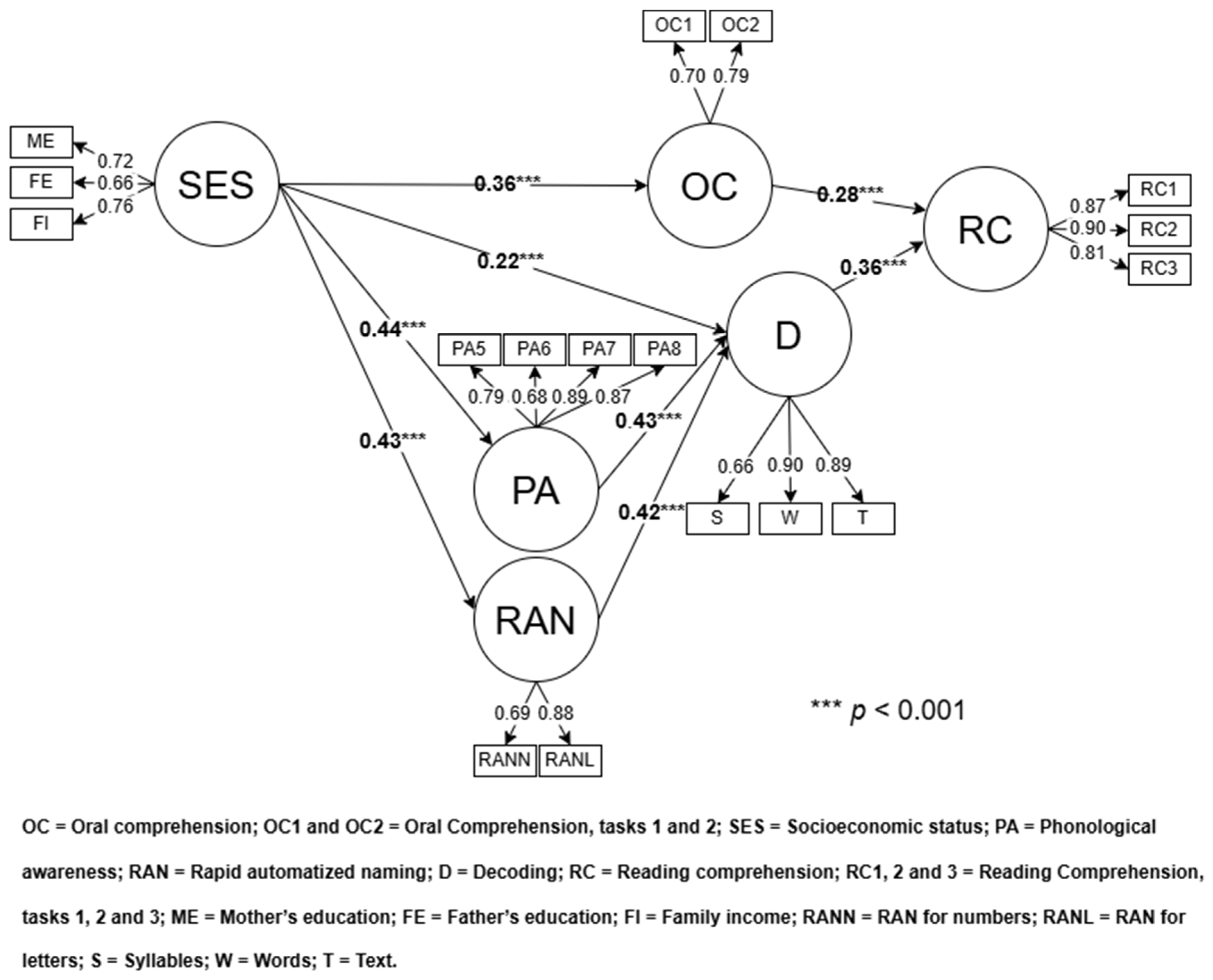
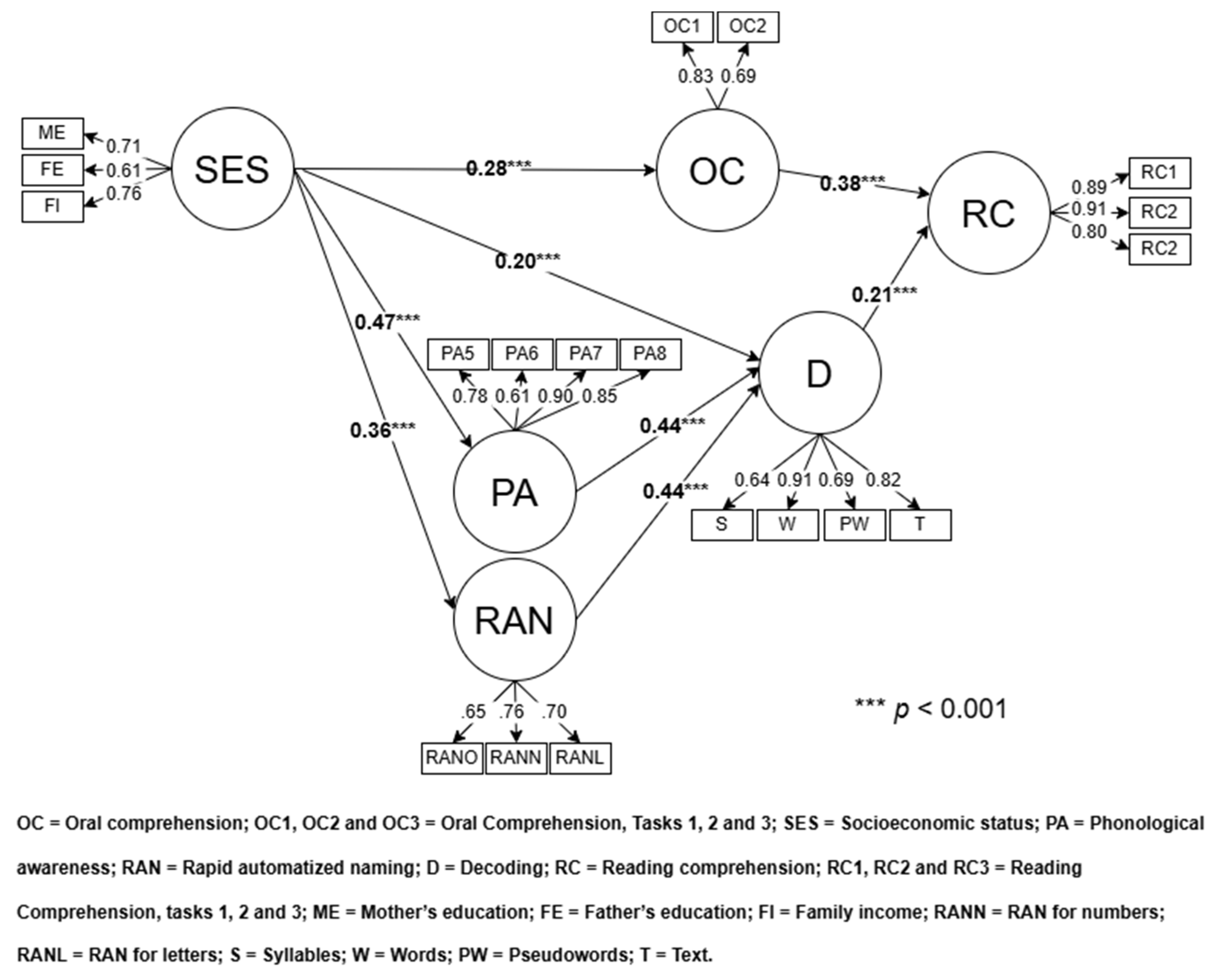
Moreover, the SEMs constructed for the three developmental clusters (Figure 1, Figure 2 and Figure 3) show a very strong explanatory weight of decoding on reading comprehension in 2nd–3rd grade (β = 0.74, p < 0.001), decreasing in 4th–5th grade (β = 0.36, p < 0.001) and 6th–7th grade (β = 0.21, p < 0.001). In contrast, the language-comprehension factor was not significant in 2nd–3rd grade but contributed β = 0.28 (p < 0.001) in 4th–5th and β = 0.38 (p < 0.001) in 6th–7th grade.
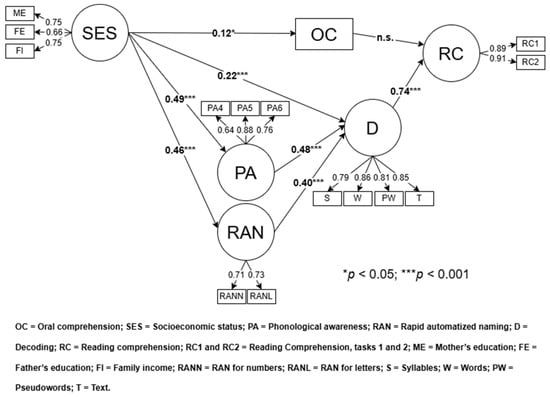
Figure 1.
Structural equation model, 2nd–3rd grade (overall sample).
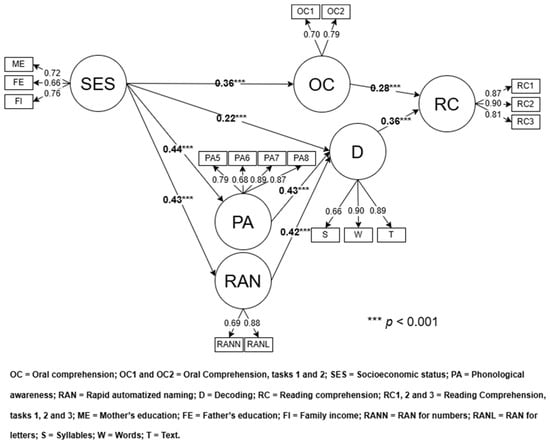
Figure 2.
Structural equation model, 4th–5th grade (overall sample).
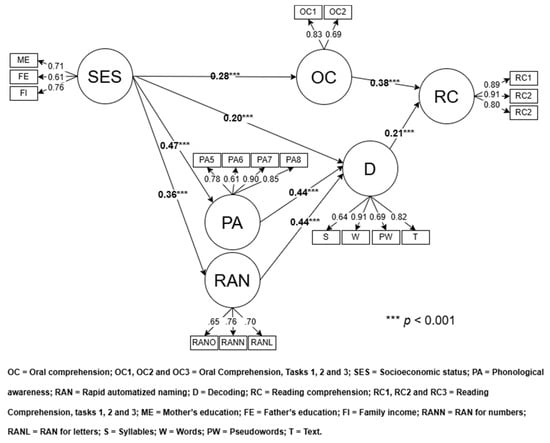
Figure 3.
Structural equation model, 6th–7th grade (overall sample).
Regarding the contribution of psycholinguistic precursors to decoding fluency, we found that phonological awareness (PA) had a strong explanatory weight across all elementary grades with little variation (β = 0.48, p < 0.001; β = 0.43, p < 0.001; and β = 0.44, p < 0.001 across the three clusters). RAN showed a slightly increasing but steady contribution to decoding throughout elementary school (β = 0.40, p < 0.001 in 2nd–3rd; β = 0.42, p < 0.001 in 4th–5th; and β = 0.44, p < 0.001 in 6th–7th), surpassing PA only by 6th–7th grade.
Short-term verbal memory (STVM) did not fit as a contributor to decoding in any of the models tested in any cluster.
3.2. Objective 2: To Explore the Effects of SES and Type of Education (Public vs. Private) on the Functioning of the SVR Parameters
The effect of SES on reading precursors remained strong throughout elementary school, as shown in Figure 1, Figure 2 and Figure 3. However, when examining the total contribution of SES to reading comprehension, this contribution decreased across clusters: β = 0.48 (p < 0.001) in 2nd–3rd, β = 0.30 (p < 0.001) in 4th–5th, and β = 0.21 (p < 0.001) in 6th–7th grade.
Linear regression models differentiating students by educational system (public vs. private) showed that SVR components explained a higher proportion of variance (adjusted R2) in public schools than in private ones: in 2nd–3rd grade, 58% of the variance in public schools (F(12,195) = 23.329, p < 0.001) versus 46.7% in private schools (F(12,183) = 14.361, p < 0.001); in 4th–5th grade, 33% in public schools (F(12,212) = 9.833, p < 0.001) versus 24% in private schools (F(12,194) = 5.992, p < 0.001); and in 6th–7th grade, 28% in public schools (F(12,193) = 7.181, p < 0.001) versus 17% in private schools (F(12,185) = 4.100, p < 0.001).
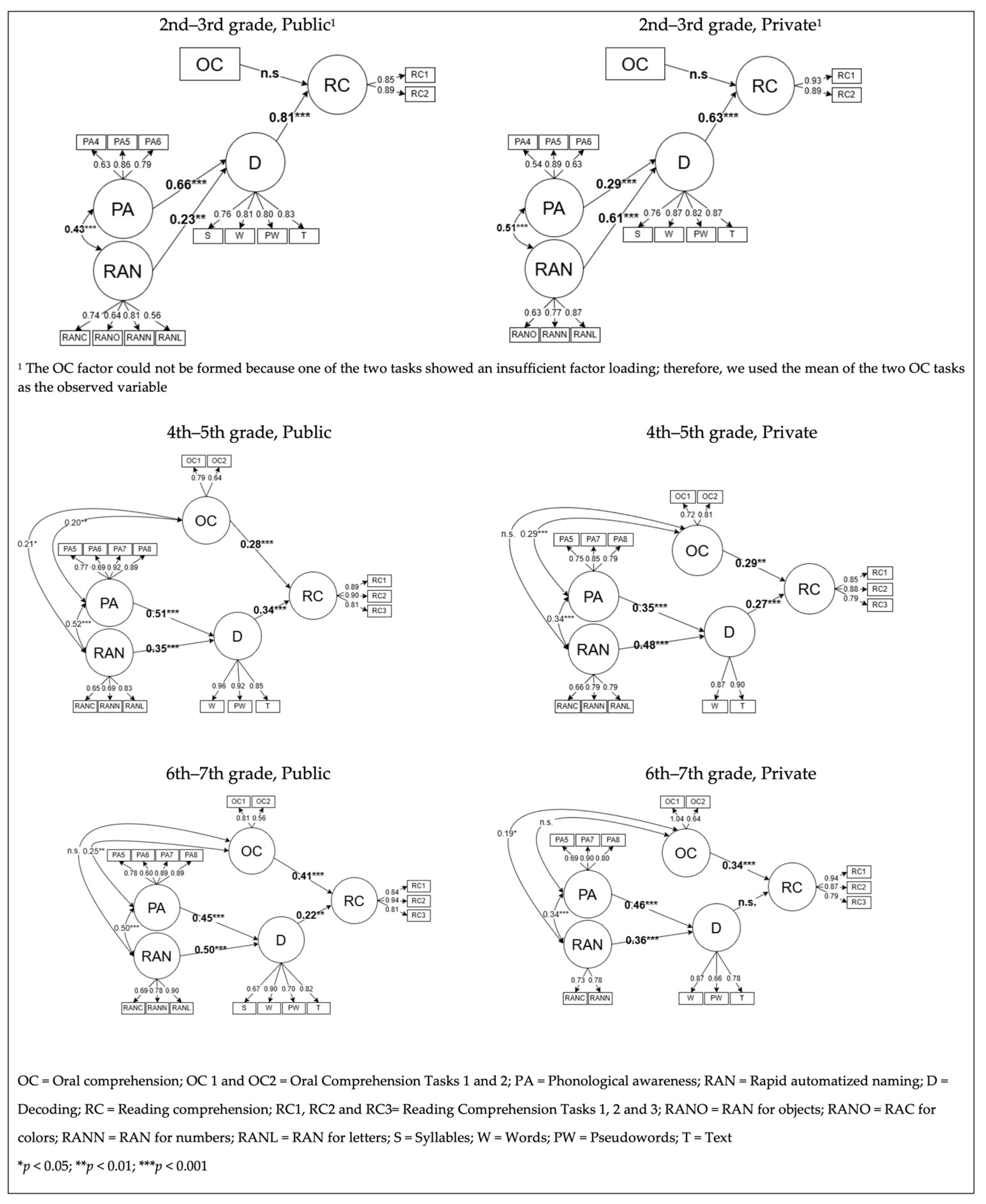
To analyze differentiated effects of the education system on SVR functioning, separate SEMs were constructed for public and private students in each developmental cluster (Figure 4). In these models, SES could not be integrated due to limited variance of its indicators within each school system.
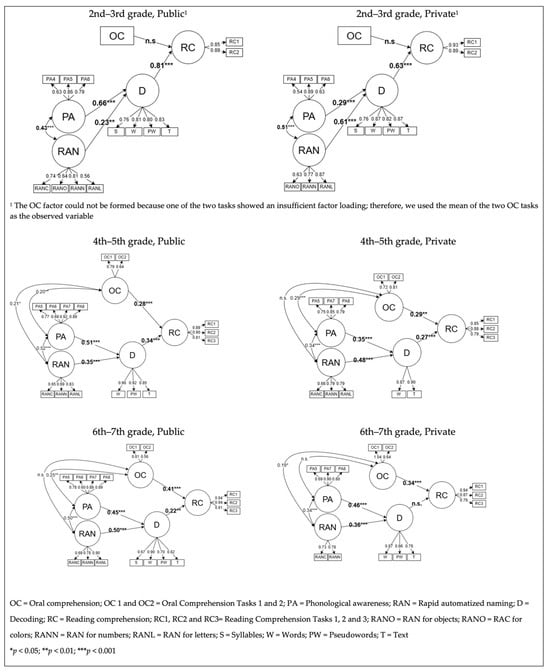
Figure 4.
Structural equation models, by evolutive cluster, by education system (public vs. private).
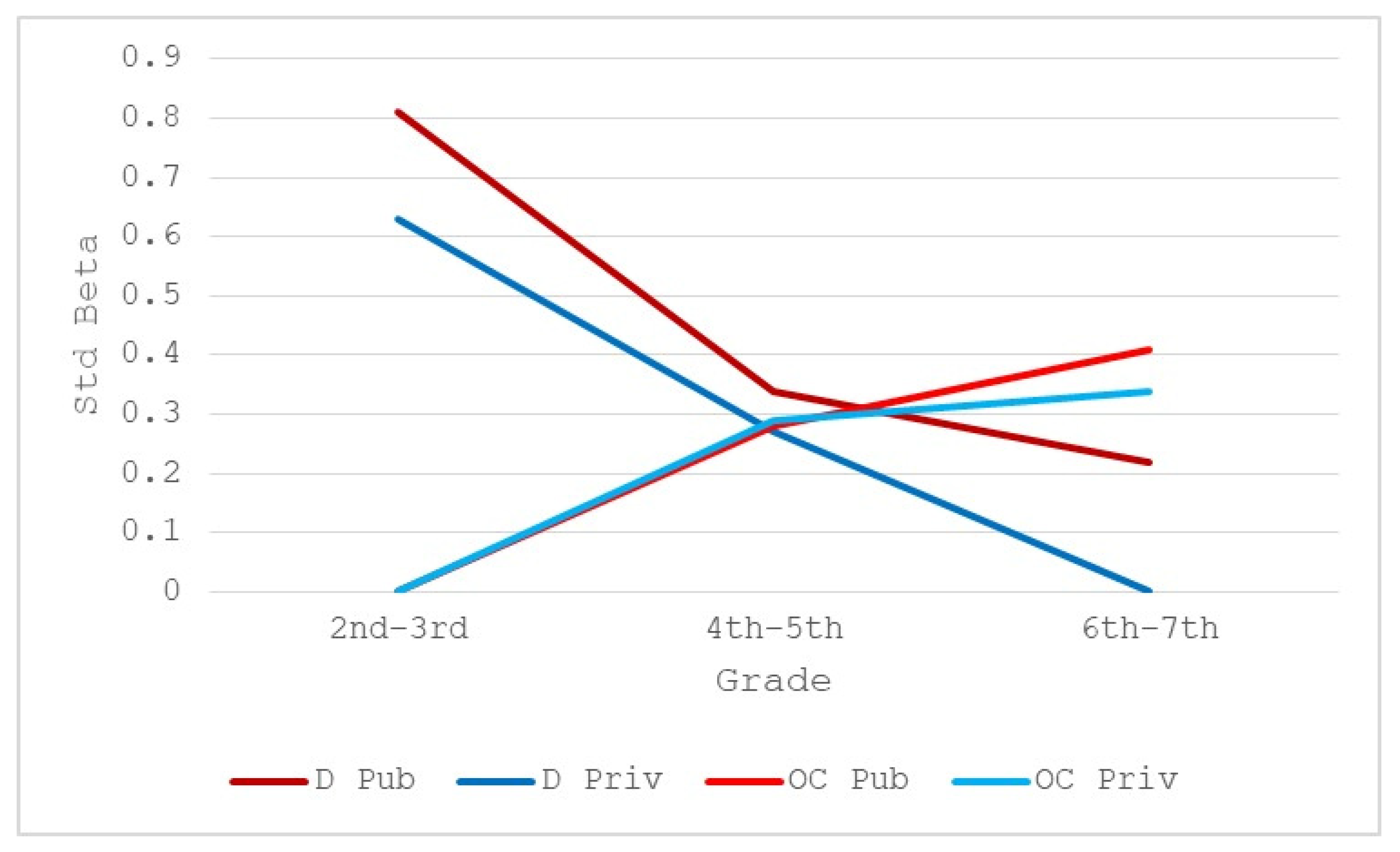
As a summary and projection of the β coefficients obtained in the differentiated models in Figure 4, Figure 5 shows that the explanatory weight of decoding and language follows the expected developmental pattern, but is reversed at the 4th–5th grade cluster in private schools, whereas in public schools this reversal occurs somewhat later. In fact, by 6th–7th grade, decoding no longer explains reading comprehension in private schools, whereas in public schools it continues to have a relevant weight (β = 0.22, while language comprehension = β = 0.41).
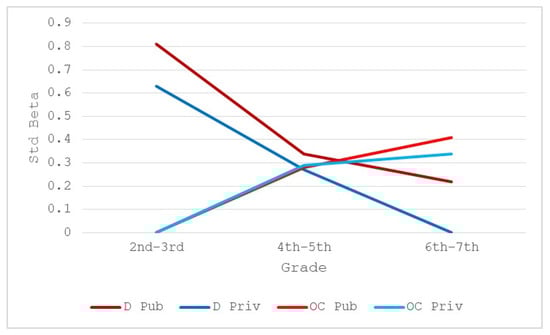
Figure 5.
Evolution of the explanatory power of D and OC for reading comprehension throughout elementary school, by grade and education system. D Pub = Decoding in public schools; D Priv = Decoding in private schools; OC Pub = Oral comprehension in public schools; OC Priv = Oral comprehension in private schools.
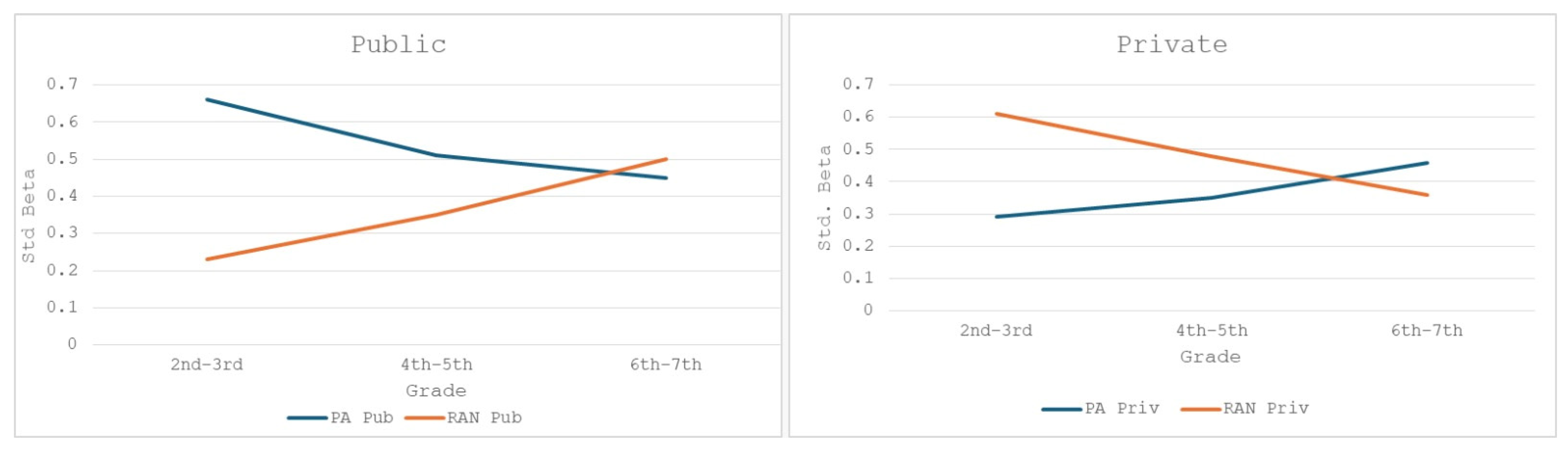
Similarly, regarding the behavior of the precursors PA and RAN, Figure 6 shows that in public education the expected theoretical pattern is maintained, with decreasing weight of PA and increasing weight of RAN, although the relationship between PA and decoding persists until 6th–7th grade (β = 0.46, p < 0.001). However, in private education the opposite pattern appears: the weight of PA increases throughout elementary school, while that of RAN decreases continuously. In both systems, the contributions of both precursors tend to converge in the final stage of elementary education.
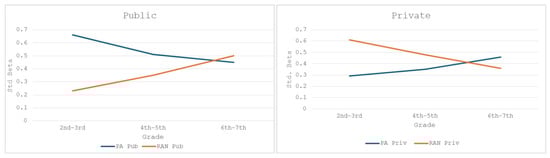
Figure 6.
Evolution of the explanatory power of PA and RAN for Decoding throughout elementary school, by grade and education system. PA Pub = Phonological awareness in public schools; RAN Pub = Rapid automatized naming in public schools; PA Priv = Phonological awareness in private schools; RAN Priv = Rapid automatized naming in private schools.
4. Discussion
The purpose of the present study was to examine the functioning of the principles of the Simple View of Reading model and the contribution of psycholinguistic variables to decoding, and to explore the effects of socioeconomic status and type of education on the functioning of the model’s parameters.
The model behaved in the studied context as predicted by theory: the oral language comprehension component contributes increasingly to reading comprehension as students progress through elementary school, and decoding fluency contributes strongly at the beginning, losing strength progressively.
The particularity in the Dominican context appears to be that the contribution of decoding to comprehension remains significant at the end of elementary school and the beginning of secondary school, as well as the late point at which language comprehension begins to better predict reading comprehension than decoding, particularly in public schools. For instance, in public schools, language comprehension did not predict reading comprehension for second and third graders. This does not invalidate the model in this context, but shows that limitations in decoding automaticity may constrain children’s ability to engage with the linguistic content of written text, thereby attenuating the observable contribution of language comprehension to reading comprehension outcomes.
This contrasts with findings in other contexts with transparent orthographies, where decoding usually loses explanatory power by 2nd or 3rd grade (Tobia & Bonifacci, 2015). This suggests that, despite the efforts reflected in recent policies, greater attention is needed to instructional approaches that support the development of reading automaticity alongside language development.
Additionally, the contribution of phonological awareness to decoding fluency—which existing evidence associates mainly with the development of the phonological route of reading used in the initial stages of learning to read in transparent orthographies (Furnes & Samuelsson, 2010)—persists unusually late, remaining strong up to 6th–7th grade. This phenomenon occurs even more markedly than in another low-reading-achievement context—the Panamanian one—where dependence on PA was maintained until 6th grade for decoding accuracy but ceased to contribute to decoding speed from 2nd grade onward. Similarly, RAN, which is expected to contribute increasingly to decoding fluency, remains constant across grade levels in the Dominican context.
If theory indicates that PA stops predicting decoding fluency as the lexical reading route becomes dominant (Share, 1995; Vaessen & Blomert, 2010), the persistence of PA dependence in this study could indicate the coexistence of both reading routes (lexical and nonlexical, the latter being less efficient) throughout elementary school. This, together with the finding of the persistent contribution of decoding fluency to reading comprehension—especially late in public education—could be related to difficulties in decoding automatization among Dominican students. Furthermore, Automaticity Theory (Cooper et al., 2024; LaBerge & Samuels, 1974) posits that as decoding requires fewer cognitive resources, more resources become available for reading comprehension. In this sense, the results appear consistent with the maintenance of an excessive cognitive load in the decoding process even at the end of elementary school/beginning of secondary school, which could at least partially explain the low reading comprehension performance of Dominican students in international assessments, both in elementary and secondary school.
Another unexpected finding was a progressive increase in the explanatory weight of PA in decoding and a corresponding decrease in the weight of RAN in private education, for which the researchers do not currently have explanatory hypotheses.
Additionally, although our results seem to confirm that SVR factors explain smaller portions of variance in reading comprehension in transparent orthographies than in opaque orthographies such as English (see Quinn & Wagner, 2018, for a meta-analysis), in the Dominican context the model appears to be more explanatory than in other Latin America–Caribbean countries: 27% in 3rd grade in Peru (Tapia Montesinos et al., 2022), 31% in 2nd grade in Chile (Infante et al., 2012), and 53% in 2nd–3rd grade in the present study. The fact that standardized R2 values are consistently higher in public schools than in private schools in the Dominican Republic, together with the fact that Peru (private system) and Chile show higher levels of reading achievement, could lead to the hypothesis that students’ level of reading performance may affect the explanatory power of the SVR. However, such a hypothesis ought to be tested through further accumulation of evidence in different types of contexts. Another hypothesis to explain this phenomenon could be that the specific phonological characteristics of spoken Spanish in the Dominican Republic—such as phonological reduction processes that increase the distance between orthography and oral realization—might affect how transparent the writing system functions in practice, thereby extending learners’ reliance on phonological processing and explaining why phonological awareness continues to predict decoding fluency unusually late in this context. Future studies should examine this possible relationship.
Although the present study focuses on low reading achievement in a specific educational context rather than on clinical diagnoses, it is likely that a subset of Dominican non-readers may meet criteria for dyslexia, which would require etiological models—such as Uta Frith’s multilevel framework integrating biological, cognitive, and behavioral components—to be appropriately addressed (Frith, 1999).
5. Recommendations
In order to support public policies aimed at improving reading comprehension, especially in low-reading-achievement contexts, further evidence is needed regarding which other variables contribute to explaining the large portion of reading-comprehension variance not explained by the SVR components.
Evidence shows that the appropriate period for training PA is during early childhood education, before the onset of formal literacy instruction (National Reading Panel, 2000; Shanahan & Lonigan, 2010). However, the Dominican Republic still shows low coverage rates in early childhood education (7.1% in ages 0–2 and 59.9% in ages 3–5; REF), making it necessary to continue efforts toward universal access to early childhood education while also introducing systematic and targeted PA stimulation programs. In cases where students have not attended early childhood education, PA reinforcement programs can be introduced simultaneously with grapheme instruction in 1st grade, as tested in another Central America–Caribbean context with similar socioeconomic vulnerability (Cubilla-Bonnetier et al., n.d.). Likewise, oral language comprehension skills should be fostered throughout schooling to strengthen reading comprehension, especially in vulnerable contexts (National Reading Panel, 2000).
Finally, it is necessary to continue advancing in teacher training in the science of reading and in the design and implementation of evidence-based literacy strategies, teaching the writing system explicitly and systematically, with direct and sequenced instruction in grapheme–phoneme correspondences and intensive and cumulative practice in decoding and encoding (Castles et al., 2018; National Reading Panel, 2000), together with the progressive introduction of texts controlled by complexity level (Mesmer, 2009).
Author Contributions
Conceptualization, D.C.-B., H.M.-S. and L.V.S.-V.; methodology, D.C.-B., H.M.-S. and L.V.S.-V.; formal analysis, D.C.-B., H.M.-S., B.R.-R., J.A.-A. and L.V.S.-V.; investigation, D.C.-B., H.M.-S. and L.V.S.-V.; resources, D.C.-B., H.M.-S. and L.V.S.-V.; data curation, D.C.-B.; writing—original draft preparation, D.C.-B., H.M.-S., B.R.-R. and L.V.S.-V.; writing—review and editing, D.C.-B., H.M.-S., B.R.-R., J.A.-A. and L.V.S.-V.; visualization, D.C.-B., H.M.-S. and L.V.S.-V.; supervision, D.C.-B., B.R.-R. and J.A.-A.; project administration, D.C.-B.; funding acquisition, D.C.-B., H.M.-S. and L.V.S.-V. All authors have read and agreed to the published version of the manuscript.
Funding
This study was funded by the Dominican Institute for Educational Evaluation and Research (IDEICE).
Institutional Review Board Statement
The study was conducted in accordance with the Declaration of Helsinki, and approved by the Ethics Committee of Universidad Iberoamericana, UNIBE (protocol code CEI2024-24, date of approval 22 February 2024).
Informed Consent Statement
Informed consent was obtained from all subjects involved in the study.
Data Availability Statement
Dataset available at: https://osf.io/jw9nk/overview?view_only=c4fdec2411544d238bc968c4d9378aed.
Acknowledgments
To Ginia Montes de Oca for her support of the project; to the principals, teachers, and families of the participating schools; to the research assistants of UNIBE’s Institute of Applied Neurosciences; and to the evaluators on the data-collection team.
Conflicts of Interest
The authors declare no conflicts of interest.
Abbreviations
The following abbreviations are used in this manuscript:
| SVR | Simple View of Reading |
| RC | Reading Comprehension |
| D | Decoding |
| OC | Oral Comprehension |
| PA | Phonological Awareness |
| RAN | Rapid Automatized Naming |
| STVM | Short-Term Verbal Memory |
| SES | Socioeconomic Status |
| FI | Family Income |
| ME | Mother’s Education |
| FE | Father’s Education |
| S | Syllable Reading Fluency |
| W | Word Reading Fluency |
| PW | Pseudoword Reading Fluency |
| T | Text Reading Fluency |
| RANO | RAN for Objects |
| RANN | RAN for Numbers |
| RANL | RAN for Letters |
| RANC | RAN for Colors |
| PISA | Programme for International Student Assessment |
| OECD | Organisation for Economic Co-operation and Development |
| ERCE | Estudio Regional Comparativo y Explicativo |
| CFI | Comparative Fit Index |
| TLI | Tucker–Lewis Index |
| RMSEA | Root Mean Square Error of Approximation |
| SRMR | Standardized Root Mean Square Residual |
| SEM | Structural Equation Modeling |
References
- Bastug, M. (2014). The structural relationship of reading attitude, reading comprehension and academic achievement. International Journal on Social and Education Sciences, 4(4), 931–946. [Google Scholar]
- Caravolas, M., Lervåg, A., Mousikou, P., Efrim, C., Litavský, M., Onochie-Quintanilla, E., Salas, N., Schöffelová, M., Defior, S., Mikulajová, M., Seidlová-Málková, G., & Hulme, C. (2012). Common patterns of prediction of literacy development in different alphabetic orthographies. Psychological Science, 23(6), 678–686. [Google Scholar] [CrossRef]
- Castles, A., Rastle, K., & Nation, K. (2018). Ending the reading wars: Reading acquisition from novice to expert. Psychological Science in the Public Interest, 19(1), 5–51. [Google Scholar] [CrossRef]
- Clinton-Lisell, V., Taylor, T., Carlson, S. E., Davison, M. L., & Seipel, B. (2022). Performance on reading comprehension assessments and college achievement: A meta-analysis. Journal of College Reading and Learning, 52(3), 191–211. [Google Scholar] [CrossRef]
- Coltheart, M., & Rastle, K. (1994). Serial processing in reading aloud: Evidence for dual-route models of reading. Journal of Experimental Psychology: Human Perception and Performance, 20(6), 1197–1211. [Google Scholar] [CrossRef]
- Coltheart, M., Rastle, K., Perry, C., Langdon, R., & Ziegler, J. (2001). DRC: A dual route cascaded model of visual word recognition and reading aloud. Psychological Review, 108(1), 204–256. [Google Scholar] [CrossRef] [PubMed]
- Consejo Nacional de Educación. (2023). Ordenanza No. 01-2023 que establece la política nacional de alfabetización inicial en la etapa oportuna [Ordinance No. 01-2023 establishing the national policy for early literacy at the appropriate stage]. Ministerio de Educación de la República Dominicana.
- Cooper, S., Hebert, M., Goodrich, J. M., Leiva, S., Lin, X., Peng, P., & Nelson, J. R. (2024). Effects of automaticity training on reading performance: A meta-analysis. Journal of Behavioral Education, 33(1), 23–52. [Google Scholar] [CrossRef]
- Cubilla-Bonnetier, D., D’Alfonso, D., De León Sautú, N., García-Gómez, R., & Sánchez-Vincitore, L. V. (n.d.). Intervención en conciencia fonológica para el aprendizaje lector en distintos contextos de vulnerabilidad socioeconómica [Phonological awareness intervention for reading acquisition in different socioeconomic vulnerability contexts]. In press.
- Cubilla-Bonnetier, D., Marte, H., Andújar-Avilés, J., Reyes-Ramírez, B. M., & Sánchez-Vincitore, L. V. (2025). The reading gap in the Dominican Republic: Education system or socioeconomic vulnerability? EdArXiv. [Google Scholar] [CrossRef]
- Cubilla-Bonnetier, D., & Sánchez-Vincitore, L. V. (2023, December 7). Preliminary psychometric properties of the Central American Reading Assessment (ECLEC). 14th International IDEICE Congress, Santo Domingo, Dominican Republic. [Google Scholar]
- Cubilla-Bonnetier, D., & Sánchez-Vincitore, L. V. (2025). Precursores psicolingüísticos de la lectura y ajuste de la concepción simple de la lectura a lo largo de la educación Primaria en un contexto de bajo rendimiento lector [Psycholinguistic precursors of reading and adjustment of the simple view of reading throughout primary education in a context of low reading achievement]. Signos, 58(117), 48–70. [Google Scholar] [CrossRef]
- Cuetos, F., Arribas, D., Suárez-Coalla, P., & Martínez-García, C. (2020). Prolexia, diagnóstico y detección temprana de la dislexia [Prolexia, diagnosis and early detection of dyslexia]. TEA Ediciones. [Google Scholar]
- Cuetos, F., Rodríguez, B., Ruano, E., & Arribas, D. (2014). Test PROLEC-R. Batería de evaluación de los procesos lectores, revisada (5th ed.). [Revised Battery for the Assessment of Reading Processes]. TEA Ediciones. [Google Scholar]
- Defior, S. (2008). ¿Cómo facilitar el aprendizaje inicial de la lectoescritura? Papel de las habilidades fonológicas [How to facilitate the initial learning of reading and writing? The role of phonological skills]. Infancia y Aprendizaje, 31(3), 333–345. [Google Scholar] [CrossRef]
- Denckla, M. B., & Rudel, R. (1974). Rapid «Automatized» naming of pictured objects, colors, letters and numbers by normal children 1. Cortex, 10(2), 186–202. [Google Scholar] [CrossRef]
- Duke, N. K., & Cartwright, K. B. (2021). The science of reading progresses: Communicating advances beyond the simple view of reading. Reading Research Quarterly, 56(S1), S25–S44. [Google Scholar] [CrossRef]
- Florit, E., & Cain, K. (2011). The simple view of reading: Is it valid for different types of alphabetic orthographies? Educational Psychology Review, 23(4), 553–576. [Google Scholar] [CrossRef]
- Frith, U. (1999). Paradoxes in the definition of dyslexia. In M. J. Snowling, & C. Hulme (Eds.), Dyslexia: Biology, cognition and intervention (pp. 192–212). Whurr Publishers. [Google Scholar]
- Furnes, B., & Samuelsson, S. (2010). Predicting reading and spelling difficulties in transparent and opaque orthographies: A comparison between Scandinavian and US/Australian children. Dyslexia, 16(2), 119–142. [Google Scholar] [CrossRef]
- Gough, P. B., & Tunmer, W. E. (1986). Decoding, reading, and reading disability. Remedial and Special Education, 7(1), 6–10. [Google Scholar] [CrossRef]
- Hair, J. F., Black, W. C., Babin, B. J., & Anderson, R. E. (2018). Multivariate data analysis (8th ed.). Cengage. [Google Scholar]
- Hoover, W. A., & Gough, P. B. (1990). The simple view of reading. Reading and Writing, 2(2), 127–160. [Google Scholar] [CrossRef]
- Infante, M., Coloma, C. J., & Himmel, E. (2012). Comprensión lectora, comprensión oral y decodificación en escolares de 2o y 4o básico de escuelas municipales [Reading Comprehension, Oral Comprehension, and Decoding in 2nd- and 4th-Grade Students from Municipal Schools]. Estudios Pedagógicos, 38(1), 149–160. [Google Scholar] [CrossRef]
- Kirk, S. A., McCarthy, J. J., & Kirk, W. D. (2004). Test illinois aptitudes psicolingüísticas (ITPA) [Illinois Test of Psycholinguistic Abilities]. TEA Ediciones. [Google Scholar]
- Kline, R. B. (2011). Principles and practice of structural equation modeling (3rd ed., pp. xvi, 427). The Guilford Press. [Google Scholar]
- LaBerge, D., & Samuels, S. J. (1974). Toward a theory of automatic information processing in reading. Cognitive Psychology, 6(2), 293–323. [Google Scholar] [CrossRef]
- Mesmer, H. A. E. (2009). Textual scaffolds for developing fluency in beginning readers: Accuracy and reading rate in qualitatively leveled and decodable text. Literacy Research and Instruction, 49(1), 20–39. [Google Scholar] [CrossRef]
- National Reading Panel. (2000). Teaching children to read: An evidence-based assessment of the scientific research literature on reading and its implications for reading instruction. Available online: https://eric.ed.gov/?id=ED444126 (accessed on 11 November 2025).
- OECD. (2023). PISA 2022 results (Volume I): The state of learning and equity in education. OECD Publishing. [Google Scholar] [CrossRef]
- Oficina Nacional de Estadística de la República Dominicana. (2014). Abandono y/o deserción escolar en república dominicana. School Dropout in the Dominican Republic. Available online: https://one.gob.do/media/4nrdh3ud/bolet%C3%ADnpanoramaestad%C3%ADstico64abandonodeserci%C3%B3nescolarenrepdomene2014.pdf (accessed on 7 November 2025).
- Peng, P., Barnes, M., Wang, C. C., Wang, W., Li, S., Swanson, H. L., Dardick, W., & Tao, S. (2018). Meta-analysis on the relation between reading and working memory. Psychological Bulletin, 144(1), 48–76. [Google Scholar] [CrossRef] [PubMed]
- Quinn, J. M., & Wagner, R. K. (2018). Using meta-analytic structural equation modeling to study developmental change in relations between language and literacy. Child Development, 89(6), 1956–1969. [Google Scholar] [CrossRef] [PubMed]
- Ripoll Salceda, J. C., Aguado Alonso, G., & Castilla-Earls, A. P. (2014). The simple view of reading in elementary school: A systematic review. Revista de Logopedia, Foniatría y Audiología, 34(1), 17–31. [Google Scholar] [CrossRef]
- Sánchez-Vincitore, L. V., Veras, C., Mencía-Ripley, A., Ruiz-Matuk, C. B., & Cubilla-Bonnetier, D. (2022). Reading comprehension precursors: Evidence of the simple view of reading in a transparent orthography. Frontiers in Education, 7, 914414. [Google Scholar] [CrossRef]
- Scarborough, H. S. (2001). Connecting early language and literacy to later reading (dis)abilities: Evidence, theory, and practice. In S. B. Dickinson, & D. K. Neuman (Eds.), Handbook of early literacy research (pp. 97–110). Guilford. [Google Scholar]
- Shanahan, T., & Lonigan, C. J. (2010). The national early literacy panel: A summary of the process and the report. Educational Researcher, 39(4), 279–285. [Google Scholar] [CrossRef]
- Share, D. L. (1995). Phonological recoding and self-teaching: Sine qua non of reading acquisition. Cognition, 55(2), 151–218. [Google Scholar] [CrossRef]
- Suárez-Coalla, P., García-De-Castro, M., & Cuetos, F. (2013). Variables predictoras de la lectura y la escritura en castellano [Predictor variables of reading and writing in Spanish]. Infancia y Aprendizaje, 36(1), 77–89. [Google Scholar] [CrossRef]
- Tapia Montesinos, M. M., Ripoll Salceda, J. C., Aguado Alonso, G., & Joshi, R. M. (2022). Simple view of reading in Spanish: A longitudinal study. Revista de Logopedia, Foniatría y Audiología, 42(4), 214–226. [Google Scholar] [CrossRef]
- Tobia, V., & Bonifacci, P. (2015). The simple view of reading in a transparent orthography: The stronger role of oral comprehension. Reading and Writing, 28(7), 939–957. [Google Scholar] [CrossRef]
- UNESCO. (2021). Los aprendizajes fundamentales en América Latina y el Caribe. Evaluación de logros de los estudiantes. Estudio Regional Comparativo y Explicativo (ERCE 2019) [Foundational Learning in Latin America and the Caribbean: Student Achievement Evaluation. Regional Comparative and Explanatory Study (ERCE 2019)]. Available online: https://bibliotecadigital.mineduc.cl/handle/20.500.12365/18615 (accessed on 10 November 2025).
- Vaessen, A., & Blomert, L. (2010). Long-term cognitive dynamics of fluent reading development. Journal of Experimental Child Psychology, 105(3), 213–231. [Google Scholar] [CrossRef]
Disclaimer/Publisher’s Note: The statements, opinions and data contained in all publications are solely those of the individual author(s) and contributor(s) and not of MDPI and/or the editor(s). MDPI and/or the editor(s) disclaim responsibility for any injury to people or property resulting from any ideas, methods, instructions or products referred to in the content. |
© 2026 by the authors. Licensee MDPI, Basel, Switzerland. This article is an open access article distributed under the terms and conditions of the Creative Commons Attribution (CC BY) license.