


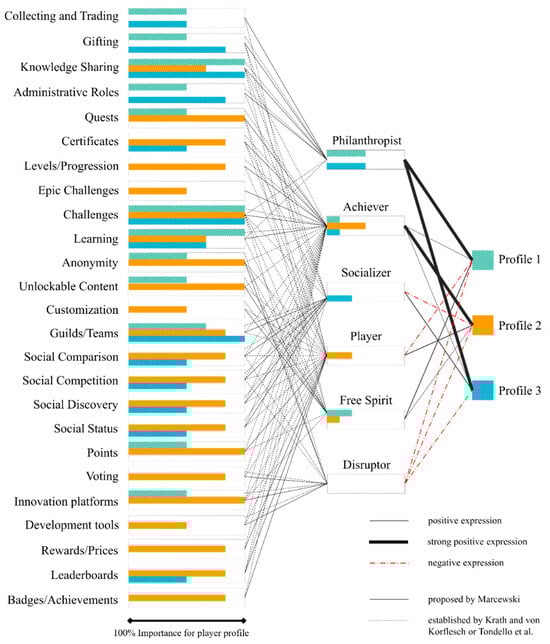
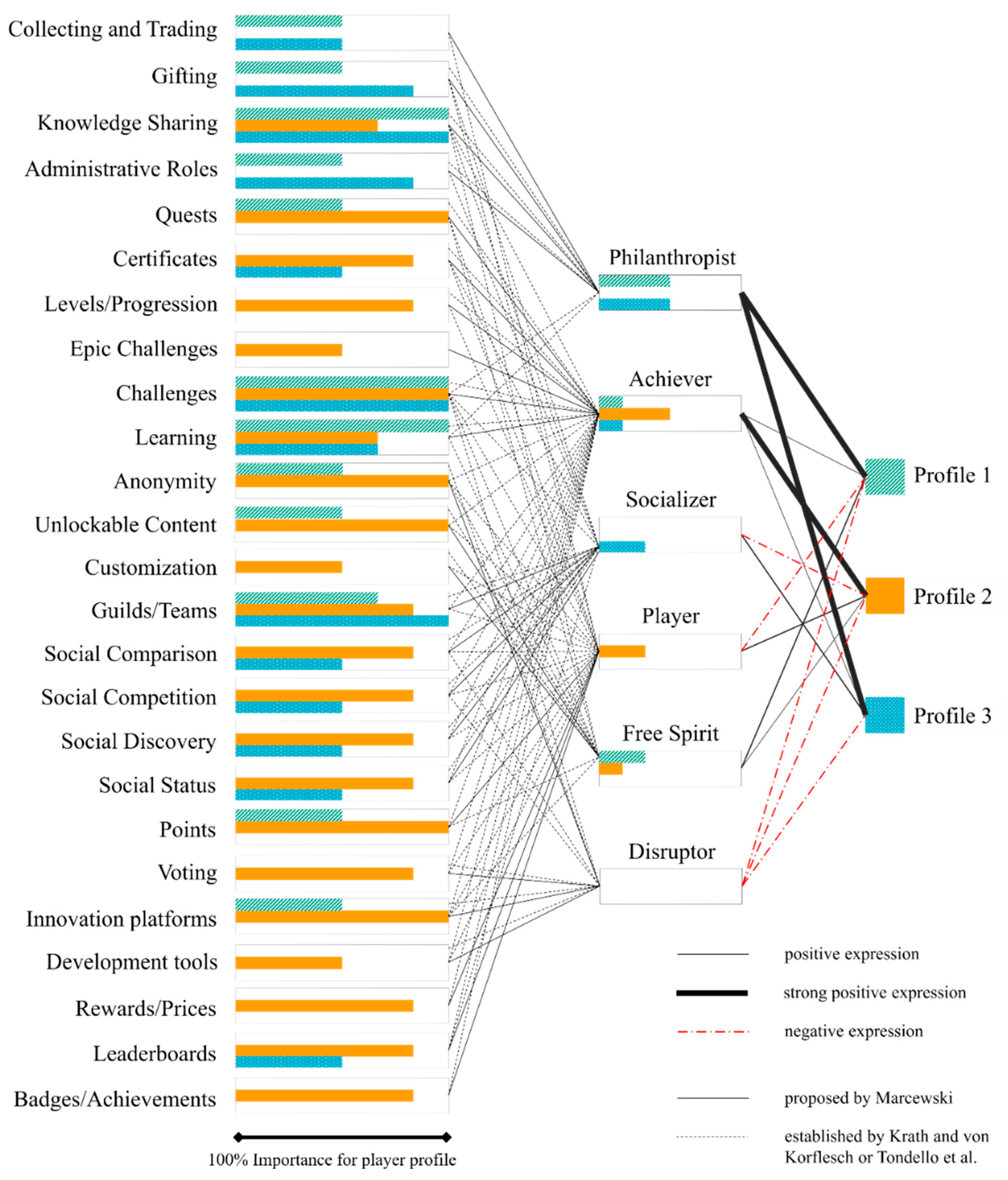
The originally published version of this paper (Brandl & Schrader, 2024) contains an error in Figure 4 regarding the appropriate mechanics. Due to an incorrect transcription of correlations, incorrect information on suitable mechanics was given. The corrected version of the Figure 4 is given below.
Figure 4.
Player profiles assigned player types and the associated game mechanics. Solid lines between mechanics are proposed relationships by Marczewski [21], dotted lines are relationships established by Krath and von Korflesch [22] or Tondello et al. [20].
Due to the correction, the following changes were made to the interpretation of the graph (Section 4.4, Paragraph 2). Passages with crossed-out text have been deleted, and mechanics shown in italics have been added.
“It is noticeable that the Challenges mechanic has the highest relevance for all player profiles. Knowledge Sharing, Guilds or Teams and Learning are also relevant for all player profiles. For the third and largest cluster, Collecting and Trading, Gifting, Administrative Roles, Certificates, Leaderboards, Social Comparsion, Social Competetion, Social Status and Social Discovery are also relevant. The first three are also relevant for Player Profile 1 and the last six of these mechanics for Player Profile 2. This Profile has the peculiarity of some mechanics only being relevant for this player profile. Levels or Progression, Customization, Rewards or Prices, Voting, Development Tools, Epic Challenges and Badges or Achievements can be used explicitly for players who match Player Profile 2. Quests, Anonymity, Unlockable Content, Innovation Platforms, and Points can be used for Player Profiles 1 and 2. Due to the negative expression of the Disruptor in all player profiles, only one associated mechanic is relevant. The mechanic of Challenges is relevant to all three player profiles due to its association with the Philanthropist, Achiever, as well as Free Spirit type, and according to Tondello et al. [20] there is also a correlation to the Disruptor type. For Profile 1 and 2 Innovation Platforms seems appropriate. Regarding the differences in the player profiles between the study programs, adjustments can now be made by giving preference to mechanics that do or do not have associations with player type. For example, the group of MH students of Player Profiles 2 and 3 can benefit more from the use of Social Comparison, Social Competition, Social Status and Social Discovery than the other groups, since they have the strongest expression of the Socializer indicator.”
In the Discussion Section (Paragraph 1, Sentences 11 and 12), the following sentences are changed:
“While Customization, Badges, Levels, and Points are not associated with Profile 3 in our results, a few of these mechanics are. For instance, Guilds, Leaderboards, Social Status and Social Competition are associated with the profile.”
The authors state that the other results and the overall scientific conclusions are unaffected. This correction was approved by the Academic Editor. The original publication has also been updated.
Reference
- Brandl, L. C., & Schrader, A. (2024). Student Player Types in Higher Education—Trial and Clustering Analyses. Education Sciences, 14(4), 352. [Google Scholar] [CrossRef] [Scilit]
Disclaimer/Publisher’s Note: The statements, opinions and data contained in all publications are solely those of the individual author(s) and contributor(s) and not of MDPI and/or the editor(s). MDPI and/or the editor(s) disclaim responsibility for any injury to people or property resulting from any ideas, methods, instructions or products referred to in the content. |
© 2025 by the authors. Licensee MDPI, Basel, Switzerland. This article is an open access article distributed under the terms and conditions of the Creative Commons Attribution (CC BY) license (https://creativecommons.org/licenses/by/4.0/).