Scoping Review on Digital Creativity: Definition, Approaches, and Current Trends

Abstract
1. Introduction
1.1. Definitions and Theoretical Approaches to Creativity
1.2. Definition and Fields of Study in Digital Creativity
1.3. The Present Study
2. Methods
2.1. Information Sources
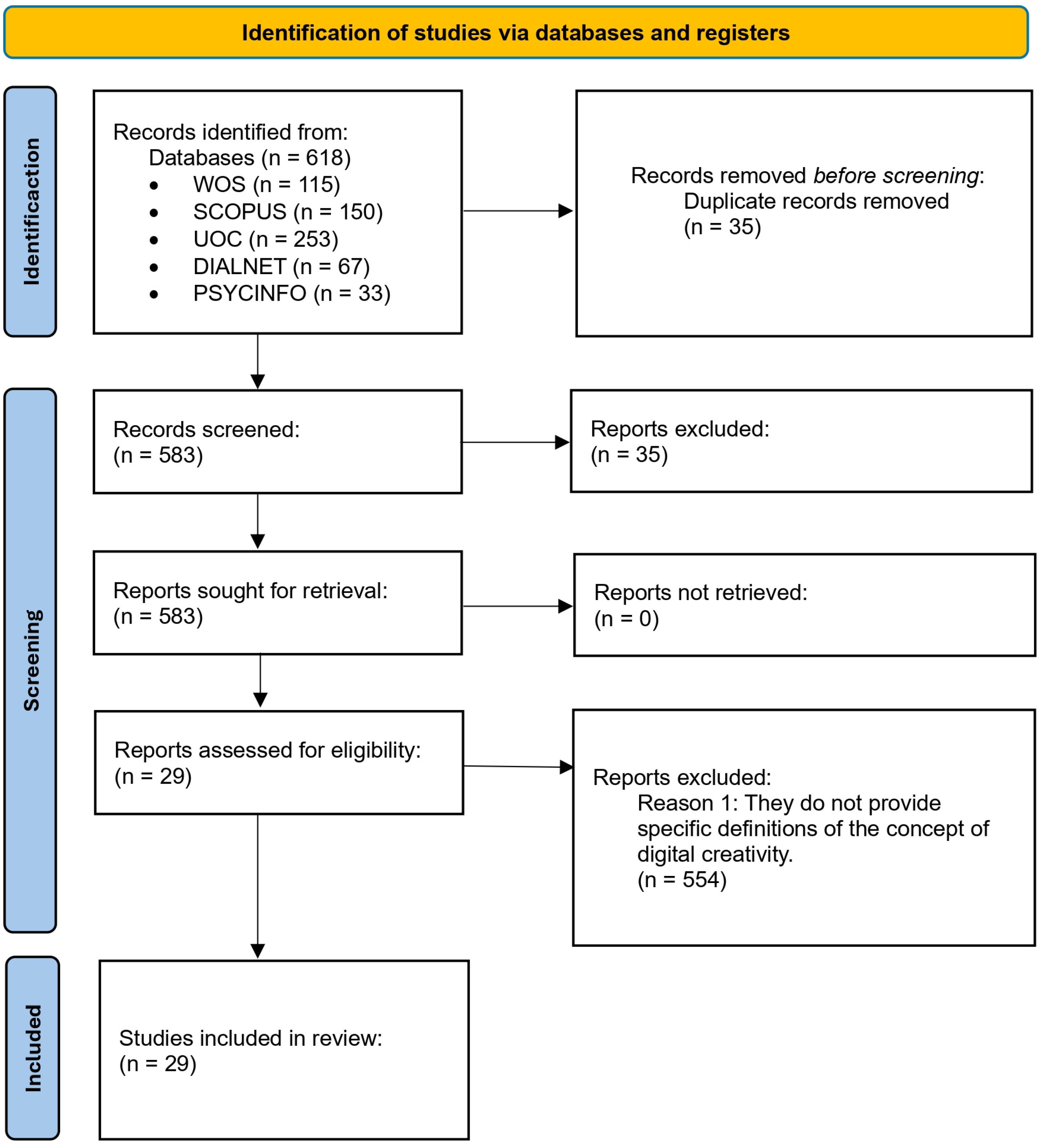
2.2. Search Strategy
2.3. Eligibility Criteria
2.4. Data Extraction Process
3. Results
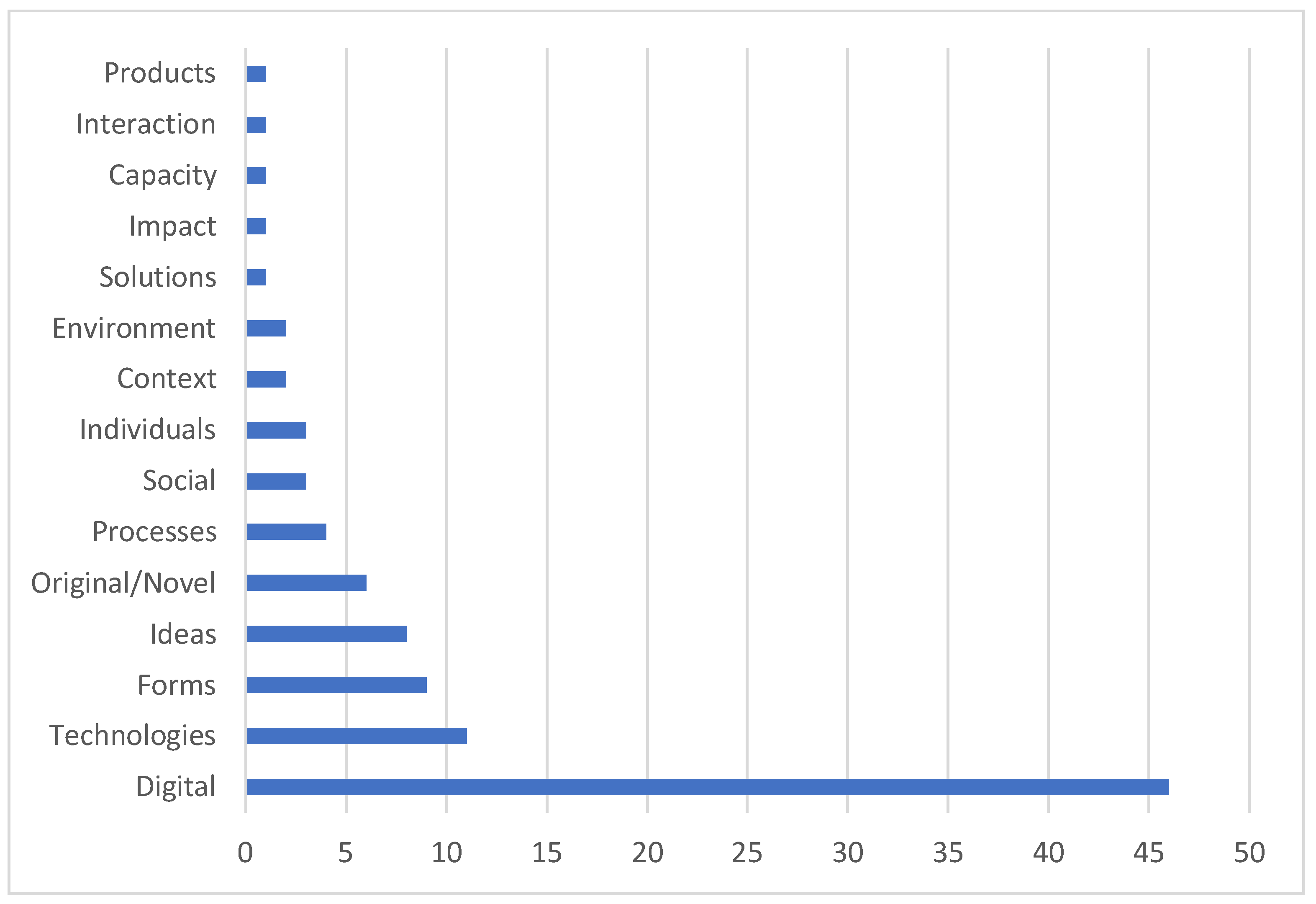
3.1. Comparative Analysis of Definitions and Theoretical Approaches to Digital Creativity
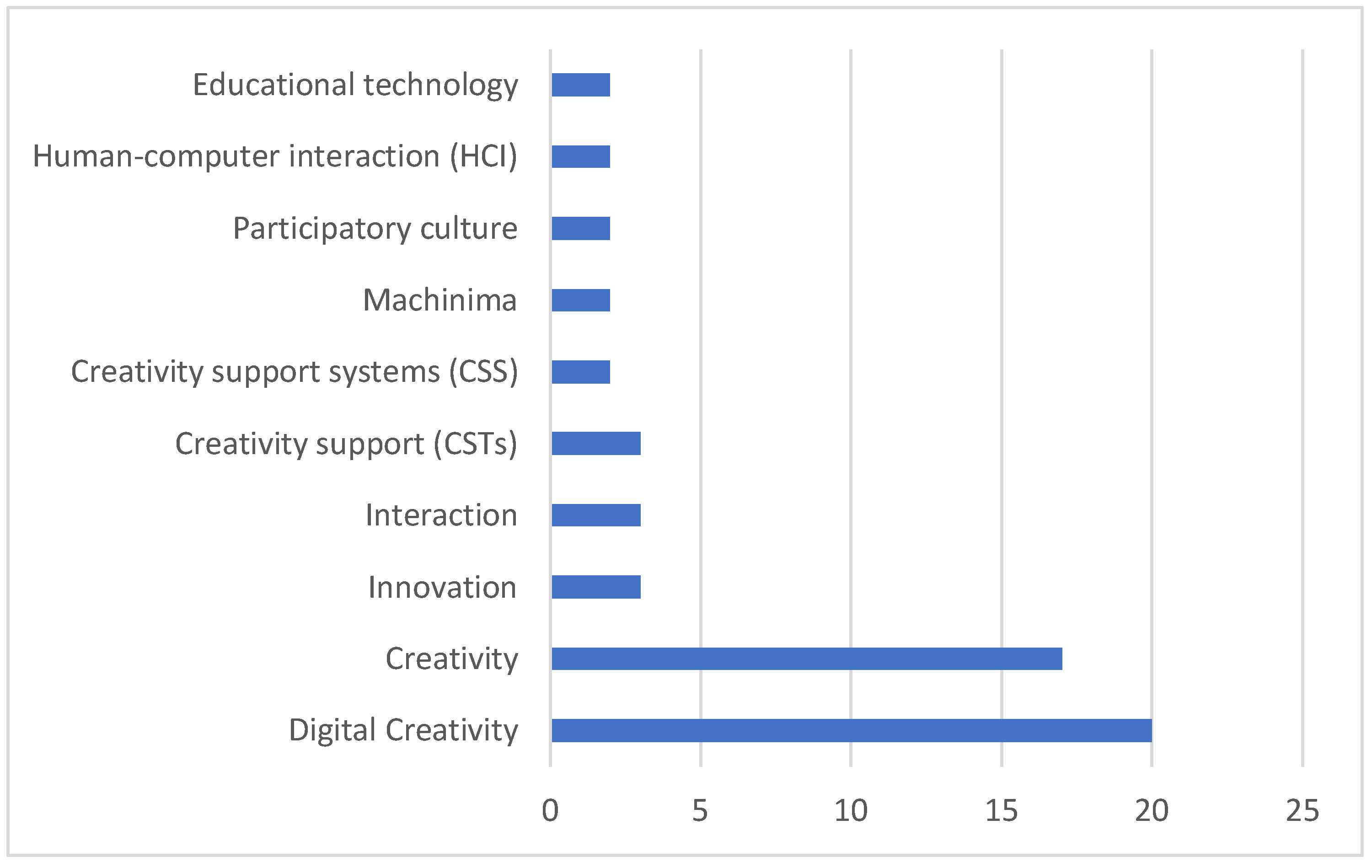
3.2. Evaluative and Interpretative Analysis of the Current Study Fields and Trends in Digital Creativity Research
4. Discussion
4.1. Definitions and Theoretical Approaches to Digital Creativity
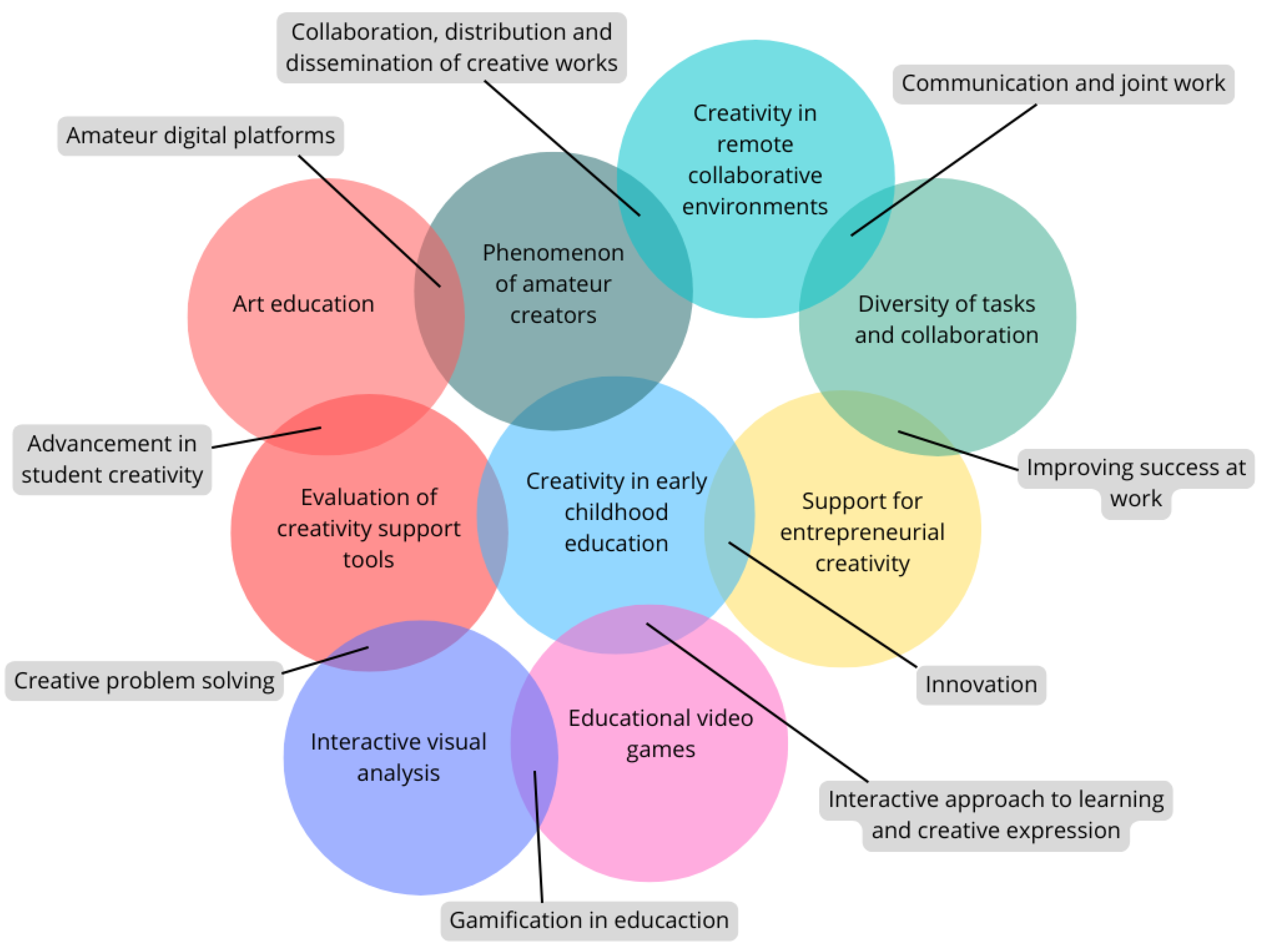
4.2. Current Study Fields and the Trends in Digital Creativity Research
5. Conclusions
Author Contributions
Funding
Institutional Review Board Statement
Informed Consent Statement
Data Availability Statement
Conflicts of Interest
References
- Al Hashimi, S. A., Al Muwali, A. A., Zaki, Y. E., & Mahdi, N. A. (2019). The effectiveness of social media and multimedia-based pedagogy in enhancing creativity among students in art, design, and digital media. International Journal of Emerging Technologies in Learning (iJET), 14(21), 176–190. [Google Scholar] [CrossRef] [Scilit]
- Ali, A., Wang, H., & Khan, A. N. (2019). Mechanism to enhance team creative performance through social media: A transactive memory system approach. Computers in Human Behaviour, 91, 115–126. [Google Scholar] [CrossRef] [Scilit]
- Amabile, T. M. (1983). The social psychology of creativity: A componential conceptualization. Journal of Personality and Social Psychology, 45(2), 357–376. [Google Scholar] [CrossRef]
- Arksey, H., & O’Malley, L. (2005). Scoping studies: Towards a methodological framework. International Journal of Social Research Methodology, 8(1), 19–32. [Google Scholar] [CrossRef] [Scilit]
- Bardzell, J. (2007). Creativity in amateur multimedia: Popular culture, critical theory, and HCI. Human Technology: An Interdisciplinary Journal on Humans in ICT Environments, 3(1), 12–33. [Google Scholar] [CrossRef] [Scilit]
- Biskjaer, M. M., Iversen, O. S., & Dindler, C. (2021). Cultivating creativity in computing education: A missed opportunity? In S. Lemmetty, K. Collin, V. P. Glăveanu, & P. Forsman (Eds.), Creativity and learning (pp. 89–113). Springer International Publishing. [Google Scholar] [CrossRef] [Scilit]
- Boden, M. A. (1998). Creativity and artificial intelligence. Artificial Intelligence, 103(1–2), 347–356. [Google Scholar] [CrossRef] [Scilit]
- Börner, K., Chen, C., & Boyack, K. W. (2010). Visualizing knowledge domains. Annual Review of Information Science and Technology, 37(1), 179–255. [Google Scholar] [CrossRef] [Scilit]
- Brooks, E. P., & Brooks, A. L. (2015). Digital creativity: Children’s playful mastery of technology. In A. L. Brooks, E. Ayiter, & O. Yazicigil (Eds.), Arts and technology (Vol. 145, pp. 116–127). Springer International Publishing. [Google Scholar] [CrossRef] [Scilit]
- Buckwalter, J. A., Wright, T., Mogoanta, L., & Alman, B. (2012). Plagiarism: An assault on the integrity of scientific research. Journal of Orthopaedic Research, 30(12), 1867–1868. [Google Scholar] [CrossRef] [Scilit]
- Carroll, E. (2013). Quantifying the personal creative experience: Evaluation of digital creativity support tools using self-report and physiological responses [Ph.D. dissertation, UNC Charlotte]. Available online: https://repository.charlotte.edu/islandora/object/etd%3A1208 (accessed on 12 October 2022).
- Choi, G. Y., & Behm-Morawitz, E. (2020). Discovering hidden digital producers: Understanding motivation and creativity in social media production. Psychology of Popular Media, 9(3), 318–327. [Google Scholar] [CrossRef] [Scilit]
- Cooke, A., Smith, D., & Booth, A. (2012). Beyond PICO: The SPIDER tool for qualitative evidence synthesis. Qualitative Health Research, 22(10), 1435–1438. [Google Scholar] [CrossRef] [Scilit]
- Copplestone, T., & Dunne, D. (2017). Digital media, creativity, narrative structure and heritage. Internet Archaeology, 44. [Google Scholar] [CrossRef] [Scilit]
- Csikszentmihalyi, M. (1996). Creativity: Flow and the psychology of discovery and invention. Harper/Collins. [Google Scholar]
- Cybulski, J. L., Keller, S., Nguyen, L., & Saundage, D. (2015). Creative problem solving in digital space using visual analytics. Computers in Human Behavior, 42, 20–35. [Google Scholar] [CrossRef] [Scilit]
- De Bono, E. (1992). Serious creativity: Using the power of lateral thinking to create new ideas. Harper Collins. [Google Scholar]
- De Bono, E. (2015). Creatividad. 62 ejercicios para desarrollar la mente. Paidós. [Google Scholar]
- Di Fuccio, R., Ferrara, F., & Di Ferdinando, A. (2020). The docent game: An immersive role-playing game for the enhancement of digital creativity. In E. Popescu, A. Belén Gil, L. Lancia, L. S. Sica, & A. Mavroudi (Eds.), Methodologies and intelligent systems for technology enhanced learning, 9th international conference, workshops (Vol. 1008, pp. 96–102). Springer International Publishing. [Google Scholar] [CrossRef] [Scilit]
- Elgammal, A., & Mazzone, M. (2020). Artists, artificial intelligence, and machine-based creativity in playform. Artnodes, 26, 1–8. [Google Scholar] [CrossRef] [Scilit]
- Esquivias, M. T. (2004). Creatividad: Definiciones, antecedentes y aportaciones. Revista Digital Universitaria, 5(1), 1–17. [Google Scholar]
- Feist, G. J. (1998). A meta-analysis of personality in scientific and artistic creativity. Personality and Social Psychology Review, 2(4), 290–309. [Google Scholar] [CrossRef] [Scilit]
- Fernández-Díaz, J. R., Llamas-Salguero, F., & Gutiérrez-Ortega, M. (2019). Creatividad: Revisión del concepto. ReiDoCrea: Revista Electrónica de Investigación y Docencia Creativa, 8, 467–483. [Google Scholar] [CrossRef] [Scilit]
- Frich, J., Biskjaer, M. M., & Dalsgaard, P. (2018, April 5–7). Why HCI and creativity research must collaborate to develop new creativity support tools. Technology, Mind, and Society Conference (pp. 1–6), Washington, DC, USA. [Google Scholar] [CrossRef] [Scilit]
- Frich, J., MacDonald Vermeulen, L., Remy, C., Biskjaer, M. M., & Dalsgaard, P. (2019, May 4–9). Mapping the landscape of creativity support tools in HCI. 2019 CHI Conference on Human Factors in Computing Systems (pp. 1–18), Glasgow, UK. [Google Scholar] [CrossRef] [Scilit]
- Garaigordobil, M. (2003). Intervención psicológica para desarrollar la personalidad infantil: Juegos, conducta prosocial y creatividad. Ediciones Pirámides. [Google Scholar]
- Garaigordobil, M., & Pérez-Fernández, J. I. (2004). Un estudio de las relaciones entre distintos ámbitos creativos. Educación y Ciencia, 8(15), 67–78. [Google Scholar]
- Gilhooly, K. J. (2016). Incubation and intuition in creative problem solving. Frontiers in Psychology, 7, 1076. [Google Scholar] [CrossRef] [Scilit]
- Guilford, J. P. (1950). Creativity. American Psychologist, 5(9), 444–454. [Google Scholar] [CrossRef] [Scilit]
- Hahn, M. H., Choi, D. Y., & Lee, K. C. (2013). An empirical analysis of the effect of social and emotional intelligence on individual creativity through exploitation and exploration. In K. C. Lee (Ed.), Digital creativity (Vol. 32, pp. 79–98). Springer. [Google Scholar] [CrossRef] [Scilit]
- Harwood, T. (2013). Machinima as a learning tool. Digital Creativity, 24(3), 168–181. [Google Scholar] [CrossRef] [Scilit]
- Hisrich, R. D., & Soltanifar, M. (2021). Unleashing the creativity of entrepreneurs with digital technologies. In M. Soltanifar, M. Hughes, & L. Göcke (Eds.), Digital entrepreneurship: Impact on business and society (pp. 23–49). Springer International Publishing. [Google Scholar] [CrossRef] [Scilit]
- Hoffmann, J., Ivcevic, Z., & Brackett, M. (2016). Creativity in the age of technology: Measuring the digital creativity of millennials. Creativity Research Journal, 28(2), 149–153. [Google Scholar] [CrossRef] [Scilit]
- Hu, S., Gu, J., Liu, H., & Huang, Q. (2017). The moderating role of social media usage in the relationship among multicultural experiences, cultural intelligence, and individual creativity. Information Technology & People, 30(2), 265–281. [Google Scholar] [CrossRef] [Scilit]
- Ivcevic, Z., & Mayer, J. D. (2009). Mapping dimensions of creativity in the life-space. Creativity Research Journal, 21(2–3), 152–165. [Google Scholar] [CrossRef] [Scilit]
- Kemp, P. E. J. (2020). Learning pathways for digitally creative youth: A study of 3D animation [Ph.D. dissertation, University of Roehampton]. Available online: https://pure.roehampton.ac.uk/ws/portalfiles/portal/3217463/Learning_pathways_for_digitally_creative_youth.pdf (accessed on 12 October 2022).
- Kikis-Papadakis, K., & Chaimala, F. (2019). Assessing competences for digital creativity. In O. Miglino, & M. Ponticorvo (Eds.), Proceedings of the First Symposium on Psychology-Based Technologies (PSYCHOBIT 2019) (pp. 1–10). CEUR Workshop Proceedings, 2524. Available online: https://ceur-ws.org/Vol-2524/paper5.pdf (accessed on 12 October 2022).
- Lee, K. C. (2015). Digital creativity: New frontier for research and practice. Computers in Human Behavior, 42, 1–4. [Google Scholar] [CrossRef] [Scilit]
- Lee, M. R., & Chen, T. T. (2015). Digital creativity: Research themes and framework. Computers in Human Behavior, 42, 12–19. [Google Scholar] [CrossRef] [Scilit]
- Lessig, L. (2004). Free culture: How big media uses technology and the law to lock down culture and control creativity. Penguin Press, HC. [Google Scholar] [CrossRef] [Scilit]
- Letelier, S. S., Manríquez M., J. J., & Rada G., G. (2005). Systematic reviews and meta-analysis: Are the best evidence? Revista Médica de Chile, 133(2), 246–249. [Google Scholar] [CrossRef] [Scilit]
- Li, Y., Kim, M., & Palkar, J. (2022). Using emerging technologies to promote creativity in education: A systematic review. International Journal of Educational Research Open, 3, 100177. [Google Scholar] [CrossRef] [Scilit]
- Loveless, A. M. (2002). A literature review in creativity, new technologies, and learning: A report for NESTA Futurelab. NESTA Futurelab. Available online: https://telearn.hal.science/hal-00190439v1/document (accessed on 20 October 2022).
- Maiden, N., Zachos, K., Brown, A., Nyre, L., Holm, B., Tonheim, A. N., Hesseling, C., Wagemans, A., & Apostolou, D. (2019, June 23–26). Evaluating the use of digital creativity support by journalists in newsrooms. 2019 Creativity and Cognition Conference (pp. 222–232), San Diego, CA, USA. [Google Scholar] [CrossRef] [Scilit]
- McGrath, L., Bresciani, S., & Eppler, M. J. (2016). We walk the line: Icons’ provisional appearances on virtual whiteboards trigger elaborative dialogue and creativity. Computers in Human Behavior, 63, 717–726. [Google Scholar] [CrossRef] [Scilit]
- McKay, A. S., Grygiel, P., & Karwowski, M. (2017). Connected to create: A social network analysis of friendship ties and creativity. Psychology of Aesthetics, Creativity and the Arts, 11(3), 284–294. [Google Scholar] [CrossRef] [Scilit]
- Montgomery, S. L. (2009). Does science need a global language?: English and the future of research. University of Chicago Press. [Google Scholar]
- Munn, Z., Peters, M. D., Stern, C., Tufanaru, C., McArthur, A., & Aromataris, E. (2018). Systematic review or scoping review? Guidance for authors when choosing between a systematic or scoping review approach. BMC Medical Research Methodology, 18(1), 1–7. [Google Scholar] [CrossRef]
- Oropesa, F. N., Pérez, M. C., Molero, M. M., Simón, M. M., Barragán, A. B., Martos, A., Sisto, M., Soriano, J. G., & Gázquez, J. J. (2018). Creatividad digital en educación secundaria: Análisis descriptivo y relacional en función de variables sociodemográficas. In La convivencia escolar, un acercamiento multidisciplinar (Vol. III, pp. 213–220). Asunivep. Available online: http://www.sej473.com/documents/capitulos/capitulo_150.pdf (accessed on 12 October 2022).
- Page, M. J., McKenzie, J. E., Bossuyt, P. M., Boutron, I., Hoffmann, T. C., Mulrow, C. D., Shamseer, L., Tetzlaff, J. M., Akl, E. A., Brennan, S. E., & Chou, R. (2021). Declaración PRISMA 2020: Una guía actualizada para la publicación de revisiones sistemáticas. Revista Española de Cardiología, 74(9), 790–799. [Google Scholar] [CrossRef] [PubMed]
- Paulus, P. B., & Nijstad, B. A. (Eds.). (2003). Group creativity: Innovation through collaboration. Oxford University Press. [Google Scholar]
- Peters, M. D., Godfrey, C. M., McInerney, P., Baldini Soares, C., Khalil, H., & Parker, D. (2015). Methodology for JBI scoping reviews. In E. Aromataris, & Z. Munn (Eds.), Joanna Briggs Institute Reviewer’s Manual (pp. 1–24). The Joanna Briggs Institute. [Google Scholar]
- Pérez-Fernández, J. I. (1997). Continuación de la investigación de la creatividad. Revista Música Arte Proceso, 4, 29–40. [Google Scholar]
- Pérez-Fuentes, M. D. C., Molero Jurado, M. D. M., Oropesa Ruiz, N. F., Simón Márquez, M. D. M., & Gázquez Linares, J. J. (2019). Relationship between digital creativity, parenting style, and adolescent performance. Frontiers in Psychology, 10, 2487. [Google Scholar] [CrossRef] [Scilit] [PubMed]
- Pizzo, A., & Valle, A. (2014). Digital creativity: A survey for the project Invisibilia. Mimesis Journal, 3(2), 53–69. [Google Scholar] [CrossRef] [Scilit]
- Plucker, J. A., Beghetto, R. A., & Dow, G. T. (2004). Why isn’t creativity more important to educational psychologists? Potentials, pitfalls, and future directions in creativity research. Educational Psychologist, 39(2), 83–96. [Google Scholar] [CrossRef] [Scilit]
- Prasch, L., Bruch, L. A. D., & Bengler, K. (2022). User needs for digital creativity support systems in an occupational context. In N. L. Black, W. P. Neumann, & I. Noy (Eds.), Proceedings of the 21st Congress of the International Ergonomics Association (IEA 2021) (Vol. 223, pp. 667–674). Springer International Publishing. [Google Scholar] [CrossRef] [Scilit]
- RAE. (2023). ROYAL SPANISH ACADEMY: Dictionary of the Spanish language. 23rd ed. [online version 23.8]. Available online: https://dle.rae.es (accessed on 1 October 2024).
- Ritter, S. M., & Dijksterhuis, A. (2014). Creativity—the unconscious foundations of the incubation period. Frontiers in Human Neuroscience, 8, 73722. [Google Scholar] [CrossRef] [Scilit]
- Rudowicz, E. (2003). Creativity and culture: A two-way interaction. Scandinavian Journal of Educational Research, 47(3), 273–290. [Google Scholar] [CrossRef] [Scilit]
- Runco, M. A., & Jaeger, G. J. (2012). The standard definition of creativity. Creativity Research Journal, 24(1), 92–96. [Google Scholar] [CrossRef] [Scilit]
- Runco, M. A., & Richards, R. (1997). Eminent creativity, everyday creativity, and health. Greenwood Publishing Group. [Google Scholar]
- Sadler-Smith, E. (2015). Wallas’ four-stage model of the creative process: More than meets the eye? Creativity Research Journal, 27(4), 342–352. [Google Scholar] [CrossRef] [Scilit]
- Salager-Meyer, F. (2008). Scientific publishing in developing countries: Challenges for the future. Journal of English for Academic Purposes, 7(2), 121–132. [Google Scholar] [CrossRef] [Scilit]
- Samoila, C., Ursutiu, D., Jinga, V., & Kane, P. (2015, September 20–24). Digital creativity peculiarities in the case of remote experiment. 2015 International Conference on Interactive Collaborative Learning (ICL) (pp. 1231–1234), Firenze, Italy. [Google Scholar] [CrossRef] [Scilit]
- Sawyer, R. K. (2012). Explaining creativity: The science of human innovation. Oxford University Press. [Google Scholar]
- Sánchez-Meca, J. (2022). Revisiones sistemáticas y meta-análisis en educación: Un tutorial. Revista Interuniversitaria de Investigación en Tecnología Educativa, 5, 5–40. [Google Scholar] [CrossRef] [Scilit]
- Seo, Y. W., & Lee, K. C. (2011, August 12–14). Multi-agent simulation approach for investigating the evolution pattern analysis of digital creativity considering task diversity. 2011 International Conference on Management and Service Science (pp. 1–4), Wuhan, China. [Google Scholar] [CrossRef] [Scilit]
- Shin, R. (2010). Taking digital creativity to the art classroom: Mystery box swap. Art Education, 63(2), 38–42. [Google Scholar] [CrossRef] [Scilit]
- Shneiderman, B. (2002). Creativity support tools. Communications of the ACM, 45(10), 116–120. [Google Scholar] [CrossRef] [Scilit]
- Sica, L. S., Ponticorvo, M., & Miglino, O. (2020). Enhancing digital creativity in education: The Docent Project approach. In E. Popescu, A. Belén Gil, L. Lancia, L. S. Sica, & A. Mavroudi (Eds.), Methodologies and intelligent systems for technology enhanced learning, 9th international conference, workshops (Vol. 1008, pp. 103–110). Springer International Publishing. [Google Scholar] [CrossRef] [Scilit]
- Simonton, D. K. (2003). Scientific creativity as constrained stochastic behavior: The integration of product, person, and process perspectives. Psychological Bulletin, 129(4), 475–494. [Google Scholar] [CrossRef] [Scilit] [PubMed]
- Sternberg, R. J., & Lubart, T. I. (1996). Investing in creativity. American Psychologist, 51(7), 677–688. [Google Scholar] [CrossRef]
- Sternberg, R. J. (Ed.). (1999). Handbook of creativity. Cambridge University Press. [Google Scholar]
- Sternberg, R. J., Lubart, T. I., Kaufman, J. C., & Pretz, J. E. (2005). Creativity. In K. J. Holyoak, & R. G. Morrison (Eds.), The Cambridge handbook of thinking and reasoning (pp. 351–369). Cambridge University Press. [Google Scholar]
- Tang, C., Mao, S., Naumann, S. E., & Xing, Z. (2022). Improving student creativity through digital technology products: A literature review. Thinking Skills and Creativity, 44, 101032. [Google Scholar] [CrossRef] [Scilit]
- Torrance, E. (1988). The nature of creativity as manifest in its testing. In R. Sternberg (Ed.), The nature of creativity (pp. 43–73). Cambridge University Press. [Google Scholar]
- Tricco, A. C., Lillie, E., Zarin, W., O’Brien, K. K., Colquhoun, H., Levac, D., Moher, D., Peters, M. D., Horsley, T., Weeks, L., & Hempel, S. (2018). PRISMA extension for scoping reviews (PRISMA-ScR): Checklist and explanation. Annals of Internal Medicine, 169(7), 467–473. [Google Scholar] [CrossRef] [Scilit]
- Valero-Matas, J. A. (2020). La educación en la technoaldea: ¿Privación de la creatividad? Foro de Educación, 18(2), 259–275. [Google Scholar] [CrossRef] [Scilit]
- Wallas, G. (1926). The art of thought. Franklin Watts. [Google Scholar]
- Williams, R., Runco, M. A., & Berlow, E. (2016). Mapping the themes, impact, and cohesion of creativity research over the last 25 years. Creativity Research Journal, 28(4), 385–394. [Google Scholar] [CrossRef] [Scilit]
- Zagalo, N., & Branco, P. (2015). The creative revolution that is changing the world. In N. Zagalo, & P. Branco (Eds.), Creativity in the digital age (pp. 3–15). Springer. [Google Scholar] [CrossRef] [Scilit]
- Zhang, J., Chen, W., Xiao, Y., & Wang, B. (2022). Exploration of digital creativity: Construction of the multiteam digital creativity influencing factor model in the action phase. Frontiers in Psychology, 13, 822649. [Google Scholar] [CrossRef] [Scilit]



| Database | Number of References |
|---|---|
| WOS | 115 |
| SCOPUS | 150 |
| UOC | 253 |
| DIALNET | 67 |
| PSYCINFO | 33 |
| Citation (Author/Year) | Country of Origin | Study Objective | Methodology | Scientific Impact |
|---|---|---|---|---|
| Bardzell (2007) | USA | Analyse the phenomenon of amateur multimedia and its creative practices. | Qualitative study | Indexing and archiving:
|
| Shin (2010) | USA | Provide art educators with strategies and ideas to embrace digital creativity in their teaching. | Literature review |
|
| Seo and Lee (2011) | Korea | Explore the evolutionary pattern of digital creativity in individuals and teams within organisations. | Literature review |
|
| Carroll (2013) | USA | Assess digital creativity support tools (CST) and their impact on users. | Quantitative study |
|
| Hahn et al. (2013) | Korea | Examine how emotional and social intelligence contribute to creative performance in professional settings. | Quantitative study |
|
| Harwood (2013) | UK | Analyse the potential of the machinima as an educational and creative tool. | Qualitative study | 2017 8/90 Q1 PSYCHOLOGY, EXPERIMENTAL 2017 18/186 Q1 PSYCHOLOGY, MULTIDISCIPLINARY
|
| Pizzo and Valle (2014) | Italy | Study the conceptualisation of digital creativity and its theoretical foundations. | Literature review |
|
| Brooks and Brooks (2015) | Denmark | Study the interaction of young children (aged 3 to 5 years) with digital technology. | Bibliometric review |
|
| Cybulski et al. (2015) | Australia | Understand how visual analytics can enhance creativity and problem solving. | Literature review | 2017 8/90 Q1 PSYCHOLOGY, EXPERIMENTAL 2017 18/186 Q1 PSYCHOLOGY, MULTIDISCIPLINARY
|
| K. C. Lee (2015) | Korea | Investigate how digital technologies are changing creativity in different domains. | Bibliometric review | 2017 8/90 Q1 PSYCHOLOGY, EXPERIMENTAL 2017 18/186 Q1 PSYCHOLOGY, MULTIDISCIPLINARY
|
| M. R. Lee and Chen (2015) | Taiwan | Structure and organise the research on digital creativity to guide future studies. | Literature review | 2017 8/90 Q1 PSYCHOLOGY, EXPERIMENTAL 3/99 2017 18/186 Q1 PSYCHOLOGY, MULTIDISCIPLINARY
|
| Samoila et al. (2015) | Romania | Explore how remote experiments enhance digital creativity in educational settings. | Literature review |
|
| Zagalo and Branco (2015) | Portugal | Explore how digital tools democratise creativity and foster self-expression. | Literature review |
|
| McGrath et al. (2016) | Swiss | Assess how the visual design on digital platforms enhances collaborative creativity. | Quantitative study | Q1 PSYCHOLOGY, EXPERIMENTAL 3/99 Q1 PSYCHOLOGY, MULTIDISCIPLINARY 9/218
|
| Copplestone and Dunne (2017) | UK, Australia | Analyse digital creativity and interactive technology in heritage narratives. | Case study |
|
| Frich et al. (2018) | Denmark | Examine how a serious game can support the digital creativity in teacher education. | Literature review |
|
| Oropesa et al. (2018) | Spain | Characterise the digital creativity in secondary school students and their sociodemographic differences. | Quantitative study | |
| Frich et al. (2019) | Denmark | Provide an overview of the creativity support tools in HCI (Human–Computer Interaction). | Literature review |
|
| Kikis-Papadakis and Chaimala (2019) | Greece | Develop competencies related to digital creativity in educational settings. | Review of the literature |
|
| Maiden et al. (2019) | UK | Evaluate the effectiveness of the INJECT tool to improve the creativity in journalism. | Quantitative study |
|
| Pérez-Fuentes et al. (2019) | Spain | Analizar la relación entre creatividad digital, estilo parental y rendimiento académico. | Quantitative study | 2019 61/196 Q2 PSYCHOLOGY, MULTIDISCIPLINARY
|
| Di Fuccio et al. (2020) | Italy | Promote digital creativity through a serious game for initial teacher training. | Review of the literature |
|
| Kemp (2020) | UK | Study the development of digital creative skills in young people through 3D animation. | Quantitative study |
|
| Sica et al. (2020) | Italy | Promote digital creativity in education through inclusive tools and divergent thinking. | Review of the literature |
|
| Valero-Matas (2020) | Spain | Examine how the use of technology affects the creativity in education and analogy creativity. | Literature review |
|
| Biskjaer et al. (2021) | Denmark | Integrate creativity into Denmark’s technology curriculum. | Review of the literature |
|
| Hisrich and Soltanifar (2021) | USA | Explore how digital technology improves entrepreneurial creativity. | Literature review |
|
| Prasch et al. (2022) | Germany | Customise creativity support systems for professionals in creative fields. | Quantitative study |
|
| Zhang et al. (2022) | China | Study the factors influencing digital creativity in multi-team systems. | Qualitative study | 2022 52/215 Q1 PSYCHOLOGY, MULTIDISCIPLINARY
|
| Author and Year | Definition of Digital Creativity | Theoretical Approach | Similarities | Differences |
|---|---|---|---|---|
| Bardzell (2007) | All forms of digital art share the same basic material (data), making multimedia applications fundamentally similar despite their diversity. | Relationship between data and multimedia authoring applications. | Emphasis on the technological foundation in creative processes. | Focuses specifically on digital art and multimedia rather than broad creativity. |
| Shin (2010) | Digital creativity involves individual, domain, field, and sociocultural contexts. | Cognitive and sociocultural model of creativity. | Recognise creativity as a multidimensional process shaped by individual and social elements. | Highlights domain specificity compared to broader definitions that generalise across contexts. |
| Seo and Lee (2011) | Digital creativity is not just technology, but the ability to solve problems and create useful products in digital environments. | Problem-solving approach to creativity in digital environments. | Focuses on the practical aspect of creativity as a way to generate solutions. | Prioritises utility over artistic or expressive elements. |
| Carroll (2013) | Digital creativity tools support scientific, engineering, humanistic, and artistic endeavours, affecting both individuals and society. | Supportive tools for diverse creative fields. | Highlights how digital tools enable creativity in various disciplines. | Broader focus on the societal impact of tools rather than specific digital skills. |
| Hahn et al. (2013) | Creativity is a multilateral phenomenon resulting from cognitive, motivational, and environmental factors. | Multifactorial theory of creativity. | Recognises creativity as the result of cognitive and environmental interaction. | It does not explicitly address the role of digital technologies. |
| Harwood (2013) | Digital creativity is participative, transforming passive consumers into co-creators through collaboration, customisation, and innovation. | Participatory and social model of digital creativity. | Emphasis on co-creation and community-based creativity. | Strongly focused on user participation rather than individual creative processes. |
| Pizzo and Valle (2014) | Digital creativity represents a dispersed notion that merges various definitions developed over decades. | Historical and conceptual synthesis of creativity definitions. | Acknowledges the complexity and evolution of the concept of digital creativity. | It does not propose a specific framework but rather highlights conceptual diversity. |
| Brooks and Brooks (2015) | The potential of digital creativity is related to emergent play values that provide new ways of interaction. | Play and interaction as drivers of creativity. | Emphasise the importance of playful interactions in digital creativity. | The focus is heavily on emergent play and interaction rather than formalised creative processes. |
| Cybulski et al. (2015) | Digital creativity includes all forms of creativity driven by digital technologies. | Broad approach to creativity facilitated by technology. | Defines creativity in a comprehensive way that encompasses multiple contexts. | Provides a generalised definition with limited emphasis on specific domains. |
| K. C. Lee (2015) | Creativity facilitated by various digital technologies. | Digital tools as enablers of creative expression. | Recognises the facilitative role of digital tools in the creative process. | Offers a general definition without emphasising specific social or cognitive factors. |
| M. R. Lee and Chen (2015) | Creativity manifested itself in forms driven by digital technologies. | Focuses on manifestations of creativity through digital tools. | Considers creativity as a technological manifestation. | Lacks elaboration on specific contexts or processes. |
| Samoila et al. (2015) | Creative digital solutions require social collaboration and transform consumers into active users. | Social creativity perspective. | Emphasises the role of social collaboration in digital creativity. | Focuses on collective creativity rather than individual initiatives. |
| Zagalo and Branco (2015) | Creative technologies offer new modes of participation, empowering people to express their creativity. | Inclusive and accessible creativity enabled by technology. | Highlights how technology democratises access to creative processes. | Focuses on empowerment and participation rather than traditional creative outputs. |
| McGrath et al. (2016) | Creativity involves the production of ideas that are original, feasible, and instrumental; in other words, new, unusual, and statistically infrequent, viable to implement, and useful. | Based on the conceptualisation of creativity as a process of generating novel and useful ideas. | Emphasises the criteria of originality and usefulness as key aspects of creativity, aligning with other creativity approaches. | Focuses on a general definition of creativity and does not address specific digital or technological aspects. |
| Copplestone and Dunne (2017) | Digital creativity describes the innovative use of digital media to express ideas, experiences, and aesthetics. | Narrative and aesthetic use of digital media. | Focuses on novel applications of digital media for expression. | Primarily orientated toward narrative and aesthetic contexts. |
| Frich et al. (2018) | Creativity involves the interaction of aptitude, process, and environment to produce novel and useful outcomes. | Interactionist approach to creativity. | Emphasises the interaction between individual abilities and the surrounding environment. | It does not explicitly focus on the digital aspect of creativity. |
| Oropesa et al. (2018) | Digital creativity includes digital achievements, everyday school creativity, and self-expressive creativity. | Educational perspective of creativity in digital contexts. | Highlights distinct types of digital creative output in educational contexts. | Focused on the educational setting rather than general digital creativity. |
| Frich et al. (2019) | Digital creativity refers to all forms of creativity driven and facilitated by various forms of digital technologies. | Broad approach to creativity enabled by digital technologies. | Highlights how digital technologies act as enablers of creative processes, similar to other definitions that focus on technological facilitation. | Provides a general definition without specifying particular contexts, processes, or cognitive aspects. |
| Kikis-Papadakis and Chaimala (2019) | Digital creativity is an imaginative activity mediated by digital technologies that results in valuable and original outcomes. | Creative learning mediated by technology. | Emphasises the purposefulness and originality of digital creativity. | Strong focus on the educational context and learning outcomes. |
| Maiden et al. (2019) | INJECT, a digital tool, enhances journalistic creativity by helping to discover novel story angles. | Practical application of digital tools for creativity. | Demonstrates how specific digital tools can enhance creativity. | Tool-specific focus rather than a general definition of digital creativity. |
| Pérez-Fuentes et al. (2019) | Digital creativity is part of the daily life of today’s youth and is defined based on three main components: digital creative achievement, school-based everyday creativity, and self-expressive digital creativity. | Educational and self-expression approach to digital creativity. | Emphasises creativity as a multifaceted concept present in everyday life, similar to other educational and expressive frameworks. | Focuses specifically on youth, highlighting school contexts and self-expression, rather than generalised creative practices. |
| Valero-Matas (2020) | Analogous human creativity is being replaced by machine-driven creativity. | Reflection on the shift from human to machine-generated creativity. | Recognises the transformation of creative processes through machine learning and AI. | Emphasis on replacement rather than enhancement or collaboration. |
| Di Fuccio et al. (2020) | Digital creativity in education involves the use of digital tools to foster learner-centred methodologies, self-learning, and collaboration. | Pedagogical approach to creativity using digital tools. | The focus is on promoting exploration, discovery, and safe experimentation. | Orientated toward educational methodologies rather than broader creative industries. |
| Kemp (2020) | Digital creativity requires unique skills, including computational thinking, often expressed through coding. | Skill-based approach to digital creativity. | The need for computational and technical skills in digital creative practices is highlighted. | Strongly focused on technical aspects rather than expressive or collaborative elements. |
| Sica et al. (2020) | Digital creativity promotes and stimulates creativity while giving value to digital tools in an inclusive framework that fosters divergent thinking. | Inclusive framework for fostering divergent thinking. | Emphasises the inclusive and stimulating role of digital tools. | Strong emphasis on divergent thinking rather than convergent or problem-solving approaches. |
| Biskjaer et al. (2021) | Creativity is the interaction among aptitude, process, and the environment through which an individual or group produces a perceptible product that is both novel and useful, as defined within a social context. | An interactionist approach to creativity, emphasising the role of the social context in creative production. | Similar to other definitions that highlight creativity as a result of interactions between internal abilities and external environments. | Does not explicitly focus on digital creativity, but rather on a broader framework of creativity within a social context. |
| Hisrich and Soltanifar (2021) | Creativity involves identifying and developing novel and useful ideas using digital technologies. | Applied creativity in entrepreneurial contexts. | Highlights creativity as a driver of innovation in entrepreneurship. | Entrepreneurial focus rather than general digital creativity. |
| Prasch et al. (2022) | It is difficult to reach an accepted definition of digital creativity, as it varies between disciplines. | Recognises the definitional challenges in interdisciplinary contexts. | Recognises the complexity of defining digital creativity across different fields. | Does not propose a specific definition, but instead discusses definitional variability. |
| Zhang et al. (2022) | Digital creativity refers to creativity expressed in various forms based on digital environments or driven by digital technologies. | Relationship between digital environments and creativity. | Highlights how digital environments foster diverse forms of creative expression. | Provides a general overview without specifying processes or social impacts. |
| Citation (Author/Year) | Keywords | Field of Knowledge | Conclusions |
|---|---|---|---|
| Bardzell (2007) | Amateur multimedia; Creativity; Human–computer interaction (HCI), Aesthetics; YouTube, Machinima. | Information Sciences | The need for greater recognition and understanding of amateur multimedia as a significant cultural phenomenon that reshapes the landscape of creativity in contemporary society is highlighted. |
| Shin (2010) | Digital creativity; Art education; Web 2.0 tools; Participatory culture; Educational technology. | Educational Context | Integrating digital creativity into the art classroom enhances students’ creative potential and encourages educators to take advantage of digital tools to make learning more dynamic and culturally relevant. |
| Seo and Lee (2011) | Communication effectiveness; Cultural differences; Companies; Presses; Complexity theory; Multi-agent systems. | Business Sector | The diversity of tasks, communication effectiveness, task expertise, and digitalist tendencies play vital roles in the promotion of digital creativity. |
| Carroll (2013) | Creativity Support Tools (CSTs); Human–computer interaction (HCI); Creativity measurement; Self-report surveys; Creativity Support Index (CSI); In-the-moment creativity (ITMC); Physiological responses; Digital creativity. | Information Sciences | Advances both subjective (CSI) and objective (ITMC) methods for evaluating creativity support tools, with important implications for tool design and user experience in creative tasks. |
| Hahn et al. (2013) | Social intelligence; Emotional intelligence; Individual creativity; Exploitation; Exploration; Creative process; Innovation; Workplace creativity. | Social Sciences | Highlights the importance of emotional and social intelligence in driving individual creativity, especially through exploration and innovation. |
| Harwood (2013) | Machinima; Transdisciplinarity, Practice-Based Learning; Digital creativity. | Educational Context | Describes machinima as a valuable tool for fostering creativity, collaborative learning, and digital competency in a connected, multimedia-driven world. |
| Pizzo and Valle (2014) | Digital creativity; Bibliography | Information Sciences | Note the diversity and interdisciplinary nature of digital creativity, while emphasising the need for a more structured approach to define its core concepts and contributions. |
| Brooks and Brooks (2015) | Early childhood learning; Creativity, Playful play; Interaction; Technology | Educational Context | Incorporating technology into early childhood education focuses on enhancing children’s creative expression through playful interactions. |
| Cybulski et al. (2015) | Business analytics; Interactivity; Data visualisation; Digital creativity; Visual metaphor. | Business Sector | Emphasises the importance of Interactive Visual Analytics (IVA) in enhancing creative problem solving through visualisation, interaction, and collaboration, calling for further research to deepen the understanding of creativity in the context of big data. |
| K. C. Lee (2015) | Digital creativity; Creativity; innovation, Digital technologies; Collaboration. | Business Sector and Social Sciences | The author discusses the transformative role of digital creativity in modern society and emphasises its potential for innovation, while also recognising the challenges it poses. |
| M. R. Lee and Chen (2015) | Digital creativity; Literature review; Intellectual structure; Research themes and framework. | Information Sciences and Social Sciences | The growing importance of digital creativity across various fields is highlighted, highlighting its central themes and offering a framework to guide future research and address the existing gaps in the literature. |
| Samoila et al. (2015) | Creativity; Divergent thinking, Convergent Thinking; Disruptive technology; Online laboratory; Remote experiments. | Educational Context | Concludes that remote experiments provide an effective platform for enhancing digital creativity, offering both students and educators new opportunities for innovation, active learning, and collaboration in the digital age. |
| Zagalo and Branco (2015) | Digital creativity; Participatory culture; Creative technologies; Democratisation of innovation; Self-expression. | Social Sciences | The author asserts that digital technologies are driving a creative revolution by making creativity more accessible, fostering a participatory culture, and enabling people to explore their creative potential in ways previously unimaginable. |
| McGrath et al. (2016) | Creativity; Visualisation; Elaborative dialogue; Creativity Support Systems (CSSs); Interaction design; Ideation; Computer-mediated communication. | Business Sector | Using unfinished visual elements on digital platforms enhances both creativity and collaborative dialogue, offering practical insights for the design of digital creativity tools. |
| Copplestone and Dunne (2017) | Digital media; Creativity; Narrative structures; Interactive technologies; Digital archaeology. | Social Sciences | Calls for a critical examination of the relationship between media forms, narrative structures, and the presentation of heritage, emphasising the need for more experimentation and exploration to fully understand the potential of digital narratives to shape engagement with the past. |
| Frich et al. (2018) | Creativity Support Tools (CSTs); Creativity; Human–computer interaction; Psychology. | Information Sciences | Describes the DoCENT game as a tool with the potential for improving digital creativity and teaching practices in education, with next steps involving enhancing the game’s features and expanding its use in different educational contexts. |
| Oropesa et al. (2018) | Digital creativity; Secondary education; Daily creativity; Sociodemographic variables. | Educational Context | The authors argue that characterising young people’s digital creativity, given the various ways to express digital creativity in the technological era, will allow better teaching planning and increase adolescent digital creativity by improving digital competence. |
| Frich et al. (2019) | Creativity Support Tools (CSTs); Creativity; Meta-analysis; Review of the literature. | Information Sciences | Encourages further research to refine the definition of Creativity Support Tools (CSTs) and better align these tools with creativity research to enhance their development and application in real-world creative processes. |
| Kikis-Papadakis and Chaimala (2019) | Digital creativity; Teacher competences; Formative assessment. | Educational Context | Highlights the importance of developing and assessing teacher competencies in digital creativity, acknowledging the complexities involved in evaluating creative work in digital contexts. |
| Maiden et al. (2019) | Journalism; Creativity; Digital support; Evaluation; News-rooms. | Business Sector | Reports that while INJECT helped increase the journalist creativity in generating novel content, it did not improve the productivity and faced challenges in adoption due to the cultural and technical barriers in newsrooms. |
| Pérez-Fuentes et al. (2019) | Academic performance; Adolescence; Digital creativity; Family–school relationship; Parenting style. | Educational Context | The author discusses the role of digital creativity as a facilitator tool in teaching, along with parenting styles, in improving the academic performance and family–school relationships. |
| Di Fuccio et al. (2020) | Serious game; Digital creativity; Role-playing game, Adaptive tutoring system; Learning scenarios; Initial training education. | Educational Context | Indicates that the game shows promise as a tool for improving the digital creativity and teaching skills in educational settings, with future work focused on expanding its functionality and incorporating more creative learning opportunities. |
| Kemp (2020) | Digital creativity; 3D animation; Educational technology; Creativity theory; Computational thinking. | Educational Context | Emphasises the importance of expanding the access to digital tools, supportive educational frameworks, and diverse learning environments to cultivate digital creativity in young people, especially through 3D animation. |
| Sica et al. (2020) | Digital creativity; Education; Teacher education. | Educational Context | The author emphasises the importance of integrating digital creativity into education to better prepare students for the demands of the modern workforce, with a strong focus on the role of teachers and the potential of digital tools to enhance creative learning. |
| Valero-Matas (2020) | Technology; Creativity; Digital and analogue; Education. | Educational Context | Calls for a balanced approach to the use of technology in education, advocating for the preservation of analogue creativity alongside the benefits of digital tools to ensure that students can fully develop their creative potential. |
| Biskjaer et al. (2021) | Creativity; Computer education; Technology comprehension; Curriculum development; Learning outcomes | Educational Context | Advocates for the progressive and informed implementation of creativity in computing education to enhance the student engagement and learning outcomes. |
| Hisrich and Soltanifar (2021) | Digital creativity; Entrepreneurship; Innovation; Artificial intelligence; Emerging technologies. | Business Sector | Highlights that digital tools and technologies are essential to unleash entrepreneurial creativity, drive innovation, and ensure long-term business success in the digital age. |
| Prasch et al. (2022) | Creativity support systems; User needs; New work; Human–machine interaction. | Business Sector | The need for customised creativity support systems that address challenges in idea generation and information research is stressed, while also facilitating collaboration and integrating digital and analogue tools for professional creative work. |
| Zhang et al. (2022) | Cross-validation studies; Influencing factor model; MTS theory, Multiteam digital creativity; Multiteam digital sharing. | Business Sector | Concludes that multiteam collaboration and digital sharing are essential for driving digital creativity, especially during the action phase, and that organisations need to focus on enabling collective efforts through digital tools and infrastructure. |
Disclaimer/Publisher’s Note: The statements, opinions and data contained in all publications are solely those of the individual author(s) and contributor(s) and not of MDPI and/or the editor(s). MDPI and/or the editor(s) disclaim responsibility for any injury to people or property resulting from any ideas, methods, instructions or products referred to in the content. |
© 2025 by the authors. Licensee MDPI, Basel, Switzerland. This article is an open access article distributed under the terms and conditions of the Creative Commons Attribution (CC BY) license (https://creativecommons.org/licenses/by/4.0/).
Share and Cite
Samper-Márquez, J.J.; Oropesa-Ruiz, N.F. Scoping Review on Digital Creativity: Definition, Approaches, and Current Trends. Educ. Sci. 2025, 15, 202. https://doi.org/10.3390/educsci15020202
Samper-Márquez JJ, Oropesa-Ruiz NF. Scoping Review on Digital Creativity: Definition, Approaches, and Current Trends. Education Sciences. 2025; 15(2):202. https://doi.org/10.3390/educsci15020202
Chicago/Turabian StyleSamper-Márquez, Juan José, and Nieves Fátima Oropesa-Ruiz. 2025. "Scoping Review on Digital Creativity: Definition, Approaches, and Current Trends" Education Sciences 15, no. 2: 202. https://doi.org/10.3390/educsci15020202
APA StyleSamper-Márquez, J. J., & Oropesa-Ruiz, N. F. (2025). Scoping Review on Digital Creativity: Definition, Approaches, and Current Trends. Education Sciences, 15(2), 202. https://doi.org/10.3390/educsci15020202