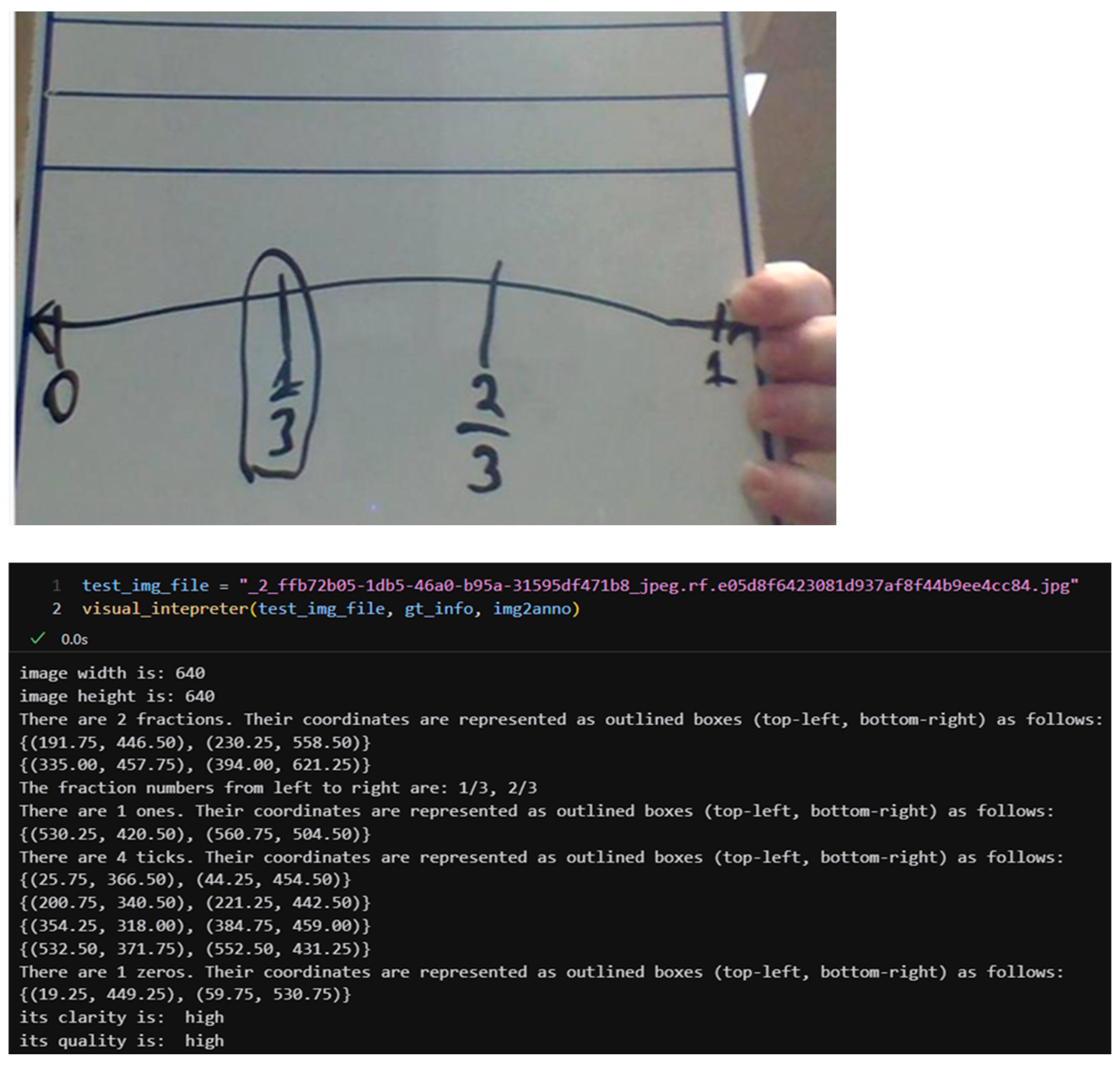
Visual Translator: Bridging Students’ Handwritten Solutions and Automatic Diagnosis of Students’ Use of Number Lines to Represent Fractions


Abstract
1. Introduction
1.1. Importance of Using Number Lines to Represent Fractions
1.2. Student Strategies and Error Types When Representing Fractions with a Number Line
1.3. Challenges in Teachers’ Grading and Diagnosis
1.4. Auto-Grading: Opportunities Offered by AI Development
1.4.1. Text Mining
1.4.2. Image Processing
1.5. Prior Work on Auto-Grading with Students’ Drawn Images
2. The Present Research
Research Questions
- (a)
- To what extent does the VT model demonstrate effectiveness in reading students’ hand-written numerical values in comparison to ground truth and other LLMs (i.e., GPT 3o, 4o., Gemini 2.5, and Grok), and
- (b)
- To what extent does the VT model demonstrate effectiveness in location identification in comparison with the ground truth and the other three LLMs?
3. Method
3.1. Data Source
3.2. Procedures
3.2.1. Data Preparation
3.2.2. Expert Annotation
3.2.3. Model Development
3.2.4. Model Evaluation
4. Results
4.1. Fraction Value Identification
4.2. Image Segmentation
5. Discussion
5.1. Implications for Research
5.2. Implications for Practice
5.3. Limitations & Future Research
Author Contributions
Funding
Institutional Review Board Statement
Informed Consent Statement
Data Availability Statement
Acknowledgments
Conflicts of Interest
Abbreviations
| API | Application Programming Interface |
| AI | Artificial Intelligence |
| CV | Computer Vision |
| GPT | Generative Pre-trained Transformer |
| GPT 4o | Generative Pre-trained Transformer 4 Omni |
| K12 | Kindergarten to 12th grade |
| ID | Identifier |
| IoU | Intersection over Union |
| JSON | JavaScript Object Notation |
| LLM | Large Language Model |
| mAP@50 | mean Average Precision at an Intersection over Union threshold of 0.50 |
| RL | Reinforcement Learning |
| STEM | Science, Technology, Engineering, and Mathematics |
| VT | Visual Translator |
| YOLOv8 | You Only Look Once, version 8 |
References
- Bright, G. W., Behr, M. J., Post, T. R., & Wachsmuth, I. (1988). Identifying fractions on number lines. Journal for Research in Mathematics Education, 19(3), 215–232. [Google Scholar] [CrossRef]
- Cramer, K. A., Post, T. R., & delMas, R. C. (2002). Initial fraction learning by fourth- and fifth-grade students: A comparison of the effects of using commercial curricula with the Rational Number Project curriculum. Journal for Research in Mathematics Education, 33(2), 111–144. [Google Scholar]
- Earnest, D. (2015). From number lines to graphs in the coordinate plane: Investigating problem solving across mathematical representations. Cognition and Instruction, 33(1), 46–87. [Google Scholar] [CrossRef]
- Farrell, M. J., Le Guillarme, N., Brierley, L., Hunter, B., Scheepens, D., Willoughby, A., Yates, A., & Mideo, N. (2024). The changing landscape of text mining: A review of approaches for ecology and evolution. Proceedings of the Royal Society B, 291, 20240423. [Google Scholar] [CrossRef] [PubMed]
- Firestone, C. (2020). Performance vs. competence in human–machine comparisons. Proceedings of the National Academy of Sciences, 117(43), 26562–26571. [Google Scholar] [CrossRef]
- Hill, H. C., Ball, D. L., & Schilling, S. G. (2008). Unpacking pedagogical content knowledge: Conceptualizing and measuring teachers’ topic-specific knowledge of students. Journal for Research in Mathematics Education, 39(4), 372–400. [Google Scholar] [CrossRef]
- Izsák, A., Tillema, E., & Tunç-Pekkan, Z. (2008). Teaching and learning fraction addition on number lines. Journal for Research in Mathematics Education, 39(1), 33–62. [Google Scholar]
- Kang, H. J. (2022). Preservice elementary teachers’ understanding of fraction multiplication and division in multiple contexts. International Electronic Journal of Elementary Education, 15(2), 109–121. [Google Scholar] [CrossRef]
- Ke, Z. T., Ji, P., Jin, J., & Li, W. (2024). Recent advances in text analysis. Annual Review of Statistics and Its Application, 11, 347–372. [Google Scholar] [CrossRef]
- Kullberg, A. (2010). What is taught and what is learned. Professional insights gained and shared by teachers of mathematics. Department of Pedagogical, Curricular and Professional Studies, Institutionen för Didaktik och Pedagogisk Profession. [Google Scholar]
- Lee, G., & Zhai, X. (2023). NERIF: GPT-4V for automatic scoring of drawn models. arXiv. [Google Scholar] [CrossRef]
- Leinhardt, G., & Smith, D. A. (1985). Expertise in mathematics instruction: Subject matter knowledge. Journal of Educational Psychology, 77(3), 247–271. [Google Scholar] [CrossRef]
- Lortie-Forgues, H., Tian, J., & Siegler, R. S. (2015). Why is learning fraction and decimal arithmetic so difficult? Developmental Review, 38, 201–221. [Google Scholar] [CrossRef]
- National Mathematics Advisory Panel. (2008). Foundation for success: The final report of the National Mathematics Advisory Panel. U.S. Department of Education. [Google Scholar]
- Newton, K. J. (2008). An extensive analysis of preservice elementary teachers’ knowledge of fractions. American Educational Research Journal, 45(4), 1080–1110. [Google Scholar] [CrossRef]
- Noparit, T., & Saengpun, J. (2013). How student teachers use proportional number line to teach multiplication and division of fraction: Professional learning in context of lesson study and open approach. Creative Education, 4(8), 19–24. [Google Scholar] [CrossRef]
- Nuraydin, S., Stricker, J., Ugen, S., Martin, R., & Schneider, M. (2023). The number line estimation task is a valid tool for assessing mathematical achievement: A population-level study with 6484 Luxembourgish ninth-graders. Journal of Experimental Child Psychology, 225, 105521. [Google Scholar] [CrossRef] [PubMed]
- Overton, T. (2016). Assessing learners with special needs: An applied approach. Pearson. [Google Scholar]
- Pettersson-Berggren, M. B. G. (2015). Teachers developing teaching: A comparative study on critical features for pupils’ perception of the number line. International Journal for Lesson and Learning Studies, 4(4), 383–400. [Google Scholar]
- Piaget, J., Inhelder, B., & Szeminska, A. (1960). The child’s conception of geometry. Routledge. [Google Scholar]
- Ravneet, S. A., & Elgammal, A. (2012, November 11–15). Towards automated classification of fine-art painting style: A comparative study. 21st International Conference on Pattern Recognition (ICPR2012), Tsukuba, Japan. [Google Scholar]
- Siegler, R. S., Carpenter, T., Fennell, F., Geary, D., Lewis, J., Okamoto, Y., Thompson, L., & Wray, J. (2010). Developing effective fractions instruction for kindergarten through 8th grade: A practice guide (NCEE 2010-4039). National Center for Education Evaluation and Regional Assistance. Available online: https://ies.ed.gov/ncee/wwc/docs/practiceguide/fractions_pg_093010.pdf (accessed on 29 June 2025).
- Siegler, R. S., & Lortie-Forgues, H. (2015). Conceptual knowledge of fraction arithmetic. Journal of Educational Psychology, 107(3), 909. [Google Scholar] [CrossRef]
- Siegler, R. S., & Pyke, A. A. (2013). Developmental and individual differences in understanding of fractions. Developmental Psychology, 49(10), 1994–2004. [Google Scholar] [CrossRef]
- Siegler, R. S., Thompson, C. A., & Schneider, M. (2011). An integrated theory of whole number and fraction development. Cognitive Psychology, 62, 273–296. [Google Scholar] [CrossRef]
- Stewart, J., Redlin, L., & Watson, S. (2008). Precalculus: Mathematics for calculus (5th ed.). Cengage Learning. [Google Scholar]
- Tunç-Pekkan, Z. (2015). An analysis of elementary school children’s fractional knowledge depicted with circle, rectangle, and number line representations. Educational Studies in Mathematics, 89, 419–441. [Google Scholar] [CrossRef]
- Ullman, S. (2019). Using neuroscience to develop artificial intelligence. Science, 363(6428), 692–693. [Google Scholar] [CrossRef] [PubMed]
- Ultralytics. (2023). Ultralytics YOLO: Real-time object detection and segmentation [Computer software]. Ultralytics. Available online: https://docs.ultralytics.com (accessed on 29 June 2025).
- Zhang, D., Li, M., Wang, Z., Lu, Q., & Deng, D. (2023, December 1). Automatic screening and diagnosis of students’ use of number lines to solve fraction problems. AI Education Summit, Notre Dame, Indiana. [Google Scholar]
- Zhang, D., Maher, C., & Wilkinson, L. (2022). What is meaningful assessment? In Y. Xin, R. Tzur, & H. Thouless (Eds.), Enabling mathematics learning of struggling students. Springer. [Google Scholar]
- Zhang, D., Stecker, P. M., & Beqiri, K. (2017). Understanding the faulty strategies in estimating fractions on number lines among students with and without mathematics disabilities. Learning Disability Quarterly, 40(4), 225–236. [Google Scholar] [CrossRef]
- Zhang, D., Wang, Z., & Li, M. (2025, March 12–15). Automated classification of student problem-solving style in representing fractions with a number line. CEC 2025, Baltimore, MD, USA. [Google Scholar]



| Model | Precision (jac) | Recall (seq) | Precision (seq) | Recall (seq) |
|---|---|---|---|---|
| VT | 0.741 | 0.701 | 0.611 | 0.582 |
| Grok-2 | 0.455 | 0.541 | 0.352 | 0.416 |
| GPT-4o | 0.638 | 0.592 | 0.521 | 0.499 |
| o3 | 0.770 | 0.695 | 0.659 | 0.606 |
| Gemini 2.5 Pro | 0.848 | 0.874 | 0.726 | 0.749 |
| Precision of VT | Recall of VT | Precision of Gemini | Recall of Gemini | |
|---|---|---|---|---|
| Location of ticks | 0.761 | 0.756 | 0.180 | 0.176 |
| Location of fractions | 0.902 | 0.961 | 0.534 | 0.556 |
| Location of ones | 0.209 | 0.555 | 0 | 0 |
| Location of zeros | 0.527 | 0.838 | 0 | 0 |
Disclaimer/Publisher’s Note: The statements, opinions and data contained in all publications are solely those of the individual author(s) and contributor(s) and not of MDPI and/or the editor(s). MDPI and/or the editor(s) disclaim responsibility for any injury to people or property resulting from any ideas, methods, instructions or products referred to in the content. |
© 2025 by the authors. Licensee MDPI, Basel, Switzerland. This article is an open access article distributed under the terms and conditions of the Creative Commons Attribution (CC BY) license (https://creativecommons.org/licenses/by/4.0/).
Share and Cite
Zhang, D.; Wang, Z.; Li, M.; Tao, Y. Visual Translator: Bridging Students’ Handwritten Solutions and Automatic Diagnosis of Students’ Use of Number Lines to Represent Fractions. Educ. Sci. 2025, 15, 1638. https://doi.org/10.3390/educsci15121638
Zhang D, Wang Z, Li M, Tao Y. Visual Translator: Bridging Students’ Handwritten Solutions and Automatic Diagnosis of Students’ Use of Number Lines to Represent Fractions. Education Sciences. 2025; 15(12):1638. https://doi.org/10.3390/educsci15121638
Chicago/Turabian StyleZhang, Dake, Zhizhi Wang, Min Li, and Yuhan Tao. 2025. "Visual Translator: Bridging Students’ Handwritten Solutions and Automatic Diagnosis of Students’ Use of Number Lines to Represent Fractions" Education Sciences 15, no. 12: 1638. https://doi.org/10.3390/educsci15121638
APA StyleZhang, D., Wang, Z., Li, M., & Tao, Y. (2025). Visual Translator: Bridging Students’ Handwritten Solutions and Automatic Diagnosis of Students’ Use of Number Lines to Represent Fractions. Education Sciences, 15(12), 1638. https://doi.org/10.3390/educsci15121638