Investigating the Impact of Transformational School Leadership: Teacher Perceptions and the Role of Leadership Training Programs

Abstract
1. Introduction
- Do secondary school teachers perceive transformational/transactional school principals as effective?
- Do principal training programs foster transformational leadership skills and practices?
2. Literature Review
2.1. Theoretical Framework: The Full-Range Leadership Model (FRLM)
2.2. Leadership and School Outcomes
2.3. Training and Preparation of School Principals
3. Materials and Methods
3.1. Participants
3.2. Data Collection and Variables of the Study
3.3. Data Analysis
4. Results
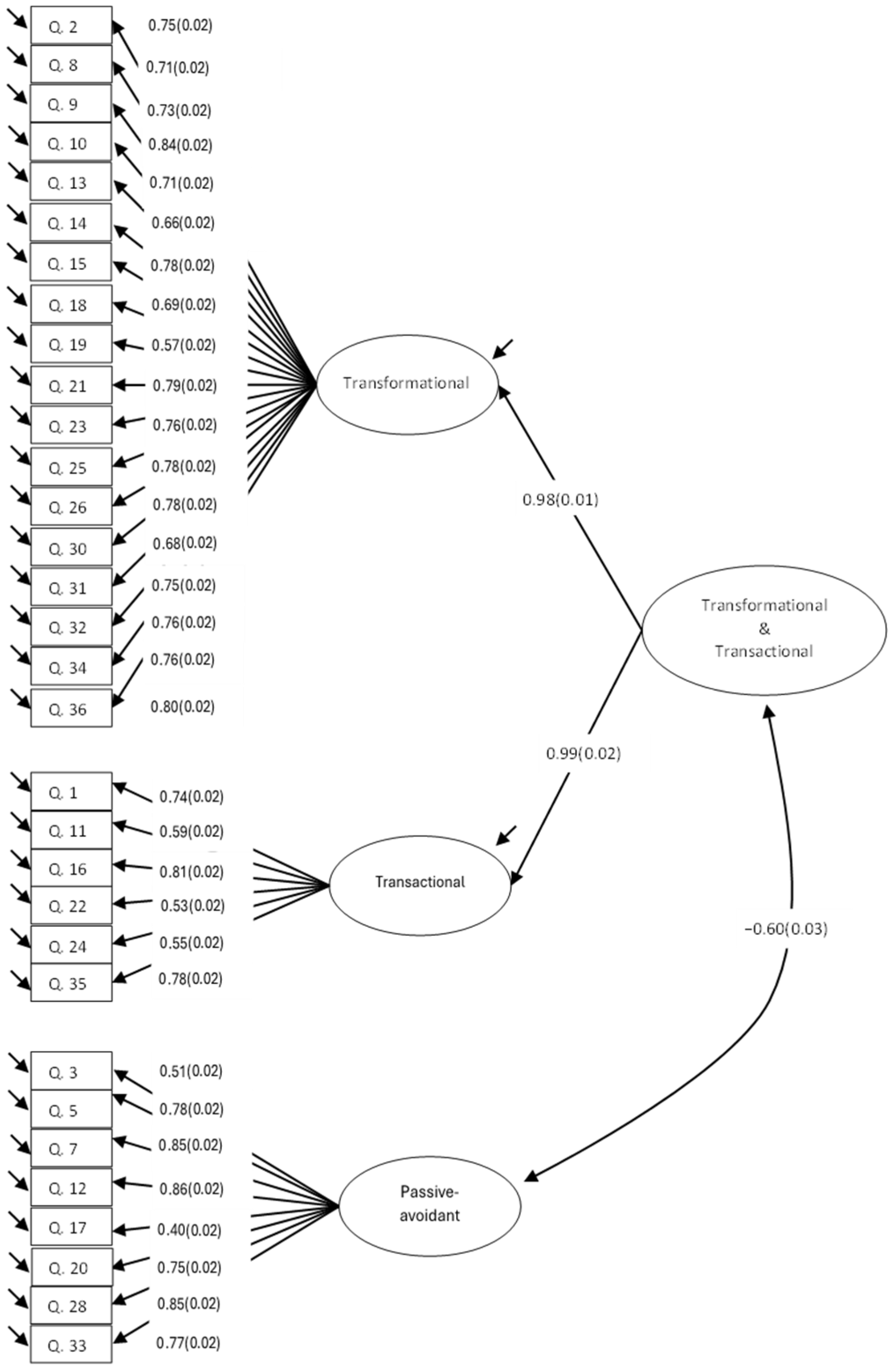
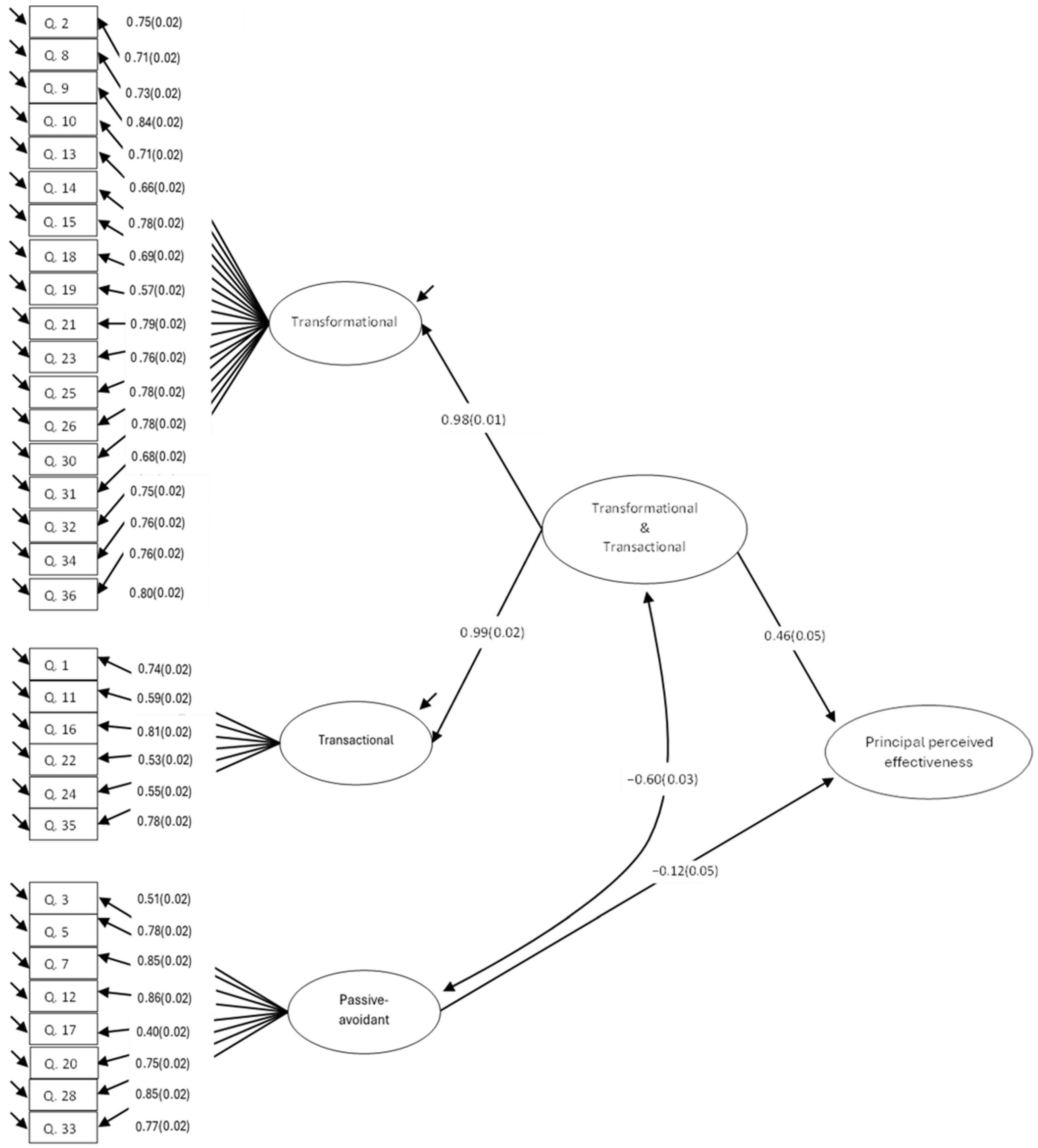
4.1. The Link Between Transformational/Transactional Leadership and Principal Effectiveness
4.2. The Impact of Training Programs on Transformational Leadership Practices
“I cannot say that there was anything in my training that truly surprised me. I would have wanted it to be stronger, more personalized, and more transformational.”(P1)
“Some things about common purposes, goals and vision were discussed to some extent. But to say that we benefited from this, I would not say so.”(P2)
“No, I cannot say that it was something addressed by the program. I cannot say that it had anything inspirational.”(P1)
“Perhaps I was somewhat influenced, but these were things I already knew and simply recalled.”(P2)
“On an unconscious and involuntary level, I feel I have been helped. But I think it happened through my own experiences.”(P1)
“I do not know if it was my postgraduate studies, my experience, my personality, or the program that made me change the way I think.”(P3)
“I remember being told that people always react to change, but that does not mean it should not happen.”(P5)
“I think only one lesson addressed individualization. It helped me to learn how to listen to each person.”(P4)
5. Discussion
6. Limitations and Directions for Future Research
7. Conclusions
Author Contributions
Funding
Institutional Review Board Statement
Informed Consent Statement
Data Availability Statement
Conflicts of Interest
References
- Antonakis, J. (2012). Transformational and charismatic leadership. In D. V. Day, & J. Antonakis (Eds.), The nature of leadership (pp. 256–288). Sage. [Google Scholar]
- Athanasoula-Reppa, A., & Lazaridou, A. (2008). Requirements, roles, and challenges of the principalship in Greece and Cyprus: Newly appointed principals’ views. European Education, 40(3), 65–88. [Google Scholar] [CrossRef]
- Avolio, B. J., & Bass, B. M. (2004). Multifactor leadership questionnaire: Third edition manual and sampler set. Mind Garden, Inc. [Google Scholar]
- Avolio, B. J., Bass, B. M., & Jung, D. I. (1999). Re-examining the components of transformational and transactional leadership using the Multifactor Leadership Questionnaire. Journal of Occupational and Organizational Psychology, 72(4), 441–462. [Google Scholar] [CrossRef]
- Barnett, K., McCormick, J., & Conners, R. (2001). Transformational leadership in schools—Panacea, placebo or problem? Journal of Educational Administration, 39(1), 24–46. [Google Scholar] [CrossRef]
- Bass, B. M. (1985). Leadership and performance beyond expectations. Free Press. [Google Scholar]
- Bass, B. M., & Avolio, B. J. (1994). Improving organizational effectiveness through transformational leadership. Sage. [Google Scholar]
- Bellibaş, M. Ş., Kılınç, A. Ç., & Polatcan, M. (2021). The moderation role of transformational leadership in the effect of instructional leadership on teacher professional learning and instructional practice: An integrated leadership perspective. Educational Administration Quarterly, 57(5), 776–814. [Google Scholar] [CrossRef]
- Berkovich, I. (2016). School leaders and transformational leadership theory: Time to part ways? Journal of Educational Administration, 54(5), 609–622. [Google Scholar] [CrossRef]
- Bogler, R. (2001). The influence of leadership style on teacher job satisfaction. Educational Administration Quarterly, 37(5), 662–683. [Google Scholar] [CrossRef]
- Bolam, R. (2003). Models of leadership development: Learning from international experience and research. In M. Brundrett, R. Smith, & N. Burton (Eds.), Leadership in education (pp. 74–89). Sage. [Google Scholar]
- Braun, V., & Clarke, V. (2006). Using thematic analysis in psychology. Qualitative Research in Psychology, 3(2), 77–101. [Google Scholar] [CrossRef]
- Braun, V., & Clarke, V. (2021). One size fits all? What counts as quality practice in (reflexive) thematic analysis? Qualitative Research in Psychology, 18(3), 328–352. [Google Scholar] [CrossRef]
- Burns, J. M. (1978). Leadership. Harper & Row. [Google Scholar]
- Bush, T. (2013). Preparing headteachers in England: Professional certification, not academic learning. Educational Management Administration & Leadership, 41(4), 453–465. [Google Scholar] [CrossRef]
- Bush, T. (2018). Preparation and induction for school principals: Global perspectives. Management in Education, 32(2), 66–71. [Google Scholar] [CrossRef]
- Chen, Y., Ning, R., Yang, T., Feng, S., & Yang, C. (2018). Is transformational leadership always good for employee task performance? Examining curvilinear and moderated relationships. Frontiers of Business Research in China, 12(1), 1–28. [Google Scholar] [CrossRef]
- Crow, G. M. (2006). Complexity and the beginning principal in the United States: Perspectives on socialization. Journal of Educational Administration, 44(4), 310–325. [Google Scholar] [CrossRef]
- Darling-Hammond, L., LaPointe, M., Meyerson, D., Orr, M. T., & Cohen, C. (2007). Preparing school leaders for a changing world: Lessons from exemplary leadership development programs. School leadership study. Final report. Stanford Educational Leadership Institute. [Google Scholar]
- Darling-Hammond, L., Wechsler, M. E., Levin, S., & Tozer, S. (2022). Developing effective principals: What kind of learning matters? Learning Policy Institute. [Google Scholar]
- Day, C., Gu, Q., & Sammons, P. (2016). The impact of leadership on student outcomes: How successful school leaders use transformational and instructional strategies to make a difference. Educational Administration Quarterly, 52(2), 221–258. [Google Scholar] [CrossRef]
- Den Hartog, D. N., Van Muijen, J. J., & Koopman, P. L. (1997). Transactional versus transformational leadership: An analysis of the MLQ. Journal of Occupational and Organizational Psychology, 70(1), 19–34. [Google Scholar] [CrossRef]
- DiStefano, C., Liu, J., Jiang, N., & Shi, D. (2017). Examination of the Weighted Root Mean Square Residual: Evidence for trustworthiness? Structural Equation Modeling: A Multidisciplinary Journal, 25(3), 453–466. [Google Scholar] [CrossRef]
- Donley, J., Detrich, R., States, J., & Keyworth, R. (2020). Leadership models. The Wing Institute. Available online: https://www.winginstitute.org/quality-leadership-leadership-models (accessed on 6 February 2025).
- Downton, J. V. (1973). Rebel leadership: Commitment and charisma in the revolutionary process. Free Press. [Google Scholar]
- Eden, D. (1998). The paradox of school leadership. Journal of Educational Administration, 36(3), 249–261. [Google Scholar] [CrossRef]
- Eliophotou-Menon, M., & Ioannou, A. (2016). The link between transformational leadership and teachers’ job satisfaction, commitment, motivation to learn, and trust in the leader. Academy of Educational Leadership Journal, 20(3), 12–33. [Google Scholar]
- Finnigan, K. S. (2010). Principal leadership and teacher motivation under high-stakes accountability policies. Leadership and Policy in Schools, 9(2), 161–189. [Google Scholar] [CrossRef]
- Griffith, J. (2004). Relation of principal transformational leadership to school staff job satisfaction, staff turnover, and school performance. Journal of Educational Administration, 42(3), 333–356. [Google Scholar] [CrossRef]
- Gumus, S., Bellibas, M. S., Esen, M., & Gumus, E. (2018). A systematic review of studies on leadership models in educational research from 1980 to 2014. Educational Management Administration & Leadership, 46(1), 25–48. [Google Scholar] [CrossRef]
- Hallinger, P. (2003). Leading educational change: Reflections on the practice of instructional and transformational leadership. Cambridge Journal of Education, 33(3), 329–352. [Google Scholar] [CrossRef]
- Harris, A., & Jones, M. (2023). The importance of school leadership? What we know. School Leadership & Management, 43(5), 449–453. [Google Scholar] [CrossRef]
- Hu, L., & Bentler, P. M. (1999). Cutoff criteria for fit indexes in covariance structure analysis: Conventional criteria versus new alternatives. Structural Equation Modeling: A Multidisciplinary Journal, 6(1), 1–55. [Google Scholar] [CrossRef]
- Huber, S. G. (2008). School development and school leader development: New learning opportunities for school leaders and their schools. In J. Lumby, G. M. Crow, & P. Pashiardis (Eds.), International handbook on the preparation and development of school leaders (pp. 163–175). Routledge. [Google Scholar]
- Hussin, S., & Al Abri, S. (2015). Professional development needs of school principals in the context of educational reform. International Journal of Educational Administration and Policy Studies, 7(4), 90–97. [Google Scholar] [CrossRef]
- Karatas, S., Arslan Dönmez, S., Yörük, T., Yanık Özdemir, S. N., Gök, R., & Doğan, A. (2024). Teachers’ perceptions regarding effective school features and effective leadership qualifications of school principals in Turkey. Sage Open, 14(1). [Google Scholar] [CrossRef]
- Kline, R. B. (2015). Principles and practice of structural equation modeling (4th ed.). Guilford Press. [Google Scholar]
- Koh, W. L., Steers, R. M., & Terborg, J. R. (1995). The effects of transformational leadership on teacher attitudes and student performance in Singapore. Journal of Organizational Behavior, 16(4), 319–333. [Google Scholar] [CrossRef]
- Lefteri, A., & Menon, M. E. (2025). Transformational and transactional school leadership as predictors of teacher self-efficacy. Studies in Educational Evaluation, 86, 101476. [Google Scholar] [CrossRef]
- Leithwood, K., Harris, A., & Hopkins, D. (2008). Seven strong claims about successful school leadership. School Leadership & Management, 28(1), 27–42. [Google Scholar] [CrossRef]
- Leithwood, K., Harris, A., & Hopkins, D. (2020). Seven strong claims about successful school leadership revisited. School Leadership & Management, 40(1), 5–22. [Google Scholar] [CrossRef]
- Leithwood, K., & Jantzi, D. (1990). Transformational leadership: How principals can help reform school cultures. School Effectiveness and School Improvement, 1(4), 249–280. [Google Scholar] [CrossRef]
- Leithwood, K., & Jantzi, D. (1999). The relative effects of principal and teacher sources of leadership on student engagement with school. Educational Administration Quarterly, 35(5), 679–706. [Google Scholar] [CrossRef]
- Leithwood, K., & Jantzi, D. (2005). A review of transformational school leadership research 1996–2005. Leadership and Policy in Schools, 4(3), 177–199. [Google Scholar] [CrossRef]
- Leithwood, K., & Jantzi, D. (2006). Transformational school leadership for large-scale reform: Effects on students, teachers, and their classroom practices. School Effectiveness and School Improvement, 17(2), 201–227. [Google Scholar] [CrossRef]
- Leithwood, K., Jantzi, D., Silins, H., & Dart, B. (1991). Using the appraisal of school leaders as an instrument for school restructuring. Peabody Journal of Education, 68(2), 85–109. [Google Scholar] [CrossRef]
- Leithwood, K., & Sun, J. (2012). The nature and effects of transformational school leadership: A meta-analytic review of unpublished research. Educational Administration Quarterly, 48(3), 387–423. [Google Scholar] [CrossRef]
- Lincoln, Y. S., & Guba, E. G. (1985). Naturalisitic inquiry. Sage. [Google Scholar]
- Lord, R. G., & Maher, K. J. (1993). Leadership and information processing: Linking perceptions and performance. Routledge. [Google Scholar]
- McCarley, T. A., Peters, M. L., & Decman, J. M. (2016). Transformational leadership related to school climate: A multilevel analysis. Educational Management Administration & Leadership, 44(2), 322–342. [Google Scholar] [CrossRef]
- Menon, M. E. (2014). The relationship between transformational leadership, perceived leader effectiveness, and teachers’ job satisfaction. Journal of Educational Administration, 52(4), 509–528. [Google Scholar] [CrossRef]
- Menon, M. E. (2021). Transformational leadership at times of crisis: The case of school leaders in Greece. European Journal of Educational Management, 4(1), 1–11. [Google Scholar] [CrossRef]
- Menon, M. E. (2024). Transformational leadership and educational outcomes: A literature review. Journal of Education, Innovation and Communication, 6(1), 98–115. [Google Scholar] [CrossRef]
- Metz, S., Piro, J. S., Nitowski, H., & Cosentino, P. (2019). Transformational leadership: Perceptions of building-level leaders. Journal of School Leadership, 29(5), 389–408. [Google Scholar] [CrossRef]
- Michaelidou, A., & Pashiardis, P. (2009). Professional development of school leaders in Cyprus: Is it working? Professional Development in Education, 35(3), 399–416. [Google Scholar] [CrossRef]
- Moolenaar, N. M., Daly, A. J., & Sleegers, P. J. (2010). Occupying the principal position: Examining relationships between transformational leadership, social network position, and schools’ innovative climate. Educational Administration Quarterly, 46(5), 623–670. [Google Scholar] [CrossRef]
- Muthén, L. K., & Muthén, B. O. (2017). Mplus user’s guide (8th ed.). Muthén & Muthén. [Google Scholar]
- Nguni, S., Sleegers, P., & Denessen, E. (2006). Transformational and transactional leadership effects on teachers’ job satisfaction, organizational commitment, and organizational citizenship behavior in primary schools: The Tanzanian case. School Effectiveness and School Improvement, 17(2), 145–177. [Google Scholar] [CrossRef]
- Nowell, L. S., Norris, J. M., White, D. E., & Moules, N. J. (2017). Thematic analysis: Striving to meet the trustworthiness criteria. International Journal of Qualitative Methods, 16(1), 1609406917733847. [Google Scholar] [CrossRef]
- Peterson, K. (2002). The professional development of principals: Innovations and opportunities. Educational Administration Quarterly, 38(2), 213–232. [Google Scholar] [CrossRef]
- Podsakoff, P. M., MacKenzie, S. B., Moorman, R. H., & Fetter, R. (1990). Transformational leader behaviors and their effects on followers’ trust in leader, satisfaction, and organizational citizenship behaviors. The Leadership Quarterly, 1(2), 107–142. [Google Scholar] [CrossRef]
- Quin, J., Deris, A., Bischoff, G., & Johnson, J. T. (2015). Comparison of transformational leadership practices: Implications for school districts and principal preparation programs. Journal of Leadership Education, 14(3), 101–121. [Google Scholar] [CrossRef]
- Robinson, V. M. J., Lloyd, C. A., & Rowe, K. J. (2008). The impact of leadership on student outcomes: An analysis of the differential effects of leadership types. Educational Administration Quarterly, 44(5), 635–674. [Google Scholar] [CrossRef]
- Silins, H. C. (1994). The relationship between transformational and transactional leadership and school improvement outcomes. School Effectiveness and School Improvement, 5(3), 272–298. [Google Scholar] [CrossRef]
- Stewart, J. (2006). Transformational leadership: An evolving concept examined through the works of Burns, Bass, Avolio, and Leithwood. Canadian Journal of Educational Administration and Policy, 54, 1–29. [Google Scholar]
- Stroud, V. (2006). Sustaining skills in headship: Professional development for experienced headteachers. Educational Management Administration & Leadership, 34(1), 89–103. [Google Scholar] [CrossRef]
- Svetina, D., Rutkowski, L., & Rutkowski, D. (2019). Multiple-group invariance with categorical outcomes using updated guidelines: An illustration using Mplus and the lavaan/semTools packages. Structural Equation Modeling: A Multidisciplinary Journal, 27(1), 111–130. [Google Scholar] [CrossRef]
- Tejeda, M., Scandura, T. A., & Pillai, R. (2001). The MLQ revisited: Psychometric properties and recommendations. The Leadership Quarterly, 12(1), 31–52. [Google Scholar] [CrossRef]
- Thody, A., Papanaoum, Z., Johansson, O., & Pashiardis, P. (2007). School principal preparation in Europe. International Journal of Educational Management, 21(1), 37–53. [Google Scholar] [CrossRef]
- Thomas, L., Tuytens, M., Devos, G., Kelchtermans, G., & Vanderlinde, R. (2020). Transformational school leadership as a key factor for teachers’ job attitudes during their first year in the profession. Educational Management Administration & Leadership, 48(1), 106–132. [Google Scholar] [CrossRef]
- Versland, T. M. (2013). Principal efficacy: Implications for rural “grow your own” leadership programs. The Rural Educator, 35(1), 2–11. [Google Scholar] [CrossRef]
- Yammarino, F. J., Spangler, W. D., & Bass, B. M. (1993). Transformational leadership and performance: A longitudinal investigation. The Leadership Quarterly, 4(1), 81–102. [Google Scholar] [CrossRef]



| Principal Code | Years of Service as Principal | Level of Education | Gender |
|---|---|---|---|
| P1 | 3 | Master’s (subject-specific) | Female |
| P2 | 2 | Master’s (educational administration) | Female |
| P3 | 5 | Master’s (educational administration) | Female |
| P4 | 2 | Bachelor’s (subject-specific) | Male |
| P5 | 11 | Master’s (subject-specific) | Female |
| Model | χ2 | df | p | CFI | RMSEA | RMSEA 90CI | WRMR |
|---|---|---|---|---|---|---|---|
| Model 1 | 1823.78 | 453 | 0.001 | 0.944 | 0.069 | 0.066–0.073 | 1.513 |
| Model 2 | 1824.48 | 455 | 0.001 | 0.944 | 0.069 | 0.066–0.072 | 1.516 |
| Model 3 | 1735.47 | 450 | 0.001 | 0.947 | 0.067 | 0.064–0.071 | 1.468 |
Disclaimer/Publisher’s Note: The statements, opinions and data contained in all publications are solely those of the individual author(s) and contributor(s) and not of MDPI and/or the editor(s). MDPI and/or the editor(s) disclaim responsibility for any injury to people or property resulting from any ideas, methods, instructions or products referred to in the content. |
© 2025 by the authors. Licensee MDPI, Basel, Switzerland. This article is an open access article distributed under the terms and conditions of the Creative Commons Attribution (CC BY) license (https://creativecommons.org/licenses/by/4.0/).
Share and Cite
Constantinou, P.; Eliophotou Menon, M.; Michael, D. Investigating the Impact of Transformational School Leadership: Teacher Perceptions and the Role of Leadership Training Programs. Educ. Sci. 2025, 15, 1495. https://doi.org/10.3390/educsci15111495
Constantinou P, Eliophotou Menon M, Michael D. Investigating the Impact of Transformational School Leadership: Teacher Perceptions and the Role of Leadership Training Programs. Education Sciences. 2025; 15(11):1495. https://doi.org/10.3390/educsci15111495
Chicago/Turabian StyleConstantinou, Prokopis, Maria Eliophotou Menon, and Demos Michael. 2025. "Investigating the Impact of Transformational School Leadership: Teacher Perceptions and the Role of Leadership Training Programs" Education Sciences 15, no. 11: 1495. https://doi.org/10.3390/educsci15111495
APA StyleConstantinou, P., Eliophotou Menon, M., & Michael, D. (2025). Investigating the Impact of Transformational School Leadership: Teacher Perceptions and the Role of Leadership Training Programs. Education Sciences, 15(11), 1495. https://doi.org/10.3390/educsci15111495