


Abstract
In recent years, artificial intelligence (AI) and learning analytics (LA) have been introduced into the field of education, where their use has great potential to enhance the teaching and learning processes. Researchers have focused on applying these technologies to teacher education, as they see the value of technology for educating. Therefore, a systematic review of the literature on AI and LA in teacher education is necessary to understand their impact in the field. Our methodology follows the PRISMA guidelines, and 30 studies related to teacher education were identified. This review analyzes and discusses the several ways in which AI and LA are being integrated in teacher education based on the studies’ goals, participants, data sources, and the tools used to enhance teaching and learning activities. The findings indicate that (a) there is a focus on studying the behaviors, perceptions, and digital competence of pre- and in-service teachers regarding the use of AI and LA in their teaching practices; (b) the main data sources are behavioral data, discourse data, and statistical data; (c) machine learning algorithms are employed in most of the studies; and (d) the ethical clearance is mentioned by few studies. The implications will be valuable for teachers and educational authorities, informing their decisions regarding the effective use of AI and LA technologies to support teacher education.
1. Introduction
Educational research on artificial intelligence (AI) and learning analytics (LA) has been growing in recent years. In particular, AI is having a significant impact in fields such as medicine, finance, and industry [1,2], and education is no exception. Today, research is also focusing on the application of AI and LA technologies in education [3]. Moreover, teacher education has been gradually introducing the use of emerging technologies to train both pre-service teachers (PSTs) and in-service teachers (ISTs). For example, teacher education has been changing from traditional classes—which are no longer the only channel by which students are to be instructed—to include online courses. Furthermore, the widespread adoption of massive open online courses (MOOCs) has made it possible to analyze student engagement based on their activities, which are tracked through the platform using analytics [4]. In the same way, AI techniques, such as natural language processing, have been used to analyze text and oral discourse [5].
1.1. Teacher Education
Teacher education is defined as the practices, strategies, and policies that prepare teachers with the professional knowledge, teaching skills, evaluation techniques, and ethical orientations needed to effectively perform their teaching activities in order to contribute to the development of society [6]. Teacher education is usually considered to have three phases—pre-service, induction, and in-service—all of which are part of a continuous process [7]. Thus, teacher education means both the basic and foundational teacher education oriented towards pre-service teachers and continuous teacher education oriented towards in-service teachers who receive professional development training. Regarding the use of technology, most teachers now recognize the importance of technology in teaching and learning activities. Thus, teacher education programs integrate technology in different ways within the classroom or via online courses—for example, by employing social media, blogs, web conferences, and discussion forums. However, the integration of technology into courses is still difficult due to several factors, such as the school culture, availability of resources, and teachers’ attitudes, knowledge, and skills [8,9]. Nevertheless, governments around the world are implementing policies to bring technology to classrooms, as it is becoming an essential component of the education system [10,11]. Therefore, teacher education plays an important role in developing teachers’ knowledge and skills related to the use of technology in the classroom.
1.2. Artificial Intelligence in Education
AI can be defined as “computing systems that are able to engage in human-like processes such as learning, adapting, synthesizing, self-correction and use of data for complex processing tasks” [12] (p. 1). AI has many branches and sub-branches, such as (a) machine learning (ML), which consists of algorithms that use educational data to identify patterns through successive training with the data; (b) deep learning, which uses large datasets to simulate and predict educational outcomes; and (c) natural language processing (NLP), which employs algorithms for language recognition to extract and analyze textual meaning [13]. In education, AI supports and enhances learning environments by employing intelligent tutoring systems, intelligent agents, and intelligent collaborative learning systems. Recently, the education sector has been significantly influenced by AI research [14], and an interdisciplinary approach is required to integrate several fields, including computer science, image processing, linguistics, psychology, and neuroscience. AI supports teachers’ decision making by reporting real-time class statuses and responding to students’ needs through personalized learning platforms. Moreover, AI has the potential to change the education system [15].
1.3. Learning Analytics
Learning analytics (LA) is defined as the “measurement, collection, analysis and reporting of data about learners and their contexts, for purposes of understanding and optimizing learning and the environments in which it occurs” [16] (p. 4). LA builds upon research areas such as educational data mining, data visualization, recommender systems, and personalized adaptive learning. The foundation of LA is educational data, as the first step is to collect data from various educational environments to identify indicators/metrics. Then, LA techniques are applied to explore and discover useful patterns. This step is followed by monitoring data, and then performing the analysis and prediction; in other cases, the data-driven interventions can lead towards the adaptation and personalization of the learning experiences, and further lead towards reflection. Therefore, the main focus of LA is to capture and analyze students’ actions generated in the learning environment to improve and enhance learning and teaching practices [17]. LA usually has two analytical approaches: (a) descriptive analytics, which is focused on the data-based actions that learners leave behind when they employ digital tools or interact in online platforms, and (b) predictive analytics, which predicts educational outcomes, such as dropout rate, based on students’ behavioral data, historical data (e.g., past course grades), and sociodemographic data [18]. For example, today, specialized educational applications are being designed for personalized learning [19], new communication tools are enabling interaction and professional collaboration between teachers [20], and digital technologies are becoming more embedded across the education sector, influencing the work of teachers [21]. In other words, teachers entering the profession need to be prepared for increasingly digitized education.
It is important to understand that AI and LA models can support teachers, through the provision of educational applications, in the same way as these technologies are reshaping other fields, e.g., medicine. Tondeur et al. [22] have highlighted the need to prepare the next generation of teachers for the integration of technology in education. Moreover, several governments have launched technology policies [23] recommending early awareness for AI. However, how to employ the new technologies—and especially AI—in education is still a gray area [24], and requires teachers to be prepared for the introduction of advanced technologies in education. Thus, teacher education plays an important role in the preparation of teachers for the future [25].
In this context, this study aims to provide an overview of the research on AI and LA in teacher education, with the specific objective of summarizing recent studies in the field, through the identification of their main goals, data sources, techniques and tools employed, the participants, and ethical procedures carried out by the studies. It is important to understand how AI and LA are impacting teacher education, in order to guide teachers, practitioners, and decision-makers regarding the potential of new technologies to support teacher education. As Garbett and Ovens [26] highlighted, teacher education needs not only to focus on pedagogical knowledge to function in the schools, but also to equip pre-service teachers to operate in an increasingly digital world.
This study applies a systematic review methodology to explore the relevant literature on the use of AI and LA technologies to improve teacher education, and it is organized as follows: First, it presents the introduction, followed by the research methodology and the review’s results. Then, we discuss the findings and implications for the future of teacher education. Finally, the conclusions are presented. The research questions that guide the present study are as follows:
- RQ1: What are the main goals and objectives of the reviewed studies regarding the use of AI and LA in teacher education?
- RQ2: What kinds of data sources are employed by the studies on AI and LA in teacher education?
- RQ3: What kinds of AI and LA techniques and tools are used to support teacher education?
- RQ4: Who are the participants included in the studies on AI and LA in teacher education?
- RQ5: How are ethical procedures being fulfilled by studies on AI and LA in teacher education?
2. Methodology
This systematic literature review was carried out to provide up-to-date information on AI and LA in teacher education. A systematic review is an explicit and systematic process for identifying, extracting, and synthesizing knowledge gained from a variety of empirical studies to answer research questions [27]. Moreover, Sleeter [28] highlighted the need to carry out systematic reviews on teacher education to provide a more comprehensive understanding of questions that remain under-researched.
The present systematic review follows the Preferred Reporting Items for Systematic Reviews and Meta-Analyses (PRISMA) guidelines [29]. The following databases were searched because they cover a broad range of educational journals: Web of Science, which is a major research platform that provides access to leading academic literature; ScienceDirect, which is a comprehensive collection of scientific journals; and IEEE Xplore, which is a large database of scientific and technical articles. The search strings included the following terms: (“teacher education” OR “pre-service” OR preservice OR “in-service”) AND (“learning analytics” OR “artificial intelligence” OR “machine learning” OR “deep learning”). They were input into the applications of the aforementioned databases and used as a filter for documents that included the search strings in their title, abstract, and/or keywords. In line with the PRISMA guidelines, the following criteria were used to decide which articles to include in the final revision: (a) articles published from 2017 to 2021; (b) articles published in the English language; (c) articles presenting empirical, primary research; (d) articles involving pre-service teachers (PSTs) or in-service teachers (ISTs); and (e) articles exclusively related to AI or LA in teacher education (Table 1).

Table 1.
Inclusion and exclusion criteria.
The search generated 2012 articles, whose titles were screened, after which 325 potential articles remained. Another 27 duplicates were eliminated, leaving 298 articles for abstract screening. Then, after applying the inclusion and exclusion criteria, 73 articles were eligible for full screening; however, 43 of these were irrelevant to the topic of this study. Finally, 30 articles remained to be analyzed (Figure 1).
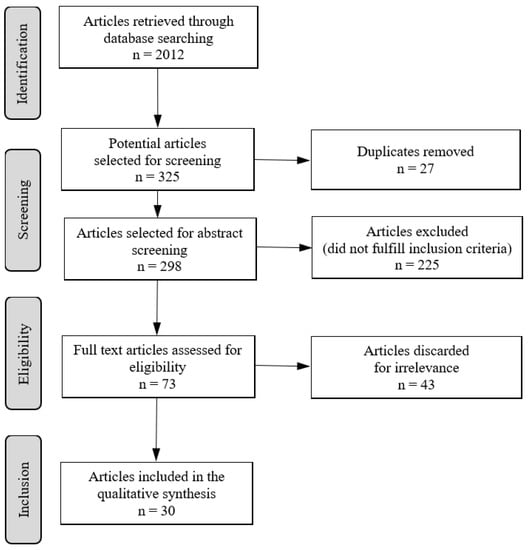
Figure 1.
PRISMA flow diagram of the systematic review.
Data were extracted by collecting and coding the information for each of the 30 selected studies and identifying the following information to help organize the data for analysis: author(s), publication year, goals and objectives of the study, data sources employed and their characteristics, techniques and digital tools employed in the study, sample size and type of participants, whether the study obtained the informed consent of the participants, and the results of the study. The selected papers were analyzed through inductive and deductive processes, including reading and re-reading through data to identify themes for analysis [30]. Two researchers were involved in the procedures, and reviewed each article independently, achieving inter-rater reliability of 81% (Cohen’s kappa coefficient). Disagreements were resolved by discussion until agreement was reached. The emerged themes are displayed using frequency tables. Table 2 presents a summary of the analysis carried out with the selected studies.
Table 2.
Summary of the studies included in this review.
3. Results
This review includes 30 studies based in 16 countries/regions, with the following distribution: Canada (3), China (8), Estonia (1), Germany (3), India (1), Indonesia (1), Japan (1), Korea (1), Malaysia (1), Morocco (1), Portugal (1), Rwanda (1), Spain (1) China Taiwan (1), Turkey (2), USA (3). The analysis guided by the research questions provides some insights into the impact of AI and LA on teacher education.
3.1. Goals and Objectives
RQ1: What are the main goals and objectives of the reviewed studies regarding the use of AI and LA in teacher education?
Several goals and objectives are mentioned in the selected studies, and can be categorized under six themes: (a) behavior when using AI and LA, (b) digital competence, (c) perceptions of AI and LA, (d) self-regulation and reflection, (e) engagement, and (f) analysis of educational data (Table 3).
Table 3.
Goals and objectives across reviewed studies.
The findings indicate that the most prominent category regarding the goals and objectives of the selected studies is the pre- and in-service teachers’ behavior when using AI and LA. For example, some of the studies include the visualization of the behaviors and interactions [31,40,52], where AI and LA tools help to explore the effectiveness of the learning activities offered. This is important, because the behavior of pre- and in-service teachers has received an increased focus, due to its relation to teacher preparation and professional training [61]. Similarly, Tezci [62] highlights how pre- and in-service teachers’ behaviors with regard to new technologies are related to their intentions to use those technologies in the classroom. The next most common category is digital competence, which is generally defined as a set of knowledge, skills, and attitudes required when using new technologies to create, communicate, and resolve problems in an efficient and effective way, and also to improve the teaching process when using technology [63]. For example, in our findings, some of the studies are focused on measuring the digital competence [37,45,53]. Similarly to these findings, a review carried out by Wilson, Ritzhaupt, and Cheng [64] found that pre- and in-service teachers’ digital competence should be considered a necessary skill in their teaching activities. Another category that emerged from the analysis is the perception of AI and LA. For example, some studies examined pre- and in-service teachers’ perceptions about the use of LA [56], as well as their perceived usability of AI-based outdoor learning tools [60]. Cooper et al. [65] also confirmed this conclusion, indicating that pre-service teachers’ positive perceptions of new technologies are related to the potential of technology to enhance learning experiences that they might otherwise not experience with other learning tools. Additionally, the studies mentioned other research goals and objectives, such as self-regulation and reflection, engagement, and the analysis of educational data. For example, some studies focused on the influence of LA feedback on reflection [33,54,55], or on exploring the levels of engagement using LA techniques [36,59] or AI methods [51]. Meanwhile, other reviewed studies even challenged pre-service teachers in order to analyze and interpret educational data [49]. These findings are similar to those of Reeves and Chiang [66], who highlighted that, in recent years, educational data have been used by teachers to inform their practices.
3.2. Data Sources
RQ2: What kinds of data sources are employed by the studies on AI and LA in teacher education?
Data are the foundation of AI and LA, as both require large datasets to perform analyses. Therefore, it is necessary to know the source of the educational data used by the reviewed studies. Three sources of data were identified: (a) behavioral data, (b) discourse data, and (c) statistical data. Each source of data includes different types of datasets (Table 4). Some of the studies had more than one type of dataset.
Table 4.
Data sources of the reviewed studies.
Most of the studies employed behavioral data, which were collected by observing and recording pre- and in-service teachers’ behaviors. The selected studies employed two types of datasets: (i) access data, e.g., location, date, time, regularity (i.e., average number of logins per week), number of times quizzes were reviewed per day; and (ii) social interaction data, e.g., network density, network cohesion, and network interaction. These kinds of data help to identify frequent access patterns, and can be properly analyzed. Discourse data are another data source found in the reviewed studies, including three types of discourse datasets: (i) text discourse data, e.g., number of posts per teacher, length of post per teacher, much or little new information, and high or low topic relevance; (ii) audio video discourse data, e.g., number of words, number of turns, and teacher–student turn-taking patterns; and (iii) discussion data, e.g., discussion topics (i.e., time, key terms, frequency), number of posts, posting frequency, and posts’ content. The other type of data source is statistical data; for example, the selected studies presented sociodemographic data related to age, gender, teacher experience, work status, number of tools used in the classroom, and number of years spent using digital technology in teaching. These findings coincide with the results of an existing study carried out by Zhao et al. [67], who noted that digital learning platforms can store massive amounts of learners’ behavioral data, which could help to assess learning and predict learners’ performance.
3.3. Techniques and Tools
RQ3: What kinds of AI and LA techniques and tools are used to support teacher education?
We found that 17 studies mainly used AI techniques (Table 5); 9 of these used machine learning, 3 employed natural language processing (NLP), 2 used vision-based mobile augmented reality (VMAR), and 3 used other AI techniques. For example, the studies used AI techniques to automatically score video presentations [37], to identify at-risk students and predict the number of dropouts [43], or to classify written reflections [54]. Moreover, 13 studies used LA techniques: 3 studies used dashboards, 2 used visual learning analytics (VLA), and 8 employed other LA techniques. For instance, LA techniques helped to visualize pre-service teachers’ behaviors and interactions [31], to support community awareness and social presence [46], and to investigate changes in engagement [52]. Similar conclusions were mentioned by Verma, Kumar, and Kohli [68], who indicated that AI techniques could benefit and enhance the quality of education.
Table 5.
AI and LA techniques across the reviewed studies.
Additionally, Table 6 lists the AI and LA software tools used in the studies. The most frequently used software tools were AI algorithms, followed by online platforms (such as the Moodle platform) and MOOC courses. Moreover, some of the reviewed studies reported the use of data analysis tools such as programming languages and statistical software, while others used monitoring tools, such as dashboards and modules. For example, these software tools were employed to support pre-service teachers’ self-study using chatbots [48], to determine teachers’ professional development [57], to automatically detect discourse characteristics [59], etc. Namoun and Alshanqiti [69] also found that AI and LA tools could help to visualize and predict learners’ achievements. Moreover, LA tools are becoming common in the context of online learning and blended learning (e.g., MOOCs).
Table 6.
AI and LA tools across the reviewed studies.
3.4. Participants in the Studies
RQ4: Who are the participants included in the studies on AI and LA in teacher education?
Regarding the participants involved in the reviewed studies, we found that 18 studies had pre-service teacher participants, while 9 studies included in-service teachers who were engaged in teacher education programs, and 3 studies included both pre- and in-service teachers (Table 7). These findings indicate that not only pre-service teachers, but also in-service teachers, are being taught to use advanced technologies such as AI and LA to update their knowledge, practices, and digital competence, all of which eventually benefit students. Coincidentally, Seufert, Guggemos, and Sailer [70] mentioned that for pre- and in-service teachers, it is important to receive continuous professional development in technologies, so as to enhance their knowledge and skills.
Table 7.
Participants across the reviewed studies.
3.5. Ethical Procedures
RQ5: How are ethical procedures being fulfilled by studies on AI and LA in teacher education?
Ethics represent an important issue regarding the use of technology. We reviewed how the selected studies on AI and LA in teacher education fulfilled the ethical procedures when collecting data from pre- and in-service teachers. Table 8 shows that 5 studies obtained ethical consent from the pre- and in-service teachers themselves, 3 studies were granted ethical consent by the institution where the research was performed, 2 studies made a short reference to the pre-service teachers’ voluntary participation, and 2 studies indicated that ethical procedures were not applicable (e.g., secondary data sources). However, most of the studies (18 studies in total) did not mention ethical procedures. Similar to our findings, other researchers such as Krutka et al. [71] have noted the same issue. Moreover, Stahl et al. [72] also highlighted the need for responsible research and innovation, with an emphasis on data privacy and security.
Table 8.
Data sources of the reviewed studies.
4. Discussion
Overall, this study provides important insights regarding the status of research on AI and LA in teacher education, which can be summarized as follows:
First, teacher education is constantly adapting and gradually introducing the use of new technologies to both pre- and in-service teachers. The application of digital technologies in education presents both opportunities and challenges. Researchers have mentioned that AI has brought some opportunities for teachers, including automated grading that provides support to lessen teachers’ workload [73], predictive analytics to detect students at risk of not completing a course [74], adaptive learning that identifies areas to provide more focused learning experiences [75], and chatbots that are helpful virtual assistants for teachers [76]. However, research is also highlighting some ethical concerns, such as privacy when compromising the exploitation of data via recommender systems [77], tracking systems that gather detailed information about actions and preferences [78], and bias and discrimination, e.g., perpetuating gender bias and social discrimination [79]. As Cadwell [80] pointed out, technologies may offer several benefits within teacher education, but it is also necessary to emphasize the importance of preparing pre-service teachers to integrate technologies into education. A complex world brings new conditions, where unexpected changes might require pre- and in-service teachers to deliver instruction through the use of technology. Moreover, regarding the use of technology in teacher education, Carrier and Nye [81] highlighted how professional development in the use of technology can empower educators, as it enhances their teaching and supports students’ learning experience [82].
Second, our review presents examples where AI and LA techniques have the potential to assist teachers in several teaching activities. For instance, we found that AI and LA methods can help to visualize PSTs’ behaviors and interactions [31], to predict PSTs’ dropout and identify risk groups [43], to support PSTs’ self-study using chatbots as a tool to scale mentoring processes [48], to automatically detect discourse characteristics from online textual data [59], to assess—through automatic scoring—the qualities of video-based oral presentations [37], to asses PSTs’ teaching competency through an intelligent assessment system [58], to classify written reflections according to a reflection-supporting model [54], etc. Similarly, Goksel and Bozkurt [83] considered that AI-featuring technologies could contribute to the advancement of some educational processes. Regarding LA methods, Van Leeuwen, Teasley, and Wise [84] also arrived at the conclusion that learning analytics can play a constructive role that can enhance and complement teachers’ decision making. However, it is necessary to develop pre- and in-service teachers’ digital competence, as an essential requirement for using advanced technologies in teaching education. Furthermore, Luckin et al. [85] indicated that teachers need to be empowered through adequate training in order to be AI-ready, which means to know how AI could be used to enhance their human teaching capabilities and expertise.
Third, our findings indicate that studies on teacher education—especially when employing AI and LA techniques and tools—need to pay attention to the importance of obtaining consent from the participants. Similarly, Pusey [86] found that pre-service teachers do not possess adequate knowledge or the ability to keep their future students’ data safe from exposure and harm. In other words, ethical issues bring some concerns about cybersecurity in education. Therefore, Reidenberg and Schaub [87], as along with other researchers, have proposed the need for transparency [88], accountability [89], and fairness [90] in the use of AI and LA in education [91]. As Siemens et al. [92] highlighted, ethics and data privacy need careful consideration in LA research. Furthermore, Holmes et al. [91] pointed out the importance of carrying out responsible research on AI in education, and the need for researchers to be trained to tackle emerging ethical questions. Therefore, researchers, students, teachers, and educational authorities should be aware of the importance of ethics with respect to personal data.
This systematic review has some limitations. First, it is focused on teacher education, including pre- and in-service teachers in education programs. Future studies could enhance the scope and include teachers who are not enrolled in education programs. Second, the present review focused on learning analytics and artificial intelligence, mainly including applications of machine learning and deep learning in education. Future studies could include other AI techniques and tools. Finally, it cannot be guaranteed that every relevant article was found; nonetheless, the present study contributes to the analysis of the use of AI and LA in teacher education.
5. Conclusions
This systematic review highlights how AI and LA are being employed in teacher education, as AI and LA techniques are gradually being adopted to support teaching activities at different educational levels. However, the rate of adoption of AI and LA in education is still slow compared to other fields, such as medicine, industry, and finance. The present study provides some evidence-based educational innovations through the application of AI and LA technology in teacher education. These applications have several purposes—for example, to visualize pre- and in-service teachers’ behaviors and interactions, to assess their video-based oral presentations through automatic scoring, to introduce AI literacy to in-service teachers, etc. One issue that is highlighted by this review is the lack of attention to ethics and data privacy, as few of the reviewed studies mentioned ethical clearance. Lastly, it is important that more teachers, practitioners, educational authorities, and decision-makers become involved and understand the opportunities and challenges that AI and LA technologies could bring to teacher education.
Author Contributions
Conceptualization, S.Z.S.-P.; methodology, S.Z.S.-P. and K.X.; validation, S.Z.S.-P. and K.X.; formal analysis, S.Z.S.-P. and K.X.; writing—original draft preparation, S.Z.S.-P.; writing—review and editing, X.H.; funding acquisition, S.Z.S.-P. and K.X. All authors have read and agreed to the published version of the manuscript.
Funding
This research was funded by Central China Normal University (Grant No. 1100/30106200286), the National Natural Science Foundation of China (Grant No. 61803391 and Grant No. 62173158).
Institutional Review Board Statement
Not applicable.
Informed Consent Statement
Not applicable.
Data Availability Statement
Not applicable.
Conflicts of Interest
The authors declare no conflict of interest.
References
- Ahuja, A.S. The Impact of Artificial Intelligence in Medicine on the Future Role of the Physician. PeerJ 2019, 7, e7702. [Google Scholar] [CrossRef] [PubMed]
- Veloso, M.; Balch, T.; Borrajo, D.; Reddy, P.; Shah, S. Artificial Intelligence Research in Finance: Discussion and Examples. Oxf. Rev. Econ. Policy 2021, 37, 564–584. [Google Scholar] [CrossRef]
- Salas-Pilco, S.Z.; Yang, Y. Learning Analytics Initiatives in Latin America: Implications for Educational Researchers, Practitioners and Decision Makers. Br. J. Educ. Technol. 2020, 51, 875–891. [Google Scholar] [CrossRef]
- Napier, A.; Huttner-Loan, E.; Reich, J. Evaluating learning transfer from MOOCs to workplaces: A Case Study from Teacher Education and Launching Innovation in Schools. Revista Iberoamericana de Educación a Distancia 2020, 23, 45–64. [Google Scholar] [CrossRef]
- Datta, D.; Phillips, M.; Chiu, J.; Watson, G.S.; Bywater, J.P.; Barnes, L.; Brown, D. Improving Classification through Weak Supervision in Context-Specific Conversational Agent Development for Teacher Education. arXiv 2020, arXiv:2010.12710. [Google Scholar]
- Oyekan, S.O. Foundations of Teacher Education. In Education for Nigeria Certificate in Education; Osisa, W., Ed.; Adeyemi College of Education Textbook Development Board: Ondo, Nigeria, 2000; pp. 1–58. [Google Scholar]
- Dunkin, M.J. The International Encyclopedia of Teaching and Teacher Education; Pergamon Press: Oxford, UK, 1987. [Google Scholar]
- Farjon, D.; Smits, A.; Voogt, J. Technology Integration of Pre-Service Teachers Explained by Attitudes and Beliefs, Competency, Access, and Experience. Comput. Educ. 2019, 130, 81–93. [Google Scholar] [CrossRef]
- Menabò, L.; Sansavini, A.; Brighi, A.; Skrzypiec, G.; Guarini, A. Promoting the Integration of Technology in Teaching: An Analysis of the Factors That Increase the Intention to Use Technologies among Italian Teachers. J. Comput. Assist. Learn. 2021, 37, 1566–1577. [Google Scholar] [CrossRef]
- Butler, D.; Leahy, M.; Twining, P.; Akoh, B.; Chtouki, Y.; Farshadnia, S.; Moore, K.; Nikolov, R.; Pascual, C.; Sherman, B.; et al. Education Systems in the Digital Age: The Need for Alignment. Technol. Knowl. Learn. 2018, 23, 473–494. [Google Scholar] [CrossRef]
- U.S. Department of Education. Advancing Educational Technology in Teacher Preparation: Policy Brief. 2016. Available online: https://tech.ed.gov/files/2016/12/Ed-Tech-in-Teacher-Preparation-Brief.pdf (accessed on 5 April 2022).
- Popenici, S.A.D.; Kerr, S. Exploring the Impact of Artificial Intelligence on Teaching and Learning in Higher Education. Res. Pract. Technol. Enhanc. Learn. 2017, 12, 22. [Google Scholar] [CrossRef]
- Lu, X. Natural Language Processing and Intelligent Computer-Assisted Language Learning (ICALL). In The TESOL Encyclopedia of English Language Teaching; Liontas, J.I., Ed.; Wiley Blackwell: Hoboken, NJ, USA, 2018; pp. 1–6. [Google Scholar] [CrossRef]
- Salas-Pilco, S.Z.; Yang, Y. Artificial Intelligence Applications in Latin American Higher Education: A Systematic Review. Int. J. Educ. Technol. High. Educ. 2022, 19, 21. [Google Scholar] [CrossRef]
- Chen, L.; Chen, P.; Lin, Z. Artificial Intelligence in Education: A review. IEEE Access 2020, 8, 75264–75278. [Google Scholar] [CrossRef]
- Siemens, G.; Gasevic, D.; Haythornthwaite, C.; Dawson, S.; Buckingham, S.; Ferguson, R.; Duval, E.; Verbert, K.; Baker, R. Open Learning Analytics: An Integrated & Modularized Platform Proposal to Design, Implement and Evaluate an Open Platform to Integrate Heterogeneous Learning Analytics Techniques. 2011. Available online: https://solaresearch.org/wp-content/uploads/2011/12/OpenLearningAnalytics.pdf (accessed on 3 May 2022).
- Krikun, I. Applying Learning Analytics Methods to Enhance Learning Quality and Effectiveness in Virtual Learning Environments. In Proceedings of the 2017 5th IEEE Workshop on Advances in Information, Electronic and Electrical Engineering (AIEEE), Riga, Latvia, 24–25 November 2017; pp. 1–6. [Google Scholar] [CrossRef]
- Rets, I.; Herodotou, C.; Bayer, V.; Hlosta, M.; Rienties, B. Exploring Critical Factors of the Perceived Usefulness of a Learning Analytics Dashboard for Distance University Students. Int. J. Educ. Technol. High. Educ. 2021, 18, 46. [Google Scholar] [CrossRef]
- Lee, D.; Huh, Y.; Lin, C.-Y.; Reigeluth, C.M. Technology Functions for Personalized Learning in Learner-Centered Schools. Educ. Technol. Res. Dev. 2018, 66, 1269–1302. [Google Scholar] [CrossRef]
- Starkey, L.A. Review of Research Exploring Teacher Preparation for the Digital Age. Cambridge J. Educ. 2019, 50, 37–56. [Google Scholar] [CrossRef]
- Pongsakdi, N.; Kortelainen, A.; Veermans, M. The Impact of Digital Pedagogy Training on In-Service Teachers’ Attitudes towards Digital Technologies. Educ. Inf. Technol. 2021, 26, 5041–5054. [Google Scholar] [CrossRef]
- Tondeur, J.; Scherer, R.; Baran, E.; Siddiq, F.; Valtonen, T.; Sointu, E. Teacher Educators as Gatekeepers: Preparing the next Generation of Teachers for Technology Integration in Education. Br. J. Educ. Technol. 2019, 50, 1189–1209. [Google Scholar] [CrossRef]
- Salas-Pilco, S.Z. Comparison of National Artificial Intelligence (AI): Strategic Policies and Priorities. In Towards an International Political Economy of Artificial Intelligence; Keskin, T., Kiggins, R.D., Eds.; Palgrave Macmillan: Cham, Switzerland, 2021; pp. 195–217. [Google Scholar]
- Leaton Gray, S. Artificial Intelligence in Schools: Towards a Democratic Future. London Rev. Educ. 2020, 18, 163–177. [Google Scholar] [CrossRef]
- Mayer, D.; Oancea, A. Teacher Education Research, Policy and Practice: Finding Future Research Directions. Oxf. Rev. Educ. 2021, 47, 1–7. [Google Scholar] [CrossRef]
- Garbett, D.; Ovens, A. Being Self-study Researchers in a Digital World: Future Oriented Research and Pedagogy in Teacher Education. Springer: Cham, Switzerland, 2016. [Google Scholar]
- Zawacki-Richter, O.; Kerres, M.; Bedenlier, S.; Bond, M.; Buntins, K. (Eds.) Systematic Reviews in Educational Research; Springer: Wiesbaden, Germany, 2020. [Google Scholar] [CrossRef]
- Sleeter, C. Toward Teacher Education Research That Informs Policy. Educ. Res. 2014, 43, 146–153. [Google Scholar] [CrossRef]
- Moher, D.; Shamseer, L.; Clarke, M.; Ghersi, D.; Liberati, A.; Petticrew, M.; Shekelle, P.; Stewart, L.A. Preferred Reporting Items for Systematic Review and Meta-Analysis Protocols (PRISMA-P) 2015 Statement. Syst. Rev. 2015, 4, 1. [Google Scholar] [CrossRef]
- Creswell, J.W.; Poth, C.N. Qualitative Inquiry and Research Design: Choosing among Five Approaches. Sage Publications: Los Angeles, CA, USA, 2016. [Google Scholar]
- Bao, H.; Li, Y.; Su, Y.; Xing, S.; Chen, N.-S.; Rosé, C.P. The Effects of a Learning Analytics Dashboard on Teachers’ Diagnosis and Intervention in Computer-Supported Collaborative Learning. Technol. Pedagogy Educ. 2021, 30, 287–303. [Google Scholar] [CrossRef]
- Benaoui, A.; Kassimi, M.A. Using Machine Learning to Examine Preservice Teachers’ Perceptions of Their Digital Competence. E3S Web of Conf. 2021, 297, 01067. [Google Scholar] [CrossRef]
- Chen, G. A Visual Learning Analytics (VLA) Approach to Video-Based Teacher Professional Development: Impact on Teachers’ Beliefs, Self-Efficacy, and Classroom Talk Practice. Comput. Educ. 2020, 144, 103670. [Google Scholar] [CrossRef]
- Cutumisu, M.; Guo, Q. (2019). Using Topic Modeling to Extract Pre-Service Teachers’ Understandings of Computational Thinking from their Coding Reflections. IEEE Trans. Educ. 2019, 62, 325–332. [Google Scholar] [CrossRef]
- Fan, Y.; Matcha, W.; Uzir, N.A.A.; Wang, Q.; Gašević, D. Learning Analytics to Reveal Links Between Learning Design and Self-Regulated Learning. Int. J. Artif. Intell. Educ. 2021, 31, 980–1021. [Google Scholar] [CrossRef]
- Hayward, D.V.; Mousavi, A.; Carbonaro, M.; Montgomery, A.P.; Dunn, W. Exploring Preservice Teachers Engagement with Live Models of Universal Design for Learning and Blended Learning Course Delivery. J. Spec. Educ. Technol. 2020, 37, 112–123. [Google Scholar] [CrossRef]
- Hsiao, S.-W.; Sun, H.-C.; Hsieh, M.-C.; Tsai, M.-H.; Tsao, Y.; Lee, C.-C. Toward Automating Oral Presentation Scoring During Principal Certification Program Using Audio-Video Low-Level Behavior Profiles. IEEE Trans. Affect. Comput. 2019, 10, 552–567. [Google Scholar] [CrossRef]
- Ishizuka, H.; Pellerin, M. Providing Quantitative Data with AI Mobile COLT to Support the Reflection Process in Language Teaching and Pre-Service Teacher Training: A Discussion. In CALL for Widening Participation: Short Papers from EUROCALL 2020; Frederiksen, K.-M., Larsen, S., Bradley, L., Thouësny, S., Eds.; Research-Publishing.net: Voillans, France, 2020; pp. 125–131. [Google Scholar] [CrossRef]
- Jensen, E.; Dale, M.; Donnelly, P.J.; Stone, C.; Kelly, S.; Godley, A.; D’Mello, S.K. Toward Automated Feedback on Teacher Discourse to Enhance Teacher Learning. In Proceedings of the 2020 CHI Conference on Human Factors in Computing Systems, Honolulu, HI, USA, 25–30 April 2020; pp. 1–13. [Google Scholar] [CrossRef]
- Karunaratne, T.; Byungura, J.C. Using Log Data of Virtual Learning Environments to Examine the Effectiveness of Online Learning for Teacher Education in Rwanda. In Proceedings of the 2017 IST-Africa Week Conference (IST-Africa), Windhoek, Namibia, 30 May–2 June 2017; pp. 1–12. [Google Scholar] [CrossRef]
- Kasepalu, R.; Chejara, P.; Prieto, L.P.; Ley, T. Do Teachers Find Dashboards Trustworthy, Actionable and Useful? A Vignette Study Using a Logs and Audio Dashboard. Technol. Knowl. Learn. 2021, 27, 971–989. [Google Scholar] [CrossRef]
- Kelleci, Ö.; Aksoy, N.C. Using Game-Based Virtual Classroom Simulation in Teacher Training: User Experience Research. Simul. Gaming 2021, 52, 204–225. [Google Scholar] [CrossRef]
- Kilian, P.; Loose, F.; Kelava, A. Predicting Math Student Success in the Initial Phase of College with Sparse Information Using Approaches from Statistical Learning. Front. Educ. 2020, 5, 502698. [Google Scholar] [CrossRef]
- Kosko, K.W.; Yang, Y.; Austin, C.; Guan, Q.; Gandolfi, E.; Gu, Z. Examining Preservice Teachers’ Professional Noticing of Students’ Mathematics through 360 Video and Machine Learning. In Proceedings of the 43rd Annual Meeting of the North American Chapter of the International Group for the Psychology of Mathematics Education, Philadelphia, PA, USA, 14–17 October 2021. [Google Scholar]
- Lucas, M.; Bem-Haja, P.; Siddiq, F.; Moreira, A.; Redecker, C. The Relation between In-Service Teachers’ Digital Competence and Personal and Contextual Factors: What Matters Most? Comput. Educ. 2021, 160, 104052. [Google Scholar] [CrossRef]
- Michos, K.; Hernandez-Leo, D. Supporting Awareness in Communities of Learning Design Practice. Comput. Hum. Behav. 2018, 85, 255–270. [Google Scholar] [CrossRef]
- Montgomery, A.P.; Mousavi, A.; Carbonaro, M.; Hayward, D.V.; Dunn, W. Using Learning Analytics to Explore Self-Regulated Learning in Flipped Blended Learning Music Teacher Education. Br. J. Educ. Technol. 2019, 50, 114–127. [Google Scholar] [CrossRef]
- Neumann, A.T.; Arndt, T.; Köbis, L.; Meissner, R.; Martin, A.; de Lange, P.; Pengel, N.; Klamma, R.; Wollersheim, H.-W. Chatbots as a Tool to Scale Mentoring Processes: Individually Supporting Self-Study in Higher Education. Front. Artif. Intell. 2021, 4, 668220. [Google Scholar] [CrossRef]
- Post, K. Illuminating Student Online Work and Research: Learning Analytics to Support the Development of Pre-Service Teacher Digital Pedagogy. In Proceedings of the Society for Information Technology & Teacher Education International Conference 2019, Las Vegas, NV, USA, 18–22 March 2019; pp. 937–941. Available online: https://www.learntechlib.org/primary/p/207759/ (accessed on 12 April 2022).
- Pu, S.; Ahmad, N.A.; Khambari, M.N.M.; Yap, N.K.; Ahrari, S. Improvement of pre-Service Teachers’ Practical Knowledge and Motivation about Artificial Intelligence Through a Service-Learning-Based Module in Guizhou, China: A quasi-experimental study. Asian J. Univ. Educ. 2021, 17, 203–219. [Google Scholar] [CrossRef]
- Sasmoko; Moniaga, J.; Indrianti, Y.; Udjaja, Y.; Natasha, C. Designing Determining Teacher Engagement Based on the Indonesian Teacher Engagement Index Using Artificial Neural Network. In Proceedings of the 2019 International Conference on Information and Communications Technology (ICOIACT) 2019, Yogyakarta, Indonesia, 24–25 July 2019; pp. 377–382. [Google Scholar] [CrossRef]
- Sun, F.-R.; Hu, H.-Z.; Wan, R.-G.; Fu, X.; Wu, S.-J. A Learning Analytics Approach to Investigating Pre-Service Teachers’ Change of Concept of Engagement in the Flipped Classroom. Interact. Learn. Environ. 2022, 30, 376–392. [Google Scholar] [CrossRef]
- Vazhayil, A.; Shetty, R.; Bhavani, R.R.; Akshay, N. Focusing on Teacher Education to Introduce AI in Schools: Perspectives and Illustrative Findings. In Proceedings of the 2019 IEEE Tenth International Conference on Technology for Education (T4E) 2019, Goa, India, 9–11 December 2019; pp. 71–77. [Google Scholar] [CrossRef]
- Wulff, P.; Buschhüter, D.; Westphal, A.; Nowak, A.; Becker, L.; Robalino, H.; Stede, M.; Borowski, A. Computer-Based Classification of Preservice Physics Teachers’ Written Reflections. J. Sci. Educ. Technol. 2021, 30, 1–15. [Google Scholar] [CrossRef]
- Yang, Y.; Du, Y.; van Aalst, J.; Sun, D.; Ouyang, F. Self-Directed Reflective Assessment for Collective Empowerment among Pre-Service Teachers. Br. J. Educ. Technol. 2020, 51, 1961–1981. [Google Scholar] [CrossRef]
- Yilmaz, F.G.K.; Yilmaz, R. Student Opinions about Personalized Recommendation and Feedback Based on Learning Analytics. Technol. Knowl. Learn. 2020, 25, 753–768. [Google Scholar] [CrossRef]
- Yoo, J.E.; Minjeong, R. Exploration of Predictors for Korean Teacher Job Satisfaction Via a Machine Learning Technique, Group Mnet. Front. Psychol. 2020, 11, 441. [Google Scholar] [CrossRef]
- Zhang, J.; Shi, J.; Liu, X.; Zhou, Y. An Intelligent Assessment System of Teaching Competency for Pre-service Teachers Based on AHP-BP Method. Int. J. Emerg. Technol. Learn. 2021, 16, 52–64. [Google Scholar] [CrossRef]
- Zhang, S.; Gao, Q.; Wen, Y.; Li, M.; Wang, Q. Automatically Detecting Cognitive Engagement Beyond Behavioral Indicators: A Case of Online Professional Learning Community. Educ. Technol. Soc. 2021, 24, 58–72. [Google Scholar]
- Zhao, G.; Liu, S.; Zhu, W.-J.; Qi, Y.-H. A Lightweight Mobile Outdoor Augmented Reality Method using Deep Learning and Knowledge Modeling for Scene Perception to Improve Learning Experience. Int. J. Hum.-Comput. Interact. 2021, 37, 884–901. [Google Scholar] [CrossRef]
- Tezci, E. Factors that Influence Pre-Service Teachers’ ICT Usage in Education. Eur. J. Teach. Educ. 2011, 34, 483–499. [Google Scholar] [CrossRef]
- U.S Department of Education. Study of the Teacher Education Assistance for College and Higher Education (TEACH) Grant Program. 2018. Available online: https://www2.ed.gov/rschstat/eval/highered/teach-grant/final-report.pdf (accessed on 5 April 2022).
- Ferrari, A. Digital Competence in Practice: An Analysis of Frameworks; JRC Technical Reports; Institute for Prospective Technological Studies—European Union: Seville, Spain, 2012; Available online: https://www.ectel07.org/EURdoc/JRC68116.pdf (accessed on 21 April 2022).
- Tican, C.; Deniz, S. Pre-Service Teachers’ Opinions about the Use of 21st Century Learner and 21st Century Teacher Skills. Eur. J. Educ. Res. 2019, 8, 181–197. [Google Scholar] [CrossRef]
- Wilson, M.L.; Ritzhaupt, A.D.; Cheng, L. The impact of Teacher Education Courses for Technology Integration on Pre-Service Teacher Knowledge: A Meta-Analysis Study. Comput. Educ. 2020, 156, 103941. [Google Scholar] [CrossRef]
- Shively, K.; Palilonis, J. Curriculum Development: Preservice Teachers’ Perceptions of Design Thinking for Understanding Digital Literacy as a Curricular Framework. J. Educ. 2018, 198, 202–214. [Google Scholar] [CrossRef]
- Cooper, G.; Park, H.; Nasr, Z.; Thong, L.P.; Johnson, R. Using Virtual Reality in the Classroom: Preservice Teachers’ Perceptions of its Use as a Teaching and Learning Tool. Educ. Media Int. 2019, 5, 1–13. [Google Scholar] [CrossRef]
- Verma, A.; Kumar, Y.; Kohli, R. Study of AI Techniques in Quality Educations: Challenges and Recent Progress. SN Comp. Sci. 2021, 2, 238. [Google Scholar] [CrossRef]
- Namoun, A.; Alshanqiti, A. Predicting Student Performance Using Data Mining and Learning Analytics Techniques: A Systematic Literature Review. Appl. Sci. 2020, 11, 237. [Google Scholar] [CrossRef]
- Seufert, S.; Guggemos, J.; Sailer, M. Technology-Related Knowledge, Skills, and Attitudes of Pre- and In-Service Teachers: The Current Situation and Emerging Trends. Comput. Hum. Behav. 2021, 115, 106552. [Google Scholar] [CrossRef]
- Krutka, D.G.; Heath, M.K.; Willet, K.B.S. Foregrounding Technoethics: Toward Critical Perspectives in Technology and Teacher Education. J. Technol. Teach. Educ. 2019, 27, 555–574. [Google Scholar]
- Stahl, B.C.; Akintoye, S.; Bitsch, L.; Bringedal, B.; Eke, D.; Farisco, M.; Grasenick, K.; Guerrero, M.; Knight, W.; Leach, T.; et al. From Responsible Research and Innovation to Responsibility by Design. J. Responsible Innov. 2021, 8, 175–198. [Google Scholar] [CrossRef]
- Blumenstyk, G. Can Artificial Intelligence Make Teaching More Personal? The Chronicle of Higher Education. 2018. Available online: https://www.chronicle.com/article/can-artificial-intelligence-make-teaching-more-personal/ (accessed on 1 August 2022).
- Herodotou, C.; Maguire, C.; McDowell, N.; Hlosta, M.; Boroowa, A. The Engagement of University Teachers with Predictive Learning Analytics. Comput. Educ. 2021, 173, 104285. [Google Scholar] [CrossRef]
- Chen, X. AI + Education: Self-adaptive Learning Promotes Individualized Educational Revolutionary. In Proceedings of the 6th International Conference on Education and Training Technologies (ICETT), Macau, China, 18–20 May 2020; pp. 44–47. [Google Scholar] [CrossRef]
- Smutny, P.; Schreiberova, P. Chatbots for Learning: A Review of Educational Chatbots for the Facebook Messenger. Comput. Educ. 2020, 151, 103862. [Google Scholar] [CrossRef]
- Regan, P.M.; Jesse, J. Ethical Challenges of Edtech, Big Data and Personalized Learning: Twenty-First Century Student Sorting and Tracking. Ethics Inf. Technol. 2018, 21, 167–179. [Google Scholar] [CrossRef]
- Asterhan, C.S.C.; Rosenberg, H. The Promise, Reality and Dilemmas of Secondary School Teacher–Student Interactions in Facebook: The Teacher Perspective. Comput. Educ. 2015, 85, 134–148. [Google Scholar] [CrossRef]
- Johnson, M. A Scalable Approach to Reducing Gender Bias in Google Translate. Google AI Blog. 2020. Available online: https://ai.googleblog.com/2020/04/a-scalable-approach-to-reducing-gender.html (accessed on 1 August 2022).
- Caldwell, H. Mobile Technologies as a Catalyst for Pedagogic Innovation within Teacher Education. Int. J. Mob. Blended Learn. 2018, 10, 50–65. [Google Scholar] [CrossRef]
- Carrier, M.; Nye, A. Empowering Teachers for the Digital Future: What do 21st-Century Teachers Need? In Digital Language Learning and Teaching; Carrier, M., Damerow, R.M., Bailey, K.M., Eds.; Routledge: London, UK, 2017; pp. 208–221. [Google Scholar]
- Nazaretsky, T.; Bar, C.; Walter, M.; Alexandron, G. Empowering Teachers with AI: Co-Designing a Learning Analytics Tool for Personalized Instruction in the Science Classroom. In Proceedings of the 12th International Learning Analytics and Knowledge (LAK) Conference, Online USA, 20–25 March 2022; pp. 1–12. [Google Scholar] [CrossRef]
- Goksel, N.; Bozkurt, A. Artificial Intelligence in Education: Current Insights and Future Perspectives. In Handbook of Research on Learning in the Age of Transhumanism; Sisman-Ugur, S., Kurubacak, G., Eds.; IGI Global: Hershey, PA, USA, 2019; pp. 224–236. [Google Scholar]
- Van Leeuwen, A.; Teasley, S.; Wise, A. Teacher and Student Facing Learning Analytics. In Handbook of Learning Analytics, 2nd ed.; Lang, C., Siemens, G., Wise, A., Gasevic, D., Merceron, A., Eds.; SOLAR: Vancouver, BC, Canada, 2022; pp. 130–140. Available online: https://solaresearch.org/wp-content/uploads/hla22/HLA22.pdf (accessed on 5 April 2022).
- Luckin, R.; Cukurova, M.; Kent, C.; du Boulay, B. Empowering Educators to Be AI-Ready. Comput. Educ. Artif. Intell. 2022, 3, 100076. [Google Scholar] [CrossRef]
- Pusey, P.; Sadera, W.A. Cyberethics, Cybersafety, and Cybersecurity. J. Digit. Learn. Teach. Educ. 2011, 28, 82–85. [Google Scholar] [CrossRef]
- Reidenberg, J.R.; Schaub, F. Achieving Big Data Privacy in Education. Theory Res. Educ. 2018, 16, 263–279. [Google Scholar] [CrossRef]
- Schelenz, L.; Segal, A.; Gal, K. Best Practices for Transparency in Machine Generated Personalization. In Proceedings of the 28th ACM Conference on User Modeling, Adaptation and Personalization (UMAP), Genoa, Italy, 14–17 July 2020; pp. 23–28. [Google Scholar] [CrossRef]
- Porayska-Pomsta, K.; Rajendran, G. Accountability in Human and Artificial Intelligence Decision-Making as the Basis for Diversity and Educational Inclusion. In Artificial Intelligence and Inclusive Education; Knox, J., Wang, Y., Gallagher, M., Eds.; Springer: Singapore, 2019; pp. 39–59. [Google Scholar]
- Sacharidis, D.; Mukamakuza, C.P.; Werthner, H. Fairness and Diversity in Social-Based Recommender Systems. In Proceedings of the 28th ACM Conference on User Modeling, Adaptation and Personalization (UMAP), Genoa, Italy, 14–17 July 2020; pp. 83–88. [Google Scholar] [CrossRef]
- Holmes, W.; Porayska-Pomsta, K.; Holstein, K.; Sutherland, E.; Baker, T.; Shum, S.B.; Santos, O.C.; Rodrigo, M.T.; Cukurova, M.; Bittencourt, I.I.; et al. Ethics of AI in Education: Towards a Community-Wide Framework. Int. J. Artif. Intell. Educ. 2021. [Google Scholar] [CrossRef]
- Siemens, G. Learning Analytics and Open, Flexible, and Distance Learning. Distance Educ. 2019, 40, 414–418. [Google Scholar] [CrossRef]
Publisher’s Note: MDPI stays neutral with regard to jurisdictional claims in published maps and institutional affiliations. |
© 2022 by the authors. Licensee MDPI, Basel, Switzerland. This article is an open access article distributed under the terms and conditions of the Creative Commons Attribution (CC BY) license (https://creativecommons.org/licenses/by/4.0/).