


Early Childhood Science Education from 0 to 6: A Literature Review

Abstract
1. Introduction
2. Methodological Framework of the Literature Review
2.1. Methods
2.2. Categorisation
2.2.1. Category 1: The Teaching of Science Concepts (Pedagogical Practices)
2.2.2. Category 2: The Product of Science Concept Formation (Conceptual Understandings/Demonstrated Capabilities)
2.2.3. Category 3: The Process of Science Concept Formation (Development over Time)
3. Findings and Discussion
3.1. Individual Study Characteristics
3.2. Findings
3.2.1. Category 1. The Teaching of Science Concepts (Pedagogical Practices)
The Teaching of Science Concepts (Pedagogical Practices): Three to Six Years
- 1A.
- The Teaching of Science Concepts (Pedagogical Practices) (three to six years): Teaching Interventions/Programs
- 1B.
- The Teaching of Science Concepts (Pedagogical Practices) (three to six years): Individual Differences Across Early Years Teachers
The Teaching of Science Concepts (Pedagogical Practices): Birth to Three
3.2.2. Category 2: The Product of Science Concept Formation (Conceptual Understandings/Demonstrated Capabilities)
The Product of Concept Formation (Conceptual Understandings/Demonstrated Capabilities): Three to Six Years
The Product of Science Concept Formation (Conceptual Understandings/Demonstrated Capabilities): Birth to Three
3.2.3. Category 3: The Process of Science Concept Formation (Development over Time)
The Process of Science Concept Formation (Development over Time): Three to Six Years
The Process of Science Concept Formation (Development over Time): Birth to Three
4. Conclusions
5. Science Concept Formation in the Birth to Three Period: Key Points from the Literature
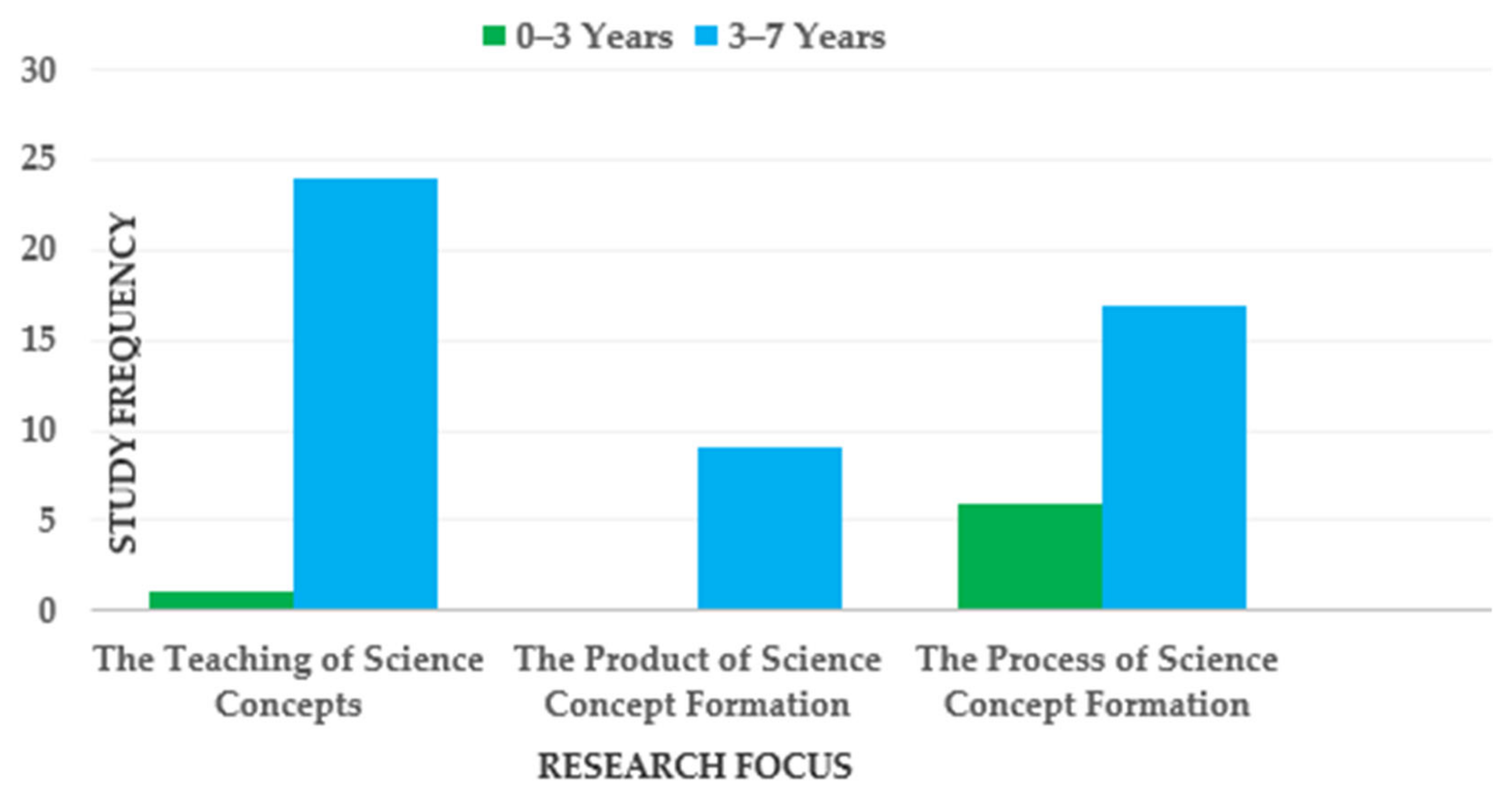
- Studies examining science concept formation in the birth to three period specifically, have focused primarily on exploring the process of concept formation; 6 of the 7 studies identified examined how young children develop their understandings of science concepts in an everyday context. This is in contrast to the literature on older pre-school age children (three to six years), where the tendency of research has been to focus on the relation between science concept formation and pedagogical practices; 24 of 50 studies (examining science concept formation in children aged three to six years) examined the relationships between teaching practices and children’s conceptual development.
- Studies examining science concept formation in birth to three period, have tended to draw upon socio-cultural/cultural historical theory; 5 of the 7 studies identified, adopted a SC/CH theoretical framework. From a SC/CH perspective, cognitive development is conceptualised as a process whereby people move “through” understanding as opposed to towards it [86]. Concept formation is therefore, conceptualised as a dynamic process that must be examined as it occurs within and across differing contexts [54]. Research examining science learning in the birth to three period specifically, has focused on the “process” of concept formation. Within the broader Early Years Science Education Research (EYSER) literature, the tendency of research, to adopt a constructivist approach has been highlighted [6]. In contrast to SC/CH research, research adopting a constructivist approach has historically, examined children’s demonstrated understandings of a particular science concept at a particular point in time. Thus, in contrast to the literature on science concept formation in infancy–toddlerhood, the literature within EYSER in general, has tended to examine the “product” of concept formation.
Author Contributions
Funding
Institutional Review Board Statement
Informed Consent Statement
Data Availability Statement
Acknowledgments
Conflicts of Interest
References
- Murray, J. Routes to STEM: Nurturing Science, Technology, Engineering and Mathematics in early years education. Int. J. Early Years Educ. 2019, 27, 219–221. [Google Scholar] [CrossRef] [Scilit]
- Uhlenberg, J.M.; Geiken, R. Supporting Young Children’s Spatial Understanding: Examining Toddlers’ Experiences with Contents and Containers. J. Fam. Econ. Issues 2021, 49, 49–60. [Google Scholar] [CrossRef] [Scilit]
- Kennedy, T.J.; Odell, M.R.L. Engaging students in STEM education. Sci. Educ. Int. 2014, 25, 246–258. [Google Scholar]
- Thomson, S.; De Bortoli, L.; Underwood, C. PISA 2015: A First Look at Australia’s Results. 2016. Available online: https://research.acer.edu.au/ozpisa/21/ (accessed on 18 March 2020).
- Eshach, H.; Fried, M.N. Should Science be Taught in Early Childhood? J. Sci. Educ. Technol. 2005, 14, 315–336. [Google Scholar] [CrossRef] [Scilit]
- Fleer, M.; Robbins, J. “Hit and Run Research” with “Hit and Miss” Results in Early Childhood Science Education. Res. Sci. Educ. 2003, 33, 405–431. [Google Scholar] [CrossRef] [Scilit]
- Fleer, M.; Fragkiadaki, G.; Rai, P. STEM begins in infancy: Conceptual PlayWorlds to support new practices for professionals and families. Int. J. Birth Parent Educ. 2020, 7, 27–31. [Google Scholar]
- Russell, T.; McGuigan, L. An updated perspective on emergent science. Early Child Dev. Care 2016, 187, 284–297. [Google Scholar] [CrossRef] [Scilit]
- Vellopoulou, A.; Papandreou, M. Investigating the teacher’s roles for the integration of science learning and play in the kindergarten. Educ. J. Univ. Patras UNESCO Chair 2019, 6, 186–196. [Google Scholar] [CrossRef]
- Saçkes, M.; Trundle, K.C.; Bell, R.L.; O’Connell, A.A. The influence of early science experience in kindergarten on children’s immediate and later science achievement: Evidence from the early childhood longitudinal study. J. Res. Sci. Teach. 2010, 48, 217–235. [Google Scholar] [CrossRef] [Scilit]
- Pendergast, E.; Lieberman-Betz, R.G.; Vail, C.O. Attitudes and Beliefs of Prekindergarten Teachers Toward Teaching Science to Young Children. J. Fam. Econ. Issues 2017, 45, 43–52. [Google Scholar] [CrossRef] [Scilit]
- Allen, M.; Kambouri-Danos, M. Substantive conceptual development in preschool science: Contemporary issues and future directions. Early Child Dev. Care 2017, 187, 181–191. [Google Scholar] [CrossRef] [Scilit]
- Kallery, M.; Psillos, D.; Tselfes, V. Typical Didactical Activities in the Greek Early-Years Science Classroom: Do they promote science learning? Int. J. Sci. Educ. 2009, 31, 1187–1204. [Google Scholar] [CrossRef] [Scilit]
- Eshach, H. Science Literacy in Primary Schools and Pre-Schools; Springer: Berlin/Heidelberg, Germany, 2006. [Google Scholar]
- French, L. Science as the center of a coherent, integrated early childhood curriculum. Early Child. Res. Q. 2004, 19, 138–149. [Google Scholar] [CrossRef] [Scilit]
- Mantzicopoulos, P.; Patrick, H. Reading Picture Books and Learning Science: Engaging Young Children with Informational Text. Theory Pract. 2011, 50, 269–276. [Google Scholar] [CrossRef] [Scilit]
- Early Childhood STEM Working Group. Early STEM Matters: Providing High-Quality STEM Experiences for All Young Learners: A Policy Report by the Early Childhood STEM Working Group. 2017. Available online: http://d3lwefg3pyezlb.cloudfront.net/docs/Early_STEM_Matters_FINAL.pdf (accessed on 22 March 2020).
- Ravanis, K. Early Childhood Science Education: State of The Art and Perspectives. J. Balt. Sci. Educ. 2017, 16, 284–288. Available online: https://search.proquest.com/scholarly-journals/early-childhood-science-education-state-art/docview/2343739757/se-2?accountid=12528 (accessed on 22 March 2020).
- Dejonckheere, P.; Van de Keere, K.; De Wit, N.; Vervaet, S. Exploring the classroom: Teaching science in early childhood. Int. Electron. J. Elem. Educ. 2016, 8, 537–558. [Google Scholar] [CrossRef] [Scilit]
- Dogru, M.; Seker, F. The Effect of Science Activities on Concept Acquisition of Age 5-6 Children Groups. Educ. Sci. Theory Pract. 2012, 12, 3011–3024. [Google Scholar]
- Hadzigeorgiou, Y. A Study of the Development of the Concept of Mechanical Stability in Preschool Children. Res. Sci. Educ. 2002, 32, 373–391. [Google Scholar] [CrossRef] [Scilit]
- Hannust, T.; Kikas, E. Children’s knowledge of astronomy and its change in the course of learning. Early Child. Res. Q. 2007, 22, 89–104. [Google Scholar] [CrossRef] [Scilit]
- Hong, S.-Y.; Diamond, K.E. Two approaches to teaching young children science concepts, vocabulary, and scientific problem-solving skills. Early Child. Res. Q. 2012, 27, 295–305. [Google Scholar] [CrossRef] [Scilit]
- Kalogiannakis, M.; Nirgianaki, G.-M.; Papadakis, S. Teaching Magnetism to Preschool Children: The Effectiveness of Picture Story Reading. J. Fam. Econ. Issues 2018, 46, 535–546. [Google Scholar] [CrossRef] [Scilit]
- Kambouri-Danos, M.; Ravanis, K.; Jameau, A.; Boilevin, J.-M. Precursor Models and Early Years Science Learning: A Case Study Related to the Water State Changes. J. Fam. Econ. Issues 2019, 47, 475–488. [Google Scholar] [CrossRef] [Scilit]
- Kolokouri, E.; Plakitsi, K. A CHAT Approach of Light and Colors in Science Teaching for the Early Grades. World J. Educ. 2016, 6, 1–13. [Google Scholar] [CrossRef] [Scilit]
- Lloyd, E.; Edmonds, C.; Downs, C.; Crutchley, R.; Paffard, F. Talking everyday science to very young children: A study involving parents and practitioners within an early childhood centre. Early Child Dev. Care 2017, 187, 244–260. [Google Scholar] [CrossRef] [Scilit]
- Nayfeld, I.; Brenneman, K.; Gelman, R. Science in the Classroom: Finding a Balance between Autonomous Exploration and Teacher-Led Instruction in Preschool Settings. Early Educ. Dev. 2011, 22, 970–988. [Google Scholar] [CrossRef] [Scilit]
- Peterson, S.M. Narrative and Paradigmatic Explanations in Preschool Science Discourse. Discourse Process. 2009, 46, 369–399. [Google Scholar] [CrossRef] [Scilit]
- Ravanis, K. The discovery of elementary magnetic properties in preschool age. Eur. Early Child. Educ. Res. J. 1994, 2, 79–91. [Google Scholar] [CrossRef] [Scilit]
- Ravanis, K.; Koliopoulos, D.; Hadzigeorgiou, Y. What factors does friction depend on? A socio-cognitive teaching intervention with young children. Int. J. Sci. Educ. 2004, 26, 997–1007. [Google Scholar] [CrossRef] [Scilit]
- Ravanis, K.; Pantidos, P. Sciences Activities in Preschool Education: Effective and Ineffective Activities in a Piagetian Theoretical Framework for Research and Development. Int. J. Learn. Annu. Rev. 2008, 15, 123–132. [Google Scholar] [CrossRef] [Scilit]
- Ravanis, K.; Christidou, V.; Hatzinikita, V. Enhancing Conceptual Change in Preschool Children’s Representations of Light: A Sociocognitive Approach. Res. Sci. Educ. 2013, 43, 2257–2276. [Google Scholar] [CrossRef] [Scilit]
- Strouse, G.A.; Ganea, P.A. Are Prompts Provided by Electronic Books as Effective for Teaching Preschoolers a Biological Concept as Those Provided by Adults? Early Educ. Dev. 2016, 27, 1190–1204. [Google Scholar] [CrossRef] [Scilit]
- Tenenbaum, H.R.; Rappolt-Schlichtmann, G.; Zanger, V.V. Children’s learning about water in a museum and in the classroom. Early Child. Res. Q. 2004, 19, 40–58. [Google Scholar] [CrossRef] [Scilit]
- Valanides, N.; Gritsi, F.; Kampeza, M.; Ravanis, K. Changing Pre-school Children’s Conceptions of the Day/Night Cycle Changer les Conceptions d’Enfants d’Age Prescolaire sur le Phenomene du Cercle ’Jour-Nuit’ Cambiar las Concepciones de los Ninos Preescolares en el Ciclo Dia/Noche. Int. J. Early Years Educ. 2000, 8, 27–39. [Google Scholar] [CrossRef] [Scilit]
- Walan, S.; Enochsson, A.-B. The potential of using a combination of storytelling and drama, when teaching young children science. Eur. Early Child. Educ. Res. J. 2019, 27, 821–836. [Google Scholar] [CrossRef] [Scilit]
- Zacharia, Z.C.; Loizou, E.; Papaevripidou, M. Is physicality an important aspect of learning through science experimentation among kindergarten students? Early Child. Res. Q. 2012, 27, 447–457. [Google Scholar] [CrossRef] [Scilit]
- Fleer, M. Supporting Scientific Conceptual Consciousness or Learning in ‘a Roundabout Way’ in Play-based Contexts. Int. J. Sci. Educ. 2009, 31, 1069–1089. [Google Scholar] [CrossRef] [Scilit]
- Gerde, H.K.; Pierce, S.J.; Lee, K.; Van Egeren, L.A. Early Childhood Educators’ Self-Efficacy in Science, Math, and Literacy Instruction and Science Practice in the Classroom. Early Educ. Dev. 2018, 29, 70–90. [Google Scholar] [CrossRef] [Scilit]
- Fleer, M.; Gomes, J.; March, S. Science Learning Affordances in Preschool Environments. Australas. J. Early Child. 2014, 39, 38–48. [Google Scholar] [CrossRef] [Scilit]
- Gomes, J.; Fleer, M. Is Science Really Everywhere? Teachers’ Perspectives on Science Learning Possibilities in the Preschool Environment. Res. Sci. Educ. 2018, 50, 1961–1989. [Google Scholar] [CrossRef] [Scilit]
- Akerson, V.L.; Gayle, A.B.; Buck, G.A.; Donnelly, L.A.; Nargund-Joshi, V.; Weiland, I.S. The Importance of Teaching and Learning Nature of Science in the Early Childhood Years. J. Sci. Educ. Technol. 2011, 20, 537–549. [Google Scholar] [CrossRef] [Scilit]
- Allen, M. Early understandings of simple food chains: A learning progression for the preschool years. Int. J. Sci. Educ. 2017, 39, 1485–1510. [Google Scholar] [CrossRef] [Scilit]
- Borgerding, L.A.; Raven, S. Children’s ideas about fossils and foundational concepts related to fossils. Sci. Educ. 2018, 102, 414–439. [Google Scholar] [CrossRef] [Scilit]
- Constantinou, C.; Spanoudes, G.; Raftopoulos, A.; Natsopoulos, D. Pre-schoolers’ construction of operational definitions in magnetism. J. Emergent Sci. 2013, 5, 6–21. [Google Scholar]
- Forman, G.E. When 2-year-olds and 3-year-olds think like scientists. Early Child. Res. Pract. 2010, 12. Available online: https://files.eric.ed.gov/fulltext/EJ910913.pdf (accessed on 6 April 2020).
- Krnel, D.; Watson, R.; Glažar, S.A. The development of the concept of ‘matter’: A cross-age study of how children describe materials. Int. J. Sci. Educ. 2005, 27, 367–383. [Google Scholar] [CrossRef] [Scilit]
- Smolleck, L.; Hershberger, V. Playing with Science: An Investigation of Young Children’s Science Conceptions and Misconceptions. Curr. Issues Educ. 2011, 14. Available online: https://cie.asu.edu/ojs/index.php/cieatasu/article/view/324 (accessed on 21 April 2020).
- Solomonidou, C.; Kakana, D.M. Preschool children’s conceptions about the electric current and the functioning of electric appliances. Eur. Early Child. Educ. Res. J. 2000, 8, 95–111. [Google Scholar] [CrossRef] [Scilit]
- Piekny, J.; Maehler, C. Scientific reasoning in early and middle childhood: The development of domain-general evidence evaluation, experimentation, and hypothesis generation skills. Br. J. Dev. Psychol. 2013, 31, 153–179. [Google Scholar] [CrossRef] [Scilit]
- Piekny, J.; Grube, D.; Maehler, C. The Development of Experimentation and Evidence Evaluation Skills at Preschool Age. Int. J. Sci. Educ. 2012, 36, 334–354. [Google Scholar] [CrossRef] [Scilit]
- Christidou, V.; Hatzinikita, V. Preschool Children’s Explanations of Plant Growth and Rain Formation: A Comparative Analysis. Res. Sci. Educ. 2005, 36, 187–210. [Google Scholar] [CrossRef] [Scilit]
- Fleer, M. Understanding the Dialectical Relations between Everyday Concepts and Scientific Concepts Within Play-Based Programs. Res. Sci. Educ. 2009, 39, 281–306. [Google Scholar] [CrossRef] [Scilit]
- Fleer, M. Affective Imagination in Science Education: Determining the Emotional Nature of Scientific and Technological Learning of Young Children. Res. Sci. Educ. 2013, 43, 2085–2106. [Google Scholar] [CrossRef] [Scilit]
- Fleer, M. Scientific Playworlds: A Model of Teaching Science in Play-Based Settings. Res. Sci. Educ. 2019, 49, 1257–1278. [Google Scholar] [CrossRef] [Scilit]
- Fragkiadaki, G.; Ravanis, K. Mapping the interactions between young children while approaching the natural phenomenon of clouds creation. Educ. J. Univ. Patras UNESCO Chair 2014, 1, 112–122. [Google Scholar]
- Fragkiadaki, G.; Ravanis, K. Genetic Research Methodology Meets Early Childhood Science Education Research: A Cultural-Historical Study of Child’s Scientific Thinking Development. Cult. Psychol. 2016, 12, 310–330. [Google Scholar] [CrossRef] [Scilit]
- Fragkiadaki, G.; Ravanis, K. Preschool Children’s mental representations of clouds. J. Balt. Sci. Educ. 2015, 14, 267–274. Available online: https://search.proquest.com/scholarly-journals/preschool-children-s-mental-representations/docview/2343755233/se-2?accountid=12528 (accessed on 10 April 2020).
- Fragkiadaki, G.; Fleer, M.; Ravanis, K. A Cultural-Historical Study of the Development of Children’s Scientific Thinking about Clouds in Everyday Life. Res. Sci. Educ. 2019, 49, 1523–1545. [Google Scholar] [CrossRef] [Scilit]
- Fragkiadaki, G.; Fleer, M.; Ravanis, K. Understanding the complexity of young children’s learning and development in science: A twofold methodological model building on constructivist and cultural-historical strengths. Learn. Cult. Soc. Interact. 2021, 28, 100461. [Google Scholar] [CrossRef] [Scilit]
- Frejd, J. When Children Do Science: Collaborative Interactions in Preschoolers’ Discussions About Animal Diversity. Res. Sci. Educ. 2019, 20, 1–22. [Google Scholar] [CrossRef] [Scilit]
- Klaar, S.; Öhman, J. Action with friction: A transactional approach to toddlers’ physical meaning making of natural phenomena and processes in preschool. Eur. Early Child. Educ. Res. J. 2012, 20, 439–454. [Google Scholar] [CrossRef] [Scilit]
- Larsson, J. Contextual and Conceptual Intersubjectivity and Opportunities for Emergent Science Knowledge about Sound. Int. J. Early Child. 2013, 45, 101–122. [Google Scholar] [CrossRef] [Scilit]
- Larsson, J. Children’s Encounters with Friction as understood as a Phenomenon of Emerging Science and as “Opportunities for Learning”. J. Res. Child. Educ. 2013, 27, 377–392. [Google Scholar] [CrossRef] [Scilit]
- Sikder, S. Social situation of development: Parents perspectives on infants-toddlers’ concept formation in science. Early Child Dev. Care 2015, 185, 1658–1677. [Google Scholar] [CrossRef] [Scilit]
- Sikder, S.; Fleer, M. Small Science: Infants and Toddlers Experiencing Science in Everyday Family Life. Res. Sci. Educ. 2015, 45, 445–464. [Google Scholar] [CrossRef] [Scilit]
- Sikder, S.; Fleer, M. The relations between ideal and real forms of small science: Conscious collaboration among parents and infants–toddlers. Cult. Stud. Sci. Educ. 2018, 13, 865–888. [Google Scholar] [CrossRef] [Scilit]
- Siry, C.; Ziegler, G.; Max, C. “Doing science” through discourse-in-interaction: Young children’s science investigations at the early childhood level. Sci. Educ. 2012, 96, 311–326. [Google Scholar] [CrossRef] [Scilit]
- Siry, C.; Max, C. The Collective Construction of a Science Unit: Framing Curricula as Emergent from Kindergarteners’ Wonderings. Sci. Educ. 2013, 97, 878–902. [Google Scholar] [CrossRef] [Scilit]
- Adbo, K.; Carulla, C.V. Learning about Science in Preschool: Play-Based Activities to Support Children’s Understanding of Chemistry Concepts. Int. J. Early Child. 2020, 52, 17–35. [Google Scholar] [CrossRef] [Scilit]
- Fragkiadaki, G.; Fleer, M.; Rai, P. The hidden and invisible: Science concepts formation in early infancy. Rise 2020, in press. [Google Scholar]
- Fridberg, M.; Jonsson, A.; Redfors, A.; Thulin, S. Teaching chemistry and physics in preschool: A matter of establishing intersubjectivity. Int. J. Sci. Educ. 2019, 41, 2542–2556. [Google Scholar] [CrossRef] [Scilit]
- Havu-Nuutinen, S. Examining young children’s conceptual change process in floating and sinking from a social constructivist perspective. Int. J. Sci. Educ. 2005, 27, 259–279. [Google Scholar] [CrossRef] [Scilit]
- Pramling, N.; Samuelsson, I.P. “It is Floating ‘Cause there is a Hole’”: A young child’s experience of natural science. Early Years 2001, 21, 139–149. [Google Scholar] [CrossRef]
- Metz, K. Children’s Understanding of Scientific Inquiry: Their Conceptualization of Uncertainty in Investigations of Their Own Design. Cogn. Instr. 2004, 22, 219–290. [Google Scholar] [CrossRef] [Scilit]
- Siraj-Blatchford, J. Emergent Science and Technology in the Early Years. In Proceedings of the XXIII World Congress of OMEP, Santiago, Chile, 31 July–4 August 2001; Available online: http://www.327matters.org/docs/omepabs.pdf (accessed on 20 May 2020).
- Fleer, M.; Pramling, N. Learning Science in Everyday Life—A Cultural-Historical Framework. Cult. Stud. Sci. Educ. 2014, 11, 3–22. [Google Scholar] [CrossRef] [Scilit]
- Gopnik, A.; Glymour, C.; Sobel, D.M.; Schulz, L.E.; Kushnir, T.; Danks, D. A Theory of Causal Learning in Children: Causal Maps and Bayes Nets. Psychol. Rev. 2004, 111, 3–32. [Google Scholar] [CrossRef] [Scilit]
- Gopnik, A.; Wellman, H.M. Reconstructing constructivism: Causal models, Bayesian learning mechanisms, and the theory theory. Psychol. Bull. 2012, 138, 1085–1108. [Google Scholar] [CrossRef] [Scilit]
- Keil, F.C. Science Starts Early. Science 2011, 331, 1022–1023. [Google Scholar] [CrossRef] [Scilit] [PubMed]
- Gopnik, A.; Zhen, Y.; Aardema, M.L.; Medina, E.M.; Schumer, M.; Andolfatto, P. Scientific Thinking in Young Children: Theoretical Advances, Empirical Research, and Policy Implications. Science 2012, 337, 1623–1627. [Google Scholar] [CrossRef] [Scilit]
- Brown, A.L.; Campione, J.C. The development of science learning abilities in children. In Growing up with Science; Harnquvist, K., Burgen, A., Eds.; Jessica Kingsley Publishers: London, UK, 1997. [Google Scholar]
- Nelson, K. Young minds in social worlds: Experience, meaning, and memory. Choice Rev. Online 2007, 45, 45–0558. [Google Scholar] [CrossRef] [Scilit]
- Robbins, J. ‘Brown Paper Packages’? A Sociocultural Perspective on Young Children’s Ideas in Science. Res. Sci. Educ. 2005, 35, 151–172. [Google Scholar] [CrossRef] [Scilit]
- Rogoff, B. Cognition as a collaborative process. In Handbook of Child Psychology; Cognition, Perception and Language; Damon, W., Kuhn, D., Siegler, R., Eds.; Wiley: New York, NY, USA, 1998; Volume 2. [Google Scholar]

| Category | Inclusion Criteria | Exclusion Criteria |
|---|---|---|
| Research Aim/Key Words | Studies focusing on science concept formation/children’s “thinking” in science | Studies in which science concept formation was not of primary interest |
| Topic | Science | STEM/STEAM |
| Age | Pre-school age children (country dependent) | Children in formal schooling |
| Area | International | None |
| Time | 1990 to date | Prior to 1990 |
| Type | Peer reviewed journal articles | Books/book chapters/non-academic articles, editorials, conference proceedings |
| Language | English | None-English |
| Research Area | Research Focus | Frequency 3 to 7 Years | Frequency 0 to 3 Years |
|---|---|---|---|
| CATEGORY 1: The Teaching of Science Concepts (Pedagogical Practices) | To explore the effectiveness of specific teaching interventions/educational programs (in relation to science concept formation) (1A). | 20 | 1 |
| To explore individual differences amongst teachers (in relation to science concept formation) (1B). | 4 | 0 | |
| Total Frequency: | 24 | 1 | |
| CATEGORY 2: The Product of Science Concept Formation (Conceptual Understandings/Demonstrated Capabilities) | To explore pre-school age children’s conceptual understandings of science concepts (2A) | 7 | 0 |
| To explore the age (biologically) that children begin developing scientific reasoning skills (2B) | 2 | 0 | |
| Total Frequency: | 9 | 0 | |
| CATEGORY 3: The Process of Science Concept Formation (Development Over Time) | To explore and understand how children are developing their understandings of science concepts (3A) | 13 | 5 |
| To explore and understand the role the teacher plays in creating conditions for children developing conceptual understandings (3B) | 4 | 1 | |
| Total Frequency: | 17 | 6 | |
| TOTAL (overall): | 50 | 7 | |
| Research Focus | Reference | Research Aim | Science Concept(s)/ Skills | Country/ Sample | Methods | Findings/Conclusions |
|---|---|---|---|---|---|---|
| To explore the effectiveness of specific teaching interventions/educational programs (in relation to science concept formation) (1A). | Dejonckheere et al., 2016 [19] | Tested and integrated the effects of an inquiry-based didactic method for preschool science. | Scientific reasoning skills | Belgium, 57 children aged 4 to 6 years | Structured interviews (pre-post-test) | The inquiry-based didactic method encouraged children’s spontaneous exploratory activities. |
| Dogru and Seker, 2012 [20] | To determine the effect of science “activities” on cognitive development and science concept acquisition skills. | Astronomy | Turkey, 48 children aged 5 to 6 years | Interviews, participant drawings | “Science activities” is an effective technique in the acquisition of basic concepts related to “the Earth, Sun and Moon”. | |
| Hadzigeorgiou, 2002 [21] | Investigated the efficacy of structured hands-on activities to facilitate preschool children to construct the concept of mechanical stability. | Mechanical stability | Greece, 37 children, 4.5 to 6 years | Video recordings | Appropriately structured activities involving children’s action on objects, complemented with a scaffolding strategy, help children construct the concept of mechanical stability. | |
| Hannust and Kikas, 2007 [22] | Analysed the influence of instruction on the development of astronomical knowledge. | Astronomy | Estonia, 113 children aged 5 to 7 years | Video recordings, interviews, drawing tasks | Children acquired factual information easily and over-generalized new knowledge easily: materials used in teaching may promote the development of non-scientific notions. | |
| Hong and Diamond, 2012 [23] | Examined the efficacy Responsive Teaching (RT) and the combination of Responsive Teaching and Explicit Instruction (RT + EI) to facilitate children’s learning of science. | Floating/sinking, scientific problem-solving skills | United States America (USA), 104 children aged 4 to 5 years | Interviews (pre-post-test) | Children learned science concepts and vocabulary better when either responsive teaching or the combination of responsive teaching and explicit instruction was used. | |
| Kallery et al., 2009 [13] | Examined the extent to which the teaching practices adopted by early-years educators are successful in supporting young children’s understanding in science. | Physics, biology, astronomy | Greece, 11 teachers | Field notes | The didactical activities analysed did not promote scientific understanding. Scientific activity was mainly confined to the representational level. | |
| Kalogiannakis et al., 2018 [24] | Examined whether the “picture story reading” method can be beneficial for young children learning about magnetism. | Magnetism | Greece, 30 children aged 4 to 5.5 years | Structured interviews, children’s drawings | Pictorial story reading in kindergarten, together with suitable questions by the teacher were effective in aiding understanding of magnetism. | |
| Kambouri-Danos et al., 2019 [25] | Examined the way in which the construction of a precursor model can support children’s scientific learning. | Water (change of states) | Greece, 91 children aged 5 to 6 years | Interviews | It is possible for children aged 5 to 6 years, to consistently approach a complete sequence of water state changes, as part of a specifically designed teaching intervention. | |
| Kolokouri, and Plakitsi, 2016 [26] | Examined the connection of Cultural Historical Activity Theory with Science Education in the early grades. | Light/shadows, colour | Greece, 92 “pre-primary” children | Video recordings, interviews, field notes | The learning of scientific concepts is a creative component of methods, interactions and social practices. CHAT is a promising field for Science Education in the early grades. | |
| * Lloyd et al., 2017 [27] | Developed and delivered a programme of activities aimed at encouraging parents’ confidence in their own ability to support emergent scientific thinking. | Forces, materials and their properties, the living world | England, 19 care givers, 26 children aged 0 to 5 years | Audio recordings, questionnaires | Parental interaction enhanced children’s learning at least as much, if not more, than practitioner interventions. Mediation of experience by familiar adults facilitated enjoyment, encouraged natural curiosity. | |
| Nayfeld et al., 2011 [28] | Developed an intervention to increase childrens use of science materials (in preschool classrooms) during “free choice” time. | Properties of matter | USA, 84 children aged 3 to 5 years | Time sampling method, interviews | Children’s voluntary presence and exploration in the science area increased after the intervention. Children demonstrated improved conceptual knowledge. | |
| Peterson, 2009 [29] | Examined the use of narrative and paradigmatic modes of explanation in large group discussions about science in preschool classrooms. | Measurement, mapping, light, properties of matter, natural habitats | USA, 29 teachers, 479 pre-school children | Video recordings | Students in the “science curriculum” classrooms were exposed to a higher frequency of paradigmatic explanations and produced a higher relative frequency of paradigmatic explanations. | |
| Ravanis, 1994 [30] | Explored learning situations that take place within the framework of a constructivist pedagogy. | Magnetism | Greece, 79 children, mean age 5.5 years | Video recordings, field notes | Children were able to discover the action of attractive magnetic forces on nonmagnetic materials, the attractive and repulsive forces between magnets, and distinguish between magnetic and nonmagnetic material. | |
| Ravanis et al., 2004 [31] | Investigated the effect of a socio-cognitive teaching strategy on young children’s understanding of friction. | Friction | Greece, 68 children aged 5 to 6 years | Structured interviews (pre-post-test) | Evidence for the effect of the socio-cognitive strategy on children’s understanding of a “precursor model” for the concept of friction was found. | |
| Ravanis and Pantidos, 2008 [32] | Explored Piagetian and Post-Piagetian strategies for children working with magnets. | Magnetism, friction | Greece, 41 children aged 5.5 to 6.5 years | Video recordings | The differing educational content of the two pieces of research led to different levels of progress in children’s thought. Successful changes in children’s thought occurred only in the case of magnetic properties. | |
| Ravanis et al., 2013 [33] | Investigated the effect of a socio-cognitive teaching strategy on young children’s understanding of light. | Light | Greece, 170 children aged 5.5 to 6.5 years | Structured interviews (pre-post-test) | Evidence for the effect of the socio- cognitive strategy on enhancing children in constructing a “precursor model” for the concept of light was found. | |
| Strouse and Ganea, 2016 [34] | Investigated whether adult prompting during the reading of an electronic book enhanced children’s understanding of a biological concept. | Electricity | USA, 91 children aged 4 years | Structured interviews (pre-post-test) | Under some circumstances, electronic prompts built into touchscreen books can be as effective at supporting conceptual development as the same prompts provided by a co-reading adult. | |
| Tenenbaum et al., 2004 [35] | Investigated the effectiveness of a combined museum and classroom intervention project on science learning in low-income children. | Water related concepts | USA, 48 kindergarten children | Interviews | In general, the program supported children’s science literacy development with regard to both concept complexity and content knowledge. | |
| Valanides et al., 2000 [36] | Investigated the effectiveness of a teaching intervention designed to teach pre-school age children astronomical concepts | Astronomical concepts | Greece, 33 children aged 5 to 6 years | Interviews | The majority of children accepted that the Sun and the Earth are separate spherical objects, but fewer children attributed the day/night cycle to rotation of the Earth on its axis. | |
| Walan and Enochsson, 2019 [37] | Explored the outcome of using a model in which drama and storytelling were connected to facilitate learning processes in science for young children. | Human biology (the immune system) | Sweden, 25 children aged 4 to 8 years | Semi structured interviews, drawings | The combination of storytelling and drama as an instructional strategy has a positive potential when it comes to teaching children science. | |
| Zacharia et al., 2012 [38] | Investigated whether physicality (actual and active touch of concrete material) is a necessity for science experimentation learning at the kindergarten level. | Balance | Cyprus, 80 children aged 5 years | Structured interviews (pre-post-test) | Physicality appears to be a prerequisite for students’ understanding of concepts (concerning the use of a beam balance), only when the students have incorrect prior knowledge of what a beam balance does. | |
| To explore individual differences amongst teachers (in relation to science concept formation) (1B). | Fleer, 2009a [39] | Examined teacher philosophy and pedagogical practices within the context of an analysis of children’s concept formation within early childhood settings. | Water related concepts, properties of matter | Australia, 2 teachers, 24 children aged 4 to 5 years | Interviews, video recordings, photographic documentation | Teacher philosophy about how young children learn is a significant contributing factor to learning in science. |
| Gerde et al., 2018 [40] | Investigated the nature of teachers’ domain-specific self-efficacy. | Common science activities (early childhood science curricula) | USA, 67 teachers | Teacher surveys | Domain-specific self-efficacy was lower for science than literacy. Self-efficacy for science, related to teacher’s frequency of engaging children in science instruction. | |
| Fleer et al., 2014 [41] | Examined how the environment is perceived by teachers for creating opportunities for science learning. | Common science activities (early childhood science curricula) | Australia, 65 children, 3.3 to 4.6 years | Video recordings, photographs | A “sciencing attitude” on the part of the teacher affords meaningful science learning for preschool children. | |
| Gomes and Fleer, 2018 [42] | Examined how teachers use the preschool environment to promote the teaching of science concepts. | Experiment based science activities | Australia, 2 pre-school teachers | Video recordings | Teachers in the same preschool setting have different levels of science awareness for the possibilities of informally teaching science. |
| Research Focus | Reference | Research Aim | Science Conept(s)/Skills | Country/ Sample | Methods | Findings/Conclusions |
|---|---|---|---|---|---|---|
| To explore pre-school age children’s conceptual understandings of science concepts (2A). | Akerson et al., 2011 [43] | Examined the capability of young children to learn about the Nature of Science (NOS). | NOS | USA, 18 children; kindergarten to 2nd grade. | Structured interviews | Children improved their understandings of NOS in each setting. Kindergarten children are developmentally capable of conceptualizing NOS when it is taught to them. |
| Allen, 2017 [44] | Explored aspects of pre-schoolers’ ecological understandings. | Ecology | England, 70 children aged 3 to 5 years | Structured interviews | 5-year-old children arecapable of grasping concepts inherent in food chain topics scheduled to appear later in their schooling. | |
| Borgeding and Raven, 2018 [45] | Investigated pre-schoolers understandings of fossils in the context of a week-long informal science camp. | Fossils | USA, 15 children aged 3 to 6 years | Structured interviews | Clear age and object-related trends for living/non-living distinctions, teleological reasoning, origins, and object ages were noted. | |
| Constantinou et al., 2013 [46] | Examined the ability of young children to construct operational definitions in magnetism and the importance of scaffolding the learning environment. | Magnetism | Cyprus 165 children aged 4 to 6 years | Structured Interviews | Cognitive maturation is not the main determinant factor that shapes the performance pattern of these children. The necessary role of scaffolding the curriculum materials to achieve successful learning is highlighted. | |
| Forman, 2010 [47] | Explored the relations between young children’s play and scientific thinking. | Push/pull, force, scientific thinking skills | USA 3 children aged 3 to 4 years | Video recordings | The small experiments, inventions, strategies, and pauses in young children’s play reveal a legitimate form of scientific thinking. Science and play represent a frame of mind. | |
| Krnel et al., 2005 [48] | Explored the development of the concept of matter. | Matter | Slovenia, 84 children aged 3 to 13 years | Structured interviews | Young children (age 3 to 7 years) experience objects and substances by acting upon them or using them. | |
| Smolleck and Hershberger, 2011 [49] | Investigated the conceptions and misconceptions of young children related to science concepts, skills, and phenomena. | Matter, magnetism, density | USA, 63 children aged 3 to 8 years | Video recordings | Findings reveal the most common conceptions related to matter, magnetism, density, and air. | |
| Solomonidou and Kakana, 2000 [50] | Investigated the representations and primary notions children create, on the basis of their everyday experience, for common electrical devices and electric current. | Electricity | Greece, 38 children aged 5.5 to 6.5 years | Semi structured interviews | Children had no difficulty in recognising and naming the electric appliances they were familiar with. Children held a variety of preconceptions about electric current. | |
| To explore the age (biologically) that children begin developing scientific reasoning skills (2B). | Piekny and Maehler, 2013 [51] | Investigated when scientific reasoning skills emerge and whether these abilities develop synchronously during childhood. | Scientific reasoning skills | Germany, 223 children, 4 to 13.5 years | Structured interviews | The three cognitive components of domain general scientific reasoning emerge asynchronously during early and middle childhood. |
| Piekny et al., 2014 [52] | Investigated how and when children’s ability to evaluate evidence and their understanding of experimentation develops, (between ages of 4 and 6). | Scientific reasoning skills | Germany, 138 children,4 to 6 years | Structured interviews | The ability to evaluate evidence is well developed at age four and increases steadily and significantly over time. Children’s understanding of experimentation increases significantly between the ages of 5 and 6. |
| Research Focus | Reference | Research Aim | Science Concept(s)/Skills | Country/ Sample | Methods | Findings/Conclusions |
|---|---|---|---|---|---|---|
| To explore and understand how children are developing their understandings of science concepts (3A). | Christidou, and Hatzinikita, 2006 [53] | Explored the different types and characteristics of preschool children’s explanations of plant growth and rain formation. | Natural phenomena | Greece, 60 children aged 4.5 to 6.5 years | Semi- structured interviews | Children are relatively selective in regard to the explanatory type they use when discussing natural phenomena. Naturalistic explanations have different characteristics according to the phenomenon under discussion. |
| Fleer, 2009b [54] | Examined the reciprocity between everyday thinking and scientific thinking during playful encounters in early childhood centres. | Physical attributes of materials | Australia, 48 children 4 to 5 years (4 focus children) | Video recordings, photographs, interviews | Playful events provide an important conceptual space for the realisation of dialectical relations between everyday concepts and science concepts. The “teacher as mediator” is central. | |
| Fleer, 2013 [55] | Examined the emotional nature of scientific learning; affective imagination in early childhood science learning. | Heating/cooling, light | Australia, 53 children aged 3 to 4 years | Video recordings | Identify 5 key elements that draw attention to the relations between emotions and cognition in science learning. | |
| Fleer, 2019 [56] | Examined how imaginative play promotes scientific learning and how teachers engaged children in scientific play. | Microbes and Microscopic organisms | Australia, 3 pre-school teachers, 26 children aged 3.6 to 5.9 years | Video observations, photographs, interviews | The building of collective scientific narratives alongside of discourses of wondering were key determinants of science learning in play-based settings. The Scientific Playworlds is a possible model for teaching science in play-based settings. | |
| Fragkiadaki and Ravanis, 2014 [57] | Explore the dynamic of pre-schoolers’ interactions during the approach of basic science concepts. | Natural Phenomena | Greece, 16 children aged 4 to 6 years | Open type, semi-structured conversations | Different types of substantial interactions between the children couples were identified. Through a “conversational approach”, organized in couples, we can foster and enhance science thinking and learning in early childhood. | |
| Fragkiadaki and Ravanis, 2016 [58] | To structure a cultural-historical understanding on how early childhood children experience science and how they develop scientific thinking as they interact with the social, cultural and material world. | Natural phenomena | Greece, 1 childaged 5.2 years | Expanded, open-type conversations | Insights into how a certain social situation between children and educators in kindergarten settings becomes the unique social situation of a child’s development was gained. | |
| Fragkiadaki and Ravanis, 2015 [59] | Examined children’s representations on the phenomena of the natural world and on natural science concepts. | Natural phenomena | Greece, 16 children aged 4.5 to 6 years | Expanded, open type conversations between children and researchers | Children use different types of representations dominated by the nature of the substance under study. Children possess a range of ideas and explanatory mechanisms regarding the natural phenomenon and they are able to reason about them. | |
| Fragkiadaki et al., 2019 [60] | Aimed to provide a cultural-historical understanding on how children form relevant representations of clouds as well as how children’s understandings are transformed and developed through communications with others. | Natural phenomena | Greece, 16 children aged 4.5 to 6 years | Expanded, open-type conversations | When children construct everyday understandings of natural phenomenon, they draw upon multiple discussions, collaborations, social experiences, knowledge, practices, values, attitudes, tools, signs, objects, sketches, and gestures. Imagination is an important dimension of children’s thinking. | |
| Fragkiadaki et al., 2021 [61] | Seek to capture and explore the dialectic interrelations between intellect, affect, and action during science experiences within early childhood educational settings. | Natural phenomena | Greece, 113 children aged 4.5 to 6.5 years | Video recordings (semi-structured conversations) | The findings made visible the processes through which children make sense and shape their understandings of the natural phenomenon during everyday educational reality. | |
| Fredj, 2019 [62] | Explored how science is done in collaborative interactions when children discuss reasons for animal diversity. | Animal biology | Sweden, 27 children aged 6 years | Video recordings | While engaged in highly collaborative interactions, the children use observations to evaluate, challenge and question each other. The character of the collaborative interactions is an important factor for how acts of doing science are carried out. | |
| * Klaar and Öhman, 2012 [63] | Explored how infants form science concepts through their actions in nature. | Natural phenomena | Sweden, 1 child aged 22 months | Video recordings Practical Epistemological Analysis (PEA) | Bodily experiences, (physical encounters) are fundamental for children’s further learning about natural phenomena and processes. A methodology based on the principles of PEA allows for analyses of non-verbal, bodily actions in order to investigate toddler’s physical nature experiences. | |
| Larsson, 2013a [64] | To gain knowledge about what aspects of, and in what way, contextual and conceptual intersubjectivity contribute to emergent science knowledge about sound. | Sound | Sweden, 10 children aged 3–6 years | Video recordings, teacher transcripts | Emergent science knowledge is developed when it is enhanced by teachers’ double move between conceptual and contextual intersubjectivity. The use of contextual and conceptual intersubjectivity contribute to bridging children’s everyday understandings to scientific concepts. | |
| * Larsson, 2013b [65] | Explored preschool children’s opportunities for learning about friction. | Friction | Sweden, 4 children aged 2.1 to 5.6 years | Video recordings; “shadowing” | Children are in contact with the phenomenon of friction during their play. Everyday play situations can be used by teachers to become more knowledgeable about children’s understandings of the friction and direct their attention to it. | |
| * Sikder, 2015 [66] | Examined how sciene concept formation becomes part of the infants-toddlers lived everyday experience at home. | Force, water properties, heating/cooling. | Australia and Singapore 4 children aged 10 to 36 months | Video recordings, interviews | Children are learning concepts (or/and small science concepts) through the purposeful actions of parents. Possibilities of science concept formation at the infant-toddler age are not any extra effort for parents. | |
| * Sikder and Fleer, 2015 [67] | Examined social interactions in everyday family life that supports the development of science concepts for infants and toddlers. | Everyday science activities (family home) | Australia and Singapore 4 children aged 10 to 36 months | Video recordings, interviews | “Small science” can help explain how the everyday experiences of young children lay the foundation for the development of concrete “scientific” concepts. | |
| * Sikder and Fleer, 2018 [68] | Examined infant-toddler’s development of science concept formation within the family context. | Everyday science activities (family home) | Australia and Singapore 4 children aged 10 to 36 months | Video recordings, interviews | Small science concepts can be developed through a special form of narrative collaboration, where parents and infants consciously consider the environment from a scientific perspective. | |
| Siry et al., 2012 [69] | Explore the nature of science learning as a social phenomenon that is discursively bound. | Water related concepts | Luxembourg, 29 children aged 4 to 6 years | Video recordings, children’s photographs and paintings | By positioning scientific inquiry as a fluid process children were able to enact science collaboratively and through multimodal means. | |
| Siry and Max, 2013 [70] | Examines how children enact developing understandings in science through multiple interactions. | Water related concepts | Luxembourg, 26 children aged 4 to 6 years, 1 teacher | Video recordings (researcher), video recordings and photography (children) | Children’s investigations were mediated by their own speculations and explanations. Emphasis is placed on the value of students being positioned as co-constructors of science curricula. | |
| Abdo and Vidal Carulla, 2020 [71] | Explore emergent understanding of preschool-aged children about the scientific concept of “small”, as used in theoretical chemistry. | Chemistry concepts | Sweden, 4 children aged 3 to 5 years | Video recordings | A process of “sustained shared thinking” could describe the teaching/learning processes evident in the children’s and teacher’s conversations. Sustained and shared conversations between children and teachers should stem from children’s everyday experiences. | |
| To explore and understand the role the educator plays in creating conditions for children developing conceptual understandings (3B). | *Fragkiadaki et al., 2020 [72] | Examined how infants in play-based settings, develop scientific understandings about their everyday world. | Sound | Australia, 13 children aged 5 months to 2 years and 3 months | Video recordings | Key elements of the teacher’s pedagogical positioning were suggestive of the way through which the “ideal form” of concept formation can be introduced and supported in the infants’ environment. 4 key elements for introducing science concepts in infants’ everyday educational reality are proposed. |
| Fridberg et al., 2019 [73] | Aimed to develop knowledge about the communication established between teacher and children in relation to an object of learning (intersubjective communication). | Chemistry and physics concepts | Sweden, 5 children aged 3 to 5 years, 5 teachers | Video recordings | Intersubjectivity can occur in different ways with different consequences for children’s opportunities to experience the intended object of learning. | |
| Havu-Nuutinen, 2005 [74] | Examined young children’s conceptual change process in floating and sinking from a social constructivist perspective. | Floating/sinking | Finland, 10 children aged 6 years | Interviews (pre-post-test) | The child’s awareness and interest were raised. Through challenging the child’s thinking and encouraging the flow of ideas the foundations for later scientific understanding can be developed. | |
| Pramling and Pramling Samuelsson, 2001 [75] | Explore the verbal interaction between a child and teacher focusing on how the interaction enables the child to test and prove a self formulated hypothesis. | Floating/sinking | Sweden, 1 child aged 3.3 years | Video recordings | Conceptually orientated teacher–child interactions seemed to support the children’s cognitive progress in cognitive skills and guided the children to consider the reasons for flotation. |
Publisher’s Note: MDPI stays neutral with regard to jurisdictional claims in published maps and institutional affiliations. |
© 2021 by the authors. Licensee MDPI, Basel, Switzerland. This article is an open access article distributed under the terms and conditions of the Creative Commons Attribution (CC BY) license (https://creativecommons.org/licenses/by/4.0/).
Share and Cite
O’Connor, G.; Fragkiadaki, G.; Fleer, M.; Rai, P. Early Childhood Science Education from 0 to 6: A Literature Review. Educ. Sci. 2021, 11, 178. https://doi.org/10.3390/educsci11040178
O’Connor G, Fragkiadaki G, Fleer M, Rai P. Early Childhood Science Education from 0 to 6: A Literature Review. Education Sciences. 2021; 11(4):178. https://doi.org/10.3390/educsci11040178
Chicago/Turabian StyleO’Connor, Gillian, Glykeria Fragkiadaki, Marilyn Fleer, and Prabhat Rai. 2021. "Early Childhood Science Education from 0 to 6: A Literature Review" Education Sciences 11, no. 4: 178. https://doi.org/10.3390/educsci11040178
APA StyleO’Connor, G., Fragkiadaki, G., Fleer, M., & Rai, P. (2021). Early Childhood Science Education from 0 to 6: A Literature Review. Education Sciences, 11(4), 178. https://doi.org/10.3390/educsci11040178

