Abstract
The goal of this study was to identify perceptions of the importance and needs of the essential job competencies required by Korean science and engineering graduates in the context of actual workplaces. We analyzed data from the 11th Youth Panel using the paired t-test, the Borich needs assessment, and the locus for focus model. An important finding was that the science and engineering graduates recognized the competencies pertaining to working with others and professional competencies as important among 15 essential competencies. We also found that they prioritized competencies differently depending on specific departments: the science graduates prioritized professional competencies, but the engineering graduates placed relatively greater importance on the competencies relating to interacting with others. Through this study, we identified the educational needs for essential job competencies from the science and engineering graduates and suggested implications for corresponding educational approaches.
1. Introduction
Along with the changes in technology and the industrial environment that have accompanied the rise of the fourth industrial revolution, there have been active discussions on human resource development and how to adapt to the requirements of a new era in an educational context across the world. In order to nurture human resources who can adapt to such changes across the social landscape, the field of education should not only focus on imparting knowledge related to specific majors but also enable students to understand and adapt to the demands of a rapidly changing society. Educators should also help students develop competencies that will enable them to comprehensively analyze and resolve the diverse problems of such a society. In Korea, there has been an increasing mismatch between the skills imparted by a university education and those that are needed by employers. This has led to companies incurring additional costs to teach new employees workplace skills after they have been hired, while also requiring new hires to expend extra time and effort when they need to receive additional education to enable them to do their jobs [1,2]. Many policies, such as LINC+ (Leaders in Industry-university Cooperation+) and programs reinforcing educational competency, have been implemented to resolve these issues. Promoting vocational training that reinforces essential job competencies has become an area of focus.
Essential job competencies are the skills required to fulfill the job duties of most occupations, and in the field of job education there are concepts of these core competencies, which have been developed to reflect the needs of industry [3,4,5,6]. In foreign countries, terms for essential job competencies are used interchangeably, and they include “key competency”, “core skill”, “workplace know-how”, and “essential skills”. National institutions from foreign countries, such as the Secretary’s Commission on Achieving Necessary Skills (SCANS) in the United States, the Quality of Education Review Committee (QERC) in Australia, the Qualifications and Curriculum Development Agency (QDCA) in England, and the Human Resources Development Canada (HRDC) in Canada, have also conducted studies related to the concept and field of essential job competence development [2]. In Korea, the Ministry of Employment and Labor developed the National Occupational Standards (NOS), and the Ministry of Education developed the Korea Skills Standards (KSS) in 2002 to improve the efficiency of human resource development [7]. In 2010, the two were combined into the National Competency Standards (NCSs), which are now used by vocational high schools, universities, and companies. In other words, the NCSs are used not only in an educational context to develop workplace-focused human resources but also to recruit new employees [8,9].
Along with the development of the NCSs, there have been many related studies in this area, and interest in essential job competencies and their importance has been increasing. Prior studies on essential job competencies in Korea has included ones that focused on articulating the concepts, characteristics, and levels of essential job competencies [10,11]; ones that assessed the levels of essential job competencies possessed by students at vocational high schools and their educational needs [12,13,14]; ones related to the awareness of essential job competencies among university students and their educational needs [15,16,17,18]; and ones related to the assessments and qualifications related to essential job competencies [3,19,20]. Studies on the factors that can affect the essential job competencies and the correlations among subfactors mostly focused on high school students. Also, the studies by [21] and [22] on university students mentioned the need to conduct studies on the essential job competencies of students in four-year courses at university.
Although there have been various studies regarding essential job competencies, few focused on the need for essential job competencies among representatives or employees of workplaces. Few studies also focused on changes in the essential job competencies required by employers and the social changes that have precipitated them. It is becoming increasingly important to conduct studies to shed light on how to reduce the gap between the education that students receive and the actual requirements of the workplace. In addition, because an education in science and engineering should foster the skills of future leaders in a society in which rapidly changing, highly scientific technology is becoming more influential, science and engineering should be the fields that respond most quickly to changes in the social landscape [23]. Therefore, this study was conducted to identify perceptions of the importance of the essential job competencies required by employers in the context of actual workplaces, the actual job descriptions of employed Korean science and engineering graduates, and changes in the perceived importance of essential job competencies by specific departments. In addition, the study contained an investigation of the educational needs related to essential job competencies with a focus on the contributions of higher education, with the goal of identifying the skills with the highest educational needs in terms of reinforcing the essential job competencies required by society.
The specific research questions are as follows. First, what are the perceptions of employed science and engineering graduates of the importance of essential job competencies, and how has the importance of essential job competencies changed over the past five years? Second, what are the results of an analysis of the educational needs of employed science and engineering graduates in terms of essential job competencies? Third, how does the prioritization of the educational needs related to developing human resources based on competencies vary by specific department (science and engineering)?
2. Theoretical Background
2.1. Essential Job Competencies
Essential job competencies are defined by the field of vocational education and are considered the basic abilities required to fulfill the job duties of most occupations. Essential job competence was embodied on the concept of competence. In the early 1970s, McClelland mentioned for the first time competencies as skills for performance and as significant predictors of employee performance and success [6,24,25] and [26] extended the definition of competencies to include both internal and external circumstances and relationships related to the job [25]. In other words, essential job competencies are concrete concepts of core competencies that reflect the needs of industry [3,4,5,6]. in Korea, essential job competencies are solely related to the workplace, which is in contrast to foreign countries, where essential job competencies encompass the concepts of “key competency”, “core competency”, “core skill”, “basic skill”, “workplace know-how”, and “essential skill”, referring to skills needed not only in the workplace but to “live the life of a human” [27,28]. The definition of essential job competencies varies by scholar, and the subfactors associated with them vary as well (see Table 1).
Table 1.
Subfactors of essential job competencies.
2.2. Prior Studies
Early studies on essential job competencies focused on articulating the concept of them, determining which fields they concerned, and establishing levels of essential job competencies. However, there have since been more studies conducted, which have become increasingly focused on diverse topics such as the factors that affect essential job competencies, correlations among the subfactors related to them, programs for teaching essential job competencies, and the relationship between essential job competencies and educational needs. Since 2014, after the implementation of the NCSs by universities and companies, studies on essential job competencies in higher education have become more prevalent [7].
Studies regarding essential job competencies generally focused on high school students (rather than university students). There are few related studies of four-year university students [21,22]. In terms of studies on university students, Kim and Lee (2017) studied the effects of possessing essential job competencies on the career-related variables of two-year college students, and they concluded that possessing essential job competencies affects the efficacy of job-hunting [29]. In addition, Cho (2017) identified the correlations between essential job competencies and subcompetencies of two-year college students, and they concluded that “studies on essential job competencies and two-year colleges show that we are in the early stages of developing related general education curricula” [21]. Furthermore, Beak and Park (2012) demonstrated that students receive insufficient education in essential job competencies at four-year universities and investigated the reasons for, and possible solutions to, this problem [22]. Hong et al. (2015) also studied differences in essential job competencies by students at five four-year universities in Seoul and stated that “there is little interest in essential job competencies at four-year universities” [16]. Seo and Moon (2018) identified trends in studies related to the NCSs based on papers published in journals from 2011 to 2017 [7]. There have been 124 (63.3%) studies related to workplace skills, and, although 23 (11.7%) related to essential job competencies, a relatively low number, there has been a continuous increase, from two papers in 2014, to five in 2015, and to 15 in 2016. This increase showed that studies that can be applied to the educational curricula of two-year colleges and liberal arts programs at four-year universities have been conducted more actively than in the past [7].
Studies on the educational needs related to essential job competencies have been conducted with various participants. In terms of studies of university students, Kim (2014) analyzed the importance and mastery of competencies related to essential job competencies among two-year college graduates, as assessed by respondents working in industries related to their majors, to identify the educational needs related to such skills [30]. The results showed that, although there was much importance placed on imparting such competencies, two-year colleges made little contribution to developing them, and that the educational curriculum should be changed to address this issue [30]. Park et al. (2013) identified the “educational needs of industry in terms of essential job competencies” by analyzing responses from graduates of Korea Polytechnics, a two-year college, and examined the educational needs related to them from the perspective of the industries in which graduates were employed [28]. The results revealed that there were pressing educational needs for competencies in “self-development”, “problem-solving”, and “communication”, and suggested that the educational curriculum should be revised to become more integrative and to systematically teach liberal arts concepts and general skills [28]. Hwang and Park (2016) identified the educational needs related to the essential job competence education among nursing students at four-year universities. Their study focused on analyzing such educational needs from the perspective of the recipients of education rather than that of providers, and it showed that there were pressing educational needs for competencies in “communication”, “problem-solving”, and “self-management” [31].
3. Materials and Methods
3.1. Participants
This study used data from the 11th survey of the Youth Panel. The data of 595 respondents were used, all graduates of engineering and science programs who were working and who responded to the items related to the importance of essential job competencies and the contribution of institutions of higher education to developing them. The demographic characteristics of the participants are listed on the table below (See Table 2). In terms of gender, 410 (68.9%) were male and 185 (31.1%) were female; in terms of age, 169 (28.4%) were under 30, 288 (48.4%) were aged 30–34, and 138 (23.2%) were aged 35–39. More than half (64.9%) were graduates of four-year universities, 26.9% were graduates of two-year colleges, and 8.2% had completed a graduate program, possessing a master’s degree or higher. The sample contained far more engineering than science graduates, as 72.4% had majored in engineering and 27.4% had majored in the sciences.
Table 2.
Demographic characteristics of the participants.
3.2. Instruments
This study used items taken from the Youth Panel survey for analyzing the educational needs related to essential job competencies (See Table 3). The Youth Panel used the term “job performance” in relation to essential job competencies to rank their importance in the workplace. There were 15 items on the survey, including “understanding a document”, “creating a document”, “communication”, “customer relationship management”, “foreign language conversation”, “foreign language reading and writing”, “math problem solving”, ”computer literacy”, “professional knowledge”, “professional practice knowledge”, “ability to cooperate”, “adaptability to change”, “creative problem solving”, “planned lifestyle”, and “self-learning”. Respondents were asked to rank items according to the “importance of job competencies”; that is, they were asked how important they thought the competency was in the workplace. They were asked about the “contribution of the final school”; in other words, they were asked about the extent to which they believed that the competency had been developed through higher education at their final schools (the ones from which they had graduated). Both items consisted of a five-point Likert scale.
Table 3.
Instrument and survey scales.
3.3. Data Analysis
SPSS 23.0 was used to analyze responses regarding perceptions of the importance of essential job competencies (job performance) and the educational needs related to them. In addition, the paired t-test, Borich needs assessment, and the locus for focus model were used. Specifically, the paired t-test was used to identify the differences between the means of each item’s job performance and the contribution of the respondents’ final schools to developing the competencies of the respondents. In addition, the Borich needs assessment results were calculated to determine the order of priority of the respondents’ education. The analysis comprehensively considered the number of essential job competencies from the High-High quadrants of the locus for focus model results and the order of priority from the Borich needs assessment to identify and verify the competencies for which there are high educational needs.
4. Results
4.1. Analysis of Differences in Perceptions of the Importance of Essential Job Competencies among Science and Engineering Graduates

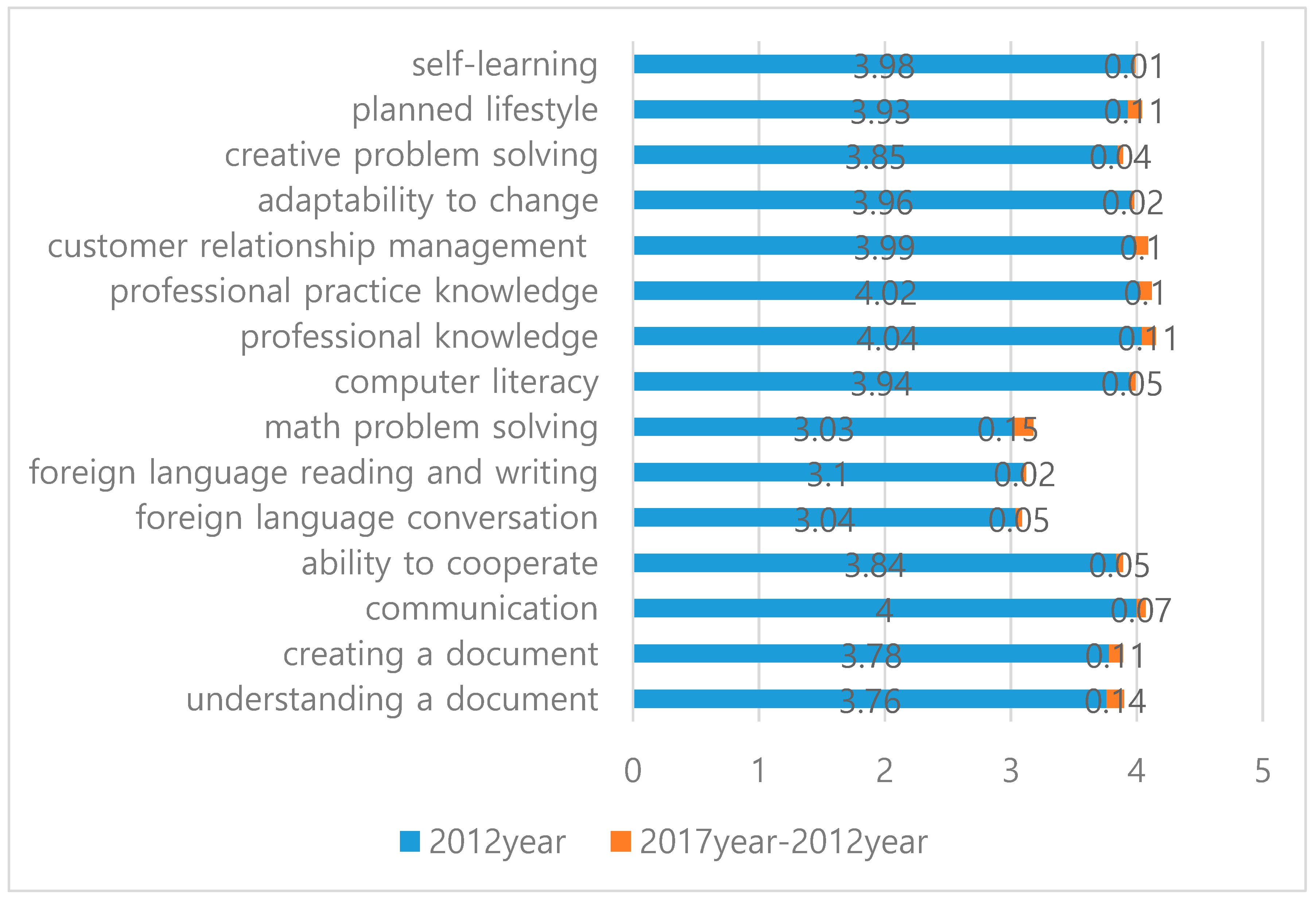
A goal of the study was to identify whether the degree of importance placed on imparting essential job competencies had changed over the past five years by analyzing the perceptions of the science and engineering graduates who responded to the survey (See Table 4 and Figure 1). According to the survey administered in 2012, the items were ranked as follows: “professional knowledge”, “professional practice knowledge”, “communication”, “ability to cooperate”, and “self-learning”. In 2017, the items were ranked somewhat differently: “professional knowledge”, “professional practice knowledge”, “ability to cooperate”, “communication”, and “planned lifestyle”. In terms of the differences in the means of items related to perceptions of the importance of the competencies over the past five years, there were great differences in respondents’ rankings of the importance of practical skills, such as “math problem solving”, “understanding a document”, “professional knowledge”, “creating a document”, and “planned lifestyle”. There were some changes in perceptions of the importance of various essential job competencies over time and according to the experience level of respondents.
Table 4.
Perceptions of the importance of essential job competencies of employees.
Figure 1.
Changes in perceptions of the importance of essential job competencies among science and engineering graduates (2012–2017).
4.2. Analysis of the Educational Needs Related to Essential Job Competencies Based on the Responses of Science and Engineering Graduates
4.2.1. Paired T-Test and Borich Needs Assessment of Essential Job Competencies Based on the Responses of Science and Engineering Graduates
“Educational need” refers to the gap that must be addressed to ease the disparities between workers’ current and expected levels of competence during the performance of job-related duties. It is necessary to identify the current status of essential job competencies and their order of priority to examine the disparities in competencies. Generally, paired t-tests, Borich needs assessments, and the locus for focus models are used to analyze data related to such educational needs.
A paired t-test and a Borich needs assessment were conducted to analyze the educational needs related to the essential job competencies of the respondents. The results of the paired t-test reveal that there is a statistically significant difference on all items; “communication”, “ability to cooperate”, “professional practice knowledge”, “customer relationship management”, and “professional knowledge” were the areas where the greatest differences could be found between the importance of the competencies and the contribution made by educational institutions to developing them (See Table 5). The Borich needs assessment yielded the same results.
Table 5.
Paired t-test and Borich needs assessment of the essential job competencies needed by employees.
4.2.2. Locus for Focus Analysis of the Essential Job Competencies of Science and Engineering Graduates
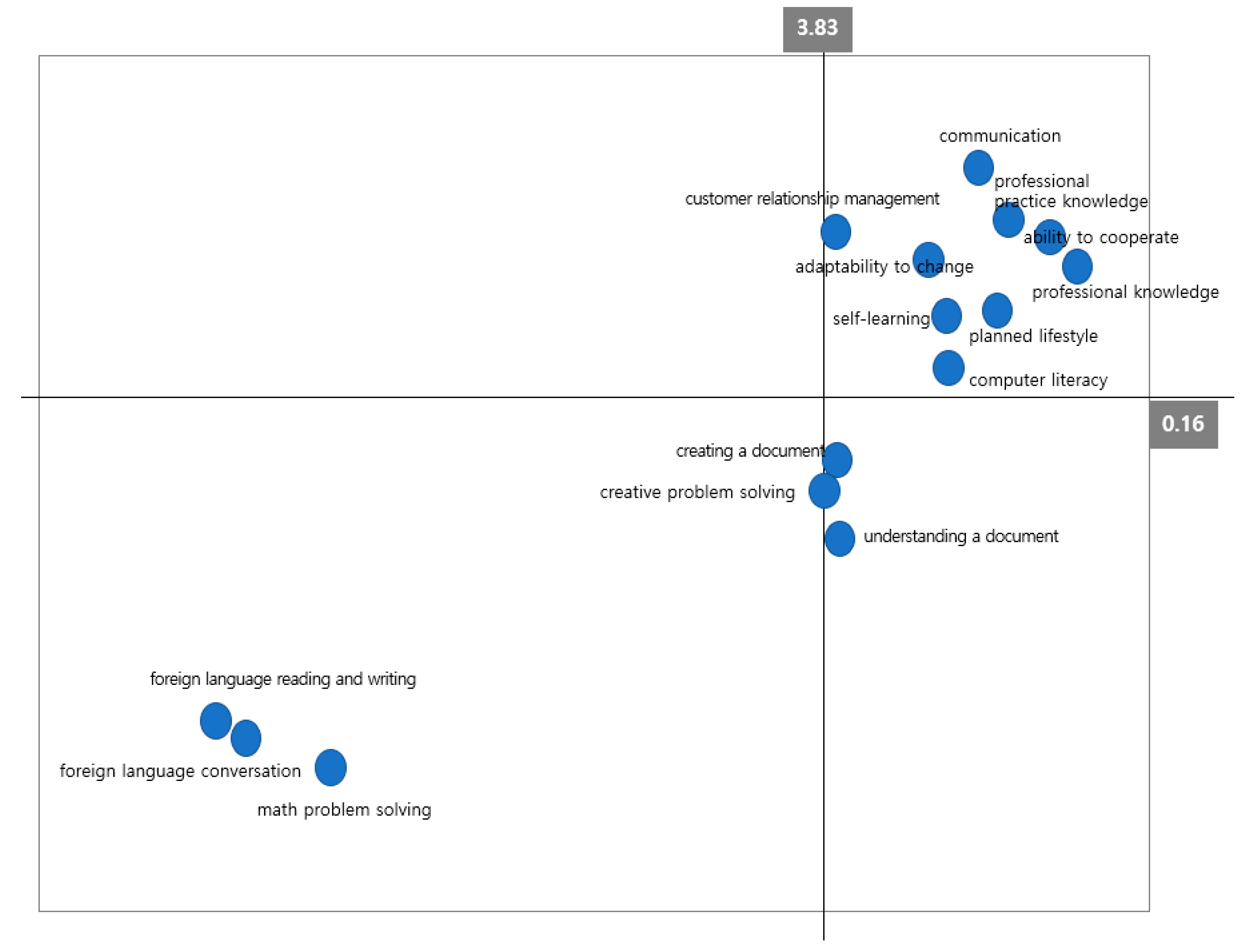
Figure 2 below shows the rankings of the 15 essential job competencies items according to the locus for focus model. The first quadrant of the model shows the items with the highest rankings. “Communication”, “customer relationship management”, “ability to cooperate”, “professional knowledge”, “professional practice knowledge”, “adaptability to change”, “self-learning”, “planned lifestyle”, and ”computer literacy” were ranked as highly important. The results were identical to those of the Borich needs assessment. The competencies located in the fourth quadrant were ranked as highly important, with little difference between the perceived importance of the competency and the contribution to its development by respondents’ final schools. Therefore, in terms of educational needs, the items in this quadrant were less pressing than the competencies in the first quadrant. In other words, although “creating a document”, “creative problem solving”, and “understanding a document” were important competencies for employees to possess, they are developed to some extent through formal education. The competencies located in the third quadrant, such as “foreign language reading and writing”, “foreign language conversation”, and “math problem solving”, were sufficiently developed through formal education in terms of the levels of competency required in the workplace.
Figure 2.
Analysis of the locus for focus model in relation to the essential job competencies of employees.
4.3. Analysis of Differences in Perceptions of the Educational Needs Related to Essential Job Competencies by Department
4.3.1. Analysis of the Educational Needs Related to Basic Essential Job Competencies Among Science Graduates.
To identify the differences in perceptions of the educational needs related to essential job competencies between science and engineering graduates, an analysis of the differences between the fields was conducted first (See Table 6). After analyzing the data of science graduates, the paired t-test showed on 12 items statistically significant differences between the perceived importance of competencies and the contributions that the respondents’ final schools had made to developing them, except for “foreign language reading and writing”, “math problem solving”, and ”computer literacy”. The results of the Borich needs assessment showed that there were differences between the perceived importance of the following competencies and the contributions made by respondents’ final schools to developing them: “professional knowledge”, “communication”, “professional practice knowledge”, “customer relationship management”, and “planned lifestyle”.
Table 6.
Paired t-test and Borich needs assessment of the perceptions of science graduates regarding essential job competencies.
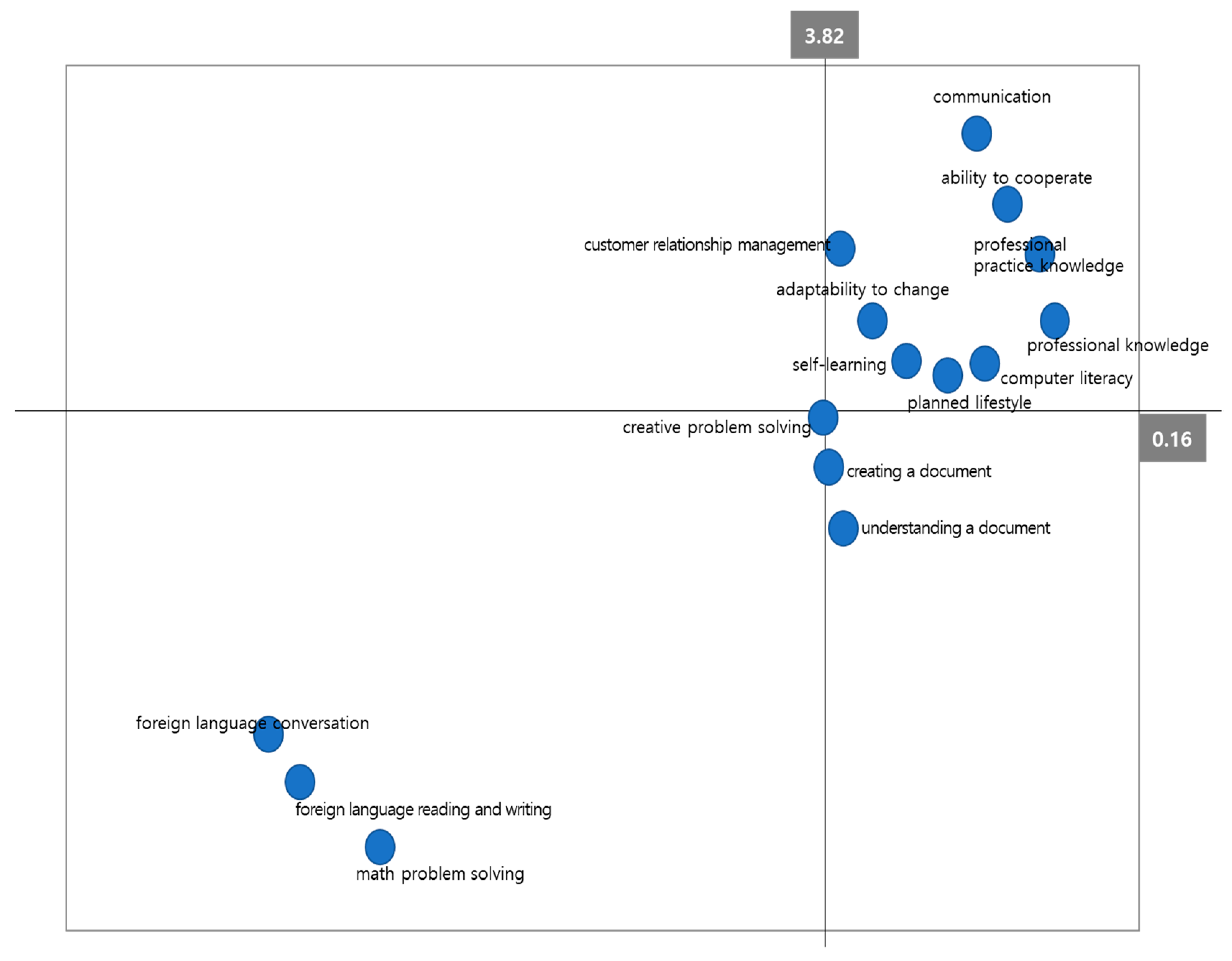
As a result of the locus for focus model to analyze the data of the science graduates, the competencies located in the first quadrant included “professional knowledge”, “communication”, “customer relationship management”, “professional practice knowledge”, “planned lifestyle”, “ability to cooperate”, “self-learning”, and “understanding a document” (See Figure 3). These results were identical to those of the Borich needs assessment. The competencies located in the fourth quadrant were ranked as highly important, with little difference between their perceived importance and the contributions made by respondents’ final schools to developing them. Therefore, in terms of educational needs, they are less pressing than the competencies in the first quadrant. In other words, although “creating a document”, “creative problem solving”, and “understanding a document” are considered important to performing well in the workplace, they are generally developed to some extent through formal education. The competencies located in the third quadrant, including “foreign language reading and writing”, “foreign language conversation”, and “math problem solving”, are sufficiently developed through formal education in terms of the levels of competency required in the workplace.
Figure 3.
Analysis using the locus for focus model to interpret the responses of science graduates regarding essential job competencies.
4.3.2. Analysis of the Educational Needs Related to Essential Job Competencies Among Engineering Graduates
When analyzing the responses of engineering graduates regarding educational needs related to essential job competencies, the paired t-test showed statistically significant differences between the perceived importance of 12 competencies and the contributions made by respondents’ final schools to developing them (See Table 7). The exceptions were “foreign language reading and writing”, “math problem solving”, and ”computer literacy”; the responses were identical to those of science graduates. The results of the Borich needs assessment showed that there were differences between the perceived importance of the following skills and the contributions of the respondents’ final schools to developing them: “communication”, “ability to cooperate”, “professional practice knowledge”, “customer relationship management”, and “professional knowledge”.
Table 7.
Paired t-test and Borich needs assessment of the responses of engineering graduates to items regarding essential job competencies.
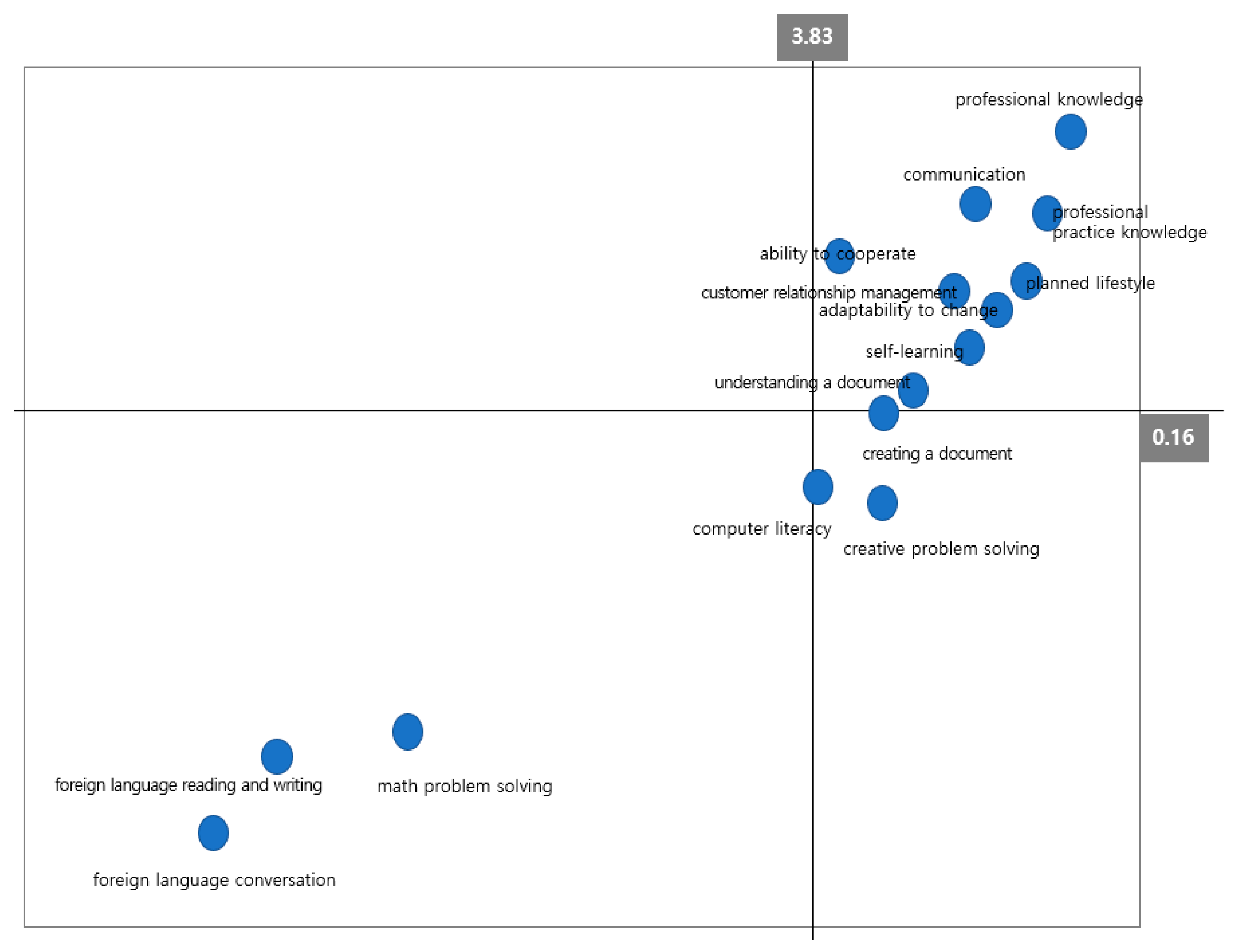
As the result of the locus for focus model to analyze the responses of the engineering graduates, the competencies located in the first quadrant included “professional knowledge”, “communication”, “customer relationship management”, “professional practice knowledge”, “planned lifestyle”, “ability to cooperate”, “self-learning”, and “understanding a document” (See Figure 4). These results were identical to those of the Borich needs assessment. The competencies located in the fourth quadrant were ranked as highly important, with little difference between the perceived importance of the skills and the contribution of the respondents’ final schools to developing them. Therefore, in terms of educational needs, they are less pressing than the competencies in the first quadrant. In other words, although the “creating a document”, “creative problem solving”, and “understanding a document” are important competencies to possess in the workplace, they are developed to some extent through formal education. The competencies located in the third quadrant, which include “foreign language reading and writing”, “foreign language conversation”, and “math problem solving”, are sufficiently developed through formal education in terms of the levels of competency required in the workplace.
Figure 4.
Locus for focus analysis of the responses of engineering graduates regarding essential job competencies.
5. Conclusions and Discussion
Since the introduction of the concept of the fourth industrial revolution at the 2016 World Economic Forum, there have been significant changes in both technology and industrial environments across the globe. In particular, the rise of the Internet of Things (IoT), artificial intelligence, big data, smart factories, and 5G, along with changes in the workplace and labor market, are bound to lead to significant changes in education as well. The rise of automation and the resulting decrease in the number of jobs, as well as the introduction of new types of jobs and occupations, has made the structure of the workplace and the requirements of job performance more complex and diverse. Along with such changes in the labor market, the development of core competencies allowing students to adapt and react quickly to a rapidly changing employment landscape is becoming a top priority in higher education.
Along with the trends in labor market changes over time, there has been a steady increase in interest in science and engineering education in Korea, which is the core of the fourth industrial revolution. Korea is a country that has received attention for the quality of its science and engineering education, as it has achieved excellent scores on the Programme for International Student Assessment (PISA) and Trends in International Mathematics and Science Study (TIMSS), which assess the global achievement levels of students in mathematics and the sciences [32]. The Korean government also considers science and engineering education the foundation of the state, and it has actively expressed interest in improving education in these fields. Therefore, it is undoubtedly important to investigate the outcomes of education in these areas in relation to the essential competencies that are needed in the workplaces that science and engineering graduates encounter and to identify the importance of various skills and the educational needs related to them.
In this context, the aim of this study was to identify the educational needs related to essential job competencies based on perceptions of their importance among science and engineering graduates, as well as to assess the contributions of institutions of higher education to developing them and to suggest possible changes these institutions can make to address such gaps in skills. To this end, the educational needs related to essential job competencies, as perceived by science and engineering graduates, were analyzed by applying the locus for focus model and the Borich needs assessment to the 15 items regarding essential job competencies (job performance) on the 11th survey of the Youth Panel.
The results can be summarized as follows. First, awareness of the importance of practical and field-related competencies among science and engineering graduates increased with experience. Second, it could be seen that competencies related to working with others as well as professional competencies were considered important by science and engineering graduates. This means that, unlike in the past, there is an increasingly large emphasis being placed on the importance of communication among employees in the fields of science and engineering, and that the ability to communicate effectively is also increasingly viewed as related to job performance. Third, it could be seen that the science graduates prioritized professional competencies more, but the engineering graduates placed relatively greater importance on the competencies that pertained to interacting with others. Unlike in the sciences, a field that produces many graduates who become researchers and that places importance on field-specific knowledge, the engineering graduates had relatively greater experience cooperating to perform tasks with people from various related fields. The results showed that, due to the conditions in which the engineering graduates worked, they tended to place greater importance on the competencies related to the changes taking place in the labor market.
The implications of the results are as follows. First, in accordance with prior studies on the essential job competencies of employees, there has been an overall and continuously increasing emphasis placed on the educational needs regarding communication and interpersonal skills. This may suggest that, despite cooperative abilities becoming more important in the workplace than individual competencies required to work alone, there is a lack of diverse efforts by institutions of higher education to reinforce cooperative abilities. Recently, there has been a global emphasis placed on the need for cooperative talents along with an emphasis on developing creative convergence talents [33]. In this respect, various educational curricula meant to nurture cooperative talents in the fields of science and engineering should be implemented. Such changes will also have important implications for how the concept of “talent” among science and engineering students is defined, in contrast to the past definition of talent, which was based solely on major-specific skills and knowledge [34].
Second, although universities have begun to emphasize the importance of developing competencies, such as creative problem-solving and self-learning skills, in accordance with the social changes that are currently taking place, the respondents did not highly rank them among the survey items. Although these two types of competencies do not seem directly relevant to the corporate world in Korea, they must be considered when learning about starting a business in relation to start-up companies. It has been predicted that the labor market and the types of workplaces that workers encounter will change drastically along with the social landscape, and it has been predicted that half of the world’s workforce will be composed of freelancers in the relatively near future [35]. Therefore, although the two competencies mentioned above may not seem important in the current labor market, they will undoubtedly become important to workers in the future. Therefore, to foster creative problem-solving and self-learning skills, it is necessary to conduct regular assessments of attitudes related to these competencies.
Lastly, professional knowledge is still extremely important in the science and engineering fields. Therefore, institutions of higher education should allow science and engineering students to obtain professional skills in their areas of study based on the technologies and educational standards specific to their majors. Such perspectives on postsecondary majors will contribute to the development of competencies among students and will help them select future jobs and contribute meaningfully to the labor market in the future. Therefore, to incorporate rapid changes in various industries and technologies into higher education, the institutions responsible for educating students should seek feedback on their curricula to enable them to formulate agile reactions to changes in the labor market.
The analysis of the locus for focus model shows that competencies located in the first quadrant, which, out of the four quadrants, indicated high importance and contribution, included communication, cooperation with others, adaptability to change, and self-learning skills. These competencies are considered to be necessary as we move toward a future society. The results mean that, in addition to gaining specialized knowledge, developing abilities to perform tasks by using knowledge from universities is required. Therefore, universities are expected to provide students with a curriculum focusing on team activities in preparation for the future society. In addition, college students need to experience a capstone design to solve real problems by utilizing their knowledge, as well as short-term and long-term internships at companies related to their major. The design thinking process has recently been used to develop creative ideas, and the process should also be actively used within the curriculum. In addition, it is necessary to encourage students to demonstrate initiative and creative thinking by helping them develop an entrepreneurial spirit, as explained by KEEN [36]. By doing so, competencies of high importance will be improved across the university curriculum.
Due to the limited participants and variables of panel surveys conducted in Korea, the study had its limitations in conducting preliminary studies and analyses focusing on Korea. However, the advent of the fourth industrial revolution affects not only Korea but also the rest of the world. This means that the competencies and talents required by society will change around the world. Against that backdrop, a lot of countries are making efforts to come up with measures for basic job skills that can flexibly deal with changes in jobs [37]. In particular, the Organisation for Economic Co-operation and Development (OECD) defines basic skills such as literacy, numeracy, and problem-solving skills as core competencies and has been implementing the Programme for the International Assessment of Adult Competencies (PIAAC) since 2012 [38]. However, the PIAAC does not reflect the various basic competencies of the changing society, as it focuses on literacy, numeracy, and problem-solving skills. Therefore, it is expected that the variables of the data from the study will be expanded and moderated for systematic comparison and follow-up studies among different countries, so that basic data of fundamental occupational skills will be accumulated and developed.
Author Contributions
Conceptualization, J.L.; methodology, J.L.; project administration, J.Y.; visualization, J.L.; writing – original draft, J.Y. and M.K.; writing – review and editing, M.K. All authors have read and agreed to the published version of the manuscript.
Funding
This research received no external funding.
Conflicts of Interest
The authors declare no conflict of interest.
References
- Chosun Edu. Available online: http://edu.chosun.com/site/data/html_dir/2018/04/12/2018041201316.html (accessed on 2 January 2020).
- Joo, I.J.; Cho, J.Y.; Lim, G.B. Current Issues and Policy Strategies of NSC Projects. Hrd. Rev. 2010, 13, 19–39. [Google Scholar]
- Na, S.I.; Cho, J.Y.; Uh, S.B.; Jang, H.J.; Sung, H.J. The Strategies for the New Installation of a National Certificate on the Basic Competencies. Agric. Educ. Hum. Resour. Dev. 2012, 44, 131–160. [Google Scholar]
- Ju, I.J.; Jin, M.S.; Park, D.Y. The Study of Core Competency’s Domains and Levels; Korea Research Institute for Vocational Education & Training: Seoul, Korea, 2010. [Google Scholar]
- Song, B.G. How to improve the job essential competencies in school education. Soonchunhyang J. Humanit. 2000, 9, 45–72. [Google Scholar]
- Yoon, D.W. A Study on the Effects of Key Competencies on Skill: A Focus on College Graduate Newcomers in Large Corporation; Doctorate-KOREATECH: Cheonan, Korea, 2018. [Google Scholar]
- Seo, B.K.; Moon, J.S. Review of Korean NCS Research Trends and Suggestions for Future Research Directions. J. Vocat. Educ. Train. 2018, 21, 1–29. [Google Scholar]
- Human Resources Development Service of Korea. Manual of NCS Development; HRDK: Seoul, Korea, 2016; pp. 1–128. [Google Scholar]
- Human Resources Development Service of Korea. Manual of NCS Corporate Application Consulting; HRDK: Seoul, Korea, 2017; pp. 1–148. [Google Scholar]
- Lee, G.N.; Jyong, C.Y. Analysis on the Key Competencies of Students and Related Program Recognized by Teachers in Vocational High School. Agric. Educ. Hum. Resour. Dev. 2003, 35, 47–68. [Google Scholar]
- Woo, S.H.; Lim, H.K.; Kim, J.S. Key Competencies Level of Students Recognized by Specialized Subjects Teachers in Industrial High School. J. Vocat. Educ. Res. 2005, 24, 69–98. [Google Scholar]
- An, G.S. A Study on Level and Significance of Key Competencies perceived by Technical High school Teacher. J. Korean Pract. Arts Educ. 2007, 13, 73–94. [Google Scholar]
- An, G.S.; Choi, W.S.; Lee, Y.M. A Study on degree of the Educational need for the Key Competencies of Technical high school students perceived by Teacher. Korean J. Technol. Educ. 2007, 7, 31–47. [Google Scholar]
- Bae, G.M.; Yoon, G.S. Training needs analysis for the development of basic job skill curriculum in specialized high school. Korean Inst. Ind. Educ. 2015, 40, 44–71. [Google Scholar]
- An, G.S.; Kim, M.K.; Choi, W.S. A study on the key competencies of college students, Journal of Korean Institute of Industrial Educators. Korean J. Inst. Ind. Educ. 2005, 30, 96–105. [Google Scholar]
- Hong, A.J.; Cho, Y.S.; Park, C.G. Exploration of college students’ characteristics on NCS basic vocational competencies. Study Educ. 2015, 53, 389–417. [Google Scholar]
- Lee, W.J.; Han, J.Y. An Importance Analysis of Basic Vocational Competencies for Developing and Implementing Secretarial Training Programs based on NCS. Women’s Stud. 2015, 89, 119–154. [Google Scholar]
- Lee, J.W.; Kim, J.M. Importance-Performance Analysis on University Students’ Recognition of NCS Vocational Competency. J. Vocat. Educ. Res. 2016, 35, 75–96. [Google Scholar]
- Lee, C.; Jung, D.Y.; Jung, B.Y.; Kwak, M.S. Development a Model for Basic Competencies of Secondary Level Vocational Education. J. Vocat. Educ. Res. 2015, 34, 125–148. [Google Scholar]
- Park, D.Y.; Hwang, Y.A. Development of the Test Based on BARS to Measure Core Competency Level for Vocational High School Students. Korean Soc. Agric. Educ. Hum. Resour. Dev. 2009, 41, 29–48. [Google Scholar]
- Cho, H.Y. The Relationships between Vocational Key Competencies and Sub-Competencies of College Students—A Case of K College. Korean J. Gen. Educ. 2017, 11, 333–362. [Google Scholar]
- Baik, J.M.; Park, Y.K. An Exploring Study on the Possibility of Utilizing the NCS (National Competency Standard) for University Education. J. Employ. Career 2012, 2, 1–19. [Google Scholar]
- Chosun Edu. Available online: http://edu.chosun.com/site/data/html_dir/2018/04/26/2018042601182.html (accessed on 2 January 2020).
- Ennis, M.R.; Employment and Training Administration; United States, and Office of Policy Development and Research. Competency Models: A Review of the Literature and the Role of the Employment and Training Administration (ETA); Office of Policy Development and Research, Employment and Training Administration, U.S. Dept. of Labor: Washington, DC, USA, 2008; pp. 1–24.
- McClelland, D.C. Testing for competence rather than for “intelligence”. Am. Psychol 1973, 28, 1–14. [Google Scholar] [CrossRef]
- Boyatzis, R.E. Competence and Job Performance. In The Competent Manager: A Model for Effective Performance; Wiley: New York, NY, USA, 1982; pp. 10–39. [Google Scholar]
- Lim, E.; Choi, D.S.; Choi, J.H.; Oh, E.J. Survey on Adults’ Key Competences: OECD ALL Survey; Korea Research Institute for Vocational Education & Training: Seoul, Korea, 2004; pp. 1–283. [Google Scholar]
- Park, J.H.; Lee, J.P.; Park, Y.H. Analysis of Educational Needs of Industry on Essential Job Competency of Graduates from Korea Polytechnics. J. Vocat. Educ. Res. 2013, 32, 83–105. [Google Scholar]
- Kim, M.H.; Lee, J.G. A Structural Relationship among Self-Perceived Occupational Basic Competencies, Career Decision Level, Job Searching Efficacy, and Career Preparation Behavior of Junior College Students. J. Vocat. Educ. Res. 2018, 30, 111–127. [Google Scholar]
- Kim, S.H. A Study on the Needs Assessment of key Competencies from Industries of College Graduates. In Proceedings of the 2014 Fall Conference, Daejeon, Korea, 28 November 2014; Korea Academia-Industrial Cooperation Society: Cheonan, Korea, 2014. [Google Scholar]
- Hwang, Y.H.; Park, S.J. Educational needs analysis for key vocational competency in nursing students. J. Korea Acad. -Ind. Coop. Soc. 2016, 17, 595–603. [Google Scholar]
- OECD. PISA 2012 Assessment and Analytic Framework; OECD: Paris, France, 2013; pp. 1–265. [Google Scholar]
- OECD. DeSeCo. Excutive Summary; OECD: Paris, France, 2005; pp. 1–20. [Google Scholar]
- National Academy of Engineering. The engineer of 2020: Visions of Engineering in the New Century; National Academies Press: Washington, DC, USA, 2004; pp. 1–101. [Google Scholar]
- Kessler, S. GIGGED: The End of the Job and the Future of Work; St. Martin’s Press: New York, UK, USA, 2018; pp. 1–304. [Google Scholar]
- KEEN’zine. ISSUE 4. Available online: https://engineeringunleashed.com/resources/keenzine.aspx (accessed on 7 March 2020).
- Frey, C.B.; Osborne, M.A. The future of employment: How susceptible are jobs to computerisation? Technol. Forecast. Soc. Chang. 2017, 114, 254–280. [Google Scholar] [CrossRef]
- OECD. Technical Report of the Survey of Adult Skills (PIAAC); OECD: Paris, France, 2013; pp. 1–1033. [Google Scholar]
© 2020 by the authors. Licensee MDPI, Basel, Switzerland. This article is an open access article distributed under the terms and conditions of the Creative Commons Attribution (CC BY) license (http://creativecommons.org/licenses/by/4.0/).