


Abstract
This was a systematic review on the inclusive education of students with visual impairment. This study focused on two of the most addressed topics: the perceptions of general education teachers and challenges faced by students with visual impairment in accessing academic subjects. It synthesized the findings of 18 peer-reviewed articles published in English from 1980 to 2020. General education teachers’ attitudes toward the inclusion of students with visual impairment were both positive and negative and were influenced by teacher-, student-, and environment-related factors. Feeling unprepared, one of the main teacher-related factors, seemed to have a great effect. In terms of access to academic subjects, the most discussed subjects were Mathematics, Science, and Physical Education. Although students with visual impairment seemed to be studying at or above their grade level, their exclusion from participation in classroom activities was apparent. Unfortunately, these challenges lead to short- and long-term consequences. Key elements in increasing accessibility to subjects were: general education teachers possessing a generic set of effective pedagogical strategies, effective teaching-learning tools, and external support. The importance of teacher training and a holistic support system were emphasized.
1. Introduction
The number of students with visual impairment who are educated in general education classrooms continues to rise worldwide. With the increase in the number of students in general education classrooms, discussions in research on education and special education have also increased. For instance, based on the narrative meta-analysis conducted by Miyauchi and Paul [1], the number of articles involving “inclusion” and “visual impairment” published from 1980 to 2018 was 472, including ones written in English in peer-reviewed journals alone.
As stated in the United Nations Convention on the Rights of Persons with Disabilities, inclusive education is every student’s right, not a privilege [2]. The benefits of inclusion for students with and without disabilities, such as greater access to the general curriculum and increased social interactions and friendships, are widely acknowledged [3]. However, there is ample research revealing how physically placing students with and without disabilities together in a classroom does not lead to quality inclusive education. For example, Jessup et al. [4] found that, although many students with visual impairment had positive experiences, one-third felt lonely or isolated and dissatisfied with their social relationships. Unfortunately, some students were teased or bullied because of their disabilities [5,6]. Challenges exist both socially and academically. Physical Education is one of the academic subjects where students with visual impairment experience isolation and exclusion [7,8].
Visual impairment is commonly known as a “low-incidence” and “high-needs” disability, and, therefore, triggers unique challenges pertaining to inclusion [9,10]. “Low incidence” implies a disability that occurs rarely or in low numbers. The specific definition can vary country to country; however, in the United States, according to the Individuals with Disabilities Education Act (IDEA) of 2004, visual impairment is a severely disabling condition with an expected incidence rate that is less than 1% of the total statewide enrollment. “High needs” is a condition wherein a teacher with specialized skills for that specific disability is required to regularly support the student in accessing the general education curriculum [11,12]. For instance, students with severe visual impairment will need to learn braille, Orientation and Mobility, as well as to use assistive technologies that involve support from qualified teachers for the visually impaired. In earlier era, when children with disabilities were predominantly educated separately from those without disabilities, it was normal for students with such a “low-incidence, high-needs” disability to be catered to in a residential school for the blind. Students were convened in a specialized environment that met their needs, with continuous support from qualified teachers for the visually impaired [13]. With inclusive education, although students are educated in their local communities, they are often placed in a learning environment that relies heavily on vision, with a limited presence of teachers qualified to support the visually impaired [14,15].
This study synthesized the findings of articles pertaining to “perceptions of general education teachers” and “challenges faced by students with visual impairment in accessing academic subjects”. These were the two most discussed topics related to inclusive education and students with visual impairment. This study built on the earlier work by Miyauchi and Paul [1] on students with visual impairment and inclusive education. They found a total of 472 articles on inclusion and visual impairment based on a systematic database search and identified 64 articles that fit the inclusion criteria after reviewing the full texts. The 64 articles were categorized into five broad research themes: “Perspective” (attitude, feeling, opinion), “Mental Health”, “Self-Esteem and Social Support”, “Content of Topic” (including academic subjects such as Mathematics, Physical Education, etc.), and “Other” (miscellaneous due to the range of diverse topics). Whereas Miyauchi and Paul [1] focused on “perceptions of students with visual impairment” within the broad research theme of “Perspective”, this study focused on the other two topics under the broad research themes of “Perspective” and “Content of Topic”.
Focusing on “perceptions of general education teachers” and “challenges faced by students with visual impairment in accessing academic subjects” is relevant in order to uncover issues that will contribute to high-quality inclusive education in the following ways.
First, despite the recognized importance of leaders and school administrators, classroom teachers are largely responsible for implementing inclusive principles and breaking down barriers to inclusion. This is especially true of high-needs and low-incidence disabilities, such as visual impairment, for the reason mentioned above. Teachers’ perceptions, especially attitude, which can be defined as an individual’s viewpoint or disposition toward a particular object, are known to facilitate or limit successful inclusion [16]. Teachers’ attitudes are associated with their willingness to provide an inclusive environment to students and young people with special needs and/or disabilities [17]. A positive teacher attitude is a prerequisite for successful inclusion. Although studies proclaim that general education teachers are more positive toward students with visual impairment than to those with other impairments [18], researchers such as Wall [19] argue differently. According to Wall [19], the attitude toward students with visual impairment depends on the level of vision, and, therefore, there are differences in the attitudes toward students with low vision and those with blindness. Hence, it is worthwhile to further discuss this topic with particular focus on visual impairment.
Second, although students with visual impairment are capable of studying all academic subjects like their peers, they are known to be excluded from participating in all subject-related activities, particularly in Mathematics, Science, and Physical Education classes [4,6,20,21]. The situation is more worrisome at the upper secondary level, as the focus of education shifts to more academic content. De Verdier and Ek [22] revealed that the level of accessibility of the course depends heavily on the subject teacher’s knowledge and willingness, causing students with visual impairment to choose courses based not on their ability and interest, but on accessibility. This implies that they are losing out on opportunities to study higher-level subjects, which may be hindering young individuals with visual impairment from pursuing a particular major in college as well as potentially working in that field. There are a substantial number of studies indicating that students with visual impairment learning in inclusive settings are not receiving an adequate amount of instruction in the area of the Expanded Core Curriculum (ECC). ECC, which is also known as a disability-specific curriculum for students with visual impairment, includes skills in social interactions and independent living, and is known to have a strong link to positive post-school outcomes [23,24]. Equal attention should be given to academic subjects in higher-level academics.
To identify and synthesize the existing literature on the “perceptions of general education teachers” and “challenges faced by students with visual impairment in accessing academic subjects”, the following four research questions were developed:
- What are the perceptions of general education teachers toward the inclusion of students with visual impairment?
- What factors impact attitudes of general education teachers toward inclusion?
- What are the challenges in accessing academic subjects for students with visual impairment in inclusive settings?
- What elements increase accessibility to academic subjects?
After providing a synthesis based on the research questions, salient suggestions for improving current inclusive education with respect to the attitudes of teachers and accessing academic subjects for students with visual impairment were discussed.
2. Methods
This systematic review involved six steps (Figure 1). Steps 1 through 4 were conducted in 2018 as part of another study published by Miyauchi and Paul [1]. The following is a summary of Steps 1–4, followed by Steps 5 and 6, which were newly added to this study. Steps 1–4 were conducted individually by two researchers, and Steps 5 and 6 were conducted by one researcher.
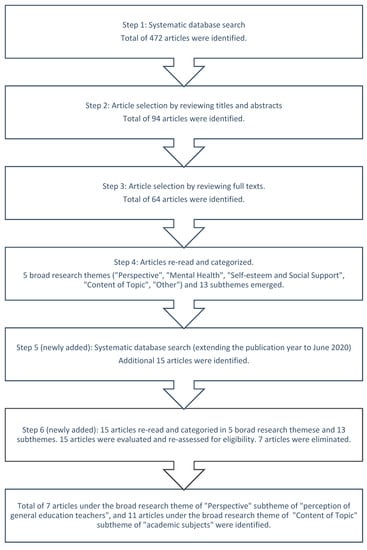
Figure 1.
Process for the selection of articles.
2.1. Steps 1 through 4
A systematic database search was conducted using the following major electronic search engines pertaining to special education: Education Full Text (Wilson), ERIC, EBSCOhost, ProQuest, and PsycInfo. The specific descriptor words and phrases used were: (“visually impaired” or “visual impairment” or “low vision” or blind) AND (“inclusive education” or inclusion or mainstreaming or integration), AND (“academic achievement” or “academic performance” or “academic success”) AND (“social skills” or “social interaction” or “social behavior” or “social competence”). Articles were first selected by reviewing titles and abstracts (Step 2) and then reviewing full texts (Step 3), which was done separately by two researchers. Disagreements were resolved by discussions at each stage. The inclusion criteria were as follows:
- The articles must have been published in English in a peer-reviewed journal between 1980 and September 2018.
- The articles must be related to students in a compulsory education program (that is, first grade to twelfth grade) with visual impairment (blind or low vision) and learning in general education classrooms/inclusive settings.
- The articles must be related only to students with visual impairment, with no other disabilities.
The last criterion was set because the challenges faced by such students in inclusive education differ depending on the type of disability and age [22,25].
Step 3 yielded 64 articles, which were re-read and categorized independently by two researchers using thematic qualitative analysis (Step 4). Any disagreements were discussed and resolved. As a result, a total of five broad research themes and 13 sub-themes emerged. The five broad research themes were “Perspective”, “Mental Health”, “Self-Esteem and Social Support”, “Content of Topic”, and “Other”.
2.2. Steps 5 and 6
For Step 5, a systematic database search was conducted using the same database and the keywords described in Step 1, extending the publication year to June 2020. This step was intended to cover published articles as much as possible after the extensive systematic review done by Miyauchi and Paul [1]. After applying the inclusion criteria, 15 additional articles were identified.
The 15 articles that were identified were re-read and further categorized into five broad search themes and 13 sub-themes, described in Step 4. Of the 15 articles, three were categorized under “Perspective”, one under “Self-Esteem and Social Support”, nine under “Content of Topic”, and two under “Other” (Step 6). These articles were combined with the 64 identified in the former search described in Step 4. Because of the broad themes and ample number of articles, this study focused on two of the most discussed topics: “Perspective”, mainly involving the subtheme “perception of general education teachers”, and “Content of Topic”, mainly involving the subtheme “academic subjects”. By focusing on these, a total of nine articles under “Perspective” and 16 under “Content of Topic” were reviewed. A narrative summary of each article was developed and, after reassessing for eligibility, two articles under “Perspective/perception of general education teachers” and five under “Content of Topic/academic subjects” were eliminated because of inconsistencies in the stated results and/or inadequately described methodology.
3. Results
The steps described above yielded seven articles related to “Perspective/perception of general education teachers” and 11 related to “Content of Topic/academic subjects”. Table 1 and Table 2 present summaries of the research articles. The results are reported for each research question below.

Table 1.
Summary of the seven reviewed articles under “Perspective/perception of general education teachers”.
Table 2.
Summary of the 11 reviewed articles under “Content of Topic/academic subjects”.
3.1. General Education Teachers’ Perception toward the Inclusion of Students with Visual Impairment
Of the seven reviewed articles that focused on the perception of general education teachers, six [19,26,27,28,29,30] pertained to the attitude of teachers toward the inclusive education of students with visual impairment and one [31] to teachers’ perceptions about the academic engagement of students with visual impairment in an inclusive setting.
Bardin and Lewis [31] conducted a quantitative study investigating the academic engagement of students with visual impairment based on the perception of 77 general education teachers who had a student with visual impairment for academic instruction. To measure the engagement level of students, a modified version of the Student Participation Questionnaire (SPQ) was used. Although previous studies have proven that the academic engagement levels of students as perceived by teachers and the actual student performance levels are correlated, this study in particular clarified that teachers’ evaluations of the engagement levels of students with visual impairment tended to be lower than the students’ actual performance levels. Although this result is open to multiple explanations, it implies the possibility of general education teachers perceiving the academic engagement of students with visual impairment more negatively compared to students who are sighted.
Regarding the articles on teachers’ attitudes toward inclusion, Hess [26] clarified whether school climate, staff attitudes toward inclusion, and the quality of life (QoL) of students with visual impairment are correlated based on the hypothesis. This research delineated that a positive attitude toward inclusion is significantly correlated to positive emotions and social status in students with visual impairment in inclusive settings, indicating that positive attitudes among general education teachers would be the bedrock of successful inclusive education.
However, the findings from the five studies [19,27,28,29,30] illustrated a mixture of positive and negative attitudes among teachers. For example, a qualitative study by Ravenscroft et al. [27] examined the attitudes of 253 elementary school teachers in Turkey using questionnaires, revealing a positive attitude toward inclusion. However, Mushoriwa [29] examined the attitudes of primary school teachers in Zimbabwe using a questionnaire, revealing a negative attitude among most teachers. Pliner [30] conducted qualitative research using a survey of 83 U.S. primary general education teachers, which also revealed negative attitudes toward inclusion, although there were some exceptions.
3.2. Factors That Impact Attitudes of General Education Teachers
Of the six articles that discussed the attitudes of teachers, five [19,27,28,29,30] described the factors. There were three major themes within the factors: teacher-related, student-related, and environment-related.
3.2.1. Teacher-Related Factors
Mushoriwa [29], who revealed that the majority of Zimbabwean primary school teachers had a negative attitude toward the inclusion of blind children, indicated several reasons for this. Among them, one was the teachers not understanding the academic or social benefits of inclusion for students with visual impairment. Another was the teachers having a strong sense of reluctance in having students with visual impairment in class because they felt unprepared. Ravenscroft et al. [27], who clarified that Turkish teachers held a positive attitude toward the inclusion of children with visual impairment, identified that teachers’ age, teaching experience, and gender had no influence on their attitude toward inclusion. One factor that did contribute to a positive attitude was their initial and in-service training, as it made school teachers feel prepared to teach.
In contrast, Selickaite et al. [28] measured teachers’ perceived self-efficacy to explore their attitudes toward inclusive education. Teachers’ sense of self-efficacy is a concept developed by Bandura [32] and is interpreted as the belief in one’s capacity to attain a certain level of performance. Their investigation on Physical Education teachers delineated that the types of student disabilities influenced the teachers’ self-efficacy, and the inclusion of students with visual impairment in Physical Education lessons appeared to be a greater challenge for Physical Education teachers than the inclusion of students with intellectual or physical disabilities. However, an Adapted Physical Education course or seminar seemed to have a positive influence on Physical Education teachers’ self-efficacy toward the inclusion of students with disabilities, including visual impairment. Moreover, Physical Education teachers who had experience with students with visual impairment in their Physical Education class and/or had friends with visual impairment tended to have higher self-efficacy toward inclusion than those who did not. Similar findings were reported by Wall [19], who explored factors that affected teachers’ attitudes toward the inclusion of students with visual impairment, clarifying that teachers with direct or indirect experiences with such students see inclusion more positively than those who do not have such experiences. In essence, these results indicated that teachers feeling unprepared and lacking confidence in their ability to teach and support students with visual impairment were strongly linked to negative attitudes.
3.2.2. Student-Related Factors
In terms of student-related factors that have an impact on the attitudes of general education teachers, the students’ level of vision and academic achievements were noted. According to Wall [19], although teachers with direct or indirect experiences with students with visual impairment held a more positive attitude toward inclusion, this was only toward students with low vision. When the attitude toward the inclusion of students with blindness was compared with the attitude toward those with low vision, regardless of their experiences with these students, teachers were neutral, if not negative, toward inclusion. In terms of academic achievement, Pliner and Hannah [30] investigated general education teachers’ attitudes toward four types of children with disabilities: orthopedically impaired, visually impaired, hard of hearing, and emotionally disturbed. A Pupil Placement Scale was developed and used to clarify the attitudes of 83 teachers in six different elementary schools. They reported that regardless of the condition of the child’s disability, teachers reacted more negatively to low-achieving children and more positively toward children who were at an acceptable achievement level. In other words, the level of achievement rather than the levels or types of disabilities determined teachers’ attitude toward inclusion.
3.2.3. Environment-Related Factors
From the review of the selected articles, the last type of factor associated with teachers’ attitudes toward the inclusion of students with visual impairment was environment-related factors. Ravenscroft et al. [27] reported how rural teachers’ positivity scores toward the inclusion of children with visual impairment were higher than those of urban teachers. Wall [19] indicated that teachers’ attitudes toward the inclusion of students with visual impairment also depended on ancillary factors, such as the setting, the moods of the people involved, and the comfort level of the integration. These findings suggest that elements surrounding the teachers at the micro and macro levels also impact their attitudes.
3.3. Challenges Pertaining to Access to Academic Subjects for Students with Visual Impairment
A total of 11 reviewed articles pertained to access to academic subjects. Of them, three focused on Physical Education [8,21,33], three on Mathematics [34,35,36], two on Science [37,38], one on Music [39], and two on Braille/literacy [22,40].
According to De Verdier and Ek [22] and Koehler and Wild [37], regardless of the level and quality of support received, more than half of the students with visual impairment performed at the grade level or above. Students were learning in inclusive classrooms, receiving standards-based education.
However, alarming situations were also highlighted in these studies. Koehler and Wild [37] clarified through a survey of 51 specialist teachers for the visually impaired on how instructional practices are delivered to students with visual impairment in general Science classrooms. The study indicated that, although most of these students were physically in the same environment as their non-disabled peers, participation in Science experiments was low. Along with Science, Physical Education was another subject with a similar challenge. Haegele and Zhu [8] and Haegele [33] depicted a situation in which many students were left out and did not participate in activities. A retrospective study conducted by Haegele and Zhu [8] examined the experiences of adults with visual impairment during school-based integrated Physical Education by utilizing an interpretative phenomenological analysis approach. According to their findings, the students’ feelings toward the Physical Education class rested on the actions, beliefs, and efforts of their Physical Education teachers. In particular, the actions of the teachers in treating students with visual impairment differently from the rest of their peers by putting them to the side or excluding them from activities were understood by the students with visual impairment as a “she is blind, she can’t do it” attitude from the teacher, leaving them with debilitating feelings. Unfortunately, this also perpetuated negative peer interaction. The negative experience with Physical Education also led to apprehensions about participating in leisure sports as an adult [33].
Finally, a lack of opportunities for students with visual impairment to opt for higher-level academic courses was also exposed. For instance, Koehler and Wild [37] cited the low rate of students with visual impairment taking advanced-placement Science classes as a concern. There is a possibility that general education classrooms are not providing visually impaired students with the same opportunities as sighted students to study certain subjects at a higher level, such as Science.
3.4. The Elements That Increase Accessibility in Academic Subjects
Of the 11 reviewed articles, five [34,35,36,38,39] offered solutions to the current challenges regarding access to the academic curriculum. From the articles reviewed, general education teachers possessing a generic set of effective pedagogical strategies, effective teaching-learning tools, and external support were derived as key elements in increasing accessibility.
3.4.1. General Education Teachers Possessing a Generic Set of Effective Pedagogical Strategies
Pino and Viladot [39] clarified the need for support in inclusive Music classrooms for students with visual impairment via semi-structured interviews. Based on their findings, the importance of general education teachers possessing generic sets of effective teaching strategies to allow students with visual impairment to learn and understand were emphasized. The generic sets of strategies dictated in this study included being able to use explanatory language and verbal information to describe visual information specifically and precisely, and when presenting different activities, taking into account the sequential analytical perceptions of blind people to ensure accessibility.
3.4.2. Effective Teaching-Learning Tools
Klingenbert et al. [35] and Klingenbert et al. [36] systematically reviewed and synthesized peer-reviewed articles on Mathematics education for students with visual impairment and e-learning in Mathematics. Based on their findings, learning aids based on audio were popularly used, and interactive e-learning tools that allow auditory and tactile learning seem to be a useful resource. However, the researchers also refer to the weaknesses in scientific evidence among many of the studies reviewed, and warn that the results should be viewed with some caution. The study of Teke and Sozbilir [38], which had a single case study design, developed learning materials in Science that consisted of two-dimensional drawing and three-dimensional models, which proved effective in deepening the understanding of students with visual impairment. Abrahamson et al. [34], on the other hand, illustrated strategies and tools that facilitate inclusive learning by utilizing “enactivism”, “Ethnomethodological Conversation Analysis (EMCA)” and the concept of Universal Design Learning (UDL). This particular study focused on Mathematics and stemmed from the ideology that contents, such as spatial relationships constituting mathematical structures, can be apprehended adequately, if not superiorly, through non-visual sensory modalities, such as auditory, kinetic, tactile, and haptic modalities.
3.4.3. External Support
As in the other studies reviewed, Pino and Viladot [39] echoed the importance of adapted teaching strategies and materials, however, with an emphasis on the role of specialist centers with specialized knowledge in visual impairment play. In particular, this study focused on higher-level Music, where blind students’ reading and understanding of braille music was vital for understanding musical theory and meeting the demands of musicians. As Pino and Viladot [39] stated, the provision of support requires more than just mastery of the discipline of Music; specialized knowledge of visual impairment, including of braille music, is crucial. Therefore, although general classroom teachers should possess a generic set of effective pedagogical strategies based on the needs of students with visual impairment, it is also important to acknowledge the role of the specialist and specialist centers and to work collaboratively. In Spain, where this study was conducted, a national organization designated for persons with blindness provided multiple levels of support to general education classrooms. That is, it provided direct and indirect services to teachers and students (including training), as well as materials in braille and tactile form.
4. Discussion
4.1. Overview of Findings
As this study revealed, although students with visual impairment were physically in the same classroom with their peers, their exclusion from participation, especially in Science and Physical Education courses, was apparent. This finding supports those of previous studies. For instance, Opie, Deppeler, and Southcott [15] and West et al. [41] clarified that barriers in accessing the curriculum were experienced more in high schools than in primary schools, and were more prevalent in subjects such as Mathematics, Science, and Physical Education. Interestingly, this situation was documented by research studies in countries including the U.S., Australia, Canada, and Singapore, as well as on the African continent, indicating that it may be a universal issue [1]. Unfortunately, these challenges lead to long- and short-term consequences. For example, in Physical Education, the negative experience of being excluded led to such students’ apprehensions about participating in leisure sports as adults. The positive outcome of participating in sports as a leisure activity is known to decrease the chances of developing health-related issues, such as obesity and anxiety [42].
This study also highlighted the low rate of students with visual impairment enrolling themselves in higher-level academic courses, such as advanced-placement Science. “Twice-exceptional student” is a term that refers to students who are gifted, that is, students with high cognition and potential for high achievement, and who have a disability at the same time [43]. Whitmore and Maker [44] describe them as the most misjudged, misunderstood, and neglected student population. Although it is estimated that 5% of the total population of students with visual impairment are “gifted”, many of them are unidentified and overlooked [45]. One reason for being overlooked is that the giftedness and the disability cancel each other out, making these students appear “average” and thus unnoticeable [43]. Johnson [46] emphasizes the importance of students with visual impairment working with professionals that understand the disability and can look beyond the disability that is masking their true ability.
General education teachers’ attitudes toward the inclusion of students with visual impairment were both positive and negative, and they were influenced by teacher-, student-, and environment-related factors. These three factors align with those found in previous research that revealed teachers’ attitudes toward students with disabilities [18]. However, in terms of attitudes toward the inclusion of students with visual impairment in particular, whereas research that covers several disabilities has revealed visual impairment to be perceived positively by general education teachers [18], this paper implies the importance of further examining the details of the demographics of the students, such as the severity of the visual impairment.
Finally, as this research revealed, one of the factors contributing to negative attitudes was teachers’ feelings of unpreparedness. However, the findings of Porter and Lacey [47] imply that this should not be taken as dismay. Their research showed that teachers working in generic special schools (that is, special schools not designated for those with visual impairment) felt relatively comfortable teaching students with visual impairment regardless of their lack of knowledge of this disability. The researchers expressed alarm at the situation where teachers’ overconfidence can “mask a lack of knowledge” and weaken the incentive to undertake additional training or to seek external specialists’ support. Unfortunately, among teachers in inclusive settings, those who remain unaware of their inadequate skills and knowledge in visual impairment, “not knowing what they don’t know”, are not at all uncommon [48]. These findings demonstrate that it is crucial for teachers to be aware of the reasons behind their apprehension and have access to resources that can alleviate their fear, but it is also important for teachers to first be aware of their own shortcomings.
4.2. Salient Suggestions to Improve Current Inclusive Education
With respect to the two main topics discussed, namely perceptions of teachers and access to academic subjects, the following two salient suggestions can help improve the current situation.
4.2.1. Teacher Training
Because positive attitudes and a generic set of strategies and knowledge in educating students with visual impairment among general education teachers effectively promote inclusion, a teacher training program incorporating these elements would be helpful. The ideal training content would encompass theoretical and knowledge-based content on inclusion and visual impairment along with authentic face-to-face interactions and practical teaching experiences with students with visual impairment. This builds on studies that present teachers with a solid understanding of the value of inclusion as the basis of good practice [49] and wherein teachers with previous experiences with students with disabilities see inclusion more positively [18]. This is especially important because visual impairment is a low-incidence disability, so the chances that these teachers have encountered visually impaired persons would be low.
4.2.2. Holistic Support System with External Specialist Support
Effective teacher training will allow general education teachers to develop different strategies that promote access for students with visual impairment; however, there should be a holistic support system for teachers. Specifically, there should be internal and external support, with internal support incorporating head teachers, teachers, and paraprofessionals. For external support, specialist centers, such as those depicted by Pino and Viladot [39], would be ideal: that is, centers that can provide support at various levels, from the adaptation of learning/teaching materials, to teacher training, consultancy services and direct support for students. Specialist centers that have a strong understanding of subjects that are prone to excluding students with visual impairment (i.e., Physical Education, higher level Music, Mathematics, and Science) are advised. Adequate internal and external support is crucial in accomplishing quality, inclusive education for students with disabilities, and in improving general education teachers’ attitudes toward inclusion [17].
5. Conclusions
This study synthesized the findings of 18 articles that were published in English peer-reviewed journals from 1980 to 2020 on the “perceptions of general education teachers” and the “challenges faced by students with visual impairment in accessing academic subjects”. With respect to the two main topics discussed, namely perceptions of teachers and access to academic subjects, the importance of teacher training and a holistic support system were emphasized to help improve the current situation.
As implications for future research, studies that allow a better understanding of underlying factors that influence general education teachers’ attitudes toward the inclusion of students with visual impairment are needed. Such research should be designed to provide information on students with visual impairment (with detailed demographics), teachers, and the environment in which teachers are placed. Future research that also examines the relationship between these factors to inform potential teacher training programs will be of value.
Finally, studies aimed at clarifying the mechanism of exclusion in certain subjects, such as Mathematics, Science, and Physical Education, are also needed, as these studies will allow the further development of effective teacher training and holistic support systems.
6. Limitations
The limitations of this study should be acknowledged. Although the study included articles that were published in peer-reviewed journals and eliminated ones that had inadequately described their methods or results, an evaluation of the quality of these studies was not conducted. Evaluation based on the quality indicators developed by the Council for Exceptional Children’s Division for Research or using assessment tools such as the Quality Assessment Tool for Studies with Diverse Designs [50] is recommended for future investigation. It is possible that a few relevant studies were unintentionally neglected or that the findings are open to varying interpretations. The interpretations should be evaluated by other independent scholars.
Funding
This research was partly funded by Japan Society for the Promotion of Science (JSPS) KAKENHI Grant Number 18K13209.
Conflicts of Interest
The author declares no conflict of interest.
References
- Miyauchi, H.; Peter, P. Perceptions of students with visual impairment on inclusive dducation: A narrative meta-analysis. Hum. Res. Rehabil. 2020, 10, 4–25. [Google Scholar]
- United Nations. Convention on The Rights of Persons with Disabilities and Optional Protocol. 2006. Available online: https://www.un.org/development/desa/disabilities/convention-on-the-rights-of-persons-with-disabilities.html#Fulltext (accessed on 1 August 2020).
- Baker, E.T.; Wang, M.C.; Walber, H.J. The effects of inclusion on learning. Synth. Res. 1995, 52, 33–35. [Google Scholar]
- Jessup, G.; Bundy, A.C.; Broom, A.; Hancock, N. The social experiences of high school students with visual impairments. J. Vis. Impair. Blind. 2017, 111, 5–19. [Google Scholar] [CrossRef]
- Chang, S.C.H.; Schaller, J. The views of students with visual impairments on the support they received from teachers. J. Vis. Impair. Blind. 2002, 96, 558–575. [Google Scholar] [CrossRef]
- Brydges, C.; Mkandawire, P. Perceptions and concerns about inclusive education among students with visual impairments in Lagos, Nigeria. Int. J. Disabil. Dev. Educ. 2017, 64, 211–225. [Google Scholar] [CrossRef]
- Haegele, J.A.; Porretta, D. Physical activity and school-age individuals with visual impairments: A literature review. Adapt. Phys. Act. Q. 2015, 32, 68–82. [Google Scholar] [CrossRef]
- Haegele, A.; Zhu, X. Experiences of individuals with visual impairments in integrated physical education: A retrospective study. Res. Q. Exerc. Sport 2017, 88, 425–435. [Google Scholar] [CrossRef]
- Ronal National Institute for the Blind. Children and Young People-England; RNIB Evidence-Based Review: London, UK, 2017. [Google Scholar]
- Lieberman, L.J.; Lepore, M.; Lepore-Stevens, M.; Ball, L. Physical education for children. Am. Phys. Educ. Rev. 2019, 90, 30–38. [Google Scholar]
- Ahsan, T.; Sharma, U. Pre-service teachers’ attitudes towards inclusion of students with high support needs in regular classrooms in Bangladesh. Br. J. Spec. Educ. 2018, 45, 81–97. [Google Scholar] [CrossRef]
- Ministry of Education New Zealand. Criteria and Definitions for Ongoing Resourcing Scheme (ORS). Available online: https://www.education.govt.nz/school/student-support/special-education/ors/criteria-for-ors/ (accessed on 1 August 2020).
- Spungin, S.J.; Huebner, K.M. Historical Perspectives. In Foundations of Education, History and Theory of Teaching Children and Youths with Visual Impairments, 3rd ed.; Holbrook, M.C., McCarthy, T., Kamei-Hannan, C., Eds.; American Foundation for the Blind: Arlington County, VA, USA, 2017; Chapter 1; pp. 3–49. [Google Scholar]
- Kalloniatis, M.; Johnston, A.W. Visual environmental adaptation problems of partially sighted children. J. Vis. Impair. Blind. 1994, 88, 234–243. [Google Scholar] [CrossRef]
- Opie, J.; Deppeler, J.; Southcott, J. You have to be like everyone else: Support for students with vision impairment in mainstream secondary schools. Support Learn. 2017, 32, 267–287. [Google Scholar] [CrossRef]
- Finkelstein, S.; Sharma, U.; Furlonger, B. The inclusive practices of classroom teachers: A scoping review and thematic analysis. Int. J. Incl. Educ. 2019, 0, 1–28. [Google Scholar] [CrossRef]
- Monsen, J.J.; Ewing, D.L.; Kwoka, M. Teachers’ attitudes towards inclusion, perceived adequacy of support and classroom learning environment. Learn. Environ. Res. 2014, 17, 113–126. [Google Scholar] [CrossRef]
- de Boer, A.; Pijl, S.J.; Minnaert, A. Regular primary schoolteachers’ attitudes towards inclusive education: A review of the literature. Int. J. Incl. Educ. 2011, 15, 331–353. [Google Scholar] [CrossRef]
- Wall, R. Teachers’ exposure to people with visual impairments and the effect on attitudes toward Inclusion. RE View 2002, 34, 111–119. [Google Scholar]
- George, A.L.; Duquette, C. The psychosocial experiences of a student with low vision. J. Vis. Impair. Blind. 2006, 100, 152–163. [Google Scholar] [CrossRef]
- Lieberman, L.J.; Robinson, B.L.; Rollheiser, H. Youth with visual impairments: Experiences in general physical education. RE View 2006, 38, 152–163. [Google Scholar] [CrossRef]
- de Verdier, K.; Ek, U. A longitudinal study of reading development, academic achievement, and support in Swedish inclusive education for students with blindness or severe visual impairment. J. Vis. Impair. Blind. 2014, 108, 461–472. [Google Scholar] [CrossRef]
- Hatlen, P. A personal odyssey on schools for blind children. J. Vis. Impair. Blind. 1993, 87, 171–173. [Google Scholar] [CrossRef]
- Sapp, W.; Hatlen, P. The expanded core curriculum: Where we have been, where we are going, and how we can get there. J. Vis. Impair. Blind. 2010, 104, 338–348. [Google Scholar] [CrossRef]
- Jessup, G.M.; Bundy, A.C.; Hancock, N.; Broom, A. Being noticed for the way you are: Social inclusion and high school students with vision impairment. Br. J. Vis. Impair. 2018, 36, 90–103. [Google Scholar] [CrossRef]
- Hess, I. Visually impaired pupils in mainstream schools in Israel: Quality of life and other associated factors. Br. J. Vis. Impair. 2010, 28, 19–33. [Google Scholar] [CrossRef]
- Ravenscroft, J.; Davis, J.; Bilgin, M.; Wazni, K. Factors that influence elementary school teachers’ attitudes towards inclusion of visually impaired children in Turkey. Disabil. Soc. 2019, 34, 629–656. [Google Scholar] [CrossRef]
- Selickaitė, D.; Hutzler, Y.; Pukėnas, K.; Block, M.E.; Rėklaitienė, D. The analysis of the structure, validity, and reliability of an Inclusive Physical Education Self-Efficacy Instrument for Lithuanian physical education teachers. SAGE Open 2019, 9, 215824401985247. [Google Scholar] [CrossRef]
- Mushoriwa, T. Research Section: A study of the attitudes of primary school teachers in Harare towards the inclusion of blind children in regular classes. Br. J. Spec. Educ. 2001, 28, 142–147. [Google Scholar] [CrossRef]
- Pliner, S.; Hannah, M. The role of achievement in teachers’ attitudes toward handicapped children. Acad. Psychol. Bull. 1958, 7, 327–335. [Google Scholar]
- Bardin, J.A.; Lewis, S. A survey of the academic engagement of students with visual impairments in general education classes. J. Vis. Impair. Blind. 2008, 102, 472–483. [Google Scholar] [CrossRef]
- Bandura, A. Self-efficacy: Toward a unifying theory of behavioral change. Adv. Behav. Res. Ther. 1978, 1, 139–161. [Google Scholar] [CrossRef]
- Haegele, J.A. Inclusion illusion: Questioning the inclusiveness of integrated physical education. Quest 2019, 71, 387–397. [Google Scholar] [CrossRef]
- Abrahamson, D.; Flood, V.J.; Miele, J.A.; Siu, Y.T. Enactivism and ethnomethodological conversation analysis as tools for expanding Universal Design for Learning: The case of visually impaired mathematics students. ZDM Math. Educ. 2019, 51, 291–303. [Google Scholar] [CrossRef]
- Klingenberg, O.G.; Holkesvik, A.H.; Augestad, L.B. Digital learning in mathematics for students with severe visual impairment: A systematic review. Br. J. Vis. Impair. 2020, 38, 38–57. [Google Scholar] [CrossRef]
- Klingenberg, O.G.; Holkesvik, A.H.; Augestad, L.B.; Erdem, E. Research evidence for mathematics education for students with visual impairment: A systematic review. Cogent Educ. 2019, 6. [Google Scholar] [CrossRef]
- Koehler, K.; Wild, T. Students with visual impairments’ access and participation in the science curriculum: Views of teachers of students with visual ompairments. J. Sci. Educ. Stud. Disabil. 2019, 22, 1–17. [Google Scholar] [CrossRef]
- Teke, D.; Sozbilir, M. Teaching energy in living systems to a blind student in an inclusive classroom environment. Chem. Educ. Res. Pract. 2019, 20, 890–901. [Google Scholar] [CrossRef]
- Pino, A.; Viladot, L. Teaching-Learning resources and supports in the music classroom: Key aspects for the inclusion of visually impaired students. Br. J. Vis. Impair. 2019, 37, 17–28. [Google Scholar] [CrossRef]
- Rogers, S. Learning braille and print together—The mainstream issues. Br. J. Vis. Impair. 2007, 25, 120–132. [Google Scholar] [CrossRef]
- West, J.; Houghton, S.; Taylor, M.; Ling, P.K. The perspectives of Singapore secondary school students with vision impairments towards their inclusion in mainstream education. Australas. J. Spec. Educ. 2004, 28, 18–27. [Google Scholar] [CrossRef]
- Haegele, J.A.; Lieberman, L.J. The current experiences of physical dducation teachers at schools for blind students in the United States. J. Vis. Impair. Blind. 2016, 110, 323–334. [Google Scholar] [CrossRef]
- Brody, L.E.; Mills, C.J. Gifted children with learning disabilities: A Review of the Issues. J. Learn. Disabil. 1997, 30, 282–296. [Google Scholar] [CrossRef]
- Whitmore, J.; Maker, C.J. Intellectual Giftedness in Disabled Persons; Aspen Publication: New York, NY, USA, 1985. [Google Scholar]
- Besnoy, K.D.; Manning, S.; Karnes, F.A. Screening students with visual impairments for intellectual giftedness—A pilot study. RE view Rehabil. Educ. Blind. Vis. Impair. 2006, 37, 134–141. [Google Scholar] [CrossRef]
- Johnson, L. Teaching the visually impaired gifted youngster. J. Vis. Impair. Blind. 1987, 81, 51–52. [Google Scholar] [CrossRef]
- Porter, J.; Lacey, P. Safeguarding the needs of children with a visual impairment in non-VI special schools. Int. J. Disabil. Dev. Educ. 2014, 65, 108–118. [Google Scholar] [CrossRef]
- Morris, C.; Sharma, U. Facilitating the inclusion of children with vision impairment: Perspectives of itinerant support teachers. Australas. J. Spec. Educ. 2011, 35, 191–203. [Google Scholar] [CrossRef]
- Ben-Yehuda, S.; Leyser, Y.; Last, U. The inclusive practices of classroom teachers: A scoping review and thematic analysis. Int. J. Incl. Educ. 2011, 15, 17–34. [Google Scholar]
- Sirriyeh, R.; Lawton, R.; Gardner, P.; Armitage, G. Reviewing studies with diverse designs: The development and evaluation of a new tool. J. Eval. Clin. Pract. 2012, 18, 746–752. [Google Scholar] [CrossRef] [PubMed]
Publisher’s Note: MDPI stays neutral with regard to jurisdictional claims in published maps and institutional affiliations. |
© 2020 by the author. Licensee MDPI, Basel, Switzerland. This article is an open access article distributed under the terms and conditions of the Creative Commons Attribution (CC BY) license (http://creativecommons.org/licenses/by/4.0/).