
Comparative Experimental Studies on Superior Cognitive Domains: AI Versus Humans



Abstract
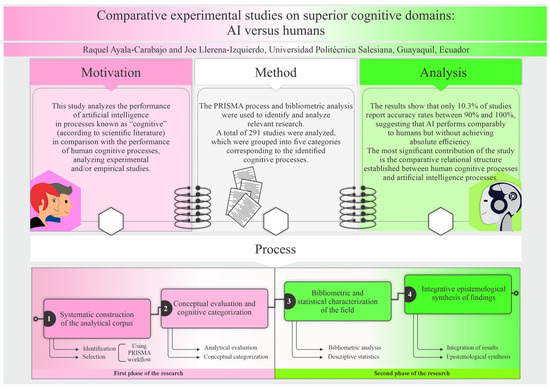
1. Introduction
1.1. Higher Cognitive Processes Based on Psychology and Cognitive Science
1.2. Cognitive Processes, AI Performance, and Technological Trust
2. State of the Art
2.1. Cognitive Architectures Inspired by Neuroscience and Cognitive Psychology
2.2. Neuro-Symbolic Integration in AI Reasoning and Decision-Making
3. Materials and Methods
4. Results
5. Discussion
6. Conclusions
Author Contributions
Funding
Institutional Review Board Statement
Informed Consent Statement
Data Availability Statement
Conflicts of Interest
References
- Esposito, A.; Desolda, G.; Lanzilotti, R. The fine line between automation and augmentation in website usability evaluation. Sci. Rep. 2024, 14, 10129. [Google Scholar] [CrossRef]
- Turtoi, D.C.; Brata, V.D.; Incze, V.; Ismaiel, A.; Dumitrascu, D.I.; Militaru, V.; Munteanu, M.A.; Botan, A.; Toc, D.A.; Duse, T.A.; et al. Artificial Intelligence for the Automatic Diagnosis of Gastritis: A Systematic Review. J. Clin. Med. 2024, 13, 4818. [Google Scholar] [CrossRef]
- Díaz-Herrera, B.A.; Roman-Rangel, E.; Castro-García, C.A.; Sierra-Lara Martinez, D.; Gopar-Nieto, R.; Velez-Talavera, K.G.; Espinosa-Martínez, M.P.; March-Mifsut, S.; Latapi-Ruiz-Esparza, X.; Preciado-Gutiérrez, Ó.U.; et al. Derivación de un modelo electrocardiográfico basado en inteligencia artificial para la detección de infarto agudo del miocardio por oclusión trombótica. Arch. Cardiol. México 2025, 95, 178–187. [Google Scholar] [CrossRef]
- Ecker, H.; Adams, N.B.; Schmitz, M.; Wetsch, W.A. Feasibility of real-time compression frequency and compression depth assessment in CPR using a “machine-learning” artificial intelligence tool. Resusc. Plus 2024, 20, 100825. [Google Scholar] [CrossRef] [PubMed]
- Polizzi, A.; Leonardi, R. Automatic cephalometric landmark identification with artificial intelligence: An umbrella review of systematic reviews. J. Dent. 2024, 146, 105056. [Google Scholar] [CrossRef]
- Chen, J.; Huang, S.; Zhang, Y.; Chang, Q.; Zhang, Y.; Li, D.; Qiu, J.; Hu, L.; Peng, X.; Du, Y.; et al. Congenital heart disease detection by pediatric electrocardiogram based deep learning integrated with human concepts. Nat. Commun. 2024, 15, 976. [Google Scholar] [CrossRef] [PubMed]
- Chang, M.Y.; Heidary, G.; Beres, S.; Pineles, S.L.; Gaier, E.D.; Gise, R.; Reid, M.; Avramidis, K.; Rostami, M.; Narayanan, S. Artificial Intelligence to Differentiate Pediatric Pseudopapilledema and True Papilledema on Fundus Photographs. Ophthalmol. Sci. 2024, 4, 100496. [Google Scholar] [CrossRef] [PubMed]
- Zhang, J.; Wu, P.; London, J.; Tenney, D. Benchmarking and Evaluating Large Language Models in Phishing Detection for Small and Midsize Enterprises: A Comprehensive Analysis. IEEE Access 2025, 13, 28335–28352. [Google Scholar] [CrossRef]
- Chen, X.; Zhao, Z.; Zhang, W.; Xu, P.; Wu, Y.; Xu, M.; Gao, L.; Li, Y.; Shang, X.; Shi, D.; et al. EyeGPT for Patient Inquiries and Medical Education: Development and Validation of an Ophthalmology Large Language Model. J. Med. Internet Res. 2024, 26, e60063. [Google Scholar] [CrossRef]
- Lavista Ferres, J.M.; Oviedo, F.; Robinson, C.; Chu, L.; Kawamoto, S.; Afghani, E.; He, J.; Klein, A.P.; Goggins, M.; Wolfgang, C.L.; et al. Performance of explainable artificial intelligence in guiding the management of patients with a pancreatic cyst. Pancreatology 2024, 24, 1182–1191. [Google Scholar] [CrossRef]
- Gumilar, K.E.; Wardhana, M.P.; Akbar, M.I.A.; Putra, A.S.; Banjarnahor, D.P.P.; Mulyana, R.S.; Fatati, I.; Yu, Z.Y.; Hsu, Y.C.; Dachlan, E.G.; et al. Artificial intelligence-large language models (AI-LLMs) for reliable and accurate cardiotocography (CTG) interpretation in obstetric practice. Comput. Struct. Biotechnol. J. 2025, 27, 1140–1147. [Google Scholar] [CrossRef]
- Bowness, J.S.; Morse, R.; Lewis, O.; Lloyd, J.; Burckett-St Laurent, D.; Bellew, B.; Macfarlane, A.J.R.; Pawa, A.; Taylor, A.; Noble, J.A.; et al. Variability between human experts and artificial intelligence in identification of anatomical structures by ultrasound in regional anaesthesia: A framework for evaluation of assistive artificial intelligence. Br. J. Anaesth. 2024, 132, 1063–1072. [Google Scholar] [CrossRef] [PubMed]
- Boyd, C.J.; Rivera, L.R.P.; Hemal, K.; Sorenson, T.J.; Amro, C.; Choi, M.; Karp, N.S. Analyzing the precision and readability of a healthcare focused artificial intelligence platform on common questions regarding breast augmentation. Artif. Intell. Surg. 2024, 4, 316–323. [Google Scholar] [CrossRef]
- Llerena-Izquierdo, J.; Mendez-Reyes, J.; Ayala-Carabajo, R.; Andrade-Martinez, C. Innovations in Introductory Programming Education: The Role of AI with Google Colab and Gemini. Educ. Sci. 2024, 14, 1330. [Google Scholar] [CrossRef]
- Kammer, J.E.; Hautz, W.E.; Krummrey, G.; Sauter, T.C.; Penders, D.; Birrenbach, T.; Bienefeld, N. Effects of interacting with a large language model compared with a human coach on the clinical diagnostic process and outcomes among fourth-year medical students: Study protocol for a prospective, randomised experiment using patient vignettes. BMJ Open 2024, 14, e087469. [Google Scholar] [CrossRef] [PubMed]
- Stanovich, K.E.; Toplak, M.E.; West, R.F. Intelligence and Rationality. In The Cambridge Handbook of Intelligence; Cambridge Handbooks in Psychology; Cambridge University Press: Cambridge, UK, 2020; pp. 1106–1139. [Google Scholar]
- Goldenholz, D.M.; Goldenholz, S.R.; Habib, S.; Westover, M.B. Inductive reasoning with large language models: A simulated randomized controlled trial for epilepsy. Epilepsy Res. 2025, 211, 107532. [Google Scholar] [CrossRef]
- Evans, J.S. Dual-process theories of reasoning: Contemporary issues and developmental applications. Dev. Rev. 2011, 31, 86–102. [Google Scholar] [CrossRef]
- Abdullahi, T.; Singh, R.; Eickhoff, C. Learning to Make Rare and Complex Diagnoses with Generative AI Assistance: Qualitative Study of Popular Large Language Models. JMIR Med. Educ. 2024, 10, e51391. [Google Scholar] [CrossRef]
- Jaworski, A.; Jasiński, D.; Sławińska, B.; Błecha, Z.; Jaworski, W.; Kruplewicz, M.; Jasińska, N.; Sysło, O.; Latkowska, A.; Jung, M. GPT-4o vs. Human Candidates: Performance Analysis in the Polish Final Dentistry Examination. Cureus 2024, 16, e68813. [Google Scholar] [CrossRef]
- Badre, D.; Nee, D.E. Frontal Cortex and the Hierarchical Control of Behavior. Trends Cogn. Sci. 2018, 22, 170–188. [Google Scholar] [CrossRef]
- Habicht, J.; Dina, L.M.; McFadyen, J.; Stylianou, M.; Harper, R.; Hauser, T.U.; Rollwage, M. Generative AI–Enabled Therapy Support Tool for Improved Clinical Outcomes and Patient Engagement in Group Therapy: Real-World Observational Study. J. Med. Internet Res. 2025, 27, e60435. [Google Scholar] [CrossRef] [PubMed]
- Lieder, F.; Griffiths, T.L. Resource-rational analysis: Understanding human cognition as the optimal use of limited computational resources. Behav. Brain Sci. 2020, 43, e1. [Google Scholar] [CrossRef]
- Kobayashi, K.; Takamizawa, Y.; Miyake, M.; Ito, S.; Gu, L.; Nakatsuka, T.; Akagi, Y.; Harada, T.; Kanemitsu, Y.; Hamamoto, R. Can physician judgment enhance model trustworthiness? A case study on predicting pathological lymph nodes in rectal cancer. Artif. Intell. Med. 2024, 154, 102929. [Google Scholar] [CrossRef] [PubMed]
- Seth, A.K. Conscious artificial intelligence and biological naturalism. Behav. Brain Sci. 2025, 1–42. [Google Scholar] [CrossRef]
- Solomou, S.; Sengupta, U. Simulating Complex Urban Behaviours with AI: Incorporating Improved Intelligent Agents in Urban Simulation Models. Urban Plan. 2025, 10, 8561. [Google Scholar] [CrossRef]
- Xu, P.; Estrada, S.; Etteldorf, R.; Liu, D.; Shahid, M.; Zeng, W.; Früh, D.; Reuter, M.; Breteler, M.M.B.; Aziz, N.A. Hypothalamic volume is associated with age, sex and cognitive function across lifespan: A comparative analysis of two large population-based cohort studies. eBioMedicine 2025, 111, 105513. [Google Scholar] [CrossRef]
- Ringgold, V.; Abel, L.; Eskofier, B.M.; Rohleder, N. Validation of the Virtual Reality Stroop Room: Effects of inhibiting interfering information under time-pressure and task-switching demands. Comput. Hum. Behav. Rep. 2024, 16, 100497. [Google Scholar] [CrossRef]
- Viscasillas Vázquez, C.; Solano, E.; Ulla, A.; Ambrosch, M.; Álvarez, M.A.; Manteiga, M.; Magrini, L.; Santoveña-Gómez, R.; Dafonte, C.; Pérez-Fernández, E.; et al. Advanced classification of hot subdwarf binaries using artificial intelligence techniques and Gaia DR3 data. Astron. Astrophys. 2024, 691, A223. [Google Scholar] [CrossRef]
- de Lellis Rossi, L.; Rohmer, E.; Dornhofer Paro Costa, P.; Colombini, E.; da Silva Simões, A.; Gudwin, R. A Procedural Constructive Learning Mechanism with Deep Reinforcement Learning for Cognitive Agents. J. Intell. Robot. Syst. 2024, 110, 38. [Google Scholar] [CrossRef]
- Roshan, M.P.; Al-Shaikhli, S.A.; Linfante, I.; Antony, T.T.; Clarke, J.E.; Noman, R.; Lamy, C.; Britton, S.; Belnap, S.C.; Abrams, K.; et al. Revolutionizing Intracranial Hemorrhage Diagnosis: A Retrospective Analytical Study of Viz.ai ICH for Enhanced Diagnostic Accuracy. Cureus 2024, 16, e66449. [Google Scholar] [CrossRef]
- Putra, R.V.W.; Marchisio, A.; Shafique, M. SNN4Agents: A framework for developing energy-efficient embodied spiking neural networks for autonomous agents. Front. Robot. AI 2024, 11, 1401677. [Google Scholar] [CrossRef]
- Zhou, J.; Duan, Y.; Chang, Y.C.; Wang, Y.K.; Lin, C.T. BELT: Bootstrapped EEG-to-Language Training by Natural Language Supervision. IEEE Trans. Neural Syst. Rehabil. Eng. 2024, 32, 3278–3288. [Google Scholar] [CrossRef] [PubMed]
- Frank, B. Consumer preferences for artificial intelligence-enhanced products: Differences across consumer segments, product types, and countries. Technol. Forecast. Soc. Change 2024, 209, 123774. [Google Scholar] [CrossRef]
- Hadar-Shoval, D.; Asraf, K.; Mizrachi, Y.; Haber, Y.; Elyoseph, Z. Assessing the Alignment of Large Language Models with Human Values for Mental Health Integration: Cross-Sectional Study Using Schwartz’s Theory of Basic Values. JMIR Ment. Health 2024, 11, e55988. [Google Scholar] [CrossRef]
- Kim, H.; Jeon, B.; Kim, M.C.; Choi, Y. Feasibility study on dose conversion using a deep learning algorithm for retrospective dosimetry. Radiat. Meas. 2025, 181, 107382. [Google Scholar] [CrossRef]
- Reinecke, M.G.; Wilks, M.; Bloom, P. Developmental changes in the perceived moral standing of robots. Cognition 2025, 254, 105983. [Google Scholar] [CrossRef] [PubMed]
- Myers, S.; Everett, J.A. People expect artificial moral advisors to be more utilitarian and distrust utilitarian moral advisors. Cognition 2025, 256, 106028. [Google Scholar] [CrossRef]
- Han, D.; Shanbhag, A.; Miller, R.J.; Kwok, N.; Waechter, P.; Builoff, V.; Newby, D.E.; Dey, D.; Berman, D.S.; Slomka, P. AI-Derived Left Ventricular Mass From Noncontrast Cardiac CT. JACC Adv. 2024, 3, 101249. [Google Scholar] [CrossRef]
- Mehrotra, S.; Jorge, C.C.; Jonker, C.M.; Tielman, M.L. Integrity-based Explanations for Fostering Appropriate Trust in AI Agents. ACM Trans. Interact. Intell. Syst. 2024, 14, 1–36. [Google Scholar] [CrossRef]
- Deeb, B.M.; Savchenko, A.V.; Makarov, I. Enhancing Emotion Recognition in Speech Based on Self-Supervised Learning: Cross-Attention Fusion of Acoustic and Semantic Features. IEEE Access 2025, 13, 56283–56295. [Google Scholar] [CrossRef]
- Bulla, L.; De Giorgis, S.; Mongiovì, M.; Gangemi, A. Large Language Models meet moral values: A comprehensive assessment of moral abilities. Comput. Hum. Behav. Rep. 2025, 17, 100609. [Google Scholar] [CrossRef]
- Chu, R.; Chik, L.; Song, Y.; Chan, J.; Li, X. An effective approach for early fuel leakage detection with enhanced explainability. Intell. Syst. Appl. 2025, 26, 200504. [Google Scholar] [CrossRef]
- Shimada, K.; Inokuchi, R.; Ohigashi, T.; Iwagami, M.; Tanaka, M.; Gosho, M.; Tamiya, N. Artificial intelligence-assisted interventions for perioperative anesthetic management: A systematic review and meta-analysis. BMC Anesthesiol. 2024, 24, 306. [Google Scholar] [CrossRef]
- Farid, Y.; Fernando Botero Gutierrez, L.; Ortiz, S.; Gallego, S.; Zambrano, J.C.; Morrelli, H.U.; Patron, A. Artificial Intelligence in Plastic Surgery: Insights from Plastic Surgeons, Education Integration, ChatGPT’s Survey Predictions, and the Path Forward. Plast. Reconstr. Surg. Glob. Open 2024, 12, e5515. [Google Scholar] [CrossRef]
- Wang, H.; Wu, Y.; Guo, S.; Wang, L. PDPP: Projected Diffusion for Procedure Planning in Instructional Videos. IEEE Trans. Pattern Anal. Mach. Intell. 2025, 47, 2107–2124. [Google Scholar] [CrossRef]
- Bixby, C.J.; Miller, B. Real-world use of an artificial intelligence-powered clinical decision support tool for ovarian stimulation. F&S Rep. 2025, 6, 140–146. [Google Scholar] [CrossRef]
- Rojas, M.; Rojas, M.; Burgess, V.; Toro-Pérez, J.; Salehi, S. Exploring the Performance of ChatGPT Versions 3.5, 4, and 4 with Vision in the Chilean Medical Licensing Examination: Observational Study. JMIR Med. Educ. 2024, 10, e55048. [Google Scholar] [CrossRef] [PubMed]
- Prazeres, F. ChatGPT’s Performance on Portuguese Medical Examination Questions: Comparative Analysis of ChatGPT-3.5 Turbo and ChatGPT-4o Mini. JMIR Med. Educ. 2025, 11, e65108. [Google Scholar] [CrossRef] [PubMed]
- Dashti, M.; Londono, J.; Ghasemi, S.; Zare, N.; Samman, M.; Ashi, H.; Amirzade-Iranaq, M.H.; Khosraviani, F.; Sabeti, M.; Khurshid, Z. Comparative analysis of deep learning algorithms for dental caries detection and prediction from radiographic images: A comprehensive umbrella review. PeerJ Comput. Sci. 2024, 10, e2371. [Google Scholar] [CrossRef]
- Domalpally, A.; Slater, R.; Linderman, R.E.; Balaji, R.; Bogost, J.; Voland, R.; Pak, J.; Blodi, B.A.; Channa, R.; Fong, D.; et al. Strong versus Weak Data Labeling for Artificial Intelligence Algorithms in the Measurement of Geographic Atrophy. Ophthalmol. Sci. 2024, 4, 100477. [Google Scholar] [CrossRef]
- Ozbek, O.; Genc, D.E.; O. Ulgen, K. Advances in Physiologically Based Pharmacokinetic (PBPK) Modeling of Nanomaterials. ACS Pharmacol. Transl. Sci. 2024, 7, 2251–2279. [Google Scholar] [CrossRef]
- Whitney, H.M.; Yoeli-Bik, R.; Abramowicz, J.S.; Lan, L.; Li, H.; Longman, R.E.; Lengyel, E.; Giger, M.L. AI-based automated segmentation for ovarian/adnexal masses and their internal components on ultrasound imaging. J. Med. Imaging 2024, 11, 044505. [Google Scholar] [CrossRef]
- Naghavi, M.; Reeves, A.; Budoff, M.; Li, D.; Atlas, K.; Zhang, C.; Atlas, T.; Roy, S.K.; Henschke, C.I.; Wong, N.D.; et al. AI-enabled cardiac chambers volumetry in coronary artery calcium scans (AI-CACTM) predicts heart failure and outperforms NT-proBNP: The multi-ethnic study of Atherosclerosis. J. Cardiovasc. Comput. Tomogr. 2024, 18, 392–400. [Google Scholar] [CrossRef] [PubMed]
- Laperdrix, C.; Duhieu, S.; Haftek, M. Chondroitin/dermatan sulphate proteoglycan, desmosealin, showing affinity to desmosomes. Int. J. Cosmet. Sci. 2024, 46, 494–505. [Google Scholar] [CrossRef] [PubMed]
- Cardenas, J.M.; Gordon, D.; Waddell, B.S.; Kitziger, K.J.; Peters, P.C., Jr.; Gladnick, B.P. Does Artificial Intelligence Outperform Humans Using Fluoroscopic-Assisted Computer Navigation for Total Hip Arthroplasty? Arthroplast. Today 2024, 27, 101410. [Google Scholar] [CrossRef]
- Builoff, V.; Shanbhag, A.; Miller, R.J.; Dey, D.; Liang, J.X.; Flood, K.; Bourque, J.M.; Chareonthaitawee, P.; Phillips, L.M.; Slomka, P.J. Evaluating AI proficiency in nuclear cardiology: Large language models take on the board preparation exam. J. Nucl. Cardiol. 2025, 45, 102089. [Google Scholar] [CrossRef]
- Huang, R.S.; Benour, A.; Kemppainen, J.; Leung, F.H. The future of AI clinicians: Assessing the modern standard of chatbots and their approach to diagnostic uncertainty. BMC Med. Educ. 2024, 24, 1133. [Google Scholar] [CrossRef]
- Innerebner, K.; Kowald, D.; Schedl, M.; Lex, E. Hybrid Personalization Using Declarative and Procedural Memory Modules of the Cognitive Architecture ACT-R. In Proceedings of the UMAP Adjunct ’25: Adjunct Proceedings of the 33rd ACM Conference on User Modeling, Adaptation and Personalization, New York, NY, USA, 16–19 June 2025; pp. 349–352. [Google Scholar] [CrossRef]
- Dang, C.V.; Jun, M.; Shin, Y.B.; Choi, J.W.; Kim, J.W. Application of modified Asimov’s laws to the agent of home service robot using state, operator, and result (Soar). Int. J. Adv. Robot. Syst. 2018, 2018, 1–9. [Google Scholar] [CrossRef]
- Boggs, J. Towards visual-symbolic integration in the Soar cognitive architecture. Cogn. Syst. Res. 2025, 91, 101353. [Google Scholar] [CrossRef]
- Ronneberg, C.R.; Lv, N.; Ajilore, O.A.; Kannampallil, T.; Smyth, J.; Kumar, V.; Barve, A.; Garcia, C.; Dosala, S.; Wittels, N.; et al. Study of a PST-trained voice-enabled artificial intelligence counselor for adults with emotional distress (SPEAC-2): Design and methods. Contemp. Clin. Trials 2024, 142, 107574. [Google Scholar] [CrossRef]
- Zuo, G.; Pan, T.; Zhang, T.; Yang, Y. SOAR Improved Artificial Neural Network for Multistep Decision-making Tasks. Cogn. Comput. 2021, 13, 612–625. [Google Scholar] [CrossRef]
- Verdes, A.; Bhattachan, S.; Kolevzon, A.; King, B.H.; McDougle, C.J.; Sanders, K.B.; Kim, S.J.; Spanos, M.; Chandrasekhar, T.; Rockhill, C.; et al. Predictors of Placebo Response in the Study of Oxytocin in Autism to Improve Reciprocal Social Behaviors. J. Child Adolesc. Psychopharmacol. 2025, 35, 202–210. [Google Scholar] [CrossRef]
- Alkam, T.; Tarshizi, E.; Van Benschoten, A.H. Reinforcement learning at the interface of artificial intelligence and cognitive science. Neuroscience 2025, 585, 289–312. [Google Scholar] [CrossRef]
- Sievers, T.; Russwinkel, N. Using Memory Contents of a Cognitive Model for Prompt Augmentation of a Large Language Model. In Proceedings of the 2025 IEEE Conference on Cognitive and Computational Aspects of Situation Management (CogSIMA), Duisburg, Germany, 2–5 June 2025; pp. 172–176. [Google Scholar] [CrossRef]
- Thomson, R.; Lebiere, C. Cognitive models of influence dynamics in a conformity simulation. Comput. Math. Organ. Theory 2025, 31, 323–343. [Google Scholar] [CrossRef]
- Huang, H.; Liu, J.; Zhang, B.; Zhao, S.; Li, B.; Wang, J. LEAD: Learning-Enhanced Adaptive Decision-Making for Autonomous Driving in Dynamic Environments. IEEE Trans. Intell. Transp. Syst. 2025, 26, 6142–6156. [Google Scholar] [CrossRef]
- Hölken, A.; Kugele, S.; Newen, A.; Franklin, S. Modeling interactions between the embodied and the narrative self: Dynamics of the self-pattern within LIDA. Cogn. Syst. Res. 2023, 81, 25–36. [Google Scholar] [CrossRef]
- Zhang, Z.; Zou, G.; Chen, C.; Qi, Z.; Yu, X.; Qi, J.; Yao, Y.; Li, X.; Xie, Y.; Tan, X. A Task-Aware Parameter Decoupling Framework for Continual Anomaly Detection. IEEE Trans. Ind. Inform. 2025, 1–11. [Google Scholar] [CrossRef]
- Kronsted, C.; Kugele, S.; Neemeh, Z.A.; Ryan, K.J.; Franklin, S. Embodied Intelligence: Smooth Coping in the Learning Intelligent Decision Agent Cognitive Architecture. Front. Psychol. 2022, 13, 846931. [Google Scholar] [CrossRef]
- Rayavaram, P.; Ukaegbu, O.; Abbasalizadeh, M.; Vellamchetty, K.; Narain, S. CryptoEL: A Novel Experiential Learning Tool for Enhancing K-12 Cryptography Education. In Proceedings of the SIGCSETS 2025: Proceedings of the 56th ACM Technical Symposium on Computer Science Education V. 1, Pittsburgh, PA, USA, 26 February–1 March 2025; pp. 980–986. [Google Scholar] [CrossRef]
- Kim, K.A.; Hong, S.; Yoo, S.; Kang, Y.; Shim, H.S. Enhancing Structured Pathology Report Generation with Foundation Model and Modular Design. IEEE Access 2025, 13, 121290–121299. [Google Scholar] [CrossRef]
- Hussein, S.Y.S.H.; Ho, P.W.C. Towards brain-inspired edge AI: A review of memristor-based neuromorphic computing and learning algorithms. Eng. Res. Express 2025, 7, 032201. [Google Scholar] [CrossRef]
- Mao, J.; Zheng, H.; Yin, H.; Fan, H.; Mei, L.; Guo, H.; Li, Y.; Wu, J.; Pei, J.; Deng, L. Adaptive dendritic plasticity in brain-inspired dynamic neural networks for enhanced multi-timescale feature extraction. Neural Netw. 2026, 194, 108191. [Google Scholar] [CrossRef]
- Wu, C.M.; Meder, B.; Schulz, E. Unifying Principles of Generalization: Past, Present, and Future. Annu. Rev. Psychol. 2025, 76, 275–302. [Google Scholar] [CrossRef] [PubMed]
- Hewavitharana, J.; Anand, A.; Giese, P.; Moretti Ierardi, C.; Steinhofel, K. Brain Inspired Learning for Neural Networks. In Proceedings of the Engineering Applications of Neural Networks; Iliadis, L., Maglogiannis, I., Kyriacou, E., Jayne, C., Eds.; Springer: Cham, Switzerland, 2025; pp. 59–72. [Google Scholar]
- García-Torres, D.; Vicente Ripoll, M.A.; Fernández Peris, C.; Mira Solves, J.J. Enhancing Clinical Reasoning with Virtual Patients: A Hybrid Systematic Review Combining Human Reviewers and ChatGPT. Healthcare 2024, 12, 2241. [Google Scholar] [CrossRef]
- Levin, C.; Suliman, M.; Naimi, E.; Saban, M. Augmenting intensive care unit nursing practice with generative AI: A formative study of diagnostic synergies using simulation-based clinical cases. J. Clin. Nurs. 2025, 34, 2898–2907. [Google Scholar] [CrossRef]
- Mundinger, A. Artificial Intelligence in Senology—Where Do We Stand and What Are the Future Horizons ? Eur. J. Breast Health 2024, 20, 73–80. [Google Scholar] [CrossRef] [PubMed]
- Fedorova, A.; Jovišić, N.; Vallverdù, J.; Battistoni, S.; Jovičić, M.; Medojević, M.; Toschev, A.; Alshanskaia, E.; Talanov, M.; Erokhin, V. Advancing Neural Networks: Innovations and Impacts on Energy Consumption. Adv. Electron. Mater. 2024, 10, 2400258. [Google Scholar] [CrossRef]
- Wilhelm, C.; Steckelberg, A.; Rebitschek, F.G. Benefits and harms associated with the use of AI-related algorithmic decision-making systems by healthcare professionals: A systematic review. Lancet Reg. Health Eur. 2025, 48, 101145. [Google Scholar] [CrossRef]
- Heisinger, S.; Salzmann, S.N.; Senker, W.; Aspalter, S.; Oberndorfer, J.; Matzner, M.P.; Stienen, M.N.; Motov, S.; Huber, D.; Grohs, J.G. ChatGPT’s Performance in Spinal Metastasis Cases—Can We Discuss Our Complex Cases with ChatGPT? J. Clin. Med. 2024, 13, 7864. [Google Scholar] [CrossRef]
- Rojek, I.; Mikołajewski, D.; Dostatni, E.; Piszcz, A.; Galas, K. ML-Based Maintenance and Control Process Analysis, Simulation, and Automation—A Review. Appl. Sci. 2024, 14, 8774. [Google Scholar] [CrossRef]
- Carrillo-de-la Peña, M.T.; Fernandes, C.; Castro, C.; Rubal, L.; Samartin-Veiga, N.; Yarnitzsky, D.; Arendt-Nielsen, L.; Dahl, C.; Medeiros, R.; Consortium, P. Validity of central pain processing biomarkers for predicting the occurrence of oncological chronic pain: A study protocol. BMC Cancer 2024, 24, 705. [Google Scholar] [CrossRef]
- Giansanti, D.; Lastrucci, A.; Iannone, A.; Pirrera, A. A Narrative Review of Systematic Reviews on the Applications of Social and Assistive Support Robots in the Health Domain. Appl. Sci. 2025, 15, 32. [Google Scholar] [CrossRef]
- Ikkatai, Y.; Itatsu, Y.; Hartwig, T.; Noh, J.; Takanashi, N.; Yaguchi, Y.; Hayashi, K.; Yokoyama, H.M. The relationship between the attitudes of the use of AI and diversity awareness: Comparisons between Japan, the US, Germany, and South Korea. AI Soc. 2025, 40, 2369–2383. [Google Scholar] [CrossRef]
- Combs, K.; Moyer, A.; Bihl, T.J. Uncertainty in Visual Generative AI. Algorithms 2024, 17, 136. [Google Scholar] [CrossRef]
- Suresh, S.; Qi, H.; Wu, T.; Fan, T.; Pineda, L.; Lambeta, M.; Malik, J.; Kalakrishnan, M.; Calandra, R.; Kaess, M.; et al. NeuralFeels with neural fields: Visuotactile perception for in-hand manipulation. Sci. Robot. 2024, 9, eadl0628. [Google Scholar] [CrossRef]
- Lundin, J.; Suutala, A.; Holmström, O.; Henriksson, S.; Valkamo, S.; Kaingu, H.; Kinyua, F.; Muinde, M.; Lundin, M.; Diwan, V.; et al. Diagnosis of soil-transmitted helminth infections with digital mobile microscopy and artificial intelligence in a resource-limited setting. PLoS Neglected Trop. Dis. 2024, 18, e0012041. [Google Scholar] [CrossRef] [PubMed]
- Tseng, L.W.; Lu, Y.C.; Tseng, L.C.; Chen, Y.C.; Chen, H.Y. Performance of ChatGPT-4 on Taiwanese Traditional Chinese Medicine Licensing Examinations: Cross-Sectional Study. JMIR Med. Educ. 2025, 11, e58897. [Google Scholar] [CrossRef]
- Djoumessi, K.; Huang, Z.; Kühlewein, L.; Rickmann, A.; Simon, N.; Koch, L.M.; Berens, P. An inherently interpretable AI model improves screening speed and accuracy for early diabetic retinopathy. PLoS Digit. Health 2025, 4, e0000831. [Google Scholar] [CrossRef]
- Zhang, X.; Tsang, C.C.S.; Ford, D.D.; Wang, J. Student Pharmacists’ Perceptions of Artificial Intelligence and Machine Learning in Pharmacy Practice and Pharmacy Education. Am. J. Pharm. Educ. 2024, 88, 101309. [Google Scholar] [CrossRef] [PubMed]
- Jho, H.; Ha, M. Towards Effective Argumentation: Design and Implementation of a Generative Ai-Based Evaluation and Feedback System. J. Balt. Sci. Educ. 2024, 23, 280–291. [Google Scholar] [CrossRef]
- Tognetti, L.; Miracapillo, C.; Leonardelli, S.; Luschi, A.; Iadanza, E.; Cevenini, G.; Rubegni, P.; Cartocci, A. Deep Learning Techniques for the Dermoscopic Differential Diagnosis of Benign/Malignant Melanocytic Skin Lesions: From the Past to the Present. Bioengineering 2024, 11, 758. [Google Scholar] [CrossRef] [PubMed]
- Hajam, M.A.; Arif, T.; Khanday, A.M.U.D.; Wani, M.A.; Asim, M. AI-Driven Pattern Recognition in Medicinal Plants: A Comprehensive Review and Comparative Analysis. Comput. Mater. Contin. 2024, 81, 2077–2131. [Google Scholar] [CrossRef]
- Funk, N.; Helmut, E.; Chalvatzaki, G.; Calandra, R.; Peters, J. Evetac: An Event-Based Optical Tactile Sensor for Robotic Manipulation. IEEE Trans. Robot. 2024, 40, 3812–3832. [Google Scholar] [CrossRef]
- Qiao, T.; Xiao, C.; Feng, Z.; Ye, J. Habitat Distributions and Abundance of Four Wild Herbivores on the Qinghai–Tibetan Plateau: A Review. Land 2025, 14, 23. [Google Scholar] [CrossRef]
- Zhang, Z.; Ding, X.; Liang, X.; Zhou, Y.; Qin, B.; Liu, T. Brain and Cognitive Science Inspired Deep Learning: A Comprehensive Survey. IEEE Trans. Knowl. Data Eng. 2025, 37, 1650–1671. [Google Scholar] [CrossRef]



| Research Questions | |
|---|---|
| RQ1: | How do human intelligence and artificial intelligence behave when solving cognitive problems? |
| RQ2: | What experimental and/or empirical results exist on the performance of artificial intelligence compared to human cognitive processes? |
| RQ3: | To what extent do empirical evidence, both for and against, challenge the concept of intelligence? |
| Cognitive Process | Quantity | Percentage |
|---|---|---|
| Decision-making | 163 | 56.01% |
| Analysis and evaluation | 73 | 25.09% |
| Judgment and reasoning | 25 | 8.59% |
| Comprehension and learning | 16 | 5.55% |
| Other cognitive processes 1 | 14 | 4.76% |
| Cognitive Process: Other Cognitive Processes | Quantity | Percentage |
|---|---|---|
| Abstraction and modelling of complex systems | 1 | 0.34% |
| High-level visual perception | 1 | 0.34% |
| Visual pattern recognition and high-level visual perception | 1 | 0.34% |
| Selective attention and high-level visual perception | 1 | 0.34% |
| Knowledge production | 1 | 0.34% |
| Evaluation of Human–AI Interaction | 1 | 0.34% |
| Evaluation and Ethics | 1 | 0.34% |
| Ethical reasoning in AI | 1 | 0.34% |
| Mind perception and ethical judgment | 1 | 0.34% |
| AI-assisted validation judgment | 1 | 0.34% |
| AI-assisted creative problem-solving | 1 | 0.34% |
| Human–AI Cognitive Interaction | 1 | 0.34% |
| Trust in automated technology | 1 | 0.34% |
| Inference of Personality Traits | 1 | 0.34% |
| Classification | Term, Frequency, Percentage | Term, Frequency, Percentage | ||||
|---|---|---|---|---|---|---|
| Term | Frequency | % | Term | Frequency | % | |
| Language models and Chatbots | ChatGPT | 24 | 14.81 | ChatGPT-4V | 1 | 0.62 |
| GPT-4 | 22 | 13.58 | Claude 3 | 1 | 0.62 | |
| GPT-3.5 | 16 | 9.88 | Clinical-T5-Large | 1 | 0.62 | |
| BERT | 5 | 3.09 | Copilot | 1 | 0.62 | |
| ChatGPT-3.5 | 4 | 2.47 | Ernie Bot | 1 | 0.62 | |
| ChatGPT-4 | 4 | 2.47 | FLAN-T5-xl | 1 | 0.62 | |
| Llama2 | 3 | 1.85 | FLAN-UL2 | 1 | 0.62 | |
| Bard | 2 | 1.23 | Gemini | 1 | 0.62 | |
| Claude 2 | 2 | 1.23 | GigaBERT | 1 | 0.62 | |
| GPT | 2 | 1.23 | GPT-4 Turbo | 1 | 0.62 | |
| GPT-4o | 2 | 1.23 | GPT-3 | 1 | 0.62 | |
| MedAlpaca | 2 | 1.23 | GPT-2 | 1 | 0.62 | |
| AraBERT | 1 | 0.62 | Llama3 | 1 | 0.62 | |
| BLOOM | 1 | 0.62 | Llama-7B | 1 | 0.62 | |
| ChatGPT-3 | 1 | 0.62 | Mistral | 1 | 0.62 | |
| ChatGPT-3.5 Turbo | 1 | 0.62 | Mixtral-8x7B | 1 | 0.62 | |
| ChatGPT-4o | 1 | 0.62 | XLM-RoBERTa | 1 | 0.62 | |
| ChatGPT-4o (mini) | 1 | 0.62 | ||||
| Vision and Content creation models | DALL-E | 2 | 1.23 | Imagen 2 | 1 | 0.62 |
| YOLO | 2 | 1.23 | Imagine | 1 | 0.62 | |
| BLIP | 1 | 0.62 | InstructBLIP | 1 | 0.62 | |
| BLIP-2 | 1 | 0.62 | Midjourney v6 | 1 | 0.62 | |
| DALL-E 3 | 1 | 0.62 | Stable Diffusion XL | 1 | 0.62 | |
| Firefly 2 | 1 | 0.62 | YOLOv5 | 1 | 0.62 | |
| Architectures and Neural networks | ResNet | 3 | 1.85 | EfficientNet | 1 | 0.62 |
| UNet | 3 | 1.85 | FPN | 1 | 0.62 | |
| DenseNet | 2 | 1.23 | PSPNet | 1 | 0.62 | |
| VGG | 1 | 0.62 | ||||
| Algorithms and Techniques | Random Forest | 2 | 1.23 | RAG | 1 | 0.62 |
| XGBoost | 2 | 1.23 | Fuzzy c-means | 1 | 0.62 | |
| Logistic regression | 1 | 0.62 | REINFORCE | 1 | 0.62 | |
| SVM | 1 | 0.62 | SOM | 1 | 0.62 | |
| Word2Vec | 1 | 0.62 | GloVe | 1 | 0.62 | |
| FastText | 1 | 0.62 | ||||
| Platforms and Tools | Google Earth | 1 | 0.62 | NVivo | 1 | 0.62 |
| SmartPLS 3 | 1 | 0.62 | ||||
| Specific or Application Terms | AI-CACTM | 1 | 0.62 | AICF | 1 | 0.62 |
| AI-ECG | 1 | 0.62 | AIM-MASH | 1 | 0.62 | |
| AI-QCT | 1 | 0.62 | Avicenna CINA | 1 | 0.62 | |
| AVIEW-LCS | 1 | 0.62 | Brainomix | 1 | 0.62 | |
| C51-DDQN | 1 | 0.62 | CAAI-FDS | 1 | 0.62 | |
| ChainingAI | 1 | 0.62 | CHDdECG | 1 | 0.62 | |
| CoSP | 1 | 0.62 | D-Conformer | 1 | 0.62 | |
| DECA | 1 | 0.62 | DeepDream | 1 | 0.62 | |
| Deeplab | 1 | 0.62 | DenseNet201 | 1 | 0.62 | |
| Diagnocat | 1 | 0.62 | Dora | 1 | 0.62 | |
| DPA-2 | 1 | 0.62 | EchoCLR | 1 | 0.62 | |
| EMOCA | 1 | 0.62 | ExpNet | 1 | 0.62 | |
| EyeArt v2.1 | 1 | 0.62 | HypVINN | 1 | 0.62 | |
| Foggy Drone | 1 | 0.62 | GI Genius | 1 | 0.62 | |
| GIT | 1 | 0.62 | GPT-agent | 1 | 0.62 | |
| GPTZero | 1 | 0.62 | InceptionTime | 1 | 0.62 | |
| Lumen | 1 | 0.62 | LumineticsCore | 1 | 0.62 | |
| MediaPipe Pose | 1 | 0.62 | Mirai | 1 | 0.62 | |
| Vision Transformer | 1 | 0.62 | MobiFit | 1 | 0.62 | |
| Analysis Tagger | 1 | 0.62 | Narrativa | 1 | 0.62 | |
| NeuralFeels | 1 | 0.62 | PathChat | 1 | 0.62 | |
| PDPP | 1 | 0.62 | PERCEPT-R | 1 | 0.62 | |
| Phoenix | 1 | 0.62 | QCPR | 1 | 0.62 | |
| Rapid | 1 | 0.62 | Realistic Vision | 1 | 0.62 | |
| RingNet | 1 | 0.62 | RosettaDock | 1 | 0.62 | |
| UNNT | 1 | 0.62 | US2ai | 1 | 0.62 | |
| Viz LVO | 1 | 0.62 | Viz.ai ICH | 1 | 0.62 | |
| vPatho | 1 | 0.62 | ||||
| Cognitive Processes | Quantity | Description | Artificial Intelligence Systems Detected |
|---|---|---|---|
| Decision making | 69 | Intelligent systems created for decision-making or making predictions based on analysed data or established rules | AI-CACTM, AICF, AIM-MASH, AI-QCT, AraBERT, GigaBERT, XLM-RoBERTa, AVIEW-LCS, Bard, Brainomix, Avicenna CINA, CAAI-FDS, ChatGPT (all versions), Ernie Bot, Gemini, Copilot, Google BARD, GPTZero, Claude (includes versions 2.0 and 3), Clinical-T5-Large, Llama2 (includes Llama2-13B and LLaMA2-7b), FLAN-UL2, GPT-3.5, GPT-4 (includes versions Turbo, 4o, 4V, and GPT-agent), CNN-BiLSTM, CoSP, Deeplab, DenseNet (includes DenseNet201), Diagnocat, Dora, ExpNet, 3DDFA-V2, RingNet, DECA, EMOCA, EyeArt (includes EyeArt Automated DR Detection System and v2.1), Foggy Drone Teacher (FDT), GANs (Generative Adversarial Networks), Logic Learning Machine (LLM), GIT, BLIP (includes BLIP-2), InstructBLIP, DALL-E, Word2Vec, GloVe, FastText, InceptionTime, Flan-T5-xl, T0-3b-T, T0pp(8bit)-T, logistic regression, XGBoost, Random Forest, LumineticsCore, MediaPipe Pose Landmark Detection, QCPR, Mirai, MobiFit, PathChat, PDPP, Rapid, Viz LVO, ResNet-34, SmartPLS 3, SVM, SOM, CNN, UNet, Fuzzy c-means (FCM), US2ai, Viz.ai ICH, UNNT, YOLO |
| Analysis and evaluation | 34 | Tools and models created for data interpretation, pattern recognition, and information evaluation | ChatGPT (all versions), BERT, BLOOM, Phoenix, Multidimensional Analysis Tagger (MAT), NVivo, C51-DDQN, DFP, Imagine, REINFORCE, DALL-E (incl. DALL-E 3), Firefly 2, Midjourney v6, D-Conformer, DeepDream, FastSurfer-HypVINN, Imagen 2, FPN, UNet, PSPNet, EfficientNet, ResNet, Stable Diffusion XL Turbo, VGG, Mix Vision Transformer (mViT), GPT-4, GPT, GPT-3, Realistic Vision, Google AI (BERT-based), Smile Random Forest, Smile CART, Google Earth Engine (GEE), vPatho, YOLOv5 |
| Judgement and reasoning | 11 | Intelligent systems that apply logic and evaluate argumentative texts to generate critical judgements | BERT, ChatGPT/GPT Family (includes versions 3.5, 4, 4o), ChainingAI, PERCEPT-R Classifier, Bard, DenseNet, GI Genius, RAG, Llama-3 (8b-instruct) |
| Comprehension and learning | 12 | Intelligent systems that focus on understanding information, acquiring it from human language | ChatGPT (incluye versiones 3.5 y 3.5-Turbo), CHDdECG, Doximity GPT, DPA-2, EchoCLR, GPT-2, GPT-3.5, GPT-4, Llama2 (incluye LLaMA 2), MedAlpaca, ORCA-mini, Lumen |
| Ethical reasoning in AI | 4 | Intelligent systems for handling ethical dilemmas or establishing moral guidelines | GPT-4, GPT-3.5, Claude 2, Bard |
| Knowledge production | 3 | Intelligent systems that generate new information, content, or insights | ChatGPT, GPT-4o, BERT |
| Abstraction and modelling of complex systems | 1 | Intelligent systems that simplify or represent complex systems | RosettaDock |
| Cognitive Process | Stage | Reference |
|---|---|---|
| Decision making | Medicine and health | [3,4,7,10,11,46,47,48,50,53,54,55,56,57,87,96,97] |
| Analysis and evaluation | Health and technology education | [2,5,9,49,51,52,86] |
| Judgement and reasoning | Technological Innovation for Sustainability and Health | [8,12,98] |
| Comprehension and learning | Technology and Humanism in Health | [6,13] |
| Other cognitive processes 1 | Technology and Human Interaction | [1] |
Disclaimer/Publisher’s Note: The statements, opinions and data contained in all publications are solely those of the individual author(s) and contributor(s) and not of MDPI and/or the editor(s). MDPI and/or the editor(s) disclaim responsibility for any injury to people or property resulting from any ideas, methods, instructions or products referred to in the content. |
© 2026 by the authors. Licensee MDPI, Basel, Switzerland. This article is an open access article distributed under the terms and conditions of the Creative Commons Attribution (CC BY) license.
Share and Cite
Ayala-Carabajo, R.; Llerena-Izquierdo, J. Comparative Experimental Studies on Superior Cognitive Domains: AI Versus Humans. Technologies 2026, 14, 55. https://doi.org/10.3390/technologies14010055
Ayala-Carabajo R, Llerena-Izquierdo J. Comparative Experimental Studies on Superior Cognitive Domains: AI Versus Humans. Technologies. 2026; 14(1):55. https://doi.org/10.3390/technologies14010055
Chicago/Turabian StyleAyala-Carabajo, Raquel, and Joe Llerena-Izquierdo. 2026. "Comparative Experimental Studies on Superior Cognitive Domains: AI Versus Humans" Technologies 14, no. 1: 55. https://doi.org/10.3390/technologies14010055
APA StyleAyala-Carabajo, R., & Llerena-Izquierdo, J. (2026). Comparative Experimental Studies on Superior Cognitive Domains: AI Versus Humans. Technologies, 14(1), 55. https://doi.org/10.3390/technologies14010055