


Abstract
This study examines the perception of insult-related vocabulary in Spanish among native speakers (L1) and Polish learners of Spanish as a foreign language (L2). Insults are analyzed as versatile speech acts fulfilling pragmatic functions such as impoliteness, affiliation, and emphasis. Adopting a contrastive approach, this research evaluates perceptions of colloquialism and emotional intensity across three groups: learners without prior stays in Spanish-speaking countries, learners with prior stays, and L1 speakers. Data were collected through surveys assessing knowledge, recognition, and perception of selected insults related to intellect and sexuality. The findings reveal that insults associated with sexuality exhibit the highest perceived offensive load across all groups, while those linked to behavior and intellect are rated as less aggressive. Polish learners of Spanish, particularly those without cultural immersion, tend to overestimate the offensiveness of insults compared to L1 speakers. However, learners with prior stays align more closely with L1 perceptions, underscoring the impact of cultural exposure. The results highlight the pivotal role of context and interlanguage in shaping learners’ interpretations of offensive vocabulary. They also establish a foundation for further exploration into the acquisition and pragmatic use of colloquial and emotionally charged language in L2 learning.
1. Introduction
Insults—referred to in Spanish variously as injuria, improperio, or palabra ofensiva—constitute a universal communicative phenomenon present in all cultures and languages. However, the terminology used to describe offensive language in Spanish is broader and includes terms such as taco, palabrota, palabra malsonante, palabra grosera, palabra vulgar, palabra soez, palabra sancionada, palabra tabú, palabra vitanda, or palabra prohibida (Chamizo Domínguez, 2008). It is important to note that not all of these terms are synonymous with insult: While insultos are inherently directed at a person with the intent to offend, tacos or palabrotas can appear in contexts where no direct insult is intended—such as expressions of pain, surprise, or frustration. This distinction highlights the diversity of forms and functions of offensive language across sociocultural and linguistic contexts, implying that not all uses are universal, either across linguistic communities or within the same speech community.
This speech act, laden with emotional, social, and cultural implications, plays a central role in human interaction. Despite its relevance, the teaching of insults in Spanish as a foreign language (SFL) remains largely underexplored (Bardovi-Harlig, 2001; Gass et al., 2020). This article examines the general characteristics of insults and their perception in different contexts while also proposing a theoretical framework to precisely define what constitutes an insult (Bardovi-Harlig & Hartford, 2005).
According to the Diccionario de la lengua española (Real Academia Española, 2020), to insult means “[t]o offend someone by provoking them with words or actions” (translated from Spanish by the author). This study focuses on verbal insults used in communication, excluding non-verbal communication. The key research questions guiding this investigation are as follows:
- Can an utterance be classified as an insult solely on the basis of the hearer’s perception of offense, or does it necessarily require an intention to harm on the part of the speaker?
- Must an insult necessarily contain a dysphemistic term?
These issues are central to academic debates on speech acts and will be addressed through a clearly defined theoretical framework in the present study through a clearly defined theoretical framework (Kasper & Blum-Kulka, 1993).
We also explore theories of impoliteness, anti-politeness, and facework as analytical tools for understanding the functions of insults. While the analysis primarily focuses on colloquiality as a pragmatic indicator, it also considers the emotional (Alonso Saralegui & Mavrou, 2018) and offensive dimensions of the terms analyzed. In doing so, we aim to provide a comprehensive approach to evaluating the perception of insults in Spanish, both as a first and second language.
2. Definition and Theoretical Framework of Insults
The definition of insults has been analyzed from various perspectives, including pragmatics, sociolinguistics, and the ethnography of communication (Doughty & Long, 2008). In this context, understanding an utterance’s meaning requires going beyond its literal interpretation; as Grice (1988) suggests, speakers rely on conversational implicatures to convey their intended meaning. This approach is further supported by Grice (1991), who emphasizes that the cooperative nature of communication enables listeners to infer implicit meanings based on context. According to Gómez Molina (2002), an insult constitutes a speech act whose primary aim is to attack the recipient’s social image through expressions considered culturally offensive. However, its function is not always aggressive. Mateo and Yus (2013) point out that insults can also serve as versatile pragmatic tools, encompassing humorous, emphatic, or even affiliative functions.
Ilie (2001) emphasizes that insults can also function as tools for ideological confrontation in political and social contexts. Similarly, Jucker and Taavitsainen (2000) examine their historical evolution, ranging from ritualized verbal duels (flyting) to digital insults (flaming). These approaches highlight the dynamic nature of insults, which are deeply influenced by cultural and temporal factors.
2.1. Impoliteness and Anti-Politeness
The theory of impoliteness provides essential tools for contextualizing insults. Brown and Levinson (1987) define impoliteness as the intentional threat to the interlocutor’s face or social image, while Culpeper (1996) expands this concept to analyze direct linguistic aggression. Within this framework, Hernández (2014) examines how Argentine youth perceive swear words and insults as part of a repertoire that oscillates between impoliteness and anti-politeness, depending on the level of trust between interlocutors.
Zimmermann (2003, 2005) conceptualizes “verbal anti-politeness” as the strategic use of offensive expressions to reinforce group cohesion or reaffirm shared identities. This approach helps explain insults not only as offensive strategies but also as affiliative mechanisms in informal contexts.
2.2. Pragmatic and Emotional Functions
Insults also serve specific pragmatic functions, such as emphasizing emotions, releasing tension, or establishing social hierarchies. Jay (2009) highlights the connection between the emotional component of insults and their communicative effectiveness. This emotional dimension is particularly relevant in intercultural contexts, where differences in the perception of offensiveness can lead to misunderstandings (Dewaele, 2018). This emotional dimension is particularly relevant in intercultural contexts, where differences in the perception of offensiveness can lead to misunderstandings (Dewaele, 2018). Previous research by Dewaele (2015, 2016) on emotional and taboo language use among L1 and L2 speakers of English has shown that non-native speakers often perceive offensive expressions as more emotionally charged than native speakers do, highlighting the influence of interlanguage and cultural factors in shaping pragmatic interpretation. These findings underscore the importance of analyzing how L2 learners of Spanish perceive and categorize insults across semantic domains (Taguchi, 2018).
In summary, insults are multifunctional speech acts that require a comprehensive analytical approach and a theoretical framework equipped to explore differences in the perception of insults between L1 speakers and learners of SFL. This analysis underscores the influence of cultural context and linguistic experience in shaping interpretations.
3. General Characteristics
This section highlights some of the main characteristics of insult-related vocabulary, including orality, implicature, and expressive modalities in absentia. These dimensions help to conceptualize insults as versatile and culturally conditioned speech acts, offering a framework to understand their complex and multifunctional nature. This is particularly relevant in intercultural contexts, where both linguistic and non-verbal components can influence the perception of offensive acts.
3.1. Orality and Spontaneity
The relationship between oral discourse and colloquial register has been widely studied (Briz Gómez, 1996; Briz Gómez et al., 1997; Gaviño Rodríguez, 2008). Oral discourse facilitates the emergence of colloquial registers, including the use of insulting vocabulary, due to its spontaneous nature (Liddicoat, 2021). Factors such as social equality between interlocutors, emotional closeness, an informal discursive framework, or non-specialized topics foster this spontaneity (Briz Gómez, 1995; Fernández Jódar, 2015).
Millán (1999) highlights that insults emerge easily in conversation and that responding to an insult with another may be a natural reaction, reflecting its dynamism as opposed to written discourse. Its essence lies in its value as an immediate and reactive speech act.
3.2. Non-Verbal Context
Insults are not limited to verbal expression, as they incorporate linguistic, paralinguistic, and non-verbal components that enrich their interpretation (Colín Rodea, 2005). These elements include the following:
- Linguistic components;
- Paralinguistic components: intonation, rhythm, and pauses;
- Non-verbal elements:
- ○
- Kinetics: gestures and body movements;
- ○
- Proxemics: management of interpersonal space.
Luque Durán et al. (2000) emphasize that these factors modulate the emotional and pragmatic impact of insults.
3.3. Implicature and Pragmatic Load
Implicatures play a central role in the interpretation of insults (Gómez Molina, 2002). Words such as cerdo (pig) or vaca (cow) acquire an insulting connotation not due to their literal meaning but because of the cultural values they evoke. These associations may vary across intercultural contexts (Colín Rodea, 2005), complicating their perception for L2 speakers. According to Grice (1988), the meaning of an utterance is not confined to its literal words but also includes the speaker’s intended implications; furthermore, Grice (1991) argues that the cooperative nature of communication enables listeners to infer implicit meanings based on context.
In some cases, implicature allows syntactic elements to be omitted without altering the offensive meaning, for example:
- (Eres un) cerdo. (You are a pig);
- (Hoy voy a comer) cerdo. (Today I am going to eat pork).
While the first example is interpreted as an insult despite the ellipsis, the second relies on context to activate such an implicature. This pragmatic load reinforces the conative nature of insults.
3.4. Expressive Modalities in Absentia
Although traditionally associated with oral discourse, insults also appear in non-face-to-face formats, such as graffiti, social media messages, or anonymous writings (Millán, 1999). These in absentia expressions alter interpersonal dynamics by eliminating the spatial and temporal coincidence between sender and receiver.
For example, insulting someone in their absence (Héctor es un capullo./Héctor is a jerk.) or through graffiti modifies the pragmatic relationship between the parties, as the message becomes decontextualized and its reception relies on deferred interpretations. In such cases, the written channel takes on a central role, transforming the function of the insult within discourse.
4. Uses of Insulting Vocabulary
Insults can serve both offensive and non-offensive functions, depending on the context and the speaker’s communicative intent. According to Lisowska (2010, 2012), the primary purpose of an insult is to direct emotionally charged words with a negative judgment toward a recipient, whether present or in absentia, with the intent to humiliate and provoke an emotional reaction.
However, as noted by Mateo and Yus (2013), insults can also be used for non-offensive purposes, especially in contexts of trust or camaraderie. For example: ¡Qué cabrón! ¡Te ha tocado la lotería! (You lucky bastard! You won the lottery!).
4.1. Offensive and Non-Offensive Functions
On the one hand, insults can have an inherently offensive use, aimed at attacking the recipient’s social image. On the other hand, there are also non-intrinsic uses, where the insult does not generate a negative perception because the recipient interprets the speaker’s intent as humorous, appreciative, or even complimentary.
In informal contexts, these non-offensive uses often demonstrate a high degree of trust or familiarity. Moreover, they can function as veiled praise framed by apparent envy, highlighting the interlocutor’s success or qualities. This type of insult serves as a pragmatic device to emphasize emotions or strengthen group cohesion.
4.2. Gradation and Intensity
The gradation of insults is essential for understanding how speakers categorize them based on their severity. García-Medall (2008) highlights that the perception of an insult varies according to the following factors:
- Semantic domain: Insults related to sexuality, physical appearance, or intellect;
- Cultural context: The acceptance and meaning of certain expressions may vary across linguistic communities.
In this regard, Marchetti (2017) analyzes Argentine Spanish and shows how speakers assess the intensity and appropriateness of insults based on context. This variability highlights the importance of considering cultural background in the study of insults, especially in SFL learning environments.
5. Methodology and Concepts for Analysis
The concepts and methodological procedures used to address these questions have been described in previous works (Fernández Jódar, 2020, 2021a, 2021b). However, they are summarized here to facilitate the understanding of the results presented.
5.1. Knowledge, Recognition, and Perception as Analytical Concepts
The data obtained from the surveys conducted aim to address the following questions (Fernández Jódar, 2021a):
- Does the learner know the meaning of a given linguistic resource? (Knowledge). This is the first step in developing lexical competence—becoming familiar with a term, its form, and its meaning.
- Can the learner identify whether the resource belongs to a formal or colloquial register? (Recognition). Once a term is known, the learner must determine whether it is used in colloquial or formal contexts.
- To what extent can the learner assess the degree of formality or colloquiality of the resource? (Perception). The distinction between registers is not binary but continuous, ranging from highly colloquial to highly formal.
Depending on their linguistic competence, learners may be able to correctly answer one, two, or all three of the proposed questions.
This analysis focuses on the perceived degree of formality or colloquiality, leaving aside other elements such as vulgarity. However, since insulting vocabulary can also convey emotional and offensive values, these complementary aspects are considered to contextualize the results.
Given that insulting vocabulary is a versatile pragmatic resource encompassing humorous, appreciative, or affiliative functions, a comprehensive evaluation of all these aspects requires specific methodologies. In this study, we limit ourselves to the participants’ subjective assessment of the terms, paying particular attention to their perception of colloquiality while not overlooking emotional implications.
5.2. Methodology
Studies on the perception of offensive language among L2 users often employ surveys or elicitation tasks to assess the emotional and pragmatic impact of taboo words (Dewaele, 2016, 2018). Inspired by these approaches, the present study employs a perception-based survey design to examine the intrinsic evaluation of insulting vocabulary without contextual cues, focusing on the perceived degree of formality or colloquiality. This methodology allows for a direct comparison of L1 and L2 perceptions, aligned with practices established in cross-linguistic pragmatics.
Data were collected through surveys similar to elicitation tests, in which participants evaluated the degree of formality or colloquiality of different words. The scale used ranged from 5 to −5, where 5 represents the highest degree of formality, −5 the highest degree of colloquiality, and 0 a neutral value. The survey consisted of 40 items, each corresponding to a single lexical unit, and included insults related to three semantic fields: intellect (e.g., tonto, idiota), sexuality (e.g., puta, maricón), and behavior (e.g., guarro, caradura). For each item, participants were asked to rate the term on the aforementioned scale based solely on their perception of its intrinsic register without any contextual cues.
The selection of terms related to sexuality was based on their frequency of use and their strong emotional and offensive connotations in colloquial Spanish. These terms were chosen to represent a range of offensive vocabulary, from less severe to more intense insults, in order to examine how learners perceive different levels of offensiveness. Additionally, sexuality-related insults are often among the most emotionally charged in both native and non-native speakers’ perceptions, making them an important focus for understanding the pragmatic aspects of language use in a second language (Gaviño Rodríguez, 2008).
The inclusion of additional terms in Section 6.3 was intended to further explore the variability in perceptions of offensive vocabulary across different semantic domains. These new words were selected to complement those analyzed earlier in the study, offering a broader perspective on learners’ perceptions of insults. The decision to introduce these additional terms was made to provide a more comprehensive understanding of how different lexical items are perceived in terms of their offensiveness and emotional weight. Although this aspect of the study was not detailed in the Methods Section, it was included to enrich the analysis of the data and highlight specific nuances in learners’ interpretations.
Although sociodemographic variables such as age, gender, and cultural background were not explicitly mentioned earlier as part of the primary research focus, they were considered briefly in the analysis to control for potential confounding factors that might influence participants’ perceptions. As the study primarily focused on learners’ familiarity with and emotional reaction to offensive vocabulary, these variables were not the main focus and therefore were not extensively discussed.
The data were analyzed using descriptive statistics, primarily focusing on the means (M) of the ratings provided by the participants for each insult in the categories of intellect, sexuality, and behavior. The means for each group (L1 speakers, Polish learners of Spanish with stays in Spanish-speaking countries, and Polish learners of Spanish without stays) were calculated to assess the perceived colloquiality and offensiveness of the terms. No advanced statistical analyses were conducted; instead, the focus was on summarizing and comparing the mean values across groups. No multiple-choice or open-ended questions were included, as the objective was to obtain numerical evaluations to facilitate quantitative analysis. Words were presented without context, allowing respondents to judge exclusively their intrinsic value. This approach ensures that the perception of the term is not influenced by situational or discursive factors and enhances the comparability of responses across participants and groups.
The sample comprised 89 university students, ensuring homogeneity in educational background and age range:
- Sixty-eight were Polish learners of Spanish as a foreign language (C1 level) from Adam Mickiewicz University in Poznan, Poland, between 2019 and 2022;
- Twenty-one were L1 Spanish speakers, Erasmus students in Poland between 2019 and 2024, who served as the control group.
The variable of cultural exposure was taken into account, distinguishing between
- Polish learners without extended stays (longer than two weeks) in Spanish-speaking countries (n = 40);
- Polish learners with prior stays in Spanish-speaking countries (n = 28).
This methodological design allows for the analysis not only of the degree of lexical knowledge and recognition but also of perceptual differences between L1 and L2 speakers and the impact of cultural exposure on the interpretation of insulting vocabulary.
6. Results of the Analyzed Components: Insulting Vocabulary Related to Intellect and Sexuality
As demonstrated in the previous sections, there are various uses and features that help distinguish what constitutes an insult from what does not. This distinction can be based on implicatures, suprasegmental traits, or non-verbal elements. In this section, we focus on analyzing the extent to which these features differ within the context of Spanish as a second language and whether such differences arise from the inherent characteristics of the language itself or from processes related to the teaching and learning of Spanish as an L2. This approach allows us to describe insults within the interlanguage of Polish learners of Spanish.
The results presented in this section are partially based on Fernández Jódar (2021b, pp. 174–186) but are expanded to examine in greater depth the factors influencing the interlanguage of learners of Spanish as a foreign language. Specifically, the study analyzes insulting vocabulary related to intellect and sexuality—two particularly relevant domains due to their emotional and pragmatic weight. Although the primary focus is on the perception of colloquiality, emotional and offensive dimensions are also considered as complementary elements to contextualize the findings. In contrast to the earlier study, this expanded analysis incorporates a broader theoretical foundation, including a detailed discussion of the pragmatic and sociolinguistic functions of insults, the role of impoliteness and anti-politeness strategies, and the influence of cultural context on perception. Furthermore, the present work introduces additional data not included in the previous publication, such as a wider set of lexical items, comparative rankings of perceived offensiveness across categories, and an in-depth analysis of the impact of cultural immersion on learners’ pragmatic competence. Finally, the discussion of results is significantly extended, offering a more comprehensive interpretation of the pedagogical implications and proposing avenues for future research in the field of offensive vocabulary acquisition in L2 contexts.
6.1. Intellect
The repertoire of insults related to intellect is extensive (Celdrán Gomáriz, 1995). However, this study focuses on the series tonto (fool), estúpido (stupid), idiota (idiot), and imbécil (imbecile) due to their high frequency of use and relevance in evaluating colloquiality.
First, it is worth noting how these terms are presented in the Diccionario de la lengua Española (Real Academia Española, 2020):
- Tonto and estúpido are not labeled as colloquial or insulting but rather as references to a lack of understanding or intelligence;
- Idiota and imbécil, on the other hand, are explicitly marked as insults.
This suggests that tonto and estúpido carry a lower derogatory weight compared to idiota and imbécil. However, survey results show that participants perceive the entire series as colloquial, placing them at negative values on the scale used.
These findings indicate that although the analysis prioritizes colloquiality, emotional and offensive weight also influences perception. The difference in perception among Polish learners can indeed be influenced by the translation of tonto and estúpido into Polish as głupi, which does not distinguish the shades of severity observed in Spanish. However, a more important aspect of the results is the shift in perception among Polish learners who had stays in Spanish-speaking countries. Specifically, these learners, compared to those without cultural immersion, rated tonto and estúpido as less offensive, showing a closer alignment with L1 speakers. This alignment is especially evident when comparing the means for the term idiota, which Polish learners with stays abroad rated more similarly to L1 speakers, suggesting that cultural exposure plays a crucial role in moderating the perception of colloquial and offensive terms.
The results by groups are as follows:
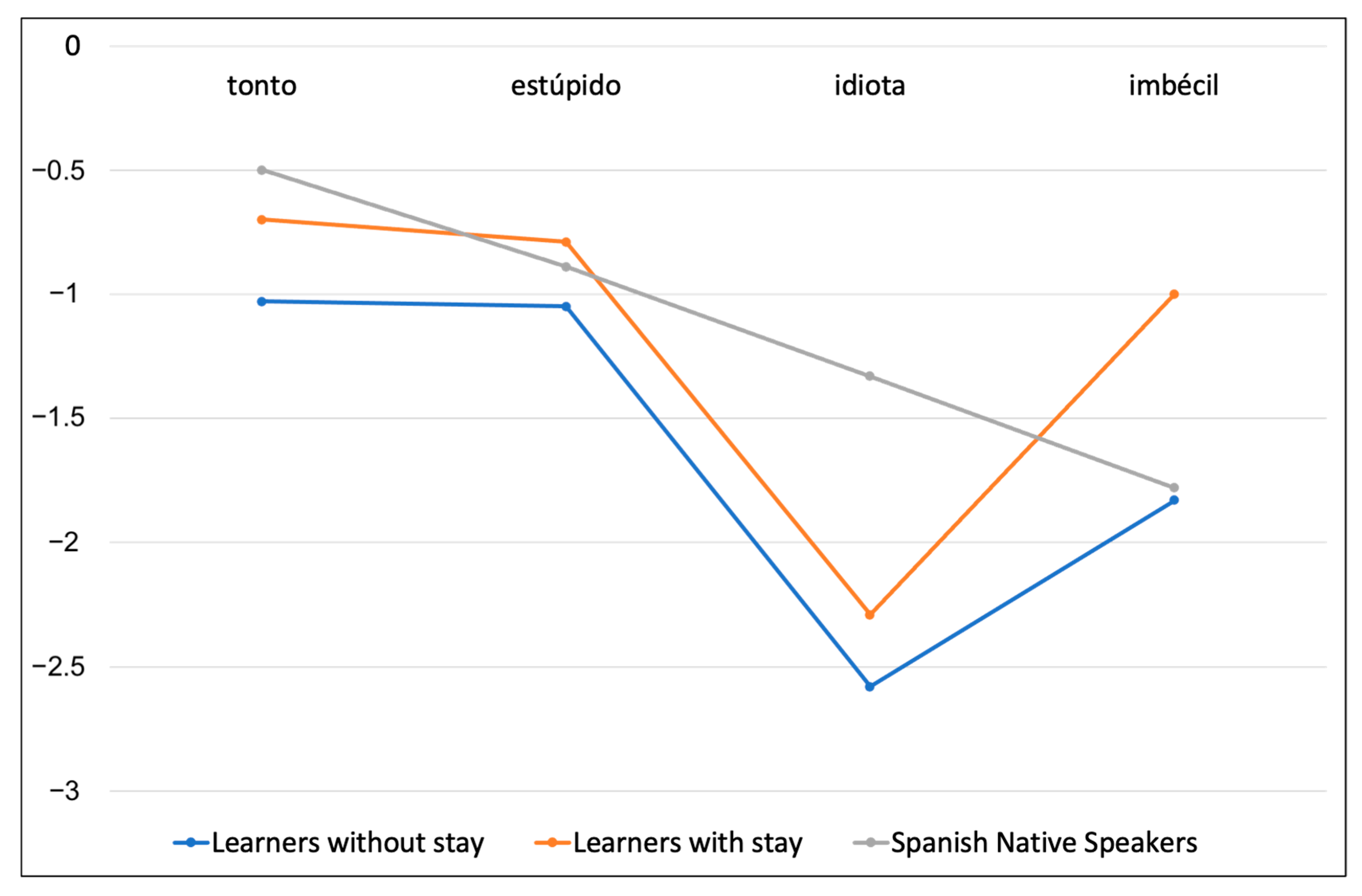
- For L1 speakers, the four terms form a clear progression in colloquiality: tonto (−0.5), estúpido (−0.89), idiota (−1.33), and imbécil (−1.78). This progression is represented as a descending line in Figure 1 (only the negative values, which frame the colloquial register, appear);
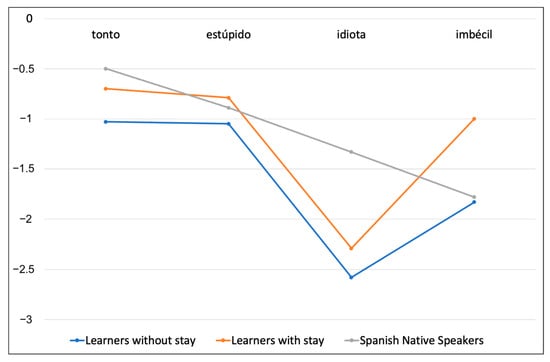 Figure 1. Recognition and perception of the series tonto/estúpido/idiota/imbécil (Fernández Jódar, 2021b).
 - In the group of Polish learners, this progression is less evident. The terms tonto and estúpido are perceived as equivalent in terms of colloquial weight: −1.03 and −1.05 (no stay) and −0.7 and −0.79 (with stay);
- The term idiota is considered more offensive and carries a stronger colloquial load compared to the previous terms, specifically tonto and estúpido, among both L1 speakers and Polish learners. This result was observed for all groups, but the perception was particularly noticeable among Polish learners without stays in Spanish-speaking countries, where the term idiota was rated as more offensive than the other two terms.
The difference in perception among Polish learners can be explained by the translation of tonto and estúpido into Polish as głupi, which does not distinguish shades of severity similar to those observed in Spanish. Additionally, the results show that learners with stays in Spanish-speaking countries tend to align more closely with L1 speakers’ values, although they do not fully replicate the exact progression.
Based on the observations discussed earlier, the perceived colloquiality identified is as follows:
- L1 speakers: tonto < estúpido < idiota < imbécil;
- Polish learners (C1): tonto = estúpido < imbécil < idiota.
These results demonstrate that differences in the perception of insulting vocabulary can be attributed both to the linguistic structures of the L1 and the lack of exposure to informal contexts in the L2. They also highlight the interaction between colloquial and emotional weight in the interpretation of these terms. Additionally, the results indicated that all groups exhibited a high level of familiarity with intellect-related terms, rendering further analysis of these terms unnecessary. In contrast, the terms related to sexuality displayed greater variability in recognition and perceived offensiveness, which warranted a more focused examination to better understand the differences in learners’ perceptions. The following section will address vocabulary related to sexuality to further explore these differences.
6.2. Sexuality
As in the previous case, the repertoire of insults related to sexuality is extensive (Celdrán Gomáriz, 1995). In this analysis, we focus on the series mariquita (fool, also a diminutive term implying effeminacy), marica (fag, a derogatory term for a homosexual man), maricón (faggot, a stronger insult for a homosexual man, a combination of marica with the augmentative suffix -ón), and mariconazo (a combination of marica and two augmentative suffixes, -ón and -azo, implying an even more intense insult) to determine whether the morphological differences between these terms influence their colloquial weight and whether these differences are perceived by Polish learners. This perception encompasses any linguistic element, including morphological features, as discussed earlier in the article.
Firstly, the Diccionario de la lengua Española (Real Academia Española, 2020) describes these terms with the following characteristics:
- Mariquita: Colloquial, derogatory, and vulgar;
- Marica: Derogatory and vulgar;
- Maricón: Derogatory, vulgar, and classified as an insult;
- Mariconazo: Not listed in the dictionary.
These definitions suggest a progression in derogatory weight, with mariquita as the least offensive term and maricón as the most strongly marked insult. The term mariconazo, not being listed in the dictionary, poses an additional challenge for learners.
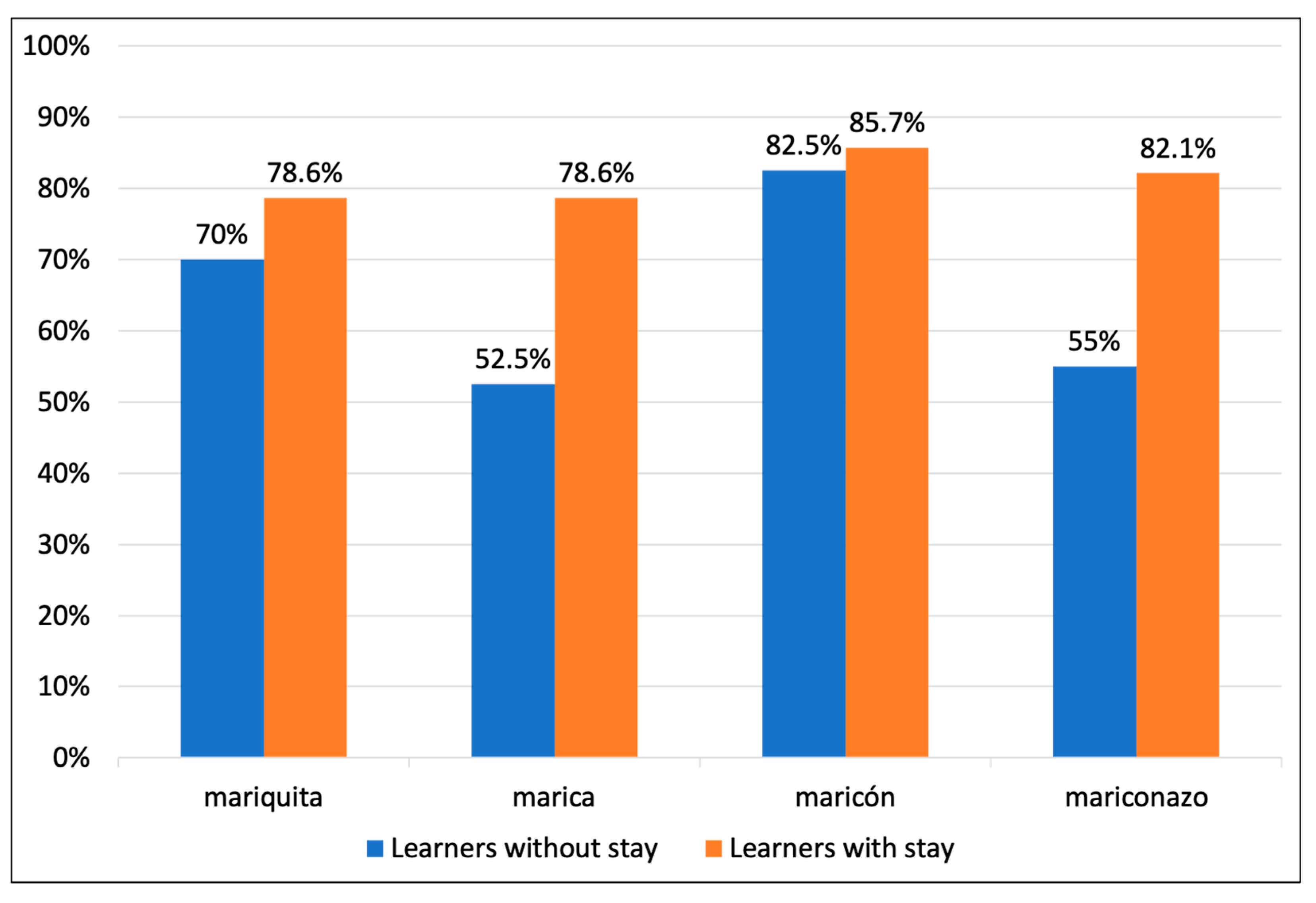
Regarding knowledge results, as reflected in Figure 2 (Fernández Jódar, 2021b), Polish learners of Spanish without stays abroad exhibit a high degree of unfamiliarity with marica and mariconazo. However, a stay in Spanish-speaking countries improves overall knowledge of all four terms. Notably, maricón is the best-known term among both groups of learners.
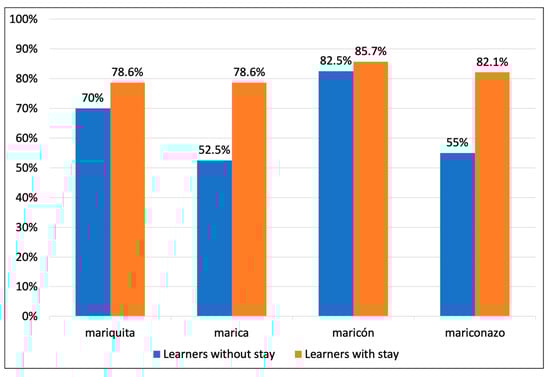
Figure 2.
Knowledge of the series mariquita/marica/maricón/mariconazo (Fernández Jódar, 2021b).
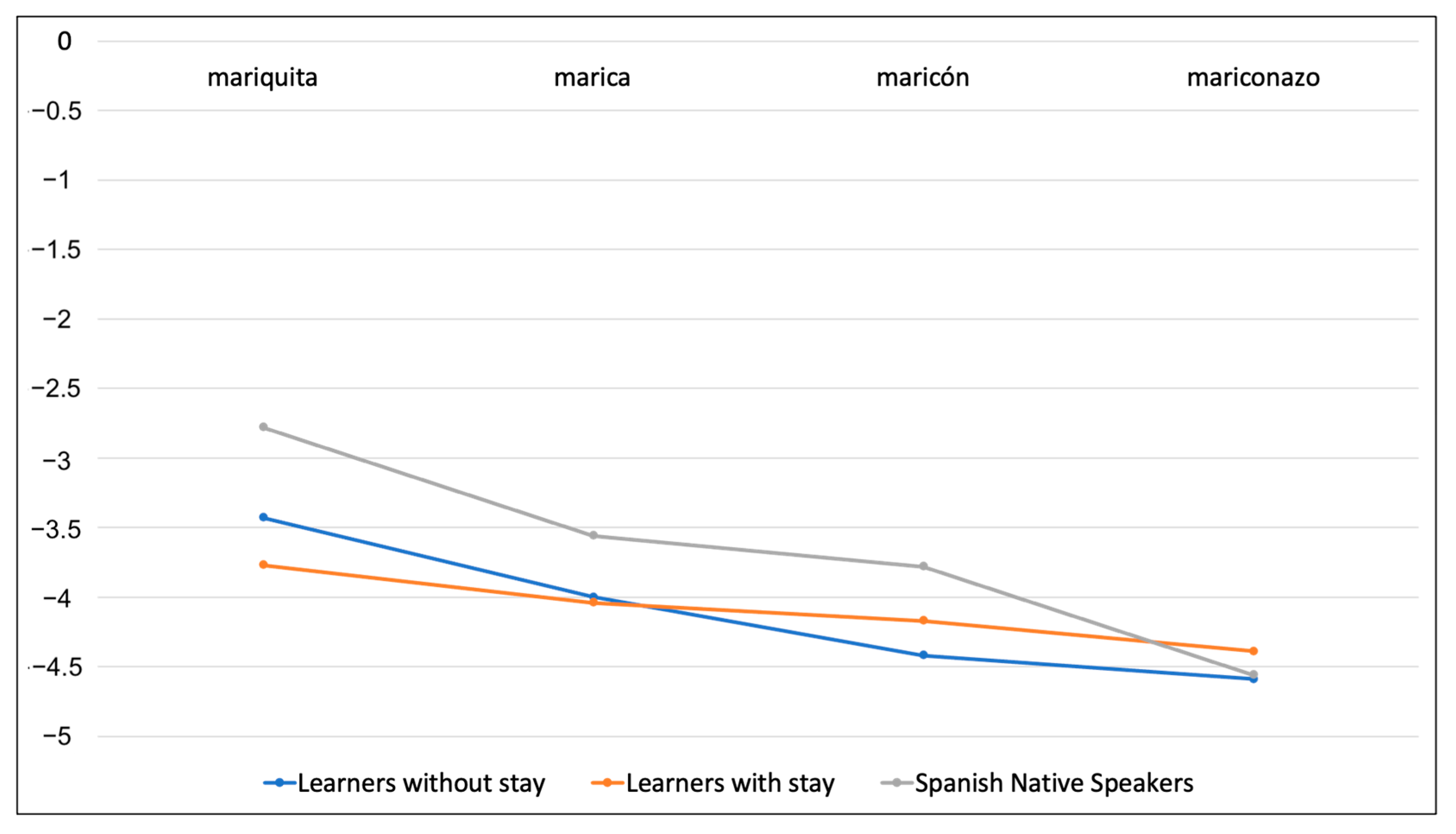
Regarding the results for recognition and perception, Figure 3 (Fernández Jódar, 2021b) indicates that all three groups perceive the four terms as colloquial, assigning them clearly negative values. However, a progression is observed, with mariquita being the least derogatory term and mariconazo the most offensive. This pattern suggests that the double augmentative suffix in mariconazo intensifies its derogatory connotation compared to the single augmentative suffix in maricón.
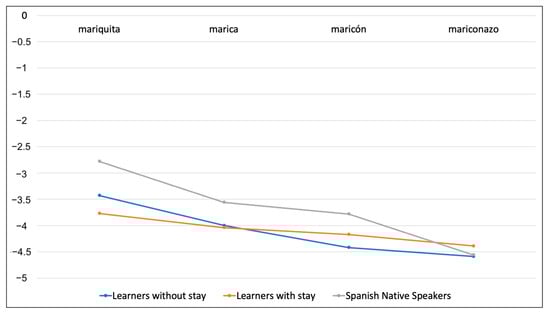
Figure 3.
Recognition and perception of the series mariquita/marica/maricón/mariconazo (Fernández Jódar, 2021b).
Furthermore, concerning the perception among Polish learners, they tend to attribute a higher degree of colloquiality, emotionality, and negative judgment to terms related to sexuality. This tendency is particularly evident in the case of mariconazo, where their evaluations align closely with those of L1 speakers.
The analyzed results reveal a clear progression in the derogatory intensity of terms related to sexuality, with the following pattern:
- L1 speakers: mariquita < marica < maricón < mariconazo;
- Polish learners (C1): mariquita < marica < maricón < mariconazo.
This pattern highlights how morphology influences the perception of derogatory intensity, with augmentatives intensifying the offensive tone. Additionally, the data show that Polish learners tend to assign higher emotional and negative values to these terms compared to L1 speakers, underscoring the importance of cultural context and pragmatic exposure in the acquisition of this type of vocabulary.
6.3. Contrasting Offensive Load Between Spanish and Spanish as a Foreign Language for Polish Learners
In the article “Cunt: On the perception and handling of verbal dynamite by L1 and LX users of English” (Dewaele, 2018), the term cunt, considered one of the most offensive insults in English, was analyzed. This study examined the comprehension, offensive charge, and frequency of use of the term among native and non-native speakers, highlighting significant differences between the two groups. Dewaele concluded that L2 speakers perceive the offensive charge less accurately and use the term less frequently than L1 speakers and that these differences depend on factors such as the context of acquisition, oral proficiency, and cultural exposure.
Inspired by this approach, our study analyzes the perception of insult-related vocabulary among Polish learners of Spanish. Although the sample size limits the analysis of sociodemographic variables, participants were selected based on their homogeneous profile as university students of similar age, allowing for a representative approximation of insult usage in formal contexts.
Thus, inspired by Dewaele (2018), we present a list of insults ordered by offensive charge and include data related to insults associated with behavior, which were previously presented and analyzed in Fernández Jódar (2021b), highlighting the evolving nature of L2 pragmatic competence (Roever, 2011). The results show that terms related to sexuality exhibit a higher negative charge, followed by insults related to behavior and intellect. This analysis confirms that emotional charge complements and nuances the perception of colloquiality, especially among SFL learners. The results are summarized in Table 1.

Table 1.
List of insults ranked from highest to lowest offensive load.
Key Findings:
- Insults related to sexuality exhibit the highest negative charge across all three groups. Among them, mariconazo and hijo de puta consistently rank at the top;
- Insults related to behavior and intellect tend to occupy lower positions on the list, indicating a less offensive charge.
Table 2 provides a comparative summary of the perceived offensive load in the analyzed insults, grouped into three categories: sexuality, behavior, and intellect. The results show that, across the three groups, insults related to sexuality are perceived as the most offensive, while terms associated with behavior and intellect are considered less aggressive. Moreover, Polish learners of Spanish with stays in Spanish-speaking countries tend to assess the offensive load more similarly to L1 speakers, particularly in the behavior and intellect categories, suggesting greater pragmatic sensitivity derived from cultural exposure.
Table 2.
Summary by category.
7. Discussion
The results of this study confirm and extend previous findings regarding the perception of insult-related vocabulary in second language acquisition, particularly in intercultural contexts where pragmatic and emotional factors play a crucial role. Consistent with earlier research (Fernández Jódar, 2021b; Dewaele, 2018), the data indicate that L2 learners—specifically Polish learners of Spanish—tend to assign a higher offensive value to many insults than L1 speakers do, especially in terms related to behavior and intellect. This tendency can be attributed to interference from the learners’ L1 and limited exposure to informal registers in the target language.
One of the central findings is the perceptual gap between learners and L1 speakers, which narrows significantly when learners have experienced cultural immersion through stays in Spanish-speaking countries. This observation reinforces the hypothesis that direct exposure to naturalistic contexts facilitates the development of pragmatic sensitivity and sociolinguistic competence, aligning L2 users’ perceptions more closely with those of L1 speakers. Such alignment is especially notable in the recognition and evaluation of colloquial terms, which are often underrepresented in formal language instruction but omnipresent in real-world interactions.
Additionally, this study highlights the influence of morphological gradation in shaping the perception of offensiveness. The analysis of the series mariquita/marica/maricón/mariconazo demonstrates that augmentative suffixes significantly intensify the perceived derogatory load of terms. This finding aligns with prior research on the pragmatic effects of morphology in colloquial speech (Celdrán Gomáriz, 1995), and it suggests that learners are sensitive to these gradations, even in the absence of contextual clues. Nonetheless, Polish learners of Spanish generally attribute greater emotional intensity to sexuality-related insults, which could stem from cultural differences in how such terms are perceived and used.
Furthermore, the results contribute to the growing body of evidence that insults serve multifunctional purposes, not solely offensive, but also affiliative, emphatic, or humorous, depending on context and intent (Mateo & Yus, 2013). The lack of contextual cues in the survey design allowed for the evaluation of intrinsic perceptions, but it also points to the necessity of studying how learners interpret these terms in situational discourse.
In sum, these findings underscore the importance of pragmatic socialization in both formal instruction and informal exposure and invite further reflection on how emotional and cultural factors intersect in the acquisition of potentially offensive vocabulary in L2 contexts.
8. Conclusions
The results obtained in this study are consistent with previous research on the perception of emotionally charged and offensive language by L2 speakers in other linguistic contexts (Dewaele, 2015, 2016, 2018). As in those studies, non-native speakers tend to assign a higher emotional and offensive value to taboo expressions compared to L1 speakers, a pattern that reflects the influence of interlanguage and limited exposure to informal registers. These cross-linguistic similarities highlight the universal role of cultural immersion and pragmatic competence in shaping L2 learners’ interpretations, and they underscore the importance of targeted pedagogical interventions in foreign language instruction.
Drawing from the analysis presented, the following conclusions can be established:
- Insults related to sexuality are consistently rated as the most offensive across all groups, including both L1 speakers and L2 learners, suggesting a universally higher emotional load associated with this semantic field.
- Polish learners of Spanish tend to perceive insults, particularly those related to behavior and intellect, as more offensive than L1 speakers. This discrepancy is likely due to the influence of their L1 and the lack of exposure to colloquial Spanish.
- Cultural immersion, through stays in Spanish-speaking countries, significantly enhances learners’ knowledge and recognition of insult-related vocabulary and leads to perceptual evaluations that more closely approximate those of L1 speakers (Kramsch, 1993).
- Morphological markers, especially augmentative suffixes, have a demonstrable impact on the perceived intensity of insults, with L2 learners exhibiting sensitivity to such gradations, though often attributing a higher degree of offensiveness than L1 speakers.
These conclusions highlight the complexity of acquiring and interpreting colloquial and emotionally charged vocabulary in a second language and emphasize the relevance of contextual and cultural factors in this process (Tomasello, 2005). Building on these findings, future research could further explore how learners from different L1 backgrounds perceive and use offensive vocabulary in Spanish, allowing for broader cross-linguistic comparisons. Such studies would contribute to a more comprehensive understanding of the universal and language-specific factors that shape the acquisition of pragmatically sensitive expressions, thereby informing both linguistic theory and applied pedagogy in multilingual contexts.
8.1. Pedagogical Implications
Given the discrepancies observed between L1 speakers and learners, particularly those without cultural immersion, it is clear that explicit instruction on colloquial registers and pragmatically sensitive vocabulary should be integrated into SFL curricula (Byram, 2020). However, rather than merely highlighting the need for such instruction, it is essential to provide concrete strategies for its implementation. Educators should focus on guiding learners through the three key concepts of colloquial registers: context, contrast, and consciousness.
Incorporating these concepts into lesson design could involve tasks that prompt learners to reflect on contextual appropriateness without requiring explicit linguistic knowledge to better navigate intercultural communication (Ting-Toomey & Dorjee, 2018). For instance, role-playing activities, analysis of authentic discourse, and media exposure can help students distinguish between various registers and develop the ability to navigate different social situations. By encouraging learners to contrast the linguistic forms they already know with those they are still acquiring, teachers can foster awareness of when certain expressions are appropriate, both within the target language and in comparison with learners’ native languages.
Furthermore, tasks could include exercises that prompt students to reflect on their existing knowledge of colloquial language, even if they are not consciously aware of how to categorize it. For example, revisiting the use of proverbs or informal expressions could help learners correct fossilized errors and increase their sociocultural awareness. By integrating these activities into SFL curricula, learners can gradually build both their lexical knowledge and pragmatic competence, ultimately improving their ability to communicate effectively and appropriately in various social and emotional contexts (Liddicoat & Scarino, 2013).
8.2. Limitations and Future Research
While this study offers valuable insights, certain limitations must be acknowledged. The sample size, although sufficient for exploratory purposes, restricts broader generalizations, and variables such as age, gender, and sociocultural background were not analyzed in depth. Future research could address these aspects, providing a more comprehensive understanding of how individual differences influence the perception and use of insult-related vocabulary.
Moreover, longitudinal studies observing learners before and after extended immersion experiences would shed light on the evolution of pragmatic competence in real time. Comparative research across other L1–L2 pairings could also help determine the extent to which these findings are specific to Polish learners of Spanish or reflect broader patterns in second language acquisition.
In any case, the data presented here underscore the critical role of cultural context, interlanguage dynamics, and pragmatic exposure in shaping how L2 learners perceive and use offensive vocabulary. Addressing these dimensions in both research and pedagogy is essential to fostering effective and socially appropriate communication in the target language.
Funding
This research received no external funding.
Institutional Review Board Statement
Not applicable.
Informed Consent Statement
Informed consent was obtained from all subjects involved in this study.
Data Availability Statement
Data are available on request due to privacy reasons.
Conflicts of Interest
The author declares no conflicts of interest.
Abbreviations
The following abbreviations are used in this manuscript:
| L1 | First Language |
| L2 | Second Language |
| SFL | Spanish as a Foreign Language |
References
- Alonso Saralegui, M., & Mavrou, I. (2018). Percepciones sobre el significado emocional y las lenguas preferidas para tratar temas emocionales en hablantes bilingües y multilingües. Revista Nebrija de Lingüística Aplicada, 12(25), 59–95. [Google Scholar]
- Bardovi-Harlig, K. (2001). Evaluating the empirical evidence: Grounds for instruction in pragmatics? Pragmatics in Language Teaching, 13–32. [Google Scholar] [CrossRef]
- Bardovi-Harlig, K., & Hartford, B. S. (2005). Interlanguage pragmatics: Exploring institutional talk. Routledge. [Google Scholar]
- Briz Gómez, A. (1995). La conversación coloquial. Materiales para su estudio. Edicions de la Universitat de València. [Google Scholar]
- Briz Gómez, A. (1996). El español coloquial. Situación y uso. Arco Libros. [Google Scholar]
- Briz Gómez, A., Gómez Molina, J. R., Martínez Alcalde, M. J., & Grupo Val. Es. Co. (1997). Pragmática y gramática del español hablado. El español coloquial. Pórtico. Available online: http://www.luiscortesrodriguez.es/wp-content/uploads/2014/11/Pragm%C3%A1tica-y-gram%C3%A1tica-del-Estado-hablado.pdf (accessed on 29 March 2025).
- Brown, P., & Levinson, S. C. (1987). Politeness: Some universals in language usage. Cambridge University Press. [Google Scholar]
- Byram, M. (2020). Teaching and assessing intercultural communicative competence: Revisited. Multilingual Matters. [Google Scholar]
- Celdrán Gomáriz, P. (1995). Inventario general de insultos. Ediciones del Prado. [Google Scholar]
- Chamizo Domínguez, P. J. (2008). Tabú y lenguaje: Las palabras vitandas y la censura lingüística. Thémata: Revista de filosofía, 40, 31–46. [Google Scholar]
- Colín Rodea, M. (2005). Modelo interpretativo del insulto. Estudios de Lingüística Aplicada, 23(41), 13–37. [Google Scholar]
- Culpeper, J. (1996). Towards an anatomy of impoliteness. Journal of Pragmatics, 25(3), 349–367. [Google Scholar] [CrossRef]
- Dewaele, J. M. (2015). British ‘Bollocks’ versus American ‘Jerk’: Do native British English speakers swear more -or differently- compared to American English speakers? Applied Linguistic Review, 6, 309–339. [Google Scholar] [CrossRef]
- Dewaele, J. M. (2016). Thirty shades of offensiveness: L1 and LX English users’ understanding, perception and self-reported use of negative emotion-laden words. Journal of Pragmatics, 94, 111–127. [Google Scholar] [CrossRef]
- Dewaele, J. M. (2018). Cunt: On the perception and handling of verbal dynamite by L1 and LX users of English. Multilingua, 37(1), 53–81. [Google Scholar] [CrossRef]
- Doughty, C. J., & Long, M. H. (Eds.). (2008). The handbook of second language acquisition. John Wiley & Sons. [Google Scholar]
- Fernández Jódar, R. (2015). El español coloquial en la clase de E/LE en contexto académico. Teoría y práctica. In E. Stala, R. S. Balches, & C. Tatoj (Eds.), Tendencias en la enseñanza de español LE: Perspectivas glotodidácticas y metodológicas contemporáneas (pp. 277–296). Ksiegarnia Akademicka. [Google Scholar] [CrossRef]
- Fernández Jódar, R. (2020). Reconocimiento y percepción del registro coloquial español en alumnos polacos: El caso de los pro-verbos. In W. Nowikow, A. M. L. González, M. A. Pawlikowska, M. Baran, & W. Sobczak (Eds.), Lingüística hispánica teórica y aplicada: Estudios léxico-gramaticales, didácticos y traductológicos (pp. 77–92). Wydawnictwo Uniwersytetu Łódzkiego. [Google Scholar] [CrossRef]
- Fernández Jódar, R. (2021a). El estudio contrastivo-pragmático entre primeras y segundas lenguas de los registros formal y coloquial. Studia Romanica Posnaniensia, 48(2), 77–86. [Google Scholar] [CrossRef]
- Fernández Jódar, R. (2021b). La adquisición del léxico del insulto en L2. In I. Piernik, & M. Wicherek (Eds.), Langues romanes non standard (pp. 174–186). Uniwersytet Jagielloński w Krakowie. [Google Scholar]
- García-Medall, J. (2008). El insulto desde la pragmática intercultural. In A. Álvarez Tejedor (Ed.), Lengua viva: Estudios ofrecidos a César Hernández Alonso (pp. 667–680). Universidad de Valladolid. [Google Scholar]
- Gass, S. M., Behney, J., & Plonsky, L. (2020). Second language acquisition: An introductory course. Routledge. [Google Scholar]
- Gaviño Rodríguez, V. (2008). Español coloquial: Pragmática de lo cotidiano. Servicio de publicaciones de la Universidad de Cádiz. [Google Scholar] [CrossRef]
- Gómez Molina, J. R. (2002). El insulto en la interacción comunicativa: Estudio sociolingüístico. Oralia, 5, 103–132. [Google Scholar] [CrossRef]
- Grice, H. P. (1988). Utterer’s meaning, sentence-meaning, and word-meaning. In Philosophy, language, and artificial intelligence: Resources for processing natural language (pp. 49–66). Springer. [Google Scholar]
- Grice, H. P. (1991). Studies in the way of words. Harvard University Press. [Google Scholar]
- Hernández, G. (2014). Manifestación de la descortesía y anticortesía en jóvenes de la provincia de Buenos Aires, Argentina: Usos y representaciones de “malas palabras” e insultos. Signo y Seña, 26, 23–47. [Google Scholar] [CrossRef]
- Ilie, C. (2001). Unparliamentary Language: Insults as Cognitive Forms of Ideologycal Confrontation. In R. Dirven, F. Roslyn, & C. Ilie (Eds.), Language and ideology, II: Descriptive cognitive approaches (pp. 235–263). John Benjamins. [Google Scholar] [CrossRef]
- Jay, T. (2009). The utility and ubiquity of taboo words. Perspectives on Psychological Science, 4(2), 153–161. [Google Scholar] [CrossRef] [PubMed]
- Jucker, A., & Taavitsainen, I. (2000). Diachronic speech act analysis: Insults from flyting to flaming. Journal of Historical Pragmatics, 1(1), 67–95. [Google Scholar] [CrossRef]
- Kasper, G., & Blum-Kulka, S. (Eds.). (1993). Interlanguage pragmatics. Oxford University Press. [Google Scholar]
- Kramsch, C. (1993). Context and culture in language teaching. Oxford University Press. [Google Scholar]
- Liddicoat, A. J. (2021). An introduction to conversation analysis. Bloomsbury Publishing. [Google Scholar]
- Liddicoat, A. J., & Scarino, A. (2013). Intercultural language teaching and learning. John Wiley & Sons. [Google Scholar]
- Lisowska, M. (2010). La expresión verbal de las emociones negativas: El caso del insulto. Studia Romanica Posnaniensia, 37(2), 3–13. [Google Scholar] [CrossRef]
- Lisowska, M. (2012). Sobre el insulto y el léxico denigratorio. Neophilologica, 24, 167–176. [Google Scholar]
- Luque Durán, J. de D., Pamies Bertrán, A., & Manjón Pozas, F. J. (2000). Diccionario del insulto. Ediciones Península. [Google Scholar]
- Marchetti, P. (2017). Puto el que lee: Diccionario argentino de insultos, injurias e improperios. Planeta. [Google Scholar]
- Mateo, J., & Yus, F. (2013). Towards a Cross-Cultural Pragmatic Taxonomy of Insults. Journal of Language Aggression and Conflict, 1(1), 87–114. [Google Scholar] [CrossRef]
- Millán, J. A. (1999). Y yo en la tuya… El insulto y el genio de la lengua. Revista de Libros, 25, 28–30. [Google Scholar]
- Real Academia Española. (2020). Diccionario de la lengua española. Available online: http://www.rae.es (accessed on 25 June 2021).
- Roever, C. (2011). Testing of second language pragmatics: Past and future. Language Testing, 28(4), 463–481. [Google Scholar] [CrossRef]
- Taguchi, N. (2018). Contexts and pragmatics learning: Problems and opportunities of the study abroad research. Language Teaching, 51(1), 124–137. [Google Scholar] [CrossRef]
- Ting-Toomey, S., & Dorjee, T. (2018). Communicating across cultures. Guilford Publications. [Google Scholar]
- Tomasello, M. (2005). Constructing a language: A usage-based theory of language acquisition. Harvard University Press. [Google Scholar]
- Zimmermann, K. (2003). Constitución de la identidad y anticortesía verbal entre jóvenes masculinos hablantes de español. In D. Bravo (Ed.), Actas del primer coloquio del programa EDICE (pp. 47–59). Universidad de Estocolmo. [Google Scholar] [CrossRef]
- Zimmermann, K. (2005). Construcción de la identidad y anticortesía verbal: Estudio de conversaciones entre jóvenes masculinos. In D. Bravo (Ed.), Estudios de la (des)cortesía en español. Categorías conceptuales y aplicaciones a corpora orales y escritos (pp. 254–271). Dunken. [Google Scholar] [CrossRef]
Disclaimer/Publisher’s Note: The statements, opinions and data contained in all publications are solely those of the individual author(s) and contributor(s) and not of MDPI and/or the editor(s). MDPI and/or the editor(s) disclaim responsibility for any injury to people or property resulting from any ideas, methods, instructions or products referred to in the content. |
© 2025 by the author. Licensee MDPI, Basel, Switzerland. This article is an open access article distributed under the terms and conditions of the Creative Commons Attribution (CC BY) license (https://creativecommons.org/licenses/by/4.0/).