Real-Time Acceleration Estimation for Low-Thrust Spacecraft Using a Dual-Layer Filter and an Interacting Multiple Model



Abstract
1. Introduction
2. Dual-Layer Filter for Acceleration Estimation
2.1. Dynamic and Measurement Model
2.1.1. Dynamic Model
2.1.2. Measurement Model
2.2. Real-Time Estimation Filter
2.2.1. Square-Root Cubature Kalman Filter
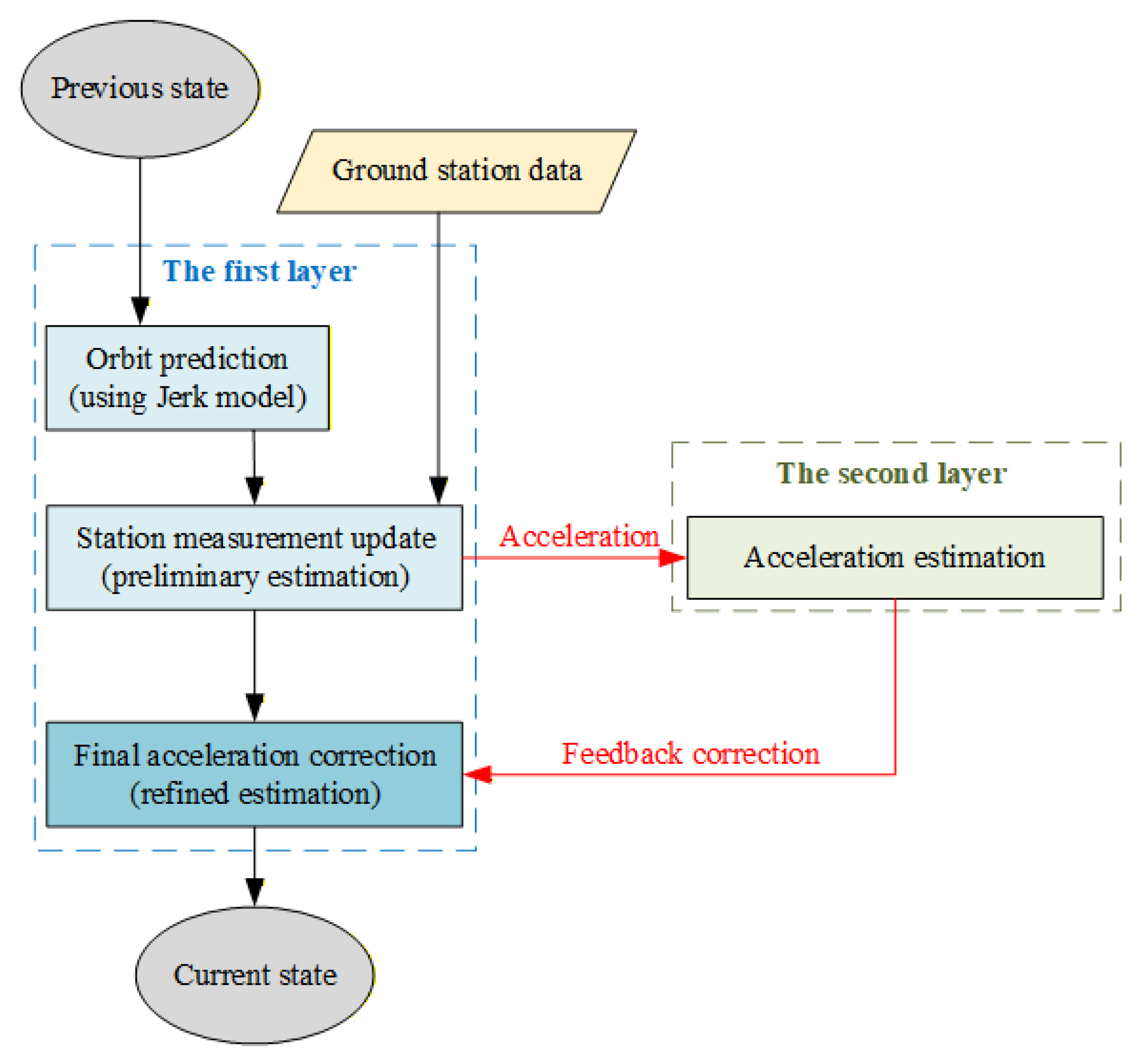
2.2.2. Dual-Layer Filter
2.2.3. IMM Algorithm
3. Simulation and Results
3.1. Simulation Setups
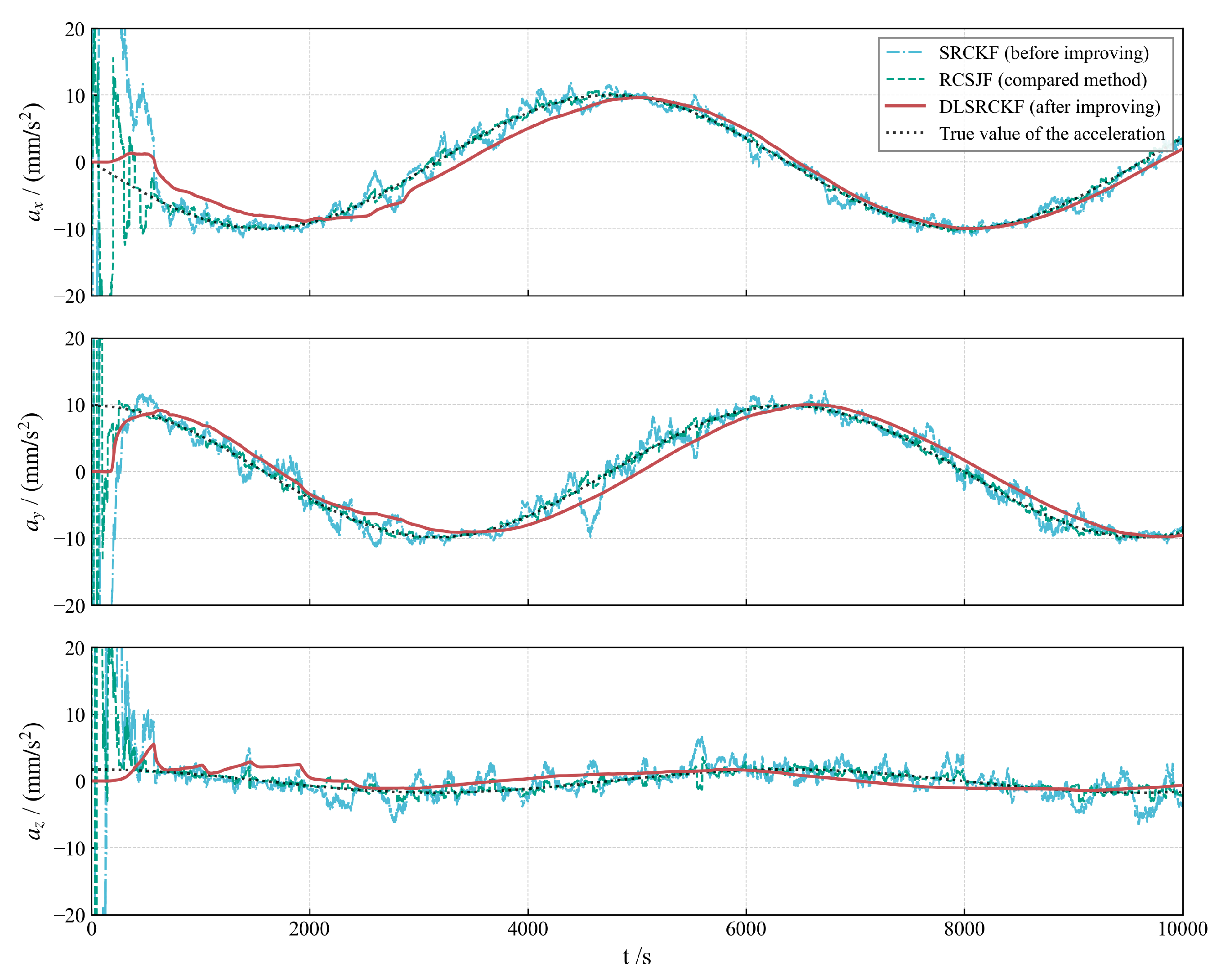
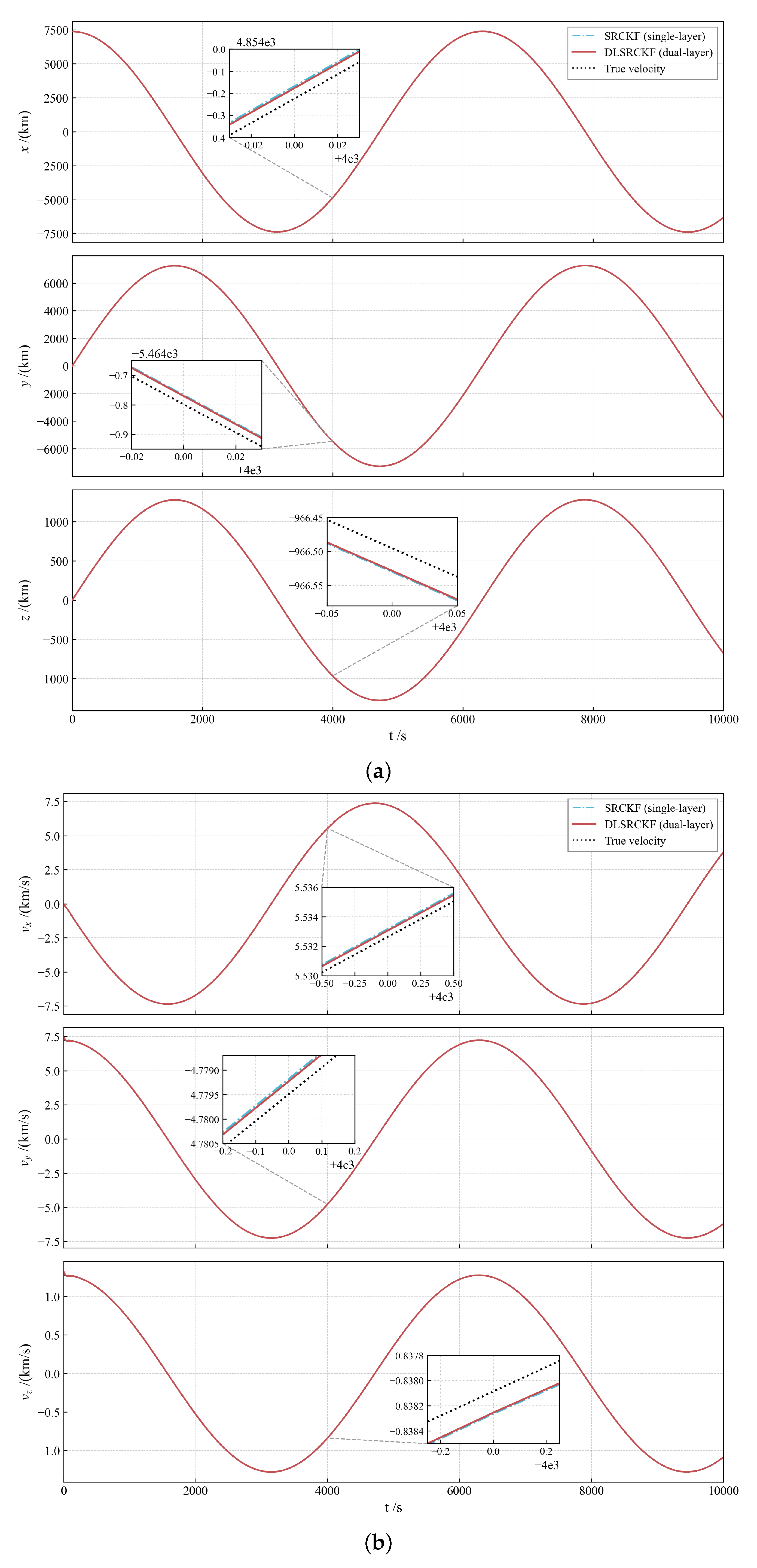
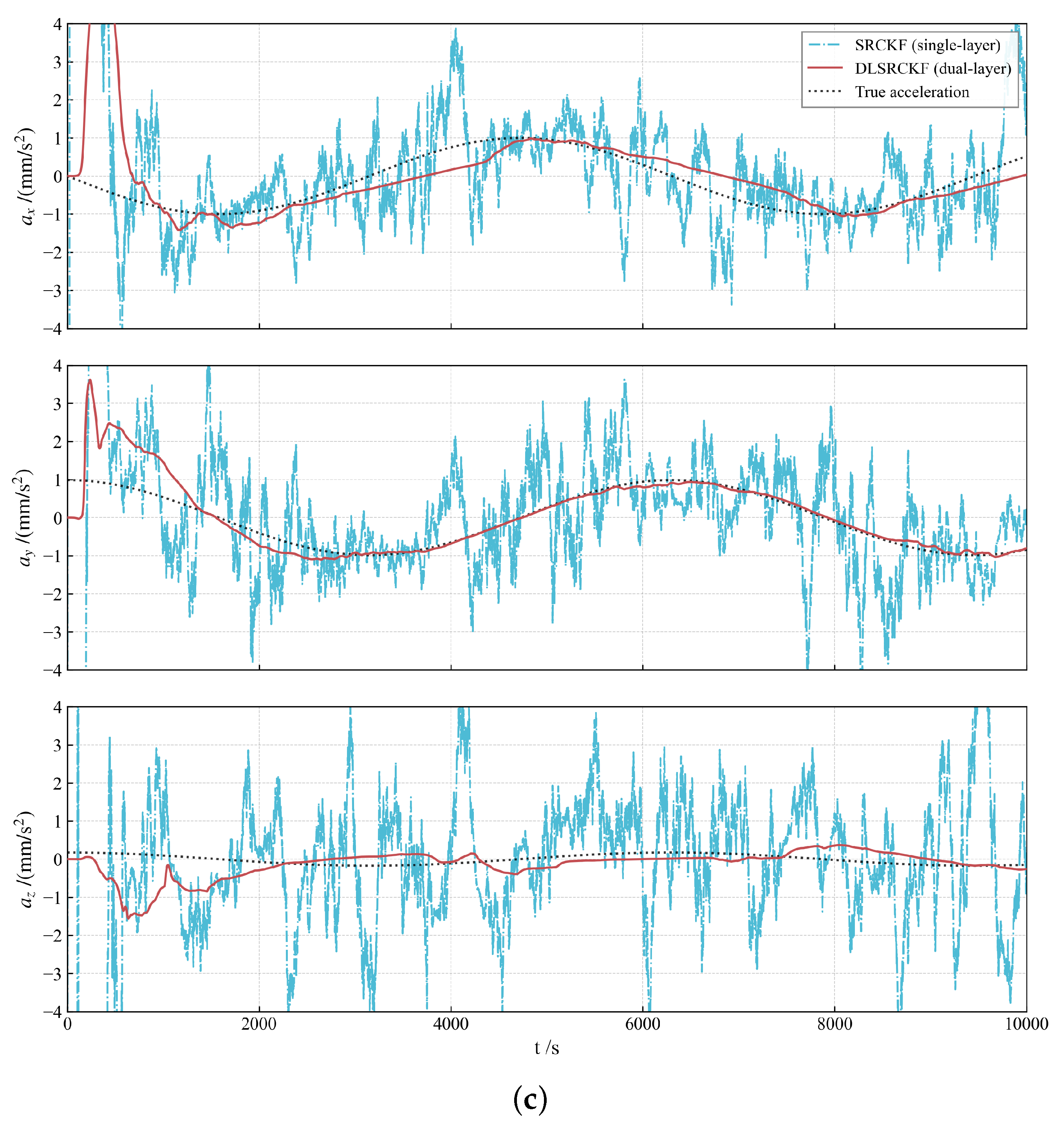
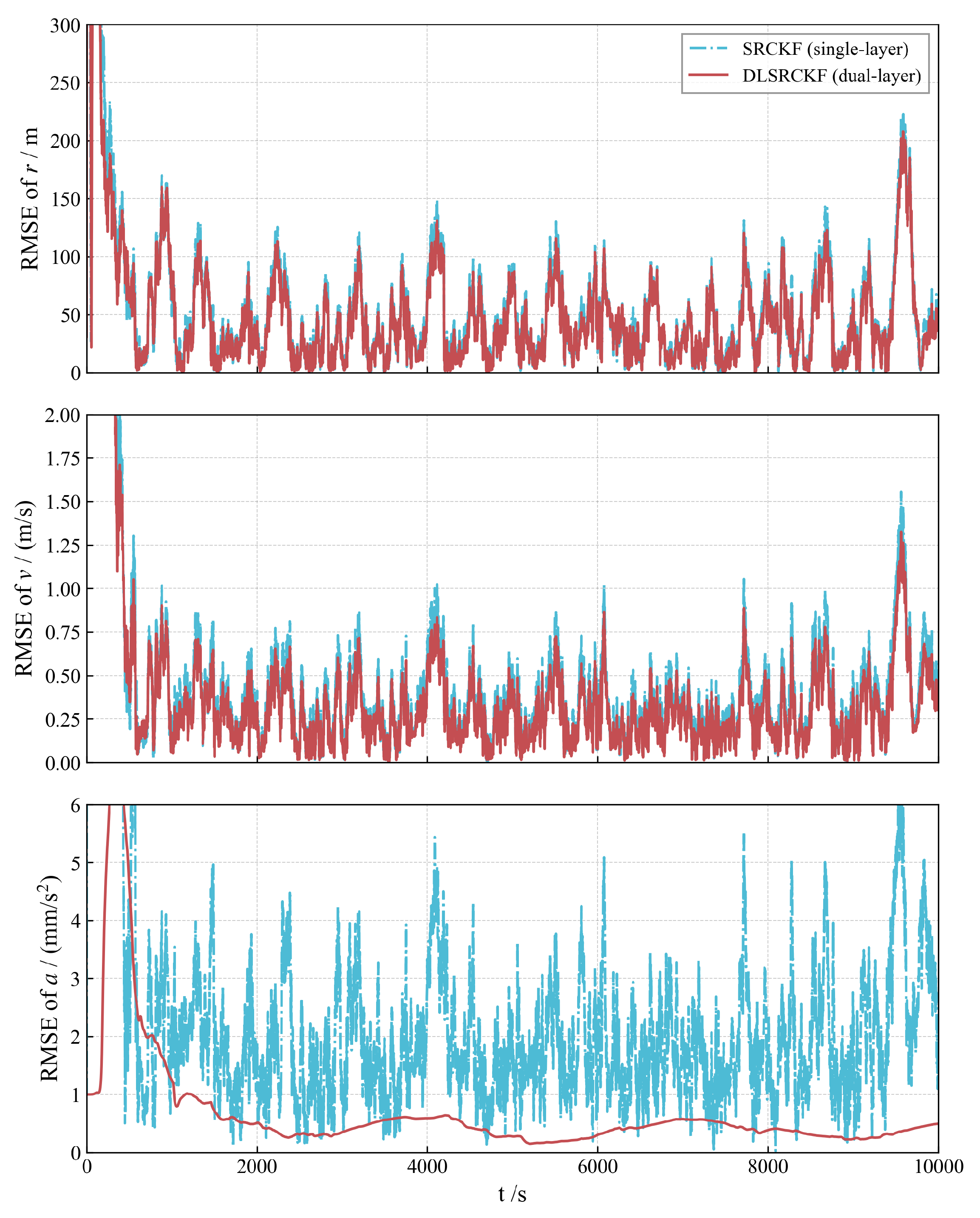
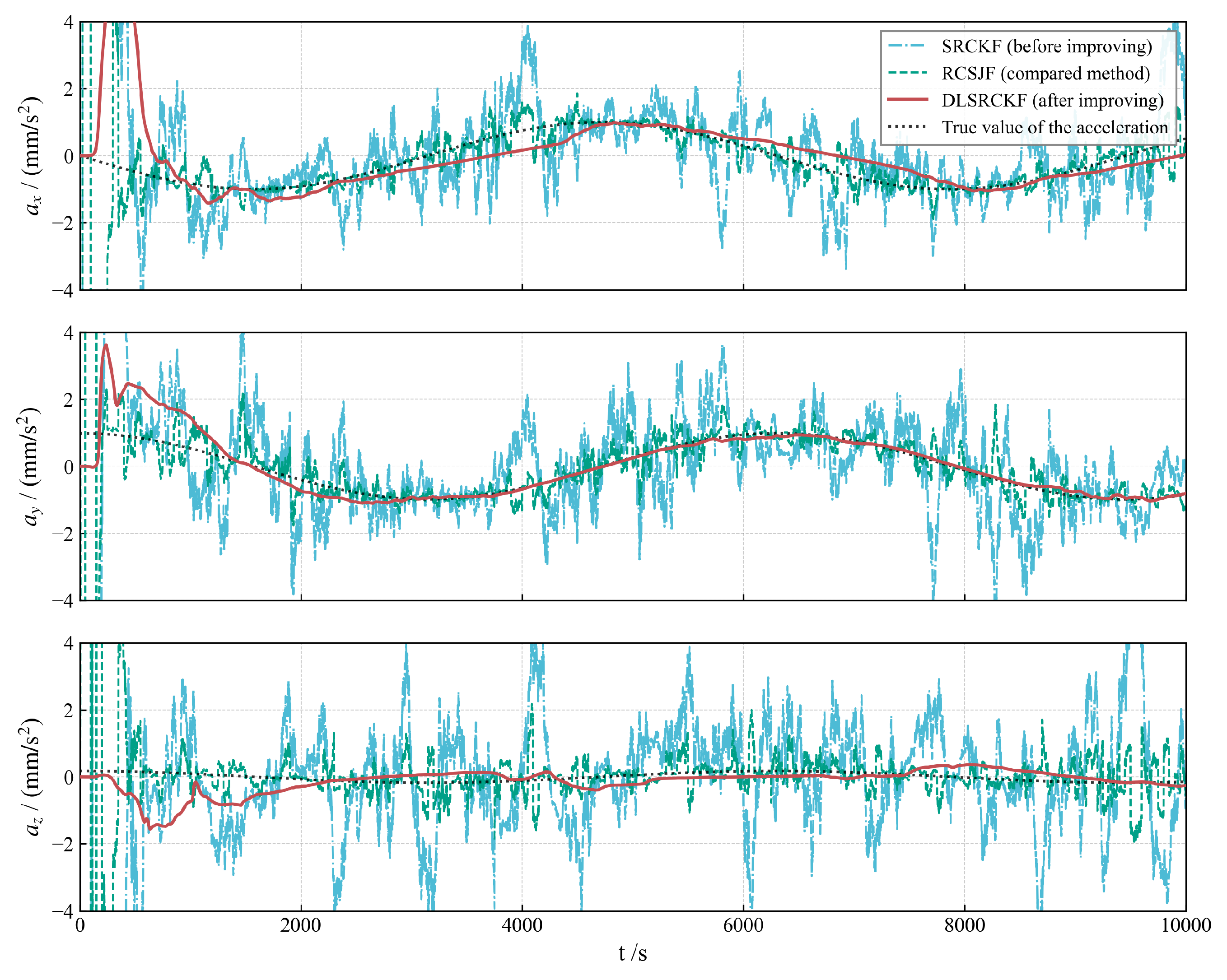
3.2. Validation of the Dual-Layer Filter
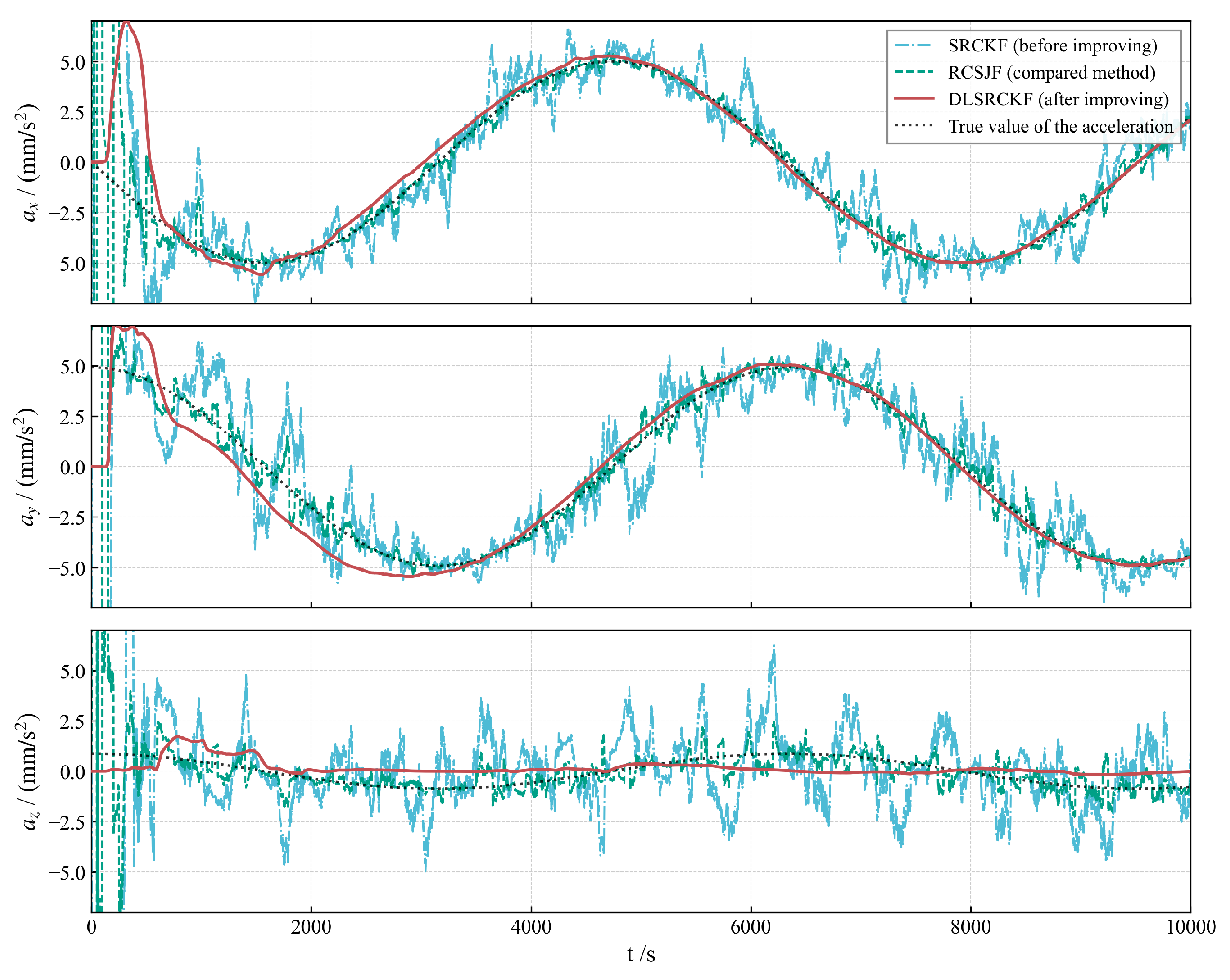
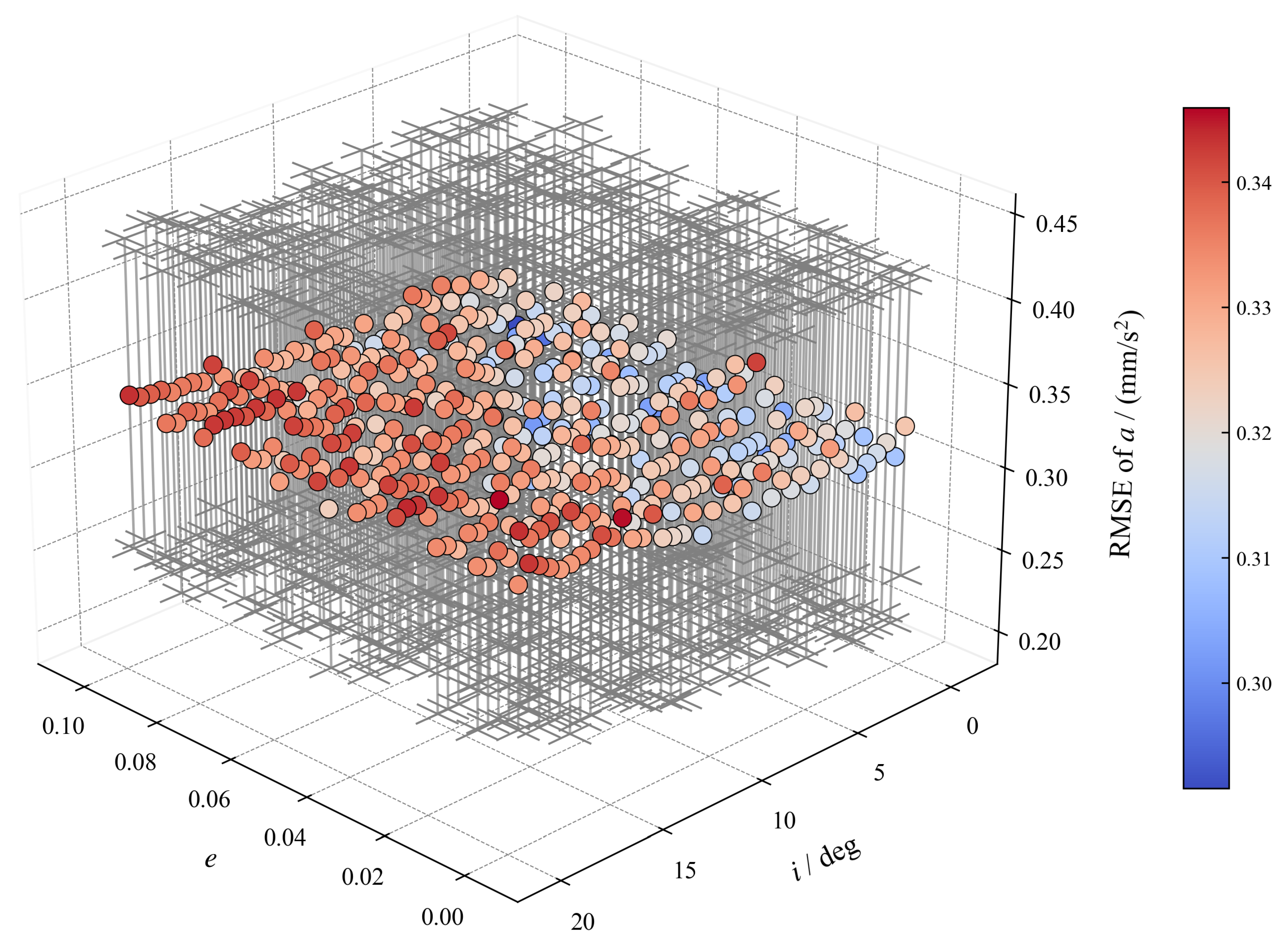
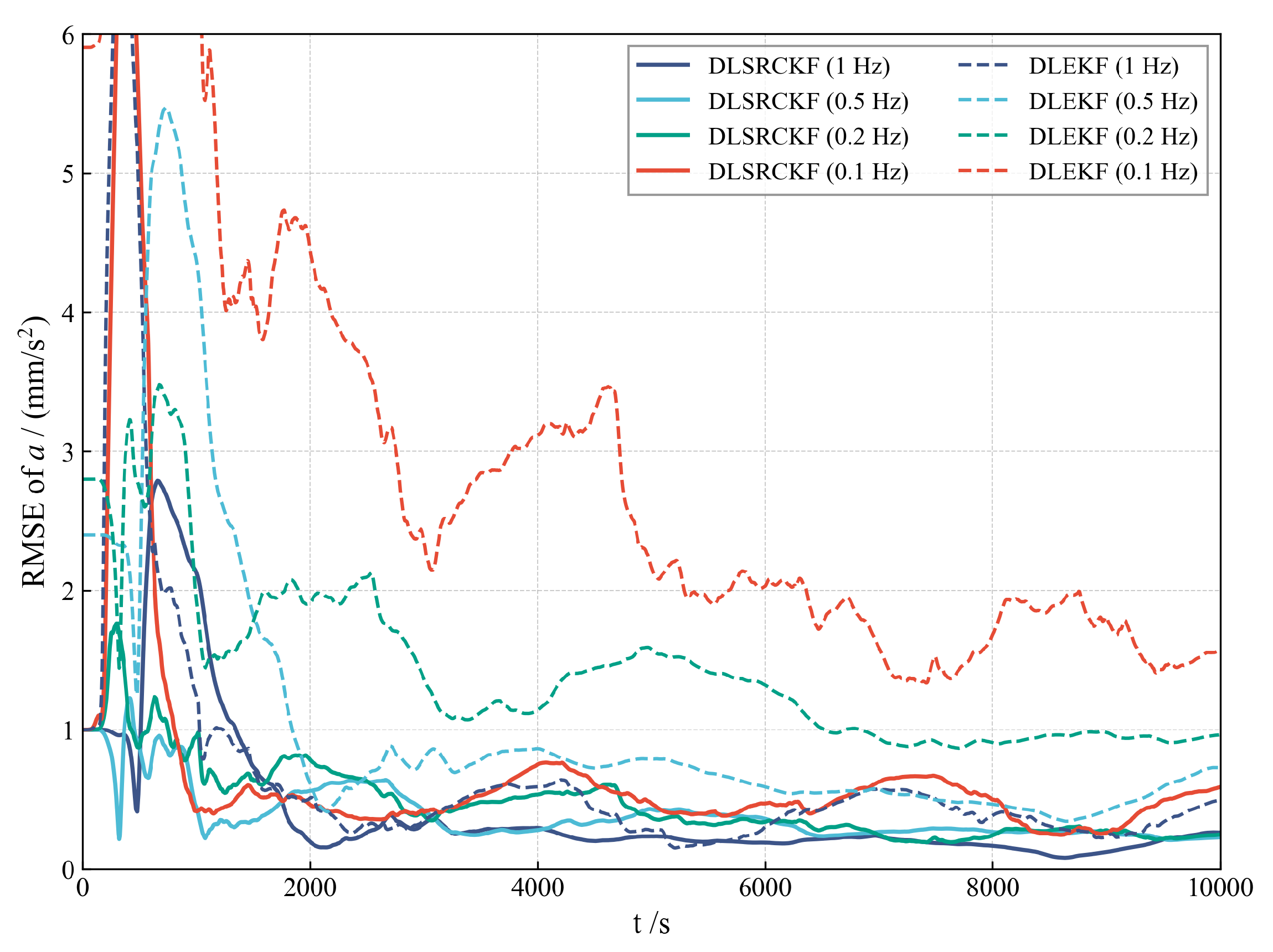
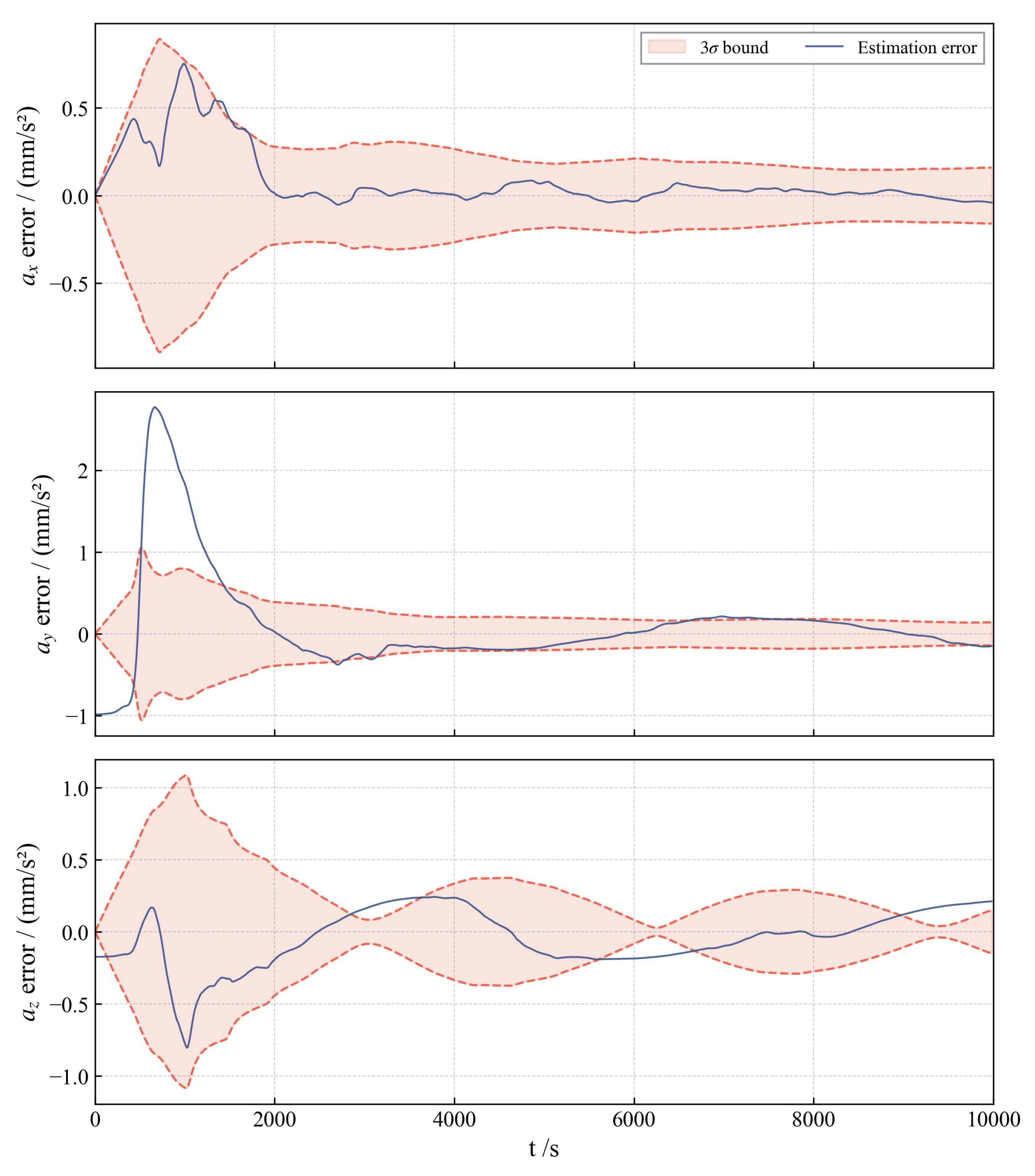
3.3. Robustness Analysis and Covariance Consistency Check
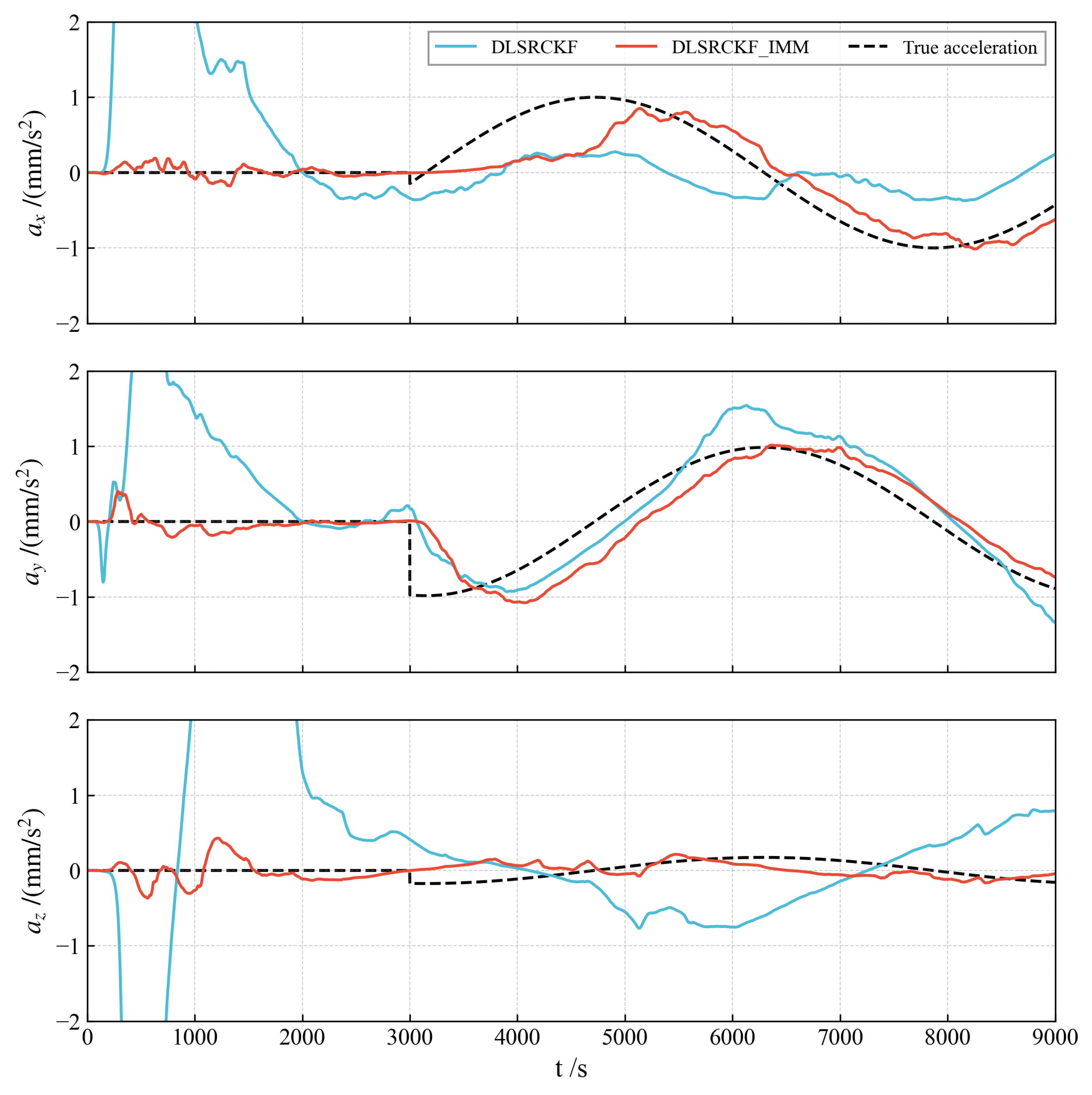
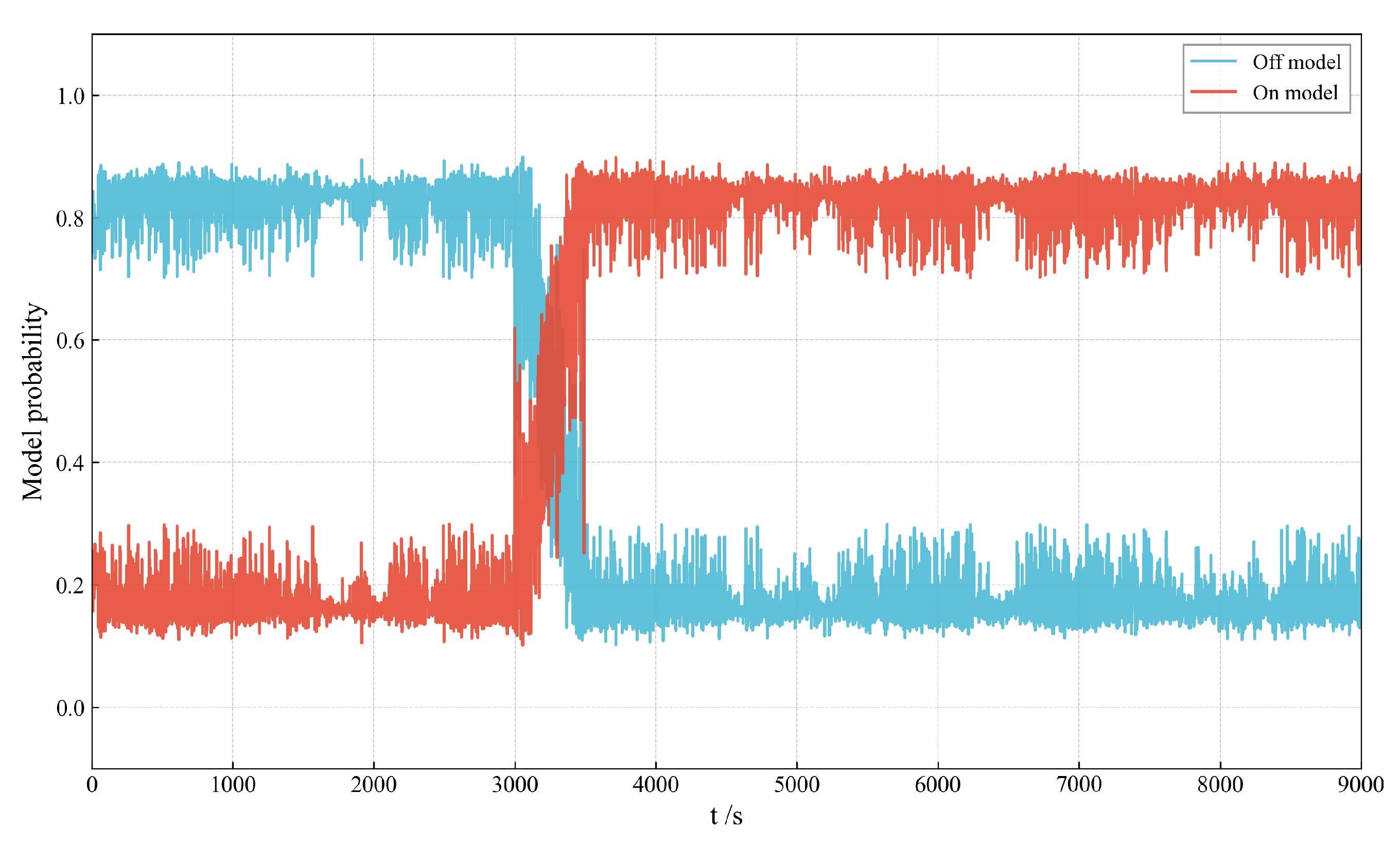
3.4. Validation of the IMM Algorithm Based on DLSRCKF
4. Conclusions
Author Contributions
Funding
Data Availability Statement
Conflicts of Interest
Abbreviations
| CKF | Cubature Kalman Filter |
| CS | Current Singer (Model) |
| DLSRCKF | Dual-Layer Square-Root Cubature Kalman Filter |
| ENU | East-North-Up (Coordinate System) |
| IMM | Interacting Multiple Model |
| LEO | Low Earth Orbit |
| RCSJF | Robust CS-Jerk Filtering |
| RMSE | Root Mean Square Error |
| SRCKF | Square-Root Cubature Kalman Filter |
| SSA | Space Situational Awareness |
| UKF | Unscented Kalman Filter |
| Latin Symbols | |
| a | Magnitude of low-thrust acceleration |
| Acceleration vector | |
| Maximum amplitude of thrust acceleration | |
| Perturbation acceleration vector due to Earth’s term | |
| A | Azimuth angle |
| e | Orbital eccentricity |
| E | Elevation angle |
| Nonlinear state transition function | |
| Process noise input matrix | |
| Nonlinear measurement function | |
| i | Orbital inclination |
| Identity matrix of dimension | |
| Jerk vector (rate of change of acceleration) | |
| Second-degree zonal harmonic coefficient of the Earth | |
| Kalman gain matrix | |
| k | Discrete time step index |
| Likelihood function | |
| M | Mean anomaly |
| Markov chain transition probability matrix | |
| m | Total number of cubature sigma points () |
| n | Dimension of the state vector |
| State error covariance matrix | |
| Process noise covariance matrix | |
| Continuous-time process noise intensity | |
| Position vector | |
| Semi-major axis | |
| Measurement noise covariance matrix | |
| Earth’s reference radius | |
| Coordinate transformation matrix from J2000 to ENU frame | |
| Square-root factor of the covariance matrix | |
| t | Time variable |
| Time step interval | |
| Velocity vector | |
| Process noise vector | |
| State vector | |
| Measurement residual vector | |
| Measurement vector | |
| Greek Symbols | |
| Maneuvering frequency of the Jerk model | |
| Model probability in IMM | |
| Mixing probability weight in IMM | |
| Longitude of the observation station | |
| Earth’s gravitational constant | |
| Cubature point vector | |
| Range | |
| Range rate | |
| Latitude of the observation station | |
| Phase angle of the periodic acceleration | |
| Right ascension of the ascending node (RAAN) | |
| Spacecraft orbital angular frequency | |
| Earth’s angular velocity vector | |
| Subscripts | |
| Indices identifying the first layer and second layer filters | |
| k | Discrete time step index |
| Posterior state estimation at time step k conditioned on measurement history up to time step k | |
| Prior state prediction at time step propagated by the dynamic model, conditioned on measurement history up to time step k | |
| L2 | Denoting the posterior state estimation of the second layer filter |
| off | Denoting the thrust-off mode |
| on | Denoting the thrust-on mode |
| proj | Denoting variables projected from the second layer back to the first layer’s space |
| Components along the axes in the reference frame | |
| Superscripts | |
| ∗ | Propagated cubature point vector after nonlinear transformation |
| XZ | Cross-covariance between the state vector and the measurement vector |
| ZZ | Innovation covariance of the measurement vector |
References
- Howell, E. Space Station Robotic Arm Hit by Orbital Debris in ‘Lucky Strike’. Space.com. 2021. Available online: https://www.space.com/space-station-robot-arm-orbital-debris-strike (accessed on 28 August 2025).
- ESA. ESA Spacecraft Dodges Large Constellation. European Space Agency. 2019. Available online: https://www.esa.int/Space_Safety/ESA_spacecraft_dodges_large_constellation (accessed on 28 August 2025).
- Kennewell, J.A.; Vo, B.-N. An overview of space situational awareness. In Proceedings of the 16th International Conference on Information Fusion, Istanbul, Turkey, 9–12 July 2013; IEEE: Piscataway, NJ, USA, 2013. [Google Scholar]
- Holzinger, M.; Scheeres, D. Applied Reachability for Space Situational Awareness and Safety in Spacecraft Proximity Operations. In AIAA Guidance, Navigation, and Control Conference; American Institute of Aeronautics and Astronautics: Reston, VA, USA, 2009. [Google Scholar]
- Sajjad, N.; Mirshams, M.; Hein, A.M. Spaceborne and ground-based sensor collaboration: Advancing resident space objects’ orbit determination for space sustainability. Astrodynamics 2024, 8, 325–347. [Google Scholar] [CrossRef]
- Wang, B.; Li, S.; Mu, J.; Hao, X.; Zhu, W.; Hu, J. Research Advancements in Key Technologies for Space-Based Situational Awareness. Space Sci. Technol. 2022, 2022, 9802793. [Google Scholar] [CrossRef]
- Zhai, G.; Bi, X.; Zhao, H.; Liang, B. Non-cooperative maneuvering spacecraft tracking via a variable structure estimator. Aerosp. Sci. Technol. 2018, 79, 352–363. [Google Scholar] [CrossRef]
- Verspieren, Q. The United States Department of Defense space situational awareness sharing program: Origins, development and drive towards transparency. J. Space Saf. Eng. 2021, 8, 86–92. [Google Scholar] [CrossRef]
- Zhang, P.; Wu, D.; Baoyin, H. Real-time hybrid method for maneuver detection and estimation of non-cooperative space targets. Astrodynamics 2024, 8, 437–453. [Google Scholar] [CrossRef]
- Fossà, A.; Losacco, M.; Armellin, R. Perturbed initial orbit determination. Astrodynamics 2024, 8, 401–416. [Google Scholar] [CrossRef]
- Yanez, C.; Mercier, F.; Dolado, J.-C. A novel initial orbit determination algorithm from Doppler and angular observations. In Proceedings of the 7th European Conference on Space Debris, Darmstadt, Germany, 18–21 April 2017. [Google Scholar]
- Gómez, R.G.; Navarro, E.S.; Píriz, J.A.R. Single track orbit determination analysis for low Earth orbit with approximated J2 dynamics. arXiv 2024, arXiv:2404.00317. [Google Scholar] [CrossRef]
- Hou, X.; Li, B.; Liu, X.; Cheng, H.; Shen, M.; Wang, P.; Xin, X. Initial orbit determination of some cislunar orbits based on short-arc optical observations. Astrodynamics 2024, 8, 455–469. [Google Scholar] [CrossRef]
- Ceresoli, M.; Colagrossi, A.; Silvestrini, S.; Lavagna, M. Robust Onboard Orbit Determination Through Error Kalman Filtering. Aerospace 2025, 12, 45. [Google Scholar] [CrossRef]
- Montenbruck, O.; Hackel, S.; Jäggi, A. Precise orbit determination of the Sentinel-3A altimetry satellite using ambiguity-fixed GPS carrier phase observations. J. Geod. 2018, 92, 711–726. [Google Scholar] [CrossRef]
- Liu, S.; Kong, J.; Cao, J.; Huang, H.; Man, H.; Yan, J.; Li, X. Precise orbit determination for Tianwen-1 during mapping phase. Astrodynamics 2024, 8, 471–481. [Google Scholar] [CrossRef]
- Guo, X.; Ren, D.; Wu, D.; Jiang, F. DNN estimation of low-thrust transfer time: Focusing on fast transfers in multi-asteroid rendezvous missions. Acta Astronaut. 2023, 204, 518–530. [Google Scholar] [CrossRef]
- Li, R.; Sun, C.; Yu, X.; Zhang, L.; Wei, J.; Fang, Q. Space Noncooperative Target Trajectory Tracking Based on Maneuvering Parameter Estimation. Space Sci. Technol. 2023, 3, 0078. [Google Scholar] [CrossRef]
- Zhao, S.; Tao, X.; Li, Z. Initial Identification of Thrust and Orbit Elements for Continuous Thrust Spacecraft in Circular Orbit. Aerospace 2023, 10, 1012. [Google Scholar] [CrossRef]
- Kechichian, J.A.; Bernard, E.; Cherian, C. Orbit Raising with Low-Thrust Tangential Acceleration in Presence of Earth Shadow. J. Spacecr. Rockets 1998, 35, 433–440. [Google Scholar] [CrossRef]
- Chadalavada, P.; Farabi, T.; Dutta, A. Sequential Low-Thrust Orbit-Raising of All-Electric Satellites. Aerospace 2020, 7, 74. [Google Scholar] [CrossRef]
- Wei, S.; Luo, Y.; Hu, W. Orbit Determination for Continuously Maneuvering Starlink Satellites Based on an Unscented Batch Filtering Method. Sensors 2025, 25, 4079. [Google Scholar] [CrossRef] [PubMed]
- Singer, R.A. Estimating Optimal Tracking Filter Performance for Manned Maneuvering Targets. IEEE Trans. Aerosp. Electron. Syst. 1970, AES-6, 473–483. [Google Scholar] [CrossRef]
- Zhou, H.; Kumar, K.S.P. A ‘current’ statistical model and adaptive algorithm for estimating maneuvering targets. J. Guid. Control Dyn. 1984, 7, 596–602. [Google Scholar] [CrossRef]
- Mehrotra, K.; Mahapatra, P.R. A jerk model for tracking highly maneuvering targets. IEEE Trans. Aerosp. Electron. Syst. 1997, 33, 1094–1105. [Google Scholar] [CrossRef]
- Wen, T.; Zeng, X.; Li, Z.; Yu, Y. A comparative assessment of gravitational field modeling methods for binary asteroid landing. Astrodynamics 2024, 8, 417–435. [Google Scholar] [CrossRef]
- Qiao, X.; Wang, B. A motion model for tracking highly maneuvering targets. In Proceedings of the 2002 IEEE Radar Conference, Long Beach, CA, USA, 25 April 2002; IEEE: Piscataway, NJ, USA, 2002. [Google Scholar]
- Yin, J.; Yang, Z.; Luo, Y. Adaptive Tracking Method for Non-Cooperative Continuously Thrusting Spacecraft. Aerospace 2021, 8, 244. [Google Scholar] [CrossRef]
- Huang, P.; Li, H.; Wen, G.; Wang, Z. Application of Adaptive Weighted Strong Tracking Unscented Kalman Filter in Non-Cooperative Maneuvering Target Tracking. Aerospace 2022, 9, 468. [Google Scholar] [CrossRef]
- Julier, S.J.; Uhlmann, J.K. Unscented filtering and nonlinear estimation. Proc. IEEE 2004, 92, 401–422. [Google Scholar] [CrossRef]
- Yang, Z.; Shang, M.; Yin, J. Analytical Second-Order Extended Kalman Filter for Satellite Relative Orbit Estimation. Aerospace 2024, 11, 887. [Google Scholar] [CrossRef]
- Khairallah, N.; Kassas, Z.M. An Interacting Multiple Model Estimator of LEO Satellite Clocks for Improved Positioning. In Proceedings of the 2022 IEEE 95th Vehicular Technology Conference (VTC2022-Spring), Helsinki, Finland, 19–22 June 2022; IEEE: Piscataway, NJ, USA, 2022. [Google Scholar]
- Goff, G.M.; Black, J.T.; Beck, J.A. Orbit Estimation of a Continuously Thrusting Spacecraft Using Variable Dimension Filters. J. Guid. Control Dyn. 2015, 38, 2407–2420. [Google Scholar] [CrossRef]
- Zhang, Z.; Shu, L.; Zhang, K.; Zhu, Z.; Zhou, M.; Wang, X.; Yin, W. Orbit Determination and Thrust Estimation for Noncooperative Target Using Angle-Only Measurement. Space Sci. Technol. 2023, 3, 0073. [Google Scholar] [CrossRef]
- Li, Z.; Yang, W.; Ding, D. Strong tracking cubature Kalman filter for real-time orbit determination for impulse maneuver satellite. In Proceedings of the 2017 36th Chinese Control Conference (CCC), Dalian, China, 26–28 July 2017; IEEE: Piscataway, NJ, USA, 2017. [Google Scholar]
- Arasaratnam, I.; Haykin, S. Cubature Kalman Filters. IEEE Trans. Autom. Control 2009, 54, 1254–1269. [Google Scholar] [CrossRef]
- Blom, H.A.P.; Bar-Shalom, Y. The interacting multiple model algorithm for systems with Markovian switching coefficients. IEEE Trans. Autom. Control 1988, 33, 780–783. [Google Scholar] [CrossRef]








| Parameter | Semi-Major Axis (km) | Eccentricity e | Inclination i (deg) | RAAN (deg) | Argument of Perigee (deg) | Mean Anomaly M (deg) |
|---|---|---|---|---|---|---|
| Value | 7378 | 0 | 10 | 0 | 0 | 0 |
| Parameter | Case 1 | Case 2 | Case 3 |
|---|---|---|---|
| a (mm/s2) | 10 | 5 | 1 |
| Thrust Magnitude | SRCKF | DLSRCKF |
|---|---|---|
| (Single-Layer) | (Dual-Layer) | |
| 2.4289 | 2.2708 | |
| 2.2143 | 0.8580 | |
| 2.1664 | 0.3198 |
Disclaimer/Publisher’s Note: The statements, opinions and data contained in all publications are solely those of the individual author(s) and contributor(s) and not of MDPI and/or the editor(s). MDPI and/or the editor(s) disclaim responsibility for any injury to people or property resulting from any ideas, methods, instructions or products referred to in the content. |
© 2026 by the authors. Licensee MDPI, Basel, Switzerland. This article is an open access article distributed under the terms and conditions of the Creative Commons Attribution (CC BY) license.
Share and Cite
Wu, Z.; Zhang, P.; Jiang, F. Real-Time Acceleration Estimation for Low-Thrust Spacecraft Using a Dual-Layer Filter and an Interacting Multiple Model. Aerospace 2026, 13, 130. https://doi.org/10.3390/aerospace13020130
Wu Z, Zhang P, Jiang F. Real-Time Acceleration Estimation for Low-Thrust Spacecraft Using a Dual-Layer Filter and an Interacting Multiple Model. Aerospace. 2026; 13(2):130. https://doi.org/10.3390/aerospace13020130
Chicago/Turabian StyleWu, Zipeng, Peng Zhang, and Fanghua Jiang. 2026. "Real-Time Acceleration Estimation for Low-Thrust Spacecraft Using a Dual-Layer Filter and an Interacting Multiple Model" Aerospace 13, no. 2: 130. https://doi.org/10.3390/aerospace13020130
APA StyleWu, Z., Zhang, P., & Jiang, F. (2026). Real-Time Acceleration Estimation for Low-Thrust Spacecraft Using a Dual-Layer Filter and an Interacting Multiple Model. Aerospace, 13(2), 130. https://doi.org/10.3390/aerospace13020130