
Recent Advancements and Challenges in Artificial Intelligence for Digital Twins of the Ocean

 ,
,  , and
, and
Abstract
1. Introduction
2. Digital Twins and AI Methodologies
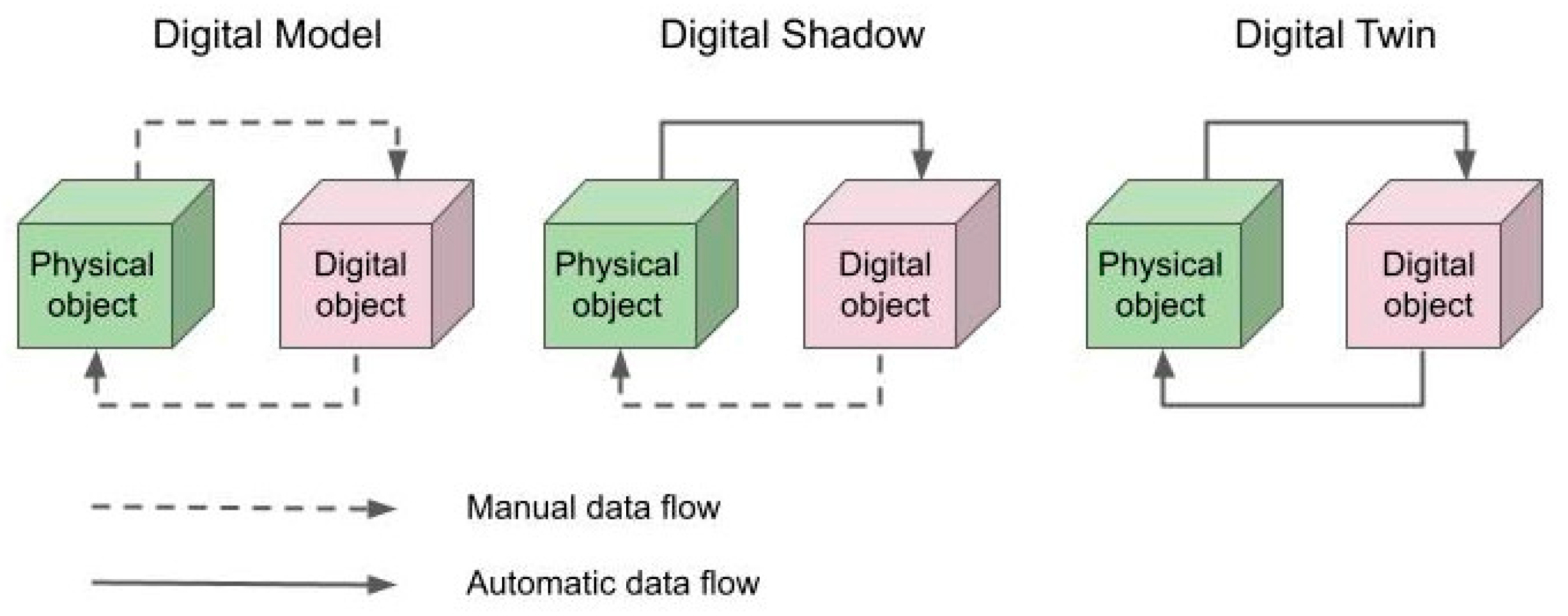
2.1. Digital Twin Terminology
2.2. AI Techniques

| Model Category | Model Type | Examples | Data Types | Applications |
|---|---|---|---|---|
| Classical Machine Learning | Supervised | Random Forest, XGBoost, GPR, Support Vector Regression (SVR) | Inputs: Gridded field Data, Time Series, Point Data Outputs: Gridded, Field Data, Time Series, Point Data, Categorical Data | Chl-a distribution [33,34,35]; Predicting microplastic accumulation [36]; Forecasting HABs [37]; Fish species distribution [38]; Classifying fish reproductive condition [39]; Estimating fishing operations [40]; Ocean surface dissolved oxygen and macronutrients estimation [41]; |
| Unsupervised | K-Means Clustering | Inputs: Imagery, Video Outputs: Imagery, Video (Segmentation mask) | Floating object detection (hybrid approach) [42] | |
| Deep Learning | Supervised | Convolutional Neural Networks (CNNs) | Inputs: Gridded/Field Data (Forecasts), Imagery/Video (Segmentation/Detection), Time Series/Point Data (Counts) | Ocean state prediction [43]; multi-source data integration for Chl-a estimation [34]; Oil spill segmentation [44]; marine heatwaves forecasting [7]; Counting fish [45]; Detecting/measuring litter [46,47] |
| Supervised | Multi-Layer Perceptron (MLP) | Inputs: Gridded field data, point data Outputs: Gridded field data, point data | Ocean 3D reconstruction from surface-only satellite data [48]; Kd retrieval from remote sensing data [27]. | |
| Supervised | Long Short-Term Memory (LSTM) | Inputs: Time Series, point Data Outputs: Time Series, Point Data (Forecasts) | Forecasting water quality; Point-wise time series forecasting, predicting atmospheric variables [49]; HABs forecasting [50]. | |
| Unsupervised | Generative Adversarial Network (GAN) | Inputs: Gridded field data Outputs: Imagery, Video (Synthesized Samples) | Synthesizing macroplastic samples to overcome data scarcity (hybrid GAN-RF) [51] | |
| Unsupervised | Autoencoders (Used in the HIDRA family of models, specifically HIDRA-3) | Inputs: Sparse Time series Outputs: Reconstructed continuous gridded field, time series | Reconstructing missing sea surface height signals in latent space [52]. | |
| Hybrid physics/ML model combination | Ensemble model, Supervised | Stacking Ensemble Learning (STK) (e.g., combining RF, SVM, KNN, XGBoost, GP) | Inputs: Gridded field data, Point data Outputs: Gridded field data (probability maps) | Predicting fishing grounds [53,54,55]. |
| Supervised | Hydro-Biogeochemical-CNN (HBGC-CNN) | Inputs: Gridded field data Outputs: Gridded field data | Daily, spatial prediction of Chl-a and HABs [56]. | |
| Reinforcement Learning | Deep Deterministic Policy Gradient (DDPG) (Hybrid with LSTM) | Inputs: Multivariate Time series Outputs: Optimal control actions (Optimization) | Optimizing energy consumption in large-scale recirculating aquaculture systems [57]. | |
| Computer Vision | Supervised | YOLOv8 (Modified version, Deep CNN) | Inputs: Imagery, Video Outputs: Imagery, Video (Bounding boxes, Segmentation masks), Time series, Point data (Classification labels) | Object detection for biomass estimation in turbid waters [58]; Distinguishing plastic from tourists on coastlines [59] |
| Mask R-CNN, (Region-based CNN) | Inputs: Imagery, Video Outputs: Imagery/Video (Segmentation Masks), Time Series/Point Data (Measurements) | Detecting and measuring fish size [60,61]; Segmenting fish body parts for disease detection [62]; Detecting seafloor marine litter [63]. |
3. DTO Applications
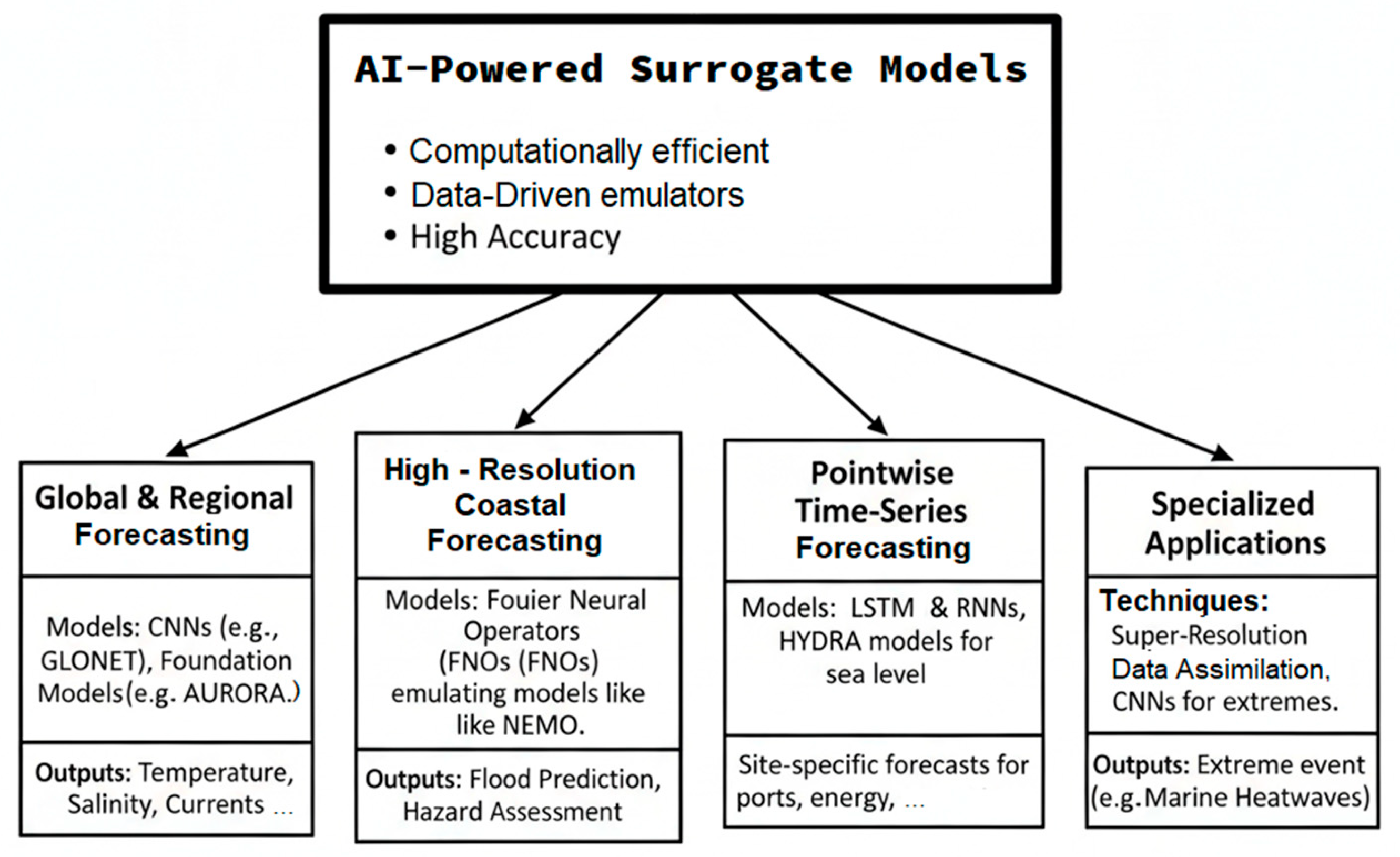
3.1. Surrogate Models in DTOs
3.2. Marine Environment and Ecosystem Health
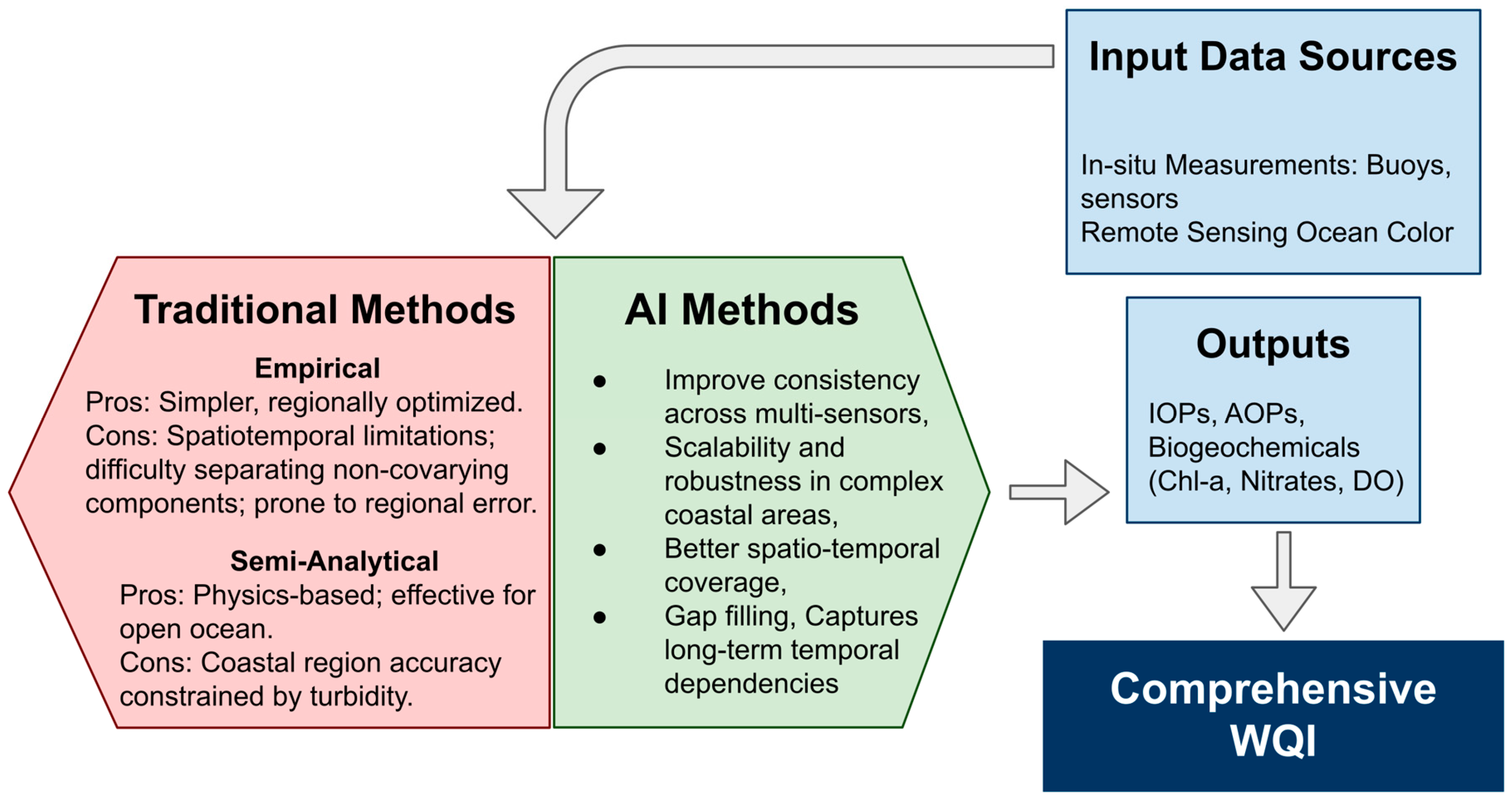
3.2.1. Water Quality and Biodiversity Monitoring
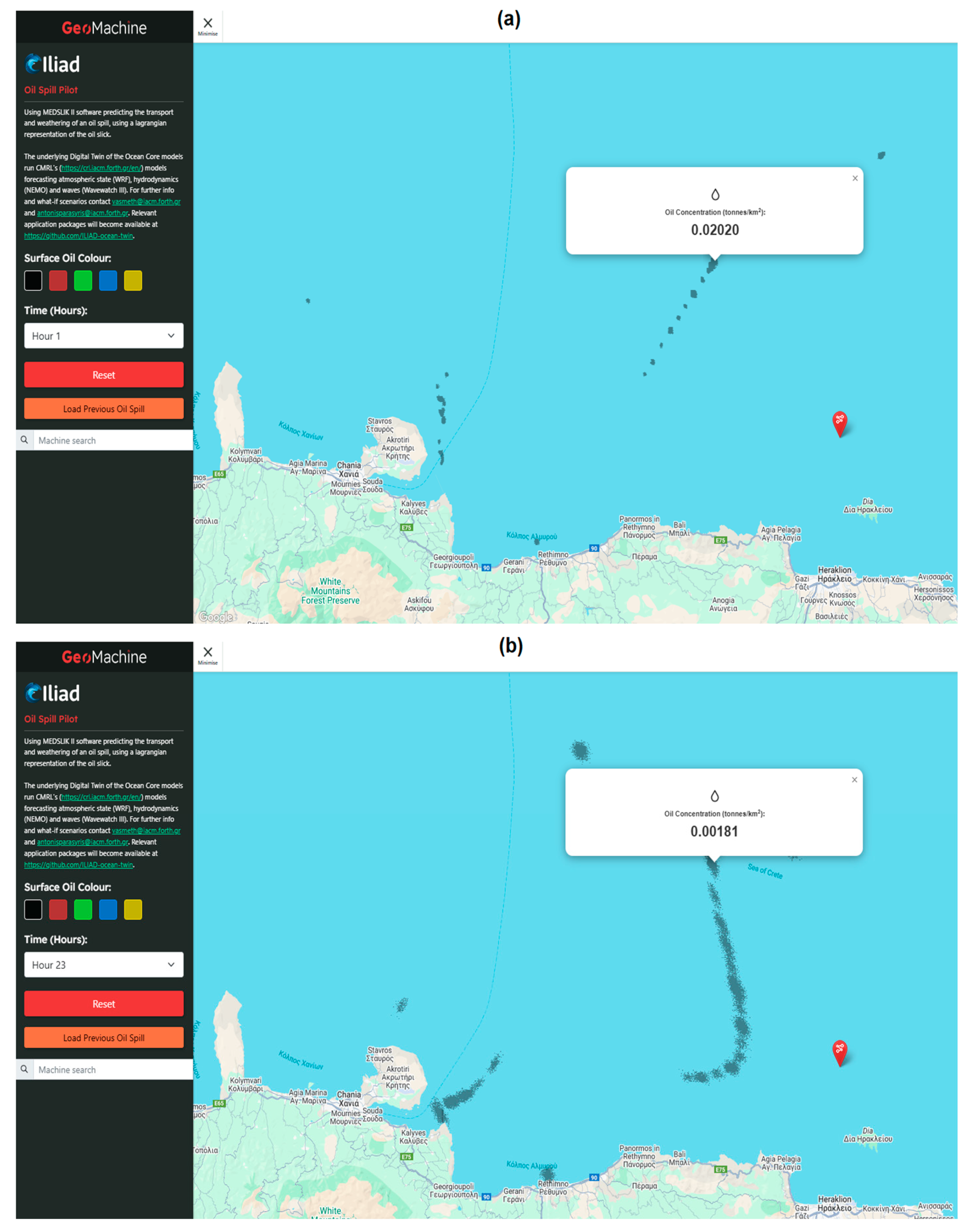
3.2.2. Oil Spill Detection and Forecasting
3.2.3. Marine Litter Monitoring
| Monitoring Domain | AI Technique | Data Source | Primary Function | Key Advantage/Context | Reference |
|---|---|---|---|---|---|
| Surface (Wide-Area) | GAN-RF | Sentinel-2 Multispectral | Macroplastic Detection & Classification | Overcomes data scarcity; large-scale mapping. | [51] |
| Random Forest | Sentinel-2 (Spectral Indices) | Macroplastic Discrimination | Robust with feature engineering (FDI). | [36] | |
| K-Means/LGBM (Hybrid) | Hyperspectral (PRISMA) | Floating Object Detection | Enhanced spectral discrimination. | [42] | |
| Naive Bayes | Spectral Indices (FDI) | Macro-plastic vs. Natural Debris | Effective for discrimination. | [123] | |
| Coastal/Shoreline (Item-Level) | APLASTIC-Q (CNN) | Drone/Aerial Imagery | Debris Detection & Quantification | High-resolution item counting; multi-class. | [46] |
| YOLOv8 (DL) | Drone/Aerial Imagery | Plastic vs. Non-Plastic Discrimination | Reduced false positives on complex backgrounds. | [59] | |
| Gradient Boosting | Coastal Morphometric Data | Microplastic Hotspot Prediction | Identifies accumulation areas. | [125] | |
| Subsurface & Prediction (3D) | XGBoost | Global Environmental Data | Microplastic Global Abundance Modeling | Identifies key drivers; large-scale prediction. | [126] |
| U-Net/VGG16 (DL) | Mobile Phone Images | Microplastic Lab Analysis (Count/Class) | Accessible, automated lab analysis. | [127] | |
| MLDet (DCNN) | AUV Imagery | Underwater Litter Detection | Robust shape recognition; AUV-specific. | [47] | |
| Mask R-CNN (CNN) | Towed Camera Images | Seafloor Litter Detection | Accurate object segmentation. | [63] |
3.3. Port Safety and Ship Routing
3.4. Marine Renewable Energy
3.4.1. Wave Energy
3.4.2. Tidal Energy
3.4.3. Offshore Wind Energy
3.5. Aquaculture and Fisheries
| Application Area | Specific Task/Objective | Key ML Model/Technique | Data Source | Primary Output | Reference |
|---|---|---|---|---|---|
| Ecosystem Health & Habitat Modeling | Seagrass Habitat Mapping | Random Forest (Hybrid with WOA) | Satellite Imagery (spectral), Environmental Parameters | Accurate habitat maps, conservation planning | [168] |
| Coral Reef Habitat Mapping | SVM, MaxEnt | Satellite Imagery, Environmental Parameters | Identification of suitable reef areas, protected zone reinforcement | [169] | |
| Cyanobacteria Abundance Prediction | LASSO Regression, Random Forest | Aquaculture Pond Data (organic carbon indicators) | Early warning of harmful blooms in ponds, management optimization | [171] | |
| Automated Monitoring of Fish Populations (Computer Vision) | Fish Counting (Cultured Fish) | MAN (Deep Learning) | Underwater Camera Imagery | Accurate count in crowded tanks | [45] |
| Fish Biomass Estimation (Turbid Water) | YOLOv8 (modified DL), Regression | Underwater Camera Imagery | Non-invasive biomass estimation in challenging conditions | [58] | |
| Fish Sizing & Measurement (Wild Fish) | Mask R-CNN, R-CNN | Underwater/Towed Camera Imagery | Accurate size data for stock assessment | [60,61] | |
| Fish Health & Disease Detection | Mask R-CNN, Inception V3 | Underwater Camera Imagery | Biomass estimation, health classification, disease segmentation | [62] | |
| Environmental & Stock State Forecasting | Harmful Algal Bloom (HAB) Forecasting | XGBoost | Remote Sensing, Numerical Model Outputs | Early warning (up to 9 days) for HABs | [37,174] |
| Species Distribution Modeling (Tuna) | Ensemble Models | Environmental Parameters (SST, Chl-a, currents) | Prediction of optimal migratory fish habitats | [176] | |
| Fishing Ground Prediction (Tuna) | Stacking Ensemble Learning (STK) | Environmental Parameters, Catch Data | Identification of high-yield fishing zones | [53,56] | |
| Fish Reproductive Condition Classification | Random Forest (RF) | Biological Samples (Image/Genomic) | Reproductive status for stock management | [39] | |
| Disease Resistance Prediction (Aquaculture) | Extreme Gradient Boosting (XGB) | Genomic Data | Prediction of disease susceptibility in species | [177] | |
| Operational Optimization & Reinforcement Learning | Fishing Activity/Ground Estimation | Random Forest (RF) | Vessel Monitoring System (VMS) Data | Dynamic management strategies, resource allocation | [40] |
| AI-Powered Digital Assistant (Aquaculture) | GPT 3.5 (fine-tuned) | Sensor Readings, Operational Data | Real-time guidance, automated actuator control | [178] | |
| Energy Optimization (RAS) | Hybrid DL (LSTM + DDPG − RL) | Hourly Operational Data (RAS) | 15–20% energy reduction, stable water quality | [57] |
4. Challenges and Future Perspectives
Author Contributions
Funding
Data Availability Statement
Acknowledgments
Conflicts of Interest
References
- Chen, G.; Yang, J.; Huang, B.; Ma, C.; Tian, F.; Ge, L.; Xia, L.; Li, J. Toward digital twin of the ocean: From digitalization to cloning. Intell. Mar. Technol. Syst. 2023, 1, 3. [Google Scholar] [CrossRef]
- Huguenin, M.F.; Holmes, R.M.; England, M.H. Drivers and distribution of global ocean heat uptake over the last half century. Nat. Commun. 2022, 13, 1–11. [Google Scholar] [CrossRef] [PubMed]
- Oliver, E.C.J.; Benthuysen, J.A.; Darmaraki, S.; Donat, M.G.; Hobday, A.J.; Holbrook, N.J.; Schlegel, R.W.; Sen Gupta, A. Marine Heatwaves. Ann. Rev. Mar. Sci. 2021, 13, 313–342. [Google Scholar] [CrossRef] [PubMed]
- Heimbach, P.; O’Donncha, F.; Smith, T.A.; Garcia-Valdecasas, J.M.; Arnaud, A.; Wan, L. Crafting the Future: Machine learning for ocean forecasting. State Planet 2025, 5, 22. [Google Scholar] [CrossRef]
- Sagi, T.; Lehahn, Y.; Bar, K. Artificial intelligence for ocean science data integration: Current state, gaps, and way forward. Elementa 2020, 8. [Google Scholar] [CrossRef]
- Zhao, Q.; Peng, S.; Wang, J.; Li, S.; Hou, Z.; Zhong, G. Applications of deep learning in physical oceanography: A comprehensive review. Front. Mar. Sci. 2024, 11, 1396322. [Google Scholar] [CrossRef]
- Parasyris, A.; Metheniti, V.; Kampanis, N.; Darmaraki, S. Marine heatwaves in the Mediterranean Sea: A convolutional neural network study for extreme event prediction. Ocean. Sci. 2025, 21, 897–912. [Google Scholar] [CrossRef]
- Sonnewald, M.; Lguensat, R.; Jones, D.C.; Dueben, P.D.; Brajard, J.; Balaji, V. Bridging observations, theory and numerical simulation of the ocean using machine learning. Environ. Res. Lett. 2021, 16, 073008. [Google Scholar] [CrossRef]
- Liu, G.; Bracco, A.; Brajard, J. Systematic Bias. Correction in Ocean Mesoscale Forecasting Using Machine Learning. J. Adv. Model. Earth Syst. 2023, 15, e2022MS003426. [Google Scholar] [CrossRef]
- Cho, D.; Yoo, C.; Im, J.; Cha, D.H. Comparative Assessment of Various Machine Learning-Based Bias Correction Methods for Numerical Weather Prediction Model Forecasts of Extreme Air Temperatures in Urban Areas. Earth Space Sci. 2020, 7, e2019EA000740. [Google Scholar] [CrossRef]
- Liu, H.-Y.; Tan, Z.-M.; Wang, Y.; Tang, J.; Satoh, M.; Lei, L.; Gu, J.-F.; Zhang, Y.; Nie, G.-Z.; Chen, Q.-Z. A Hybrid Machine Learning/Physics-Based Modeling Framework for 2-Week Extended Prediction of Tropical Cyclones. J. Geophys. Res. Mach. Learn. Comput. 2024, 1, e2024JH000207. [Google Scholar] [CrossRef]
- Kadow, C.; Hall, D.M.; Ulbrich, U. Artificial intelligence reconstructs missing climate information. Nat. Geosci. 2020, 13, 408–413. [Google Scholar] [CrossRef]
- Smith, P.A.H.; Sørensen, K.A.; Buongiorno Nardelli, B.; Chauhan, A.; Christensen, A.; St. John, M.; Rodrigues, F.; Mariani, P. Reconstruction of subsurface ocean state variables using Convolutional Neural Networks with combined satellite and in situ data. Front. Mar. Sci. 2023, 10, 1218514. [Google Scholar] [CrossRef]
- Sloyan, B.M.; Chapman, C.C.; Cowley, R.; Charantonis, A.A. Application of Machine Learning Techniques to Ocean Mooring Time Series Data. J. Atmos. Ocean. Technol. 2023, 40, 241–260. [Google Scholar] [CrossRef]
- AboElHassan, A.; Sakr, A.H.; Yacout, S. General purpose digital twin framework using digital shadow and distributed system concepts. Comput. Ind. Eng. 2023, 183, 109534. [Google Scholar] [CrossRef]
- Brarda, P.G.; Fernandez, G.; Ayala, N.F. Digital Twin, Digital Shadow or Digital Model? A Systematic Literature Review. IFIP Adv. Inf. Commun. Technol. 2026, 766, 306–319. [Google Scholar] [CrossRef]
- Chapelle, O.; Scholkopf, B.; Zien, A. (Eds.) Semi-Supervised Learning. IEEE Trans. Neural Netw. 2009, 20, 542. [Google Scholar] [CrossRef]
- Breiman, L. Random forests. Mach. Learn. 2001, 45, 5–32. [Google Scholar] [CrossRef]
- Chen, T.; Guestrin, C. XGBoost: A scalable tree boosting system. In Proceedings of the ACM SIGKDD International Conference on Knowledge Discovery and Data Mining, San Francisco, CA, USA, 13–17 August 2016; pp. 785–794. [Google Scholar] [CrossRef]
- Rasmussen, C.E. Gaussian Processes in Machine Learning; Lecture Notes in Computer Science (including subseries Lecture Notes in Artificial Intelligence and Lecture Notes in Bioinformatics; Springer: Berlin/Heidelberg, Germany, 2004; Volume 3176, pp. 63–71. [Google Scholar] [CrossRef]
- Smola, A.J.; Schölkopf, B. A tutorial on support vector regression. Stat. Comput. 2004, 14, 199–222. [Google Scholar] [CrossRef]
- Hastie, T.; Tibshirani, R.; Friedman, J. The Elements of Statistical Learning; Springer: Berlin/Heidelberg, Germany, 2009. [Google Scholar] [CrossRef]
- Chen, W.; He, C.; Ji, C.; Zhang, M.; Chen, S. An improved K-means algorithm for underwater image background segmentation. Multimed. Tools Appl. 2021, 80, 21059–21083. [Google Scholar] [CrossRef]
- Lecun, Y.; Bengio, Y.; Hinton, G. Deep learning. Nature 2015, 521, 436–444. [Google Scholar] [CrossRef]
- LeCun, Y.; Bottou, L.; Bengio, Y.; Haffner, P. Gradient-based learning applied to document recognition. Proc. IEEE 1998, 86, 2278–2323. [Google Scholar] [CrossRef]
- Hochreiter, S.; Schmidhuber, J. Long Short-Term Memory. Neural Comput. 1997, 9, 1735–1780. [Google Scholar] [CrossRef] [PubMed]
- Metheniti, V.; Karageorgis, A.P.; Drakopoulos, P.; Kampanis, N.; Sofianos, S. Deriving the diffuse attenuation coefficient in the Eastern Mediterranean Sea, using observational optical measurements and a multi-layer perceptron regression model. Deep Sea Res. Part. I Oceanogr. Res. Pap. 2023, 199, 104105. [Google Scholar] [CrossRef]
- Goodfellow, I.; Pouget-Abadie, J.; Mirza, M.; Xu, B.; Warde-Farley, D.; Ozair, S.; Courville, A.; Bengio, Y. Generative adversarial networks. Commun. ACM 2020, 63, 139–144. [Google Scholar] [CrossRef]
- Hinton, G.E.; Salakhutdinov, R.R. Reducing the Dimensionality of Data with Neural Networks. Science (1979) 2006, 313, 504–507. [Google Scholar] [CrossRef]
- Wolpert, D.H. Stacked generalization. Neural Netw. 1992, 5, 241–259. [Google Scholar] [CrossRef]
- Lillicrap, T.P.; Hunt, J.J.; Pritzel, A.; Heess, N.; Erez, T.; Tassa, Y.; Silver, D.; Wierstra, D. Continuous control with deep reinforcement learning. In Proceedings of the 4th International Conference on Learning Representations, ICLR 2016—Conference Track Proceedings, San Juan, Puerto Rico, 2–4 September 2015; Available online: https://arxiv.org/pdf/1509.02971 (accessed on 17 October 2025).
- Redmon, J.; Divvala, S.; Girshick, R.; Farhadi, A. You Only Look Once. CVPR 2016, 2016, 779–788. [Google Scholar] [CrossRef]
- Chen, S.; Hu, C.; Barnes, B.B.; Xie, Y.; Lin, G.; Qiu, Z. Improving ocean color data coverage through machine learning. Remote Sens. Environ. 2019, 222, 286–302. [Google Scholar] [CrossRef]
- Jin, D.; Lee, E.; Kwon, K.; Kim, T. A Deep Learning Model Using Satellite Ocean Color and Hydrodynamic Model to Estimate Chlorophyll-a Concentration. Remote Sens. 2021, 13, 2003. [Google Scholar] [CrossRef]
- Hu, C.; Feng, L.; Guan, Q. A Machine Learning Approach to Estimate Surface Chlorophyll a Concentrations in Global Oceans From Satellite Measurements. IEEE Trans. Geosci. Remote Sens. 2021, 59, 4590–4607. [Google Scholar] [CrossRef]
- Sannigrahi, S.; Basu, B.; Basu, A.S.; Pilla, F. Development of automated marine floating plastic detection system using Sentinel-2 imagery and machine learning models. Mar. Pollut. Bull. 2022, 178, 113527. [Google Scholar] [CrossRef]
- Izadi, M.; Sultan, M.; El Kadiri, R.; Ghannadi, A.; Abdelmohsen, K. A Remote Sensing and Machine Learning-Based Approach to Forecast the Onset of Harmful Algal Bloom. Remote Sens. 2021, 13, 3863. [Google Scholar] [CrossRef]
- Effrosynidis, D.; Tsikliras, A.; Arampatzis, A.; Sylaios, G. Species Distribution Modelling via Feature Engineering and Machine Learning for Pelagic Fishes in the Mediterranean Sea. Appl. Sci. 2020, 10, 8900. [Google Scholar] [CrossRef]
- Flores, A.; Wiff, R.; Donovan, C.R.; Gálvez, P. Applying machine learning to predict reproductive condition in fish. Ecol. Inform. 2024, 80, 102481. [Google Scholar] [CrossRef]
- Meeanan, C.; Noranarttragoon, P.; Sinanun, P.; Takahashi, Y.; Kaewnern, M.; Matsuishi, T.F. Estimation of the spatiotemporal distribution of fish and fishing grounds from surveillance information using machine learning: The case of short mackerel (Rastrelliger brachysoma) in the Andaman Sea, Thailand. Reg. Stud. Mar. Sci. 2023, 62, 102914. [Google Scholar] [CrossRef]
- Sundararaman, H.K.K.; Shanmugam, P. Estimates of the global ocean surface dissolved oxygen and macronutrients from satellite data. Remote Sens. Environ. 2024, 311, 114243. [Google Scholar] [CrossRef]
- Taggio, N.; Aiello, A.; Ceriola, G.; Kremezi, M.; Kristollari, V.; Kolokoussis, P.; Karathanassi, V.; Barbone, E. A Combination of Machine Learning Algorithms for Marine Plastic Litter Detection Exploiting Hyperspectral PRISMA Data. Remote Sens. 2022, 14, 3606. [Google Scholar] [CrossRef]
- Aouni, A.E.; Gaudel, Q.; Regnier, C.; Van Gennip, S.; Le Galloudec, O.; Drevillon, M.; Drillet, Y.; Lellouche, J.-M. GLONET: Mercator’s End-to-End Neural Global Ocean Forecasting System. December 2024. Available online: https://arxiv.org/pdf/2412.05454 (accessed on 10 September 2025).
- Metheniti, V.; Parasyris, A.; Fazzini, N.; Outmani, S.; Correia, M.; Goddard, J.; Alexandrakis, G.; Kozyrakis, G.V.; Vettorello, L.; Keeble, S.; et al. Coastal Crete: A Digital Twin of the Ocean for Oil Spill Identification and Forecasting. In Proceedings of the OCEANS 2025 Brest, Brest, France, 16–19 June 2025; IEEE: New York, NY, USA, 2025; pp. 1–8. [Google Scholar] [CrossRef]
- Li, Y.; Yu, Q.; Xie, M.; Zhang, Z.; Ma, Z.; Cao, K. Identifying oil spill types based on remotely sensed reflectance spectra and multiple machine learning algorithms. IEEE J. Sel. Top. Appl. Earth Obs. Remote Sens. 2021, 14, 9071–9078. [Google Scholar] [CrossRef]
- Wolf, M.; Van Den Berg, K.; Garaba, S.P.; Gnann, N.; Sattler, K.; Stahl, F.; Zielinski, O. Machine learning for aquatic plastic litter detection, classification and quantification (APLASTIC-Q). Environ. Res. Lett. 2020, 15, 114042. [Google Scholar] [CrossRef]
- Ma, D.; Wei, J.; Li, Y.; Zhao, F.; Chen, X.; Hu, Y.; Yu, S.; He, T.; Jin, R.; Li, Z.; et al. MLDet: Towards efficient and accurate deep learning method for Marine Litter Detection. Ocean. Coast. Manag. 2023, 243, 106765. [Google Scholar] [CrossRef]
- Sammartino, M.; Nardelli, B.B.; Marullo, S.; Santoleri, R. An artificial neural network to infer the mediterranean 3d chlorophyll-a and temperature fields from remote sensing observations. Remote Sens. 2020, 12, 4123. [Google Scholar] [CrossRef]
- Parasyris, A.; Alexandrakis, G.; Kozyrakis, G.V.; Spanoudaki, K.; Kampanis, N.A. Predicting Meteorological Variables on Local Level with SARIMA, LSTM and Hybrid Techniques. Atmosphere 2022, 13, 878. [Google Scholar] [CrossRef]
- Wen, J.; Yang, J.; Li, Y.; Gao, L. Harmful algal bloom warning based on machine learning in maritime site monitoring. Knowl. Based Syst. 2022, 245, 108569. [Google Scholar] [CrossRef]
- Jamali, A.; Mahdianpari, M. A Cloud-Based Framework for Large-Scale Monitoring of Ocean Plastics Using Multi-Spectral Satellite Imagery and Generative Adversarial Network. Water 2021, 13, 2553. [Google Scholar] [CrossRef]
- Rus, M.; Mihanović, H.; Ličer, M.; Kristan, M. HIDRA3: A deep-learning model for multipoint ensemble sea level forecasting in the presence of tide gauge sensor failures. Geosci. Model. Dev. 2025, 18, 605–620. [Google Scholar] [CrossRef]
- Song, L.; Li, T.; Zhang, T.; Sui, H.; Li, B.; Zhang, M. Comparison of machine learning models within different spatial resolutions for predicting the bigeye tuna fishing grounds in tropical waters of the Atlantic Ocean. Fish. Oceanogr. 2023, 32, 509–526. [Google Scholar] [CrossRef]
- Li, J.; Chen, F.; Dai, Q.; Zhu, W.; Li, D.; Yu, W.; Zhou, W. Construction and Comparison of Machine-Learning Forecast Models of Albacore Thunnus alalunga Fishing Grounds in the South Pacific Ocean. Fishes 2024, 9, 375. [Google Scholar] [CrossRef]
- Zhang, J.; Fan, D.; He, H.; Xiao, B.; Xiong, Y.; Shi, J. Forecasting Albacore (Thunnus alalunga) Fishing Grounds in the South Pacific Based on Machine Learning Algorithms and Ensemble Learning Model. Appl. Sci. 2023, 13, 5485. [Google Scholar] [CrossRef]
- Li, H.; Li, X.; Song, D.; Nie, J.; Liang, S. Prediction on daily spatial distribution of chlorophyll-a in coastal seas using a synthetic method of remote sensing, machine learning and numerical modeling. Sci. Total Environ. 2024, 910, 168642. [Google Scholar] [CrossRef]
- Alnemari, A.M.; Elmessery, W.M.; Moghanm, F.S.; Espinosa, V.; Shams, M.Y.; Elwakeel, A.E.; Saeed, O.; Eid, M.H.; Alhag, S.K.; Al-Shuraym, L.A.; et al. Energy optimization in large-scale recirculating aquaculture systems: Implementation and performance analysis of a hybrid deep learning approach. Aquac. Eng. 2025, 111, 102561. [Google Scholar] [CrossRef]
- Rani, S.V.J.; Ioannou, I.; Swetha, R.; Lakshmi, R.M.D.; Vassiliou, V. A novel automated approach for fish biomass estimation in turbid environments through deep learning, object detection, and regression. Ecol. Inform. 2024, 81, 102663. [Google Scholar] [CrossRef]
- Zhao, H.; Wang, X.; Yu, X.; Peng, S.; Hu, J.; Deng, M.; Ren, L.; Zhang, X.; Duan, Z. Application of improved machine learning in large-scale investigation of plastic waste distribution in tourism Intensive artificial coastlines. Environ. Pollut. 2024, 356, 124292. [Google Scholar] [CrossRef] [PubMed]
- Monkman, G.G.; Hyder, K.; Kaiser, M.J.; Vidal, F.P. Using machine vision to estimate fish length from images using regional convolutional neural networks. Methods Ecol. Evol. 2019, 10, 2045–2056. [Google Scholar] [CrossRef]
- Garcia, R.; Prados, R.; Quintana, J.; Tempelaar, A.; Gracias, N.; Rosen, S.; Vågstøl, H.; Løvall, K. Automatic segmentation of fish using deep learning with application to fish size measurement. ICES J. Mar. Sci. 2020, 77, 1354–1366. [Google Scholar] [CrossRef]
- Aftab, K.; Tschirren, L.; Pasini, B.; Zeller, P.; Khan, B.; Fraz, M.M. Intelligent Fisheries: Cognitive Solutions for Improving Aquaculture Commercial Efficiency Through Enhanced Biomass Estimation and Early Disease Detection. Cognit. Comput. 2024, 16, 2241–2263. [Google Scholar] [CrossRef]
- Politikos, D.V.; Fakiris, E.; Davvetas, A.; Klampanos, I.A.; Papatheodorou, G. Automatic detection of seafloor marine litter using towed camera images and deep learning. Mar. Pollut. Bull. 2021, 164, 111974. [Google Scholar] [CrossRef]
- Lellouche, J.-M.; Greiner, E.; Le Galloudec, O.; Régnier, C.; Benkiran, M.; Testut, C.-E.; Bourdallé-Badie, R.; Drévillon, M.; Garric, G.; Drillet, Y. The Mercator Ocean Global High-Resolution Monitoring and Forecasting System. New Front. Oper. Oceanogr. 2018, 563–592. Available online: http://purl.flvc.org/fsu/fd/FSU_libsubv1_scholarship_submission_1536245264_041d5712 (accessed on 10 October 2025).
- Wang, K.; Xu, H.; Wang, H.; Qiu, R.; Hu, Q.; Liu, X. Digital twin-driven safety management and decision support approach for port operations and logistics. Front. Mar. Sci. 2024, 11, 1455522. [Google Scholar] [CrossRef]
- Bodnar, C.; Bruinsma, W.P.; Lucic, A.; Stanley, M.; Allen, A.; Brandstetter, J.; Garvan, P.; Riechert, M.; Weyn, J.A.; Dong, H.; et al. A foundation model for the Earth system. Nature 2025, 641, 8065. [Google Scholar] [CrossRef]
- Joanna, S.; Angelique, M.; Jennifer, V.; Pascal, M. Solving coastal dynamics: Introduction to high-resolution ocean forecasting services. State Planet Discuss. 2025, 2025, 1–17. [Google Scholar] [CrossRef]
- Madec, G.; NEMO Team. NEMO Ocean Engine Reference Manual; NEMO Team: Dover, NH, USA, 2024. [Google Scholar]
- Jordão, H.; Jiang, P.; Weisser, C.; Meinert, N.; Lavin, A.; Walker, C.C.; Wainwright, H.M.; Holgate, S.; Lütjens, B.; Barnard, P. Coastal Digital Twin: Learning a Fast and Physics-Informed Surrogate Model for Coastal Floods Via Neural Operators. 13 December 2021, AGU. Available online: https://agu.confex.com/agu/fm21/meetingapp.cgi/Paper/887845 (accessed on 10 September 2025).
- Rus, M.; Ličer, M.; Kristan, M. HIDRA-D: Deep-learning model for dense sea level forecasting using sparse altimetry and tide gauge data. EGUsphere 2025, 2025, 1–25. [Google Scholar] [CrossRef]
- Camps-Valls, G.; Fernández-Torres, M.Á.; Cohrs, K.H.; Höhl, A.; Castelletti, A.; Pacal, A.; Robin, C.; Martinuzzi, F.; Papoutsis, I.; Prapas, I.; et al. Artificial intelligence for modeling and understanding extreme weather and climate events. Nat. Commun. 2025, 16, 1–14. [Google Scholar] [CrossRef] [PubMed]
- Horton, R. An index number system for rating water quality. J. Water Pollut. Control Fed. 1965, 37, 300–306. [Google Scholar]
- Uddin, M.G.; Nash, S.; Olbert, A.I. A review of water quality index models and their use for assessing surface water quality. Ecol. Indic. 2021, 122, 107218. [Google Scholar] [CrossRef]
- Uddin, M.G.; Nash, S.; Diganta, M.T.M.; Rahman, A.; Olbert, A.I. Robust machine learning algorithms for predicting coastal water quality index. J. Environ. Manag. 2022, 321, 115923. [Google Scholar] [CrossRef]
- Lin, J.; Liu, Q.; Song, Y.; Liu, J.; Yin, Y.; Hall, N.S. Temporal Prediction of Coastal Water Quality Based on Environmental Factors with Machine Learning. J. Mar. Sci. Eng. 2023, 11, 1608. [Google Scholar] [CrossRef]
- Mobley, C.D. Radiative Transfer in the Ocean. In Encyclopedia of Ocean Sciences; Elsevier: Amsterdam, The Netherlands, 2001; pp. 2321–2330. [Google Scholar] [CrossRef]
- Hu, C.; Lee, Z.; Franz, B. Chlorophyll aalgorithms for oligotrophic oceans: A novel approach based on three-band reflectance difference. J. Geophys. Res. Oceans 2012, 117, 1011. [Google Scholar] [CrossRef]
- O’Reilly, J.E.; Werdell, P.J. Chlorophyll algorithms for ocean color sensors—OC4, OC5 & OC6. Remote Sens. Environ. 2019, 229, 32–47. [Google Scholar] [CrossRef]
- Austin, R.W.; Petzold, T.J. Spectral Dependence of the Diffuse Attenuation Coefficient of Light in Ocean Waters. Opt. Eng. 1986, 25, 253471. [Google Scholar] [CrossRef]
- Werdell, P.J.; Bailey, S.W. An improved in-situ bio-optical data set for ocean color algorithm development and satellite data product validation. Remote Sens. Environ. 2005, 98, 122–140. [Google Scholar] [CrossRef]
- Zhang, T.; Fell, F. An empirical algorithm for determining the diffuse attenuation coefficient K d in clear and turbid waters from spectral remote sensing reflectance. Limnol. Oceanogr. Methods 2007, 5, 457–462. [Google Scholar] [CrossRef]
- Wang, M.; Son, S.H.; Harding, L.W. Retrieval of diffuse attenuation coefficient in the Chesapeake Bay and turbid ocean regions for satellite ocean color applications. J. Geophys. Res. Oceans 2009, 114, 10011. [Google Scholar] [CrossRef]
- Morel, A. Optical modeling of the upper ocean in relation to its biogenous matter content (case I waters). J. Geophys. Res. 1988, 93, 10749. [Google Scholar] [CrossRef]
- Morel, A.; Maritorena, S. Bio-optical properties of oceanic waters: A reappraisal. J. Geophys. Res. Oceans 2001, 106, 7163–7180. [Google Scholar] [CrossRef]
- Morel, A.; Claustre, H.; Antoine, D.; Gentili, B. Natural Variability of Bio-Optical Properties in Case 1 Waters: Attenuation and Reflectance Within the Visible and Near-UV Spectral Domains, as Observed in South Pacific and Mediterranean Waters. 2007. Available online: www.biogeosciences.net/4/913/2007/ (accessed on 20 January 2021).
- Arst, H.; Erm, A.; Reinart, A.; Sipelgas, L.; Herlevi, A. Calculating irradiance penetration into water bodies from the measured beam attenuation coefficient, II: Application of the improved model to different types of lakes. Nord. Hydrol. 2002, 33, 227–240. [Google Scholar] [CrossRef]
- Gordon, H.R.; Brown, O.B.; Jacobs, M.M. Computed Relationships Between the Inherent and Apparent Optical Properties of a Flat Homogeneous Ocean. Appl. Opt. 1975, 14, 417. [Google Scholar] [CrossRef]
- Sathyendranath, S.; Platt, T. The spectral irradiance field at the surface and in the interior of the ocean: A model for applications in oceanography and remote sensing. J. Geophys. Res. Oceans 1988, 93, 9270–9280. [Google Scholar] [CrossRef]
- Lee, Z.; Carder, K.L.; Arnone, R.A. Deriving inherent optical properties from water color: A multiband quasi-analytical algorithm for optically deep waters. Appl. Opt. 2002, 41, 5755. [Google Scholar] [CrossRef]
- Lee, Z.P.; Du, K.P.; Arnone, R. A model for the diffuse attenuation coefficient of downwelling irradiance. J. Geophys. Res. C Ocean. 2005, 110, 1–10. [Google Scholar] [CrossRef]
- Lee, Z.; Weidemann, A.; Kindle, J.; Arnone, R.; Carder, K.L.; Davis, C. Euphotic zone depth: Its derivation and implication to ocean-color remote sensing. J. Geophys. Res. 2007, 112, C03009. [Google Scholar] [CrossRef]
- IOCCG. Uncertainties in Ocean Colour Remote Sensing; IOCCG: Dartmouth, NH, Canada, 2019. [Google Scholar] [CrossRef]
- Zoffoli, M.L.; Lee, Z.; Ondrusek, M.; Lin, J.; Kovach, C.; Wei, J.; Lewis, M. Estimation of Transmittance of Solar Radiation in the Visible Domain Based on Remote Sensing: Evaluation of Models Using In Situ Data. J. Geophys. Res. Oceans 2017, 122, 9176–9188. [Google Scholar] [CrossRef]
- Metheniti, V.; Vervatis, V.; Kampanis, N.; Sofianos, S. Turbidity effects on the Aegean sea surface properties using numerical simulations. Ocean. Dyn. 2025, 75, 1–15. [Google Scholar] [CrossRef]
- Kolluru, S.; Gedam, S.S.; Inamdar, A.B. A neural network approach for deriving absorption coefficients of ocean water constituents from total light absorption and particulate absorption coefficients. Comput. Geosci. 2021, 147, 104678. [Google Scholar] [CrossRef]
- Park, J.; Kim, J.H.; Kim, H.C.; Kim, B.K.; Bae, D.; Jo, Y.H.; Jo, N.; Lee, S.H. Reconstruction of Ocean Color Data Using Machine Learning Techniques in Polar Regions: Focusing on Off Cape Hallett, Ross Sea. Remote Sens. 2019, 11, 1366. [Google Scholar] [CrossRef]
- Liu, H.; Li, Q.; Bai, Y.; Yang, C.; Wang, J.; Zhou, Q.; Hu, S.; Shi, T.; Liao, X.; Wu, G. Improving satellite retrieval of oceanic particulate organic carbon concentrations using machine learning methods. Remote Sens. Environ. 2021, 256, 112316. [Google Scholar] [CrossRef]
- Morel, A.; Bélanger, S. Improved detection of turbid waters from ocean color sensors information. Remote Sens. Environ. 2006, 102, 237–249. [Google Scholar] [CrossRef]
- Zhao, D.; Feng, L.; Yang, Z.; Yu, X.; Wang, M. A Deep Learning-Assisted Algorithm to Improve Inherent Optical Properties Estimations Over Inland and Nearshore Coastal Waters. IEEE Trans. Geosci. Remote Sens. 2025, 63, 1–14. [Google Scholar] [CrossRef]
- Chen, L.; Chen, L.; Chen, L.; Pan, X.; Zhang, J.; Zhang, J.; Demeaux, C.B.; Wang, Y.; Wang, Y. Inversion diffuse attenuation coefficient of photosynthetically active radiation based on deep learning. Opt. Express 2023, 31, 37365–37380. [Google Scholar] [CrossRef]
- Huang, J.; Wang, D.; Pan, S.; Li, H.; Gong, F.; Hu, H.; He, X.; Bai, Y.; Zheng, Z. A New High-Resolution Remote Sensing Monitoring Method for Nutrients in Coastal Waters. IEEE Trans. Geosci. Remote Sens. 2023, 61, 1–15. [Google Scholar] [CrossRef]
- Li, C.; Wu, H.; Yang, C.; Cui, L.; Ma, Z.; Wang, L. Advanced Machine Learning Models for Estimating the Distribution of Sea-Surface Particulate Organic Carbon (POC) Concentrations Using Satellite Remote Sensing Data: The Mediterranean as an Example. Sensors 2024, 24, 5669. [Google Scholar] [CrossRef]
- Zhang, Z.; Chen, P.; Jamet, C.; Dionisi, D.; Hu, Y.; Lu, X.; Pan, D. Retrieving bbp and POC from CALIOP: A deep neural network approach. Remote Sens. Environ. 2023, 287, 113482. [Google Scholar] [CrossRef]
- Hotte, N.; Sumaila, U.R. Potential Economic Impact of a Tanker Spill on Ocean-Based Industries in British Columbia; The University of British Columbia: Vancouver, BC, Canada, 2012. [Google Scholar] [CrossRef]
- Kokkos, N.; Petalas, S.; Keramea, P.; Psomouli, F.; Sylaios, G. A Digital Twin for Oil Spill Incidents in the North Aegean. Available online: https://gkhub.earthobservations.org/packages/e03x7-55x27 (accessed on 5 August 2025).
- Krestenitis, M.; Orfanidis, G.; Ioannidis, K.; Avgerinakis, K.; Vrochidis, S.; Kompatsiaris, I. Oil Spill Identification from Satellite Images Using Deep Neural Networks. Remote Sens. 2019, 11, 1762. [Google Scholar] [CrossRef]
- Conceição, M.R.A.; Mendonça, L.F.F.; Lentini, C.A.D.; Lima, A.T.C.; Lopes, J.M.; Vasconcelos, R.N.; Gouveia, M.B.; Porsani, M.J. SAR Oil Spill Detection System through Random Forest Classifiers. Remote Sens. 2021, 13, 2044. [Google Scholar] [CrossRef]
- Yang, J.F.; Wan, J.H.; Ma, Y.; Zhang, J.; Hu, Y.B.; Jiang, Z.C. Oil spill hyperspectral remote sensing detection based on DCNN with multi-scale features. J. Coast. Res. 2019, 90, 332–339. [Google Scholar] [CrossRef]
- Jiang, Z.; Zhang, J.; Ma, Y.; Mao, X. Hyperspectral Remote Sensing Detection of Marine Oil Spills Using an Adaptive Long-Term Moment Estimation Optimizer. Remote Sens. 2022, 14, 157. [Google Scholar] [CrossRef]
- Yang, J.; Hu, Y.; Zhang, J.; Ma, Y.; Li, Z.; Jiang, Z. Identification of marine oil spill pollution using hyperspectral combined with thermal infrared remote sensing. Front. Mar. Sci. 2023, 10, 1135356. [Google Scholar] [CrossRef]
- Cózar, A.; Echevarría, F.; González-Gordillo, J.I.; Irigoien, X.; Úbeda, B.; Hernández-León, S.; Palma, Á.T.; Navarro, S.; García-de-Lomas, J.; Ruiz, A.; et al. Plastic debris in the open ocean. Proc. Natl. Acad. Sci. USA 2014, 111, 10239–10244. [Google Scholar] [CrossRef]
- Zhang, Y.; Wu, P.; Xu, R.; Wang, X.; Lei, L.; Schartup, A.T.; Peng, Y.; Pang, Q.; Wang, X.; Mai, L.; et al. Plastic waste discharge to the global ocean constrained by seawater observations. Nat. Commun. 2023, 14, 1–12. [Google Scholar] [CrossRef]
- Deudero, S.; Alomar, C. Mediterranean marine biodiversity under threat: Reviewing influence of marine litter on species. Mar. Pollut. Bull. 2015, 98, 58–68. [Google Scholar] [CrossRef]
- Landrigan, P.J.; Stegeman, J.J.; Fleming, L.E.; Allemand, D.; Anderson, D.M.; Backer, L.C.; Brucker-Davis, F.; Chevalier, N.; Corra, L.; Czerucka, D.; et al. Human Health and Ocean Pollution. Ann. Glob. Health 2020, 86, 151. [Google Scholar] [CrossRef]
- Gall, S.C.; Thompson, R.C. The impact of debris on marine life. Mar. Pollut. Bull. 2015, 92, 170–179. [Google Scholar] [CrossRef]
- Thushari, G.G.N.; Senevirathna, J.D.M. Plastic pollution in the marine environment. Heliyon 2020, 6, e04709. [Google Scholar] [CrossRef]
- Andrady, A.L. Weathering and fragmentation of plastic debris in the ocean environment. Mar. Pollut. Bull. 2022, 180, 113761. [Google Scholar] [CrossRef] [PubMed]
- Smith, M.; Love, D.C.; Rochman, C.M.; Neff, R.A. Microplastics in Seafood and the Implications for Human Health. Curr. Environ. Health Rep. 2018, 5, 375–386. [Google Scholar] [CrossRef] [PubMed]
- Edyvane, K.S.; Dalgetty, A.; Hone, P.W.; Higham, J.S.; Wace, N.M. Long-term marine litter monitoring in the remote Great Australian Bight, South Australia. Mar. Pollut. Bull. 2004, 48, 1060–1075. [Google Scholar] [CrossRef] [PubMed]
- Zablotski, Y.; Kraak, S.B.M. Marine litter on the Baltic seafloor collected by the international fish-trawl survey. Mar. Pollut. Bull. 2019, 141, 448–461. [Google Scholar] [CrossRef]
- Fakiris, E.; Papatheodorou, G.; Kordella, S.; Christodoulou, D.; Galgani, F.; Geraga, M. Insights into seafloor litter spatiotemporal dynamics in urbanized shallow Mediterranean bays. An optimized monitoring protocol using towed underwater cameras. J. Environ. Manag. 2022, 308, 114647. [Google Scholar] [CrossRef]
- Serra-Gonçalves, C.; Lavers, J.L.; Bond, A.L. Global Review of Beach Debris Monitoring and Future Recommendations. Environ. Sci. Technol. 2019, 53, 12158–12167. [Google Scholar] [CrossRef]
- Nivedita, V.; Begum, S.S.; Aldehim, G.; Alashjaee, A.M.; Arasi, M.A.; Sikkandar, M.Y.; Jayasankar, T.; Vivek, S. Plastic debris detection along coastal waters using Sentinel-2 satellite data and machine learning techniques. Mar. Pollut. Bull. 2024, 209, 117106. [Google Scholar] [CrossRef]
- Kylili, K.; Kyriakides, I.; Artusi, A.; Hadjistassou, C. Identifying floating plastic marine debris using a deep learning approach. Environ. Sci. Pollut. Res. 2019, 26, 17091–17099. [Google Scholar] [CrossRef]
- da Silva Ferreira, A.T.; de Oliveira, R.C.; Ribeiro, M.C.H.; de Freitas Sousa, P.S.; de Paula Miranda, L.; de Oliveira Folharini, S.; Siegle, E. Microplastic Deposit Predictions on Sandy Beaches by Geotechnologies and Machine Learning Models. Coasts 2025, 5, 4. [Google Scholar] [CrossRef]
- Zhen, Y.; Wang, L.; Sun, H.; Liu, C. Prediction of microplastic abundance in surface water of the ocean and influencing factors based on ensemble learning. Environ. Pollut. 2023, 331, 121834. [Google Scholar] [CrossRef]
- Lorenzo-Navarro, J.; Castrillón-Santana, M.; Sánchez-Nielsen, E.; Zarco, B.; Herrera, A.; Martínez, I.; Gómez, M. Deep learning approach for automatic microplastics counting and classification. Sci. Total Environ. 2021, 765, 142728. [Google Scholar] [CrossRef] [PubMed]
- Neugebauer, J.; Heilig, L.; Voß, S. Digital Twins in the Context of Seaports and Terminal Facilities. Flex. Serv. Manuf. J. 2024, 36, 821–917. [Google Scholar] [CrossRef]
- United Nations Conference on Trade and Development (UNCTAD). Review of Maritime Transport 2024: Navigating Maritime Chekpoints; United Nations Publication: New York, NY, USA, 2024. [Google Scholar]
- Verschuur, J.; Koks, E.E.; Li, S.; Hall, J.W. Multi-hazard risk to global port infrastructure and resulting trade and logistics losses. Commun. Earth Environ. 2023, 4, 1–12. [Google Scholar] [CrossRef]
- Borriello, A.; Calvo Santos, A.; Feyen, L.; Ghiani, M.; Guillén, J.; McGovern, L.; Petrucco, G.; Pistocchi, A.; Pleguezuelo Alonso, M.; Politiek, H.D.; et al. The EU Blue Economy Report 2025; Publications Office of the European Union: Louxemburg, 2025. [Google Scholar] [CrossRef]
- Jahangard, M.; Xie, Y.; Feng, Y. Leveraging machine learning and optimization models for enhanced seaport efficiency. Marit. Econ. Logist. 2025, 27, 1–42. [Google Scholar] [CrossRef]
- Mannarini, G.; Salinas, M.L.; Carelli, L.; Petacco, N.; Orović, J. VISIR-2: Ship weather routing in Python. Geosci. Model. Dev. 2024, 17, 4355–4382. [Google Scholar] [CrossRef]
- Madusanka, N.S.; Fan, Y.; Yang, S.; Xiang, X. Digital Twin in the Maritime Domain: A Review and Emerging Trends. J. Mar. Sci. Eng. 2023, 11, 1021. [Google Scholar] [CrossRef]
- Parasyris, A.; Metheniti, V.; Vettorello, L.; Ribeiro, J.; Delgado, M.; Goddard, J.; Rebane, J.; Egerer, M.; Alexandrakis, G.; Kozyrakis, G.V.; et al. Coastal Crete: The Ship Routing/Harbor Safety Digital Twin of the Ocean. In Proceedings of the IEEE OCEANS 2025 Brest, Brest, France, 16–19 June 2025; IEEE: New York, NY, USA, 2025; pp. 1–6. [Google Scholar] [CrossRef]
- Salinas, M.L.; Mannarini, G. [VISIR-2 Ship Weather Routing Model] Source Code (Python). 2025. Available online: https://zenodo.org/records/15497175 (accessed on 15 December 2025).
- Effrosynidis, D.; Spiliotis, E.; Sylaios, G.; Arampatzis, A. Time series and regression methods for univariate environmental forecasting: An empirical evaluation. Sci. Total Environ. 2023, 875, 162580. [Google Scholar] [CrossRef]
- European Commission. Communication from the Commission to the European Parliament, the Council, the European Economic and Social Committee and the Committee of the Regions: Roadmap Towards Ending Russian Energy Imports. 2025. Available online: https://eur-lex.europa.eu/legal-content/EN/TXT/?uri=CELEX%3A52025DC0440R%2801%29&qid=1747125158211 (accessed on 15 December 2025).
- Aderinto, T.; Li, H. Ocean Wave Energy Converters: Status and Challenges. Energies 2018, 11, 1250. [Google Scholar] [CrossRef]
- European Commission. Communication from the Commission to the European Parliament, the Council, the European Economic and Social Committee and the Committee of the Regions: ‘An EU Strategy to Harness the Potential of Offshore Renewable Energy for a Climate-Neutral Future’. 2020, Brussels. Available online: https://eur-lex.europa.eu/legal-content/EN/TXT/?uri=COM:2020:741:FIN (accessed on 10 October 2025).
- Sabine, C.; Robinson, C.; Isensee, K.; Bastian, L.; Batten, S.; Bellerby, R.; Blasiak, R.; Laarissa, S.; Lira Loarca, A.; McGeachy, C.; et al. Ocean Decade Vision 2030 White Papers Challenge 5: Unlock ocean-based solutions to climate change. In The United Nations Decade of Ocean Science for Sustainable Development (2021–2030); UNESCO-IOC: Paris, France, 2024. [Google Scholar] [CrossRef]
- UNESCO-IOC. MSPglobal Policy Brief: Marine Spatial Planning and the Sustainable Blue Economy. Paris, France. 2021. Available online: https://www.researchgate.net/publication/350956285_UNESCO-IOC_2021_MSPglobal_Policy_Brief_Marine_Spatial_Planning_and_the_Sustainable_Blue_Economy_Paris_UNESCO_IOC_Policy_Brief_no_2 (accessed on 15 December 2025).
- Zhou, Y. Ocean energy applications for coastal communities with artificial intelligencea state-of-the-art review. Energy AI 2022, 10, 100189. [Google Scholar] [CrossRef]
- Khojasteh, D.; Shamsipour, A.; Huang, L.; Tavakoli, S.; Haghani, M.; Flocard, F.; Farzadkhoo, M.; Iglesias, G.; Hemer, M.; Lewis, M.; et al. A large-scale review of wave and tidal energy research over the last 20 years. Ocean Eng. 2023, 282, 114995. [Google Scholar] [CrossRef]
- Mlakar, P.; Ricchi, A.; Carniel, S.; Bonaldo, D.; Ličer, M. DELWAVE 1.0: Deep learning surrogate model of surface wave climate in the Adriatic Basin. Geosci. Model. Dev. 2024, 17, 4705–4725. [Google Scholar] [CrossRef]
- Bento, P.M.R.; Pombo, J.A.N.; Mendes, R.P.G.; Calado, M.R.A.; Mariano, S.J.P.S. Ocean wave energy forecasting using optimised deep learning neural networks. Ocean Eng. 2021, 219, 108372. [Google Scholar] [CrossRef]
- Muthamizhan, T.; Karthick, K.; Aruna, S.K.; Velmurugan, P. AI-Driven Stacking Ensemble for Predicting Total Power Output of Wave Energy Converters: A Data-Driven Approach to Renewable Energy Processes. Processes 2025, 13, 961. [Google Scholar] [CrossRef]
- Shahbazbegian, A.; Ghiasi, M. Developing a machine learning (ML) based graphical user interface (GUI) for significant wave height (SWH) forecasting to support wave energy converters (WECs) operations planning. Renew. Energy 2026, 256, 124490. [Google Scholar] [CrossRef]
- Liu, Y.; Zhang, X.; Dong, Q.; Chen, G.; Li, X. Phase-resolved wave prediction with linear wave theory and physics-informed neural networks. Appl. Energy 2024, 355, 121602. [Google Scholar] [CrossRef]
- Lee, D.; Yang, S.; Oh, J.-W.; Cho, S.-G.; Kim, S.; Kang, N. AI-Powered Digital Twin of the Ocean: Reliable Uncertainty Quantification for Real-Time Wave Height Prediction with Deep Ensemble. December 2024. Available online: https://arxiv.org/pdf/2412.05475 (accessed on 17 October 2025).
- Zhang, M.; Yuan, Z.M.; Dai, S.S.; Chen, M.L.; Incecik, A. LSTM RNN-based excitation force prediction for the real-time control of wave energy converters. Ocean Eng. 2024, 306, 118023. [Google Scholar] [CrossRef]
- Katsidoniotaki, E.; Psarommatis, F.; Göteman, M. Digital Twin for the Prediction of Extreme Loads on a Wave Energy Conversion System. Energies 2022, 15, 5464. [Google Scholar] [CrossRef]
- Poguluri, S.K.; Bae, Y.H. Enhancing Wave Energy Conversion Efficiency through Supervised Regression Machine Learning Models. J. Mar. Sci. Eng. 2024, 12, 153. [Google Scholar] [CrossRef]
- Halder, R.; Damodaran, M.; Khoo, B.C. Deep learning-driven nonlinear reduced-order models for predicting wave-structure interaction. Ocean Eng. 2023, 280, 114511. [Google Scholar] [CrossRef]
- González-Gorbeña, E.; Pacheco, A.; Plomaritis, T.A.; Ferreira, Ó.; Sequeira, C.; Moura, T. Surrogate-Based Optimization of Tidal Turbine Arrays: A Case Study for the Faro-Olhão Inlet. In Lecture Notes in Computer Science (Including Subseries Lecture Notes in Artificial Intelligence and Lecture Notes in Bioinformatics); Springer: Berlin/Heidelberg, Germany, 2019; Volume 11538, pp. 548–561. [Google Scholar] [CrossRef]
- Roth, J.; Jacobs, G.; Röder, J.; Zweiffel, M.; Bauer, T.; Amos, L. Regression-based hub load calculation of a tidal turbine with blade root sensor data. Proc. Eur. Wave Tidal Energy Conf. 2025, 16. [Google Scholar] [CrossRef]
- Upadhyay, D.; Sampalli, S. SCADA (Supervisory Control and Data Acquisition) systems: Vulnerability assessment and security recommendations. Comput. Secur. 2020, 89, 101666. [Google Scholar] [CrossRef]
- Rashid, H.; Benbouzid, M.; Titah-Benbouzid, H.; Amirat, Y.; Berghout, T.; Mamoune, A. Mapping a Machine Learning Path Forward for Tidal Stream Turbines Biofouling Detection and Estimation. In IECON Proceedings (Industrial Electronics Conference); IEEE: New York, NY, USA, 2023. [Google Scholar] [CrossRef]
- Thanthirige, T.R.M.; Flanagan, M.; Kennedy, C.; Goggins, J.; Finnegan, W. Advancements in Structural Testing and Life Predictions of Tidal Turbine Blades. Proc. Eur. Wave Tidal Energy Conf. 2025, 16. [Google Scholar] [CrossRef]
- Finnegan, W.; Kennedy, C.; Flanagan, M.; Goggins, J. Strain failure limits of tidal turbine blades based on full-scale structural testing. Proc. Eur. Wave Tidal Energy Conf. 2025, 16. [Google Scholar] [CrossRef]
- Mbasso, W.F.; Harrison, A.; Dagal, I.; Jangir, P.; Khishe, M.; Kotb, H.; Shaikh, M.S.; Smerat, A.; Fendzi Donfack, E.; Kumar, R. Digital twins in renewable energy systems: A comprehensive review of concepts, applications, and future directions. Energy Strategy Rev. 2025, 61, 101814. [Google Scholar] [CrossRef]
- Singh, D.; Dwight, R.P.; Laugesen, K.; Beaudet, L.; Viré, A. Probabilistic surrogate modeling of offshore wind-turbine loads with chained Gaussian processes. J. Phys. Conf. Ser. 2022, 2265, 032070. [Google Scholar] [CrossRef]
- Hasan, A.; Hu, Z.; Haghshenas, A.; Karlsen, A.; Alaliyat, S.; Cali, U. An Interactive Digital Twin Platform for Offshore Wind Farms’ Development. Digit. Twin Driven Intell. Syst. Emerg. Metaverse 2023, 269–281. [Google Scholar] [CrossRef]
- Vasconcelos, D.; Vieira, M.; Dias, D.; Reis, L. Structural evaluation of the deepCWind offshore wind platform. Frat. Integrita Strutt. 2020, 14, 24–44. [Google Scholar] [CrossRef]
- Mehlan, F.C.; Keller, J.; Nejad, A.R. Virtual sensing of wind turbine hub loads and drivetrain fatigue damage. Forsch. Ingenieurwesen/Eng. Res. 2023, 87, 207–218. [Google Scholar] [CrossRef]
- Pereira, R.S.; Filipe, L.; Meda, R. Short Term Operation & Maintenance Planning of Offshore Wind Farms: Holistic Development of a Digital Twin. In Proceedings of the Oceans Conference Record (IEEE), Brest, France, 16–19 June 2025. [Google Scholar] [CrossRef]
- Srikonda, R.; Rastogi, A.; Oestensen, H. Increasing facility uptime using machine learning and physics-based hybrid analytics in a dynamic digital twin. In Proceedings of the Annual Offshore Technology Conference 2020, Houston, TX, USA, 4 May 2020. [Google Scholar] [CrossRef]
- He, B.; Zhao, Y.; Liu, S.; Ahmad, S.; Mao, W. Mapping seagrass habitats of potential suitability using a hybrid machine learning model. Front. Ecol. Evol. 2023, 11, 1116083. [Google Scholar] [CrossRef]
- da Silveira, C.B.L.; Strenzel, G.M.R.; Maida, M.; Gaspar, A.L.B.; Ferreira, B.P. Coral reef mapping with remote sensing and machine learning: A nurture and nature analysis in marine protected areas. Remote Sens. 2021, 13, 2907. [Google Scholar] [CrossRef]
- Phillips, S.J.; Dudík, M. Modeling of species distributions with Maxent: New extensions and a comprehensive evaluation. Ecography 2008, 31, 161–175. [Google Scholar] [CrossRef]
- Zhang, M.; Zhang, Y.; Yu, S.; Gao, Y.; Dong, J.; Zhu, W.; Wang, X.; Li, X.; Li, J.; Xiong, J. Two machine learning approaches for predicting cyanobacteria abundance in aquaculture ponds. Ecotoxicol. Environ. Saf. 2023, 258, 114944. [Google Scholar] [CrossRef] [PubMed]
- Yu, X.; Wang, Y.; An, D.; Wei, Y. Counting method for cultured fishes based on multi-modules and attention mechanism. Aquac. Eng. 2022, 96, 102215. [Google Scholar] [CrossRef]
- Muñoz-Benavent, P.; Andreu-García, G.; Valiente-González, J.M.; Atienza-Vanacloig, V.; Puig-Pons, V.; Espinosa, V. Enhanced fish bending model for automatic tuna sizing using computer vision. Comput. Electron. Agric. 2018, 150, 52–61. [Google Scholar] [CrossRef]
- Jang, J.; Baek, S.S.; Kang, D.; Park, Y.; Ligaray, M.; Baek, S.H.; Choi, J.Y.; Park, B.S.; Lee, M.I.; Cho, K.H. Insights and machine learning predictions of harmful algal bloom in the East China Sea and Yellow Sea. J. Clean. Prod. 2024, 459, 142515. [Google Scholar] [CrossRef]
- Hill, P.R.; Kumar, A.; Temimi, M.; Bull, D.R. HABNet: Machine Learning, Remote Sensing-Based Detection of Harmful Algal Blooms. IEEE J. Sel. Top. Appl. Earth Obs. Remote Sens. 2020, 13, 3229–3239. [Google Scholar] [CrossRef]
- Mugo, R.; Saitoh, S.I. Ensemble Modelling of Skipjack Tuna (Katsuwonus pelamis) Habitats in the Western North Pacific Using Satellite Remotely Sensed Data; a Comparative Analysis Using Machine-Learning Models. Remote Sens. 2020, 12, 2591. [Google Scholar] [CrossRef]
- Palaiokostas, C. Predicting for disease resistance in aquaculture species using machine learning models. Aquac. Rep. 2021, 20, 100660. [Google Scholar] [CrossRef]
- Le, N.-B.-V.; Huh, J.-H. AgTech: Building Smart Aquaculture Assistant System Integrated IoT and Big Data Analysis. IEEE Trans. AgriFood Electron. 2024, 2, 471–482. [Google Scholar] [CrossRef]
- Majumder, S.; Maity, S.; Balakrishnan Nair, T.M.; Bright, R.P.; Nagaraja Kumar, M.; Shwetha, N.; Kumar, N. Potential Fishing Zone Characterization in the Indian Ocean by Machine Learning Approach. Adv. Intell. Syst. Comput. 2021, 2, 43–54. [Google Scholar] [CrossRef]
- Ullah, I.; Kim, D.H. An Optimization Scheme for Water Pump Control in Smart Fish Farm with Efficient Energy Consumption. Processes 2018, 6, 65. [Google Scholar] [CrossRef]
- Chaplin, J.C.; Martinez-Arellano, G.; Mazzoleni, A. Digital Twins and Intelligent Decision Making. In Digital Manufacturing for SMEs: An Introduction; University of Nottingham: Nottingham, UK, 2020. [Google Scholar] [CrossRef]
- Raes, L.; McAleer, S.R.; Croket, I.; Kogut, P.; Brynskov, M.; Lefever, S. Decide Better: Open and Interoperable Local Digital Twins; Springer: Berlin/Heidelberg, Germany, 2025. [Google Scholar] [CrossRef]
- Ricciardi, G.; Callegari, G. Digital Twins for Climate-Neutral and Resilient Cities. State of the Art and Future Development as Tools to Support Urban Decision-Making. Urban Book Ser. 2023, F813, 617–626. [Google Scholar] [CrossRef]
- Lu, Y.; Liu, C.; Wang, K.I.-K.; Huang, H.; Xu, X. Digital Twin-driven smart manufacturing: Connotation, reference model, applications and research issues. Robot. Comput. Integr. Manuf. 2020, 61, 101837. [Google Scholar] [CrossRef]
- Miedtank, A.; Schneider, J.; Manss, C.; Zielinski, O. Marine digital twins for enhanced ocean understanding. Remote Sens. Appl. 2024, 36, 101268. [Google Scholar] [CrossRef]
- Cavalieri, S.; Gambadoro, S. Digital Twin of a Water Supply System Using the Asset Administration Shell. Sensors 2024, 24, 1360. [Google Scholar] [CrossRef]
- Zhao, T.; Wang, S.; Ouyang, C.; Chen, M.; Liu, C.; Zhang, J.; Yu, L.; Wang, F.; Xie, Y.; Li, J.; et al. Artificial intelligence for geoscience: Progress, challenges, and perspectives. Innovation 2024, 5, 100691. [Google Scholar] [CrossRef]
- Tzachor, A.; Hendel, O.; Richards, C.E. Digital twins: A stepping stone to achieve ocean sustainability? NPJ Ocean Sustain 2023, 2, 16. [Google Scholar] [CrossRef]
- Alzubaidi, L.; Bai, J.; Al-Sabaawi, A.; Santamaría, J.; Albahri, A.S.; Al-dabbagh, B.S.N.; Fadhel, M.A.; Manoufali, M.; Zhang, J.; Al-Timemy, A.H.; et al. A survey on deep learning tools dealing with data scarcity: Definitions, challenges, solutions, tips, and applications. J. Big Data 2023, 10, 46. [Google Scholar] [CrossRef]
- Orofino, S.; McDonald, G.; Mayorga, J.; Costello, C.; Bradley, D. Opportunities and challenges for improving fisheries management through greater transparency in vessel tracking. ICES J. Mar. Sci. 2023, 80, 675–689. [Google Scholar] [CrossRef]
- Wesselkamp, M.; Moser, N.; Kalweit, M.; Boedecker, J.; Dormann, C.F. Process-Informed Neural Networks: A Hybrid Modelling Approach to Improve Predictive Performance and Inference of Neural Networks in Ecology and Beyond. Ecol. Lett. 2024, 27, e70012. [Google Scholar] [CrossRef]
- Ryo, M.; Angelov, B.; Mammola, S.; Kass, J.M.; Benito, B.M.; Hartig, F. Explainable artificial intelligence enhances the ecological interpretability of black-box species distribution models. Ecography 2021, 44, 199–205. [Google Scholar] [CrossRef]
- Linardatos, P.; Papastefanopoulos, V.; Kotsiantis, S. Explainable AI: A review of machine learning interpretability methods. Entropy 2021, 1, 18. [Google Scholar] [CrossRef]
- Mastrandrea, M.D.; Mach, K.J.; Plattner, G.K.; Edenhofer, O.; Stocker, T.F.; Field, C.B.; Ebi, K.L.; Matschoss, P.R. The IPCC AR5 guidance note on consistent treatment of uncertainties: A common approach across the working groups. Clim. Chang. 2011, 108, 675–691. [Google Scholar] [CrossRef]
- Gómez-Talal, I.; Azizsoltani, M.; Bote-Curiel, L.; Rojo-Álvarez, J.L.; Singh, A. Towards Explainable Artificial Intelligence in Machine Learning: A study on efficient Perturbation-Based Explanations. Eng. Appl. Artif. Intell. 2025, 155, 110664. [Google Scholar] [CrossRef]
- Darvishvand, L.; Kamkari, B.; Huang, M.J.; Hewitt, N.J. A systematic review of explainable artificial intelligence in urban building energy modeling: Methods, applications, and future directions. Sustain. Cities Soc. 2025, 128, 106492. [Google Scholar] [CrossRef]
- Chakraborty, D.; Başaǧaoǧlu, H.; Gutierrez, L.; Mirchi, A. Explainable AI reveals new hydroclimatic insights for ecosystem-centric groundwater management. Environ. Res. Lett. 2021, 16, 114024. [Google Scholar] [CrossRef]


| Challenge Category | Specific Constraint | Future Research Direction/Solution | Supporting ML Concept |
|---|---|---|---|
| Data Scarcity & Quality | Spatially sparse/temporally irregular data leading to overfitting. | Investment in open observational infrastructure and metadata standards. | Transfer Learning, Data Augmentation |
| Data Governance | High-value datasets restricted by commercial/privacy concerns (e.g., fisheries). | Technical solutions for selective data sharing and privacy-preserving analytics. | Differential Privacy |
| Model Portability | High cost of re-training ML models for new regions. | Broader adoption of physics-informed and hybrid modeling strategies. | Physics-Informed Neural Networks |
| Model Credibility & Risk | Opaque systems (black boxes) and risk of model fabrication (hallucinations). | Transparent reporting of uncertainties (epistemic/aleatoric). | Uncertainty Quantification |
Disclaimer/Publisher’s Note: The statements, opinions and data contained in all publications are solely those of the individual author(s) and contributor(s) and not of MDPI and/or the editor(s). MDPI and/or the editor(s) disclaim responsibility for any injury to people or property resulting from any ideas, methods, instructions or products referred to in the content. |
© 2025 by the authors. Licensee MDPI, Basel, Switzerland. This article is an open access article distributed under the terms and conditions of the Creative Commons Attribution (CC BY) license.
Share and Cite
Metheniti, V.; Parasyris, A.; Pereira, R.S.; Kazanjian, G. Recent Advancements and Challenges in Artificial Intelligence for Digital Twins of the Ocean. Climate 2026, 14, 3. https://doi.org/10.3390/cli14010003
Metheniti V, Parasyris A, Pereira RS, Kazanjian G. Recent Advancements and Challenges in Artificial Intelligence for Digital Twins of the Ocean. Climate. 2026; 14(1):3. https://doi.org/10.3390/cli14010003
Chicago/Turabian StyleMetheniti, Vassiliki, Antonios Parasyris, Ricardo Santos Pereira, and Garabet Kazanjian. 2026. "Recent Advancements and Challenges in Artificial Intelligence for Digital Twins of the Ocean" Climate 14, no. 1: 3. https://doi.org/10.3390/cli14010003
APA StyleMetheniti, V., Parasyris, A., Pereira, R. S., & Kazanjian, G. (2026). Recent Advancements and Challenges in Artificial Intelligence for Digital Twins of the Ocean. Climate, 14(1), 3. https://doi.org/10.3390/cli14010003