Chiricaspi (Brunfelsia grandiflora, Solanaceae), a Pharmacologically Promising Plant




Abstract
1. Introduction
2. Results
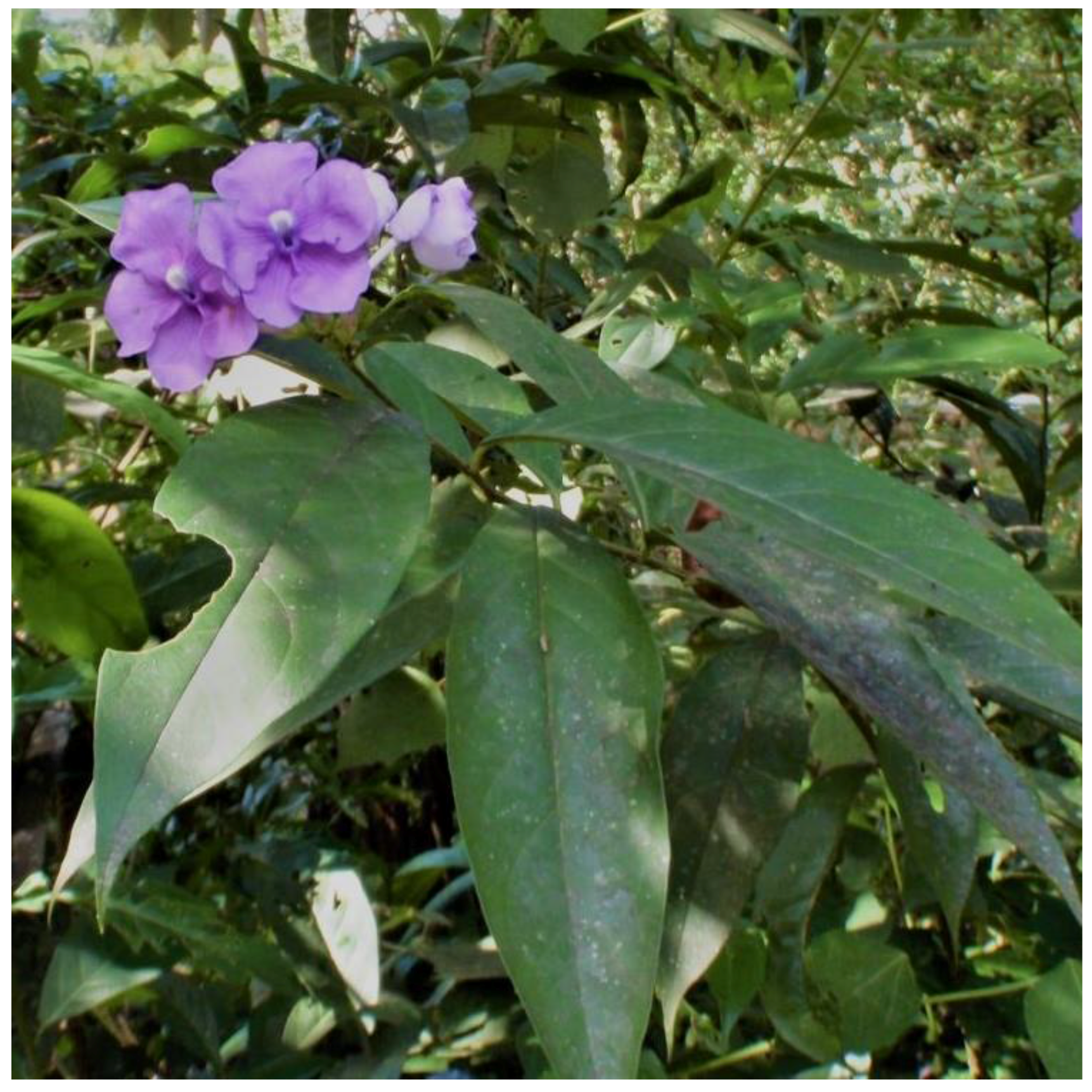
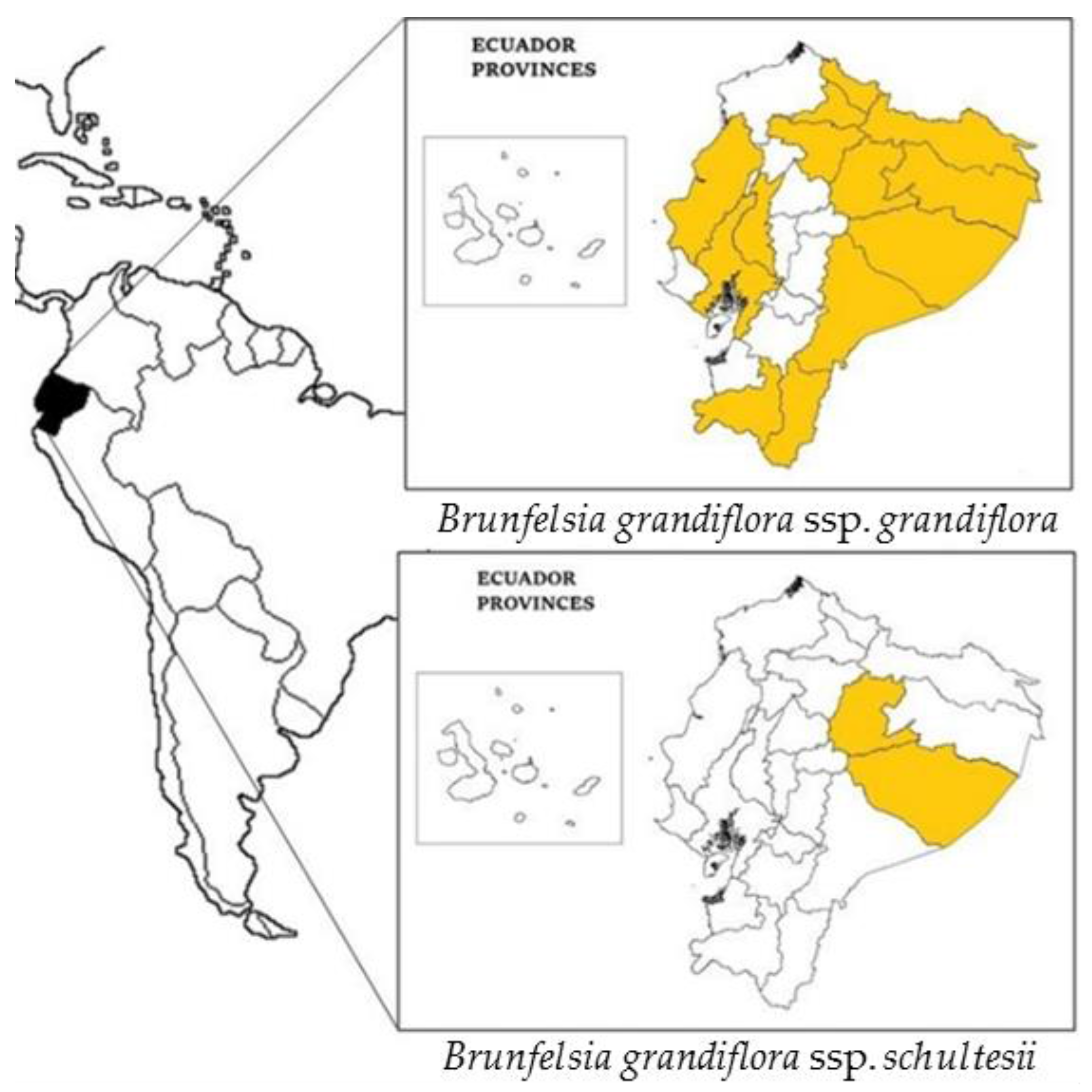
2.1. Brunfelsia grandiflora: Botanical Description, Chorolorogy, Variability, and Names
2.2. Compilation of Brunfelsia grandiflora Ethnobotanical Uses
2.3. Towards a Validation of the Pharmacological Action of B. grandiflora
2.4. Experimental Studies on Activity
3. Discussion
4. Materials and Methods
4.1. Study Area and Voucher Collection
4.2. Ethnobotanical Survey
4.3. Scientific Validation
5. Conclusions
Author Contributions
Funding
Acknowledgments
Conflicts of Interest
References
- Bennett, B.C. Hallucinogenic Plants of the Shuar and Related Indigenous Groups in Amazonian Ecuador and Peru. Brittonia 1992, 44, 483–493. [Google Scholar] [CrossRef] [Scilit]
- Missouri Botanical Garden. Available online: www.tropicos.org (accessed on 25 June 2018).
- Plowman, T. Brunfelsia in Ethnomedicine. Bot. Mus. Lealf. Harv. Univ. 1977, 25, 289–320. [Google Scholar] [PubMed]
- De la Torre, L.; Navarrete, H.; Muriel, P.; Marcia, M.; Balslev, H. Enciclopedia De Plantas Utiles Del Ecuador; Herbario QCA & Herbario AAU: Quito, Ecuador, 2008; Volume 1. [Google Scholar]
- Nordegren, T. The A-Z Encyclopedia of Alcohol and Drug Abuse; Brown Walker Press: Parkland, FL, USA, 2002. [Google Scholar]
- León, B.; Wiersema, J.H. World Economic Plants: A Standard Reference, 2nd ed.; CRC Press: Boca Raton, FL, USA, 2013. [Google Scholar]
- Gilman, E.F. Brunfelsia Grandiflora Yesterday, Today, and Tomorrow. FPS77. Available online: http://edis.ifas.ufl.edu/pdffiles/FP/FP07700.pdf (accessed on 23 May 2018).
- Schultes, R.E.; Hofmann, A.; Rätsch, C. Plants of the Gods. Their Sacred, Healing and Hallucinogenic Powers; Healing Arts Press: Rochester, VT, USA, 1998. [Google Scholar]
- Pratt, C. An Encyclopedia of Shamanism, Volume 1; Rosen Publishing Group: New York, NY, USA, 2007. [Google Scholar]
- Santiváñez Acosta, R.; Cabrera Meléndez, J. Catálogo Florístico de Las Plantas Medicinales Peruanas; Ministerio de Salud, Instituto Nacional de Salud: Lima, Perú, 2013. [Google Scholar]
- Mejía, K.; Reginfo, E. Plantas Medicinales de Uso Popular En La Amazonía Peruana; Agencia Española de Cooperación Internacional & Instituto de Investigaciones de la Amazonía Peruana: Lima, Perú, 2000. [Google Scholar]
- Voogelbreinder, S. Garden of Eden: The Shamanic Use of Psychoactive Flora and Fauna, and the Study of Consciousness; 2009. Available online: http://docshare01.docshare.tips/files/27747/277478962.pdf (accessed on 23 May 2018).
- Jauregui, X.; Clavo, Z.M.; Jovel, E.M.; Pardo-De-Santayana, M. “Plantas Con Madre”: Plants That Teach and Guide in the Shamanic Initiation Process in the East-Central Peruvian Amazon. J. Ethnopharmacol. 2011, 134, 739–752. [Google Scholar] [CrossRef] [Scilit] [PubMed]
- Kvist, L.P.; Christensen, S.B.; Rasmussen, H.B.; Mejia, K.; Gonzalez, A. Identification and Evaluation of Peruvian Plants Used to Treat Malaria and Leishmaniasis. J. Ethnopharmacol. 2006, 106, 390–402. [Google Scholar] [CrossRef] [Scilit] [PubMed]
- Kloucek, P.; Polesny, Z.; Svobodova, B.; Vlkova, E.; Kokoska, L. Antibacterial Screening of Some Peruvian Medicinal Plants Used in Callería District. J. Ethnopharmacol. 2005, 99, 309–312. [Google Scholar] [CrossRef] [Scilit] [PubMed]
- Polesna, L.; Polesny, Z.; Clavo, M.Z.; Hansson, A.; Kokoska, L. Ethnopharmacological Inventory of Plants Used in Coronel Portillo Province of Ucayali Department, Peru. Pharm. Biol. 2011, 49, 125–136. [Google Scholar] [CrossRef] [Scilit] [PubMed]
- Reginfo, E.; Cerruti, S.; Pinedo, P.M. Plantas Medicinales de La Amazonía Peruana: Estudio de su uso y cultivo; Instituto de Investigaciones de la Amazonía Peruana: Iquitos, Perú, 1997. [Google Scholar]
- Luzuriaga-Quichimbo, C.X. Estudio Etnobotánico En Comunidades Kichwas Amazónicas de Pastaza (Ecuador). Ph.D. Thesis, Universidad de Extremadura, Badajoz, Spain, 2017. [Google Scholar]
- Lloyd, H.A.; Fales, H.M.; Goldman, M.E.; Jerina, D.M.; Plowman, T.; Schultes, R.E. Brunfelsamidine: A Novel Convulsant from the Medicinal Plant Brunfelsia Grandiflora. Tetrahedron Lett. 1985, 26, 2623–2624. [Google Scholar] [CrossRef] [Scilit]
- Kress, H. Brunfelsia Grandiflora. Available online: https://www.henriettes-herb.com/eclectic/kings/franciscea.html (accessed on 23 May 2018).
- Rubio, V.; García-Pérez, A.I.; Herráez, A.; Tejedor, M.C.; Diez, J.C. Esculetin Modulates Cytotoxicity Induced by Oxidants in NB4 Human Leukemia Cells. Exp. Toxicol. Pathol. 2017, 69, 700–712. [Google Scholar] [CrossRef] [Scilit] [PubMed]
- Gong, J.; Zhang, W.; Feng, X.; Shao, M.; Xing, C. Aesculetin (6,7-Dihydroxycoumarin) Exhibits Potent and Selective Antitumor Activity in Human Acute Myeloid Leukemia Cells (THP-1) via Induction of Mitochondrial Mediated Apoptosis and Cancer Cell Migration Inhibition. J. BUON 2017, 22, 1563–1569. [Google Scholar] [PubMed]
- Minina, S.A.; Astakhova, T.A.; Gromova, E.G.; Vaichageva, Y.V. Preparation and Pharmacological Study of Cuscohygrine bis(methyl benzenesulfonate). Pharm. Chem. J. 1977, 11, 478–481. [Google Scholar] [CrossRef] [Scilit]
- DrugBank. Scopolamine. Available online: http://www.drugbank.ca/drugs/DB00747 (accessed on 23 May 2018).
- Kim, H.J.; Jang, S.I.; Kim, Y.J.; Chung, H.T.; Yun, Y.G.; Kang, T.H.; Jeong, O.S.; Kim, Y.C. Scopoletin Suppresses Pro-Inflammatory Cytokines and PGE2 from LPS-Stimulated Cell Line, RAW 264.7 Cells. Fitoterapia 2004, 75, 261–266. [Google Scholar] [CrossRef] [PubMed]
- Moon, P.D.; Lee, B.H.; Jeong, H.J.; An, H.J.; Park, S.J.; Kim, H.R.; Ko, S.G.; Um, J.Y.; Hong, S.H.; Kim, H.M. Use of Scopoletin to Inhibit the Production of Inflammatory Cytokines through Inhibition of the IκB/NF-ΚB Signal Cascade in the Human Mast Cell Line HMC-1. Eur. J. Pharmacol. 2007, 555, 218–225. [Google Scholar] [CrossRef] [Scilit] [PubMed]
- Oliveira, E.J.; Romero, M.A.; Silva, M.S.; Silva, B.A.; Medeiros, I.A. Intracellular Calcium Mobilization as a Target for the Spasmolytic Action of Scopoletin. Planta Med. 2001, 67, 605–608. [Google Scholar] [CrossRef] [Scilit] [PubMed]
- Rollinger, J.M.; Hornick, A.; Langer, T.; Stuppner, H.; Prast, H. Acetylcholinesterase Inhibitory Activity of Scopolin and Scopoletin Discovered by Virtual Screening of Natural Products. J. Med. Chem. 2004, 47, 6248–6254. [Google Scholar] [CrossRef] [Scilit] [PubMed]
- Carpinella, M.C.; Ferrayoli, C.G.; Palacios, S.M. Antifungal Synergistic Effect of Scopoletin, a Hydroxycoumarin Isolated from Melia Azedarach L. Fruits. J. Agric. Food Chem. 2005, 53, 2922–2927. [Google Scholar] [CrossRef] [Scilit] [PubMed]
- Choi, R.Y.; Ham, J.R.; Lee, H.I.; Cho, H.W.; Choi, M.S.; Park, S.K.; Lee, J.; Kim, M.J.; Seo, K.I.; Lee, M.K. Scopoletin Supplementation Ameliorates Steatosis and Inflammation in Diabetic Mice. Phyther. Res. 2017, 31, 1795–1804. [Google Scholar] [CrossRef] [Scilit] [PubMed]
- Kayser, O.; Kolodziej, H. Antibacterial Activity of Extracts and Constituents of Pelargonium Sidoides and Pelargonium Reniforme. Planta Med. 1997, 63, 508–510. [Google Scholar] [CrossRef] [Scilit] [PubMed]
- Fuchino, H.; Sekita, S.; Mori, K.; Kawahara, N.; Satake, M.; Kiuchi, F. A New Leishmanicidal Saponin from Brunfelsia Grandiflora. Chem. Pharm. Bull. 2008, 56, 93–96. [Google Scholar] [CrossRef] [Scilit] [PubMed]
- Borgtoft, H.; Fjeldså, J.; Øllgaard, B. People and Biodiversity: Two Case Studies from the Andean Foothills of Ecuador. Centre for Research on Cultural and Biological Diversity of Andean Rainforests. DIVA Tech. Rep. 1998, 3, 1–190. [Google Scholar]
- Neychev, V.; Mitev, V. Pro-Sexual and Androgen Enhancing Effects of Tribulus Terrestris L.: Fact or Fiction. J. Ethnopharmacol. 2016, 179, 345–355. [Google Scholar] [CrossRef] [Scilit] [PubMed]
- United Nations. Convention on Biological Diversity. Available online: https://www.cbd.int/convention/. (accessed on 23 May 2018).
- Moher, D.; Liberati, A.; Tetzlaff, J.; Altman, D.G.; PRISMA Group. Preferred Reporting Items for Systematic Reviews and Meta-Analyses: The PRISMA Statement. BMJ 2009, 339, b2535. [Google Scholar] [CrossRef] [PubMed]


| Part | Formulation | Traditional Knowledge | Ethnic Group Ecuador Province | |
|---|---|---|---|---|
| Human Consumption | ||||
| Edible Fruits/Sweet fruits | F | - | edible | Pichincha |
| Animal Feeding | ||||
| Edible Fruits/Sweet fruits | F * | avian food * | Wao * Orellana * | |
| Building | ||||
| Houses, buildings, and agricultural facilities | S | building | Wao Napo | |
| Industry and Crafts | ||||
| Cosmetics, perfumery, and cleaning | L | decoction or crushed and mixed with cold water | refreshing baths | Tsa’chi Pichincha |
| Tools and utensils (working, domestic, hunting, fishing, defense, etc.) | L, S | hunting tools | Kichwa del Oriente Orellana | |
| Personal clothing and ornaments | F | clothing in festivals | personal adornment | Shuar Napo |
| Medicinal | ||||
| Conception, pregnancy, childbirth, and puerperium | L, S, R, B | contraconceptive | Kichwa del Oriente Napo | |
| Respiratory system | B | a drop of juice resulting from crushing the bark is applied in the nose | flu | Cofán Sucumbíos |
| R, L | coction | Kichwa del Oriente Napo | ||
| Musculature and skeleton | S | bark is removed | bloated and aching body | Kichwa del Oriente Orellana |
| R | fumes * | rheumatism arthritis | Kichwa del Oriente Napo * Orellana | |
| Skin and subcutaneous cellular tissue | L | burns | Kichwa del Oriente Orellana | |
| B *, L * | powder and infusion * | wounds and blows * | Kichwa del Oriente * Napo * Orellana * | |
| Nervous system and mental disorders | headache * | Shuar Morona-Santiago | ||
| fumes * | Kichwa del Oriente * Napo * | |||
| Symptoms and states of indefinite origin | L | infusion | body weakness | Kichwa del Oriente Pastaza |
| L | powder and infusion * | chills and fever * | Kichwa del Oriente * Napo *, Orellana * | |
| B | chills and fever * | Secoya * Sucumbíos * | ||
| infusion | healthy | Kichwa del Oriente Napo, Orellana | ||
| Social, Symbolic, and Ritualistic Uses | ||||
| Life Cycle Rituals | R, S | paternity test | Siona Sucumbíos | |
| Rituals of uncertainty, protection, and affliction | R, L | infusion | induce vomiting for body purification | Shuar Napo |
| L | infusion for bathing or drinking | improve luck during hunting, attract and tame animals | Kichwa del Oriente Napo, Orellana | |
| B | infusion for drinking | improve the aim of a blowpipe during hunts | Shuar Napo | |
| infusion for bathing, mixed with orange, onio, caimito, and achiote | protect against the “evil eye” | Kichwa del Oriente Orellana | ||
| L | infusion | cause chills | Pastaza | |
| only for shamans (*) | obtain knowledge about new medicines (*) | Cofán * Sucumbíos | ||
| Hallucinogen, narcotic, and smoking | B | infusion, only for curacas | “become a tiger” | Cofán Sucumbíos |
| Shuar Napo | ||||
| S | crushed with cold water, the shaman swallows it | disease diagnosis and to remove evil spirits from the body | Cofán Sucumbíos Shuar Napo | |
| B, R, S, L | drinks, sometimes mixed with Banisteriosis caapi to intensify the effect | hallucinogen used in rituals | Secoya *, Shuar Kichwa del Oriente Orellana, Sucumbíos Napo, Zamora Chinchipe |
| Part | Formulation | Traditional Knowledge | |
|---|---|---|---|
| Medicinal | |||
| Digestive system | L | a handful of leaves is cooked, from thirty minutes to an hour, in two liters of water; it is taken in small glasses on an empty stomach | stomach pain and diarrhea ### |
| Conception, pregnancy, childbirth, and puerperium | B | scrape, mix it with a small glass of warm water, let it hover, and drink it | childbirth ### |
| Insect or other animal bites | B | scrape a piece and put it on the injury (tupe); repeat it when the product becomes dry, until the worm gets out | against tupe ### |
| Musculature and skeleton | R * | small roots scraped and tied with a rag or bandage and placed twice a day on the affected part * | aching body * |
| Skin and subcutaneous cellular tissue | B * | the bark is grated, deposited on a rag or bandage and tied to the area that has been hit* | body blows * |
| L * | the leaf is crushed, placed on the affected area, tied, and then the patient falls asleep; the process must be repeated as many times as possible* | skin tumors * | |
| Social, Symbolic, and Ritualistic Uses | |||
| Rituals of uncertainty, protection, and affliction | B | it is prepared in a pot and a glassful is swallowed; during the treatment, a diet must be followed (refrain from taking salt or chili, Capsicum frutescens), nor should you stay near the candle | improve men’s energy when going into the forest |
| B | the bark is grated, mixed in a medium recipient called pilchi, with water and taken at midnight; they also inform the authors that consuming this brew produced a lot of cold and chills | ensure strength blowing the blow pump during hunts |
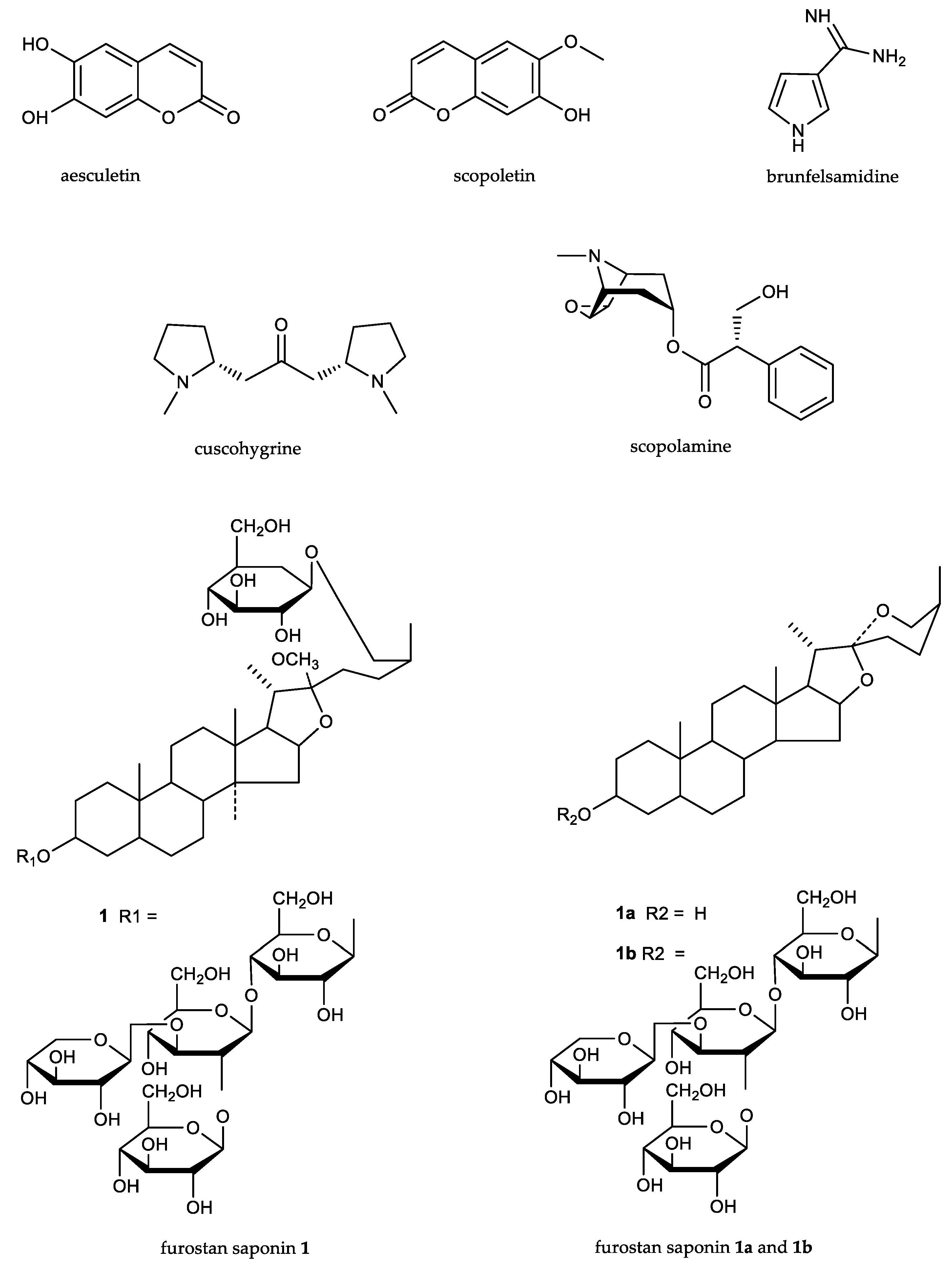
| Molecules | Activity | References |
|---|---|---|
| aesculetin | inhibition of cancer cell migration | [21] |
| antileukemia | [22] | |
| brunfelsamidine | convulsant, affects serotonin levels | [19] |
| cuscohygrine | short-term ganglion-blocking | [23] |
| scopolamine | anticholinergic | [24] |
| scopoletin | anti-inflammatory by cytokine suppression | [25,26] |
| spasmolytic by inhibition of calcium moving | [27] | |
| cholinergic in vivo rat brain | [28] | |
| blood pressure regulator | [29] | |
| hepatic steatosis protector by enzymatic inhibition | [30] | |
| antifungal | [29] | |
| antibacterial | [31] | |
| saponins | antileishmania | [32] |
© 2018 by the authors. Licensee MDPI, Basel, Switzerland. This article is an open access article distributed under the terms and conditions of the Creative Commons Attribution (CC BY) license (http://creativecommons.org/licenses/by/4.0/).
Share and Cite
Luzuriaga-Quichimbo, C.X.; Hernández del Barco, M.; Blanco-Salas, J.; Cerón-Martínez, C.E.; Ruiz-Téllez, T. Chiricaspi (Brunfelsia grandiflora, Solanaceae), a Pharmacologically Promising Plant. Plants 2018, 7, 67. https://doi.org/10.3390/plants7030067
Luzuriaga-Quichimbo CX, Hernández del Barco M, Blanco-Salas J, Cerón-Martínez CE, Ruiz-Téllez T. Chiricaspi (Brunfelsia grandiflora, Solanaceae), a Pharmacologically Promising Plant. Plants. 2018; 7(3):67. https://doi.org/10.3390/plants7030067
Chicago/Turabian StyleLuzuriaga-Quichimbo, Carmen X., Míriam Hernández del Barco, José Blanco-Salas, Carlos E. Cerón-Martínez, and Trinidad Ruiz-Téllez. 2018. "Chiricaspi (Brunfelsia grandiflora, Solanaceae), a Pharmacologically Promising Plant" Plants 7, no. 3: 67. https://doi.org/10.3390/plants7030067
APA StyleLuzuriaga-Quichimbo, C. X., Hernández del Barco, M., Blanco-Salas, J., Cerón-Martínez, C. E., & Ruiz-Téllez, T. (2018). Chiricaspi (Brunfelsia grandiflora, Solanaceae), a Pharmacologically Promising Plant. Plants, 7(3), 67. https://doi.org/10.3390/plants7030067