Genetic Dissection of Carotenoid Variation by Integrating Quantitative Trait Loci Mapping and Candidate Region Association Study in Sweet Corn

 , , , , ,
Abstract
1. Introduction
2. Results
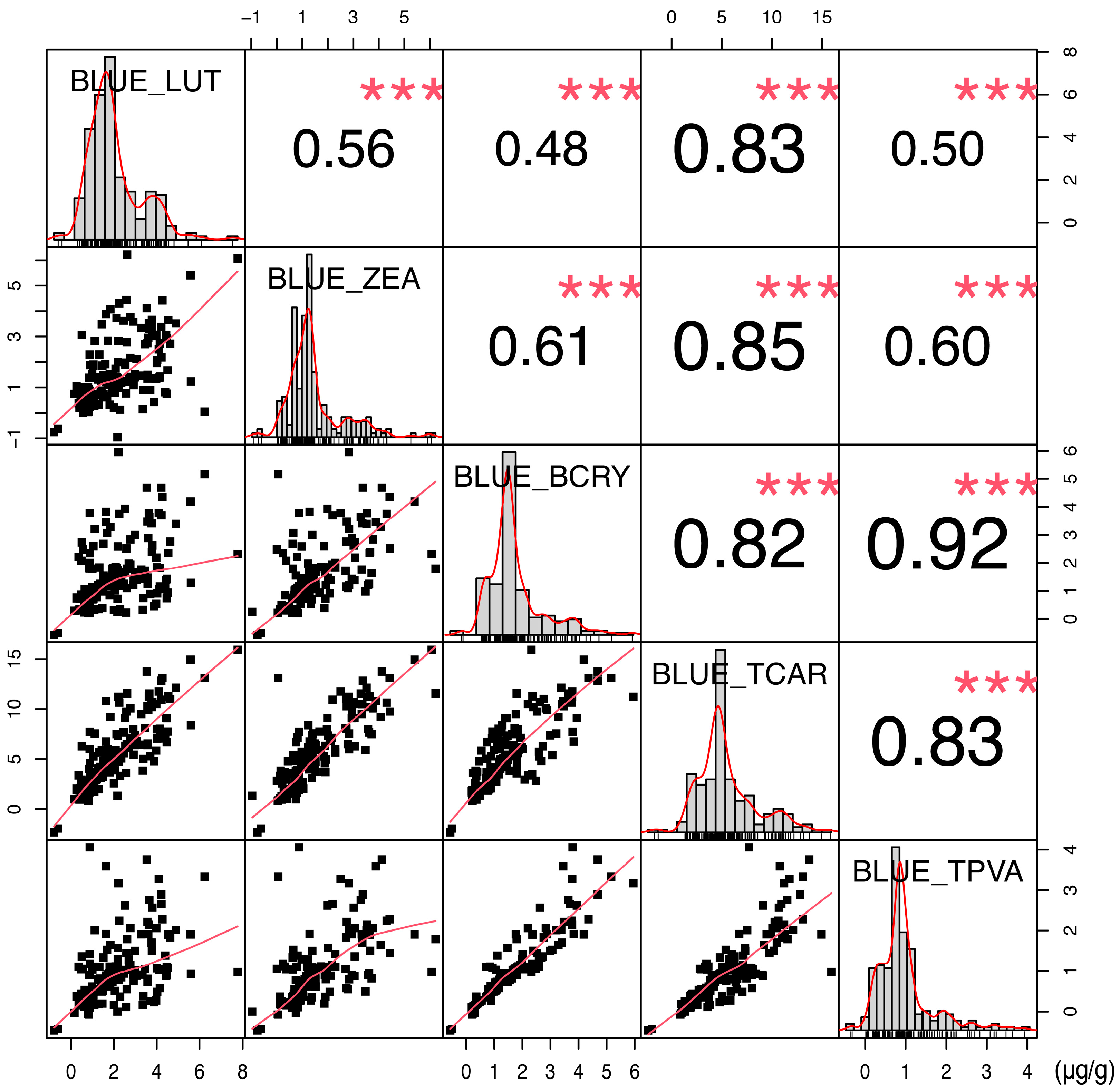
2.1. Phenotypic Analysis of Carotenoid-Related Traits in Maize Kernels
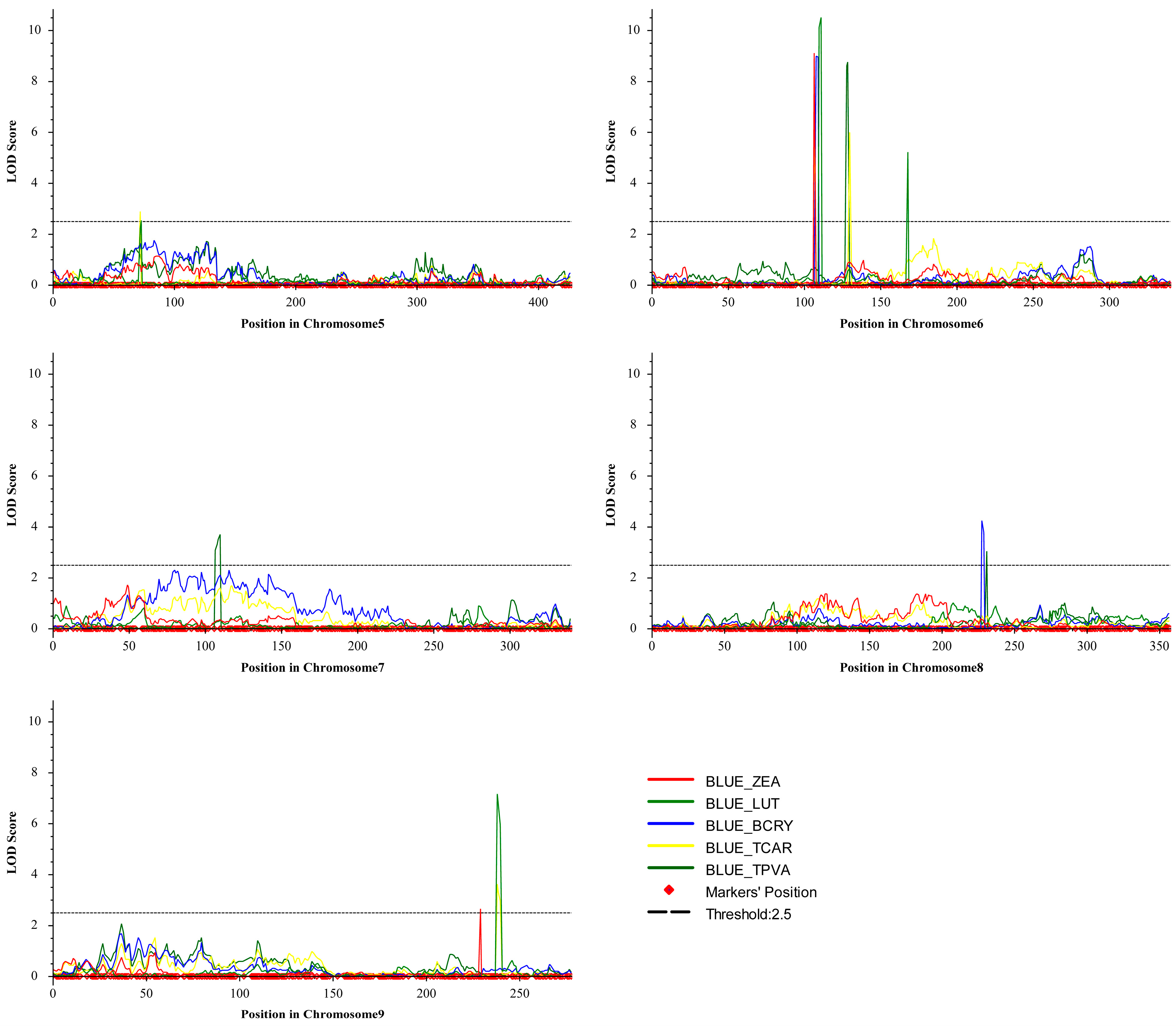
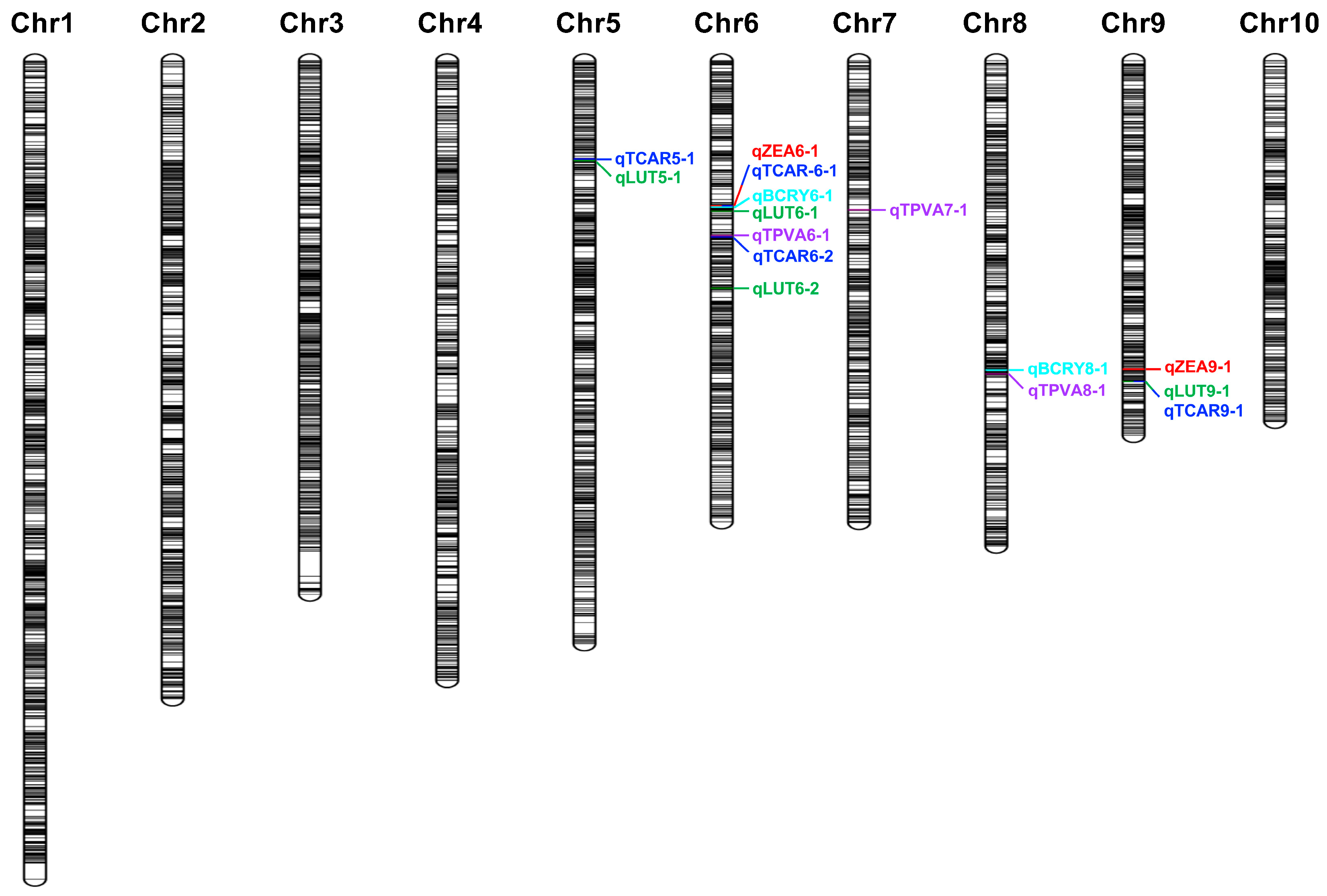
2.2. QTL Mapping of Carotenoid-Related Components
2.3. Integrating Candidate Region Association Study to Identify Potential Genes
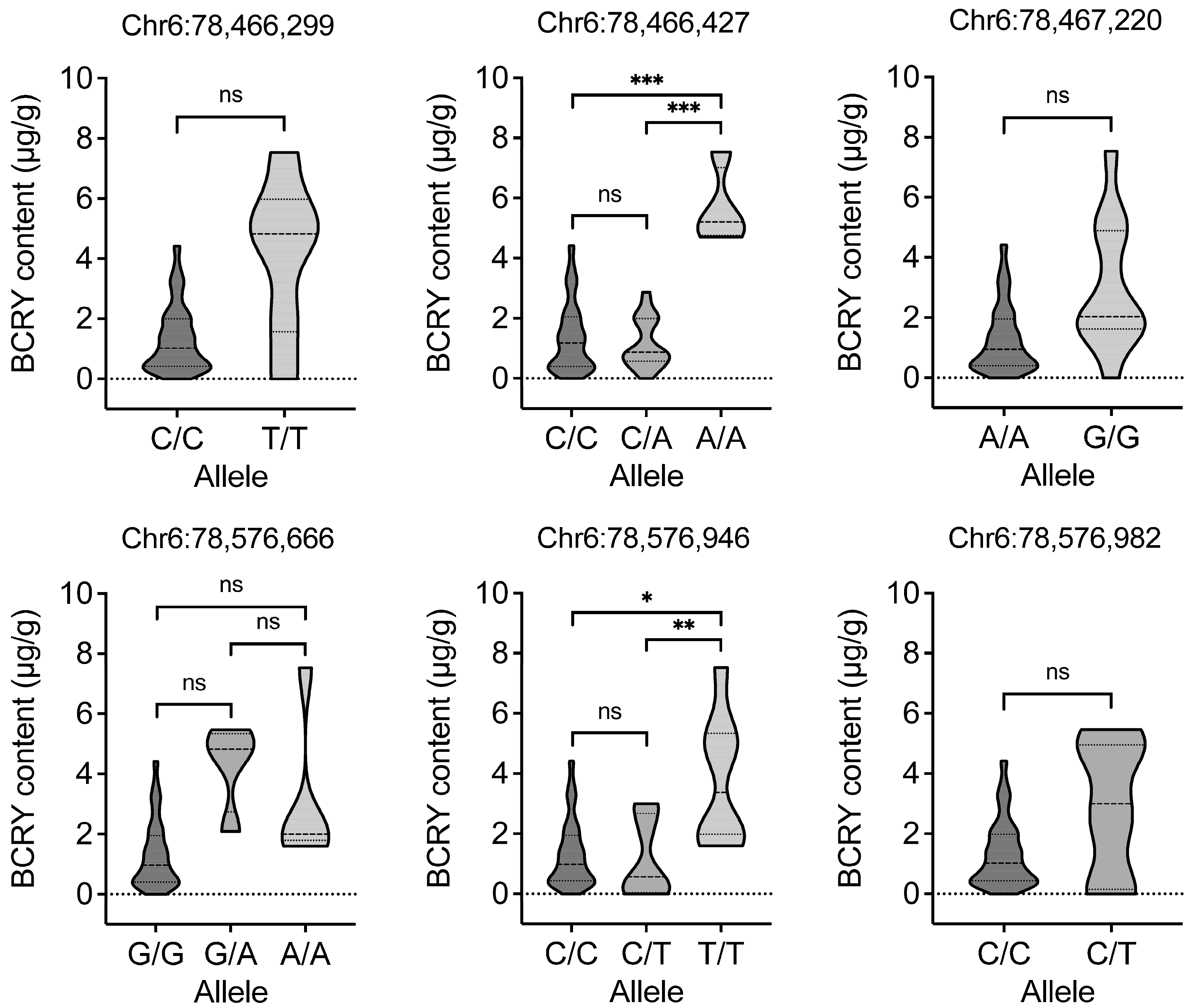
2.4. Allelic Variation and Its Effect on β-Cryptoxanthin Accumulation
3. Discussion
4. Materials and Methods
4.1. Plant Materials and Field Experiments
4.2. Carotenoid Quantification
4.3. DNA Extraction and Genotyping
4.4. QTL Mapping
4.5. Candidate Region Association Study
4.6. Statistical Analysis
Supplementary Materials
Author Contributions
Funding
Data Availability Statement
Acknowledgments
Conflicts of Interest
References
- Nisar, N.; Li, L.; Lu, S.; Khin, N.C.; Pogson, B.J. Carotenoid metabolism in plants. Mol. Plant 2015, 8, 68–82. [Google Scholar] [CrossRef] [Scilit] [PubMed]
- Sun, T.H.; Yuan, H.; Cao, H.B.; Yazdani, M.; Tadmor, Y.; Li, L. Carotenoid metabolism in plants: The role of plastids. Mol. Plant 2018, 11, 58–74. [Google Scholar] [CrossRef] [Scilit]
- Cazzonelli, C.I.; Pogson, B.J. Source to sink: Regulation of carotenoid biosynthesis in plants. Trends Plant Sci. 2010, 15, 266–274. [Google Scholar] [CrossRef] [Scilit]
- Havaux, M. Carotenoid oxidation products as stress signals in plants. Plant J. 2014, 79, 597–606. [Google Scholar] [CrossRef] [Scilit]
- Diepenbrock, C.H.; Ilut, D.C.; Magallanes-Lundback, M.; Kandianis, C.B.; Lipka, A.E.; Bradbury, P.J.; Holland, J.B.; Hamilton, J.P.; Wooldridge, E.; Vaillancourt, B.; et al. Eleven biosynthetic genes explain the majority of natural variation in carotenoid levels in maize grain. Plant Cell 2021, 33, 882–900. [Google Scholar] [CrossRef] [Scilit]
- Eggersdorfer, M.; Wyss, A. Carotenoids in human nutrition and health. Arch. Biochem. Biophys. 2018, 652, 18–26. [Google Scholar] [CrossRef] [Scilit] [PubMed]
- Babu, R.; Rojas, N.P.; Gao, S.B.; Yan, J.B.; Pixley, K. Validation of the effects of molecular marker polymorphisms in LcyE and CrtRB1 on provitamin A concentrations for 26 tropical maize populations. Theor. Appl. Genet. 2013, 126, 389–399. [Google Scholar] [CrossRef] [Scilit] [PubMed]
- West, K.P. Extent of vitamin A deficiency among preschool children and women of reproductive age. J. Nutr. 2002, 132, 2857s–2866s. [Google Scholar] [CrossRef] [Scilit] [PubMed]
- Baseggio, M.; Murray, M.; Magallanes-Lundback, M.; Kaczmar, N.; Chamness, J.; Buckler, E.S.; Smith, M.E.; DellaPenna, D.; Tracy, W.F.; Gore, M.A. Natural variation for carotenoids in fresh kernels is controlled by uncommon variants in sweet corn. Plant Genome 2020, 13, e20008. [Google Scholar] [CrossRef] [Scilit]
- Yin, P.F.; Fu, X.Y.; Feng, H.Y.; Yang, Y.Y.; Xu, J.; Zhang, X.; Wang, M.; Ji, S.H.; Zhao, B.H.; Fang, H.; et al. Linkage and association mapping in multi-parental populations reveal the genetic basis of carotenoid variation in maize kernels. Plant Biotechnol. J. 2024, 22, 2312–2326. [Google Scholar] [CrossRef] [Scilit]
- Vranová, E.; Coman, D.; Gruissem, W. Network analysis of the MVA and MEP pathways for isoprenoid synthesis. Annu. Rev. Plant Biol. 2013, 64, 665–700. [Google Scholar] [CrossRef] [Scilit]
- Matthews, P.D.; Luo, R.B.; Wurtzel, E.T. Maize phytoene desaturase and ζ-carotene desaturase catalyse a poly-Z desaturation pathway: Implications for genetic engineering of carotenoid content among cereal crops. J. Exp. Bot. 2003, 54, 2215–2230. [Google Scholar] [CrossRef] [Scilit] [PubMed]
- Lado, J.; Zacarias, L.; Rodrigo, M.J. Regulation of carotenoid biosynthesis during fruit development. Subcell. Biochem. 2016, 79, 161–198. [Google Scholar] [CrossRef] [Scilit]
- Chen, W.W.; Zhang, X.B.; Lu, C.L.; Chang, H.L.; Chachar, Z.; Fan, L.N.; An, Y.X.; Li, X.H.; Qi, Y.W. Genome-wide association study of carotenoids in maize kernel. Plant Genome 2024, 17, e20495. [Google Scholar] [CrossRef] [Scilit]
- Palaisa, K.A.; Morgante, M.; Williams, M.; Rafalski, A. Contrasting effects of selection on sequence diversity and linkage disequilibrium at two phytoene synthase loci. Plant Cell 2003, 15, 1795–1806. [Google Scholar] [CrossRef] [Scilit]
- Palaisa, K.; Morgante, M.; Tingey, S.; Rafalski, A. Long-range patterns of diversity and linkage disequilibrium surrounding the maize Y1 gene are indicative of an asymmetric selective sweep. Proc. Natl. Acad. Sci. USA 2004, 101, 9885–9890. [Google Scholar] [CrossRef] [Scilit] [PubMed]
- Harjes, C.E.; Rocheford, T.R.; Bai, L.; Brutnell, T.P.; Kandianis, C.B.; Sowinski, S.G.; Stapleton, A.E.; Vallabhaneni, R.; Williams, M.; Wurtzel, E.T.; et al. Natural genetic variation in lycopene epsilon cyclase tapped for maize biofortification. Science 2008, 319, 330–333. [Google Scholar] [CrossRef] [Scilit]
- Yan, J.B.; Kandianis, C.B.; Harjes, C.E.; Bai, L.; Kim, E.H.; Yang, X.H.; Skinner, D.J.; Fu, Z.Y.; Mitchell, S.; Li, Q.; et al. Rare genetic variation at Zea mays crtRB1 increases β-carotene in maize grain. Nat. Genet. 2010, 42, 322–327. [Google Scholar] [CrossRef] [Scilit]
- Chander, S.; Guo, Y.Q.; Yang, X.H.; Zhang, J.; Lu, X.Q.; Yan, J.B.; Song, T.M.; Rocheford, T.R.; Li, J.S. Using molecular markers to identify two major loci controlling carotenoid contents in maize grain. Theor. Appl. Genet. 2008, 116, 223–233. [Google Scholar] [CrossRef] [Scilit]
- Jittham, O.; Fu, X.Y.; Xu, J.; Chander, S.; Li, J.S.; Yang, X.H. Genetic dissection of carotenoids in maize kernels using high-density single nucleotide polymorphism markers in a recombinant inbred line population. Crop J. 2017, 5, 63–72. [Google Scholar] [CrossRef] [Scilit]
- Azmach, G.; Menkir, A.; Spillane, C.; Gedil, M. Genetic loci controlling carotenoid biosynthesis in diverse tropical maize lines. G3-Genes Genom. Genet. 2018, 8, 1049–1065. [Google Scholar] [CrossRef] [Scilit]
- Owens, B.F.; Lipka, A.E.; Magallanes-Lundback, M.; Tiede, T.; Diepenbrock, C.H.; Kandianis, C.B.; Kim, E.; Cepela, J.; Mateos-Hernandez, M.; Buell, C.R.; et al. A foundation for provitamin A biofortification of maize: Genome-wide association and genomic prediction models of carotenoid levels. Genetics 2014, 198, 1699–1716. [Google Scholar] [CrossRef] [Scilit]
- Suwarno, W.B.; Pixley, K.V.; Palacios-Rojas, N.; Kaeppler, S.M.; Babu, R. Genome-wide association analysis reveals new targets for carotenoid biofortification in maize. Theor. Appl. Genet. 2015, 128, 851–864. [Google Scholar] [CrossRef] [Scilit] [PubMed]
- Wang, X.F.; Elling, A.A.; Li, X.Y.; Li, N.; Peng, Z.Y.; He, G.M.; Sun, H.; Qi, Y.J.; Liu, X.S.; Deng, X.W. Genome-wide and organ-specific landscapes of epigenetic modifications and their relationships to mRNA and Small RNA transcriptomes in maize. Plant Cell 2009, 21, 1053–1069. [Google Scholar] [CrossRef] [Scilit] [PubMed]
- Davidson, R.M.; Hansey, C.N.; Gowda, M.; Childs, K.L.; Lin, H.N.; Vaillancourt, B.; Sekhon, R.S.; de Leon, N.; Kaeppler, S.M.; Jiang, N.; et al. Utility of RNA sequencing for analysis of maize reproductive transcriptomes. Plant Genome 2011, 4, 191–203. [Google Scholar] [CrossRef] [Scilit]
- Chen, J.; Zeng, B.; Zhang, M.; Xie, S.J.; Wang, G.K.; Hauck, A.; Lai, J.S. Dynamic transcriptome landscape of maize embryo and endosperm development. Plant Physiol. 2014, 166, 252–264. [Google Scholar] [CrossRef] [Scilit]
- Wong, J.C.; Lambert, R.J.; Wurtzel, E.T.; Rocheford, T.R. QTL and candidate genes phytoene synthase and ζ-carotene desaturase associated with the accumulation of carotenoids in maize. Theor. Appl. Genet. 2004, 108, 349–359. [Google Scholar] [CrossRef] [Scilit]
- Kandianis, C.B.; Stevens, R.; Liu, W.P.; Palacios, N.; Montgomery, K.; Pixley, K.; White, W.S.; Rocheford, T. Genetic architecture controlling variation in grain carotenoid composition and concentrations in two maize populations. Theor. Appl. Genet. 2013, 126, 2879–2895. [Google Scholar] [CrossRef] [Scilit]
- Shen, G.D.; Sun, W.L.; Chen, Z.C.; Shi, L.; Hong, J.; Shi, J.X. Plant GDSL esterases/lipases: Evolutionary, physiological and molecular functions in plant development. Plants 2022, 11, 468. [Google Scholar] [CrossRef] [Scilit]
- Rodríguez-Suárez, C.; Requena-Ramírez, M.D.; Hornero-Méndez, D.; Atienza, S.G. Towards carotenoid biofortification in wheat: Identification of XAT-7A1, a multicopy tandem gene responsible for carotenoid esterification in durum wheat. BMC Plant Biol. 2023, 23, 412. [Google Scholar] [CrossRef] [Scilit]
- Mellado-Ortega, E.; Hornero-Méndez, D. Carotenoids in cereals: An ancient resource with present and future applications. Phytochem. Rev. 2015, 14, 873–890. [Google Scholar] [CrossRef] [Scilit]
- Mellado-Ortega, E.; Hornero-Méndez, D. Lutein esterification in wheat flour increases the carotenoid retention and is induced by storage temperatures. Foods 2017, 6, 111. [Google Scholar] [CrossRef] [Scilit]
- Requena-Ramírez, M.D.; Atienza, S.G.; Hornero-Méndez, D.; Rodríguez-Suárez, C. Mediation of a GDSL esterase/lipase in carotenoid esterification in tritordeum suggests a common mechanism of carotenoid esterification in Triticeae species. Front. Plant Sci. 2020, 11, 592515. [Google Scholar] [CrossRef] [Scilit] [PubMed]
- Watkins, J.L.; Li, M.; McQuinn, R.P.; Chan, K.X.; McFarlane, H.E.; Ermakova, M.; Furbank, R.T.; Mares, D.; Dong, C.M.; Chalmers, K.J.; et al. A GDSL esterase/lipase catalyzes the esterification of lutein in bread wheat. Plant Cell 2019, 31, 3092–3112. [Google Scholar] [CrossRef] [Scilit]
- Palacios-Rojas, N.; McCulley, L.; Kaeppler, M.; Titcomb, T.J.; Gunaratna, N.S.; Lopez-Ridaura, S.; Tanumihardjo, S.A. Mining maize diversity and improving its nutritional aspects within agro-food systems. Compr. Rev. Food Sci. Food Saf. 2020, 19, 1809–1834. [Google Scholar] [CrossRef] [Scilit]
- Kurilich, A.C.; Juvik, J.A. Quantification of carotenoid and tocopherol antioxidants in Zea mays. J. Agric. Food Chem. 1999, 47, 1948–1955. [Google Scholar] [CrossRef] [Scilit]
- Guo, Z.; Yang, Q.; Huang, F.; Zheng, H.; Sang, Z.; Xu, Y.; Zhang, C.; Wu, K.; Tao, J.; Prasanna, B.M.; et al. Development of high-resolution multiple-SNP arrays for genetic analyses and molecular breeding through genotyping by target sequencing and liquid chip. Plant Commun. 2021, 2, 100230. [Google Scholar] [CrossRef] [Scilit] [PubMed]
- Chen, S.F. fastp 1.0: An ultra-fast all-round tool for FASTQ data quality control and preprocessing. iMeta 2025, 4, e70078. [Google Scholar] [CrossRef] [Scilit] [PubMed]
- Li, H. Aligning sequence reads, clone sequences and assembly contigs with BWA-MEM. arXiv 2013, arXiv:1303.3997. [Google Scholar] [CrossRef] [Scilit]
- Purcell, S.; Neale, B.; Todd-Brown, K.; Thomas, L.; Ferreira, M.A.R.; Bender, D.; Maller, J.; Sklar, P.; de Bakker, P.I.W.; Daly, M.J.; et al. PLINK: A tool set for whole-genome association and population-based linkage analyses. Am. J. Hum. Genet. 2007, 81, 559–575. [Google Scholar] [CrossRef] [Scilit]
- Van der Auwera, G.A.; O’Connor, B.D. Genomics in the Cloud: Using Docker, GATK, and WDL in Terra, 1st ed.; O’Reilly Media: Sebastopol, CA, USA, 2020. [Google Scholar]
- Zhang, X.; Guan, Z.; Wang, L.; Fu, J.; Zhang, Y.; Li, Z.; Ma, L.; Liu, P.; Zhang, Y.; Liu, M.; et al. Combined GWAS and QTL analysis for dissecting the genetic architecture of kernel test weight in maize. Mol. Genet. Genom. 2020, 295, 409–420. [Google Scholar] [CrossRef] [Scilit]
- Shikha, K.; Shahi, J.P.; Vinayan, M.T.; Zaidi, P.H.; Singh, A.K.; Sinha, B. Genome-wide association mapping in maize: Status and prospects. 3 Biotech 2021, 11, 244. [Google Scholar] [CrossRef] [Scilit]
- Bradbury, P.J.; Zhang, Z.; Kroon, D.E.; Casstevens, T.M.; Ramdoss, Y.; Buckler, E.S. TASSEL: Software for association mapping of complex traits in diverse samples. Bioinform. 2007, 23, 2633–2635. [Google Scholar] [CrossRef] [Scilit]
- Zhao, X.; Liu, Y.; Wu, W.; Li, Y.; Luo, L.; Lan, Y.; Cao, Y.; Zhang, Z.; Gao, S.; Yuan, G.; et al. Genome-wide association analysis of lead accumulation in maize. Mol. Genet. Genom. 2018, 293, 615–622. [Google Scholar] [CrossRef] [Scilit] [PubMed]
- Dong, S.S.; He, W.M.; Ji, J.J.; Zhang, C.; Guo, Y.; Yang, T.L. LDBlockShow: A fast and convenient tool for visualizing linkage disequilibrium and haplotype blocks based on variant call format files. Brief. Bioinform. 2021, 22, bbaa227. [Google Scholar] [CrossRef] [Scilit] [PubMed]
- Gabriel, S.B.; Schaffner, S.F.; Nguyen, H.; Moore, J.M.; Roy, J.; Blumenstiel, B.; Higgins, J.; DeFelice, M.; Lochner, A.; Faggart, M.; et al. The structure of haplotype blocks in the human genome. Science 2002, 296, 2225–2229. [Google Scholar] [CrossRef] [Scilit] [PubMed]




| Environment | Trait | Mean ± SD (μg/g) | Range (μg/g) | Skewness | Kurtosis | CV (%) |
|---|---|---|---|---|---|---|
| SPG | LUT | 0.76 ± 0.61 | 0.11–3.54 | 2.14 | 5.48 | 80.1 |
| ZEA | 0.46 ± 0.67 | 0.04–5.18 | 3.97 | 19 | 146.38 | |
| BCRY | 0.62 ± 0.58 | 0.02–5.13 | 4.16 | 23.1 | 93.27 | |
| ACAR | 0.00 | 0.00 | / | / | / | |
| BCAR | 0.01 ± 0.14 | 0.00–1.91 | 12.05 | 150.76 | 1065.11 | |
| TCAR | 1.85 ± 1.60 | 0.40–11.13 | 2.77 | 8.92 | 86.28 | |
| TPVA | 0.32 ± 0.35 | 0.01–3.05 | 4.71 | 27.69 | 108.2 | |
| SUF | LUT | 3.21 ± 2.55 | 0.31–8.92 | 0.69 | −0.91 | 79.46 |
| ZEA | 2.51 ± 2.18 | 0.00–8.65 | 1.07 | −0.05 | 86.85 | |
| BCRY | 2.35 ± 2.09 | 0.04–8.25 | 0.97 | −0.16 | 88.95 | |
| ACAR | 0.10 ± 0.43 | 0.00–3.32 | 5.15 | 29.23 | 420.62 | |
| BCAR | 0.33 ± 0.71 | 0.00–4.38 | 2.88 | 9.81 | 215.78 | |
| TCAR | 8.50 ± 6.16 | 0.85–25.00 | 0.81 | −0.41 | 72.49 | |
| TPVA | 1.55 ± 1.56 | 0.02–7.93 | 1.42 | 1.77 | 100.8 |
| Trait | QTL | Chromosome | Marker Interval | LOD | PVE (%) | Additive |
|---|---|---|---|---|---|---|
| LUT | qLUT5-1 | 5 | 14,745,795–15,981,919 | 2.54 | 3.83 | 0.25 |
| qLUT6-1 | 6 | 100,095,064–100,870,497 | 10.50 | 17.25 | 0.52 | |
| qLUT6-2 | 6 | 121,751,651–121,788,281 | 5.22 | 8.24 | 0.36 | |
| qLUT9-1 | 9 | 161,970,440–161,911,412 | 7.14 | 11.16 | 0.42 | |
| ZEA | qZEA6-1 | 6 | 91,756,773–91,927,299 | 9.10 | 17.02 | 0.48 |
| qZEA9-1 | 9 | 158,823,760–158,813,271 | 2.65 | 4.70 | 0.25 | |
| BCRY | qBCRY6-1 | 6 | 91,927,299–96,134,979 | 8.97 | 17.04 | 0.44 |
| qBCRY8-1 | 8 | 151,902,915–152,790,422 | 4.23 | 7.55 | −0.29 | |
| TCAR | qTCAR5-1 | 5 | 15,584,794–14,745,795 | 2.89 | 5.60 | 0.63 |
| qTCAR6-1 | 6 | 91,756,773–91,927,299 | 6.92 | 14.05 | 1.00 | |
| qTCAR6-2 | 6 | 105,941,426–105,969,916 | 5.98 | 11.97 | 0.92 | |
| qTCAR9-1 | 9 | 161,970,440–161,911,412 | 3.62 | 7.03 | 0.71 | |
| TPRA | qTPVA6-1 | 6 | 105,711,040–105,941,426 | 8.76 | 16.45 | 0.29 |
| qTPVA7-1 | 7 | 82,417,620–82,290,864 | 3.68 | 6.55 | −0.18 | |
| qTPVA8-1 | 8 | 155,431,072–157,945,924 | 3.03 | 5.43 | −0.17 |
Disclaimer/Publisher’s Note: The statements, opinions and data contained in all publications are solely those of the individual author(s) and contributor(s) and not of MDPI and/or the editor(s). MDPI and/or the editor(s) disclaim responsibility for any injury to people or property resulting from any ideas, methods, instructions or products referred to in the content. |
© 2025 by the authors. Licensee MDPI, Basel, Switzerland. This article is an open access article distributed under the terms and conditions of the Creative Commons Attribution (CC BY) license.
Share and Cite
Zhao, Y.; Qu, J.; Gu, W.; Yu, D.; Wang, H.; Zhang, Z.; Garcia, F.S.V.; Yang, M.; Sun, X.; Zheng, H.; et al. Genetic Dissection of Carotenoid Variation by Integrating Quantitative Trait Loci Mapping and Candidate Region Association Study in Sweet Corn. Plants 2026, 15, 50. https://doi.org/10.3390/plants15010050
Zhao Y, Qu J, Gu W, Yu D, Wang H, Zhang Z, Garcia FSV, Yang M, Sun X, Zheng H, et al. Genetic Dissection of Carotenoid Variation by Integrating Quantitative Trait Loci Mapping and Candidate Region Association Study in Sweet Corn. Plants. 2026; 15(1):50. https://doi.org/10.3390/plants15010050
Chicago/Turabian StyleZhao, Yingjie, Jingtao Qu, Wei Gu, Diansi Yu, Hui Wang, Zhonglin Zhang, Felix San Vicente Garcia, Mengxia Yang, Xiaoyu Sun, Hongjian Zheng, and et al. 2026. "Genetic Dissection of Carotenoid Variation by Integrating Quantitative Trait Loci Mapping and Candidate Region Association Study in Sweet Corn" Plants 15, no. 1: 50. https://doi.org/10.3390/plants15010050
APA StyleZhao, Y., Qu, J., Gu, W., Yu, D., Wang, H., Zhang, Z., Garcia, F. S. V., Yang, M., Sun, X., Zheng, H., & Guan, Y. (2026). Genetic Dissection of Carotenoid Variation by Integrating Quantitative Trait Loci Mapping and Candidate Region Association Study in Sweet Corn. Plants, 15(1), 50. https://doi.org/10.3390/plants15010050