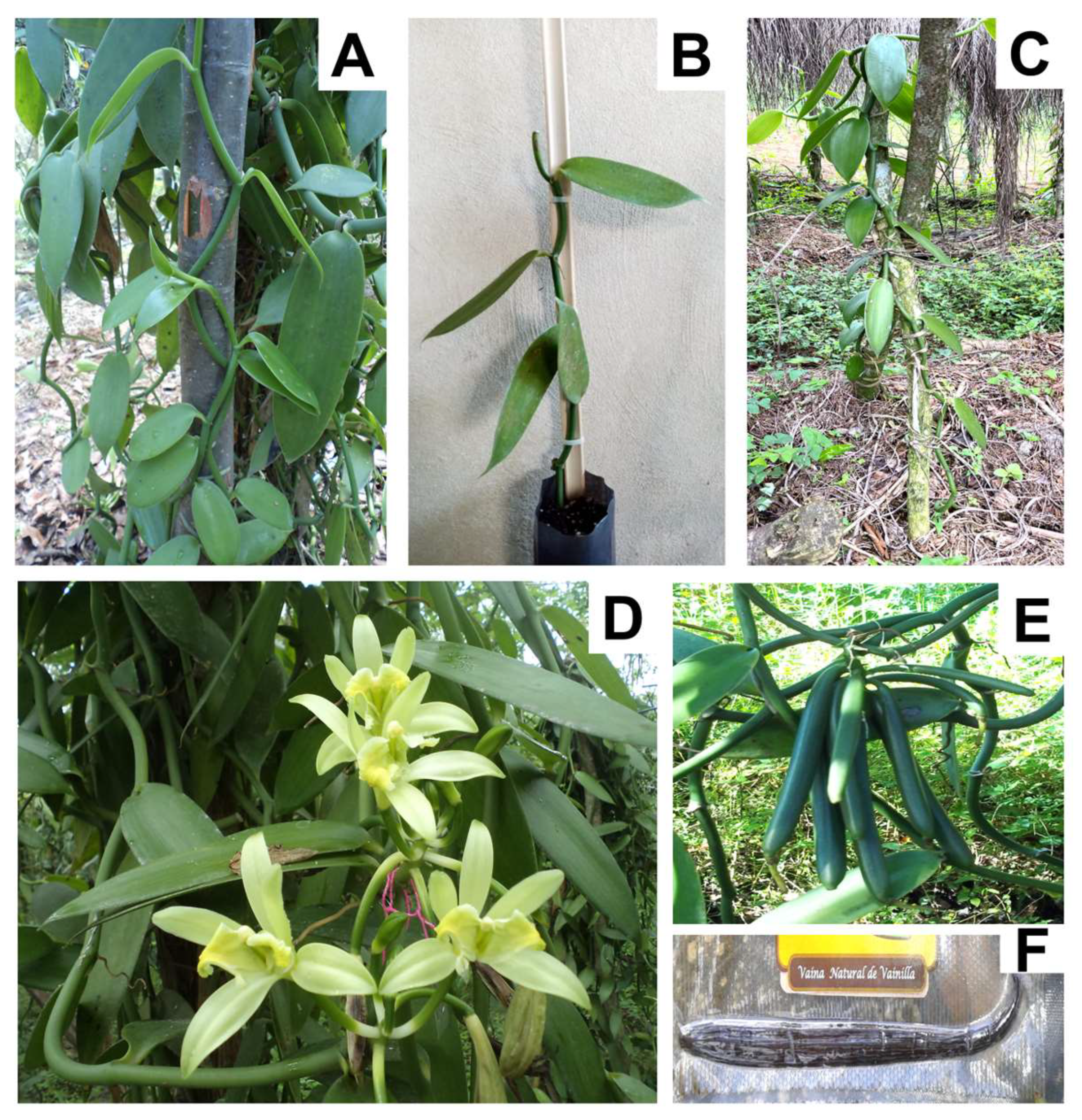
Silicon Nanoparticles (SiNPs) Enhance Elongation and Rooting of In Vitro Shoots of Vanilla (Vanilla planifolia Andrews) During Micropropagation in RITA® Bioreactors

Abstract
1. Introduction
2. Results
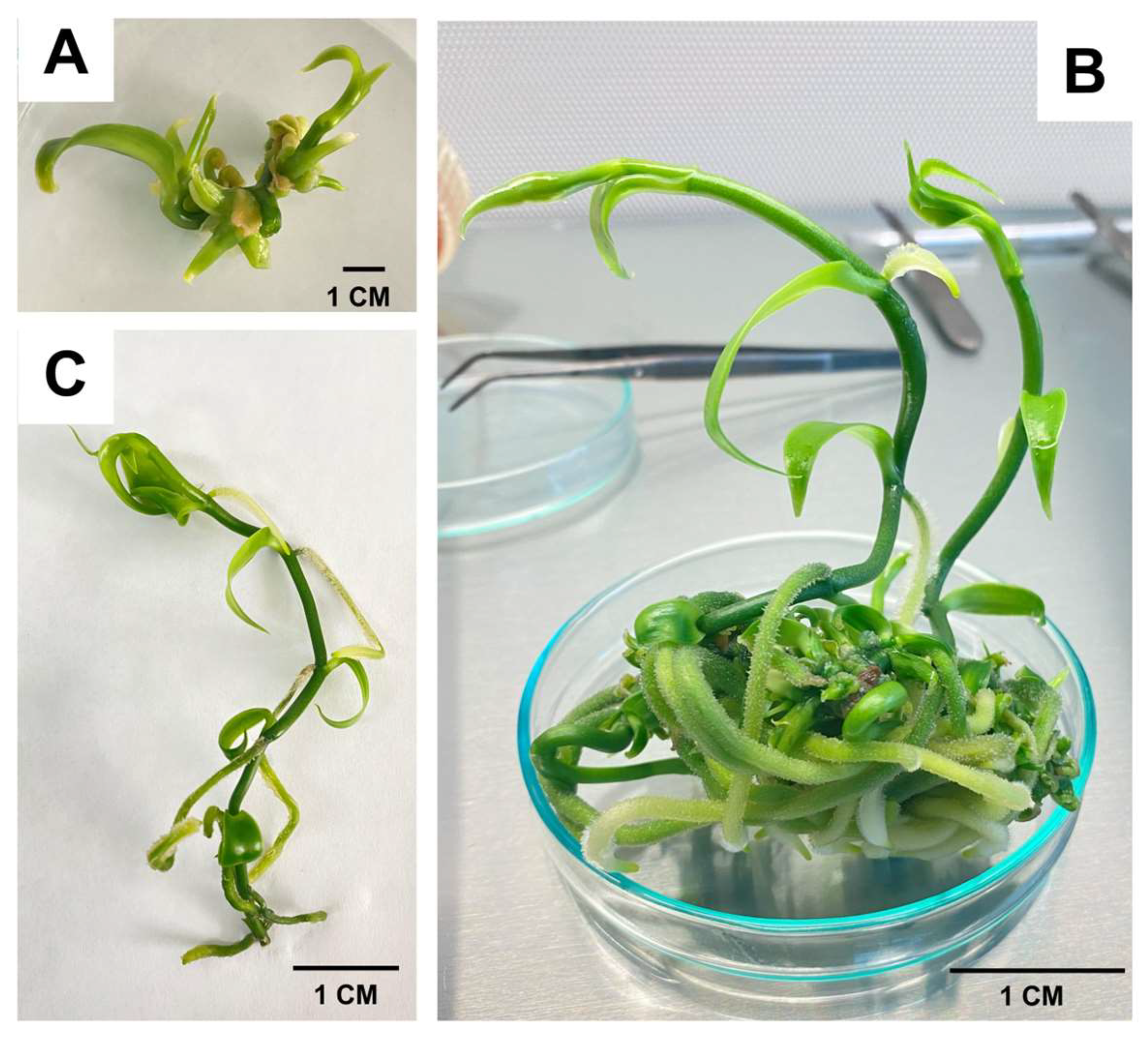
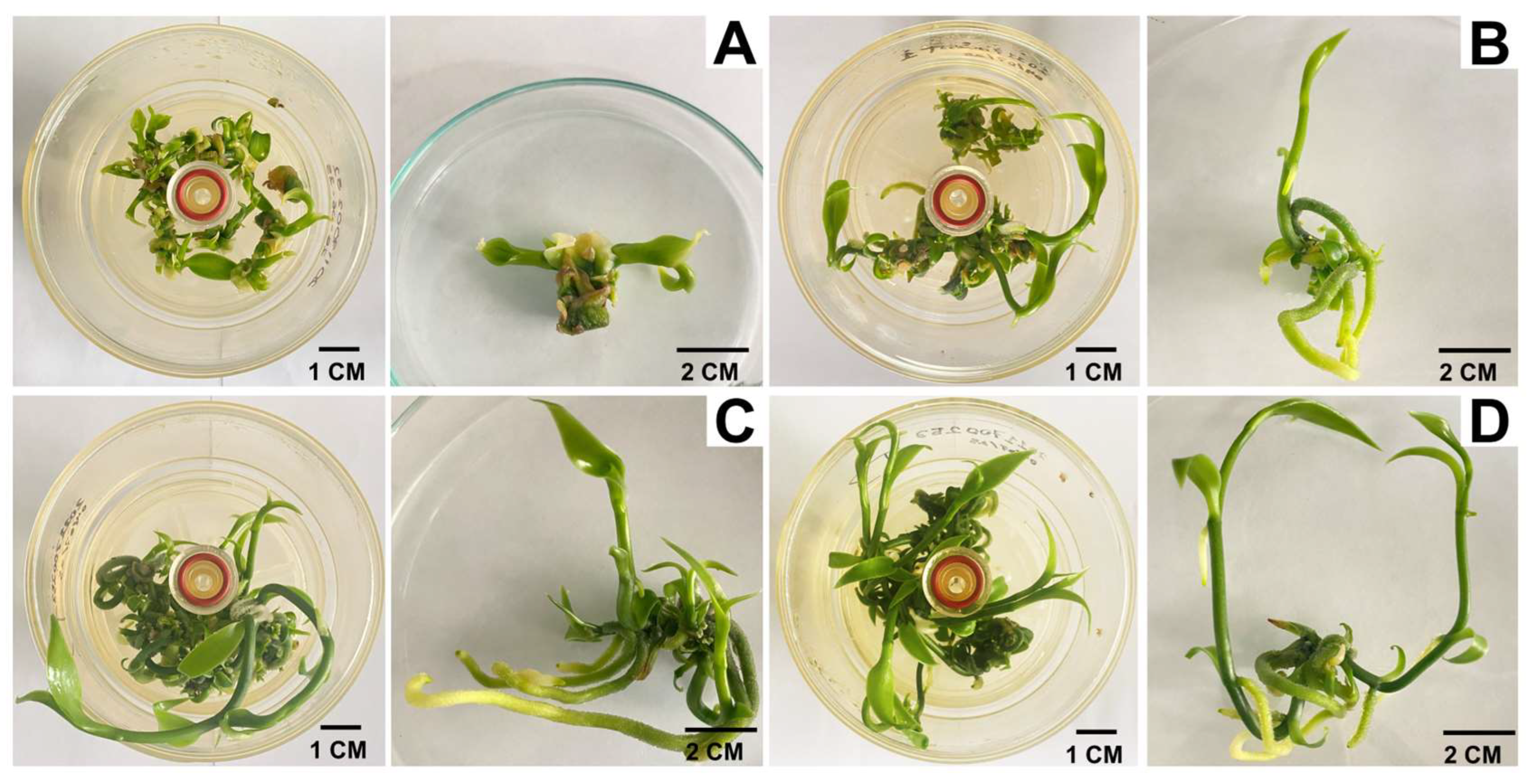
2.1. Effect of Silicon Nanoparticles (SiNPs) on In Vitro Propagation of Vanilla in RITA® Biorreactors
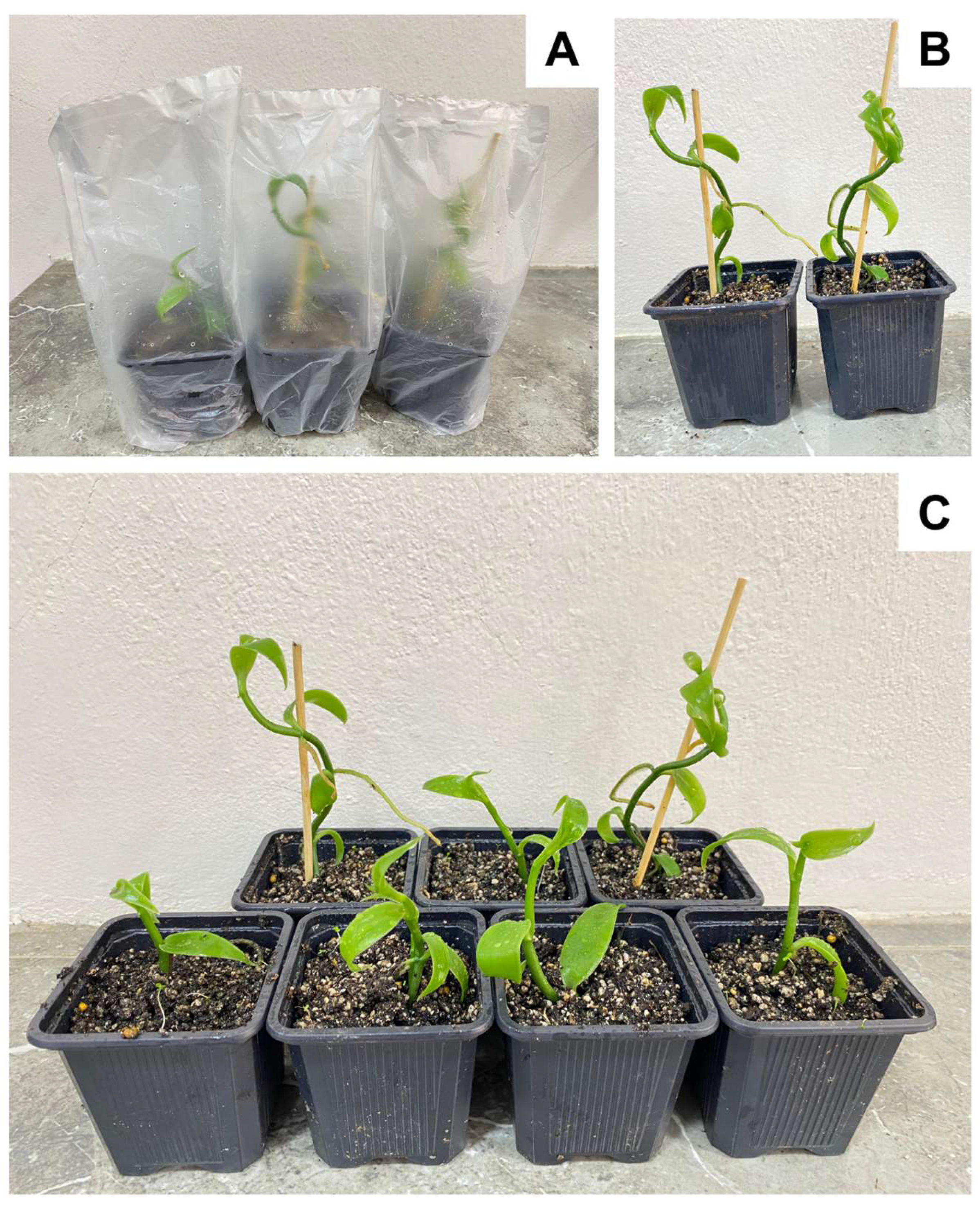
2.2. Acclimatization
3. Discussion
4. Materials and Methods
4.1. Plant Material
4.2. Multiplication of Plant
4.3. Preculture in Liquid Medium
4.4. Effect of Silicon Nanoparticles (SiNPs) on In Vitro Propagation of Vanilla in RITA® Biorreactors
4.5. Acclimatization
4.6. Statistical Analysis
5. Conclusions
Funding
Data Availability Statement
Acknowledgments
Conflicts of Interest
References
- Divakaran, M.; Suseela Bhai, R.; Menchaca Garcia, R.; Aarthi, S.; Devasahayam, S.; Nirmal Babu, K.; Sudarshan, M.R. Vanilla. In Handbook of Spices in India: 75 Years of Research and Development; Springer: Singapore, 2024; pp. 2591–2685. [Google Scholar]
- Ramírez-Mosqueda, M.A.; Bello-Bello, J.J. SETIS bioreactor increases in vitro multiplication and shoot length in vanilla (Vanilla planifolia Jacks. Ex Andrews). Acta Physiol. Plant. 2021, 43, 52. [Google Scholar] [CrossRef]
- Iftikhar, T.; Majeed, H.; Waheed, M.; Zahra, S.S.; Niaz, M.; AL-Huqail, A.A. Vanilla. In Essentials of Medicinal and Aromatic Crops; Springer: Cham, Switzerland, 2023; pp. 341–371. [Google Scholar]
- Yeh, C.H.; Chen, K.Y.; Lee, Y.I. Asymbiotic germination of Vanilla planifolia in relation to the timing of seed collection and seed pretreatments. Bot. Stud. 2021, 62, 6. [Google Scholar] [CrossRef]
- Kumar, R.; Salaria, N.; Kumari, I.; Hajam, Y.A. Plant Tissue Culture Technology: An Innovative Tool for the Propagation, Management, and Conservation of Himalayan Biodiversity; CRC Press: Boca Raton, FL, USA, 2025. [Google Scholar]
- Malabadi, R.B.; Chalannavar, R.K.; Kolkar, K.P. Plant cell totipotency: Plant tissue culture applications-An updated review. World J. Adv. Eng. Technol. Sci. 2025, 16, 112–135. [Google Scholar] [CrossRef]
- Zuzarte, M.; Salgueiro, L.; Canhoto, J. Plant tissue culture: Industrial relevance and future directions. In Plants as Factories for Bioproduction: Recent Developments and Applications; Steingroewer, J., Ed.; Springer: Cham, Switzerland, 2024; pp. 1–15. [Google Scholar]
- Singh, R.K.; Chokheli, V.A. Plant Biotechnology: Applications in In Vitro Plant Conservation and Micropropagation. Horticulturae 2025, 11, 358. [Google Scholar] [CrossRef]
- Lorenzo, J.C.; Tapia y Figueroa, M.D.L. Mini-review: Plant micropropagation using temporary immersion bioreactors with emphasis on sugarcane and potato. Plant Cell Tissue Organ Cult. 2025, 163, 69. [Google Scholar] [CrossRef]
- Wijerathna-Yapa, A.; Hiti-Bandaralage, J.; Pathirana, R. Harnessing metabolites from plant cell tissue and organ culture for sustainable biotechnology. Plant Cell Tissue Organ Cult. 2025, 162, 55. [Google Scholar]
- Pandey, H.; Misra, V.; Sharma, A.; Chatterjee, B.; Sutradhar, M.; Kumar, R.; Heisnam, P.; Devadas, V.A.S.N.; Kesavan, A.K.; Mal, A.K.; et al. Interventions of plant tissue culture techniques and genome editing in medicinally important spice crops. Med. Plant Biol. 2025, 4, e023. [Google Scholar]
- Patiño, D.; Figueroa, L.T. Micropropagation of banana cv. Williams through temporary immersion system: Response to explant density and plant growth regulators. Agroindustrial Sci. 2025, 15, 49–54. [Google Scholar] [CrossRef]
- Baltazar-Bernal, O.; Mora-González, E.G.; Ramírez-Mosqueda, M.A. Orchid micropropagation using temporary immersion systems: A review. Temporary immersion systems in plant micropropagation. In Micropropagation Methods in Temporary Immersion Systems; Springer: New York, NY, USA, 2024; pp. 227–244. [Google Scholar]
- Gianguzzi, V.; Sottile, F. Temporary immersion system as an innovative approach for in vitro propagation of Sorbus domestica L. Horticulturae 2024, 10, 164. [Google Scholar] [CrossRef]
- de Oliveira, J.P.; Luis, Z.G.; de Araújo Silva-Cardoso, I.M.; Gomes, A.C.M.M.; de Souza, A.L.X.; Scherwinski-Pereira, J.E. Comparative structural analysis of banana plantlets cultivated in semi-solid medium and in temporary immersion bioreactor. In Vitro Cell. Dev. Biol. Plant 2025, 1–20. [Google Scholar] [CrossRef]
- Ochatt, S.; Abdollahi, M.R.; Akin, M.; Bello, J.B.; Eimert, K.; Faisal, M.; Nhut, D.T. Application of nanoparticles in plant tissue cultures: Minuscule size but huge effects. Plant Cell Tissue Organ Cult. 2023, 155, 323–326. [Google Scholar] [CrossRef]
- Balamurugan, V.; Abdi, G.; Karthiksaran, C.; Thillaigovindhan, N.; Arulbalachandran, D. A review: Improvement of plant tissue culture applications by using nanoparticles. J. Nanoparticle Res. 2024, 26, 188. [Google Scholar] [CrossRef]
- Hong, J.; Wang, C.; Wagner, D.C.; Gardea-Torresdey, J.L.; He, F.; Rico, C.M. Foliar application of nanoparticles: Mechanisms of absorption, transfer, and multiple impacts. Environ. Sci. Nano 2021, 8, 1196–1210. [Google Scholar] [CrossRef]
- Wang, L.; Ning, C.; Pan, T.; Cai, K. Role of silica nanoparticles in abiotic and biotic stress tolerance in plants: A review. Int. J. Mol. Sci. 2022, 23, 1947. [Google Scholar] [CrossRef]
- Gao, X.; Avellan, A.; Laughton, S.; Vaidya, R.; Rodrigues, S.M.; Casman, E.A.; Lowry, G.V. CuO nanoparticle dissolution and toxicity to wheat (Triticum aestivum) in rhizosphere soil. Environ. Sci. Technol. 2018, 52, 2888–2897. [Google Scholar] [CrossRef]
- Siddiqi, K.S.; Husen, A. Plant response to silver nanoparticles: A critical review. Crit. Rev. Biotechnol. 2022, 42, 973–990. [Google Scholar] [CrossRef]
- Ghorbanpour, M.; Fahimirad, S. Plant nanobionics a novel approach to overcome the environmental challenges. In Medicinal Plants and Environmental Challenges; Springer: Cham, Switzerland, 2017; pp. 247–257. [Google Scholar]
- Gautam, K.; Singh, H.; Sinha, A.K. Nanotechnology in Plant Nanobionics: Mechanisms, Applications, and Future Perspectives. Adv. Biol. 2025, 9, 2400589. [Google Scholar] [CrossRef]
- Spinoso-Castillo, J.L.; Chavez-Santoscoy, R.A.; Bogdanchikova, N.; Pérez-Sato, J.A.; Morales-Ramos, V.; Bello-Bello, J.J. Antimicrobial and hormetic effects of silver nanoparticles on in vitro regeneration of vanilla (Vanilla planifolia Jacks. ex Andrews) using a temporary immersion system. Plant Cell Tissue Organ Cult. 2017, 129, 195–207. [Google Scholar] [CrossRef]
- Pastelín-Solano, M.C.; Ramírez-Mosqueda, M.A.; Bogdanchikova, N.; Castro-González, C.G.; Bello-Bello, J.J. Las nanopartículas de plata afectan la micropropagación de vainilla (Vanilla planifolia Jacks. ex Andrews). Agrociencia 2020, 54, 1–13. [Google Scholar]
- Bello-Bello, J.J.; Spinoso-Castillo, J.L.; Arano-Avalos, S.; Martínez-Estrada, E.; Arellano-García, M.E.; Pestryakov, A.; Bogdanchikova, N. Cytotoxic, genotoxic, and polymorphism effects on Vanilla planifolia Jacks ex Andrews after long-term exposure to Argovit silver nanoparticles. Nanomaterials 2018, 8, 754. [Google Scholar] [CrossRef]
- Naaz, H.; Rawat, K.; Saffeullah, P.; Umar, S. Silica nanoparticles synthesis and applications in agriculture for plant fertilization and protection: A review. Environ. Chem. Lett. 2023, 21, 539–559. [Google Scholar]
- El-Shetehy, M.; Moradi, A.; Maceroni, M.; Reinhardt, D.; Petri-Fink, A.; Rothen-Rutishauser, B.; Schwab, F. Silica nanoparticles enhance disease resistance in Arabidopsis plants. Nat. Nanotechnol. 2021, 16, 344–353. [Google Scholar] [CrossRef]
- El-Naggar, H.M.; Osman, A.R. Enhancing growth and bioactive metabolites characteristics in Mentha pulegium L. via silicon nanoparticles during in vitro drought stress. BMC Plant Biol. 2024, 24, 657. [Google Scholar] [CrossRef]
- Toaiema, W.I.; Mustafa, S.S. Silicon nanoparticle application on Thymus serpyllum under drought and salinity stress in vitro. BioNanoScience 2024, 14, 1242–1253. [Google Scholar] [CrossRef]
- Cokuraj, M.; Manokari, M.; Abdulrahman, A.A.; Mahipal, S.S. Synergistic effects of growth regulators and silicon nanoparticles on enhancing morpho-structural stability in Vitex agnus-castus L. plantlets. S. Afr. J. Bot. 2025, 177, 500–509. [Google Scholar]
- Feizi, S. Role of nanomaterials in plant cell and tissue culture. In Nanomaterial Interactions with Plant Cellular Mechanisms and Macromolecules and Agricultural Implications; Springer: Cham, Switzerland, 2023; pp. 359–397. [Google Scholar]
- Pathak, A.; Haq, S.; Meena, N.; Dwivedi, P.; Kothari, S.L.; Kachhwaha, S. Multifaceted role of nanomaterials in modulating in vitro seed germination, plant morphogenesis, metabolism and genetic engineering. Plants 2023, 12, 3126. [Google Scholar] [CrossRef]
- Nhut, D.T. Undeniable positive impacts of metal nanoparticles in plant tissue culture. In Metal Nanoparticles in Plant Cell, Tissue and Organ Culture; Nhut, D.T., Tung, H.T., Eds.; Springer Nature: Singapore, 2024; pp. 1–44. [Google Scholar]
- Al-Qudah, T.; Mahmood, S.H.; Abu-Zurayk, R.; Shibli, R.; Khalaf, A.; Lambat, T.L.; Chaudhary, R.G. Nanotechnology applications in plant tissue culture and molecular genetics: A holistic approach. Curr. Nanosci. 2022, 18, 442–464. [Google Scholar] [CrossRef]
- Guru, G.R.; Ramteke, P.; Vágvölgyi, C. Potential impacts of nanoparticles integration on micropropagation efficiency: Current achievements and prospects. Front. Plant Sci. 2025, 16, 1629548. [Google Scholar] [CrossRef] [PubMed]
- Sivanesan, I.; Park, S.W. The role of silicon in plant tissue culture. Front. Plant Sci. 2014, 5, 571. [Google Scholar] [CrossRef]
- Sahebi, M.; Hanafi, M.M.; Azizi, P. Application of silicon in plant tissue culture. In Vitro Cell. Dev. Biol. Plant 2016, 52, 226–232. [Google Scholar] [CrossRef]
- Bello-Bello, J.J.; Mancilla-Álvarez, E.; Spinoso-Castillo, J.L. Scaling-up procedures and factors for mass micro-propagation using temporary immersion systems. In Vitro Cell. Dev. Biol. Plant 2025, 61, 321–332. [Google Scholar] [CrossRef]
- Mancilla-Álvarez, E.; Serrano-Fuentes, M.K.; Fuentes-Torres, M.A.; Sánchez-Páez, R.; Bello-Bello, J.J. Chitosan Nanoparticles: An Alternative for In Vitro Multiplication of Sugarcane (Saccharum spp.) in Semi-Automated Bioreactors. Plants 2025, 14, 1697. [Google Scholar] [CrossRef]
- Bravo-Ruíz, I.N.; González-Arnao, M.T.; Hernández-Ramírez, F.; López-Domínguez, J.; Cruz-Cruz, C.A. Types of temporary immersion systems used in commercial plant micropropagation. In Micropropagation Methods in Temporary Immersion Systems; Springer: New York, NY, USA, 2024; pp. 9–24. [Google Scholar]
- Ramírez-Mosqueda, M.A.; Cruz-Cruz, C.A. Temporary immersion systems in plant micropropagation. In Micropropagation Methods in Temporary Immersion Systems; Springer: New York, NY, USA, 2024; pp. 3–8. [Google Scholar]
- De Carlo, A.; Tarraf, W.; Lambardi, M.; Benelli, C. Temporary immersion system for production of biomass and bioactive compounds from medicinal plants. Agronomy 2021, 11, 2414. [Google Scholar] [CrossRef]
- Ramos-Castellá, A.; Iglesias-Andreu, L.G.; Bello-Bello, J.; Lee-Espinosa, H. Improved propagation of vanilla (Vanilla planifolia Jacks. ex Andrews) using a temporary immersion system. In Vitro Cell. Dev. Biol. Plant 2014, 50, 576–581. [Google Scholar]
- Ramírez-Mosqueda, M.A.; Iglesias-Andreu, L.G. Evaluation of different temporary immersion systems (BIT, BIG, and RITA) in the micropropagation of Vanilla planifolia Jacks. In Vitro Cell. Dev. Biol. Plant 2016, 52, 154–160. [Google Scholar] [CrossRef]
- Mustafa, S.S.; Toaiema, W.E. In vitro propagation and influence of silicon nanoparticles on growth of Thymus serpyllum. East. J. Agric. Biol. Sci. 2022, 2, 17–24. [Google Scholar]
- Manokari, M.; Dey, A.; Faisal, M.; Alatar, A.A.; Joshee, N.; Shekhawat, M.S. Structural alterations of Cymbopogon citratus (DC.) Stapf leaves and roots caused by silicon nanoparticles during in vitro propagation. Ind. Crops Prod. 2023, 197, 116648. [Google Scholar]
- Manokari, M.; Dey, A.; Faisal, M.; Alatar, A.A.; Singh, R.K.; Shekhawat, M.S. Silicon Nanoparticles (SiNPs) Positively Affect Morpho-Structural Differentiation in Micropropagated Plantlets of Santalum album L. Silicon 2023, 15, 6843–6850. [Google Scholar] [CrossRef]
- Manokari, M.; Faisal, M.; Alatar, A.A.; Barboni, D.; Shekhawat, M.S. Silicon nanoparticles on the enhanced micropropagation of Hemidesmus indicus (L.) R. Br. ex Schult. Silicon 2024, 16, 775–782. [Google Scholar] [CrossRef]
- Zhao, F.; Hou, T.; Wang, J.; Jiang, Y.; Huang, S.; Wang, Q.; Xian, M.; Mu, X. Immobilization of proline-specific endoprotease on nonporous silica nanoparticles functionalized with amino group. Bioprocess. Biosyst. Eng. 2017, 40, 1–7. [Google Scholar]
- Sarkar, M.M.; Mathur, P.; Mitsui, T.; Roy, S. A review on functionalized silica nanoparticle amendment on plant growth and development under stress. Plant Growth Regul. 2022, 98, 421–437. [Google Scholar] [CrossRef]
- Deodhar, G.V.; Adams, M.L.; Trewyn, B.G. Controlled release and intracellular protein delivery from mesoporous silica nanoparticles. Biotechnol. J. 2017, 12, 1600408. [Google Scholar] [CrossRef]
- Manokari, M.; Cokul Raj, M.; Dey, A.; Faisal, M.; Alatar, A.A.; Singh, R.K.; Shekhawat, M.S. Silicon nanoparticles moderated morphometric deficiencies by improving micro-morpho-structural traits in Thunbergia erecta (Benth.) T. Anderson. Silicon 2023, 15, 5415–5427. [Google Scholar] [CrossRef]
- Khattab, S.; El Sherif, F.; AlDayel, M.; Yap, Y.K.; Meligy, A.; Ibrahim, H.I.M. Silicon dioxide and silver nanoparticles elicit antimicrobial secondary metabolites while enhancing growth and multiplication of Lavandula officinalis in-vitro plantlets. Plant Cell Tissue Organ Cult. 2022, 149, 411–421. [Google Scholar] [CrossRef]
- Kulus, D.; Tymoszuk, A.; Kulpińska, A.; Viehmannova, I.; Wojnarowicz, J.; Szałaj, U. Effect of nanoparticles on the ex-vitro performance of cryopreservation-derived plant material. PLoS ONE 2024, 19, e0310424. [Google Scholar] [CrossRef] [PubMed]
- Bello-Bello, J.J.; Schettino-Salomón, S.; Ortega-Espinoza, J.; Spinoso-Castillo, J.L. A temporary immersion system for mass micropropagation of pitahaya (Hylocereus undatus). 3 Biotech 2021, 11, 437. [Google Scholar] [CrossRef] [PubMed]
- Pożoga, M.; Olewnicki, D.; Latocha, P. A Temporary Immersion System as a Tool for Lowering Planting Material Production Costs Using the Example of Pennisetum × advena ‘Rubrum’. Agriculture 2024, 14, 1177. [Google Scholar] [CrossRef]
- Weisany, W.; Razmi, J.; Eshaghabadi, A.H.; Pashang, D. Silicon nanoparticles (SiNP): A novel and sustainable strategy for mitigating environmental stresses in plants. J. Soil Sci. Plant Nutr. 2024, 24, 2167–2191. [Google Scholar] [CrossRef]
- Murashige, T.; Skoog, F. A revised medium for rapid growth and bioassays with tobacco tissue cultures. Physiol. Plant. 1962, 15, 473–497. [Google Scholar] [CrossRef]




| SiNPs (mg L−1) | No. of Shoots | Shoot Length (cm) | No. of Leaves | No. of Roots | Root Length (cm) |
|---|---|---|---|---|---|
| 0 | 2.83 ± 0.40 c | 1.61 ± 0.15 c | 4.71 ± 0.74 b | 0.00 ± 0.00 c | 0.00 ± 0.00 d |
| 50 | 3.44 ± 0.33 bc | 1.76 ± 0.32 c | 8.78 ± 0.81 a | 3.63 ± 0.56 b | 2.06 ± 0.31 c |
| 100 | 4.66 ± 0.23 ab | 4.34 ± 0.20 b | 10.00 ± 0.57 a | 5.63 ± 0.47 a | 3.91 ± 0.16 a |
| 150 | 5.12 ± 0.38 a | 5.48 ± 0.22 a | 9.50 ± 0.52 a | 5.00 ± 0.43 ab | 3.17 ± 0.30 b |
Disclaimer/Publisher’s Note: The statements, opinions and data contained in all publications are solely those of the individual author(s) and contributor(s) and not of MDPI and/or the editor(s). MDPI and/or the editor(s) disclaim responsibility for any injury to people or property resulting from any ideas, methods, instructions or products referred to in the content. |
© 2025 by the author. Licensee MDPI, Basel, Switzerland. This article is an open access article distributed under the terms and conditions of the Creative Commons Attribution (CC BY) license (https://creativecommons.org/licenses/by/4.0/).
Share and Cite
Ramírez-Mosqueda, M.A. Silicon Nanoparticles (SiNPs) Enhance Elongation and Rooting of In Vitro Shoots of Vanilla (Vanilla planifolia Andrews) During Micropropagation in RITA® Bioreactors. Plants 2025, 14, 3732. https://doi.org/10.3390/plants14243732
Ramírez-Mosqueda MA. Silicon Nanoparticles (SiNPs) Enhance Elongation and Rooting of In Vitro Shoots of Vanilla (Vanilla planifolia Andrews) During Micropropagation in RITA® Bioreactors. Plants. 2025; 14(24):3732. https://doi.org/10.3390/plants14243732
Chicago/Turabian StyleRamírez-Mosqueda, Marco A. 2025. "Silicon Nanoparticles (SiNPs) Enhance Elongation and Rooting of In Vitro Shoots of Vanilla (Vanilla planifolia Andrews) During Micropropagation in RITA® Bioreactors" Plants 14, no. 24: 3732. https://doi.org/10.3390/plants14243732
APA StyleRamírez-Mosqueda, M. A. (2025). Silicon Nanoparticles (SiNPs) Enhance Elongation and Rooting of In Vitro Shoots of Vanilla (Vanilla planifolia Andrews) During Micropropagation in RITA® Bioreactors. Plants, 14(24), 3732. https://doi.org/10.3390/plants14243732