Women’s Knowledge of Local Plants and Their Gastronomic Heritage in Chitral, NW Pakistan

 ,
,  ,
,  , , and
Abstract
1. Introduction
2. Materials and Methods
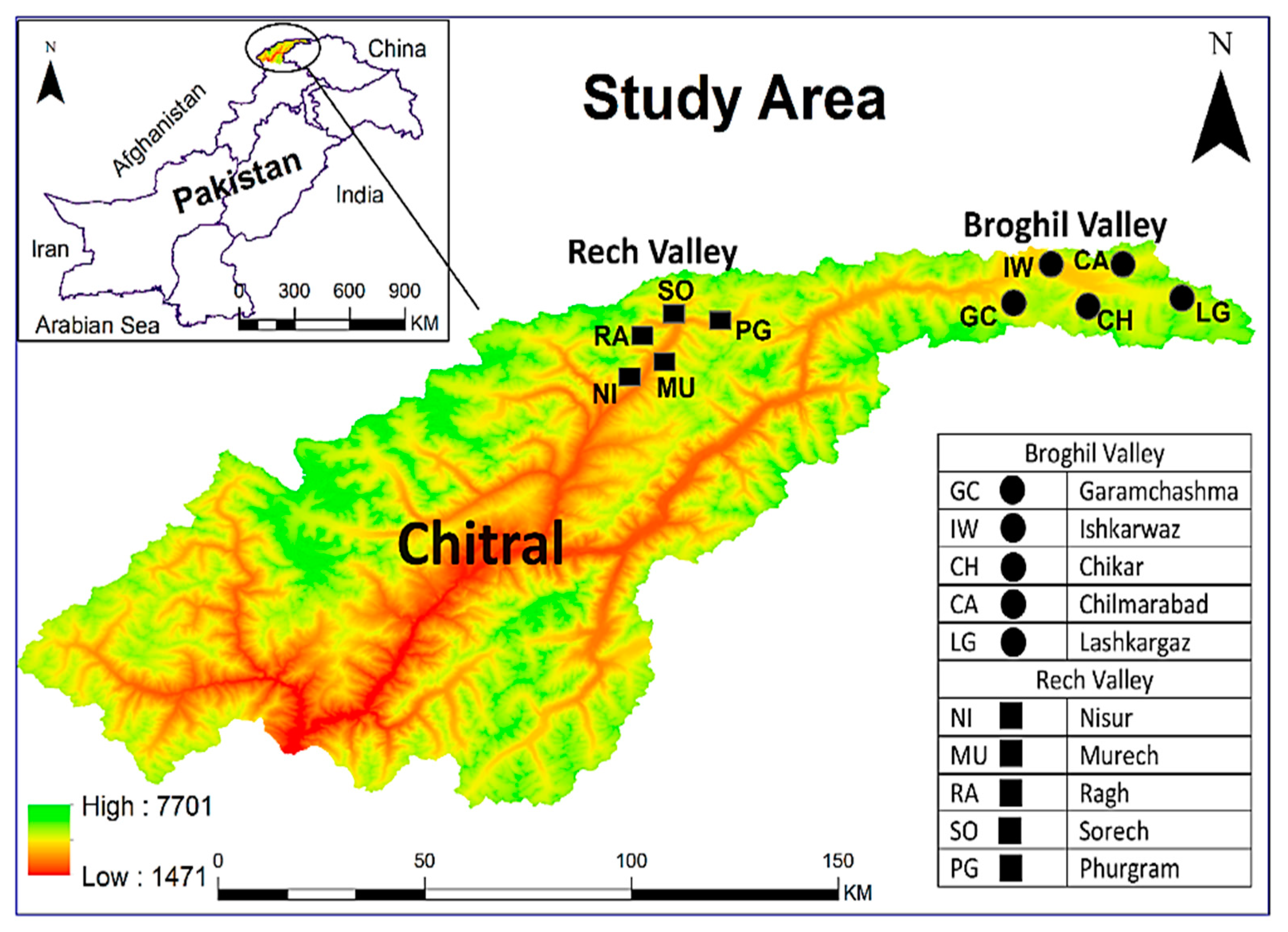
2.1. Study Area
2.2. Field Survey and Data Collection
- Key Informant Interviews (KIIs): Women 50 years and older with a solid understanding of traditional knowledge of the local food system participated as key informants (KIs). The snowball sampling technique was used to choose these KIs, and interviews were conducted utilizing well-versed semi-structured questions [20]. Information regarding crucial animal-based food supplies and wild and cultivated food plant species was the focus of the questions. The interviews highlighted culinary uses of plants such as vegetables, snacks, teas, seasonings, and traditional food preparation methods and shared information on dairy products.
- General Informant Interviews (GIIs): The general informant interviews were conducted with female community members of different age groups (15 to 40 years) to collect data on their food knowledge in general and traditional food knowledge in particular. The data gathered through general interviews evaluated young women’s understanding of food preferences and social eating trends.
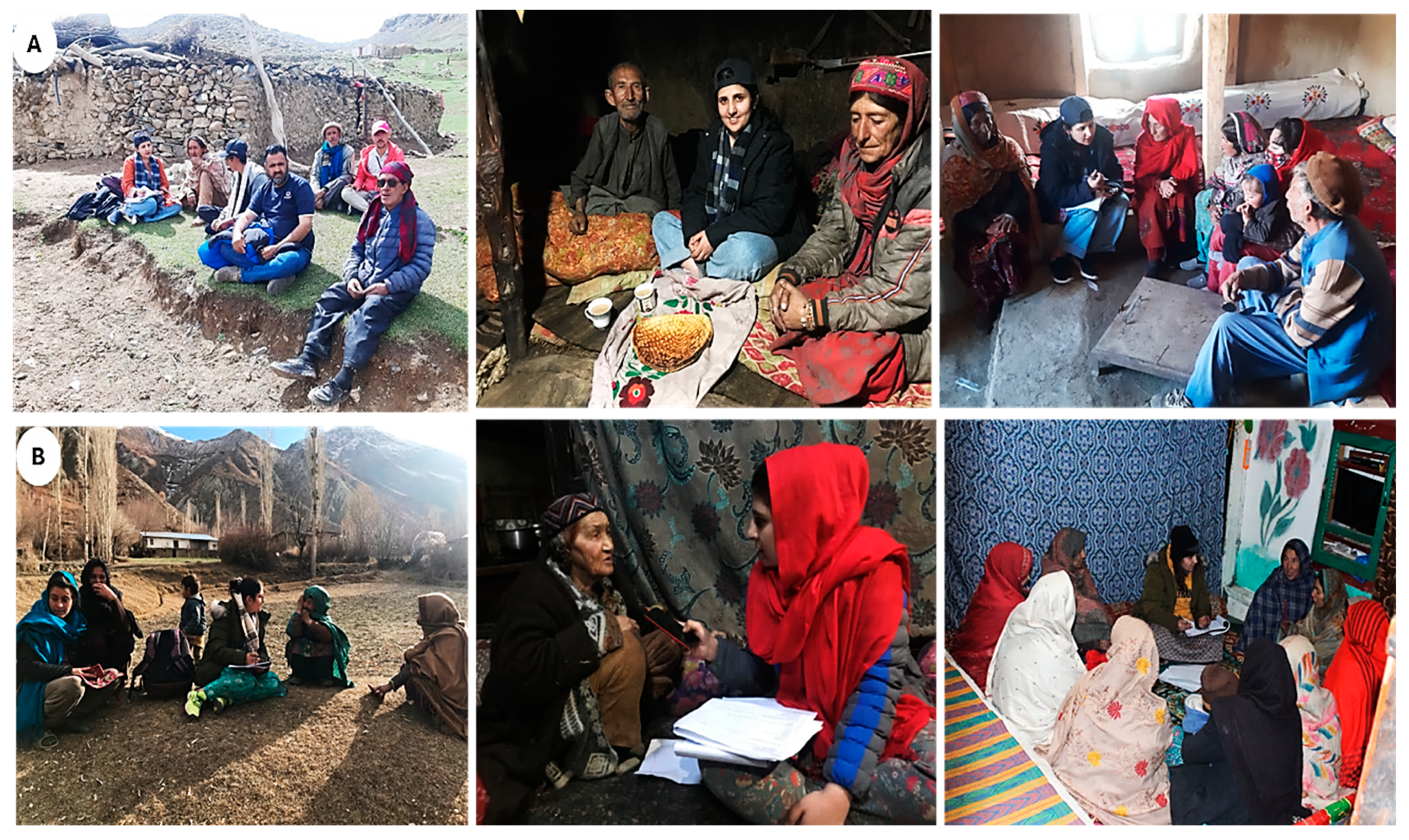
- Focused Group Discussions (FGDs): The FGDs (n = 5) were held in each village as a supportive/additional activity to ensure the validity and authenticity of information provided by key and general informant not to be counted. Some glimpses of interviews from general informants and group discussions with Wakhi and Kho are given in Figure 2A and B, respectively. The FGDs served multiple vital roles in the research process as they validated and cross-verified information obtained from key informants, ensuring data accuracy and reliability. Moreover, FGDs facilitated in-depth exploration of research topics. Thus, by bringing together participants with varied insights and experiences, FGDs uncovered different facets of the subject, revealing nuances often missed in individual interviews. Additionally, FGDs provide context to the information collected, helping researchers understand how individual perspectives relate to group dynamics [21].
2.3. Data Analysis
3. Results and Discussion
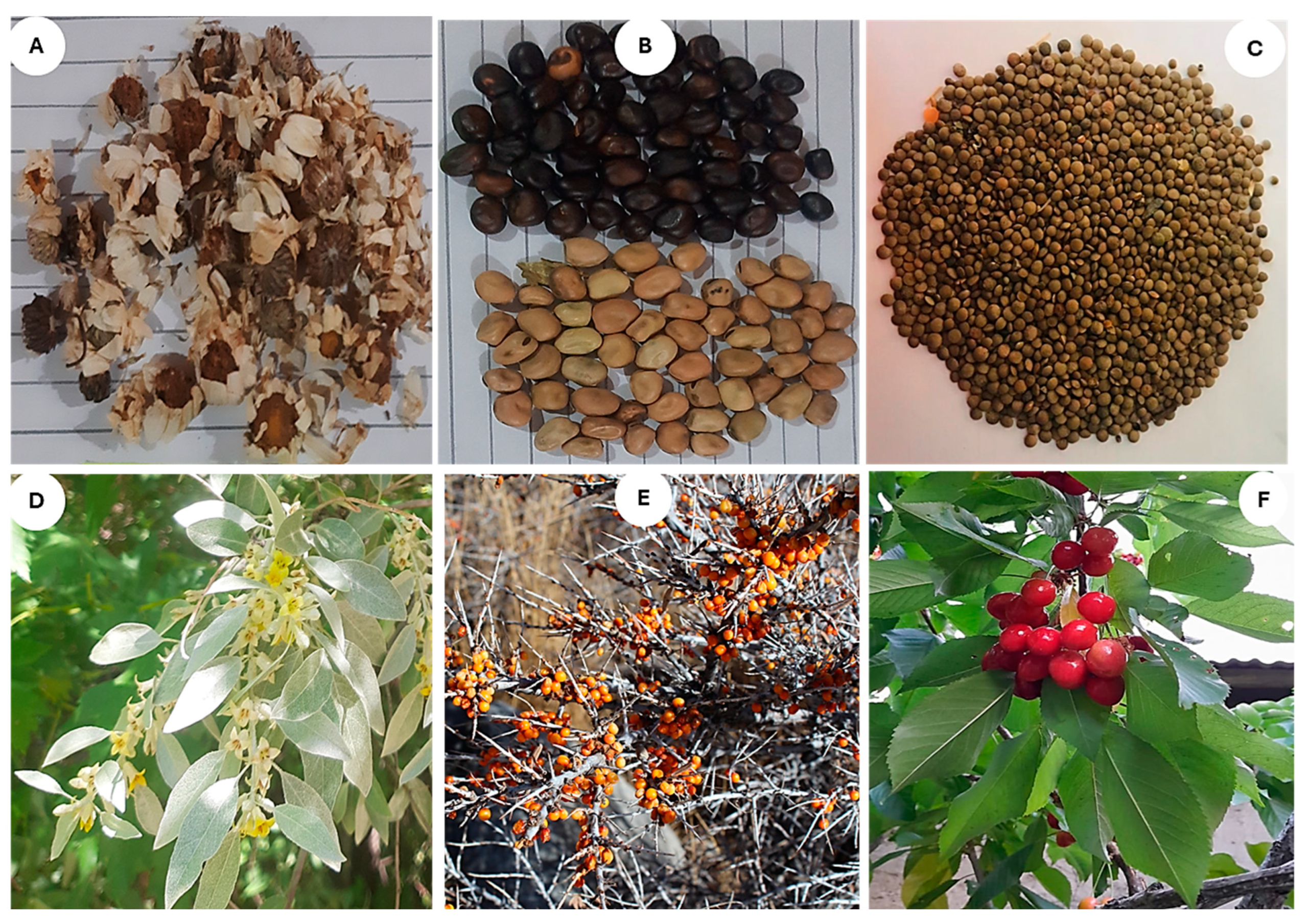
3.1. Diversity of Food Plants and Their Uses
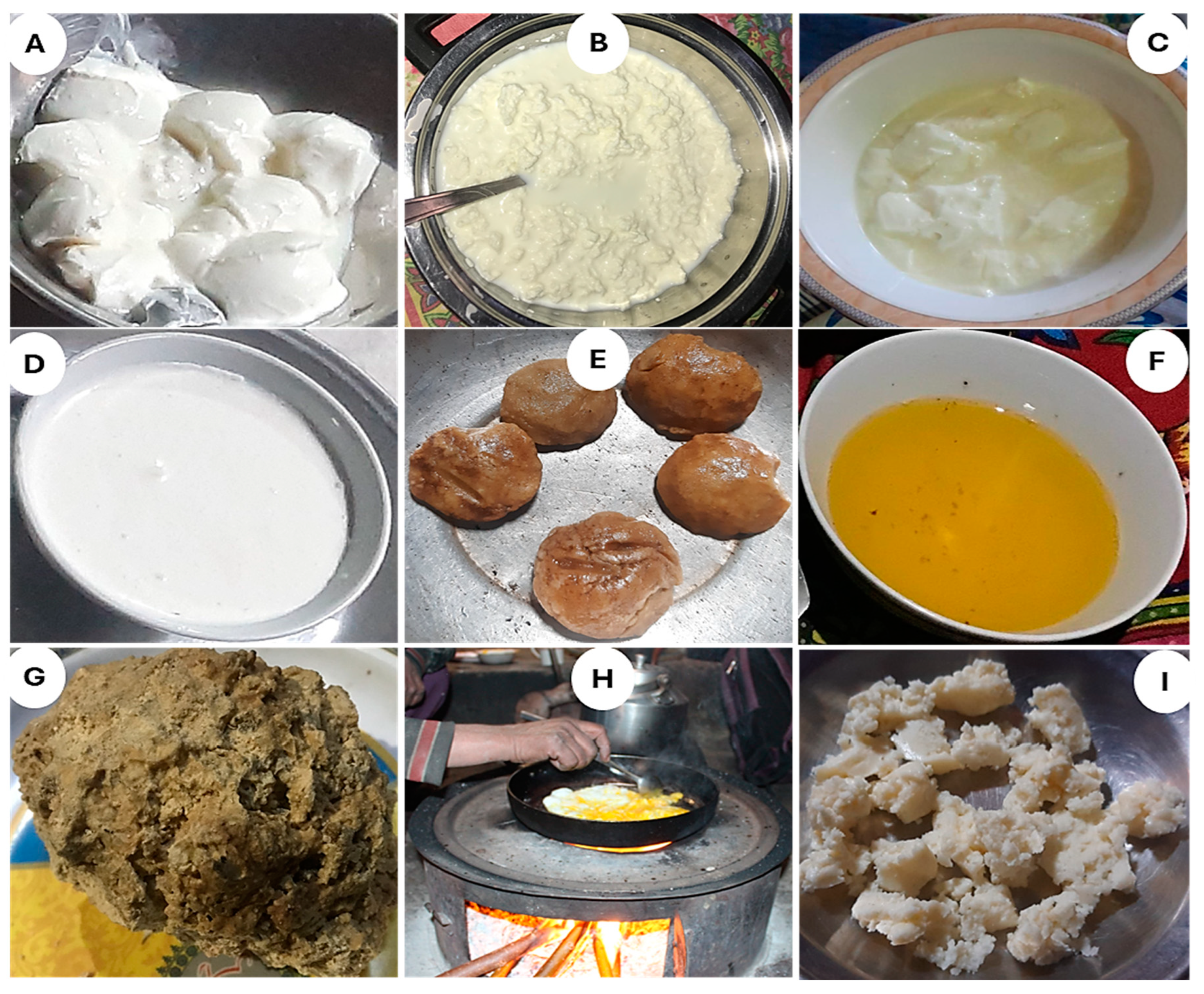
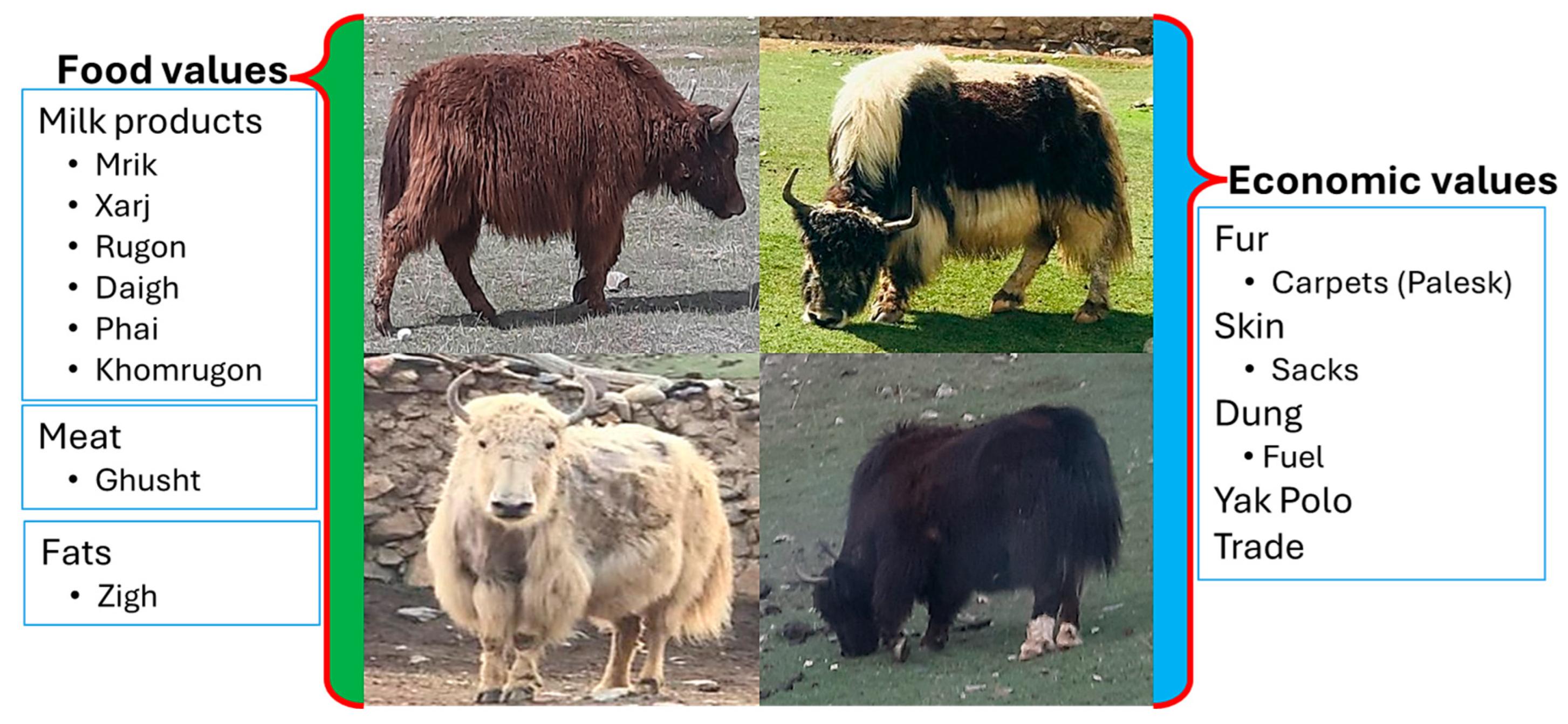
3.2. Animal-Based Food Diversity in Upper Chitral
3.3. Traditional Cuisines of Kho and Wakhi Communities
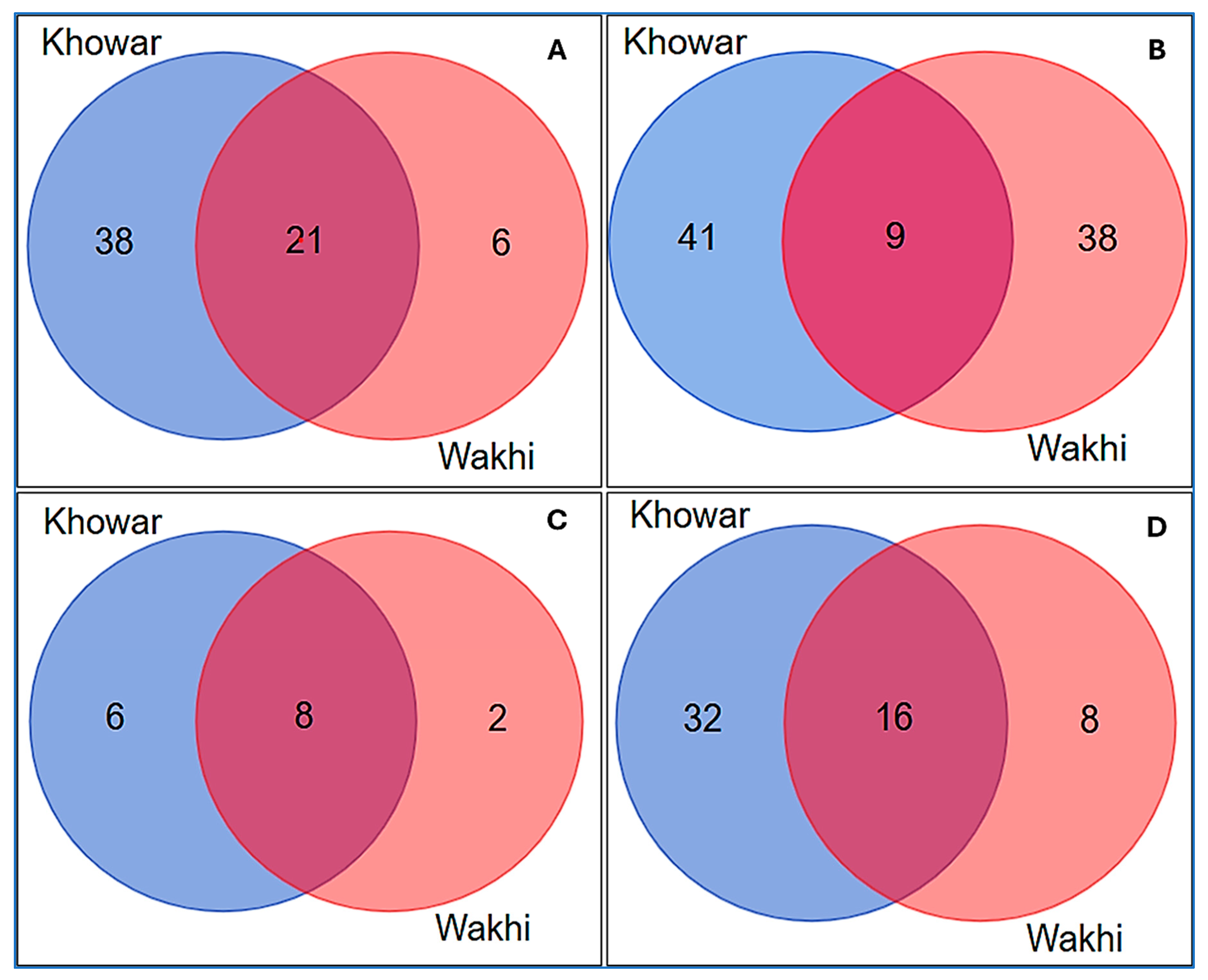
3.4. Cross-Cultural Comparison of the Local Food Heritage
3.5. Novelty in Food Diversity of Upper Chitral
3.6. Socio-Economic Perspective of Local Food Resources in Upper Chitral
3.7. Kho and Wakhi Women’s Knowledge and Food Security
3.8. Threats to Traditional Gastronomy of Chitral and Mitigation Strategies
- The study area has observed the temporary migration of youth for education and income-generation activities, which is causing rapid cultural blending and less interest in traditional ways of living. Thus, the level of rapid modernization and changing lifestyles in the young generation is causing the cultural integrity of traditional foods to fade.
- Approximately 85% of the respondents identified the younger generation’s detachment from cultural heritage and natural resources, attributing it to multiple socio-economic factors. The youth find traditional practices like foraging outdated and useless, as they can easily access the nearby markets and purchase contemporary food items even though it requires mental, physical, and financial effort.
- Most of the young Wakhi people were aware about the local name of plant species in Khowar instead of traditional Wakhi names. This can be attributed to the dominance of Kho in the region and the intermarriages between the two linguistic groups. But it is noteworthy to preserve the Wakhi language and heritage.
- The reports of market-based food sources are prominent in general informants, while home-grown and wild food resources were frequently reported by the key informants in both linguistic groups. According to the general informants, most of the food ingredients are easily available in the local markets, so the foraging of food plants is limited. Moreover, they preferred contemporary culinary practices due to the convenience and facilities that make cooking easy. For instance, one of the respondents in Ragh village of Rech valley mentioned that the use of modern facilities like pressure cookers has made cooking easier compared to old times.
- In contrast, the trend of citations relevant to animal-based food sources is in much better shape compared to food plants. More than 80% of the general informants mentioned dairy products as an important component of the local food system, specifically in Broghil. However, the increasing flux of tourists in the region rapidly damages the natural settlement. For example, the extensive use of motorbikes and other means of transport pollutes and disturbs the ecosystem and affects the natural wild animals. However, due to increasing tourism, the locals have initiated service provision in the area. However, the development of the hospitality business in the region is beneficial but not at the cost of environmental loss. The construction of buildings can be threatening to the local environment. Therefore, timely, inclusive responses to under-managed tourism and development in the study area must be tackled for a secure future.
- Community-led projects that document information sharing between younger and older generations to ensure the preservation and conservation of food traditions should be launched in the study area and its allied regions.
- Local, national, and international organizations must create entrepreneurship opportunities for youth and encourage them to create fusion by combining traditional food products with contemporary culinary art and innovative recipes from traditional cuisines.
- Promoting traditional gastronomy through food tourism and food business should elevate the socioeconomic standing of the local populations. Traditional cuisines and food culture must also be revitalized through local food festivals and events.
- Lastly, youth must be educated by integrating food culture education and its associated health benefits into the community education system and initiatives. Community organizations must engage youth in preserving food resources and bio-cultural diversity through digital campaigns employing social media platforms in the best possible ways and partnering with local stakeholders.
4. Conclusions
Author Contributions
Funding
Data Availability Statement
Acknowledgments
Conflicts of Interest
References
- Ibnouf, F.O. The value of women’s indigenous knowledge in food processing and preservation for achieving household food security in rural Sudan. J. Food Res. 2012, 1, 238. [Google Scholar] [CrossRef]
- Olatokun Wole, M.; Ayanbode, O.F. Use of indigenous knowledge by women in a Nigerian rural community. Indian J. Tradit. Knowl. 2009, 8, 287–295. [Google Scholar]
- Singh, A.; Singh, R.K.; Sureja, A.K. Cultural significance and diversities of ethnic foods of Northeast India Indian. J. Tradit. Knowl. 2007, 6, 79–94. [Google Scholar]
- Aluko, Y.A. Women use indigenous knowledge for environmental security and sustainable development in Southwest Nigeria. Int. Indig. Policy J. 2018, 9, 2. [Google Scholar]
- FAO. The Future of Food and Agriculture: Trends and Challenges, Policy Support and Governance. Food and Agriculture Organization of the United Nations. 2017. Available online: https://www.fao.org/policy-support/tools-and-publications/resources-details/en/c/472484/ (accessed on 11 June 2024).
- García, M.D.M.H. The role of women in food security. Cuad. Estrateg. 2013, 161, 82–96. [Google Scholar]
- Ravera, F.; Reyes-García, V.; Pascual, U.; Drucker, A.G.; Tarrasón, D.; Bellon, M.R. Gendered agrobiodiversity management and adaptation to climate change: Differentiated strategies in two marginal rural areas of India. Agric. Hum. Values 2019, 36, 455–474. [Google Scholar] [CrossRef]
- Ibnouf, F.O. Challenges and possibilities for achieving household food security in the Western Sudan region: The role of female farmers. Food Secur. 2011, 3, 215–231. [Google Scholar] [CrossRef]
- Swanepoel, L.; Tioti, T.; Eria, T.; Tamuera, K.; Tiitii, U.; Larson, S.; Paul, N. Supporting women’s participation in developing a seaweed supply chain in Kiribati for health and nutrition. Foods 2020, 9, 382. [Google Scholar] [CrossRef]
- Vunyingah, M.; Kaya, H.O. Sorghum as an indigenous drought resistant crop for food security in the Northwest Province of Cameroon. J. Soc. Sci. 2016, 46, 185–191. [Google Scholar]
- Baig, M.A.; Zaman, Q.; Baig, S.A.; Qasim, M.; Khalil, U.; Khan, S.A.; Ali, S. Regression analysis of hydro-meteorological variables for climate change prediction: A case study of Chitral Basin, Hindukush region. Sci. Total Environ. 2021, 793, 148595. [Google Scholar] [CrossRef]
- Malik, A.; Hunzai, I.A. Promise and Challenge of Pluralism for Sustainable Development in Mountain Areas: Experience and Encounters from Northern Areas and Chitral. In Proceedings of the International Workshop “Strategies for Development and Food Security in Mountainous Areas of Central Asia”, Dushanbe, Tajikistan, 6–10 June 2005. [Google Scholar]
- Tajik, M. Historical, Ethnic, and Cultural Connections between the Peoples of Pakistan and the Pamiris in Tajikistan. In Tajiks: History, Culture, Religion and People; Routledge: Oxfordshire, UK, 2022; Available online: https://research.nu.edu.kz/en/publications/historical-ethnic-and-cultural-connections-between-the-peoples-of (accessed on 22 June 2024).
- Aziz, A.M.; Ullah, Z.; Adnan, M.; Sõukand, R.; Pieroni, A. Plant use adaptation in Pamir: Sarikoli foraging in the Wakhan area, Northern Pakistan. Biology 2022, 11, 1543. [Google Scholar] [CrossRef] [PubMed]
- ICIMOD. Broghil National Park. www.icimod.org. 2019. Retrieved 11 June 2024. Available online: https://www.icimod.org/wp-content/uploads/2019/12/Broghil-National-Park.pdf (accessed on 20 September 2023).
- Lewis, M.P.; Simons, G.F.; Fennig, C.D. Ethnologue: Languages of the World; SIL International: Dallas, TX, USA, 2009; Volume 12, Available online: http://www.ethnologue.com (accessed on 22 June 2024).
- Pamir Times. Deprived and Angry: People of Rech Valley Threaten Boycott of Elections. PAMIR TIMES. 2012. Available online: https://pamirtimes.net/2012/05/11/deprived-and-angry-people-of-rech-valley-threaten-boycott-of-elections/ (accessed on 27 September 2023).
- Hadi, F.; Rahman, A.U.; Ibrar, M.; Dastagir, G.; Arif, M.; Naveed, K.; Adnan, M. Weed diversity with particular reference to their ethnomedicinal uses in wheat and maize at Rech Valley, Hindokush Range, Chitral, Pakistan. Pak. J. Weed Sci. 2014, 20, 335–346. [Google Scholar]
- The ISE Code of Ethics–International Society of Ethnobiology. International Society of Ethnobiology. 14 June 2016. Available online: https://www.ethnobiology.net/what-we-do/core-programs/ise-ethics-program/code-of-ethics/ (accessed on 1 October 2023).
- Aziz, M.A. Documenting Local Food Knowledge at Hindukush: Challenges and Opportunities. Societies 2022, 13, 1. [Google Scholar] [CrossRef]
- Majumder MS, I.; Hasan, I.; Mandal, S.; Islam, M.K.; Rahman, M.M.; Hawlader, N.H.; Sultana, I. Climate change induced multi hazards disaster risk assessment in Southern coastal belt of Bangladesh. Am. J. Environ. Eng. Sci. 2017, 4, 1–7. [Google Scholar]
- Ali, S.I.; Qaiser, M. (Eds.) Flora of Pakistan; University of Karachi: Karachi, Pakistan, 1993–2009. [Google Scholar]
- Tardío, J.; Pardo-de-Santayana, M. Cultural importance indices: A comparative analysis based on the useful wild plants of Southern Cantabria (Northern Spain). Econ. Bot. 2008, 62, 24–39. [Google Scholar] [CrossRef]
- Waheed, M.; Haq, S.M.; Arshad, F.; Bussmann, R.W.; Pieroni, A.; Mahmoud, E.A.; Casini, R.; Yessoufou, K.; Elansary, H.O. Traditional wild food plants gathered by ethnic groups living in semi-arid region of Punjab, Pakistan. Biology 2023, 12, 269. [Google Scholar] [CrossRef]
- Pieroni, A.; Morini, G.; Piochi, M.; Sulaiman, N.; Kalle, R.; Haq, S.M.; Sõukand, R. Bitter Is Better: Wild Greens Used in the Blue Zone of Ikaria, Greece. Nutrients 2023, 15, 3242. [Google Scholar] [CrossRef]
- Haq, S.M.; Hassan, M.; Jan, H.A.; Al-Ghamdi, A.A.; Ahmad, K.; Abbasi, A.M. Traditions for future cross-national food security—Food and foraging practices among different native communities in the Western Himalayas. Biology 2022, 11, 455. [Google Scholar] [CrossRef]
- Ijaz, S.; Perveen, A.; Ashraf, S.; Abid, R.; Kousar, S.; Abbas, Z.; Arslan, M. Traditional knowledge of wild edible plants used by the people of Lawat, District Neelum, Azad Jammu & Kshmir, Pakistan. Ethnobot. Res. Appl. 2022, 23, 1–16. [Google Scholar]
- Aziz, M.; Ullah, Z.; Adnan, M.; Sõukand, R.; Pieroni, A. The fading wild plant food–medicines in upper Chitral, NW Pakistan. Foods 2021, 10, 2494. [Google Scholar] [CrossRef]
- Michel, D.; Eriksson, M.; Klimes, M. Climate change and (in) security in Transboundary River basins. In Handbook of Security and the Environment; Edward Elgar Publishing: Cheltenham, UK, 2021; pp. 62–75. [Google Scholar]
- Aziz, M.; Abbasi, A.M.; Ullah, Z.; Pieroni, A. Shared but threatened: The heritage of wild food plant gathering among different linguistic and religious groups in the Ishkoman and Yasin Valleys, North Pakistan. Foods 2020, 9, 601. [Google Scholar] [CrossRef] [PubMed]
- Aziz, M.; Ullah, Z.; Pieroni, A. Wild food plant gathering among Kalasha, Yidgha, Nuristani and Khowar speakers in Chitral, NW Pakistan. Sustainability 2020, 12, 9176. [Google Scholar] [CrossRef]
- Haider, A.; Qaiser MJ PJ, B. The ethnobotany of Chitral Valley, Pakistan with particular reference to medicinal plants. Pak. J. Bot. 2009, 41, 2009–2041. [Google Scholar]
- Hadi, F.; Kılıc, O.; Ullah, S.; Gul, A.; Shah, G.M.; Noreen, S.; Bussmann, R.W. Indigenous utilization of medicinal plants in Kalasha tribes, District Chitral, Hindukush Range, Pakistan. Ethnobot. Res. Appl. 2024, 27, 1–19. [Google Scholar] [CrossRef]
- Birjees, M.; Ahmad, M.; Zafar, M.; Nawaz, S.; Jehanzeb, S.; Ullah, F.; Zaman, W. Traditional knowledge of wild medicinal plants used by the inhabitants of Garam Chashma valley, district Chitral, Pakistan. Acta Ecol. Sin. 2022, 42, 19–33. [Google Scholar] [CrossRef]
- Wali, S.; Jan, H.A.; Haq, S.M.; Yaqoob, U.; Bussmann, R.W.; Rahim, F. The Traditional phyto-recipes used to cure various ailments by the local people of Shishi Koh valley, Chitral, Pakistan. Ethnobot. Res. Appl. 2021, 22, 1–32. [Google Scholar]
- Athar, M.; Bokhari, T.Z. Ethnobotany and production constraints of traditional and commonly used vegetables of Pakistan. J. Veg. Sci. 2006, 12, 27–38. [Google Scholar] [CrossRef]
- Bibi, N. Profile of the medicinal and economic plants of Laspur Valley Chitral, Pakistan. Med. Aromat. Plants 2019, 8, 330. [Google Scholar] [CrossRef][Green Version]
- Abbas, W.; Hussain, W.; Hussain, W.; Badshah, L.; Hussain, K.; Pieroni, A. Traditional wild vegetables gathered by four religious groups in Kurram District, Khyber Pakhtunkhwa, North-West Pakistan. Genet. Resour. Crop Evol. 2020, 67, 1521–1536. [Google Scholar] [CrossRef]
- Sher, H.; Bussmann, R.W.; Hart, R.; De Boer, H.J. Traditional use of medicinal plants among Kalasha, Ismaeli and Sunni groups in Chitral District, Khyber Pakhtunkhwa province, Pakistan. J. Ethnopharmacol. 2016, 188, 57–69. [Google Scholar] [CrossRef]
- Rasool, G.; Khan, B.A.; Jasra, A.W. Yak pastoralism in Pakistan. Yak Prod. Cent. Asian Highl. 2002, 95–100. [Google Scholar]
- Hadi, F.; Razzaq, A.; Rahman, A.; Rashid, A. Ethnobotanical notes on woody plants of Rech Valley, Torkhow, District Chitral, Hindu-Kush range, Pakistan. Sch. J. Agric. Sci. 2013, 3, 468–472. [Google Scholar]
- Shah, S.M.; Hussain, F. Ethnomedicinal plant wealth of Mastuj valley, Hindukush range, district Chitral, Pakistan. J. Med. Plant Res. 2012, 6, 4328–4337. [Google Scholar]
- Dastagir, G.; Jan, S.A.; Uza, N.U.; Ahmad, I.; Bussmann, R.W. Traditional knowledge and diversity of medicinal plants in Hindukush range, Tehsil Mastuj, Chitral, Pakistan: An ethnobotany survey. Ethnobot. Res. Appl. 2022, 24, 1–19. [Google Scholar] [CrossRef]
- Abbasi, A.M.; Khan, M.A.; Khan, N.; Shah, M.H. Ethnobotanical survey of medicinally important wild edible fruits species used by tribal communities of Lesser Himalayas-Pakistan. J. Ethnopharmacol. 2013, 148, 528–536. [Google Scholar] [CrossRef]
- Abdullah, A.; Andrabi, S.A.H. Wild edible plants and fungi used by locals in the Kupwara district of Jammu and Kashmir, India. Pleione 2021, 15, 179–189. [Google Scholar]
- Sultan-Ud-Din, A.H.; Ali, H.; Ali, H. Floristic composition and life form classes of district Shangla, Khyber Pakhtunkhwa, Pakistan. J. Biol. Environ. Sci. 2016, 8, 187–206. [Google Scholar]
- Devi, U.; Sharma, P.; Ahmad, A.; Khan, A.S. Wild plant resources used as food in Spiti Valley: A cold arid zone of Himachal Pradesh, India. J. Med. Plant Stud. 2023, 11, 106–114. [Google Scholar] [CrossRef]
- Long, R.J.; Ding, L.M.; Shang, Z.H.; Guo, X.H. The yak grazing system on the Qinghai-Tibetan plateau and its status. Rangel. J. 2008, 30, 241–246. [Google Scholar] [CrossRef]
- Joshi, S.; Jasra, W.A.; Ismail, M.; Shrestha, R.M.; Yi, S.L.; Wu, N. Herders’ perceptions of and responses to climate change in Northern Pakistan. Environ. Manag. 2013, 52, 639–648. [Google Scholar] [CrossRef]
- Sibarani, R.; Sinar, S. The role of women in maintaining health and preserving culinary in Malay Batubara society through the tradition of Menotou Banjo. Gac. Sanit. 2021, 35, S583–S587. [Google Scholar]
- Amin, M.; Aziz, M.A.; Pieroni, A.; Nazir, A.; Al-Ghamdi, A.A.; Kangal, A.; Abbasi, A.M. Edible wild plant species used by different linguistic groups of Kohistan Upper Khyber Pakhtunkhwa (KP), Pakistan. J. Ethnobiol. Ethnomedicine 2023, 19, 6. [Google Scholar] [CrossRef] [PubMed]



| Sites | Veg. | LG | SA | MG | EG | Villages | GA | Elev. (m.a.s.l) | HH | NP. (KI/GI) | Age | Occupation |
|---|---|---|---|---|---|---|---|---|---|---|---|---|
| Rech valley | Alpine, Sub-alpine | Khowar | Farming, animal husbandry | Exogamic | Sunni & Ismaili | Nisur | Mountains and valleys | 2625 | 192 | 3/5 | 15–80 | Housewife, Teachers, Health Worker, Students |
| Murech | 2678 | 164 | 3/5 | Housewife, Teachers | ||||||||
| Sorech | 2770 | 205 | 3/5 | Health Worker, Students | ||||||||
| Ragh | 2712 | 115 | 3/5 | Housewife, Teachers | ||||||||
| Phurgram | 2910 | 125 | 3/5 | Health Worker, Students | ||||||||
| Broghil valley | Alpine, Sub-alpine | Wakhi | Animal husbandry, Pastoralism | Exogamic | Ismaili | Garam Chashma | Mountains, Glaciers, Pastures, wetland | 3349 | 56 | 4/4 | Housewife, Students | |
| Chikar | 3629 | 32 | 3/4 | Housewife, Students | ||||||||
| Chilmar Abad | 3552 | 33 | 2/5 | Housewife, Students | ||||||||
| Ishkarwaz | 3510 | 27 | 2/3 | Housewife, Students | ||||||||
| Lashkargaz | 3708 | 43 | 3/5 | Housewife, Students |
| S. # | Scientific Name/Family/Voucher Number | Linguistic Group | Habit | W/C | Part Use | Food Category | RFC | URs (Kho) | URs (Wakhi) | PRF | |
|---|---|---|---|---|---|---|---|---|---|---|---|
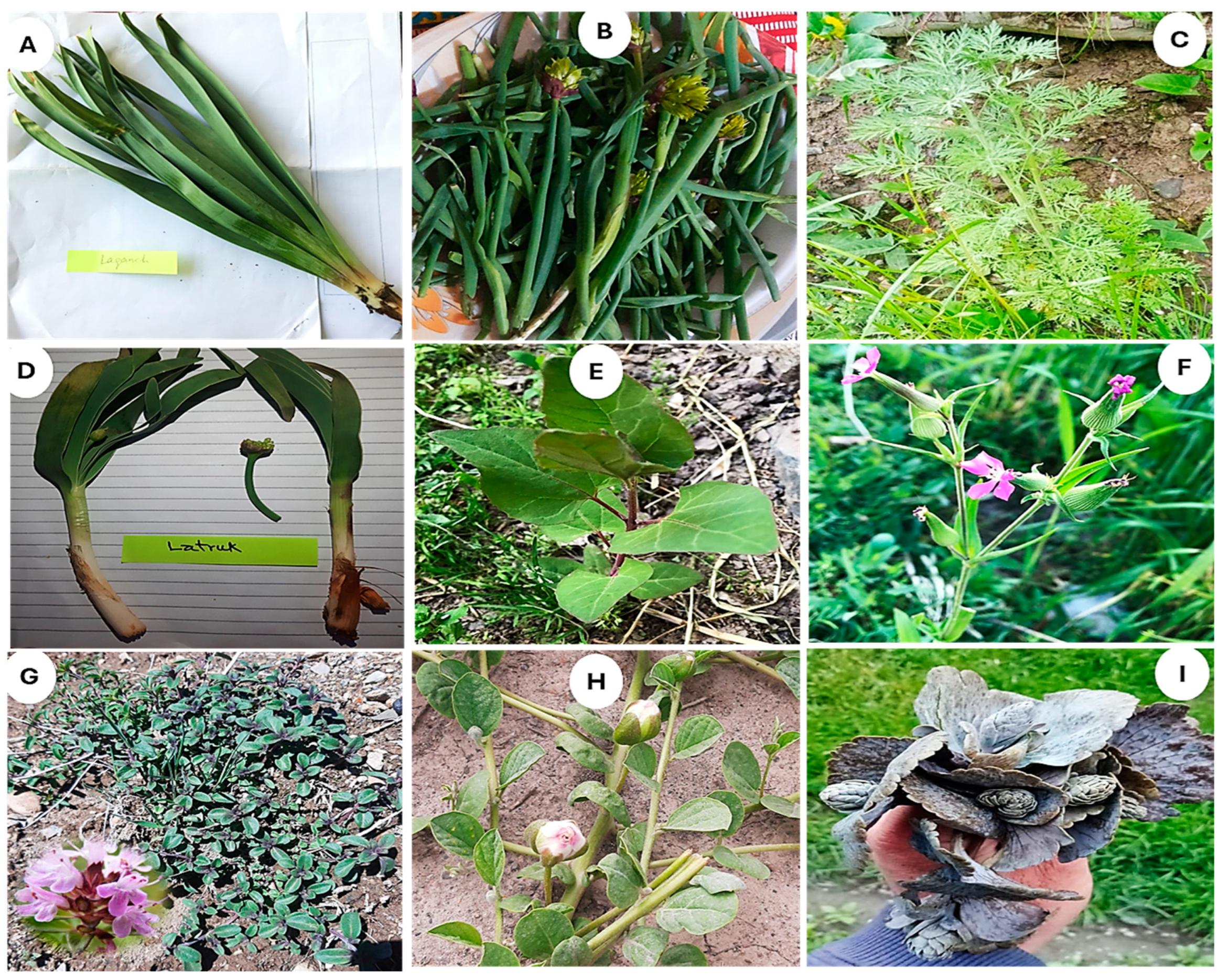
| 1. | Allium barsczewskii Lipsky Amaryllidaceae CUHA-407 | Kach | Kach | H | W | Ap | Vegetable/Salad | 0.853 | 33 | 31 | [14,32] |
| 2. | Allium carolinianum Redoutè Amaryllidaceae CUHA-115 | Latruk | Lanturk | H | W | Ap | Vegetable | 0.760 | 23 | 34 | [28] |
| 3. | Allium cepa L. Amaryllidaceae CUHA-408 | Threshtu | Piyoz | H | C | Wp | Cooked/Raw | 0.453 | 3 | 56 | [33] |
| 4. | Anthemis nabataea Eig Asteraceae CUHA-409 | Shirvisht | Shirvishun | H | W | Fl | Tea/flavoring/spice | 0.373 | 37 | 9 | [34] |
| 5. | Artemisia absinthium L. Asteraceae CUHA-410 | Kharkhalich | H | W | Sd | Tea/Soup | 0.775 | 43 | [35] | ||
| 6. | Atriplex hortensis L. Amaranthaceae CUHA-411 | Dar Kunakh | H | W/C | Ap | Vegetable | 0.725 | 23 | |||
| 7. | Benincasa fistulosa (Stocks) H.Schaef. and S.S.Renner Cucarbitaceae CUHA-412 | Tinda | Cl | C | Frt | Vegetable | 0.475 | 19 | [36] | ||
| 8. | Berberis vulgaris L. Berberidaceae CUHA-413 | Chowenj | Zolg | S | W | Ap | Snack | 0.293 | 14 | 8 | [28] |
| 9. | Beta vulgaris L. Amaranthaceae CUHA-414 | Lablabu | H | C | Rt | Salad/Snack | 0.875 | 38 | [37] | ||
| 10. | Brassica napus L. Brassicaceae CUHA-415 | Kalam | S | C | Rt | Vegetable/Snack | 0.825 | 40 | [37] | ||
| 11. | Brassica oleracea L. Brassicaceae CUHA-416 | Gobi | H | C | Lvs | Vegetable | 0.075 | 03 | [37] | ||
| 12. | Brassica rapa L. Brassicaceae CUHA-417 | Chirogh | H | W | Lvs | Vegetable | 0.171 | 06 | [14] | ||
| 13. | Buglossoides arvensis (L.) I.M.Johnst. Boraginaceae CUHA-418 | Shaghechi | H | W | Ap | Vegetable | 0.075 | 03 | [38] | ||
| 14. | Capparis spinosa (Lam.) Capparaceae CUHA-419 | Kaveer | S | W | Fl | Vegetable/Soup/Condiment | 0.525 | 21 | [28] | ||
| 15. | Carthamus tinctorius L. Asteraceae CUHA-420 | Pom | H | C | Fl | Food Color | 0.300 | 24 | |||
| 16. | Cenchrus americanus L. Morrone Poaceae CUHA-421 | Grass | H | C | Grn | Cereal | 0.275 | 11 | [39] | ||
| 17. | Chenopodium album L. Amaranthaceae CUHA-423 | Kunakh | Shlieet | H | W/C | Ap | Vegetable | 0.453 | 26 | [14] | |
| 18. | Chenopodium foliosum Asch. Amaranthaceae CUHA-422 | Shittet | H | W | Lvs/Frt | Vegetable/Snack | 0.057 | 02 | [28] | ||
| 19. | Coriandrum sativum L. Apiaceae CUHA-424 | Dhanu | Dhanu | H | C | Ap | Condiment | 0.520 | 43 | 8 | [35] |
| 20. | Cucurbita maxima Duchesne CucurbitaceaeCUHA-425 | Alok | Cl | C | Frt, Sd | Vegetable | 0.200 | 10 | [37] | ||
| 21. | Cuminum cyminum L. Apiaceae CUHA-426 | Zeera | Zeera | H | W | Sd | Tea/Condiment | 0.653 | 57 | 16 | [37] |
| 22. | Daucus carota L. Apiaceae CUHA-427 | Kheshgoom | Zarduk | H | C | Rt | Vegetable/Salad | 0.560 | 61 | 8 | [34,35] |
| 23. | Eremurus stenophyllus Baker Asphodelaceae CUHA-428 | Laqanch | Laq | H | W | Ap | Vegetable | 0.880 | 33 | 37 | [14] |
| 24. | Ferula narthex L. Apiaceae CUHA-429 | Rauw | H | W | Sht | Snack | 0.375 | 15 | [2,34] | ||
| 25. | Hippophae rhamnoides L. Elaeagnaceae CUHA-430 | Khilghitu | Zakh Khusgik | S | W | Frt | Snack | 0.066 | 2 | 3 | [14] |
| 26. | Hordeum vulgare L. Poaceae CUHA-431 | Siri | Yirk | H | C | Grn | Cereal | 0.680 | 21 | 30 | [37] |
| 27. | Hylotelephium Spp. Crassulaceae CUHA-432 | Asqarbash | H | W | Ap | Vegetable | 0.375 | 15 | [40] | ||
| 28. | Juglans regia L. Juglandaceae CUHA-45 | Birmough | T | C | Nt | Snack/oil/Flavoring | 0.700 | 65 | [28,34] | ||
| 29. | Lactuca sativa L. Asteraceae CUHA-433 | Kileem | Kileem | H | C | Ap | Salad | 0.226 | 16 | 1 | [37] |
| 30. | Lathyrus oleraceus Lam. Fabaceae CUHA-434 | Mater | H | C | Sd | Vegetable | 0.425 | 17 | [36] | ||
| 31. | Lens culinaris MediK Fabaceae CUHA-435 | Sirju | H | C | Sd | Vegetable/Flour | 0.500 | 39 | [37] | ||
| 32. | Lepidium ruderale Hk. & Anders Brassicaceae CUHA-436 | Palak khardachi | H | C | Ap | Salad | 0.100 | 4 | [37] | ||
| 33. | Lepyrodiclis holosteoides (C.A.Mey.) Caryophyllaceae CUHA-437 | Birghal | Yorkwush | H | W | Ap | Vegetable | 0.747 | 29 | 27 | [14] |
| 34. | Malus domestica (Suckow) Borkh. Rosaceae CUHA-438 | Palough | T | C | Frt | Fruit | 0.425 | 29 | [28] | ||
| 35. | Malva neglecta Wallr. Malvaceae CUHA-286 | Suachal | Suachal | H | W | Ap | Vegetable | 0.067 | 2 | 3 | [28] |
| 36. | Medicago sativa subsp. Sativa (L.) Fabaceae CUHA-440 | Lalmi | H | W/C | Ap | Vegetable | 0.100 | 4 | [28] | ||
| 37. | Mentha longifolia (L.) Huds. Lamiaceae CUHA-48 | Bain | H | W | Lvs | Tea/Salad | 0.225 | 14 | [35] | ||
| 38. | Mentha suaveolens Ehrh. Lamiaceae CUHA-441 | Pudina | H | W/C | Ap | Tea/Condiment | 0.075 | 6 | [37] | ||
| 39. | Nasturtium officinale R.Br. Brassicaceae CUHA-50 | Troqkhard achi | H | W | Ap | Salad | 0.075 | 3 | [31] | ||
| 40. | Panicum miliaceum L. Poaceae CUHA-55 | Olien | H | C | Grn | Cereal | 0.375 | 15 | [37] | ||
| 41. | Papaver involucratum Popov. Papaveraceae CUHA-442 | Gulmorwoi | H | W | Lvs | Tea | 0.343 | 12 | [14] | ||
| 42. | Pisum sativum L. Fabaceae CUHA-443 | Kuchoon | Sakh | Cl | C | Sd | Lentil/Snack/Flour | 0.587 | 9 | 11 | [37] |
| 43. | Prunus amygdalus Batsc. Rosaceae CUHA-444 | Badam | Tree | C | Nt | Fruit | 0.125 | 5 | [35] | ||
| 44. | Prunus armeniaca L. Rosaceae CUHA-73 | Zhuli | T | C | Frt, Nt | Fruit | 0.425 | 34 | [35] | ||
| 45. | Prunus avium L Rosaceae CUHA-445 | Cherry | T | C | Frt | Fruit | 0.050 | 2 | [41] | ||
| 46. | Pyrus bourgaeana Decne. Rosaceae CUHA-445 | Tong | T | C | Frt | Fruit | 0.275 | 15 | [41] | ||
| 47. | Raphanus raphanistrum (L.) Brassicaceae CUHA-447 | Shalmo | Sholum | H | C | Wp | Vegetable/Salad | 0.680 | 53 | 23 | [37] |
| 48. | Rheum ribes L. Polygonaceae CUHA-448 | Ishpar | Ishpat | H | W | Sht | Snack | 0.173 | 11 | 2 | [28] |
| 49. | Rumex dentatus Rech.f. Polygonaceae CUHA-91 | Chirkonjur | Shilkha | H | W | Ap | Vegetable | 0.587 | 18 | 26 | [28] |
| 50. | Salvia rhytidea Benth Lamiaceae CUHA-449 | Korotch | H | W | Ap | Salad/Condiment | 0.150 | 9 | [42] | ||
| 51. | Saxifraga sibirica L. Saxifragaceae CUHA-450 | Dromosuru | H | W | Sht | Condiment | 0.350 | 14 | |||
| 52. | Silene conoidea L. Caryophyllaceae CUHA-324 | Apupar | H | W | Ap | Vegetable | 0.625 | 25 | [28] | ||
| 53. | Solanum lycopersicum L. Solanaceae CUHA-451 | Patingal | H | C | Frt | Salad/condiment | 0.300 | 17 | [37] | ||
| 54. | Solanum melongena L. Solanaceae CUHA-452 | Patigan | H | C | Frt | Vegetable | 0.025 | 1 | [37] | ||
| 55. | Solanum tuberosum L. Solanaceae CUHA-453 | Alu | Olue | H | C | Tbr | Vegetable/Snack | 0.613 | 44 | 17 | [37] |
| 56. | Taraxacum campylodes G.E.Haglund Asteraceae CUHA-336 | Pops | H | W | Lvs | Tea | 0.143 | 5 | [14] | ||
| 57. | Thymus serpyllum L. Lamiaceae CUHA-454 | Jimbilak | H | W | Lvs | Tea | 0.600 | 21 | [14] | ||
| 58. | Trigonella gladiata Steven ex M.Bieb. Fabaceae CUHA-455 | Sugon | H | W | Ap | Condiment | 0.125 | 6 | [35,42] | ||
| 59. | Triticum aestivum subsp. spelta (L.) Thell. Poaceae CUHA-456 | Gom | Ghidim | H | C | Grn | Cereal | 0.680 | 35 | 16 | [37] |
| 60. | Vicia faba L. Fabaceae CUHA-457 | Andalo | H | C | Sd | Snack | 0.100 | 6 | [37] | ||
| 61. | Vigna unguiculata (L.) Walp. Fabaceae CUHA-458 | Lobia | Cl | C | Sd | Lentil | 0.200 | 8 | [37] | ||
| 62. | Zataria multiflora Boiss. Lamiaceae CUHA-459 | Troshnagholi | H | W/C | Ap | Condiment | 0.050 | 4 | [42] | ||
| 63. | Zea mays subsp. mays L. Poaceae CUHA-460 | Juari | H | C | Sd | Cereal | 0.850 | 44 | [35] | ||
| 64. | Ziziphora clinopodioides (Rech.f.) Lamiaceae CUHA-461 | Xhughur | H | W | Ap | Condiment | 0.025 | 1 | [14] | ||
| 65. | Zygophyllum obliquum Popov Zygophyllaceae CUHA-462 | Yumwush | H | W | Lvs | Vegetable | 0.400 | 14 | [14] | ||
| S. # | Scientific Name/Family | Habit | Local Name | Part(s) Used | Products | RFC | |
|---|---|---|---|---|---|---|---|
| Khowar | Wakhi | ||||||
| 1. | Anas crecca L. Anatidae | Wild | Alhi | Yoch | Meat | Pushur K, Ghusht W | 0.280 |
| 2. | Bos grunniens L. Bovidae | Domesticated | Zogh | Zugh | Milk | Mrik W | 0.747 |
| Xarj W | 0.653 | ||||||
| Rugon W | 0.587 | ||||||
| Digh W | 0.533 | ||||||
| Phai W | 0.480 | ||||||
| Khomrugon W | 0.387 | ||||||
| Meat | Pushur K, Ghusht W | 0.280 | |||||
| Fat | Zagh K, Zigh W | 0.173 | |||||
| 3. | Bos taurus L. Bovidae | Domesticated | Leshu | Ghev | Milk | Phenak K | 0.750 |
| Trin K | 0.750 | ||||||
| Khombokh K, Mrik W | 0.747 | ||||||
| Maska K, Khomrugon W | 0.387 | ||||||
| Qurut W | 0.657 | ||||||
| Cheer K, Xarj W | 0.653 | ||||||
| Don K, Rugon W | 0.587 | ||||||
| Shetu K, Digh W | 0.533 | ||||||
| Macheer K, Phai W | 0.480 | ||||||
| Shiphinak K | 0.450 | ||||||
| Phaneer W | 0.400 | ||||||
| Shut K | 0.375 | ||||||
| Chaka K | 0.025 | ||||||
| Meat | Pushur K, Ghusht W | 0.280 | |||||
| Fat | Zagh K, Zigh W | 0.173 | |||||
| 4. | Capra hircus L. Bovidae | Domesticated | Pai | Toogh | Milk | Phenak K | 0.750 |
| Trin K | 0.750 | ||||||
| Khombokh K, Mrik W | 0.747 | ||||||
| Maska K, Khomrugon W | 0.387 | ||||||
| Qurut W | 0.657 | ||||||
| Cheer K, Xarj W | 0.653 | ||||||
| Don K, Rugon W | 0.587 | ||||||
| Shetu K, Digh W | 0.533 | ||||||
| Macheer K, Phai W | 0.480 | ||||||
| Shiphinak K | 0.450 | ||||||
| Phaneer W | 0.400 | ||||||
| Shut K | 0.375 | ||||||
| Chaka K | 0.025 | ||||||
| Meat | Pushur K, Ghusht W | 0.280 | |||||
| Fat | Zagh K, Zigh W | 0.173 | |||||
| 5. | Capra sibirica Pallas Bovidae | Wild | Tonishu | Jondor | Meat | Pushur K, Ghusht W | 0.280 |
| Fat | Zagh K, Zigh W | 0.173 | |||||
| 6. | Columba leuconota Vig. Columbidae | Wild | Kebet | Meat | Ghusht W | 0.280 | |
| 7. | Columba livia Gmelin Columbidae | Wild | Aghagh | Meat | Pushur K | 0.280 | |
| 8. | Gallus domesticus L. Phasianidae | Domesticated | Kahak | Karkh | Eggs | Ayukun K | 0.307 |
| Meat | Pushur K | 0.280 | |||||
| 9. | Ovis arie L. Bovidae | Domesticated | Keli | Maye | Meat | Pushur K, Ghusht W | 0.280 |
| Fat | Zagh K, Zigh W | 0.173 | |||||
| 10. | Streptopelia decaocto Friv. Columbidae | Wild | Kalkor | Felanch | Meat | Pushur K, Ghusht W | 0.280 |
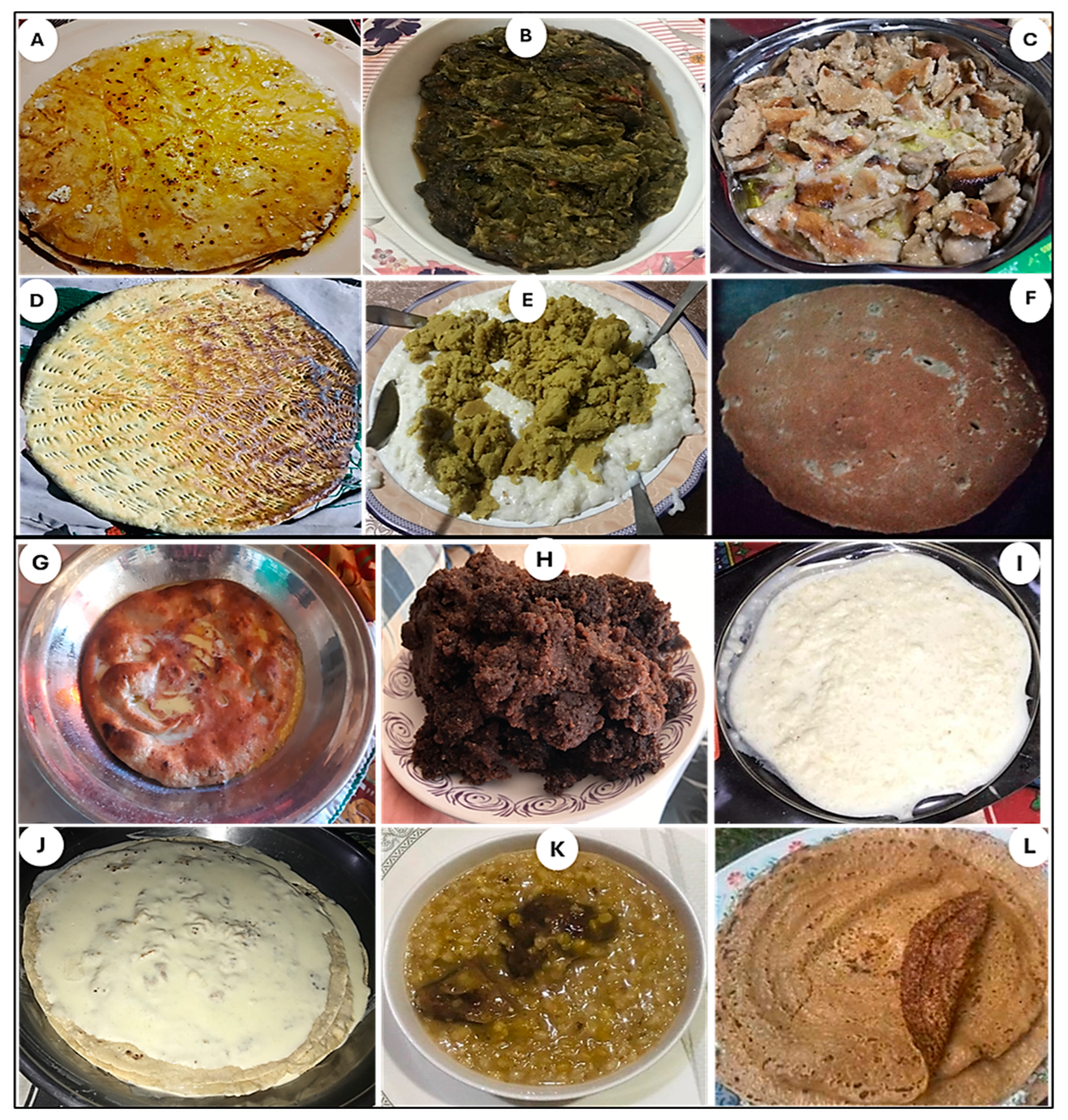
| S. # | Khowar | Wakhi | Major Ingredients | Recipes | Source | RFC |
|---|---|---|---|---|---|---|
| 1. | Andalai | Kuchoon (Peas) + Barley (Siri) | Pea and barley flour is mixed at an equal ratio, and dough is prepared with salt to taste. A flatbread is then baked. | Plant | 0.125 | |
| 2. | Atala | Wormwood + Cumin seeds + Butter + Salt | The seeds are fried in butter/ghee, and flour is added along with water and simmered until done. Salt is added as per the requirement | Plant | 0.225 | |
| 3. | Brat | Qomuchduni | Flour + Butter/Ghee + Salt | The dough is kneaded, puffed, and then flattened to make flat bread. Oil/ghee is used to polish either side of the bread, and it is baked in the traditional way using coal and ashes. | Plant | 0.627 |
| 4. | Chambor Tiki | Dried apricot + Apricot kernels | Dried apricots are ground and shaped with apricot kernels. Eaten as a snack. | Plant | 0.025 | |
| 5. | Cheer Grinj | Sheerbronj | Milk + Rice + Salt | Rice is boiled in water with salt to taste. When it is tender enough, milk is added. The dish is simmered until it has a uniform texture and consistency. | Plant + Animal | 0.747 |
| 6. | Cheera Kali | Milk + Salt + Flour | Milk is boiled with salt to taste. Flatbread is rolled out and cut into noodles or fine pieces. The pieces are added to the milk and boiled until done. | Plant + Animal | 0.550 | |
| 7. | Cheera Leganu | Xarlmoch | Wheat flour + Milk +Salt | The wheat flour is turned into small dough balls using the traditional method, then boiled in milk with salt until soft. | Plant + Animal | 0.280 |
| 8. | Cheera Mul | Xarjmul | Wheat flour + Milk +Salt | Wheat flour is added to boiling water with salt to taste. The dish is gradually heated and boiled until done. In another pot, milk/cream is boiled and added to the dish, which is then served. | Plant + Animal | 0.373 |
| 9. | Cheera Shapik | Xarjkhech | Milk + Wheat flour + Salt + Butter/Ghee | Milk is heated in a pot, seasoned with salt according to taste, and brought to a boil. A small amount of flour is added to thicken the milk. After getting to a certain texture, the paste is cooled. On the other side, flatbread, locally called Phulka, is prepared. The paste is sandwiched between flat bread or tortillas. The dish is topped either with the same paste or butter. | Plant + Animal | 0.653 |
| 10. | Chuchu Shoshp | Shoshp Peshiru (Sweetened wheat flour) + Milk + Desi ghee | Water is boiled, added to sweetened wheat flour, and simmered until done. It is served with milk, desi ghee, or walnut oil. | Plant + Animal | 0.375 | |
| 11. | Ghalmandi | Cottage cheese + Coriander +Salt + Butter +Tortilla | Cottage cheese, coriander, and salt are added, and a paste is prepared. On the other side, flatbread, locally called Phulka, is prepared. The paste is sandwiched between flat bread or tortillas. The dish is topped with sizzling butter. | Plant + Animal | 0.875 | |
| 12. | Ghara | Millet + Salt + Milk | The millet is finely ground and boiled in water with salt to taste until it softens. Then, milk is added and boiled until it has the desired consistency and flavor. | Plant | 0.075 | |
| 13. | Kali | Osh | Onions + Green Spices +Cumin + Caper + Meat + Flatbread | Sliced onions are fried in oil and added to some flavoring and spice. The most used flavoring agents are cumin, caper, and meat. After frying the spices, the water is heated until it boils. Thin strips of dough are sliced and added to the oiling stew. The stew then simmered until done. | Plant | 0.413 |
| 14. | Kaveerogh | Caper +Meat | Caper flowers are boiled with the meat stew until develop flavor. | Plant | 0.425 | |
| 15. | Khaigina | Eggs + Milk +Salt | Milk is boiled and added to whisked eggs and salt; later, hard-boiled eggs are also added. | Plant + Animal | 0.075 | |
| 16. | Khesta Shapik | Khestakhech | Wheat flour + Yeast | A liquid dough is prepared and kept until it poofs; then, flatbread is prepared and toasted. | Plant + Animal | 0.787 |
| 17. | Khisht | Wheat flour + Desi ghee + Salt | Desi ghee/butter is melted and added to flour and salt and thoroughly mixed. The mixture is fried and then shaped into bread by pressing. | Plant + Animal | 0.200 | |
| 18. | Kotbat | Milk + Rice +Desi ghee + Flour | This is a combination of two traditional dishes namely Sanabachi and Cheergrinj. The Cheergrinj is topped with Sanabachi. | Plant + Animal | 0.600 | |
| 19. | Kuchunai | Sakhech | Dried peas +Salt | The local variety of peas is dried and ground. The flour is then kneaded, and thick flatbread is toasted/griddled. | Plant | 0.093 |
| 20. | Laxek | Wheat grain + Salt + Meat | Soaked wheat grains are ground well. Meat is boiled until tender; salt is added for taste, and later, the ground wheat grains are added to the meat stew. | Plant + Animal | 0.625 | |
| 21. | Leganu | Moch | Lentil flour + Tomato + Onion, Green seasoning + Salt | Lentil flour is turned into small dough balls using the traditional method and then boiled in water with salt it until softens. In a frying pan, onion, tomatoes, and green spices and seasoning are fried and seasoned on top of it and left to rest for a while. | Plant + Animal | 0.775 |
| 22. | Leganu Muxhi | Leganu (Cuisine 21) + Flour + Salt | This is a combination of two traditional dishes; Leganu is sandwiched between two Khesta Shapik (fermented flat roti) and toasted. | Plant | 0.025 | |
| 23. | Mul | Mul | Wheat flour + Salt + Butter | Wheat flour is added to boiling water with salt to taste. The dish is gradually heated and boiled until done. Sizzling butter/desi ghee is seasoned on top of the dish and served. | Plant | 0.560 |
| 24. | Mulida | Molda | Milk, Salt, Desi Ghee, Flour | Milk is boiled with salt to taste, and boiled milk is added to already toasted tortilla pieces. Later it is seasoned with butter/desi ghee | Plant + Animal | 0.280 |
| 25. | Pakhti | Bronj | Rice + Salt + Ghee/Oil | Water with salt to taste is boiled. Already soaked rice is added to boiling water and cooked until the water evaporates. A deep-heated oil/ghee is seasoned on top of the rice. | Plant | 0.453 |
| 26. | Phenak Paratha | Cottage cheese + Flour + Salt | After the flour is kneaded, it is flattened in a round shape. A paste is prepared with cottage cheese, salt, and green seasonings. The flattened bread is filled with the paste and then griddled/toasted or fried. | Plant and Animal | 0.125 | |
| 27. | Qalaibat | Animal fat +Flour+ Salt, | After heating, fat is mixed with equal amounts of water and salt. Later, wheat flour is added, and the dish is stirred and simmered until done. | Plant + Animal | 0.325 | |
| 28. | Rishok | Flour +Eggs + Salt | Flour is added to salt, egg, and water. A liquid paste is prepared. The pasted is flattened on a heated pan and toasted with oil. | Plant + Animal | 0.525 | |
| 29. | Sanabachi | Bat | Butter + Desi ghee + Flour + Salt + Coloring agent. | Butter/desi ghee is heated in a pot, and then flour is fried. When a light brown color appears, a coloring agent (safflower) is mixed to enhance color. Then, water is added and cooked until it attains the required consistency. | Animal | 0.920 |
| 30. | Sanabachi Tiki | Sanabachi (Cuisine 29) + Flour + Salt + Oil | The sanabachi and cottage cheese are filled in bread, and the bread is baked traditionally. | Plant + Animal | 0.375 | |
| 31. | Shakarpostek | Dried mulberries +Walnuts | Dried mulberries are ground traditionally and added to walnuts. The mix is further pounded until a desired texture and used as a dessert. | Plant | 0.075 | |
| 32. | Shakh | Green vegetable + Salt + Tomatoes + Onion + Spices + Oil | The vegetable is boiled and mashed into a paste. In another pot, gravy is prepared with onions, tomatoes, salt, and other spices. The vegetable paste is added to the gravy and fried. A certain amount of water is also added. When it boils a flour paste is added. Then the dish is simmered until done. | Plant | 0.800 | |
| 33. | Shakh Muxhi | Cooked vegetable (Sakh) + Khesta Shapik (Cuisine # 16) | The cooked vegetable (Sakh) is sandwiched between two pieces of Khesta shapik. | Plant | 0.300 | |
| 34. | Shapiko Sora Don | Rugonkhech | Flat bread + Desi ghee | A flatbread is seasoned with hot sizzling desi ghee and served. | Plant + Animal | 0.253 |
| 35. | Shorab Chai | Tea + Salt + Walnuts + Milk | Water is boiled with tea bags, salt, and crushed walnuts. After a good boil, milk is added and simmered until it develops a taste. | Plant + Animal | 0.075 | |
| 36. | Shoshp | Shushp | Shoshp Peshiru (Sweetened wheat flour) + Walnut | Walnuts are heated until produce oil; the walnut oil is added to water. When the water boils, the sweetened wheat flour is added and slow cooked for almost 12 h. | Plant | 0.480 |
| 37. | Shoshp Kali | Shoshp Peshiru (Sweetened wheat flour) + Water | The sweetened wheat flour is added to boiling water and simmered until it attains the required consistency. | Plant | 0.350 | |
| 38. | Shoshp Muxhi | Shoshp + Khesta shapik | This is a combination of two traditional dishes; Shoshp is sandwiched between two Khesta shapik (fermented flat roti) and toasted. | Plant | 0.050 | |
| 39. | Shoshp Shapik | Flour (Sweetened) + Wheat flour | Sweetened flour is added to normal wheat flour and kneaded. Then, flatbread is prepared and toasted. | Plant | 0.100 | |
| 40. | Shula | Meat + Rice + Salt | The meat is boiled until it is tender, and salt is added for taste. The meat stew is added to a local variety of rice. The whole porridge is cooked until it attains required consistency. | Plant + Animal | 0.240 | |
| 41. | Siriae | Yirkkhech | Barley flour + Wheat grains | The flour (barley) is kneaded with a small amount of wheat. Then, flatbread is prepared and toasted. | Plant | 0.240 |
| 42. | Sormuliogh | Fresh wheat aerial parts + Onion + Spices + Flavoring agent | Green wheat grass is collected from the field, and the kernels are separated using the traditional method. The grains are fried and then boiled in water until softened. In a pan, onion, green spices, and flavoring agents are fried. The fried mixture is seasoned on the top of the dish. | Plant | 0.075 | |
| 43. | Tarbat | Animal fat +Sweetened flour, | Animal fats are melted, and water is added to it. Later, sweetened wheat flour is added and slowly cooked until done. | Plant + Animal | 0.325 | |
| 44. | Tawa ShoshpShalan | Shoshp Peshiru (Sweetened Wheat Flour) + Water | The sweetened wheat flour is turned into a liquid paste and is toasted and cooked on Tawa. | Plant | 0.025 | |
| 45. | Thathori | Flour (Maize, Barley, Wheat) + Salt | Flour (maiz, barley) is kneaded with a small amount of wheat flour. The puffed dough is rolled out into small-size breads and griddled/toasted. | Plant | 0.125 | |
| 46. | Troq Muxhi | Flour +Apricot nuts + Cottage cheese | After the flour is kneaded, it is flattened into a round shape. A paste is prepared with crushed apricot nuts and cottage cheese with salt and other green seasonings in it. The flattened bread is filled with the paste and then griddled/toasted. | Plant | 0.025 | |
| 47. | Xholai Brat | Flour + Walnuts + Potatoes + Onion + Salt + Other Seasonings + Desi ghee/Oil | The dough is kneaded when it is puffed then flattened to make flat bread. A paste is prepared with crushed walnuts, boiled potatoes, sliced onions, and salt. The paste is used to fill in the bread, oil/ghee is used to polish either side of the bread, and the bread is baked in the traditional way using coal and ashes. | Plant | 0.525 | |
| 48. | Xholai Shapik | Flour + Walnuts + Potatoes, Onion + Salt +Other Seasonings | A dough is kneaded and flattened to make flatbread. A paste is prepared with crushed walnuts, boiled potatoes, sliced onions, and salt. The paste is used to fill in the bread, and it is toasted/griddled. | Plant | 0.050 | |
| 49. | Qurutaab | Qurut (Cheese) + Bread + Desi ghee | Qurut is soaked in water until it softens, and pieces of flatbread are added to this liquid/juice and seasoned with desi ghee. | Animal | 0.743 | |
| 50. | Thonikcha | Desi ghee + Flour + Salt + Milk + Qurutogh (Qurut water) | Flour with desi ghee, salt, and milk is kneaded, and the dough is prepared. The flattened bread is pasted in a clay oven, and milk or Qurutogh is splashed on it and toasted. | Plant + Animal | 0.657 | |
| 51. | Shindet | Flatbread + Desi ghee + Milk | A pre-toasted bread is soaked in milk and seasoned with sizzling desi ghee. | Plant + Animal | 0.371 | |
| 52. | Khishkphai | Oil +Flour + Salt | 1: After heating some oil, flour is added and cooked until it turns brown. After that, water is added and cooked until finished, and salt is added for taste. 2: milk is boiled with salt in it. Flour is added and simmered until done. | Animal | 0.057 | |
| 53. | Ptoq | Flour +Salt + Yeast + Qurutogh/Milk | Flour is kneaded with salt, and when it is puffed, bread is rolled out. The rolled-out small breads are pasted in the clay oven with a splash of Qurutogh and milk and griddled/toasted. | Plant + Animal | 0.600 | |
| 54. | Objush | Milk + Salt + Water | Water is boiled, and milk and a pinch of salt are added to taste. Then, the solution is boiled for some time and drank as tea. | Animal | 0.086 | |
| 55. | Dildongi | Flour + Salt + Yeast | Flour is kneaded with salt, and when it is puffed, bread is rolled out. The rolled-out bread is pasted in the clay oven and griddled/toasted. | Plant + Animal | 0.686 | |
| 56. | Jigoe | Milk + Phai (Curd) | Milk is boiled, and Phai is added and boiled until the required consistency is attained. | Animal | 0.057 |
Disclaimer/Publisher’s Note: The statements, opinions and data contained in all publications are solely those of the individual author(s) and contributor(s) and not of MDPI and/or the editor(s). MDPI and/or the editor(s) disclaim responsibility for any injury to people or property resulting from any ideas, methods, instructions or products referred to in the content. |
© 2024 by the authors. Licensee MDPI, Basel, Switzerland. This article is an open access article distributed under the terms and conditions of the Creative Commons Attribution (CC BY) license (https://creativecommons.org/licenses/by/4.0/).
Share and Cite
Sabbah, A.; Abbasi, A.M.; Aziz, M.A.; Benhasher, F.F.; Pieroni, A.; Aldosari, A.A.; Gatasheh, M.K.; Amin, M. Women’s Knowledge of Local Plants and Their Gastronomic Heritage in Chitral, NW Pakistan. Plants 2024, 13, 2747. https://doi.org/10.3390/plants13192747
Sabbah A, Abbasi AM, Aziz MA, Benhasher FF, Pieroni A, Aldosari AA, Gatasheh MK, Amin M. Women’s Knowledge of Local Plants and Their Gastronomic Heritage in Chitral, NW Pakistan. Plants. 2024; 13(19):2747. https://doi.org/10.3390/plants13192747
Chicago/Turabian StyleSabbah, Arfaa, Arshad Mehmood Abbasi, Muhammad Abdul Aziz, Fahdah Falah Benhasher, Andrea Pieroni, Ali Abdullah Aldosari, Mansour K. Gatasheh, and Muhammad Amin. 2024. "Women’s Knowledge of Local Plants and Their Gastronomic Heritage in Chitral, NW Pakistan" Plants 13, no. 19: 2747. https://doi.org/10.3390/plants13192747
APA StyleSabbah, A., Abbasi, A. M., Aziz, M. A., Benhasher, F. F., Pieroni, A., Aldosari, A. A., Gatasheh, M. K., & Amin, M. (2024). Women’s Knowledge of Local Plants and Their Gastronomic Heritage in Chitral, NW Pakistan. Plants, 13(19), 2747. https://doi.org/10.3390/plants13192747